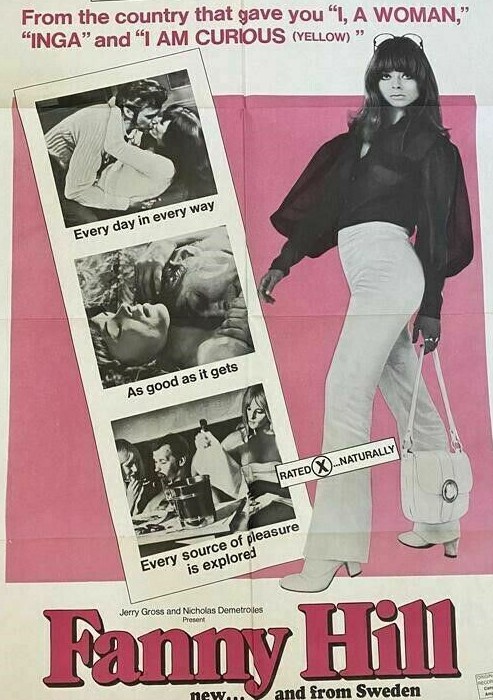
For three weeks at the end of November 1969 through to mid-December, the top films on the Variety weekly box office Top 50 chart were sexploitation films. The Swedish Fanny Hill (1968) was the first to hit the top and I Am Curious, Yellow, also from Sweden, took the top place for the next fortnight.
This was something of a slap of cold reality in the face of Hollywood which had assumed that by and large its product was sufficient to meet the needs of exhibitors nationwide. The slump in production due to the financial issues facing the top studios led the industry to expect that the traditional low-budget pictures that would make up the shortfall would come from the usual sources – westerns, crime, horror. Few would have bet on sexploitation taking up the slack.
The new Variety system of collating box office was in part to blame for the influx of sexploitation films being so transparent. Until the magazine instituted its weekly Top 50 grossing pictures in April 1969 and widened the net for gathering in those figures, box office was reported from just 200-300 first run houses in the major cities. This now expanded substantially to five times as many cinemas and included smaller houses in a greater number of cities as well as cinemas that belonged to a Showcase (wide release) circuit.
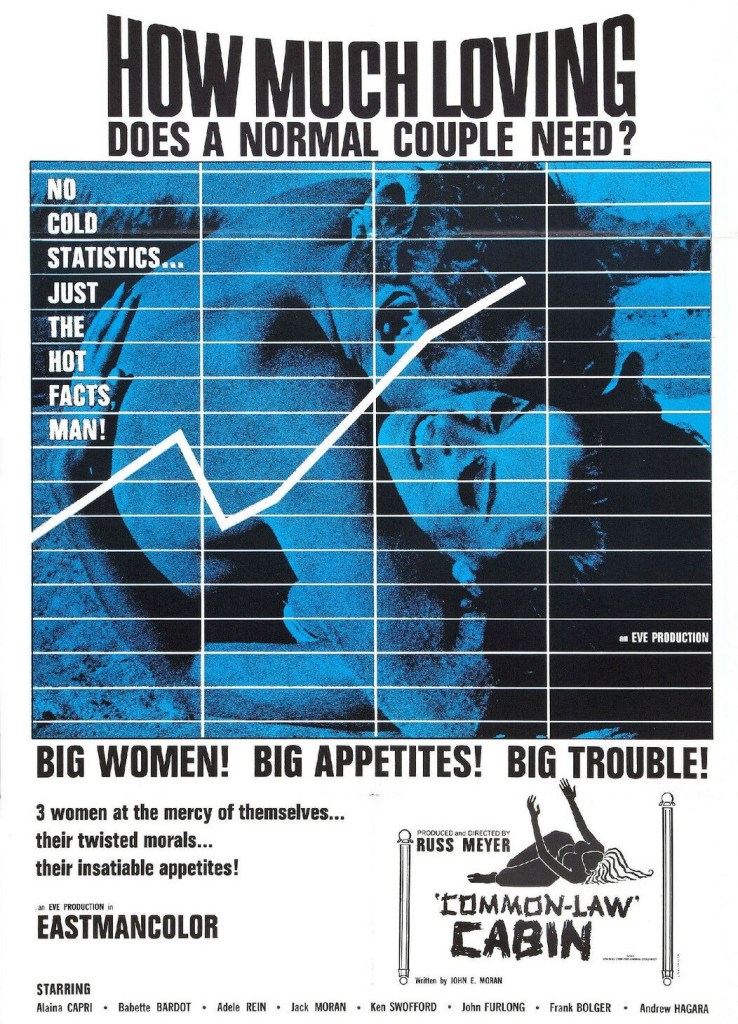
That resulted in a greater breadth of films being reported. Except on first run arthouses, where some art films with greater sexual content could be shown, it was rare for a sexploitation picture to feature in a big city first run. Russ Meyer was the acceptable face of sexploitation, especially since his films contained humor. Even so, eyebrows were raised when the exploits of Common Law Cabin (1967) made headlines in Variety (“Sexploitation pair: $22,000 at Fox”) at Detroit’s biggest cinema, the 5,100-seater Fox, a major first run venue. That film found slots in first run in Chicago at the Center and the Fine Arts in Portland. Another Meyer opus Finders Keepers found a berth at the Randolph in Philadelphia (“Russ Meyer’s Nude Pic Into Philly’s Classy First Run”). But that was the extent of its invasion of first run for that year. And that was pretty much how the industry expected things to stay, a rare sexploitation making a few headlines, but not much more.
So when Fanny Hill grossed $625,000 – equivalent to $4.7 million today – from 49 houses to hit the top spot it sent the industry reeling in shock. I Am Curious Yellow hit the top spot in successive weeks with $594,000 from 52 houses followed by $454,000 from 90. In some respects it should not have come as any great surprise. I Am Curious, Yellow had already had already featured several times in the weekly top ten, fifth with $213,000 from 16 houses, sixth with $137,000 from 14 and again with $$237,000 from 18.
Sexploitation distribution was handled in much the same way as any other picture. Probably it came closer to replicating an arthouse release, where prints, due to their cost, were in short supply and cinemas undertook to hold onto a movie for several weeks, if not months. But when a movie was clearly pulling in the crowds, the distributors switched to a more mainstream system, combining Showcase with first run. The big danger when films went wide was that grosses plummeted. But that was clearly not the case here. Yes, the earlier per-screen averages were higher but the later ones certainly did not fall off a cliff.
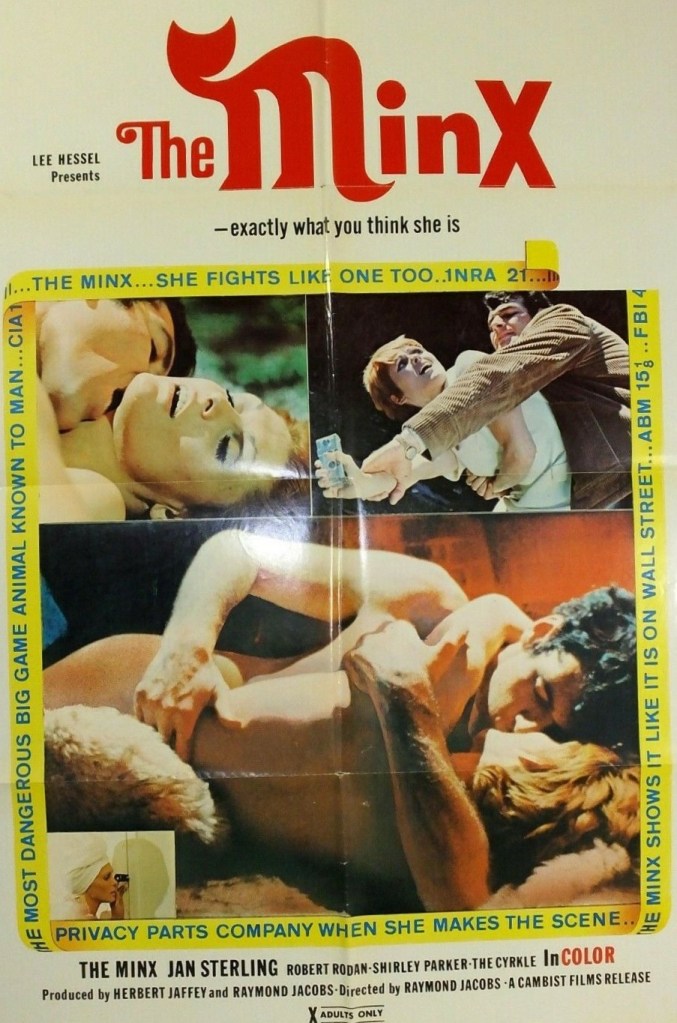
Outside of these two pictures, other sexploitationers had been making an impact on the weekly chart. The Libertine (1968) had placed 11th with $184,000 from 56, Naked Angels (1969) came 17th one week with $148,000 from 11 and lower down the chart The Minx (1969) had showed potential with $52,000 from three while Camille 2000 (1969) had earned $32,000 from two. Sexploitationers absorbed lessons learned from more mainstream distributors in how to use the Top 50 as a promotional tool. A movie that was not only taking in big bucks, but placed high in the chart and had a great per-screen average was inevitably going to attract attention.
Perhaps the oddest part of the sexploitation breakout was that so few had seen it coming. If so, they had not been reading the trade papers. This side of the business had grown so fast in a couple of years that those involved had formed their own association. It turned out a war had broken out between the suppliers of cheaply-made sexploitationers and those willing to increase their budgets in order to entice audiences with better production values.
But this was at the hard-core end of the business, the number of outlets tripling from 300 theaters three years before to 800 in 1969, and operating obviously outside the restrictions of the Production Code or the new censorship system. Initially, movies costing $8,000-$15,000 could have been put together in a weekend. Now up to 100 movies budgeted at at a maximum of $45,000 were being made every year with a potential profit of $125,000-$300,000 each. About half a dozen companies had annual million-dollar turnovers.
But this business had also filtered down to the more easily exhibited soft-core, which fitted into the “X” category under the new censorship rules. The 100 cheap soft-core efforts financed by individual theaters or small chains which filled a supporting spot on a double bill produced meagre returns so it made more sense to edit down a hard-core feature to suit a soft-core audience. The demand for hard-core, most prominently seen in Detroit, where hard-core pictures often outgrossed first run, was filtering down into soft-core, hence the growth in bookings for the likes of Fanny Hill and I Am Curious, Yellow.
The other reason for moving into the soft-core market was that the hard-core end was saturated resulting in lower rentals and consequently lower profits which inhibited production. Theaters struggling to cover overheads from the thin stream of movies emanating from the major studios or finding there was little juice left in blockbusters by the time they drifted down the exhibition food chain increasingly turned to soft porn.
SOURCES: “Sexploitation Filmmakers, Showmen Form Adult Motion Picture Ass’n,” Box Office, January 20, 1969, p8; “Over-Seated for Sex,” Variety, July 2, 1969, p1; “Sexpix of $25,000-$45,000 Negative Cost See Bright, Not Clouded, Future,” Variety, July 16, 1969, p17. Results for the “Top 50 Chart” in Variety were taken from the following issues in 1969: Jun 4, Jul 2, Jul 9, Jul 23, Sep 24, Oct 1, Oct 15, Nov 5, Nov 26, Dec 3, Dec 10, Dec 17, Dec 24.
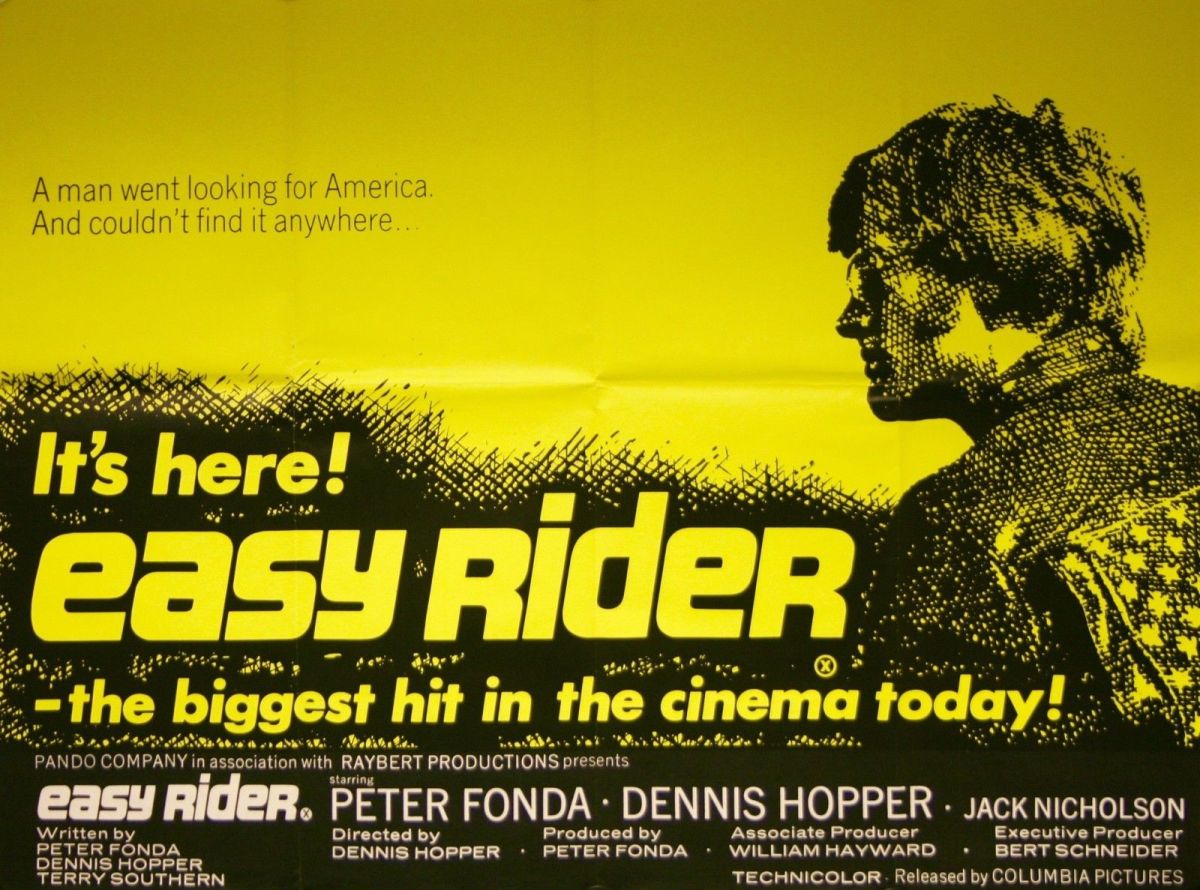
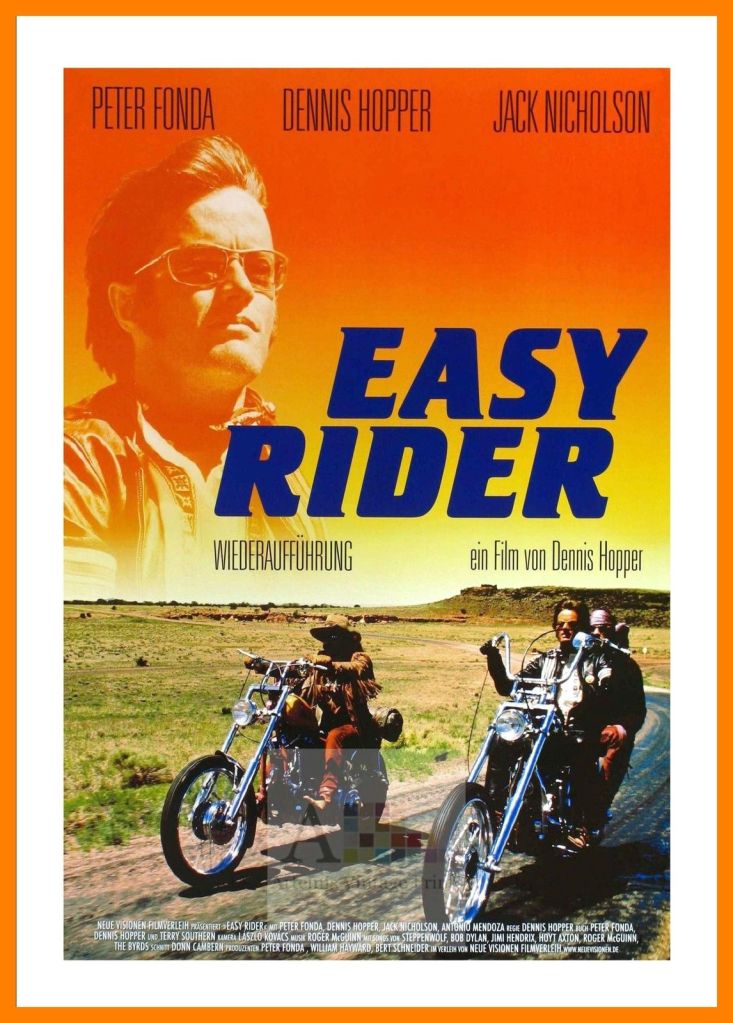
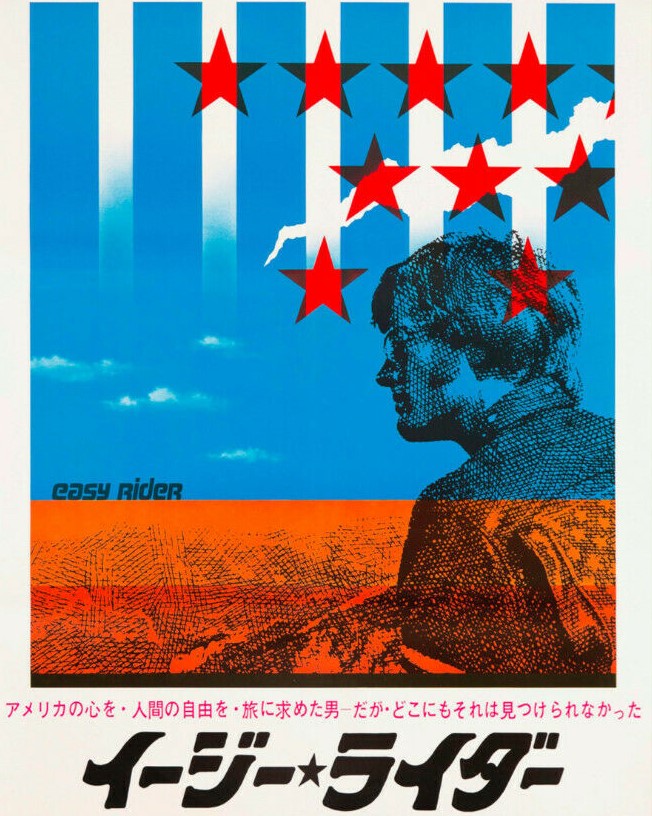
Just goes to show what a little bit of reimagining can do. A companion piece to The Wild Angels (1966) but which takes the viewer in the opposite direction, turning the characters from perpetrators of violence to its victims, adding in a stonking soundtrack and a bit more philosophy, though holding on to the long tracking shots of motorbikes that defined the Roger Corman approach. From the bare bones of the Corman movie emerged a cinematic – and box office – miracle.
You could be forgiven for thinking that the movie’s main influences were the early Cinerama pictures that focused on extensive tracking shots of scenery (in this case, the open road) and unusual customs (ditto, alternative lifestyles, dope-taking etc) and Mike Nichol’s use of contemporary pop music in The Graduate (1967). But it also drew on the assumption, as did Hitchcock in Vertigo (1958) and Kubrick with 2001: A Space Odyssey a decade later, that a camera doing nothing can be hypnotic.
Message pictures were the remit of older directors like Stanley Kramer and Martin Ritt and films that had something to say about the human condition generally emanated from Europe and not low-budget efforts coming out of Hollywood. Easy Rider has a European sensibility, an almost random collection of unconnected episodes with no narrative connection to the main story, itself incredibly slight, of two mild-mannered dudes heading to New Orleans to see the Mardi Gras.
Road trips were not particularly unusual in American cinema but the form of previous locomotion was horse-related – westerns. The journey has been a central theme to movies. This is an 80-minute picture masquerading as a 95-minute one, a good fifteen minutes of screen time taken up with endless shots of Peter Fonda and Dennis Hopper on bikes passing through the landscape, with a contemporary soundtrack as comment.
Unusually, it’s also a hymn to ancient values, heads bowed in prayer at meals as different as you could get, the Mexican family and the commune, a marching band playing “When The Saints Go Marching In” and the recitation of prayers in the cemetery.
What marks the film out stylistically, perhaps enforced by the lean financing, is the sparing way it is told. The most dramatic scenes – the three murders – are filmed in shockingly simple fashion. There are often long pans along groups of characters. While innovative, the flash-cut flash-forward editing adds little to what is otherwise a very reflective film. Inspired use is made of natural sound, the muffled thumping of oil derricks at the cemetery, the soundtrack to one death is just the battering of unseen clubs by unseen assailants.
The dialogue could have been written by Tarantino, none of the confrontation or angst that drives most films, but odd musings that bring characters to life. At the beginning of the trip, Hopper and Fonda are welcomed wherever they travel, but towards the end resented, treated as though a pair of itinerant aliens. They entrance young girls but are vilified by authority, jailed for no reason except the threat to traditional values they apparently represent.
Elements not discussed at the time of release make this more rounded than you would imagine. The excitable Hopper, a nerd in hippie costume, is driven by the American dream of making money. The more reflective Fonda, developing a character trait he revealed in The Wild Angels, senses something is not only missing from his life but has been lost forever. He has the rare stillness of a top actor, face reflecting unspoken inner turmoil. As revelatory is the performance of Jack Nicholson, here effectively making a bid for stardom in a part that would snare an Oscar nomination.
It remains an extraordinary film, a series of accumulated incidentals holding up a mirror to an America nobody wanted to acknowledge and the brutal climax no less powerful now.
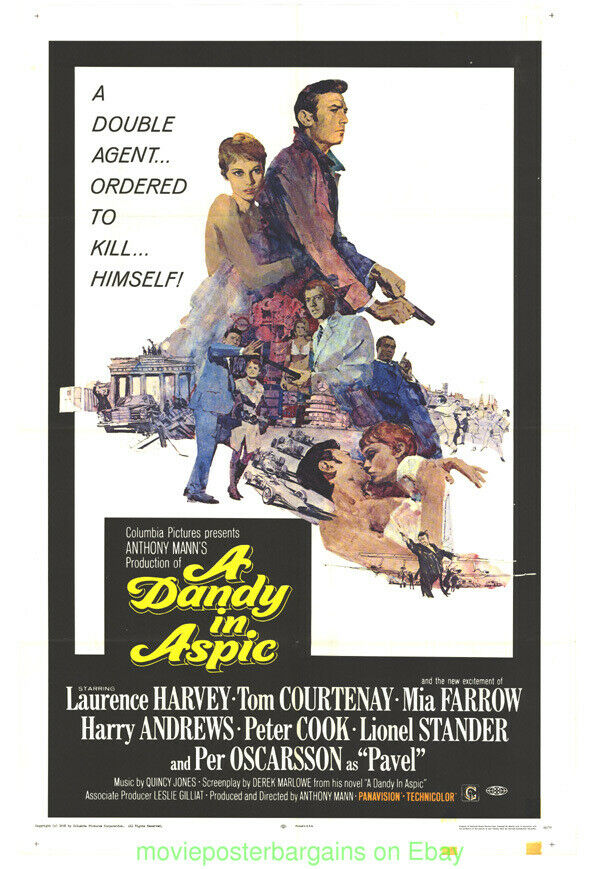
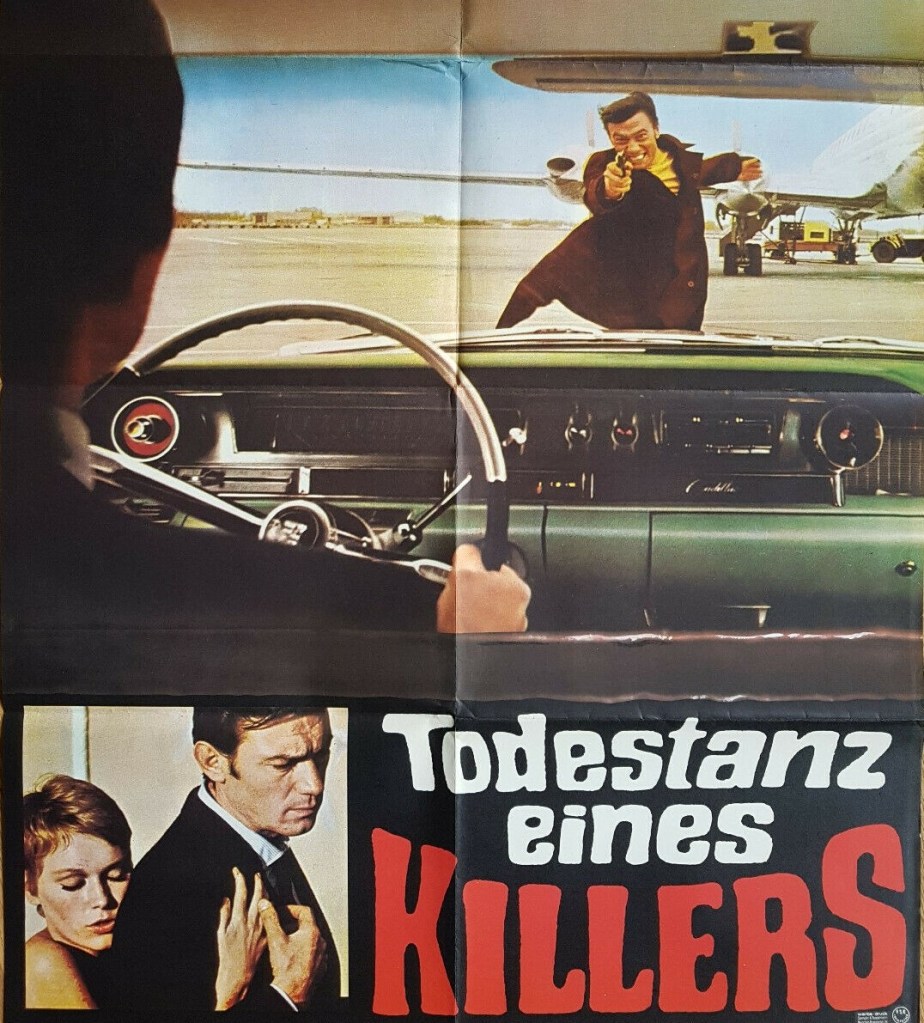
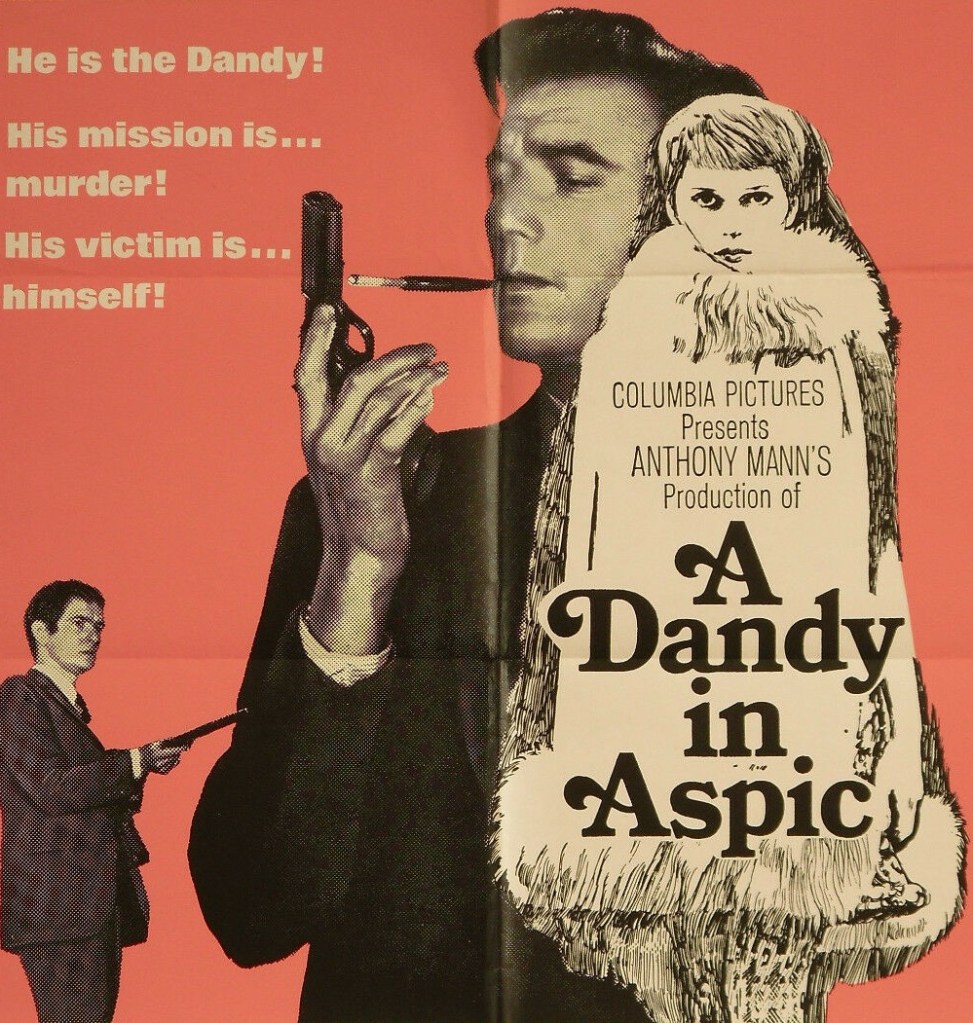
Belongs to the “serious spy” genre that exposed the nitty-gritty espionage business, often more concerned with the impact of the job on the spy than on the mission on which they have been sent. The biggest successes came early on – The Spy Who Came in from The Cold (1965), The Ipcress File (1965) and The Quiller Memorandum (1966). A Dandy in Aspic is one of the latest in the series of sad spies and like The Defector (1966) it’s more of a character study than an action picture. The tone is set with the credits, a puppet dangling to the point of being tormented, on a string.
The character in question is Eberlin (Laurence Harvey), a spy who wants to quit and go home. He knows only too well what happens to the burnt-out case, one of his colleagues is a drug addict. Only in this case home is Russia. But the feedback he receives is that nobody back home wants him to quit. His British bosses send him to go to Berlin to assassinate a dangerous Russian spy called Krasnevin. The only problem is, Eberlin is Krasnevin and so begins a game of bluff and double bluff while he fails to uncover the supposed foreign assassin his ruthless British unwanted colleague Gatiss (Tom Courtenay) is helping him locate.
Thrown into the mix is a girl, Caroline (Mia Farrow) a casual pick-up, a photographer he met in London who turned up in Berlin. Happenstance? Perhaps. But there is no such thing for a suspicious spy and to tell the truth even the moviegoer will treat her as just too good to be true even though she is a delightful personality and beautiful to boot. The fact that Eberlin has a girlfriend Miss Vogler (Barbara Murray) doesn’t seem to bother him, spies, as you will know by now, discarding women like old shoes.
If a noose is closing in, it’s a strange one, and feels more like it’s coming from the East rather than the West. He is blocked from taking a trip to East Berlin. Cops are tipped off when he makes contact with someone who could get him over/through the Wall. His Eastern masters seem willing to pay good money to find out the identity of Krasnevin.
It’s all twisted and complex and all sorts of strange characters come out of the woodwork. For no reason at all one sequence is set at a Grand Prix race, one of the drivers paid to cause a distraction to allow someone to be shot. Like The Defector, this is a movie that unravels backwards. Once you get to the end it makes a lot more sense. If you were asked to choose, on the basis of the characters presented, whether the Russians or British had more principles you would be hard put to decide.
Laurence Harvey (The Running Man, 1963) is one of the few actors with the vicious fragility to carry this off. He is coming apart at the seams. He can hold onto his good looks far longer than his mental stability. His rare acts of violence seem petulance. And since we are never allowed inside his head, since he cannot confess his feelings to Caroline, he cannot explain what it’s like to be abandoned by your native country, cast aside like an old lover. It’s left to the audience to work this out for themselves, that a true patriot risking his life for his country is refused sanctuary.
He’s doomed and soon he knows it, nowhere left to run, the sense that the trap is closing and perhaps the few hours spent with Caroline are like a condemned man’s final wishes.
Filmed in bleak London and Berlin, the setting reflects the character’s mindset. There’s a bit too much fancy cinematography and sound effects, but otherwise it’s solid entry into the “more real than reality” subgenre. Director Anthony Mann (The Heroes of Telemark, 1965) died during the making of the film, Laurence Harvey taking the helm for the last two weeks of shooting and post-production so it’s possible this is not quite the film Mann had in mind.
You can see here elements of the documentary style Mann developed in The Heroes of Telemark and it’s possible that when it came to the editing director Harvey accorded himself more prominence than Mann might have, leaving a complex tale more difficult to follow than necessary.
Harvey is very good in the role of the ruthless narcissist, Mia Farrow – she followed this with Rosemary’s Baby (1968) – with a creditable English accent is excellent as the lover though Tom Courtenay (Operation Crossbow, 1965) seems miscast. Excellent support is provided by Lionel Stander (Once Upon a Time in the West, 1968), Harry Andrews (Danger Route, 1967) and Per Oscarsson (Who Saw Him Die?. 1968). Look out for comedian Peter Cook (Bedazzled, 1967) as an unlikely lothario, Barbara Murray (television series The Power Game, 1965-1969) and Calvin Lockhart (Dark of the Sun, 1968).
Authenticity came at a cost. In electing to film in Europe veteran producer-director team of William Perlberg and George Seaton, their partnership stretching back two decades, incurred the ire of U.S. movie unions campaigning against “runaway” productions and tax-avoiding stars like William Holden. Feelings ran so high the movie was picketed on release, even though it had received a Presidential seal of approval after John F. Kennedy requested a screening.
Perlberg and Seaton were lucky not to be indicted for a further act of anti-Hollywood behavior, the hiring of so many European actors and actresses in favor of the home-grown variety, but with the incursion of Sophia Loren, Brigitte Bardot and Gina Lollobrigida into the U.S. box office introducing another big female star into the Hollywood firmament would likely have been welcomed.
Producer Perlberg bluntly defended the decision to film abroad a movie set in war-torn Europe (where much of the damage caused by the war had not been rectified). “Where would you find three solid blocks of rubble but Berlin?” he demanded. “Or a prison like Moabit? Our company was yesterday filming in a partially bombed out section of the Altona railway station, six stories high. Action involved a 14-car German train (which Union Pacific can’t reproduce). How can we build Stockholm in Hollywood.” More to the point, he added, “Of course where in the world can you get weather like this? It’s been raining every day.”
Perlberg and two-time Oscar winner Seaton (Airport, 1970), separately and together, had considerable experience of war pictures, having between them made The Proud and the Profane (1956) and The Bridges at Toko-Ri (1954), both pictures, incidentally, starring Holden. The Alexander Klein bestseller The Counterfeit Traitor, purchased in 1957 for a modest $75,000, appeared to follow a similar trajectory. “Competition for the entertainment dollar has wedded us to big films and global stories,” maintained Perlberg despite complaint by Hollywood unions that such films, in the face of shrinking U.S. production, denied their members work.
Although the European locations would shave $500,000 from the budget of The Counterfeit Traitor, still coming in at a hefty $3.4 million and originally to be filmed under the title Man in the Middle, Perlberg was adamant that “the picture could never be made in Hollywood with justice to the subject and story… We are shooting this picture where it happened. On the streets that Eric Erickson (the character William Holden plays) walked; in the houses that were his hideouts.”
Perhaps key to this philosophy was the ability to shoot inside the notorious and still-active Moabit Prison, housing 1,300 prisoners and located close to Berlin’s famous Tiergarten. Amazingly, the prison warden granted permission not just to shoot in the courtyard but also inside the actual building. The prison officials initially denied that anyone was shot in the courtyard (a key scene in the film) until Erickson turned up and testified to the contrary, standing in the cell through whose bars he had witnessed the execution. You could not buy such authenticity and certainly not recreate it in a Hollywood back lot.
Paperback movie tie-in.
The 100-day shooting schedule included a month in Berlin, two months in Hamburg and scenes set in Copenhagen and Stockholm. It was the epitome of a multi-country adventure – the cameraman French (Jean Bourgoin who shot Tati’s Mon Oncle), wardrobe coordinator Italian, sound mixer German and assistant director British. But in Denmark, they worked with a Danish crew, in Sweden a Swedish crew. “I doubt that any other picture has been made with this type of operation – changing crews with each country involved. It has certain pitfalls but we’ve found in Germany alone that it would have been foolish to do it any other way,” added Perlberg.
“Hollywood set dressers, for instance, are great but no amount of research can match actual experience. Our interior decorators lived in the environment, witnessed the events and dressed the sets accordingly.” Apart from language problems, in Germany, where the bulk of filming took place, the lack of a centrally located “movie town” like Hollywood caused issues. Actors and crew were drawn from Berlin, Munich and Hamburg, with all the cast put up in first class hotels and paid a per diem of $15. With over 70 speaking roles, the movie also called on 2,000 extras. The producers also worked in the oldest film studio in the world, Nordish Film in Copenhagen built in 1906, and the rebuilt Palladium, which had been blown up by the Germans during World War Two.
Actors and directors worked abroad to limit their U.S. tax exposure. Anyone taking advantage of foreign income was viewed as a tax cheat. William Holden, who would only make one movie in Hollywood in seven years, epitomized the wealthy tax dodger. Living abroad also cut down on paying U.S. tax. Switzerland, for example, where Holden took up residence, calculated tax on the amount you spent on the annual rental of your home, resulting in huge savings – Yul Brunner claimed this legitimate move alone had saved him $2 million.
Holden complained that he was unfairly being singled out. “How about Clark Gable in Naples, Tony Quinn, Charlton Heston in Ben- Hur? Why do they pick on me? I pay U.S. taxes in the highest brackets and will continue doing so for years.” He was a prime target not just because he was outspoken about living and working abroad but because he was, along with John Wayne, the highest-earning male actor, on $750,00 per picture plus percentage. He had the pick of the projects, linked with The Guns of Navarone (1961), The Alamo (1961), The Americanization of Emily with William Wyler in the director’s chair, The Visit with Ingrid Bergman and Melody for Sex where he would be paired with both Sophia Loren and Gina Lollobrigida. He had followed up The World of Suzie Wong (1961) filmed in Hong Kong, with Satan Never Sleeps (1961) filmed in Britain, and then was lining up The Lion in Kenya, Together in Paris (aka Paris When It Sizzles) in France and The 7th Dawn in Malaya.
Although Prussian-born Lili Palmer (Sebastian, 1968) was an established Hollywood import, the movie offered a wide range of parts to fast-rising European talent. Most major studios had already invested in “new faces from abroad” so Perlberg-Seaton were not going against the grain on this one. Paramount, for example, had hired the German Hardy Kruger and the French Gerald Blain and Michele Girardon for Hatari! (1962). Columbia lined up Frenchman Alain Delon for Lawrence of Arabia (1962) and Greek actress Irene Papas in the female lead in The Guns of Navarone (1961). MGM chose Ingrid Thulin for The Four Horsemen of the Apocalypse (1962) and United Artists set Maximilian Schell in Judgement at Nuremberg (1961). Claudia Cardinale was intended to make her Hollywood debut opposite Sidney Poitier in Iron Men – never made.
Heading the list of potential break-out stars were Ingmar Bergman protegees Sweden’s Eva Dahlbeck (Smiles of a Summer Night, 1955) and Ulf Palme (Dreams, 1955). They had appeared in two films together, Dreams and Meeting in the Twilight (1946). German Wolfgang Preiss would later appear in The Train (1965) and Von Ryan’s Express (1965). But the biggest casting coup was Klaus Kinski. “No German producer lightly engages him because most of his engagements in German theaters have ended with a resounding quarrel or scandal,” explained journalist Peter Baker, “(but he is) nevertheless regarded with awe and respect as one of the greatest actors to merge from post-war Germany.” His three days in The Counterfeit Traitor won him a role in Perlberg-Seaton’s next picture The Hook (1963).
SOURCES: William Perlberg, “Searching Europe for Authenticity,” Films and Filming, February 1961, p9; Peter Baker, “The Tour of Babel,” Films and Filming, February 1961, p10-11, 41; “Lazar Percenting Ericson Spy Tome,” Variety, October 16, 1957, p3; “Lament for B.O. Stars,” Variety, January 29, 1958, p14; “Holding Money via Residence in Switzerland,” Variety, August 5, 1959, p12;“Par’s Sex Stars,” Variety, September 2, 1959, p3; “Holden, Seaton Invade Berlin for War Film,” Variety, October 28, 1959, p7; “H’wood – O’Seas Row Boils Up,” Variety, August 24, 1960, p7; “Bill Perlberg’s Back and Loves Hollywood,” Variety, November 2, 1960, p7; “New Faces from Abroad To Make Debuts in U.S. Films During 1961–62 Season,” Box Office, September 4, 1961, p12-13; “President Kennedy Sees Counterfeit Traitor,” Box Office, May 7, 1962, pW8; “Warm-Up for Picketing Strategy,” Variety, June 6, 1962, p4.
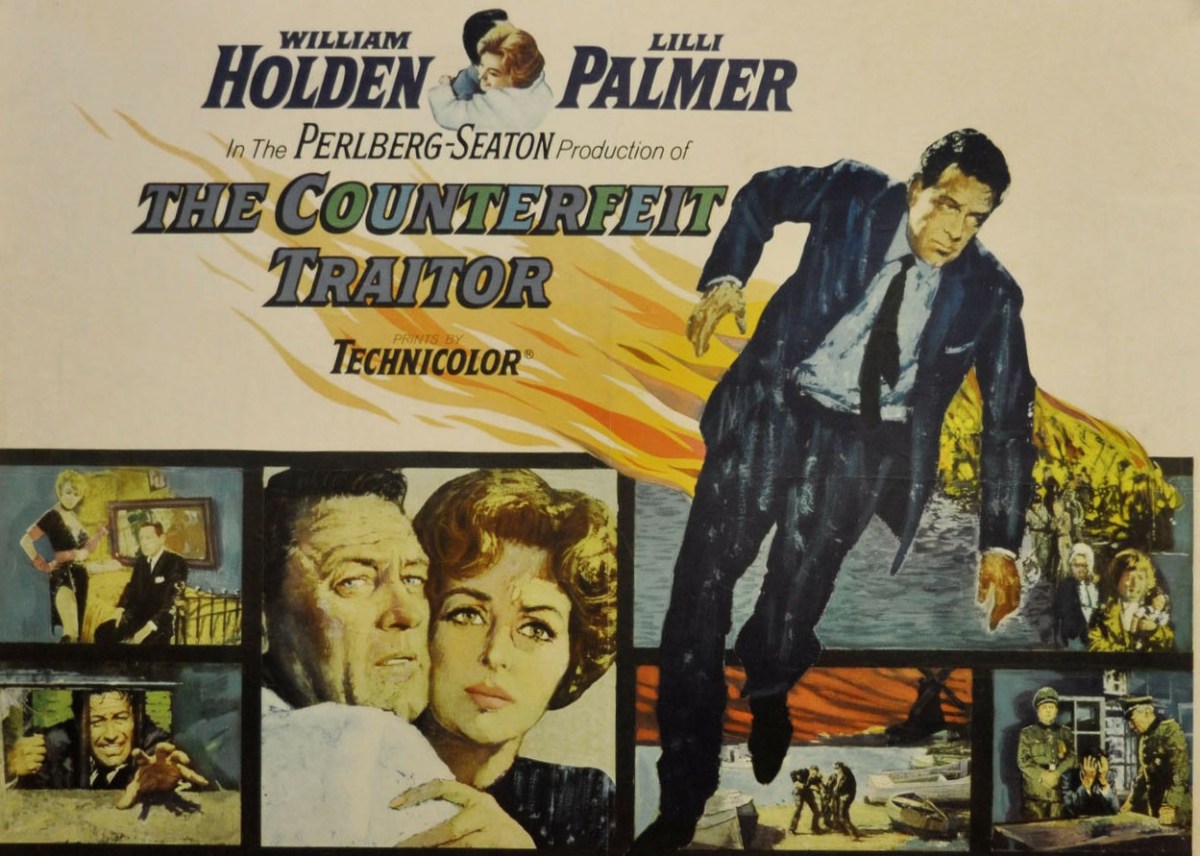
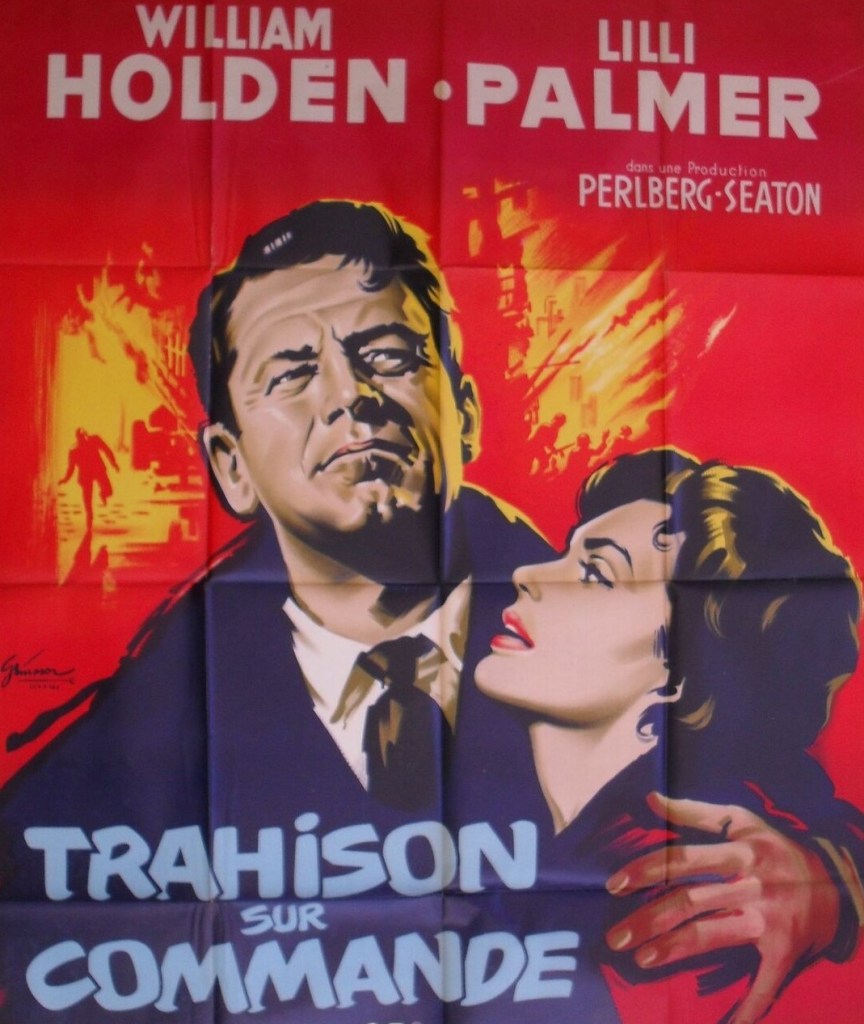
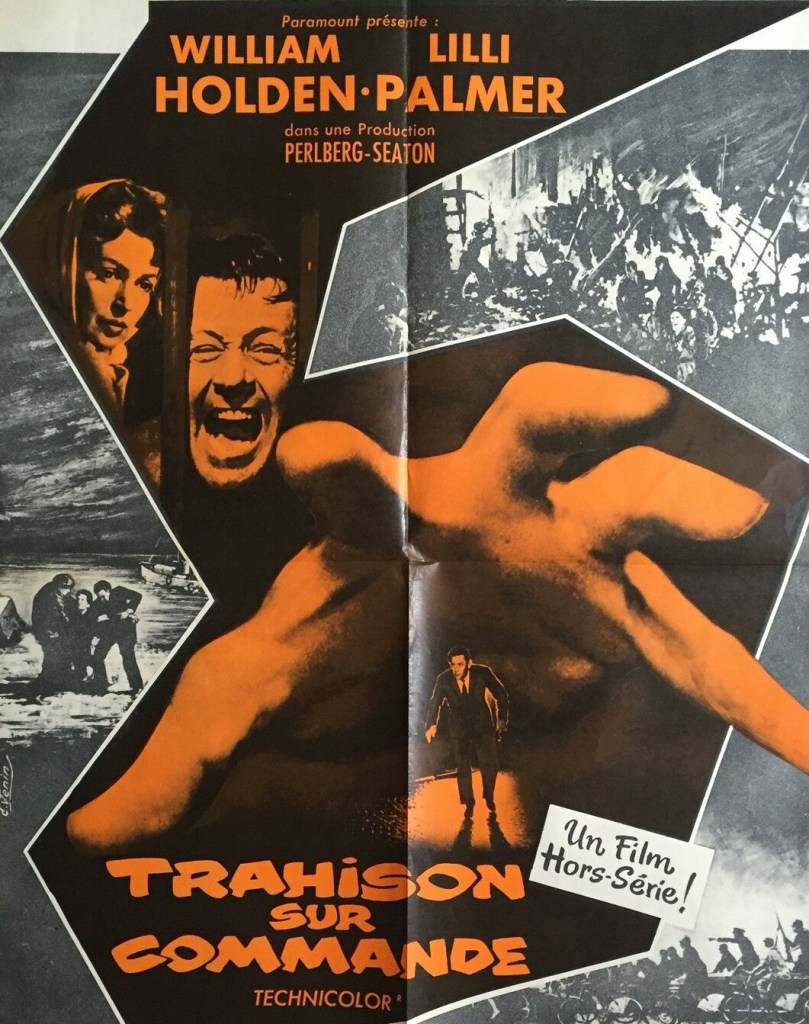
Cynical and opportunistic Swedish oil executive Eric Erickson (William Holden) blackmailed into World War Two espionage finds redemption after witnessing first-hand the horrors of Nazi Germany. Two extraordinary scenes lift this out of the mainstream biopic league, the first Erickson witnessing an execution, the second a betrayal. While some participants in the espionage game pay a terrible price, others like spy chief Collins (Hugh Griffiths) manage to maintain a champagne lifestyle.
Structurally, this is something of a curiosity. The first section, with over-emphasis on voice-over, concerns Holden’s recruitment and initial attempts at spying on German oil installations on the pretext of building a refinery in Sweden. Although resenting the manner in which he was recruited, Erickson has no qualms about resorting to blackmail himself to enlarge his espionage ring.
But it’s only when Marianne Mollendorf (Lili Palmer) enters the frame as his contact in Germany that the movie picks up dramatic heft. As cover for frequent meetings, they pretend to be lovers, that charade soon deepening into the real thing. While abhorring Hitler, she suffers a crisis of conscience after realising that the information she is passing on to the Allies results in innocent deaths. The final segment involves Erickson’s thrilling escape back home.
The picture is at its best when contrasting the unscrupulous Erickson with the principled Marianne. Virtually every character is trying to hold on to a way of life endangered by the war or created by the conflict and there are some interesting observations on the way Erickson manages to harness foreign dignitaries while being held to hostage in his home country. Loyalties are sparing and even families come under internal threat.
Sweden was neutral during the Second World War so in assisting the Allied cause Erickson was effectively betraying his country and once, in order to keep proposed German investors sweet, he begins to spout Nazi propaganda at home finds himself deserted by friends and, eventually, wife.
In some respects, Holden (The Devil’s Brigade, 1968) plays one his typical flawed personalities, easy on the charm, fluid with convention, but once he learns the true cost of his espionage a much deeper character emerges. The actor’s insistence, for tax reasons, on working abroad – this was filmed on location in Europe – would hamper his box office credibility and although not all his movie choices proved sound this was a welcome diversion. Whether American audiences were that interested in what a Swede did in the war was a moot point, as poor box office testified. And the title might have proved too sophisticated for some audiences, given there was no counterfeiting of money involved.
Lili Palmer (Sebastian, 1968) is excellent as the manipulative Marianne, betraying her country in order to save it from the depredations of Hitler, not above using her body to win favour, but paralyzed by consequence. Hugh Griffith (Exodus, 1960) provides another larger-than-life portrayal, disguising his venal core. Werner Peters (Istanbul Express, 1968) puts in an appearance and Klaus Kinski (Five Golden Dragons, 1967) has a bit part.
Double Oscar-winner George Seaton (Airport, 1970) makes a bold attempt to embrace a wider coverage of the war than the film requires and could have done with concentrating more on the central Erickson-Mollendorf drama, especially the German woman’s dilemma, but, made before James Bond reinvented the idea of espionage, this remains a more realistic examination of duplicity in wartime.
CATCH-UP: William Holden pictures reviewed in the Blog are Alvarez Kelly (1966) and The Devil’s Brigade (1968); Lili Palmer movies reviewed are Operation Crossbow (1965), Sebastian (1968) and Hard Contract (1969).
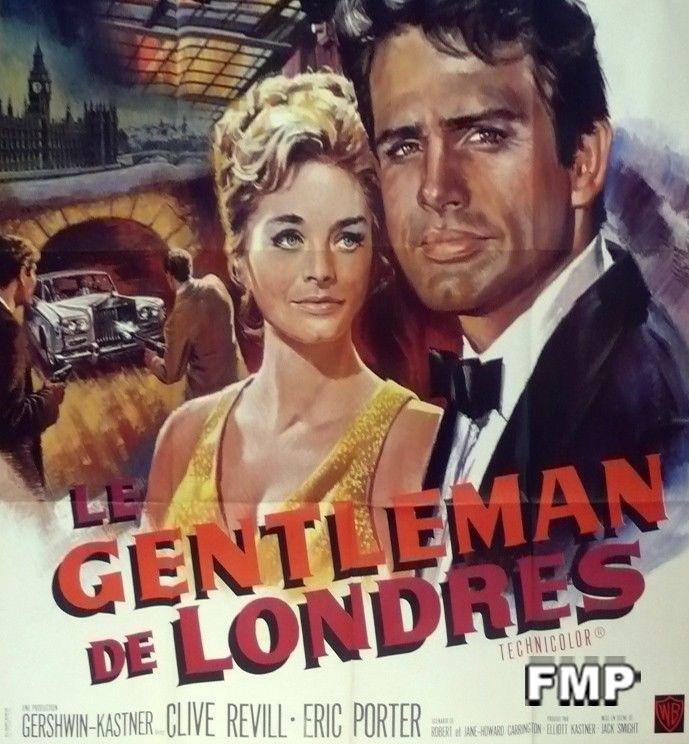
Amazing the tension that can emanate from one turn of a card. Or, more correctly, waiting for one. Only problem is we’re two-thirds through the movie before high-stakes poker begins – the pot nudging £250,00 (close on a cool £5 million now). Mostly, the earlier tension derives from not knowing what the hell is going on in this enjoyable thriller made at the height of the Swinging Sixties as playboy gambler Barney (Warren Beatty), a walking Carnaby St model driving an Aston Martin DB5, tilts the odds dramatically in his favor.
Barney is a gambler but the problem with gambling is the odds. They can be against you too much. So Barney decides to turn himself into a burglar, the kind that can clamber over rooftops, abseil between buildings, and break into – a printing business called Kaleidoscope. This just happens to print the playing cards supplied to all the major European casinos. So Barney does a little doctoring of the master printing plates. Bingo, the odds are a bit more even now that he knows what cards are coming out of the shoe – he plays chemin de fer (as it is known in posh casinos; pontoon or 21 to you and me).
While cleaning up he bumps again into fashion designer Angel – their original meet-cute taking place in a traffic jam – who he dated once in London. Unbeknownst to him, she is on a scouting mission, looking to snare the kind of high-rolling gambler who can take on and completely fleece drugs kingpin Harry (Eric Porter) being pursued by her father Manny (Clive Revill), a cop who, rather than waste so much time collecting the required evidence to put the villain behind bars, decides it would easier done by making him broke. Unable to pay his debts, some other villain would put him out of business in the traditional cemented-boot fashion.
It takes a while for the movie to line up all its ducks in a row, mainly by holding back the vital information the audience requires. But the audience is privy to details of the way Manny works that Barney is not. Even for ruthless villains, Manny has a peculiar calling card, one that would make any gambler think twice about entering his lair. Of course, it doesn’t take long for Manny to rumble Barney’s game so the stakes are much higher than the charmer imagines.
Throw in as much fashion as London was capable of generating at this time, the burgeoning romance, some exotic European locations, a castle with a moat, and the usual tourist guide stuff of red buses, Big Ben, Piccadilly Circus, pubs and Tower Bridge and you have all the ingredients of an easy on the eye thriller.
A bit over-reliant on star power. That is, if you don’t need Beatty to do much more than be Beatty, all teeth and charm. At this point Beatty’s career looked as if it was fast approaching its end. The box office success of Splendor in the Grass (1961) had been followed by a string of flops, romantic dramas and comedies that should have had audiences queuing up plus an occasional wild card like Arthur Penn’s Mickey One (1965), the biggest flop of all. He does make an engaging crook, and he never loses his screen charisma here, but there ain’t quite the right number of twists that moviegoers weaned on the likes of Topkapi (1964) had come to expect.
Hollywood had been doing its best to position Susannah York as a top box office attraction and she had snagged leading female roles in The 7th Dawn (1964) opposite William Holden and Stanley Baker in Sands of the Kalahari (1965) but she was recovering from the colossal flop of Scruggs (1965) by ‘poet of the cinema’ David Hart. Kaleidoscope offered the kind of role York could do with her eyes closed. So while the screen pair were not exactly sleep-walking it was not the kind of story that was going to create sparks.
Character actor Clive Revill (Fathom, 1967) and Eric Portman (The Pumpkin Eater, 1964) take more leeway with their roles, the latter almost chewing he scenery, the former content with just chewing his lips. Look out for Jane Birkin (Blow-Up, 1966) and British television stalwarts Yootha Joyce, George Sewell and John Junkin.
The title would have been more enigmatic, original meaning of images twisted out of shape, had it not also applied, straightforwardly, to the card-making company. Giving Harry the surname of Dominion seems overkill.
Director Jack Smight (No Way to Treat a Lady, 1969) came to this after twisty private eye picture Harper/The Moving Target (1966), a big hit starring Paul Newman, but this is too lightweight a feature to command such interest, but he does keep the story rolling along and it’s an effortless watch and it has a certain offbeat quality. The screenplay was fashioned by Robert Harrington and Jane-Howard Hammerstein, making their movie debut, who also co-wrote Wait until Dark (1967). It was also the debut for Winkast Productions, the Jerry Gershwin-Elliott Kastner production team who went on to make Where Eagles Dare (1968).
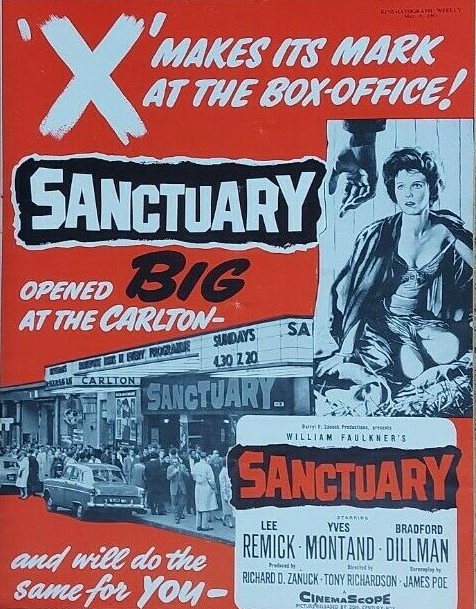
This overheated melodrama stands as a classic example of Hollywood’s offensive attitudes to women. Nobel prize-winning author William Faulkner could hardly blame the movies for sensationalising his misogynistic source material since if anything the movie took a softer line. Told primarily in flashback as headstrong southern belle Temple Drake (Lee Remick) attempts to mitigate the death sentence passed on her maid Nancy (Odetta). Given that such appeals are directed at Drake’s Governor father (Howard St John), and that the maid has been condemned for murdering Drake’s infant child, that’s a whole lot of story to swallow.
Worse is to follow. Drake takes up with Prohibition bootlegger Candy Man (Yves Montand) after being raped by him and thereafter appears happy to live with him in a New Orleans brothel – the “sanctuary,” no irony intended, of the title – despite him slapping her around. The film steers clear of turning her into the prostitute of the original book, but pretty much sets up the notion that high class women will fall for a low-class tough guy whose virility is demonstrated by his brutality. In other words a “real man” rather than the dilettantes she has previously rejected.
After the Candy Man dies, Drake returns home and marries wealthy suitor Gowan Stevens (Bradford Dillman) who blames himself, rightly, for Drake falling into the clutches of the gangster in the first place. But a past threatening to engulf her precipitates the infanticide.
Faulkner was a Hollywood insider, adapting Sanctuary for The Story of Temple Drake (1933) and earning high praise for his work on Bogart vehicles To Have and Have Not (1944) and The Big Sleep (1946). The success of The Tarnished Angels (1957) starring Rock Hudson, The Long, Hot Summer (1958) with Paul Newman and The Sound and the Fury (1959) headlined by Yul Brynner had sent his cachet rocketing. But all three were directed by Americans – Douglas Sirk and Martin Ritt – who had a distinctive visual style and an ear for what made melodrama work.
Sanctuary had been handed to British director Tony Richardson (Look Back in Anger, 1959) and he didn’t quite understand how to make the best of the difficult project. So while Lee Remick manages to suggest both strength and fragility, and makes her character’s wanton despair believable, Yves Montand is miscast and Bradford Dillman fails to convince even though portraying a weak character. Too many of the smaller roles appear as cliches. And it’s hard to believe the maid’s motivation in turning murderer. Watch out for Strother Martin (Cool Hand Luke, 1967).
What was acceptable steamy melodrama in the 1930s fails to click three decades on. Faulkner’s thesis that high-falutin’ women want a man to master them and furthermore will fall in love with their rapist seems to lack any understanding of the female mind and will not appeal any more to the modern sensibility than it did on release. Lee Remick is what holds the picture together, in part because she plays so well the role of a woman embracing degradation, and refusing – no matter how insane the idea appears – to let go of the man she believes is the love of her life. It’s not Fifty Shades of Grey, but it’s not that far off that kind of fantasy figure, and given the success of that book, it’s entirely possible there is a market for what Faulkner has to peddle.
Not easy to find. This is actually on YouTube if you go onto that channel and search. Strangely enough, if I post a link, it says it is no longer playing there – but just as strangely if you go looking you will find it.
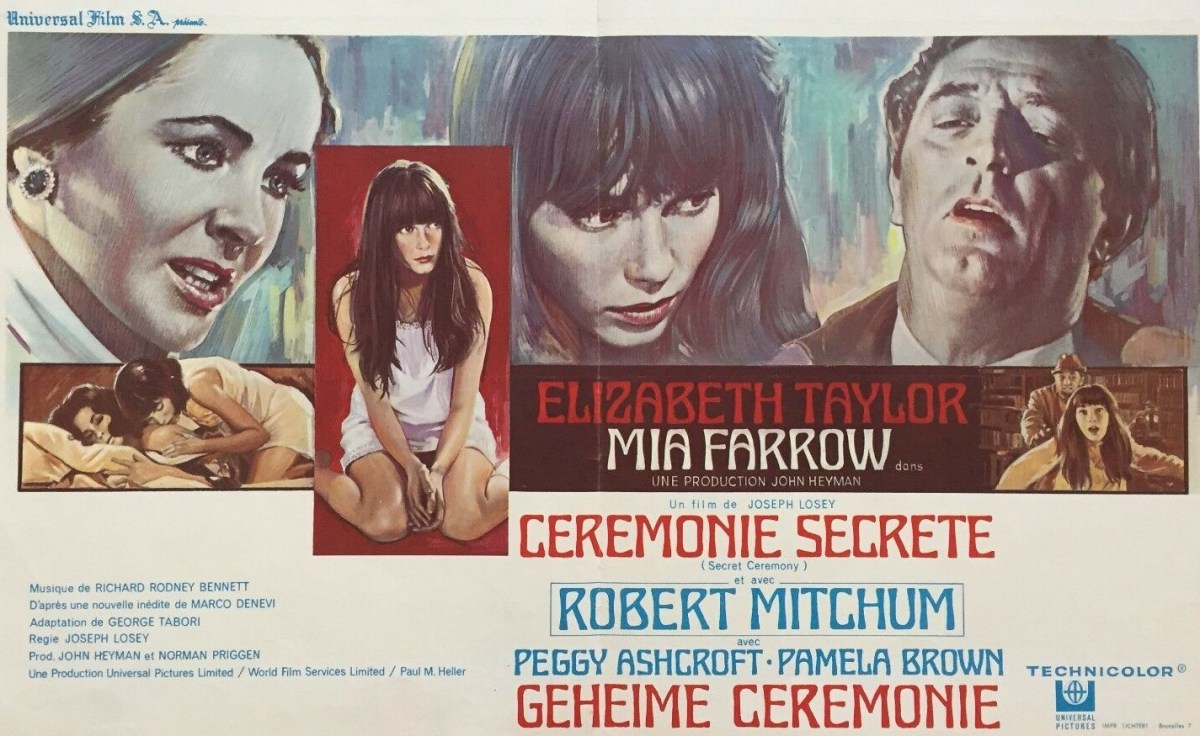
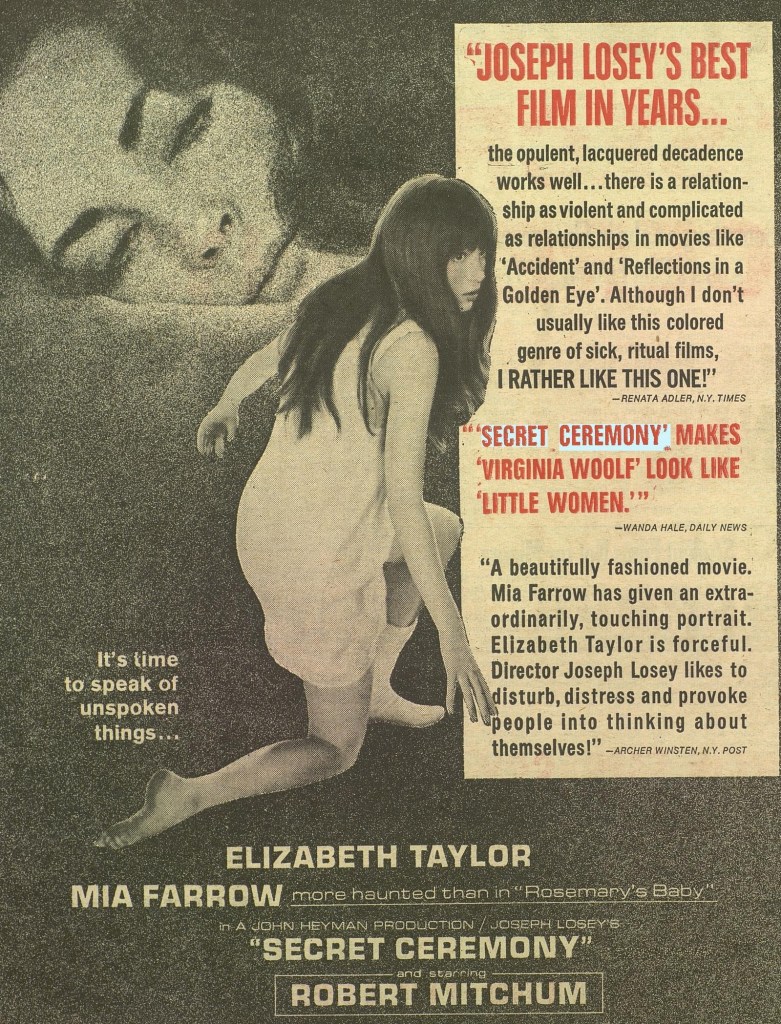
I was probably as surprised as anyone to discover that far from being a flop, Secret Ceremony was in fact a hit, taking $3 million in rentals in the U.S., ranking among the Top 20 foreign movies at the French box office, and hitting the target in Italy, Germany and Australia. Yet, outside of France, it was universally derided by the critics.
Joseph Losey (The Servant, 1964) held the unusual position of being a cult director working in Britain. He was the “object of a vociferous cult….his following grown in scope and size with each new film” and, conversely, as his popularity among the arthouse fraternity increased, he attracted more critical ire. Courting popularity by entering the spy genre with Modesty Blaise (1966) and linking up with the Elizabeth Taylor/Richard Burton box office colossus for Boom! (1967) seemed to go against the critical grain. Losey ascribed the critical coruscation Boom! received as less to do with the merits of the film itself than “people using the opportunity to launch personal attacks on the Burtons.”
Boom! had been packaged John Heyman, who coupled acting as agent for Burton and Taylor with being the producer, not necessarily a good combination. Universal was convinced it had “Virginia Woolf in color,” a reference to the previous enormous hit, although the box office told a different story. Jay Kanter, Universal’s London production chief who greenlit the project, commented: “When the Burtons were involved a lot of my judgement was colored by the magnitude of the star she (Taylor) was considered to be.”
So it was something of a surprise to find Losey and Taylor teaming up again for Secret Ceremony. Of course, it may have been the money, Taylor at this point still holding out for a million-dollar purse. Heyman said, “We were regarded as whizz-kids just for making two consecutive films with Elizabeth Taylor and bringing them in under budget.”
Losey’s world reflects a “highly selective form of naturalism.” Except for Accident (1966), from Sleeping Tiger (1954) through to Secret Ceremony, Losey worked with the same design consultant/production designer Richard MacDonald whom the director treated as a sounding board, to “test (ideas) and reject them in the telling.” This is a director for whom “patterned exoticism is extraordinarily precise.” A more important collaborator had been playwright Harold Pinter who had fashioned The Servant (1963) and Accident, bringing to both films his distinctive ear for dialogue. He was hardly required for Boom! whose screenwriter was the even more famous playwright Tennessee Williams (A Streetcar Named Desire, 1951) and for Secret Ceremony Losey went elsewhere for his screenwriter.
Losey was among the string of American talent who taken refuge in Britain in the wake of the anti-Communist hysteria of the late 1940s/early 1950s – others included producer Carl Foreman (The Guns of Navarone, 1961), and directors Cy Enfield (Sands of the Kalahari, 1966) and Edward Dmytryk (Mirage, 1965). By the time of Secret Ceremony, Losey had been working in Britain for nearly a quarter of a century and established himself as a director of distinctive vision, a critical fave in his adopted homeland, wildly appreciated by the French, with an occasional box office home run.
But although regarded as a British film-maker, Losey made Secret Ceremony – and Boom! for that matter – exclusively with Hollywood money, the budget 100 per cent supplied by Universal, that studio having decided that anything coming out of Britain would appeal to younger audiences. There was an untapped pool of talent available in British television who could be hired for substantially less than their U.S. counterparts. In three years Universal’s London production unit, headed by Jay Kanter, spent $30 million on a dozen projects. The biggest budget was allocated to Boom! with $3.9 million followed by $3.5 million to The Countess from Hong Kong (1967) starring Marlon Brando and Sophia Loren. The Night of the Following Day (1968) cost $1.5 million as did Fahrenheit 451 (1967) and Three into Two Won’t Go (1968). Secret Ceremony came in at $2.45 million.
Robert Mitchum and Joseph Losey went way back to a time in Hollywood when both were working their way up the RKO ladder. As well as Losey, Mitchum had been friends with many who would fall foul of the blacklist including screenwriter Dalton Trumbo, Dmytryk and Howard Koch (Casablanca, 1942). When Mitchum’s dalliance with drugs brought him a jail sentence, Losey visited him and brought him chilli from a famed restaurant.
Mitchum was recommended for the role in Secret Ceremony by Roddy McDowell, a friend of Taylor, who had been working with the actor on Henry Hathaway western Five Card Stud (1968). Mitchum received the job offer while on holiday in Mexico. For two weeks’ work he would earn $150,000. The role itself was scarcely onerous, drawing on aspects of the loathsome character he had created for Night of the Hunter (1955), but it did require an English accent of some kind and to his amusement Mitchum found himself on the telephone, like a salesman listing available product, going through the variety of accents he bring to the part.
Whether it was almost having to sell himself to the director or some previous incident, Mitchum and Losey did not resume their friendship. In fact, their relationship was the polar opposite. “He was very unpleasant,” recalled the director, “it was extremely hard for me to work with him.” Losey never found the source of Mitchum’s contempt. “In some curious way I must have made some mistake with him; I don’t know what it was.” Even attempts to recall Mitchum’s collaboration with Charles Laughton on Night of the Hunter failed to break the ice. Losey believed that Mitchum played tough to mask “an intense sense of failure.”
Mitchum wasn’t above sneaking away from the set. On one occasion taking himself off to visit old friend Robert Parrish, he knocked back some tequila and complained about the movie. On the Holland section of the shoot, Mitchum got into a food fight with a hotel diner. In the end, Losey was so disturbed by Mitchum that he was grateful when he departed as per contract despite the fact that some scenes had not been shot, including, according to the actor, the bathtub sequence, which would have accentuated the incest theme rather than the hint of lesbianism. Mitchum’s epitaph to the movie was that he talked Mia Farrow out of True Grit (1969) claiming Hathaway was a terror to work with.
The bath scene turned out to be the cause of some marital anguish. The set was cleared for its shooting of the scene after Taylor froze on emerging from her dressing room to see so many people gathered. But this was hardly Taylor at her beautiful best as she had been gaining weight. Even so Losey filmed her at times as though she was the grand Hollywood star with hair framing her face and the camera glimpsing her cleavage, but at other times her weight was a source of determining her character, when she eats with her mouth full and belches.
Halfway through filming Taylor was afflicted by severe physical pain and she was rushed to hospital for a hysterectomy, an operation that lasted over three and a half hours. Complications followed the surgery and she was given drugs that caused her to hallucinate. Writing in his diaries, Richard Burton noted: “This is the first time I’ve seen a loved one in screaming agony for two days, hallucinated by drugs, sometimes knowing who I was and sometimes not, a virago one minute, an angel the next.” She went from commanding him to leave the room to crying out for him to return. Sometimes she believed she was on board their yacht, other times that a film was playing on the switched-off television set.
The loss of her uterus may have affected her performance since in the film she plays a mother who has lost a child and in reality was a woman who had lost the ability to have another child.
The film exacerbated the tensions in the Burton-Taylor marriage. It was usually Taylor who was the one who had to keep a watchful eye on her partner in case he strayed. In this case, ironically, it was Burton who exhibited the jealous streak. The way Losey had whispered in the actress’s ear to build up her confidence during the bath scene while getting rid of extraneous crew found its way back to Burton who misinterpreted the action as intimacy. “My wife and Joe Losey are having a professional love affair,” he claimed. He spent a lot more time than usual on the set of his wife’s film. He even offered to take on the Mitchum role.
Losey had long been fascinated by a strange-looking house in West Kensington, London, and managed to hire it for the shoot. Debenham House in Addison Road, between Holland Park Avenue and High St Kensington, is one of a handful of truly Gothic London buildings. The church used was in Little Venice, St Mary Magdalene in Rowington Close, also in London, and the antique shop was located at the corner of St Stephen’s Mews and Westbourne Green. When the production shifted to Holland it was to the coastal town of Noordwjik with use made of the Grand Hotel there.
By the time the film opened, Taylor found herself in the middle of a storm over foul language (“gutter talk” in Variety parlance) for which she was seen as the “chief exponent.” It was an ironic position for Taylor to find herself in given her expletive-ridden performance in Who’s Afraid of Virginia Woolf (1966) had not only been critically acclaimed and a huge box office hit but seen as helping to break down the censorship barriers. However, it appeared that the “urination expression” and a word that was prefixed by “bull” were beyond the pale and Variety proclaimed that it was “evidently assumed that if a star of her (Taylor’s) magnitude can be gotten to speak the words, everyone else – actors, actresses, distributors, exhibitors and the public – will be accustomed to strong lingo in pix.” It was hardly coincidence that on the same day that this article was the leading story on the trade paper’s front page that inside six out of seven New York critics gave Secret Ceremony a drubbing, the exception being Renata Adler of the New York Times who called it Losey’s “best film in years.”
Even producer Heyman had his doubts about the material. “It should have been the story of two people who need and trust each other,” he said, “until one leans on the other a little bit more than she should. Unfortunately, the kind of sympathy which Losey shows for people in real life was absent from the relationship which is what I think made it unacceptable.” He summed up, “A cold picture.” (This has the taint of someone trying to work out why the film was a critical failure because otherwise I think Heyman got it exactly right for the movie I saw I did not view as cold nor unacceptable.)
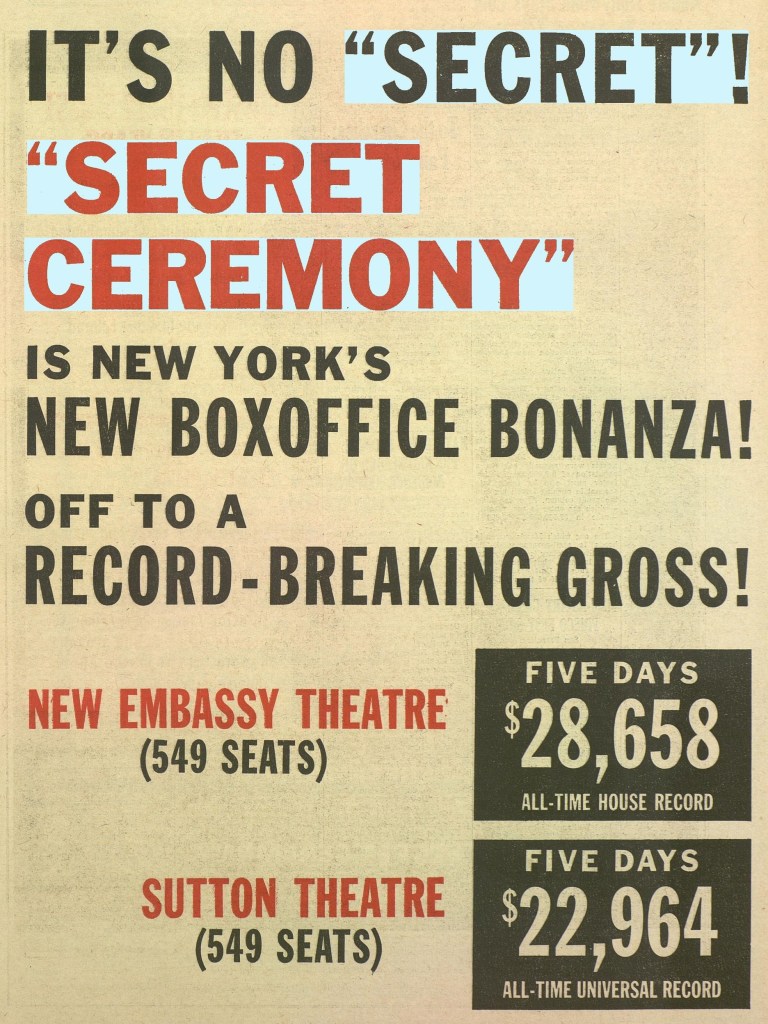
And neither, strangely enough, did the public. Although making a poor showing in Britain, it was not a box office disaster. That was averted by astute marketing, the potency of the stars and a public who, not for the first time, ignored the critics. The movie broke records when it opened at the New York arthouse pair, the Sutton and the New Embassy, and further afield in cities like Dallas. Arthouse success would have been anticipated but nobody would have expected that when it went wide in New York the second week improved upon the first. As well as a decent showing in the States, it hit the ground running around the world, and “ought to be credited” as one of Universal’s “most successful pictures from either domestic or foreign source.” In the French box office rankings, it placed above The Detective (1968) and Hang ‘Em High (1968) and just below The Thomas Crown Affair (1968). Acclaimed by that country’s critics, the Academie du Cinema named it best foreign film with Taylor and Farrow taking the gongs for best foreign actresses.
When Universal sold the movie to television for $1.25 million, a fee which certainly provided the picture with a decent extra profit margin, fourteen minutes were cut out and replaced by a 500 lines of extra dialog and a filmed discussion of the psychological issues raised, prompting Losey to demand his name be removed, claiming it “exactly reversed the meaning an intention of my film.”
SOURCES: Lee Server, Robert Mitchum, Baby I Don’t Care, (Faber and Faber, 2001) p169, 232, 509-512; Sam Kashner & Nancy Schoenberger, Furious Love, (JR Books, 2011)p240, 242-243,2; Alexander Walker, Hollywood England, (Orion Books, 2005) p200, 345, 354-257; “Screen: Secret Ceremony,” New York Times, October 26, 1968; “Joseph Losey Following Has Grown,” Box Office, October 28, 1968, pE1; “No End to Gutter Talk,” Variety, October 30, 1968, p1; “N.Y. Critics This Week: Ouch,” Variety, October 30, 1968, p12; “Secret Ceremony Sets House Mark at Sutton, New Embassy,” Box Office, November 4, 1968, pE2; “Secret Ceremony Setting New Records in Dallas,” Box Office, January 13, 1969, pSW1; “This Week’s N.Y. Showcases,” Variety, February 5, 1969, p9; “Jay Kanter,” Variety, February 26, 1969, p78; “Kanter No Martyr,” Variety, March 19, 1969, p26; “Ceremony, Z Nab Kudos,” Variety, May 7, 1969, p107; “French Filmgoing,” Variety, January 28, 1970, P27; “Paris First Runs,” Variety, April 29, 1970, p76; “Losey Wants His Credit Blipped from Vidversion of U’s Secret Ceremony,” Variety, September 16, 1970, p70; “All-Time Film Rental Champs,” Variety, October 15, 1990, pM184.
Trade magazine Variety’s innovative weekly Top 50 based on grosses that had begun in April 1969 changed the way exhibitors regarded box office. Instead of waiting till the appearance of the magazine’s year-end round-up which was limited to around the top 100 movies, cinema owners now got a week-by-week snapshot of how new movies were playing. All box office figures had previously concentrated on the big movies of the day – the roadshows and pictures with big stars – that opened at the first run city center houses that were easier for Variety to track. The switch to a computerized system made it more feasible to examine the takings from hundreds of cinemas not necessarily showing the big movies sucking up all the publicity oxygen.
An examination of the films hitting the coveted number one position in the weekly chart illuminated the changes in the business. For a start, to reach number one a movie had to be showing on over 30 cinemas, but this could rise to 100-plus, and began to show the benefits of the wider first run release. This was also really the beginning of the per-screen average. High figures could be achieved by recruiting a large number of screens but exhibitors could easily disseminate the information and decide whether the number of screens massaged the figures or showed how successful a film really was. And this was the start of another promotional ploy, the business of a movie holding onto to the top spot for a second, third or even fourth week, proof a movie had “legs.”
The Year’s weekly Top Ten performers make interesting reading. The biggest figures posted in any one week during 1969 were for On Her Majesty’s Secret Service which hauled in a massive $1.22 million (equivalent to $9.6 million today) from 99 screens – a $12,323 screen average. This was followed by Goodbye, Columbus with $935,000 from 65 screens, a higher screen average of $14,384. Next came The Love Bug with $724,000 from 76 houses ($9,526 average). Another week of Goodbye, Columbus shouldered $681,000 from 60 ($11,350).
The Love Bug had a further two weeks at the top, pinching $658,000 from 117 ($5,623) and $633,000 from 44 ($14,386). Seventh-best week was taken by The Killing of Sister George with $621,000 from 70 ($8,871). Snatching eighth spot was Fanny Hill with $625,000 from 49 ($12,755). Ninth was Krakatoa, East of Java with $621,000 from 68 ($9,132). Last place in the top ten went to I Am Curious, Yellow with $594,000 from 52 ($11,423).
From the exhibitor perspective there were two notable points. The first was the per-screen average. Secondly, cinema bookers could not fail to notice not only that two of the top ten in weekly gross and three of the top five films in terms of screen averages went to sexploitation pictures.
It was soon abundantly clear that producers could sell their pictures to sometimes doubting exhibitors by the simple process, not so much of bombarding them with adverts and Pressbooks extolling a film’s potential, but of getting a movie into sufficient theatres for the box office figures to tell their own story.
Although the other big films expected to top the weekly chart did achieve that aim – among them True Grit (twice), Butch Cassidy and the Sundance Kid (also twice), Ice Station Zebra, Easy Rider (three times), Midnight Cowboy, Oliver! and Paint Your Wagon – there were as many unfancied movies perching atop the weekly pile.
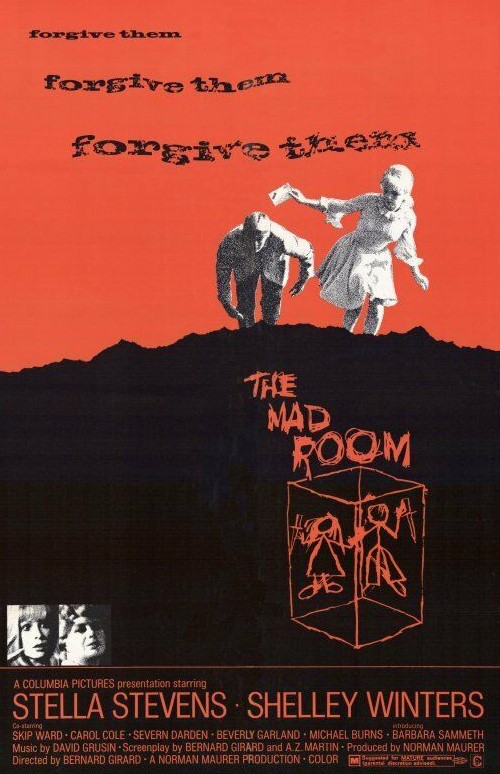
Apart from the sexploitation films and The Killing of Sister George, others holding down the number one spot for a week were British star Carol White in Mark Robson thriller Daddy’s Gone A-Hunting ($544,000 from 71), What Ever Happened to Aunt Alice ($540,000 from 48), Gordon Parks’ bittersweet drama The Learning Tree ($401,000 from 49), Stella Stevens and Shelley Winters in horror film The Mad Room ($283,000 from 38) and reissues Bonnie and Clyde/Bullitt ($546,000 from 81) and The Longest Day ($501,000 from 76).
Distributors of low-budget pictures used to have to take ads out in the trades to prove to potential customers that their movies were pulling in decent business. Now they had better proof, from the most important source of all, Variety, whose box office figures were scanned by every cinema manager in the country. Once a week without a distributor putting a hand in their advertising pocket there was all the promotional evidence they needed.
This was the second sea change in the way cinema owners perceived the business, the first being the opening up of the collection of box office figures through Variety’s annual report on upwards of 1,000 titles. To have figures at your finger tips for the price of a subscription to a newspaper was a game changer.
But there was yet another game changer to come.
SOURCES: The Top 50 Grossers chart appearing weekly in Variety from April to December 1969.
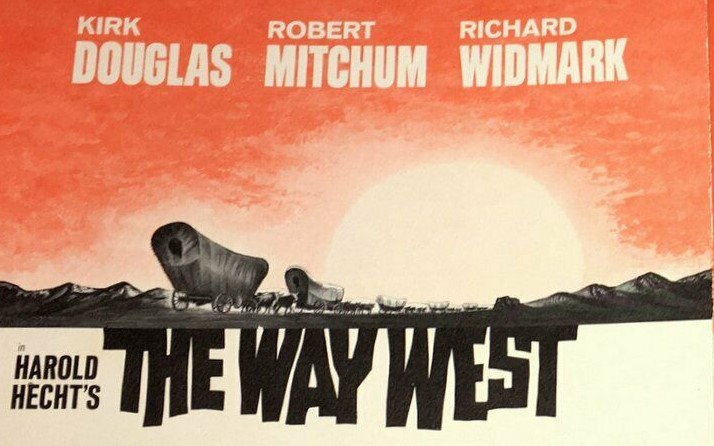
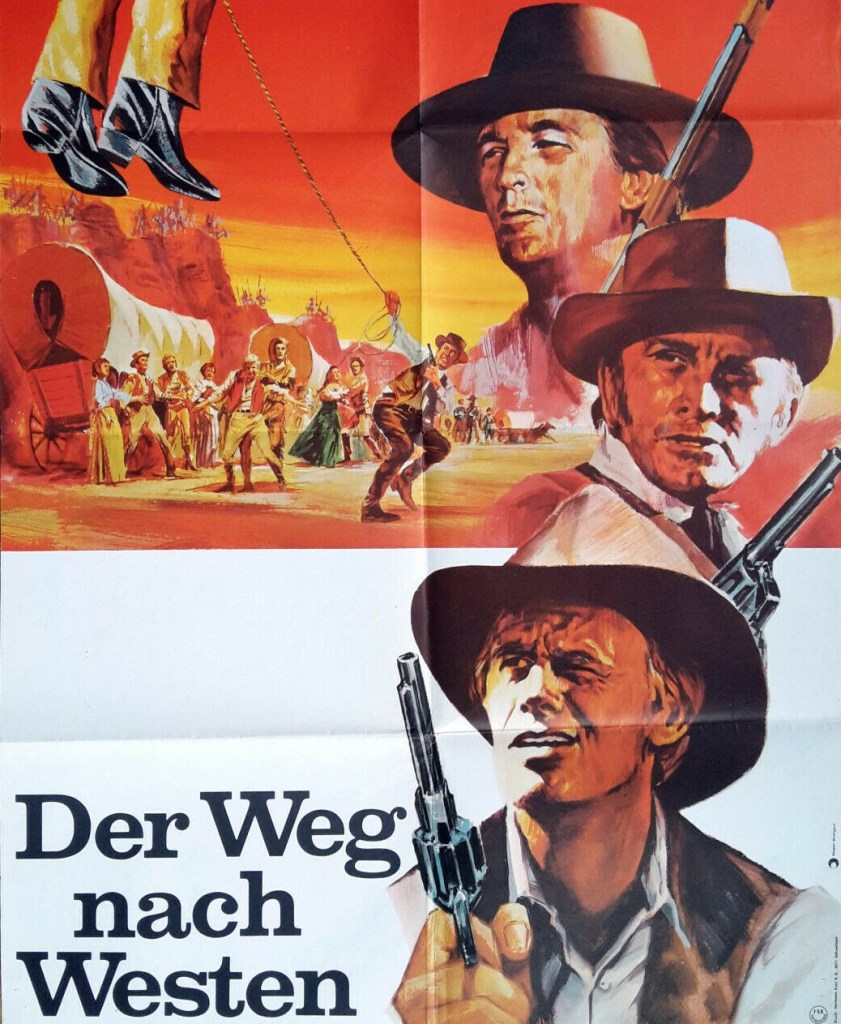
As you might expect with a title like this John Wayne was in the frame, at least at the start. But when Burt Lancaster’s production outfit Hecht-Lancaster bought the property that was the end of that casting idea. Hecht-Lancaster was at its peak in 1956, each of its first 11 pictures turning a profit, and just signed up to a $40 million three-year deal with United Artists. Biggest project on the table: $5 million for The Way West with a dream team of Lancaster, James Stewart and Gary Cooper and a script from Clifford Odets (The Sweet Smell of Success, 1957). But by 1959 the dream had soured, with $545,000 already shelled out on the western with no sign of a start date. A year later the project was shelved. When Harold Hecht split from Lancaster, the rights reverted to United Artists.
Hecht’s initial efforts as a solo producer had not paid off, Taras Bulba (1962), Flight from Ashiya (1964), both starring Yul Brynner, and Tony Curtis comedy Wild and Wonderful (1964) all covered in red ink, before suddenly resurfacing with the hit Cat Ballou (1965), making him imminently more bankable than before. However, given the impact music had in Cat Ballou, Hecht hankered after something in the same vein, except bigger, and bought the rights to Finian’s Rainbow, a Broadway hit from 1947. When casting issues caused delay, Hecht signed a one-picture deal with United Artists for The Way West. The studio had such high hopes for the movie that plans were made for its world premiere to be held at the Houston Astrodome, a first, and it was considered a natural for roadshow treatment.
A substantial rejig was required of the source material, the Pulitzer-Prize-winning novel by A.B. Guthrie, by screenwriters Ben Maddow and Mitch Lindemann, not least to ensure that the character played by Kirk Douglas remained with the wagon train until the end of the trail, unlike in the book. Andrew V. McLaglen, with three box office western hits behind him in McLintock (1963) starring John Wayne and Maureen O’Hara, Shenandoah (1965) with James Stewart and The Rare Breed (1966) co-starring Stewart and O’Hara, was first choice to sit in the director’s chair.
Charlton Heston (El Cid, 1961) was approached to play the lead of Senator Tadlock. When he turned it down, Kirk Douglas signed on for his first western in five years – although his next would also be a western, The War Wagon (1967) with John Wayne – Robert Mitchum (Villa Rides, 1968) was offered the choice of either scout Dick Summers or firebrand Life Evans. At the end of a long lunch with Hecht and McLaglen, Mitchum could not make up his mind and the producer and director assigned him the role of the scout.
“I’m awfully glad it worked out the way it did,” recalled McLaglen, “because Widmark was perfect for the other part and Mitchum was perfect for the scout.” It might not have been Widmark because Max von Sydow was also reputedly offered a part. Von Sydow was too big a star to play any of the other supporting parts and the part assigned to Widmark was Scandinavian so in that sense an ideal fit.
While Widmark did not attempt a Scandinavian accent, Mitchum spoke Lakota, apparently with a decent accent, in several scenes where he had to communicate with Native Americans. He didn’t learn the language, as modern actors might do, but simply recited the words spoken to him off-camera. Mitchum and Douglas had acted together in Out of the Past (1947), where the former had the larger role, and, while not sharing scenes, appeared in The List of Adrian Messenger (1963), where the billing was reversed. Although not in a directorial capacity McLaglen had worked with Mitchum on Blood Alley (1956) before the actor was fired.
It was an arduous shoot, virtually the whole picture shot as exteriors, in Tucson, Arizona, and in various locations in Oregon including Bend, Christmas Valley and the Crooked River Gorge. Around 400 members of cast and crew made the trek. In the absence of CGI, everything seen on the screen was achieved for real without any recourse to blue screen. The desert was real. When the river was forded, it was with real wagons and the cast. The wagons were raised and then lowered from the tops of cliffs using the old-fashioned methods that would have been available at the time, that is by rope-and-tackle.
In order to begin filming or play less arduous scenes on top of the cliffs, cast and crew went up in a ski lift. “You’re up there, hundreds of feet up, nothing but rocks to call on,” Jack Elam remembered. “If you had to go to the bathroom it was a matter of half an hour down and half an hour up.” When the wagons were lowered down the cliff all the actors at some point had to participate and according to Elam “some people landed in the hospital.” The river crossing was no less dangerous, with the potential for drowning a constant hazard.
“Andy McLaglen…was wonderful through the whole thing. Stayed calm through thick and thin,” said Elam. Added assistant director Terry Morse, “Nothing intimidated him…for all the difficulties he kept it right on schedule.”
Given three stars with reputations, it was not surprising there were flashpoints, Kirk Douglas, apparently, at the heart of most, accused of snatching newspapers out of the hands of supporting players and trying to usurp the director. Commented Harry Carey Jr., “He tried to take over the thing at some point. Widmark got furious at it, very agitated. He screamed, ‘You’re not directing this goddam movie.’ Really raised hell with Douglas.”
Said McLaglen, “Somebody like Kirk Douglas and somebody like Mitchum, they were poles apart in personality. Bob was an easygoing guy and Kirk was more volatile. But there was never a feud.” Just how easygoing Mitchum was – a production assistant was assigned to keep an eye on him just in case he got carried away with his predilection for fishing and was wading in the water when it was time for his next scene.
Kirk Douglas thought so little of the picture there’s not a single mention of it in his autobiography The Ragman’s Son.
The movie wrapped on August 29, two days ahead of schedule, which was quite remarkable given how tough the shoot had been. The fact that it took almost a year to reach screens suggested UA had problems with the finished product. Andrew McLaglen asserted that it had been shorn by nearly 30 minutes after the first round of cinema screenings, but that memory seems faulty given that the film Variety reviewed the movie in mid-May 1967 – a month before its world premiere in Eugene, Oregon, on June 13 – ran 122 minutes, the stated running time. Critics were not kind but the director thought it was “a terrific picture” and “one of the things I dream about today.”
SOURCES: Kate Buford, Burt Lancaster, An American Life (Aurum Press, 2000) p171,192, 194; Lee Server, Robert Mitchum, Baby I Don’t Care, (Faber and Faber, 2002), p491-495; Kirk Douglas, The Ragman’s Son (Simon & Schuster, 2012); “Largest Independent Motion Picture Deal,” Variety, April 13, 1956; “Hollywood Report,” Box Office, November 15, 1965, p20; “Hecht’s Oncer for UA,” Variety, March 30, 1966, p5; “Astrodome May Show Hollywood’s Way West,” Variety, May 4, 1966, p12; “Hecht Finishes Production of UA’s The Way West,” Box Office, September 5, 1966, pW5; “Review,” Variety, May 17, 1967, p6.