John Wick Chapter 4 (2023) ***** – Seen (three times) at the cinema

The Godfather Part II of action movies. It’s taken me three visits to fully appreciate the visual, aural and thematic splendor. Usually when someone pays homage to the likes of John Ford, David Lean, Francis Coppola, Akira Kurosawa, Luchino Visconti, Ridley Scott, Michael Mann, James Bond (yup) and the myriad directors who filmed a car chase, the result is rarely top-notch. That’s not the case here.

Let’s begin with sound. The bone-jarring punch that opens this picture is easily the best aural opening of any picture and would make the case for Imax straight off the bat. That’s followed by thematic motifs, the sun (I can’t tell if it’s rising or falling) and the stairs that will figure so prominently, the sun especially a gorgeous palette, whether streaming through the Eiffel Tower or in fabulous sunrise mode to indicate the beginning of the climactic duel, a throwback to the classic western, and as operatic in its composition as anything Sergio Leone could throw at us.

Not to mention that this is essentially a story of bounty hunters, and that puts it squarely in the window of the spaghetti western. And could you get any closer to Leone than naming one of the pair of assassins in pursuit Mr Nobody? As the price on John Wick’s head reaches dizzying proportions – $40 million – it’s open season. Setting aside the punching and kicking and whacking and ramming with cars, nobody has filmed shoot-outs like these since the glory days of Michael Mann.  

And that’s before we come to Hollywood’s best-ever dog, a cojones-chewing throat-mauling nutcase that can turn cute at any given moment. And if you are looking for thematic completion there you have it, this entire series began because an idiot killed John Wick’s dog. This is a dog as if it had somehow been born out of John Wick.

Perhaps the best element of the spoken and unspoken brotherhood that infuses the picture is  the underlying cynicism that accompanies it. You save someone and they owe you. Mr Nobody (Shamier Anderson) comes to Wick’s rescue twice, once cynically because the price on his head is not yet high enough and then out of acknowledgement for his enemy’s action regarding the dog.

And it takes a moment, given Wick is never permitted explanation, to realise that Wick’s final action will provide a satisfactory outcome to all concerned.

Only a director of note would think to capture the sound of sand tricking through an hourglass and the silence when it stops, or the tap of a tiny spoon against the tip of a tiny coffee cup. The Marquis (Bill Skarsgard), tasked by the invisible High Table with bringing down Wick, enjoys such extraordinary wealth you wonder what more does a man need – except of course to satisfy his ambitions within the closed circle of the High Table. Probably no supporting member of any cast has ever been provided with such elegant narrative.

Underneath blazing chandeliers in a room the size of a small town, he chooses one cake from an immeasurably large selection – the rest of which presumably go to waste – and only, delicately with a fork, eats half. As if never sated, he must lick the last of his coffee from his spoon. The female riders in his stables are practising with sabers, you imagine for more than acrobatic purpose. His final act reveals the man in all his arrogance and cowardice.

You wonder where the heck did Chad Stahelski come from to make a movie of such majesty. Yes, I know he’s a former stunt man but that’s like asking Yakima Canutt to conjure up something as iconic as The Searchers. The preceding Wick trilogy, as good as they are, did not set you up for this.

There’s not a single wasted character. The previous betrayer Winston (Ian McShane) returns and is not just blamed for the whole debacle but finds his prospects tied in even more closer to his one-time buddy. The Harbinger (Clancy Brown), who begins as messenger and  transitions to intermediary and finally judge,  has such a mythical presence  you wish Marvel could pay heed and hire someone with his gravitas.

Stahelski has such command of his material that he can set up twists for which his narrative skills provide solution. Instead of the traditional sons of gangster pictures, and bear in mind it was an errant son who started this whole business off, it’s daughters, one innocent of her father’s occupation, the other complicit. Some codes are replete with honor, others more practical.

Once the deadline is set for a duel to resolve the situation, blind assassin Caine (Donnie Yen) needs Wick to make it, but, having assisted him, evens the odds by slicing through his hand. At the end of a tortuous ordeal fending off the multitudes in Paris, Wick has a 200-step climb to his final destination. Further multitudes lie in wait. He gets to the top before he rolls back down and has to start all over again, the clock ticking.

And there can’t have been a better final image than in  Wick loosening his belt.

Brilliant script by Shay Hatten (Army of the Dead, 2021) and Michael Finch (Predators, 2010), with some lines that will enter the screenwriting Hall of Fame, and Wick and his supporting cast are stupendous, but in the end this film belongs to the director and a movie that calls out to be seen in the cinema and to be called a masterpiece.

I’ll probably go back next week.

Operation Fortune: Ruse de Guerre (2022) ***

The only redemptive factor in this too-clever-for-its-own-good post-ironic mess is a gorgeous performance by Hugh Grant. The one-time romantic male lead has shorn the floppy locks, put to bed the trademark stumbling over words and taken to the dark side. From pantomime villain in Paddington 2 (2017), through small-screen A Very English Scandal (2018) and The Undoing (2020) to Dungeons and Dragons: Honour Among Thieves (2023), Grant has reinvented himself as a baddie par excellence.

If there is any justice in the world or, put another way, some Hollywood or streaming mogul wanting to cash in on an instantly attractive character, they should be thinking of a film or television series revolving around his wonderful Cockney billionaire criminal, the epitome of the diamond geezer. The moment he appears, about a quarter of the way in, the film lights up. When he departs, it falls flat again.

Not surprisingly, given it is the embodiment of the over-egged pudding. The movie’s idea of character depth is to make all-round thug Nathan (Jason Statham) a wine connoisseur. Statham’s done pretty well to turn from a supporting actor to lean B-movie (Crank, 2006) shoot-‘em-ups to second banana in big budget pictures like the Fast and Furious franchise and The Meg (you didn’t think Jason was the actual star, did you, when there was a monster the size of a city block on the loose). In growl and unshaven cheeks, he may look like Bruce Willis, but Bruce Willis he ain’t. And he ain’t Charles Bronson either, despite rolling the dice twice on The Mechanic( 2011 and 2016).

Whitehall mandarin Knighton (Eddie Marsan) calls on smooth operative Nathan (Cary Elwes), who spends a lot of time eating, to put together a bunch of government-sponsored crooks – Orson (Jason Statham), Sarah (Aubrey Plaza) and JJ (Bugzy Malone) – to find a stolen artefact and prevent it being sold on to international gangsters or terrorists. Only problem is, nobody knows what was stolen. But somebody must know its value because another gang, led by turncoat Mike (Peter Ferdinando), is chasing the same item.

There’s a ton of computer jiggery-pokery that mostly gets in the way but suffice to say top-ranked crook Greg (Hugh Grant) is seen as being at the centre of whatever is going on, whatever that is, your guess is as good as mine. Lo and behold – what larks! – there’s a dead easy way to get inside Greg’s fortress (a giant ocean-going yacht): he is a huge fan of action star Danny (Josh Hartnett) who is recruited to play himself (a conceit too post-ironic for simple irony).

For a man as rich as Greg and as generous – he raises money for war orphans – Greg keeps poor company and consequently leads Nathan’s team to their prey, cueing burglaries, chases, fisticuffs. But most of the excitement is undercut by the aforementioned jiggery-pokery. It’s hard to concentrate on the action if every two seconds Nathan or Sarah is listening to a voice in his ear or we are being told by a third party that such some cute implausible jiggery-pokery is simplifying their tasks.

There are some electrifying sequences: the opening robbery taking place to the sound of Nathan’s footsteps echoing along a long marble hallway; a burglary where the occupants, rendered unconscious by jiggery-pokery, are so out of it Nathan can remove rings from fingers and watches from wrists.

But all the time this ultra-clever stuff is going on you just wished director Guy Ritchie (Wrath of Man, 2021) would have the sense of turn the camera back on to the one real characters in the ensemble, Greg, who doesn’t need anyone whispering in his ear or rely on jiggery-pokery to get through a scene.

Two brilliantly-scripted scenes demonstrated the talent gap between Grant and Statham. Nathan has his eye on Sarah and the scene between them where he imagines an immediate sexual connection is toe-curlingly superb. Nathan has a scene where, confusingly, he answers “yes” to each of Nathan’s questions and it comes off like a guide in how not to play comedy.

I’m not usually one to thank streaming giants for putting cinema-ready material on the small screen, but here I’m pretty grateful for saving me the expense. I’d seen a trailer for this months ago and thought it sounded pretty good. But if I’d seen it at the cinema I’d have been far more disappointed given the time and effort involved. As it was, I could stop the show and go back to watch the Hugh Grant scenes.

The concept could have been an ideal picture if it had come down to a more bare-bones story of two jumped-up thugs trying to gain the upper hand. I feel sorry for Statham. If Hugh Grant hadn’t delivered such a terrific performance, he wouldn’t have the movie stolen from under his feet. Two one-time big stars, Cary Elwes (The Princess Bride, 1987) and Josh Hartnett  (Black Hawk Down, 2001) play against type while Aubrey Plaza (Emily the Criminal, 2022), mostly loaded down with exposition, sparkles.

Watch it for Hugh Grant.

Masquerade (1965) ***

Made just before director Basil Dearden embarked on Khartoum (1965), this is probably best-known these days for being screenwriter – and ace self-publicist – William Goldman’s first credit. It’s based on Castle Minerva by Victor Canning whose previous filmed books included The Golden Salamander (1950) with Trevor Howard, The Venetian Bird (1952)  with Richard Todd, and The House of the Seven Hawks (1959) with Robert Taylor.

I’d like to say this is a self-aware thriller with spy and comedic elements but it veers awful close to either a cult film or a mess. Basic story has Frazer (Cliff Robertson) hired by former wartime commander and now British intelligence agent Col Drexel (Jack Hawkins) to look after an Arab princeling who has been kidnapped by the British (so much for Brits always being on the side of the angels) to help seal an oil concession in the Gulf.

Theoretically, the kidnapping is for the teenager’s own good, to prevent him being assassinated before he ascends to the throne…see it’s getting awfully complicated already. Anyway, it turns out he actually has been kidnapped by Drexel who has turned rogue in order to fund his retirement. The boy is held in some kind of fortress/castle in Spain and then another more sinister one.

Frazer meantime falls for the seductive charms of Sophie (Marisa Mell) who he thinks is a smuggler intent on stealing his boat but a) is part of the kidnap gang and b) in love with him enough to help him escape when he in turn is captured.

Did I mention the film also included a circus, a clown act, a gunfight on a dam, characters left dangling on a rope bridge, a lady in red, a balancing act along a perilous ledge, entrapment in a wine tanker (huh?) and an animal cage (double huh?), a vulture, men in bowler hats…

It is enlivened by visual gags – ultra-large footprints (from somebody wearing flippers). The dialogue sparkles as when the prince, with an overactive entitlement gland, says, “I am practically divine,” to which Hawkins deadpans “Your Highness, you are irresistible.” Add to that various cliché-twisting scenes – the double-dealing Sophie now overcome by love, says to Drexel: “Ask me anything you want and I will tell you the truth,” but every question he asks solicits the response, “I don’t know.” Then, imprisoned in a cage, after protracted cobbling together of lengths of bamboo to steal keys they turn out to be the wrong keys.

Throw in: British propriety  – Frazer’s  substantial fee for risking his life is reduced to a miserable sum once tax has been deducted; and a superb Arab charge on horseback with tracking cameras, either a rehearsal for Khartoum or the scene that got Dearden the gig.

Actually, the more I write about it the more fun it sounds and I wish it were, but it does not quite gel. Cliff Robertson (The Devil’s Brigade, 1968) and Marisa Mell (Danger: Diabolik, 1968) don’t convince – Robertson talks through gritted teeth without suggesting he has much inner grit – although Jack Hawkins (The Third Secret, 1964) and other British stalwarts like Charles Gray (The Devil Rides Out, 1968) and Bill Fraser (The Best House in London, 1969) and Frenchman Michel Piccoli (Danger: Diabolik) deliver the goods. It should have been a straightforward three-star job or – if qualifying as a cult – in the five-star class. It is definitely not an outright stinker. Perhaps best filed under “curiosity.”

Taste of Excitment (1969) **

Must-see for all the wrong reasons. An epic of confusion, appalling acting and dodgy accents make this thriller a prime contender for the “So-Bad-It’s-Good” Hall of Fame. Director Don Sharp (The Devil-Ship Pirates, 1964) jibed at star Eva Renzi (Funeral in Berlin, 1966) when he should have concentrated on a script that is over-plotted to within an inch of its life. A couple of kidnaps, casino visit, a sniper, and a vertiginous cliff-top maneuver are thrown in before a truth serum lights up the climax in spectacularly hilarious fashion.

Promising material goes badly awry. English tourist Jane Kerrell (Eva Renzi), floating around the South of France, is being targeted for unknown reasons. A white Mercedes has tried to drive her off the road, mysterious phone calls and visions make her believe she is going mad, that prognosis helped along by handy psychiatrist Dr Forla (George Pravda). And before you can say Surete, Scotland Yard and NATO she is the chief suspect in the murder of a man called Chalker on the ferry to France. Assistance comes in the form of handsome artist David Headley (David Buck) – preposterously famous “I’m David Headley” “The painter?” – who nearly does what’s she’s been complaining everyone else is trying to do, namely knock her down with his car. He specialises in painting nude women and for no reason at all, given he is identified immediately as a lothario, he resists her attempts to take her to bed.

Turns out Jane is something of a boffin, as any self-respecting computer expert would be known in those days, and a millionaire businessman Beiber (Paul Hubschmid), one of Headley’s rich clients, enlists the painter to offer her a job. Of course, he has something else in mind. His company is being accused to shipping unnamed goods to the unnamed opposition, hence the involvement of NATO chap Breese (Francis Matthews).

But nobody is to be trusted, especially as the French police have dismissed her fears as nonsensical. Scotland Yard’s Inspector Malling (Peter Vaughan) throws flames on the fire by not coming to her rescue but planning to arrest her since she is the last person to see Chalker alive. Then it turns out Chalker must have given her a code or secret message before he died. The police take apart her red Mini Cooper in clinical French Connection style but find nothing. That just shows how dumb they are. It never occurred to them, as it does instantly to Headley, to check the carburretor.

By now you’ll have guessed consistency is not this movie’s strong point. You never even know who the sniper Gaudi (Peter Bowles) is targeting his aim is so appalling. There’s even a sinister secretary Miss Barrow (Kay Walsh) with a pronounced Scottish accent in the Jean Brodie class. Headley comes up with an idea to disguise her – by changing her hairstyle (that’ll fool them!! – and astonishingly, in keeping with the bizarre tone, it does).

For someone who is meant to be paranoid Jane is surprisingly trusting, toddling off with clearly-identified villains when fed a line.

Most of the advertising, including this spread in “Films and Filming” magazine, made play of the sight of Eva Renzi’s naked derriere but ignored the unusual gender equality when it came to the nudity since in this scene David Buck gets out of bed and stands as equally starkers by the window.

You won’t be surprised when Jane ends up trussed and gagged, in her bikini naturally, in a fabulous house with an electrified fence. I can’t resist telling you about the truth serum. Before the evil psychiatrist has the chance to question her he is bopped on the head, Headley having sneaking in before (the dolts!) Gaudi thought to switch on the electric fence. (The electric fence is nullified by the police who just switch off all the electricity in the area.) But when she escapes, still full of the truth drug, when Gaudi calls out to find out where she is hiding, the serum forces her to give the correct answer. In the midst of the danger, Headley takes the opportunity to get an honest answer to the question of whether she loves him. And that’s not the best bit. The final line, given there hasn’t been a decent line all the way through, is a cracker. “Never believe a woman when she is telling you the truth” certainly gives you something to ponder.

So much is held back from the audience that there is never a chance, unlike Charade (1963), of genuine tension. Even the one gripping moment, taking a shortcut along a perilous cliff road, which is well done, is undercut by their pursuer beating them to their destination. The whole thing has an air of being improvised or being devised by someone who thought that twists counted more than characterisation, plot development or relationships.

The acting is so uniformly bad that Eva Renzi actually looks good. David Buck (Deadfall, 1968) is miscast in the slick Cary Grant role. While it is entertaining to see Peter Bowles (The Charge of the Light Brigade, 1968) drop his plummy English accent, his Italian accent fails to pass muster. Peter Vaughan (Alfred the Great, 1969), saddled with the bulk of the murky exposition, does his best. In a bit part, veteran Kay Walsh (A Study in Terror, 1965), holds the acting aces but she doesn’t have much competition.

Director Don Sharp also had a hand in the screenplay so it’s difficult to know who must take most blame, him or colleagues Brian Carton and Ben Healey. This was the alpha and omega of this pair’s movie career.

If you want to see how not to handle a potentially classy thriller tune in.  Can’t make up my mind whether to give this two stars for being so bad or four stars for being so bad it’s good. You decide.

And you can do so for free on Flick Vault. Be warned that you have to get past some adverts first. And if you’re wondering what happened to the opening credits, there ain’t any.

The Midas Run (1969) ***

You ever wonder what triggers criminality? Don’t deny an upper class English civil servant his knighthood, don’t fire an American university lecturer for an anti-war demonstration, don’t humiliate your beautiful wife by making her part of a business transaction. They might all feel robbery is the best revenge.

The highly respected Pedley (Fred Astaire) has talked his superiors in government into the notion that the best way to ship a consignment of gold is by passenger rather than commercial airplane. He recruits wannabe author Mike (Richard Crenna) who, in turn, comes to the rescue of glamorous Sylvia (Anne Heywood) when she is being sold off to sweeten a business deal.

The apparently eccentric casting was based on unfulfilled promise. Fred Astaire, who had not starred in a film for over decade, had made a comeback for Finian’s Rainbow (1968). But that had flopped, putting a dent in his marquee credentials and dramatic roles were hardly the forte of this twinkle-toed dancer. Richard Crenna’s bid for leading man status in Star! (1968) had spectacularly derailed at the box office.

Anne Heywood, the only one of the three principles to have a recent hit, in unexpected sleeper The Fox (1967), found no demand consequently for her services except from lover, future husband and biggest fan, producer Raymond Stross who had bankrolled the lesbian drama, and assigned her female lead here. You could extend your incredulity to the involvement of Swedish director Alf Kjellin,who hadn’t made a picture since Siska seven years before, and like most of his countrymen was seen as producing arthouse fare.

The biggest problem in a gold heist, as anyone watching the current television series The Gold will be aware, is shifting loot that weighs a ton. So Mike and Sylvia hire some Italian crooks to supply a couple of petrol tankers to hide and transport the bullion after the airplane has been forced down over Italian airspace by an Albanian fighter plane, Mike driving the World War Two tank that supplies the ground-based pressure.

As with any heist picture, robbery is only the beginning, double-cross the middle and triple-cross the end. Pedley, who has accompanied the shipment, is delegated by the British secret service to recover the gold, aided by suspicious assistant Wister (Roddy McDowall).  The twist here is that he not only recovers most of the gold, apart from some secreted away by the now romantically-inclined twosome, but points the finger at his accomplices, including the fence General Ferranti (Adolfo Celi).

It then becomes a question of whether the younger crooks can evade his clutches, whether Wister can confirm his suspicions that the investigation has proceeded a tad too conveniently, and discover what the heck the bowler-hatted Englishman is up to. And, of course, whether Mike can trust Sylvia. It wouldn’t be the first – or last (see Perfect Friday, 1970) – grand theft in which the male has been the dupe.

Along the way there is some clever comedy, a play on the British assumption that everyone in the world naturally speaks English, the implicit trust that the upper-classes place in each other, and the stock view that any Italian, law enforcer or crook, can be distracted by a pretty face or comely derriere.

On the downside, the set-up takes too long coming to fruition, especially a mid-movie  interlude that seems intend on channelling the worst romantic notions of the era, idyllic strolls in fields, that I half-expected a burst of slow-motion trotting, or some metaphor for the orgasm. There is some little understood banter about war games. And, for obvious reasons, La Heywood strips down to brassiere in the overheated tank (Mike manages to resist such un-English impulses) though she has previously indulged her innovative ideas about dress, turning a bedsheet into a fashionable toga at a moment’s notice.

There’s nothing particularly new here but Fred Astaire makes a deft impression as a typical upper-class Englishman, accent not found wanting, and successfully reinvents himself as a dramatic actor, that highpoint an Oscar nomination for The Towering Inferno (1974). Anne Heywood, once you realise she is playing all sides against each other, slips easily into the femme fatale role. Richard Crenna’s acting appears limited since his character, despite occasional initiative, is outwitted by all and sundry, and that was scarcely a good look in those days for the leading man to be out-thought by the leading woman.

Effortless, and harmless enough for a matinee.

Perfect Friday (1970) ****

Delicious caper movie. Under-rated and largely dismissed because a) it is very British, b) audiences preferred Stanley Baker in an action film like Zulu (1964) and c) it appeared a year after the action-driven heist picture The Italian Job. So many black marks you might think it was an automatic candidate for relegation.

But, in fact, it is a delight, a gem that never outstays its welcome and, furthermore, elicits tremendously enjoyable performances from the three principals, with the added bonus, I guess, of the costume budget being much reduced by Ursula Andress prancing around so much in the nude.

Mr Graham (Stanley Baker) is an uptight, bowler-hatted, spectacled, unmarried, straitlaced banking executive. That’s too fancy a title for his job. He’s not the manager, he’s not even the deputy, he’s the deputy to the deputy (here called an “under-manager”) and his sole joy in life appears to be granting or refusing overdrafts, an action that might, to one of life’s smidgeons, be construed as an exercise in power.

One of his clients is uber-sexy Lady Britt Dorset (Ursula Andress) who, while living in penury, manages to swan around in the most divine outfits and a swanky sports car, mostly as the result of his overdrafts. Although he believes he is tough and worldly it never occurs to him to wonder how his client has the wherewithal to repay the overdrafts.

She is married, but to the equally poverty-stricken Lord Nicholas Dorset (David Warner) whose sole income derives from a daily payment from sitting in the House of Lords and schemes such as attaching his name to a restaurant chain.

It doesn’t strike Mr Graham as particularly odd that Britt takes a fancy to him, infidelity appearing to be written into her marriage vows. And it’s not long before the deputy deputy manager starts to wonder how he might turn this relationship into something more permanent. So he comes up with a clever caper, a three-man job, or more correctly a two-man one-woman job. He’s going to steal £300,000, split three ways, from his bank. Nicholas will pose as a bank inspector, Britt will be the one who physically removes the cash and Mr Graham, naturally, will take on the role of criminal mastermind, finding a way to get hold of the necessary duplicate keys and over-riding the usual security concerns.

For a good while most of the plan consists of keeping the husband out of the way, sent on various “missions” across the country and abroad, to give Mr Graham time to enjoy making love to the wife. There’s an occasional hiccup to the plan, but mostly it appears to be running smoothly.

Except, as you might imagine, double cross is afoot. Mr Graham would like to purloin the husband’s share, all the more to set up cosy home somewhere abroad with the wife. And, as you might expect, there’s a sting in the tale.

But this is all so effortlessly done, tremendous tension as the robbery is carried out in complete silence (as was by now par for the course), jaunty music intervening at other times, the combination of the three opposites making for a delightful scenario, the stuffy manager at odds with the lazy, louche husband, and an unlikely companion for the sexy, apparently docile, wife.

Some clever directorial touches from Peter Hall (Three into Two Won’t Go, 1967) provide unexpected zest, but primarily this is a comedy of manners shifted onto the heist plane. And the best thing about it is the performances.

Ursula Andress (The Blue Max, 1966), here taking top billing, delivers her best-ever performance, the sexy front concealing a clever brain, easily manipulating lover and husband, deceit embedded in her genes, the hard-coiled core hidden from view, as she indulges both herself and her paramour.

Stanley Baker is superb, almost in Accident (1966) stiff upper lip mode, but without, until sex triggers criminality, that character’s free-wheeling attitude and immorality. He lives his entire life in a glass booth, observing and being observed, working within an arcane code of practices, not believing that he, of all people, could actually break the rules.

But David Warner (Titanic, 1997) steals the show as a bored upper-class lord who wants nothing more than a quiet life paid for by someone else and who almost throws a hissy fit when, as part of his role, he is forced to wear clothes he finds demeaning. If it wasn’t for the prize, this whole enterprise would be so much beneath him, and he doesn’t even have the satisfaction of being able to put this underling in his place.

Sheer enjoyment.

The First Deadly Sin (1980) ****

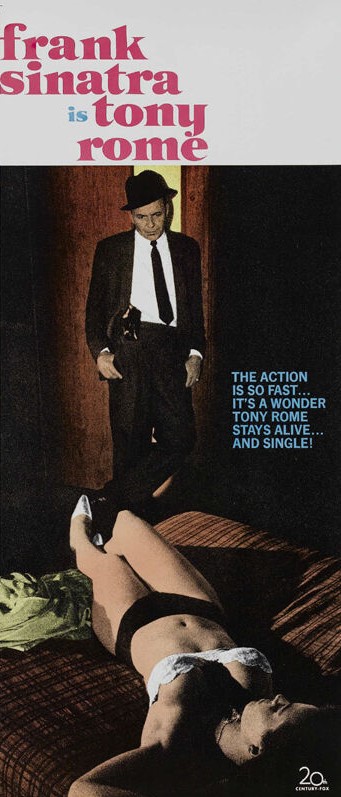
Highly under-rated. Mostly because star Frank Sinatra has the audacity at the age of 65 to play an older cop as an older guy, with none of the wisecracking or physical zap of his previous crime movies like Tony Rome (1967) and The Detective (1968). Deliberately downbeat and surprisingly compassionate with a gallery of unusual and realistic supporting characters.

Sure, we start off with a cliché, cop Delaney (Frank Sinatra) about to retire sniffs out a serial killer operating across New York. But that’s about as far as the cliches go. His boss (Anthony Zerbe) is highly territorial and doesn’t want Delaney doing work that might benefit any precinct other than his own. On top of that an operation on artist wife Barbara (Faye Dunaway) has gone seriously wrong and now she’s hooked up to all sorts of machines in hospital, Delaney sitting by her bedside reading from a book.

Unable to use the department’s facilities, Delaney is forced back on improvisation and enlists a museum curator Langley (Martin Gabel), an expert on weaponry, to find the specific type of tool the assailant is using to crack open heads. Langley is old, too, lacking in either wisecracks or physical zap, likely to doze off at inopportune moments.

Delaney isn’t above taking the law into his own hands, gaining admittance by devious means to the apartment of suspect Daniel (David Dukes) only to be told in no uncertain terms that not only has he no just cause to arrest Daniel, a high-flying executive with legal connections, but that any judge would immediately throw out the case thanks to the cop’s law-breaking.

So the movie settles into two parallel stories, both, if you like about observation. Delaney follows the suspect and he watches his wife die, in both instances unable to intervene, not able to prevent the murderer killing again unless he should happen to catch him in the act and as far as the hospital is concerned having to listen to a doctor (George Coe) tell him that doctors aren’t infallible and often get it wrong. Even his only ally, forensic expert Dr Ferguson (James Whitmore), is warning him off.

And where you might expect in another film a bit of romance between Delaney and witness Monica (Brenda Vaccaro) that doesn’t go anywhere either because he is a faithful husband and doesn’t need any distractions from a dying wife and she’s not the kind of woman that often turns up in crime pictures to form an adulterous relationship. If anything, she turns her attention to mothering Langley.

So this isn’t a fast action tough-talking crime picture of the kind audiences had been familiar with from the late 1960s/early 1970s, there’s no car chase to add entertainment heft. In fact, Delaney is an old-fashioned cop, I don’t think you even see him in a vehicle, he’s mostly pounding a beat of one kind or another.

And it’s oddly compassionate. There’s a lot of cross-cutting between the two narrative strands, and it soon becomes pretty clear that this is a different kind of killer, not one carefully planning his next murder, or taking sexual delight from the agony he inflicts, and he isn’t into abduction either, nobody corralled away in a basement or attic, night-time providing murky cover for his activities.   

What we’re actually witnessing, it turns out, is a killer’s meltdown, as he hunkers naked in a bath or hides under bedclothes in a closet. And Delaney recognizes that insanity and that this is someone who needs treatment rather than being locked up in a prison.  Daniel justifies his acts as a kind of purity. His victims are “all living inside me, I love them and they love me.”

The idea of sacrifice is embedded in the initial image of a neon-lit cross hanging above a street, the crucifix cross-referenced in several other scenes, and Xmas wet and miserable rather than Hollywoodized snow and ho-ho-ho.

So get your downbeat boots on and join the trudge and don’t start complaining this is lazy acting from Sinatra when actually he is delivering one of his finest performances. Nobody complained that Tom Hanks was lazy when he acted old in A Man Called Otto, where sorrow is similarly repressed, or that Hanks had a shade too much zest for a man his age. Faye Dunaway (Three Days of the Condor, 1975) has made an equally bold decision to play a woman who never gets out of bed and she makes no attempt, as an actress, to invoke your sympathy, there’s none of the cuteness you might expect from doomed romance. Critics, in general, have been put off by the fact that she plays a dying woman as if she is actually dying rather than about to spring into a song-and-dance.

You might be surprised to learn that director Brian G. Hutton (Where Eagles Dare, 1968) came out of a self-imposed seven-year retirement to make this picture, in some respects a companion piece to the equally down beat Night Watch (1973). And he makes a terrific virtue out of keeping characters realistic. Add Martin Gabel to the principals for playing old and slow when age dictates he’s old and slow. Screenplay by Mann Rubin (The Warning Shot, 1967) from the Lawrence Sanders bestseller.

Thoughtful, brooding picture, fitting finale to Sinatra’s career. This is the last hurrah without any forced Hollywoodized hurrah.

“It won’t be the same without you,” says the reception desk cop as Delaney hands in is papers. “It’s always the same,” retorts the world-weary cop.

But please go into it with your eyes open and not in expectation of the more typical 1970s crime movies.

Incidentally, I had thought this one of the lost movies, out of circulation due to legal shenanigans, so was pleasantly surprised when it popped up on YouTube.

The Naked Edge (1961) ***

What a potential cinematic coup. Upstanding Gary Cooper (High Noon, 1952) a villain? That’s the entire premise and a bold one at that.

Businessman George (Gary Cooper) is the key witness in the trial of alcoholic colleague Donald Heath (Ray McAnally) on charges of murder and theft of £60,000. But after Heath is convicted, George’s wife Martha (Deborah Kerr) begins to suspect the wrong man has been found guilty. Her husband has suddenly come into a large sum of money from, he claims, playing the stock market and at the trial’s conclusion is accosted by a stranger, Jeremy Clay (Eric Portman).

The “red danger warning flashing light.”

Several years a later blackmail letter comes to light, increasing Martha’s doubts. After all this time, George can’t quite lay his hands on the documents regarding his stock market claims. He is spotted in London when he should be abroad. 

Martha is so convinced something is wrong that she writes a cheque to Heath’s wife (Diane Cilento) not realizing how shady this would look if the case was revisited. Alarming incidents mount up – her husband’s razor, an invitation to walk along a clifftop. Much of the pressure is self-generated. She has put so much faith in her husband that she would be destroyed if he was guilty, so he must be innocent. Except she can’t quite get rid of the nagging voice.

For his part, George behaves so oddly, being caught out in lies about his whereabouts, and except, conversely, on his insistence that for the sake of their love she must trust him, he does little to shake the doubts especially when Clay pops up again reasserting his misgivings. Since there is no sign of a police investigation, Martha is solely responsible for creating the tension. And, with her out of the way, life might be a lot easier all-round.

The much-vaunted “final 13 minutes” – as promoted in the poster – certainly justifies the tension but outside of whatever’s going on in Martha’s head much of that has been created by bursts of melodramatic music, sudden close-ups and continued emphasis on her point-of-view.

This was Gary Cooper’s final film and it wasn’t the kind of triumphant send-off achieved by Clark Gable (The Misfits, 1961) or Spencer Tracy (Guess Who’s Coming to Dinner, 1967). It might even have been a surprise choice, audiences more accustomed to find him in westerns – add Vera Cruz (1954) and Friendly Persuasion (1957) to his star turns in that genre. But although he had made nine westerns in the previous decade, he also starred in six non-westerns, including a politician-businessman in Ten North Frederick (1958), and wasn’t averse to playing less than straitlaced characters.

That grim determination that become a hallmark when upholding law and order easily transitioned into just grim determination against whatever threatened his well-being. Of course, the whole enterprise relies on sleight-of-hand but that’s par for the course.

Deborah Kerr had ended the 1950s as a strong-minded female but now seemed to be hell-bent on exploring her fragility and this role seems a direct line to characters played in The Innocents (1961), The Chalk Garden (1964) and The Night of the Iguana (1965).

Audiences were used, by now, to being told when they could enter a theatre. Remember, this was in the glory days of the continuous performance when customers could take their seats at any time during a screening not, as now, before the picture started. You might think it odd that people were barred from entry during the final 13 minutes, as if anyone would consider this a good time to enter, but it was very common for people to take their seats at any odd time. Just in case people didn’t have watches to hand, cinemas were instructed to install a red light and have it flashing in the lobby to prevent interlopers entering. Alfred Hitchcock, of course, invented this clever marketing ploy of annoying the customers for Psycho (1960) but it was still going on as late as Return from the Ashes (1965).

Not Cooper’s greatest film but a decent two-hander that might have worked better if there had been more of a sense of gaslighting Kerr. That it works at all is down to the actors, not a bad achievement when you consider the director was asking the audience to go completely against type in accepting Cooper as a potential killer.

British director Michael Anderson (The Quiller Memorandum, 1966) had the sense to ignore the attractions of tourist London and concentrate on suspense. Joseph Stefano (Psycho) based the screenplay on a novel by Max Ehrlich.

Charade (1963) *****

Arguably the slickest thriller ever made. Two stars at the top of their game, three rising stars giving notice of their talent, more twists than you could shake a Hitchcock at, the chance to frighten the life out of the most fashionable actress of her generation, and standout scene after standout scene.

Three characters are presented upfront as bad guys, but whole enterprise is so laden with suspicion you are not all surprised when the finger points at Peter (Cary Grant) and Reggie (Audrey Hepburn), not least because Peter keeps changing his name, but also because audiences with lingering memories of film noir could easily imagine Reggie as a femme fatale especially when she comes on to a man whose got three decades on her.

Basic story: Reggie returns from a ski holiday where she met divorced Peter to find her husband dead and Parisian apartment empty. She is menaced by three men – Tex (James Coburn), Herman (George Kennedy) and Leopold (Ned Glass) – convinced she knows the whereabouts of $250,000 they lay claim to. Bartholomew (Walter Matthau) of the C.I.A. also stakes a claim. Tex has a nasty habit of throwing lighted matches at her, Herman threatening her with his steel hand. And there are doubts about Peter, initially perceived as a savior.

It is a film of such constant twists, you never know quite where you are, and forced to follow the lead of a befuddled and confused Reggie you question everything, so it’s an unsettling watch. Given the permutations, you could easily come up with a number of different endings.

And although this is virtually thrill-a-minute stuff it has the most endearing light romance, full of beautifully-scripted sparkling cross-purpose banter, and managing to work in marvellous scraps of Parisian atmosphere, some tourist-hinged (a market, boat ride on the Seine), others (a subway chase) less exhilarating. At times, Reggie turns spy and comes up with clever ruses to evade pursuit.

You can have this amount of conflict – baffling clues, perplexed French Inspector Grandpierre (Jacques Marin) kidnap, rooftop fight – without corpses soon mounting up. Alleviating the tension are a myriad of little jokes: a small boy with a water pistol, time out in a night club to play the rather frisky orange game, Peter showering with his clothes on. The romance might have helped except every time Reggie trusts Peter he gives her good reason to distrust him. And, of course, she could as easily have squirreled the money away herself.

The whole ensemble is delivered with such style and attention to detail (a bored man at a funeral clips his nails, cigarettes are expensive in France, voices echo when a boat passes under a bridge, phone booths are both refuges and traps) that it’s as if every single second was storyboarded to achieve the greatest effect.

It’s not just the entrance of the bad guys, door slamming in an empty church, that signals a director alert to every nuance, but the fact they all proceed, in different ways, to check Reggie’s husband is actually dead. A man has drowned in his bed. “I sprained my pride,” explains Peter after coming off worse in a fight. Apart from the core tale of suspicion, betrayals, theft and murder, everything else in the thriller genre is completely revitalized, in dialog and visuals this is nothing you have ever seen before.

The principals invest it with a rare freshness. Cary Grant (Walk, Don’t Walk, 1966) and Audrey Hepburn (Two for the Road, 1967) are such natural screen partners you wonder why (expense apart) the exercise was never repeated. And in typical John Wayne fashion, to minimise the May-December romance element, it’s Hepburn who makes all the running in that department, and you get the impression that she had been married to an older man anyway. Grant’s character is surprisingly adept at the old fisticuffs while Hepburn is more feisty than helpless, and devious, too, not above using the old screaming routine as a device to bring Grant running for romantic reasons.

James Coburn has his best role since The Magnificent Seven (1960), Walter Matthau (Lonely Are the Brave, 1962), at this point not considered comedian material, brings very human touches to his role, and George Kennedy (Mirage, 1965) presents a memorable villain.

And that’s not forgetting an absolutely outstanding score by Henry Mancini (Hatari!, 1962), jaunty one minute, romantic the next, and for the most thrilling sequences creating the type of effect David Shire achieved in All the President’s Men (1976) of steadily mounting tension rather than instruments shrieking terror. And the Saul Bass-style title credits were actually conceived by Maurice Binder of James Bond fame.

Outside of his musicals, this is the peak of Stanley Donen’s (Two for the Road) career. The gripping screenplay was the work of Peter Stone (Mirage), based on a story by Marc Boehm (Help!, 1965).

One of the few twist-heavy thrillers that rises effortlessly above the material.

Shoot Loud…Louder, I Don’t Understand (1966) ***

The Raquel Welch picture nobody’s seen. Which is a shame because she demonstrates considerable comedic flair. And there’s a freshness and naturalness – almost a youthful gaucheness – about her that’s lacking in other movies where she was developing her more iconic acting style.

Tania (Raquel Welch) literally bumps into sculptor Alberto (Marcello Mastroianni) when his latest acquisition, an iron gate (locked naturally), blocks a footpath. Intrigued, she enters his Aladdin’s cave of artefacts and is frightened by his mad uncle who communicates via fireworks. With a start like that, you’re either headed for gentle romance between sensible young woman and less sensible artist, the usual on-off on-off scenario, or, this being quirky Italy and the director the even quirkier Eduardo Di Filippo (better known as a playwright – Saturday, Sunday, Monday) it’s going to follow a different route.

While Raquel Welch is for the most part costumed in alluring dresses she does not wear a bikini as in the poster at the top.

And so it does. Alberto thinks he has witnessed the murder of neighbor Amitrano (Paolo Ricci) – blood-soaked glove one clue – but when he confesses it might have been a delusion, something to which he is prone, he is arrested because the dead man was a gangster.  That sets a surreal tone – chairs raining from the sky, anyone?, a coffin full of potatoes, fortune tellers – and for some reason Alberto (who has received a bang on the head) begins to think Tania is also a figment of his imagination.

You can see where that idea came from, the delectable Tania in cleavage-resplendant form wearing dresses with clasps that appear unwilling to do their job. But on the other hand, he is handsome enough, with an artistic beard, and I doubt it would be the first time he had attracted a beautiful woman.

Tania is certainly a character, driving around in a sports car (with pink drapes) that appears to float rather than drive, containing another receptacle for a blood-soaked glove and with hot food in the glove compartment. In fact, she carries around a goodly supply of this local delicacy in case she might feel hungry in a police station or what have you.

Raquel Welch wasn’t girl of the year when this was made but by the time it was released in the USA in 1968 she had made a name for herself, in particular being named Star of the Year by one of the industry’s exhibiting organisations.

There’s certainly a bunch of dream-like sequences. After he finds a bloody knife and bloodied clothes Alberto gets punched on the head by a turbaned man, only to wake momentarily and fan his face with a fan, the kind of imagery Fellini could have dreamed up in his sleep. But this is set against a realistic backdrop, neighbors screaming at each other in the traditional Italian manner.  

So, what we are left with is a perfectly acceptable comedy where Alberto is accused of a crime he didn’t commit but the film might be too Italian for most tastes. This was made before La Welch achieved screen notoriety through the donning of a fur bikini and critics tended to look on Mastroianni (A Place for Lovers, 1968) as a serious actor rather than someone mixed up in this kind of gentle tomfoolery. I thought he was excellent in the role. But that was par for the course here, everyone dismissed.

De Filippo (Ghosts – Italian Style, 1967) didn’t have the kind of critical following ascribed to the likes Fellini and Antonioni so if this fitted into his normal style nobody was aware of it. But I’ve a feeling that this quirkiness was one of his hallmarks.

If you accept it on face value without looking to insert some kind of meaning then it makes perfect sense. As I mentioned, although her voice is dubbed, Raquel Welch (Bandolero, 1968) comes across very well, especially as, despite the enticing attire, she is not required to be all sexed-up or carry the dramatic weight of the tale, unlike the westerns where she is generally an object of lust and continually attempting to assert independence.

Having said that, this is particularly hard to track down, so you might not think it’s worth the bother. But, of course, if you are a Welch completist, nothing will be too much trouble. However, you’ll need to scour the second-hand markets to find a DVD.

Discover WordPress

A daily selection of the best content published on WordPress, collected for you by humans who love to read.

The Atavist Magazine

by Brian Hannan

WordPress.com News

The latest news on WordPress.com and the WordPress community.