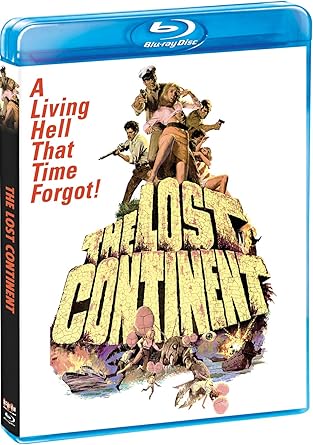
The Lost Continent (1968) ***

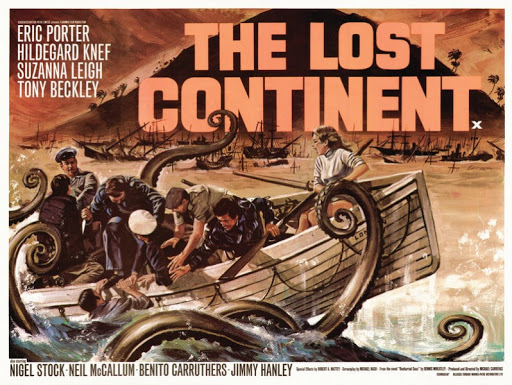
Hammer had struck gold revisiting ancient civilization in One Million Years B.C. (1966) and with its adaptation of Dennis Wheatley’s The Devil Rides Out (1967). The Lost Continent was another Wheatley number (source novel Uncharted Seas) mixing dangerous voyage, hints of the legendary Atlantis, and monsters. While the first half could have been marketed as The Wages of Fear At Sea the second half would come under the heading  “The Greatest Oddball Film Ever Made.”

It boasts one of the most intriguing setting-the-scene openings not just of a Hammer picture but of any film – a camera pans along a steamship on whose deck are: people dressed in furs, others in modern clothing and – Conquistadors. Attention is focused on a coffin.  How and why they got there is told in flashback. A first half of taut drama, mutiny, sharks, a ferocious octopus, and lost-at-sea a thousand miles from land segues into sci-fi with carnivorous weeds, monsters, and a weird, weird world.
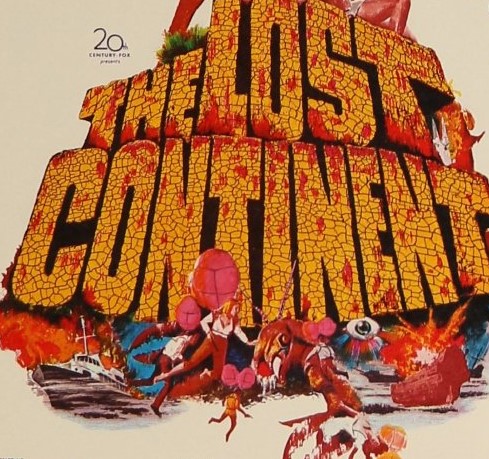
It’s hard to know what’s worse, Captain Lansen (Eric Porter) with a cargo of toxic chemicals made combustible when touched by water or the equally combustible passengers all with murky pasts, so determined to escape their previous lives that they refuse to turn back in the face of a hurricane. Heading the Dodgy Half-Dozen is dictator’s mistress Eva (Hildegarde Knef) with two million dollars in stolen securities and bonds. Dr Webster (Nigel Stock), a back-street abortionist, is at odds with daughter Unity (Suzanna Leigh), who has cornered the market in backless dresses. Harry (Tony Beckley)  (The Penthouse, 1967) plays a conman while Ricaldi (Ben Carruthers) is trying to recover the pilfered bonds.

But the arrival of cleavage queen Sarah (Dana Gillespie) as an escapee from the weird world signals a shift to Planet Oddball. The only way to navigate the weeds trapping the ship is with a primitive version of snowshoes with balloons attached to the shoulders. Soon they are trapped in the past, not as prehistoric as One Million Years BC (1966), just a few centuries back to the Spanish Conquistador era. The film steals the idea from the Raquel Welch picture of giant creatures locked in battle but without going to the necessity of hiring Ray Harryhausen.
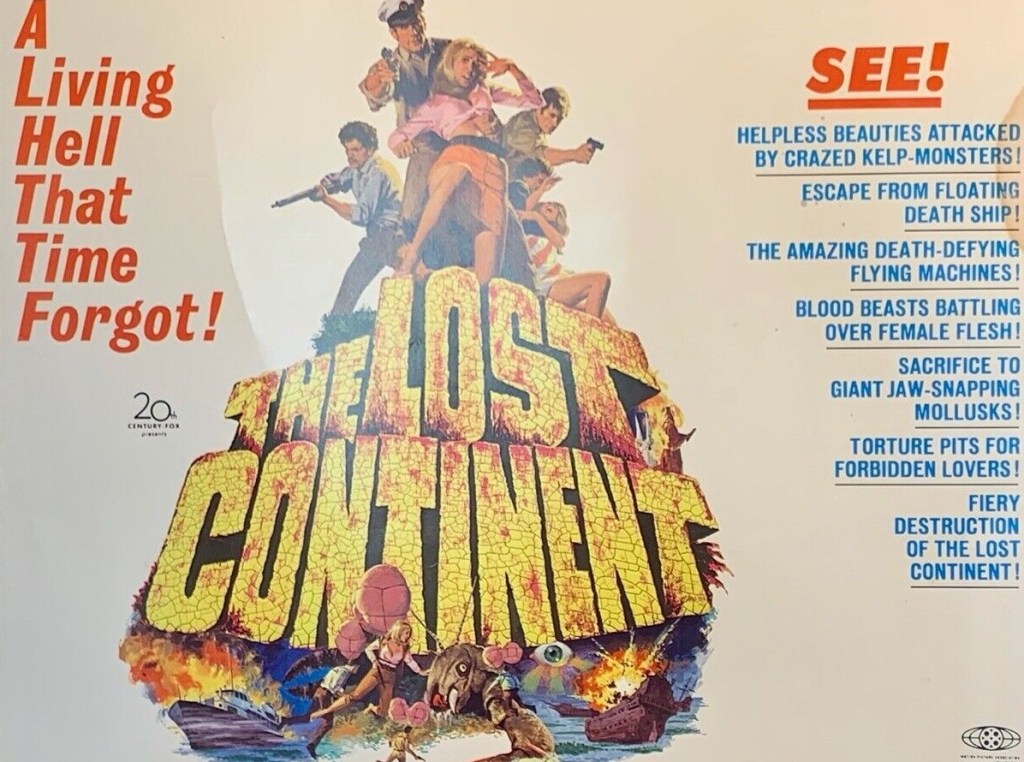
You couldn’t legislate for the movie’s logic and you shouldn’t even try, just go with the weird flow. It’s on safe enough territory until like The Hangover (20090  it has to explain the bizarre opening sequence. If ever a film has bitten off more than the special effects can chew, it’s this, but it’s still fun watching it try.

The casting relied heavily on actors best known from television or rising stars. Eric Porter was straight from BBC television mini-series mega-hit The Forsyte Saga (1967). Nigel Stock essayed Dr Watson in the BBC Sherlock Holmes series (1964-1968). Falling into the emerging-star category were:  Tony Beckley (The Penthouse, 1967), Suzanna Leigh (The Pleasure Girls, 1965) Neil McCallum (Catacombs / The Woman Who Wouldn’t Die, 1965), and Dana Gillespie (Secrets of a Windmill Girl, 1966). Hildegarde Knef (Mozambique, 1964) was just about the most experienced.

In this kind of picture, without being sexist about it, if a woman is required to do more than just scream, it often indicates she has the better part. And so it is here. Leigh and Knef hog the dramatic highlights while Gillespie, courtesy of her outfit and footwear, can’t help but steal the show.

On board ship, director Michael Carreras, fresh from Prehistoric Women (1967), does well, the characters are all solidly presented with decent back stories, but once he enters weird world budget deficiencies sabotage the picture. Even so, it’s worth a look just to see what you’re missing. If you’re looking for a genuine freak show, this ticks the boxes.
The Long Ships (1964) ***

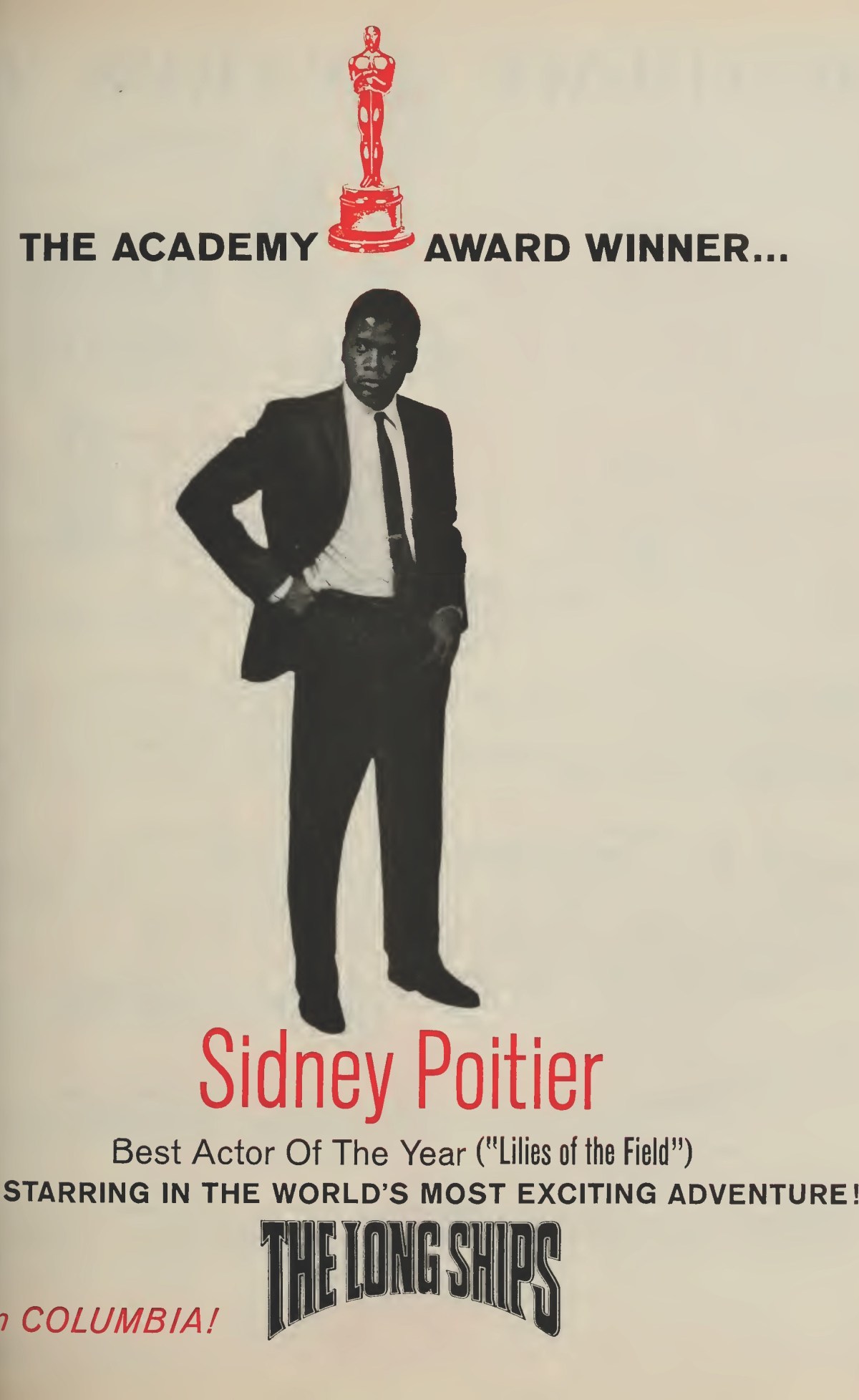
Decent hokum sees Vikings ally with Moors to seek a mythical giant bell made of gold, “the mother of voices.” There are stunning set-pieces: a majestic long ship coming into port, superior battles, the Mare of Steel, the discovery of the bell itself, while a clever ruse triggers the climactic fight. There’s even a “Spartacus” moment – when the Vikings declare themselves willing to die should their leader be executed.

Rolfe (Richard Widmark) is the wily Viking, second cousin to a con man, demonstrating his physical prowess although he does appear to spend an inordinate amount of time swept up ashore after shipwreck. Moorish king Aly Mansuh (Sidney Poitier) is his rival for the legendary bell.  The diminutive Orm (Russ Tamblyn), Rolfe’s sidekick, appears to be in a constant athletic duel with the Viking.

Although handy with a sword, both are equally adept at employing seduction, Aly Mansuh making eyes at Viking princess Beba Loncar (in her Hollywood debut) while Rolfe targets Poitier’s neglected wife Rosanna Schiafffino (Two Weeks in Another Town, 1962). The story is occasionally put on hold to permit the Viking horde to pursue their two favorite pastimes – sex and violence – and they make the most of the opportunity to frolic with a harem.

One of the marks of the better historical films is the intelligence of the battle scenes. Here, faced with Muslim cavalry, the Vikings steal a trick from The 300 Spartans by lying down to let the horses pass then rising up to slaughter their riders. But there is also an unusual piece of intelligent thinking. Realising, as the battle wears on, that they are substantially outnumbered and have their backs to the sea, Widmark takes the sensible option of surrendering.

Richard Widmark (The Secret Ways, 1961) makes the most of an expansive role. Instead of seething with discontent or intent on harm as seemed to be his lot in most pictures, he heads for swashbuckler central, with a side helping of Valentino, gaily leaping from high windows and engaging in swordfights. Sidney Poitier (Duel at Diablo, 1966), laden down with pomp and circumstance rather than immersed in poverty as would he his norm, is less comfortable as the Islamic ruler. (Widmark and Poitier re-teamed in The Bedford Incident, 1965, also reviewed in the blog.)

The puckish Tamblyn (The Wonderful World of the Brothers Grimm, 1962) almost steals the show. Both Loncar and Schiaffino have decent parts.

Director Jack Cardiff, Oscar-nominated for Sons and Lovers (1960), brings to bear his experience of working on The Vikings (1958) for which he was cinematographer. He is clearly at home with the action and equally there is some fine composition. However, the story in places is over-complicated, and he fails to rein in the mugging of one of the industry’s great muggers Oscar Homolka (Joy in the Morning, 1965) and there is a complete disregard for accent discipline.  Edward Judd (The Day the Earth Caught Fire, 1961), Scotsman Gordon Jackson (The Great Escape, 1963) and Colin Blakely (The Private Life of Sherlock Holmes, 1970) have supporting roles.

Berkely Mather (Dr No, 1962), Beverly Cross (Jason and the Argonauts, 1963) and, in his sole movie credit, Frans G Bengtsson, collaborated on the screenplay.

Good fun and great to see Widmark and Poitier turning their screen personas upside down.

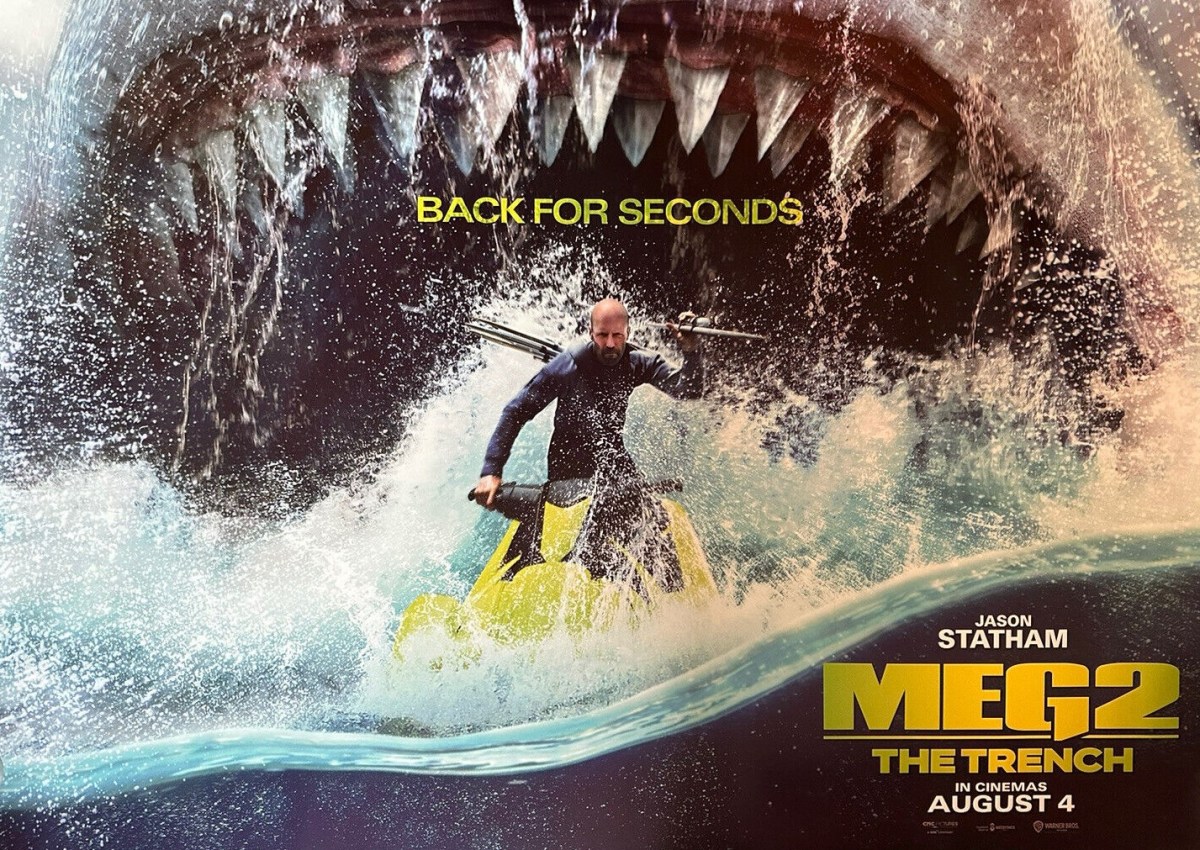
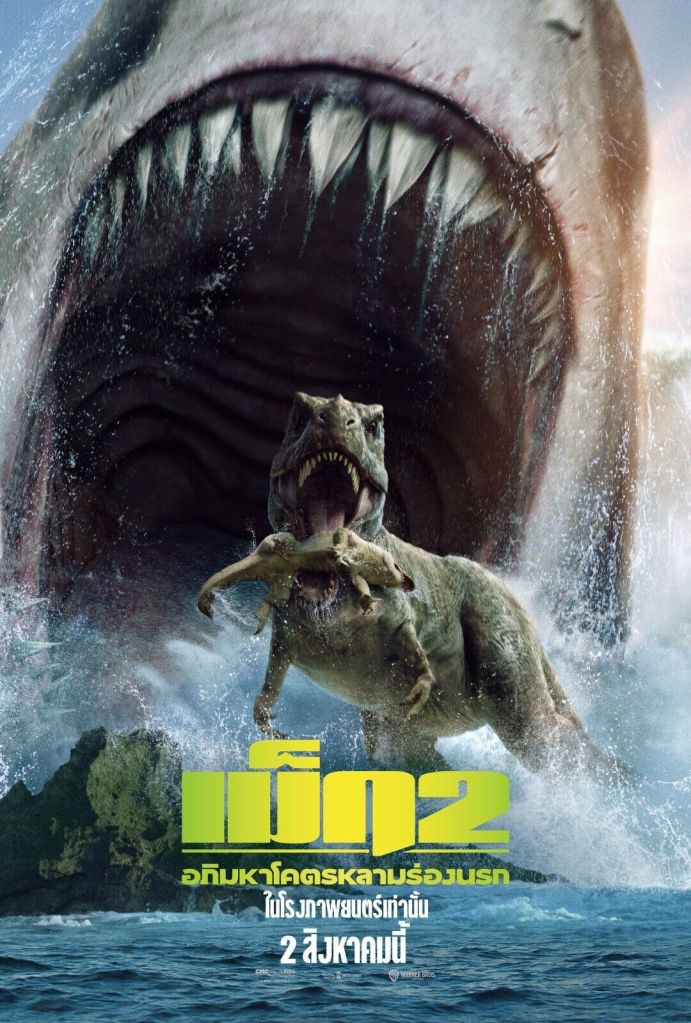
Meg 2: The Trench (2023) **** vs The Dive (2023) **

Once you get over the notion of Jason Statham as an eco-warrior, and alternating between grumpy and cuddly step-dad, and that the eco-goodies are actually hypocritical eco-baddies, pillaging the depths of the ocean for the equivalent of Avatar’s unobtainium, and the top scientist who keeps a captive Megaladon in check by what looks like dog-training techniques, and the usual gobbledegook sci-fi anomalies, you are in for a hell of a ride as a trio of Megs start chomping down on the kind of witless holidaymakers who peppered the likes of Piranha 3D.

There are neat references to Jurassic Park and nods to Chinese rather than American culture, especially in veneration of the old, and the action, once it surfaces from the gloomy depths, is breath-taking. Perfect summer popcorn material. You can pretty much ignore the MacGuffin, whose sole purpose is to ensure the Megaladons are freed from climactic imprisonment – the “thermoclime” – in the Mariana Trench.

Given there’s a fair bit of plotty-plot-plot to get through it’s just as well we kick off with action. Jonas (Jason Statham) ingeniously bursts out of a container on a merchant ship dumping hazardous waste and having captured on film the evidence he requires is scooped from the ocean like a drowned rat by a seaplane with giant jaws. Deep-sea exploration company owner Jaining (Wu Jin) has teamed up with billionaire investor Hillary (Sienna Guillory) to make further forays into the aforementioned trench.

On a routine dive in a far-from-routine submersible, Jonas’s teenage step-daughter Meiying (Shuya Sophia Cai) stows away so when the crew discover an illicit mining operation and that the captive Meg has escaped and teamed up two other Megs, the stakes couldn’t be higher. It’s a bit murky down below and despite the various oohs and aahs of the explorers nothing really stunning on view. Still, that’s not what we’re here for, and luckily Avatar-style visuals take second place to more action as Jonas, striding along the trench floor in exosuit, has to save all from the ruthless mercenary Montes (Sergio Peris-Mencheta).

But, really, this a mere prelude to what’s going to happen once everyone, creatures included, surface. The Megs are slick operators, keeping tight formation as they tear through the water. Fancying a tourist snack, the creatures home in on Fun Island. Jonas has his work cut out saving the innocent rich from the quartet of predators and a bunch of nasty prehistoric amphibians while fending off Hillary and her gang of thugs.

It’s certainly inventive enough and occasionally light-hearted and the action is spread out among the various participants, Meiying proving a chip off the old block, and no romance this time getting in the way. Heartless villain Hillary is despatched in the most obvious homage to Jurassic Park and the climax, as you might expect, is Jonas going one-on-one with any alpha male, whether Montes or the gigantic creatures. Explosives taped to harpoons, explosives made out of fertilizer, and helicopter rotors are among the improvised weapons.

While you couldn’t accuse it of being thoughtful, and you might even consider it a shade cynical in its use of eco-activism, it never takes itself seriously, which means it’s just a whole load of fun. Go looking for anything more meaningful or more cinematic (a la Steven Spielberg) and you’re wasting your time. But who, really, would make such a mistake. The popcorn is calling.

Certainly, compared to arthouse cop-put The Dive it’s a work of genius. This purported anti-blockbuster resorts to info-dumps to create any sort of suspense. By the time you’re halfway through you’re desperate for a shark, octopus, manta-ray, demon of the deep, to gobble up this hapless pair of divers, sisters Drew (Sophie Lowe) and May (Louisa Krause). If it had the conviction of its arthouse credentials, there would have been a tragic ending, the incompetent Drew unable to save the resourceful, efficient, May, trapped underwater by an unexplained rockfall.  

The falling rocks manage to bury their rucksacks, including car keys, but magically miss the jetty yards away.  For no earthly reason except it fits the story, May can’t open the car boot to find a tire lever. For no earthly reason, as an experienced diver, and although her life depends on it, she doesn’t know how to properly attach an oxygen tank. And quite how, in her bewilderment, and in murky depths, she manages to find the trapped sister time and again is baffling. And when she does find the solution to releasing her sister it’s one of those daft ideas straight out of Apollo 13 that you sit there questioning. Naturally, there’s a pocket of trapped air underground just when it’s most needed.

But, mostly, Drew’s running around like a headless chicken and for some reason that detracts rather than builds suspense. Half the time we’re getting info dumps, not of the time-running-out variety, but on how far down they are and what you’ve got to do avoid the bends.  But you discover less about the characters than in The Meg 2, and care even less. Drew is grumpy, disillusioned for some reason, while May is sparky and enthusiastic and any time the supposed suspense gets too much director Maximilian Erlenwein cuts away to their carefree childhood or to a conversation that is meant to have hidden meaning.

Rotten Tomatoes critics rate The Dive (69%) above Meg 2 (30%) but audiences, who know better, go the other way, 73% for the monster-filled concoction, 50% for the monster-free bore.

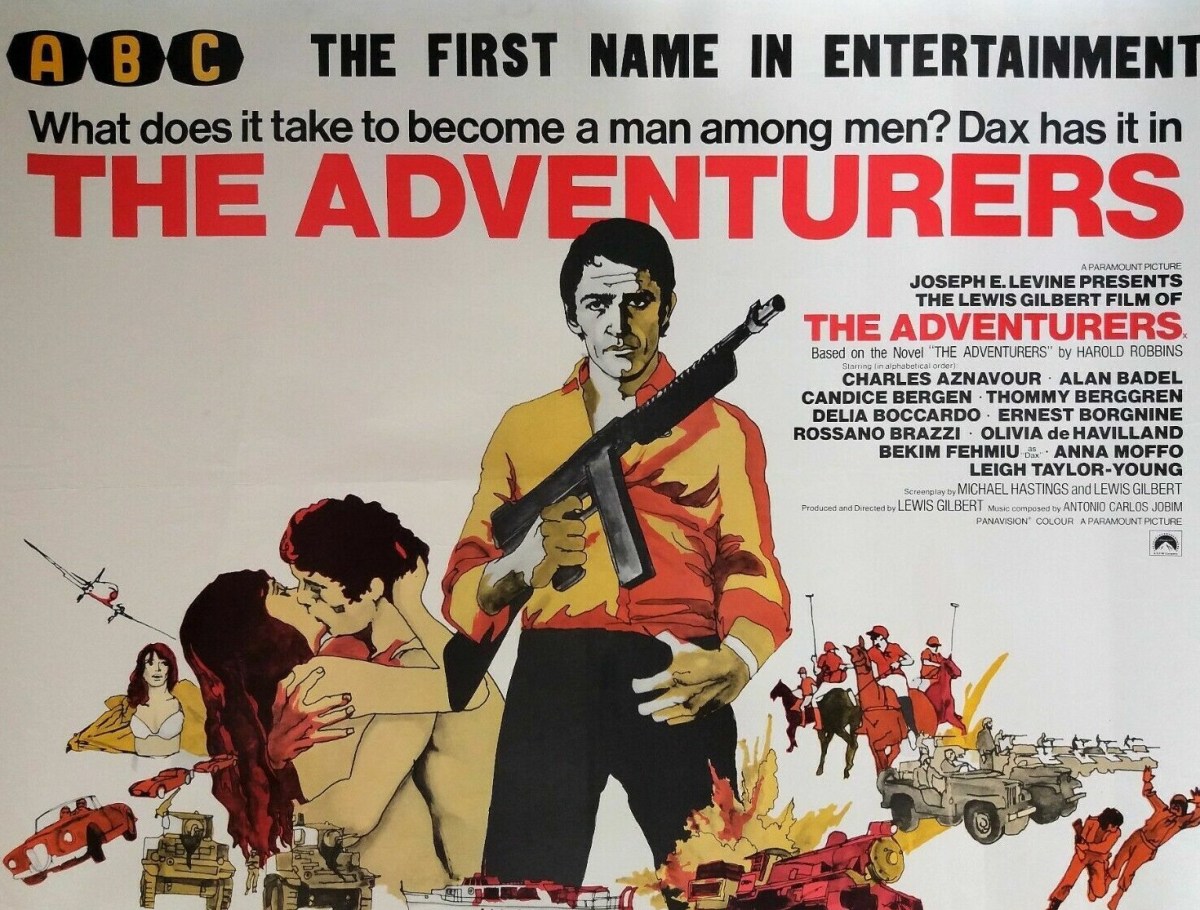
The Adventurers (1970) ***

Class A Trash. Adaptation of Harold Robbins (Nevada Smith, 1966) bestseller goes straight to the top of the heap in the So-Bad- It’s-Good category. Only Alan Badel (Arabesque, 1966) as a double-dealing revolutionary comes out of this with any honors.

The likes of Candice Bergen (Soldier Blue, 1970), Rossano Brazzi (Rome Adventure/Lovers Must Learn, 1962), double Oscar-winner Olivia de Havilland (Hush, Hush, Sweet Charlotte, 1964), Leigh Taylor-Young (The Big Bounce, 1969)  and Ernest Borgnine (The Wild Bunch, 1969) must have wondered how they were talked into this.

And director Lewis Gilbert (Loss of Innocence/The Greengage Summer, 1961) must have wondered how he talked himself into recruiting unknown Yugoslavian Bekim Fehmiu (The Deserter/The Devil’s Backbone, 1970), nobody’s idea of a suave lothario,  for the lead.

One of the taglines was “Nothing has been left out” and that’s to the movie’s detriment because it’s overloaded with sex, violence, more sex, more violence, in among a narrative that races from South American revolution (in the fictional  country of Corteguay) through the European jet set, fashion, polo, fast cars, orgies, and back again with revenge always high on the agenda. At close on three hours, it piles melodrama on top of melodrama with characters who infuriatingly fail to come to life.

Sensitivity is hardly going to be in order for Dax (Bekin Fehmiu) who, as a child after watching his family slaughtered and mother raped, makes his bones as a one-man firing squad, machine-gunning down the murderers. From there it’s a hop-skip-and-jump to life as the son of ambassador Jaime (Fernando Rey) in Rome where he belongs to an indulgent aristocracy who play polo, race cars along hairpin bends, swap girlfriends and, given the opportunity, make love at midnight beside the swimming pool.

His fortunes take a turn for the worse when his father backs the wrong horse, the rebel El Condor (Jorge Martinez de Hoyos)  in Corteguay, and is killed by the dictator Rojo (Alan Badel). In between an affair with childhood sweetheart Amparo (Leigh Taylor Young), life as a gigolo and cynical marriage to millionairess Sue Ann (Candice Bergen), Dax takes up the rebel cause, initially foolish enough to fall for Rojo’s promises which results in the death of El Condor, and then to join the rebels.

But mostly it’s blood, sex, betrayal and revenge. Anyone Dax befriends is liable to face a death sentence. He only has to look at a woman and they are stripping off. It’s a heady mess. It might have worked if the audience could rustle up some sympathy for Dax, especially as he was entitled to feel vulnerable after his childhood experiences. But he just comes across as arrogant and the film-makers as even more arrogant in assuming that because women fall at his feet that must mean he had bucketloads of charm rather than that was what it said in the script. He’s fine as the thug but not convincing as a lover.

Excepting Badel, the best performances  in a male-centric sexist movie come from women, those left in Dax’s wake, particularly Candice Bergen as the lovelorn wife and Olivia De Havilland as the wealthy older woman who funds his lifestyle, aware that at any moment he will leave her for a younger, richer, model. Lewis Gilbert is at his best when he lets female emotion take over, not necessarily wordy intense scenes, because Bergen and De Havilland can accomplish a great deal in a look.

The rest of it looks like someone has thrown millions at a B-picture and positioned every character so that they have nowhere else to go but the cliché.

By this point, Hollywood had played canny with Harold Robbins, toning down the writer’s worst excesses and employing name directors to turn dire material into solid entertainment. Edward Dmytryk (Mirage, 1965) had worked wonders with The Carpetbaggers (1964),  whose inherent salaciousness was held in check by the censor and made believable by characters played by George Peppard (Pendulum, 1969), Alan Ladd (Shane, 1953) and Caroll Baker (Station Six Sahara, 1963). Bette Davis and Susan Hayward contrived to turn Where Love Has Gone (1964) into a decent drama. Even Stiletto (1969), in low-budget fashion, managed to toe the line between action and drama.

But here it feels as if all Harold Robbins hell has been let loose. Rather than reining in the writer, it’s as if exploitation was the only perspective. Blame Lewis Gilbert, director,  and along with Michael Hastings (The Nightcomers, 1971) in his movie debut, also the screenwriter for the end result.

On the other hand, if you can leave your critical faculties at the door, you might well enjoy how utterly bad a glossy picture can be.

The Gypsy Moths (1969) *****

Unsung masterpiece. In the same year, director Jphn Frankenheimer went from the career nadir of The Extraordinary Seaman to an absolute gem. Beautifully paced, exquisitely observed, with five heart-wrenching performances of naked repression. For star Burt Lancaster a companion piece to The Swimmer (1968), for leading lady Deborah Kerr better work than even The Arrangement (1969), for supporting actor Gene Hackman (Downhill Racer, 1969) a wake-up call to Hollywood. Sparked by thrilling aerial sequences. And like Easy Rider (1969) interprets transience as freedom.

And in the most stunning piece of directorial bravura since Alfred Hitchcock despatched Janet Leigh halfway through Psycho (1960), here John Frankenheimer, four-fifths of the way through, leaves the others to pick up the pieces after the star’s apparent suicide.

A trio of sky divers – Mike (Burt Lancaster), Joe (Gene Hackman) and Malcolm (Scott Wilson) – on a barnstorming tour of small town USA board with Malcolm’s estranged Aunt Elizabeth (Deborah Kerr) and Uncle John (William Windom) in the small Kansas town where he was born and orphaned at age ten. John clearly resents the intrusion, Elizabeth finds it impossible to even hug her nephew, but a single glance between Mike and Elizabeth says it all. She is the bored housewife, he the conqueror.

But for all the subsequent revelations that would be melodramatic meat-and-drink to the likes of Elia Kazan’s The Arrangement, the entire tone is low-key. While fuelled on regret, this is not a movie that feasts on it.

And quite astonishingly, there is a whole pile of information dumps that serve to add tension to the tale. The stars of the show are all involved in the nitty-gritty, penning dates and times on posters, sewing their kit, the bombastic Joe acting as marketing guru and cheerleader. In a talk to women’s group, while purportedly explaining how a parachute works, Mike gives his audience a whiff of danger. For the whole enterprise depends on coming close to death. The longer a sky diver takes to open his parachute, hurtling to the ground at 200 mph, the more the crowd soaks it up.

The sky divers are long past the days of thrill-seeking, this is just a job, they are itinerants with nobody meaningful in their lives. Sky diving is “not only a way to live but also a way to die as few things are.”

Except when the performer, Mike is so reserved he might almost have disappeared into a void except silence seems to fill out his personality. He embarks on an affair with Elizabeth with scarcely a word spoken.

The screenplay has an amazing structure, each character exposed in novel fashion. The extremely realistic Mike finds himself in the deep waters of imagination. The overly-confident Joe speaks of his fears to the topless dancer (Sheree North) he has picked up but only when she’s safely asleep. He beats his chest in Church as he recites the “I am not worthy” section of the old Catholic Mass. Even the dancer gets a couple of great lines, confiding in a friend that Mike would have been her first choice to bed but Joe proved a decent substitute.

And there’s just a wonderful, initially mystifying, set of scenes, that could easily have been cut, but left in display the director’s utter mastery. A cranky conductor is rehearsing a marching band for, we learn later, the Fourth of July parade, picking, as is the way of cranky conductors, on some innocent in the band. Come The Fourth of July the marching band turns into main street – and finds it empty. The entire town, in a demonstration of ghoul-ness, has decamped to watch Malcolm attempt the stunt that cost Mike his life.

Returning home, Malcolm finds no homecoming despite his childless aunt desperate for a surrogate son. If she was any more buttoned-up she would explode. “I just wasn’t very observant,” she observes, explaining how her sister stole away her lover. And when that couple died in a car accident, John, who married Elizabeth on the rebound, forbade his wife to adopt Malcolm because he didn’t want to be daily faced with the son of her true love.

So many scenes are wordless observation. We focus on the dead eyes of John, pretending to be asleep, when his adulterous wife returns. Elizabeth watches her husband in a mirror. Virtually every shot of Elizabeth reveals the torment of a woman desperately clinging on to sanity. Every shot of Malcom reveals rejection.

Characters are viewed in long-shot, through doors, or from the sky, and then in bold extreme close-up, but not in a kind of experimental fusion of style, but through careful directorial consideration. You feel that every shot is just the correct shot for the moment.

For once, Frankenheimer has no conspiracy theory to peddle, but oddly enough this bears similarity to the car crash of The Extraordinary Seaman in that it is riddled with ghosts, of choices not taken, of regrets taken root.

And there is something quite remarkable in the character construction. Both Mike and Malcolm are melancholic, sapped of energy. Into this gap bursts Joe, a vibrant personality, the one gets every party going and always ends up with a bottle in one hand and a girl in the other. It’s quite a stunning performance from an, at this point in his career, a scene-stealer of some style.

In previous films Gene Hackman was always doing something, the hallmark chuckle still in embryo, but his performance often got in the way. Here, the screenplay by William Hanley – based on the novel by James Drought – effectively places him center stage, taking up the slack from the other pair and Hackman responds by proving how he could carry a picture if he was in fact the star.

Scott Wilson (In Cold Blood, 1967) takes the opposite approach, drawing us in with his soulful eyes and a demeanor calling out for affection. He dominates the final section as he, too, contemplates suicide, a pretty tall order given at this point he is in the sky and his eyes are masked by goggles.

When Deborah Kerr asks Burt Lancaster, “Why are we so contemptible to you?” it’s the question she’s asking of herself and that self-loathing guides her repressed performance, occasional bouts of adultery her only release, but unable, as with her early lover, to charge headfirst into happiness.

Lancaster’s role is central but not over-dominant in the way of The Swimmer. While seemingly the picture’s anchor, Frankenheimer is duping the audience in the manner of Hitchcock. Lancaster is not the unshakeable monolith he appears, but a fragile heart.  

Critics, possibly still confounded by The Extraordinary Seaman and feeling Frankenheimer had shot his bolt, were pretty dismissive of this at the time. It doesn’t score highly on any of the current critical aggregate charts.

But I find that simply astonishing. If ever there was a movie demanding reappraisal, it’s this.

Just stunning.

Go see.

Giants of Thessaly (1960) ***

Spoiler alert – this film contains no giants unless you count the one-eyed Cyclops. It’s the Jason and the Argonauts story with a lot of political shenanigans thrown in.

Even lacking the Ray Harryhausen special effects of the film covering the same ground a few years later and without the kind of budget dropped into the lap of a Stanley Kubrick it’s not a bad stab at retelling the myth. And Carlo Rambaldi (later the creator of E.T.) does a decent job of the Cyclops at a time when special effects were primitive.

This belongs to the Italian-made “peplum” genre, out of which came Hercules (1958). What struck me most was the director’s use of the camera, very often tracking a character in scenes that would otherwise have been static. There are virtually no close-ups and hardly any medium close-ups. It’s quite strange to see.

On the one hand a moving camera is an expense and on the other hand lack of close-ups saves money, so it’s possible the money spent on one technique was the result of saving money from another.

Alternatively, much of the director’s work has gone into arranging characters in group scenes in such a way that dramatic impact is sustained while not moving the camera. There’s enough political chicanery going on to keep two different plots going. Back in Jason’s (Roland Carey) homeland, where he is a king, an usurper not only seeks his throne but wants his wife and tries to deceive the population into thinking Jason is dead.

Meanwhile, Jason faces mutiny on board the Argo and then the temptations of the Siren, battle with the Cyclops, and then a final bold act to reclaim the Golden Fleece. Possibly the best scene is kept for the end, when the Argo arrives home with its own brand of deception. The film is topped off with a clever trick. Sometimes what we would now view as a B-film, ideal Saturday matinee material, sticks in the mind because it has been the proving ground for a future director or star but writer-director Riccardo Freda had already turned out Spartacus the Gladiator (1953) and Theodora, Slave Empress (1954).

Star Roland Carey was unusual in this field because he was actually a trained actor rather than hired for his torso, but this did not exactly stoke his career – his appearance in Fall of the Roman Empire (1962) was uncredited. Female lead Ziva Rodann was unusual, too, in that she was Israeli rather than Italian, had appeared in Samuel Fuller’s Forty Guns (1957) and second- billed in exploitationer Macumba Love (1960) and would later play Nefertiti in the Batman television series. If you go in not expecting much, you might get a surprise, though, be warned, the acting is wooden and other special effects, such as the storm, not quite in the Rambaldi class

Genghis Khan (1965) ****

Hollywood was never reined in by the strictures of history, much preferring fiction to fact for dramatic effect, and that’s largely the case here, although the titular hero’s real life remains shrouded in myth.

If you do catch this surprisingly good feature, make sure it’s not one of the many pan-and-scan atrocities on the market. I watched this in the proper Panavision ratio which meant it occupied only one-third of my television screen, but in that format it’s terrific. It’s a bit of an anomaly for a decade that churned out high-class historical epics like El Cid (1961) because this clocks in about a hour short of other films in the genre and there’s no star actor or director to speak of and no Yakima Canutt to handle the second unit action scenes.

Omar Sharif’s marquee value at this point was so low that if you check out any of the original posters you’ll note that his name hardly rates a mention and he also comes at the very end of the opening screen credits. Although this is post-Lawrence of Arabia (1962), it’s pre-Doctor Zhivago (1965), suggesting nobody had a clue how to market his talents.

Director Henry Levin was a journeyman, fifty films under his belt, best known for not a great deal except for, following this, the second and third in the Matt Helm spy series. Given this film was critically ignored on release and since, and a flop to boot, it definitely falls into the “Worth a Look” category. Although there are few stand-out scenes of the artistic variety such as pepper Lawrence of Arabia or El Cid, this is still well put together and Levin shows an aptness for the widescreen.

The narrative breaks down into three parts – the first section describing enslavement of Genghis Khan (Omar Sharif) by nemesis Jamuga (Stephen Boyd – the picture’s star according to poster and screen credits) – before banding together rival tribes in revolt; the second part a long trek to China; and the third encompassing a final battle and hand-to-hand combat with Jamuga. For a two-hour picture it has tremendous sweep, not just the scenery and the battle scenes, but political intrigue, romance, a rape scene and even clever comedy. Genghis Khan  believes his glory is predestined, but he has very modern ideas about the role of women.

The best section, oddly enough, is set in China where Genghis engages in a duel of wits with the distinctively contradictory Emperor (Robert Morley), but that’s not to detract from the film’s other qualities, the action brilliantly handled, especially the chaos of battle, the romance touching, and the dialog intelligent and often epigrammatic.

Unlike James Mason (Age of Consent, 1969) who makes a calamitous attempt at a Chinese accent, Robert Morley (Some Girls Do, 1969), costume apart and looking as if he has just walked out of an English country house, but his plummy tones belie a very believable character. Stephen Boyd (Assignment K, 1968) shines as the villain of the piece. Telly Savalas (Battle of the Bulge, 1965) and Woody Strode (The Professionals, 1966) have decent parts as Khan’s s sidekicks, the former unexpectedly bearing the brunt of the film’s comedy. French actress Francoise Dorleac (Billion Dollar Brain, 1967) is effective as Sharif’s wife.

Hitchcock stole one of his most famous ideas from Genghis Khan. About the only scene in Torn Curtain (1966) to receive universal praise was a killing carried out to a soundtrack of nothing more than the grunts of assailant and victim. But, here, where the score by Yugoslavian composer Dusan Radic was extensively employed, the rape scene is silent and just as stunning. If the only prints widely available are of the pan-and-scan variety I’m not surprised the film has been for so long overlooked, but if you can get hold of one in the preferred format you will be in for a surprise.      

Mister Moses (1965) ***

The “lost” Robert Mitchum picture, never seen on VHS or DVD, but now turning up on YouTube.

Elephants have little proven appeal for audiences. From Dumbo (1941), Hannibal (1960), Billy Rose’s Jumbo (1962) and Hannibal Brooks (1968) through to Dumbo (2017) and Babylon (2022), the story is one of negative impact on box office. Baby elephants are maybe a different story – see Hatari! (1962)  – but there’s very little that’s cuddly about the adult version and their main purpose appears to be to annoy a major stars initially and then go on a rampage that either hinders or helps said star. If you’re acquainted with elephants, you’ll notice this is of the tameable Asian variety rather than the untamed African.

The unnamed beast here would fall into the former category except the eponymous Mister Moses (Robert Mitchum) – real name Joe – can talk to the animal in a language it understands and persuade it to show off its parlor tricks, enhancing Moses’s status among a small  community in Kenya. Moses is a con-man-cum-diamond smuggler, rescued from a river, specifically the reeds growing there that offer a Biblical connection to the natives.

The Bible plays a significant role here, though the natives don’t fall for the Noah story as explained by missionary (Alexander Knox). They are, like Native Americans, being driven off their land by the arrival of a dam which will flood their traditional grounds. Their cattle have not been included in the grand plan to airlift the entire community. So they refuse government help, hence the need to embark on a 300-mile trek.

Moses, a dodgy character with “an allergy to badges of authority”, is blackmailed by the missionary’s daughter Julie (Carroll Baker) and ends up doing the job of her fiancé, district commissioner Robert (Ian Bannen), to shift the natives off their land. He’s got some parlor tricks up his sleeve, too, including a flame-thrower which, again the old Biblical touch, he can employ to burn a bush, thus endearing himself as a leader.  

Naturally, enough, though staid, Julie finds herself attracted to Moses, a somewhat laid-back character with quite a line in hip patter. But it’s quite a stretch for Julie to be seduced by his knowledge of classical literature, namely the Andromeda-Perseus tale. Not everyone takes to Moses’ leadership, saboteurs steal the map and the compass.  And it’s no surprise when someone finds another purpose for the flame-thrower. There’s a bad witch doctor Ubi (Raymond St Jacques) to be put in his place, and Joe rises out of his lethargy long enough to dispose of a couple of villains.

With the emphasis on the Biblical, Joe is called upon to “part the waters” Exodus-style. Disappointingly, this is a bit of a parlor trick. It had me wondering how the heck he was going to do that,  with just a flame thrower and an elephant at his disposal, and also given that the sole purpose of rivers in African movie vernacular is so that the leading lady can bathe in one. Since the aforementioned river is nothing more than the outcome of another dam, Moses is clever enough to simply persuade the dam superintendent to – miracle of miracles – to turn off the water.

There’s enough going on to maintain interest and the will-she-won’t-she element is well-handled and there’s a good final line, “What’ll I do for laughs?”

Robert Mitchum has been here before (Rampage, 1963) but this time is on the side of the animals. Of course, the main interest is not how well he gets on with the elephant but whether he strikes sparks with a Carroll Baker (Harlow, 1965) eschewing her normal sexy persona. A cross between Hayley Mills and Deborah Kerr, Baker doesn’t quite suggest bottled-up sexual energy fizzing to get out, but then that wouldn’t be in character. It’s not in The African Queen league in terms of screen partnerships but it’s certainly workable enough.

Ian Bannen (The Flight of the Phoenix, 1965) is at his scowling best although Raymond St Jacques (Uptight, 1968) gives him a run for his money. Director Ronald Neame (Gambit, 1966) proved as adept at handling the big-name stars as the animals without it being acclaimed as a famous “lost” work of Mitchum. The screenplay by Charles Beaumont (Night of the Eagle/Burn, With, Burn, 1962) and Monja Danischewsky (Topkapi, 1964) was based on the novel by Max Catto (Seven Thieves, 1960).

A pleasant enough diversion.

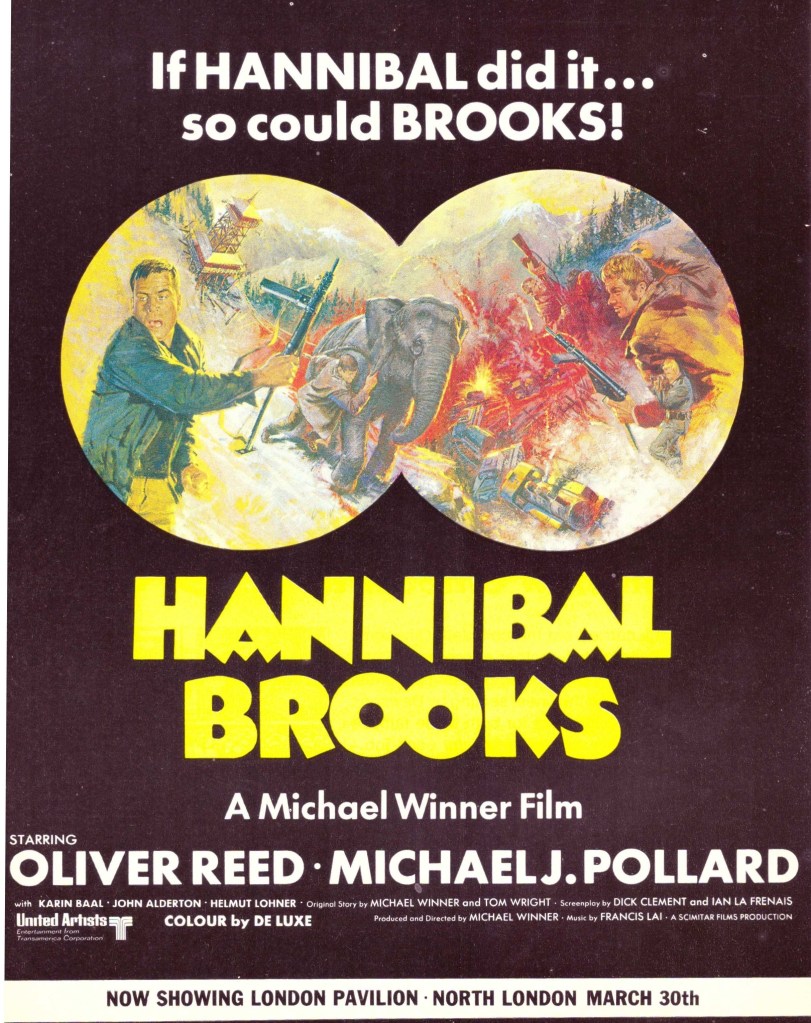
Hannibal Brooks (1969) ***

Gruff British star Oliver Reed shows his tender side in this entertaining offbeat POW escape picture. With local German men called up for war, Berlin Zoo relies on local prisoners-of-war to help look after the animals. Stephen Brooks (Oliver Reed) is detailed to look after an elephant (considerably more discreet in his toilette than those employed on Babylon). When Berlin is bombed, Brooks takes the elephant to Innsbruck in Austria.

His nickname is a bit of a misnomer. You would think he was going to emulate his famous predecessor and take the elephant over the Alps and into Italy, which would be possibly a safe destination because at this stage of the war the Americans have invaded and are marching north. But, instead, sadly, he only plans to make it as far as neutral Switzerland, where he would be equally safe.

Naturally he is pursued – and captured, and pursued and captured. But there always seems to be a convenient pile of logs that, a la Swiss Family Robinson, can be weaponised. And should you need any obstacle pulled down, well, an elephant comes in pretty handy on that score too.

Ineffectual American escapee Packy (Michael J. Pollard) turns up from time to time, usually in some piece of action that goes wrong, once to interrupt a romantic dalliance with Brooks’ occasional companion Anna (Maria Brockefhoff). And this being the Tyrol, it seems a shame not to halt proceedings every once in a while to take in a marching band or a traditional wedding or fair and for every damsel to have her cleavage on display.

Heading up the pursuit is Colonel von Haller (Wolfgang Preiss) although you might imagine he had more important things on his mind at this stage of the war than chase an elephant. Various troopers are so easily duped by Brooks they might have gone under the collective expression of “dolts.”

Where the elephant has to take the long way – he could as easily have been called “Slowly” – the Germans can travel by road, rail and cable car. It’s pretty episodic stuff, enlivened here and there by explosions and gunfights and the like and the question of whose side Anna is really on.

In some respects it’s a buddy picture. When the buddy is the elephant it works pretty well. Brooks is surprisingly tender and caring. But when Packy enters the equation and it’s the old question of three into two won’t go it becomes a bit lopsided. You get the impression it’s one of these picture that, to accommodate the budget, required an American star and Michael J. Pollard, with his already-established schtick, was nearest to hand.

It’s just as well Reed has toned down his scene-stealing growls and sideways glances because nobody can steal a scene like Pollard. If the elephant was ever in the slightest genuine danger, then you might have had a better picture, but nobody in those days was going to slaughter such a magnificent beast just to give a movie a harder edge.

Elephant is surplus to requirements in this action-based poster.

So the harder edge never comes, and it skips along uneasily between gentle comedy and action, with a potential screen partnership of unlikely personalities never quite gelling. If director Michael Winner had stuck with Reed and the elephant it would probably have worked much better. Or if the escapees had to blow up some vital factory or carry out another mission deep inside enemy territory it might have carried more narrative thrust.

It’s like two separate pictures, Reed and the elephant and Pollard and his bunch of generally hapless escapees. Harmless enough stuff and interesting mostly for seeing Oliver Reed upending his usual screen persona.

At this point in his career, Michael Winner (You Must Be Joking, 1965) was better known for comedy so perhaps this was his passport to suggesting to Hollywood he could handle action. Certainly, it suggested he could merit a bigger budget, for his next movie was The Games (1970) before stepping into the more comfortable territory of Lawman (1971).

I’d suggest this was equally a stepping stone for Reed (The Assassination Bureau, 1969). This film is largely ignored in assessments of the changes to his acting style that he made to accommodate the critically-acclaimed Women in Love (1969). And you can certainly draw a development line between the Michael J. Pollard of Bonnie and Clyde (1967) and his character in Little Fauss and Big Halsy (1970) where he successfully buddied up with Robert Redford. Dick Clement (The Jokers, 1967) devised the screenplay from a story by the director and Tom Wright, on whose own story of being a POW zookeeper this is based.

Most movies perceived as stepping stones are made of stronger material, and although this is more lightweight, it’s entertaining enough and certainly helped director and both stars switch career tracks.

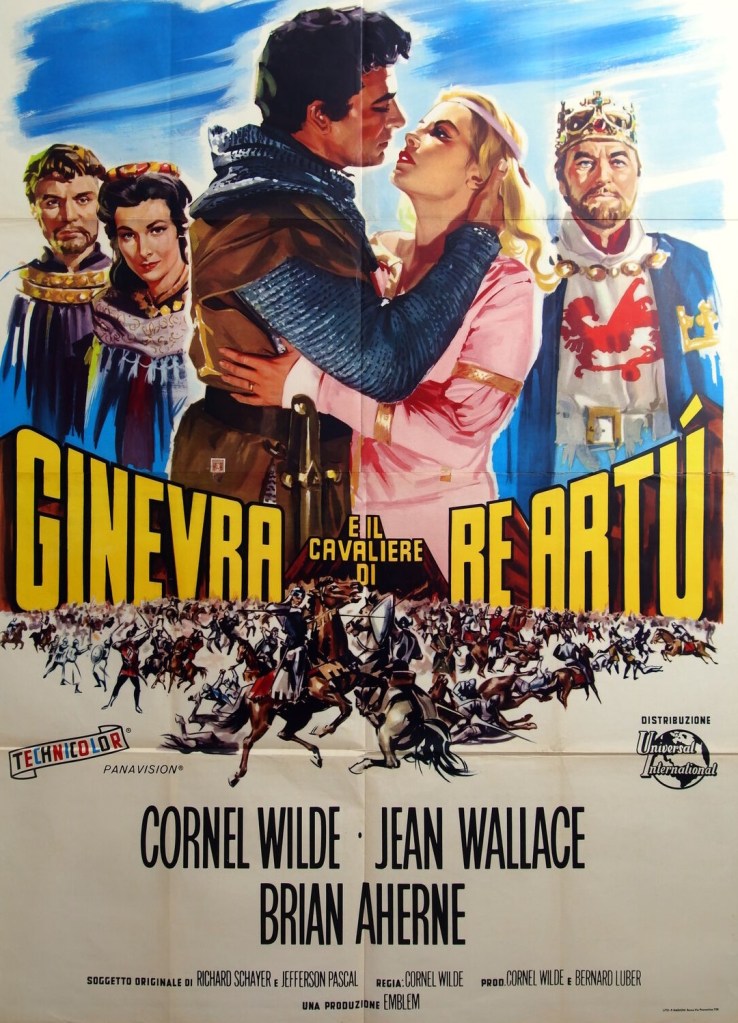
Sword of Lancelot / Lancelot and Guinevere (1963) ***

The legend is knotty. On the one hand it’s the most chivalric period in history. Excalibur, The Holy Grail, the feudal-tyranny-busting power-sharing democracy of The Round Table, and before Harry Potter came into view the most celebrated wizard of all time in the shape of Merlin. On the other hand, love was a pawn. Women were traded to cement relationships between rival kingdoms. And humans were all too fallible.

For a start, you had a king, Arthur, who couldn’t keep it in his pants and had already sired a bastard son Mordred who had his own ideas about inheritance. Then you had the king’s champion, Lancelot, who had a similar problem, except in his case he couldn’t keep his hands off the king’s new wife, Guinevere.

To pull off this love story, and keep the audience onside, you needed actors of a high caliber otherwise it sinks to a tawdry tale of adultery and betrayal. Unfortunately, there’s no Robert Taylor-Elizabeth Taylor (Knights of the Round Table, 1951) to hand and the combination of Cornel Wilde and his wife Jean Wallace doesn’t have the same ring or impact.

So, wisely, Cornel Wilde who doubles – make that quadruples – as director, co-writer and co-producer as well as star, concentrates on action, far more than in other swashbucklers of the decade such as Pirates of Tortuga (1961) and King’s Pirate (1967). Wilde has genre credentials, outside of Errol Flynn and Tyrone Power, with At Sword’s Point (1952) to his credit.

And you can’t help taking a liking to a swashbuckler which begins with a joke about soap, and then carries the same riff through to the obligatory bathing scene, where the act of physical washing, rather than merely splashing about in the nude for audience titillation purposes, sparks the relationship between the doomed couple.

This version of the story begins with the French king reneging on the deal to marry his daughter to King Arthur and demanding the matter be settled in the traditional manner, one-to-one combat. Lancelot is elected the English champion. By the time he returns home, complication lies in his wake. It’s not long before suspicions are aroused, Guinevere unable to keep emotions in check when she imagines Lancelot wounded in battle. Indiscretion gets the better of them and when Lancelot is discovered leaving her bedchamber, it’s all lovelorn systems go. Condemned to death for adultery, she needs rescued from a burning pyre.

Guilt ruins exile. Lancelot is now a reluctant rebel. And sex is off the agenda. Matters are only settled in the most drastic fashion, one that ensures an ending to rival Casablanca (1942). Action compensates for acting – Wilde runs the gamut of emotions from grimace to grin while Wallace over-acts – with a number of well-managed battle scenes.

The pick is Lancelot leading an army against raping pillaging Vikings. Apparently impregnable behind a lake that prevents attack on three sides, the Vikings don’t expect the English to block off their escape by setting the forest on fire, forcing them to charge through the water to Lancelot’s waiting troops. Another pitched battle is equally well-handled with thundering horses, each side trading volleys of arrows, and a clever flanking movement.

Although a relative novice behind the camera, Wilde is not afraid to experiment. Tracking cameras are extensively used as is limited point-of-view (opponent viewed through a vizor) although he does resort on occasion to older tricks like speeding up film so foot soldiers resemble Olympic sprinters.

And there is a sprinkling of other jokes and observations. A courtier mangles a visitor’s name in Court Jester fashion. Church bells ring because someone is battering the hell out of the iron casing. A rhymer is on hand to mock. A trumpeter is killed before he can sound the retreat. An old crone chomping on an apple settles in to watch a burning at the stake.

Obviously, in my search for a 1960s swashbuckler, I take the blame for bringing this to your attention. While lacking the charisma of Doug McClure and Jill St John in King’s Pirate  and the acting not rising much above the levels of Pirates of Tortuga, this outshines both in the action department.

Discover WordPress

A daily selection of the best content published on WordPress, collected for you by humans who love to read.

The Atavist Magazine

by Brian Hannan

WordPress.com Blog

News, Tips & Website Tutorials