I am a published author of books about film - over a dozen to my name, the latest being "When Women Ruled Hollywood." As the title of the blog suggests, this is a site devoted to movies of the 1960s but since I go to the movies twice a week - an old-fashioned double-bill of my own choosing - I might occasionally slip in a review of a contemporary picture.
The one where Burt Reynolds suddenly alights on his screen persona. At the outset he’s just another B-picture dude hoping to get by on macho posturing. Then, as though his brain has sparked into silver screen intelligence, the cocky grin appears. And we’re off.
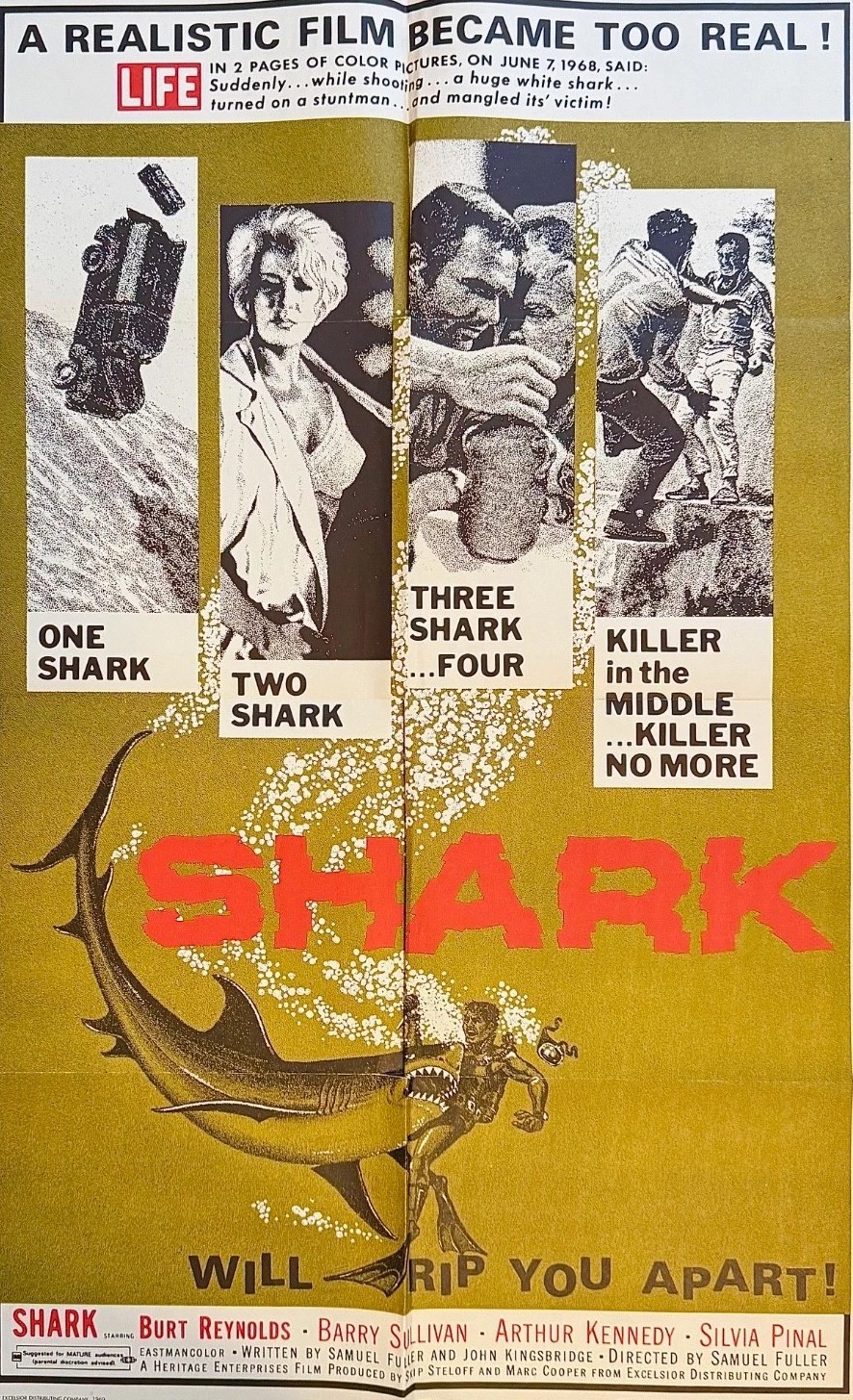
If any director was skewered by his insistence on retaining his artistic vision, it’s Samuel Fuller (The Naked Kiss, 1964). He wasn’t one for good guys and bad guys. Everybody’s up to something, if good deeds occur it’s by accident. Such realism would make him catnip for today’s disillusioned generation.
And it’s got cult written all over it because Fuller wanted to take his name off the picture after it was re-edited by the producer, possibly to include more shark footage at the expense of the human flotsam and jetsam trying to make a buck in the shark-infested waters off the Sudan in Africa. (Spoiler alert: it was filmed in Mexico). The shark footage for the era, it has to be said, is pretty damn good and although the sequences of people being gobbled up by a marauding shark must have been staged with a fake shark they look entirely convincing on the small screen.
And this was before the shark exploded on the screen via documentary Blue Water, White Death (1971) and of course Jaws (1975). Even so, the producers managed to make the sharks here sound even more fearsome by duping Life magazine into running some fake news about Burt Reynolds’ stunt double being killed by a shark.
In any other world two partners hunting for sunken treasure who were in sore need of a diver would simply have made an honest approach to their target, offering a share of the loot. Who’d not jump at the opportunity? Except Professor Mallare (Barry Sullivan) and Anna (Sylvia Pinal) only have a license to dive for strange sea specimens, not lost gold, and Caine (Burt Reynolds) is a gunrunner wanted by the police. The local cop Inspector Barok (Enrique Lucero) does his best to keep tabs on things except, short of donning scuba gear, he’s got no way of seeing what they’re getting up to underwater, though, clearly, as the story plays out, he has his suspicions.
Anna reckons she needs to offer Caine a sweetener to come on board, so she hops into bed with him. The only person who has a redemptive bone in his body is the alcoholic doctor (Arthur Kennedy) who spoils his own salvation by demanding dough for saving someone’s life.
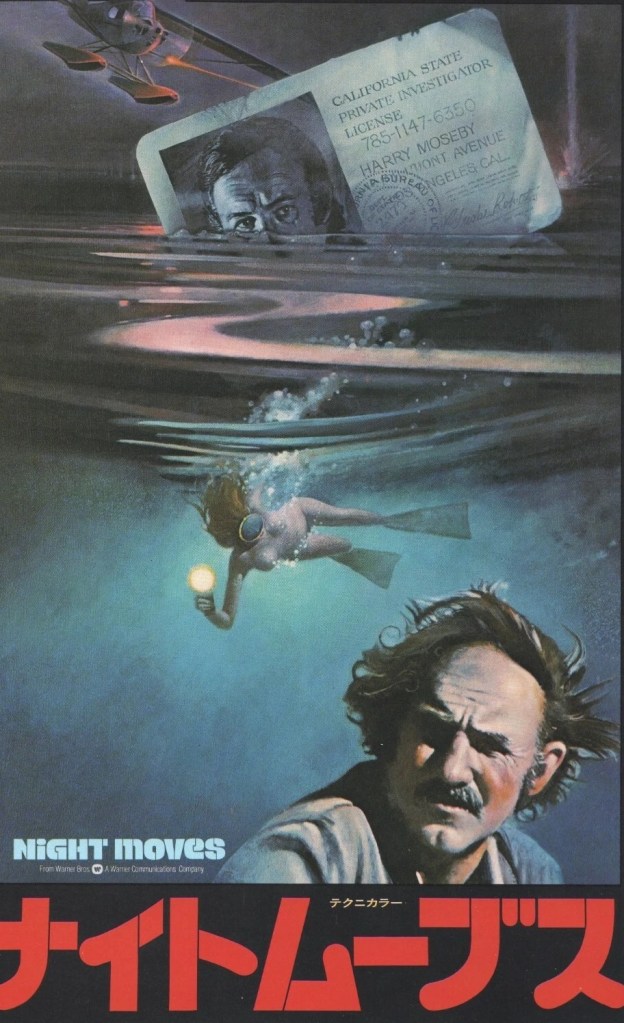
So while, what with being unable to resist the delectable Sylvia, Caine signs on for a share of the gold, he is from the outset planning how, in the event of striking it lucky, to get rid of his partners, which is just as well because they’re equally intent on getting rid of him. The climax is a pretty good one, and given I’d just watched Gene Hackman in Night Moves (1975) being left stranded and dying in a boat going round in circles in the ocean, that notion is matched here where Sylvia makes her escape on a boat she doesn’t know is sinking.
Burt Reynolds (Sam Whiskey, 1969), once the cocky grin puts in an appearance, isn’t the only plus point here. Five-time Oscar nominee Arthur Kennedy (Anzio, 1968) is slumming it but no doubt having a ball as an incorrigible drunk. This might also be perceived as a bit of a comedown for Sylvia Pinal (Guns for San Sebastian, 1968) after being a regular in Luis Bunuel arthouse offering like Viridiana (1961), The Exterminating Angel (1962) and Simon of the Desert (1965) but her part is too underwritten to do her talents justice. Barry Sullivan (Harlow, 1965) fills in the blanks.
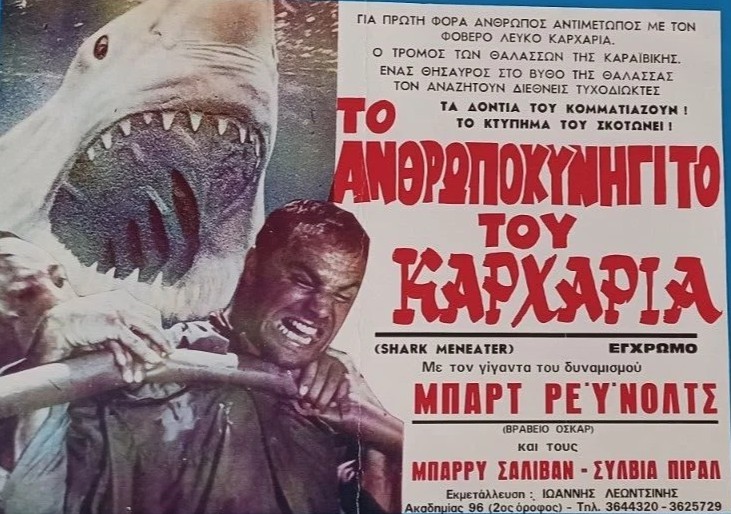
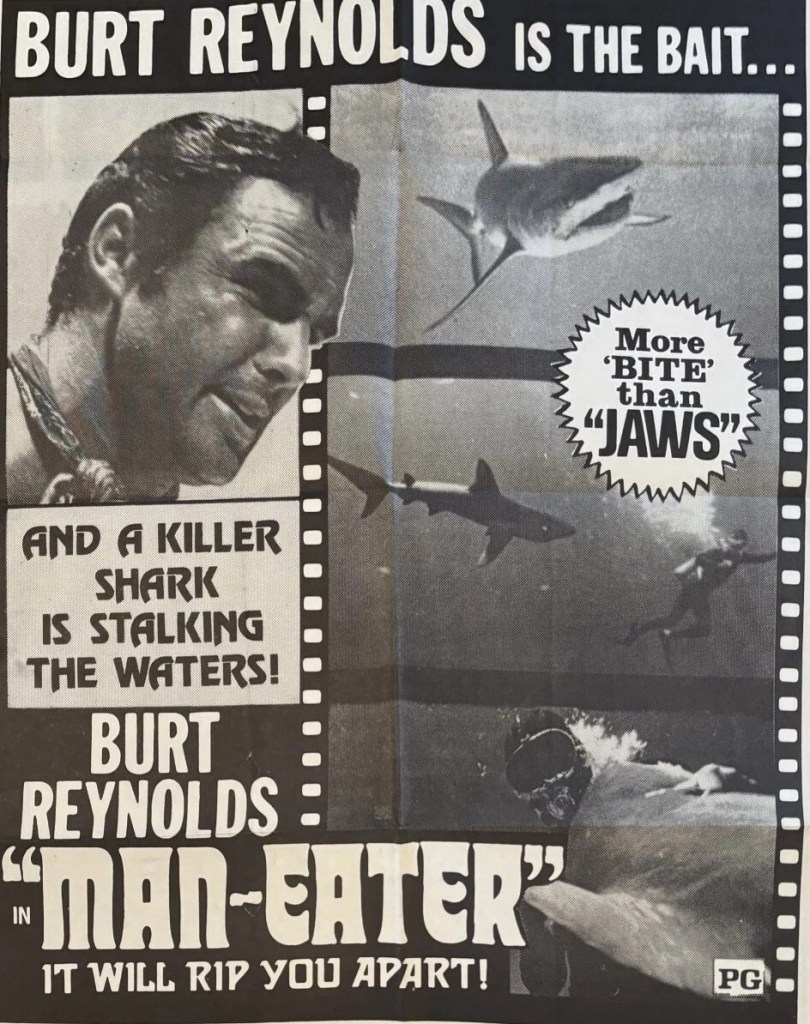
But maybe the star attraction is the shark in the days when such a creature made rare appearances on screen even if it’s not a great white as with Blue Water, White Death or Jaws. The Steven Spielberg blockbuster did Shark! a good turn, and in its wake the Fuller picture was reissued as Man-Eater in both 1975 and 1976 and again in 1978 after Burt Reynolds, cocky grin to the fore, had achieved superstardom thanks to Smokey and the Bandit (1977) and Hooper (1978). Screenplay by the director and television writer John T. Dugan in his movie debut based on the Victor Canning (Masquerade, 1965) bestseller.
It’s a shame Samuel Fuller objected to the end result for as far as I can see, after a slow start, it’s quite a decent picture and as I said the characters will appeal to a contemporary audience.
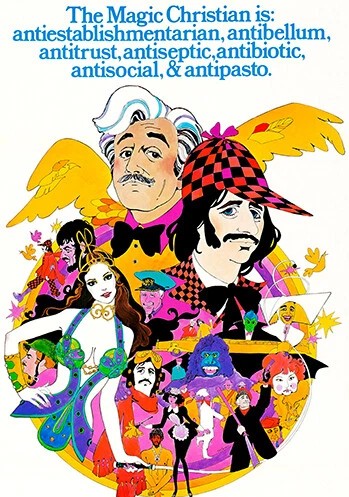
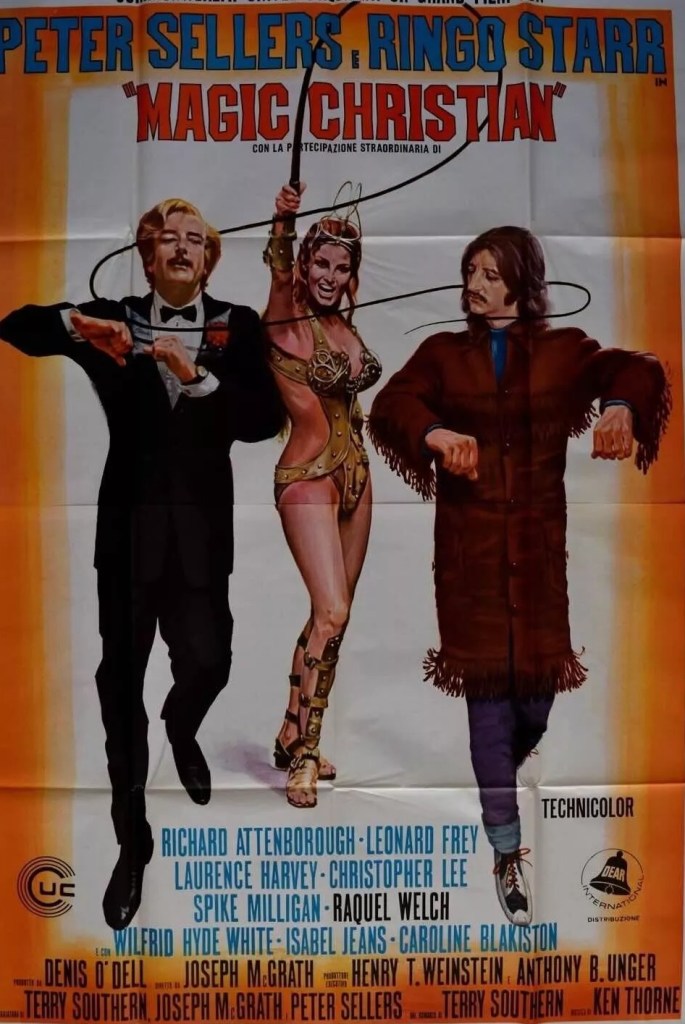
Substitute contemporary artwork/installation/performance art for practical joke and this will come up trumps. Taken in the artistic sense, where artists are pillorying society, there are gems – a stage Hamlet performing a striptease, feeding scraps of money to the ducks, ship passengers experiencing an apparent voyage when the vessel hasn’t left land, cutting up a famous work of art. Although I have to point out this will inevitably be remembered by some for a bikini-ed Raquel Welch cracking the whip over a galley of topless oarswomen.
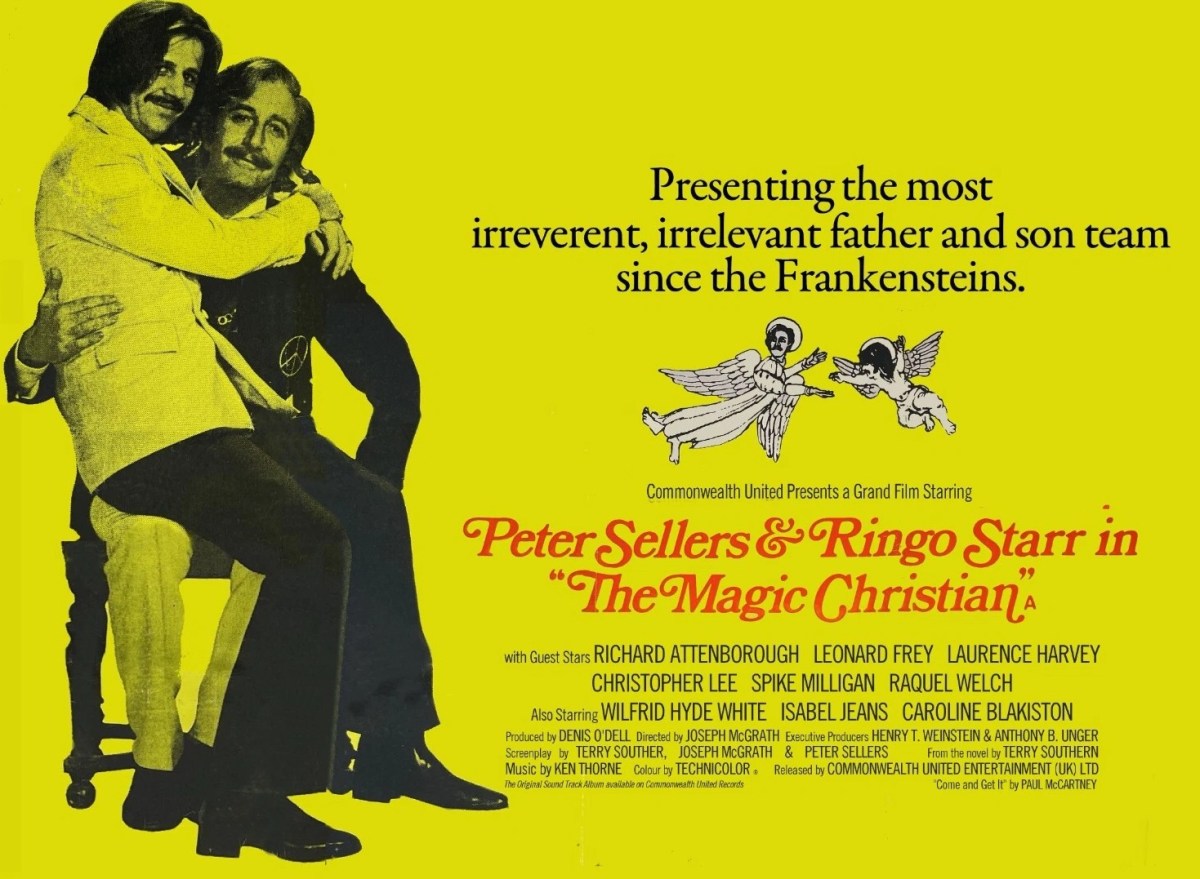
Effectively a series of comedy skits loosely tied together under the theme of money, mostly in the form of bribery. Billionaire Sir Guy Grand (Peter Sellers) sets out to teach adopted son Youngman (Ringo Starr) just what money can buy. Could you pay one of the teams sufficient dough in the annual Boat Race for them to ram the other? Would a parking warden (Spike Milligan) eat the parking ticket he has just issued? In the spirit of fair play is it okay to down a pheasant with an anti-aircraft gun?
When the going slows down, surrealism enters the equation: ship’s captain kidnapped by a gorilla, vampire waitperson, black head on white body, urine-soaked banknotes given away to a crowd, the occasional nun or Nazi, newspapers where apologies are written in Polish.
Plot-wise, there’s not much to it and the satire is merely repetitive as Sir Guy embarks on educating Youngman on the perverse uses of money. It has the feeling not of following a storyline but of “what can we get up to next” and attempting to layer shock upon shock in the manner, it has to be said, of some contemporary directors.
But there’s neither sufficient bite to the satire nor punch to the shock so it remains an elaborate series of disconnected sequences. Luckily, nobody’s having to pretend to put in an acting shift which is just as well because Ringo Starr proves he can’t act.
And it’s not much helped by a host of cameos – Laurence Harvey (A Dandy in Aspic, 1968), Richard Attenborough (Guns at Batasi, 1964), Christopher Lee (Dracula, Prince of Darkness, 1965), Raquel Welch (Bandolero!, 1968), director Roman Polanski (Rosemary’s Baby, 1968), Wilfred Hyde-White (P.J. / New Face in Hell, 1967), comic Spike Milligan and various members of the future Monty Python team including John Cleese (A Fish Called Wanda, 1988) and Graham Chapman. Harvey and Welch make the biggest splash.
Excepting Dr Strangelove, Hollywood had failed to capture the essence of offbeat novelist Terry Southern (Candy, 1968) and despite input from Chapman, Cleese and Sellers, this never really gets off the ground.
Peter Sellers (The Pink Panther, 1963) was in something of a career rut where very little struck home at the box office and he would continue a dismal losing streak until resuscitating The Pink Panther franchise in 1975.
Director Joseph McGrath’s (The Bliss of Mrs Blossom, 1967) record was spotty. Best known for music videos for The Beatles, he was only well served when his cast was filled with strong actors.
No more than an occasionally humorous trifle with an equally occasional target hitting the bullseye.
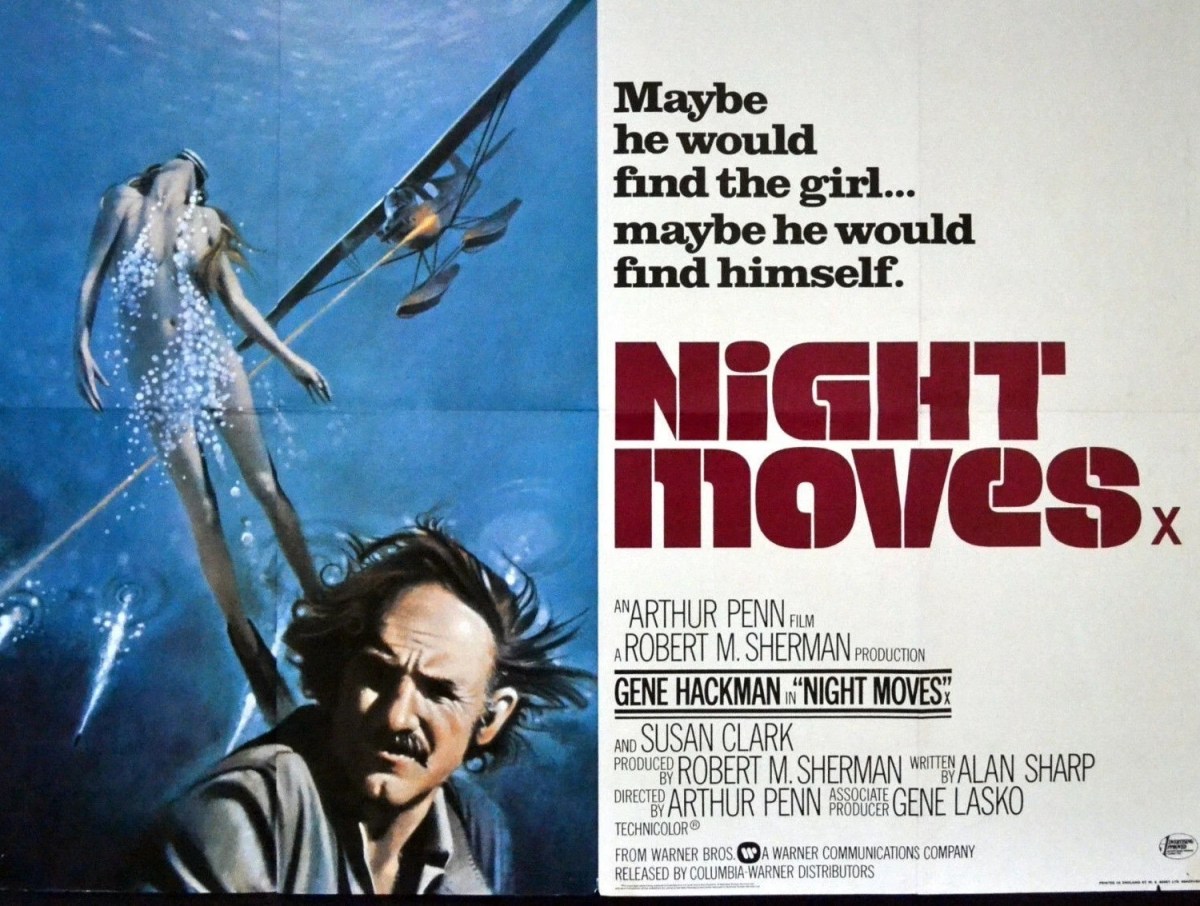
You want to know what screenplays are all about, it’s rarely dialog. It’s something registering the eyes. It’s very rare for a movie’s tone to change in a heartbeat. Or in this case in the blink of an eye. Planning to surprise his wife Ellen (Susan Clark) coming out of a movie theater, private eye Harry Moseby (Gene Hackman) sees her snuggle into the arms of another man (Harris Yulin).. The look on his face is pure shock. And from here on in, Moseby’s life turns upside down. He goes from macho man, ex-football jock with a swagger, to someone who’s duped by everyone around him.
Scottish screenwriter Alan Sharp was, for half a decade, an anomaly – though in the best possible way. Few screenwriters have achieved general fame – maybe Robert Towne (Chinatown, 1974), William Goldman (Butch Cassidy and the Sundance Kid, 1969) or John Milius (Magnum Force, 1973) – recognized for their writing style and creating identifiable characters. This was the final film in a short-lived golden era for Sharp, an award-winning novelist, who hooked Hollywood with his fresh takes on two of Hollywood most important genres, crime and the western. Beginning with The Last Run (1971) starring George C. Scott, he followed up with elegiac western The Hired Hand (1971), directed and starring Peter Fonda, Robert Aldrich’s tough Ulzana’s Raid (1972) with Burt Lancaster and Billy Two Hats (1974) topbilling Gregory Peck.
In a decade majoring on disillusion, Night Moves set a new template. Previously, the private eye, no matter how cynical, remained a hero, walking the mean streets, always coming out on top. Even Jack Nicholson in Chinatown won the day, exposing corruption, and Elliott Gould was as cool as the cats he preferred in The Long Goodbye (1973).
Moseby isn’t that good at his job. Little detection is required to track down missing Delly Grastner (Melanie Griffith), whose alcoholic mother Arlene (Janet Ward) requires her returned so she can claim an alimony check. This takes Moseby to old buddy, stunt coordinator man Joey (Edward Binns), making a film in which Delly is an extra and her sometime boyfriend Quentin (James Woods) a mechanic. And then onto the Floridsa Keys where the girl is hiding out with her stepfather Tom (John Crawford) and his younger sensuous ex-stripper girlfriend Paula (Jennifer Warren).
As the body count climbs – none of it Moseby’s doing, he’s not in the pistol-packing Dirty Harry league – and a boat wreck is found by Delly while snorkelling, the mystery deepens. But unlike most movies in the genre where the private dick is single or divorced, Moseby is (or was) a happily married man. And where in most movies in the genre, the personal life is left behind once the sleuth is on a case, here Moseby’s head remains filled with betrayal. His wife hasn’t even swapped him for a romantic hunk, instead his rival is smaller and walks with a limp.
Instead of Ellen taking the blame for the situation, Moseby is forced to confront his shortcomings which, of course, include not being able to talk about his early life or his feelings. Which means he’s primed to fall for Paula. Being the macho man, he thinks he’s making the running but in fact she’s using him as a patsy. And soon, just as he’s not spotted signs that this wife was being unfaithful, so, too, his misreads everything about the set-up at the Florida Keys and only discovers, when it’s too late, that he’s been played for a fool.
Usually, the protagonist in these pictures gets away with a quip or is disinclined to take commitment seriously, bed-hopping like James Bond. But Moseby is uxorious and finds it impossible to come to terms with his wife’s deceit. Once in a while he’s able to verbally let go, but mostly Hackman hardly needs dialog to convey his inner feelings to the audience. It’s an acting master class.
And it’s a very bold downbeat ending, the metaphor of a boat going round in circles is easily indicative of Moseby. You’re not going to get a more complicated character in the entire genre than Moseby and this is Gene Hackman (The Gypsy Moths, 1969) at his very best even though his peers didn’t notice, no Oscar acclamation forthcoming. The female roles are distinctive, Melanie Griffith (Working Girl, 1988) theoretically the most auspicious but all the women deceive, Jennifer Warren (Sam’s Song, 1969) slinky about it, while Susan Clark (Coogan’s Bluff, 1968) turns the situation back on her husband.
Arthur Penn’s (The Chase, 1966) career was already on the slide after the critical and commercial success of Bonnie and Clyde (1967) and revisionist western Little Big Man (1970). Warner Brothers didn’t like the finished result and neither did critics nor moviegoers, so in general it’s fallen away in public esteem.
Long-forgotten courtroom picture that deserves urgent reassessment in the wake of Jeffrey Epstein and especially the casual destruction of Virginia Giuffre. We’re so accustomed to attorneys being shown in a good light – defense lawyers rescuing the innocent, prosecutors putting away the evasive guilty – that we forgot just how brutal a trial is for the unprepared. Even a “fair trial” permits a lawyer to brutalize a witness. Until recently, rape trials came apart once the prosecution could prove the victim was “asking for it.”
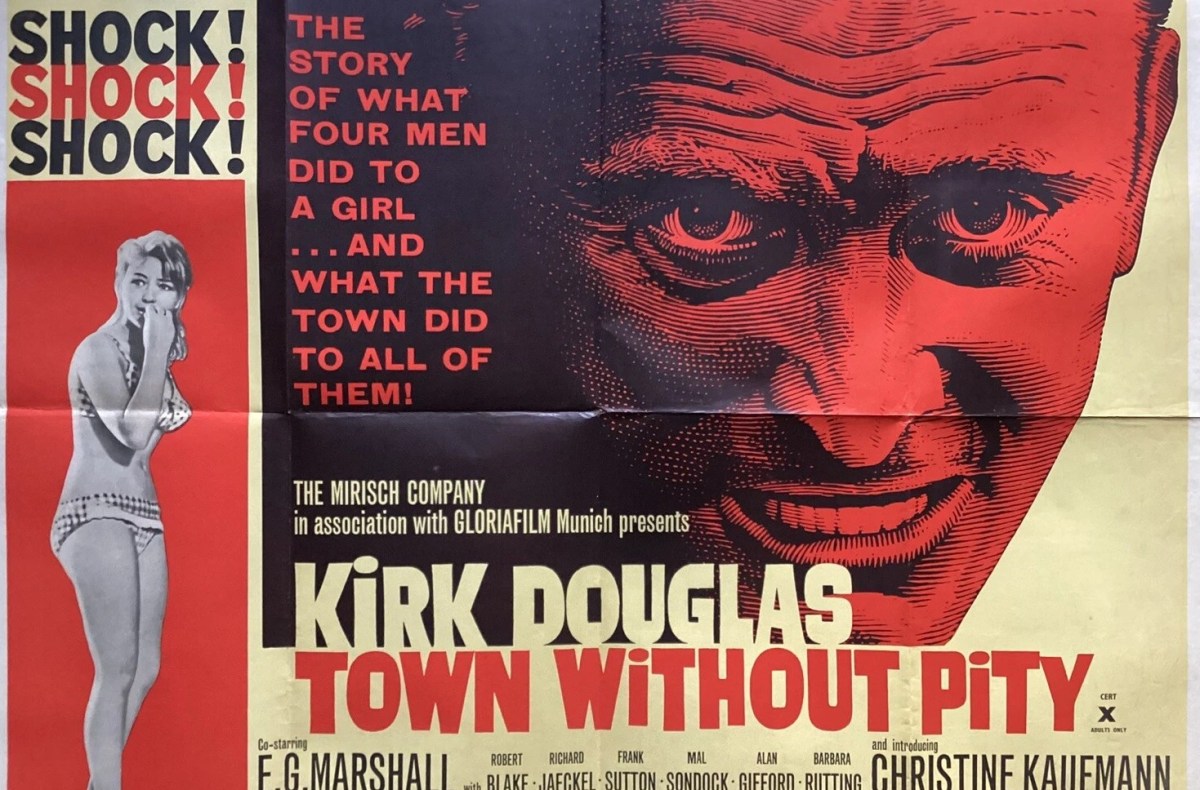
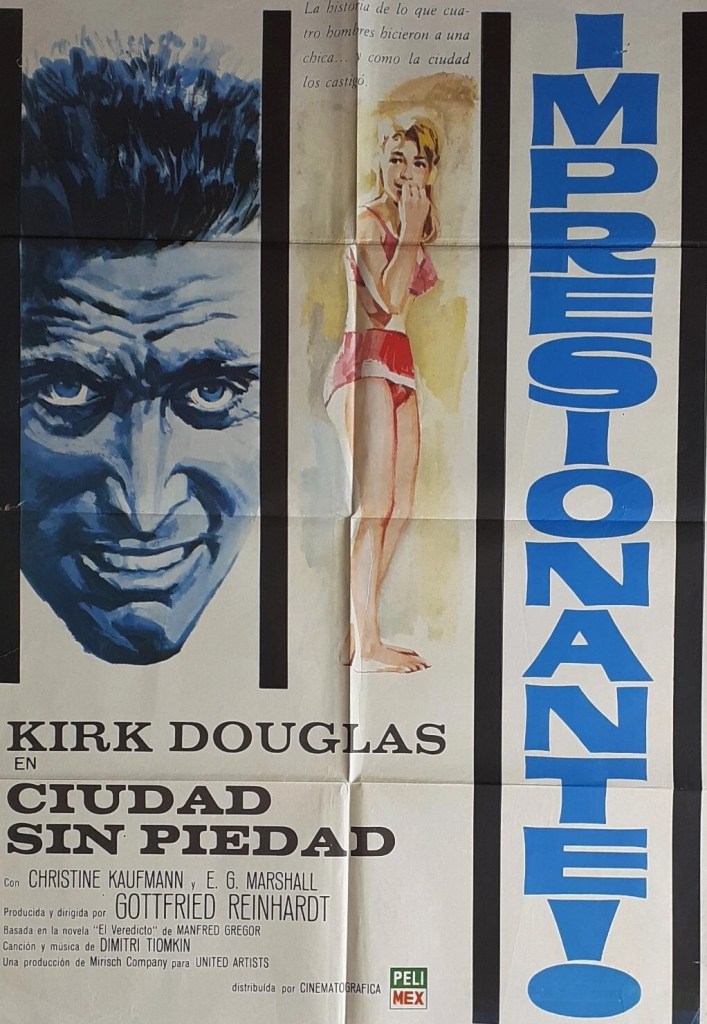
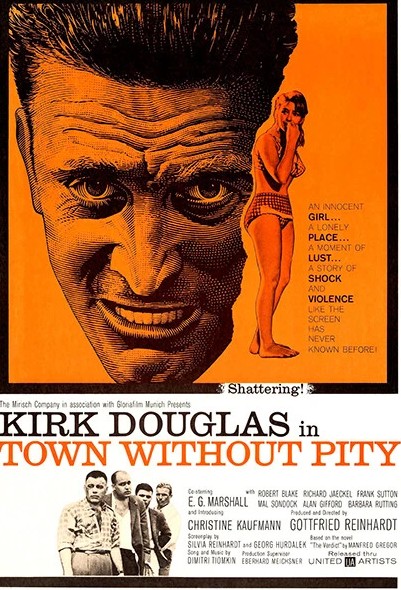
Four American soldiers rape a young girl in Occupied Germany at the start of the 1960s. Major Steve Garrett (Kirk Diouglas), defending the quartet, goes on the attack, attempting to demolish the reputation of banker’s daughter Karin (Christine Kaufman). Unusually, the stakes are the highest they could be. Under a quirk of German law, the soldiers could face the death penalty. Under another quirk, for that to have any chance of occurring, Karin has to take the witness stand. If Garrett can place her and her family under sufficient pre-trial duress she might excuse herself from court.
Turns out Garrett finds many willing accomplices among the townspeople. It’s not so much a town without pity as a town called malice. Some dislike her father, others feel she has already brought the town into disrepute, and there’s the usual generation clash. A voyeuristic neighbor reports that she stands boldly naked at her window. Another has seen Karin and her boyfriend Frank (Gerhart Lippert) spend a weekend together. Her shamed father Karl (Hans Nielsen) discovers a lot he didn’t want to know about his adored daughter, though, even so, he backs her, willing to suck up the humiliation and finger-pointing.
Everyone knows the men are guilty although one of them, Corporal Larkin (Robert Blake), might be technically innocent because he proves to be impotent. Even so, he was present and did nothing to prevent the assault. The men’s defense is that they came upon her naked and, having quarrelled with Frank, she flaunted herself, desiring the sexual attention of men. Since it would be embarrassing to admit that she stood around naked beside the river, she lies and says she was wearing a bikini at the time.
Kirk Douglas was such a dab hand at playing the action hero – Gunfight at the O.K. Corral (1957), The Vikings (1958), Spartacus (1960) – and the misunderstood, as in Lust for Life (1956), that audiences tended to forget his cynical turn in Ace in the Hole (1951) and that he could transition into mean at the drop of a hat. Here, he has the excuse of only doing his job.
But it’s vicious stuff and once Garrett has Karin in the courtroom there’s only going to be one winner at the expense of destroying the loser. She is torn apart as he sets her up as a woman who enjoys showing men her naked body and proves false her contention that the men ripped the bikini from her.
She can’t take the gruelling attack and faints, her father removing her from the witness box, rendering the death penalty inapplicable. There’s a sad coda, which would not have been unexpected.
German director Gottfried Reinhardt, who had worked with Douglas before on The Story of Three Loves (1953), takes an unusual approach, to some extent shielding the audience from Garrett with a voice-over narration from local reporter Inge (Barbara Rutting), with whom Garret initially flirts. But there‘s little grandstanding, any references to the law are not in recognition of its contribution to justice, but in pointing out that it’s not a good idea to get caught in the legal maw because you will be destroyed one way or another.
There’s one shot at the end where Garrett realizes that he’s been instrumental in driving Karin to suicide, but mostly he views himself as a victor, a legal warrior who will do anything to win. He excuses his behavior because he’s not trying to get his clients off the charge of rape but merely determined to avoid them hanging. But you know he’s still belongs to the tribe of men who can brutalize the innocent on the witness box and never feel remorse.
Kirk Douglas is superb, as is Austrian-born Christine Kaufman (Taras Bulba, 1962) in her debut. And although the rest of the cast has little to do, the collection of wannabes includes Robert Blake (Tell Them Willie Boy Is Here, 1969) and Richard Jaeckal (The Dirty Dozen, 1967). Scripted by George Hurdalek (Tread Softly, 1965) and Sylvia Reinhardt (Situation Hopeless But Not Serious, 1965) from the book by Manfred Gregor.
Watching it now, the case of Virginia Giuffre hangs over this. She was reviled on all fronts before reaching an out-of-court settlement but never recovered from the ordeal and took her own life.
I’m taking a day off. Someone else is doing the writing. Turns out I was sitting on a scoop, a major story of considerable interest. I was interviewed a week or so ago by the Daily Mail, Britain’s biggest daily newspaper with a massive online audience. The result made headlines in the paper as it was turned into a two-page feature and also went online. So I thought I’d share it with you.
Feel free to post this link elsewhere.
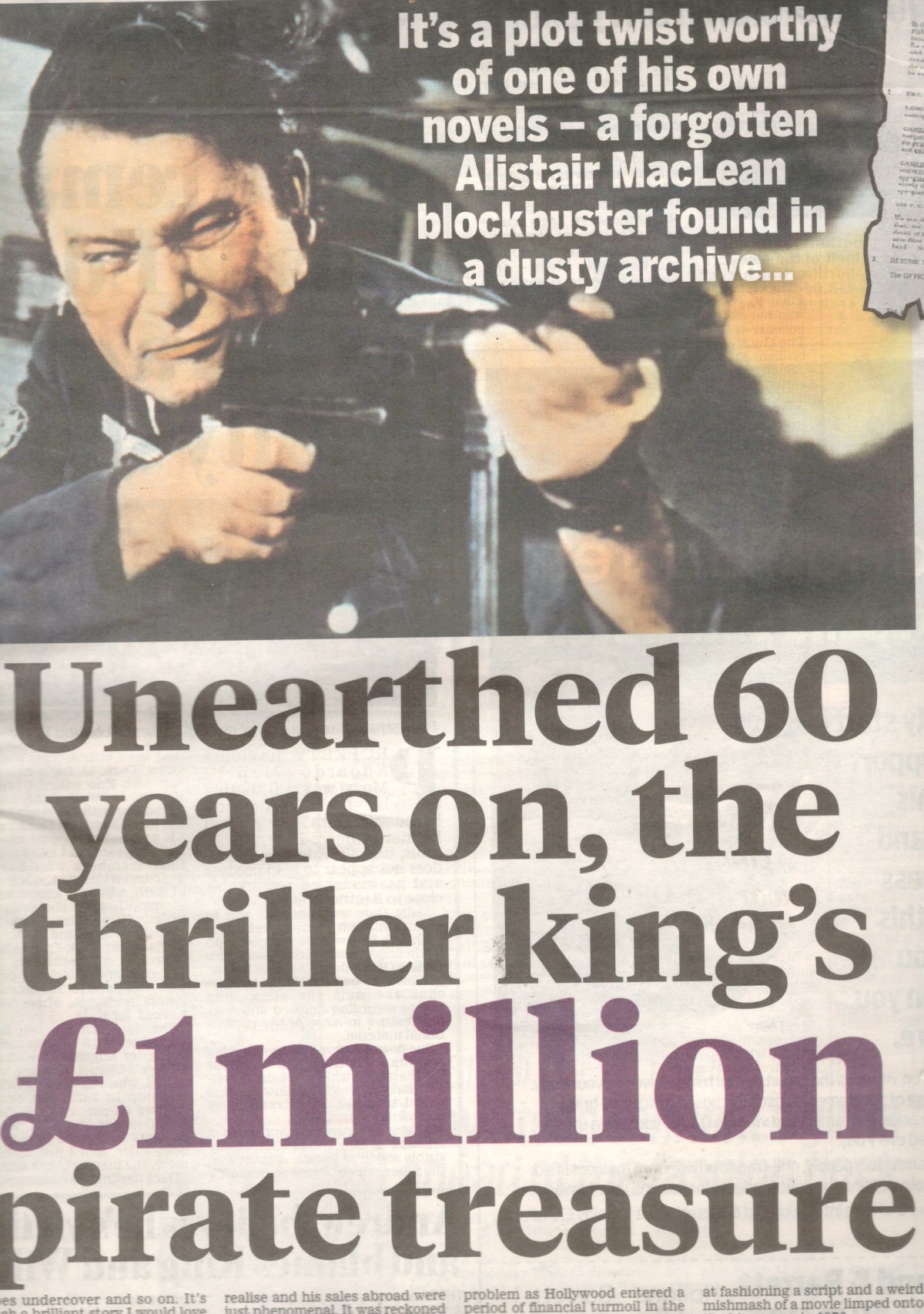
“Unearthed 60 Years On, Thriller King Alistair MacLean’s £1million Pirate Treasure,” By Gavin Madeley, Daily Mail, February 27, 2026
Staring at the words on his computer screen, Brian Hannan felt a heart-stopping jolt bring him up short.
It was like in the movies, when the hero realises they have stumbled across something big.
‘When I saw it, my eyes popped out of my head,’ he recalled. ‘I thought, “You’ve got to be kidding – how does this even exist? How does nobody know about it?” It’s a Fort Knox of gold, just sitting there waiting for somebody to make something of it.’
For months, the author and film historian had been trawling through an ocean of documents in search of priceless nuggets for his new book about Scots thriller writer Alistair MacLean’s extraordinary Hollywood career.
The vast archive he was mining had belonged to Elliot Kastner, the ebullient American producer who helped transform MacLean the bestselling novelist – of HMS Ulysses, Ice Station Zebra and The Guns of Navarone fame – into MacLean the brilliant screenwriter.
Such was the writer’s international appeal he earned the unprecedented accolade of seeing his name appear above the title of blockbusters such as Where Eagles Dare, When Eight Bells Toll, Breakheart Pass and Fear Is The Key.
For a period of time, it seemed everything he wrote flew straight off his typewriter and into movie theatres around the world.
A total of 14 movies and four films-for-television were made from his books and the MacLean brand was pure box office – except for the one time the magic formula failed.
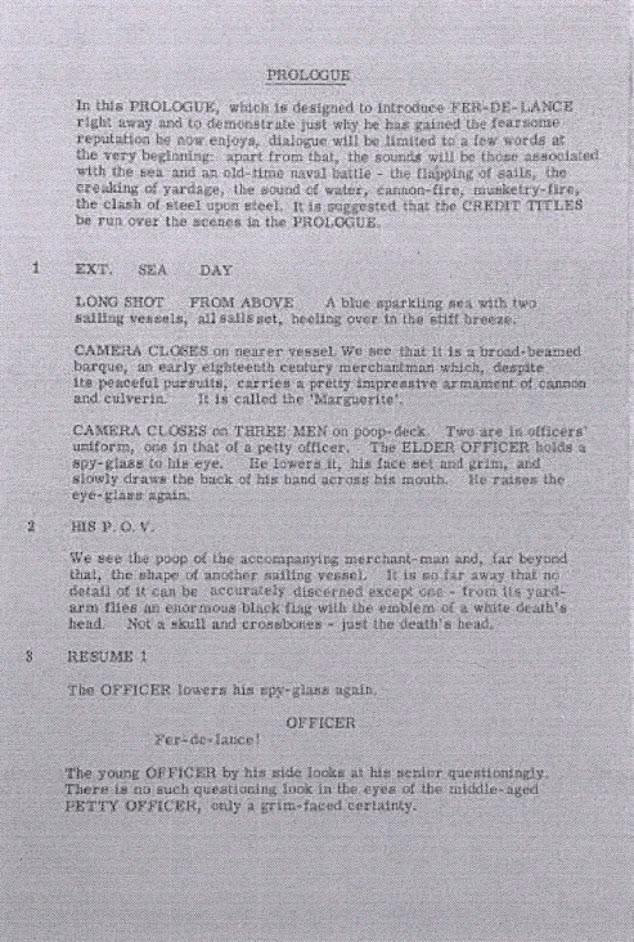
Opening scene of the lost screenplay, commissioned by Elliott Kastner, but never filmed.
Mr Hannan stumbled upon it by chance after Kastner’s son, Dillon, heard about his project and emailed over his father’s entire store of papers, in the hope it might offer up something new.
There, buried in an innocuous file marked ‘Pirates’ which Mr Hannan had ignored for weeks, he found treasure – a high seas adventure filled with swashbuckling heroes and buccaneering brigands written at the peak of his powers by the ‘king of the action thrillers’.
He said: ‘It is a genuine lost manuscript by Alistair MacLean and, as far as I’m aware, nobody else knows it exists, which means it could be extremely valuable.
‘MacLean died in 1987 so this could be his first work in at least 40 years.
‘Anyone familiar with MacLean’s work can see his hand. It’s just unbelievable to get your hands on raw material by someone of his stature which no-one has ever seen before.
‘But such is the continuing popularity of MacLean around the world, the script could easily be worth £1 million if it was novelised into a hardback book and another £1 million for the paperback.
‘It could make a beautiful film. You would have to add some proper sword fights but the story is great and it could make a commercially viable film.
‘It’s got a light tone and a lot of humour – like the Pirates of the Caribbean franchise and they are making another of those – so it’s not as if there isn’t an appetite for pirate movies. The female character is terrific, someone with smarts who can deal with the man on her own terms.
‘Sandra Bullock, in her younger days, or someone like Sydney Sweeney would be perfect for the role.’
Mr Hannan said it had become common for famous authors such as Wilbur Smith, Dick Francis and Lee Child to keep their names to the fore by having someone else write their books.
Last year, he wrote to Child asking if he would be interested in novelising the script. ‘He said it was fantastic but he was retired and that was that,’ he said.
‘I know James Paterson finished off a Michael Crichton novel so it has been done and if you put someone like that and MacLean together, it would be terrific.’
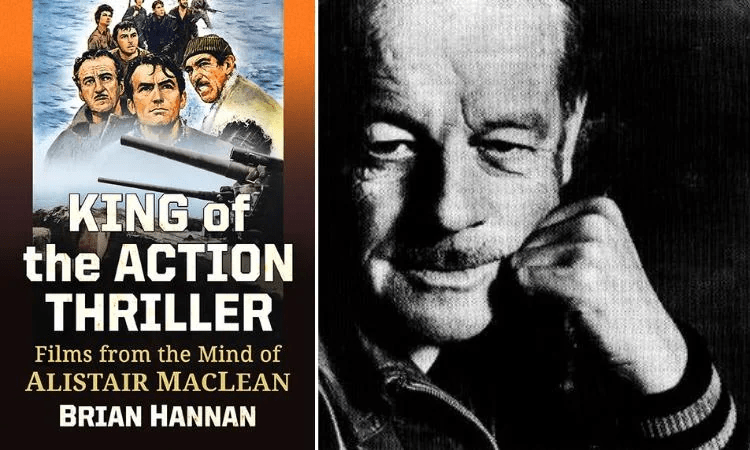
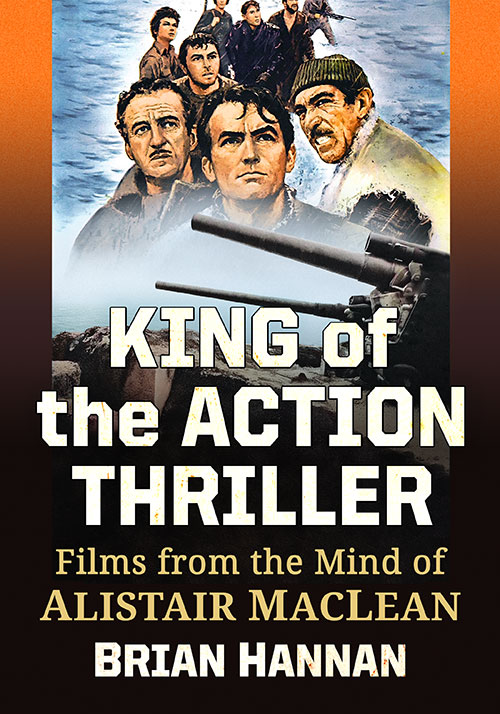
The unlikely story of how MacLean came to write about pirates is revealed in Mr Hannan’s new book – King of the Action Thriller: Films from the Mind of Alistair MacLean.
In it, he explains the key role played by Kastner, an American agent who moved to the UK with ambitions to be a leading movie producer.
Kastner was familiar with MacLean’s books and was desperate to make a movie with him. The only problem was that the film rights to every book he had written were already sold.
Born the third of four sons of a Church of Scotland minister on April 21, 1922, in Glasgow, MacLean grew up to be a literary sensation.
Raised in a manse at Daviot, near Inverness, he spoke only Gaelic until the age of six.
After studying English at Glasgow University, he initially worked as a teacher in Rutherglen but found his voice after winning a newspaper short story competition in March 1954. That led to Scottish publisher William Collins offering a £1,000 advance for his first novel.
MacLean duly obliged and battered out a book, drawing vividly on his wartime service in the Arctic Convoys. The book, HMS Ulysses, proved a word-of-mouth sensation, shifting 250,000 hardback copies in the UK alone and outselling Gone With The Wind by five to one. He was an instant hit.
His next book, The Guns of Navarone, was another bestseller and, at MacLean’s peak in the 1960s, one of his tales was snapped up every 18 seconds, every day of the year.
Below: An article that appeared in The Dubrovnik Times.
“Lost Alistair MacLean Screenplay Discovered — Thriller Legend Once Called Dubrovnik Home” by Mark Thomas, Dubrovnik Times, March 9, 2026
In time, he would outsell Ian Fleming and, for a season, even Agatha Christie. It wasn’t long before Hollywood came calling.
‘He wrote books very fast. The actual writing would take four or five weeks and all the books he wrote were sold to the movies as soon as he wrote them as they were cinematic and he told great stories,’ said Mr Hannan.
That might have put a dent in Kastner’s hopes of working with MacLean. Undaunted, he doorstepped MacLean in October 1965 and persuaded him to write him an original screenplay.
‘He said to MacLean, “I want a film like The Guns of Navarone, I want women in it, and I want action”,’ said Mr Hannan.
‘MacLean said, “I’ll write you a screenplay on one condition – you pay me for the screenplay and I keep the rights to novelise it afterwards”.’
Normally the producer would keep those rights, but wily MacLean changed the system, cutting out the publisher. Mr Kastner struck the deal, giving MacLean $200,000, a half-share of the profits and the book rights.
Within weeks, MacLean brought him a screenplay. It bore the rather insipid title of The Eagle’s Castle (soon changed to Where Eagles Dare), but the script packed a real punch.
‘Pretty much what he wrote appeared on screen with a few minor cuts,’ said Mr Hannan. ‘MacLean grasped the art of screenwriting very quickly.’
Kastner shrewdly bought up When Eight Bells Toll, which was his next book, pre- publication and commissioned two more screenplays.
One was ostensibly a Western, Breakheart Pass, and the other was a pirate-themed script, then known only as Caribbean. However, these slightly leftfield choices put him at odds with his publisher.
‘Because MacLean was known for writing a certain type of thriller, Collins weren’t keen on him writing Westerns or pirate films.’
For MacLean it was not so unusual, said Mr Hannan, as he liked to find inspiration in unusual settings. ‘He always wanted to try something new.
‘All his books are set in what in those days might be considered strange locales. Not like Graham Greene, who goes and finds a trouble zone, there’s no trouble zone in the Arctic unless MacLean creates one in Ice Station Zebra.
‘He tended to look for places which were different, where he could bring something new to the table – and I think that’s what he was doing with Breakheart Pass and Caribbean.’
Collins passed on Breakheart Pass, too, at least until Kastner put together the movie starring Charles Bronson more or less a decade later. The publisher then released a novelised version which became a huge bestseller.
But the same never happened for Caribbean, which MacLean twice refined, tightened and shortened.
Despite his endeavours, none of the studios bit and nor did Collins.
‘I’m sure at the time I would have had the same reaction as Collins, “You’ve got to be kidding”,’ said Mr Hannan.
‘But I knew Breakheart Pass had worked as a Western as I had seen it at the movies.
‘When I started reading this one, there was lots of clever stuff and it has all the hallmarks of a MacLean – there is always somebody who is being blackmailed, or someone who goes undercover and so on. It’s such a brilliant story I would love to see it as a book and a film.’
Caribbean follows the familiar MacLean template with the heroes battling huge odds, betrayals, breakneck plot twists and ending with a vast explosion, damnation for the baddies and sweet resolution for the good guys. To some extent the film world’s reluctance to touch Caribbean was a surprise, given the author’s global appeal.
‘MacLean had cracked something most people didn’t realise and his sales abroad were just phenomenal. It was reckoned if you had Alistair MacLean’s name on a film, people would come and see it regardless of who was in it or what genre it was,’ said Mr Hannan.
‘Film-makers started putting MacLean’s name above the title, and in huge letters, which was unheard of for a screenwriter to get that kind of billing. They used MacLean’s name to advertise his next film, using the tag, “From the mind of Alistair MacLean”.’
The project’s timing was also a problem as Hollywood entered a period of financial turmoil in the late-1960s. ‘They just couldn’t get the money. This was around 1969-70 and the movie industry was in incredible trouble, and nobody was really wanting to finance a big-budget pirate picture.
‘They hadn’t made any since the heyday of Burt Lancaster.’
When Kastner’s film rights lapsed, others tried their hand at churning out a swashbuckling feature. A succession of other screenwriters – including a young Robert Ludlum – tried their hand at fashioning a script and a weird mishmash of a movie limped onto the big screen in 1976.
Swashbuckler, starring Robert Shaw, was completely unrecognisable from the film envisaged by MacLean, whose name was, understandably, nowhere near it. It amounted to an act of movie-making piracy, said Mr Hannan. ‘It was garbage – done as a kind of spoof and it didn’t work at all. All MacLean’s clever stuff had gone.’
It was a rare blip in the MacLean conveyor belt of successes, although privately he was already suffering from the pressure of producing endless bestsellers.
It manifested itself in heavy drinking, which would eventually end his life.
Twice-divorced, he had reconciled with his first wife, Gisela, and was splitting his time between homes in Dubrovnik and Switzerland.
In 1985, health scares had prompted MacLean to give up drinking but, in January 1987, he relapsed and went on a bender with an Irish hotel porter which triggered several strokes.
He lapsed into a coma from which he never awoke.
‘He was an alcoholic,’ said Mr Hannan. ‘I think he started drinking heavily early in his career. It’s a very sore subject with his family.’
So much so, Mr Hannan has had little cooperation from them in his quest to promote MacLean’s lost manuscript. ‘It means nobody knows this script exists, apart from me and those I have chosen to tell. Maybe someday soon, someone will come knocking on my door and ask, “Can you show us what you’ve found?”
‘Well, what I found was a million-pound manuscript.
‘It’s like if somebody found a lost novel by Graham Greene, or Boris Pasternak. Similarly, this would rocket off the shelves without question.’
A lost MacLean manuscript may be a moneyspinner, but for whom? MacLean’s surviving relatives? Kastner’s family? MacLean’s publisher? Mr Hannan? Ultimately, this mystery thriller may well end in a courtroom drama, where intellectual property lawyers cross swords for a cut of the prize.
‘It’s not really clear who has ownership of the manuscript, but someone could be sitting on a multi-million-pound bounty,’ said Mr Hannan.
Perhaps one day, it will lead to a new film hitting our screens with Alistair MacLean’s name above the title? ‘Or my name,’ he laughs, ‘Brian Hannan’s version of Alistair MacLean’s Caribbean!’
■ King of the Action Thrillers: Films from the Mind of Alistair MacLean by Brian Hannan is out now, priced £28/$39.
SOURCES: Gavin Madeley, “Unearthed 60 years on, thriller king Alistair MacLean’s £1million pirate treasure,” Daily Mail, February 27, 2026; Brian Hannan, King of the Action Thriller (McFarland, 2026).
I’m still trying to work out why I enjoyed the Rat Pack’s last hurrah so much. Sure, it’s the knockout debut of “My Kind of Town,” the last tune Frank Sinatra performed on the big screen and one that would have epitomised Ol’ Blue Eyes had it not been supplanted a few years later by “My Way.” And Bing Crosby, also in top crooning form, would have stolen the show except for Peter Falk’s gangster and Barbara Rush weaving a seductive web around all the males. But, actually, it’s mostly because this one time, far more than in the three preceding pictures, there’s a match between story and stars, as if at last the whole idea has come together. The gimmick of transplanting the Robin Hood legend to 1920s Prohibition Chicago works a treat, a gentle spoof rather than an awkward one.
The notion that you would bring together three of the greatest singers – Sinatra, Dean Martin and Sammy Davis Jr. – of their generation and deny audiences the chance to hear their voices was anathema to audiences. As if nobody could make up their mind which way a Rat Pack vehicle was headed, Martin and Davis were accorded tunes in Oceans 11 (1960) but the next two pictures, westerns of one kind or another, appeared tuneless. Robin and the 7 Hoods is a proper musical, all the stars sing, some even get to dance, and the story carries a lot more heft than your usual musical, some decent running gags, and an affectionate nod to the old Warner Brothers gangster pictures.
Guy Gisborne (Peter Falk), having taken control of the city by rubbing out his rival, comes up against Robbo (Frank Sinatra) refusing to bow the knee. Naturally, both decide the only solution is to bust up each other’s joints. Even more naturally, this ends in stalemate. Cue the entrance of Marian (Barbara Rush), the dead mob boss’s daughter who wants her father avenged. As a by-product of her involvement, Robbo ends up donating $50,000 to the poor, a good deed turned into public relations bounty by orphanage chief Allen A. Dale (Bing Crosby), reviving the legend of the outlaw who stole from the rich and gave to the poor.
Complications arise when Robbo refuses to fall for Marian’s wiles and is framed for the murder of a corrupt Sheriff Glick (Robert Foulk). Marian proves far smarter than her male counterparts and when bribery, seduction and corruption fail she turns to politics.
While Sinatra’s rendition of “My Kind of Town” is the standout, tunesmiths Sammy Cahn and Jimmy van Heusen showcase some terrific numbers, in particular the gospel-style “Mr Booze” performed by Bing Crosby, “Style” involving Sinatra, Martin and Crosby, a Martin solo “Any Man Who Loves His Mother,” Sammy Davis with “Bang! Bang!” and even Peter Falk makes a decent stab at “All for One and One for All.” Once Sinatra, Martin or Crosby wrapped their larynxes round a particular song, they claimed ownership for life, you can’t imagine anyone else doing it better. And so it proved here.
In acting terms Sinatra, Martin and Davis are on cruise control, although Sinatra, the butt of the conspiracy, tends to have to work a little harder. The supporting cast relish the opportunities presented. Peter Falk (Penelope, 1966) makes the most of a made-to-order role as the back-stabbing mob chief, his fast-talking style little match for more superior brains, and you can see a screen persona develop in front of your eyes. Bing Crosby (Stagecoach, 1966) starts out as a joke with his outlandish language but soon comes to represent a different perspective on legitimate illegitimate moneymaking schemes. Barbara Rush (Come Blow Your Horn, 1963) is quite superb as the conniving sophisticate, all long dresses and innovative ideas.
Although Gordon Douglas (Stagecoach, 1966) would hardly be your go-to director for a musical, he acquits himself very well, incorporating a great deal of the style he evinced in Claudelle Inglish (1961). There are two marvellous running scenes. The first is that whenever the municipality sees fit to lay the foundation stone of some great new building you can be sure the block contains a corpse. But the second is just wonderful. Any time Marian has a man in her lounge, she goes round switching off the lamps until the room is in darkness. Each time, the scene is played in exactly the same way and of course the minute she starts switching off the lights, moving as sinuously as a spider from lamp to lamp, you know where this scene is going. I should also mention the “Mr Booze” sequence in which an illegal nightclub is transformed into a gospel meeting.
Edward G. Robinson (The Biggest Bundle of Them All, 1968) has a cameo and also look out for Oscar-nominated Victor Buono (What Ever Happened to Baby Jane, 1962). Songs aside, David R. Schwartz (The Bobo, 1967) penned this one.
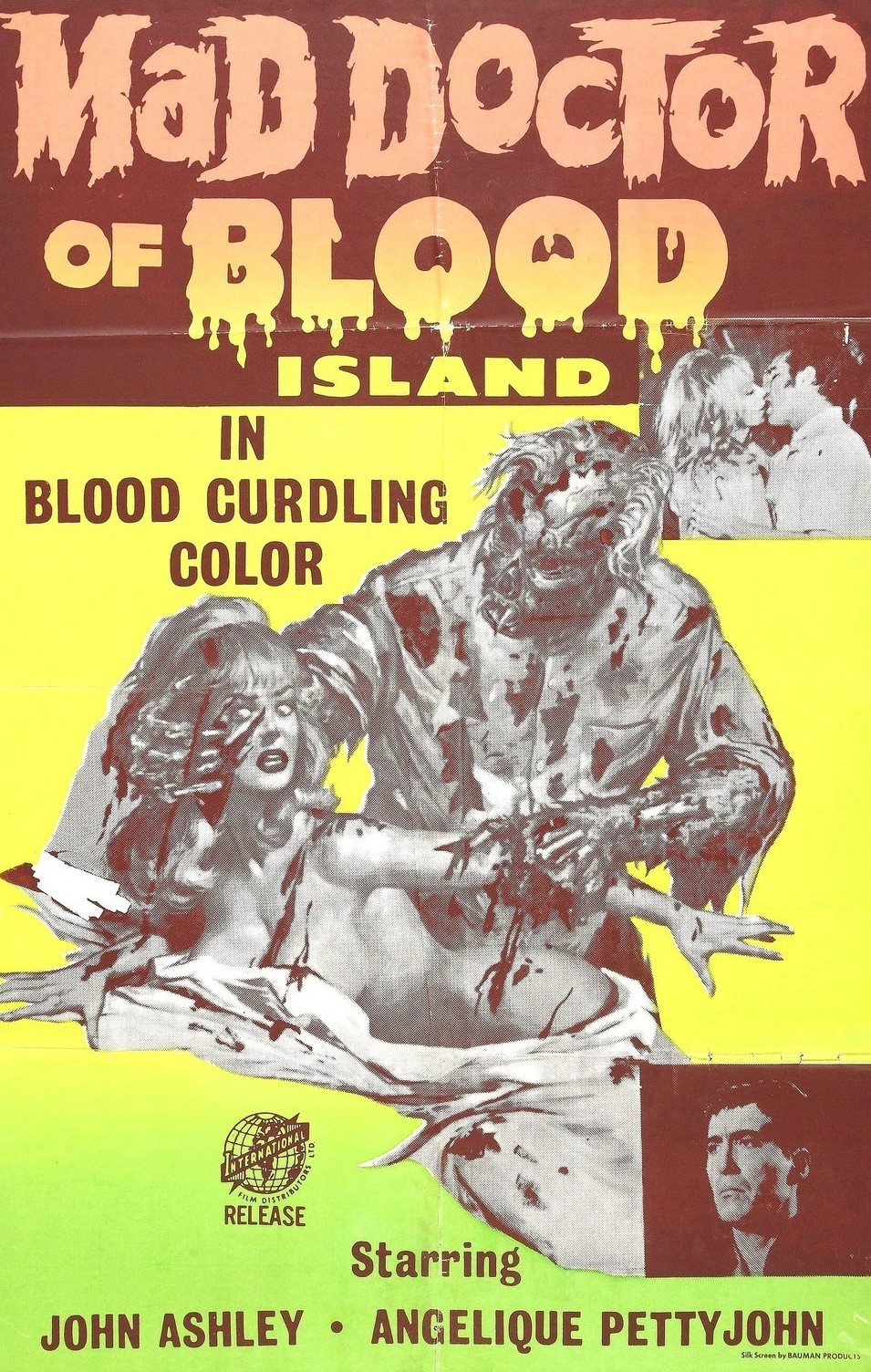
Not a direct sequel to Brides of Blood (1968) but in today’s vernacular this would be taking place in a “Bloodverse”. Swap human sacrifice for erotic ritual, eliminate the man-eating trees and giant insects, throw in buckets of green blood and women who can’t pass a waterfall without diving in naked, a voyeur, add a touch of estrangement, remove any mention of radiation, and while there’s clearly a monster on the loose a strange doctor appears as much of a liability. To keep the exploitation audience onside, there’s more nudity, plus sex. To keep the arthouse fans happy there’s innovative camera use, a kind of shuddering disorienting effect as the camera jumps back and forward.
This time round our visiting scientist, pathologist Dr Bill Foster (John Ashley), is investigating a strange disease that’s broken out on the island. Accompanying him are non-scientists Sheila Willard (Angelique Pettyjohn) looking for her father (Tony Edmunds) and Carlos (Ronaldo Valdez) who’s planning to persuade his widowed mother (Tita Munoz) to leave. Dr Lorca, the local authority, welcomes the visitors.
None of the new arrivals have much luck. Sheila’s father is a hopeless alcoholic and doesn’t view with any interest reuniting with his daughter while Carlos’s mother refuses point blank to leave. Worse, his father, it transpires died in mysterious circumstances several years before. Dr Lorca is generally obstructive.
It takes a good few sightings of the monster, not a giant as such beings often are, but the size of a normal human with skin a funny color and extremely mottled, to keep things going. Generally speaking, said monster, as in the previous film, has a predilection for naked women, though their nudity doesn’t always seem linked to skinny-dipping under a waterfall.
Finally, the monster becomes more inquisitive and invades the house where the guests are staying. Sheila, who makes the mistake of wandering out into the jungle alone, is attacked by the monster but escapes.
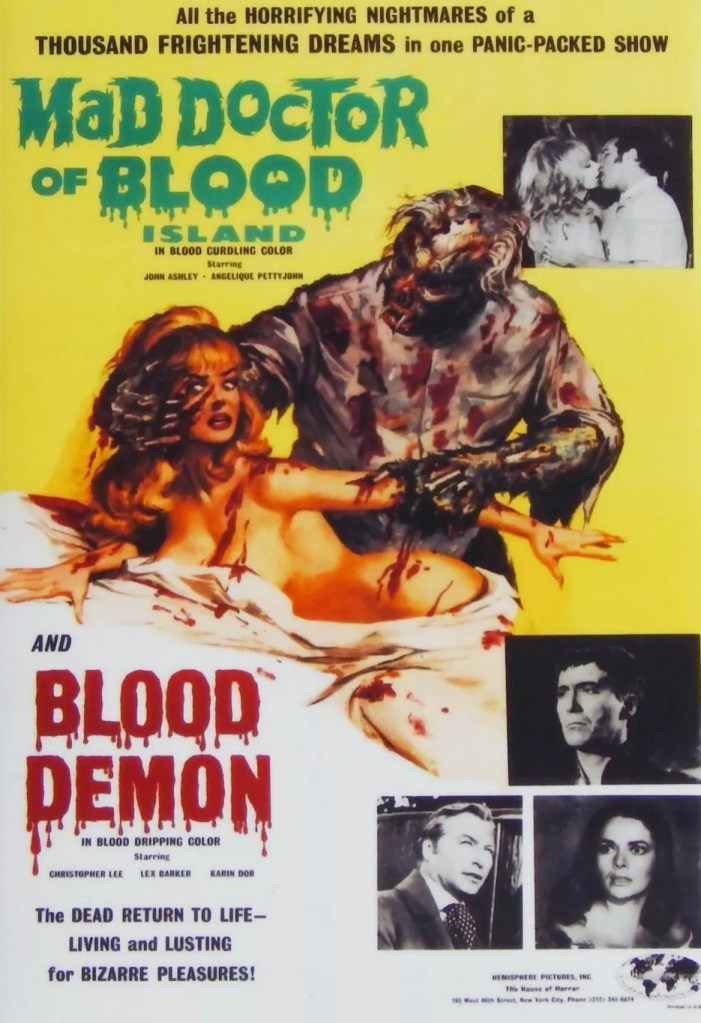
Blood sells – double the feature, double the blood. Check out my review of “Blood Demon.”
Carlos discovers his father’s coffin is empty. Sheila and Bill hit it off, sufficiently enamored of each other that they make love in a cave. About the only contribution Bill makes, apart from being one-half of the love interest, is to track the monster to a cave where people are being kept prisoner.
The warder is Dr Lorca who has been carrying out experiments on the natives, one of his earliest victims being Carlos’ father Don Ramon who is the current monster. For no apparent reason, except he’s a monster, Don Ramon kills his wife and then because he’s not completely a monster but still has human feelings lets his son go free, instead turning his vengeance onto Dr Lorca and in the carnage that follows apparently killing himself.
But not so fast. As had already been demonstrated in the 1960s, success could breed instant further success, franchises now abounding, not just James Bond, Matt Helm, Harry Palmer and Derek Flint but The Magnificent Seven and The Pink Panther, so nobody was going to pass up the opportunity to make a few more bucks. The door is opened for a sequel when the final shot picks out the hand of the monster hiding in a lifeboat on the ship ferrying away the survivors.
This is more of a cliché than Brides of Blood and some scenes such as the erotic ritual and dalliance at waterfalls and in caves seemed intent on hooking an audience other than horror. Once again, it’s the female lead who steals the picture – though it’s not much of a fight. Angelique Pettyjohn (Heaven with a Gun, 1969) has not just the heaving bosom of her predecessor and her sassiness but a more solid emotional journey.
You’re not going to expect much genuine emotion in a horror picture of the period but in that respect Pettyjohn and, surprisingly, the monster come off best.
Again directed by Eddie Romero and Gerardo De Leon from a script this time round by Reuben Canoy (The Passionate Strangers, 1966).
Being this was the age of the Lothario, what with James Bond and Matt Helm and Co surrounded by adoring women, you were hardly going to find many males in the audience feeling that sex addiction was a bad thing. Nor was commitment phobia likely to be high in the agenda of the females in the audience.
Really, there’s no real reason to go to any trouble to come up with justification for bedroom farce that borders just occasionally on screwball comedy. Let men be caught with their trousers down and women in various stages of deshabille and let’s hope there are enough jokes in between to keep the pot boiling.
The main problem here is that while Peter O’Toole shows a fine and unexpected gift for comedy, the two actors for whom comedy is supposed to be their metier mostly fall flat, Peter Sellers resorting to over-acting and Woody Allen in his movie debut trying to steal every scene and the best lines (he wrote the script) to boot.
There are a couple of cracking set-ups. In one a language teacher who gets her class of foreigners to repeat what she says finds that they are parroting every word of a crazy fight she is having with her lover. And a strip club, even one as high-falutin as The Crazy Horse in Paris, has rarely provided so many laffs. And in an echo of Cyrano de Bergerac, a man wakes up an entire apartment block trying to woo the lover of his friend.
Michael James (Peter O’Toole) seeks advice from psychiatrist Dr Fassbender (Peter Sellers in a dreadful wig) as to how to temper his sexual instincts. He is under siege from lover Carole (Romy Scheider) who is desperate to marry him. The repressed married doctor is mad keen on Renee (Capucine) but the minute she sets eyes on Michael she can’t get enough of him.
To make Michael jealous Carole flirts with Viktor (Woody Allen), her nervous wreck of a chum.
Soon Michael is juggling four lovers, Liz (Paula Prentiss) and Rita (Ursula Andress) as well as Carole and Renee. Eventually, for no great reason except it must have seemed a good idea at the time and it’s the ideal location for a bedroom farce, they all end up in a small hotel, where Michael has his work cut out, dashing from room to room, to assuage all his lovers, while Fassbender and Viktor try to snap up his leftovers.
This all takes place against a background of La Dolce Vita involving a revolving cast of fashionistas and disco dancers. Michael drives an antique car straight out of Chitty Chitty Bang Bang (1968) and he carries off style with great elan. Wherever he is, Michael is the center of attention, in a disco resorting to striptease, and you can hardly blame him for being unable to resist so many gorgeous women throwing themselves at him.
While Peter O’Toole (The Lion in Winter, 1968) seamlessly holds it together, Peter Sellers (The Pink Panther, 1963) and Woody Allen (Annie Hall, 1977) threaten to pull the flimsy structure apart, the latter in particular determined to turn it into a Woody Allen picture. But Peter O’Toole is sheer delight and, as misogynistic as it sounds, carries off with aplomb the central conceit of a poor fellow who just can’t get enough of women. His comedy instinct is first-rate, far better employed here than in How to Steal A Million (1966) and his drunken scene is a joy.
Peter Sellers appears to be spoofing himself while Woody Allen, years away from solidifying his screen persona, is, as usual, just himself.
It’s left to the female cast to add depth and virtually all come out of the experience with bonus points, Romy Scheider (Otley, 1969) and Paula Prentiss (Man’s Favorite Sport, 1964) in particular while Ursula Andress (She, 1966) and Capucine (Fraulein Doktor, 1968) raise the glamor stakes to a new high.
Director Clive Donner (Alfred the Great, 1958) does his best to keep the picture on an even keel while allowing it to lurch sideways whenever the comedy requires. Written by Woody Allen.
There was a time when movies had charm. An easy grace. A fluidity. The ability to hold an audience in the palm of their hands with the simplest of narratives. Sadly, that time is long gone. I doubt if any Hollywood director – so raddled now by self-indulgence and self-importance – would even know how to make this kind of souffle.
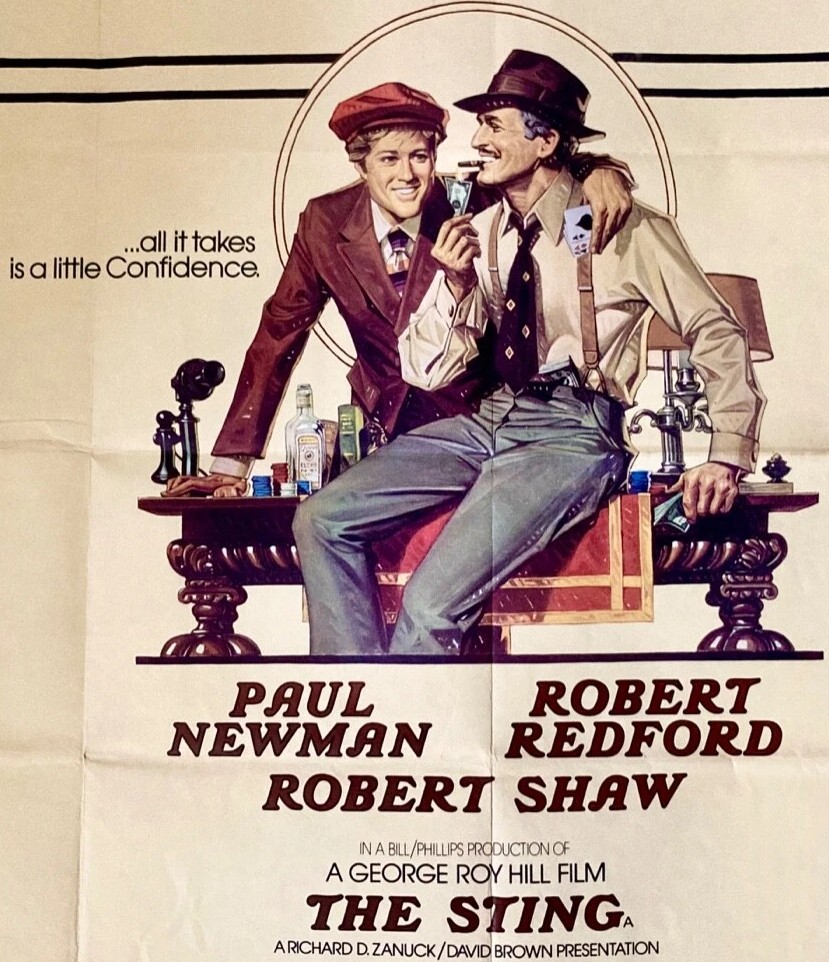
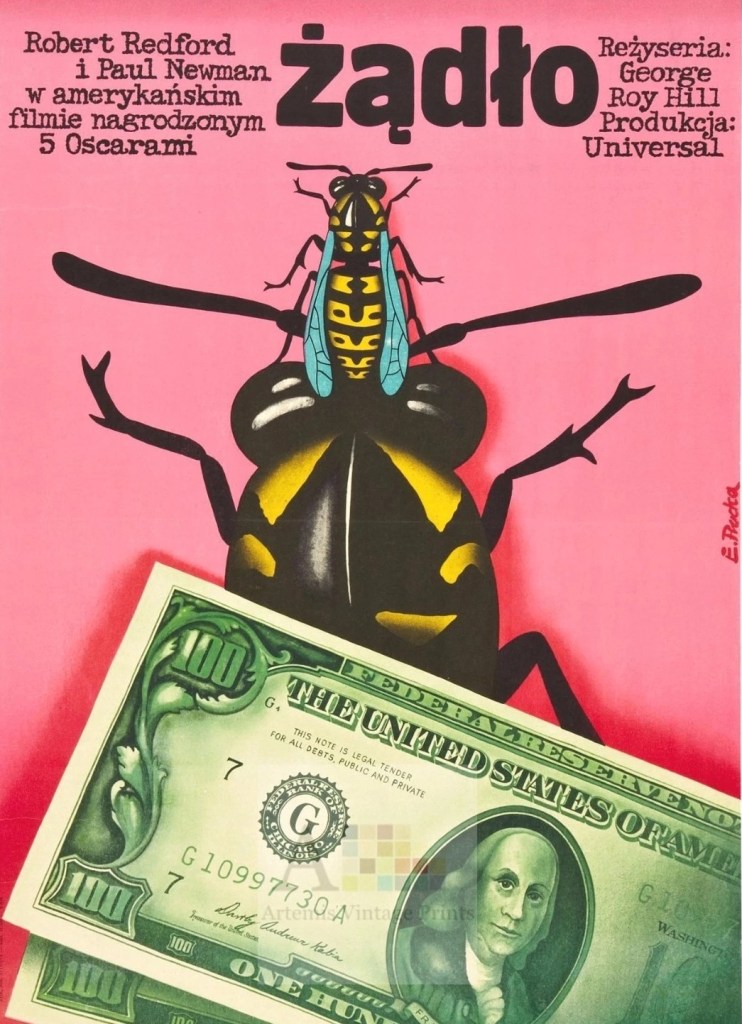
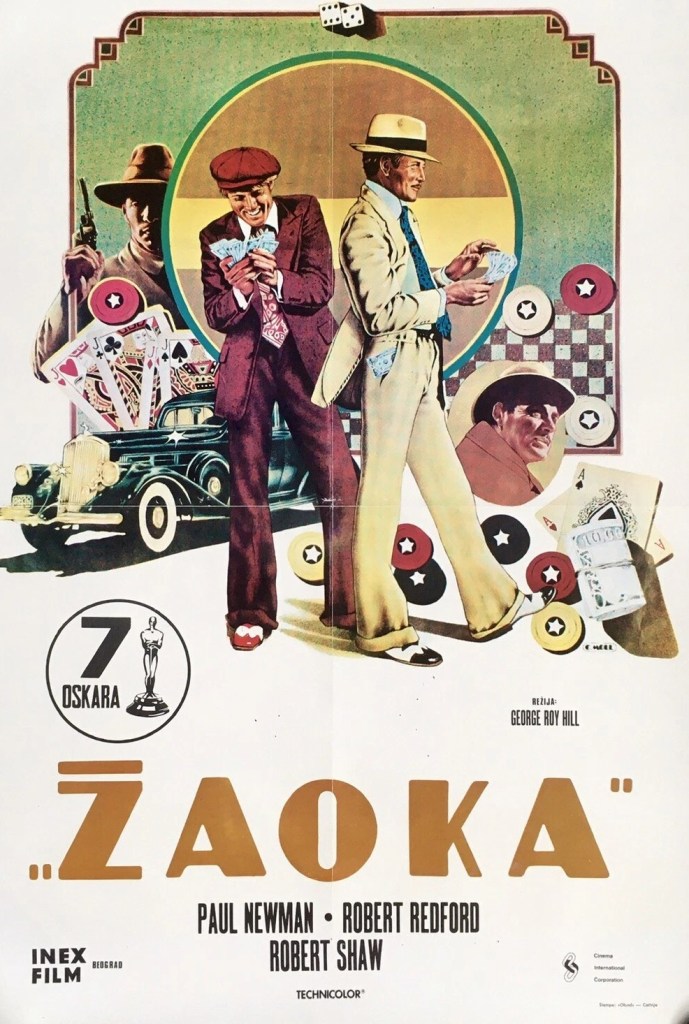
I haven’t watched this movie in decades. And I fully expected to dismiss it as having aged badly. Instead, I just adored it. In part that is due to what is surely the greatest male screen partnership ever. It wasn’t uncommon then and now for two top stars to be paired together, but usually the narrative had them in conflict. That’s not the case here. There’s a reason why Paul Newman and Robert Redford were credited in Butch Cassidy and the Sundance Kid (1969) with inventing the buddy movie. Their screen personas just dovetail and they appear so comfortable with each other.
Sure, the story is a cracker, and the direction is impeccable, what with using long-gone techniques like the wipe, and the chapter headings, and, of course, the adaptation of the Scott Joplin music and audience exposure to the techniques of pulling the “big con” and the secret nose-stroking by which fraudsters identified each other. But while this premise would surely have worked with another duo, it would not have worked half as well.
This was Robert Redford’s annus mirabilis. It’s impossible these days to comprehend his impact, for the simple reason that stars rarely release two movies in the one year. Following Butch Cassidy and the Sundance Kid, Redford had been there or thereabouts without quite taking the final step required to become a box office sensation, indulging himself in worthy pictures like The Candidate (1972) and Jeremiah Johnson (1972), but the latter was decidedly under-performing until Warner Bros sent it long after initial release down the “four-wall” route that would prove pivotal to The Exorcist (1973), whereby a studio hired theaters to show a movie, paying a flat fee that covered an exhibitor’s costs and some profit rather than splitting the proceeds on a percentage basis.
But the double whammy of The Way We Were (1973) and The Sting sent Redford’s marquee value into the stratosphere. And he’s not the big romantic lead that he was in the Streisand picture, if anything he comes up short in the romantic department, dumb enough to seduce a female assassin. He’s always one way or another needing to be rescued from a self-induced calamity rather than the confident gunslinger of Butch Cassidy and the Sundance Kid with an adoring woman hanging on his every word.
There are a couple of other memorable pieces of acting that I’d like to draw to your attention. The first is Reford’s thumbs, which always seem to stick out, the reason for which is never explained and possibly they’ve been beaten by previous malfeasance into that position. The second isn’t Robert Shaw’s pronounced limp, but his menacing catchphrase “You follow?” which must be the toughest two words outside of swearing ever spoken by a gangster.
Seeking revenge on underworld kingpin Doyle Lonnegan (Robert Shaw), on-the-run con man Johnny Hooker (Robert Redford) teams up with the more experienced Henry Gondorff (Paul Newman). The plan is to rook Lonnegan of half a million dollars. They’re going to do it with a racing scam, where they know the results of a race before anyone else.
But first Gondorff needs to find finance and needle Lonnegan enough to bait the hook. He achieves both by stealing Lonnegan’s wallet before using that cash for his wagers and cheating better than Lonnegan at poker.
Then Hooker has to pretend that he’s fallen out with Gondorff and willing to work with Lonnegan to screw two million bucks out of Gondorff. Meanwhile, to spice up the plot, maverick cop Snyder (Charles Durning) is on the trail of Hooker and the FBI are on the trail of Gondorff.
The payoff is so brilliant that audiences at the time reputedly cheered and I have to say I felt like doing so myself.
Robert Redford was nominated for an Oscar but I think the acting honors were even with Newman. The movie won the Best Film Oscar and Best Director for George Roy Hill (Hawaii, 1966) and usually when you come to re-evaluate Oscars you tend to mark down many of the choices because they don’t really hold up. This was up against The Exorcist, American Graffiti, Ingmar Bergman’s Cries and Whispers and the comedy A Touch of Class, so it wasn’t as though there was another better contender.
I like to think it won for bravura. Elan. In every department. Fresh and innovative, oozing charm and with the greatest double act in American cinema.
Director George Roy Hill (Hawaii, 1966) was on a roll and the screenplay by David S. Ward (Steelyard Blues, 1973) hit a home run.
There’s hardly been a more enjoyable Oscar-winner.