Author: Brian Hannan
I am a published author of books about film - over a dozen to my name, the latest being "When Women Ruled Hollywood." As the title of the blog suggests, this is a site devoted to movies of the 1960s but since I go to the movies twice a week - an old-fashioned double-bill of my own choosing - I might occasionally slip in a review of a contemporary picture.
Chubasco (1968) ***
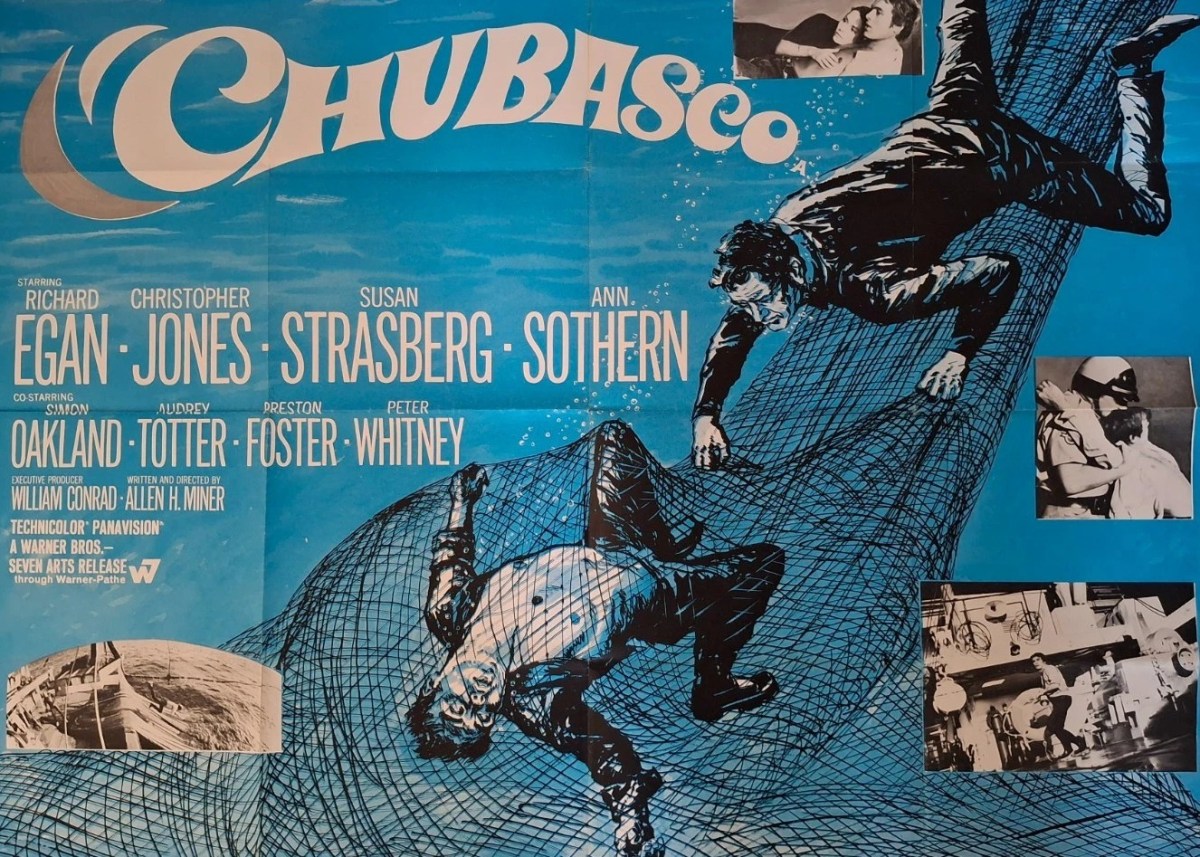
Rather desultory effort. Whatever bite it had back in the day – if it struck a chord at all – has been lost in the passage of time and proves a more suitable vehicle for the limited talents of the enigmatic Christopher Jones than David Lean’s Ryan’s Daughter (1970) for which he proved an uncomfortable fit.
I have some background in commercial fishing – not active, I hasten to add, but as a journalist, my second job being for a UK weekly Fishing News and in that capacity been out enough at sea with fisherman to understand the complexities and dangers of the job. Nothing on screen reflected that reality until The Perfect Storm (2000). And this is a very lite version of that, in part because the catching method employed here is less implicitly dangerous than in the Wolfgang Petersen epic.
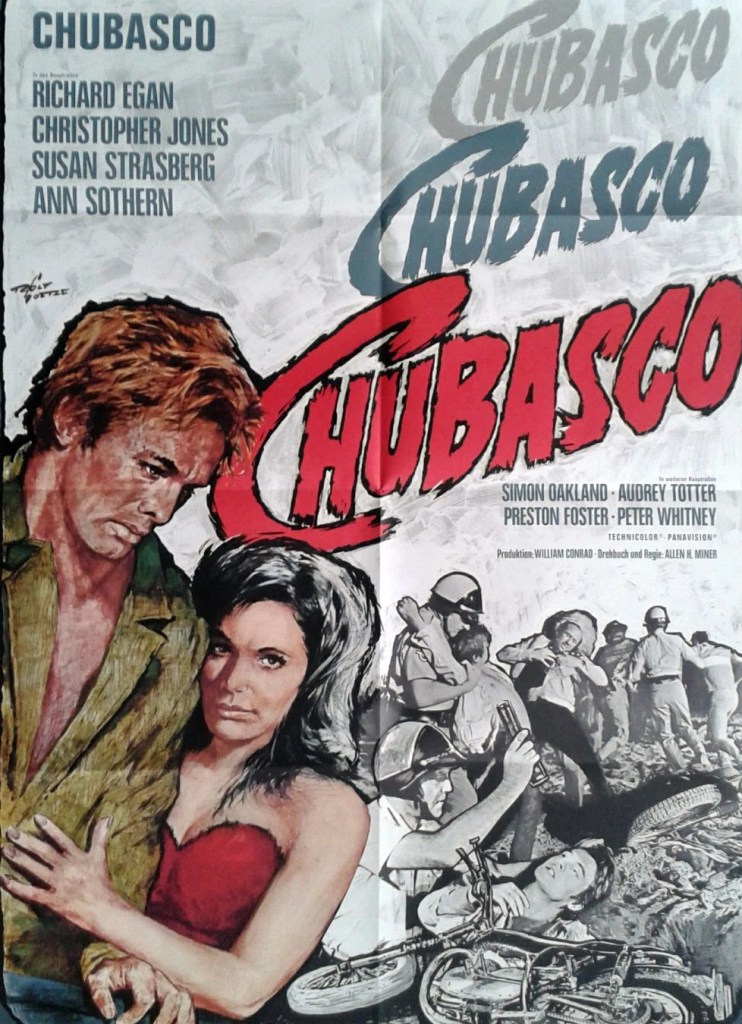
This fits into the Rebel Without a Cause mold, but with a stroppy entitled lad to the fore, struggling to elicit any sympathy from the audience and only the fact that his potential father-in-law is determined to beat him down makes him at all appealing.
The titular Chubasco (Christopher Jones), a 20-year-old lay-about who’s tangled too many times with the law, is given one last chance to go straight by being enrolled on a tuna-catching fishing vessel skippered by Laurindo (Simon Oakland). Sebastian Morino (Richard Egan), a rival fishing boat captain and father of Chubasco’s girlfriend Bunny (Susan Strasberg), is dead set on curtailing the romance.
Naturally, Chubasco’s sullenness doesn’t endear himself to the crew, but he settles into his role on board ship, suffering beginner’s wear and tear, and gaining some credence after helping save a young man who’s fallen overboard. He’s determined to defy Sebastian and after his first, successful, voyage, plans to marry Bunny, who’s skipped out of the house. However, at the wedding, Laurindo keels over and dies, forcing Chubasco to take a job with his father-in-law, who is now set on ruining the marriage. Chubasco, equally, is determined to make his way and after an accident Sebastian and Chubasco are reconciled.
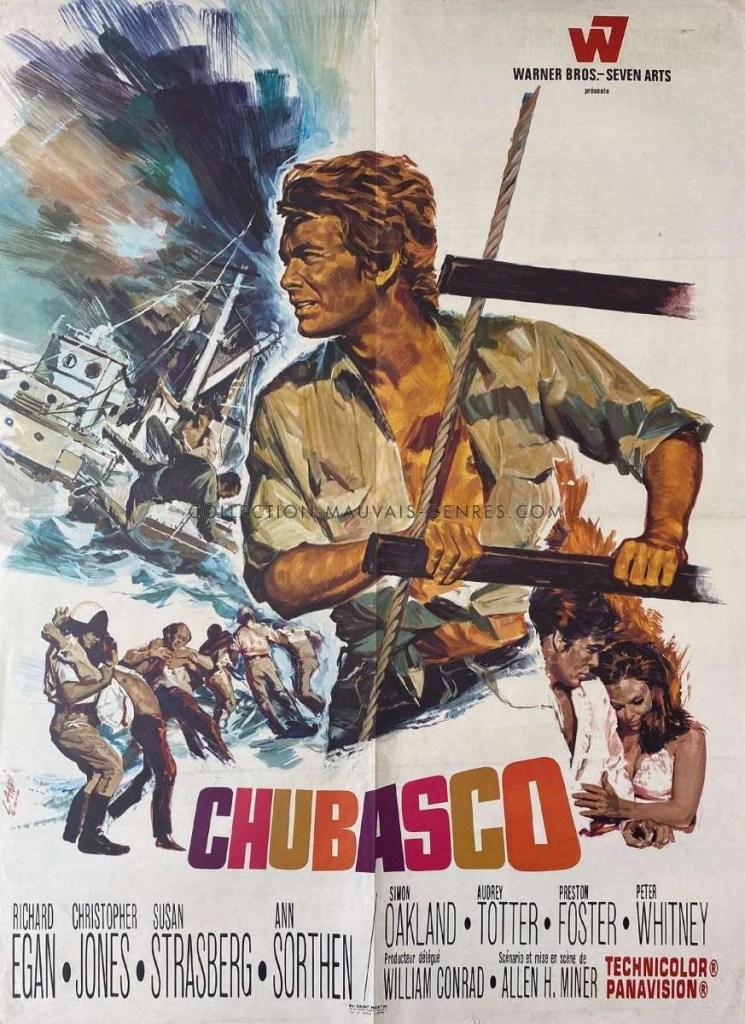
It takes a long time to get to the end and seems to weave in and out of any distraction possible to churn up what should be a straightforward tale. The fishing detail is interesting but not in the same league as The Perfect Storm, so even the danger – and there is danger – is just not as gripping. And in the absence of genuine tension on board, it’s left to the extraneous to fill in the gaps.
But given Sebastian is for the most part miles away from Chubasco, making it impossible for their paths to cross, further tension is completely absent. And, once Chubasco proves his worth on board, any tension between him and his shipmates dissipates. Too long is spent setting up the story, with Chubasco being arrested and reprieved, arrested and reprieved. Little is made of the fact that he is ultimately following in his father’s footsteps – he wears his old man’s fishing boots and carries his marlin knife – or that he is an orphan, struggling along with only his grandmother for support.
Christopher Jones was reckoned to be the successor to James Dean, but really all he had in common with the 1950s superstar was the quiff and the surly demeanor. That didn’t seem to put producers off, his good looks making up for his lack of genuine screen persona and after his movie debut here he was given top-billing in Wild in the Streets (1968), Three in the Attic (1968), Brief Season (1969) and The Looking Glass War (1970) before falling into David Lean’s area of influence. But that would be his last role for over a quarter of a century.
Perhaps with a stronger guiding hand, he might have developed the promise studios thought he had.
Luckily, here, he’s surrounded by strong screen presences in Richard Egan (300 Spartans, 1962) and Susan Strasberg (Sisters / My Sister, My Love, 1969) but they don’t appear often enough.
Written and directed by Allen H. Miner in his sole movie outing.
A let down.
Nobody Runs Forever (1968) / The High Commissioner ****

Character-driven intelligent thriller ripe for re-evaluation. And not just because it stands out from the decade’s genre limitations, neither hero threatened by mysterious forces in the vein of Charade (1963) or Mirage (1965) nor, although espionage elements are involved, fitting into the ubiquitous spy category. Instead, it loads mystery upon mystery and leaves you guessing right to the end.
And a deluge of mystery would not work – even with the London high-life gloss of cocktail parties, casinos and the Royal Box at Wimbledon – were it not for the believable characters. Rough Aussie Outback cop Scobie Malone (Rod Taylor) is despatched to London at the behest of New South Wales prime minister (Leo McKern) to bring home Australian High Commissioner Sir James Quentin (Christopher Plummer) to face a charge of murder.

or “The High Commissioner.”
Unlike most cop pictures, Malone is not sent to investigate a case, he is merely muscle. While he may have his doubts about the evidence against Quentin, suspected of murdering his first wife, he resists all attempts to re-open the case. Arriving in the middle of a peace conference hosted by the principled Quentin, he agrees to investigate security leaks from Australia House and along the way turns into an impromptu bodyguard when Quentin’s life is endangered. But Quentin’s wife Sheila (Lilli Palmer) and secretary Lisa (Camilla Sparv) are not taken in by the deception and so Malone himself forms part of the mystery.
With a preference for cold beer to expensive champagne, you might expect Malone to be a bull in a china shop. Instead, dressed for the part by the solicitous Quentin, Malone fits easily into high society, taking time out from his duties for a dalliance with the elegant Madame Chalon (Daliah Lavi). The background is not the gloss but the passion the Quentins still feel for each other, she willing to do anything (literally) to save her husband, he losing the thread of an important speech when worried about his wife.
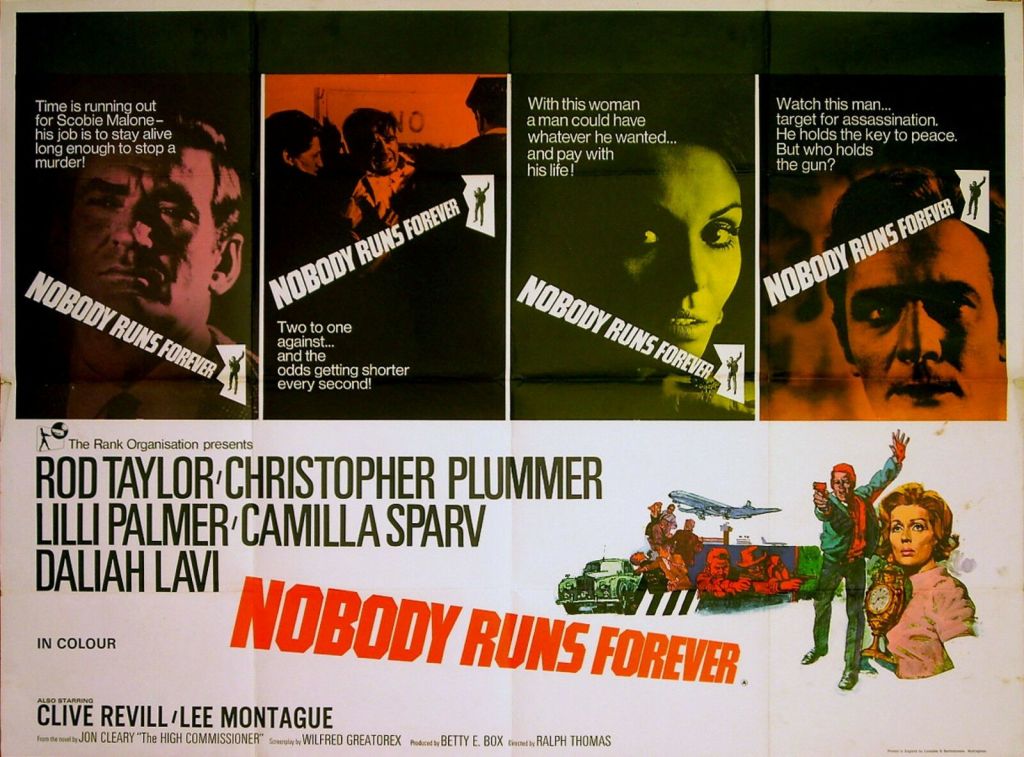
While there is no shortage of suspects for all nefarious activities, red herrings abound and cleverly you are left to make up your own mind, rather than fingers being ostentatiously pointed. There is some delicious comedy between Malone and Quentin’s uptight butler (Clive Revill), enough punch-ups, chases and clever tricks to keep the movie more than ticking along but at its core are the relationships. Malone’s growing respect for Quentin does not overrule duty, Lisa’s evident love for Quentin cannot be taken the obvious further step, Sheila’s overwhelming need to safeguard her husband sends her into duplicitous action.
The politics are surprisingly contemporary, attempts to alleviate hunger and prevent war, and while there was much demonstration during the decade in favor of world peace, this is the only picture I can think of where a politician’s main aim is not self-aggrandisement, greed or corruption. There are some twists on audience expectation – the dinner-jacketed Malone in the casino does not strike a James Bond pose and start to play, he is seduced rather than seducer, and remains a working man throughout.
Rod Taylor (Dark of the Sun, 1968) and Christopher Plummer (Fall of the Roman Empire, 1964) are terrific sparring partners, red-blooded male versus ice-cool character, their jousts verbal rather than physical. The rugged Taylor turns on the charm when necessary, a throwback to his character in Fate Is the Hunter (1964). Thoughts of his wife soften Plummer’s instinctive icy edge. Lilli Palmer (The Counterfeit Traitor) is superb as yet another vulnerable woman, on the surface in total control, but underneath quivering with the fear of loss. Two graduates of the Matt Helm school are given meatier roles, Daliah Lavi (The Silencers, 1966), as seductress-in-chief is a far cry from her stunning roles in The Demon (1963) and The Whip and the Body (1963) – and it still feels a shame to me that she was so ill-served in the way of roles by Hollywood. Camilla Sparv (Murderers Row, 1966) has a more low-key role.

Clive Revill (The Double Man, 1967) has another scene-stealing part and look out for Calvin Lockhart (Dark of the Sun), Burt Kwouk (The Shoes of the Fisherman, 1968) and, shorn of his blond locks, an unrecognizable Derren Nesbit (The Naked Runner, 1967) and in his final role Hollywood legend Franchot Tone (Mutiny on the Bounty, 1935).
Ralph Thomas (Deadlier than the Male, 1967) directs with minimum fuss, always focused on character, although there is a sly plug for Deadlier than the Male in terms of a cinema poster. (Speaking of posters, I couldn’t help notice this interesting advert at an airport for a VC10 promoted as “10derness.”) Wilfred Greatorex (The Battle of Britain, 1969) made his screenplay debut, adapting the bestseller by Jon (The Sundowners) Cleary. This may not be quite a true four-star picture but it is a grade above three-star.
CATCH-UP: Rod Taylor films reviewed in the blog so far are Seven Seas to Calais (1962), Fate Is the Hunter (1964), The Liquidator (1965), The Glass Bottom Boat (1966), Hotel (1967) and Dark of the Sun (1968).
Law of the Lawless (1964) ***
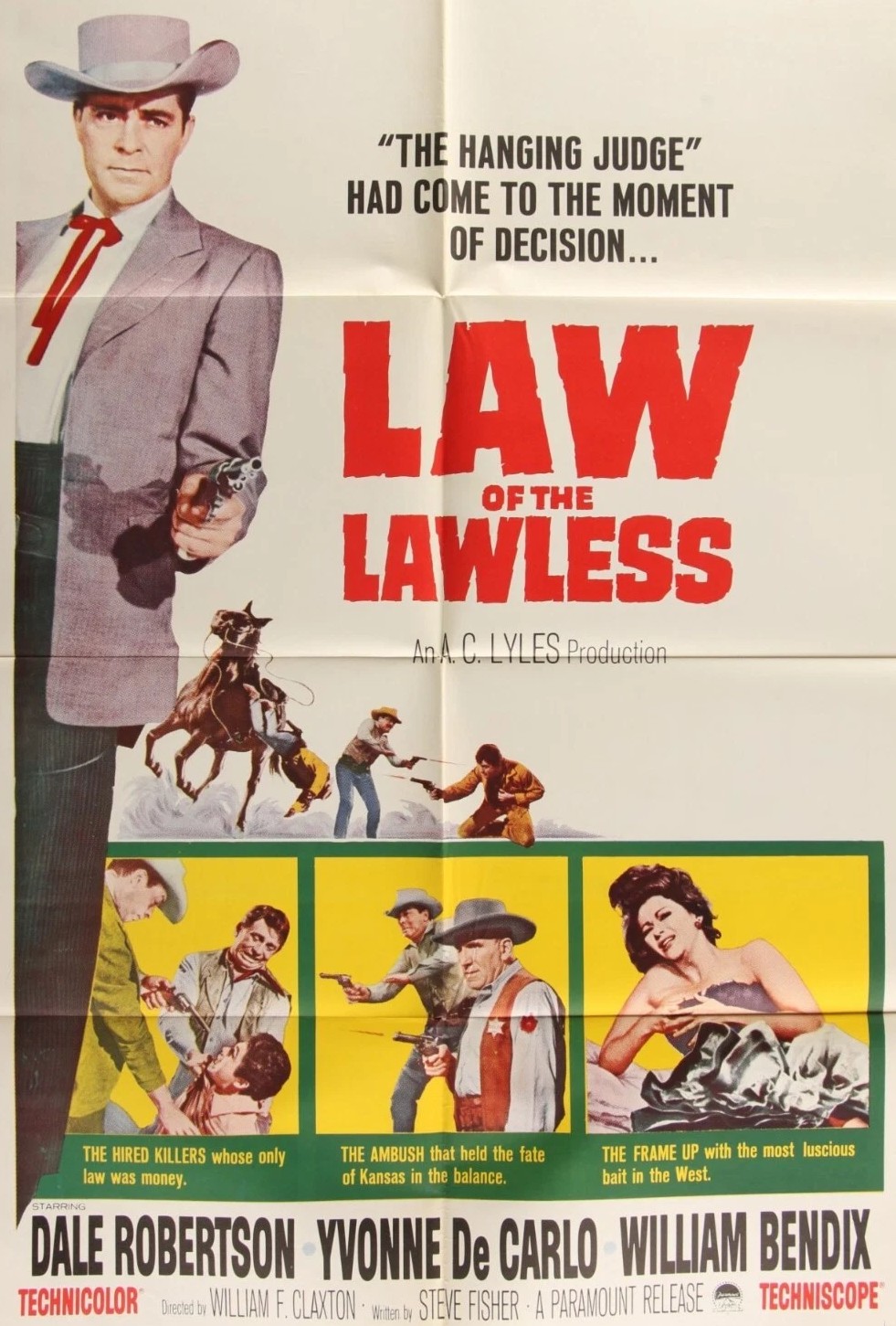
I’m rescuing another low-budget western from critical oblivion. While this can’t boast existentialism to boost its credentials or claim to belong to the cult fraternity and, technically, doesn’t belong to the revisionist sub-genre which was beginning to gather pace, and while you won’t go to this for visual style or striking composition, there is more than enough going on for it to be worthy of reassessment.
For a start it majors on remorse. You might come across a western hero who bitterly regrets the woman cast aside or the family abandoned (though more likely such actions will sit lightly), but you’ll virtually never find anyone who regrets using the gun, whether for righteous reasons or not. But here you’ve got the two main characters, one on the side of the law and the other of a criminal disposition, who both show remorse for their actions. And had the director been more disposed to the visual he would have made a great deal more of the scene where the black-garbed widows arrive in town, victims of both gunslingers who killed their husbands and of the judges who pronounced the death sentence on their gunslinging husbands.
And there’s considerable pause to imagine what happens to such widows. Unless they can find a benefactor, perhaps an older unmarried rancher or a widower, they are going to end up working in saloons and selling their bodies. On top of that we have a cracker of a courtroom drama where the exceptionally clever lawyer can twist the facts to suit his client.
This could also have been another kind of western altogether, the one where the hero is constantly beset by a variety of enemies, and the narrative therefore one of tension. But Judge Clem Rogers (Dale Robertson) has four separate outfits baying for his blood and still director William F. Claxton manages to also fit in all these ideas about remorse, the law, widows, conniving lawyers, the entitled of that era, and failed romance.
Rogers is in town for the trial of former friend Pete (John Agar), son of Tom (Barton McClane) the biggest rancher around, for killing someone in cold blood. Tom, a piece of work, has various plans to tilt the odds in his favor, first planning to blackmail Rogers over being caught in a honeytrap with Pete’s fiancée Ellie Irish (Yvonne DeCarlo) and whichever way the trial goes he has hired gunslinger Joe Rile (Bruce Cabot) at a fee of $10,000 to kill the judge. Rile and Clem have history, the gunslinger killed the judge’s father. And it’s Tom who hits on the scheme of embarrassing the judge by flooding the town with widows, many of whom are widows thanks to Rogers.
And there are four other dudes, three brothers and an outsider, also intent on killing Rogers. While Sheriff Ed Tanner (Wiliam Bendix) isn’t inept he lacks the force of personality to keep the bad guys in check and when he’s wounded his inexperienced deputy Tim (Rod Lauren) foolishly steps up to the plate.
You can’t help but feel sorry for Ellie, forced to play the part of the lure to dupe Rogers, especially when it’s clear she has more feelings for him than she does for Pete, whom she admits she doesn’t love but needs his security. There’s an interesting power struggle between Tom and Rile with the gunslinger refusing to kowtow to his employer. The court case is riveting because it turns on various twists. And climax is a knockout that you won’t see coming.
This isn’t one like The Shooting (1966), rescued from oblivion by critics and cultists – Paramount issued it as a second feature so it’s not unseen – and it’s not trying to rewrite the Hollywood history of Native Americans, and as I said it’s not distinguished visually, but it does pack an awfully thoughtful punch, tackling areas that the bulk of western film directors have ignored.
Dale Robertson (Coast of Skeletons, 1965) heads a good B-picture cast with veterans William Bendix (Oscar-nominated for Wake Island, 1943), Yvonne De Carlo (career revived by The Munsters, 1964-1966), Lon Chaney Jr (The Wolf Man, 1941) and Bruce Cabot (King Kong, 1933).
William F. Claxton (Desire in the Dust, 1960) is to be commended for cramming in so much interest. Script by Steve Fisher (Rogue’s Gallery, 1968).
An unexpected treat.
Project Hail Mary (2026) ***** – Seen (Three Times) at the Cinema

Excited as I was at the prospect of another film from the author of The Martian (2015), which I’ve seen at least half a dozen times, I was wary at the idea of spending so much time watching just one actor on screen, having been subjected to the hubris of Chris Pratt a few weeks back in Mercy (2026) where I was bored out of my skull with staring at his visage for the best part of two hours. Sure, Tom Hanks managed to hold our attention virtually single-handed in Cast Away (2000) , but he’s a double Oscar-winner and if you can’t rely on someone of that stature to hold your attention, who can. Ryan Gosling has come nowhere near the Oscar circle though this bravura performance may change his fortunes.
Since I don’t have a scientific bone in my body I’m a sucker for these space pictures where astronauts have to tinker with all sorts of technology to save their lives or the world, the two are often inseparable. Here, the object of the exercise could not be bigger. Non-astronaut and unwilling volunteer Ryland Grace (Ryan Gosling) has to save the sun from being gobbled up by pesky microbes. Turns out our sun isn’t the only one at risk. Another sun in a distant galaxy is also at threat and Grace has to buddy up with an alien, whom he nicknames Rocky, to come up with a scheme to save both suns.

So, there’s a lot of science, but it made sense to me (though I’m no expert), and plenty setbacks and it’s touch-and-go whether our heroes will meet with success, bearing in mind that this is a suicide mission and the best Grace can hope for is a peaceful death because he knows he’s got no chance of reaching home nor surviving in space beyond a few years.
But, actually, at the core of the picture is the kind of relationship that would replicate that seen in Spielberg’s E.T. (1981) except that little Rocky is more of a big brother to Grace than a hapless alien.
Every now and then we flit back to Earth for a flashback which explains how high-school teacher Grace came to be selected for the mission and, given I’m not such a mean plot-spoiler, sets a high bar for humanizing our hero, explaining exactly how when he wakes up in the spaceship he doesn’t know why he’s there. Grace and Rocky are, for whatever reason, the only survivors of the crews of their respective spaceships. I’m not sure how to describe the alien spaceship, it seems to be made of something and nothing, while Rocky is capable of cladding himself in what resembles multi-sided plastic and can construct a steel fishing rod four miles long in the twinkle of an eye.

Just as Matt Damon learns how to grow potatoes on Mars, so our intrepid pair embark on a series of unusual activities in order to win the day. Back on Earth sour-faced boss Eva (Sandra Huller) has, literally, a show-stopping scene when she picks up the mic and warbles a karaoke tune.
You might quibble at the running time (157 minutes) but in an era of overblown over-long self-indulgent epics, this makes every minute count and I didn’t look at my watch once. Andy Weir knows his stuff, or can invent enough of it to make us believe in his concepts, so part of the process of this picture is going through what works of the technology and what doesn’t and alighting on the equivalent of the sling shot to see us home free.
And in an era of the overblown etc, how welcoming to find genuine emotion so underplayed back on Earth, the connection between Grace and Eva barely tickling along until she picks up the karaoke mic.
I’ve not been a huge fan of Ryan Gosling (Barbie, 2024) of the floppy hair and stupid grin, but when he’s thrown into a serious picture that lightweight personality works wonders. Rocky, too, is a great creation, a completely new idea of an alien.
Directed by Phil Lord and Christopher Miller (22 Jump St, 2014), this is a terrific experience. Written by Drew Goddard (The Martian).
The last time science met feel-good was E.T. and this doesn’t fall far short.
Inadmissible Evidence (1968) ***
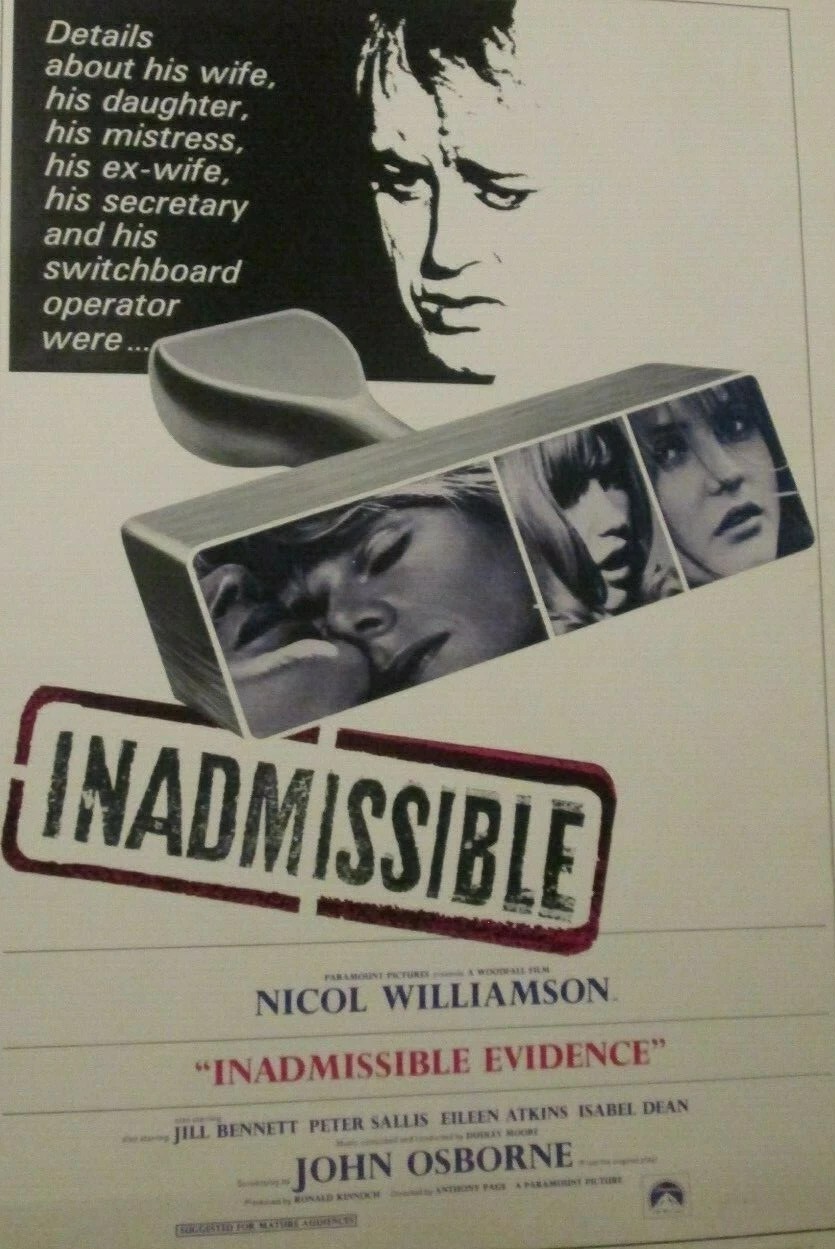
The Angry Young Man approaching 40 is not only a lot angrier but misogynistic, rude, contemptuous, constantly berating society, and, despite his physical energy, completely lacking in the charm that made playwright John Osborne’s groundbreaking Look Back in Anger (1959) with Richard Burton such a conspicuous success.
Lawyer Bill Maitland (Nicol Williamson) exhibits neither self-awareness nor remorse as the aspects of his personality that have fueled his downfall are brought home to roost. He is abandoned by wife, two lovers and colleagues and finds that all the people he has ostracized over the years are unlikely to come to his aid in time of trouble.
Mostly, it’s just a catalog of disaster as his personal and professional life fall apart. While never a high-flyer in the legal field he had done enough to run a reasonably successful business, delegating those tasks for which he was unfit to employees, but treating everyone with disrespect, except temporarily when he is in seduction mode.
There’s an early scene advising a client on her impending divorce where it seems as though the scenario could shift in his favor, in the sense that the audience could be more on his side, empathizing with his situation rather than hating him. Mrs Gamsey (Isabel Dean) doesn’t want to divorce her philandering husband but realizes she can’t make him happy and has no idea what might bring him contentment, a situation that clearly reflects Bill’s own, and though for a moment it looks like he might be on the verge of self-realization the moment passes and he’s back on a rant against the world.
When secretary and lover Shirley (Eileen Atkins) tells him she’s pregnant, his first instinct isn’t congratulations or commiseration, but to try and establish, by working out when they last had sex, whether he could be the father. No sooner has she quit than he’s trying it on with the newest staff member, the comely Joy (Gillian Hills). Despite sleeping with him she doesn’t stay enamored of him for long. No matter, he already has another mistress, Liz (Jill Bennett) but that relationship is on the brink.
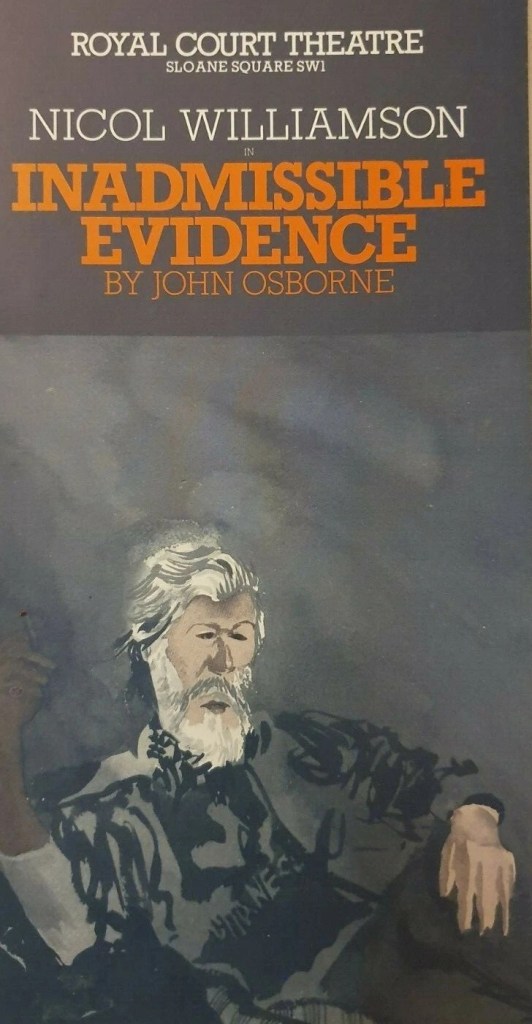
His marriage to Anna (Eleanor Fazan) is falling apart and she at least has the strength of mind to give him a good slap when at a party he insults their friends. That sends him scurrying out of the marital house. Daughter Jane (Ingrid Brett) can’t put up with his behavior either.
He is too late in realizing just how essential his clerk Hudson (Peter Sallis) is and by the time he offers the man a partnership, Hudson is already halfway out the door having received a better offer. He’s a poor operator, leaving a client (and former lover) in the lurch while another client is reduced to tears.
Throughout this, Bill keeps up a steady stream of abuse on virtually anyone his imagination alights. But it’s that imagination that also preys on his mind as he slips into nightmare scenarios of being brought to court for trial for his personal misdemeanors, of being disqualified from the profession, of being cremated. It’s not going to end well but just how it ends is left to the audience’s imagination.
It’s only the energy of Nicol Williamson (The Reckoning, 1970) that makes this fly at all. This falls into the sub-genre of successful men, lacking in self-worth, heading for a nervous breakdown as exemplified by The Arrangement (1969). Williamson was being hailed as the successor to the mantle of Richard Burton, but his choice of films soon scuppered that notion. He was a bigger draw on stage.
Here, director Anthony Page (Absolution, 1978) does him a disservice by, in terms of framing, refusing to give him physical stature. The camera always seems to be looking down on him, squashing his features, rather than elevating him as occurred in other films. Page does the audience a disservice by choosing to film in black-and-white. Whether for budgetary or artistic purposes is unclear. Adapted by Osborne from his play.
For about 30 minutes this is terrific stuff because Williamson can command the screen like few others. But then it’s just too wearing.
The Carpetbaggers (1964) ****
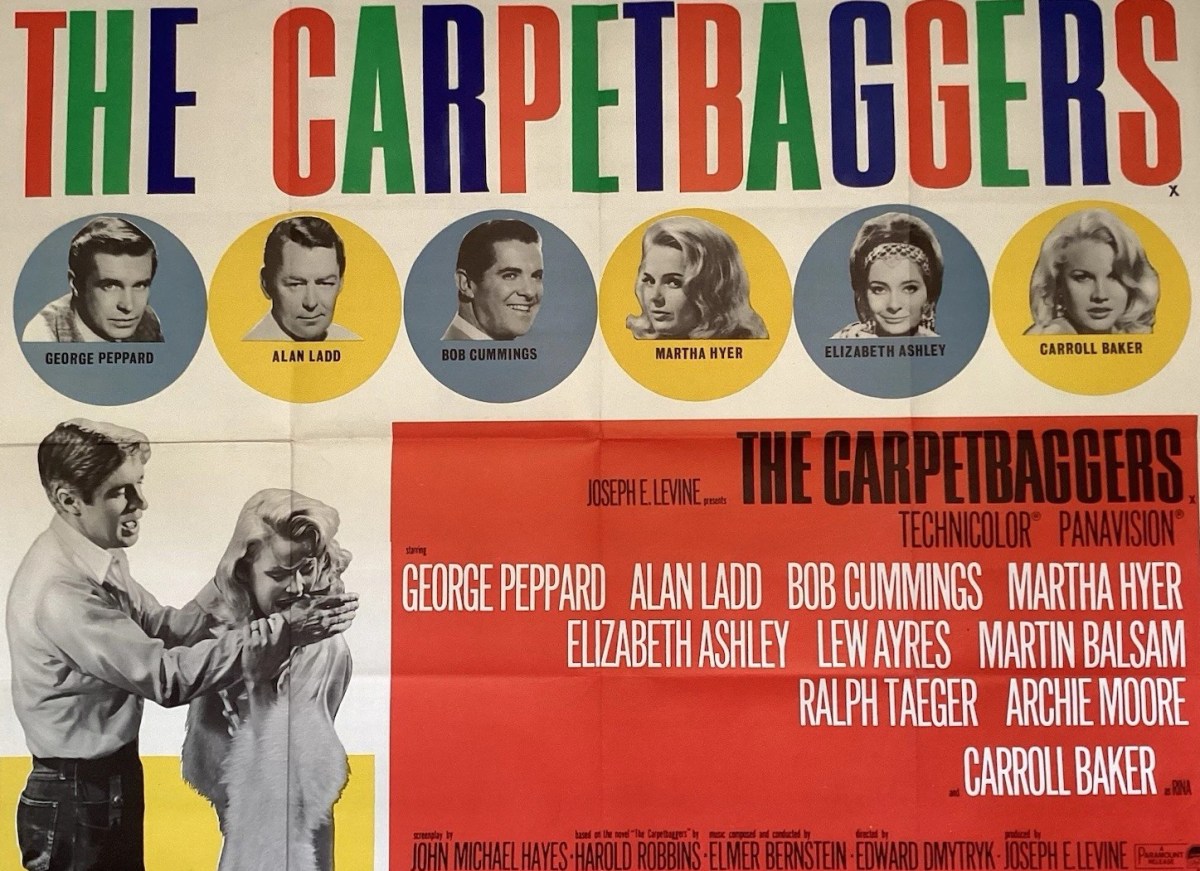
Likely because the gigantic bestseller by Harold Robbins (Stiletto, 1969) on which this was based made it impervious to critics, the critics determined to slaughter it. Which was a great shame because if they had been at all open-minded, not to mention fair, they would have recognized, outside of a terrific tale with a spellbinding performance by George Peppard (The Blue Max, 1966), a master class in screenwriting from double Oscar nominee John Michael Hayes (Butterfield 8, 1960).
There’s hardly a slack line in the entire ensemble and given he was adapting a monster of a book he cuts to the chase with infinite guile. Scenes demonstrate instant characterization and are littered with quotable lines and the story, even at two-and-half-hours, is told at breakneck speed.
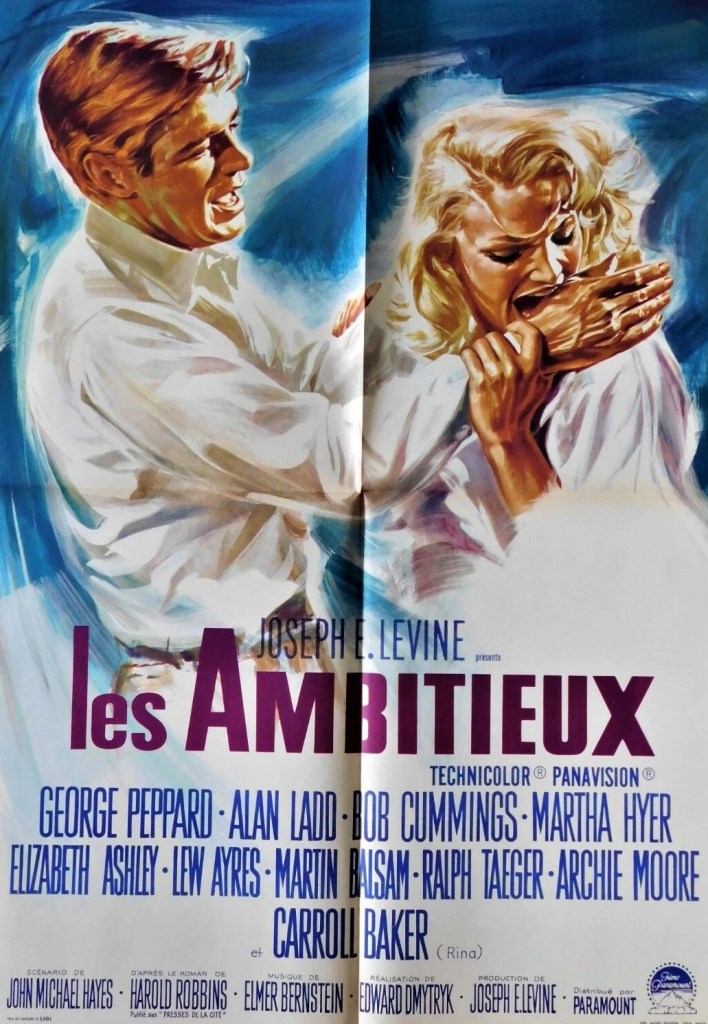
No sooner are we introduced in the opening two scenes to the reckless, arrogant and bedhopping Jonas Cord (George Peppard) than his father has dropped dead and Cord has not only inherited the company but immediately turned from louche spoiled brat into hard-nosed businessman, not just tough but determinedly mean especially in the area of revenge. In a superb scene with his father’s widow Rina (Carroll Baker), we learn that she dumped Jonas for his richer father, and although Jonas appears to be leading her on, that’s only until he can humiliate her by exposing her innate greed.
Despite her wayward sexuality, Rina is a savvy businesswoman, enough to make sure she is set up for life, although the other men she gravitates towards are not as weak as Jonas’s father, nor as nasty as Jonas, and Nevada Smith (Alan Ladd) has the wisdom to led her down gently when he enters her seductive web. The Nevada Smith backstory, which takes up a hefty chunk of the novel, is dealt with in one clever scene, which could act as a trailer for the later film starring Steve McQueen.
And early on there’s a superb scene, akin to the madwoman in the attic, where Jonas opens a locked door containing a derelict bedroom strewn with children’s toys that belonged to his brother. The reason for the locking away is never explained but it’s the only time Jonas gives in to his vulnerable side.
Both Rina and Nevada segue into successful film careers and eventually have an affair. Cord becomes a movie mogul.
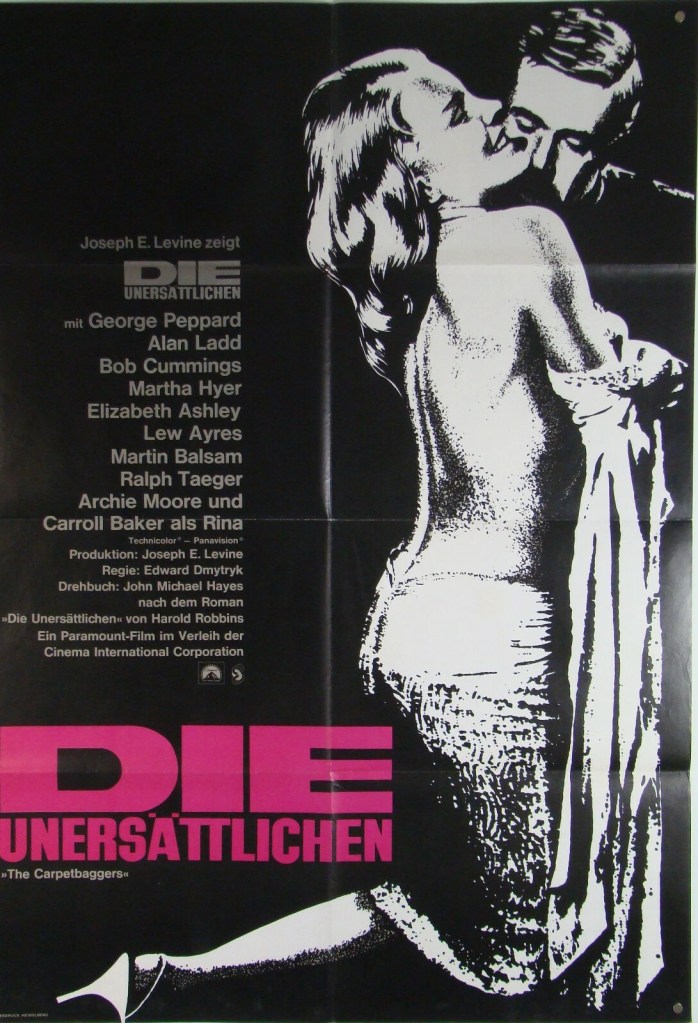
Though it certainly enters soap territory in the second half it’s so true to the characters that it plays out in hugely enjoyable fashion. Jonas remains ruthless – and unhappy – while Rina powers her way through men and booze, the latter leading to her death. Nevada doesn’t turn into a superstar, Jonas abandons wife Monica (Elizabeth Ashley) and child, begins an affair with former porn star Jennie (Martha Hyer) and destroys her.
You will be surprised to learn this has a happy ending. I can’t confess to have read the book so no idea whether or not this was tacked on to keep the studio happy. Whatever, it’s a terrific ride, full of punchy lines and sharply-wrought scenes and enough of the pell-mell structure of the book to keep an audience riveted.
This proved the career breakthrough for George Peppard – Breakfast at Tiffany’s (1961) had done considerably less for his career than it had for Audrey Hepburn – and he offered Hollywood mavens a new kind of hero, not just a tough guy in the Steve McQueen mold, but a mean tough guy that would open the door for the likes of Lee Marvin.
As you will know I’ve got a soft spot for Peppard, who’s generally been under-rated as an actor. This performance, despite the depths he showed, was equally dismissed, but it’s the turn of this career.
Carroll Baker (Harlow, 1965), too, has a part with real meat and makes the most of it, not just a slinky sex god, but devious and smart, and vulnerable. Alan Ladd (Shane, 1953) in his final picture is well out of his comfort zone and might have looked forward to an extended career playing a different kind of character except for his untimely demise.
The females are uniformly good, especially as they all have underlying reasons for their attraction to the wealthy Jonas, Monica desperate to save her father’s business, Jessica desperate to hide her past.
Edward Dmytryk (Mirage, 1965) doesn’t put a foot wrong, allowing insecurities in tough characters to creep through, but the star of the show for me is John Michael Hayes who turns what could have been a routine blockbuster with a built-in audience into a cracking entertainment.
One to catch.
The Wrong Arm of the Law (1963) ***
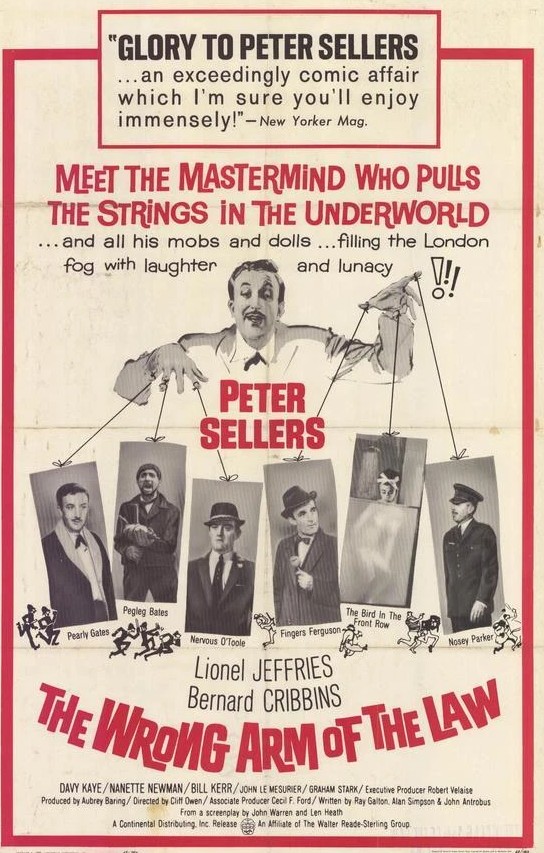
Effortless stuff from Peter Sellers – funny accents and all – that put into sharp perspective his later strained performances in vehicles like What’s New Pussycat (1965) coupled with one of those delicious tales replete with countless twists that sets bad guy against bad guy. An on-from Sellers dominates any picture and here he’s at the top of his game and all you can do is sit back and wallow in the pleasure of watching him.
Theoretically, he’s playing two roles – poncy French fashion house owner Jules and London crime mastermind Pearly Gates. But the Frenchman is a role he’s adopted. In that capacity he garners information from a gullible clientele only too happy to boast about where they’ve stashed their jewels or where someone else is putting on an ostentatious display of wealth. This is relayed back to the gang who go and steal it.
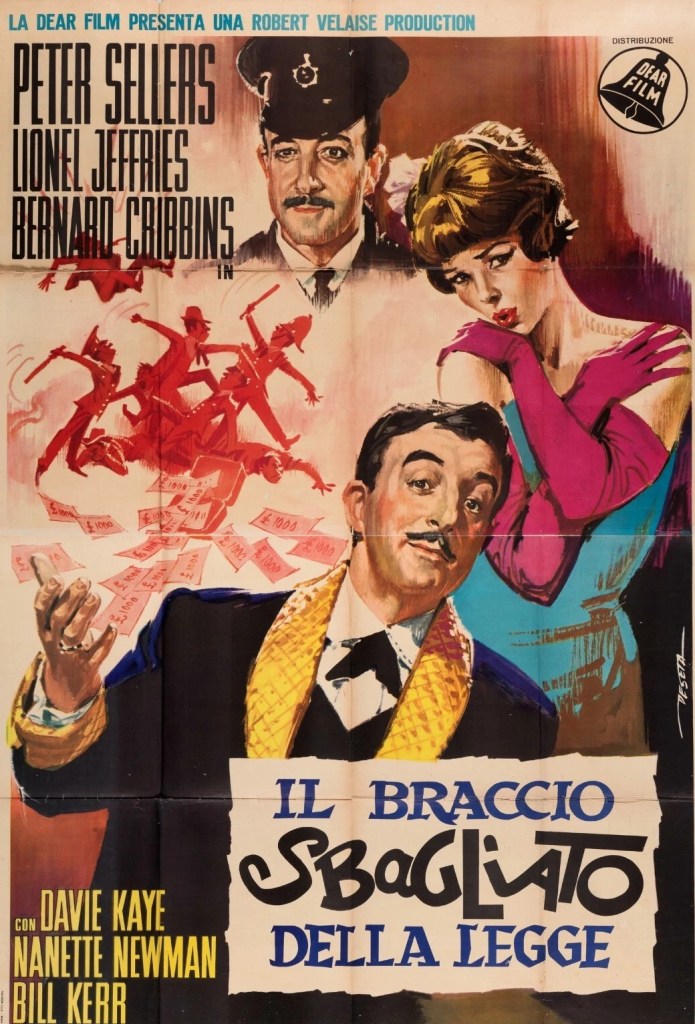
The first twist is that the gang itself is being duped. Another mob, Australians, posing as cops (known as the I.P.O. mob – Impersonating Police Officers) arrest the thieves and make off with the loot. Gates is furious and is convinced it must be an inside job, he’s got a grass on his team. He is correct. But, twist number two, he’s the blabbermouth, unwittingly passing on details of his next criminal coup to girlfriend Valerie (Nanette Newman), adept at playing on his arrogance to winkle out the information.
As the gangsters are operating under a city-wide syndicate with gangs allocated territories and not treading on each other’s shoes, Gates’s first suspicions fall on rival gang leader “Nervous” O’Toole (Bernard Cribbins). But when that proves a bust, the syndicate teams up with the real cops led by Inspector “Nosey” Parker (Lionel Jeffries) with the approval of his boss (John le Mesurier) and establish a 24-hour no-robbing arrangement while trying to flush out the IPO outfit.
Together, they set in motion a major crime, assuming the information will be passed on to the IPO team, and the cops can catch them in the act. Twist number three, Gates doesn’t see why he should go to all that trouble without adequate reward and plans to make off with the stolen money.
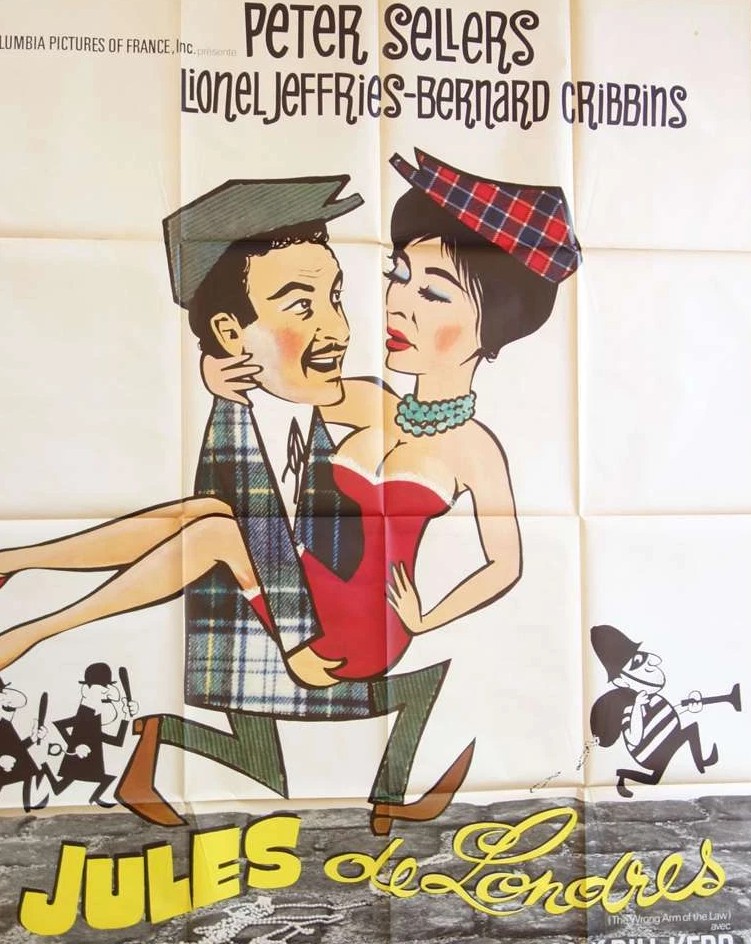
The terrific cast doesn’t let Sellers have it all his own way. Lionel Jeffries (Chitty Chitty Bang Bang, 1968), Bernard Cribbins (She, 1965) and John Le Mesurier (Dad’s Army television series, 1968-1977) can scene-steal with the best of them. Nanette Newman (The Wrong Box, 1966) is a revelation and the supporting cast is bumped up with the likes of Graham Stark (The Magic Christian, 1969) and Bill Kerr (Doctor in Clover, 1966) and if you’re quick you’ll spot a pre-fame Michael Caine (Zulu, 1964).
Not all the jokes are good but they come so thick and fast that you don’t care. And in the midst of this we have a rather enlightened and vulnerable Gates. He is a considerate employer, looking after his team in bad times, paying them well and generally acting as a paternal figure, while away from the gang he can unwind with Valerie and let his true feelings and the pressures he’s under be known.
Director Cliff Owen (The Vengeance of She, 1968) hardly stops to take breath. Screenplay by the due of Ray Galton and Alan Simpson (The Spy with a Cold Nose, 1966) working in conjunction with John Antrobus (The Big Job, 1965).
Avoid the snigger territory of the Carry On pictures, this is probably the last British comedy that could get away with such innocence and was rewarded with huge box office numbers in Britain.
Sheer enjoyment.
Three Days of the Condor (1975) *****
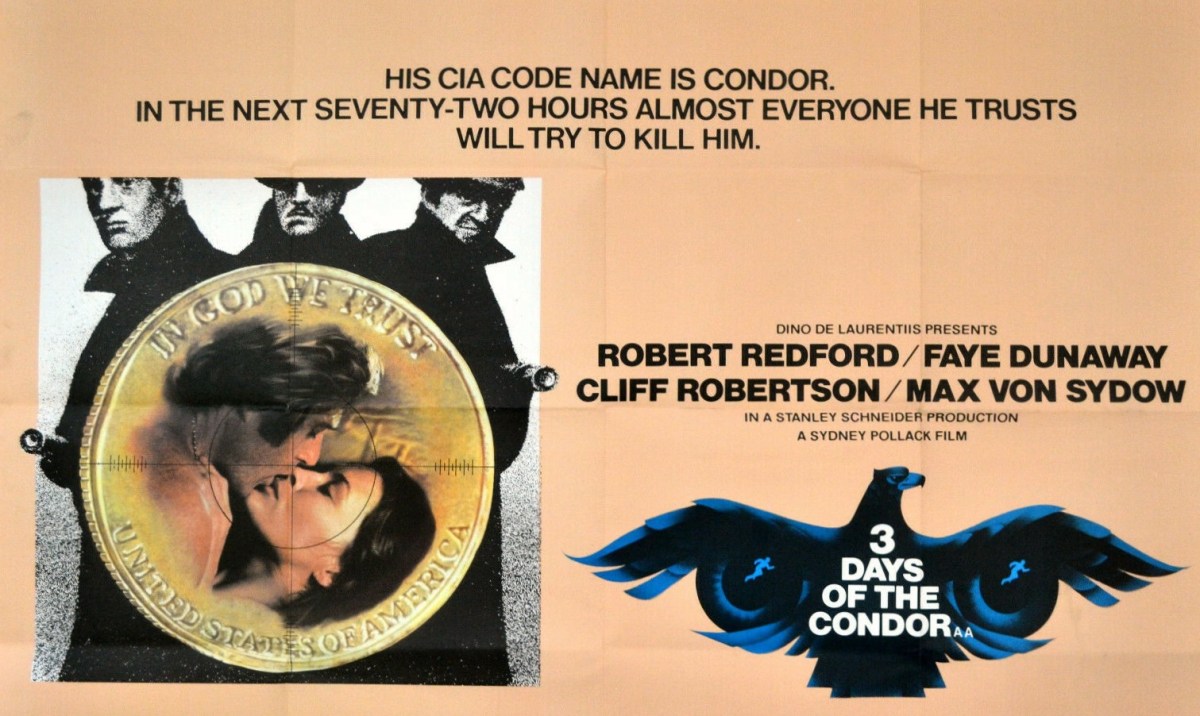
My belated tribute to the recently-deceased Robert Redford. He’s made a bunch of worthier films and his pair with Paul Newman – Butch Cassidy and the Sundance Kid (1969) and The Sting (1973) – take some beating. But this is the one I go back to the most because it combines worthiness with thrills and two stunning performances.
Outstanding thriller in the paranoia vein with Robert Redford delivering one of his best performances. Never mind the terrific score by Dave Grusin (Tell Them Willie Boy Is Here, 1969), the soundtrack to this tale of political chicanery involving the C.I.A. is the chattering of computer printers.
Joe Turner (Robert Redford) is an amiable geek – beanie hat, unfashionable Solex moped – working in an obscure department of the C.I.A. (although one where the receptionist has a gun in her desk drawer) looking for codes in novels. He doesn’t quite conform to type, irritating his rules-conscious colleagues, late for work, illicitly using the back door instead of the front. On returning from collecting lunch, he finds the entire department massacred. His Washington boss Higgins (Cliff Robertson) promises to bring him in but instead arranges an ambush.

On the run, unable to return to his own apartment, his girlfriend Janice (Tina Chen) among those murdered, he kidnaps photographer Kathy (Faye Dunawaye) at first content to find somewhere to hole up but then using her to help him resolve the issues. It’s soon apparent that Turner, in his desk job, has stumbled upon a secret organisation deep within the C.I.A. In a touch of the Hitchcocks, director Sydney Pollack (The Scalphunters, 1968) lets the audience know what Turner does not, that Higgins and his bosses Wabash (John Houseman) and Atwood (Addison Powell) are out for his blood, assassin Joubert (Max von Sydow) the triggerman.
But as Joubert points out, Turner is an amateur and that makes him unpredictable. The killers believe Turner will easily be dealt with. But he’s not as stupid or unresourceful as they might expect. The opening section reveals just how handy he is: fixing a computer, knowledgeable about plants and for some reason the weather, working out an insoluble murder in a book, and most important of all has learned to trust nobody especially his bosses. It turns out he’s got a few of his own tricks up his sleeve, not least how to work a telephone exchange to his advantage and how to flush out his adversaries.
There’s a terrific game of cat-and-mouse and in possibly the only picture in the early cycle of conspiracy pictures the first character capable of harnessing technology.
You often read about character-driven movies but that’s only usually in the sense of dramatic flaws or preferring exploring personality to action. This is character-driven in an entirely different way. Turner’s life depends on him being able to read character, to notice what’s wrong or false in a given situation, to assess the qualities of those around him. For much of the dialogue, Turner is observing as much as listening, watching for behavioural clues.

Even without the presence of Kathy, this would have been a highly satisfactory thriller. But the tentative romance takes it to another level. Unusually, she is a loner, whose photographic metier is loneliness. That they bond at all is surprising, that they do so with such touching emotion brings unexpected intimacy.
There’s a very contemporary feel to the politics, not just American authorities doing what they want but the idea that liberal values will vanish the moment there is genuine threat to loss of the high living standards citizens enjoy or, worse, oil or gas rationing or famine. “Do we have plans to invade the Middle East?” Turner demands of Higgins. You can’t get more contemporary than that! And at one point Turner uses unsuspecting people as a human shield.
For such a fast-moving picture, time is taken out to understand the characters involved, Higgins not quite as far up the espionage tree as he should be, Joubert’s hobby the meticulous painting of model soldiers. A peck on the cheek is all the information we are given that Tina, a work colleague, is Turner’s girlfriend.
As Kathy moves from indignant captive to welcome participant, you can see that she represents the desire of many liberals to give the authorities a bloody nose. There is one brilliant moment at the end where Turner’s fears overcome his feelings and the devastation of what she perceives as emotional betrayal is seen on her face.
But this is Robert Redford’s picture. He was on an almighty box office roll – Jeremiah Johnson (1972), The Sting (1973), The Way We Were (1973), The Great Gatsby (1974), The Great Waldo Pepper (1975) and on the horizon All the President’s Men (1976). Every minute of the movie his face or body are working hard, eyes constantly involved in the character observation I mentioned. He goes from being light-hearted and handsome at the start to serious and deadly at the end. And there are some superb bits of business. When the rain stops, for example, he checks his watch to see it has ended when he predicted. When he returns after lunch, he peers down over the steps to see that his moped that earlier some kids had tried to steal was still there.
This is probably the quietest you’ll ever see Faye Dunaway (A Place for Lovers, 1968). She is an enigma, the puzzle only uncovered in her photographs. But as a photographer, she is also an observer, and she soon likes what she sees in Turner. The strong supporting cast includes Cliff Robertson (Masquerade, 1965), Max von Sydow (The Quiller Memorandum, 1966), John Houseman (Seven Days in May, 1964), Tina Chen (Alice’s Restaurant, 1969) and Addison Powell (The Thomas Crown Affair, 1968).
Sydney Pollack does an exceptional job, cutting between the pursuers and the pursued. The opening sequence itself is quite superb as the director sets up the massacre which is carried out in silence, machine guns fitted with suppressors, while providing insight into Turner. Based on the bestseller Six Days of the Condor by James Grady, the intelligent screenplay by Lorenzo Semple Jr.(Fathom, 1967, and The Parallax View, 1974) and David Rayfiel (Castle Keep, 1969) keeps everyone on their toes.
More straightforwardly enjoyable than Coppola’s self-conscious The Conversation (1974) and Pakula’s occasionally opaque The Parallax View (1974) with computer surveillance, giving this another contemporary edge, a key factor in the way the tale that switches between pursued and pursuer
Bunny Lake Is Missing (1965) ****

Otto Preminger (Hurry Sundown, 1967) returns to his film noir roots (Laura, 1944; Whirlpool, 1950) for this crisply-told tale, mixing police procedural with psycho-drama, of a missing child who may the figment of her mother’s imagination. It’s beautifully filmed and for anyone brought up on modern cinema of short takes and the camera bouncing from one close-up to the next, it will be a revelation, as Preminger favors classic Hollywood style, long takes, in a single shot the camera often following a person in and out of several rooms, and equally classical composition, scenes containing three or four characters where everyone acts within the frame.
Single-mother Ann (Carol Lynley) turns up to collect her four-year-old daughter Bunny from her first day at a London nursery only to discover not just the child gone but nobody has any recollection of the child being there in the first place. That is, apart from the school cook (Lucie Mannheim), who promised to look out for the child but who has subsequently disappeared. Ann is anxious anyway because she is moving house and in her new apartment has an encounter with her creepy landlord Horacio (Noel Coward), a master of the innuendo and the casual stroke of the arm.

It’s a very English school with stiff-upper-lip not to mention snippy teachers. “We mustn’t get emotional,” school administrator Miss Smollett (Anna Massey) warns the distraught mother. Ann’s brother Steven (Keir Dullea), a journalist, kicks up more of a stink, arguing with staff, and with a very threatening manner. Things get creepier still. Upstairs, they hear voices but it’s just the school’s founder Ada (Martita Hunt) who records children talking about nightmares. Steven seems over-protective towards his sister, which is understandable, and somewhat over-affectionate, which is not.
Detective Superintendent Newhouse (Laurence Olivier) and sidekick Sgt Andrews (Clive Revill) investigate. He is an unusual cop. A university graduate but not of the excitable Inspector Morse persuasion for one thing, and reasonable to an irritating degree in that he keeps all his options open. But the cops are thorough, descriptions of the missing child issued, search of the premises and surrounding area undertaken. But it turns out there is no record of Bunny in the school ledger, no sign of her existence in the flat, and it transpires that as a child herself Ann had an imaginary companion called Bunny.
As Steven becomes more obstreperous and the intense Ann verges on the hysterical, not helped by the unwanted attentions of the landlord, a BBC performer with a melodious voice he believes irresistible to women and more than a passing interest in sadism, the case appears to be heading in the direction of a quick visit to a psychiatry ward. The usual anchor in these situations, the policeman, is not as definite as normal, Newhouse not pushing the investigation in a direction the audience will find acceptable, but largely standing back, as if yet to make up his mind, which adds to the sense of mystery.

Preminger isn’t in the business of piling twist upon twist, but as these arrive in due course, the options they offer are even more psychologically damaging. And from setting off at a steady pace with everything apparently settled down by the steady superintendent, the minute he departs the scene, the story takes on a different dimension and there are three superb chilling scenes, one in hospital, another in a doll’s hospital and the last in a garden as the question of just who is unhinged becomes more apparent. There is certainly madness in the movie but it comes when you least expect it and from a direction you may not have considered. On another level, the world of children is entirely alien to the adult and the reconciliation between the two worlds impossible to bridge.
Preminger extracts a performance from Laurence Olivier (Khartoum, 1966) that cuts the character to the bone, eliminating many of the actor’s tropes and tics, but at the same time making him perfectly human, unable to resist, for example, a traditional school pudding, and finding ways to curb Steven’s excesses while comforting Ann. By controlling the actor who always exerts screen presence, Preminger makes him come across with even greater authority. It’s an achievement in itself to ensure that Olivier never raises his voice.
Carol Lynley (The Pleasure Seekers, 1964) is excellent as the distraught mother, one step away from losing her mind and Keir Dullea (The Fox, 1967) constantly raises the stakes. Noel Coward (The Italian Job, 1969) possibly does the best job of the lot, his normal high levels of sophistication eschewed in favour of the downright creepy. In supporting roles look out for Clive Revill (Kaleidoscope, 1966), Finlay Currie (Vendetta for the Saint, 1969), Anna Massey (De Sade, 1969) and Adrienne Corri (The Viking Queen, 1967). Pop group The Zombies featuring Rod Argent and Colin Blunstone put in an appearance.
Husband-and-wife team John Mortimer (John and Mary, 1969) and Penelope Mortimer (The Pumpkin Eater, 1964) wrote the screenplay from the besteller by Evelyn Piper. But it is most assuredly an Otto Preminger production. He has a surprisingly good grasp of British custom and character, shot all the movie on location, but in black-and-white so it is not dominated by the tourist London of red buses or red pillar boxes, and his probing camera and long takes are a marvel for any cinematic scholar.

