Marketing: Black Stamps

You might be tempted to fork out for the range of James Bond Commemorative Stamps being brought out to celebrate No Time to Die when it eventually sees the light of day on movie screens.

But stamps either as collector’s items or for trading purposes have been around since the silent era.  A line of movie commemorative stamps issued in America in 1944 sold 1.1 million first day covers, the second highest-ever at the time, and in the late 1950s Movie Stamps Inc set up a business that worked in the same way as the Green Stamps given away in supermarkets and gas stations. In this system, if you collected enough you won a gift, usually, in regards to the movie business, a couple of free tickets.

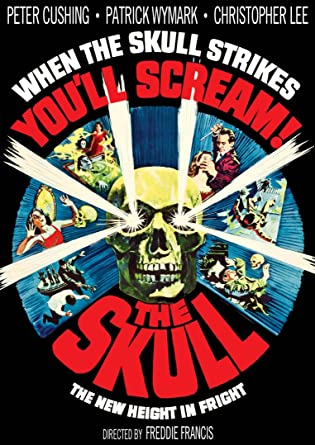
So Columbia Pictures looking for a way to sell its Hammer double bill The Gorgon (1964) with Christopher Lee and Peter Cushing and The Curse of the Mummy’s Tomb (1964) starring the lesser-known Terence Morgan revived the idea.

Horror specialist Hammer was one of the British film studios going through a production boom – over 100 movies were being made in that country in that year – with The Secret of Blood Island (1965) in the works for Universal and She for MGM. But horror was still a difficult sell and Hammer had ignored the advice of Variety that The Gorgon would work best if teamed with “a lively comedy.”

American International had expanded the horror market away from the Frankenstein/Dracula axis by exploiting the Edgar Allan Poe back catalog and William Castle had achieved some success in modern tales of terror such as Dementia 13 (1963) and The Night Stalker (1964). But Castle could call upon the likes of Barbara Stanwyck and Robert Taylor, players with substantial marquee status despite their lately diminished careers, for radio and television interviews.

For Hammer the obvious exploitation options were limited to a spread in the quarterly Castle of Frankenstein magazine which could be purchased for 35 cents at newsstands.

So the marketing honchos dusted off the old movie stamps idea. In some advertisements, the studio offered free stamps to the first 10,000 ticket-buyers but in the advertisement shown above they appeared to be given away free to everyone. The faces of the various monsters and characters featured in both films were imprinted on the stamps. However, on the debit side, there was no sign of any redemption for the collected cards. You couldn’t, should you be so inclined, collect ten and get a guest ticket in return. You could probably trade them and build up a collection. I’m not sure they did much for the movie judging by the box office accounts that exist but if anyone remembers seeing them or collecting them let me know.

Sources: “Film Industry New 3c Stamps Sets Record,” Variety, Nov 15, 1944, 1; “Tease-In Kids with Movie Star Stamps,” Variety, Aug 21, 1957, 20; “Premium Stamp Set Up,” Variety, Aug 20, 1958, 7; Review of The Gorgon, Variety, Aug 26, 1964, 6;  advert, Box Office, Nov 16, 1964, 2; “Film Plugs and Pluggers,” Variety, December 30, 1964, 21; Mark Thomas McGee, Beyond Ballyhoo: Motion Picture Promotion and Gimmicks, p125-131.

Easy Rider (1969) *****

You could be forgiven for thinking that the movie’s main influences were the early Cinerama pictures that focused on extensive tracking shots of scenery (in this case, the open road) and unusual customs (ditto, alternative lifestyles, dope-taking etc) and Mike Nichol’s use of contemporary pop music in The Graduate (1967). But it also drew on the assumption, as did Hitchcock in Vertigo (1958) and Kubrick with 2001: A Space Odyssey a decade later, that a camera doing nothing can be hypnotic.

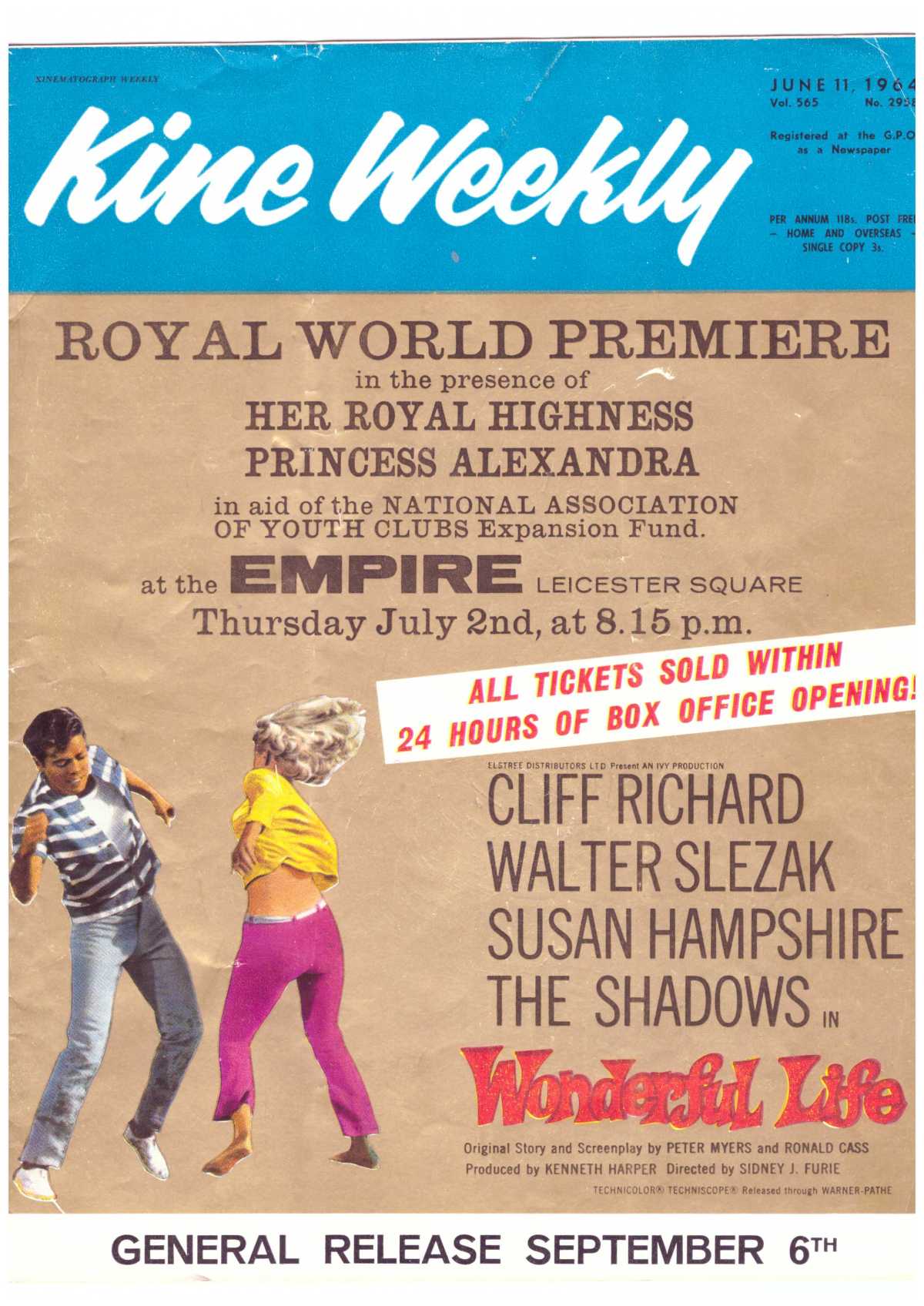
Selling a picture to the public and selling it to cinemas were two separate marketing skills. The easiest way to guarantee bookings for any film was to promote the box office figures through the trade press – as here in the British “Kine Weekly.” Columbia had cleverly booked the movie into one of the smallest cinemas in London’s West End where it was almost certainly guaranteed to break the box office record. But even the studio must have been taken aback by the way Easy Rider pulverized the previous record.

Message pictures were the remit of older directors like Stanley Kramer and Martin Ritt and films that had something to say about the human condition generally emanated from Europe and not low-budget efforts coming out of Hollywood. Easy Rider has a European sensibility, an almost random collection of unconnected episodes with no narrative connection to the main story, itself incredibly slight, of two mild-mannered dudes heading to New Orleans to see the Mardi Gras.

Road trips were not particularly unusual in American cinema but the form of previous locomotion was horse-related – westerns. The journey has been a central theme to movies. This is an 80-minute picture masquerading as a 95-minute one, a good fifteen minutes of screen time taken up with endless shots of Peter Fonda and Dennis Hopper on bikes passing through the landscape, with a contemporary soundtrack as comment.

Unusually, it’s also a hymn to ancient values, heads bowed in prayer at meals as different as you could get, the Mexican family and the commune, a marching band playing “When the Saints Go Marching In” and the recitation of prayers in the cemetery.

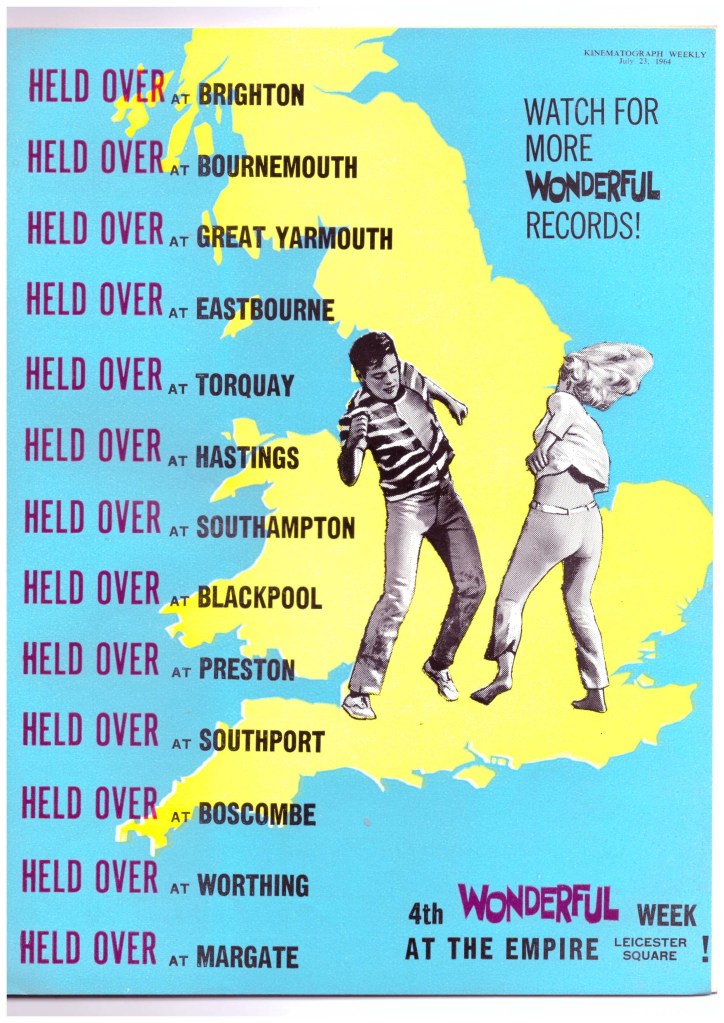
Success in London was no guarantee that a movie would perform as well all over the country. Columbia continued to book it into smaller venues in the hope it would repeat the London experience of breaking box office records. When it did the studio took out another advert in Kine Weekly to let exhibitors know.

What marks the film out stylistically, perhaps enforced by the lean financing, is the sparing way it is told. The most dramatic scenes – the three murders – are filmed in shockingly simple fashion. There are often long pans along groups of characters. While innovative, the flash-cut flash-forward editing adds little to what is otherwise a very reflective film. Inspired use is made of natural sound, the muffled thumping of oil derricks at the cemetery, the soundtrack to one death is just the battering of unseen clubs by unseen assailants.

The dialogue could have been written by Tarantino, none of the confrontation or angst that drives most films, but odd musings that bring characters to life. At the beginning of the trip, Hopper and Fonda are welcomed wherever they travel, but towards the end resented, treated as though a pair of itinerant aliens. They entrance young girls but are vilified by authority, jailed for no reason except the threat to traditional values they apparently represent.

Elements not discussed at the time of release make this more rounded than you would imagine. The excitable Hopper, a nerd in hippie costume, is driven by the American dream of making money. The more reflective Fonda senses something is not only missing from his life but has been lost forever. He has the rare stillness of a top actor, face reflecting unspoken inner turmoil.

It remains an extraordinary film, a series of accumulated incidentals holding up a mirror to an America nobody wanted to acknowledge and the brutal climax no less powerful now.   

Of course, the Easy Rider soundtrack itself summons up memories of the era and it is worth listening to just by itself and you might even want to go all the way and listen to it in the original vinyl.

Below is a link for the DVD.

   https://www.amazon.co.uk/Easy-Rider-DVD-Peter-Fonda/dp/B00LTK2Z44/ref=sr_1_1?crid=YSG6SCL8QQF9&dchild=1&keywords=easy+rider+dvd&qid=1596660339&s=dvd&sprefix=easy+rider%2Caps%2C153&sr=1-1

Selling Films Joe Levine Style

After the monumental success of Hercules, exhibitor-turned-distributor Joseph E. Levine pretty much thought he could sell pictures to theater owners on the basis of his name alone. Which explains the absence of any mention of star Steve Reeves (of Hercules fame, ironically enough) from the first seven pages of the Pressbook for Thief of Baghdad (1961).

The Pressbook itself was guaranteed to garner attention from its unusual shape and size. Most Pressbooks are standard A4 – roughly 8 inches wide and 12 inches high – but this easily exceeded the norm. The front page was 22 inches wide by 17 inches with a flap that extended the height to 29 inches. Turn the next page and it became bigger again – 33 inches wide by 22 inches high – and remained that size for another ten pages.

What the first seven pages sold was the Levine name and how he was going to promote the picture to moviegoers. He promised national television and radio advertising saturation. In addition, he supplied free of charge two trailers for television and four for radio which theater owners could use for supplementary local use.

Twenty thousand toy stores were lined up to sell merchandising – “an elaborate array of novelty items, hobby kits, puzzles and games.” Window displays were a key tool in marketing films to local moviegoers.

In addition, Dell had published two tie-ins – a full-color comic book for children and a novelization paperback for adults. In those days books such as these were sold on news stands and revolving racks in drug stores and five-and-dime outlets as well as bookshops. For only $25 (including delivery cost) movie theaters could buy a “double-flasher” eight-foot-high standee to promote the movie in advance.

Unusually, at a time when movies came with up to seven or eight different taglines intended to appeal to different types of audiences (the exhibitor would know which one held the most appeal), Thief of Baghdad limited itself to only four. The main tagline was: “The fantastic deeds…the incredible daring of the thief who defied an empire.”

There were two main alternatives:  either “Opening wide a new world of screen wonders” or “the amazing becomes the incredible the fantastic becomes the real.” All three taglines were quantified with the addition of a number of “screen thrills” such as flying horses, faceless fighters, man-devouring trees, a one-faced army, the giant killer of the sea and a “harem of mystery.”  Finally, there was the option of “he was a score of lovers…a hundred fighters…a thousand thieves…a man in a million.”  

Costuming ushers in “typical Baghdad wear” and calling upon local muscle men to don similar garb was suggested as another marketing ploy.  

Otherwise – which seemed the least of Levine’s concerns – there was actually quite a lot to write home about. It was filmed in Tunisia in the Mosque of the Barber – featuring 600 columns transported from Carthage – and the Mosque of the Sabre in the oasis city of Kairwan. The filmmakers had to devise their own ancient marketplaces since the ones in existence were too modernized. Local extras were used to add further authenticity. An ancient reservoir dating back to 700AD was drained and transformed into a prison.

The special effects by Thomas Howard included a winged horse and a forest of man-eating trees. To create the effect of a brigade of horsemen all in the image of the titular thief, Edwards achieved the illusion by having the men wear masks of Reeves’ face.  

Italian female lead Georgia Moll made her Hollywood debut in The Quiet American (1958) while model Edy Vessel, who refused to give out her vital statistics for publicity purposes, was cast as a seductive temptress.

Reeves, famed for sticking to a particular diet, brought with him 24 jars of honey and 40 pounds of nuts and made yoghurt from camel’s milk.  

This was the sixth version of the film, the first starring Douglas Fairbanks in 1924 followed sixteen years later by the British-made Alexander Korda iteration. Further versions from a variety of sources appeared in 1949, 1952 and 1960.

Walk, Don’t Run (1966) ***

Stars rarely get to choose when they want to retire. Usually, the phone stops ringing, or they slide down the credits until no one can remember who they once were, or they end up in terrible international co-productions, or like Tyrone Power (Solomon and Sheba) they die on the job or, like Spencer Tracy, because of it.

Cary Grant, on the other hand, went out at the top, or near enough, after a string of box office winners, including this one, throughout the Sixties. If you are more generally familiar with Grant through Hitchcock thrillers or Charade, you might have forgotten his comedy expertise. He was a master of the double take and the startled expression – and he needs that here in what is sometimes a pretty funny farce.

The set-up is peculiar. Grant is a businessman landing in Tokyo two days before the 1964 Olympic Games with nowhere to stay and ends up sleeping on the couch of Samantha Eggar and later sharing his room with Jim Hutton, an athlete equally lacking in the forward planning department. (Excluding the Olympics, of course, the film has a similar concept to The More the Merrier, 1943).

There’s no great plot and no great need for one. Grant’s main purpose is to play Cupid to Hutton and Eggar and steer her stuffy fiancé out of their way. But it says a lot for Grant’s talent that not much plot is required. He is just so deft, whether he is playing top dog or being beaten at his own game by a rather resilient Hutton.

Eggar is Doris Day-lite, but Hutton is a revelation, not the dour dog of later The Hellfighters (1968) and The Green Berets (1968), but showing true comedic talent, especially in quick-fire verbal duels with Grant. There is only a wee bit of stereotype, overmuch bowing mainly and a Russian shot-putter, but some other Japanese customs are more interesting, yellow flags to cross the road, for example.

There are a couple of brilliant visual gags, one involving trousers, another with Grant getting locked out of the apartment, and a terrific payoff in a Japanese restaurant. Except for thrillers, Grant did not need great directors, he knew comedy inside out and here the accomplished Charles Walters (High Society, 1956) has the sense to let him get on with it.

Grant was 62 when the film appeared so quite rightly delegates romance to Hutton, which is a shame because his (non-romantic) interaction with the pernickety Eggar (she and fiance equally matched in this department) carries all the Grant romantic hallmarks. Instead, he ensures that romance between Hutton and Eggar runs its true course, which while that is satisfying enough, is a bit like removing John Wayne from the final shootout in a western. Oh, and there is a reason for the Olympic Games setting.

Coming Soon – August 1960

Four smaller pictures took Broadway by surprise, each recording record-breaking openings.  

The most obviously commercial was crime drama Portrait in Black starring Lana Turner and Anthony Quinn. Turner’s box office throughout the 1950s had been inconsistent but audiences had responded to the previous year’s weepie Imitation of Life. However, co-star Anthony Quinn, despite two Best Supporting Actor Oscars, was still generally classified as a leading male rather than outright star. The movie had premiered in Chicago to startling results and emulated that in Cleveland. So the industry was not entirely surprised when the movie broke the opening day record at the 1,642-seat Palace and the weekly record at the 550-seat arthouse the Trans-Lux 85th Street.  

Nature’s Paradise could not have provided a more polar opposite. The British-made nudie went down the old-fashioned “grind” route – first showing at 8.45am, final showing at 2am –  to break the record at the 390-seat World arthouse. And at equally opposite ends of the spectrum was Disney’s real-life documentary Jungle Cat which took apart the record at the 592-seat Normandie, also an arthouse.

Of the four openers, the one for whom an arthouse was the most likely home was another British feature, Jack Cardiff’s adaptation of D.H. Lawrence’s Sons and Lovers starring Trevor Howard and Wendy Hiller. This broke the one-day record three days in a row at the 590-seat Beekman, despite a tepid review by Bosley Crowther, regarded as the nation’s premier critic. However, the Lady Chatterley’s Lover court case meant that to some extent the film was critic-proof. Its unexpected publicity boost brought in the audiences.

There was also surprising audience support for British star Dirk Bogarde’s Hollywood debut Song without End, a biopic of composer Franz Liszt, which opened in New York’s biggest cinema, the 6,200-seat Radio City Music Hall. (Although MGM had part-financed the actor’s previous endeavor The Angel Wore Red, that was an Italian picture.) Director Charles Vidor died during shooting and George Cukor took over. French actress Capucine also made her Hollywood debut.

The month’s other openers were All the Young Men starring Alan Ladd and Sidney Poitier; Frank Sinatra and the “Rat Pack” in crime caper Ocean’s 11; and sci-fi The Time Machine with Rod Taylor.

Horror maestro William Castle used the “Illusion-O” gimmick to plug 13 Ghosts. Moviegoers required a device similar to 3D glasses to spot the ghosts.

Julien Duvivier’s Marie Octobre was the only foreign film hitting New York during the month. Danielle Darrieux starred in a drama about former resistance members uncovering a traitor in their midst.

SOURCES: Variety 1960 – Aug 3, Aug 10, Aug 17, Aug 24, Aug 31.

Pollyanna (1960) ***

This Walt Disney version discarded much of Eleanor H. Porter’s original best seller not to mention a great deal of the tear-jerking section that played to superstar Mary Pickford’s strengths in the silent 1920 adaptation. Pickford was in her late 20s at the time and a movie mogul to boot (having launched United Artists) so had a depth of emotion Hayley Mills (aged 13 during filming) could not hope to match.

The screenplay is a good lesson in how to retain the essential element of a story – a positive-thinking orphan alleviates the gloom in an embittered town – while providing more for adult audiences. Disney assembled an awesome cast with three Oscar-winners – Jane Wyman (Best Actress, Johnny Belinda, 1948),  Karl Malden (Best Supporting Actor, A Streetcar Named Desire, 1952) and Donald Crisp (Best Supporting Actor, How Green Was My Valley, 1942) – plus four-time nominee Agnes Moorehead and Adolph Menjou.

Despite no Oscar recognition Nancy Olsen had been leading lady to the likes of Bing Crosby, John Wayne and William Holden. In effect, parents would be very familiar with the stellar supporting cast. Unusually for a kid’s picture, Wyman, Malden and Crisp each are given a reflective moment to prove they are doing more than taking an easy salary cheque. 

At least in Hollywood terms (Mills made her debut the year before in the British Tiger Bay, 1959) Pollyanna falls into the a-star-is-born category. The actress acquits herself well, with her expressive face, while hearing the emotion she packs into the word “gorgeous” is word admission alone. With a healthy subplot about a town in thrall to matriarch Wyman, the weight of the movie does not fall on Mills’ shoulders alone and fire-and-brimstone preacher Malden and faded spinster Wyman are particularly good; Malden especially allocated more screen time than would be normal in a movie aimed at kids.

I have never read the book nor (to my shame) seen the Pickford version, so I came to the movie with low expectations, anticipating a lazy, maudlin effort. So I was quite surprised to discover how much I enjoyed it and was shocked by the final piece of action which turned the movie on its head. Sure, it relies on the feelgood factor but there is some decent stuff here – Pollyanna’s determination to find goodness in every event and every person takes her into some strange avenues – the rainbow playing on the walls, the “good parts” of the Bible – that these days makes for an entertaining matinee.  

What the Exhibitor Said

The only view the public in the 1960s ever heard was that of the movie critics. Generally more concerned with the bottom line than plaudits (unless those translated into box office), studios could harvest their own opinion about a movie’s worth through reported box office figures. Exhibitors were caught in the middle – being told by critics how good a movie was and by reports in Variety and other trade magazines how well it was doing on initial release.

But how a movie performed in first run often bore no resemblance to receipts in fifth or sixth or tenth or eleventh run, in small towns or places where the population barely topped the thousand-mark. So weekly trade paper Box Office magazine gave exhibitors a voice, allowing them to sound off about an under-performing picture or praise one that still had some juice left by the time it reached their location.

You will see from the titles mentioned below just how long it took for some movies to complete their runs. You can also see the conditions under which theater owners worked – some films only played two days or had their box office nullified by weather.

Reports below are from the March 30, 1964, issue of Box Office and I would assume exhibitors had played the films a few weeks prior to this date.

Hud (released May 1963), drama starring Paul Newman. “Business above average but no one seemed pleased in what they paid for.” – Ken Christianson, Roxy Theatre, Washburn (pop 913), North Dakota. Played Sunday and Monday. He also screened historical epic Taras Bulba (December 1962) starring Yul Brynner and Tony Curtis on a Sunday and Monday and commented: “Excellent, entertaining, interesting story but below average at box office. Just too many of this type.”

Bye, Bye Birdie (June 1963), musical starring Janet Leigh and Dick Van Dyke. “If you want a small town natural, play Birdie…Bad weather killed the box office.” – W. S. Funk, Kingstree Drive-In Theatre, Kingstree (pop 2,500), South Carolina.

The Haunting (August 1963), horror starring Julie Harris and Claire Bloom. “It is doing all right. The advertising material is so good for a change that I’m not worried about this one.” – Jim Fraser, Auditorium Theatre, Red Wing (pop 12,500), Minnesota. Played Sunday, Monday and Tuesday.

Nine Hours to Rama (April 1963), drama starring Horst Buchholz. “This picture was definitely a dud in my town. Might have been better as part of a double bill had it had less running time.” – Joseph Machetta, Emerson Theatre, Brush (pop 3,621 in 1960 Census), Colorado. Played Tuesday and Wednesday. The theater also showed the double bill of war drama The Young and the Brave (August 1963) starring Rory Calhoun and William Bendix with the older George Pal sci-fi Atlantis, the Lost Continent (1961) and Machetta commented: “The combination was rewarding at the box office. I would suggest trying it as the combination provides interest to most ages.” Played this duo Thursday and Friday.

A Gathering of Eagles (June 1963), drama starring Rock Hudson and Rod Taylor. “A good picture but one of Rock Hudson’s poorest grosses. Airplane pictures don’t set the world on fire for me anymore.” – Terry Axley, New Theatre, England (pop 2,136), Arkansas. Played Sunday and Monday.

Donovans’s Reef (June 1963) with John Wayne and Lee Marvin. “A wonderful family comedy in color and drew a big turnout. John Wayne did a wonderful job and is a big favorite here.” – Leonard J. Leise. Roxy Theatre, Randolph (pop 1,029), Nebraska. Played Thursday, Friday and Saturday.

If you ever attended any of these theaters or know of them or were even in the audience for the pictures mentioned, please get in touch.

The Woman Who Beat Hollywood

Outside of her brace of Oscars, Olivia de Havilland’s biggest achievement was in forcing studios to pay actors who did not want to work. She wasn’t the first person to take on the studios as I discovered when researching my book When Women Ruled Hollywood. Bette Davis, Myrna Loy and Hedy Lamarr preceded her.

De Havilland owed the studio several months on her contract since she had failed to fulfill its terms by refusing to work and was put on suspension. She took the view that the suspension should form part of her contract. The law agreed.

De Havilland was without doubt a great actress – her Oscars for To Each His Own (1946) and The Heiress (1949) plus nominations for Gone with the Wind (1939), Hold Back the Dawn (1941) and my favorite The Snake Pit (1948) attest to that.

But without Errol Flynn at her side she was never a big star. Her only big hit once she left the Warner Brothers comfort zone was medical drama Not as a Stranger (1955) which had strong co-stars in Frank Sinatra and Robert Mitchum. Once she won her freedom she was only seen 15 pictures in 20 years. Both Joan Crawford and Bette Davis made 50 per cent more.

She enjoyed one of the great screen partnerships with Errol Flynn in swashbucklers like Captain Blood (1935) and The Adventures of Robin Hood (1938) and westerns Dodge City (1939) and They Died with their Boots On (1941). Despite her protestations to the contrary, Warner Brothers looked after their ingenue and developed her talent. Versatility was key to remaining a star – the public soon grew tired of a star confined to single genre – and she appeared in westerns, drama, comedies.

Her main problem was her age. She was only 19 when Captain Blood appeared. She was competing with the more mature Bette Davis and Joan Crawford, eight and twelve years older, respectively, for the best parts the studio had to offer. Warner Brothers was also willing to let her go out on loan, her first two nominations were for work at other studios, MGM and Paramount. Since most of the top male actors were much older, it would be hard for her to be accepted by audiences as their equal in a romance or drama.

That she won her case against the studio was as much to do with politics as anything else. The idea that an actor should enjoy more freedom in the workplace than a miner or a nurse was patently preposterous. However, the government was involved in aggressive action against Hollywood that would result in the break-up of the studio system and make hundreds of actors, who depended on contracts, freelancers whether they liked it or not.

However, she certainly made great use of her freedom, as the unwed mother in To Each His Own, confined to a mental asylum in The Snake Pit and forced to choose between money and happiness in William Wyler’s The Heiress.

After a three-year hiatus, she returned with another strong performance in the adaptation of Daphne du Maurier’s My Cousin Rachel (1952). But by the end of the decade she had lost her star status, demoted to leading lady, below Alan Ladd in the billing for in The Proud Rebel (1958) and Dirk Bogarde in Libel (1959). After the reissue of Gone with the Wind in 1961, her career briefly revived – with romantic drama Light in the Piazza (1962) and powerful performances as the woman terrorized by thugs in Lady in a Cage (1964) and Hush, Hush, Sweet Charlotte (1964).   

Thereafter, there were occasional supporting roles and television parts. Her last movie was The Fifth Musketeer (1979).

Fall of the Roman Empire (1964) ****

There could not be a more contemporary picture. As an examination of the problems of assimilating different cultures it is hard to beat. As an assessment of the difficulties of the transition of power it is faultless.

In Gladiator Ridley Scott, taking a few liberties with the known facts, re-imagined the circumstances discussed here of the death of Emperor Marcus Aurelius and the ascension to power of his son Commodus. Along the way, Scott stole a few of Anthony Mann’s visual ideas, snow falling on the battlefield, for example, and at the end the phalanx of guards, shields up, blocking in Commodus and the dethroned military chieftain (Stephen Boyd here, Russell Crowe in Gladiator) for their gladiatorial climax.

British advertisement for the film about to go on general release after a spell in the more expensive West End. The “normal prices” slogan was very commonly found on movies as they headed towards the more normal kind of cinema. in addition, by the time it was rest go into wider release the critics had delivered their verdicts and these could be tagged onto any advertising.

The title does not refer to an invasion of Rome by vast armies of barbarians but the internal corruption which signals the end of the empire. Audiences, taught Latin and Roman history as a matter of course at school around the time the film was released, would be more familiar with the subject matter, but hardly prepared for the spectacle.

Every extra in the known world must have been employed for several scenes, cities bursting with inhabitants, armies sprawling over vast tracts of land. One standout is the extraordinary chariot clash between the two protagonists, not in the confines of an amphitheatre a la Ben Hur, but on wild terrain, along narrow cliff roads, wheels tipping over the edge, down ravines and forest. The other is the soundless gladiatorial fight, not a whisper of music until there is a victor.

And there should be mention of the torture of James Mason, very well done. There is political intrigue, quite a clever way of poisoning an enemy, and plenty argument over the issue of accommodating different cultures, traditional punishment versus the novel notion of extending the hand of friendship and granting automatic citizenship.

The relatively short-lived “Show Time” fan magazine was launched in Britain as Odeon’s answer to the highly successful “ABC Film Review.” Both magazines were only sold inside cinemas but it was common for cinemagoers to purchase copies without necessarily going into to see a picture. This magazine ceased publication by the end of the decade. This was the launch issue in Janaury 1964.

Loyalty is also tested – is treason a form of loyalty? And how much does loyalty depend solely on payment? Proof is given of how integrating cultures can work, an idea that seems alien to Romans accustomed to beating subjects into submission. In some respects the drama takes second place to the discussion.

Christopher Plummer is the deranged Commodus who embraces and disdains in turn his friend Livius (Stephen Boyd). Sophia Loren, as Commodus’ sister (no incestuous suggestions here), is in love with Boyd and though married off to Armenian king Omar Sharif she manages to spend little time with her husband.

If approached as a political film rather than a traditional epic it has a lot to offer. If you want just battles and thwarted romance then a lot less. The mixture of both strikes a good balance. While there are arguments that it is too long, it could actually do with another twenty minutes or so to iron out narrative inconsistencies.  

In the News: July 1960

ADVANCE BOOKING REACHES NEW HEIGHTS

When these days you casually book your movie tickets online for a screening a week or a month ahead, you might not be aware it was not always so easy to book in advance. Sixty years ago it was a rarity. You had to wait in line outside the theater like everybody else.

The emergence of the roadshow at the tail end of the 1950s changed all that. Then you could book by mail (snail mail not email), filling out a booking form with your choice of seating and date and send it off with a check or money order to the theater and wait for tickets to come back a week later. Advance bookings quickly become a measure of how well a roadshow would perform.

So in summer 1960 United Artists were cock-a-hoop in reporting that Exodus, not due out for another six months, had racked up a record $700,000 advance. At first this cash just rolled around in the bank accounts of the designated theater, but in the 1970s studios realized that it was in large part their money and that was when they started demanding upfront guarantees.

STILLS GO UPMARKET

A new trend in stills photography took root. Studios began hiring world-famous snappers. Heading up the trend, United Artists sent nine photographers from international agency Magnum Photos to Reno, Nevada, to provide atmospheric pictures during the shooting of John Huston’s The Misfits. The big names included Eve Arnold, Henri Cartier-Bresson and Inge Morath. They were paid substantial amounts, far more than regular stills photographers. The best known earned $5,000 a week. This was an investment in a name since the idea was that top-class magazines would be more likely to feature a photographic spread on a movie should the pictures come with the cachet of a recognised name. It proved a genius marketing idea. Top magazines took the bait. As an offshoot, and attracting another sizable slice of publicity, the work went on display at Loew’s Capitol movie house in New York as a prelude to presentation in other first run houses.

IN OTHER NEWS

Charlie Chaplin was omitted from the Hollywood Walk of Fame…The premature death at the age of 51 of Twentieth Century Fox head of production Buddy Adler opened the door for the return of Darryl F. Zanuck, thus paving the way a few years later for the legendary producer to save the studio when it almost went bust thanks to gigantic overruns on Cleopatra… Studios considered pulling back on newspaper advertising when they discovered not only were some newspapers censoring movie  ads but around 35 per cent of them refused to run reviews…In the first push in what would turn out to be a long-term marketing campaign for The Greatest Story Ever Told director George Stevens hired an international head of public relations and shortly after issued an advertisement that will forever be a blot on the copybook of John Wayne, who was the first star to be signed.   

Sources: Variety – Jul 6, July 13, Jul 20, Jul 27, 1960; “Photographic Exhibition for The Misfits,” Box Office Showmandiser section, Jan 16, 1961, 10.

Discover WordPress

A daily selection of the best content published on WordPress, collected for you by humans who love to read.

The Atavist Magazine

by Brian Hannan

WordPress.com News

The latest news on WordPress.com and the WordPress community.