I am a published author of books about film - over a dozen to my name, the latest being "When Women Ruled Hollywood." As the title of the blog suggests, this is a site devoted to movies of the 1960s but since I go to the movies twice a week - an old-fashioned double-bill of my own choosing - I might occasionally slip in a review of a contemporary picture.
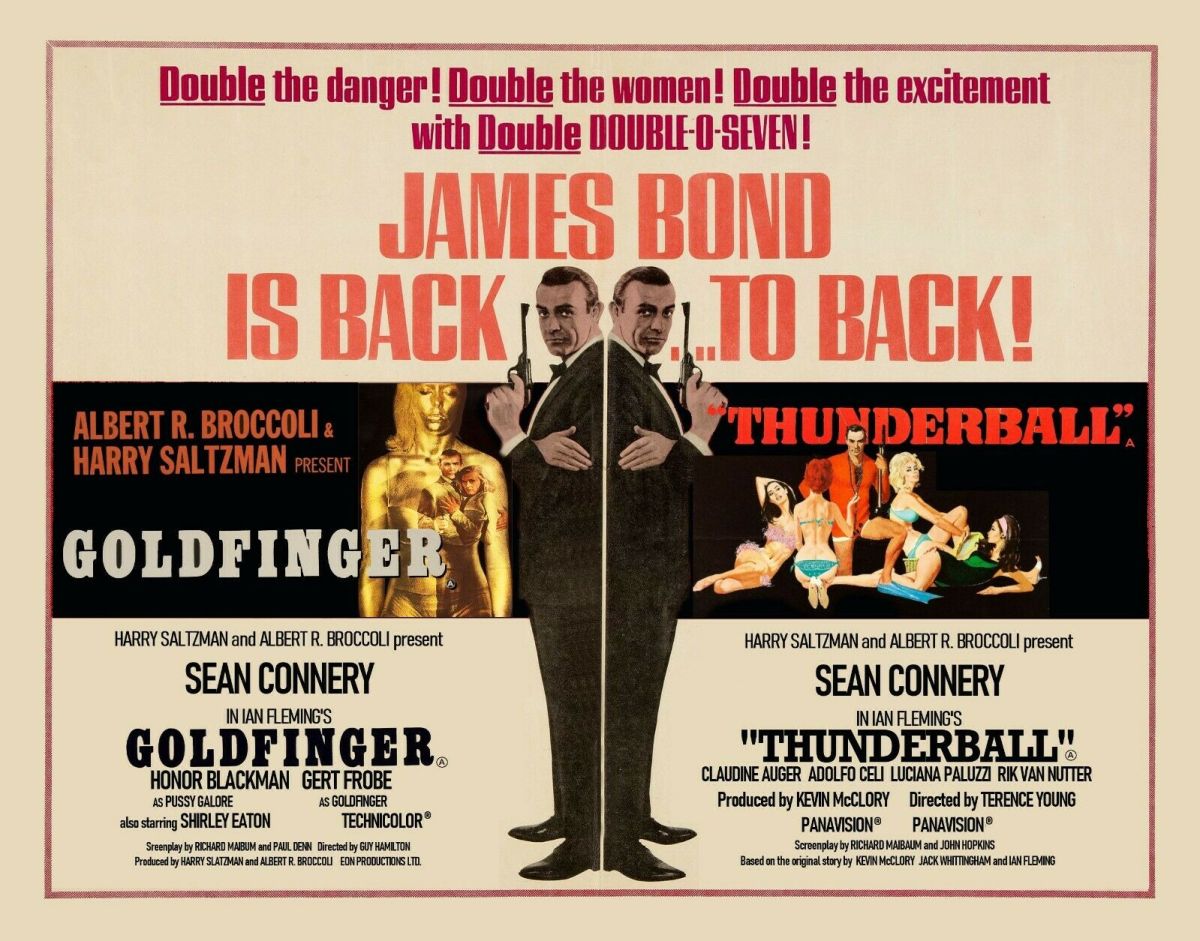
The 60th Anniversary celebration of the James Bond phenomenon in British cinemas that has been running for a few months now sent me back to examine the extent of the James Bond Reissue Double Bill.
As I mentioned a few weeks back, the Dr No (1962)/From Russia with Love (1963) revival in 1965 kicked off the biggest-ever demand for a screen character, one of whom the public never seemed to grow tired, certainly for the next decade until the first of the series were sold to television. Prior to United Artists’ approach with the Bonds, unless a picture had Oscar-driven box office power it would not even be considered for revival for around seven years, considered a generation in audience terms.
In Britain, the movies were guaranteed circuit releases on the Odeon chain. However, contrary to the approach in the United States, the movies were not thrown back into circulation right away and it wasn’t until three years later that the next double bill – Goldfinger (1964)/Thunderball (1965) – put in an appearance. But thereafter, there was no stopping the Bond bandwagon. In 1969 You Only Live Twice (1967) went out with either From Russia with Love or Dr No (cinemas could choose their preferred pairing).
In 1970, United Artists took a break from the Sean Connery reissue business by concentrating on the studio’s other big male star Clint Eastwood, doubling up For A Few Dollars More (1965) with A Fistful of Dollars (1964). But by 1971 it experimented with playing Connery and Eastwood together, first pairing You Only Live Twice/A Fistful of Dollars and later the same year Goldfinger/For a Few Dollars More. But in 1972 the studio reverted to type with Thunderball/Dr No and the following year Diamonds Are Forever (1971)/From Russia with Love.
In 1974 it was You Only Live Twice/Thunderball and few months later Dr No/Goldfinger. Come 1975 it was time for two of the later offerings to enter the revival business – Live and Let Die (1973) and On Her Majesty’s Secret Service (1969) followed at the end of the year by The Man with the Golden Gun (1974) and Live and Let Die. The next year brought a programme change – Diamonds Are Forever teamed up with new Bond Roger Moore in the non-Bond adventure Gold (1974).
In 1977, for the first time in nearly a decade the Bond reissue was absent from British cinemas although the following year saw a re-teaming of Live and let Die and The Man with the Golden Gun. But that pretty much spelled the end of the annual James Bond double bill, television by now too quickly eating up new product.
The British approach was almost conservative compared to the way the Bond revivals were handled in the US. After the sensational performance of Dr No/From Russia with Love in 1965 U.S. exhibitors had to wait only a year for Goldfinger/Dr No. United Artists showed little restraint, following a policy of “play them till they drop,” and launching the Connery/Eastwood combo in 1968 with You Only Live Twice/The Good, the Bad and the Ugly (1967) plus a straightforward Connery item Thunderball/From Russia with Love the same year followed by Goldfinger/Dr No in 1969.
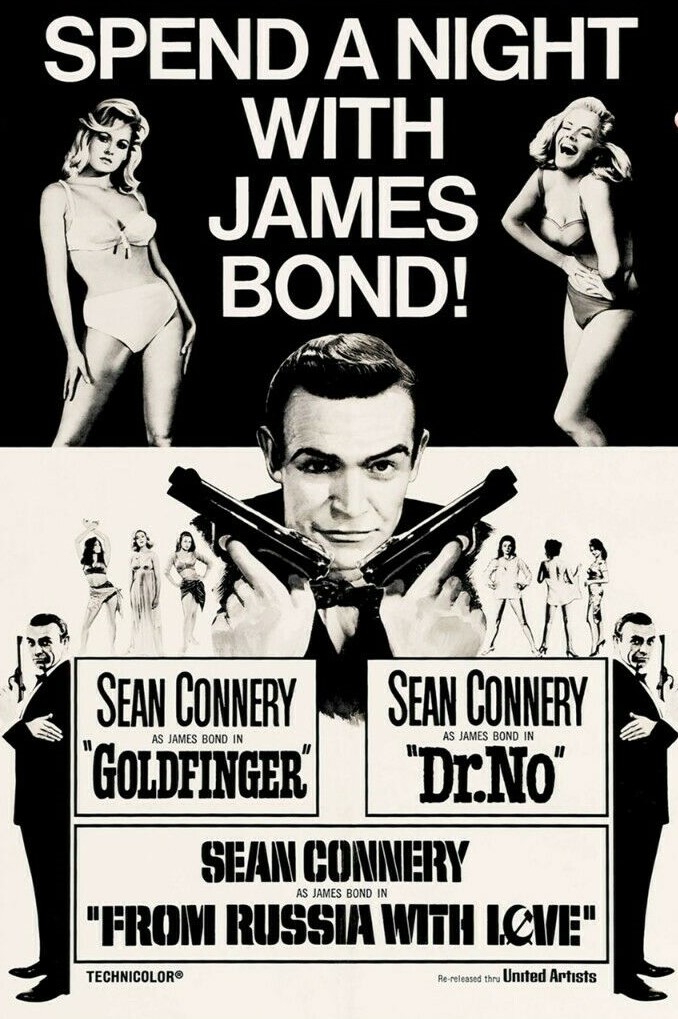
In the U.S. the year of the missing Bond reissue was 1970. But in 1971 United Artists reissued two Bond dualers six months apart. First out was Thunderball/You Only Live Twice and then Dr No/From Russia with Love. Ahead of the television premiere of Goldfinger in September 1972, UA brought back Goldfinger/From Russia with Love and then the triple bill (“Spend a Night with James Bond!”) of Goldinger/Dr No/From Russia with Love plus a double bill of Thunderball/You Only Live Twice, the last program incidentally knocking up a colossal gross of $122,000 – equivalent to $853,000 now – from 14 houses in New York in its opening week.
But the bonanza came to an end when television ponied up $17.5 million – equivalent to $126 million today – for the first seven pictures in the series. And this was before residuals kicked in from VHS, television resale and syndication, DVD, cable and streaming. Even when the MCU can guarantee billion-dollar revenues from many of its movies it’s doubtful if any one of its blockbusters made as much money as the best of the Bonds in their lifetime, much of that extra revenue coming from the way the revivals proved the enduring popularity of the series.
SOURCES: Allen Eyles, Odeon Cinemas 2: From J. Arthur Rank to the Multiplex (Cinema Theatre Association, 2005) p211-220; Brian Hannan, Coming Back to a Theater Near You (McFarland, 2016) p147-151, 175-177, 227.
I could have seen this for nothing on Netflix, but instead, hoping to do an action picture justice by seeing it on the big screen, I shelled out my bucks for the privilege. Bourne Ripoff is as much as you need to know. Lazy writing with a bundle of the incongruities you can get away with within the MCU because as long as there’s the requisite action nobody bothers too much about logic.
Don’t be fooled into thinking this is John Wick gone wild. It’s many things gone wild, including a heap of overacting, and a pair of the biggest villainous klutzes you will ever come across. It’s vaguely redeemed by an explosions/ shootout/ tram chase in Vienna but that’s only enough to shift it up from one-star to two. And it’s a shame because Ryan Gosling (First Man, 2018) in his first movie for four years is a believable tough guy in the Bourne tradition and Ana de Armas delivers on the action chops she displayed in No Time to Die (2021).
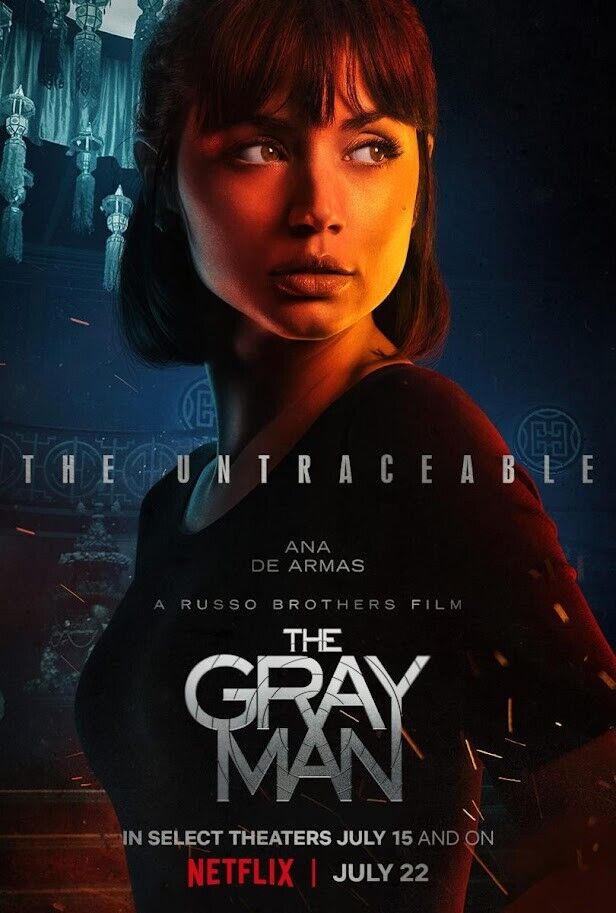
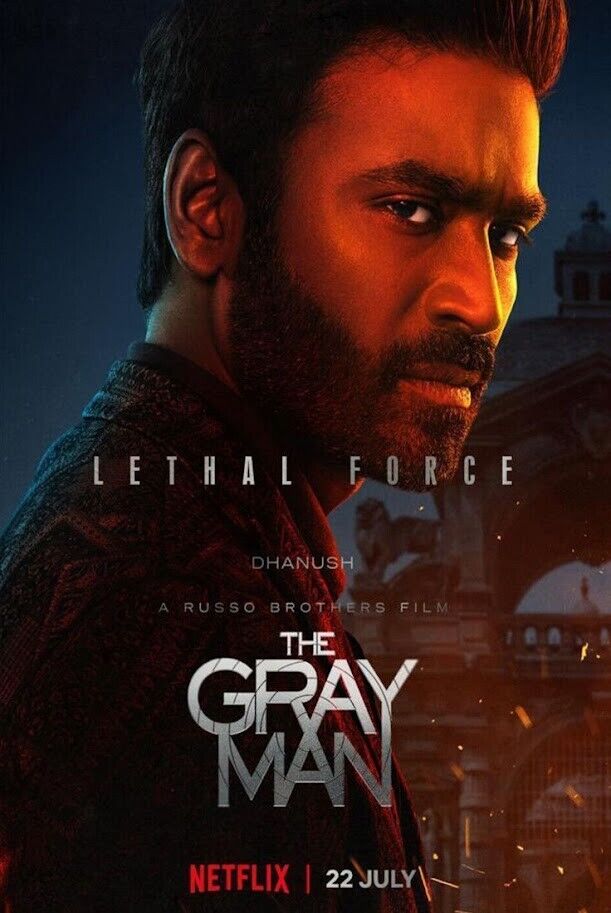
A poster straight out of the Joseph E. Levine playbook. He used to dream up these kind of posters which characters were assigned titles that bore no resemblance to the part they played on screen.
It should be an action romp, but instead it’s a mess. A C.I.A. black ops unit – inventively called the gray department – is hiring convicted killers to knock off anyone they want. Six (Ryan Gosling) got jailed for an insane amount of time, would you believe (nope!) for, as a teenager, killing his dad who was domestically abusing both his sons (trying to drown Six, for example). Six’s latest mission is to kill a guy who turns out to be an assassin in the same line of work but who is blackmailing C.I.A. boss Carmichael (Rege-Jean Page).
There’s nothing cool about Carmichael, he throws coffee at windows when he’s cross, and that sets an awfully bad example because his underling Suzanne (Jessica Henwick) is also prone to getting very cross. But that’s nothing compared to complete nutjob Lloyd (Chris Evans) who enjoys a bit of torture and gives psychopaths a bad name, but if I got this right attended Harvard with Carmichael so that’s okay then. Lloyd is hired to kill Six because he knows too much. And Lloyd calls in other assassins.
Now we’ve had that template in Bourne so what’s going to make it different? I know, let’s ramp it up. Instead of individual assassins, who might display some kind of finesse, let’s have teams of rampaging assassins. You can’t really wreck Vienna with just an assassin or two, you need a whole army.
Danush (Avik San) is an unusual assassin in that he operates on his own, not needing a huge team, but he is also cursed by – remember he’s a ruthless assassin – being suddenly conscience-stricken.
Oh, I forgot to mention Fitzroy (Billy Bob Thornton), the guy who sprung Six from jail but is now retired. Luckily, he happens to have a young niece Claire (Julia Butters). And that comes in handy when Lloyd needs to bring him to heel – and can kidnap the girl. But wait, two years before, Six was assigned to protect Claire and saved her life twice.
Twice? Yep, once from assassination and once when he rushed her to hospital after something went wrong with her pacemaker. Yep, she has some terrible heart disease. But not enough apparently to prevent her being the world’s pacemaker poster girl. Guess what? She can race along the top of a castle and jump 100 feet off a castle wall into a moat.
After being blame-shamed by Carmichael, Six’s C.I.A. sidekick Dani (Ana de Armas) switches sides to help him and can be counted on to turn up to shoot darts at Lloyd and appear with a fast car in time to save Six from assassins on the aforesaid tram. But she’s one of the victims of the lazy writing. She has two clear chances to save the day by marksmanship and fails each time. The first excuse is just so dumb. Thrown a sharpshooting rifle by Six, she discovers this comes minus ammunition. “Never throw a loaded gun,” must be one of the stupidest lines ever written, a lame joke that clearly makes reference to No Time to Die. Armed with another sharpshooting device and with clear line of sight on Lloyd, for reasons that are never made clear she doesn’t shoot.
Did I mention that Six is the kind of tough guy who, armed with little more than a penknife, can saw through a water pipe because the directors want to do some kind of riff on Kingsman: The Secret Service (2014) or that this this is the thriller version of If It’s Tuesday It Must Be Belgium (1969) with a different country about every ten minutes. And if people aren’t losing digits, it’s fingernails.
Ryan Gosling and Ana de Armas come out of this well but Chris Evans (Avengers: Infinity War, 2018), with a Tom Selleck moustache, is just awful, a joke villain, the only surprise being he doesn’t twirl said moustache. It’s almost as if he’s doing his utmost to make people forget he was ever Captain Marvel, but this is to the utmost and beyond. Stick to Bridgerton would be my advice to Rege-Jean Page. Billy Bob Thornton (Bad Santa 2, 2016) plays one of his more restrained characters.
The Russo Brothers (Avengers: Infinity War) throw every trick in the book at the movie without starting from the obvious point – a decent script.
Almost a curiosity in the Clint Eastwood canon from the later perspective, this modern western concerning a maverick Arizona cop pursuing a fugitive in New York could also be interpreted as a riposte to the violent avenger of the “Dollars” trilogy and Hang ‘Em High (1968). Like Rio Conchos (1964) there’s an action-packed start and finish and not much in between unless you count Coogan (Clint Eastwood) being beaten up, and like Firecreek, made in the same year but less of an audience attraction, a slow burn with little of the depth of the Vincent McEveety effort.
It fits more neatly into the “victim” niche of The Beguiled (1970) and Play Misty for Me (1971) with Eastwood, while attempting to present a macho image, set upon by predatory women. Here, although led into a trap by the girlfriend Linny (Tisha Sterling) of the wanted Ringerman (Don Stroud), the victim elements are mostly humorous, Coogan a fish-out-of-water taken advantage of by cab drivers and hoteliers and by a justice system that takes more note of due process than he is accustomed to. Otherwise, it’s pretty much a romance as Coogan, for whom persistence pays off, beds probation officer Julie (Susan Clark).
Coogan is a paid up member of the wham-bam-thank-you-ma’am fraternity, frolicking with an adulterous lover in Arizona, and displaying no qualms about getting it on with Linny. In the hands of Jack Lemmon this would be a comedy, so it’s a strange choice for Eastwood unless for experimental purposes, trying to set himself up more as Steve McQueen than John Wayne.
The picture opens with Coogan tracking down a Native American, and manacling him to a pole outside a house while he repairs inside for sex. Interrupted by a sheriff frustrated by his ways, he is despatched to New York where he manages, through a bluff, to have Ringerman removed from Bellevue mental hospital. On the way home, he is ambushed by Linny and some thugs, losing consciousness and his gun, neither going down well with the more bureaucratically-minded Lt. McElroy (Lee J Cobb) whose undercover stake-out plans he has also ruined.
Luckliy, Coogan has chanced upon probation officer Julie who can’t quite manage to deter his amorous advances and at an appropriate moment he sneaks a look at her files for his next lead. Not quite as sharp as he imagines, and clearly not much good at assimilating painful lessons, after a dalliance with Linny, he is astonished to be led into yet another trap. In the end, of course, he gets his man, courtesy of a motorbike chase. But there’s a curious ending. Not only does Julie, who he has betrayed with Linny, turn up to wave him off, but, as if he has now turned into a kinder, more humane specimen, he affords his prisoner a smoke, something he pointedly refused to do with the Native American.
It’s not dated particularly well and modern audiences will have trouble accepting domestic abuse and rape as comedic situations and eyebrows are scarcely going to be raised at the drug-addled Linny nor the club where naked women fly overhead on trapezes. The idea that intelligent women like Julie, weighed down with psych jargon and over-concern for offenders, just need a big hunk in their lives doesn’t fly either.
But if you accept the out-of-towner trope, and are happy to see Clint practising his squint and double take , you will find in between the action and “victim” agenda, a quite tolerable romance. It was a bold choice for a star best known for killing people. Tough guy that he is, he is flummoxed by the big city and has a hell of a job getting his man. On the other hand Eastwood and Clark have excellent chemistry. This is embryo Eastwood, almost as if he is trying on a variety of screen persona to see what will fit. After Dirty Harry (1971) there was little truck with romance except for The Bridges of Madison County (1995) and In the Line of Fire (1993) so it’s interesting to see his moves, albeit that the best romantic work he did was in the director’s chair with Breezy (1973).
Susan Clark is superb, all the professional confidence of Tell Them Willie Boy Is Here (1969) but the romantic cynicism replaced by an appealing hesitancy. Lee J. Cobb (Exodus, 1960) has little to do except be grumpy, Don Stroud (Madigan, 1968) doesn’t feature prominently enough while Tisha Sterling (Journey to Shiloh, 1968) makes the bigger impact.
Don Siegel (Dirty Harry) would become an Eastwood long-time confederate, directing him in six movies, of which this was the first. He had just made a Hollywood comeback after six years in the feature film wilderness with Madigan (1968), a tougher cop picture. I would be inclined to lavish more critical plaudits on the idea of playing around with the tough guy persona, but I’m not sure that was the intention.
It was time someone took the piss out of the MCU. Just as well Marvel decided to do it for themselves. The result is a hoot.
Finding gainful employment for the universe’s dumbest superhero is no joke, but in a welter of visual and verbal gags the studio celebrates his stupidity. I was laughing from the outset and I didn’t stop and from the mad recaps to the giant goats, Thor (Chris Hemsworth) treating his weapons as if they had the power to upset him, his ignorance of the devastation he wreaks, and non-PC references to orgies and the size of his manhood, the inevitable Marvel save-the-world plot takes second place to humor.
Asgard has been turned into a tourist attraction, terrible actors perform sagas in tacky productions to entertain visitors, until Gorr (Christian Bale) the god-killer, having been allocated in normal mysterious fashion and in Excalibur-style the Necrosword, comes calling, kidnapping children, packing them off to the Shadow Realm as a means of luring Thor. Fortunately, lost love Jane Foster (Natalie Portman), unfortunately dying of cancer, reappears in his life, though, on the debit side, she steals his hammer, causing him to turn to his axe. There’s hammer hocus-pocus, the usual lengthy daft exposition, but that’s offset by Thor, sensitive soul that he is, feeling he has to woo the discarded axe.
Also recruited are Asgard king Valkyrie (Tessa Thompson) and stone-man Korg. First port of call, naturally, is Omnipotence City where all the top gods hang out, including Zeus (Russell Crowe), the top god of all. Unwilling to help them out when there are delectable maidens hanging on his every word and orgies to enjoy, Zeus foolishly picks a fight and loses his lightning bolt.
But that’s enough of the madcap fun. Now it gets serious in the usual annoying way, redemption and its alter-ego sacrifice required at every turn, as you try to keep up with the new ideas suddenly introduced, the Bifrost and Eternity, and have to remind yourself of the rules regarding the axe and sword and the various pitfalls awaiting the characters. But the first half has given the movie sufficient energy to woosh you through the second half.
I’m not sure of The Avengers recruitment policy and how Thor ever fitted in and it’s just as well his cohorts in this adventure, part of the way at least, are the equally demented Guardians of the Galaxy phalanx led by the vain and vainglorious Star Lord (Chris Pratt). I always felt the rest of the MCU mob, albeit they occasionally deliver a good quip or two, were just too serious a bunch, what with all the saving-the-universe-and-beyond malarkey whereas Thor and Star Lord are blood brothers, daft specimens, useless at romance and anything serious, good for nothing except a good scrap.
There are a whole bunch of stand-out comic scenes – Thor looking to Star Lord of all people for advice on matters of the heart, the goats leading the space craft crash-landing into a planet. Admittedly, excepting the serious bits at the end, this is far more light-hearted than anything else in the MCU and thankfully sticking to the one universe rather than the multi-universe departures of late.
Chris Hemsworth (Thor: Ragnarok, 2017) as usual is superb, just the right bombast and imbecility coupled with vulnerability and sweetness, his clipped delivery at odds with his befuddlement, his eve-of-battle speeches would have Churchill turning in his grave. But Russell Crowe (Unhinged, 2020), with his mangled Greek accent, matches him in the dumb stakes. Natalie Portman (Lucy in the Sky, 2019) makes a welcome return and Tessa Thompson (Passing, 2021) proves a good side-kick to both. Christian Bale (Ford vs. Ferrari, 2019) bring his malevolent A-game as a memorable villain. Watch out for cameos from Matt Damon (The Last Duel, 2021), Melissa McCarthy (Superintelligence, 2020), Luke Hemsworth (Death of Me, 2020) and Sam Neill (Jurassic World: Dominion, 2022).
Director Taika Waitiki (Thor: Ragnarok , who also voices Korg, does a quite brilliant job of combining action and comedy. He also takes credit for the screenplay along with Jennifer Kaytin Robinson (Unpregnant, 2020).
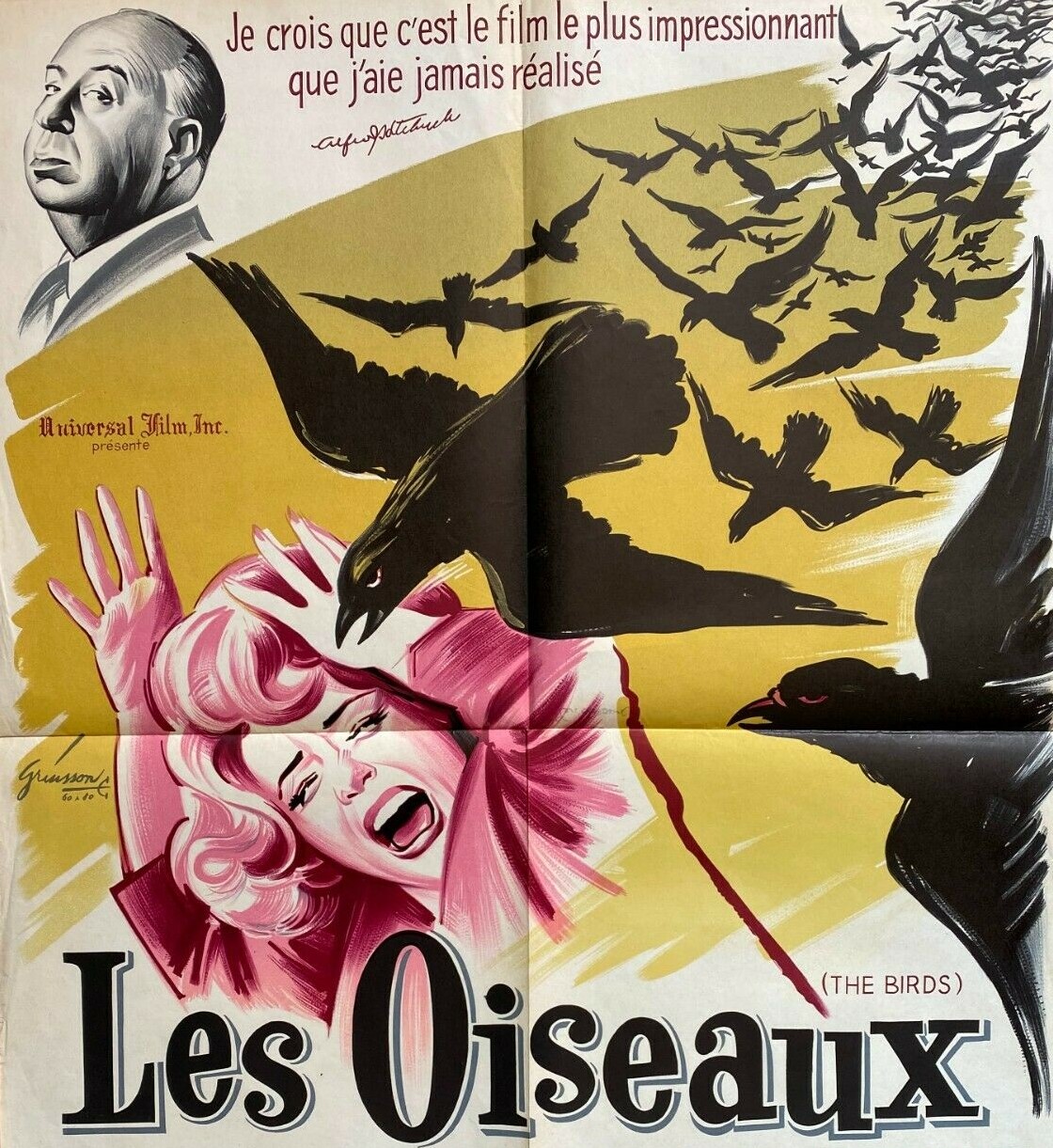
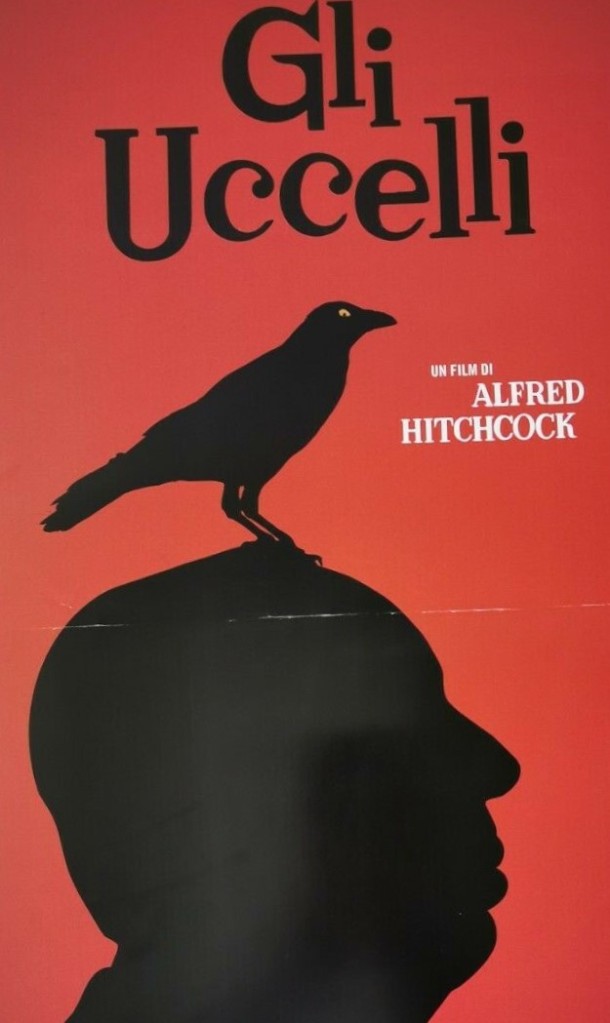
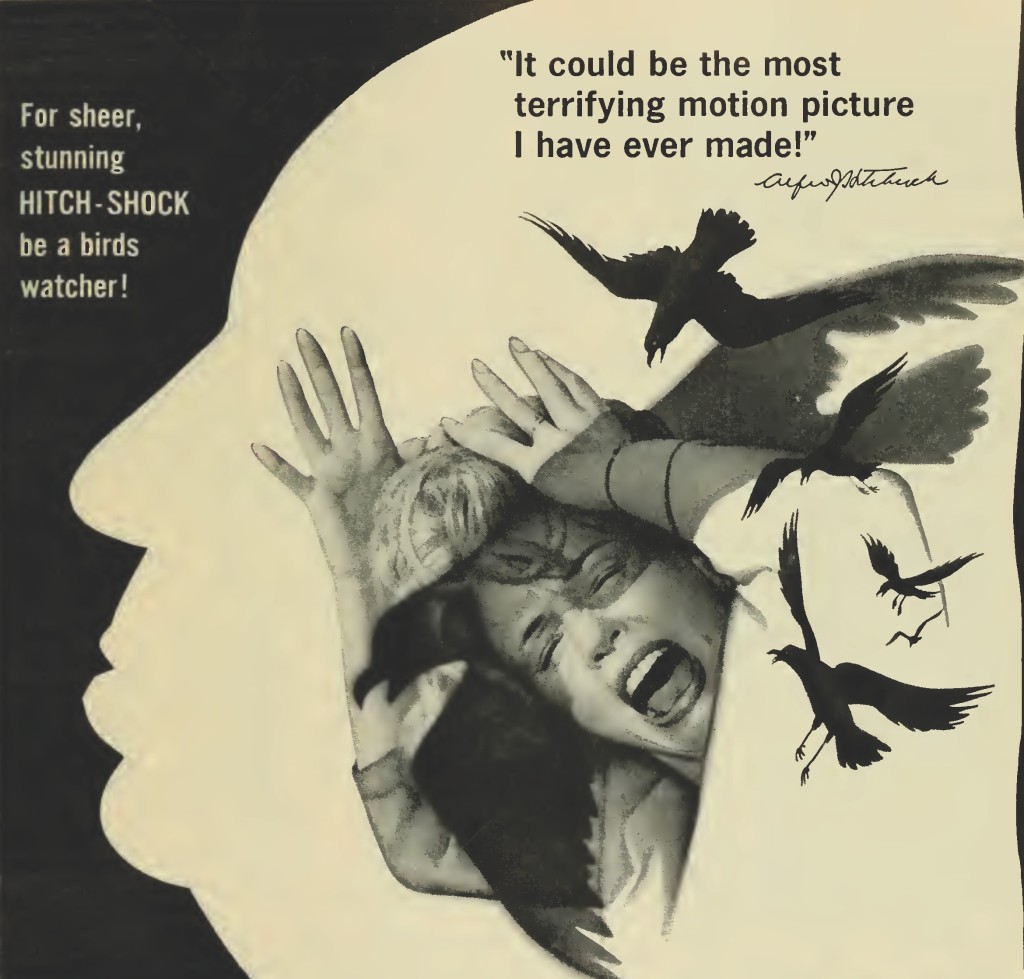
Alfred Hitchcock had a different picture – in fact, several movies – in mind as the follow-up to Psycho (1960), the biggest hit of his career. In pole position was Marnie to star Grace Kelly (“she voluntarily offered to do the picture after reading the story”), the woman he had made a star, in a sensational return to the screen after her marriage to Prince Rainier of Monaco. Her participation would bring her around $1 million. He worked on a script during 1961 but Kelly’s schedule meant the film would have to be postponed to 1963-1964 at the earliest.
A close second came No Bail for a Judge to star Audrey Hepburn. When those projects failed to get off the ground in the gap between Psycho and The Birds (1963), Hitchcock also considered reuniting with James Stewart (Vertigo, 1958) for Blind Man. The original idea came from a visit by the writer to Disneyland where he had an idea for a blind man given an eye transplant who subsequently remembers things he could not have witnessed. This was then transposed to an ocean liner, with Ernest Lehman signing on for script duties in December 1960. For almost a year he worked on a movie called Frenzy, no relation except for serial killing, to the later picture. But there was also Trap for a Solitary Man, Cold War thriller Village of Stars and The Mind Thing.
When Hitchcock finally settled on The Birds, based on a short story published in Good Housekeeping magazine in 1952 and reprinted in a Hitchcock anthology in 1959, he first turned to Scottish author James Kennaway (Tunes of Glory, 1960). That collaboration lasted until Kennaway decided the only way the movie would work would be if the birds were never seen. He considered Wendell Mayes (Von Ryan’s Express, 1965) and Ray Bradbury (The Picasso Summer, 1969) before in August 1961 turning to Evan Hunter (Last Summer, 1969). Wearing his Ed McBain (Fuzz, 1972) hat, Hunter was a crime aficionado so it was no surprise he suggested adding a murder to the mix.
But Hitchcock’s first act was to shift the location from Cornwall to Bodega Bay, sixty miles away from San Francisco. While the screenplay was being worked upon, an extensive proce3ss that would include last-minute changes once filming had begun, Hitchcock considered a potential female star.
He screen-tested Pamela Tiffin (One, Two, Three, 1961) and examined footage featuring Yvette Mimieux (The Time Machine, 1960), Carol Lynley (Return to Peyton Place, 1961) and Sandra Dee (Tammy Tell Me True, 1961). He also considered two actresses he already had under contract Joanna Moore (Walk on the Wild Side, 1962) and Claire Griswold (Experiment in Terror, 1962).
Both the women already under contract had proved disappointing. Of Moore, John Russell Taylor wrote: “no one could have been less cooperative in the required making-over process, she did not like the clothes, she did not like the hair styles and she did not seem to like anyone she came into contact with at the studio.” Griswold, more compliant, “seemed to have little professional ambition and was quite content with what she was, Mrs Sydney Pollack.”
But then he spotted model Tippi Hedren in a television commercial. She was signed up to a seven-year $26,000-a-year ($254,000 at current prices) contract before she even met Hitchcock, one of the director’s modus operandi to ensure fees did not increase when his name was mentioned. Although actors, once successful, tended to complain they were hired at unfair salaries, this was in fact a pretty good amount for an untrained actress who would automatically become a star by the very fact of being in a Hitchcock picture. Of course, Hitchcock hoped to profit by keeping her salary low for any future movie. But it was still a gamble; if her career fizzled out, as did occur, he would lose out.
However, given his reputation for treating actors as cattle and expecting them to know what to do with little direction, he went to extreme pains to ensure Hedren was prepared for the role. He encouraged her to sit in on script conferences, meetings with set designers, and other essential collaborations like the director pf photography and the music supervisor and went into considerable detail about her motivation and how the film would move from periods of intensity to relaxation. Nobody ever received a more complete education in the Hitchcock method.
Hitchcock admitted he would have preferred to cast more experienced stars with guaranteed box office marquee such as Cary Grant and Audrey Hepburn but the long shooting schedule and the time required for trick photography would render them too expensive.
For this picture, Hitchcock switched studios from Paramount to Universal. At $3.3 million, very little going to the stars, this was his most expensive movie date especially in comparison to the $800,000 of Psycho. After a tortuous screenplay process, Hitchcock also sought input from others like famed short story writer V.S. Pritchett whose several notable suggestions the director accepted, much to the ire of Evan Hunter. According to Taylor, Hitchcock found himself “nervy and oppressed” possible due to the film’s Day of Judgement elements, and abandoned his normal shooting routine.
He was famous for shooting the picture he already had in his head. Instead, here “he started studying the scenario all over again while shooting it…(and) began to do something he never normally did – improvising on set.” He went deeper into characterizations – making the viewpoint far more subjective than initially conceived, in particular “keeping the audience much closer to the Tippi Hedren character”
At the last minute he dropped several pages of dialogue and the original Hunter ending. He edited out a love scene between Hedren and Taylor and detailed a script for the sound, specifying what kind he wanted for every scene. While Bernard Herrmann was involved, it wasn’t in the usual sense, and instead they worked out musical scenario of “evocative sound and silence” which was created by Remi Gassman and Oskar Sala who specialized in electronic music.
It was by far the most complicated shoot Hitchcock had ever attempted. The birds were a mixture of trained birds, dummies and optical illusions. When the gull attacked Hedren as the boat docks that was a dummy on a wire pulley, the blood a pellet implanted on her clothes. But as filming intensified, the blood seen on the screen was real blood. Anchovies and ground meat were spread on the actors’ hands at attract the gulls.
But when it came time to shoot the scene in the attic Hedren was not warned the birds would be real. Hitchcock believed terror would be better expressed by an untrained actress if it was real. While propmen wore thick leather gloves to protect their skin, the actress was permitted no such luxury. When the birds avoided Hedren, the propmen simply picked them up and threw them at the actress. Filming took a week, by the end of which, after getting her eye clawed, Hedren broke down in tears. It would be impossible for a director to take such liberties today although young, impressionistic actors tend to fall prey to such actions.
The proposed ending was jettisoned in favor of a lengthy shot of Hedren and co-star Rod Taylor driving through a bird-infested landscape that the director called the “single most difficult shot I’ve ever done.”
Hitchcock got into trouble with the authorities over unauthorized use of birds. His permit allowed for the use of 20 dead and 30 live birds but an investigation by the U.S. Wildlife and fisheries found 40 dead gulls and 54 live ones as well as 60 songbirds for which no license had been given. He was fined $400. The movie was of course a boon for exhibitors planning promotional stunts. A thousand pigeons were released in a shopping center in Albany, carrier pigeons carried a message from Los Angeles to Memphis, birds trainers were in full flight, 200 exotic birds were displayed in the lobby of the Stanton in Baltimore, while the director attracted notoriety by making birds singular rather than plural when the tagline became “The Birds Is Here!
Much has been written of Hedren’s reactions to the birds, but it’s worth having a look at Roar (1981), a famous disaster of a picture, which she and husband Noel Marshall financed, where she appeared to be quite happy to be bitten and clawed by lions, a lot less tame than was suggested. The mauling was so bad Hedren required 50 stitches, required plastic surgery and nearly lost an eye. In one unscripted scene that ended up in the picture a lion grabbed her hair and would not let go. Most of the lion attacks resulted in injury to someone, actors and crew, including cinematographer Jan de Bont who required 120 stitches to sew his torn scalp back in place. By such standards, her treatment by Hitchcock was relatively tame.
SOURCES: Patrick McGilligan, Alfred Hitchcock, A Life in Darkness and Light (Regan Books, 2003), p608-629; John Russell Taylor, Hitch, The Authorised Biography (Faber and Faber, 1978) p262-270; Brian Hannan, Darkness Visible, Alfred Hitchcock’s Greatest Film (Baroliant, 2013); “Princess Grace’s Take Per Hitchy Estimate,” Box Office, April 4, 1962, p2; “Fine Hitchcock $400,” Box Office, April 18, 1962, p17; “Pigeons Blaze a Trail,” Box Office, April 8, 1963, pB3; “Pigeons for Birds,” Box Office, May 6, 1963, pB3; “The Birds Is Here,” Box Office, May 13, 1963, pA1; “Bad Girls Bird House,” Box Office, May 27, 1963, pA3.
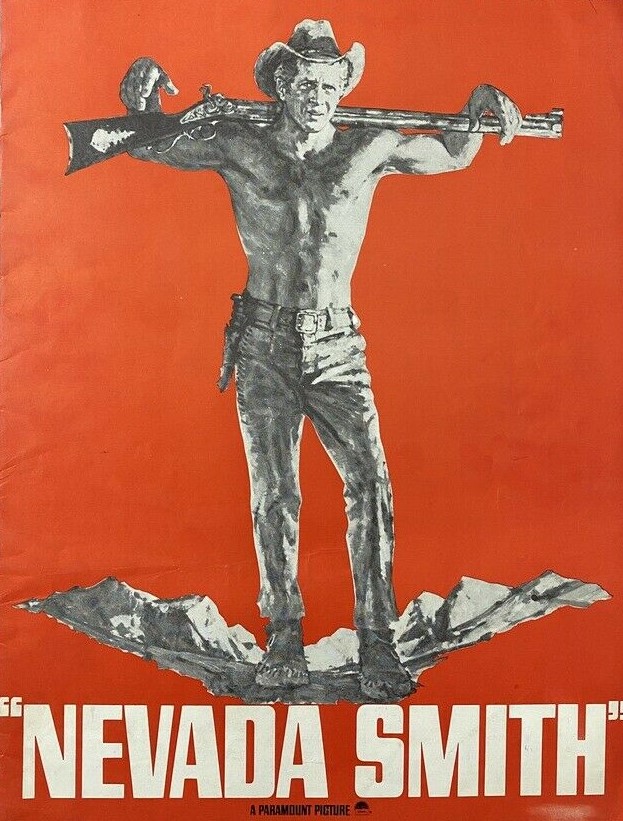
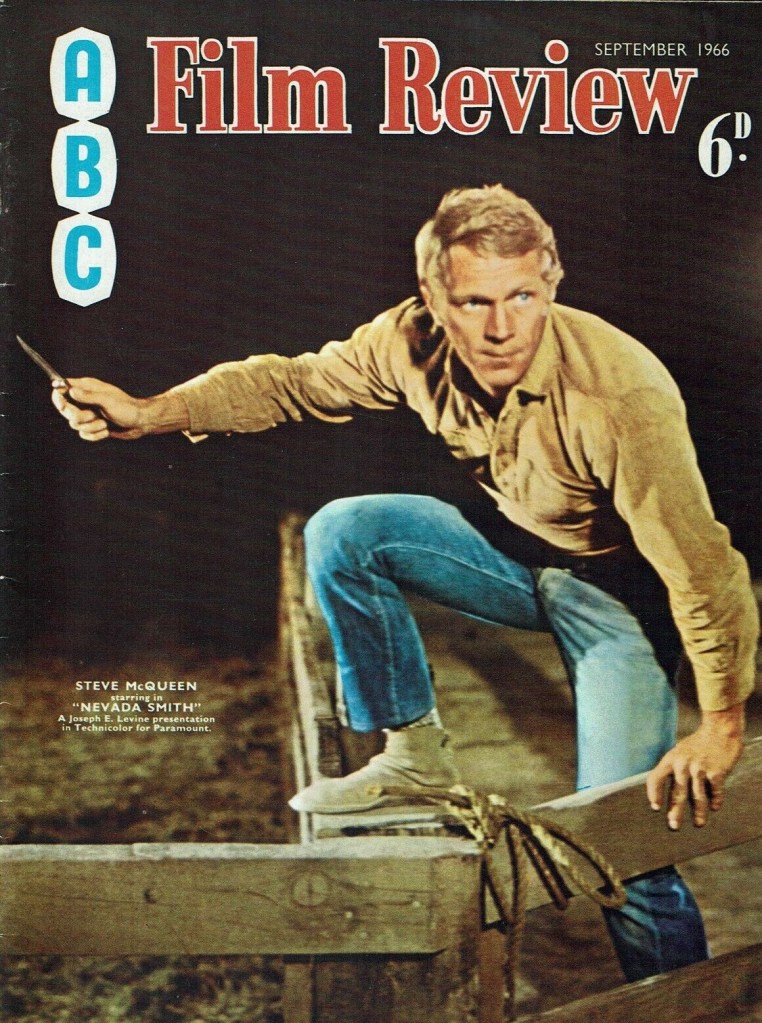
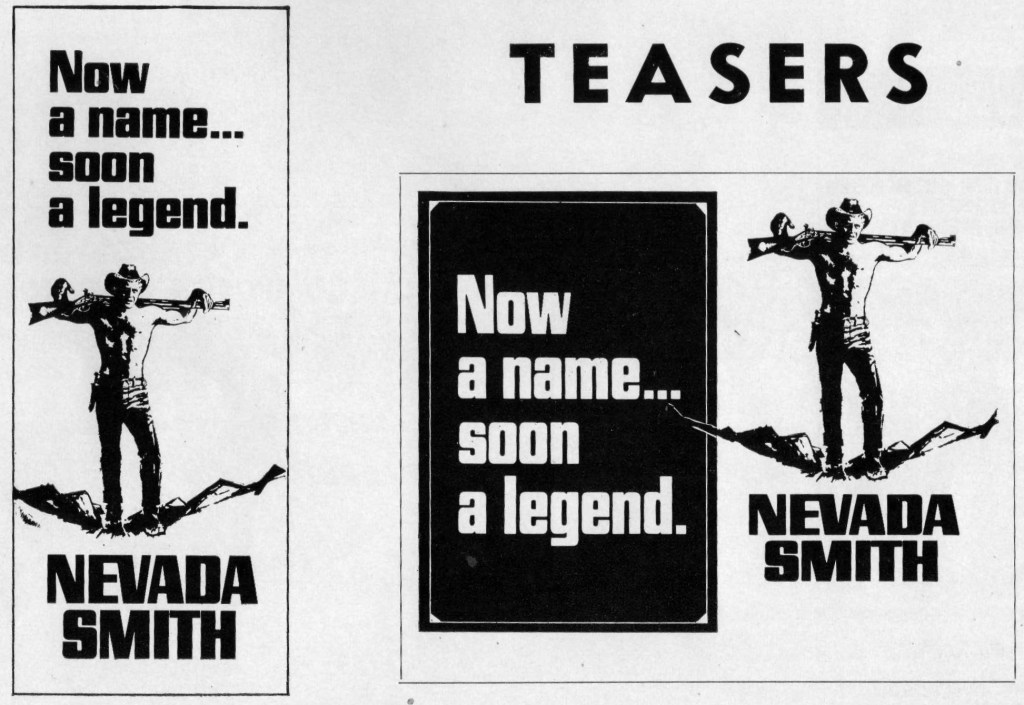
Truth never stopped producer Joe Levine. Not finding in the film the requisite image to encapsulate the struggle of Nevada Smith he just invented one. The iconic poster of Steve McQueen with rifle over his shoulders did not appear in the movie. Yes, in the early part of the picture Nevada Smith trekked through the wasteland. But that was minus any weapon, unless you count the broken pistol he had found under a wrecked wagon. Naturally enough, if he did have a rifle at that point, presumably Levine surmised, that’s exactly how he would have carried it.
Levine was an unusual character even by Hollywood standards. He was pretty much the first to invent the metaverse, the extended world within which a main character revolved, having sourced Nevada Smith from the Harold Robbins bestseller The Carpetbaggers which he had turned into a blockbusting film in 1964, and by dint of picking up the story of Nevada Smith at an earlier age than in the movie created a “prologue,” better known these days as a prequel or an origin story. Better still, it was two pictures for the price of one book.
Of course, it wasn’t Levine’s idea to make a prequel, or at least that’s how the publicists spun it. “It doesn’t happen very often,” begins the Pressbook, “but it happens, a character in a motion picture intrigues the fancy of fans to such an extent that they write the producer and beg more of him. Instead of wanting to know more about this fascinating character, the public wrote in asking how this intriguing character got that way.”
Levine took quite a different approach to marketing a movie than other producers. He tended to concentrate on one central image, creating a single core advertisement rather than, as other studios did, churning out a host of different adverts to meet the various perceived needs of exhibitors. And he also liked to fix subsidiary characters in the audience’s mind by providing nuggets of information about their personalities in the poster.
Assuming McQueen was such a big star, exhibitors didn’t need any more juicy nuggets, so the first two editorial pages of the Pressbook concentrate on everything but McQueen. And given that the star’s production company, Solar, was involved in the making, it seems McQueen was exactly of the same opinion. The biggest plug went to Henry Hathaway (The Sons of Katie Elder, 1965), “one of Hollywood’s most celebrated directors,” credited with inventing the action picture three decades before with Lives of the Bengal Lancers. But “action was never permitted to get in the way of the story which, Hathaway always insisted, was of prime interest.”
Five-time Oscar nominee Arthur Kennedy, rather than the second-billed Oscar-winner Karl Malden, came next in the promotion stakes. Kennedy epitomized the importance of a stage training for actors, borne out by the fact that, except for McQueen, all the main players received their training in the theatre. Brian Keith, however, addressed the downside of being in a long-running play. “It means you’re tied down,” he complained, “nothing to do every afternoon, can’t go anywhere or do anything, you have to keep yourself fresh for the evening.”
The Pressbook was surprisingly short on the kind of journalistic snippets that an exhibitor might feed to a local newspaper. That Suzanne Pleshette had a pathological terror of snakes, that Pat Hingle had nearly died after falling down an elevator shaft, and that Hathaway had given Karl Malden his big break were the closest the Pressbook came to anything that might interest a newspaperman.
The iconic image of McQueen shouldering the rifle was mostly used on its own in teaser adverts. For the main advert, that was placed centrally above a montage of scenes from the picture and at the foot came the one-liners about the other characters. Tom Fitch (Karl Malden) was described as “he treated Nevada like a kid – then spent a lifetime regretting it” (not true as it happens). Jonas Cord (Brian Keith) – “he taught Nevada how to kill – then got out of the way.” Bowdre (Arthur Kennedy) – “the bravest man in the world with a gun – and a coward when he faces one” (not true either). Pilar (Suzanne Pleshette) – “she found Nevada in jail and he loved his way out.”
While the main advert, outside of the teasers, was the only advert, there were more taglines. And quite wordy at that. “Some call him savage – and some called him saint…some felt his hate – and one found his love…some had to run – and three had to die…and there never was another like Nevada Smith.” (Incidentally, he had two lovers, not one.) A second tagline ran: “From the California gold fields to the Louisiana bayous, he drank and killed and loved and never forgot, how to hate!” There was a third, briefer, tagline – “Now a name…soon a legend” and that sometimes prefixed the other taglines.
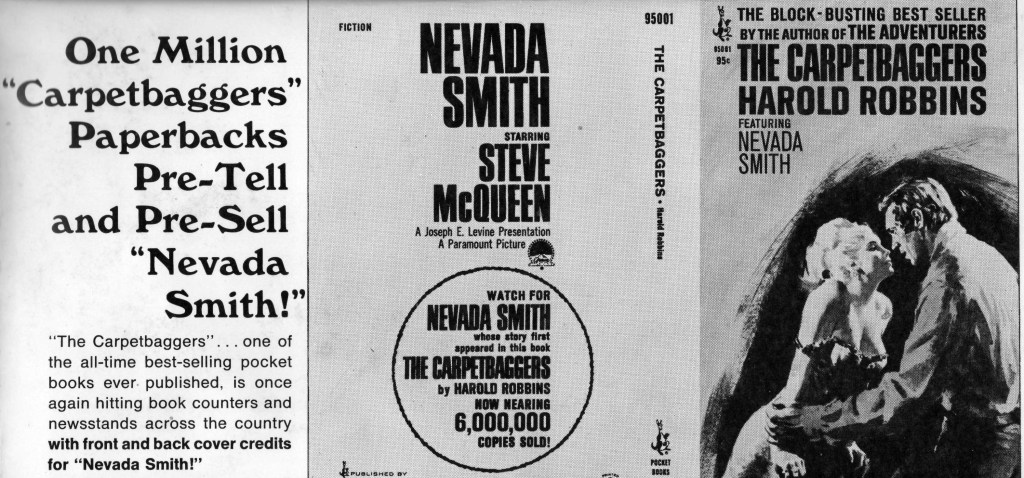
In terms of tie-ins, there was little. Possibly The Carpetbaggers had already done the work for Levine. The novel had been the biggest-selling fiction since the turn of the decade, around six million copies printed, so it was the ultimate “pre-sell” with a movie tie-in edition, front and back covers bearing testament to Nevada Smith. Pocket Books was one of the biggest publishers in the country and there were over 20,000 outlets for paperbacks including book stores, drug stores, and newsstands. Window banners, rack cards, counter displays and dump displays meant pedestrians would be passing an artillery of promotion every day.
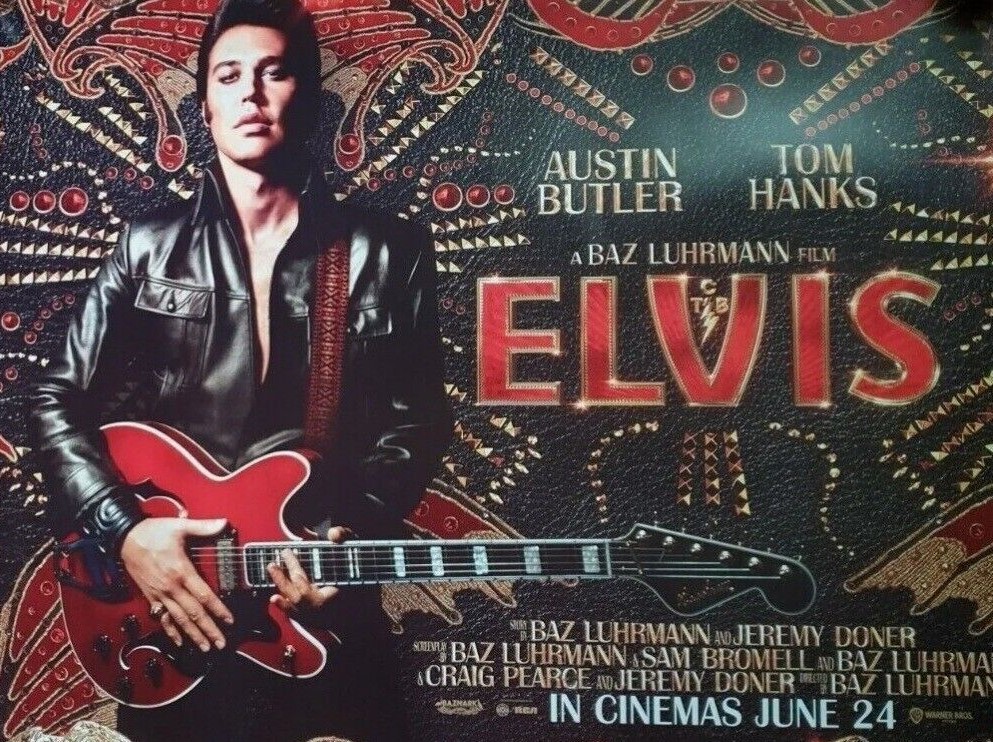
There’s a saying where I come from – “a big boy did it and ran away” – and that seems to be the approach here, Col Parker (Tom Hanks) to blame for all the ills of Elvis Presley (Austin Butler).
Exhilarating when it goes jukebox, capturing Elvis’s electrifying stage presence, anything but when we are subjected to Tom Hanks’ worst accent this side of The Ladykillers (2004). Essentially a tale of two spendthrifts, or “lost boys” as Col Parker persuasively puts it, who each wasted a vast fortune on gambling, drugs, women, cars, airplanes and hangers-on. Baz Luhrman’s flash-bang-wallop style only serves to hide the lack at the heart of the story, none of the self-awareness that lifted Bohemian Rhapsody (2018). The idea of telling the tale from the point-of-view of Col Parker is a movie suicide note.
The early section is best, recounting a troubled upbringing, alcoholic mother and jailbird father, and the birth of the star’s style, absorbing blues and soul and church music in his home town, his unheard-of (discounting Frank Sinatra and the bobby soxers and Bill Haley and the Comets, natch) impact on audiences. But except for political references the 1960s is skipped by so that we can come more quickly to the late decade stylistic reinvention of television and Vegas. Too much – Pricilla (Olivia De Jonge), the pill-popping, the women – exists on the periphery as if that was the cost of doing a deal with the devil, dig too deep into the murk and you will be denied access to the music.
Quite how a creepy soft-spoken manager straight out of Stephen King ever managed to talk the Presley family into anything is a mystery. Col Parker must surely have had more charm than Tom Hanks can ever muster. I get that Parker was increasingly out of kilter with the changing music scene, but his deal-making (which is all an act ever requires from a manager) was phenomenal, he played studios off against each other to keep Elvis on top in Hollywood, he set the tone salary-wise for Vegas gigs, and he invented the satellite concert.
I’m going a little off-piste here but I remember being shocked to discover, as I’m sure rock gods were too, that record labels charged the artists for everything. Those plush limousines that met you at the airport, the suites in fancy hotels, the cost of recording the album, every indulgence, every entitlement came off the top before a group received a red cent in royalties. There are umpteen cases of stars being stiffed by management, Creedence Clearwater Revival and Mike Oldfield who signed contracts that handed over the largest part of their earnings, or closer to home Britney Spears, Taylor Swift, George Michael who all raged at the machine.
By comparison, Elvis had a pretty good deal. Even at 50 per cent of everything he earned, he racked up a colossal amount, half a million a year at least from just two months of performing in Vegas, $1.5 million a year from his decade of making movies, not to mention singles and albums that sold by the gazillion. All told he took in the lifetime equivalent these days of at least half a billion and if he died with only a few million in the bank you can’t blame Parker for Elvis squandering it. If he had taken a bigger share, all that would have happened is he would spent more. It would hardly have saved him from twin dependence on two drugs – the need to play before a live audience and the pills he popped to make up for the times he spent not getting a high from his fans.
Although I’m a big fan of box office, I’m not usually one for box office prediction but I’d be surprised if this even reaches $100 million Stateside, and not just because it needs to pull in the resistant older audience but because I don’t think word-of-mouth, as opposed to CinemaScore ratings, will be as strong as it needs to be. Any recommendation will come with the kind of reservation that I have, wrong director, wrong perspective, too much wrong.
I kept on expecting more dramatic meat but it never came. Sure Elvis was shocked at the assassinations of the Kennedys and Martin Luther King but who wasn’t. It would be interesting to find out who chose the songs Elvis recorded because, for me, “In the Ghetto” marked the reversal of his fortunes, a piece that touched on a nation’s hidden agony, and not “Suspicious Minds,” great tune that it is. Outside of the opening section, the most absorbing parts were those that concentrated on creativity, how the famed television special was put together, Elvis himself conjuring up arrangements for his Vegas show.
On the plus side, I never noticed the time. The movie just about raced by and every time it looked like flagging there was another live performance to keep us hooked. I’d never heard of Austin Butler though he had a small part in Once Upon a Time in Hollywood (2019) but this is definitely a calling card. Tom Hanks, under a slab of prosthetics, may want to forget this performance and it’s shame because I’ve not seen him act since A Beautiful Day in the Neighbourhood (2019) due to streamer-snapping. Olivia De Jonge (Josie and Jack, 2019) isn’t in it enough but has a wonderful scene when they first meet, her intonation marvelous.
As well as directing, Baz Luhrman (The Great Gatsby, 2013) had a hand in the screenplay along with Sam Bromell, making his movie debut, and Luhrman regular Craig Pearce.
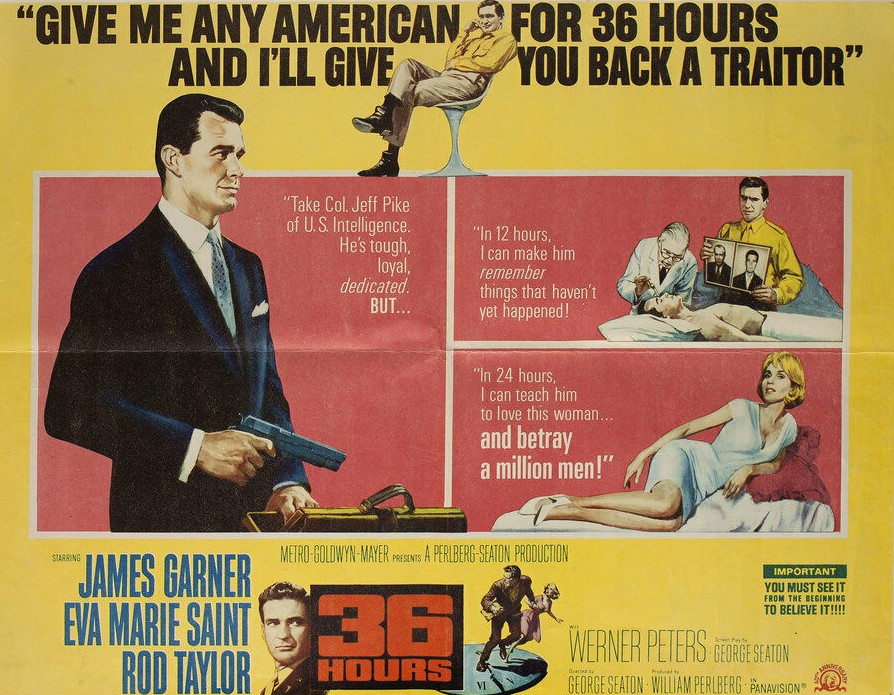
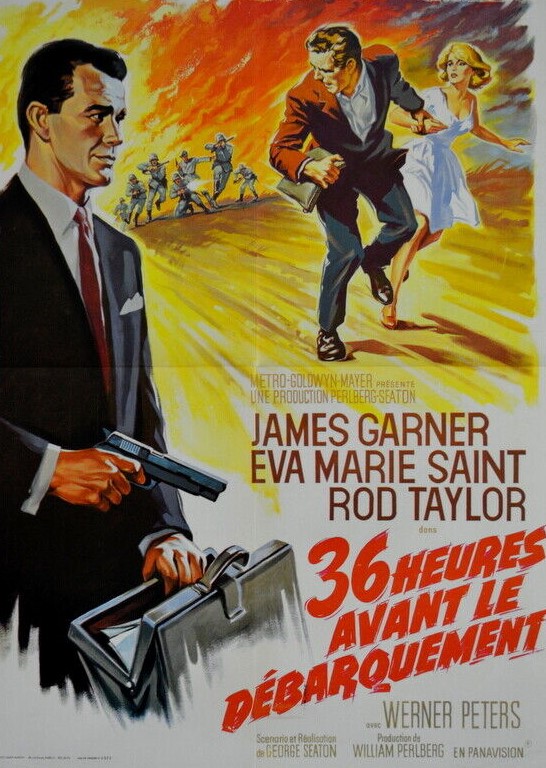
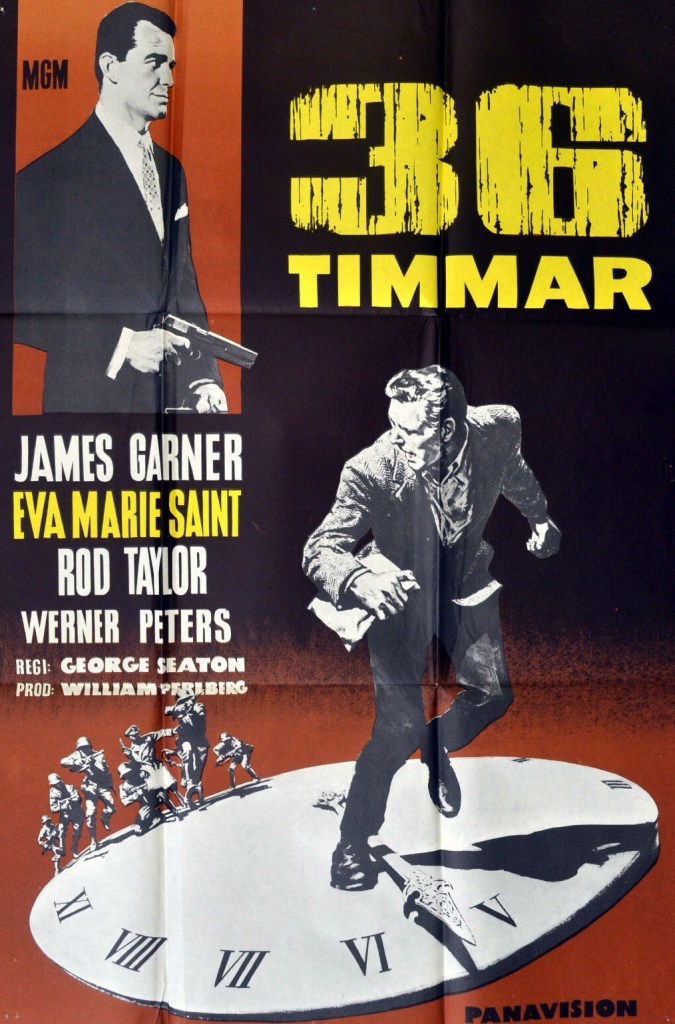
High concept thrillers that derails two-thirds of the way through. While it’s a battle of wits between German psychiatrist Major Gerber (Rod Taylor) and kidnapped spy Major Pike (James Garner), and between the German and his cynical superior, S.S. chief Schack (Werner Peters), it’s a fascinating insight into the power of mind games, almost slipping into the sci fi genre. Pike has intimate knowledge of the Allied D-Day plans but instead of submitting him to routine torture, he is handed over to Gerber who convinces him he has been suffering from amnesia for six years.
Pike finds himself in what he perceives to be an Allied hospital where everyone wears Yank uniforms, speaks English and listens to baseball scores on the radio. Pike has aged, thanks to greying hair and vision blurred so badly he requires spectacles. There’s even a wife, Anna (Eva Marie Saint), he doesn’t remember marrying. On the eve of D-Day the Germans expect the main invasion thrust to target Calais, the shortest crossing from England, not the Normandy beaches further to the south. Someone who knows the truth might well be willing to suffer extreme torture to keep the secret out or enemy hands, therefore justifying this approach.
While the idea of a prefabricated existence would not be foreign to today’s audience, it was an unusual idea at the time, although films as diverse as The Wizard of Oz (1939) and 1984 (1956) revolved around alternative reality. That the whole scheme is entirely plausible is down to Gerber. Rather than the one-dimensional villain, he’s an early version of the “good German,” whose scientific breakthroughs have alleviated suffering. Yes, he’s charming and suave and clever enough to hurry Pike along, but also very humane.
As you might expect, the best part is the constructed universe, Pike’s understandable disbelief at suffering from amnesia, and for so long, the shock to his vanity that his hair and eyes show signs of ageing. Just like Battle of the Bulge (out the next year) where American-born Germans were dropped behind enemy lines as saboteurs, Gerber’s ease with American idiom and culture is key to making the enterprise work. An easy-on-the-ear scientist, he employs a cupboard as a prop to explain the differences in the various types of amnesia. Pike is fooled and does inadvertently betray his country and the twist is that Schack, with so much invested in the notion of the invasion at Calais, refuses to believe it.
As ever in this kind of semi-sci-fi film it’s something incredibly simple (along the lines of the aliens susceptible to water in Signs or the common cold in War of the Worlds) that makes the clever construct unravel. In this case it’s Pike finding a paper cut on his finger and working out it should not be so sore after six years. So, thereafter, the film shifts into escape mode, which is considerably less thrilling compared to the sci-fi hi-jinks. A sub-plot involving Anna, a Jew willing to do anything to avoid the concentration camp, adds some depth to the proceedings.
Oddly enough, despite the title there’s no real sense of a deadline, nor does it come close to achieving the tension racked up in Day of the Jackal (1973) for an event the audience knew never took place, since 36 Hours fails to convince us the D-Day landings were ever in jeopardy.
It’s much more involving, not to mention highly successful, in the middle section where Pike is being duped, the lengths to which Gerber has gone to create the perfect fiction under audience scrutiny, while we watch Pike twist and turn as he comes to terms with what in those days would be perceived as serious mental illness, and from which there is no defined cure. That the escape is triggered by Gerber’s ego adds another element.
The picture did not hit the box office target on release in part I guess because by that time no enemy had to kidnap anyone to fill in the blanks in their scientific knowledge since there was such a plethora of defectors and in part because it seems insane that anyone would go to such excesses when less costly and proven torture implements were to hand.
That it works at all is down to the acting. James Garner (Hour of the Gun, 1967) straddles a number of his screen personas, from his instantly recognisable cocky character of The Great Escape (1963) to the befuddled double-takes of A Man Could Get Killed (1966) and tougher incarnation of Grand Prix (1966). Rod Taylor (Dark of the Sun, 1968) is his match with one of his best performances, infusing the mad scientist with surprising humanity at the same time as wriggling out from under the maw of the inhuman Schack, and, despite clearly being desperate to see his plan work, managing to keep his character on an even, chatty, keel. Eva Marie Saint (The Stalking Moon, 1968), the go-to choice for a vulnerable woman, brings an edge to her role.
Audiences glimpsing the name Roald Dahl in the credits in those days would not have been expecting an imaginative confection in the Willie Wonka and the ChocolateFactory (1971) vein but something much more adult given the twist-ridden short stories which had made his name. This was based on his Beware of the Dog (1946) tale, the first of his pieces to be made into a film although some of the best of Alfred Hitchcock Presents (1958-1961) had lent heavily on his work.
Writer-director George Seaton put the project together, with occasionally some elan, but as with The Counterfeit Traitor (1962) it’s a film of two distinct parts, but whereas with that film the latter stage was the more interesting here it is the first section. This is best approached as an offshoot of the kind of sci fi themes that inform the work of Philip K. Dick.
Catch-Up: Rod Taylor’s acting development can be traced through films already reviewed in the Blog – Seven Seas to Calais (1962), Fate Is the Hunter (1964), The Liquidator (1965), The Glass Bottom Boat (1966), Hotel (1967), Dark of the Sun (1968) and The High Commissioner (1968). James Garner pictures previously reviewed are: Doris Day comedy Move Over, Darling (1963), spy spoof A Man Could Get Killed (1966) and the westerns Duel at Diablo (1966) and Hour of the Gun (1967).
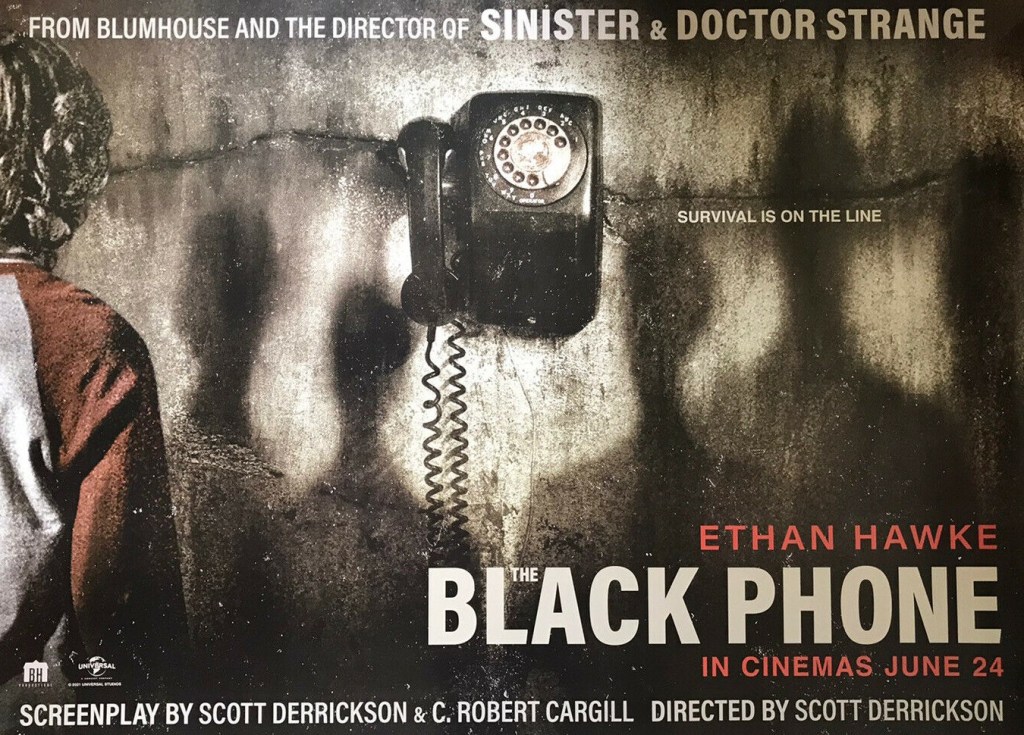
Most original horror film since Jordan Peele’s Get Out (2017) and sharing that film’s ability to throw the audience off guard by constantly twisting expectations and slowly taking its time to reach an incredible denouement. Be warned, though, it is about child abuse and some of the scenes come down to the knuckle. But it is also, surprisingly, a coming-of-age picture.
In 1978 in a Denver suburb, Finney (Mason Thames) and younger sister Gwen (Madeleine McGraw) live with widowed alcoholic father (Jeremy Davies), prone to beating his kids with a belt. Although bullied by classmates, Finney always picks himself up. Gwen has dreams which may be real – her mother committed suicide after similar visions.
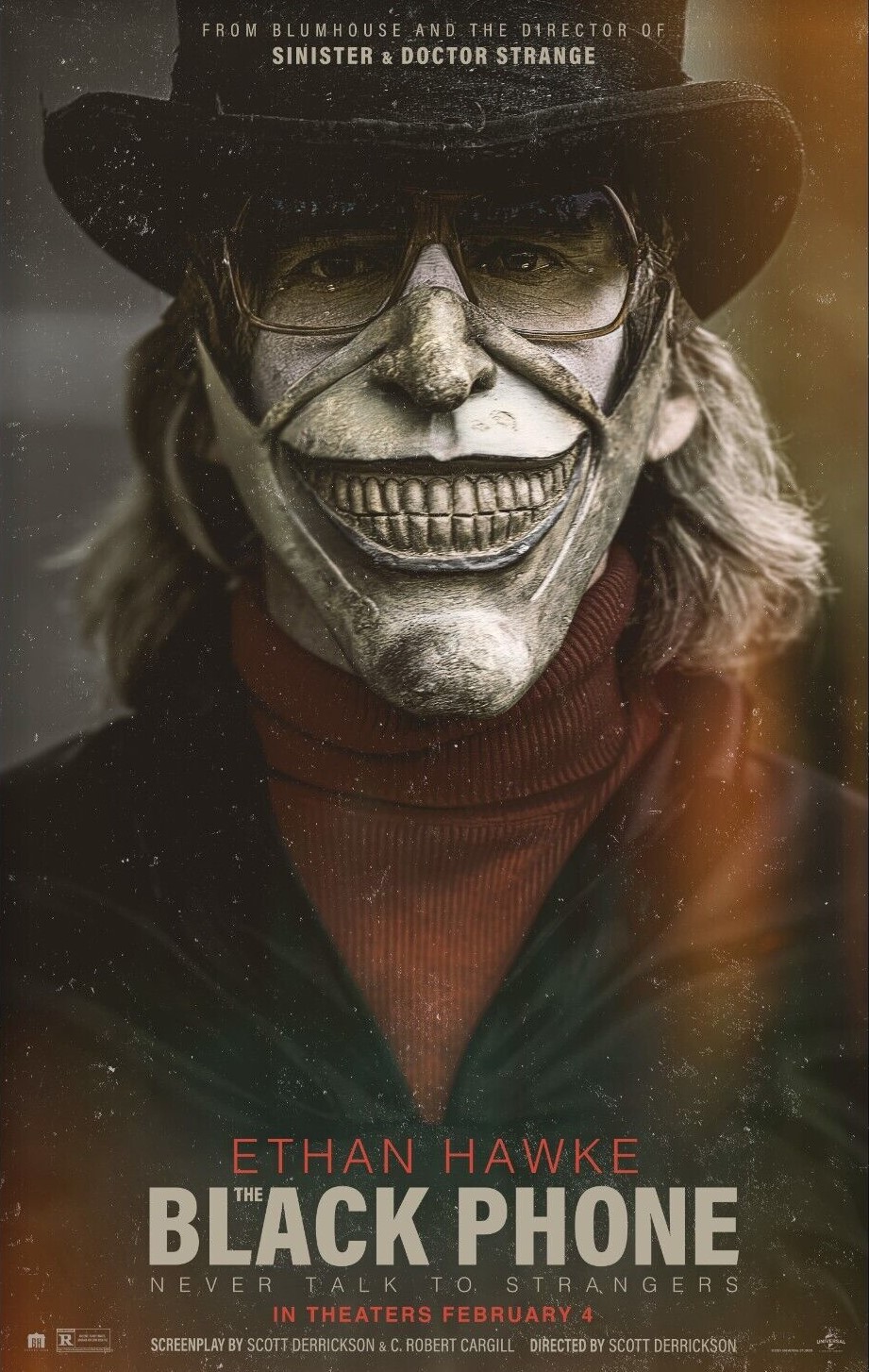
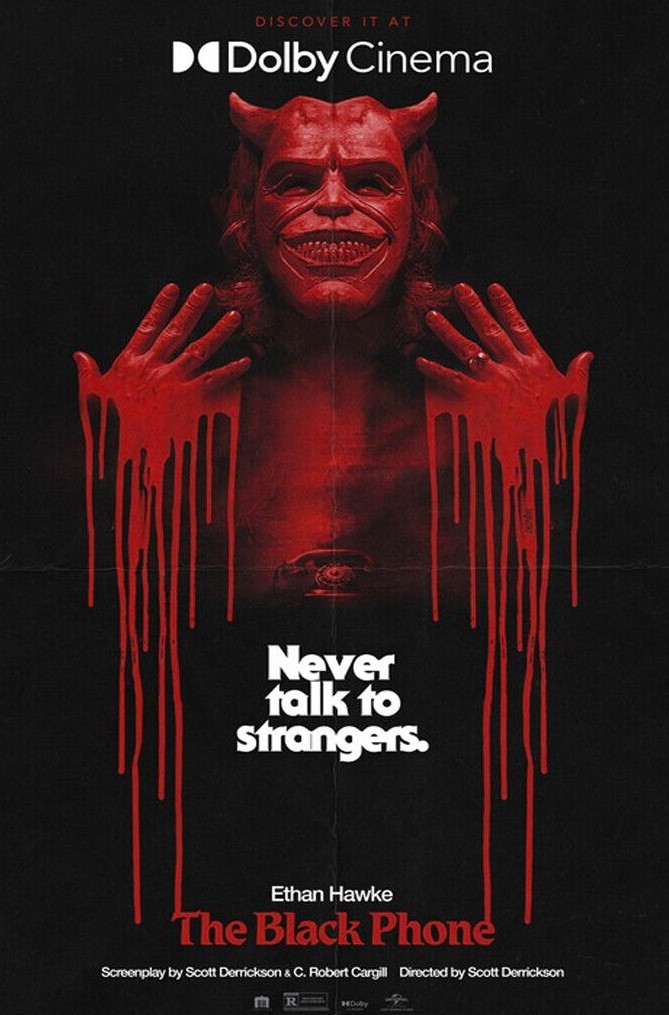
When Finney becomes the latest victim of masked serial child kidnapper The Grabber (Ethan Hawke) he finds himself trapped in a basement, empty except for a mattress and a phone that doesn’t work. The cops are baffled. Gwen attempts to reach her brother through dreams. When the phone mysteriously does ring it’s always one of the Grabber’s five previous victims offering practical escape advice. At the top of the stairs a half-naked masked Grabber sits in a chair gripping a leather belt waiting for his captive to become “naughty” so he can be punished.
I’m going to be in spoiler alert country if I tell you anymore but if you’ve seen the trailer be aware that’s far from the whole story. Part of what makes this so good is how realistic is the portrayal of the kids and the venal world they inhabit. They have no defence against the brutal father and in some respects expect adults to behave in horrific fashion. A boy who Finney helps with schoolwork acts as his protector but when he is kidnapped the bullies take revenge, handing out a bloody beating. Although brother and sister are close, there are few limits to their teasing. And Gwen has the lip of an adult in taking on a couple of unwary cops.
All the time you are left guessing. Is the Grabber behind the phone calls? Is it another of his elaborate games? Does he intend to offer escape, only to snatch it away? Can Gwen summon up spirits at will or will she flounder helplessly trying to save her brother. And if he disappears for ever, what prospect could be worse than living with her awful dad? Have the snippy cops got any leads at all? The father’s not out helping the hunt for his boy, so it possible he’s involved, especially since he wields a belt similar to the killer? Is Max, the visitor from out of state, possibly the killer, even though he appears to be a harmless cocaine-sniffing conspiracy nut?
And if five previous victims are gone, presumed dead, what chance has Finney, a vulnerable kid if ever? His protector was a very tough kid, one capable of beating a bully to a pulp, and if he can’t survive the kidnapping what chance does Finney have?
Over it all is the malevolent presence of the Grabber who wears two-piece masks (with devilish horns and long chin) that show different parts of his face but never the whole, who sometimes just sounds like a guy who has lost his way and means no real harm, if only he could sort out what’s gone wrong. His kidnapping ploy is to drop his shopping on the sidewalk and hope a nice kid is going to help, especially as he is a magician with a stack of black balloons, the kind of conjurer who might appeal to an edgy teenager who thinks The Texas Chainsaw Massacre the greatest film ever made.
Jump-out-of-your-seat shocks are few but this is a rare horror movie that has little reliance on such tricks. Tension is maintained with magnificent ease.
Mason Thames (Walker TV series 2021) and Madeleine McGraw (Secrets of Sulphur Springs, 2021-2022) are terrific as the kids, not putting a foot wrong as they move in the sometimes inexplicable adult world, but sharpening their teeth on vicious childhood. Sure the mask does a lot for Ethan Hawkes (The Northman, 2022) but his voice and his movements do the rest and this is a bold part to take on, way out of his comfort zone. Jeremy Davies (The House That Jack Built, 2018) is every bit as creepy.
While Scott Derrickson has dipped his foot into horror (The Exorcism of Emily Rose, 2005.) and for that matter the supernatural (Doctor Strange, 2016) before, he has never done so with such distinction, reining in the shocks in favour of escalating tension, never shifting focus away from the kids. He co-wrote the screenplay with Doctor Strange collaborator Robert Cargill based on the short story by Joe Hill (Horns, 2013).
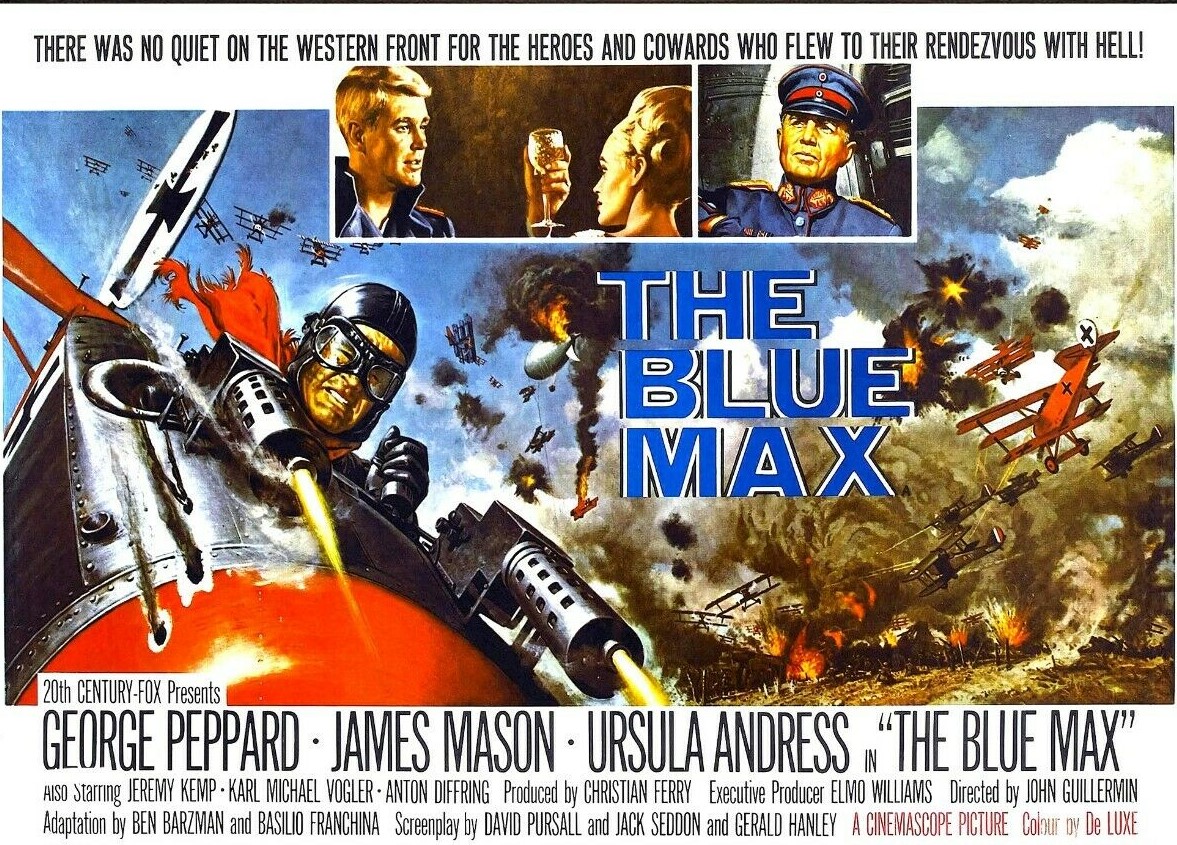
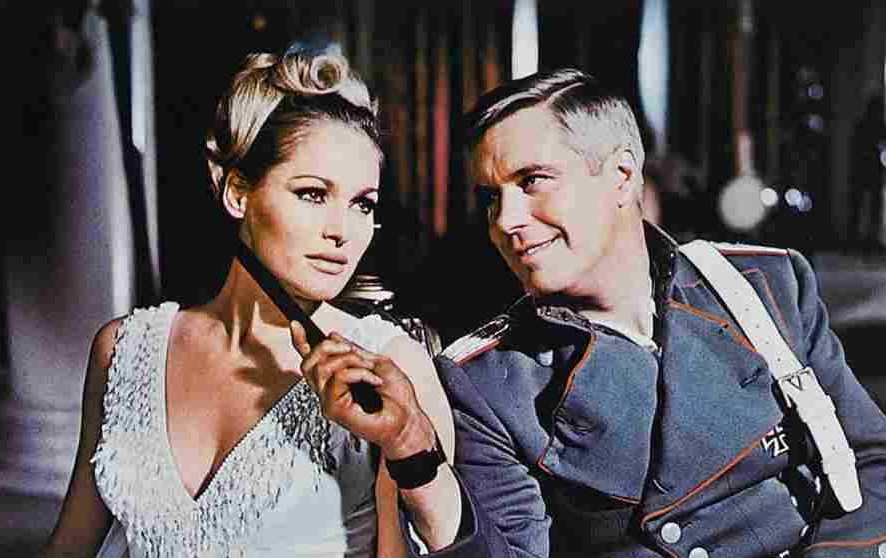
Watching The Bridge at Remagen sent me back with renewed admiration to John Guillermin’s take on World War One in The Blue Max. Again, a tale of two men battling for supremacy, although in this case they are both on the same side. Flying aces Lt Bruno Sachel (George Peppard) and Willi von Klugerman (Jeremy Kemp) could easily be accommodated within the highest echelons of the German fighter pilot division except that each wishes to be known as the country’s number one pilot and there is also a question of class and nepotism.
Quite how working-class Sachel Peppard makes the transition from grunt in the trenches to Germany’s elite flying corps is never made clear in this glorious aerial adventure. But he certainly brings with him an arsenal of attitude, clashing immediately with upper-class colleagues who retain fanciful notions of chivalry – harking back to the days of cavalry charges – in a conflict notorious for mass slaughter.
He climbs the society ladder on the back of a publicity campaign designed by General Count von Klugerman (James Mason) intent on creating a new public hero. On the way to ruthlessly gaining the medal of the title, awarded for downing twenty enemy aircraft, he beds Mason’s playful mistress Kaeti (Ursula Andress).
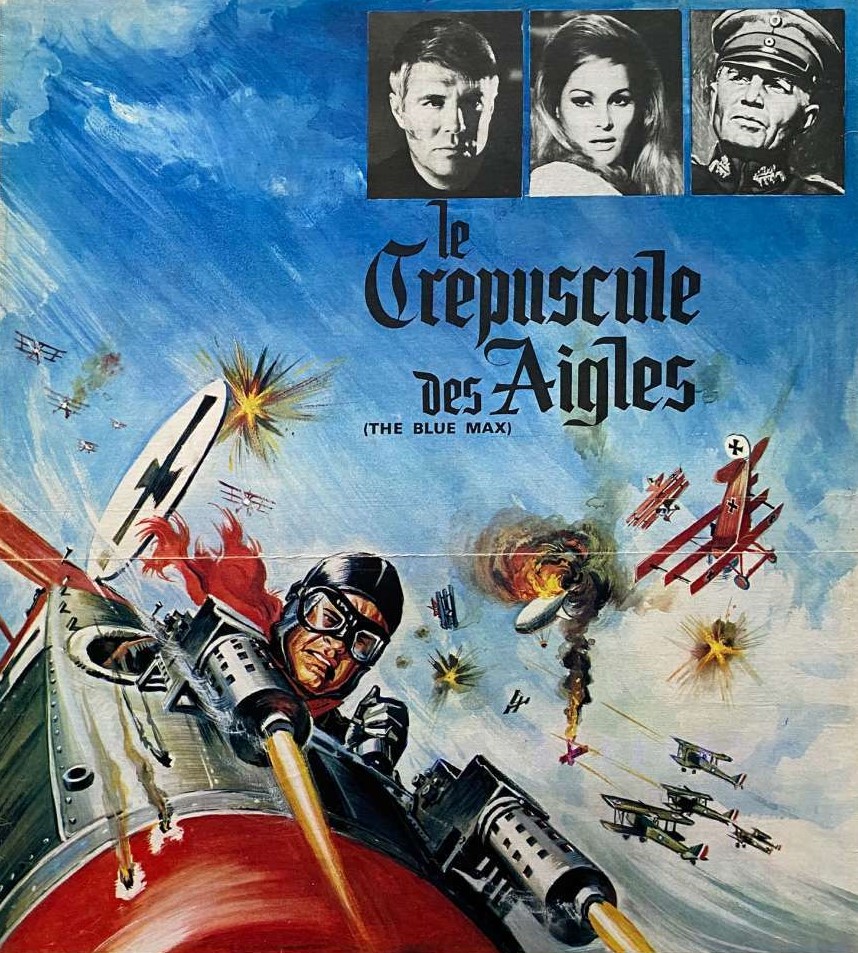
While the human element is skillfully drawn, the innate jealousy and petty rivalries that threaten to spoil the camaderie so essential to any war effort, it is the aerial element that captures the attention. The planes are both balletic and deadly. Because biplanes fly so much more slowly than World War Two fighters, the aerial scenes are far more intense than, say, The Battle of Britain (1969) and the dogfights, where you can see your opposite number’s face, just riveting. Recognition of the peril involved in taking to the sky in planes that seem to be held together with straw is on a par with Midway (2019) while the ability of the best pilots to dodge trouble in the sky has been more recently highlighted in top Gun: Maverick (2022).
I was astonishing to discover not only was this a flop – in part due to an attempt to sell it as a roadshow (blown up to 70mm for its New York premiere) – but critically disdained since it is an astonishing piece of work. Guillermin makes the shift from small British films to a full-blown Hollywood epic with ease. His camera tracks and pans and zooms to capture emotion and other times is perfectly still.
The best scene, packing an action and emotional wallop, will knock your socks off. Having eliminated any threat from an enemy plane, rather than shoot down the pilot, Peppard escorts it back to base, but just as he arrives the tail-gunner suddenly rouses himself and Peppard finishes the plane off over the home airfield, the awe his maneuver originally inspired turning to disgust.
The action sequences are brilliantly constructed, far better than, for example 1917 (2019) – which by contrast appears labored. One battle involving planes and ground troops is a masterpiece of cinematic orchestration, contrasting raw hand-to-hand combat between enemy soldiers with aerial skirmish. Guillermin takes a classical approach to widescreen with action often taking place in long shot with the compositional clarity of a John Ford western. Equally, he uses faces to express emotional response to imminent or ongoing action.
George Peppard (Pendulum, 1969) is both the best thing and the worst thing about the picture. He certainly hits the bull’s eye as a man whose chip on one shoulder is neatly balanced by arrogance on the other. But it is too much of a one-note performance and the stiff chin and blazing eyes are not tempered enough with other emotion, and he fails to portray the kind of complex character he would essay so brilliantly in P.J./New Face in Hell (1968) and House of Cards (1968) It would have been a five-star picture had he brought a bit more savvy to the screen, but otherwise it is at the top of the four-star brigade.
James Mason (Age of consent, 1969) is at his suave best, his aristocratic German somewhat redeems the actor after his appalling turn the same year as a Chinaman in Genghis Khan. Jeremy Kemp (A Twist of Sand, 1968) is surprisingly good as the equally ruthless but distinctly more humane superior officer. For once given the chance to act, Ursula Andress (The Southern Star, 1969) is more than mere eye candy, the kind of mistress with an eye more on the main chance than true love, although she does manage to swan around in one scene clad in only towels.
Look out for Derren Nesbit (The Naked Runner, 1967), Anton Diffring (Where Eagles Dare, 1968), Harry Towb (The Bliss of Mrs Blossom, 1968) and Karl Michael Vogler (The Dance of Death, 1967).
Guillemin’s technical skill is outstanding. In Bridge at Remagen it was the tracking camera and the blitz of war that captured the eye, here it is fabulous aerial photography. In the later picture, it was often hard to delineate individuals within the overall frame since the whole point of the film was the absolute messiness of war, but The Blue Max, dealing with one-on-one duels, presented a better opportunity to take advantage of cinematic elan. The screenplay, based on the bestseller by Jack Hunter, was courtesy of the team of David Pursall and Jack Seddon (The Southern Star) and Gerald Hanley (The Last Safari, 1967) after initial work by Ben Barzman and Basilio Franchina (both The Fall of the Roman Empire, 1964).
There had been a marked trend towards even-handedness in terms of presenting both sides during World War Two, as exemplified by Battle of the Bulge (1965), but this was the first to present the Germans in such heroic fashion.






 The Magnificent 60s