
Seems you couldn’t make a movie about defeat in the 1960s, you had to find something in the story that sounded victorious. Although the Allied landings at Anzio in January 1944 eventually led to the liberation of Rome, the whole operation was a mess. So instead of concentrating on outnumbered American and British troops being pounded to pieces on the beaches, director Edward Dmytryk (Alvarez Kelly, 1966) opts for the men-on-a-mission angle.
Somewhat bizarre is the insertion of war correspondent Ennis (Robert Mitchum) into the story. Sure, because he’s not going to get busted for insubordination, he can challenge and/or lambast fictional commanding officers General Carson (Robert Ryan) and Major General Lasky (Arthur Kennedy) but it seems odd that he goes around spreading anti-war sentiment when the people escorting him are in serious danger of being killed. On the plus side are three sequences depicting the brutal reality of war in a way that no other picture of the period dared.
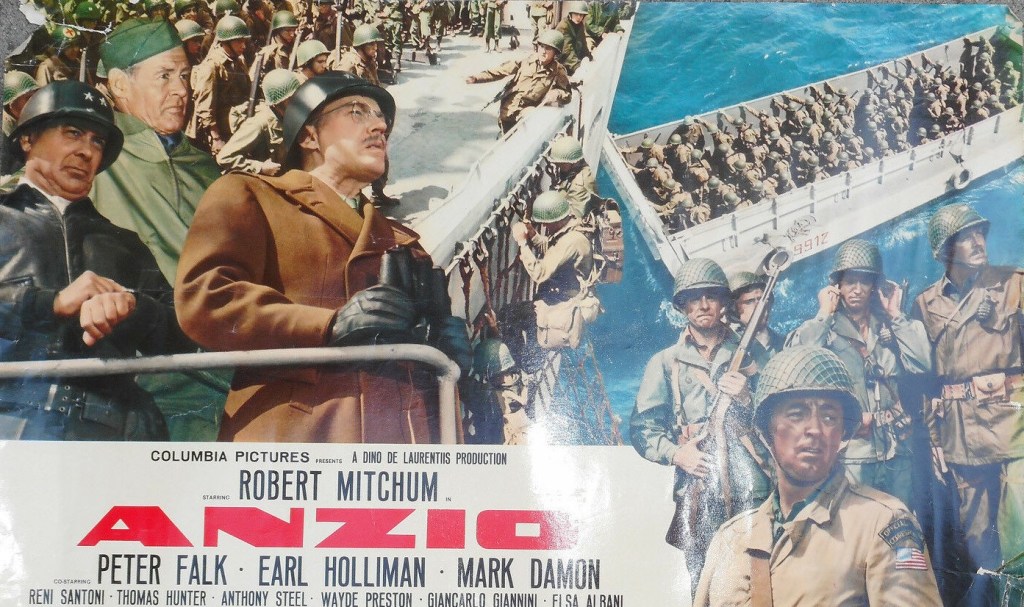
After landing unopposed Laskey decides not to risk moving forward, leaving his troops open to being trapped by advancing Germans even though Ennis, after commandeering a jeep, manages to reach Rome with encountering any opposition.
A Ranger battalion is sent to scout the surrounding countryside and the movie chooses to concentrate on a small platoon unit within that, headed by Sgt Stimmler (Earl Holliman) and including the fun-loving Corporal Rabinoff (Peter Falk), the kind of guy who spends the night before the landing entertaining three sex workers in the back of stolen ambulance who are of course desperate to learn the words to “Bye, Bye, Blackbird.”
After the Rangers are cut to pieces at the Battle of Cisterna, the unit escapes through a minefield, discovers a massive German construction site, holes up in house with three Italian women, is pinned down by snipers in a field of shell-holes and finally makes it back.
American troops being slaughtered at Cisterna is a helluva note as the movie switches tack from exposing leadership folly to just getting the platoon out of this mess. Pursued by a flame-throwing Panzer, they pick their way through a minefield using the quite clever device of lobbing onto it large chunks of stone and then walking across on the stones as if crossing a dangerous river.
Wanting to find out more about the mysterious construction work results in Ennis causing the death of one of the gang. When they hide out in the Italian house, eventually killing off investigating Germans, the naïve Ennis wants to take the women with them.

Trapped by snipers in open country, they are being picked off one by one with only clever tricks and sacrifice offering a way out. One of the notions is to throw a fake grenade the snipers’ way. The instant reaction to any soldier to an incoming grenade is to get the hell out of the way, turning themselves into a turkey shoot. But the only other way to entice the snipers to reveal themselves is for the soldiers to take turns in presenting themselves as targets.
One of the ongoing themes of the picture is Ennis refusing to bear arms, and although the trailer shows him blasting away with a machine gun that only occurs at this climax when he seizes the weapon from a dead German. Ennis is an odd character for a war picture. None of the soldiers can believe anyone would not just volunteer to participate in a bloody war but carry nothing to defend themselves with. It’s a bit tiresome to hear him being reminded that he doesn’t have to be here, and to turn down the offer or a rifle or a grenade.
And for a non-combatant he’s not exactly uninvolved in strategic matters. A couple of times, as if he’s the most entitled grunt you ever came across, he virtually assumes command, barking orders that the others obey. Admittedly, it’s his cleverness that gets them through the minefield, but it’s his stupidity that gets others killed and to have him pontificating at the end that men go to war “because they like it” is incredibly facile, although in keeping with the anti-Vietnam sentiments of the time (1968, that is, not 1944).
Rabinoff, the only other character about whom we learn anything, is unfortunately on the preposterous side.
While the movie is far from dire, and as I said, very realistic when in portraying war actuality, it’s not the picture I guess audiences expected. While the scene-stealing of Peter Falk (Penelope, 1966) gets in the way, Robert Mitchum (5 Card Stud, 1968) proves an interesting character, although he is also laden down by having to spout a bunch of dumb lines. Arthur Kennedy (Fantastic Voyage, 1966) is the pick, especially at the end facing up to the ignominy of being relieved of command.
This kind of movie is potentially a breakout for the supporting cast. But here, with the exception of Falk, the script lets them down, nobody given the kind of distinctive characterisation that elevated The Dirty Dozen (1967), for example, above the norm. Apart from Earl Holliman (The Power, 1968) and Italian Giancarlo Giannini (The Sisters, 1969) this was not a career-making movie. You can spot Mark Damon (Dead Men Don’t Count, 1968), Patrick Magee (A Clockwork Orange, 1971), Anthony Steel (The Story of O, 1975), Rene Santoni (Guns of the Magnificent Seven, 1969), Wolfgang Preiss (Von Ryan’s Express, 1965) and Robert Ryan (Battle of the Bulge, 1965).
Edward Dmytryk (Mirage, 1965) does a reasonable job with the materials to hand, and the minefield and sniper scenes are first class. Italian veteran Duilio Coletti (Under Ten Flags, 1960) directed the Italian version though I’ve no idea what that was, or if it differed in any way from the Dmytryk cut. Coletti also had a hand in fashioning the screenplay along with H.A.L. Craig (Fraulein Doktor, 1969), Frank De Felitta (Audrey Rose, 1977) and Giuseppe Mangione (Run, Psycho, Run, 1968).


This was quite entertaining. As always, Mitchum kept me glued to the screen.
LikeLiked by 2 people
I thought he put in a good shift on this one. Critics often carped that he phoned in his performance but I thought this was just fine.
LikeLiked by 1 person
Got this on DVD awaiting a watch. Will return after my re-appraisal.
LikeLiked by 1 person
Something: “Working titles included The Anzio Landing, The Landing at Anzio, The Battle for Anzio, and The Battle of Anzio. In Italy, the picture was released under the title Lo sbarco di Anzio.
A 23 Jul 1965 DV article referred to the picture as The Anzio Landing when listing it as one of producer Dino De Laurentiis’s slate of twenty pictures scheduled for release in 1965 and 1966. Italian director Duilio Coletti was said to be “prepping” the film in Rome, Italy, near the town of Anzio, Italy, where the action is set, as stated in a 23 Mar 1966 Var brief. However, the 11 Apr 1966 DV indicated that De Laurentiis was considering shooting in Spain and had sought logistical cooperation from Spanish authorities.
By early summer 1966, Columbia Pictures was on board to co-produce with De Laurentiis, as announced in a 5 Jun 1966 NYT item, which stated that Duilio Coletti would write and direct the $3-million production. Columbia provided the financing in its entirety, or at least several million dollars, as indicated in the 11 Oct 1967 Var. The following year, a 2 May 1967 LAT brief named Edward Dmytryk as the director, and noted that Robert Mitchum had been cast in a leading role. The project marked a re-teaming of Dmytryk and Mitchum, who had previously collaborated on Till the End of Time (1946, see entry) and Crossfire (1947, see entry). Despite the hiring of Dmytryk, Duilio Coletti stayed on as second-unit director, according to the 28 Jun 1967 Var.
Principal photography commenced on 29 May 1967, as noted in a 2 Jun 1967 DV production chart. Location shooting took place in the Italian cities of Anzio, Taranto, and Rome. Taranto sequences entailed a beach landing scene, according to the 21 Jun 1967 Var, and a crowd scene shot at the Colosseum involved 3,000 background actors and was described in the 1 Oct 1967 LAT as “the biggest scene ever shot in Rome.” Filmmakers received support from the Italian government which, according to a 17 Apr 1968 Var item, was rare at that time. Italian authorities were said to have provided “a quiet naval contribution.”
Columbia initially planned to release Anzio as a “roadshow” attraction with reserved seating. However, an item in the 20 Mar 1968 Var reported that the studio now intended to distribute the picture as a general wide release. Publicity included an advertisement on a thirty-foot billboard located at Yankee Stadium’s center field. As stated in a 24 Apr 1968 DV brief, the billboard advertisement marked the “first time a film company has used such an ad medium.”
Due to the picture’s status as an American-Italian co-production, Edward Dmytryk was denied directorial credit for “nationality reasons” on the Italian version. The 30 Aug 1967 Var noted that Dmytryk would receive “a film by” credit on Italian release prints, instead.
Samuel Marx was identified as a producer in the 24 Aug 1966 issues of LAT and Var, and as a writer-producer in the 4 Jan 1967 Var. The 12 Apr 1968 DV stated that Marty Paich was set to arrange and conduct the title song, “This World Is Yours. DV items published on 28 Sep 1966, 6 Jun 1967, and 14 Aug 1967 listed Henry Silva, the Scots Guards Band, and Elizabeth Thompson as cast members.”
LikeLiked by 1 person
I am a fan of Dmytryk who is mostly under-rated. I wondered if they cut it back in the editing stage becayse to qualify for a roadshow it would have had to be longer. Thanks again,
LikeLike