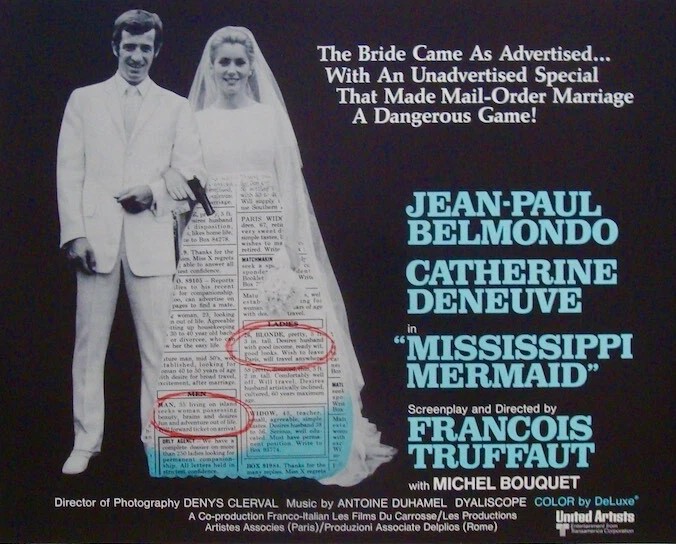
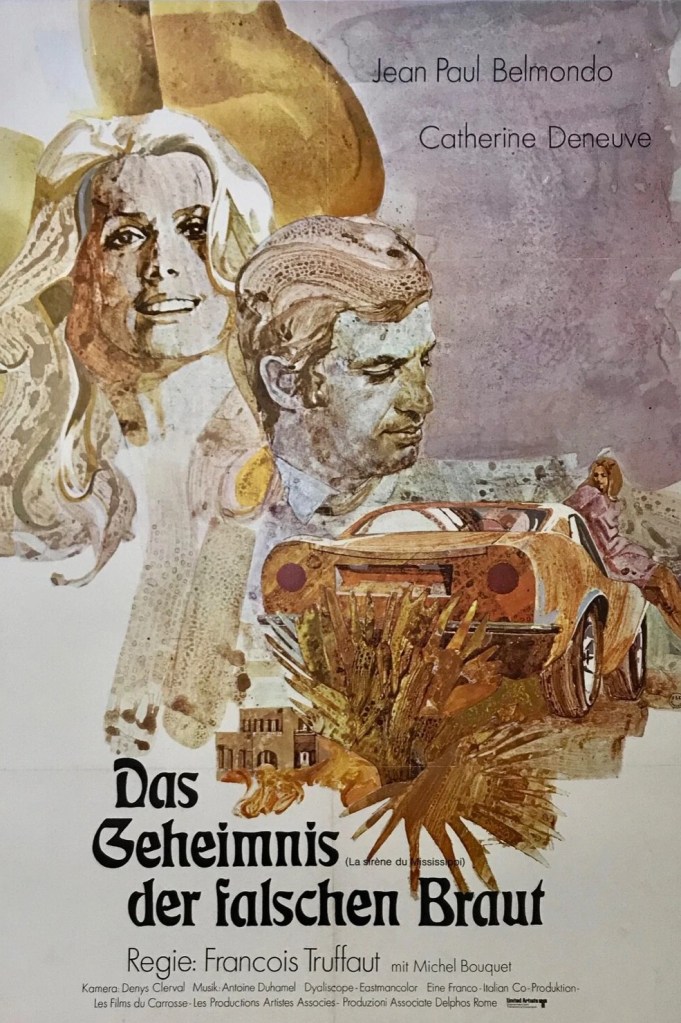
The problem with deifying your heroes is that you might be tempted to imitate them. Celebrated French director Francois Truffaut (Fahrenheit 451, 1966) had just published his seminal book on Alfred Hitchcock, the first full-length work to treat him as a cinematic genius (an idea, it has to be said, largely dismissed at the time in the USA). Mississippi Mermaid is a homage to Vertigo (1958) with a hero in love with something which doesn’t exist, his idealized version of a woman.
Louis (Jean-Paul Belmondo) and Julie (Catherine Deneuve) couldn’t be more different. A factory owner, he’s got dough and wants a wife. She wants dough and will do anything to get it. She’s the queen of femme fatales and he’s the king of suckers. So it’s a bit of stretch at times, no matter how glamorous and sexy Julie is, for him to stick by her no matter what scheme, at his expense (literally), she comes up with.
There’s unexpectedly another element that will chime with the contemporary audience – the quick way of finding a partner. These days it’s online apps and Tinder and the like, but back in the day people sought romance through the classified adverts of newspapers. In five lines, as Louis points out, you had to pour out all your hopes and reveal your soul.
I don’t think the ending works at all and it’s a bit long, but otherwise as a study of infatuation a la Vertigo it does pretty well. His description of her features in geographical terms is one of the most lyrical romantic scenes of all time. Unfortunately, what he sees gets in the way of what she is.
For a start, she’s not Julie. Julie Roussel was the woman who had responded to his classified advertisement and after some correspondence – the old-fashioned kind via hand-written letters – had agreed to travel to the remote island of Reunion, just off the coast of Madagascar, to become his bride. Marion, a nightclub hostess, befriended Julie on the boat, discovered the purpose of her voyage, and passed this on to her boyfriend who came up with a clever plan. He would kill Julie while Marion would impersonate the dead woman and find a way of ripping off the mark.

Louis is so entranced with Julie, even though he suspects there’s been some of bait-and-switch, that he agrees to allow his new wife access to his bank accounts. It doesn’t take long for her to rook him and make off with his fortune. He hires private detective Comolli (Michel Bouquet) to find her. By coincidence, Louis beats the sleuth to it, coming across Marion dancing as a nightclub hostess in France.
But when he confronts her, she turns out to be a dupe, too, her boyfriend having made off with all the loot and then, sucker that he is, Louis falls in love with her all over again. Given she’s a wanted woman, they go on the run in France, living off his income from the factory. But when Comolli turns out to be too incorruptible for his own good and traces the couple and refuses to be bought off, Louis kills him and buries him in the cellar.
They’re planning now to hide out in Switzerland, out of French jurisdiction, and she persuades him to sell off the factory to fund their future. That only goes half according to plan, he gets the money but the discovery of Comolli’s corpse means most of the cash is stuck in an apartment surrounded by police. Still, they set off and hide out in an abandoned cottage a few miles from the Swiss borders where she starts to poison him.
And that’s where it should have ended, she trudging into Switzerland with what remains of his dough and snagging another sucker, him left for dead in a remote cottage deep in the snow. Except, that would be too heartless, apparently, for audiences of the period, so the whole finale is dressed up in redemption. Revelation is the key. She realizes that when he accepts his fate and calls on her to administer the poison quicker that actually that’s the moment when she falls in love with him. Crikey, what rubbish.
Luckily, the rest of this works because of the depth of Louis’ fixation on Marion. It’s a twist on Vertigo. Instead of the woman not living up to the man’s fantasy, here he refuses to see through the charade. At times, sure, he castigates her for leading him a merry dance and eating her way through his money, but mostly he acts as if in a romantic trance, as if whatever spell she’s cast on him can never be broken.
To protect her, he lowers himself to her level, believing murder is a fine way to get what you want. You can see what he sees in her. But also you can see through her wiles in a way that’s impossible for him.
Jean-Paul Belmondo (Breathless, 1960) is superb in a reversal of his usual male dominance as is Catherine Deneuve (Mayerling, 1968) as the beautiful woman who twists him round her finger but reveals sadder depths than normally associated in his eyes with beauty.
Written by the director based on a Cornell Woolrich (Rear Window, 1954) novel.
It’s certainly a fine effort by Monsieur Truffaut but mostly goes to show how difficult it is to carry off a Hitchcockian thriller.


