Red Sun (1971) ****

Reminder of just how good an actor Charles Bronson was before he went all monosyllabic in The Valachi Papers (1972) and Death Wish (1974) and growled and grimaced his way to superstardom. Realistic western filled with anti-heroes except for the least likely hero in the shape of a Japanese swordsman.

In the early days of the multi-national co-production, the idea was to headline the picture with stars who could sell the picture in their domestic country, although Bronson did double duty, a Yank who was a far bigger star in France than in his home land. Frenchman Alain Delon (Texas Across the River, 1966) also doubled up, a reliable performer in U.S. markets as well as in his home patch. Toshiro Mifune (Hell in the Pacific, 1968), huge commercially in Japan, also appeal to the global arthouse mob. Ursula Andress (She, 1965), though technically Swiss, held sway over male hormones in wide swathes of Europe. And if that wasn’t enough, for good measure, there was another French beauty in Capucine (The 7th Dawn, 1964).

Interspersed with bouts of action of one kind or another, the story is mostly of the immoral kind, double-crossing to the fore, seduction merely a tool, but arriving at a surprisingly moral conclusion. Usually, pictures that focus on adversarial characters forced to work together pivot on a gender clash, romance going to find a way. But here, the outlaw and the swordsman are mostly at odds and, to top it all, outlaws, swordsman and seducer have to band together to save the day at the end.

Story is slightly complicated in that Link (Charles Bronson) begins as a bad guy, in league with Gauche (Alain Delon), to rob a train and doesn’t really stop being a bad guy, and is very self-aware about the consequences of his chosen profession, even when, double-crossed and left for dead, he seeks revenge on his partner. The opening section has a heist-like quality, you know the kind, where clever machination is required. Here, it’s how to empty the train of the soldiers helping escort a Japanese ambassador. But once that’s accomplished and the small matter of $400,000 swiped, only greed cues the complication, in that Gauche also nabs a Japanese ceremonial sword, and Kuroda (Toshiro Mifune) is honor-bound to recover it.

Gauche is also the kind of outlaw who doesn’t appreciate his team’s efforts, not only attempting to murder Link but finding occasion to bump off other members of the gang. Link becomes Kuroda’s prisoner and spends a good chunk of time trying to escape and even when they supposedly come to an agreement can’t resist the odd double-cross. The quarrel is mainly over who gets to kill Gauche.

Anyway, eventually, they end up in a small western town big enough to contain a whorehouse run by Pepita (Capucine), sometime lover of Link, where lies potential bait in the shape of Christina (Ursula Andress), Gauche’s girlfriend. When Gauche doesn’t take the lure,  they have to saddle up and seek him out, hoping to trade the girl for at least some of the loot and the sword. Christina is as untrustworthy a prisoner as Link and gets them into trouble with the local Commanche, thus setting up a finale in a blazing cornfield.

The tasty exchanges between the Yank and the Japanese, more than the culture clash, drive the picture, though the eastern obsession with cleanliness is a new one for the western. You wouldn’t say the pair end up buddies but they certainly hold each other in healthy respect.

Charles Bronson isn’t easy-going but he’s much more natural, with a welcome grin, plenty dialog, and ready for most eventualities (except the first one, obviously). Mifune brings in  the wider audience that gave Hell in the Pacific the thumbs-down. This could have been a swashbuckler had he been more cavalier in character, and perhaps the most telling difference between east and west is his venerating approach to a sex worker. Mifune is a fine match for Bronson.

Delon and Bronson go way back to  Farewell, Friend / Adieu L’Ami (1968), the movie that turned Bronson into a giant star in France and in which they were the adversarial buddies. Delon here plays both sides of his screen person, the charming gallant and the ruthless gangster, and it’s a rare sight indeed to have three actors at the top of their game appearing in scenes together. Ursula Andress also plays against type, as a conniving seductress, with a complete lack of the self-awareness that typifies Bronson. Mostly, she’s just nasty.

On the face of it, the eastern western should be nothing more than a marketing gimmick but in the capable hands of Terence Young (Mayerling, 1968) it works a treat. More talky than audiences might have expected but that adds meat to the raw bones of a revenge picture. Took three screenwriters to pull it off – William Roberts (The Magnificent Seven, 1960), Denne Bart Petitclerc (Islands in the Stream, 1977) and Laird Koenig (Bloodline, 1979). Great score by Maurice Jarre (El Condor, 1970).

A surprise.

Sam Whiskey (1969) ***

You don’t realize the importance of treatment until you see an interesting story mangled. Taking the comedic approach to a heist picture is tricky. You can’t just make it happen because that’s what the script says, you’ve got to prove to an audience that whatever takes place is believeable. And frankly, asking three inexperienced dudes to smelt down a ton of gold and sneak it into a government building in the shape of a bust (the statue kind, not the other) and then smelt it back down again while inside and turn it into gold bars is a stretch too far.

This is amiable enough as far as it goes, and Burt Reynolds gives his good-ol’-boy routine a try-out, Angie Dickinson strays from her usual screen persona, and it does present some interesting screen equality – a Yaqui Indian shown as someone you would pay a debt to, Ossie Davis making a pitch for the African American acting crown.

I saw this double bill at the time of original release.

But it’s bogged down in a cumbersome plot that I guess many in the audience, like me, would have been begging for a switcheroo at the end that made more sense for the genre.

So, bear with me, Laura (Angie Dickinson) hires ex-gambler Sam Whiskey (Burt Reynolds) to retrieve $250,000 worth of gold ingots lying inside a sunken riverboat at the bottom of a river. Fair enough, you think, it’s the nineteenth century, nobody would be able to hold their breath that long to attempt to retrieve it even one gold bar at a time.

But she only wants the gold back to satisfy family honor. You see, her dead husband was in charge of transporting the gold to the local mint and to cover up his calmaity he replaced the gold with ingots made of lead. And hold on, there’s more, a Government inspector is due at the mint.

So, Sam and his buddies, blacksmith Jed (Ossie Davis) and strongman turned inventor O.W. Bandy (Clint Walker) have not just to recover the gold, and resist the temptation to simply spirit it away over the border, but find a method of getting it back inside the mint without anyone knowing and at the same time smuggle out the false ingots.

Of course, Laura has a blueprint of the plans of the mint so that’s okay then. And there’s a bust of her dead husband in the hallway of the mint and if Sam can just find the right excuse to take it away – and bearing in mind he has no obvious mold to use to re-cast it – he can re-make it in gold, return it, sneak it down into the smelting room and turn it back into gold bars.

Yes, the story is that complicated. Sam is only prevented from stealing the haul for himself by the seductive presence of Laura, who also has to act femme fatale enough to waylay the real inspector, whose identity Sam steals. I was praying that Laura, who seemed to be too good to be true what with all that family honor, was actually playing Sam for a patsy and that what was being removed from the mint was the real gold and what was being substituted was the fake.

No such luck. And this might well have worked if it had been treated seriously, if Sam was a famous robber, and if the director hadn’t interrupted proceedings every few minutes with some woeful comedy music and littered it with non-sequiturs or even provided a decent villain apart from Fat Henry (Rick Davis) and his motley crew who suspect something is up and attempt to hijack the gold before it reaches the mint.

And it’s a shame because the leading players are all an interesting watch. Burt Reynolds (Fade In, 1968), still a few years short of stardom, takes a risk in playing his character in light comedy fashion, coming off second best in his opening encounter with Jed. Angie Dickinson (Jessica, 1962) is far too genteel to play the femme fatale and it’s clear she only goes down the seduction route when Sam balks at the barminess of the idea, but it’s equally clear she’s the brains of the operation, and that’s pretty much a first in the western robbing business, and her character is so deftly acted that it’s only later, when you add everything up, you realize the depths of the character and that’s she only allowed audiences a glimpse of the surface.

Ossie Davis (The Scalphunters, 1968) doesn’t attempt the obvious either. He’s not after the Jim Brown action crown. He can look after himself with his fists, but he’s got the intelligence to avoid getting trapped by violence. And Clint Walker (The Great Bank Robbery, 1969), also primarily playing against type, is a muscular version of the crackpot inventor you usually found in a British comedy, but who is capable of coming up with an early version of  diving equipment. And he has a great line that despite endless rehearsal he muffs up, “Aha!” he proclaims, battering in a bedroom door, in best Victorian melodrama fashion, “I caught you trifling with my wife.”

So it’s worth it for the performances and if you ever hankered after the seminal shot of a squirrel overhearing a conversation or wondered how many shots in one movie a director could contrive to make through a small space then this is for you. Screenwiter William Norton (The Scalphunters) had better luck with other directors but here Arnold Laven (Rough Night in Jericho, 1967) takes a wrong turning. Amiable is not enough, certainly not for a complicated heist picture.

Angie Dickinson and Burt Reynolds completists, though, will not want to miss this.

Riot on Sunset Strip (1967) ***

Catholic high school girls in trouble? Call Sam Katzman. Delinquents, crazed by music or booze or sex or drugs (maybe all four), on the rampage? Call Sam Katzman. Thugs, to quote from Johnny Cash, keen to “watch a man die?” Call Sam Katzman. The new generation threatening to swamp the old? Call Sam Katzman. Require a sensuous lass in tight clothes to perform an Ann-Margret-style number? Call Sam Katzman.

Legendary five-and-dime producer Sam Katzman, with over 200 pictures in his portfolio, had put his stamp on everything from the East Side Kids and jungle flicks to horror, westerns and sci-fi. Any new genre with rip-off potential, he’d be first in the queue. Forget knives and guns and fists, music was the most dangerous weapon, over-exciting the young.

“Girls in Hot Leather” is the bait-and-switch Italian title.

So no surprise then to find the man behind Rock Around the Clock (1955) and Calypso Heat Wave (1957)  also responsible for Teenage Crime Wave (1955), New Orleans Uncensored (1955) and Hot Rods to Hell (1967). Or that he’s an exponent of the old bait-and-switch here – no riot here that I could spot.

And probably over-emphasis on earnestness for a potential exploitationer, from the occasional intrusions of a pseudo-documentary voice-over to the grown-ups debating the causes of the latest outbreak of teenage rebellion, long hair, marijuana, popping pills and energetic dancing. That said, it’s even-handed, adults blamed for the divorce plague that leaves youngsters alone and vulnerable, cops too prone to violence, greedy businessmen and characters with right-wing tendencies causing the problem or making matters worse. “They’re just kids,” spouts earnest top cop Lorrimer (Aldo Ray), “they could be your sons and daughters,” not realizing one of them is.

Away from the grown-up talk-fest, the kids sit either numb listening to loud rock bands in far from sleazy clubs or on the dance floor pounding away to the beat, in either case not having much to say to each other, and inevitably ending up out the back door smoking a quiet joint or gathering in some pretty fancy home for a tripping party

Andrea (Mimsy Farmer), a youngster from a broken home living with her drunken mother, falls in with a bunch of teenagers who hang out in these hard-wired locales. Initially, she resists joining in, and perfectly innocent when caught up in a scuffle. But when supposed cool dude Herbie (Schuyler Hayden) spikes her drink with some acid at a party she turns all Ann-Margret, and is allocated a near six-minute slot to shake her stoned booty, leading the aforesaid Herbie to take her upstairs and take advantage. Doesn’t end well for Herbie as she’s under-age.

Turns out, too, Andrea is not so much the long-lost as abandoned daughter of Lorrimer and when he goes into rescue mode she gives him both barrels. “You left me alone for four years, let’s keep it that way,” she snaps. Apprised of her situation, he sets about the youngsters with his fists.

That supposedly leads to the riot. But it’s no more than the mildest of protests as he has to endure a Walk of Shame a la Game of Thrones (though with clothes on) and, bizarrely, becomes the poster boy for both police brutality and for anti-police-brutality. Natch, there’s a tacked-on happy ending but not before the voice-over can intone in apocalyptic manner: “Half the world’s population is under 25. Where will they go? What will they do?”

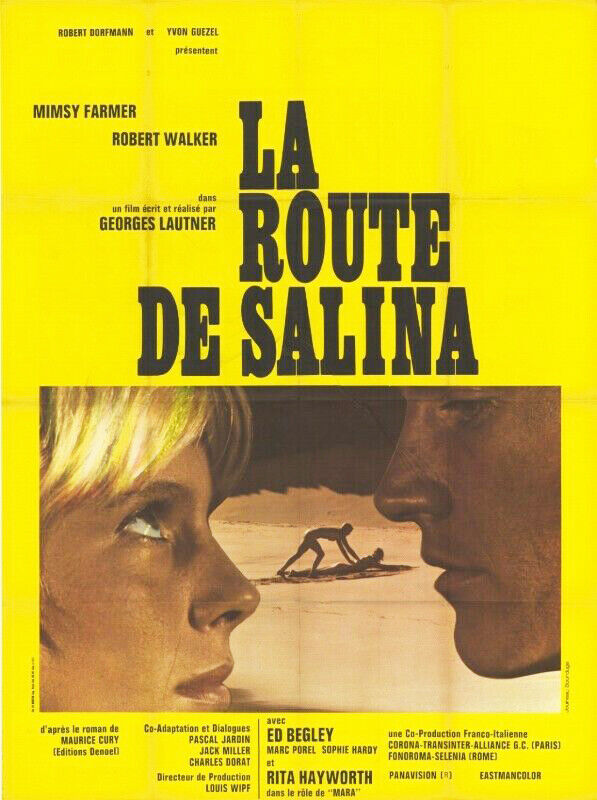
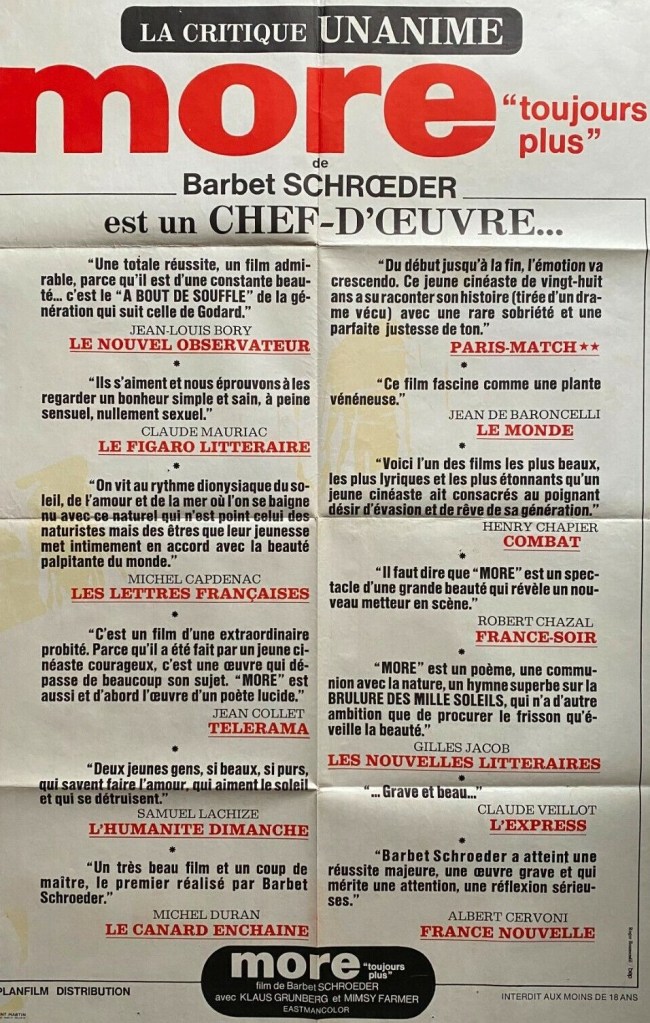
I had come at this because I was intrigued to discover Mimsy Farmer as the junior minx in Spencer’s Mountain (1963) and as she was overshadowed by Ann-Margret in Bus Riley’s Back in Town (1965) wondered how her career had progressed. Presumably come to a standstill, otherwise she wouldn’t have ended up in a B-picture cul de sac. She puts in a good performance, however, miles away from the lively youngster of the Henry Fonda picture, withdrawn, anxious, not fitting in.  

A good chunk of the picture is wasted, from today’s perspective, on no-name bands and not much happening, but the talk-fest aspects prove that little has changed in the way the grown-ups misunderstand the young and much the same arguments for reining in the supposedly out-of-control teenagers are still being trotted out today. But it does point a prescient finger at marriage break-up (the fault of the grown-ups doing much of the blaming) as a root cause of teenage misbehavior and contemporary audiences will only be too familiar with predatory males spiking drinks.

Aldo Ray (Welcome to Hard Times, 1967) would be the marquee name, but you try and compete with a lithe teenager who says more in her six minutes of pent-up emotion and the resultant dancing than all the time spent on earnest debate. Laurie Mock (Hot Rods to Hell, 1967) is the wildest of the females.

Director Arthur Dreifuss was a Katzman regular but was also responsible for the movie version of Brendan Behan’s The Quare Fellow (1962). Screenwriter Orville H. Hampton had a surprising pedigree with Cage of Evil (1960) and Jack the Giant Killer (1962) and Oscar-nominated for One Potato, Two Potato (1964).

More absorbing than I expected and Mimsy Farmer’s trip a lot more interesting than Peter Fonda’s.

An American Dream / See You in Hell, Darling (1966) ****

The Stuart Whitman Appreciation Society kicks into high gear with this under-rated drama. A huge flop and critically savaged at the time, its bitterly sardonic existentialist center will appeal more to contemporary audiences.

Norman Mailer, author of the source novel, was a hugely controversial public figure. A magnet for alimony, writer of sledgehammer prose, his filmed bestsellers (The Naked and the Dead, 1958) hit the box office with a heavy thud, climaxing in the disastrous Tough Guys Don’t Dance (1987). Politician, avant-garde film-maker (Maidstone, 1970) and leading exponent of the “new journalism” (The Armies of the Night, 1968), his works were exceptionally tricky to translate onto the screen.

This one picks its way through a flotilla of heavyweight themes – corruption, entitlement, the Mafia – by focusing on a trio of flawed characters dogged by ideals amd let down by reality. War hero crusading journalist and television’s version of a “shock jock”, Stephen Rojack (Stuart Whitman) is weary of beating his head against a legal brick wall in his bid to bring to justice Mafia lynchpin Ganucci (Joe de Santis). But he’s also extremely done in coping with adulterous alcoholic heiress wife Deborah (Eleanor Parker).

When he asks for a divorce she retaliates with violence and scathing verbal abuse. In the scuffle that follows she teeters off the ledge of their penthouse apartment. In his defence Stephen might well have claimed self-defence given she tried to crown him with a huge rock, or at the very least relief (although admittedly that has little legal standing), but instead opts for suicide. In revenge for Stephen’s ongoing slating of the police and because the deceased is daughter to exceptionally important entrepreneur Kelly (Lloyd Nolan), the eighth richest man in America, the cops try to pin on him a murder rap. The charge is really a moral one, and equally as ruinous to a fast-rising career, that while he may not have pushed her he didn’t act to save her.

As it happens, and apparently coincidentally, Ganucci happens to be passing the penthouse at the time the woman hits the deck. Equally, coincidentally, riding with him is his moll Cherry (Janet Leigh) a wannabe singer whose only gigs are in Mob-owned night clubs.

But Ganucci’s presence turns out not to be coincidental after all. He was on his way to straighten Stephen out, possibly intending to use blackmail since Cherry is a stain on Stephen’s supposedly unblemished past. The cops are ferocious in their grilling, and adopt an unusual amount of forensic evidence for the time. Stephen would probably have come apart quicker had it not been for rekindling romance with Cherry, which, unexpectedly, provides the hoods with a lure to reel him in.

The satire is mostly reined in – cops unable to catch the real murderous Mafia pick on the guy who’s picking on them, Stephen’s business partners latch on to his sudden publicity/ notoriety to negotiate a multi-million-dollar pay rise with, natch, a rider in the contract negating it should he be found guilty. The drama is characters racing headlong towards fleeting happiness, the tiny morsels of hope that might filter down from the unacheivable American dream.

The performances carry it. What was it in Stuart Whitman (Shock Treatment, 1964) that drew him towards characters given a hard time? Whatever it was, he rode it in spades and here he presents his most complex character to date, oozing suspicion, suffocated by guilt, believing that all will come right in the end if he has a good woman by his side, not realizing that Kelly knows only too well which side her bread is buttered on. Janet Leigh (Grand Slam, 1967) plays very much against type as the hard-eyed chanteuse but Eleanor Parker (Warning Shot, 1966) essays one of the best – and most vicious – drunks (and lost souls drowning in a sea of wealth) you will ever see.

Not to be outdone, director Robert Gist (Della, 1965), pulls off some neat scenes, opening with a shot of a naked Eleanor Parker clad only in dark sunglasses watching television, using camera movement to put claustophobic heat on Whitman during interrogation scenes (Christopher Nolan’s interrogator in Oppenheimer apes his trick of pushing his chair close to his victim), portraying the flimsy sexiness of Parker in flimsy negligee, all the time not letting Whitman escape from his internal demons.

Perhaps, more boldly, rather than, as would be the contemporary temptation, treating Deborah’s death as a mystery, the details only unfolding bit-by-bit and leading to a hairy climax, Gist shows her death and lets the audience make up its mind what part Stephen played in it. The downbeat ending, too, would sit more easily with the contemporary audience. Mann Rubin (The Warning Shot, 1967) knocked out the screenplay.

This finished off Whitman’s career – he didn’t make another movie for four years and then ended up in B-picture limbo, directors more interested in his square jaw than the inner confusion he was so deft at portraying.  

Well worth a look.  

Deathstalker II (1987) *** – Seen at the Cinema

Boldest sequel I’ve seen in a long time. Sure, the genre was biting the dust what with Legend (1986) and Highlander (1986) joining the flop parade, but still you’d think Part II would not so obviously poke fun at the original. Not in an all-out Mel Brooks or Naked Gun way, but just seriously determined not to take this particular world seriously.

By this point, while a cinematic release seemed doubtful – over one-third of independent productions in 1987 were denied theatrical distribution – there was a booming market for VHS, the U.S. enjoying spectacular growth, Germany video income of $550 million outgrossing cinema, and British sales topping $800 million, so the market was big enough to accommodate any genre falling by the big screen wayside.

Yep, as with “Deathstalker I” not much in the way of supplementary posters. And, as you might expect, misleading. Monique, you’ll be astonished to learn, lacks sword skills and Tarlevsky ain’t so ripped.

Our hero (John Terlesky) is still disinclined to perform any heroic acts and gets duped by runaway princess masquerading as seer Reena (Monique Gabrielle) – her lack of smarts no pretence, “Deathstalker, is that your first name or your last name?” one of her priceless gems – into tackling evil sorcerer Jarek (John Lazar) who has gone all doppelganger and created a murderess princess clone (Monique Gabrielle again). Of course, there are potions and spells and quite a few of the ogres and hog-faced guards of the previous outing turn up looking as though they’ve just been sliced out of the original. And he’s got a sidekick Sultana (Toni Naples) who goes in for the old head-on-a-platter routine.

But before they reach the castle there’s a zombie (rejects of the rejects from the Star Wars cantina) encounter as Deathstalker takes a notion to enter a mausoleum which has been rigged out with Indiana Jones traps while the living dead erupt from the cemetery to poke around with Reena. And there’s a bunch of inglorious bastards who are so bad they have been outlawed by the likes of Genghis Khan or Attila the Hun but who really have not been handed the correct weaponry for the job.

Finally, there’s Trial by Amazon – while decked out in the old One Million Years B.C. bikini oddly enough none manage to lose their scanty clothing. Deathstalker trounced in the ring as punishment for his “treatment of womankind” by a giant female wrestler (Queen Kong) and having, somewhat against the run of play, managed to win that bout, is ready to get merry with an adoring queen (Maria Socas) when commitment phobia intervenes, so then it’s on to the castle.

There’s still plenty blood-and-thunder – actually way more effort has gone into the swordplay – but (spoiler alert) the rampant nudity has been toned down. Celestial choir is gone, too, and little reference to the power of the sword. Deathstalker this time has acquired a sense of humor so instead of eyebrows denoting emotion it’s a grin or smile. And the clone princess is a piece of work, the villain’s cruella du jour, mounting the faces of victims above her bedpost, and, with nothing better to do, snaps out sarcasm. Jarek has the time of his life as a villain, though there’s a feeling he’s got his genres mixed up because the worst he can do to Reena is dangle her over a pot of boiling water as if he’s in a jungle picture.

Still, it all comes good in the end. It’s funny in a wink-to-the-audience kind of way, plenty intentional gags, this Deathstalker would struggled to bulge a muscle, and has more in common with the common-or-garden charming con man. Monique Gabrielle (Emmanuelle 5, 1987) gets two chances to prove she can act and if going from dumb to nasty is proof of acting then she’s got it down to a fine art. Gabrielle and Terlesky – real-life lovers – have a natural screen chemistry that’s rarely achieved in this genre and her dumb lass is believable. John Lazar (Beyond the Valley of the Dolls, 1970) manages to keep campness at tolerable arm’s length. Directed by Jim Wynorski (100 credits, who am I to choose one?)

Even without the blooper reel tacked on at the end, a hoot.

Deathstalker (1983) *** – Seen at the Cinema

Back in ye olde times before streaming killed off the ancillary market, you could make a decent buck from Z-list pictures that made no attempt to target the entire world but were quite content to feed the maw of a limited genre. Sword-n-sorcery never required anyone who could actually act, just topless beefcake and cheesecake, skin glistening as much as possible, special effects limited to an occasional explosion, monsters little more than rejects from the Star Wars cantina.

Chuck them out to an exhibition industry not so much starved of product as waiting an age to get their hands on a big-budget number, which like roadshow a couple of decades before remained in the biggest cinemas for months, and you would turn an easy profit. This one set the makers back a mere half a million bucks and picked up $1.2 million (in rentals) on U.S. release alone and, more importantly, another $2 million from video rental and the same again likely from sell-through and the same again when DVD appeared and again when cable started to run out of A-list and B-list features and scrabbled about for anything that could fill a slot. And that’s before you started talking about the overseas market, this kind of adventure, with heads, arms, eyes and fingers lopped off (and occasionally fed to pet monsters)  more acceptable worldwide than comedies or musicals

Yep, you’re right, this is exactly the same advert with the title color changed.

Heck, you didn’t even need much of a plot – any Lord of the Rings rip-off would do, a series of inanimate objects that combined to invest the owner with immeasurable power – and you didn’t even require to hide nudity under the guise of “sexposition” a la Game of Thrones, any passing gal liable to have her clothes ripped off or belong to some half-naked harem or be happy to step up for a bout of mud-wrrestling.

Must be World Deathstalker Day because a pair from this series turned up at my local multiplex courtesy of the people at DMP, who otherwise specialize in sci-fi and horror all-nighters or mini-festivals. Or it could be that Lana Clarkson attracted a cult following after being murdered by Phil Spector. Deathstalker, filmed in Argentina since you ask,  originally came out when my cinemagoing habit took a back seat to parenting so would have passed me by and I don’t remember getting a VHS/DVD fix, so I thought I’d toddle along and see why this deserved the reissue treatment along with this week’s other revival fave, Interstellar, which could at least claim tenth anniversary status.

Plot – since you insist – has our eponymous hero (Rick Hill) – no, hero’s too strong a word because he’s reluctant to put himself out for anybody unless it involves womanizing and financial reward – setting out, having been handed a powerful sword by a passing witch, to relieve the sorcerer Munkar (Bernard Erhard) of his power. Along the way he encounters a similar heroic hunk Oghris (Richard Brooker) and female warrior Kaira (Lana Clarkson) and gets sidetracked into attempting the rescue of kidnapped Princess Codile (Barbi Benton) and then taking part in a gladiatorial tournament and of course can’t help but get distracted by the half-naked women.

Munkar is a Machiavellian villain. He uses the tournament to get rid of any challengers to his throne, since they’ll kill each other in combat and he can murder the winner. Only Deathstalker is an obstacle, since his sword renders him invulnerable, and Oghris is easily tempted to turn traitor to solve that little problem. Contemporary audiences might run shy of this type of picture because, essentially, it’s Misogyny Central and there are three attempted rapes in the first five minutes and there’s hardly a minute goes by without some female losing their clothes.

Still, presumably, it does what it says on the tin, plenty action, ogres, imps, hog-faced warriors and naked women in abundance, and the usual narrative malarkey that you won’t need a degree to keep up with (unlike Interstellar, for example). And if you’re a fan of the celestial choir this one’s for you as any time Deathstalker raises the sword to the sky that comes on to indicate he’s not getting electrocuted by the sudden bolts of light saber stuff. You can come to scoff or enjoy for the genre romp it is, laugh at intentional and unintentional jokes, and sit back in wonder at the ten minutes of animated Intermission adverts that arrive at the rate of one a minute that were served up back in the day to entice Drive-In patrons to the delights of the Refreshment Counter.

Director John Watson (Under the Gun, 1987) stuck to the admittedly limited knitting, throwing in close-ups whenever the action stalled, allowing his star to demonstrate his array of knitted eyebrows and drawn lips.  Howard B. Cohen (Barbarian Queen, 1985) dreamt this one up.

Can’t say I complained too much once I knew what I was letting myself in for and a joy to see, in some eyes, a less-than-worthy vehicle being restored to the big screen.

Marnie (1964) *****

Arguably Alfred Hitchcock’s most difficult film and with some attitudes that will not sit well with today’s audiences nonetheless this is an assured work and the completion of an unofficial trilogy that tries to explain the unexplainable. The director had not been making what might be termed traditional Hitchcock pictures for well over half a decade if you take North by Northwest (1959) as the anomaly in a sequence that began with the obsessive Vertigo (1958). You could argue that Hitchcock had turned a bit “north by northwest” himself, the “hero” of Psycho (1960) a mother-obsessed serial killer, the “bad guys” in The Birds (1963) the titular rapacious creatures who besiege the leading characters and set the world on an apocalyptical course.  

Attempts are made in both Psycho and The Birds to explain the actions of the predators, but such explanations are external, remote, and with Marnie Hitchcock takes the bold step of attempting to explain what makes such a devious, compulsive, frigid liar tick. Hitchcock called the movie a “sex mystery” but it was unclear whether he was just once again trying to tantalize his audience or whether he believed it was film about the mystery of sex, what causes attraction between two people while others steadfastly refuse to consider the concept.  To embellish his thesis he chose one of the world’s most beautiful actresses (Tippi Hedren) and the actor (Sean Connery) who could easily lay claim to being the world’s sexiest man (as he was later anointed in various polls).

It seemed almost an indecent proposal to deny the bed-hopper-par-excellence – as viewed from the James Bond perspective. And it certainly took all the charm Connery could muster to prevent audiences baulking at the almost perverse scientific aspects of his character, an amateur zoologist who welcomed a known criminal into his world for the chance to examine her at close quarters.  The audience is constantly kept at one remove. In the first section we watch enthralled as Hedren carries out her bold thefts, as if she is capable of wrapping the entire male population around her little finger by the simple device of adjusting her skirt.

But in the middle section, it is Connery who is in control and the trapped Hedren who is twisting and turning searching for an escape route. In the final section, when it is clear that is the lover, not the scientist, in Connery that tries to find a way round the problem, the tension is at its height because we have no idea whether she will run true to form and manage to steal and lie her way out or whether Connery’s patience will snap and he will throw her to the wolves who are certainly by this point circling.

The central device on which Hitchcock hooked an audience was the moviegoer demand for a happy ending. He duped cinemagoers in Psycho, slaughtering the heroine halfway through. In The Birds Rod Taylor and Tippi Hedren underwent a harrowing physical assault and while clearly romantically involved by the end Hedren was a wreck. Here, the assaults are mental. There is none of the romantic banter that defines the greatest of his traditional works. Hedren and Connery are together because he has forced the issue and loving though his blackmail is it is still an unequal relationship and one from which she will seek to escape at every opportunity. Hedren’s compulsive character is a mystery that appears insoluble as she resists every attempt to break down the wall she has erected to protect herself from her past.

The story is straightforward with few of the twists of other pictures. We meet Hedren as she escapes with nearly $10,000 stolen from her employers. We learn quickly that she is a master of disguise, has several social security cards up her sleeve, can turn from brunette to blonde, and is so practiced in her deception that she can convince an employer to take her on without references. As the employer is spelling out his predicament to the police, an amused Sean Connery, a customer of her employer, appears. Hedren runs off to a bolt-hole, an upmarket hotel, close to the stables where she keeps a horse, Forio.

Shifting back to Hedren we find her visiting her mother in a tawdry street near the docks. The artifice of confidence is shredded away. She is jealous of the attention her mother gives a little girl whom she looks after. She wants love that her mother is unable to give. When she lays her head on her mother’s lap waiting for the soothing stroke of a hand all she receives is rebuke for leaning too heavily on her mother’s sore leg. The mother in North by Northwest was played for comedy, in Psycho an occasion for murder, and here a means of control. Here, too, we witness the color red sparking an inexplicable and frightening experience.

When Hedren applies for a new job it is at Connery’s firm, where he is the coming man. He watches amused as she is interviewed, intervenes to ensure she is hired. They have in common that they are widowed. Hedren is already planning her next big score, discovering that the combination to the safe is kept in a drawer to which her employer’s secretary has the key.

But he is ready for her and it seems almost perverse that he does not let her know he is aware of her true identity. Instead, under the guise of asking her to work overtime, he gives her an academic paper to type. The subject is predators, “the criminals of the animal world” in which females feature. His gentle pressure is almost sadistic and she is saved by a sudden storm which triggers another bad subconscious reaction.  

Her theft of money from the office is a classic Hitchcock scene. It begins in complete silence. The screen is divided in two, the office and the corridor. Seeing a cleaner appear, Hedren removes her shoes to make her getaway. Almost as she reaches the safety of the stairs, a shoe falls out of her pocket and clatters on the floor. The cleaner does not look up. She is very hard of hearing.

But Connery is again prepared and when she disappears tracks her to her bolt-hole, confronts her, questioning her again and again until he thinks he is close to the truth. He can’t turn her in because he has fallen in love. The choice is stark – him or the police. Soon they are married. But the honeymoon, despite his patience, is a disaster, she cannot “bear to be handled” and they return home further apart than ever.

Meanwhile, figures from her past begin to appear. Lil (Diane Baker) who lusts after Connery brings peril to their door. Connery persists with trying to get Hedren to open up.

Eventually, there is a break in her compulsive syndrome, brought on by love, and we head back to her mother’s to get to the root of the problem. Even when the problem is solved her mother remains distant, still won’t stroke her hair. If there is a happy ending it is like that of The Birds, an immediate problem solved but who knows when or if the crows will return, and there is a similar resolution here, Hedren learns the source of her nightmares but it would be a very blind person who did not see terrible ramifications for the future.

There are certainly a few jarring moments, Hitchcock’s insistence on back projection for a start, but then you didn’t really think in North by Northwest that the director was allowed to film in front of the United Nations. Rather than a technical flaw, the back projection seems to fit another purpose, a device to make the audience stop and examine what is going on for much of it occurs when Hedren is in her fantasy world. And you would have to take exception to Coonery’s actions in the bedroom on honeymoon, no matter how gentle his caresses at other times. And certainly, the psychological assumptions ring hollow given our current knowledge of such conditions, but despite that make for tense viewing.

But the meat of the movie is self-deception. Hedren is convinced she can get away with a series of thefts. Connery is convinced her can cure her. His constant interrogation is what passes for lovers’ banter. In aligning himself as her moral guardian and perhaps her savior, “dying to play doctor,” Connery has entered a nightmare of his own making. Only an arrogant man would believe all women would fall at his feet and Hitchcock clearly makes a connection with Connery’s ongoing incarnation as James Bond where that is exactly the case. Connery is every bit as flawed, as obsessive, as Scottie in Vertigo, determined to shape a woman into perfect form, and that, yes, expecting to eradicate the imperfect past.

Connery emanated such ease, such amazing grace, on the screen that it backfired. Critics often didn’t believe he was putting much into his acting when in reality he was acting his socks off. This is a tremendously difficult part, walking the tightrope between looking a deluded fool and retaining audience empathy and coming across badly when he pushed a vulnerable woman too hard. This is a very rounded character, a gentle adoring lover in the main, but not one to be crossed. His interrogations are intense and yet still you can see that it will kill him if he is double-crossed. The casual amusement with which he greeted her appearance at his office is replaced by fear at her sudden departure.

Hedren, too, whose acting ability was often called into question, carries on where she left off from in The Birds. By the end of that picture her nerves had been shredded. Here, her emotions, which she cannot as easily control as the rest of her life, too often fly off into a high pitch. Half the time she is the cool collected customer of The Birds, the rest of the time she is demented.  Except in The Birds she was self-confident around men. Any self-assurance she has now is skin deep. There was always a fragility about Hedren, hidden behind the glossy exterior and fashionable outfits, and here it is exposed. The touching scenes with her mother, the mouth tightened in jealousy over the little girl, are perfectly played. A little girl lost in wolf’s clothing. And trapped, she is almost snarling at her captor, the submissive dialog concealing the mind hard at work looking for an exit.

The interrogative scenes between Connery and Hedren are extremely difficult to pull off. It would have been easier if Connery was not in love with her, and to some extent pulled his punches. It would be easier for her if he was an out-and-out predator who could be paid in kind to shut up and go away. Instead, they both have to walk a verbal tightrope and only actors of some excellence can pull off that trick without losing the audience.

Model Shop (1969) ***

Surprising number of similarities to The Appointment (1969), including the aura of seediness, but lacking that film’s inherent tension or style. Lola (Anouk Aimee) is another model pursued by a another man who catches a glimpse of her in the street as in the Lumet affair. But it turns out a “model shop” is a tacky dive where men pay to take photographs of semi-naked women rather than anything to do with haute couture.

Lola is as depressed as Carla in The Appointment and for the same reason, abandoned by her boyfriend, who has gone off to gamble in Las Vegas. But new lover George (Gary Lockwood) is the antithesis of the successful Omar Sharif. You are inclined to give him a free pass because he’s got the draft hanging over him.

If he was disaffected, that could explain it. But he’s just bone idle, sponging off everyone in sight, musician friends and more ambitious girlfriend Gloria (Alexandra Hay), an actual model, though more in the commercial line than high fashion, but bringing in enough to pay his bills.

You might feel sorry for him that “the man” is trying to repossess his car until you see it’s an MG coupe that an unemployed guy could not afford and that when he does get enough cash to pay the outstanding payment he comes up with another excuse rather than parting with the money. He studied architecture but hasn’t the gumption to make his way in the adult world whereas Gloria accepts she might have to sit in a bathtub naked for a potential client if she wants to get on.

He won’t marry Gloria or give her a child so she’s full of empty threats to leave him but doesn’t carry that out until she discovers photos of Lola that he’s left lying around. There’s not much going on. It’s certainly a downmarket world. George and Gloria lived in a rundown suburb of Los Angeles with a pumpjack drilling for oil outside their front door.

A good chunk of time is spent on the road, not “out along the highway looking for adventure” as in Easy Rider (1969) and not in the great outdoors, but mindless drifting, or tailing Lola, around L.A.. There’s some kind of deadline on their romance – she’s headed home to France, his call-up is immediately imminent so unless there’s some expose of the seedier side of the city going on there’s not much else, just two people who lost their way finding brief solace in each other.

Anyone attracted by Anouk Aimee’s top billing is going to be disappointed, not in her performance, which reveals a markedly vulnerable gal beneath the glam (though she does dress haute couture). But Gary Lockwood (They Came to Rob Las Vegas, 1968) is front and central; she doesn’t turn up until about a third of the way through and only has a handful of scenes thereafter. So it’s that kind of slice-of-life movie, what the British used to term a “kitchen sink” picture, and takes place over a short time-span.

Gary Lockwood is excellent but he’s not asked to do very much, and you kind of get the impression he’s just being his charming self. Aimee seems to have cornered the market in playing “degrading” women, accused of being a sex worker in The Appointment and loaned out to high-class friends of her husband in Justine (1969). In some senses, bringing out the  character behind the tawdry image appears her forte. Alexandra Hay (Skidoo, 1968) is equally good, the grit behind the glam, not just a pretty face.

But just nothing happens. The background – the draft, potential Vietnam peace talks, the occasional joint – is scarcely a visceral snapshot of America at the time. European director looks at America and doesn’t much like what he sees, but less obviously a commentary on society along the lines of Antonioni’s Zabriskie Point the following year or even the home-grown Medium Cool (1969).

And lacking the style of Demy’s previous outing, the exuberant musical The Young Girls of Rochefort (1967) and you keep on expecting – hoping – the characters are going to burst into song. Oddly enough, it suffers from an unexpected culture clash. Relocate the same characters and the same story to Paris, speaking French with subtitles, and it would have worked better no matter how slight the story because it would automatically be infected by Gallic charm and even the poorer streets there would be interesting.

Carole Eastman (Five Easy Pieces, 1970) a.k.a. Adrien Joyce contributed to Demy’s screenplay. Members of rock band Spirit appear in the film and provide several tracks but there was no soundtrack album to take advantage of their involvement.

You might be interested to know that Harrison Ford was at one time up to play the lead. Hay was a starlet under contract to Columbia who financed the film. Equally oddly, it was not sufficiently arthouse to appeal to the cognoscenti and it was little surprise that the studio eventually chose to promote the seedier aspects in the marketing.

The Appointment (1969) ****

You can see why MGM dumped this. Just as easily as you can see its attraction for star Omar Sharif, his boldest-ever role, completely against type, burying the romantic hero in one fell swoop. It wasn’t just the arthouse pretensions – the absurdly long, by Hollywood standards, long shots held for an insanely long time and the greatest aerial shot, almost to the moon and back, ever devised – that made the studio cut and run faced with the impossibility of selling Omar Sharif as a creepy, repressed guy who drives his wife to suicide.

Luxuriant moustache trimmed to look like a ramrod British colonel, often bespectacled, unmarried middle-aged lawyer Federico (Omar Sharif) takes a fancy to the withdrawn Carla (Anouk Aimee), fiancée of legal buddy Renzo (Fausto Tozzi). She works as a model in a high-class fashion house.

So Federico is shocked to discover that Renzo has dumped her after discovering evidence, somewhat circumstantial it has to be said, that she moonlights as an equally high-class sex worker who takes occasional assignments from antiques dealer Emma (Lotte Lenya). Now that Carla is unencumbered in the marital stakes, Federico undertakes to discover whether the accusation is indeed correct. If not, then he reckons, she might well fall for him, if only on the rebound, after all he is very successful and, despite the geeky haircut and moustache, a handsome dude.

It’s left to your imagination whether Federico actually has sex with the young woman – who “could pass for 17” and arrives clutching schoolbooks – for whom he pays 100,000 lire (around $1,000) but my guess is he does, getting her to pretend he’s her Latin schoolmaster. So that’s the Omar Sharif romantic persona killed off right there and from then on it’s hard to muster any sympathy for the character, every bit as obsessive, say, as James Stewart in Vertigo (1958).

This has a Hitchcockian aura, an atmosphere of stealth and secrecy and chill. He ends up marrying her, turns into a control freak, refuses to let her go out to work, complains about her make-up, asks where she’s been. He gets it into his head that she’s back to her old tricks and rekindles the investigation. She becomes more withdrawn and eventually commits suicide. The ideal ending, the arthouse ending, would have left Federico forever puzzled, not knowing whether he had married a hooker or not, whether, for all his caution, he had been duped. But that’s not the way with what you would otherwise describe as a psychological thriller – calling it a big-budget arthouse picture from a major studio by a relatively unacclaimed (outside of The Pawnbroker, 1964) mainstream director would not be an option – so we get a twist at the end.

This isn’t your usual Italy either, it’s not set in a sun-drenched land with impeccable beaches and ladies wandering around with cleavage abounding. This is the Italy of traffic jams and rain and wind and huge brown waves battering the shore and buttoned-up women.

And audiences have rarely been presented with such a depressing insecure female character. You get the impression she wears fabulous clothes to hide, not glorify, her body. She might come across as playing with Federico, pretending to be asleep when he comes to bed during a romantic weekend on a remote island, the woman way out of his league who wants to keep him at a distance while she makes up her mind. But that interpretation would only be from Federico’s perspective. Otherwise, an attendant viewer would note that she doesn’t seem at all comfortable with life, and that abandoned by one lover without finding out why she can’t risk losing her heart to another.

Had this been made by Visconti or Antonioni (Blow-Up, 1966, went down a similar suspicious route) it might have been acceptable as a distribution vehicle for MGM (after all, they did pump millions into Zabriskie Point, 1970). The odd thing was, the arthouse mob didn’t like it either, showing disdain in the most publicly humiliating manner possible, audiences at Cannes booing it off the screen.

But once you accept the odd premise and equally fall in with the seedy character depicted by Omar Sharif, you begin to feel its power. The daring camerawork is exceptional, some of the scenes in extreme long shot contain as their essence elements of intimacy, and the world’s greatest aerial shot pulls away from the picture’s most romantic scene, as if giving indication of what is not well, rather than enveloping the characters with the usual background of nature at its most rapturous. And it’s pretty much silent, a John Barry theme dips in and out, but scarcely swells when it does, on a rare occasion, appear, so this plays out without much in the way of musical nods to the audience.

Outside of Lawrence of Arabia (1962), this is easily Omar Sharif’s greatest performance. His gamble in parlaying his box office marquee and universal romantic appeal (he appeared in Mayerling, the ultimate romantic tale, the same year) to take on this unappealing role showed a commitment to expanding his screen persona that went unrewarded. Anouk Aimee, anointed one of the screen’s biggest female romantic leads after the unexpected success of A Man and a Woman (1966), is also playing against type.

Sidney Lumet went through a distinctly lean period between The Pawnbroker and his 1970s output – The Anderson Tapes (1971), Serpico (1973), Dog Day Afternoon (1975) – and while The Pawnbroker presented an equally disaffected character he was crying out for your sympathy. You could almost view The Appointment as an exercise in style and the director trying to see, in terms of narrative and character, what he could get away with, and to become the director stars would trust when they wanted to shake up their screen persona – witness Sean Connery as a criminal and Al Pacino as a gay bank-robber.

Critics have avoided this like the plague – three reviews on imdb, only one on Rotten Tomatoes – so if that’s not a sign of being under-rated I don’t know what is.

It’s different for sure but that doesn’t make it any less worth seeing. And it would certainly fit in with the expectations of a contemporary audience.

C.C. and Company (1970) *

Just terrible. Not even the presence of Ann-Margret (The Swinger, 1966) can save this. Scarcely a single redeeming feature and nothing that might lend itself to shift it into the So Bad It’s Good category. In fact, you would probably put it in a lower class, the So Bad It’s Worse Than You Can Possibly Imagine strata. Little seen for over half a century, and small wonder.

And, boy, did Ann-Margret need a hit after a three-year self-imposed exile in Italy, where she earned big bucks for pictures that hardly got a sniff on the U.S. release circuit, putting an almighty dent in her marquee value. In theory, she should have returned home with a bang, as female lead in a Stanley Kramer production, R.P.M. (1970), the most prestigious picture she had ever been associated with, and easily the best director. But that, riding the counter-culture wave, was a big flop.

This was her second attempt at counter-culture. Motorbike sagas were bankable after the success of Easy Rider (1969) and even as B-pictures had attracted decent audiences for the likes of The Wild Angels (1967) and Run, Angel, Run (1969).

But this was saddled with a terrible star in Joe Namath, and a terrible script by Roger Smith (The First Time, 1969), Ann-Margret’s husband-manager, that puts the wild boys of the highways in a motocross competition, swapping their high-powered bikes for the much smaller Kawasaki engines used in that sport.

If you were American, Joe Namath was a god. If you were foreign, he was a nobody. One of the country’s greatest American football (not soccer!) players, he had made his movie debut in another flop, Norwood (1969). My guess is Ann-Margret was there to help out her husband, also the producer, and beef up the marquee.

But C.C. Ryder (Joe Namath) looks more like an overgrown schoolboy, hulking though he is, than a Hell’s Angel. For the lack of believability he invests in the role you would have done as well with pop star Fabian (Ten Little Indians, 1965).

Anyway, on with the barmy story. So, fashion director Ann (Ann-Margret) has the bright idea, as fashion directors did in those days, of setting up a shoot against the backdrop of a motocross event, kind of like Zabriskie Point (1970) but with bikes. On the way, her car breaks down. The two passing bikers who come to her rescue have something else in mind and she is only saved from rape by the intervention of Ryder.

He belongs to a biking troupe headed by Moon (William Smith), the misogynist’s misogynist, who slaps his women around and sends them out to prostitute themselves on the highways because unlike the enterprising chaps from Easy Rider he’s not got the brains to set up a drugs operation. Then he gets the inspired notion of picking up easy money by sending his guys to compete in the motocross competition because, surely, them being serious motorbike freaks they can beat the hell out of any professional motocross rider who does this for a living.

No doubt audiences will be rooting for the amateurs the way they do for the young kids in other movies that need to put on their own show to save an orphanage or the like.

Naturally, Ryder falls for Ann. Equally naturally, Moon doesn’t like that one bit. And so kidnaps Ann, ensuring Ryder comes to the rescue. Cue a showdown. No doubt we’ll see an almighty battle with chains and wrenches and surely there will be a flashing blade or two as this pair roll around in the dust.

Nope! Let’s just find a handy football stadium and race round the athletic dirt track. That’s bound to be more exciting. You would get more excitement watching goldfish in a bowl.

Theoretically, the combination of Namath and Ann-Margret should have reached the incendiary levels of football star Jim Brown’s sexual tussle with Raquel Welch in 100 Rifles (1969). Nope. Namath has all the screen charisma of a beetle and there’s nothing Ann-Margret can do to help that. You couldn’t have wasted her first nude scene on someone less deserving.

As you might expect, Ann-Margret does get to dance, but for some reason the camera is more focused on Namath who is lacking in the shake-your-booty department.

There is one decent scene and one interesting shot. Unfortunately, the only good scene is the opener, giving a false sense that this might be an interesting picture. It involves Namath “grazing” his way round a supermarket, making up a sandwich from easily available ingredients, even stealing a tissue from a box to wipe his lips. What a rascal, no wonder everyone would be terrified of such a biker. And in the climactic race one of the bikers hits a fence that collapses concertina style.

But that’s it, a 94-minute vanity project that killed off Namath’s movie career and nearly put the kibosh on Ann-Margret’s. You can’t really blame television director Seymour Robbie (Marco, 1973) for failing to improve the material or the stars.  

Sometimes being a completist (in this case following Ann-Marget’s career) has its down side.  

PREVIOUSLY REVIEWED IN THE BLOG: Ann-Margret in State Fair (1962), Viva Las Vegas (1964), Kitten with a Whip (1964), The Pleasure Seekers (1964), Bus Riley’s Back in Town (1965), Once a Thief (1965), The Cincinnati Kid (1965), Made in Paris (1966), The Swinger (1966), Stagecoach (1966), Appointment in Beirut/Rebus (1968), Criminal Affair/Criminal Symphony (1968).

Discover WordPress

A daily selection of the best content published on WordPress, collected for you by humans who love to read.

The Atavist Magazine

by Brian Hannan

WordPress.com News

The latest news on WordPress.com and the WordPress community.