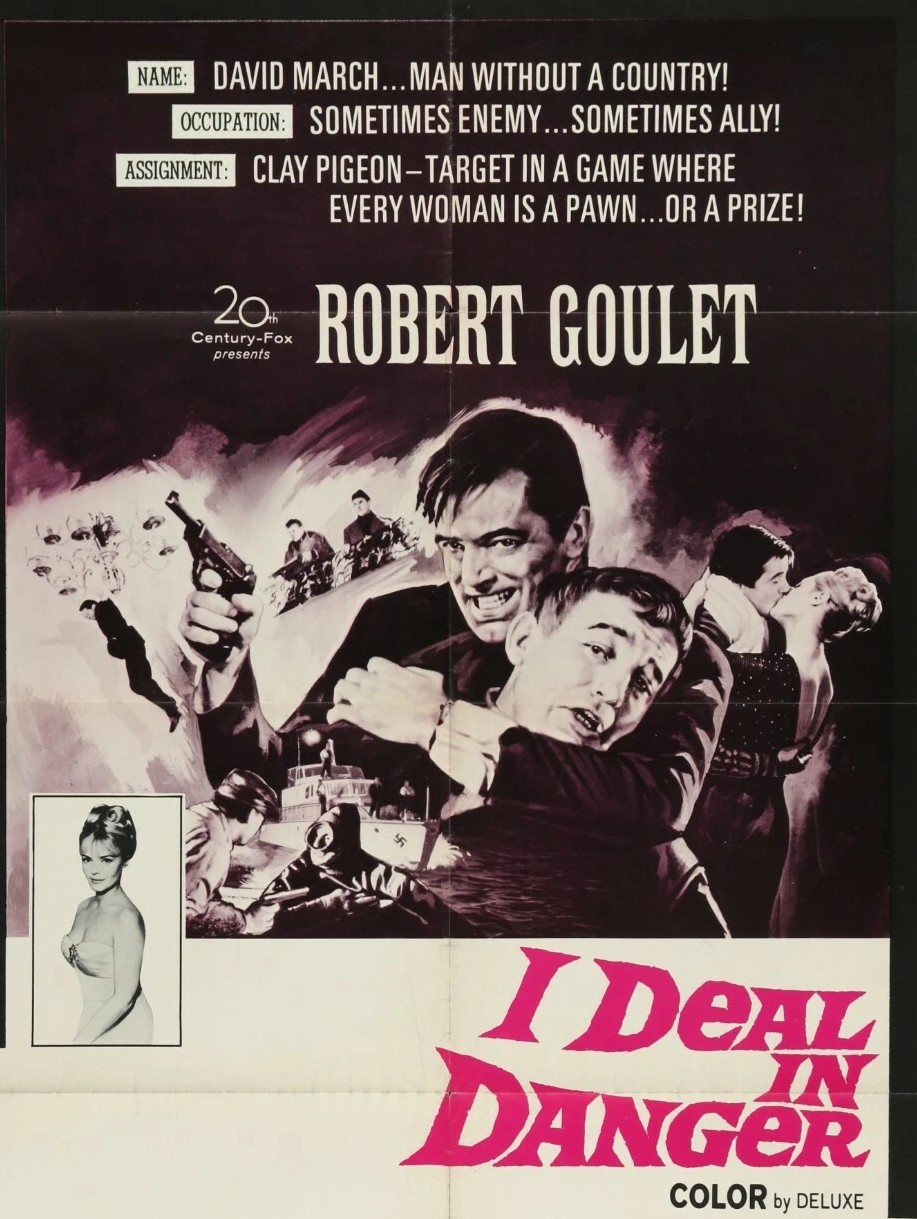
I Deal in Danger (1966) ***

Crooner Robert Goulet, winner of the 1963 Grammy for best new star, was going down a familiar route of transition to the big screen. Bing Crosby and Frank Sinatra, Oscar-winners both, had led the line for singers who made it big in films. And they wouldn’t be the last – Barbra Streisand (Funny Girl, 1968), Kris Kristofferson (Convoy, 1978), Jennifer Lopez (Hustlers, 2019) and Lady Gaga (Joker: Folie a Deux, 2024) would also achieve the crossover.

Goulet has the looks and delivery to fit into the burgeoning espionage market, though this is set in World War Two. As well as action, it is packed full of crises to be overcome, double agents, triple agents, dirty tricks, and clever maneuvers. You never know which way it’s going to go at any given moment.
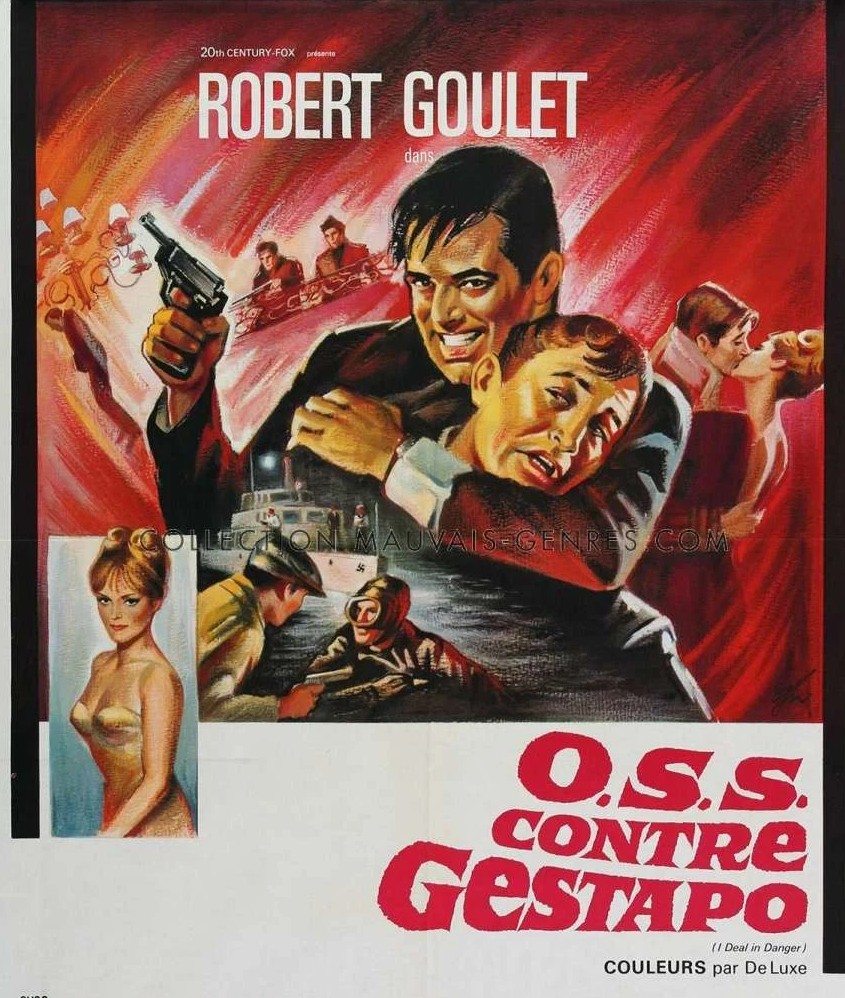
David March (Robert Goulet) is an American double agent who has infiltrated the Third Reich at a very high level – he acts as a kind of Lord Haw-Haw, predicting the Germans will come out on top and sneering at Allied efforts to stop them. But he’s under suspicion from Gestapo officer Elm (Werner Peters) who’s convinced the Yank is the last of an 18-strong espionage operation called Blue Light.

Having passed on information to the Allies, via a hole in a bar of soap, about the Germans working on a new secret weapon, March is later tasked with destroying it. But first he has to deal with another Yank traitor, Spauling (Donald Herron),who, ostensibly, could break March’s cover. Instead, it turns out Spauling’s job is to sacrifice himself to enhance March’s cover.

March is horrified at the prospect of having to shoot his old friend stone dead, even if Spauling is suffering from an incurable illness and only has weeks to live, so more like a mercy killing than murder. Instead, with a clever ruse, March turns the tables on Elm, convincing his own colleagues that the Gestapo officer is the last member of Blue Light, leaving March in the clear to concentrate on sabotage.
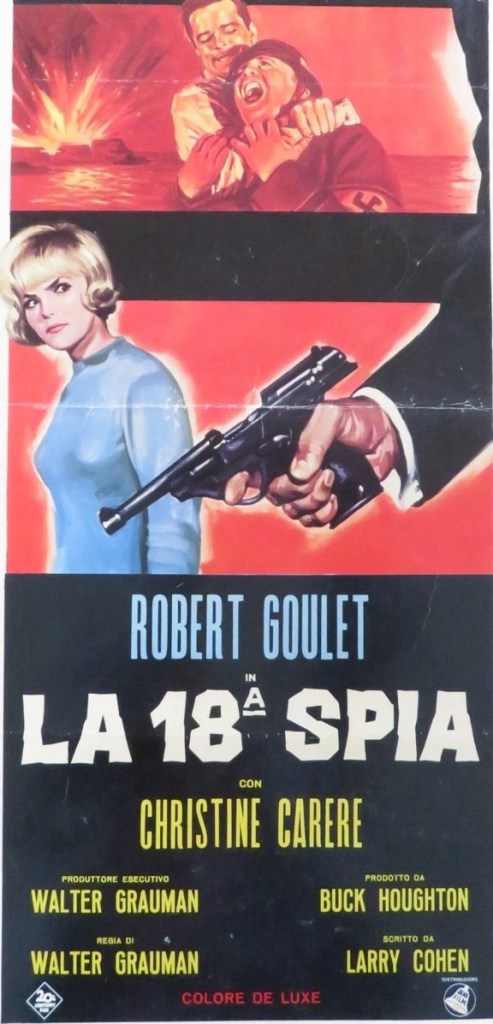
Naturally, as a spy, he must have an affair and who better than with fellow double agent Suzanne (Christine Carere) who convinced the Germans she was a collaborator after her French father, a World War One hero, was hanged by his own countrymen in World War Two.

So now we’re into The Heroes of Telemark (1965)/The Guns of Navarone (1961) territory except the secret weapon is a submarine that can cross the Atlantic fitted with enough missiles to take the USA out of the war without going to all the bother of an invasion.

But the sabotage operation is far from straightforward. March and Suzanne enrol in their mission German scientist Gretchen (Eva Pflug), whose scientist father has been denounced by the Germans but, in one of the best scenes, draws the line at treachery. And soon Gretchen has qualms about betraying her colleagues. Suspicious guards foil March’s attempts to smuggle in items essential to explosions. March’s own principles are called into question.

And with his initial plans hampered, March aims for implosion rather than explosion, turning the weapon on the factory building it.

Very passable entertainment and would have suited a marketplace desperate for the supporting material that could make up a decent double bill. You can’t quibble with Robert Goulet (I’d Rather Be Rich, 1964) especially as the espionage game threw up lots of worse actors. French actress Christine Carrere and German Eva Pflug bring a Continental air to proceedings while Werner Peters (Battle of the Bulge, 1965) continues his run of bad guys.

You might be more attracted by director Walter Grauman who helmed 633 Squadron (1964) and cult writer-director Larry Cohen (Black Caesar, 1973). This was, in fact, culled from four out of seven episodes of a US television series Blue Light (1966), created by Grauman and Cohen and  swiftly re-edited to hit the overseas market.

Basically, a better class of B-picture.
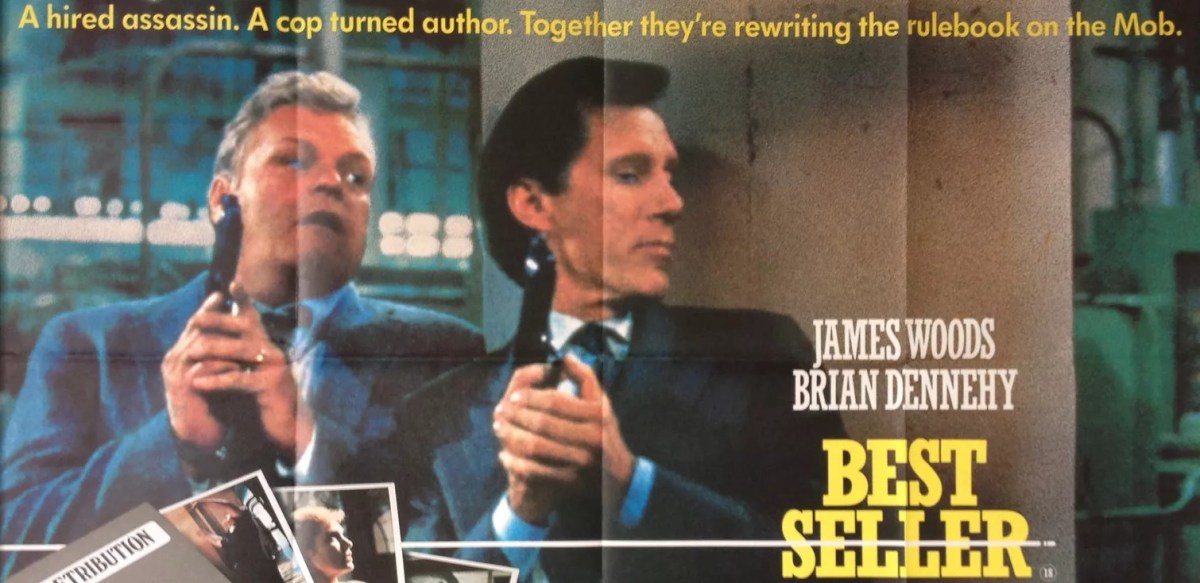
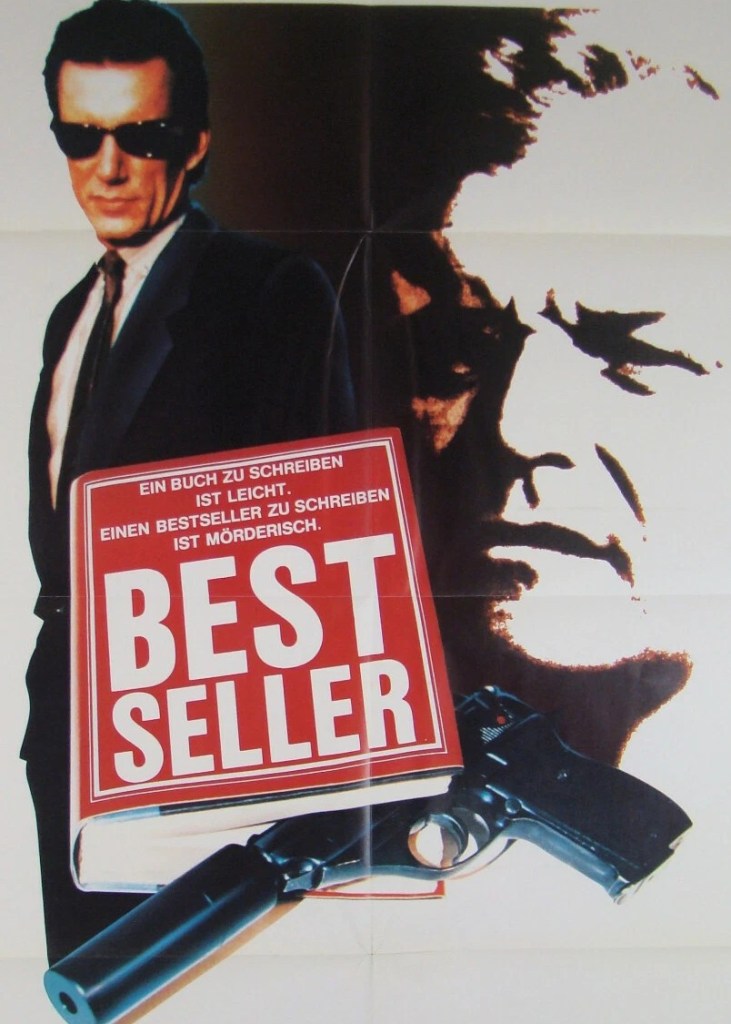
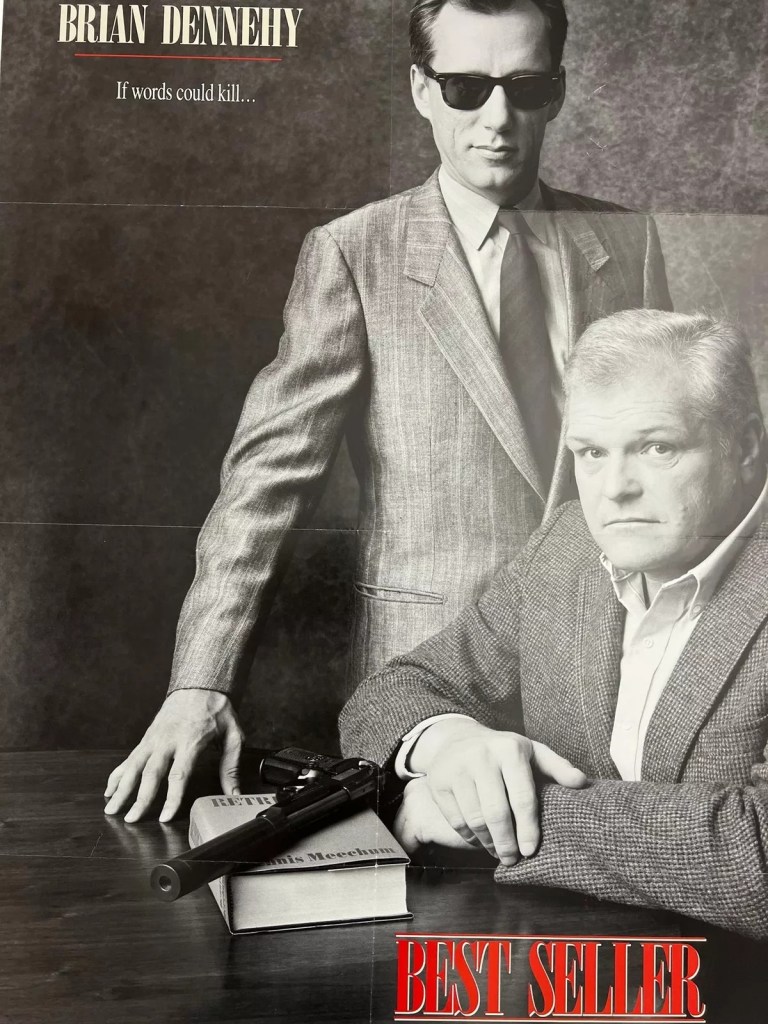
Best Seller (1987) ***

If nobody’s shot your dog or killed a member of your family, it’s kinda hard for an assassin to work up much audience sympathy. And although this is closer to John Wick than say The Mechanic (1972) or Day of the Jackal (1973), it doesn’t help the sympathy cause if your leading character is played by James Woods (Oscar-nominated the same year for Salvador) who so often essays an amoral fidgety weasel.

So it’s left to Brian Dennehy (F/X, 1986) to do the heavy lifting. Dennehy was the kind of stolid supporting actor who once in a while in the Hollywood Dream made it through on occasion to top billing. His brawn was not in the obvious top-off mold of muscle men Sylvester Stallone and Arnold Schwarzenneger and more in keeping with Holt McCallany (The Amateur, 2025).

It’s not unheard of for characters on either side of the law to team up to tackle the bad guys, but it’s a bit of a stretch for incorruptible widowed hero cop Dennis Meechum (Brian Dennehy) not to toss assassin Cleve (James Woods) into the pokey especially when there are ample witnesses to one of the killer’s killings. But, wait, let’s throw him a get-out-of-jail-free card because he saved the life of Meechum.

Even so, Cleve is as creepy as all get out and even if – especially if – he was a fantasist and not an accomplished assassin you would expect the sensible cop to run a mile, especially after he kidnaps Meechum’s daughter. For reasons unknown, Cleve is handed another get-out-of-jail-free card because actually he didn’t kidnap the 16-year-old Holly (Allison Balsam) but just gave her and her pals a lift home. Quite why a cop’s daughter would fall for the line given by a complete stranger that he was her dad’s pal is anyone’s guess, except it suits the script.

There’s quite a lot of what used to be called “high concept” – in other words getting away with the most unlikely of scenarios – here, not least that Meechum would go along with the psychotic Cleve in order to get the material to write a book, that particular well having dried up after the death of Meechum’s wife.

The fact that Meechum has a side hustle as a best-selling author – though still a cop – is one of the many stretches in the tale. You have to go along with quite a lot until the proper narrative kicks in, and realize that, in fact, Meechum is merely the dupe to allow Cleve to achieve his real aim which is to gain revenge by knocking off former employer David Madlock (Paul Shenar) who, regardless of whatever other malarkey he is up to, had the good sense to rid himself of the psychotic entitled gunman.

It seems inconceivable, too, that, by the simple device of employing a barrage of lawyers, big businessman and philanthropist Madlock would not be able to block publication. Meechum refuses to bow under pressure but his publisher might well do once she has been terrorized by Cleve.

And this wouldn’t work at all except for Cleve. Like Jeff Bridges in Thunderbolt and Lightfoot (1974) he’s a loner (though also like that character having no problem seducing women) who’s desperate for male friendship and appreciation. He wants to buddy up with Meechum and for the cop to enter into such a relationship willingly. In Cleve’s demented eyes, sharing the same woman appears to be one way they could cement the relationship. He appears to view the publication of the book which would uncover the illegitimate activities of the seemingly legitimate Madlock as a means of redemption. He wants to come out well in the book, even introduces Meechum to his quite normal family, and sees that as some kind of weird redemption.  

Eventually, there’s enough shoot-out action, especially when Cleve enters silent John Wick assassin mode, to make the journey worthwhile. But although Cleve is a fascinating original character and the dynamics of the relationship constantly shift, it beggars belief that Meechum would entertain him for a moment especially when he discovers Cleve was responsible for wounding him and killing some of his colleagues in a robbery several years before.

Woods is the standout though Dennehy does stake a decent claim as a leading man. Despite being third-billed Victoria Tennant (The Ragman’s Daughter, 1972) hardly appears.

Screenwriter Larry Cohen (It’s Alive, 1974) is no stranger to the genre mash-up and generally gets away with inconsistencies but here the bar is set way too low at the outset for the tale to be believable. Director John Flynn (The Sergeant, 1968) goes with the flow.

Worth it to see Dennehy get a shot at the big time and for another in Woods’ tribe of weasels but will have you scratching your head with the unlikeliness of the tale.

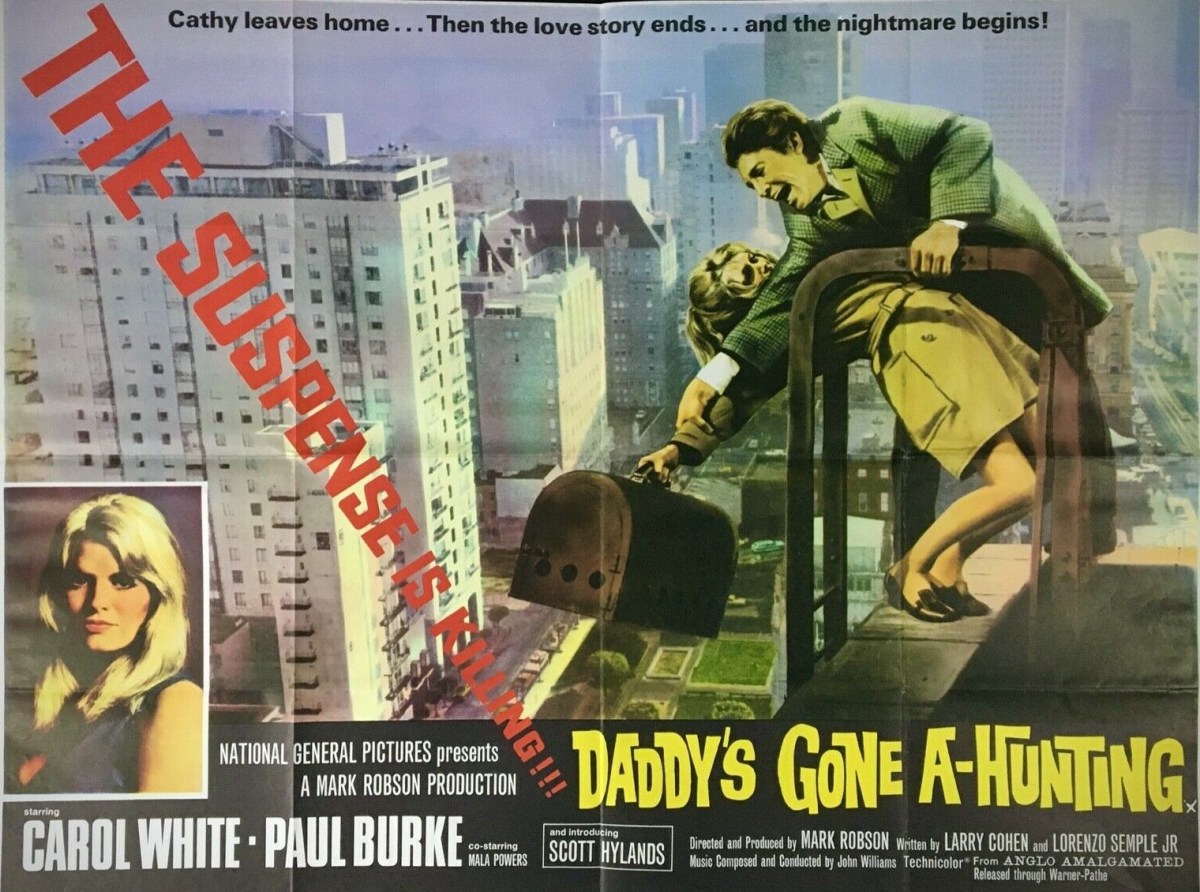
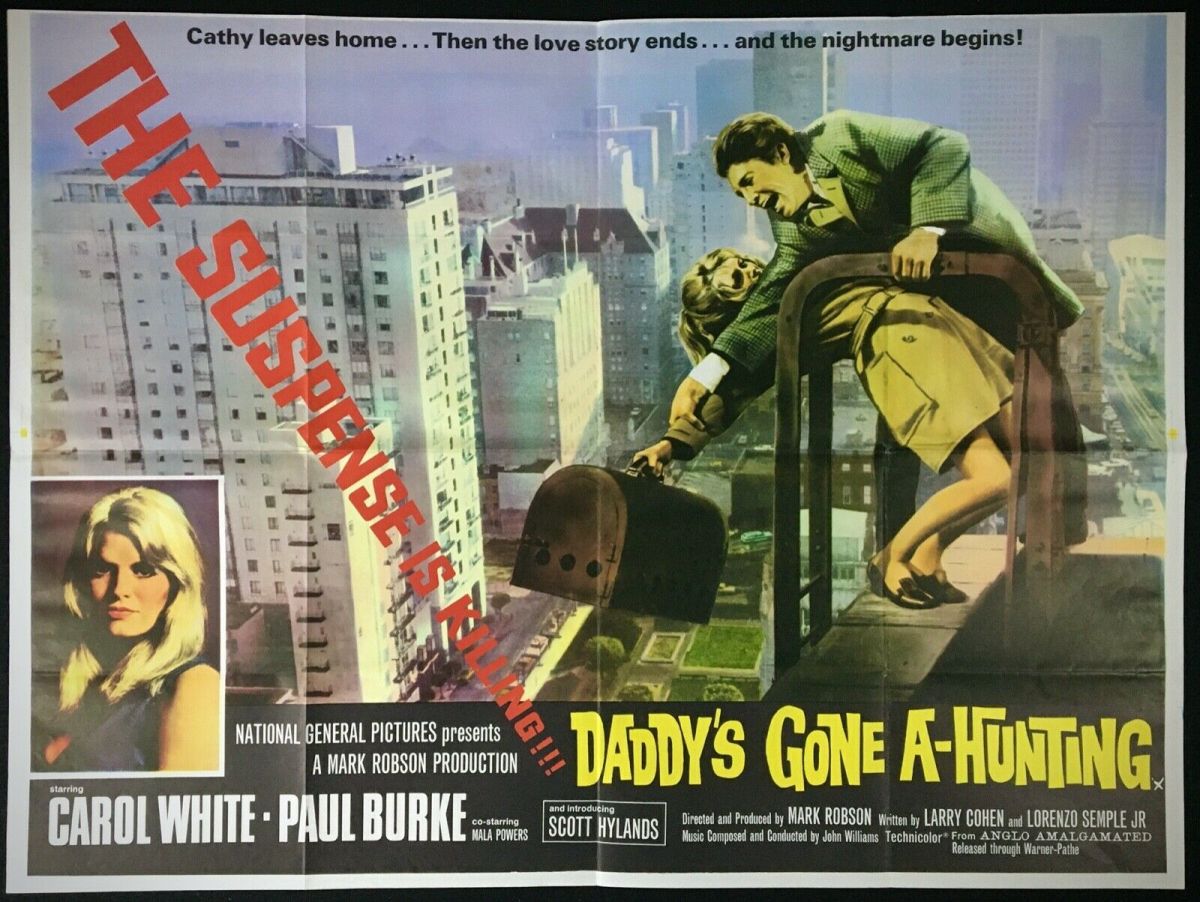
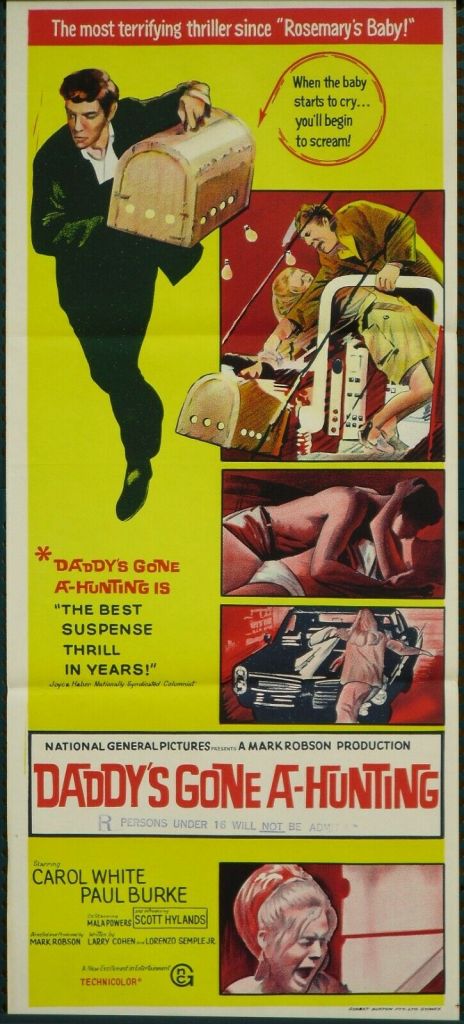
Daddy’s Gone A-Hunting (1969) ***

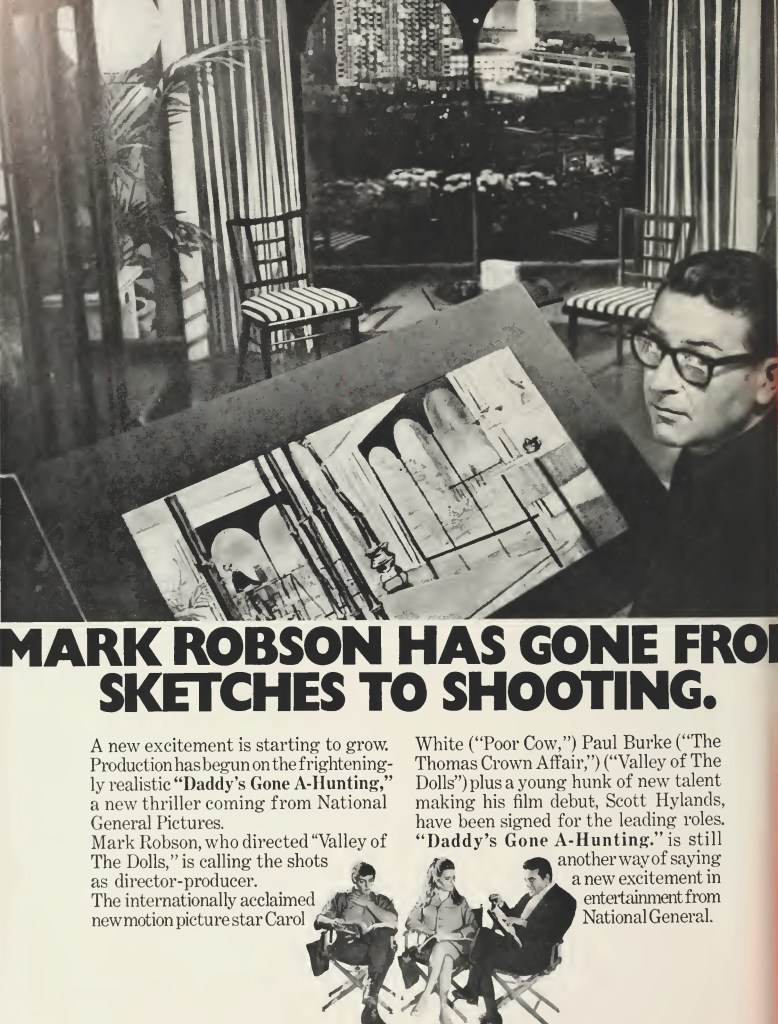
Everyone wants to be a star-maker. Director Mark Robson thought he had some form in this area after Valley of the Dolls (1968) showcased Barbara Parkins and Sharon Tate. There’s no doubt British actress Carol White reveling in critical kudos for Poor Cow (1967) had promise. But not necessarily good professional advice otherwise how to account for a supporting role in Prehistoric Women/Slave Girls (1967) her first picture after success in three BBC television productions. The female lead in Michael Winner’s I’ll Never Forget Whatisname (1967) was followed by a small role in the more prestigious John Frankenheimer drama The Fixer (1968). But none of these films did anything at the box office. Enter Mark Robson.

This thriller might have made her a star had it not been so darned complicated. It veers from paranoia to stalkersville to Vertigo via Gaslight without stopping for breath and some elements are so obviously signposted at the start you are just waiting for them to turn up. Plus, if ever a film has dated, it’s this one, going back to the days when abortion carried automatic stigma and fathers could get away with lines like “you murdered my baby.”

So, one of the few times in history San Francisco got snow (it averages zero inches annually according to Google) the meet-cute is sketch artist Cathy (Carol White) being hit by a snowball thrown by wannabe Kenneth (Scott Hylands, making his debut). But when she realizes how much he enjoys watching cats stalking canaries decides she doesn’t want his baby and aborts it. 

A few years later she marries congressional candidate Jack (Paul Burke from Valley of the Dolls) and when pregnant crosses paths with Kenneth who manages to insinuate himself into her family via her husband. Twist follows twist until we are on the Top of the Mark (a famous city landmark) for a gripping climax.

White does well as she shifts through the emotional gears but she is barely given respite from being overwrought so at times her acting appears one-dimensional rather than varied. In fairness to her, the movie’s plot gives her no chance to deliver a settled performance. Hyland looks as if he’s auditioning for a role as a serial killer, but the depth of his cunning and his twisted perceptions kept this viewer on edge – what it would take for Cathy to make amends will chill you to the bone.

Robson has some nice directorial touches, a scene reflected in the eye of a cat, a clever jump-cut from marriage proposal to marriage ceremony and some flies in milk.  Mala Powers makes a welcome big screen appearance after nearly a decade in television. That this whole concoction emanated from the fertile imaginations of screenwriters Larry Cohen (It’s Alive, 1974) and Lorenzo Semple Jr. (Fathom, 1967) might give you an idea of what to expect.

Daddy’s Gone A-Hunting (1969) ***

Everyone wants to be a star-maker. Director Mark Robson thought he had some form in this area after Valley of the Dolls (1968) showcased Barbara Parkins and Sharon Tate. There’s no doubt British actress Carol White reveling in critical kudos for Poor Cow (1967) had promise. But not necessarily good professional advice otherwise how to account for a supporting role in Prehistoric Women/Slave Girls (1967) her first picture after success in three BBC television productions. The female lead in Michael Winner’s I’ll Never Forget Whatisname (1967) was followed by a small role in the more prestigious John Frankenheimer drama The Fixer (1968). But none of these films did anything at the box office. Enter Mark Robson.

This thriller might have made her a star had it not been so darned complicated. It veers from paranoia to stalkersville to Vertigo via Gaslight without stopping for breath and some elements are so obviously signposted at the start you are just waiting for them to turn up. Plus, if ever a film has dated, it’s this one, going back to the days when abortion carried automatic stigma and fathers could get away with lines like “you murdered my baby.”

So, one of the few times in history San Francisco got snow (it averages zero inches annually according to Google) the meet-cute is sketch artist Cathy (Carol White) being hit by a snowball thrown by wannabe Kenneth (Scott Hylands, making his debut). But when she realizes how much he enjoys watching cats stalking canaries decides she doesn’t want his baby and aborts it.  A few years later she marries congressional candidate Jack (Paul Burke from Valley of the Dolls) and when pregnant crosses paths with Kenneth who manages to insinuate himself into her family via her husband. Twist follows twist until we are on the Top of the Mark (a famous city landmark) for a gripping climax.

White does well as she shifts through the emotional gears but she is barely given respite from being overwrought so at times her acting appears one-dimensional rather than varied. In fairness to her, the movie’s plot gives her no chance to deliver a settled performance. Hyland looks as if he’s auditioning for a role as a serial killer, but the depth of his cunning and his twisted perceptions kept this viewer on edge -what it would take for Cathy to make amends will chill you to the bone.

Robson has some nice directorial touches, a scene reflected in the eye of a cat, a clever jump-cut from marriage proposal to marriage ceremony and some flies in milk.  Mala Powers makes a welcome big screen appearance after nearly a decade in television. That this whole concoction emanated from the fertile imaginations of screenwriters Larry Cohen (It’s Alive, 1974) and Lorenzo Semple Jr. (Fathom, 1967) might give you an idea of what to expect.

Catch-Up: Mark Robson films previously reviewed in this Blog are: The Prize (1963) and  Lost Command (1966).  

            +

Discover WordPress

A daily selection of the best content published on WordPress, collected for you by humans who love to read.

The Atavist Magazine

by Brian Hannan

WordPress.com Blog

News, Tips & Website Tutorials