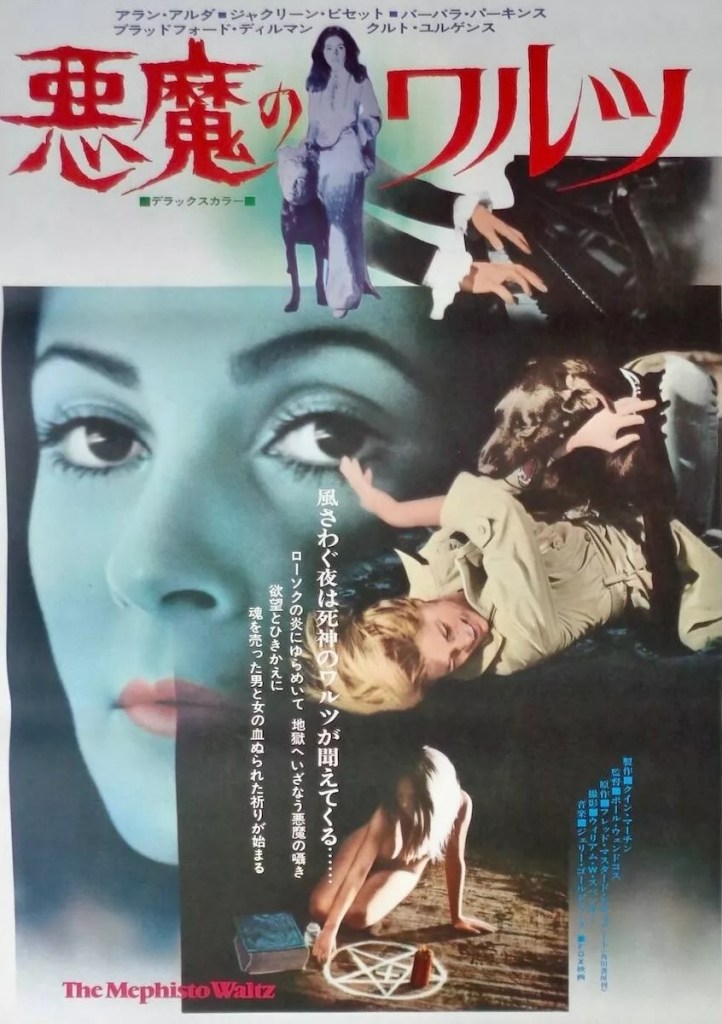
Horror is a small world and at any moment you are likely to bump into stars of the caliber of Christopher Lee, Boris Karloff and Barbara Steele – or in this picture all three. Investigating his missing brother Peter sends antiques dealer Robert Manning (Mark Eden) to a remote country mansion where he encounters owner Morley (Christopher Lee), his seductive niece Eve (Virginia Weatherall), the wheelchair-bound authority on witchcraft Professor Marsh (Boris Karloff), deaf mute Elder (Michael Gough) and a centuries-old mystery.
Morley can legitimately deny that Peter has ever set foot on the premises since it was common for the brother to adopt an alias when seeking out significant antiques. By the time Robert amasses sufficient clues to challenge Morley on this particular issue, it appears that further ideas of more sinister goings-on may be illusory. On his first night Robert observes an annual celebration of the Black Witch but although an effigy is burned this festival appears to have more to do with the innocent consumption of alcohol and heady bouts of sex than satanism.
And after a while, Robert indulges in carnal delight with Eve. However, he is plagued by a nightmare that involves a grotesque trial by a jury wearing animal heads. Gradually, he learns Morley, meanwhile, is such a congenial host, and his niece delightful and sybaritic company, that the finger of suspicion points at Elder, who does take a pot shot at Robert, and the professor who has a collection of instruments of torture.
Were it not for veteran director Vernon Sewell (Urge to Kill, 1960) beginning proceedings with some kind of black mass complete with floggings and female sacrificial victim, the audience might have been kept in greater suspense. As it is, the non-violent annual celebration throws us off the scent as does the seduction of Eve and the prospect that Robert’s nightmare is little more than psychedelic hallucination. The denouement is something of a surprise. The ritualistic aspects of the picture are well done and given this is a Tigon film rather than Hammer you can expect harsher treatment of the S&M element, especially for the period.
The eerie atmosphere and well-staged witchcraft scenes are a plus, but, despite the involvement of a handful of horror gods, the movie’s reliance on lesser players to drive the narrative is a minus. Lee, Karloff and Steele (though in a more minor role) are all excellent as is the demented Michael Gough but Mark Eden (Attack on the Iron Coast, 1968) is too lightweight to carry the picture although Virginia Wetherall in her first big part suggests more promise. More of Lee, Karloff and Steele would have definitely added to the picture but since this type of film often requires the young and the innocent to take center stage that was not to be.
Directed by Vernon Sewell (The Blood Beast Terror, 1968) from a script by Dr Who writers Mervyn Haisman and Henry Lincoln and Jerry Sohl (Die, Monster, Die, 1965).
Considerably more prescient than perceived at the time. Predicts the influence of pop stars – immeasurably magnified now through social media – and instant cancellation as a consequence of inappropriate action or remark, plus the way marketing tie-ins can boost product. Itemizes more succinctly the corporate pressure brought to bear on entertainers as well as the constant public exposure that denies performers any privacy. The radio in a watch was way ahead of its time and you could also argue that it predates A Clockwork Orange (1971) in identifying the attraction of violence and it touches on self-harm.
It’s both daft but realistic, overblown but intimate, mixing gibberish and brilliance so well it’s hard to know which side to come down on. All the obvious targets – Church, Government, big business, the dumb young – are here.
The story is set in a Big Brother style “near future” when control of the masses is the aspiration of Government. Steven Shorter (Paul Jones) is the messianic pop star trapped by fame. His stage act is quite stunning. Imprisoned in a cage, handcuffed, brutally beaten by warders, he sings of freedom to a young, mostly female, audience driven to tears by his ordeal, and occasionally on the point of rioting.
Paul Jones’s performance was criticized at the time because reviewers wanted performer more than puppet, but, at the distance of a half a century, it looks more like the actor has made the correct choice, entombed by the restrictions placed upon his life.There’s scarcely a rebellious pop/rock star alive who hasn’t been in the thrall of big business. Rebellion is the modern equivalent of “bread and circuses,” whatever keeps the young happy and limited to venting their own revolutionary tendencies in a contained situation, and in this case endorsed by the State. The history of music is littered with entertainers taken advantage of by big business and, just as likely, willingly signing a big deal they later regretted – Creedence Clearwater Revival, George Michael come to mind though Taylor Swift found a sweet way of taking financial revenge. And of decades of tours that appeared to benefit as much the sponsors as the entertainers.
While there’s a 1984 vibe here, that element of a single party in eternal control of Britain is as relevant now as then. Some would argue the world, through the dominance of social media, is more vacuous than before. Others, precisely because of social media, less vacuous. Entertainers might be willingly enrolled to sell a variety of products or promote political activity, any one of which could be interpreted as as harmless as being used to sell 600 million apples which will go to rot unless immediately consumed, which is the marketing task in hand here.
Critics at the time were less taken by the principals, the pop star Steven Shorter (Paul Jones) and potential love interest Vanessa (Jean Shrimpton), recruited to paint his portrait but, in effect, presented as a glorified groupie. They wanted the performer to be as charismatic offstage, in the manner of Mick Jagger or John Lennon, as on, as if stage antics could not be separated from reality. But I found the numbing down of Shorter more authentic. He had lost/sold his individuality, he went where his bosses dictated, and although not indicated you could as easily equate his offstage life to being stoned out of his mind, which would accord with the experience of lot more entertainers afterwards than at the time.
If he only comes alive through performance that, too, while taken to an extreme, would be in line with the experience of many performers whose personality only catches fire when performing. Many actors, for example, will insist that fulfillment comes from wearing a variety of stage or screen masks.
And Shorter’s inherent masochism, willingly accepting the blows delivering by his truncheoned guards on stage, his back covered in scars, resonates more strongly today when self-harm in an indicator of poor mental health. Yet, he can rebel, aware of the individual control he exerts, that he chooses to demonstrate almost contemptuously when at a grand dinner party he refuses wine and insists instead that everyone, even his supposed boss, partakes of hot chocolate.
The other notion touched upon, which resonates far more today than then, is the price fame exacts, most importantly loss of privacy. When Vanessa, not unexpectantly, falls for our hero, she declines to take their brief affair further, “we’d never be alone together, not really.” And it’s surely not unintentionally ironic that the theme of his main song is “set me free.”
Bob Dylan embracing the electric guitar, scandalizing his purist folk base, might have provided the impetus for the climactic scenes, when the messianic Steven turns his back on rebellion (“repents” in a brilliantly staged concert) and instead embraces traditional Christian values, providing an opportunity for surprisingly entertaining pop versions of Onward Christian Soldiers and Jerusalem.
I haven’t mentioned that this isn’t a straightforward candidate for the A Star Is Born sub-genre, reporting rise and fall in standard manner, but instead is presented as documentary, but of the kind that would be more easily appreciated today, seductive camera dominant rather than the intrusive presenter, with all subsidiary characters either justifying their behavior or being shown abusing their position.
Probably most relevant of all is that Shorter’s career comes to a close from inappropriate remark, triggering cancelation and loss of “privilege.”
I can see why director Peter Watkins chose someone who could sing for his main character – Paul Jones had been lead singer of Manfred Mann before going solo, in both guises releasing a string of hit singles – since that kind of veracity is virtually impossible to achieve from miming or imitation. Instead of delivering a poor performance, and elivening every moment with “charisma,” it appears to me that Paul Jones, in his movie debut, is instead correct to follow his intuition or inner truth that offstage an entertainer is a mere ghost of himself. I would hazard that model Jean Shrimpton wasn’t called upon to do much acting, but her own soft-spoken Engish rose personality with just a hint of steel suits her character well.
Watkins, too, resisted the temptation to litter the background with scene-stealing supporting actors, or those hoping for a career break, and of these only Jeremy Child (A Fish Called Wanda, 1988) might be instantly recognizable.
Watkins had made his name with what appeared at the time to be tougher-talking television docu dramas Culloden (1964) and The War Game (1966), the latter so graphically showing the effects of nuclear war it was promptly banned. While Privilege on initial release carried little of the power of the first two, in retrospect it has come into its own. The only screenplay by Norman Bogner, better known for television, from an idea by Johnny Speight (BBC’s Till Death Do Us Part, 1966-1975) which translated to the U.S. as All in the Family, 1971-1979).
It might have been better if director Elia Kazan had handed over the screenwriting chores for this adaptation of his bestseller about the midlife crisis of advertising man Eddie Anderson (Kirk Douglas). As director he over-angsts the pudding. Anderson’s attempts to juggle wife Florence (Deborah Kerr) and mistress Gwen (Faye Dunaway) coupled with growing disgust at selling a new brand of cigarettes, Zephyr (“The Clean One”), in a way that pointedly avoids their cancer potential, leads to a suicide attempt.
During convalescence he determines to quit the advertising world and go back to his first love, writing, but in fact he ends up sabotaging his career. Florence represents impossible seduction and conscience. Slinky, in dark glasses, hot-tempered rather than submissive or demure, she accuses him of self-deception in his job. The picture flits back and forth between his various choices – different job, return to wife, settle down with mistress, or what seems his ideal world, cossetted by both Gwen and Florence.
Gwen is an excellent study of the modern woman (of that fast-changing period, I hasten to add), who needs a man for sex but not necessarily love, and can use the opposite sex as ruthlessly as any man. What she actually requires in her real life is quite different to what she seeks in the fantasy love she enjoyed with Anderson, sex on the beach, the buzz of controlling a high-powered man. Florence could be seen as an old-fashioned portrait of the adoring wife except for capturing so well the bewilderment of betrayal.
Kazan conjures up some wonderful images: the tension before the suicide attempt as Anderson plays chicken between two trucks, Gwen emerging wet from the pool to eat dangling grapes or with her legs up on Anderson’s desk, Anderson’s mother lighting votive candles in her house before using the same match for her cigarette, Kerr’s futile attempts to win back her fallen husband, Anderson flying solo.
In parts well-observed and directorially savvy, quick cuts between the present and the past, however it sinks beneath its own self-indulgence. My guess is that author Kazan could not bear to kill off a single one of the characters he had created for his acclaimed novel and the upshot is a vastly over-populated picture, few of whom cast any real light on Anderson’s predicament. So we are not only introduced to mother, dying father, brother, sister-in-law and analyst but priest and a bucket of clients and guys from the office. And there are some plot oddities – Anderson gets time off apparently to write journalistic pieces – and what is clearly intended as hard-hitting satire of the advertising world does not come off.
Dunaway (Bonnie and Clyde, 1967) is the standout as Gwen, living life according to her own rules, and with an unexpected vision of domesticity but Deborah Kerr (Prudence and the Pill, 1968) does pain like nobody else and is extremely convincing. Strangely enough, I didn’t go much for Douglas (Seven Days in May, 1964). He could have been leading a cavalry charge for all the range of emotions he exhibited. Douglas is no Montgomery Clift (Wild River, 1960), James Dean (East of Eden, 1955) or Marlon Brando (On the Waterfront, 1954) who was Kazan’s first choice. Kazan had not made a picture in six years and it had been eight years since his last hit Splendor in the Grass (1961). Not quite out-of-touch in concept and delivery, nonetheless it was shunned by the Oscar fraternity.
An odd one distinguished by Deborah Kerr and Faye Dunaway.
Touching low-budget B-movie shot in black-and-white of a young man receiving his sexual education from an older woman. Motherless Vito (Scott Maxwell), the son of an apartment block super, is seduced by the older Iris (Lola Albright), three-time divorcee, looking for a son to mother.
This is not the transactional sex of The Graduate, and seduction is too strong a description for the yearning Iris whose advances are sensual and romantic, stroking Vito’s head, trapping his hand with her foot, and there is nothing clandestine about their affair either, no false names on a hotel register. They dally in the park, eat hotdogs, and he buys her flowers.
But as he experiences love for the first time, he also experiences more difficult emotions like jealousy and finds it difficult not just to cope with what seems like another man in her life, the wholesaler Juley (Herschel Bernardi), but the fact that she treats him with such contempt. Spoiler alert – well, not really, because you know from the off this is not going to turn out well – the affair ends when he discovers she is a stripper. And while she is left bereft, he now appears more attractive to girls his own age.
In contrast to the powerful emotions stoked up when the pair are together, director Alexander Singer (Psyche ‘59) fills us in on the rest of Vito’s humdrum life, working for his father during the school holidays, goofing off with his pals, and generally failing to make headway with girls his own age. But Iris’s life is not humdrum. Although she has a rule not to work in her own area, she breaks that to accommodate her estranged husband, whom she seems to tolerate, while at the same time drinking herself into oblivion to avoid any moves from Juley. Nor is she ashamed of her profession. It is an act, a job like any other, and provides her with a nice apartment.
Small wonder she treats men with contempt. Perhaps what she falls in love with is untainted innocence. In some senses she is adrift, at other times in full command. And her love for Vito is convincing.
It is full of incidentals. He gulps down ice-cream, she teaches him to drink one sip at a time, without being patronizing the father (Joe De Santis) tries to educate him to honor his inner feelings.
Lola Albright (Peter Gunn television series) carries off a difficult role very well indeed. Without laughs to help him out as it did Dustin Hoffman in The Graduate, Scott Maxwell is believable both as the youth growing into adulthood and the youth wanting to remain a youth with no adult responsibilities. The low-key performance of Joe De Santis is worth a mention.
While the picture no doubt attracted attention for the risqué material, which would have certainly given the Production Code pause for thoughts, it provided a more rounded picture than was normal at the time of a woman working in the sex industry, even if only in the stripping department. Iris did not fall into any of the cliches. She is presented as a woman first and foremost rather than a stripper.
Alexander Singer sticks to the knitting and doesn’t come unstuck. John Hayes (Shell Shock, 1964) wrote the screenplay based on the Burton Wohl bestseller.
John Mills ventures back into Tunes of Glory (1960) territory as a top official coming apart at the seams. This time it’s not the British Army but the Italian Police where, as Franz Buloff, he heads up the narcotics squad. And this time he’s not the complacent victim but decides to take action against his tormentor.
Closing in on drugs kingpin Scheurermann, he finds that one witness after another is being silenced by an assassin with a deadly knife. He suspects a leak in his department, unaware the traitor is much closer to home. And despite the usual dissatisfied boss Ostermeyer (Tillio Altamura) breathing down his neck, he would be making more headway if it wasn’t for the fact that his head is constantly filled with images of his wife Lisa making love to another man.
For her part, Lisa seems determined to unhinge her husband, eliciting jealousy at every turn, by never answering the phone at night and always an excuse, when he tracks her down, for not being where was supposed to be. Rather than calming him down, her occasional seduction of her husband only serves to ramp up his fury.
In any case, it’s an odd set-up, he’s much older and the security he offers is not just financial. She was once a suspect herself and being married to a top cop has put a force field between her and suspicion. There’s clearly an unspoken assertion that somehow she has duped the cop, making him fall in love with an apparently innocent woman. They couldn’t be more opposite. “I like danger,” is her mantra.
He breaks open the case after following up a clue dropped at the scene of the crime. After arresting Max (Robert Hoffman), he strikes a deal with the killer. In return for his freedom, the murderer has to take out Lisa. But, of course, it’s not as simple as that. When Buloff realizes the deep water he is treading, he calls off the assassination. But then when he discovers that Max has helped himself to a bonus – beginning an affair with Lisa – he recants and puts the man back on the spot.
So, now, it’s Max who faces the quandary of having to kill his lover. And that puts up square in cat-and-mouse territory.
This isn’t quite giallo, the genre was still in the process of being born, in part because there’s no mystery about the killer, in part because the murders aren’t bloody enough, and in part because the dead aren’t sexy young women. So it’s more a series of character studies, each driven to an edge by an action that otherwise would be out of character.
A top cop like Buloff should have been a better judge of character than to fall for Lisa’s wiles in the first place. Lisa, too, should have recognized her penchant for the seedier side of life rather than being as she puts it “too young to be buried alive” in a stifling marriage to a jealous husband. But, she, too, is a poor judge of character, expecting to win back the favor of the drug overlord after she had so openly crossed the tracks to the other side of the law.
And Max, one of the first of a series of killers in movies who wanted out (see The Brotherhood, 1968, and Stiletto, 1969), is trapped into more killing because nowhere is safe. Getting rid of Buloff was never in his plans, as that would draw even more unwelcome attention. But then neither was falling in love with the cop’s wife. There’s still a few twists to go not least when Lisa discovers that the husband she felt she had under control had broken free and was intending to have her killed.
John Mills, a surprising addition to the Brits heading for Italy, is excellent especially as the big flaw in Tunes of Glory was his inability to find the cunning to strike back at his chief tormentor. Here, he might have second thoughts about dispatching his wife, but revenge is always the best weapon.
Luciana Paluzzi (Chuka, 1967, which, incidentally, also featured Mills) gets her teeth into a decent role rather than been saddled in lightweight fare since swanning around in swimwear in Thunderball (1965). Austrian Robert Hoffman (Assignment K, 1968) is given a surprising range of emotions to deal with.
Massimo Dallamano (Venus in Furs, 1969) handles the material well and gets the best out of his cast without taking the bloodier route of the later giallo. He was one of four writers contributing to the screenplay. This was one of the feature films made by new American mini-major Commonwealth United, one of the stack of “instant majors” popping up around this time.
John Mills is always watchable and the twists make this one play.
Trust Brian De Palma to invent a gameshow called “Peeping Toms.” And give Hollywood an insight into the delicious malevolence to come later in his career. Often compared to Hitchcock, this is Hitchcock diced and sliced, awash with style. Not simply inspired use of split screen but an ending Edgar Allan Poe would have been proud of. De Palma plays with and confounds audience expectation and has mastered enough of the Hitchcock approach to make the villainess more attractive than the heroine. If you’re in the mood for Hitchcock homage, this is a good place to start.
Both main characters are strictly low end, sometime model Danielle (Margot Kidder) gameshow fodder, journalist Grace (Jennifer Salt) handed run-of-the-mill reporting jobs instead of, as she would prefer, investigating police corruption. Grace also has to contend with a mother (Mary Davenport), in typical non-feminist fashion, determined to marry her off.
While the Siamese twin notion is straight out of the B-movie playbook and right up the street of exploitation maestros AIP, De Palma takes this idea and hits a home run. But you’ll have to be very nimble to keep up with the narrative.
Danielle meets Philip (Lisle Wilson) at the gameshow and after dinner she invites him to her apartment for sex. In the morning, he buys a surprise birthday cake for Danielle and her twin Dominique. On his return, he is murdered, an act witnessed by Grace, a neighbor across the street. She calls the police but before they can arrive Danielle’s ex-husband Emil (William Finley) – introduced to the audience, incidentally, as a creepy stalker – cleans up the mess and hides the corpse in the fold-up bed-couch.
Fans of the forensic may have trouble with this section as these days blood is more difficult to hide, but that’s evened up by the notion that a pushy journo would be allowed to sit in on the investigation. But heigh-ho, this was back in the day, so anything goes, and in any case, a la Hitchcock, it’s the woman who enters harm’s way. The cops, annoyed to hell by Grace, give up on the case and the reporter, having found the cake carrying the names of both twins, manages to destroy the evidence.
Great set of reviews that only served to confuse the public. An audience searching for schlock doesn’t want art.
Grace isn’t the kind of reporter easily thwarted so she hires private eye Larch (Charles Durning) who burgles the apartment and finds proof Danielle has been separated from her Siamese twin, who died during the operation. Grace follows Emil and Danielle to a mental hospital where, in a brilliant twist, mistaken for a patient, she is sedated and becomes an inmate. Later, hypnotised by Emil, she is convinced there has been no murder.
You’re going to struggle with the sharp turn exposition takes, but, heigh-ho, how else are we going to uncover the truth. Effectively, we learn that sex releases murderous thoughts in Danielle. The detail is a good bit creepier than that, but I wouldn’t want to spoil too much.
In many places it was seen as the lower part of a schlock double bill. A reviewer in the trades was correct when he predicted it was “certain to be an underground fave for some time” (i.e.limited to cult appeal) since well-reviewed horror pictures didn’t attract an initial audience.
But the ending is a corker. Grace is a prisoner. There’s another twist after that, but the notion of the investigator driven mad and ending up a prisoner of their own delusions, true Hitchcock territory, is honed to perfection here.
De Palma uses the split screen in the same way as Hitchcock employed the cutaway shot to increase the tension of potential discovery. Several sequences are rendered very effectively through this device. Oddly enough, Grace doesn’t fit the Hitchcock mold of classy heroines. She’s way too feisty and independent and there’s almost a feeling that she gets what she deserved for tramping uninvited around a vulnerable person’s life. Here, Danielle is the victim, taken advantage of by the medical profession and her creepy husband, separation from twin ravaging her intellect.
Margot Kidder (Gaily, Gaily, 1969) and Jennifer Salt (Midnight Cowboy, 1969) are both excellent in difficult roles. Charles Durning (Stiletto, 1969) makes a splash in the kind of role that made his name. As a bonus, there’s a great score from Bernard Herrmann (Psycho, 1960).
But this is De Palma’s picture, serving notice to Hollywood that here was a talent of Hitchcockian proportions.
Amorality tale. Compulsive opening but contradictory ending. Nobody comes out of this well as male and female alike use each other with little compunction shown. British film making that at one point appeared to be disappearing down the kitchen sink explodes into life with an exploration of just how far the Swinging Sixties can swing. Julie Christie picked up the Oscar for her portrayal of the impulsive, wilful, yet vulnerable model sleeping her way to the top, an unpopular theme in today’s climate.
The credits open with a striking image. A poster for global hunger relief being pasted over by one advertising model Diana (Julie Christie), the face of the decade. There are various other potshots at the hypocritical rich, fawned over for deigning to distribute some of their wealth to the poor, but it doesn’t quite complete the circle, because it’s exactly this kind of virtue-signalling philanthropic society to which Diana, with no sense of judgement, aspires.
It would be more convenient to view Diana as exploited, but, in fact, once she loses her puppy innocence, she is as good at the exploitation game as anyone else. First port of call is dull BBC arts journalist Robert (Dirk Bogarde) who provides her with an opening into the fashionable London set. Both, I should mention, are married, but ditch partners (and children in Robert’s case) and set up home together, she in demand as a hostess at charity events.
Trading sexual favors with advertising executive Miles (Laurence Harvey), she wins a role in a B-picture and his backing to make her the face of a campaign advertising chocolates, that commercial filmed in a palazzo in Italy owned by uber-wealthy but older Cesare (Jose Luis de Vilallonga), a prince, from whom she eventually accepts a marriage proposal, only to find she’s just as bored in Italy as elsewhere. There’s a speedy return to London and Robert’s bed, but he dumps her. Theoretically, she’s so powerless and vulnerable, poor lamb, that she submits to his plan to send her back to Italy, rather than, by now considerably more powerful, starting all over again with someone else.
Possibly the morality of the time or in keeping with some movie dictat required an unhappy ending (of sorts). But this seems to contradict her personality. Bear in mind she had already shown how readily she traded men, and you could already see her running off with a wealthy playboy in Italy and dumping the prince.
At the remove of over half a century, the wild goings-on would be viewed as tame by contemporary standards, and the flashiness of the style, which attracted criticism, would be ignored in favor of the stunning performance by Julie Christie and her empowered female. Sure, she’s emotionally immature, shallow and all the rest of it, and as likely to become a member of the hypocritically rich, but she’s managed to finesse a life as a model into a high-flying princess with the world at her feet and sure as heck she would soon learn how to manipulate that world as easily as Swinging London.
The only dated aspect is the sexuality, much of which was sneaked in under the censor’s nose (though I would imagine would be considerably cut for U.S. audiences) but that acts as a time capsule for a period when homosexuality was still in Britain punishable by law. Nonetheless, there are fleeting references to cross dressing, an orgy, a threesome and oral sex. (Although a cynic might observe how effective courting controversy was for publicity purposes). In some senses, the obsession of director John Schlesinger with thumbing his nose at the censor gets in the way of the central section which is meant to show how far, in terms of decadence, Diana has fallen when in reality she seems to enjoy exploring the wilder and more sensual parts of her personality.
There’s a clever role-reversal. Usually, it’s the man who plays away from home but expects to still be accepted back by a resigned partner. Here it’s Diana. If the men in her life are to be blamed at all it’s for being dumb, not recognizing her ambition and demanding nature. A lover who continues to tap away at his typewriter while Diana exhibits signs of restlessness is as dumb as they come. Miles and Cesare are more her type, the sexually voracious former switching partners at the drop of a hat, while the older man probably already has a mistress stashed away and expects his trophy wife to pick up a discreet lover in the way of aristocracy the world over.
So, at the remove of several decades, a different Diana emerges, one very much in control of her own destiny, picking up men as it suits her purpose, yes still some emotional growing-up to do, but you could easily see her turning into one of the dowager duchesses who run these fundraising balls with young bucks like Miles lionising her and leaving a few other husbands and/or lovers in her wake, possibly still unhappy, but the rich rather than the poor version.
Not sure if she’d qualify as a feminist icon, but she certainly navigated the world of the male gaze and used it to her advantage.
Turned director John Schlesinger (Midnight Cowboy, 1969) into a brand name. Nominated for five Oscars including Best Picture and winning for three, Julie Christie as Best Actress, Frederic Raphael (Two for the Road, 1967) for the script and Julie Harris for costume design. Bogarde, as well as Christie, reigned supreme at the Baftas. Commercially, one of the most successful British films ever, on a budget of around $1 million earning over $4 million in U.S. rentals alone.
Another rich kid with mental health issues though without Orson Welles to offer expiation. The cause of this character’s illness is undetermined but it’s easy enough to spot the trigger to violence. The lad’s father is dead and his mother’s new husband, a wealthy banker, wants him out of the way, or at least out of the house, or at least, given he’s twenty-one, out working rather than mooning about the house all day.
And this was certainly the year for the movies exploring split personality – if such shallow treatment could be deemed investigation – what with Tony Curtis and Rod Steiger in serial murderous form in, respectively, The Boston Strangler (1968) and No Way to Treat a Lady (1968). And for movie fans it was an unexpecteldy speedy reteaming for Hayley Mills and Hywel Bennett after the humungous success of The Family Way (1967) in which the actress shed her child-star persona in no uncertain manner and the British film industry was, apparently, suddenly blessed with a duo with marquee appeal.
A poster that gives the game away.And an apostrophe issue.
This takes the Rod Steiger route of charming killer rather than a Tony Curtis puzzled and horrified by the demands of his ulterior personality. Given the emphasis on mental illness these days, Twisted Nerve is the hardest of the trio to take, since it’s effectively a play on an old gimmmick, deviousness concealed inside appeal.
Martin (Hywel Bennett) faced with expulsion from his house by overbearing substitute father Henry (Frank Finlay) pretends to scoot off to France but instead inveigles himself into the boarding house run by Joan (Billie Whitelaw) after tricking her librarian daughter Susan (Hayley Mills) into extending a sympathetic hand to his alter ego, the childish Georgie, whose behavior falls only a little way short of sucking his thumb and clutching a teddy bear.
Joan’s initial cynicism gives way to maternal feelings when he clambers into her bed in the middle of the night after a supposed nightmare. (And not with sexual intent.)
Occasionally, Martin cannot control his true feelings, despite Susan rebuffing his romantic overtures. Father is the first victim, substitute mother Joan the second and it’s only a matter of time before Susan becomes a target either for his stifled sexuality or his inner venom.
This would probably work just as well minus the schizophrenic element. In fact, there’s too much of tipping the nod to the audience. Eventually, Susan’s suspicions are aroused but director Roy Boulting (The Family Way) is no Alfred Hitchcock able to manipulate an audience. So, mainly, what we are left with is Hywel Bennett’s ability to pull off a double role rather than his victims’ susceptibility to his charms.
Hayley Mills’ character could do with fattening up, otherwise she’s just the dupe, bright, bubbly, self-confident and attractive though she is, although her mother, in passing, is given more depth, a lonely attractive widow prone to sleeping with her attractive guest Gerry (Barry Foster) and, unnerved to some extent by her daughter’s growing independence, wanting a son to mother.
It’s only un-formulaic in the sense that the director is playing with an audience who were not expecting anything like this as a story fit for their two newest adult stars so hats off especially to Bennett for considering a role that could as easily have typecast him for the rest of his career. As I said, setting aside the mental illness elements, Bennett is good fun, as he toys with both aspects of his character, adeptly dealing with those who would patronise him, and like Leopold and Lowe convinced he can get away with the perfect crime, whose planning and attention to detail is noteworthy.
As with the Chicago killers it’s only accident that gives him away, although the policeman here (Timothy West) is less dominant than his American counterpart.
Clearly filmmakers of the 1960s were beginning to grapple with mental illness but either lurching too far towards romance as a way of instigating tragedy as with Lilith (1964) or to the most violent aspects of the condition as with virtually anything else beginning with Psycho (1960).
Worth a look for Hywel Bennett’s chilling performance – template for Edward Norton’s turn in Primal Fear (1996) – and Hayley Mills fans won’t want to miss it. Strong performances by Billie Whitelaw (The Comedy Man, 1964), Barry Foster (Robbery, 1967) and Frank Finlay (The Shoes of the Fisherman, 1968) help enormously. There was quite an input into the screenplay. Along with Boulting, Leo Marks (Sebastian, 1968) doing the heavy lifting adapting work by Roger Marshall (Theatre of Death, 1967) and, in his only movie credit, Jeremy Scott. Great score by Bernard Herrmann.
While sci-fi was being viewed through a serious glass darkly what with Fantastic Voyage (1966), 2001: A Space Odyssey (1968) and Planet of the Apes (1968) along came Roger Vadim’s little number to set up an alternative universe of camp fun. Had this been a box office smash in the nature of The Odd Couple ($18.5 million in U.S. rentals) rather than under a third of that there might have been less of the po-faced doomladen sci fi in the following decade.
But if you wonder where Star Wars got its vibe, setting aside the overt sexiness portrayed here, this is as good a place to start. Naïve adventurers, check. Ice planet, check. All sorts of weird creatures in strange otherworldly locales, check. A doomsday weapon, check.
It’s kind of newsworthy to be rewatching this given that star du jour Sydney Sweeney (Anyone But You, 2023) is going to be donning the Barbarella costume for a remake next year. And who knows to what Oscar-winning fare that might lead, if she were to follow the Jane Fonda template, given it was La Fonda’s follow-up that brought her serious attention from the Academy.
But it would be remiss of me if I didn’t bring up the testy matter of director Roger Vadim’s uncanny obsession with getting his myriad girlfriends to shed their clothes for the movies, Fonda being the latest example, and in no uncertain terms, the striptease performed during the opening credits certainly rivaling Kubrick and Spielberg for the most jaw-dropping opening to a sci-fi movie.
Whether it was Fonda or someone else and whether it was Vadim or someone else you couldn’t get away from the fact that Barbarella as a sci-fi icon was most definitely on the sexy side as determined by her creator Jean-Claude Forest, sharing like British comic strip heroine Jane a predilection for losing her clothes.
Barbarella shares something of the same innocent abroad personality, the kind who gets into one unexpected scrape after another, after being despatched from peace-loving Earth to save the world by finding Durand Durand (the pop band making homage to the movie dropped the final letter of this character’s name) and his doomsday machine.
So mostly, it’s one imaginative character or scene after another, delivered in disconnected episodic manner, and it sometimes has the feel of a jukebox movie, of the greatest hits of the comic strip writer strung together, with an occasional comment on the problems created by sex and a climactic gender-spinning twist. You’d have to remember what Pop Art was to chuck it into that short-lived category but if you think it belongs on the same planet as the more earthbound Modesty Blaise (1966) and Danger: Diabolik (1968), think again.
The best sections are truly terrific. The sharp-teethed menacing robot dolls are exceptionally scary as they nip chunks out of our heroine’s flesh and leave her blood-soaked. There’s a homage to The Birds (1963) where our plucky heroine is trapped in a cage with a flock of sparrows. You’ve also got the The Catchman, performing the same function but considerably scarier than the same year’s Child Catcher from Chitty Chitty Bang Bang. But no wonder the kids need caught because they are full of evil intent.
You’ve got a blind angel (John Phillip Law) who can’t fly, a problem mysteriously solved by sex with the ever-gracious Barbarella who, previously, has discovered, courtesy of The Catchman, the immense pleasure of the art of making love the old-fashioned way rather than just popping a pill. The angel also has no memory, permitting an ironic twist ending. You’ve got an incompetent rebel (David Hemmings). Sex is pretty much top of everyone’s agenda, even the villain (Milo O’Shea) who uses it to kill people via his own invention, which proves not much cop, since rather than murdering Barbarella with excessive pleasure, she makes it blow up.
Along the way there’s any number of interesting inventions: a manta-ray acts as the skis for a futuristic sailing ship, hollow robotic soldiers, a labyrinth.
Some of the special effects wouldn’t pass muster these days, but that’s a minor flaw compared to the rest of what’s on show. It’s not exhilarating in the real sense, but if you’re unfamiliar with the source material, it retains an endless fascination, more like a sexed-up version of the Ray Harryhausen world than anything that would have interested Kubrick. And, heck, just fun. What’s not to like.
Jane Fonda (They Shoot Horses, Don’t They, 1969) holds it all together, innocent rather than naïve, even her sexuality is innocent not exploitative, and possibly for a film deemed sexy makes greater comment on the dangers of lust than many a more self-important movie.
Great supporting cast with David Hemmings (Blow-Up, 1966), John Philip Law (Danger: Diabolik), Anita Pallenberg (Performance, 1970), Milo O’Shea (Ulysses, 1967) and Marcel Marceau.
Roger Vadim’s best film. Written by a huge squad of writers, nine in total, headed up by Vadim and Terry Southern (Candy, 1968).
Will probably be yanked out of circulation at the approach of the remake so now’s your chance to catch up on a fun sci fi.
Your first question is how did rookie director Marc Lawrence have the standing and the foresight to assemble such an amazing cast? Not just wife-and- husband team Ursula Andress and John Derek (Once Before I Die, 1966) upfront, but Rat Pack member Sammy Davis Jr (Sergeants 3, 1962), The Godfather (1972) alumni Robert Duvall and John Marley, Aldo Ray (The Power, 1968), Richard Jaeckel (The Devil’s Brigade, 1968), Keenan Wynn (Warning Shot, 1966) and Arthur O’Connell (Fantastic Voyage, 1966).
And it’s bold work, throwing the Psycho dice, playing the hell out of the noir tune, most of the time heading down a nihilistic road, and with a terrific twist for a climax. Some great scenes that with a more experienced director would be instantly memorable and managing to fit into what should be a straightforward thriller some intriguing oddball characters.
Anonymous drifter (John Derek) ends up in a small town in Nowheresville where Marsha (Ursula Andress) has a slew of lovers including the sheriff (Aldo Ray). Wealthy rancher husband Sam (Arthur O’Connell) is the jealous type who checks out her speedometer to see if her tales of out-of-town visits tally up. Naturally, a handsome stranger is easy prey to her seductive charms but when hubbie spots said stranger leaving his house he loses his rag and kills her.
Holy moly, talk about Psycho, getting rid of the sexy star one-third of the way through is a heck of a note. Who does this director think the audience is coming to see? But if he’s no Hitchcock, he’s got another trick up his sleeve. Sheriff won’t let the husband plead guilty, not when he can play that card for all it’s worth, rooking the rancher for thousands of bucks, so he decides to pin the blame on the man seen leaving the house. Not only that, he plants evidence, stolen jewellery etc, on the suspect and handcuffs him.
Suspect escapes, taking with him a cop car, but those handcuffs are tougher to remove than most cinemagoers have been led to believe from previous yarns. A hacksaw won’t do it nor will trying to burn them apart with an oxy-acetylene cutter. So he’s stuck with carrying about proof of guilt or at least suspicion and spends most of the time picking up cats or items to hide the evidence.
A couple of bikers (Robert Duvall and Richard Jaeckel) decide to chase the reward money, able to scoot through the desert in a way denied the cops’ four-wheelers. It’s a shame this pair are anonymous, as most characters here are, defined by occupation rather than slowing down the pace with introductions. So it’s the Robert Duvall character who we discover is more fragile than his appearance would suggest and lashes his bike with a chain when his character is questioned.
So here’s the oddball line-up: a couple (George Tobias and Lurene Tuttle) running a small-time animal-bird sanctuary, nursing back to health creatures peppered with gunshot or the wounded version of roadkill; a junkyard dealer (Keenan Wynn), one-time hoofer who can’t wait to demonstrate his moves; and a type of boy scout leader (Allyn Roslyn) whose troop gets lost in a sandstorm, one of whom our drifter rescues. The latter sequence has a touching aspect, rescued child, probably the only person in the whole movie with an understanding of law, accepting a suspect as innocent rather than guilty, is betrayed by the leader who instead of helping our escapee to safety, hands him over to the cops.
And to a final, quite unexpected, climax.
So it’s corruption all the way, even our innocent, supposedly heading home to a beloved wife, taking time out for a touch of adultery.
There’s something about these early low-budget films that brings out the best in Ursula Andress. She’s not just spouting lines to fill in some essential part in a story, but takes her time over delivery, essentially establishing character with what she does between talking and for a practised seducer there’s an innocence in her pleading, “Please take me somewhere nice.”
Aldo Ray is as odious as they come, sneaky too, and you sense he has practice on pinning the blame on the wrong person. And no wonder the wife plays around when her self-pitying husband gets so stoned he passes out.
I saw this on a very poor print on YouTube but even so its narrative qualities, if less so the direction, were obvious.