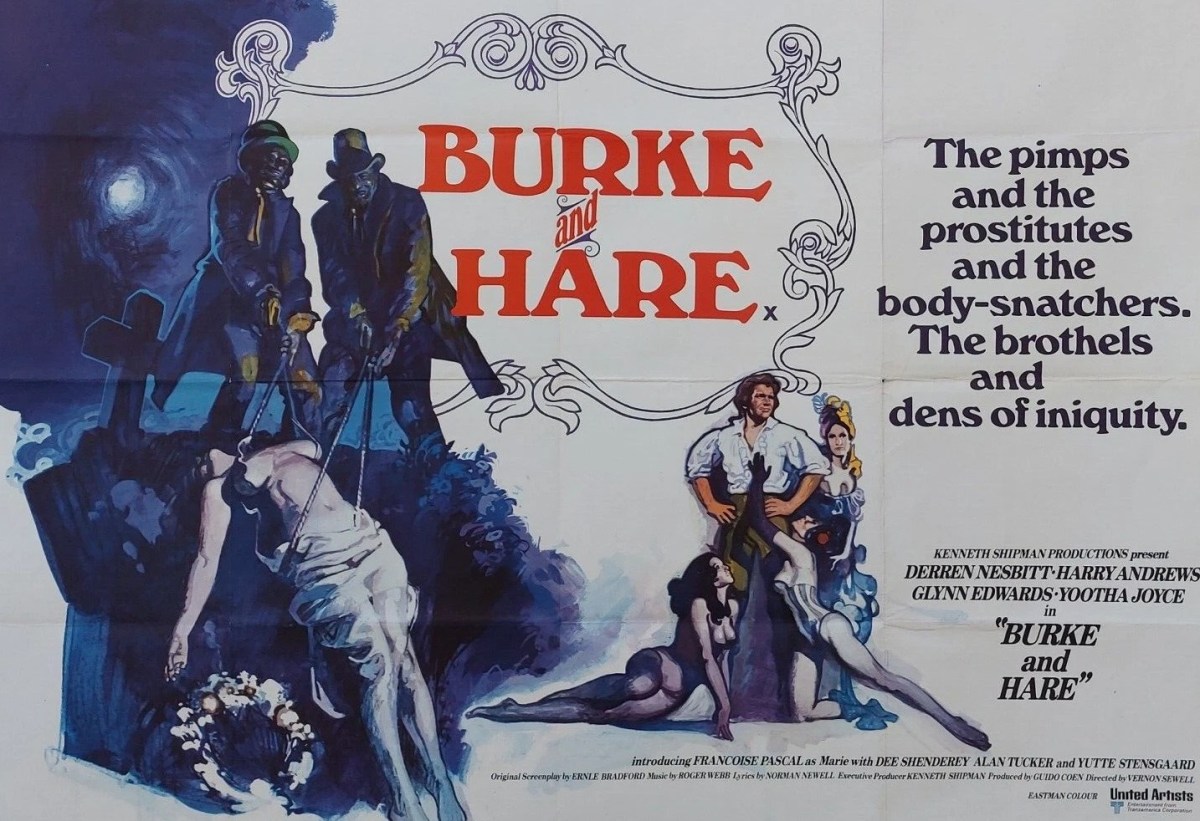
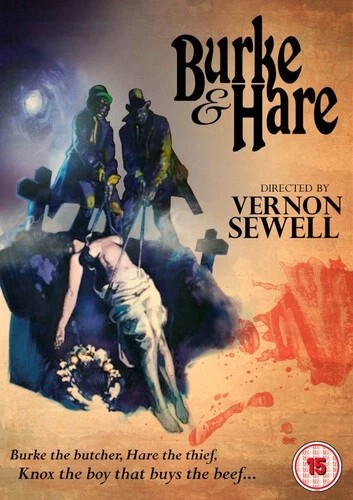
Burke and Hare (1972) **

There’s probably a thesis to be written about how Hammer subverted the traditional horror picture by inserting lashings of nudity. The studio’s female vampire trilogy, beginning with The Vampire Lovers (1970), was presumably made with an eye on attracting bigger box office rather than upending the status quo and taking the exceptionally feminist approach of making females the predators. Although in the first of the series, men were the eye candy, for the second and third it appeared to make more sense for the prey to be disrobed females, a double whammy, if you like, of female nudity.

That formula then appeared to be applied to any movie roughly in the horror genre, sometimes, as here, with just awful results. Young starlets who might previously have been expected to restrict their titillation to cleavage, were now going all-in. It helps if for no apparent narrative function you can set half the tale in a brothel and also ensure part of the attraction of such premises is voyeurism, peep-holes through which the clientele can view a couple having sex.
Two of the damsels on ample display were Francoise Pascal, hitherto one of those trapped into risque roles such as School for Sex (1969), and Yutte Stensgaard, who’s marquee value appeared to have been terminated despite all her nudity in Lust for a Vampire (1971) and now reduced to a supporting role.

Apologies for concentrating on the licentious, but the movie has little more to offer. Burke and Hare preceded Dr Jekyll as Edinburgh’s most famous villains, but it’s hard to get worked up about their activities. Audiences were inured to grave-robbing since without an steady  supply of body parts Frankenstein would have struggled to make his monsters.

The idea of people donating their bodies to medical science was hardly a hidden secret in the 1970s and the idea that you could build a movie exposing the hypocrisy of doctors seeking to use corpses for anatomy lesson seems far-fetched. There was no law against using corpses. As eminent surgeon Dr Knox (Harry Andrews) explains in supercilious tones it was not a crime to cut open a dead body.
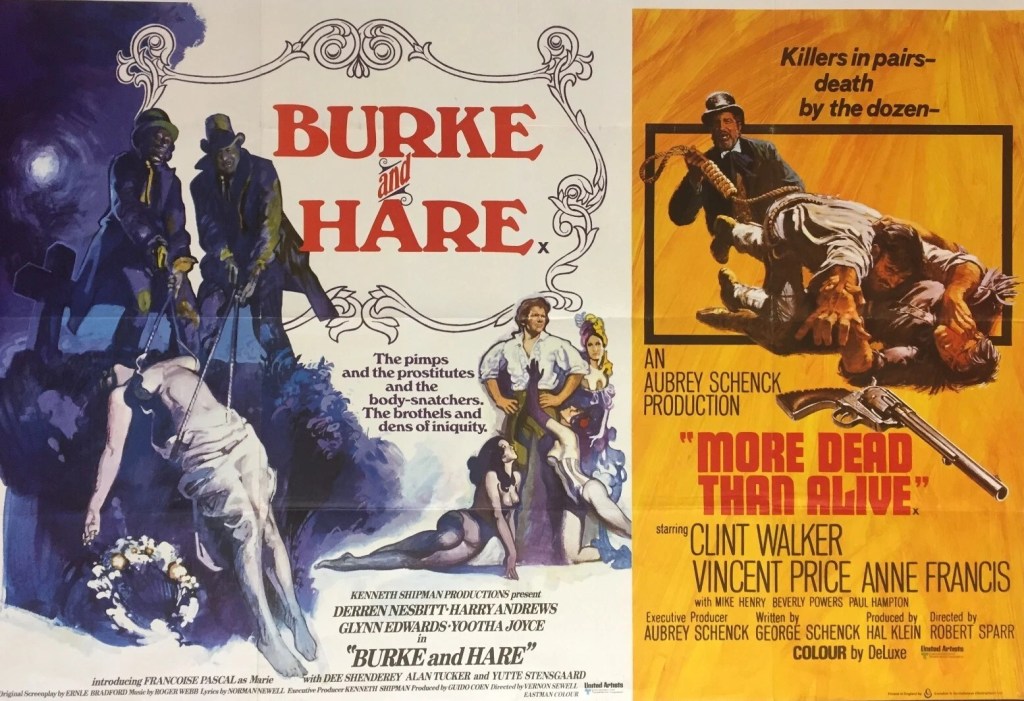
It was more customary to pair one horror film with another but since the producers didn’t have another one to hand they latched onto a western.

So we are left with our graverobbing tag team of Burke (Derren Nesbitt) and Hare (Glynn Edwards) and various other low lifes in Edinburgh in the 1820s whose main preoccupation seems to managing a Scottish accent. There’s little that’s particularly gruesome about the graverobbing and given the victims are all dead a complete lack of gore. Even the one legitimate opportunity to add frisson, the extraction of a  heart by Dr Knox during a class, is ignored.

Graverobbing, however, doesn’t supply all the needs of Dr Knox, so our pair resort to murder. That has the specific advantage of delivering fresher corpses. Suffocation is the murderer’s tool, since already slashed bodies might suggest even to Dr Knox that the corpses had met a different kind of end.

Where does the brothel fit into all this you might wonder? Is Dr Knox a regular? ‘Fraid not. For our entrance to the brothel we have to rely on sketchily-drawn medical students. Sex worker Marie (Francoise Pascal) ends up on Dr Knox’s slab after an unwelcome encounter with Burke. At some point, a little bit of detective work takes over, as Marie’s medical student lover is not satisfied with the post mortem declaring she died of alcohol poisoning.

But since you hardly care about any of these characters, it’s more like a documentary with sex and nudity thrown in.

Derren Nesbitt (Where Eagles Dare, 1968) didn’t enhance his reputation but Glynn Edwards rolled out another of his sneaky characters that provided a lifetime of supporting roles.

Directed by Vernon Sewel; (Curse of the Crimson Altar, 1968) from a script by historian Ernle Bradford making his debut.

A bit better than Orgy of the Dead (1965) but not by much.
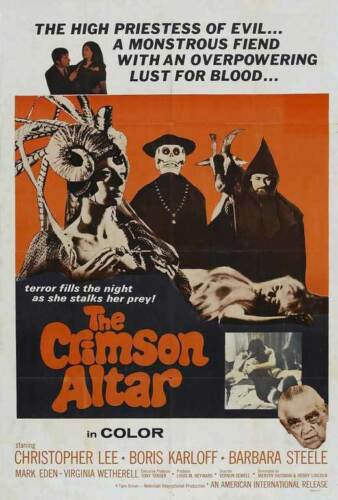
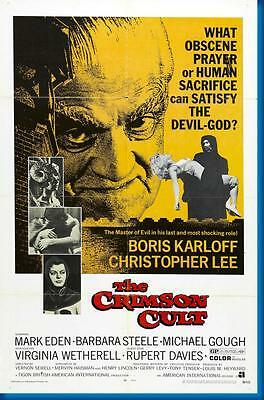
The Crimson Cult / The Crimson Altar/ Curse of the Crimson Altar (1968) ***

Horror is a small world and at any moment you are likely to bump into stars of the caliber of Christopher Lee, Boris Karloff and Barbara Steele – or in this picture all three. Investigating his missing brother Peter sends antiques dealer Robert Manning (Mark Eden) to a remote country mansion where he encounters owner Morley (Christopher Lee), his seductive niece Eve (Virginia Weatherall), the wheelchair-bound authority on witchcraft Professor Marsh (Boris Karloff), deaf mute Elder (Michael Gough) and a centuries-old mystery.

Morley can legitimately deny that Peter has ever set foot on the premises since it was common for the brother to adopt an alias when seeking out significant antiques. By the time Robert amasses sufficient clues to challenge Morley on this particular issue, it appears that further ideas of more sinister goings-on may be illusory. On his first night Robert observes an annual celebration of the Black Witch but although an effigy is burned this festival appears to have more to do with the innocent consumption of alcohol and heady bouts of sex than satanism.

And after a while, Robert indulges in carnal delight with Eve. However, he is plagued by a nightmare that involves a grotesque trial by a jury wearing animal heads. Gradually, he learns Morley, meanwhile, is such a congenial host, and his niece delightful and sybaritic company, that the finger of suspicion points at Elder, who does take a pot shot at Robert, and the professor who has a collection of instruments of torture.

Were it not for veteran director Vernon Sewell (Urge to Kill, 1960) beginning proceedings with some kind of black mass complete with floggings and female sacrificial victim, the audience might have been kept in greater suspense. As it is, the non-violent annual celebration throws us off the scent as does the seduction of Eve and the prospect that Robert’s nightmare is little more than psychedelic hallucination. The denouement is something of a surprise. The ritualistic aspects of the picture are well done and given this is a Tigon film rather than Hammer you can expect harsher treatment of the S&M element, especially for the period.  

The eerie atmosphere and well-staged witchcraft scenes are a plus, but, despite the involvement of a handful of horror gods, the movie’s reliance on lesser players to drive the narrative is a minus. Lee, Karloff and Steele (though in a more minor role) are all excellent as is the demented Michael Gough but Mark Eden (Attack on the Iron Coast, 1968) is too lightweight to carry the picture although Virginia Wetherall in her first big part suggests more promise.  More of Lee, Karloff and Steele would have definitely added to the picture but since this type of film often requires the young and the innocent to take center stage that was not to be.

Directed by Vernon Sewell (The Blood Beast Terror, 1968) from a script by Dr Who writers Mervyn Haisman and Henry Lincoln and Jerry Sohl (Die, Monster, Die, 1965).

Worth a watch.

The Crimson Cult/ Curse of the Crimson Altar (1968) ***

Horror is a small world and at any moment you are likely to bump into stars of the caliber of Christopher Lee, Boris Karloff and Barbara Steele – or in this picture all three. Investigating his missing brother Peter sends antiques dealer Robert Manning (Mark Eden) to a remote country mansion where he encounters owner Morley (Christopher Lee), his seductive niece Eve (Virginia Weatherall), the wheelchair-bound authority on witchcraft Professor Marsh (Boris Karloff), deaf mute Elder (Michael Gough) and a centuries-old mystery.

Morley can legitimately deny that Peter has ever set foot on the premises since it was common for the brother to adopt an alias when seeking out significant antiques. By the time Robert amasses sufficient clues to challenge Morley on this particular issue, it appears that further ideas of more sinister goings-on may be illusory. On his first night Robert observes an annual celebration of the Black Witch but although an effigy is burned this festival appears to have more to do with the innocent consumption of alcohol and heady bouts of sex than satanism.

Thanks to career reinvigoration after Peter Bogdanovich’s “Targets” (1967)
Boris Karloff gained top billing in the British release.

And after a while, Robert indulges in carnal delight with Eve. However, he is plagued by a nightmare that involves a grotesque trial by a jury wearing animal heads. Gradually, he learns that Morley, meanwhile, is such a congenial host, and his niece delightful and sybaritic company, that the finger of suspicion points at Elder, who does take a pot shot at Robert, and the professor who has a collection of instruments of torture.

Were it not for veteran director Vernon Sewell (Urge to Kill, 1960) beginning proceedings with some kind of black mass complete with floggings and female sacrificial victim, the audience might have been kept in greater suspense. As it is, the non-violent annual celebration throws us off the scent as does the seduction of Eve and the prospect that Robert’s nightmare is little more than psychedelic hallucination. The denouement is something of a surprise. The ritualistic aspects of the picture are well done and given this is a Tigon film rather than Hammer you can expect harsher treatment of the S&M element, flagellation delivered by women, especially for the period.  

In the U.S. – where it was shown both as “The Crimson Cult” and “The Crimson Altar” – Christopher Lee was accorded prime billing status.

The eerie atmosphere and well-staged witchcraft scenes are a plus, but, despite the involvement of a handful of horror gods, the movie’s reliance on lesser players to drive the narrative is a minus. Lee, Karloff and Steele (though in a more minor role) are all excellent as is the demented Michael Gough but Mark Eden (Attack on the Iron Coast, 1968) is too lightweight to carry the picture although Virginia Wetherall in her first big part suggests more promise.  More of Lee, Karloff and Steele would have definitely added to the picture but since this type of film often requires the young and the innocent to take center stage that was not to be.

Discover WordPress

A daily selection of the best content published on WordPress, collected for you by humans who love to read.

The Atavist Magazine

by Brian Hannan

WordPress.com News

The latest news on WordPress.com and the WordPress community.