Curious about what happened to Haya Harareet, Charlton Heston’s leading lady in Ben Hur (1959), filmed in 70mm glorious color, I happened across this neat twisty British thriller filmed in standard ratio and black-and-white. Turned out to be put together by the Basil Dearden/Michael Relph combo and starring Stewart Granger, one-time star of MGM extravaganzas like King Solomon’s Mines (1951) and clearly now atoning for failing to hit the box office mark often enough for Hollywood’s liking.
Driven by a brilliant plot, whose resolution I defy you to guess, and climaxing with three stunning twists, the first story-driven but the others landing a no less effective emotional and human punch. I should warn you right away that Harareet is not in the picture as much as you would expect given that she took second billing. That’s no surprise, really, since on her first entrance, as wife Nicole, she walks out on husband John Brent (Stewart Granger) citing his illicit romantic liaisons.
Though driving a swanky car and living in a big house, Brent, a top-level shipping executive, is one harassed individual. What’s more he is being blackmailed by alcoholic dentist Ralph Beldon (Norman Bird). When the shipping company’s safe is robbed of £130,000 (equivalent to £3 million today), suspicion falls on Brent, one of only two employees with both keys and the combination. Enter about-to-retire chain-smoking Detective Superintendent Hanbury (Bernard Lee, shortly to achieve global fame as “M” in the Bond series).
Constantly wreathed in a cloud of smoke, Hanbury’s investigation leads to various suspects – the other keyholder Charles Standish (Hugh Burden) whose job is at risk, interior designer Clive Lang (John Lee) who is over familiar with Nicole, and friend Alan Richford (Conrad Philips) who is secretly in love with Nicole. All have good reason to be responsible for the theft, not least Nicole because of Brent’s habit of talking in his sleep and in trying to memorize ever-changing safe combinations constantly running them through his head, conscious or unconscious.
To add to the complications, Brent has a mysterious past. In addition, a masked gunman pops up from time to time. So, although Brent remains the prime suspect, Hanbury, with an investigator’s vigilance and attention to detail that Hercule Poirot would be proud of, uncovers clues that point elsewhere. Pretty soon, Brent is on the run, first to France, where he is arrested, and then, after escaping custody, through the murky streets of Soho trying to locate a girl to whom he might have given the combination while asleep. He, too, discovers some unpleasant truths far closer to home.
Basil Dearden (Victim, 1961) does a brilliant job of setting up the mystery, a dab hand, too, at serving up multiple red herrings, as well as a spot of sleight of hand, not least when the music intrudes too loudly in old-fashioned manner as if to point the finger, and the audience’s attention, in a misleading direction. Sure, it’s a low-budget affair by Hollywood standards and indeed by Dearden/Relph standards (big-budget roadshow Khartoum, for example), and the black-and-white photography is for financial rather than artistic reasons, but it is superbly done and keeps you guessing to the end.
Stewart Granger (The Last Safari, 1967) is at his suave best. Harareet, all fur coat and steely resolve, gives a good performance. Bernard Lee is an excellent British copper, hoping to end his career on a high note, patiently probing suspects, and there is a good turn from Norman Bird as the dodgy dentist and a fleeting appearance by Willoughby Goddard as an equally dodgy hotel manager. Written by David Pursall and Jack Seddon who went on to churn out MGM’s Miss Marple thrillers.
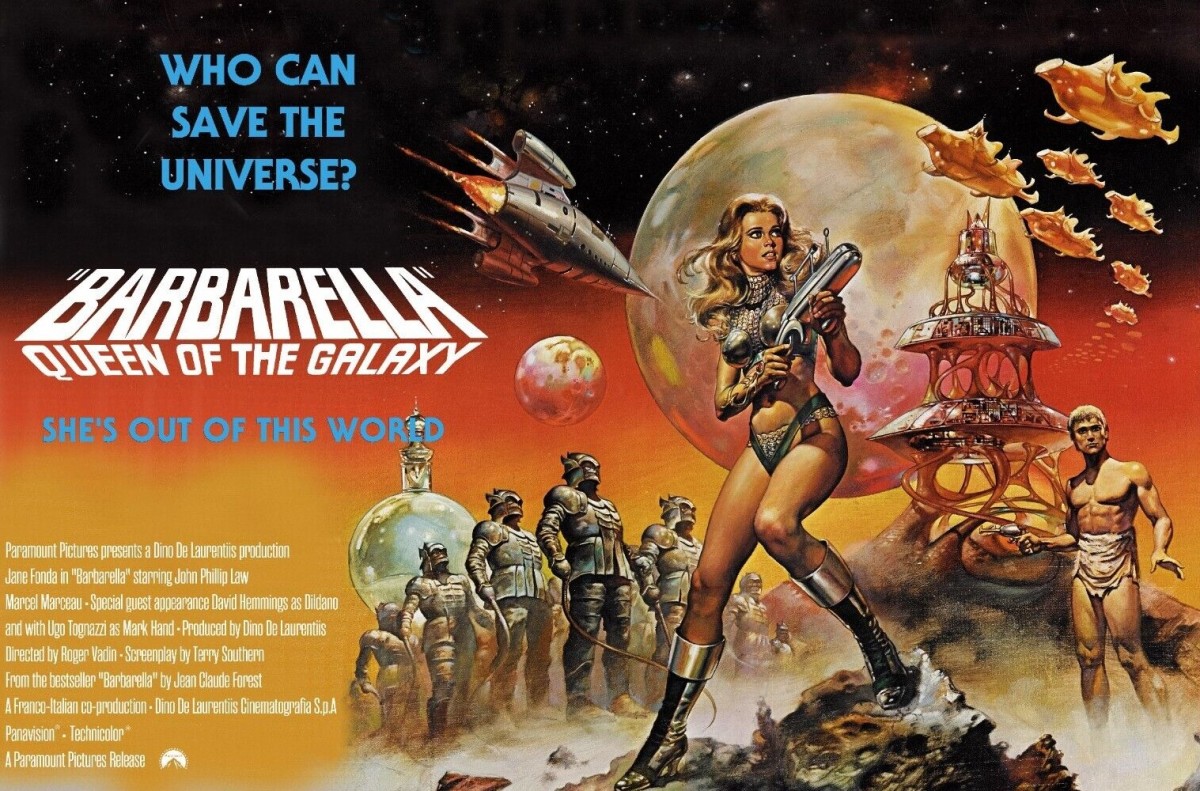
While sci-fi was being viewed through a serious glass darkly what with Fantastic Voyage (1966), 2001: A Space Odyssey (1968) and Planet of the Apes (1968) along came Roger Vadim’s little number to set up an alternative universe of camp fun. Had this been a box office smash in the nature of The Odd Couple ($18.5 million in U.S. rentals) rather than under a third of that there might have been less of the po-faced doomladen sci fi in the following decade.
But if you wonder where Star Wars got its vibe, setting aside the overt sexiness portrayed here, this is as good a place to start. Naïve adventurers, check. Ice planet, check. All sorts of weird creatures in strange otherworldly locales, check. A doomsday weapon, check.
It’s kind of newsworthy to be rewatching this given that star du jour Sydney Sweeney (Anyone But You, 2023) is going to be donning the Barbarella costume for a remake next year. And who knows to what Oscar-winning fare that might lead, if she were to follow the Jane Fonda template, given it was La Fonda’s follow-up that brought her serious attention from the Academy.
But it would be remiss of me if I didn’t bring up the testy matter of director Roger Vadim’s uncanny obsession with getting his myriad girlfriends to shed their clothes for the movies, Fonda being the latest example, and in no uncertain terms, the striptease performed during the opening credits certainly rivaling Kubrick and Spielberg for the most jaw-dropping opening to a sci-fi movie.
Whether it was Fonda or someone else and whether it was Vadim or someone else you couldn’t get away from the fact that Barbarella as a sci-fi icon was most definitely on the sexy side as determined by her creator Jean-Claude Forest, sharing like British comic strip heroine Jane a predilection for losing her clothes.
Barbarella shares something of the same innocent abroad personality, the kind who gets into one unexpected scrape after another, after being despatched from peace-loving Earth to save the world by finding Durand Durand (the pop band making homage to the movie dropped the final letter of this character’s name) and his doomsday machine.
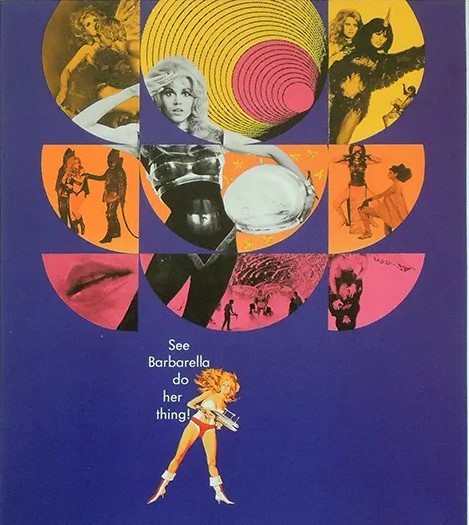
So mostly, it’s one imaginative character or scene after another, delivered in disconnected episodic manner, and it sometimes has the feel of a jukebox movie, of the greatest hits of the comic strip writer strung together, with an occasional comment on the problems created by sex and a climactic gender-spinning twist. You’d have to remember what Pop Art was to chuck it into that short-lived category but if you think it belongs on the same planet as the more earthbound Modesty Blaise (1966) and Danger: Diabolik (1968), think again.
The best sections are truly terrific. The sharp-teethed menacing robot dolls are exceptionally scary as they nip chunks out of our heroine’s flesh and leave her blood-soaked. There’s a homage to The Birds (1963) where our plucky heroine is trapped in a cage with a flock of sparrows. You’ve also got the The Catchman, performing the same function but considerably scarier than the same year’s Child Catcher from Chitty Chitty Bang Bang. But no wonder the kids need caught because they are full of evil intent.
You’ve got a blind angel (John Phillip Law) who can’t fly, a problem mysteriously solved by sex with the ever-gracious Barbarella who, previously, has discovered, courtesy of The Catchman, the immense pleasure of the art of making love the old-fashioned way rather than just popping a pill. The angel also has no memory, permitting an ironic twist ending. You’ve got an incompetent rebel (David Hemmings). Sex is pretty much top of everyone’s agenda, even the villain (Milo O’Shea) who uses it to kill people via his own invention, which proves not much cop, since rather than murdering Barbarella with excessive pleasure, she makes it blow up.
Along the way there’s any number of interesting inventions: a manta-ray acts as the skis for a futuristic sailing ship, hollow robotic soldiers, a labyrinth.
Some of the special effects wouldn’t pass muster these days, but that’s a minor flaw compared to the rest of what’s on show. It’s not exhilarating in the real sense, but if you’re unfamiliar with the source material, it retains an endless fascination, more like a sexed-up version of the Ray Harryhausen world than anything that would have interested Kubrick. And, heck, just fun. What’s not to like.
Jane Fonda (They Shoot Horses, Don’t They, 1969) holds it all together, innocent rather than naïve, even her sexuality is innocent not exploitative, and possibly for a film deemed sexy makes greater comment on the dangers of lust than many a more self-important movie.
Great supporting cast with David Hemmings (Blow-Up, 1966), John Philip Law (Danger: Diabolik), Anita Pallenberg (Performance, 1970), Milo O’Shea (Ulysses, 1967) and Marcel Marceau.
Roger Vadim’s best film. Written by a huge squad of writers, nine in total, headed up by Vadim and Terry Southern (Candy, 1968).
Will probably be yanked out of circulation at the approach of the remake so now’s your chance to catch up on a fun sci fi.
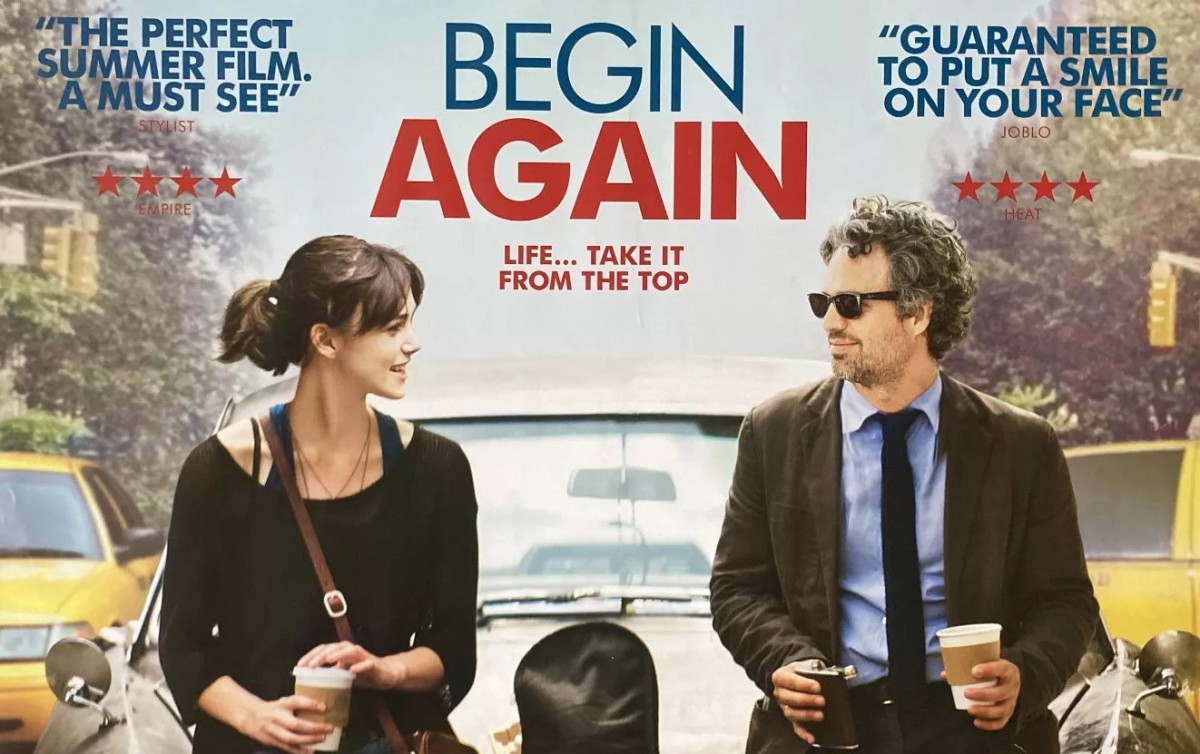
Timely reminder that Hollywood could make decent coin from lightweight romantic froth. Imagine how many movies this year would be delighted to be walking away with $84.1 million (around $111 million in today’s money) from the worldwide ticket wickets, especially given the low budget. So you have to wonder: what was the magic formula that audiences responded to that they’re not responding to now. Because, to be honest, this is the most unlikely of unlikely concoctions.
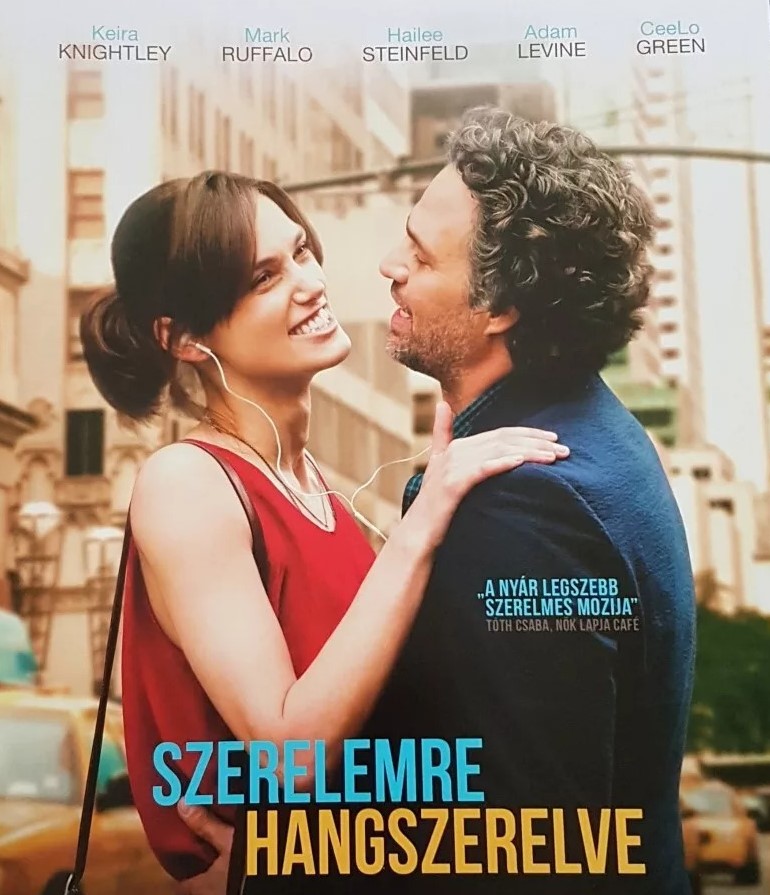
After a previous fairy tale Once (2007) – whose real-life happy ending included being adapted for theater and turned into a Broadway hit – writer-director John Carney (following two low budget flops) tries again but drives a tank through credibility. At this point rumpled Mark Ruffalo, whose undeniable charm has saved many a picture, had apparently lost the last of his nine marquee lives so that he now fell into the category of American actor fawned over by British filmmakers because he deigns – even though relegated to second billing – to get involved. For the top-billed Keira Knightley (Atonement, 2007) it would prove to be her last hit.
Musician Adam (Dave Kohl), on the cusp of stardom, has been flown over to New York by his record company. His girlfriend Gretta (Keira Knightley), along for the ride, is an unsuccessful songwriter. After Adam has an affair, she dumps him, wandering the streets with a bag and a bike until, lo and behold, she bumps into (as one does in a city of 19 million people) old pal Steve (James Corden) busking on a street corner.
At an open mic gig, she is pestered to do a number. The minute she starts singing the entire audience starts chatting amongst themselves. But wait, just-fired depressed alcoholic record producer Dan (Mark Ruffalo) in the audience recognizes her “talent,” immediately envisaging the string and percussion arrangement that could magically transform the number. Except, she doesn’t want fame, she wants purity. Initially, rejecting his (artistic) overtures, she agrees to his world-beating notion of recording an album in the streets, Steve having miraculously accumulated sufficient recording equipment. Cue umpteen shots of cute New York (Brooklyn Bridge, Greenwich Village) and no hummable songs.
There’s kind of a will-she-won’t-she romantic subplot with Dan but he’s still smitten with estranged and acidic wife Miriam (Catherine Keener). Another subplot involves his daughter Violet (Hailee Steinfeld). Sparks never fly and you start wishing for the next best thing – a speedy resolution. No such luck. Dan makes said album, complete with (would you believe) 24-page glossy booklet. Gretta rejects a record deal out of supposed purity, but in fact greed, wanting more than a 10% cut of the pie.
The disc sells 10,000 copies in a day on the internet. Rewind. It sells that amount because (purity be damned) one of Dan’s buddies is Mos Def and he is a God of Twitter and enough of his millions of followers obey his every command. There is but one subtle scene, when Knightley intuits her boyfriend’s betrayal and without a word slaps him in the face.
A few more slaps would have done this film good. Knightley gushes like one of the Famous Five, the film itself like a 1940s movie where rejected theatrical nobodies put on a show in a barn. The central theme of artistic purity and refusing to give in to an over-commercialized business scarcely rings true, but somehow it provides the movie with the kind of innocence that the more romantically-inclined among the audience would vote for in a world of wishful thinking.
And, actually, precisely because it refuses to give the audience what in one way it’s demanding – a proper romantic movie – and goes down the other route of artist fighting for integrity, it comes off with something of the rare feel of a movie being true to itself.
Of course, since then, Ruffalo’s career has occasionally soared, both artistically (three more Oscar nominations, most recently for Poor Things) and commercially (long-running role as The Hulk). Conversely, Knightley’s career has plummeted. Outside of The Imitation Game (2014) in which she had a supporting role and a bit part in the final Pirates of the Caribbean adventure, each successive movie in which she has been top-billed has made less than the last. From a $14 million haul for Colette (2018) we’re now down to $1.9 million worldwide for Misbehaviour (2020) and $400,000 for Silent Night (2021). After her breakthrough in True Grit (2010), Hailee Steinfeld’s career had also been wayward, big budget flops including Bumblebee (2018) and The Marvels (2023).
If the movie’s box office sounds like a Hollywood fairy tale and you maybe recall it as not doing much business Stateside, that’s because, in one of those anomalies that occasionally shine on a movie, it proved an absolute sensation in South Korea. Just under half of its entire worldwide revenue came from South Korea. Go figure.
Even without that, a $43 million haul for an improbable lightweight semi-romance mainlining on artistic purity would have had the backers rubbing their hands with glee.
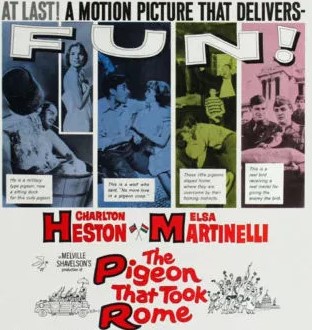
Netflix would know how to sell this. Append the “based on a true story” credit and you’ll attract a global audience. I’ve no idea how true this tale is though I assume that at certain points in war using a pigeon may have been the most efficient method of communication. If this had been under the Netflix aegis there would surely have been a scene to explain that you can’t just point the bird in any old direction but that it automatically returns to its home, that aspect being pivotal to the movie, the reason it was made in the first place.
That is, if you believe in the rather fanciful notion, as shown in what appears to be an official newsreel, of said pigeon being presented with a medal for its part in the Allied invasion of Rome in World War Two. Luckily, there’s more to this picture than the intricacies of homing pigeons.
Not much more, I hasten to add, because the other significant plot point, which I suspect has a more substantial basis in truth, is that passing American soldiers had a tendency to impregnate (and abandon) Italian women. If you were to argue that Elsa Martinelli (who had just put John Wayne in his place in Hatari!, 1962) is what saves the picture you wouldn’t be far wrong. But you can’t complain about Hollywood churning out lightweight movies in the 1960s since a chunk of the current output falls into that category.
For no apparent reason, no espionage experience for example, Yank soldiers Capt MacDougall (Charlton Heston) and Sgt Angelico (Harry Guardino) are delegated to sneak into Rome, disguised as priests, and spy on the Germans. They are put up in the household of Massimo (Salvatore Baccaloni), an underground figure, but his daughter Antonella (Elsa Martinelli) takes against the pair since they are extra mouths to feed and if only the Americans would hurry up and enter the city the populace wouldn’t be starving. However, she makes nice when her sister Rosalba (Gabriella Pallotta) reveals she is pregnant by a previous Yank (whether he was the espionage business, too, is never revealed) and is desperate need of a husband.
The sergeant is quite happy to romance the girl since a couple smooching in the park makes good cover for him transmitting messages by radio. And when that form of transmission becomes too dangerous, the Americans rely on pigeons. Soon Angelico realises his feelings for Rosalba are real and proposes to her, even after she reveals her condition. But that means celebration to announce their forthcoming nuptials.
Short of any food, Antonella slaughters the pigeons, convincing MacDougall that the meal consists of squab. To cover up, the Italians steal a bunch of pigeons from the Germans. Of course, as you’ll have guessed, that means the pigeons will return to the enemy. But once MacDougall works this out, he starts sending the Germans false messages that prove (apparently) pivotal to the Germans hightailing it out of the city (hence the medal awarding).
Pretty daft and inconsequential sauce to be sure, but Antonella keeps matters lively, knocking back MacDougall at every turn, taking every opportunity to condemn men for starting wars, and presenting herself as something of a conniver, possibly willing to lead on the Germans in return for food (MacDougall when burglarizing a German villa comes across her naked in the shower). Her occasional swipes give the picture a harder edge than you’d expect, but, her fiance killed in the war, she leads MacDougall a merry dance in the manner of the romantic comedies of the day. Otherwise, the comedy is for the most part lame, the old hitting your thumb with a hammer one such moment.
Despite co-starring with Wayne and here Heston and later Robert Mitchum (Rampage, 1963), Martinelli didn’t fit into the Hollywood pattern of taking European stars and slotting them into the female lead opposite a succession of top male stars. Think Sophia Loren with Heston in El Cid (1961), with Gregory Peck in Arabesque (1966) and with Marlon Brando in The Countess from Hong Kong (1967) and headlining a few pictures on her own. Gina Lollobrigida led Rock Hudson by the nose in Come September (1961) and Strange Bedfellows (1965) and Sean Connery a merry dance in Woman of Straw (1964).
Martinelli seemed to fade too quickly from the Hollywood mainstream which was a pity because she’s the glue here. Charlton Heston (Number One, 1969) spends most of the time looking as if he wondered how he managed to allow himself to be talked into this. You want to point the finger, then Melville Shavelson’s (Cast a Giant Shadow, 1966) your man – he wrote, produced and directed it.
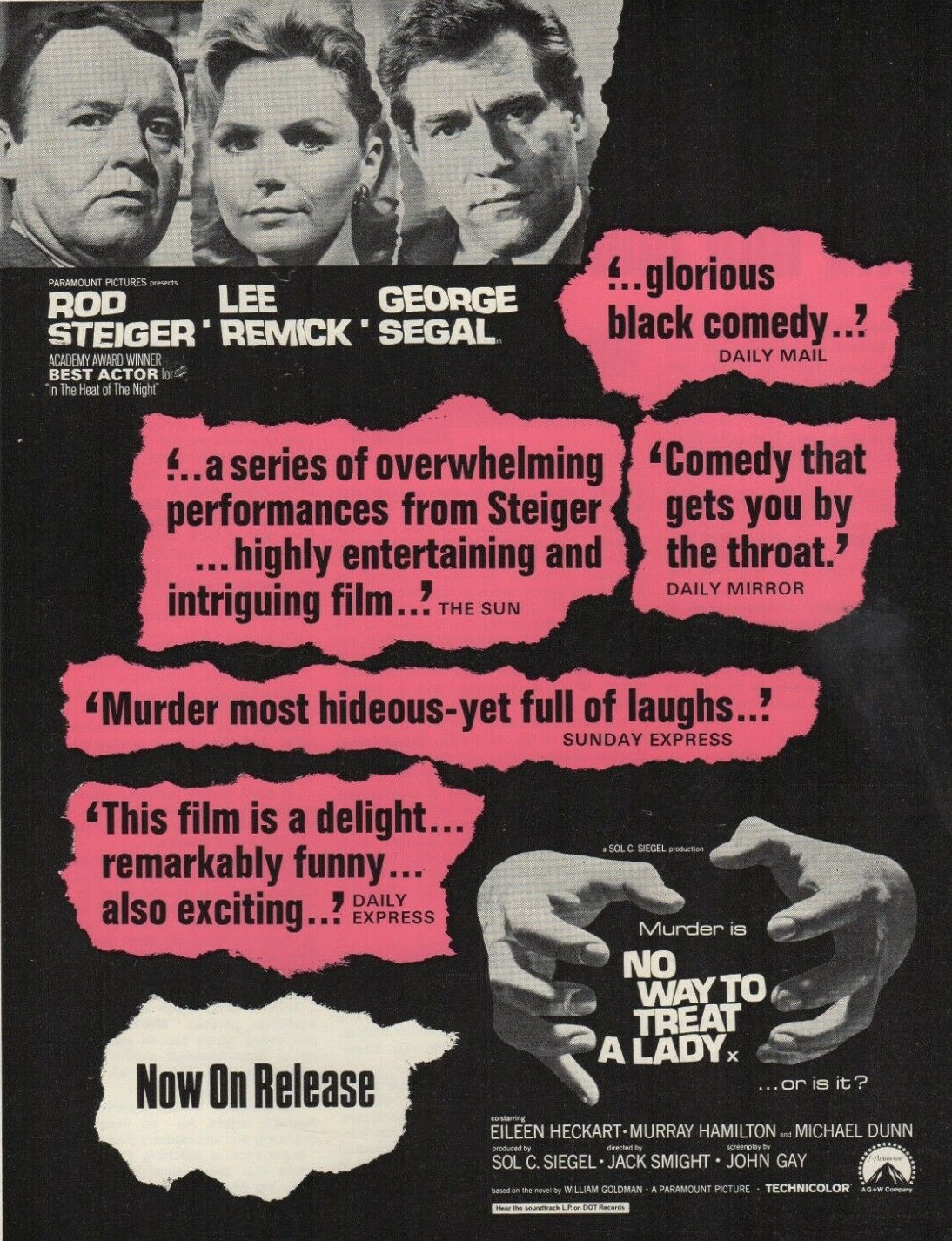
Sly, cunning highly original drama hugely enjoyable for a number of reasons, top among which would be Rod Steiger’s serial killer. As the wealthy and cultured Christopher Gill, the actor employs disguise to enter the homes of the unsuspecting. These range from Irish priest, German maintenance man, camp wig salesman, a woman and even a policeman knocking on doors to advise people not to admit strangers.
Clearly Steiger has a ball with these cameos, but, more importantly, his character pre-empts the celebrity status accorded the modern-day mass murderer. This is a killer who wants everyone to know just how good he is at his self-appointed task, who desperately wants to be on the front pages, who revels in a cat-and-mouse taunting of the police. To be sure, an element of this is played as comedy, but from our perspective, half a century on, it is a terrific characterization of the narcissistic personality, and far more interesting than the psychological impulse that causes him to kill in the first place.
The hapless detective (George Segal) on the receiving end of Gill’s brilliance is named Morris Brummel which means that he is met with laughter anytime he introduces himself since he that is invariably shortened to Mo Brummel, too close to Beau Brummel, the famous dandy, from whom the cop could not be further removed. And Brummel is not your standard cop, stewed in alcohol with marital problems, feuding with his bosses and close to burn-out. Brummel would love marital problems if only to get out from under his nagging mother (Eileen Eckhart) , with whom he lives.
He is dogged, but respects authority and takes his demotion like a man. Not coincidentally, killer and cop are linked by mother issues. Although Gill is angry when ignored he does not taunt Brummel the way his mother does. She is ashamed he is a cop and not wealthy like his brother.
Even less standard is the meet-cute. Kate Palmer (Lee Remick) is a useless witness. She can’t remember anything about the priest she passed on the stairs. When the cop arrives, she is hungover and just wants to get back to sleep, and without being aware that Brummel is in fact Jewish praises his nose. Gill is a bit ham-fisted in the seduction department and it is Palmer who makes the running. But although appearing glamorous when first we see her, in reality she is a mundane tour guide. Their romance is conducted on buses and a police river launch, hardly the classic love story.
Although the trio of principals boasted one Oscar and two nominations between them, their careers were at a tricky stage. Winning the Oscar for In the Heat of the Night (1967) did not trigger huge demand for Steiger’s services and he had to skip over to Italy for his next big role. Both Remick and Segal, in freefall after a series of flops, had been working in television. Whether this picture quite rejuvenated their careers is a moot point for the picture was reviled in certain quarters for bringing levity to a serious subject and it was certainly overshadowed in critical terms by The Boston Strangler (1968) a few months later. But all three give excellent performances, especially Steiger and Segal who subjugated screen mannerisms to create more human characters.
While Jack Smight had directed Paul Newman in private eye yarn Harper (1966) the bulk of his movies, regardless of genre, were tinged with comedy. While he allows Steiger full vent for his impersonations, he keeps the actor buttoned-down for most of the time, allowing a more nuanced performance. Violence, too, is almost non-existent, no threshing of limbs of terrified victims. John Gay wrote the screenplay from a novel by William Goldman (who had written the screenplay for Harper) so short it almost constituted a movie treatment.
In reality, the comedy is slight and if you overlook a sequence poking fun at the vertically-challenged, what remains is an examination of propulsion towards fulfilment through notoriety and the irony that the murders elevate the mundane life of the investigating officer.
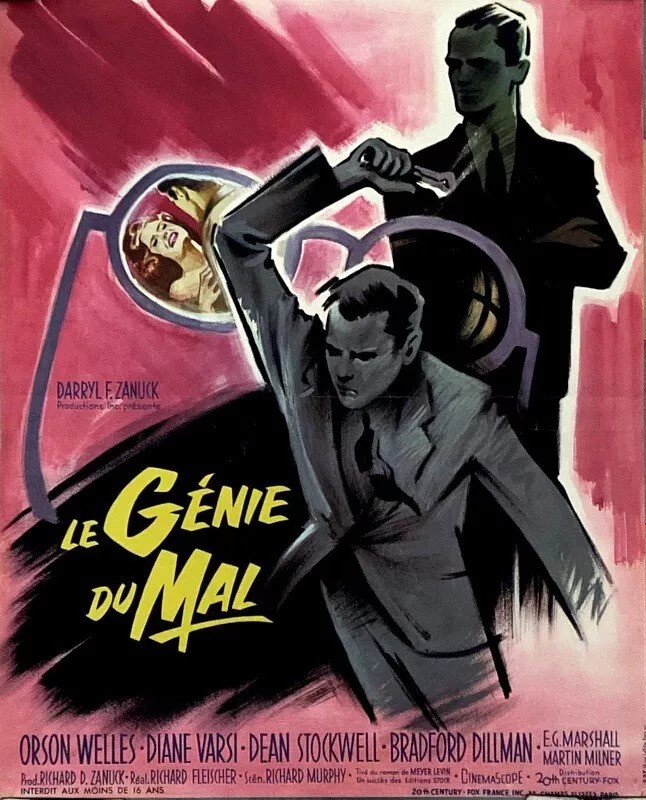
Controversy breeds controversy. Convicted killer Nathan Leopold was furious when author Meyer Levin reneged on his deal to write a book concentrating only on the murderer’s prison time, instead churning out a fictionalized account of the “crime of the century.” Levin’s novel, published in October 1956 by Simon & Schuster in the U.S., was snapped up by Darryl F. Zanuck for an upfront fee of $150,000 and the same again when the movie appeared.
A play, also ensnared in controversy, preceded the movie. Broadway producer Michael Myerberg was so dissatisfied by Levin’s script that he called in Robert Thom as co-writer. For his efforts Thom was due one-fifth of Levin’s share of the stage royalties. The play opened at the Ambassador in New York on 24 October 24, enjoying a healthy 18-week run.
There was contemporary feel to the cast given that, like now, Broadway was recruiting big names from Hollywood including Rex Harrison, Richard Burton, Walter Pidgeon, Anne Baxter, Joan Blondell, Paulette Goddard and for Compulsion rising star Dean Stockwell (Gun for a Coward, 1956). Actually, there was a heck of cast. As in the movie Stockwell played Judd. Roddy McDowell (Five Card Stud, 1968) played Arthur. But the big sensation was an “obscure actor” understudy Michael Constantine (Beau Geste, 1966), thrown into the limelight by illness, in the key role of the defense attorney. Also in small roles were Ina Balin (The Commancheros, 1961), Barbara Loden (Fade In, 1968), Suzanne Pleshette (Nevada Smith, 1966) and John Marley (The Godfather, 1972).
Levin complained he had been forced “under duress” to take on Thom as a co-writer and refused to pay him. The case went to court. Levin lost but he won a victory of a sort in writing Thom out of the play when it made its London West End debut. Meanwhile, Leopold was intent on his own revenge, on release from prison on parole in 1958 and having published his own autobiography, suing Levin and Zanuck, among others, for $1.5 million. He, too, was a loser in court.
In an early version of the nepo baby, Darryl F. Zanuck gave son Richard a leg-up by assigning him to be producer of the movie.
When director Richard Fleischer entered the equation Orson Welles was already cast as the defense attorney modelled after Clarence Darrow. The director might well have signed up on the strength of the script by Oscar-nominated Frank Murphy (Broken Lance, 1954). “It was the best I ever read,” he said. Among other things, Murphy had tightened up on the action of the play, removing scenes set in prison long after event, and taking a documentary-style approach to the film.
On hearing Welles was involved, “my tongue was hanging out,” admitted Fleischer. Given Welles’ murky finances, time was always going to be of the essence. Tax problems limited the amount of time – ten days exactly – he was available for shooting. And nobody was going to waste any of that valuable time on rehearsals. He arrived from Mexico on the day of the shooting and was booked onto a voyage to China the night filming finished.
Welles always supplied himself with a false nose, and that was the director’s first astonishing encounter with his star, on the first day of shooting. Welles explained his real nose was “just a button” and only once had appeared with it in a movie. He claimed Laurence Olivier was prone to the same insecurity. That wasn’t the actor’s only peccadillo.
He had trouble remembering lines. To cover this up he would claiming he was “reaching” for the words, actorspeak for showing thinking on camera. Fleischer discovered the way to challenge the actor over this was to tell him his reaching was so “realistic” it looked like he had forgotten his lines. In addition, Welles hated having anyone in his eye line, couldn’t cope with eye contact at all. So when it came for his part of a two-person scene he would play it to a blank wall, but with pauses, laughter, “exactly as though there were someone speaking to him.”
In the normal course of filming such a problem could be accommodated. It was a different story when it came to the movie climax, an 18-minute speech, the longest uninterrupted monologue in movie history. It was impossible to film it in one take. Apart from anything else, a movie camera only held ten minutes of film. So it needed broken down into smaller sections, some of which were quite long in themselves. As some of the speech was directed in general terms to the courtroom that didn’t demand eye contact so Welles was safe there.
But other sections had to be directed to the prosecutor (E.G. Marshall) and his team. To get round the problem of maintaining eye contact, Welles had a simple solution. All the other actors had to keep their eyes closed. And that’s what they did. Fleischer recalled as “a ludicrous but memorable sight” seeing all the actors “line up, listening intently, with their eyes closed.”
Only four days were left for the speech. So the director pointed his three cameras in one direction and shot every section of the speech that applied to, then moved the cameras around until he had completed a 360-degree rotation. However, the last section was filmed in one complete, technically complicated, three-minute section. It was rehearsed to fulfil the technical criteria and then Welles was left alone on the set for a couple of hours to do his own rehearsal. He didn’t want Fleischer to see any of his performance beforehand, just come in and film it. In other words, trust the actor. A dangerous proposition given this was the second last day Welles was available. However, Welles delivered a virtuoso performance captured by intricate camerawork.
To save money, the studio had revamped a set from another picture, dressed up with “a little paint, some different trim…a set for almost no cost.” Fleischer had redressed an older that set lacked one wall. Welles, clearly unaware of budgetary problems, wanted to make his exit from the scene through the side that had no wall. Told that was impossible, Welles noted that, if director, he would have stood up to the studio, forced them to build a wall so he could exit in the manner that seemed most appropriate. “That’s why I’m directing this picture and not you,” was the director’s prompt reply.
Needless to say, Welles was not always on his best behaviour. Sometimes, he was playing to the gallery, especially if the producer hove into view, or if he was feeling narked that a director with conspicuously lesser directorial skills was in charge. Among those to receive both barrels were a hapless stills photographer and a publicity man guilty of an imaginary slight. Both these incidents could be brushed off, the collateral of tension on any movie. It was a different story when the director was in the legendary actor’s sights, as occurred when Welles had the opportunity to view dailies. He took the film apart, “a total disaster from beginning to end.” Explanation for the unexpected explosion came from the fact that his salary had been “garnished” by a tax official, meaning he wouldn’t be paid.
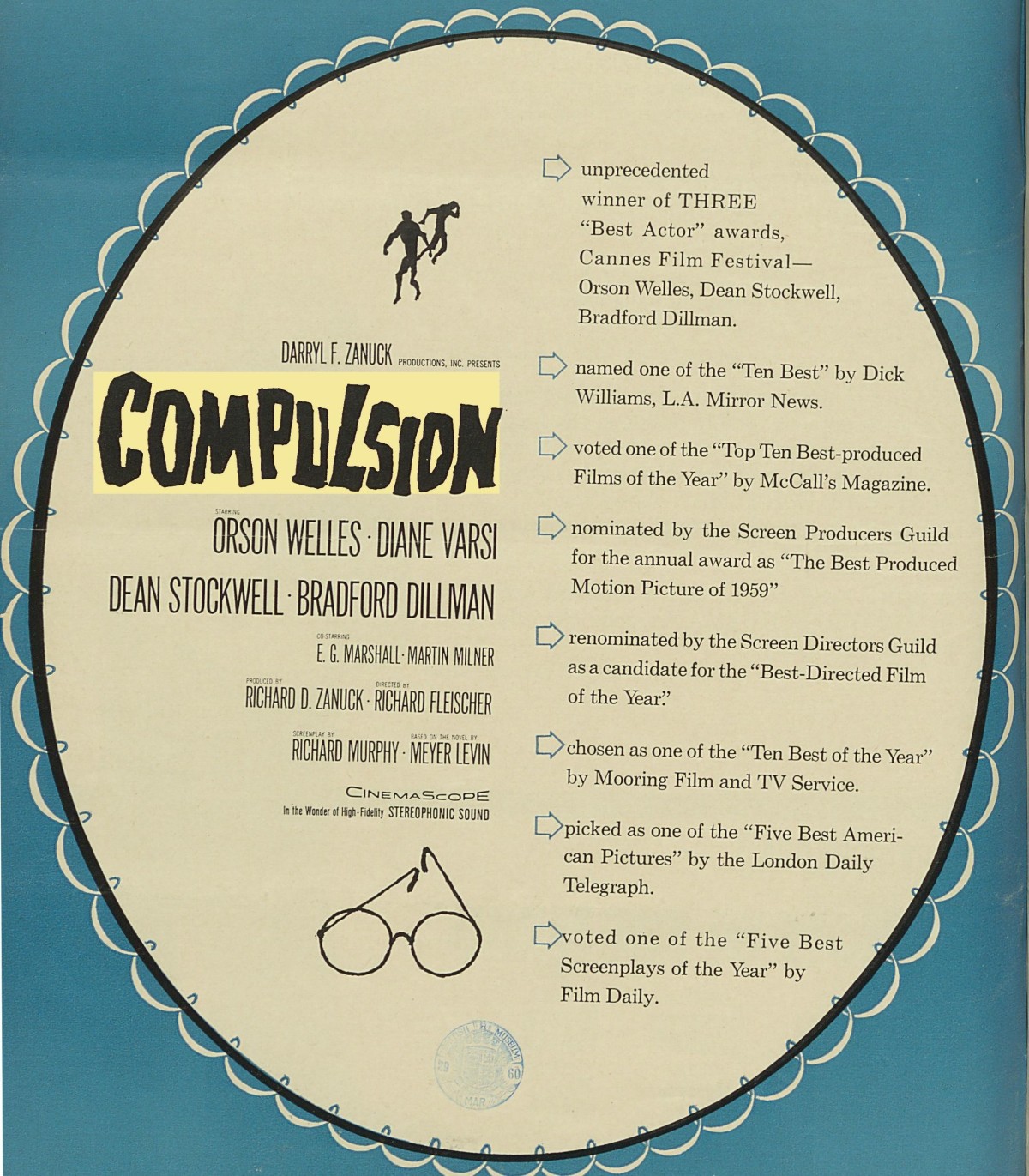
At Cannes the three stars shared Best Actor honors. Fleischer was nominated for a Bafta and a DGA. Despite fears that to avoid stirring up old controversy Chicago would be denied a release, that city proved one of the earliest to show the movie. It did well in the big cities, less well elsewhere. Rentals were a disappointing $1.8 million, ranking it 48th for the year. In London, exhibitors exploited the old gimmick of denying patrons entrance once Orson Welles lumbered to his feet for his big speech.
Despite success in the big-budget adventure field with movies like 20,000 Leagues under the Sea (1954) and The Vikings (1958), Fleischer hankered after independence. He set up his own shingle Nautilus but complained that with so many “properties” tied up by the studios, and likewise marquee names, he was reduced to “combing library shelves and finding properties major studios had missed.” He had three projects on his planned indie slate – Willing Is My Lover, an original screenplay by Frank Murphy, an adaptation of Tolstoy’s Resurrection and Trouble in July by Erskine Caldwell. But none ever saw the light of day.
SOURCES: Richard Fleischer, Just Tell Me When To Cry, Carroll & Graf, 1993, p161-175; “Writers Harvest,” Variety, December 5, 1956; “Compulsion Producer,” Variety, September 25, 1957, p1; “Legit Increasingly Recruits Players from Film,” Variety, October 9, 1957, p63; “Shows on Broadway,” Variety, October 30, 1957, p82; “Levin Withholds Thom Royalties for Compulsion,” Variety, December 11, 1957, -p73; “Meyer Must Pay,” Variety, March 12, 1958, p73; “Meyer Levin to London,” Variety, December 28, 1958, p49; “Old Gimmick, New Pic,” Variety, May 13, 1959, p12; “Properties, Stars Monopolized,” Variety, July 22, 1959, p10; “Now-Free Slayer Sues on Privacy,” Variety, October 7, 1959, p21.
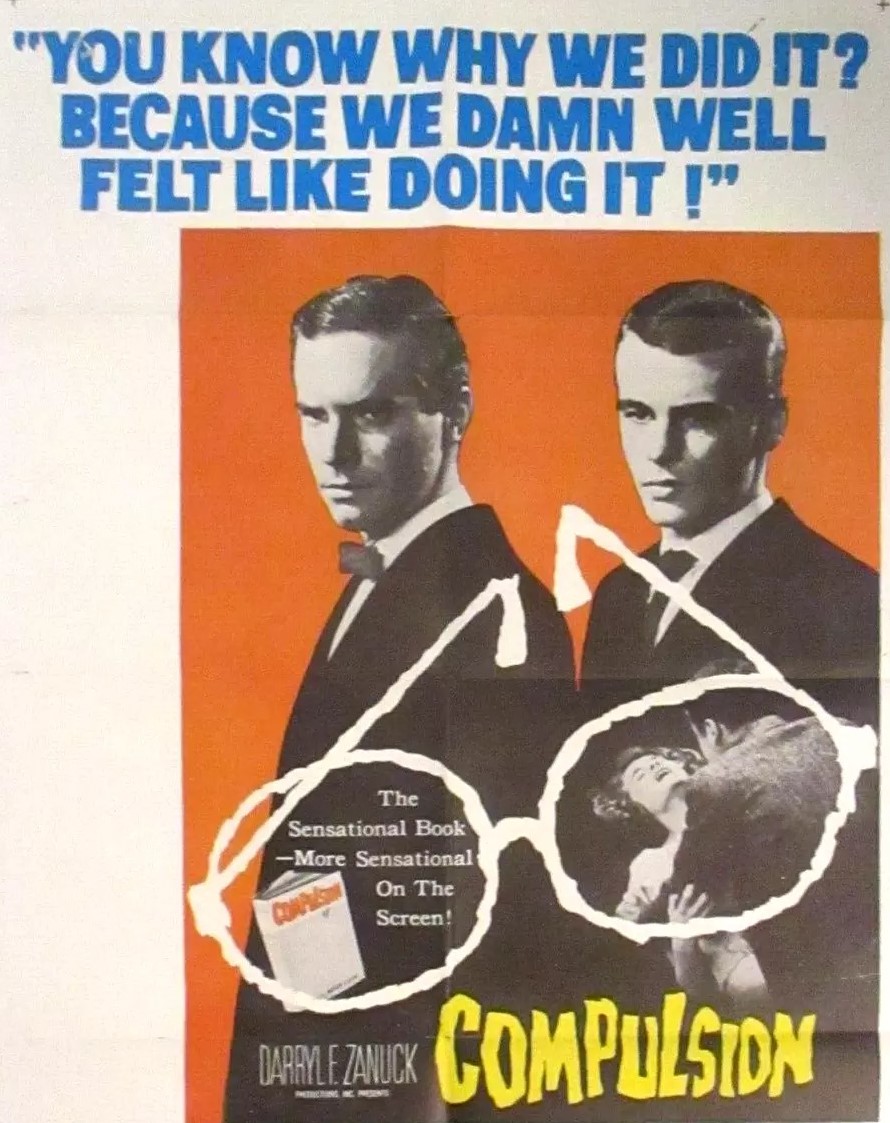
One movie that didn’t need Orson Welles to ride in and save the day and in some senses he gets in its way. Not because he’s – as was often his wont if lacking strong direction – over-acting but because his presence shifts the narrative imperative from motive and psychiatric investigation to a plea against passing the death sentence. A fictionalized version of the “crime of the century,” the kidnapping and killing of a young boy by Leopold and Lowe, a pair of intellectually arrogant wealthy young men, in Chicago 1924, it would make ideal fodder for a Netflix true crime slot, especially as there was no contesting the evidence.
Until the arrival of woebegone defense attorney Jonathan Wilks (Orson Welles) – Clarence Darrow in the real case – this has been given a low key docu style treatment even if it only touches upon what might have caused Arthur (Bradford Dillman) and Judd (Dean Stockwell) to embark on their terrible deed. They have intellectualized murder, believing that they are beyond mortals in their cranial superiority and therefore not only capable of committing the perfect crime, but relishing the prospect of getting away with it and rubbing their inferiors’ noses in the dirt.
Cocky sexually confident Arthur is the dominant one, constantly tormenting his friend for his social deficiencies, Judd the more vulnerable, astonished to find that someone can interpret the loss of his mother as impinging on his emotional security. We enter the tale post-crime and the narrative assumes the audience is already familiar with the Leopold and Lowe case, which proves a distraction now because I had to look them up to fill in the blanks.
Setting aside their superiority, the movie brings to the fore aspects of criminal behavior only familiar to us from more recent analysis. For example, Arthur wants to remain close to the investigation, offering the police advice, and taking malicious enjoyment out of pointing out possible suspects. Police procedure, which would still have been in its infancy, nonetheless turns upon tracing 4,200 purchases of a very common type of spectacles which, in an unexpected twist, is suddenly whittled down to three thanks to this particular pair containing an unique advanced design element.
However, alibis only fall apart by accident as the pair stick to their rehearsed stories even in the face of intense interrogation, especially Judd’s contention that his spectacles could have fallen from his jacket pocket close to where the body was discovered by pure coincidence. The pair have already confessed when Wilks rides to the rescue, or at least save them from corporal punishment. Most of this is via a legal trick. He places the onus of deciding their fate on the thoughtful judge who can follow legal argument more easily than a bloodthirsty jury appalled at the crime and out for revenge.
In his deployment of Orson Welles, director Richard Fleischer (The Boston Strangler, 1968) plays a blinder. Audiences expecting to see Welles in full bombastic oratory flow were blindsided by the almost apologetic tone taken. There’s virtually none of the usual courtroom sparring and there’s no last-minute witness final twist as was de rigeur for the genre. But, then, you’ve got Orson Welles, the greatest American actor never to win an Oscar, given what he could do with words, glances, whispers and silence. He’s always going to get the last laugh in an exchange of banter, but with a life a stake this isn’t the time for bluster.
It’s an incredibly well-judged performance. Setting aside the monologue, the kind actors would kill for, it’s his general demeanor, almost self-effacing, nothing swanky in his dress, and yet not resorting either to actor gimmicks like wiping sweat from his head with a handkerchief nor even raising his voice. Compare this to the Oscar-winning performance of Gregory Peck in To Kill a Mockingbird (1962) and you’ll wonder why the Academy chose to overlook Welles.
But he’s not the only standout. Bradford Dillman (Circle of Deception, 1961) has the showiest role, oozing icy charm and indifference, but the more obviously emotionally-crippled Dean Stockwell (Psych-Out, 1968) has the more difficult. Perhaps Diane Varsi (Wild in the Streets, 1968) has the toughest part, convincing as the girl who finds something worth caring about inside a killer.
Richard Fleischer has always been unfairly tabbed as the not-great director who made a number of great films. Whichever way your sympathy falls on this issue, this is one of his great movies, steering clear of the sensational, cleverly keeping Welles out of sight until virtually the final third of the movie and then, courtesy of how well he has managed the material, not allowing the actor to steal the show.
Hardly dated at all given the death penalty is still practised in many U.S. states and countries around the world. The plea for clemency isn’t so much the driving force as the acceptance that money doesn’t buy immunity from psychiatric disorder and may well be its cause. Despite his arrogance, Arthur seeks the approval of “Mumsy”, while Judd has no mother. With a host of servants to carry out the parenting, the actual parents can go off and enjoy themselves, ignorant of the dangers of lack of attachment.
It’s still hard to feel any sympathy for the pair, indulging in a thrill kill because wealth protects them and at the mercy of intellect, and while Fleischer makes no attempt at exoneration or mitigation a contemporary audience would intuit more about the family imperfections or lack of parental care or psychiatric awareness that drove them to this.
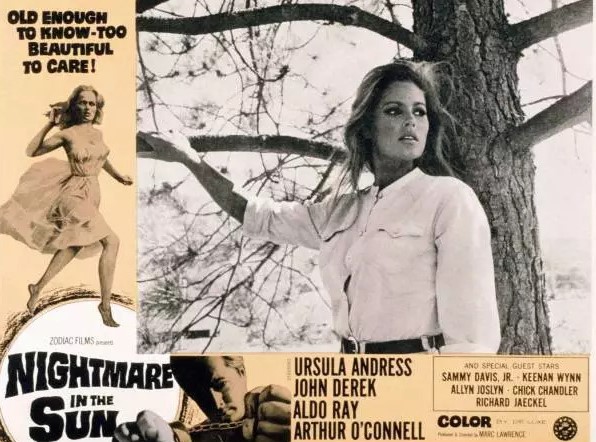
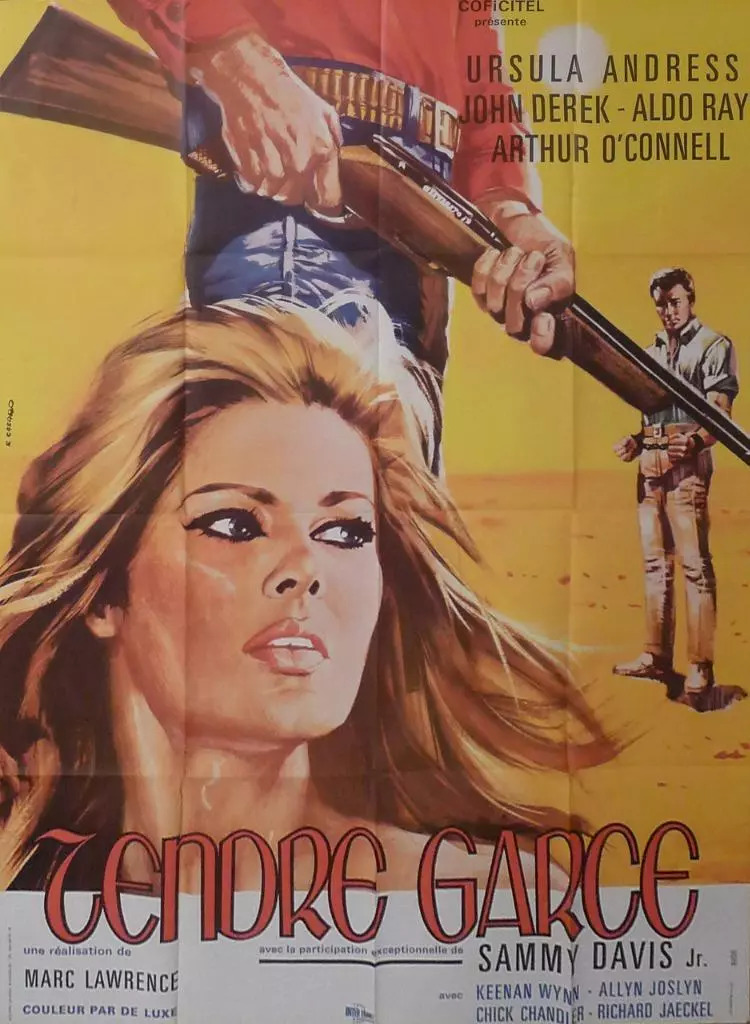
Your first question is how did rookie director Marc Lawrence have the standing and the foresight to assemble such an amazing cast? Not just wife-and- husband team Ursula Andress and John Derek (Once Before I Die, 1966) upfront, but Rat Pack member Sammy Davis Jr (Sergeants 3, 1962), The Godfather (1972) alumni Robert Duvall and John Marley, Aldo Ray (The Power, 1968), Richard Jaeckel (The Devil’s Brigade, 1968), Keenan Wynn (Warning Shot, 1966) and Arthur O’Connell (Fantastic Voyage, 1966).
And it’s bold work, throwing the Psycho dice, playing the hell out of the noir tune, most of the time heading down a nihilistic road, and with a terrific twist for a climax. Some great scenes that with a more experienced director would be instantly memorable and managing to fit into what should be a straightforward thriller some intriguing oddball characters.
Anonymous drifter (John Derek) ends up in a small town in Nowheresville where Marsha (Ursula Andress) has a slew of lovers including the sheriff (Aldo Ray). Wealthy rancher husband Sam (Arthur O’Connell) is the jealous type who checks out her speedometer to see if her tales of out-of-town visits tally up. Naturally, a handsome stranger is easy prey to her seductive charms but when hubbie spots said stranger leaving his house he loses his rag and kills her.
Holy moly, talk about Psycho, getting rid of the sexy star one-third of the way through is a heck of a note. Who does this director think the audience is coming to see? But if he’s no Hitchcock, he’s got another trick up his sleeve. Sheriff won’t let the husband plead guilty, not when he can play that card for all it’s worth, rooking the rancher for thousands of bucks, so he decides to pin the blame on the man seen leaving the house. Not only that, he plants evidence, stolen jewellery etc, on the suspect and handcuffs him.
Suspect escapes, taking with him a cop car, but those handcuffs are tougher to remove than most cinemagoers have been led to believe from previous yarns. A hacksaw won’t do it nor will trying to burn them apart with an oxy-acetylene cutter. So he’s stuck with carrying about proof of guilt or at least suspicion and spends most of the time picking up cats or items to hide the evidence.
A couple of bikers (Robert Duvall and Richard Jaeckel) decide to chase the reward money, able to scoot through the desert in a way denied the cops’ four-wheelers. It’s a shame this pair are anonymous, as most characters here are, defined by occupation rather than slowing down the pace with introductions. So it’s the Robert Duvall character who we discover is more fragile than his appearance would suggest and lashes his bike with a chain when his character is questioned.
So here’s the oddball line-up: a couple (George Tobias and Lurene Tuttle) running a small-time animal-bird sanctuary, nursing back to health creatures peppered with gunshot or the wounded version of roadkill; a junkyard dealer (Keenan Wynn), one-time hoofer who can’t wait to demonstrate his moves; and a type of boy scout leader (Allyn Roslyn) whose troop gets lost in a sandstorm, one of whom our drifter rescues. The latter sequence has a touching aspect, rescued child, probably the only person in the whole movie with an understanding of law, accepting a suspect as innocent rather than guilty, is betrayed by the leader who instead of helping our escapee to safety, hands him over to the cops.
And to a final, quite unexpected, climax.
So it’s corruption all the way, even our innocent, supposedly heading home to a beloved wife, taking time out for a touch of adultery.
There’s something about these early low-budget films that brings out the best in Ursula Andress. She’s not just spouting lines to fill in some essential part in a story, but takes her time over delivery, essentially establishing character with what she does between talking and for a practised seducer there’s an innocence in her pleading, “Please take me somewhere nice.”
Aldo Ray is as odious as they come, sneaky too, and you sense he has practice on pinning the blame on the wrong person. And no wonder the wife plays around when her self-pitying husband gets so stoned he passes out.
I saw this on a very poor print on YouTube but even so its narrative qualities, if less so the direction, were obvious.
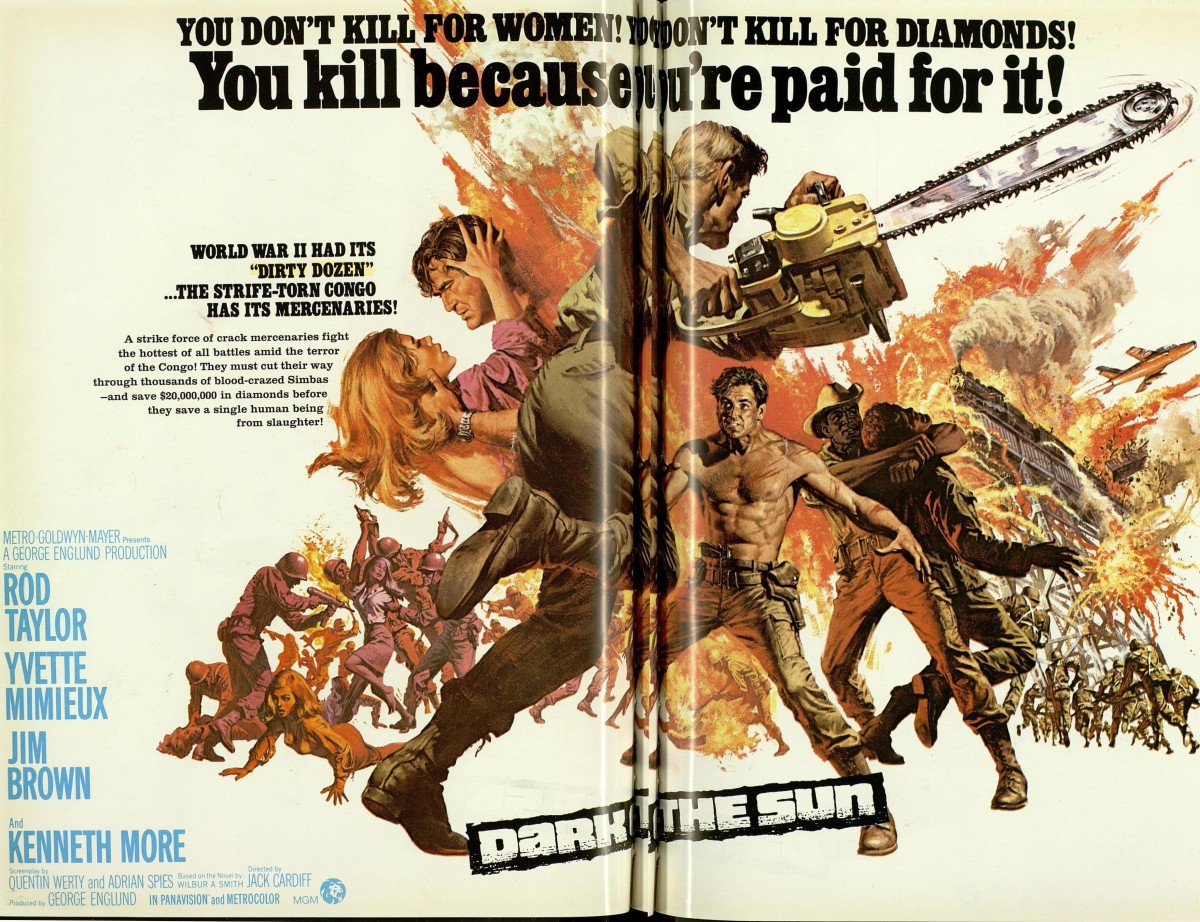
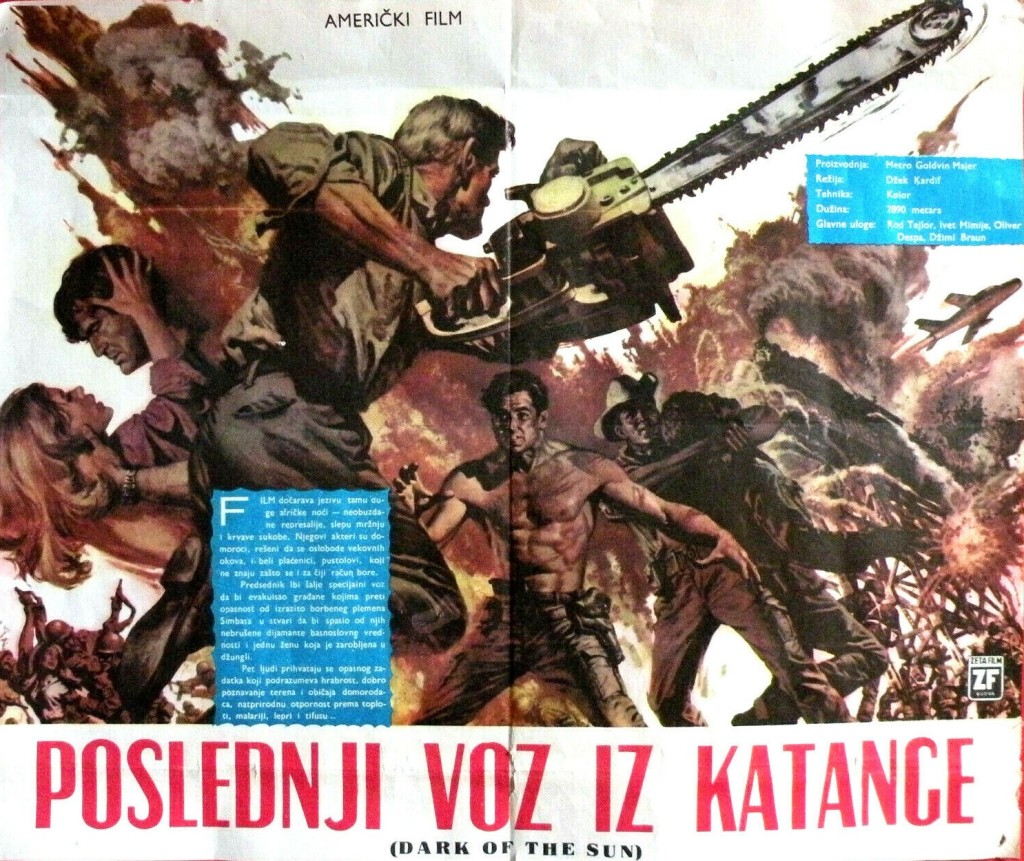
Rod Taylor made a brisk transition to two-fisted action hero from his previous forte of drama (Hotel, 1967) and comedy foil to Doris Day (The Glass Bottom Boat, 1966) in this violent adventure set in the Congo in the early 1960s. As Captain Curry, assisted by sidekick Sgt Ruffo (Jim Brown) and 40-man local outfit Striker Blue Force, he leads an ostensibly humanitarian mission to rescue settlers cut off by the Simba rebels as a cover for collecting $50 million in diamonds. The loot is essential to save the toppling regime of President Ubi (Calvin Lockhart). The only feasible transport is train. There is a three-day deadline.
Problems immediately ensue, not least a clash with Capt. Heinlein (Peter Carsten), former Nazi leader of Blue Force, who is even more ruthless than Curry, mowing down two native children who stray too close to the train, and apt to go into a fistfight with a chainsaw. The train is attacked by a United Nations plane and on reaching its destination Curry is forced to wait three hours until the time-controlled giant diamond vault can be opened, giving the rebels time to catch up. Then it’s an ongoing battle of one kind or another.
Although the worst of the violence is carried out by the rebels – rape, torture and massacre – a core element of the drama is how a lifetime of killing has affected Curry. Ruffo, a man of principle who grew up in a primitive tribe, acts as his conscience – and that of the audience – spelling out how violence is more than a money-making scheme and essential to upholding order in terrorist times. Curry has some redemptive features, saving widow Claire (Yvette Mimieux) from Heinlein, sending the alcoholic Doctor Wreid (Kenneth More) to help a woman give birth, and eventually acknowledging his strong bond with Ruffo. Although Curry would like to think he is the opposite of Heinlein, they are carved from the same stock and when the savage beast is loose blood lust takes over.
Claie is more or less there as bait, tempting Heinlein and any rebels in the vicinity, but coming into her own in convincing Wreid, paralytic by this stage, to carry out a section on the pregnant woman, and as a reminder of civilization for Curry.
The action scenes are terrific, particularly the plane strafing the train, and there is a particularly good ruse, instigated by Ruffo, to outwit the enemy. Hollywood never managed to portray the terror of the native Vietnamese on being overrun by Viet Cong, and this film could easily be that substitute, especially when some of the rescued white settlers realize they will not escape.
This is not one of those films like Born Free (1966) or Out of Africa (1985) which are scenic odes to the continent, in part because the picture was shot in Jamaica, but in the main because director Jack Cardiff (Our Mother’s House, 1967) chooses to focus on the mechanics of the mission. And in so doing, he writes a love letter to a train. There had a mini-vogue for war movies set on trains – Von Ryan’s Express (1965) and The Train (1965) come to mind – but none reveal an adoration for the power and perhaps the beauty of the locomotive. Every move it makes (to steal an idea from pop group The Police) is noted on screen and on the soundtrack, the hissing, the belching smoke, the wheels, cabooses, engine, the coupling and uncoupling of links, the screech of brakes, and various tracking and crane shots as the train snakes its way through enemy terrain.
Rod Taylor is excellent in the kind of role he is made for. Jim Brown in a major step up the billing after The Dirty Dozen (1967) is surprisingly good in a part that calls as much for reflection as action. Peter Carsten is the all-time Nazi scum. Yvette Mimieux, who had partnered Taylor in The Time Machine (1960), is also in transition mode, her role a meatier dramatic departure from the likes of the innocuous Monkeys, Go Home! (1967). In what was essentially his last major role – even though it doesn’t amount to much in screen time – Kenneth More (Sink the Bismarck!, 1960) wavers considerably from his stiff-upper-lip default.
The score by Jacques Loussier is particularly good, as Quentin Tarantino attested when he incorporated elements of it for Inglorious Bastards, which was a boon for the composer since up till then he was best remembered for the music accompanying the advert for Hamlet cigars. You might get a laugh out of the screenplay credits. Quentin Werty (i.e. Qwerty, the first six letters on a typewriter) the pseudonym of Ranald McDougall, Oscar-nominated for Mildred Pierce (1945), co-wrote the screenplay, adapted from the novel by Wilbur Smith, with television writer Adrian Spies.
An outstanding example of the all-out action mission picture, its occasional outdated attitudes do not get in the way of the picture and half a century later from what we now know of how wars are fought the levels of violence will appear realistic rather than exploitative.
The Director’s Cut, can you believe? Or less pompously, The Expanded Version. An extra 30 minutes added to the general release version that traveled the world to general disfavor. (The original 121-minute cut was edited to 109 minutes and this version clocks in at 144 minutes.) Was it a sense of disgruntlement – or sheer opportunism – that led to the Director’s Cut, so many of which scarcely improved on the original version. How many versions can an audience take of The Exorcist (1973) or Blade Runner (1982)? And even where extra length definitely added depth to Kingdom of Heaven (2005) that couldn’t overcome its major flaw, in a massive case of hubris, director Ridley Scott believing he could get away with casting Orlando Bloom instead of waiting till Russell Crowe became available.
When Time Ran Out killed off the disaster cycle and the Hollywood career of uber-producer Irwin Allen who had started that particular ball rolling with The Poseidon Adventure (1972), upped the ante with The Towering Inferno (1974) and dropped the ball with The Swarm (1978) and Beyond the Poseidon Adventure (1979).
This doesn’t feel so much like a disaster movie as a picture tying up all the knots, various relationships coming asunder, and having to accommodate a bunch of well-known supporting actors of dubious all-star-cast status before they suddenly spring into dramatic narrative view. Audiences had never been particularly keen on volcanic pictures, after all what can the trapped characters do but dodge a sludge of soup and hope they don’t run straight into a tidal wave or, worse, have to negotiate a rickety/rope bridge. The chances of you having a tightrope walker coming to the rescue would generally be remote but that’s what we have here (step forward Burgess Meredith).
I had thought from the title and some guy in a hazmat suit wandering over a desolate area that this might be a prophetic eco-disaster, but excepting that there’s, for reasons best known to the scriptwriters, an oil well being drilled close to a volcano and that hotel investor Shelby (William Holden) has the bright idea of using the volcano as a marketing prop, there’s nothing much going on. The special effects are okay on the small screen, but even if they had been spectacular on the big screen their effect on the much smaller environs of DVD would in any case have been diminished.
So, basically, it’s reliant on working up sufficient audience interest in the relationships to make us care for the characters. We’re offered a pair of two-timing teams. First up, we’ve got Shelby’s secretary and marketing guru Kay (Jacqueline Bisset) who’s just turned down the offer to become his sixth “or seventh” wife, but who, presumably is enjoying, this being the 1980s and not the 1930s, some kind of sexual dalliance with him. When Kay meets up with oil driller old flame Hank (Paul Newman), they rekindle their romance, although with doom impending there’s not much time to take it forward beyond a picnic on the beach.
Next up, hotelier Bob (James Franciscus) is cheating on wife Nikki (Veronica Hamel), Shelby’s god-daughter, with staff member Iolani (Barbara Carerra) who is due to be married to childhood sweetheart hotel manager Brian (Edward Albert). To flesh out the tale, both Shelby and Bob have daddy issues, Tom (Ernest Borgnine) is a New York cop on the tail of swindler Francis (Red Buttons), and no doubt audiences will be desperate to find who wins a cockfighting contest being held in a local saloon.
Modern transport proves no match for an eruption, so in quick succession we see a car and a helicopter tumbling down the mountainside. The tsunami wipes out a good chunk of the actors that didn’t make it into the all-star-cast bracket and everyone else takes to the hills, no doubt hoping they won’t encounter a rickety/rope bridge. Disaster turns enemies into pals, Tom and Francis, for example, though it’s only now that Nikki comes across her husband’s infidelity.
And this would be a disaster all round except that having hooked myself into watching this, courtesy of a freebie on YouTube, and nothing of real dramatic interest going on, I found myself, oddly enough, concentrating on the three principals and was treated, even more odd I guess, to fine examples of just what these stars do to earn their crust. Paul Newman (The Prize, 1963) in particular, with very little to react to, does very little but with incredible facial agility, to genuine effect, portraying emotion with infinitesimal gesture. Sure, he’s always had the shrug and the walk, both far more suggestive of inner turmoil than any other actor I can name, but here, with very little dialog coming to his aid, you can tell exactly what’s going on in those baby blues.
Jacqueline Bisset (The Cape Town Affair, 1969), too, dressed a good bit less suggestively than in the posters, essays a confident woman coming unstuck when confronted with a romantic error. The scenes between the pair are not meant to be scorching, so there’s none of the screen charisma audiences might feel they’ve been sold, but instead it’s a slow-burn, a couple trying to come to terms with each other, passing through disappointment and hopefully onto something better. And you can’t find anyone better to carry disillusion than William Holden (The Devil’s Brigade, 1968).
Abject swansong for director James Goldstone (Winning, 1969) and Oscar-nominated screenwriter Carl Foreman (The Guns of Navarone, 1961) but Oscar-winning co-writer Stirling Silliphant (Marlowe, 1969) carried on longer. Who wrote the most effective scenes, Shelby’s engagement ploy and Hank’s initial rejection of Kay, is anybody’s guess but there is some quality writing here. Probably the strangest part of the whole debacle was that the source was a piece of non-fiction, The Day the World Ended by Gordon Thomas and Max Morgan Witts, about a 1902 eruption on Martinique that had nothing to do with oil wells or hotel construction.
There’s always something wrong with a disaster picture if you suggest watching it for the acting, but happily, this is the case.












 The Magnificent 60s