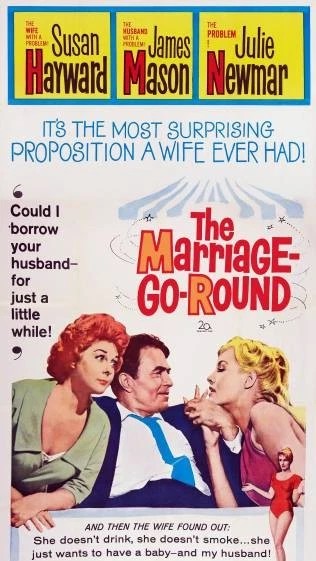
Marriage-Go-Round (1961) ***

You wouldn’t expect a typical lightweight Hollywood concoction of the frothiest kind to make a connection with our contemporary society. And, in general, you’d be correct to do so. But even in its moment of confection (or should I say, conception) this focuses on an issue that is very modern indeed. Not just an unmarried woman choosing who she wants to father her child, but targeting an already married man to do so.

And on very much genetic grounds. She can get brawn anywhere she looks in her home country of Sweden, looks too wouldn’t be hard to find, but she wants a special kind of brain to augment her own natural beauty. (The idea is based on the notion that celebrated beautiful dancer Isadora Duncan made a similar proposition to playwright George Bernard Shaw).
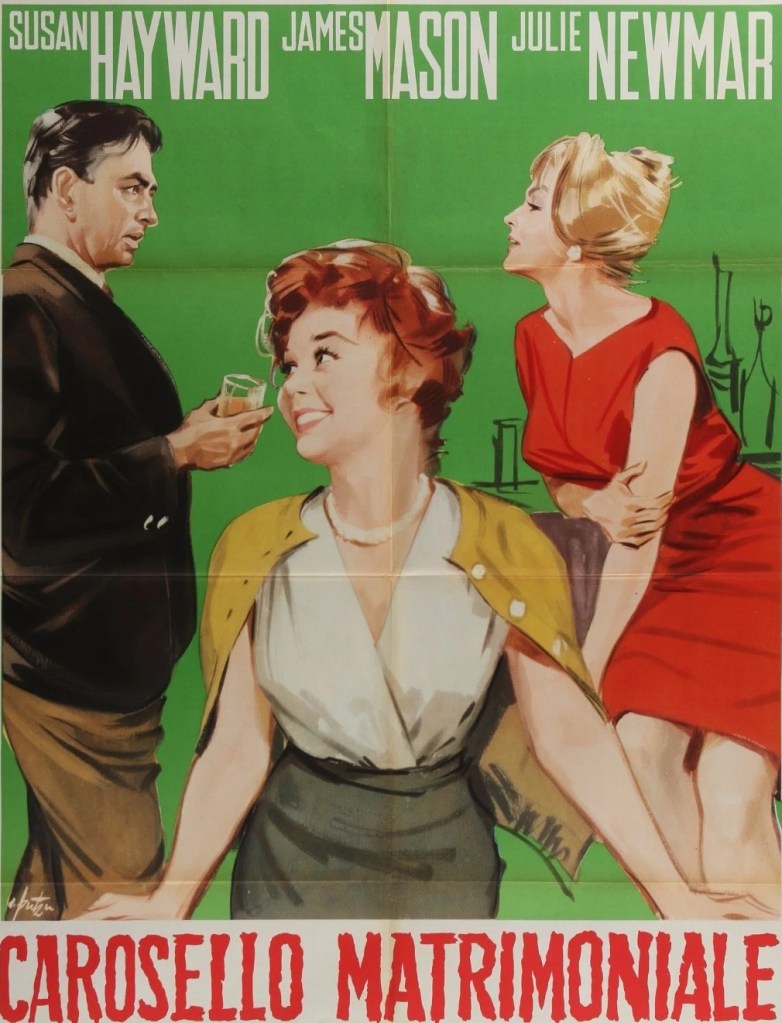
Normally, a child resulting from adultery would be possibly par for the course and switch the confection into something more serious although likely in this kind of movie there would be some easy answer, a childless couple desperate to adopt, for example, so all could end happily ever after.

The notion that it’s not love specifically the woman is after but just a hand-picked sperm donor would fit more easily into the 21st century social landscape. And our heroine would be praised to the skies for not muddying the waters of maternal ambition with anything so onerous as romance.

The married couple here Paul (James Mason) and the unfortunately named Content Delville (Susan Hayward), both sociology professors, add zest to proceedings by adding comment (occasionally verging on the hypocritical) from the sidelines in the form of lectures being delivered contemporaneously representing male and female attitudes.

The tall well-endowed Swedish blonde bombshell Katrin (Julie Newmar), daughter of a former colleague of Paul, whom the couple knew as a gangly teenager a decade before, hasn’t a discreet bone in her body and no sooner has she turned up at the Delville household on vacation than she’s putting her unusual proposition to Paul. Flattered though he is by her attentions, clearly he would be happier with just enjoying a little sex on the side without the outcome she seeks.
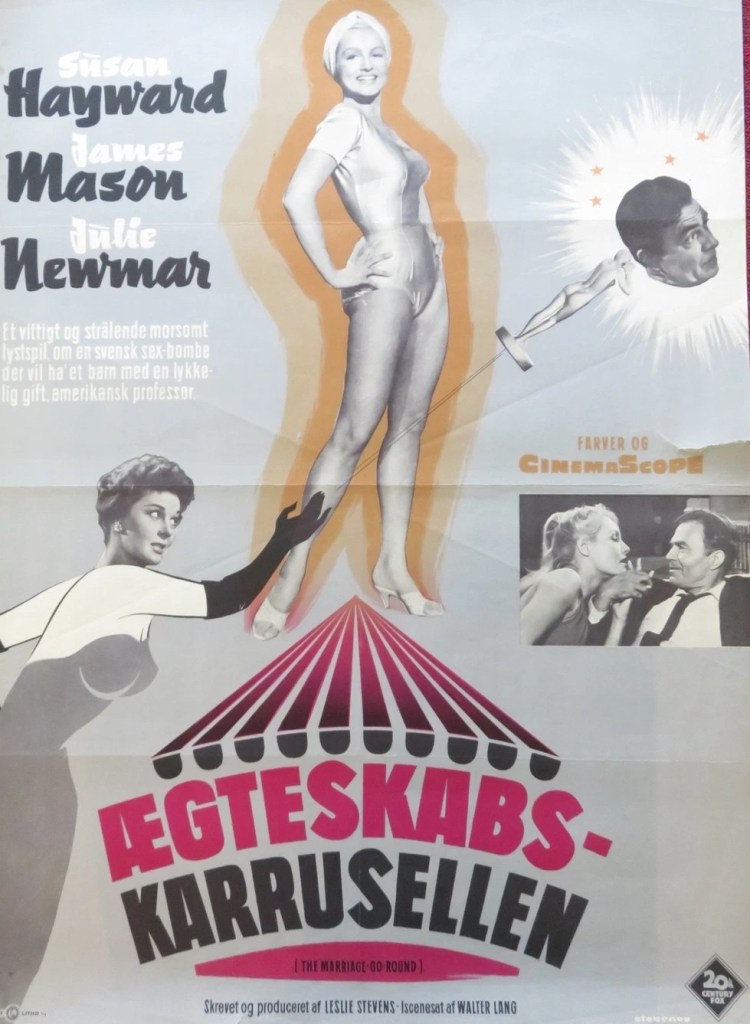
So most of the film is Paul trying vainly not to succumb, pretty hard when she makes such an obvious show of herself, flaunting her physique in swimsuit and sometimes modesty only protected by a towel and, again given discretion is not in her nature, presenting him with a nude statuette of herself so he can get a proper idea of what he’s  missing.

Meanwhile, his wife is trying to convince herself that her husband is not going to stray. She makes the mistake of seeking the advice of married colleague Dr Ross Barnett (Robert Paige), unaware that to a man capable of exploiting vulnerability he is only too willing to take advantage of the situation and persuade her that having an affair with him would even things up.

And meanwhile, meanwhile, in their role as observers, the couple continue to present themselves in a different manner while offering advice to their tempted selves.

Though based on a successful Broadway play, such a hit that MGM paid $400,000 for the screen rights, the unusual structure limits the staginess and filmed in the classic will-he-won’t-he sex comedy manner and filled with lavish colorful costumes and sets it fulfils its lightweight (for the times) ambitions.

Hollywood wasn’t at all averse to pitching these May-December romances especially as its biggest stars were getting older, but this is a distinct twist on that scenario. James Mason (Age of Consent, 1969) is excellent as the older man who only wants part of his cake to eat it, and while trying to retain a morally upright stance finds that seductive immorality is hard to stop.

Susan Hayward (I Thank a Fool, 1962) has her work cut out to prevent the slinky Julie Newmar (Mackenna’s Gold, 1969) stealing the picture.

Adapted from his own play by Leslie Stevens (The War Lord, 1965), it’s directed with a clever eye by veteran Walter Lang (Can-Can, 1960).

Would have fitted into the “high concept” category for the time except it carries reverberations into the present day.

Fun cast and good laughs.
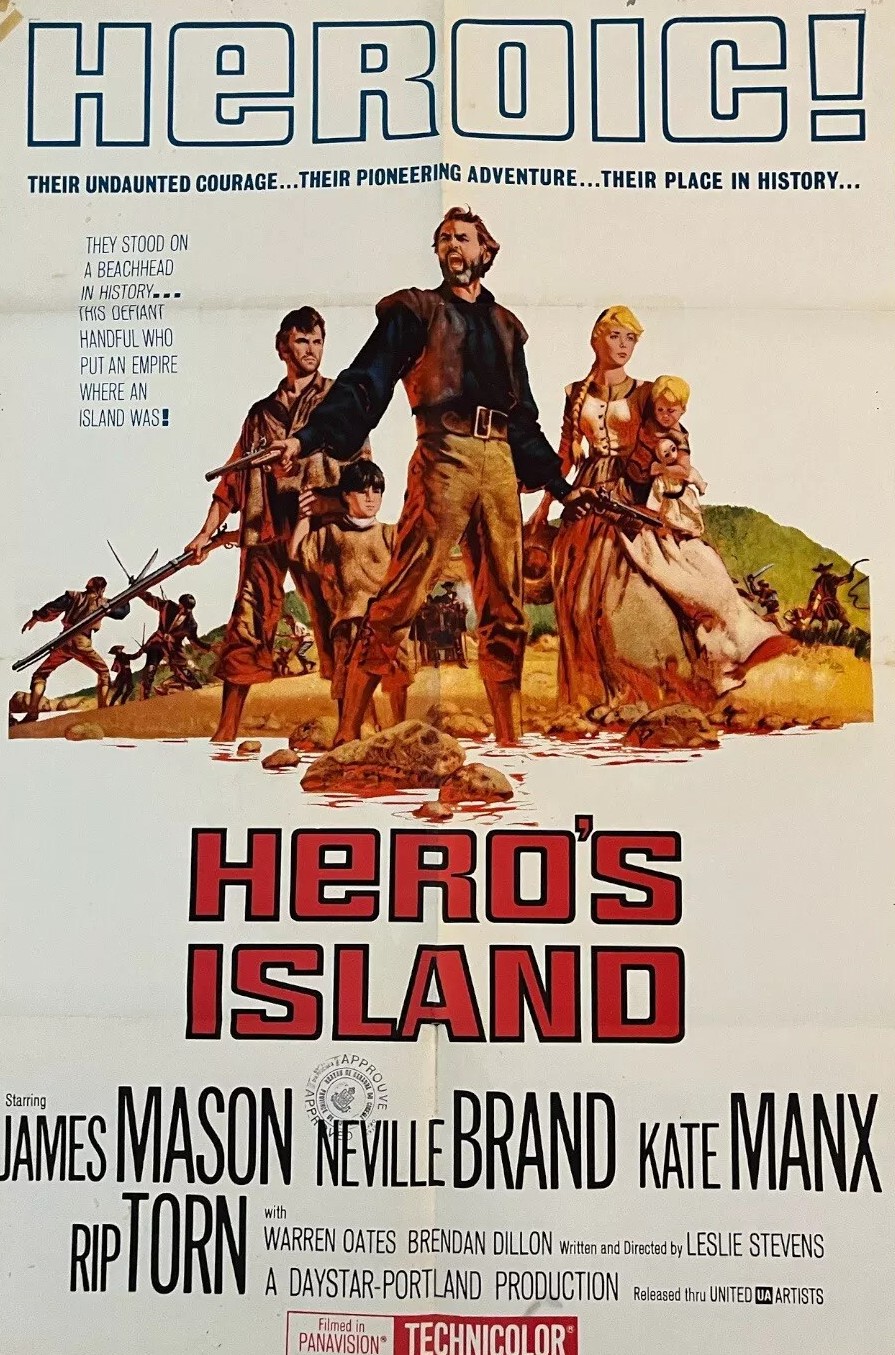
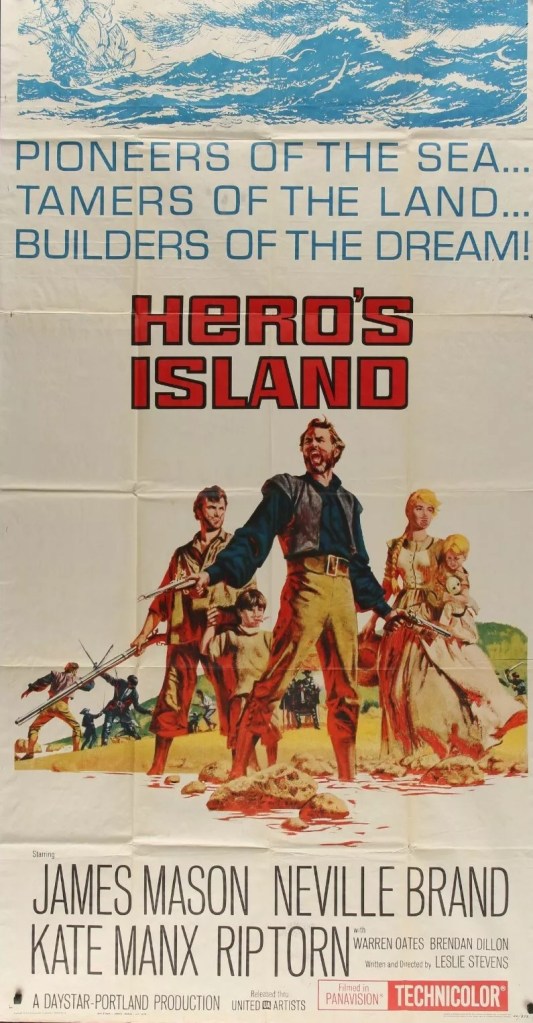
Hero’s Island (1962) ***

There’s a good reason you’ve never even heard of this famous lost film. A fabnulous cast – cult character actors (and occasionally stars) Warren Oates, Harry Dean Stanton, Rip Torn plus a top-billed James Mason – can’t prevent this relatively short film coming over as long drawn out. Proof, too, that cult television producers – in this case Leslie Stevens of The Outer Limits (1963-1965) and Stoney Burke (1962-1963) – shouldn’t always risk stepping into the director’s chair.  

But let’s stick for the time being to the good bits. It’s a historical Lord of the Flies, an almost primitive battle over territory, a small apparently uninhabited island off the coast of the Carolinas in the United States. There’s recognition of the British version of slavery, when, driven off their lands, or to escape dire poverty, people in the eighteenth century went willingly into indentured service in North America. After seven years, you could gain freedom – a contract torn up and rejoined at the indent the legal definition – and wives could equally be bought and if they were very lucky the husband might even agree to marry them in a church. You could buy children in similar fashion. There were other legal niceties, ownership could be challenged, since only a “full working family” could take command of land.

Freed from indenture, Thomas Mainwaring (Brendan Dillon), wife Devon (Kate Manx), two young sons and servant Wayte (Warren Oates) arrive on Bull Island, intending to live off the land, growing crops, fishing, building a house, and honoring God. But brothers – fishermen – Nicolas (Rip Torn), Dixey (Harry Dean Stanton) and Enoch (Robert Sampson) resent the intrusion, murder the husband and attempt to drive the others away, first invoking the law and then threatening violence.

The situation becomes more balanced when  Jacob (James Mason) washes up on the shore, tied hands and legs to a raft, though claiming to be the subject of a shipwreck. Gradually, he sides with the widow although he doesn’t take kindly to her giving orders, refusing to bear arms, and believing that faith in God will see them through. He’s so disenchanted that when pirates descend on the island, he stands back, refusing to help when the widow and then her children are kidnapped.

But eventually, thank goodness, he springs into action, revealing hmself handy with a cutlass, and a pirate, having sailed with Blackbeard, though his captaincy did not go so well, mutiny the true reason for ending up on a raft. Still, he wades into the pirates, retrieves the situation and the fisherman accept the widow’s rights to the island.

So, some interesting historical information, and a touch of swashbuckling. But that hardly makes up for the acres of time when nothing much occurs and the characters jaw about God, the law and life in general. A tinderbox of a set-up barely crawls along, scarcely catching fire.

And that’s despite the all-round good acting, Rip Torn (Sol Madrid, 1968), Harry Dean Stanton (Paris, Texas, 1984) and Warren Oates (The Wild Bunch, 1969) all at the beginning of their careers, their trademark acting styles not yet developed, so talent revealed as fresh, while James Mason (The Deadly Affair, 1967) acts very much against type. In her sophomore screen role, Kate Manx (Private Property, 1960), Leslie Stevens’ second wife (of five), only holds sway until Mason appears to blow her off the screen.

Writer-director Leslie Stevens (Private Property) has way too much to say but not the directorial skill to properly dramatize the material, which is crying out for greater tension, fiercer argument and more action.  

Now that I’ve brought this movie to your attention you may be wondering why, with this knock-out cast, you’ve never heard of it. And the reason is, as I’ve explained, it just doesn’t take off. More like a filmed play than a movie, the camera hardly ever moving. I’m not sure either why James Mason was tempted into becoming joint producer. He had just come off Tiara Tahiti (1962) and Stanley Kubrick’s Lolita (1962) so I would be guessing his career was in decent shape. Though sometimes it’s marquee power that pushes actors into the producing field. Whatever the plan, it backfired, the movie was a financial disaster and he wasn’t top-billed again for four years.

Worth a look for the cast but mostly just to see how even with the best cast a movie can miss the spot.

Discover WordPress

A daily selection of the best content published on WordPress, collected for you by humans who love to read.

The Atavist Magazine

by Brian Hannan

WordPress.com Blog

News, Tips & Website Tutorials