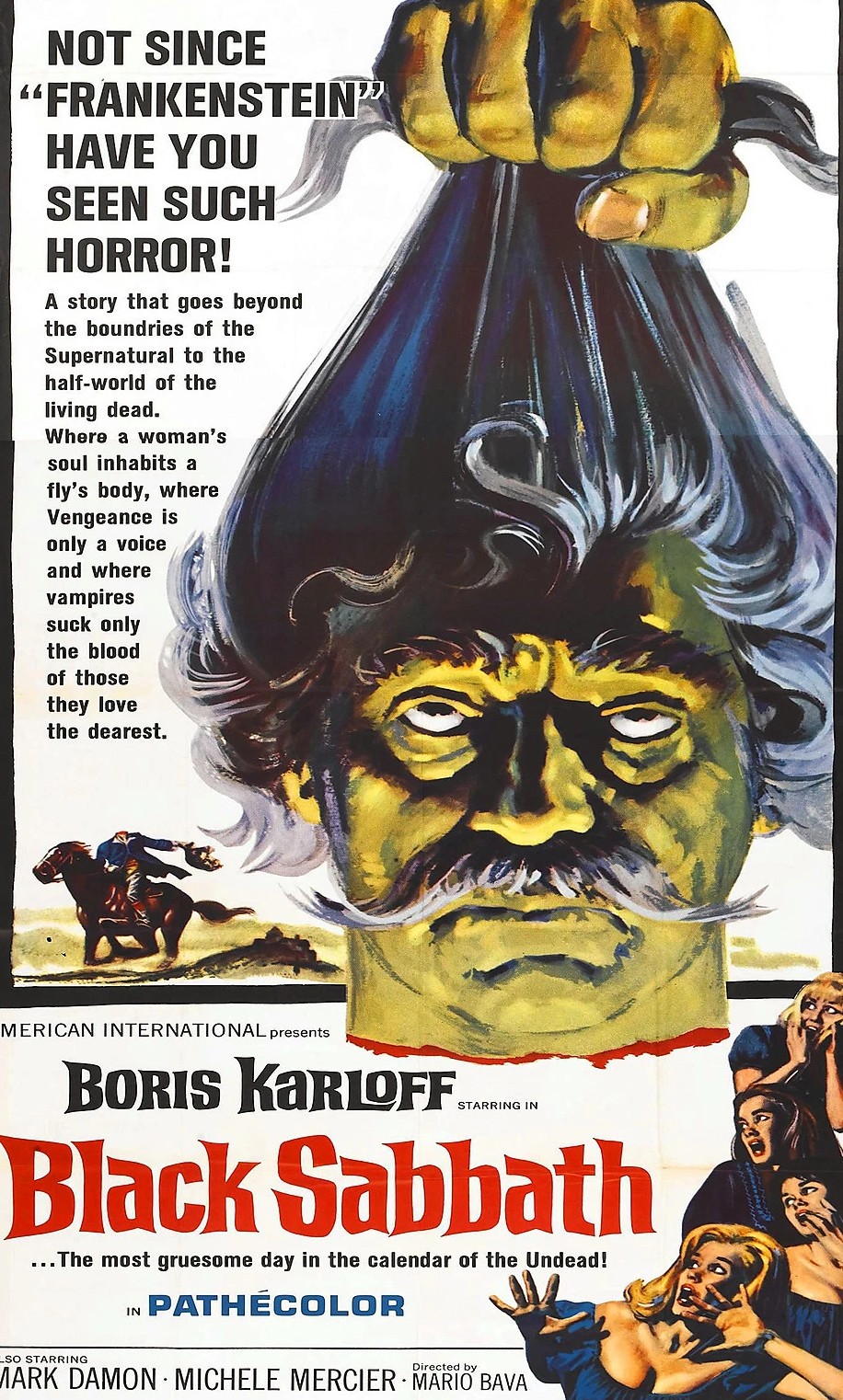
Fully deserves its cult status. This portmanteau of three horror tales is held together by Boris Karloff (The Crimson Cult/Curse of the Crimson Altar, 1968) in the creepy style Alfred Hitchcock adopted for introducing episodes of his television series. Director Mario Bava (The Whip and the Body, 1963), possibly better known for giallo than horror, is more inclined to employ sight and sound to unnerve his characters – and the audience – rather than the jump scares you’d get today.
So, yes, a phone ringing might well be a standard thriller trope and trigger high anxiety but the sound of a fly buzzing (except obviously in The Fly) and the steady trip of water would fall into the more unusual category. Plus Bava is in the Luchino Visconti (The Leopard, 1963) class in his use of color. In one section, the tones shift, in the same room, to a dull red and an eerie blue/green.
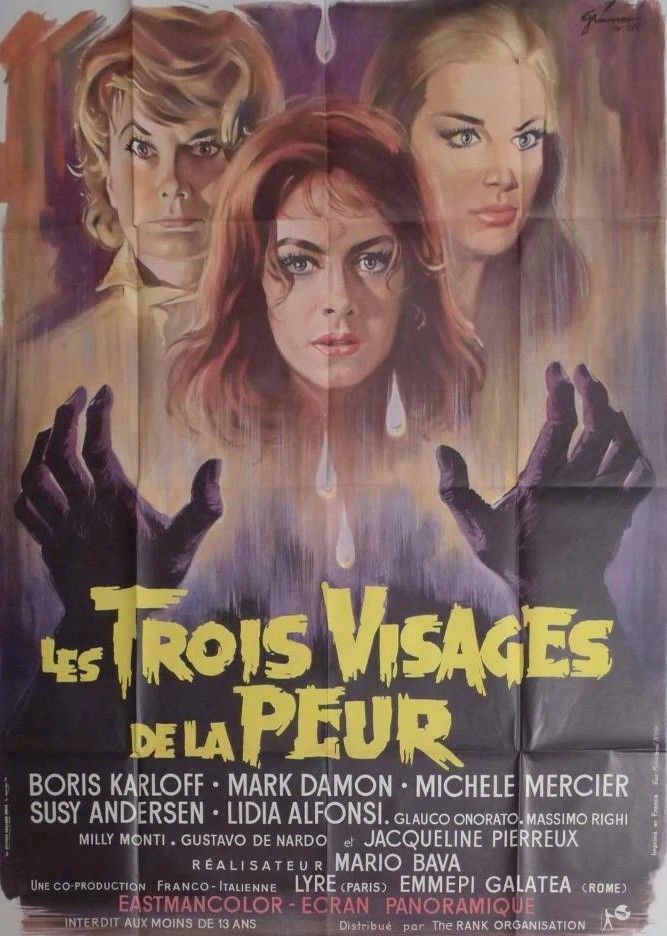
In the manner of these multi-country co-productions, each country supplied a star who could sell it domestically. So Michele Mercier (You Can’t Win ‘Em All/Dubious Patriots, 1970) represents French funding, Lidia Alfonsi (Face to Face, 1967) the Italian contribution while Karloff and Mark Damon (The Young Racers, 1963), in the final segment, hold up the American end.
In some respects, the opening piece is the best. Nurse Helen (Jacqueline Pierreux) is called out late at night to deal with a corpse, preparing it for burial. She steals an expensive ring from the dead woman’s finger. Accidentally, she tips over a glass of water. Not accidentally, she takes a few swipes at a fly that has alighted on the woman’s ring finger. Back home, the fly reappears, buzzing around in the darkness.
If that’s not enough, she hears the sound of dripping water. She races around her apartment switching off dripping taps in the kitchen and bathroom. But that doesn’t stop the dripping. And the fly keeps buzzing away. It’s astonishing the tension racked up by this pair of low-level sounds, no need for thunder or lightning or pouring rain or furniture moving of its own accord and all the other tricks of the horror trade. Then the corpse appears. It doesn’t end well.
French sex worker Rosy (Michele Mercier) starts receiving menacing phone calls late at night, purportedly coming from her dead pimp Frank (Milo Queseda). Her testimony put Frank in prison. Rosy seeks help from her former lover Mary (Lidia Alfonsi) who traipses over, provides Rosy with a knife for protection and sedates her. And then, in a letter, confesses that she was behind the menacing phone calls in a bid to win back her former lover. Frank breaks in, strangles Mary, imagining her to be Rosy, and then advances on Rosy, unaware of the knife hiding beneath the sheets. It’s only when it’s over, you realize that it was tragedy, after all, if seen from the perspective of Mary, whose telephone ploy resulted in her own death.
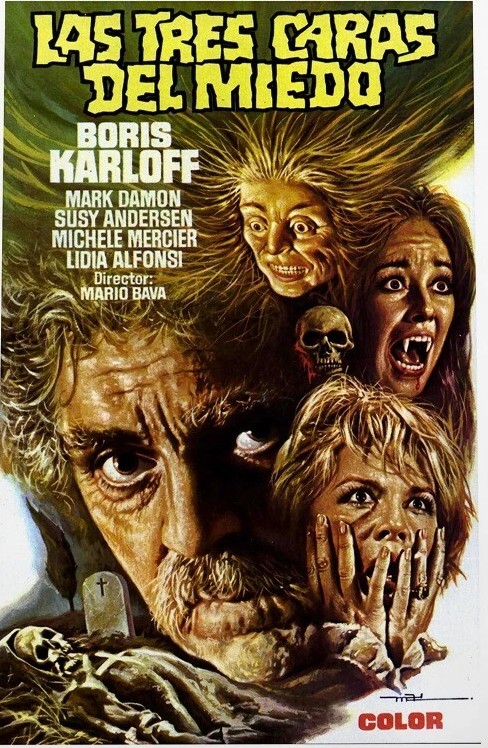
Boris Karloff has a menace all of his own in the final segment, a vampire tale set far away from the traditional Transylvania. Count Vladimir (Mark Damon) comes upon a beheaded corpse with a dagger through its heart. The knife belongs to Gorca (Boris Karloff) who has gone missing, but is apparently vampire hunting. When he returns he’s pretty shaggy-looking. Vladimir, meanwhile, has been taken in by his family. And it turns out that for someone wanting to avoid vampires that’s the worst place to be.
The Karloff portion could as easily have been expanded into a full-length feature, but as it is, it is laden down with a haunting kind of horror and the gradual realization that all is not well.
Overall, while audiences might welcome the various stars, this is, unusually for horror, a director’s picture. Saturated with a craftsman’s use of color, and raising tension with every sight and sound, this is Bava at his best.

