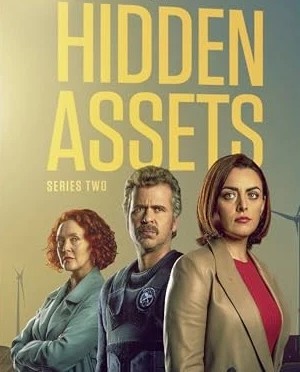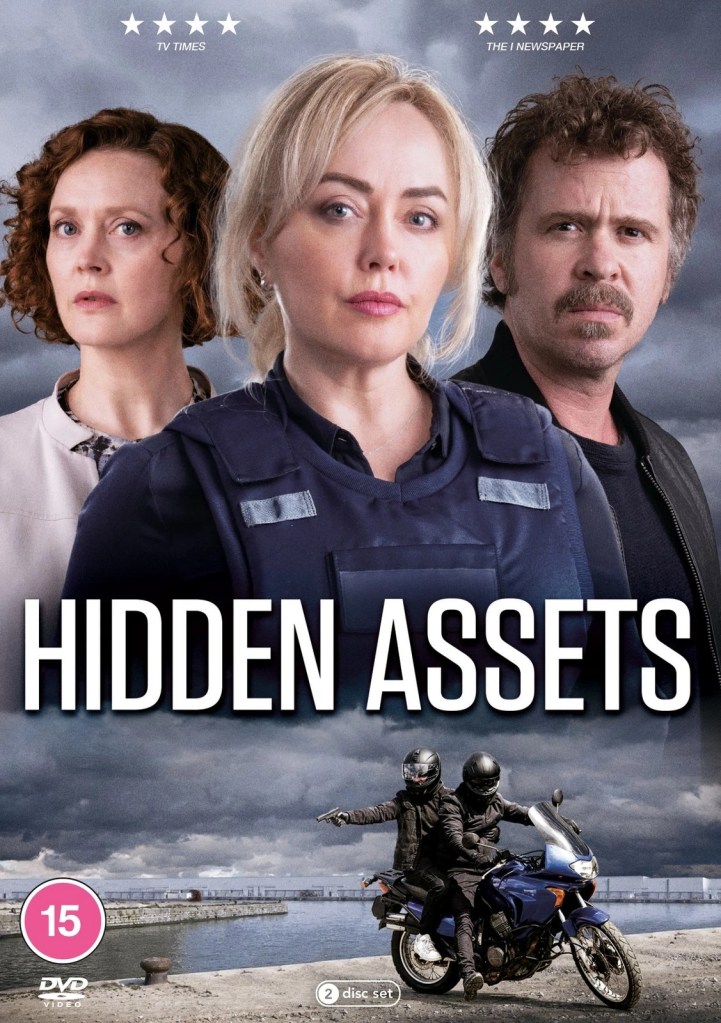
Hidden Assets: Season 1, 2021*** Season 2, 2023**** Season 3, 2025**

Jumping the shark takes a particular blend of over-reach and narrative naivety. Assumptions about what makes a series tick are often misleading. Dramatic changes to personnel and location can both add (as in Season 2) and detract (as in Season 3).

I’ve been binge-watching this Irish-Belgium/Irish-Spanish crime series when I should be knuckling down to viewing more movies from the 1960s. I thought I was onto a winner when the second series proved a vast improvement on the first. That was before I came to the third series. The first two series are connected and I’m just hoping nobody’s of a mind to link the third series to another, as yet unmade, series.

As far as investigation goes, we’re in new territory. The Criminal Assets Bureau in Ireland tracks down the cash made by big-time crooks. Jurisdiction can extend, by mutual consent, to European countries such as Belgium (the first two seasons) or Spain (the third).

What makes the first two, related, series so captivating is that they’re not just about crime but political machination and big business and cover areas like immigration and the rise of the Far Right political parties.

SERIES ONE:

You might wonder how Irish cops end up in Antwerp. The connection is diamonds, Antwerp being famous for them, and gangsters now utilizing them as the easiest way to shift currency away from prying eyes. Irish cop Emer Berry (Angeline Ball) heads up a Criminal Assets Bureau investigation chasing gangster Fionn Brannigan (Peter Coonan).

That leads her to Belgium where she crosses swords and paths with gum-chewing (he’s trying to stop smoking) Belgian cop Christian de Jong (Wouter Hendrickx). He’s on the trail of terrorists whose latest outrage killed 11 people and sent the ratings soaring for Far-Right politician Victor Maes (Steve Geerts). Brannigan turns out to be the estranged brother of Bibi Melnick (Simone Kirby) who runs a huge business in the port of Antwerp.

She’s connected by marriage to dodgy businessman Richard Melnick (Michael Ironside) who wants to privatize the publicly-run port. Bibi gets mixed up in a people-trafficking scam, linked to the terrorist. Takes a heck of a time to entangle most of the proceedings and there’s an ending – a possible connection between the terrorism act and Maes – that lends itself to a sequel.

Bibi is the main victim, losing her job to the ruthless Frances Swann (Karine Vanasse).  The hard yards of policing and inspired use of technology are compounded by sufficient action. But the biggest flaw is Angelina Ball. She just looks disinterested all the way through and given she’s our conduit to the developing tale it’s hard at times to summon up the energy to keep watching.

SERIES TWO:

Ramps up the tempo beginning with Emer Berry having been replaced by high-flying Detective Sergeant Claire Wallace (Nora-Jane Noone) who has the grit, tenacity and emotional input her predecessor lacked. And a huge gender shift of power takes place.

It’s the women who take prime position. Frances Swann looks like a distant relative of Jack Palance or Lee Marvin with those gimlet eyes and she spins the wheel astutely. Bibi Melnick, who looks out for the count, standing to lose her entire family fortune and possibly her son (husband James already collateral damage), pulls out an absolute blinder of a last-minute trick and reveals that she’s a worthy successor in the duping game to the likes of Keyser Soze of The Usual Suspects fame. Even Fionn’s wife Siobhan (Sophie Jo Wasson) isn’t an innocent bystander but well up to ensuring she gets her share of ill-gotten gains.

There’s a disconnect between Wallace and De Jong because she suspects there’s a mole in his side of the operation and that person, in the spirit of entrepreneurism that infects the city, is a woman and delivers, if unintentionally, the coup that knocks the audience for six. And in the background, cleverly playing the conservation card, is another businesswoman who turns out to be in collusion with Bibi. Wallace and De Jong also fall out because he shoots the cornered terrorist and she wanted him alive, not out of the goodness of her heart, but for interrogation purposes.

But this is well-drilled stuff, red herrings, twist and turns, interference by superiors, realpolitik, the harsh stink of dirty dealings plus a side helping of racism and drug running. The stakes are incredibly high, politicians blackmailed by criminals, assassins running amok, cops racing against the clock to prevent another  terrorist explosion, billions of Euros on tap from privatization and another 200 million Euros – Bibi’s father’s hidden wealth – up for grabs. The cops think they have come out on top, outside of the political machinery that they have to put up with, and the audience thinks so too until the final killer scene.

Without the deadweight of Angeline Ball, the second series really flies, all the actors stepping up to the plate, Nora-Jane Noone (Bring Them Down, 2024)  and Wouter Hendrickx (The Class of 2000, 2025) more than hold this together and would be the stars of the show except for sheer cunning they are outdone by Simone Kirby (Kneecap, TV series 2024), who plays an especially clever long game in acting terms, and Karine Vanasse (Cardinal, TV series 2017-2020). Shining among the supporting cast is Cathy Belton (Miss Scarlett and the Duke, TV series 2020-2026).

SERIES THREE:

Begins with a major problem. De Jong was killed in series two so he’s not available and the action switches to Spain. But Detective Wallace (Nora-Jane Noone) is now saddled with two sub-plots. Suddenly, it’s revealed she is a mother with a disgruntled partner. And although she stood calmly by and watched a terrorist get his head blown off in series two – her only emotion  being annoyance that she can’t interrogate him – now she appears to fall apart when a criminal blows his brains out in front of her.

The plot, when it veers from the straightforward drug-running and people-trafficking, is shot through with holes. Wallace, hunting 27 million Euros, heads for Bilbao where the trail leads to Irish crook-gone-legit Anthony Pearse (Frank Laverty) and she becomes embroiled in a local investigation into the murder of a local journalist.

I’m sure all the plots regarding drug-smuggling and people-trafficking have been explored and I sympathize with writers forced to come up with something novel. But not when it’s as barmy as this. Immigrants and drugs are being smuggled in from Africa in the same trucks carrying hazardous waste (the immigrants a side hustle).

Immigrants had been turning up in hospital with the kind of ailments you get from contamination with hazardous waste. But none of the gangsters unloading either immigrants or drugs have been so afflicted, yet the minute Wallace inadvertently steps in a puddle of waste alarm bells start ringing.

The waste is being transported out of Africa for treatment in Bilbao by – wait for it – a medical charity that wants to ensure the waste resulting from its good deeds isn’t left behind. There must be countless dumps, legal or otherwise, in Africa for the stuff, never mind shipping it thousands of miles, at who knows what cost to a struggling charity, to northern Spain (presumably there’s no comparable factory in southern Spain.)

Nora Jane-Noone is hampered by having to switch on the emotions every now and then whereas before she had been as flinty-eyed as the criminals and having to keep a straight face at various denouements involving hazardous waste.  The screen chemistry (not of the romantic kind I hasten to add) that she had with De Jong in the previous two series is not replicated with the Spanish cop played by Inigo Gastesi.

The only saving grace in the third series is a new character, the extremely annoying ambitious Detective Liam Boylan (Donall O’ Healai) who rats on colleagues, steals everyone’s ideas but actually is an ace interrogator and has the knack of getting information out of people where others have failed.

Series three is a series too far but the previous episodes are worth watching.

Young Cassidy (1965) ***

I’m assuming MGM adjudged that a film about a playwright, no matter how famous, and even if directed by John Ford (Cheyenne Autumn, 1964), would not be enough to attract an audience. And that a better physical match for said writer would have been a weedy actor of a Tom Courtenay  disposition. So, I came to this with no idea it was about world-famous Irish playwright Sean O’Casey since his name is never mentioned and the main character is called John Cassidy (Rod Taylor).

Which was just as well because I was wondering what kind of lad Cassidy was when despite his obvious brawn he was an inept labourer, requiring instruction on how to properly use a spade. That this working-class fellow has any inclination towards authorship is not obvious until halfway through the picture, by which time he has demonstrated qualities more appropriate for brawling, revolution and sex. 

Technically, this was a John Ford film as he was the producer.
The French chose not to point out he was not the director.

It probably says a lot about me that I was unaware of the significance of the title of O’Casey’s most famous play – The Plough and the Stars (1926 and, incidentally, filmed a decade later by Ford). By the time I was cogniscent of the country – early on, I assure you, as my grandfather was an Irish immigrant – the Irish flag was the tricolor made up of green, white and orange. I hadn’t known that the flag created by rebels two years before the Easter Uprising of 1916 was a representation of the plough and the stars, hence public outrage when O’Casey blithely adopted it as the title for his breakthrough play.

But you only need a vague idea of history to appreciate the movie. A couple of stunning scenes provide the background of dissent and poverty. The brutality of soldiers and police in quelling a riot is matched by striking transport workers tossing a scab into the river, his drowning ensured by the wagon that follows him in. Cassidy’s true position in the hierarchy is best shown when he is given a cheque rather than cash from a publisher. Lacking a bank account, not only does he fail to cash the cheque but is treated dismissively by clerks at the bank. His joy at rising above his station in receiving such a payment is immediately destroyed by feeling out of place and unwelcome in a bank.

Because, otherwise, Cassidy is quite the confident young fellow, winning over almost any young woman who falls within his compass, varying from upmarket prostitute Daisy (Julie Christie) to meek bookshop assistant Nora (Maggie Smith) and casual acquaintances.

Writing isn’t presented in the romantic manner of David Lean in Doctor Zhivago out the same year (with Julie Christie in a much bigger role), no stunning imagery and no close-up of soulful eyes, just Cassidy sitting at a table working through the night. But there is no indication as to why he chose plays as his metier, especially when the main theatre in Dublin, the Abbey, was the fiefdom of the middle- and upper-classes.

Ironically, Cassidy is tested more when his situation improves than as a downtrodden worker joining the revolutionary cause. As a worker his fists, brawn, brain and looks see him through. But once he steps up into the intellectual class, he is adrift, his new occupation driving a wedge through relationships.  

Not aware that this was a biopic of a playwright, I had little need to question the narrative, and just took each incident as it came. I never had the impression of a condensed biopic, crammed full of cameos. More of an interesting story set  against the background of rising Irish nationalism.

There’s a certain amount of “Oirishness” to contend with – the accents vary – the poverty is never as bleak as you might expect, and once the story heads out of Dublin you might think it’s going to go all the way to The Quiet Man country. But then you have to bear in mind that working-class poverty, as long there was employment available, was not quite of the slum kind, and that once you get out of Dublin you do indeed hit beautiful countryside.

Rod Taylor is good as the brawler-turned-playwright. In the duel of the rising stars, Maggie Smith (The Prime of Miss Jean Brodie, 1969) wins by a nose from Julie Christie, but then, though further down the credits, she has the bigger role. Michael Redgrave (Assignment K, 1968) as poet W.B. Yeats (responsible for the phrase “a terrible beauty is born”) makes the most of choice lines, Edith Evans (The Chalk Garden, 1964) is a quirky, mischievous  Lady Gregory, co-founder of the Abbey. It’s top-heavy with talent including Sian Philips (Becket, 1964), Flora Robson (55 Days at Peking, 1963), Jack MacGowran (Age of Consent, 1969) and T.P. McKenna (Perfect Friday, 1970).

Turns out John Ford was too ill to direct more than few minutes and that role fell to Jack Cardiff (Dark of the Sun, 1968) and I would have to say he does an agreeable job. John Whiting (The Captain’s Table, 1959) drew from O’Casey’s autobiography to write an intelligent script.

Discover WordPress

A daily selection of the best content published on WordPress, collected for you by humans who love to read.

The Atavist Magazine

by Brian Hannan

WordPress.com News

The latest news on WordPress.com and the WordPress community.