The Luck of Ginger Coffey (1964) ***

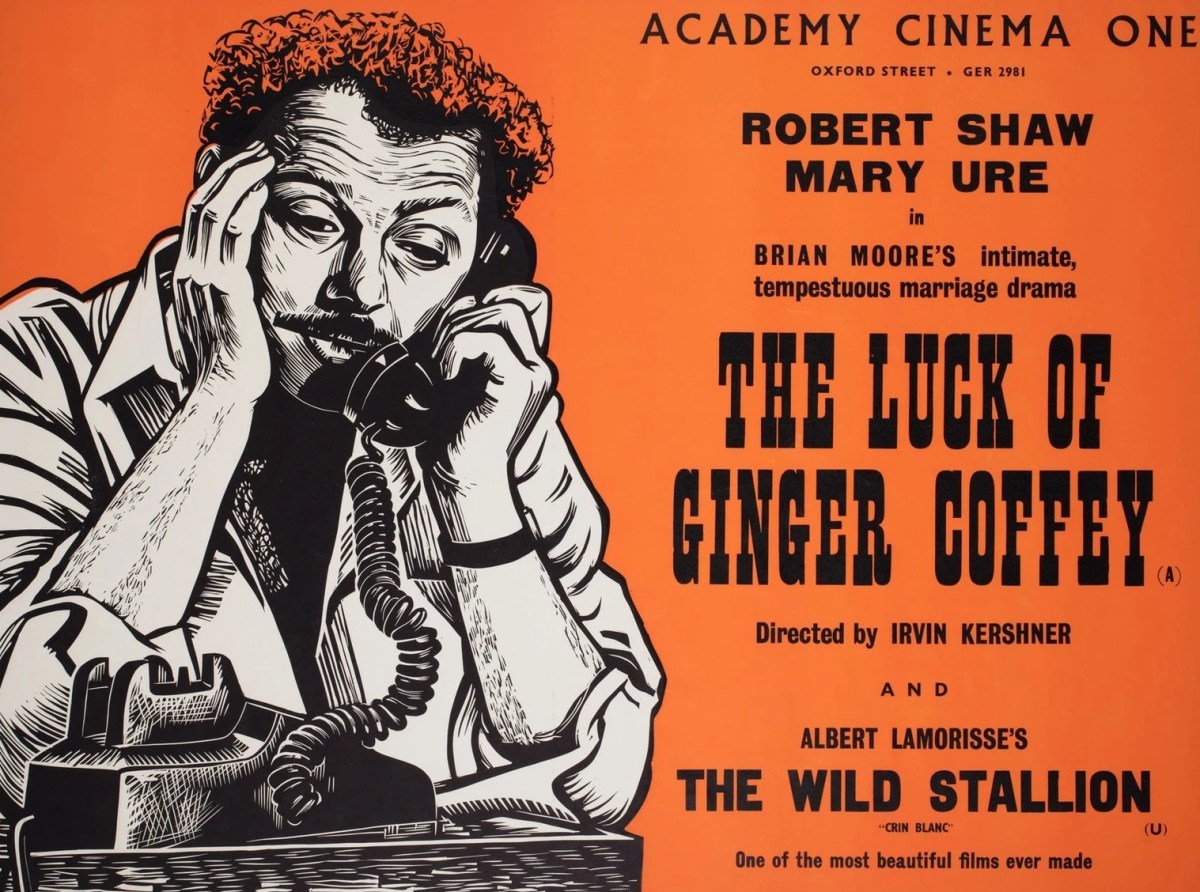
The feckless in movies usually have charm to see them through. The titular Ginger (Robert Shaw) is remarkably deficient on that front. He’s the wishful-thinker par excellence though his wishes are off the scale and he seems to be also deficient on the thinking front. After 14 years in the Army in Ireland, he’s emigrated with wife Vera (Mary Ure) and daughter Paulie (Libby McLintock) to Canada where he has notably failed the make the grade.

He’s eminently employable, just not at the type of job to which he thinks he is entitled, if not directly in the managerial line then something where promotion is guaranteed. He’s always got an excuse for quitting a job after a few weeks.
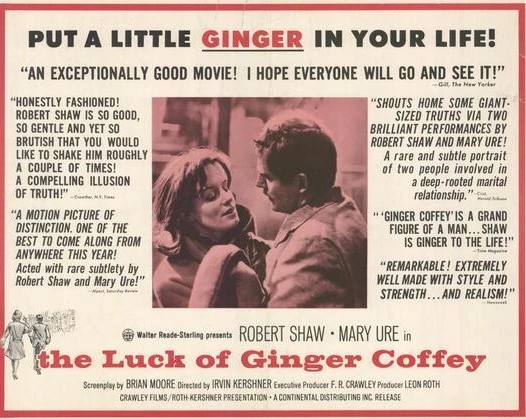
This would fall into the “kitchen sink drama” sub-genre except that Ginger is not exactly on the breadline and if poverty threatens it’s through his own self-destructive and selfish tendencies. His wife has given up so Ginger has to lie to her about having already bought the boat tickets home.

He’s so unsympathetic, self-deluded and dishonest that you are virtually shouting hurrah for Vera when she takes up with another man, Joe (Tom Harvey), a journalist and ostensibly Ginger’s best friend. That shocks him out of his malaise, and he takes up a job delivering diapers. Even getting in at the bottom of the newspaper business, working as a proofreader, isn’t enough for his inflated ambition. But he’s been kicked out his apartment, sleeping now at the YMCA. Further humiliations ensue, sufficient for him to accept his shortcomings and try to change.

While he’s confident in his own potential, nobody else is and the movie basically trudges along with him until he comes to his senses. This isn’t an emigrant’s tale in the normal cinematic sense because he’s not ostracized because of his nationality, not barred from jobs, in fact there’s a whole system set up by the Government to help him find a job.
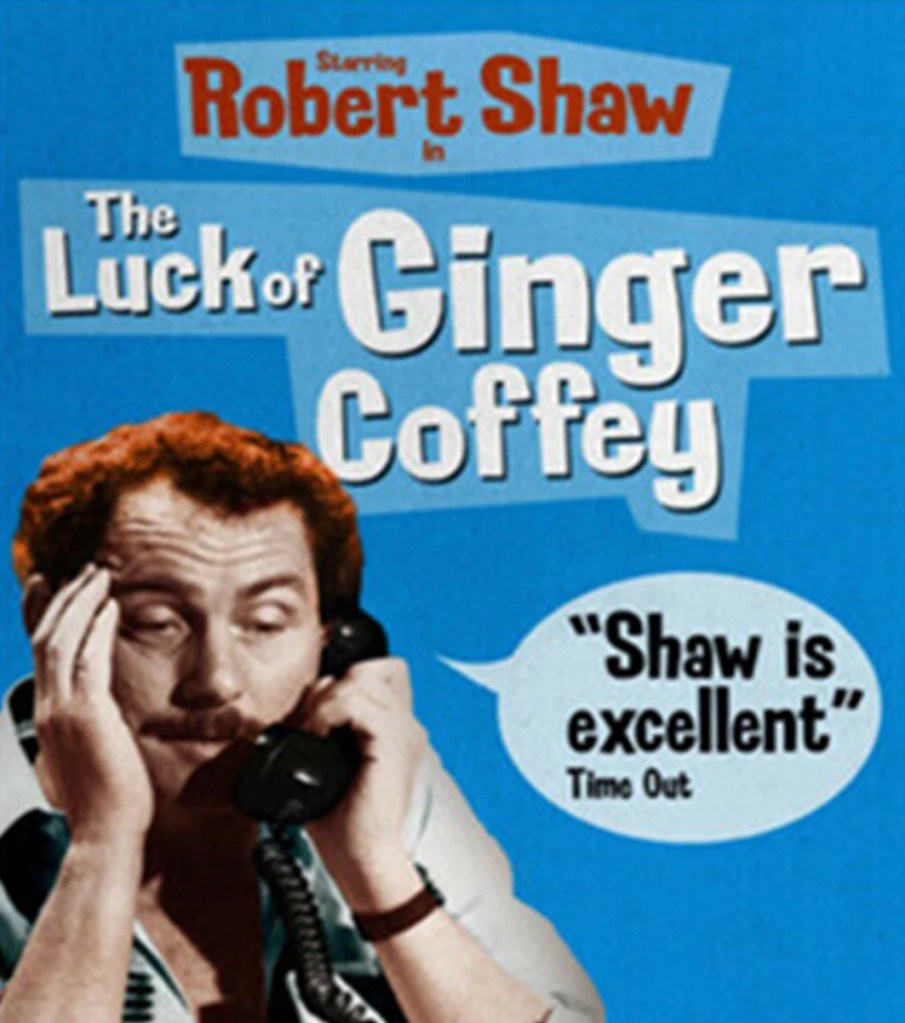
It takes his wife quite a while to cotton on to his constant deception

Quite why such a downbeat picture ever got made is a mystery. The novel by Brian Moore, on which it was based was certainly a literary and commercial success, and it was funded by Frank Crawley, possibly the biggest of the Canadian independents, on a $500,000 budget. It ended up on arthouse release in the UK.

Richard Harris was originally nailed-on for the part but he swapped it for Sam Peckinpah’s Major Dundee (1965). Harris would have brought more immediate physical energy and a sense of danger to the role, rather than the sense of an oaf just bumbling along.

Possibly the best thing about it is the realism. Yes, it’s really the star crossing icy roads, just avoiding oncoming traffic in scenes that were clearly set on Montreal roads and not on the safety of a sound stage.

Shaw and Ure were married, so were both tagged as rising stars, the husband coming off From Russia with Love (1963), but there was argument to put that she was already the bigger marquee name after Look Back in Anger (1959), Sons and Lovers (1960) and female lead in The Mind Benders (1963).

This really had not much going for it other than worthiness, the chance for a decent film with some reasonable names to come out of Canada, and to give another rising star, director Irvin Kershner (A Fine Madness, 1966), a chance. Written by Moore (Torn Curtain, 1966).

Well-made but too dour for me.

Amazon Prime has it. In fact, it was recommended to me on that channel because I had watched Two Gentlemen Sharing.

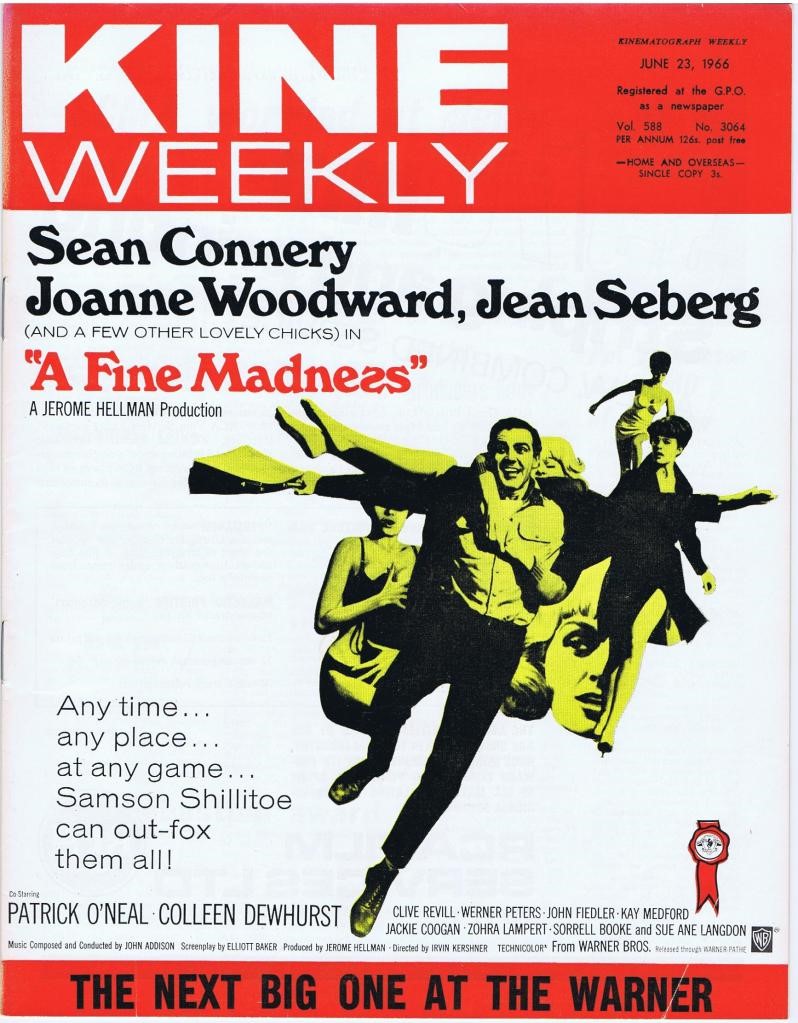
A Fine Madness (1966) **

Let’s start with the Hollywood happy ending. Poet Samson (Sean Connery) slugs pregnant second wife (Joanne Woodward). He’d have punched her lights out before if only she hadn’t been so good at diving out of the way. As it is he manages to throw her down the stairs. The film kicks off with him ill-temperedly whacking her over the head with a pillow.

This is the kind of film where violence against women is treated as a running gag.

Let’s try to sell it as a wacky comedy.

Lydia (Jean Seberg), wife of psychiatrist Dr West (Patrick O’Neal) treating Samson for writer’s block, doesn’t have the courage to make it plain to his creepy colleague Dr Vorbeck (Werner Peters) that she doesn’t fancy him when he endlessly paws her and slaps her rear so he takes this as the green light to attempt to rape her. That’s another running gag.

Surly loud-mouthed bully Samson gets a free pass because he’s an artist, a poet with one poor-selling volume of poetry, and unable to find the time or space to complete his masterpiece. He would have more time if he didn’t spend so much of it chasing women.

At my count, he gets through at least four – Lydia, office secretary Miss Walnicki (Sue Ann Lngdon), a client (he cleans carpets for a living) Evelyn (Zohra Lampert), and Dr Kropotkin (Collen Dewhurst), another colleague of Dr West, not to mention the current wife he drives demented and the previous wife for whom he is being aggressively pursued for alimony.

You can see how director Irvin Kershner was a shoo-in for The Flim-Flam Man/One Born Every Minute (1967) because at every opportunity he tries to turn simple dramatic confrontation that enhance the story into needless chases that divert it and extract slapstick from material that in no way suggests it’s ripe for such an approach.

Trivia lovers note: The John “Redcap” Thaw in the supporting feature “Dead Man’s Chest” is the same John Thaw from “The Sweeney” and “Morse“.

There’s a story in here somewhere and a pretty barmy one at that if you set aside the poor poet’s endless battle against a world that fails to understand his genius and his dodging of the alimony. Rightfully diagnosed as some kind of sociopath by yet another of Dr West’s colleagues, the needle-happy Dr Menken (Clive Revill), he is admitted to a psychiatric hospital initially as a way of dodging his creditors and providing him with space and time to write.

Again, his most creative use of his time is to make out with Lydia and Krokoptin. But since he is spotted in a hydro-bath/ripple bath with  naked Lydia, the vengeful husband gives the go-ahead to perform some kind of lobotomy on the poet, on the assumption it will dull his violent tendencies. (It doesn’t work.) The opportunity to satirise the psychiatric profession takes second place to another opportunity for a chase.

Anomalies abound. Samson’s character is clearly drawn on Welsh poet Dylan Thomas who exploited his fame and made his money on recital tours. Performing is against the broke Samson’s principles and he turns viciously on his audience of appreciative women. Despite demanding center stage, when offered it he turns it down. He lambasts middle-aged women but has little against those younger members of the species more susceptible to his charms. He only has to tell Miss Walnicki she has “pouty lips” and she falls into his arms.

All this has going for it are the performances. Sean Connery (Marnie, 1964), it has to be said, certainly exhibits screen charisma though this is not as far removed as he would like from the macho James Bond. Joanne Woodward (From the Terrace, 1960) – switching from her normal brunette to blonde – is excellent as the downtrodden waitress wife, but on the occasions when she is spiky enough to put him in his place soon regrets her temerity.

Jean Seberg (Pendulum, 1969) – switching from blonde to brunette and paid more ($125,000 to Woodward’s $100,000) – is good as the sexually frustrated rich housewife. And Patrick O’Neal (Stiletto, 1969) looks as if he is desperate to throw a punch. Elliott Baker (Luv, 1967) wrote the screenplay based on his own novel.

You do sometimes wonder at the knuckle-headedness of stars. Was this all that was offered to Connery at his James Bond peak? Or was it a pet project? I doubt if it would have been made with another big star – you couldn’t see even the macho Steve McQueen entering this territory and the likes of Paul Newman wouldn’t go near it.

Theoretically, studio head honcho Jack Warner gets the blame for this. He didn’t like Kershner’s cut and ordered it re-edited but I’d be hard put to see how his hand could be any less heavy than that of the director.

That’s two stinkers in a week. If you want proof of just how rampant sexism was in Hollywood check out a double bill of this and A Guide to a Married Man (1967).

An insult.

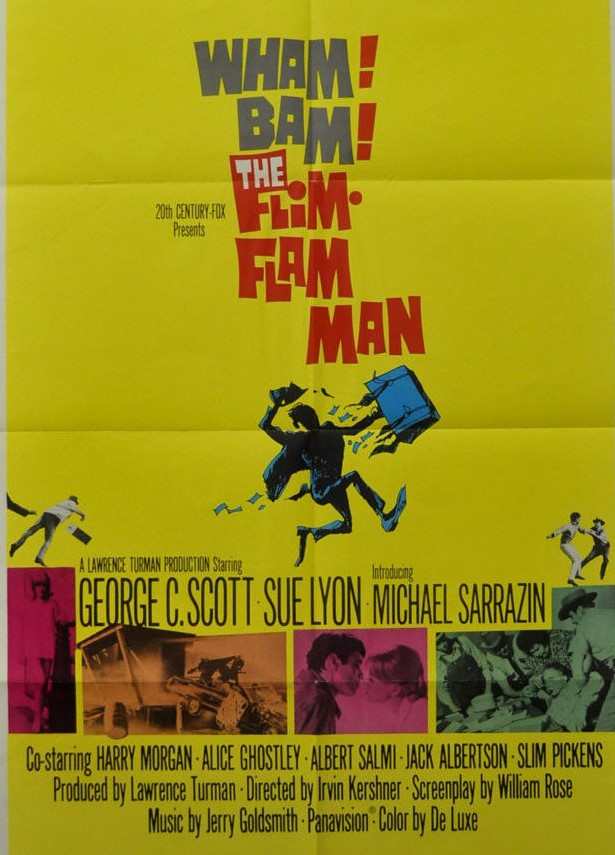
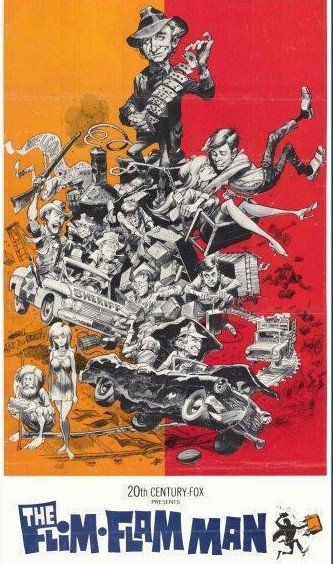
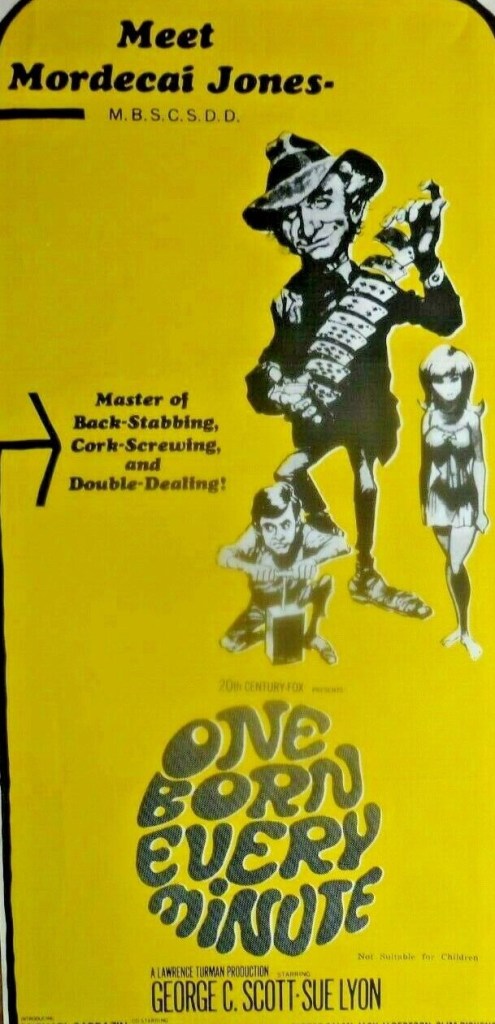
The Flim Flam Man / One Born Every Minute (1967) ***

Throwback to It’s A Mad, Mad, Mad, Mad World (1963), prelude to Smokey and the Bandit (1977) and in the middle of the car chases and town wrecking a character study of a pair of grifters, one veteran, the other his pupil.

U.S. Army deserter Curley (Michael Sarrazin) teams up with veteran con man Mordecai (George C Scott) who teaches him the tricks of the trade. There’s nothing particularly innovative about the older man’s techniques – Find the Queen, The Lost Wallet, selling hooch as genuine whiskey – and the rewards are not particularly rewarding unless you are living at scavenger level in whatever run-down habitat you can find.

The dumb cops, Sheriff Slade (Harry Morgan) and Deputy Meshaw (Albert Salmi), aren’t quite so stupid otherwise they wouldn’t occasionally happen upon their quarry. And the larcenous duo offer nothing more clever by way of escape except to hijack vehicles.

So once you get past the aforementioned car chases and town wrecking it settles down into a gentle old-fashioned drama. Luckily all the good ol’ boy shenanigans are limited to the police, and neither main character is afflicted by over-emphatic accents.

Mordecai ain’t no Robin Hood nor a criminal mastermind who might have his eyes on a big- money heist. His ethos is stealing not so much from the gullible but the greedy. All his suckers think they can make an easy killing from a guy who appears a harmless old duffer.

He’s not looking for a big score because he’s got nobody to settle down with and because, although on a wanted list (as “The Flim-Flam Man” of local legend) he’s not going to exercise the authorities except cops with very little otherwise to do. He is as laid-back a drifter as they come.

Curley offers the drama. He starts to have qualms not so much about stealing from the greedy but about the repair bills for the cars they wrecked, especially one belonging to the young innocent Bonnie Lee (Sue Lyon), to whom he takes a fancy. While she reciprocates it’s only up to a point, having the good sense not to hook up with a criminal, so eventually he has to choose between giving himself up and serving time in the hope Bonnie Lee will hang around and severing his links with Mordecai, whom he treats as a father figure.

How he works that out is probably the best scene, especially given his temporary profession. Whether this is the first picture to feature so prominently incompetent cops rather than either the tough or corrupt kind I’m not sure but Slade and Meshaw take some beating.

In his first starring role, Michael Sarrazin (Eye of the Cat, 1969) is the cinematic catch. All the more so because director Irvin Kershner doesn’t take the easy route of focusing on his soulful eyes, permitting the actor to deliver a more rounded performance. He’s certainly more natural here than any future movie where he clearly relied far more on the aforementioned soulful eyes.  

While I’m not sure the ageing make-up does much for him, George C. Scott (Petulia, 1968), in his first top-billed role, tones down the usual operatics and makes a convincing loner who can make one good romantic memory last a lifetime. He switches between completely relaxed to, on spotting a likely victim, sharp as a tack. The harmless old man guise falls away once he smells greed, replaced by cunning small-time ruthlessness.

Sue Lyon (Night of the Iguana, 1964) has little to do except not be the sex-pot of her usual screen incarnation and that’s to the good of the picture. By this stage of his career Harry Morgan was more likely to be found in television so it’s a treat to see him make the most of a meaty supporting part. Look out for Strother Martin (Cool Hand Luke, 1967) and Slim Pickens (Rough Night in Jericho, 1967).

Irvin Kershner (A Fine Madness, 1966) appears on firmer ground with the drama than the wild car chase/town wrecking but I suspect it takes more skills to pull off the latter than the former where the actors can help you out. Though I notice Yakima Canutt is down as second unit director so he might be due more of the credit. Screenwriter William Rose had already plundered the greed theme and, to that extent the car chase, for his seminal It’s A Mad, Mad, Mad, Mad World.

The outlandish elements, fun though they are, give this an uneven quality that gets in the way of a tidy little picture.

Discover WordPress

A daily selection of the best content published on WordPress, collected for you by humans who love to read.

The Atavist Magazine

by Brian Hannan

WordPress.com Blog

News, Tips & Website Tutorials