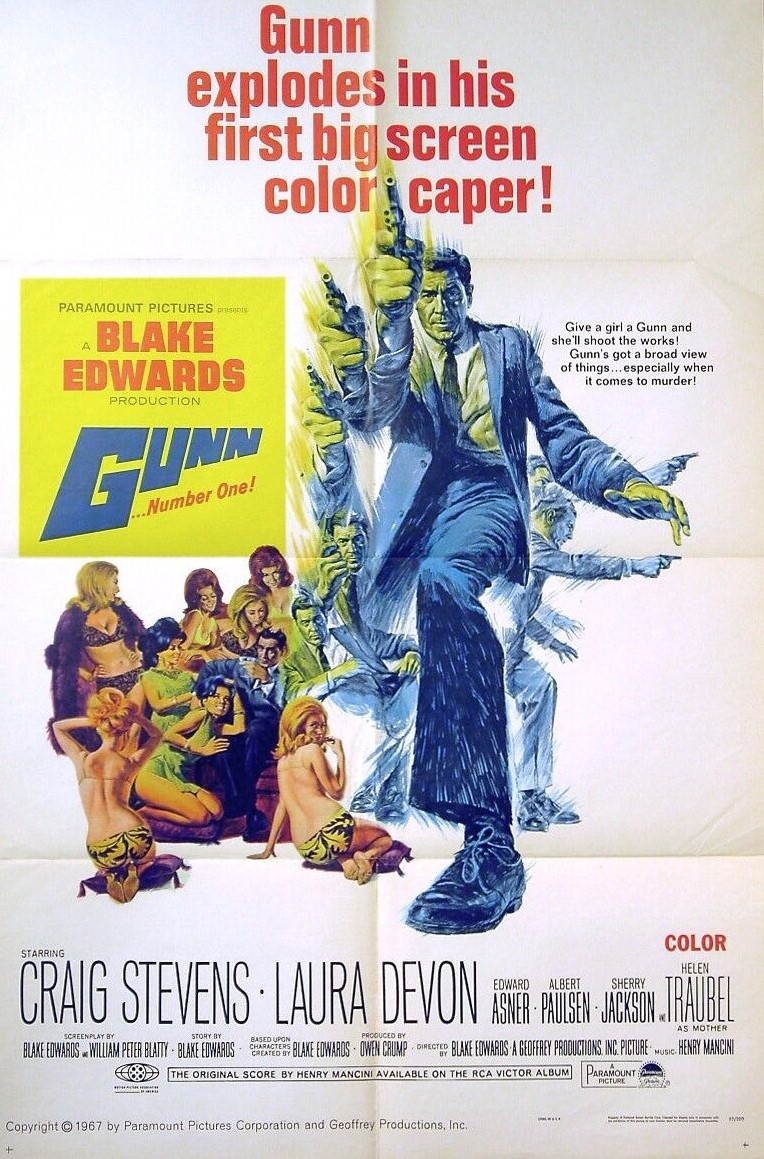
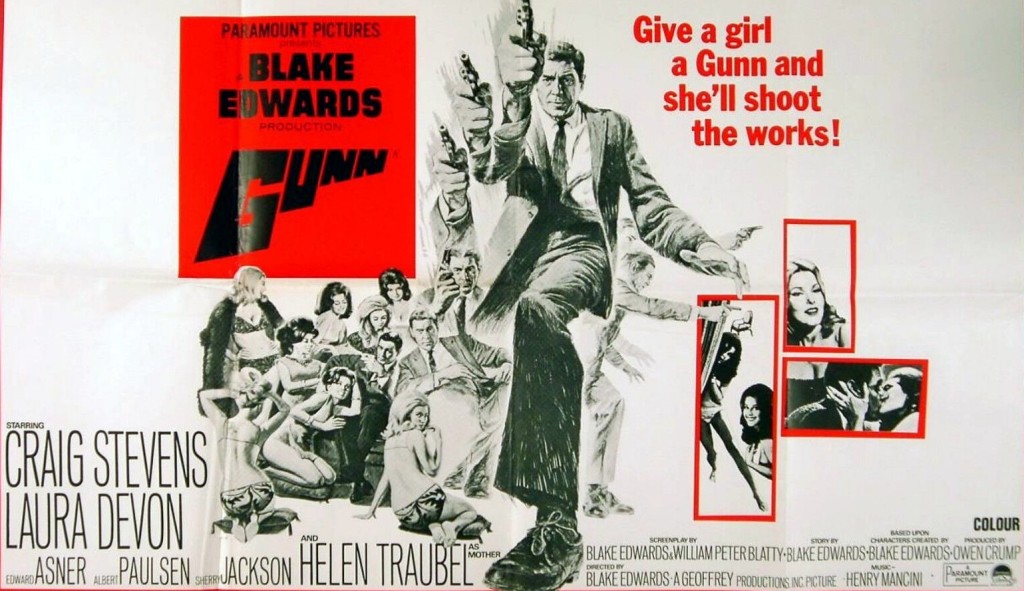
Director Blake Edwards was so confident that he could repeat on the big screen the small screen success of Peter Gunn (1958-1961) that the movie was promoted as the first in a series. He couldn’t have been more wrong.
Although the private eye genre had been given a fillip by Paul Newman’s shamus Harper (1966) the bulk of screen investigation has been subsumed wholesale by spies. And the amount of time that had passed between the demise of the original television series and the movie revival – only six years – was hardly enough for nostalgia to kick in. Nor did star Craig Stevens have any box office appeal – this was his first picture in nearly a decade.
A James-Bond-rip off credit sequence with girls dancing to a psychedelic background sets up a more contemporary picture than the one unveiled which is as old-fashioned as they come and, except for an increased budget, betrays its television origins. A few characters, Gunn’s girlfriend Edie (Helen Traubel), a nightclub singer, Mother (Laura Devon), the owner of the eponymous nightclub, and Lt Jacoby (Edward Asner) are reprised from the series although played by different actors.
The dialogue is sometimes slick (“Call me Samantha” – “Samantha” – “You called”) and sometimes corny as when prior to an explosion that knocks the hero sideways is the line “may God strike me down.”
Gunn is hired by a nightclub owner Mother to find out who killed a gangster who had once saved the detective’s life. Fingers point at another gangster, Nick (Alberto Paulsen), somewhat protected from the law by his corruption, but it soon becomes clear that the obvious may not be correct. Naturally, Gunn gets in the way of Lt Jacoby, while women fall at his feet.
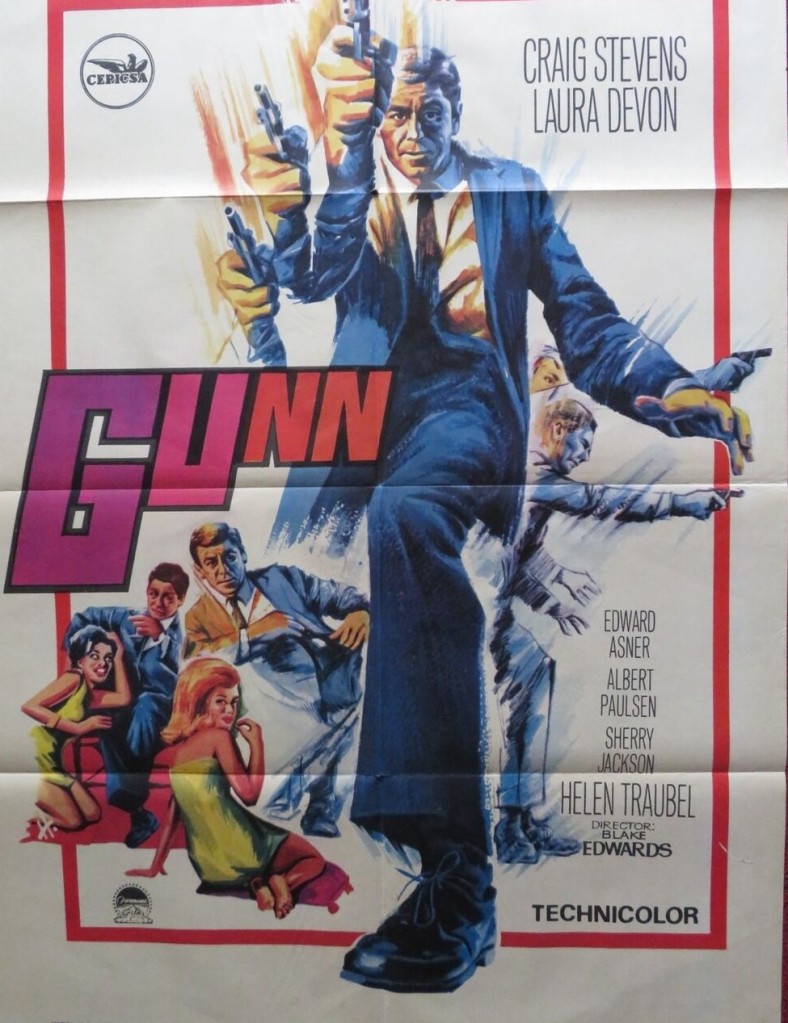
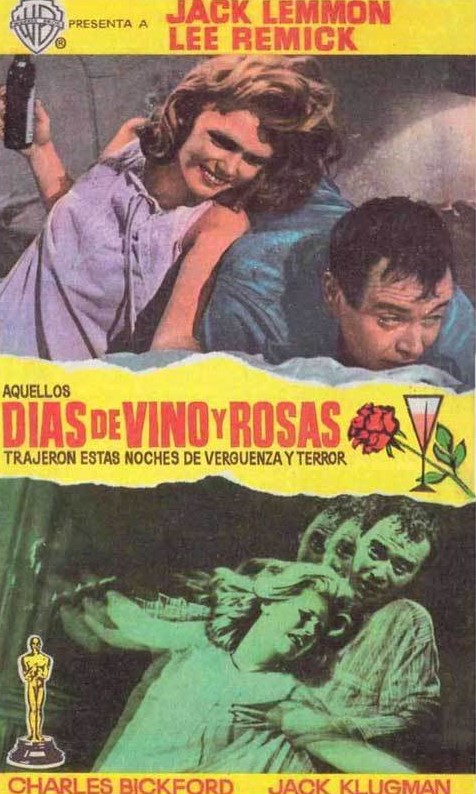
Somewhat unusually, in this foreign poster the women are covered up.
Making the biggest impression is Sherry Jackson (The Mini-Skirt Mob, 1968) as the aforementioned Samantha who turns up unannounced in Gunn’s flat. You can catch Edward Asner (The Satan Bug, 1965) in an early role. Plus there’s the Henry Mancini (Breakfast at Tiffany’s, 1961) score, already a big hit. The only element that makes it contemporary is some gender-confusion but otherwise it’s a fairly flat story and relies far too much on its television origins.
Rather than go to the trouble of reinventing the character for more contemporary times, Blake Edwards (The Grip of Fear / Experiment in Terror, 1967), wearing two hats, simply rewrites the small screen’s first episode, adding some violence to attract a cinematic audience.
It might have been better had William Friedkin not turned it down, but given how poorly that director served The Night They Raided Minsky’s / The Night They Invented Striptease (1968) it could well have had the same outcome.
Strictly for fans of nostalgia.
You can catch the original TV series on DVD or check out the movie version for free on YouTube.
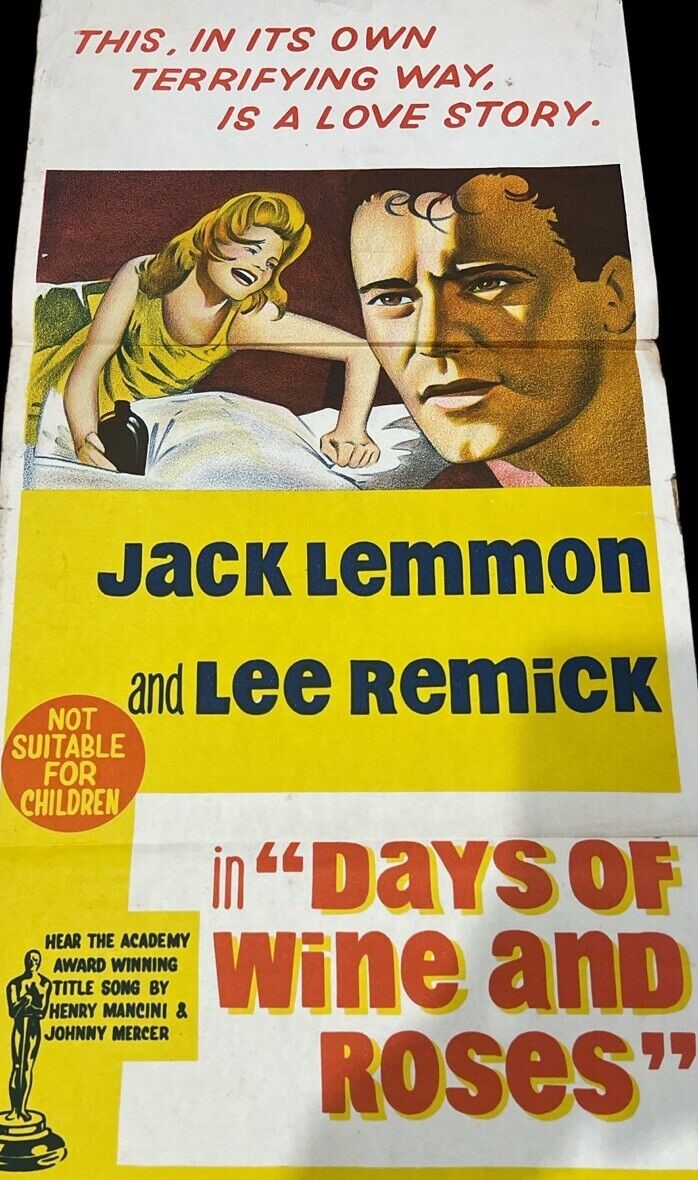
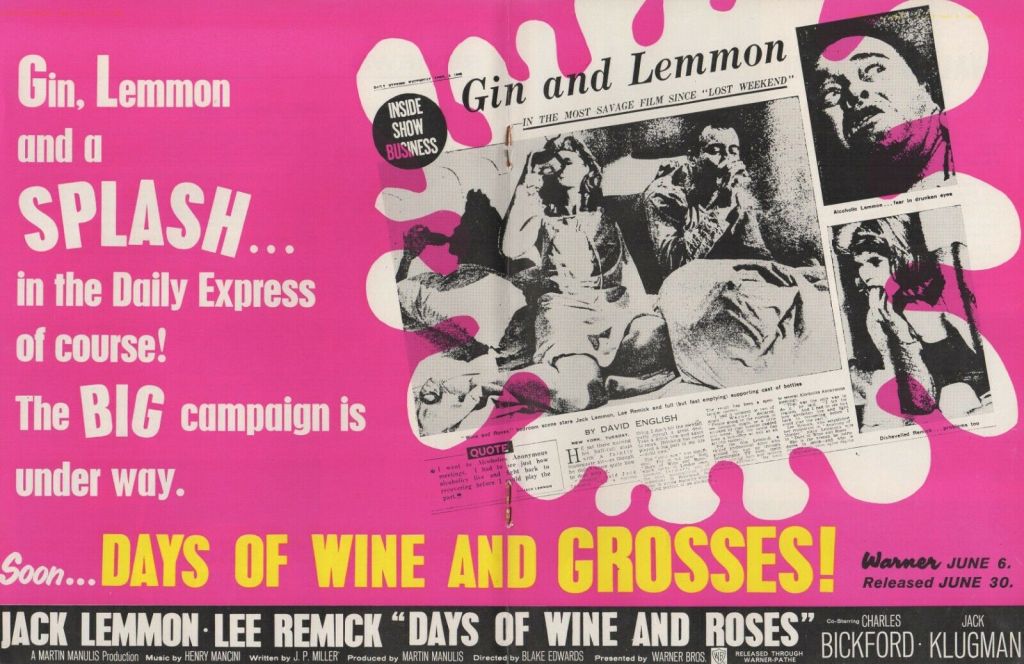
A touch of Mad Men satire adds a contemporary bite to tale of the destructive power of alcohol. Not since Billy Wilder let loose on The Lost Weekend (1945) did Hollywood finance a no-holds-barred examination of alcohol addiction.
But let’s start with the amoral world of advertising or, in this case, public relations. When we are introduced to executive Joe (Jack Lemmon) he’s little more than a pimp for his client, rounding up a plethora of blondes who can be salivated over by wealthy men on a big yacht. When we first meet Kirsten (Lee Remick) she is initially mistaken by Joe as a blonde worth salivating over only to learn that actually she is the prim, though pretty, secretary of his client to whom the idea of a potential pawing on a big yacht has no appeal, regardless of how wealthy the pawing hands might be.
Romance should never have got off the ground as they insult each other in turn, but in the way of such tales, one of his barbed comments strikes home and she consents to be taken to dinner. Astonished to discover she doesn’t drink, he alights upon her weakness for chocolate as a way of getting her to sample Brandy Alexander (as stiff with chocolate as alcohol). That’s all it takes. While she begins to lose her inhibitions, he, ironically, adopts a principled stance towards the aforesaid pimping and is moved to another account.
After they marry, she stays off the sauce once a baby arrives, he, petulant at taking second place to the baby, gets deeper into the stuff. Eventually, he wears her down, and they have a whale of a time getting drunk and ignoring the child. Meanwhile, he is sliding lower down the company pyramid thanks to his drinking. Matters come to a head when she sets the apartment on fire.
Eventually, jobless, Joe throws himself on the mercy of Kirsten’s stern father Ellis (Charles Bickford) and they manage a good few months on the wagon until in a drunken spree he manages to destroy a greenhouse at his father-in-law’s landscaping business. Joe ends up with the DTs, committed to a sanatorium and determines to mend his ways. But that means admitting his addiction and joining Alcoholics Anonymous. Kirsten, meanwhile, is not such a softie, refusing the believe she is an alcoholic.
Their bright future darkens by the minute as squalidness and selfishness take over. In some senses, this is a case study of the alcoholic, the one who can fight the demons and the one who can’t be bothered to fight anything since the bottle is the easiest cure.
Made at a time when Hollywood was not predisposed to this kind of sharp shock of reality, not even with attractive stars to make the tale more palatable, this is easily the highlight of director Blake Edwards’ career, the comedies and even the romanticised Breakfast at Tiffany’s (1961) seeming like so much fluff in comparison. He manages to avoid being either sentimental or sanctimonious and possibly the only time he holds back is when the fire takes place off-screen. Otherwise, it’s light years ahead of The Lost Weekend, whose protagonist seems more easily than humanly possibly to beat the addiction.
If you think Jack Lemmon (How To Murder Your Wife, 1965) is usually a hyperactive character anyway on screen, wait till you see what’s he’s like with a drink in him, just as if he doesn’t know when to stop, consequence never entering his consciousness, as like any drunken maniac he’s living in a fantasy world. But because she starts out on a different dramatic plane, and her slide into incoherence is more sobering, Lee Remick (No Way to Treat a Lady, 1968) beats him to the critical kudos. Terrific performances from both and from those tasked with keeping them in line, Charles Bickford (The Unforgiven, 1960) and Jack Klugman (Goodbye, Columbus, 1969) as the recovering alcoholic trying to get Joe to face up to his condition.
In all the literature devoted to twentieth century humanitarians, you’ll find few busting a gut to highlight the work of Bill Wilson (better known as Bill W), the founding father of Alcoholics Anonymous. But this self-funded organisation that created a community for the addicted probably did more in the last century to cure a terrible disease than any scientist inventing a drug. Incidentally, James Garner played Bill in a television biopic My Name Is Bill W (1989).
Sometimes I think actors take on roles aiming to enhance their reputation by playing difficult unsympathetic characters. But I imagine Lemmon and especially Remick got the shock of their lives on seeing the completed movie because their character disintegration is so total it would have required teams of public relations executives to put a good spin on a picture that shows human beings in such a depressing light, almost disempowered by their addictions. First appearing as teleplay in 1958, writer JP Miller (The Young Savages, 1961), while adding more gloss for the movie adaptation, nevertheless does not shrink of the unpalatable truths.
J. Lee Thompson (The Guns of Navarone, 1961) saw a much-needed boost to a drifting career vanish when he ducked out of this project – he had spent considerable time developing the project – in favor of Mackenna’s Gold (1969). Blake Edwards, first director attached, probably also lamented losing out. This was to have been Edwards last outside film before committing exclusively to Mirisch.
Producer Arthur P. Jacobs, who had bought the rights to Pierre Boulle’s Monkey Planet in 1963, could hardly believe his luck after the calamitous Doctor Dolittle (1967). Unusually, the two films were not cross-collaterized, a standard studio device whereby the losses on one film were played against the profits in the other, which would have almost certainly resulted in no profit payments to Jacobs.
And you could probably say the same for eventual director Franklin J. Schaffner, relegated to television and movie stiffs like The Double Man (1967) after the failure of big-budget historical drama The War Lord (1965) and his abortive attempt to film the Travis McGee novels of John D. MacDonald, whose total sales exceeded 14 million. He wasn’t involved in Darker than Amber (1970), the first McGee title to be filmed. Heston, who Schaffner had directed in The War Lord, pushed for his involvement.
Charlton Heston was also in dire need of career resuscitation, his past five movies – Sam Peckinpah’s Major Dundee (1965), The Agony and the Ecstasy (1965), The War Lord (1965), Khartoum (1966) and realistic western Will Penny (1967) – had all tanked. “In my view,” he opined, “I haven’t made a commercial film since Ben-Hur,” clearly ignoring the success of El id (1961).
And once it became a success Warner Brothers regretted letting it go. The studio had been involved in the project when Blake Edwards was to direct. The movie was cancelled due to cost – it was budgeted then at $3-$3.5 million – and script and production problems. The studio might also have shied away after learning of the booming budget and lengthening schedule for MGM’s 2001: A Space Odyssey. Twentieth Century Fox ended up forking out $5.8 million to turn the project into reality.
As was often the norm in Twentieth Century Fox pictures, studio head honcho Darryl F. Zanuck found a part for his mistress, in this case Linda Harrison as Nova, the mute love interest. She was a graduate of the studio’s program of investment in young talent. Others included Jacqueline Bissett (The Detective, 1968) and Edy Williams (The Secret Life of An American Wife, 1968). Had Raquel Welch (One Million Years B.C, 1966) considered the opportunity to don a fur bikini again, it is doubtful Harrison would have won the role. But she turned it down as did Ursula Andress (The Southern Star, 1969). Angelique Pettyjohn (Heaven with a Gun, 1969) was auditioned
Former child star Roddy McDowall (Lassie Come Home, 1943), Kim Hunter (A Streetcar Names Desire, 1951) and Maurice Evans (The War Lord) fleshed out the ape contingent. Ingrid Bergman (The Visit, 1964), also in much need of a career uplift, turned down the role of Zira. Other stars in the frame for roles included Yul Brynner, Alec Guinness and Laurence Olivier. Edward G. Robinson should have played Zaius, but couldn’t manage with the make-up.
Source material was Monkey Planet by Pierre Boulle, author of Bridge on the River Kwai. Twilight Zone creator Rod Serling took a year and a reported 30 drafts to turn in a viable screenplay and the former blacklisted Michael Wilson, whose name had been removed from the credits of Bridge on the River Kwai (1957) and Lawrence of Arabia (1962), added the polish. Wilson had won an Oscar for A Place in the Sun (1951) and another one for Friendly Persuasion (1956) although that was actually awarded to Jessamyn West since Wilson’s involvement was kept secret. If he had not been blacklisted, he would have been in the unusual position of having won four screenplay Oscars, although in the end the others were retrospectively awarded.
If you were looking for a sci-fi picture with dramatic heft, decent action, mysterious outcome and an examination of the human condition this was a more straightforward bet than 2001: A Space Odyssey (1968). While Fox reckoned its previous sci-fi venture Fantastic Voyage (1966) had worked out well, it had reservations about the cost of Planet of the Apes and the possibility of making an ape setting believable. In this case the special effects’ conundrum was make-up for the apes. If they just looked like humans wearing monkey suits the movie would not fly. Fox spent $5,000 on a test with Heston in a scene with two apes before it greenlit the movie.
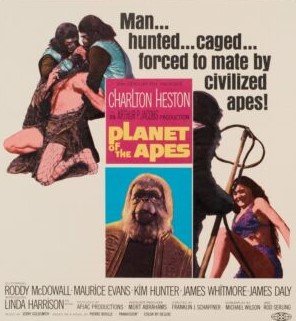
Faces that could not express emotion and were as stiff as a botox overdose would invite audience ridicule. In the end the studio spent a reported million dollars on pioneering ape renditions by John Chambers, who previously been a surgical technician repairing the faces of wounded soldiers. He had a team of 78 make-up artists There were almost as many scripts as crew and the changes wrought as the picture moved closer to being greenlit were to switch from a futuristic setting to a primeval one (which, incidentally, saved on costs), covering up the breasts of the female prisoners and inventing the stunning ending.
There were three possible endings, the one shot being that favored by the star.. Heston’s hoarse voice was not in the script, but an incidental by-product of him catching the flu. Apart from studio sets, the movie was filmed in blistering heat in Arizona. The rocket ship crashed into Lake Powell in Utah, ape city – modeled on the work of celebrated Spanish architect Gaudi – was constructed in Malibu Creek State Park, and the final scene was filmed on Zuma Beach in Malibu.
Unlike Fantastic Voyage which told audiences what the mission was, but in keeping with 2001: A Space Odyssey, Planet of the Apes opens with mystery. Like Rosemary’s Baby, the movie is viewed through the eyes of an innocent, one who cannot quite cotton on to his fall down the evolutionary food chain. Albeit more hirsute and muscular than Mia Farrow, nonetheless the casting of Heston dupes the audience into thinking he is somehow going to win, rather than just escape. He is an experiment who has wandered into the wrong planet. But there are few films that can top that shock ending. And the movie more than fulfills the “social comment,” on which Heston was very keen, contained in the Boulle novel.
SOURCES: Russo, Joe, Landsman, Larry, and Gross, Edward, Planet of the Apes Revisited, The Behind the Scenes Story of the Classic Science Fiction Saga (New York: Thomas Dunne Books/St Martin Griffin, 2001); Hannan, The Making of The Guns of Navarone, 187. “Warners Ape World,” Variety, March 18, 1964, 4; “High Costs Impress Capital,” Variety, March 23, 1964, 3; “Planet of Apes Off for Present,” Variety, March 10, 1965. “Michael Wilson Under His Own Name For A.P. Jacobs,” Variety, December 14, 1966, 7. “MacDonald Novels Cue Major Pictures Corp.,” Variety, May 17, 1967, 5; Austen, David, “It’s All A Matter Of Size,” Films and Filming, April 1968, 5; “Fox’s Talent School,” Variety, June 26, 1968, 13; Film Locations for Planet of the Apes,” www.film-locations.com.
I have to confess this Behind the Scenes article would have been better if I had not loaned out – and never got it back – my copy of The Making of Planet of the Apes by JW Rinzler which was published five years ago.
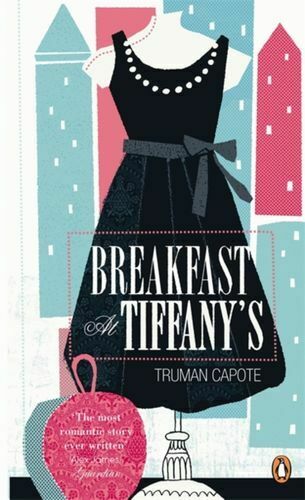
For a start the book – a novella really, scarcely topping the 100-page mark – by Truman Capote was set during the Second World War. And the book’s narrator Paul (George Peppard in the film) is more of an observer in the vein of in Nick Carraway in The Great Gatsby and as such is not privy to every action of Holly Golightly (Audrey Hepburn) rather than, say, the redoubtable Dr Watson who, as confidante of Sherlock Holmes, can faithfully record his every action.
So the first task set screenwriter George Axelrod was to update the picture to the contemporary era of the early 1960s. Fashion-wise, this proves a tremendous boon, allowing the director the give Holly her iconic look. And it does permit more leeway with acceptable sexual mores. However, while in both book and film Paul is an aspiring writer, in the book he is initially unpublished, while in the film he has had a book of short stories published, but is living as a gigolo. In the book he is an innocent 19-year-old, mouth clearly agape at Holly’s shenanigans, while in the film he is clearly more mature.
Since Hollywood is intent on providing a happy ending, it was essential for the screenplay to make Paul an acceptable suitor rather than a young swain largely in awe of the captivating Holly.
Axelrod did not have to do much to capture the book’s Holly. In fact, he appropriated wholesale chunks of dialogue. Capote had done such a wonderful job of describing her unique personality that it made a lot of sense to retain her vocabulary and diction.
Axelrod turns Paul into a more dramatic figure, such that he is able to both challenge himself and Holly, emerge from his own self-destructive trap, and develop his own narrative arc, and play a more significant role in Holly’s life, so that the romantic possibilities, which appear distant in the book, can be more easily realized.
The input of other characters is enlarged or diminished. The Japanese neighbor Mr Yunioshi (Mickey Rooney), who only appears at the beginning of the book, is called into more extensive comedic duties by the screenwriter. Mag Wildwood (Dorothy Witney), only seen in passing in the film, has a more significant role in the book, becoming for a time Holly’s flatmate and rival in love. There is no room in the film for Madame Spanella, held responsible in the book for informing the police about Holly’s arrangement with the gangster. For structural reasons, Axelrod is also able to dispense with bar owner Mr Bell, a pivotal character at the book’s opening.
Otherwise, the book acts as a pretty useful treatment, from which the screenwriter need only occasionally depart. Sometimes this is for clarification. In the film Holly insists her marriage to Doc was annulled whereas in the book this is far from clear, leaving her open to charges of bigamy. Axelrod turns into dialogue some of Paul’s observations and turns some dialogue into scenes. In addition, in the book Holly becomes pregnant by her Brazilian lover, thus expecting marriage to automatically follow.
The couple do steal masks from a dime store, but do not visit Tiffany’s together to have the cheap ring inscribed, but the scene has its origins elsewhere in the book. Nor does Paul in the book introduce Holly to the public library and though he finds evidence of her mugging up on South America it is only in the film that that becomes a scene.
The book avoids the happy ending Hollywood was so desperate to reach. Holly goes off on her own. The cat is chucked out of the cab and although a remorseful Holly immediately chases after it, she is too late.
The notion that a creature as wild and individual as Holly Golightly would submit to marriage to an impoverished writer seems a fantasy too far. Unhappy endings were not unknown in Hollywood, look at Casablanca, but for whatever reason Paramount or Blake Edwards dictated otherwise.
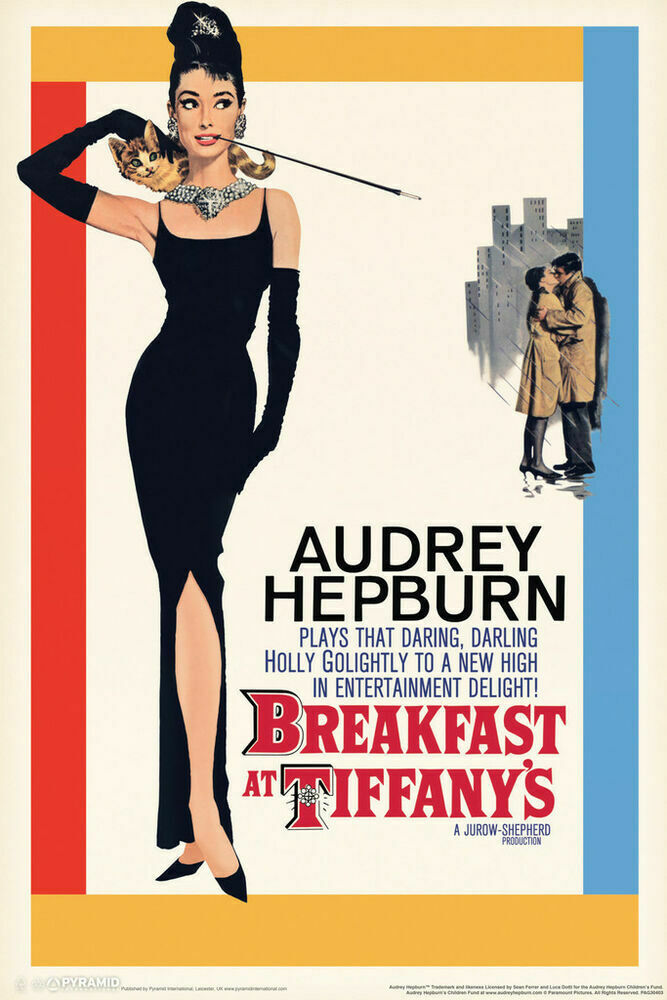
Reassessment sixty years on – and on the big screen, too – presents a darker picture bursting to escape the confines of Hollywood gloss. Holly Golightly (Audrey Hepburn) is one of the most iconic characters ever to hit the screen. Her little black dress, hats, English drawl and elongated cigarette holder often get in the way of accepting the character within, the former hillbilly wild child who refuses to be owned or caged, her demand for independence constrained by her desire to marry into wealth for the supposed freedom that will bring, contradictory demands which clearly place a strain on her mental health.
Although only hinted at then, and more obvious now, she is willing to sell her body in a bid to save her soul. Paul Varjak (George Peppard), a gigolo, being kept, in some style I should add with a walk-in wardrobe full of suits, by wealthy married Emily (Patricia Neal), is her male equivalent, a published author whose promise does not pay the bills. The constructs both have created to hide from the realities of life are soon exposed.
There is much to adore here, not least Golightly’s ravishing outfits, her kookiness and endearing haplessness faced with an ordinary chore such as cooking. the central section, where the couple try to buy something at Tiffanys on a budget of $10, introduce Holly to the New York public library and boost items from a dime store, fits neatly into the rom-com tradition.
Golightly’s income, which she can scarcely manage given her extravagant fashion expenditure, depends on a weekly $100 for delivering coded messages to gangster Sally in Sing Sing prison, and taking $50 for powder room expenses from every male who takes her out to dinner, not to mention the various sundries for which her wide range of companions will foot the bill.
Her sophisticated veneer fails to convince those whom she most needs to convince. Agent O.J. Berman (Martin Balsam) recognizes her as a phoney while potential marriage targets like Rusty Trawler (Stanley Adams) and Jose (Jose da Silva Pereira) either look elsewhere or fear the danger of association.
The appearance of former husband Doc (Buddy Ebsen) casts light on a grim past, married at fourteen, expected to look after an existing family and her brother, and underscores the legend of her transformation. But the “mean reds” from which she suffers seem like ongoing depression, as life stubbornly refuses to conform to her dreams. Her inability to adopt to normality is dressed up as an early form of feminism, independence at its core, at a time when the vast bulk of women were dependent on men for financial and emotional security. Her strategy to gain such independence is dependent on duping independent unsuitable men into funding her lifestyle.
Of course, you could not get away in those days with a film that concentrated on the coarser elements of her existence and few moviegoers would queue up for such a cinematic experience so it is a tribute to the skill of director Blake Edwards (Operation Petticoat, 1959), at that time primarily known for comedy, to find a way into the Truman Capote bestseller, adapted for the screen by George Axelrod (The Seven Year Itch, 1955), that does not compromise the material just to impose Hollywood confection. In other hands, the darker aspects of her relationships might have been completely extinguished in the pursuit of a fabulous character who wears fabulous clothes.
Audrey Hepburn is sensational in the role, truly captivating, endearing and fragile in equal measure, an extrovert suffering from self-doubt, but with manipulation a specialty, her inspired quirks lighting up the screen as much as the Givenchy little black dress. It’s her pivotal role of the decade, her characters thereafter splitting into the two sides of her Golightly persona, kooks with a bent for fashion, or conflicted women dealing with inner turmoil.
It’s a shame to say that, in making his movie debut, George Peppard probably pulled off his best-ever performance, before he succumbed to the surliness that often appeared core to his later acting. And there were some fine cameos. Buddy Ebsen revived his career and went on to become a television icon in The Beverley Hillbillies. The same held true for Patricia Neal in her first film in four years, paving the way for an Oscar-winning turn in Hud (1963). Martin Balsam (Psycho, 1960) produced another memorable character while John McGiver (Midnight Cowboy, 1969) possibly stole the show among the supporting cast with his turn as the Tiffany’s salesman.
On the downside, however, was the racist slant. Never mind that Mickey Rooney was a terrible choice to play a Japanese neighbor, his performance was an insult to the Japanese, the worst kind of stereotype.
The other plus of course was the theme song, “Moon River,” by Henry Mancini and Johnny Mercer, which has become a classic, and in the film representing the wistful yearning elements of her character.
CATCH IT ON THE BIG SCREEN: This is a restoration of the classic. The Showcase chain is showing it all this week in various cinemas throughout the United Kingdom (I caught it last week at my local Showcase). It is also showing in Barcelona on July 26; Amsterdam on July 31-August 3; Stockholm on August 5; and Gent, Belgium, on August 6.
A company called Park Circus – which has offices in London, Paris, Los Angeles and Glasgow – has the rights to the reissue and if you want to find out if the picture will be showing in your neck of the woods at a later date you can contact them on info@parkcircus.com