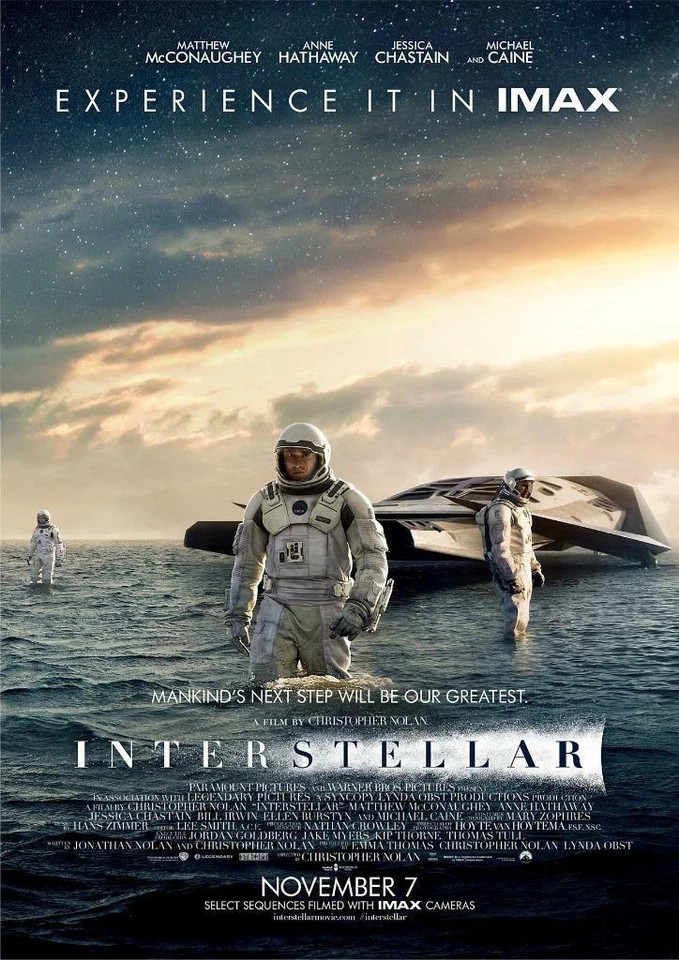
I have to confess I wasn’t a big fan of Interstellar when it first came out. I’m not a big fan of Matthew McConaughey, with that aw shucks accent, and couldn’t get my head around the scientific mumbo-jumbo. But now it seems like a greatest hits package, scenes, sequences, dialog to savor and the bonus of one of Hans Zimmer’s best scores – what would the cornfield section be without his compelling repetitive music?
If you take director Christopher Nolan’s work as a whole this is the second in a quartet – Inception (2010), Oppenheimer (2023) and The Odyssey (2026) being the others – that expresses his artistic maturity. The conquering of new worlds comes at a personal price. The speech of Odysseus acknowledging that it’s a different man who returns from adventure, ideas of heroic stature stunted by what needed to be done to complete the task, encapsulates this cinematic philosophy.

In some respects, the key character here is the bit player. In the biggest piece of audience deception since Alfred Hitchcock killed off the female lead halfway through Psycho (1960), Nolan goes the other way, introducing a big star (Matt Damon) in an unbilled appearance. And what a doozy of a role. Audiences would have been more likely to accept McConaughey as the kind of character who always has a selfish side hustle, but not Matt Damon, who had grown into his generation’s Tom Hanks, the James Stewart guy-next-door role.
But it’s Damon’s character, Dr Mann, who goes off-piste in terms of commitment. He’s reneged on the original deal, to, if necessary, give up his life for the cause of scientific advancement and/or saving the world. Sure, in making that initial promise, glory would have gone to his head, but now, abandoned in the middle of the universe, with no hope of a future, he’s lost all that grandstanding humanity and doesn’t care who loses out as long as he gets to live. And you could argue that’s the starting point for Ryland Grace in Project Hail Mary (2026) who has to be pressganged into his mission,
Yes, Cooper (Matthew McConaughey) realizes at the end how much he’s going to lose – the scene of him begging his daughter back through time to prevent him leaving on the original voyage is one of the most moving scenes ever shot. The mumbo-jumbo still seems like mumbo-jumbo to me, even if it provides concrete proof of Einstein’s Theory of Relativity as it relates to time.
But that’s a minor quibble in what’s otherwise just a glorious picture. Even the big points Nolan wants to make are presented in typically minor fashion, that a right-wing lunacy has taken hold in a world on the brink of self-destruction that includes the official denial that the lunar landings ever took place.
The clues to the maps that will reveal the treasure to save mankind are initially distinctly old-fashioned, Morse Code, the binary system, the tracking of a spent drone, before we’re diving into the more advanced notions of wormholes and the fifth dimension. That eminent scientist Professor Brand (Michael Caine) would commit scientific fraud, concealing the results of his experiments because they clash with his desires, keeps us in the human loop. Man wants so much to make a breakthrough that he just pretends he has done so that the project will be greenlit.
Yes, the galaxy and the universe contains untold wonders and as many terrors – an ice-bound planet is no place to build a new community nor is one where waves reached the heights of skyscrapers. And the universe has a pretty hard time of it conforming to human desire or need when virtually all the major humans come with major emotional flaws that are liable to drive them as much off-piste as Mann.
Brand’s daughter Amelia (Anne Hathaway) is as prone as her father to adjusting the facts to fit her emotional demands, more desperate to land on the one planet which contains her lover than any other. And Murph (Jessica Chastain), Cooper’s daughter, is twice duped by the men she instinctively trusts the most, once by her father and once by Professor Brand. Her response to knowing that the mission has been successful is to tell her brother that her father hadn’t lied, but had abandoned them for justifiable cause.
One of the elements that’s common to this quartet is key to the Nolan style. His mastery of tension is second to none, and that builds towards a climax because there’s not one climax involved but generally two, sometimes three, as various events arrive at their conclusion at exactly the same time.
As you will well be aware, I’m one of those moviegoers that has a tendency to go back and see favored films again and again, drowning in sheer enjoyment. Sometimes, as recently with Ridley Scott’s Kingdom of Heaven (2005), I come to the point of a viewing too far and find my initial enthusiasm has dried up. So re-viewings always come with a certain amount of trepidation, that a whole shedload of wormholes will uncover flaws I had previously missed.
Luckily, this time round, that wasn’t the case.


