I always wondered why this was a flop. I’m still baffled. Not only is it a perfectly serviceable caper picture, but it’s also high-concept before the term was invented, a World War Two submarine involved in holding up high-end ocean liner Queen Mary (yep, the real thing, thanks to cooperation from owners Cunard).
The dialogue’s crisp, the robbery well-planned, a good number of twists, plenty underwater thrills, hostility between crew members, and sexual tension kept high by the presence on board of the Italian Miss Big. Diver Mark Brittain (Frank Sinatra) is sucked into a treasure hunt in part because he needs the money and in part through the sexual magnetism of Rosa (Virna Lisi), the expedition backer, who already has suave Vic (Anthony Franciosa) on a string.
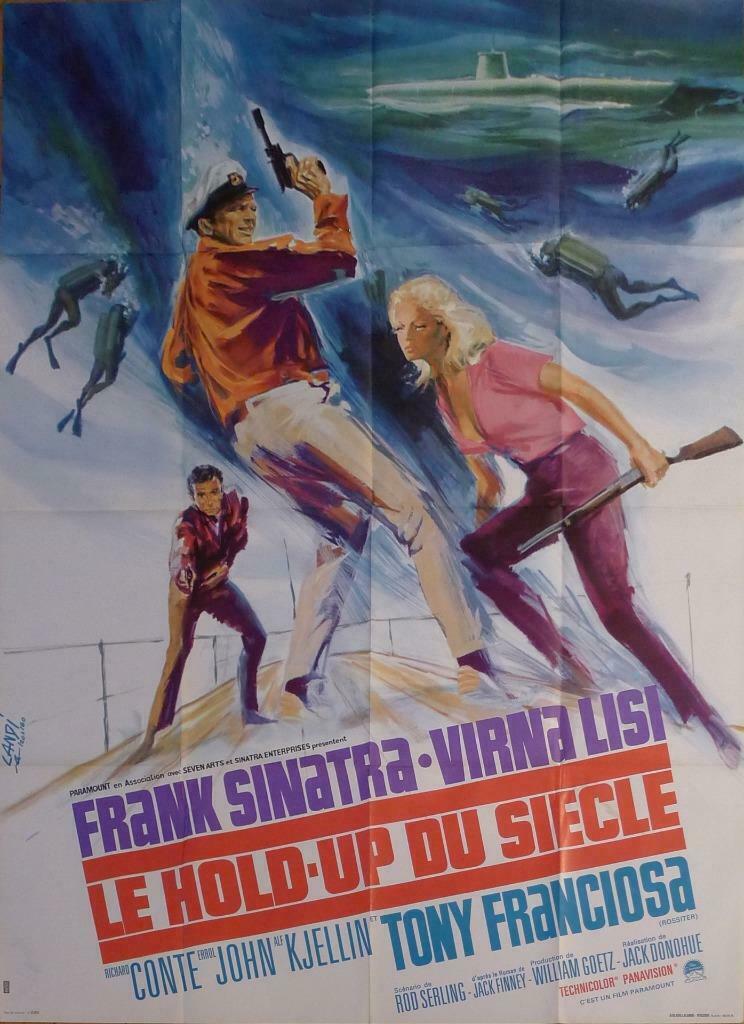
The plan evolves into piracy when Brittain discovers a World War Two German submarine on the seabed. As it happens, skippering the salvage vessel is former German U-boat captain Eric (Alf Kjellin). After Mark successfully raises the sub, it’s game on, Vic’s qualms wilting under Rosa’s seductive gaze. The other team members are engineer Tony (Richard Conte) and wireless operator Linc (Errol John). The prize is a cool million in cash and gold bullion.
Catch No 1: the sub can’t stay submerged for more than an hour. Catch No 2: it’s not that seaworthy and could spring a leak at any time (“don’t just look for water, listen for it,” advises Eric). Catch No 3: in order to successfully board the Queen Mary looking for vital equipment, one of these very American Yanks has to pass himself off as a British sub captain on a secret mission.
Potential Catch No 4 has already been dealt with – if the Queen Mary officers rumble the ruse and call the thieves’ bluff the hijackers plan to put a dummy torpedo up the spout and fire it into the ship’s hull. Catch No 5: there’s so much pent-up hostility among the team the whole endeavor could be sunk. Mark and Vic are vying for Rosa’s favors and clever bombshell that she is she intends to keep it that way, stringing both along.
Racist Vic takes against Eric and also resents splitting the loot with late arrival Tony. Alf not only resents Mark, also a former sub officer, for ending up on the war’s winning side, but exhibits psychopathic tendencies and might just for the hell of it blow a passing tanker out of the water. Like any gang, each member brings something specific to the party. And without giving too much away, the endgame turns into a battle of wits, especially when the unexpected occurs.
I’m a big fan of Sinatra’s acting style. He is so natural, his gestures don’t look like they’ve been rehearsed for hours in a mirror, you’ll never accuse him of Method acting, or picking parts with Oscars in mind, but somehow he still manages to inhabit his characters.
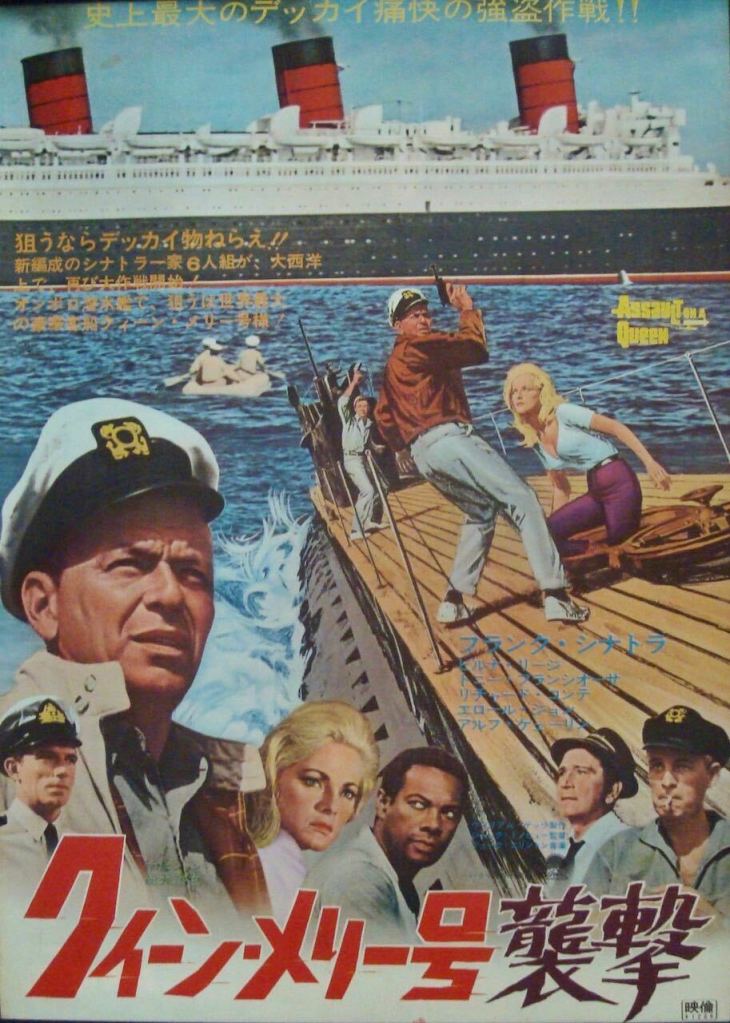
This is a fascinating role for Virna Lisi (How to Murder Your Wife, 1965), reminiscent of film noir in the way she handles men, but also years ahead of her time not just in combining sexual and financial independence but of being the boss funding the heist and recruiting the team, and soon has the reluctant Mark playing ball with no sense that’s ultimately she’s going to fall at his feet.
Anthony Franciosca (Rio Conchos, 1964) is mostly a distraction, engaged in a private feud with James Coburn as to who has the brightest and biggest screen teeth. Richard Conte (Lady in Cement, 1969) and Alf Kjellin (Midas Run, 1969) are the physical and mental muscle, respectively, and Trinidadian Errol John (Man in the Middle, 1965) essays an interesting role. Jack Donohue (Marriage on the Rocks, 1965) keeps it all ticking along.
Rod Serling (Planet of the Apes, 1968) devised the screenplay from the novel by Jack Finney (Good Neighbor Sam, 1964). So why did critics and the public have such a downer on the picture? Critical attitudes to the star were easier to understand. Sinatra’s films were generally disliked, and knowledge of his one-take preference allowed critics to thumb their collective noses at his acting, assuming he put no effort into it.
Rumors of his underworld connections were beginning to emerge, he had just married Mia Farrow, less than half his age, and the Beatles and the British invasion had usurped his position in the pop rankings. The general feeling was he was on the way out so why not boot him while he was down. This was despite him receiving some of the best notices of his career for Von Ryan’s Express (1965).
Audiences might have been expecting another Rat Pack lark in the vein of Ocean’s 11 (1960) or felt the supporting cast lacked lustre, Lisi a little known commodity, this only her second Hollywood picture, Franciosca still the second banana, and Hardy Kruger would certainly have invested the German with more malevolence. Otherwise, it’s hard to see what there is to complain about. As I mentioned the dialogue was good, characters simmering, and the story satisfying enough.
Sure, a better director might have extracted more tension from the set pieces, lifted the pace, and added a booming score as with Ice Station Zebra (1968).
It might not be the best heist picture ever made, but it’s too good to be dismissed.