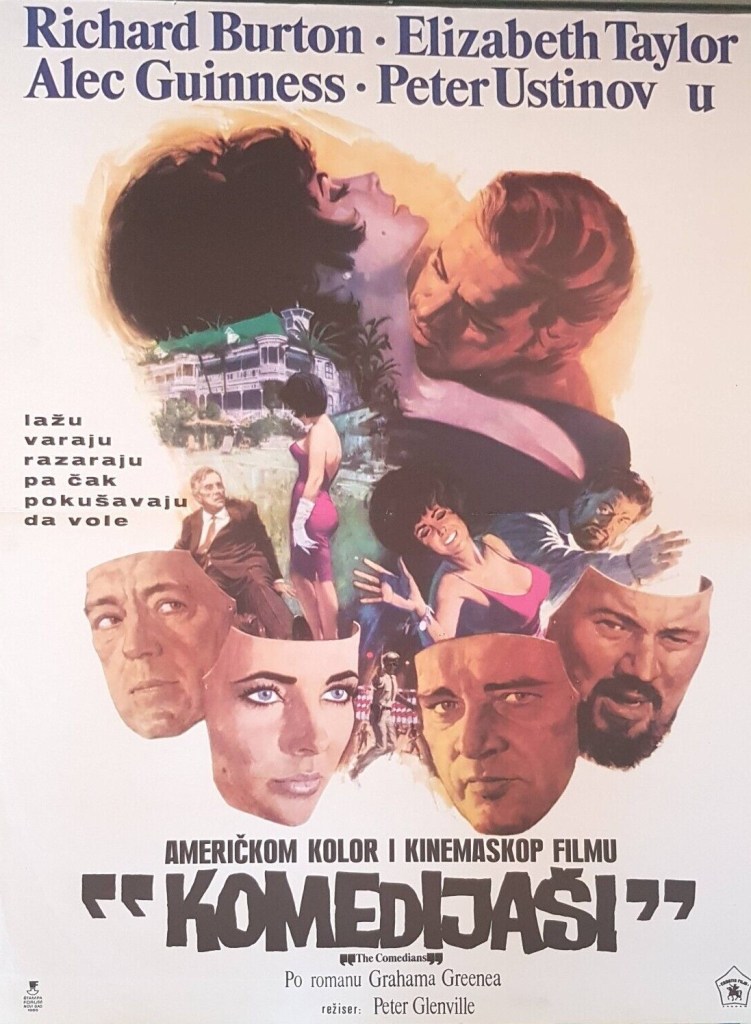
Behind the Scenes: “The Counterfeit Traitor” (1962)

Authenticity came at a cost. In electing to film in Europe veteran producer-director team of William Perlberg and George Seaton, their partnership stretching back two decades, incurred the ire of U.S. movie unions campaigning against “runaway” productions and tax-avoiding stars like William Holden. Feelings ran so high the movie was picketed on release, even though it had received a Presidential seal of approval after John F. Kennedy requested a screening.

Perlberg and Seaton were lucky not to be indicted for a further act of anti-Hollywood behavior, the hiring of so many European actors and actresses in favor of the home-grown variety, but with the incursion of Sophia Loren, Brigitte Bardot and Gina Lollobrigida into the U.S. box office introducing another big female star into the Hollywood firmament would likely have been welcomed.

Producer Perlberg bluntly defended the decision to film abroad a movie set in war-torn Europe (where much of the damage caused by the war had not been rectified). “Where would you find three solid blocks of rubble but Berlin?” he demanded. “Or a prison like Moabit? Our company was yesterday filming in a partially bombed out section of the Altona railway station, six stories high. Action involved a 14-car German train (which Union Pacific can’t reproduce). How can we build Stockholm in Hollywood.” More to the point, he added, “Of course where in the world can you get weather like this? It’s been raining every day.”

Perlberg and two-time Oscar winner Seaton (Airport, 1970), separately and together, had considerable experience of war pictures, having between them made The Proud and the Profane (1956) and The Bridges at Toko-Ri (1954), both pictures, incidentally, starring Holden. The Alexander Klein bestseller The Counterfeit Traitor, purchased in 1957 for a modest $75,000, appeared to follow a similar trajectory. “Competition for the entertainment dollar has wedded us to big films and global stories,” maintained Perlberg despite complaint by Hollywood unions that such films, in the face of shrinking U.S. production, denied their members work.

Although the European locations would shave $500,000 from the budget of The Counterfeit Traitor, still coming in at a hefty $3.4 million and originally to be filmed under the title Man in the Middle, Perlberg was adamant that “the picture could never be made in Hollywood with justice to the subject and story… We are shooting this picture where it happened. On the streets that Eric Erickson (the character William Holden plays) walked; in the houses that were his hideouts.”

Perhaps key to this philosophy was the ability to shoot inside the notorious and still-active Moabit Prison, housing 1,300 prisoners and located close to Berlin’s famous Tiergarten. Amazingly, the prison warden granted permission not just to shoot in the courtyard but also inside the actual building. The prison officials initially denied that anyone was shot in the courtyard (a key scene in the film) until Erickson turned up and testified to the contrary, standing in the cell through whose bars he had witnessed the execution. You could not buy such authenticity and certainly not recreate it in a Hollywood back lot.  

Paperback movie tie-in.

The 100-day shooting schedule included a month in Berlin, two months in Hamburg and scenes set in Copenhagen and Stockholm. It was the epitome of a multi-country adventure – the cameraman French (Jean Bourgoin who shot Tati’s Mon Oncle), wardrobe coordinator Italian, sound mixer German and assistant director British. But in Denmark, they worked with a Danish crew, in Sweden a Swedish crew. “I doubt that any other picture has been made with this type of operation – changing crews with each country involved. It has certain pitfalls but we’ve found in Germany alone that it would have been foolish to do it any other way,” added Perlberg.

“Hollywood set dressers, for instance, are great but no amount of research can match actual experience. Our interior decorators lived in the environment, witnessed the events and dressed the sets accordingly.” Apart from language problems, in Germany, where the bulk of filming took place, the lack of a centrally located “movie town” like Hollywood caused issues. Actors and crew were drawn from Berlin, Munich and Hamburg, with all the cast put up in first class hotels and paid a per diem of $15. With over 70 speaking roles, the movie also called on 2,000 extras.  The producers also worked in the oldest film studio in the world, Nordish Film in Copenhagen built in 1906, and the rebuilt Palladium, which had been blown up by the Germans during World War Two.

Actors and directors worked abroad to limit their U.S. tax exposure. Anyone taking advantage of foreign income was viewed as a tax cheat. William Holden, who would only make one movie in Hollywood in seven years, epitomized the wealthy tax dodger. Living abroad also cut down on paying U.S. tax. Switzerland, for example, where Holden took up residence, calculated tax on the amount you spent on the annual rental of your home, resulting in huge savings – Yul Brunner claimed this legitimate move alone had saved him $2 million.

Holden complained that he was unfairly being singled out. “How about Clark Gable in Naples, Tony Quinn, Charlton Heston in Ben- Hur? Why do they pick on me? I pay U.S. taxes in the highest brackets and will continue doing so for years.” He was a prime target not just because he was outspoken about living and working abroad but because he was, along with John Wayne, the highest-earning male actor, on $750,00 per picture plus percentage. He had the pick of the projects, linked with The Guns of Navarone (1961), The Alamo (1961), The Americanization of Emily with William Wyler in the director’s chair, The Visit with Ingrid Bergman and Melody for Sex where he would be paired with both Sophia Loren and Gina Lollobrigida. He had followed up The World of Suzie Wong (1961) filmed in Hong Kong, with Satan Never Sleeps (1961) filmed in Britain, and then was lining up The Lion in Kenya, Together in Paris (aka Paris When It Sizzles) in France and The 7th Dawn in Malaya.

Although Prussian-born Lili Palmer (Sebastian, 1968) was an established Hollywood import, the movie offered a wide range of parts to fast-rising European talent. Most major studios had already invested in “new faces from abroad” so Perlberg-Seaton were not going against the grain on this one. Paramount, for example, had hired the German Hardy Kruger and the French Gerald Blain and Michele Girardon for Hatari! (1962). Columbia lined up Frenchman Alain Delon for Lawrence of Arabia (1962) and Greek actress Irene Papas in the female lead in The Guns of Navarone (1961). MGM chose Ingrid Thulin for The Four Horsemen of the Apocalypse (1962) and United Artists set Maximilian Schell in Judgement at Nuremberg (1961). Claudia Cardinale was intended to make her Hollywood debut opposite Sidney Poitier in Iron Men – never made.

Heading the list of potential break-out stars were Ingmar Bergman protegees Sweden’s Eva Dahlbeck (Smiles of a Summer Night, 1955) and Ulf Palme (Dreams, 1955). They had appeared in two films together, Dreams and Meeting in the Twilight (1946). German Wolfgang Preiss would later appear in The Train (1965) and Von Ryan’s Express (1965). But the biggest casting coup was Klaus Kinski. “No German producer lightly engages him because most of his engagements in German theaters have ended with a resounding quarrel or scandal,” explained journalist Peter Baker, “(but he is) nevertheless regarded with awe and respect as one of the greatest actors to merge from post-war Germany.” His three days in The Counterfeit Traitor won him a role in Perlberg-Seaton’s next picture The Hook (1963).  

SOURCES: William Perlberg, “Searching Europe for Authenticity,” Films and Filming, February 1961, p9; Peter Baker, “The Tour of Babel,” Films and Filming, February 1961, p10-11, 41; “Lazar Percenting Ericson Spy Tome,” Variety, October 16, 1957, p3; “Lament for B.O. Stars,” Variety, January 29, 1958, p14; “Holding Money via Residence in Switzerland,” Variety, August 5, 1959, p12;“Par’s Sex Stars,” Variety, September 2, 1959, p3; “Holden, Seaton Invade Berlin for War Film,” Variety, October 28, 1959, p7; “H’wood – O’Seas Row Boils Up,” Variety, August 24, 1960, p7; “Bill Perlberg’s Back and Loves Hollywood,” Variety, November 2, 1960, p7; “New Faces from Abroad To Make Debuts in U.S. Films During 1961–62 Season,” Box Office, September 4, 1961, p12-13; “President Kennedy Sees Counterfeit Traitor,” Box Office, May 7, 1962, pW8; “Warm-Up for Picketing Strategy,” Variety, June 6, 1962, p4.

The Counterfeit Traitor (1962) ***

Cynical and opportunistic Swedish oil executive Eric Erickson (William Holden) blackmailed into World War Two espionage finds redemption after witnessing first-hand the horrors of Nazi Germany. Two extraordinary scenes lift this out of the mainstream biopic league, the first Erickson witnessing an execution, the second a betrayal. While some participants in the espionage game pay a terrible price, others like spy chief Collins (Hugh Griffiths) manage to maintain a champagne lifestyle.

Structurally, this is something of a curiosity. The first section, with over-emphasis on voice-over, concerns Holden’s recruitment and initial attempts at spying on German oil installations on the pretext of building a refinery in Sweden. Although resenting the manner in which he was recruited, Erickson has no qualms about resorting to blackmail himself to enlarge his espionage ring.

But it’s only when Marianne Mollendorf (Lili Palmer) enters the frame as his contact in Germany that the movie picks up dramatic heft. As cover for frequent meetings, they pretend to be lovers, that charade soon deepening into the real thing. While abhorring Hitler, she suffers a crisis of conscience after realising that the information she is passing on to the Allies results in innocent deaths. The final segment involves Erickson’s thrilling escape back home.

The picture is at its best when contrasting the unscrupulous Erickson with the principled Marianne. Virtually every character is trying to hold on to a way of life endangered by the war or created by the conflict and there are some interesting observations on the way Erickson manages to harness foreign dignitaries while being held to hostage in his home country. Loyalties are sparing and even families come under internal threat.

Sweden was neutral during the Second World War so in assisting the Allied cause Erickson was effectively betraying his country and once, in order to keep proposed German investors sweet, he begins to spout Nazi propaganda at home finds himself deserted by friends and, eventually, wife.  

In some respects, Holden (The Devil’s Brigade, 1968) plays one his typical flawed personalities, easy on the charm, fluid with convention, but once he learns the true cost of his espionage a much deeper character emerges. The actor’s insistence, for tax reasons, on working abroad – this was filmed on location in Europe – would hamper his box office credibility and although not all his movie choices proved sound this was a welcome diversion. Whether American audiences were that interested in what a Swede did in the war was a moot point, as poor box office testified. And the title might have proved too sophisticated for some audiences, given there was no counterfeiting of money involved.

Lili Palmer (Sebastian, 1968) is excellent as the manipulative Marianne, betraying her country in order to save it from the depredations of Hitler, not above using her body to win favour, but paralyzed by consequence. Hugh Griffith (Exodus, 1960) provides another larger-than-life portrayal, disguising his venal core. Werner Peters (Istanbul Express, 1968) puts in an appearance and Klaus Kinski (Five Golden Dragons, 1967) has a bit part.

Double Oscar-winner George Seaton (Airport, 1970) makes a bold attempt to embrace a wider coverage of the war than the film requires and could have done with concentrating more on the central Erickson-Mollendorf drama, especially the German woman’s dilemma, but, made before James Bond reinvented the idea of espionage, this remains a more realistic examination of duplicity in wartime.

CATCH-UP: William Holden pictures reviewed in the Blog are Alvarez Kelly (1966) and The Devil’s Brigade (1968); Lili Palmer movies reviewed are Operation Crossbow (1965), Sebastian (1968) and Hard Contract (1969).

Sanctuary (1961) ***

This overheated melodrama stands as a classic example of Hollywood’s offensive attitudes to women. Nobel prize-winning author William Faulkner could hardly blame the movies for sensationalising his misogynistic source material since if anything the movie took a softer line.  Told primarily in flashback as headstrong southern belle Temple Drake (Lee Remick) attempts to mitigate the death sentence passed on her maid Nancy (Odetta). Given that such appeals are directed at Drake’s Governor father (Howard St John), and that the maid has been condemned for murdering Drake’s infant child, that’s a whole lot of story to swallow.

Worse is to follow. Drake takes up with Prohibition bootlegger Candy Man (Yves Montand) after being raped by him and thereafter appears happy to live with him in a New Orleans brothel – the “sanctuary,” no irony intended, of the title – despite him slapping her around. The film steers clear of turning her into the prostitute of the original book, but pretty much sets up the notion that high class women will fall for a low-class tough guy whose virility is demonstrated by his brutality. In other words a “real man” rather than the dilettantes she has previously rejected.

After the Candy Man dies, Drake returns home and marries wealthy suitor Gowan Stevens (Bradford Dillman) who blames himself, rightly, for Drake falling into the clutches of the gangster in the first place. But a past threatening to engulf her precipitates the infanticide.

Faulkner was a Hollywood insider, adapting Sanctuary for The Story of Temple Drake (1933) and earning high praise for  his work on Bogart vehicles To Have and Have Not (1944) and The Big Sleep (1946). The success of The Tarnished Angels (1957) starring Rock Hudson, The Long, Hot Summer (1958) with Paul Newman and The Sound and the Fury (1959) headlined by Yul Brynner had sent his cachet rocketing. But all three were directed by Americans – Douglas Sirk and Martin Ritt – who had a distinctive visual style and an ear for what made melodrama work.

Sanctuary had been handed to British director Tony Richardson (Look Back in Anger, 1959) and he didn’t quite understand how to make the best of the difficult project. So while Lee Remick manages to suggest both strength and fragility, and makes her character’s wanton despair believable, Yves Montand is miscast and Bradford Dillman fails to convince even though portraying a weak character. Too many of the smaller roles appear as cliches. And it’s hard to believe the maid’s motivation in turning murderer. Watch out for Strother Martin (Cool Hand Luke, 1967).

What was acceptable steamy melodrama in the 1930s fails to click three decades on. Faulkner’s thesis that high-falutin’ women want a man to master them and furthermore will fall in love with their rapist seems to lack any understanding of the female mind and will not appeal any more to the modern sensibility than it did on release. Lee Remick is what holds the picture together, in part because she plays so well the role of a woman embracing degradation, and refusing – no matter how insane the idea appears – to let go of the man she believes is the love of her life. It’s not Fifty Shades of Grey, but it’s not that far off that kind of fantasy figure, and given the success of that book, it’s entirely possible there is a market for what Faulkner has to peddle.

Not easy to find. This is actually on YouTube if you go onto that channel and search. Strangely enough, if I post a link, it says it is no longer playing there – but just as strangely if you go looking you will find it.

Book into Film: “The Way West” (1967)

Screenwriters Ben Maddow and Mitch Lindemann earned their keep on this one. The source was a literate historical novel by A.B. Guthrie which, despite winning the Pulitzer Prize, was seen primarily as a western. In considerable detail, it covered what a wagon train heading to Oregon needed to do and know in order to make the 2,000-mile trip. It is a fascinating read, told from many points of view. But very little of the book found its way into the film.

It wouldn’t have been much of a film if the screenwriters had simply followed the book structure, for much of that was internalized, thoughts and feelings of the settlers, dramatic incident not so much. So if this was going to be a big-budget western it needed a lot more.

The paperback was sold as a western not as a novel of literary merit so it was inevitable
that the Native Americans who played a minor role in the book took center stage
on the book cover to target the expected audience.

What isn’t in the book: Tadlock (Kirk Douglas) isn’t a Senator for a start, he’s not a widow and doesn’t have a child. He’s not a visionary either with some grandiose map of how he envisages the town he’ll build. He doesn’t hang a man, get a whipping or die falling over a cliff. He’s quit the wagon train long before the cliff section. And he stopped being the leader of the expedition less than halfway through the book.

What isn’t in the book: Evans (Richard Widmark) isn’t overfond of alcohol, doesn’t create an unforced halt in order to celebrate Independence Days several days too soon, doesn’t have a grandfather clock whose loss causes him to lose his rag with Tadlock, in fact it’s he who picks the fight after discovering Tadlock intends to hang a thieving Native American.

What isn’t in the book: Dick Summers (Robert Mitchum) isn’t losing his eyesight, though recently widowed his wife wasn’t a Native American, and he doesn’t have a lucky necklace to pass on to a young man or woman.

So there’s a whole passel of wonder right there. The screenwriters have instantly dramatized all three leading characters by providing them with different attributes, making Tadlock and Summers more sympathetic than in the book, rendering Evans less sympathetic. The problem with the book’s Summers is that what makes him interesting is his lore, his knowledge of everything to do with the West, little of which translates to the screen. So providing the toughest of them all with an impediment allows him an immediate story arc.

What isn’t in the book: a Native American child is not killed by a settler, there’s no settler hanged by Tadlock to placate the warring tribe. There’s no warring tribe. There’s no race with other wagon trains at the outset and no racing across a river to get ahead of a rival. There’s no stowaway preacher either, though there is a preacher (Jack Elam). There is only one stop along the way in the film, at Fort Hall, but two in the book, the other being Laramie.

What isn’t in the book, I’m sorry to say, is the wonderful sequence of lowering wagons down a cliff, and Brownie (Michael McGreevy) marries Mercy (Sally Field) because otherwise she’s going to leave the wagon train at Fort Hall and he doesn’t make a pledge in public that her unborn child is his. And there’s no part for Stubby Kaye.

This hardback cover gives far better representation of the novel’s content.

Some of the more solid emotional material is retained. The frigidity of Mrs Mack (Katherine Justice) remains, giving her husband (Michael Witney) the excuse to seduce Mercy, considerably more innocent in the book, where she is described not as sassy but awkward in adult company, “growed up in body and not in knowing.”  While not loving Brownie, she marries him for convenience, though she learns to love him. Brownie gets advice on handling Mercy from Summers and much of that dialog is imported straight from the book.

From the book comes the idea of the settlers chiseling their names on the rock, of Brownie, while doing so, being captured by Native Americans and being traded back to his father.

Cover of the British Corgi movie tie-in paperback printed in 1967.

But there are some ideas lifted from the book out of sequence that the screenwriters build up into major dramatic incidents. The river crossing at the start of the film is taken from the river crossing near the end of the book. Close to the start of the novel, Mack kills a Native American, whose tribe seek justice but are sent away empty handed by Tadlock. That becomes a key sequence in the film when Mack is hanged by Tadlock. A child is killed by a rattlesnake and that is transferred to a different father who gives full expression to his grief.

The screenwriters exacerbate the tensions between the characters, create more moments of high drama, invent the visionary element, and are responsible for the vast bulk of crisp dialogue. While the dialogue in the book sounds authentic, it lacks the brittleness and thrust of the words spoken in the film.

A.B. Guthrie was a celebrated American novelist, a journalist who had come to fiction late, over 40 when he produced his first book, a mystery novel set in the West. But after winning a fellowship to Harvard, his writing took a literary turn, and his West did not take the traditional romanticized view. Two of his novels had been filmed – The Big Sky (1952) starring Kirk Douglas and These Thousand Hills (1959) directed by Richard Fleischer – and he had written an Oscar-nominated screenplay for Shane (1953), based on the Jack Schaefer novel, as well as for The Kentuckian, based on the Felix Holt book. The Way West had become such a touchstone for originality and an acclaimed masterpiece that it seemed impossible to turn it into a film.

Whether the film’s negative critical reaction and audience disregard was down to the screenplay veering so far away from what was considered a classic novel is hard to say. This is a very good example of a book that appeared unfilmable being somehow turned into a more than watchable film.     

And I can recommend the book.

“The Godfather” Steal And Other Stories

It was the heist of the century – the biggest steal in Hollywood history. Movie rights to The Godfather should have cost in the region of $1 million – i.e. boosting the original budget by around 20 per cent – given that Twentieth Century Fox shelled out a million bucks plus add-ons for The Love Machine published the same year and even Portnoy’s Complaint, a difficult book to transfer to the screen, went for $400,000. It was quite extraordinary that the movie rights to a bestseller which outsold the Jacqueline Susann novel and virtually everything in sight arrived at Paramount for the measly sum of $85,000. In other words, the greatest film of all time, according to the current 50th anniversary publicity splurge and notwithstanding Vertigo, had one of the cheapest starts.

Initially, around 1966, the studio had optioned a 20-page treatment entitled Mafia and paid small sums in the region of $5,000 and $7,500 and then $25,000 on publication and another $25,000 when hardback sales reached 150,000 copies, but its maximum exposure was $85,000. Had there been a Hollywood bidding war at the time of publication or shortly after it would easily have overtaken the sum paid for Portnoy’s Complaint or more likely that matched or bettered The Love Machine.

The movie tie-in edition appeared after the paperback had already shifted eight million copies. interestingly, it had already reached saturation point, only another couple of million sales added after the release of the film, though future instalments of the series brought in further sales. So you could easily argue that the book benefitted the movie far more than the other way round.

To add fuel to the fire, Puzo was paid only $100,000 for the screenplay at a time when William Goldman had received $400,000 for Butch Cassidy and the Sundance Kid (1969) and The Godfather was an hour longer than the western.  And as if that wasn’t enough it was quite clear by the time the movie appeared that the tail was wagging the dog. Puzo had laid the groundwork for public hysteria about the movie by his book selling a staggering eight million copies.

In theory, Puzo enjoyed some largesse when Fawcett paid a record $410,000 for the paperback rights. However, paperback rights were split with the publisher of the hardback and were essentially an advance on sales. And in any case that sum was easily topped by the amount paid for Papillon published the same year. Paperbacks would bring in a royalty of about 15 cents a copy whereas the author’s share of hardback revenues would be five times that amount. So in some respects it was better for Puzo that the book remained in hardback, especially as, one year on from publication in March 1969, it was still topping the New York Times hardback bestseller chart. The Putnam hardback had sold close on one million copies split between bookshop sales and book club deals, netting the author around $700,000.

The problem with such a big hardback sale was that it invariably ate into the paperback revenues so it was in the author’s financial interest, especially for a novel still flying so high, to keep it in hardback for as long as possible. Conversely, for Fawcett, the paperback house, the longer it remained in hardback, the greater the risk of not getting its money back. So Fawcett enforced its contract and insisted the paperback appear one year after hardback publication. Although Fawcett’s initial print run for the paperback was a record 3.5 million copies that would bring Puzo less in royalties than he had accumulated from the hardback. Luckily, it didn’t work out that way.

Two years later the paperback, priced at $1.50 had sold eight million copies. In February 1972, Fawcett upped the price of the paperback to $1.65 and brought out a movie tie-in edition with 32 pages of stills. In addition, Mario Puzo, who had been paid $100,000 for The Godfather screenplay, and felt, overall, that he had been chiseled, was publishing The Godfather Papers, which was less than fulsome about his employers Paramount. But it was still extraordinary, even by Hollywood standards, that the biggest beneficiary of this publishing fairy story was the studio itself.  

When the rumor mill started working overtime about who would play Don Corleone, it was reported that Puzo was dining with Ernest Borgnine and that studio production chief Robert Evans favored John Marley from Love Story. The situation at all studios towards the end of the 1960s was dicey and it was symptomatic of the continuing financial crisis that when Robert Evans passed the five-year mark as head of production at Paramount in September 1971 he was the industry’s longest-running production chief. Even so, the glory days of huge roadshow budgets were long gone. The Godfather was the most expensive project, topping out eventually at $6 million. But given its length and complexity – 102 New York locations for a start – it was surprisingly inexpensive given that Love Story had cost £2.1 million and less prestigious projects like Plaza Suite and Such Good Friends came in at $2 million.

The film was initially set to be released at Xmas 1971 – publication of The Godfather Papers was to coincide with that. But in summer 1971 Paramount changed its mind. It already had 85-100 cinemas lined up for the movie in its first big release splash. And now it was considering holding back the picture until May-June 1972. Despite perceived pressure on the director, the message Paramount’s Frank Yablans gave to the media was one of total support. “We will not sacrifice one-tenth of one per cent of quality just to hit a release date…(we are) not locked into any kind of release pattern.” And despite later reported concerns about Coppola’s production, in July 1971, while filming was not complete, Yablans commented: “the rushes have a fantastic look.”

Although it was intended as a wide release – a fraction of the 3,000 theaters that would constitute a wide release these days – Yablans was careful to distinguish the release from “saturation.” He defined saturation, wrongly as it happened, as a concentrated release in one specific area, the 50 or 100 houses in a “Showcase” strand in New York for example. He explained the difference – two or three cinemas per city across the entire country. There was nothing revolutionary about this apparently revolutionary approach. Hollywood had a habit of playing fast and loose with its own history and day-and-date releases of movies into 500-plus theaters all at once had been going on for decades. In fact the 300-odd cinemas making up the first run of The Godfather was about the same as for Billy Jack a year earlier.   

What in fact was more significant was the length of the run. A really successful Showcase saturation might run four or five weeks but that was dependent on the week-by-week performance of the picture at the box office. A film that was “retained by public demand” was effectively that, it had punched so high that it was foolish to let it go. Paramount effectively fell back on the roadshow device of insisting on a cinema agreeing a specific length of run before the movie opened. Paramount specified this as twelve weeks – the original roadshow “season” was 13-15 weeks. In other words this was the “Box Office Un-Equalizer,” everything in revenue terms favoring the studio.

Then Paramount pulled the film forward from its projected May-June slot to Easter 1972 – which meant effectively Good Friday, March 31. Three months before opening, the studio had a trio of Loew’s first run theaters lined up – Loew’s State 1 and 2 and Loews’ Orpheum, all in Manhattan. Finally, it opened a fortnight before Easter, on March 15, in five top houses in New York. The first five days brought in a record $410,000 and it was another two weeks before the picture opened anywhere else. Limiting release proved highly successful in profit terms. Out of an initial gross of $101 million, Paramount received $64 million, an exceptionally high ratio for the times.

I hope you got the chance like I did this week to marvel all over again at The Godfather on the big screen. I can hardly add anything to the critical tsunami that greeted this picture 50 years ago and again in the last week so I’m not going to try. instead, I’ve rummaged through my files to uncover these few nuggets of information and look forward to next week’s episode of the saga.

SOURCES:  Brian Hannan, In Theaters Everywhere, A History of the Hollywood Wide Release, 1913-2017 (McFarland, 2019), p179, 187-188; “Puzo’s Jackpot,” Variety, February 26, 1969, p76; “Paramount’s Bargain Price (80G) for Godfather Rights,” Variety, September 17, 1969, p1; “Record Paperback Order,” Variety, February 11, 1970, p58; “As To That Godfather,” Variety, May 20, 1970, p30; “Peak 600G Paperback deal,” Variety, August 26, 1970, p53; “Paramount’s Bargain on Godfather,” Variety, October 7, 1970, p21; “Godfather Not on Paramount Christmas Tree,” Variety, July 21, 1971, p3; “Bestsellers As Trailers,” Variety, Jul 21, 1971, p5; “Egomania Equals Fiscal Lunacy,” Variety, July 28, 1971, p18; “Record 451G Paperback Deal,” Variety, August 4, 1971, p54; “Five Years in Hot Seat Makes Bob Evans Coast’s Longest Running Production Chief,” Variety, September 29, 1971, p2; “Yablans Strategy on Godfather,Variety, November 17, 1971, p4; Puzo Books Tells About Godfather Experiences,” Variety, December 15, 1971, p2; “Godfather at Easter,” Variety, December 22, 1971, p65; “Godfather at $1.65,” Variety, February 2, 1972, p70; Advert, Variety, February 2, 1972, p13; Advert, Box Office, March 27, 1972, p4.

We Need To Talk About Sir Sean, Part II: Who Wrote That Heinous Racist Scene: Book into Film – “Woman of Straw” (1964)

You can blame one of the screenwriters, either Robert Muller (Contest Girl, 1964) or Stanley Mann (The Collector, 1965), for coming up with the scene in Woman of Straw where the grotesque millionaire Charles Richmond (Ralph Richardson) forces his two black servants to pretend to be dogs to show his own dogs how to jump over each other. It’s not in the book. However, in fairness to the screenwriters they must have thought this preferable to the scene in the original book by Catherine Arley where Richmond offers a gold watch to the best imitation of a dog by his servants. This includes them getting down on all fours and eating food like a dog. Disgusting though this is, it is tempered by being a competition with a more than decent reward (a gold watch) for the winner.

The offensive scene in “Woman of Straw.”

And now we get into a difficult position since one of the most highly-praised episodes of Succession involved employees of grotesque millionaire Logan Roy (Brian Cox) being forced to get down on the floor and pretend to be boars and eat sausages like a boar (Boar on the Floor, Succession, Season Two, Episode Two). This sequence has a 94% rating on Rotten Tomatoes, the critical accumulation website. The episode won an Emmy for director Andrij Parekh. Scott Tobias of Vulture gave it five stars and Randall Colburn of The A.V. Club an A-minus. Various commentators referenced the Stanford Experiments, the culture of fear inherent in working with wealthy individuals, and the animalistic collapse of civilization.

So that has left me wondering if my objection to Woman of Straw was merely on racist grounds and to wonder if there would have been an outcry if the Succession episode had featured a black person grovelling on the ground.

The screenwriters made significant changes to the source novel. For a start in the book both the woman and the millionaire were German. Hildegarde Meiner in the book becomes the Italian Maria (Gina Lollobrigida) in the film. But Hildegarde is not a relatively innocent nurse as in the film. Instead, she is an out-and-out gold-digger, determined to marry a wealthy man in order to make up for a desperate life in the aftermath of the Second World War.

Back cover of the movie tie-in edition of the British paperback.

In the book the villain of the piece is also German, Korff, not British like Sean Connery. And he is simply the millionaire’s secretary not his nephew. The pivotal element of the story is the same, Tony Richmond (Connery) feeling he is owed much more of the old man’s fortune than the pittance provided for him in the will. Korff is also 60 years old and although Hildegarde makes a play for him, any romantic liaison is out of the question because the secretary wants to adopt her as his daughter.  Korff sets Hildegarde up as the nurse and instructs her to play it aloof and principled. Hildegarde does not fall into the category of beauty but, with better clothes and professional make-up, oozes class.

The rest of the story plays out much like the film except there is no rescue at sea and the millionaire does not listen to classical music. The novel narrative, while not in the first person, is told from the woman’s perspective. However, Korff is more devious than Anthony Richmond, ensuring in several ways that the nurse will take the rap.

Front over of earlier British paperback, not a movie tie-in.

The film’s ending is driven by the need for some kind of happy resolution, for the guilty to be brought to justice, the dupe exonerated to some extent. But the book belongs more to the film noir genre and the ending is quite different, the villain getting away with and Hildegarde seeing no way out but to commit suicide.

The deprivations that Hildegarde has undergone as a consequence of her Hamburg family being killed during the war and her struggle for survival thereafter and her desperation to find a wealthy white knight make her a more  sympathetic character.

The book is an excellent thriller in its own right.

Book into Film – “Hot Enough for June”/ “Agent 8 3/4” (1964)

Timing is everything in the movie business. Had British film studio Rank shifted into top gear to adapt the best-selling thriller The Night of Wenceslas by Lionel Davidson soon after its publication in 1960 it would probably have been a completely different film to Hot Enough for June which took four years to reach the screen. Davidson had produced a ground-breaking espionage thriller that had critics reaching for the superlatives and putting him in the same bracket as Graham Greene and Eric Ambler. A film appearing, for example, in 1961 would not have been lost in the box office tsunami, in Britain at least, that greeted Dr No on its movie debut in 1962.

But by the time Hot Enough for June was released a second Bond – From Russia with Love (1963)- had changed public attitudes to spy films and in addition readers were reeling from two blockbuster spy novels, Len Deighton’s The Ipcress File (published in 1962) and John Le Carre’s monumental bestseller The Spy Who Came in from the Cold (published 1963). In preproduction in May 1963, minus any cast, the projected film was still being known as The Night of Wenceslas. Star Dirk Bogarde dithered so much about his involvement that at one point he was replaced by the considerably younger Tom Courtenay (Billy Liar, 1963).

U.S. cover of the Davidson novel.

As was often the case in adaptations of best sellers, the screenwriter, in this instance Lukas Heller (Whatever Happened to Baby Jane, 1962) both added to and subtracted from the original material. For example, the Nicholas of the Lionel Davidson novel was not a particularly attractive character, truculent, snippy, with a bad case of self-entitlement, a bit of a ne’er-do-well, scrounging to pay bills, with expensive tastes and far from charming in his relationship with his girlfriend. He is also employed, rather than unemployed and with hankerings to be a writer as in the film, and comes into the orbit of Cunliffe (Robert Morley in the film) who dupes him into thinking an uncle has left him an inheritance.

Sensibly, Lukas Heller dispenses with Nicholas’s back story which posits him as a Czechoslovakian exile, albeit leaving his native land at the age of six, and various other complications concerning that country. He is sent to collect a formula for unbreakable glass. The “hot enough for June” password is a Heller construct and feels as if belongs to an earlier era of spy pictures. In the book all Nicholas has to do is leave his guide book lying around in the factory for the contact to write there the formula. However, rather than discovering he is working for the British Secret Service, the novelist employs a different twist, that the young man is, unknowingly, in the pay of foreigners plotting against Britain.

Davidson envisaged a different kind of Czech girl, more of a Valkyrie, statuesque (“her breasts stood out like bombs”) rather than the slimmer Sylva Koscina. It is Heller who adds the complication of her father heading up the secret police. In the book, her father is merely a musician and conveniently absent for most of the time, freeing up his house for romantic interludes. And the book has none of the James Bondesque features since the first of the series had not been written when The Night of Wenceslas was published.

However, the film having established the alternative world of rival secret agencies, of the girl being under suspicion and of her father being a senior official in the espionage business, the screenwriter then follows the bulk of the novel’s romance and the thrilling episodes involving Nicholas on the run. The swimming pool, cigarette burn, the parade and the milkman can all be found in the book.

There is one element that had to be changed. In the book, Nicholas makes two trips to Prague. But it is a golden rule of screenwriting that a character visits a location only once. Davidson ends his book with a touch of irony: Nicholas is swapped for Cunliffe.

At whose behest, it was decided to insert the comedy is anybody’s guess. Possibly the feeling that the book as written would be too unsophisticated for audiences accustomed to the rattling action and glamour of a James Bond. The Bond-style connections at the beginning of the film are clunky and the later references to espionage at the highest level also seemed to have been slotted in with no regard to retaining the essence of the book.

Hot Enough for June / Agent 8 3/4 (1964) ***

Thanks to his language skills unemployed wannabe writer Nicholas (Dirk Bogarde) is recruited as a trainee executive on a too-good-to-be-true job visiting a Czech glass factory  only to discover that while engaged on what appears a harmless piece of industrial espionage is in fact considerably more serious.  Complications arise when he falls in love with his chauffeur Vlasta (Sylva Koscina) whose father, Simenova (Leo McKern), is head of the Czech secret police.

Eventually, it dawns on Nicholas that he is in the employ of the British secret service headed by Colonel Cunliffe (Robert Morley). Soon he is on the run. Adopting a variety of disguises including waiter, Bavarian villager and milkman he evades capture and makes a pact with Vlasta that neither of them will participate in espionage activities.

The slinky clothing and the image of Bogarde with a gun played up to the James Bond persona,
which is of course completely lacking in the film. While Sylva Koscina is seductive
at the correct moment she is not overtly so.

A chunk of the comedy arises from misunderstandings, Iron curtain paranoia, the destruction of indestructible glass, password complications, Nicholas’s contact turning out to be a washroom attendant, and from the essentially indolent Nicholas being forced into uncharacteristic action. Soon he is adopting the kind of ruses a secret agent would invent to outwit the opposition, including burning the hand of a man with his cigarette and stealing a milk cart.

The romance is believable enough and Vlasta has the cunning to shake off the secret agent shadowing her, although the ending is unbelievable and might have been stolen from a completely different soppy picture. Although Nicholas is clearly in harm’s way several times that is somewhat undercut by the espionage at a higher level being presented as a gentleman’s game.

There are unnecessary nods to 007 and the kind of gadgets essential to Bond films, although none come Nicholas’s way. But these attempts to modernise what is otherwise an old-fashioned romantic comedy largely fail. Taking a middle ground in comedy rarely works. You have to go for laughs rather than plod around hoping they will miraculously appear. And in fact the comedy is redundant in a plot – innocent caught up in nefarious world – that has sufficient story and interesting enough characters to work.

As well as James Bond, the movie tagline referenced “The Spy Who Came in
from the Cold” (1965). The American version of “Hot Enough for June”
appeared with a new title a year after the British release and was
able to take advantage of the film adaptation of the John Le Carre novel.

That the movie is in any way a success owes everything to the casting. Dirk Bogarde, though well into his 40s, still can carry off a character more than a decade younger. He can turn on the diffidence with the flicker of an eyelash. And yet can call on inner strength if required. He is the ideal foil for light comedy, having made his bones in Doctor in the House (1954), reprising the character for Doctor in Distress (1963), while dipping in and out of serious drama such as Victim (1961) and the acclaimed The Servant (1964), released just before this.

In some respects it seems as if two different pictures are passing each other in the night. The Bogarde section, excepting some comedy of misfortune, is played for real while in the background is a bit of a spoof on the espionage drama.

Sylva Koscina (The Secret War of Harry Frigg, 1968) is excellent as the beauty who betrays her country for love. Robert Morley (Topkapi, 1964) and Leo McKern (Assignment K, 1968), although in on the joke, are nonetheless convincing as the secret service bosses.  Look out for a host of lesser names in bit parts including Roger Delgado (The Running Man, 1963), Noel Harrison (The Girl from U.N.C.L.E. 1966-1967), Richard Pasco (The Gorgon, 1964) and stars of long-running British television comedies John Le Mesurier, Derek Fowlds and Derek Nimmo.  

This was the eighth partnership between director Ralph Thomas and Dirk Bogarde, four in the Doctor series but also three serious dramas in Campbell’s Kingdom (1957), A Tale of Two Cities (1958) and The Wind Cannot Read (1958). In themselves the comedies and the dramas were successful, but mixing the two, as here, less so. Lukas Heller (The Dirty Dozen, 1967) wrote the screenplay based on the Lionel Davidson bestseller.

American distributors were less keen on this picture and it was heavily cut for U.S. release and retitled Agent 8¾ presumably in an effort to cash in on the James Bond phenomenon. I’ve no idea what was lost – or perhaps what was gained – by the editing.

The end result of the original version is a pleasant enough diversion but not enough of the one and not enough of the other to really stick in the mind.

The Battle of the Villa Fiorita (1965) ****

One of the few romantic dramas of the 1960s to resonate today. Neglected wife Moira (Maureen O’Hara) abandons her two children to fly to the eponymous villa on Lake Garda in Italy to take up with composer Lorenzo (Rossano Brazzi).  While husband Darrell (Richard Todd) accepts the fait accompli, kids Michael (Martin Stephens) and Debby (Elizabeth Dear) set out to bring her back. Although Disney had created a hit on a similar theme with The Parent Trap (1961) – also starring O’Hara – The Battle of the Villa Fiorita failed to find an audience at the time primarily because it sailed too close to comfort regarding the reality of the effect of separation and impending divorce on children.

Nor are these kids Disney cute. While Debby occasionally calls upon her internal winsome to tug at heartstrings, both she and Michael are made of sterner stuff. Unwilling to use comedy as a means of bringing the errant adults to heel, the movie gets deeper and deeper into darker territory, as the kids embark on a war of attrition, disrupting the cushy love-nest and forcing their mother to accept her maternal responsibilities. And the ending is far from what you would term happy.

Moira injects some nascent feminism into her role, determining that she is entitled to happiness rather than merely fulfilling the part of a good mother, running a household,  looking after her offspring and enjoying the life of a well-to-do matron married by a husband too often away on business and the too-familiar company of boring respectable friends. A Disney picture would have seen the kids relying on the kindness of strangers or harmless subterfuge to make the trip from Britain by boat and train to Italy. Here, they fund the journey by selling Debby’s horse. The trek is not only dull but on their miserable budget they spend most of the time famished, unable to afford food on the train, resigned to watching adults in their compartment stuff their faces (Disney would have had the grown-ups share  out the tasty fare).

Arriving at the palatial villa, where Moira is waited on hand and foot, spoiled by presents and ardently wooed, the children are under no illusion about the uphill battle they face especially when Moira is not immediately stricken enough by conscience to give in to their entreaties. Lorenzo’s initial solution is to fly the children home. Adult fortitude begins to waver when the English pair join forces with Lorenzo’s estranged daughter Donna (Olivia Hussey) on a hunger strike. Lorenzo shows a sharper side to his temperament, Moira a weaker. The children’s solidarity is also, however, sorely tested by their own differences.

That there is no easy solution – the kids perhaps joining their mother full-time in Italy or some kind of child-sharing scheme – is what gives this movie its power. The classical idea of a repressed woman finding redemption in the arms of an Italian lover (as with Summertime, 1955, also starring Brazzi) is turned on its head as reality intervenes. It’s as well the kids don’t kill us with cuteness, but instead present a realistic example of what it’s like for adoring children to be abandoned. As the film progresses, and the children turn the screw, they soon face adult realization that, even if they win, the mother they will bring back will not be the mother they knew.

After turns with James Stewart (Mr Hobbs Takes a Vacation, 1962) and John Wayne (McLintock!, 1963), Maureen O’Hara had regained her marquee appeal, and although feisty enough in those outings, this was a different, and more courageous,  performance than her fans might have expected. Her conflict is mostly internalized and especially when her children fail to see her point of view, that feistiness vanishes from sight replaced by a more somber, thoughtful individual. Brazzi is excellent as the lover whose paternal responsibilities he takes lightly compromised by a woman forced to come to terms with motherhood. Martin Stephens (The Innocents, 1961), Elizabeth Dear (The Pumpkin Eater, 1964) and, making her debut, Olivia Hussey (Romeo and Juliet, 1968) make convincing, conniving, children still dealing with their own hormonal and emotional growth.   

Adapting the bestseller by Rumer Godden (Black Narcissus, 1947), this proved to be the final movie for veteran director Delmer Daves (3:10 to Yuma, 1957).

Topkapi (1964) *****

The mother of all heists directed by the father of all heist pictures.

Films as diverse as The Italian Job (1969), Mission Impossible (1996) and Ocean’s Eleven (2001) owe director Jules Dassin a massive debt since he pretty much invented this genre with the French-made Rififi (1955). But that involved professional criminals. Outside of masterminds Elizabeth (Melina Mercouri) and Walter (Maximilian Schell), this crew are amateurs, deliberately chosen for their lack of criminal records and with a mind to the specific tasks required. So we have acrobat Giulio (Gilles Segal), upper-class English gadget inventor Cedric (Robert Morley), strongman Hans (Jess Fisher) and driver Arthur (Peter Ustinov).

The target is the impenetrable, complete with sound-sensitive floor, Topkapi Palace in Istanbul where they plan to steal a priceless emerald-encrusted dagger. The plan is ingenious. Arthur is initially only hired to smuggle the weapons essential to the audacious heist across the border. But when he is caught and forced to cooperate with the Turkish secret police, he is enlisted as a replacement for Hans. Minus the rifles and grenades which at first appeared indispensable to the plan, the thieves come up with an even more inspired alternative involving among other things scampering across rooftops, abseiling, a parrot and slowing down the revolutions of a lighthouse.

Originally intending to betray his colleagues as soon as possible, Arthur falls under the seductive spell of Elizabeth and finds himself recruited as the replacement muscles. Elizabeth exudes such sexuality she has the entire gang in her thrall and makes the cowardly, weak, acrophobic Arthur believe he can overcome all his fears. Like current television sensation Money Heist, Walter engages in a cat-and-mouse game with the police, always one step ahead, with a bagful of red herrings at his disposal, eventually giving the pursuers the slip during a wresting competition held in a massive outdoor arena.

Interestingly, too, this doesn’t have the trope of gangsters at each other’s throats, planning to double-cross one another or bearing old grudges. Nor is this the last robbery for anyone prior to retirement. Equally, nobody challenges the leader. In fact, the entire crew could not be more docile, content to sit at the feet of Elizabeth and Walter, lapping up the former’s flirtation, wondering at the latter’s skill, as if they are all honored to have been chosen.

The climactic heist, carried out minus music, and lasting over 30 minutes is absolutely superb, setting a very high bar for future imitators, and there is a twist ending. Dassin mixes light comedy and high tension with the sultry attractions of Elizabeth to produce an at times breathtaking picture. As well as the heist itself, the wrestling sequence is stunning and the transition of Arthur forms the acting highlight (he won the Best Supporting Actor Oscar).

But all four main stars are superb. Audiences accustomed to a more uptight Maximilian Schell (The Condemned of Altona (1962) will have been surprised by his charming performance. Melina Mercouri (Oscar-nominated for Never on Sunday, 1960) is the archetypal blonde bombshell, liberal with her favours but careful not to favour just one. Although Walter devises the plan, she is actually the criminal supremo, selecting the targets, and then delegating to ensure the tasks are carried out. Robert Morley is having the time of his life. Akim Tamiroff (Lord Jim, 1965) has a cameo as a chef.

A film noir star after Brute Force (1947) and The Naked City (1948) Dassin’s Hollywood career collapsed in the wake of the anti-Communist McCarthy hearings and he was blacklisted. Rififi opened few doors but even the success of Never on Sunday (1960) brought negligible offers. Despite returning to the mainstream with such elan through the conduit of Topkapi, albeit with a European cast, he remained on the Hollywood periphery and although the American-set Uptight (1968) – previously reviewed in the Blog – involved another heist that was primarily the wrapping for social documentary.

More at home with comedies screenwriter Monja Danischewsky (The Battle of the Sexes, 1960) draws out more humour than the source material, Light of Day by noted thriller writer Eric Ambler, would ostensibly suggest.

A delight from start to finish, the crème de la crème of the heist genre, this is unmissable. Dassin can lay claim to being the John Ford of the crime picture.

Discover WordPress

A daily selection of the best content published on WordPress, collected for you by humans who love to read.

The Atavist Magazine

by Brian Hannan

WordPress.com News

The latest news on WordPress.com and the WordPress community.