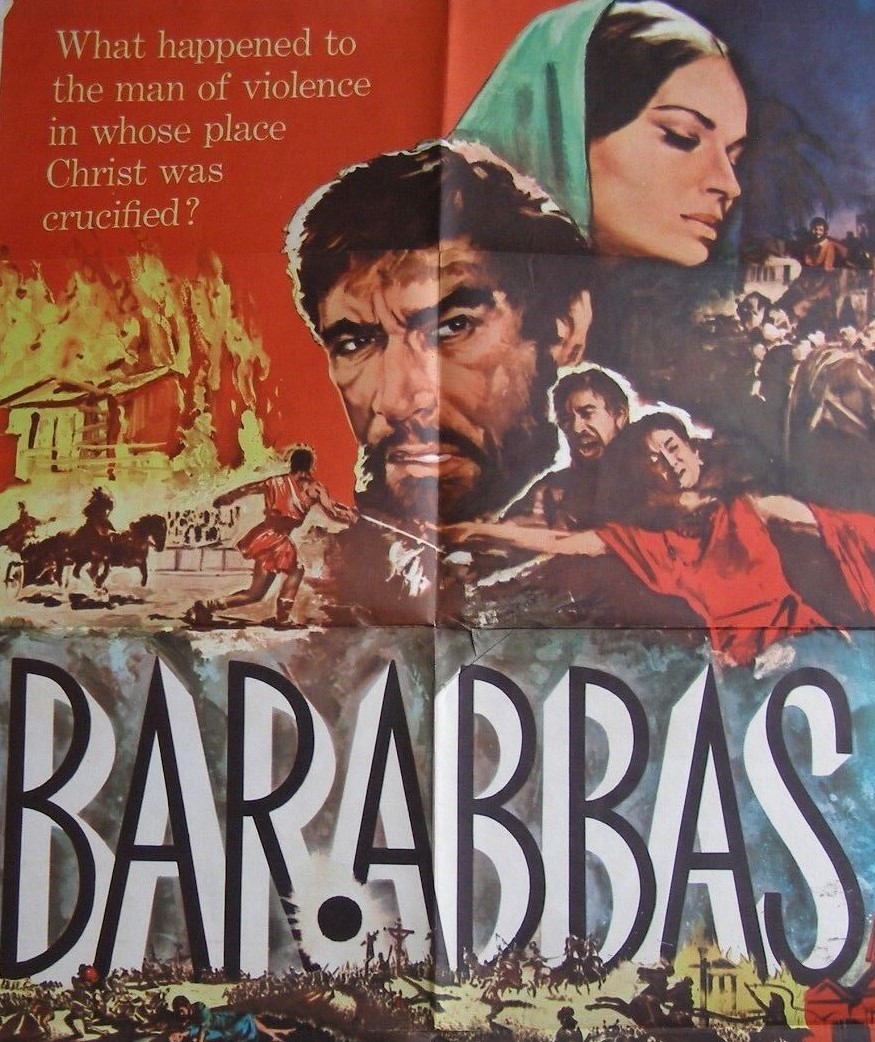
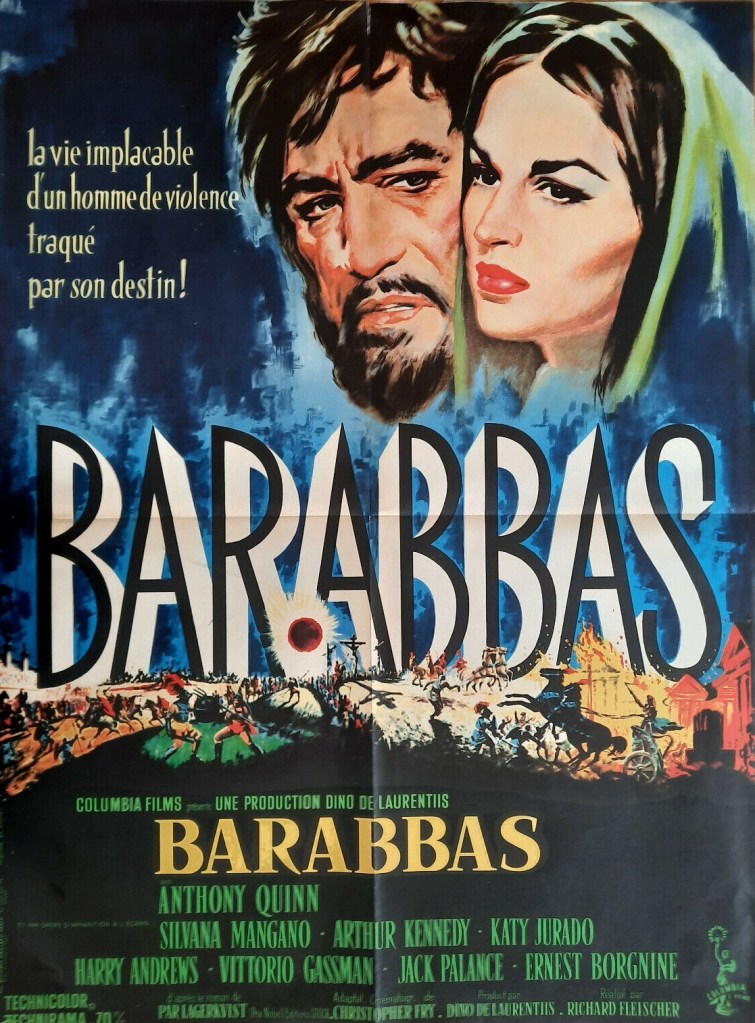
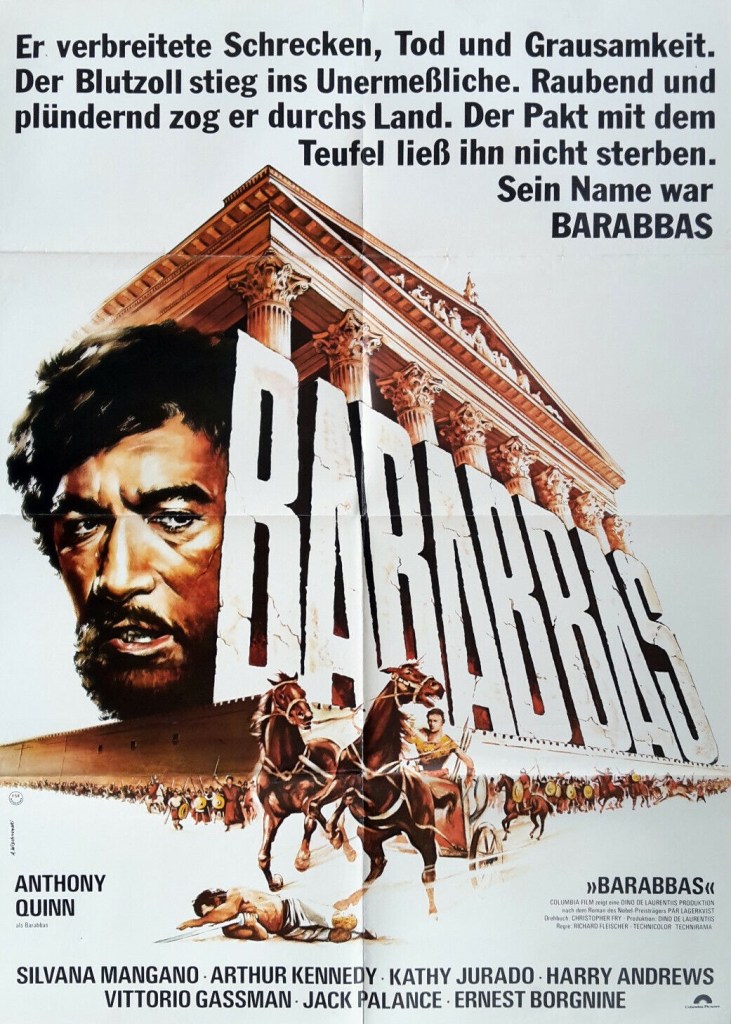
Brutally ironic ending adds a final twist to this religious epic that sheds a murky rather than heavenly light on the early days of Christianity. Barabbas (Anthony Quinn), in case you are unaware, is the criminal who, in a public vote, is spared crucifixion instead of Jesus Christ. Intent on returning to his lusty life, instead he finds himself drawn to the teachings of the Son of God despite his feverish attempts to deny it. Death might have been preferable to two decades spent imprisoned in the sulphur mines followed by a stint as gladiator only, finally refusing to deny his conversion, he ends up on a cross.
The fate of Barabbas in the Bible is undetermined, only meriting a few lines, but in the imagination of Swedish novelist Par Laverkvist he lived quite an extraordinary life, a criminal vagabond coming to believe in what he originally despised. The religious element is almost an excuse to investigate life at the edge of a pauper’s existence, a world in which faith is possibly the only way to get through the day. It’s an episodic tale with Barabbas as a Job-like peasant on whom constant indignity and humiliation is heaped.
A witness at times to the most exalted elements of Christianity – the eclipse surrounding the crucifixion, the stone rolled away from the tomb – he also sees lover Rachel (Silvana Mangano), a Christian convert, stoned to death. It’s a miracle he survives imprisonment in the mines and that when, thanks to an earthquake, he escapes it’s almost bitter irony that he ends up in gladiator school, facing the demonically sadistic Torvald (Jack Palance). Even when pardoned, he is again arrested for, believing the end of the world is nigh as described in the Christian teachings, helping burn Rome to the ground. Arrest this time sends him back to where he started, heading for crucifixion, though this time willingly.
Anthony Quinn (Guns for San Sebastian, 1968) is excellent as the dumb, mostly mystified peasant, only occasionally rising to the occasion, mostly defeated, or captured, and failing to defend those he should protect. Not entirely cowardly, witness his battle in the arena, but self-serving, and in a sense cursed by events outside his control.
Others are only briefly in the spotlight, Silvana Mangano (Five Branded Women, 1960) good as the converted Christian accepting her fate, ditto Vittorio Gassman (Ghosts of Rome, 1961) as an enemy prisoner in the mines, and Jack Palance (Once a Thief, 1965) over-the-top as the kingpin gladiator. In cameo roles – not exactly the promised all-star cast – you can find Ernest Borgnine (Chuka, 1967), Arthur Kennedy (Claudelle Inglish, 1961), Katy Jurado (A Covenant with Death, 1967), Valentina Cortese (The Visit, 1964) and Harry Andrews (The Charge of the Light Brigade, 1968).
Director Richard Fleischer (The Big Gamble, 1961) does a brilliant job of keeping reverence at bay, turning the potential awe of the eclipse into a moment of personal terror, ensuring that current persecution rather than potential eternal life remains foremost, focusing on the human not the ethereal. He presents Barabbas as constantly mystified at his escape, guilt-ridden that he has done nothing with his life, thwarted in virtually every attempt at redemption.
The big scenes are well-handled, the sulphur mines a pit of Hell, the arena far more realistic than Spartacus (1960), the burning of Rome that initially represents freedom turning into a trap. Filmed in Technirama 70mm, Fleischer makes the most of the widescreen and the historical detail.
In some respects this makes more sense if viewed alongside the director’s crime triptych of Compulsion (1959), The Boston Strangler (1968) and 10 Rillington Place (1970) which concentrate on outsiders coming to national attention through illicit activity.
Far from the usual stodgy religious offerings of the period, more in keeping with a Pasolini-like vision, with a keener eye on history than creed, it’s been rather overlooked and deserves reappraisal.
Christopher Fry (The Bible…in the Beginning, 1966) was credited with the screenplay from the book by the Nobel prize-winning novelist Par Laverkvist.
Audiences reared on the actor’s westerns and Hitchcock thrillers of the 1950s might have been somewhat taken aback to see the hard-hitting star turning up in a comedy. Setting aside Bell, Book and Candle (1958), he hadn’t been seen in anything that would resemble a Hollywood confection since a couple of lack-luster Post-War comedies – Magic Town (1947), Jackpot (1950) – when he was trying to regain the marquee status he had lost by going off to fight. Of course, having gone heavyweight with Anatomy of a Murder (1959), Two Rode Together (1961) and The Man Who Shot Liberty Valance (1962) he might have thought he was due some movie R’n’R.
Whether this contemporary equivalent of a beachside air bnb gone wrong was the ideal choice is a moot point. But he would certainly be playing against type. After all those tough guys, principled leaders and occasional dodgy characters, you wouldn’t have to go far to find people who might enjoy seeing him taken down a peg or two.
Harassed banker Roger (James Stewart) wants a quiet getaway with wife Peggy (Maureen O’Hara). But she has different ideas and he finds himself bunked down with a brood too many, his own family, in-laws and unexpected guests. Naturally some of these unexpected guests included rats, happily infesting this shambling house that could have been second-choice for Bates Motel, and there are plenty running gags about what doesn’t work or falls off and a shared telephone line.
If there was such a sub-genre as the mature coming-of-age picture, this would be it, Roger realizing he has a lot of catching up to do in the emotional relationship department.
Mostly, it’s one episode after another. The cook quits, his daughter and son-in-law have eschewed the traditional approach to child-rearing, son Danny wants to be left alone to play his computer games, sorry watch television, teenage daughter Katey (Lauri Peters) is turning into a wallflower, rather well-endowed neighbors catch his eye. To show willing, he’s the yachtsman who gets lost and bored bird-watcher.
But if audiences have learned one thing from a decade of Stewart-watching, it’s that he’s generally far from hapless and although it’s not his fault he’s trapped in the shower room with a naked woman (Marie Wilson), he’s not so much a do-gooder as a do-er, setting out to repair as much as possible the fractured relationships, not above a bit of bribery or cutting a few corners.
This is amiable enough stuff, a few good laughs, and much merriment to be had from the mere sight of the banker, lord of his domain at work cast adrift outside it, and having to adapt to different perspectives. There’s a harder edge than you might expect and some of the scenes of relationships under pressure don’t make easy viewing.
These days, everything wouldn’t work out so well, but in the 1960s I guess the tension was derived from working out exactly how it would work out. And waiting for teen heartthrob Fabian (North to Alaska, 1960) to sing. It seems a contradiction in terms that a pop star trying to prove himself as an actor has to fall back on singing. But them’s the breaks.
A mixture of situational comedy and sharp repartee, it never falls apart at the seams, enough in the tank to keep everything on an even keel.
James Stewart moves from coldness at finding himself in awkward situations to warmth as he finds ways to retrieve the best elements out of them. Stewart doesn’t have to adapt his screen persona that much, he was always a tad grouchy, and he’s packed a briefcase full of sarcastic remarks. But the scene where he reconnects with his son is very touching, Stewart at his heartfelt best.
Maureen O’Hara (The Battle of the Villa Fiorita, 1965) who also has a few icy veins sets those aside to mother all and sundry. Stewart and O’Hara prove an excellent screen partnership and they would be paired again in The Rare Breed (1966), where he was on more solid ground.
John Saxon (The Appaloosa, 1966) gets a chance to show what he can do besides being tough and John McGiver (My Six Loves, 1963) adds another interesting character to his portfolio of offbeat roles.
Veteran Henry Koster (Harvey, 1950) knows how to handle any amount of handfuls and when to pick out the comedy or head straight for the drama. Nunnally Johnson (The Dirty Dozen, 1967) based the screenplay on the bestseller by Edward Streeter, an expert in domestic upsets, previously penning Father of the Bride.
How is that the British, way down now in the rankings of global movie production, have come up with a successful genre all of their own – the national treasure. Maggie Smith and Helen Mirren to be sure first came to prominence in the same year, 1969, with The Prime of Miss Jean Brodie and Age of Consent respectively, but whereas Hollywood has turned its back on the ageing female contingent, the British film industry has wrapped its most famous stars in cotton wool and proceeded to give them roles they can take to the Oscar bank.
Mirren was in her early 60s when she romped home in The Queen (2006); you only have to say Downton Abbey and Smith, already two Oscars to the good, is regarded as screen royalty. And that’s before Judi Dench enters the equation, a few years older than Mirren when she nabbed the Oscar for Shakespeare in Love (1998). You can pretty much count on getting funding for any picture if you can rustle up any of this trio. Want to bring back the older crowd? Dangle these carrots!
Elevated into this category now is Lesley Manville, the 66-year-old star of the delightful Mrs Harris Goes to Paris. While largely escapist, there’s enough of a contemporary vibe, a Paris redolent of filth, the downtrodden going on strike, to provide an edge, and a narrative that continually punctures dreams any time fantasy looks like running away with itself. Set in 1950s London and Paris where the poor know their place, and are rigidly kept in it by the arrogant rich, but where aspiration can at any moment take flight.
Cleaner Mrs Harris, dreaming of buying a £500 dress – we’re talking the best part of £14,000 these days – scrimps and saves, and through a couple of more than fortuitous events, finds her way to the House of Dior where she is despised by haughty manager Claudine (Isabelle Huppert), adored by philosophic model Natasha (Alba Baptista) for having such aspirations, and manages to cast a spell, although not for the reasons expected, over rich widower the Marquis de Chassagne (Lambert Wilson).
There’s not much plot. She has to remain in Paris for a fortnight for fittings and whiles away the time helping along the romance between under-manager Andre (Lucas Bravo) and Natasha, assisted by their existentialist leanings, eventually overcoming hostility and putting everything to rights in the Dior empire. But you don’t need plot when you’ve got charm. The English notion of fair play initially comes a cropper when facing French egalitarianism out of whack, when the rich can jump the queue and basically make everyone jump to their tune. But when a character like Mrs Harris settles for second best you can be sure she’ll come up trumps. Whether it’s icing on the cake or to make a rubbish-strewn Paris more palatable, there’s a good ten minutes of oo-la-la devoted to parading the latest fashions.
Not content with conquering one city, Mrs Harris developed sequelitis and headed for New York.
And there’s not just a philosophical undertone – people not what they appear on the surface – but a feminist one, women holding the world together while men whistle. But by and large it’s joyous entertainment, a confection straight out of the Hollywood top drawer, a poor woman having her day in the sun through sheer strength of character.
Unless you’re British or a big fan of arthouse director Mike Leigh or noticed her Oscar nomination in the largely unnoticed The Phantom Thread (2017) Lesley Manville will probably have passed you by. She nabbed a cult following as the dumped-upon lead in comedy series Mum (2016-2019) and picked up a wider audience as Princess Margaret in The Crown, but mostly she’s known for a certain kind of acting, where she can change expression 20 times in a minute without ostensibly doing anything different. Just like her predecessors, Smith, Dench and Mirren.
You can’t take your eyes off her, which is quite feat when she’s up against French screen royalty (perhaps a “tresor national”) Isabelle Huppert (Elle, 2016). Alba Baptista (Warrior Nun series) could well be the breakout star here though Lucas Bravo definitely runs her close. I saw Bravo in Ticket to Paradise (2022) and the characters there and here could not be more different. Ellen Thomas (Golden Years, 2016), Lambert Wilson (Benedetta, 2021), Anna Chancellor (For Love or Money, 2019) and Jason Isaacs (Operation Mincemeat, 2021) have smaller roles.
Director Anthony Fabian (Skin, 2008) adds deeper issues to a movie that was crying out to be all surface. He co-wrote the screenplay with Carroll Cartwright (What Maisie Knew, 2012) based on the classic Paul Gallico novel.
The unexpected U.S. box office success should have propelled star Kenneth More into the Hollywood firmament. The British box office champ of the previous decade, after comedies like Genevieve (1953) and Doctor in the House (1956), war movie Reach for the Sky (1956) and drama A Night to Remember (1958), he had been rewarded by a tie-up between British studio Rank and Twentieth Century Fox. That allowed him bigger budgets and bigger co-stars, pairing him with Jayne Mansfield in comedy western The Sheriff of Fractured Jaw (1958), and Lauren Bacall for historical adventure North West Frontier (1959).
While hits in Britain, they failed to raise his profile in America. That changed with Sink the Bismarck!, his performance highly praised, the movie a genuine and very profitable hit. It should have been the stepping-stone he needed to break into the Hollywood big time. And for a short time it looked as if he would.
He was scheduled to co-star with Gregory Peck in the big budget high adventure war picture The Guns of Navarone (1961), in the part that finally went to David Niven. He lost the role through petulance.
At a public event, he verbally tore into his boss, John Davis, head of Rank, to whom he was contracted and on whose goodwill he relied to loan him out to Columbia for this movie which would become the number one hit in the annual U.S. box office race. In revenge, Davis blocked the loan-out and in effect stymied his career. Few companies were going to invest in a star whose movies would automatically be blocked from being booked on the Odeon chain, owned by Rank, and one of the two biggest circuits in Britain. As a result of his intemperate, drunken, action, More’s career plummeted.
Oddly enough, Sink the Bismarck! also killed off the career of the German-born Dana Wynter, a rising Hollywood star, leading lady to Rock Hudson in Something of Value (1957) Robert Wagner in In Love and War (1958) and James Cagney in Shake Hands with the Devil (1959) and denoted star of Henry Koster’s Fraulein (1958). After Sink the Bismarck!, and On the Double (1961), she lost out on big roles until the low-budget If He Hollers, Let Him Go (1968).
It seemed almost a contradiction in terms that such a big hit as Sink the Bismarck! could produce no outright winners in the career stakes. And although director Lewis Gilbert had a stab at the Hollywood big budget picture with The 7th Dawn (1964) starring William Holden, he relied on later British pictures Alfie (1965) and You Only Live Twice (1967) to give his career the fillip it surely deserved.
Lewis Gilbert was virtually a veteran by the time Sink the Bismarck! appeared, 16 previous pictures including Reach for the Sky, another More-starrer Paradise Lagoon (1957) and Carve Her Name with Pride (1958).
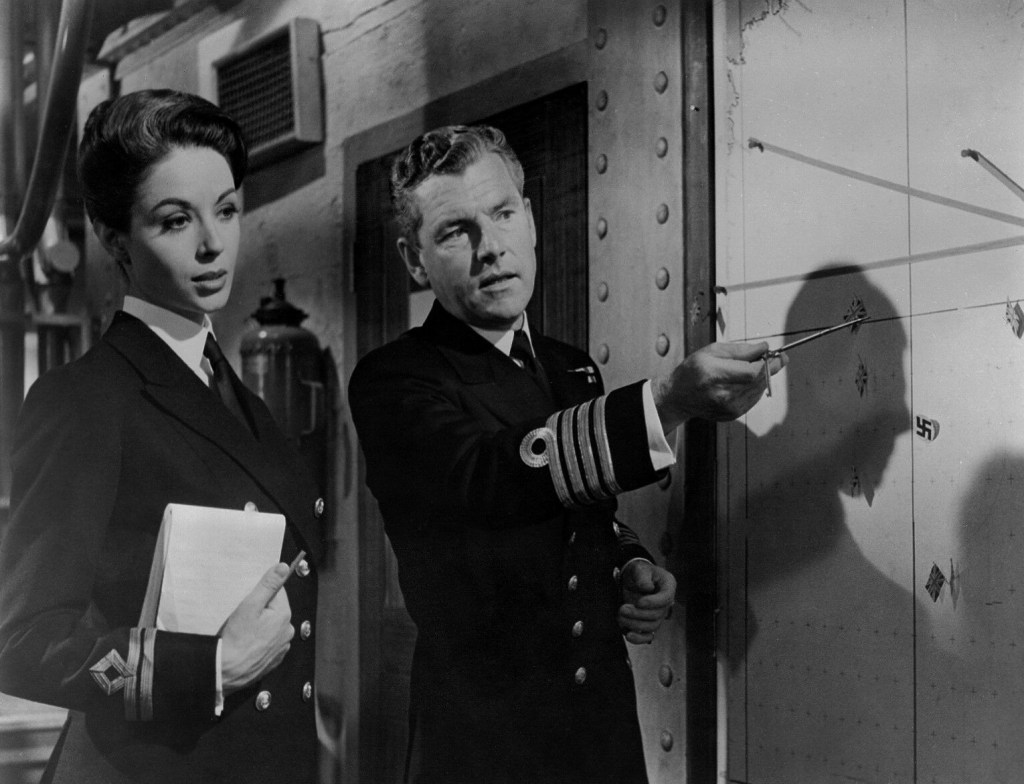
Kenneth More explaining details to Dana Wynter. In the movie they would have the most buttoned-down romance you could imagine, feelings not pronounced until the end.
Gilbert described Sink the Bismarck! as a “detective story set at sea,” and that’s the picture he determined to make, focusing on the hunt more than the normal World War Two heroics, the usual battleground endeavours taking second place to backroom tactics that resembled a “psychological chess game” between British and Germans. It was a change of pace for star Kenneth More, his screen persona the opposite of “someone so stiff and buttoned up.” A star of More’s caliber was all the movie needed to be funded.
The bigger problem was the hardware. “If we were to film on real ships, explode old ones even,” recalled Gilbert, “we would need the cooperation of the Admiralty.” Luckily, the wife of producer John Brabourne (Romeo and Juliet, 1968) was the daughter of Earl Mountbatten, the former Governor of India, who happened to be First Sea Lord (head of the Admiralty) who could put in a good word.
“Blowing up ships, or bits of ships, turned out to be not so hard,” explained Gilbert. Portsmouth’s naval shipyards contained many vessels whose active days were over and who were considered nothing more than scrap metal. So, prior to the commencement of shooting, Gilbert took a crew into the shipyard and began the blowing up. Because these were not models, the use of real ships “gave the film extra conviction.”
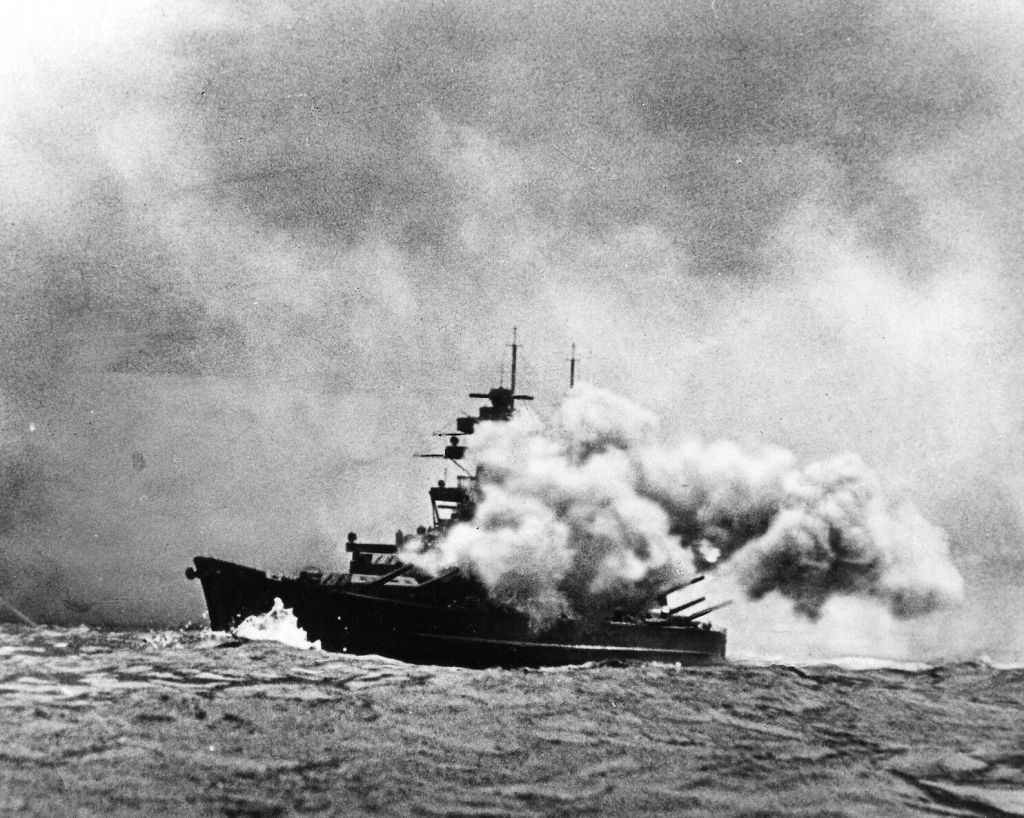
Gilbert also received permission to film on HMS Vanguard, the last British battleship of the era still on active duty although it too was due to be scrapped. That permitted filming the ship’s 15-inch guns in action. It doubled for scenes set aboard HMS Hood, Prince of Wales, King George V and the Bismarck, creating greater authenticity. HMS Belfast stood in for the pursuing cruisers including HMS Norfolk, Suffolk, Dorsetshire and Sheffield. A Dido-class cruiser provided the set for Bismarck’s destruction.
Aircraft carrier HMS Victorious played herself as well as HMS Ark Royal but any actual flying took place aboard HMS Centaur. The destroyers participating in the night-time attacks were HMS Cavalier and HMS Hogue. The bridge of the Prince of Wales was “reproduced down to the last detail.” One of the officers wounded in that attack was Esmond Knight, an actor on the film, who had virtually lost his sight, but from memory was still able to determine that the bridge was “a perfect replica.”
Three Fairey Swordfish biplanes with torpedoes were used. Three RAF jet pilots volunteered to the fly the biplanes in the movie for the experience of understanding the risks involved in diving at less than the top speed of 138 mph in a machine which was little more than wood and canvas to drop torpedoes on a highly-armed ship, but Gilbert had already hired specialist crews.
Top Hollywood model maker Howard Lydecker (The Underwater City, 1962) was recruited to build the 20ft model of the Bismarck, which, unfortunately, sank on launch. Raising it was not a problem. Long shots were filmed on the massive Pinewood water tank. It helped the production that during the battle the weather had been foul, so ships could be seen emerging from fog, or rendered invisible because of it.
Gilbert used his own wartime experience to render the battle realistic. He remembered sailing past the Scharnhorst, one of Germany’s three most powerful battleships, being unable to see it because of fog but aware of its presence from the sound of its guns. “We knew it from what we heard and felt, not from what we saw.”
Post-war the sinking of the Bismarck became a cause celebre. The British were accused of a war crime for nor picking up survivors. However, the British claimed that the presence of U-boats in the area rendered this too hazardous.
SOURCES: Lewis Gilbert, All My Flashbacks (Reynolds & Hearn, 2010) p 197-203; Brian Hannan, The Making of The Guns of Navarone (Baroliant Press, 2013) p67.
Hard to believe but outside of the Hollywood big-budget Bridge on the River Kwai (1957), this was the biggest British film at the U.S. box office in the previous decade. In fact, the British war films that did so well in the home territory, The Cruel Sea (1953) and Reach for the Sky (1956), sank like a stone when exported to in America while earnings for Ealing comedies, limited to arthouses, hardly made a dent in the box office.
What makes this so appealing is the very lack of Britishness and the intrusion of a Yank, famed reporter Edward R Morrow (playing himself), interrupting the action at various points to keep audiences up to speed. The fact that the sinking of the Bismarck, the biggest battleship ever built, was one of the few British actions at the start of the Second World War to be counted a success probably helped. Watching the Brits being lionized for defeat was not an attractive notion for global audiences.
But in the main it is a thrilling docu-drama, very much a departure for the genre, with every nuance of potential consequence spelled out. Dialog and models being moved across maps announce the risks inherent in the British attack: the superiority of the newly-built German battleship, the multiple options the Germans had in 1941 to escape, the difficulties in pinpointing the German vessel in the fog-bound waters of the North Sea, and the devastation the battleship could inflict on the beleaguered convoys on which Britain depended to stay afloat. In addition, even when targeted the Germans could flee to occupied France or potentially summon U-boats or air support.
So in the manner or Operation Crossbow (1965) or Day of the Jackal (1973) the audience is primed for a minute-by-minute enterprise, the battleship deemed so dangerous that the Admiralty is willing to risk its own scarce supplies of battleships, destroyers, cruisers and aircraft carriers in a bid sink the enemy. It is so much a documentary that the beyond the thrill of the hunt there is little room left for drama and certainly little of the stirring kind that had become such a byword for the British version of the genre – and such a turn-off for foreign audiences who could hardly make out what the actors were saying never mind work out why such-and-such a mission they had never heard of was so important.
In any case emotion is forbidden in the subterranean claustrophobic Admiralty War Office where new operational commander Capt Shepherd (Kenneth More) holds sway. A martinet, “cold as a witch’s heart,” on arrival he rids staff of what he sees as the rank indiscipline of addressing colleagues by forename rather than surname, eating sandwiches at a desk to which the workforce have been chained for hours and various minor offences against the strict code of a uniform.
It was inherent in this type of picture that the land-based unit suffer the casualties of war, husbands dead or missing in action, wives and children killed by German bombs. But the tightening of the stiff-upper-lip ensures that when such revelations become known, they appeared like emotional depth-charges on this otherwise staid ocean. And Capt Shepherd, through his choices, as would be true of many high-ranking officers, might be sending his own son to is death.
This is also one of the first instances in war pictures where the Germans are not treated as stock villains, but intelligent people, like Admiral Lutyens (Karel Stepanek) with his own vanity and a hunger for redemption, and Capt Lindemann (Carl Mohner), as valiant an opponent in the cat-and-mouse duel where outwitting the British enemy could wreak untold carnage and hasten – unusually from the German point-of-view rather than from the Allies – the end of the war.
A few months after launch the Bismarck is spotted leaving its home port, destination North Atlantic to feast on convoys travelling from America with invaluable supplies. There are four possible routes open to get round the top of Britain. To prevent the Germans reaching any of them British ships must be sacrificed, including HMS Hood – three survivors out of a crew of 1400.
It’s David vs Goliath except David is a terrier capable of inflicting tiny wounds that drain the battleship of some of its power, loss of fuel and rudder problems limiting movement. It’s a different kind of war picture, as well as the big guns blasting at each other over huge distances, the British employ biplanes loaded with torpedoes, a weapon also used in some instances by its ships.
To keep audiences more heavily involved, there are snippets of dialog involving characters on board the various ships, some in distinctly un-stiff-upper-lip mode, and montages of the various vessels getting ready for action, as well as shots of devastation should a shell find its target.
But basically it’s brilliantly-told tactic-heavy war picture that shows the shifting battleground, how the various ships are deployed, with no shortage of telling the audience how crucial success is and how crushing defeat. There’s no reliance on individual heroism, no snappy soldier defying authority, no hunch being played out, none of the usual cliches of the genre, instead, as with The Longest Day (1962) a clear explanation of what’s going on with superb battle scenes for the action-inclined.
It’s fair to say that even on the small screen, the models look a bit iffy, but this is more than compensated by other scenes on real warships, the use of newsreel footage, and fast cutting. That action never takes place under a clear blue sky but always in murky waters also adds to the realism.
In a role that would have been custom-made for Kenneth More (The Comedy Man, 1964), king of the stiff-upper-lip, rather than simply spouting his lines, he adds considerable emotional depth. Dana Wynter (Something of Value, 1957) is excellent as his equally buttoned-up assistant.
There’s a full crew of supporting British character actors including Michael Hordern (Khartoum, 1966), Laurence Naismith (Jason and the Argonauts, 1963), Geoffrey Keen (Dr Syn, Alias The Scarecrow, 1963) and Maurice Denham (Some Girls Do, 1969) while the Czech-born Karel Stepanek (Operation Crossbow, 1965) and Carl Mohner (Assignment K, 1968) inject humanity into the Germans.
Lewis Gilbert (The 7th Dawn, 1964) does a brilliant job of bringing this all together, adding touches of emotion and humour to what could have been a too-dry concoction, drawing on a screenplay by Edmund H. North (HMS Defiant/Damn the Defiant, 1962) which was based on the book by C.S. Forester of Hornblower fame.
I’m astonished this highly original western has disappeared into critical oblivion. As cruel as it is unusual, overturning every cliché, brimming with realism, more drama that action, some stunning scenes, and an ending only the bold would ever consider, this is desperately in need of reappraisal.
A refuge becomes a trap. The hero never wins. A spurned lover remains spurned. The cavalry are the dregs of society. Nobody listens to common sense. There’s no sending for help to relieve the beleaguered garrison. What chance does anyone have when the commanding officer is proud to die “by the book” rather than engineer a simple escape.
Gunslinger Chuka (Rod Taylor), arriving from the wintry north, shares some of his provisions with starving Arapaho Native Americans, comes upon a broken down stage containing two high-born Mexicans en route to California, Veronica (Luciana Paluzzi) and Helena (Victoria Vetri), his presence, thanks to that simple act of generosity, ensuring the marauding Arapahoes spare their lives. At the fort, a deserter is being whipped on the orders of martinet English commander Col Valois (John Mills). A patrol has failed to return so Valois won’t let the newcomers leave.
Chuka, sympathetic to the situation of the starving Arapahoes, suggests the colonel gives them food and sufficient weapons to allow them to hunt their own food. Veronica, now a widow, turns out to be Chuka’s long-lost love. Romance beckons but his unsavory occupation turns her stomach. Hired gun Chuka is not the only one to exploit need. Major Benson (Louis Hayward), the fort’s second-in-command, has a squaw (Herlinda Del Carmen), trading shelter for sex, stashed away.
Valois convenes a dinner party in honor of his guests – “I miss conversation and the elegance of dining in mixed company” – only to torpedo the occasion by revealing “what a uniform can conceal,” the sins of his officers: Benson a card cheat, Lt Daly (Gerald York) court-martialed for treason, the company doctor a coward. An arrow through the window ends dinner prematurely, Chuka demonstrating his skills in shooting the perpetrators.
Bit of artistic license here – Luciana Paluzzi is buttoned up all the way, no naked back, and Rod Taylor is not quite so athletic.
Honor plays no part in Chuka’s life and he refuses to help out Valois unless paid $200, enough he thinks to start life afresh with Veronica, and only after a knockdown no-holds-barred fight with faithful Sgt Otto Hahnsbach (Ernest Borgnine), the only man on the post who doesn’t despise Valois – an upper-class stranger in a strange land – prevents Chuka leaving in any case.
On a scouting mission, Chuka finds the patrol strung up and a massive Arapaho war party on the verge of attack. He returns to a mutiny, led by Benson, quelled by a single shot by Valois, the first time, it transpires, he has killed a man. In a very moving speech, Hahnsbach reveals that Valois saved his life, but in consequence was tortured and castrated. Benson turns out to have a very soft spot for his squaw, feelings naturally unreciprocated. Valois refuses Chuka’s entreaty to abandon the fort, leaving the supplies and guns behind, but saving the lives of everyone.
This time it’s the Native Americans who exhibit the strategic martial skill. It doesn’t end well. And here’s no stirring music to comfort the audience. Defeat here is raw, none of the manufactured heroics of The Alamo (1960) or The Wild Bunch (1969).
Sure, I expected a tad more action, but in its place was a more than satisfying drama that honed to the reality of the American West, a pitiless region exploited by the pitiless. The rule of authority doesn’t just commit commanding officers to suicidal action, it also condemns civilians like Veronica, who flees her home rather than confronting her father over another forced marriage.
The ranks of the U.S. Cavalry – beatified by the likes of John Ford for whom occasional drunkenness and a fondness for fisticuffs were the only sins – must in reality, like armies the world over, have been filled with the scum of the earth, wanted men, killers, thieves and vagabonds, using new identities to escape their past. As if the best source of recruitment was characters on a par with The Dirty Dozen. While Valois and Hahnsbach believe they have whipped the men into shape, there wouldn’t be any whipping of deserters if that were true.
Valois the martinet certainly has parallels with the commanding officer of Tunes of Glory (1960), also played by John Mills, on the verge of a nervous breakdown as a result of his war experience. And we are led to believe that Valois is as “guilty” as the rest of the outfit when, in fact, he keeps his heroism hidden. Hahnsbach begins with an impersonation of Victor McLaglen, John Ford’s high priest of rowdiness, but he also reveals hidden depths.
This is Rod Taylor reinvented, far removed from the romantic charmer of the Doris Day comedies or the tough hero of The Mercenaries/Dark of the Sun (1968). And Taylor, himself, was very much responsible for bringing this laid-back but deadly gunslinger to the screen. He was the film’s producer, had an uncredited hand in the screenplay, redefining the role as he saw fit. And it was an audacious character to put on the screen. The gunslingers of The Magnificent Seven bemoaned their lot, lack of family, wives, emotional baggage, but they didn’t bring the Revisionist Western to life.
And although Clint Eastwood would put a different spin on the hired gun, the Leone films were not released in the U.S. until after this was made so would not have influenced the production. As well as sharing his food with the starving Arapaho, Taylor ensures his character puts their case in straightforward language.
And a sense of foreboding, courtesy of the opening scenes, hangs over the whole enterprise, and part of the skill of director Gordon Douglas (Stagecoach, 1966) is to lull us into a false sense of security, that somehow the main characters will escape the foretold destiny. I have mentioned before my surprise that Douglas is treated just as a journeyman director. Sure, his western output can’t be mentioned in the same breath as Ford, Howard Hawks or Sergio Leone, but this is not far off not just for its down’n’dirty attitude to the West, but for some moments of pure cinema. Not only does the ending echo the opening but our introduction to Taylor, via an aerial shot, echoes our last image of him, in both cases eyes gazing upwards in apprehension.
The dinner party scene is quite superb, and Mills goes from hidebound martinet to sympathetic character, his wistfulness as he recalls wooing women in the past likely to stay in the memory, as does his reaction to shooting the mutineer, while Borgnine’s recollection of Mills’ heroism is beautifully done, Borgnine, too, morphing from cliché bully to proper character. In another film, a star of Taylor’s caliber would have fought for a happy ending, but every opportunity for one, Taylor and Paluzzi scampering off into the sunset, for example, or being reconciled, is denied.
Good to see Luciana Paluzzi (Thunderball, 1965) in a more interesting role and Victoria Vetri (credited here as Angela Dorian), prior to her Playboy fame, given the chance to play a more rounded character than when she went down the Raquel Welch route in When Dinosaurs Ruled the Earth (1970). Richard Jessup (The Cincinnati Kid, 1965) wrote the taut screenplay based on his own novel.
Couple of minor quibbles – why doesn’t the window break when an arrow comes through it but shatters when Chuka jumps out, how come the Native Americans have enough guns to launch a major attack on the fort but not enough to hunt for food? But those are very minor points.
Director William Wyler was “saved,” to use the term preferred by his biographer Jan Herman, from what turned out to be the biggest picture of all time (up till then) The Sound of Music (1965) by a piece of door-stepping by two determined young producers who presented him with a pre-publication copy of John Fowles’ novel The Collector.
Wyler had been well down the pre-production route for The Sound of Music. It was he who hired Julie Andrews, having seen her performance on Broadway in My Fair Lady, and been granted access to the rushes of Mary Poppins (1964). While he was an odd choice to direct, being more of an opera buff and hard of hearing, he would later nurse Funny Girl (1967) to box office and critical acclaim.
While instinct told the German-born director that The Sound of Music “would be a success” he was troubled that it was set in Austria at a time just before World War Two when the country was mostly whole-heartedly welcoming the Nazis. “I can’t bear to make a picture about all those nice Nazis,” he said.
So when novice producers Jud Kinberg and John Kohn, television writers who had set up Blazer Films, brought him what would turn out to be a sensational bestseller, actor Terence Stamp already under contract and a deal in place with Columbia, turned up on Wyler’s doorstep with a completed screenplay they gave him a reason to pull out of The Sound of Music. He ignored the screenplay in favor of devouring the book.
“I couldn’t put the book down and I’m a man who can put down books very easily,” he said. While not so enamoured of the screenplay by Stanley Mann, he signed up, and although since the 1950s he had either officially or unofficially acted as producer on his own movies, he agreed to allow Kinberg and Kohn to do the job this time, as long as they did not interfere with direction and that he, of course, had final say.
Despite critical acclaim for Billy Budd (1962), a part he won ahead of the likes of Warren Beatty, Terence Stamp had not made a film since, and begun to doubt whether he was cut out for stardom. He wasn’t short of media attention – the various women he squired seemingly all the time made sure of that – but he was distinctly lacking in movie offers.
He took on the role of the deranged Freddie – even though he loathed the character – primarily because he had no other choice. “I hadn’t gotten any new work in roughly a year,” he explained. “I knew the camera loved me, so I had confidence in that. But I just thought this Freddie character was beyond me.” And once Wyler was signed, Stamp felt he would not come up to the director’s high standards. Told that Wyler had no objections to his casting, the still dubious actor asked to take part in the screen tests the director was holding for actresses hoping to win the role of Miranda, the female lead, partly to feel his way into the part and partly to give Wyler an opportunity to fire him if he wasn’t up to the mark.
Without the director being present, he tested with Sarah Miles, whom he had played opposite in Term of Trial (1962) and Samantha Eggar (Doctor in Distress, 1963). Once Wyler saw the footage, with Stamp clad in his own notion of the character’s clothing he expressed his confidence in the actor and told him, “I’m not going to make the book. I’m going to make a modern love story.”
Samantha Eggar was fired three weeks into rehearsals, undermined by just how good Stamp was, unable in her inexperience to cope with his “nasty attitude,” a deliberate decision by the actor, remaining in character during shooting, in part because they had attended drama school together where he had a crush on her and could not allow himself to feel inferior to her. Although his character worshipped her in one sense, his level of entitlement made him feel superior to her in another.
It turned out Stamp was following Wyler’s instructions. The director didn’t want Stamp and Eggar mixing off-set. The actor was to be as cold to her in real life as the character was in the film.
There had been enormous press coverage over Eggar being chosen, one of those Gone with the Wind-style star hunts of which Hollywood was so fond, so the press would leap at the news that she had departed the picture without shooting a scene. Wyler, in the meantime, pursued Natalie Wood (Splendor in the Grass, 1961), a far more accomplished actress and certainly not going to be dominated on screen, or in real life for that matter, by the likes of Stamp. Columbia production head honcho Mike Frankovich intervened on Eggar’s behalf, a script read-through was arranged, and Eggar was back in, on condition she agreed to an acting coach, Kathleen Freeman, of Wyler’s choosing.
But it wasn’t just the humiliation of working with a coach – although Marilyn Monroe famously employed a coach, she was scorned for relying on one – that Eggar had to put up with. Eggar wasn’t permitted to leave the set during the day, or eat with the rest of the cast, forcing her to remain in the daunting isolation of her character.
“He wanted her in a constant state of terror and that’s really very difficult to act,” revealed Stamp, who agreed to conspire with the director to drag out of her the performance of her life. It felt to Stamp that they were torturing the young actress even if that extended to no more on his part than giving her the cold shoulder.
Wyler went further. He wanted her to feel defenceless. During the rain sequence, she had a bucket of water thrown in her face so she was absolutely drenched. And while her travails were not much compared to what, for example, Kate Winslet endured on Titanic, it has been viewed as yet another example of a director bullying a young actress.
I’m not so sure about that, to be honest. The scene called for Eggar to be soaked to the skin and whatever way that occurred she would need to be absolutely drenched. Whether she believed a gentle shower of rain from a sprinkler would achieve the same effect is unknown and you might consider whether Wyler took the bucket approach because he believed her incapable of registering the required look of shock.
It transpired that Eggar hadn’t a clue, beyond checking his credits, who Wyler was. She hadn’t been allowed to visit the cinema until she was 18. And “had no knowledge…of the history of film.” Directors scarcely made the gossip pages and the flurry of biographies and critical appreciations were a few decades away. And minus VHS or DVD there was no way to easily lay your hands on a director’s back catalogue. “I was very ignorant,” she admitted, “of the position that he held as a Hollywood icon.” It’s entirely possible she never even saw Ben-Hur, for she has never mentioned doing so.
During the love scene, she was kept nude while Stamp had his clothes on. “I kept wondering why I had to stand there with no clothes on when they were only shooting me from the waist up.” (And in keeping with the Production Code rules, no nudity was shown on screen). Eggar wondered if perhaps Wyler, who had a reputation as a ladies man and enjoying dalliances during shooting with some of his actresses, had taken a fancy to her. But he showed no signs of making any moves or even making the kind of remark that suggested he was in love with her, or ogling her body. It was just another device to keep her in character. (Thought it might have been better all round if she had been given some say in this approach.)
On the other hand, Wyler clearly went out of his way to help her. He reversed his own decision to use her. To help her remain in character and develop her role, ridding her gradually of the confidence she exuded in her earlier scenes, Wyler shot the film in sequence, as unusual a method in Hollywood as the other techniques mentioned here. And when a photographer hid in the gantry to get a shot of Eggar in the nude, Wyler raced to her defence, ripping the camera from the intruder’s hand, destroying the film and throwing the man out.
A later decision in the editing room enhanced her performance without the actress having to express single emotion, speak an extra line or give another look. The script called for her character to remember her lover, using his image to see her through her ordeal. But Wyler completely cut out actor Kenneth More playing the lover, leaving in just one shot of the back of his head, so that instead of appearing to rely on that memory and those feelings to combat the situation, she was presented instead as woman of great resilience. “It’s love keeping her alive,” Eggar would later say.
And there’s certainly no sense that Wyler was dissatisfied with her performance. However, like Stamp, she doubted her own skill. “At first I just felt I couldn’t do it. It took me five weeks to get on Wyler’s wavelength. When it’s over you realise you have done the best you could do. It’s very satisfying for an actress.”
Stamp saw a different side to Wyler. He recalls a director who didn’t even call “action.” He would “simply roll his hand” in order not to disturb an actor’s concentration. Unless, of course, an actor was not up to the mark: Maurice Dallimore, who played the nosy neighbor, felt the rough edge of the director’s tongue when he could not manage the necessary English accent.
Originally, Wyler intended to shoot the film in black-and-white. But when the cinematographer did a black-and-white test of Eggar he also did a color one that captured the magnificence of her red hair and skin. Wyler had feared that color would act as a distraction and “could be phony, exaagerated.” Except for some establishing shots in Britain, the picture was shot in Hollywood. The scene with the bathwater running down the stairs was not in the book and of course Wyler took quite a different approach to the novelist. Even so, John Fowles appeared pleased with the result.
Stamp changed his views of Wyler. Initially, he told Roger Ebert, “I don’t go much for Wyler.” But, contacted by Jan Herman for the Wyler biography, he claimed Wyler and Fellini were the two best directors he had ever worked with. “It was one of the great experiences of my life. He was just wonderful in a way I’ve never come across before,” he told Brian Raven Ehrenpreis.
SOURCES: Jan Herman, William Wyler, A Talent for Trouble (Da Capo Press, 1997) p418-428; Roger Ebert, “Interview with Terence Stamp,” New York Times, June 12, 1968; Brian Raven Ehrenpreis, “Get Your Sword!”, www.thequietus.com , August 25, 2018; “Collecting Life, An iIterview with Samantha Eggar, www.terrortrap.com ; Kathleen Carroll, “Redhead Mad for Pink,” New York Daily News, June 20, 1965.
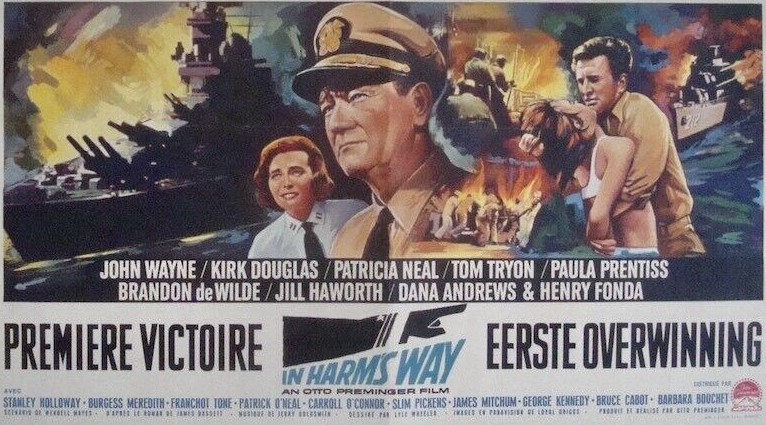
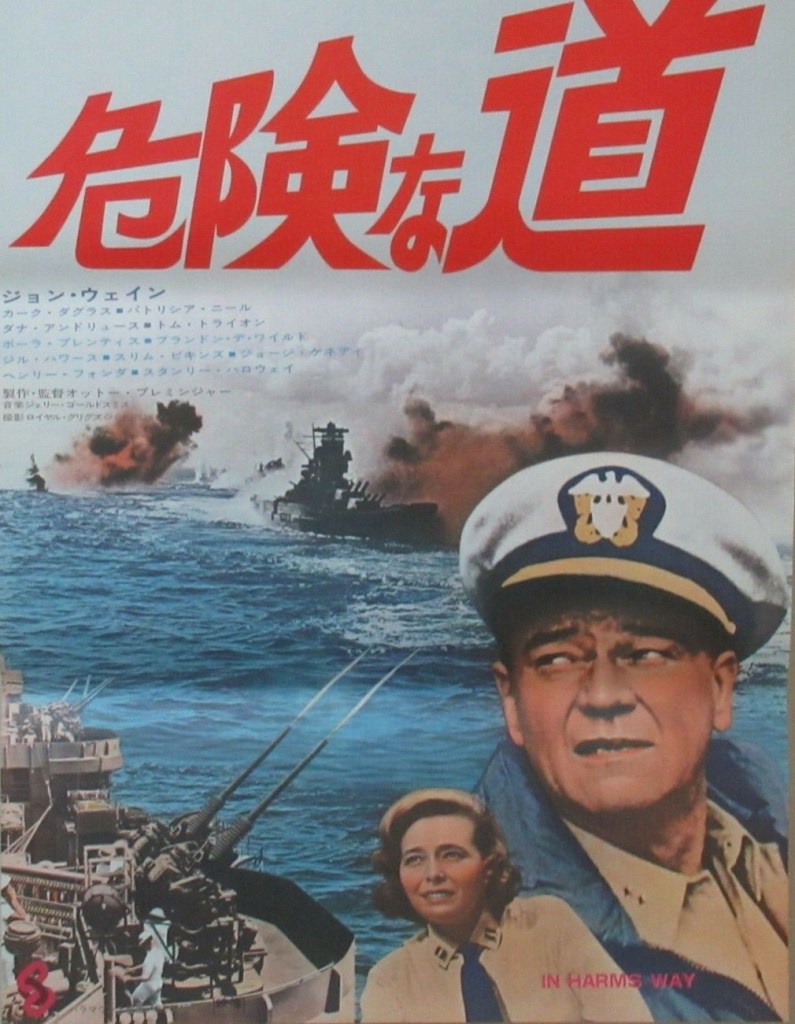
Preminger at a peak, the more I watch this picture, not just the more impressed I become but the more I want to watch it again – three times, as it happens, for this review. A tale of heroism populated by morally wounded heroes, the undertone of critique for the Naval establishment dealt with in brilliant narrative fashion, terrific pacing, one of John Wayne’s very best performances, Kirk Douglas not far behind, great action scenes, and one of the few movies to fulfil this director’s original intent.
You can, of course, argue that it’s the height of political PR. Just as the Americans managed with The Alamo and the British with Dunkirk, the aim was to turn defeat into victory, so this moves beyond the humiliation of Pearl Harbor to the victories beyond. But in some sense Pearl Harbor is just the prologue to a stiffer examination of men at war, rather than sailors taken to task over the complacency that left them so open to cataclysmic attack.
And while there’s a number of sub-plots, these are more expertly handled than I can recall in many another lengthy big-budget picture, no endless cutting between major and minor characters, but the minor characters only entering the frame when they have a dramatic part to play.
Captain “Rock” Rockwell (John Wayne) falls foul of his superiors for basically being in command of a ship sunk by a torpedo. On a technical point, he’s stripped of command, and reduced to a desk job, a casualty of the peace-time hierarchy determined to find someone to blame, only returning to active duty – and promoted to Admiral – when more war-oriented figures are put in charge.
The desk job gives him time to romance feisty nurse Lt. Maggie Haines (Patricia Haines) who has the cojones to take charge of the budding relationship. She happens to share an apartment with another nurse, the much younger Ensign Annalee Dorne (Jill Dorne) who is dating entitled Ensign Jeremiah Torrey (Brandon de Wilde), Rock’s estranged son.
Jeremiah works for slimy glory-hunter Commander Neal Owynn (Patrick O’Neal), a former U.S. Congressman using his political skills to worm his way into the office of by-the-book Vice Admiral Brodick (Dana Andrews). Rock shares his apartment with Commander Egan Powell (Burgess Meredith), a thrice-married playboy, high up in Navy intelligence.
Rock’s second-in-command is Commander – junior to a captain in case you don’t understand the U.S. Navy ranking system – Paul Eddington, a hothead whose mourning for dead wife Liz (Barbara Bouchet) results in him also being reduced to a desk job and exiled to the Pacific. On the fringes of the story are Lt. Commander “Mac” MacConnell (Tom Tryon) and pregnant wife Beverley (Paula Prentiss).
How all these characters enmesh is the consequence of a quite brilliant screenplay by Wendell Hayes (Advise and Consent, 1962). Rockwell and Eddington both seek redemption, the former to prove his Naval worth and regain the affection of his son, the latter to absolve himself for his terrible actions.
You can always tell the hero in war films because they are so rarely a physical casualty of war, all the others are killed and wounded but hardly ever the hero, so it takes something for the Hollywood Hero of the Century to play a character who is wounded not once but twice, and for the early part of the picture walks around with his arm in his sling (not quite an echo of the way he holds his arm in The Searchers, but evoking the same internal conflict).
The only supposed out-and-out hero is MacConnell, but his inaction at the beginning of the movie fails to prevent the death of Eddington’s wife. And his heroism largely takes place off-screen and it’s worth noting that Rock doesn’t raise a rifle or pistol in anger (or even get into a punch-up as was the actor’s wont in other films). Being in charge he’s removed from the core action even if suffering the consequences of battle. In a marvellous touch of irony, Rockwell is the most passive hero to hit the screen. It’s an incredibly bold and self-confident director who would even think of luring audiences into an action picture starring the Hero of the Century and then denying him a single moment of screen glory.
Much has been written about the cinematic arc John Ford took in the beginning and ending of The Searchers, the symbolic opening and closing of doors, but since Preminger is long out of critical favor nobody’s has bothered to notice how much of this film concerns cinematic echo.
To take the most obvious example, the first witnesses of the airborne Japanese attack on Pearl Harbor are illicit pair Liz Eddington and her paramour (Hugh O’Brian) and towards the end it’s her husband Paul, by this point guilty of horrendous behaviour, who leads the airborne fightback against the enemy.
A beach – where Liz and escort make love – is how the director initially pushes the audience towards sympathising with the drunken Eddington. A beach is where we later learn to despise him, as he brutally rapes Ensign Dorne. And it doesn’t take much to work out that his wife’s exuberant wildness explains Eddington’s initial attraction to her, not realising that psychologically it provides him with an excuse for his own darker wildness, initially restricted to self-destruction but when it truly emerges it’s to the detriment of an innocent.
And that’s before we get on to Rockwell as the messenger of death, delivering the bad news to wives, and then being on the receiving end after his son dies in battle. And finally, the political peace-time high-ups get their come-uppance in actual war.
It’s insulting – as some have suggested – that the performance of John Wayne (The Hellfighters, 1968) is the result of undiagnosed cancer when in fact this is a finely nuanced role of a high-ranking figure living out in his life in regret, at times quite shamefaced about abandoning his son at a very early age. Preminger cracked down on Wayne’s habit of splitting his lines in two, so those typical pauses we have come to expect are in large part gone, and it helps the movie’s pacing. For most of the movie the character is saddled with consequence. That passivity that the director saw as essential to the role is virtually present all the time.
Preminger wrings a different performance, too, from Kirk Douglas (A Lovely Way to Die, 1968), equally laden with regret, but not enough to prevent him lashing out and the actor is accorded two quite stunning scenes, the first as he broods in silence over his wife, but for the second, prior to raping Ensign Dorne, the stone-cold look on his face suggests a serial killer held at bay for too long and now about to explode.
Burgess Meredith (Hurry Sundown, 1967) is another brought to directorial heel, his more common scene-stealing and vowel-stretching also eliminated, but in exchange given a larger-than-life character on which to expend screen energy. The entire cast is good-to-excellent and it’s jam-packed: Patricia Neal (Hud, 1962), Tom Tryon (The Cardinal, 1964), Paula Prentiss (Man’s Favorite Sport, 1963), Brandon De Wilde (Shane, 1953), Jill Haworth (Exodus, 1960), Dana Andrews (The Satan Bug, 1965), Franchot Tone (Advise and Consent, 1962), Patrick O’Neal (Stiletto, 1969), George Kennedy (Cool Hand Luke, 1967), Henry Fonda (Battle of the Bulge, 1965), Barbara Bouchet (Danger Route, 1967) and Stanley Holloway (My Fair Lady, 1964) Many of the supporting cast were also playing against type – Prentiss as the young wife falling to pieces, Andrews and O’Neal as slippery political types, Holloway a guerrilla, and perhaps most interesting off Neal, not the typical woman left behind when the man goes off to war but, in her role as nurse, entering harm’s way herself.
And despite criticism of the miniatures used in sea scenes while that might have been obvious on the big screen you don’t notice it on the small screen. The action scenes are very well-done for the time, and quite unusual in that by and large it’s the Americans who appear shell-shocked not the enemy.
Cramming this much narrative into the overall arch of Pearl Harbor and retaliation against the Japanese, while bringing so many different characters to the fore with clear dramatic purpose is an amazing achievement, screenwriter Wendell Mayes (Advise and Consent) doing the heavy lifting in this department.
But Preminger the director is very much to the fore, in his composition and use of the camera for long tracking shots (a particular favorite of mine) such as at the beginning. A riveting watch full of splendid acting. Shooting it in black-and-white might have at one time appeared to date the picture but instead it has rendered it ageless. Five stars without a doubt.
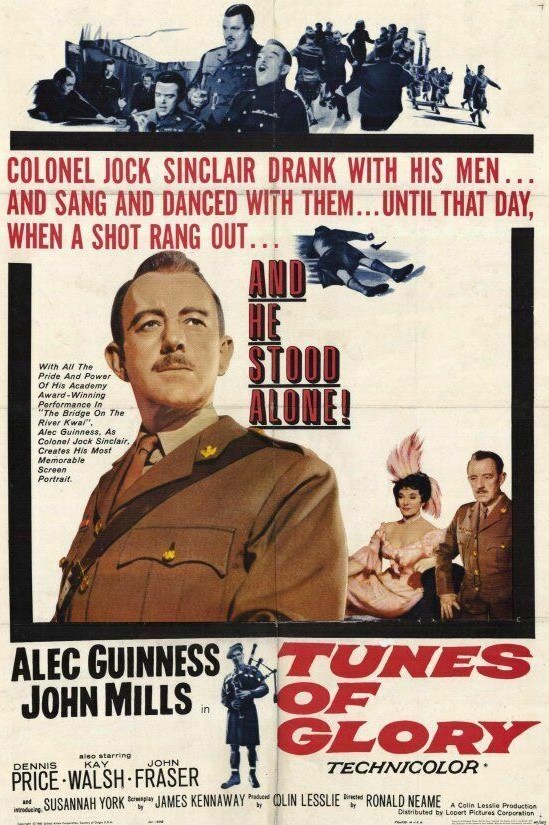
Fans of Succession will appreciate this power struggle in a Scottish army regiment set in 1948. In a reverse of The Godfather (1972) where the Corleones complain about needing a “wartime consigliore,” here the powers-that-be have decided this unnamed distinctly Highlander company requires a commanding officer with skills more appropriate to peace time.
Major Jock Sinclair (Alec Guinness) has been in charge of the battalion since the North Africa campaign in World War Two when the original commander was killed. But he has never been promoted to full Lt. Col. Naturally, having been in charge for six years, he feels the job should be his. At a time when the currency of command was wartime experience he’s less than pleased when he loses out to Col. Barrow (John Mills) who spent most of the war as a Japanese POW.
It doesn’t help that they are complete opposites. Sinclair is a tough, hard-drinking, attention-seeking Scotsman who enlisted as an ordinary soldier and rose through the ranks winning two medals for courage during the conflict. Barrow is Oxford-educated English upper-class, a lecturer at Sandhurst Military Academy, and recalls his war experience with terror rather than the braggadocio of Sinclair. Worse, he doesn’t drink.
It doesn’t take long for the pair to clash. Sinclair, who has ruled as much by preying on weakness as force of personality, is quick to start to look for flaws in his opponent’s make-up. Barrow feels discipline has been slipping and enforces tougher measures. That might make him unpopular but an army is built on discipline so soldiers can hardly complain.
But Barrow slips up by misreading the men. He chooses the worst of all issues to make a stand. For the first post-war official barracks party, Barrow insists the soldiers embark on traditional Highland dancing in regulation fashion rather than in their normal exuberant, not to say rowdy, manner. The soldiers are infuriated when Barrow insists they take lessons.
He has just lit the fuse. Naturally, nothing goes according to plan. Barrow is humiliated, Sinclair triumphant. But victory does not turn out the way Sinclair expected.
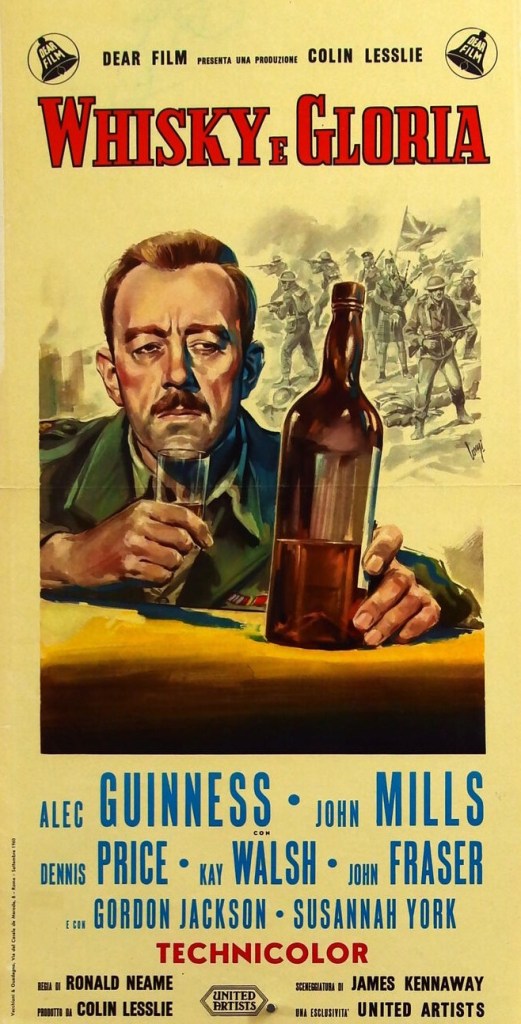
Somewhat cynical rebranding of the film in Italy as “Whisky and Glory,” possibly trying to cash in on the success of “Whisky Galore” and also misleading in suggesting actual conflict with the fighting in the background.
The main thrust of the narrative, as you might expect, is the stand-off between Sinclair and Barrow and the tensions felt all round, as would be the case in any business (Succession, now, of course the classic example) when a new boss takes control. While everyone might expect, and perhaps fear, change, in the military (as in the navy) there is always the danger, should the new broom try to sweep too clean, of mutiny.
This might not amount to a raising of arms. But there are other effective methods of mounting opposition – laxity, questioning or outright refusal to obey orders – or giving the new chief the cold shoulder. Here, in the background, are other simmering tensions. Not everyone is comfortable with Sinclair’s very laddish approach to command, the back-stabbing and double-dealing Major Charles Scott (Dennis Price) ready to pounce at any opportunity.
Sinclair is also having to deal with his daughter Morag (Susannah York) asserting her independence, having the temerity not just to take a boyfriend, Corporal Fraser (John Fraser), but one from the ranks rather than the officer class. And he feels the harsh tongue of his own paramour Mary (Kay Walsh).
Emotional isolation is rarely commented upon in matters of the armed forces and yet it is so much a driving force. If not adequately compensated by camaraderie, a man at the top can be very lonely indeed, and prone to the most vicious self-torment.
Director Ronald Neame (The Prime of Miss Jean Brodie, 1969) superbly invokes an army atmosphere away from the more usual battleground backdrop. The picture is anchored by brilliant performances all round and a roll-call of strong supporting characters. An unflinching look at power, especially leadership and the personal toll it takes. And it was astonishing that the movie could hit the target so well without relying on the usual round of sex, violence or that old stand-by the comic subordinate. It also probes the issues of what happens – in any industry – when the wrong person is put in charge. No less an authority than Alfred Hitchcock called it “one of the best films ever made.”
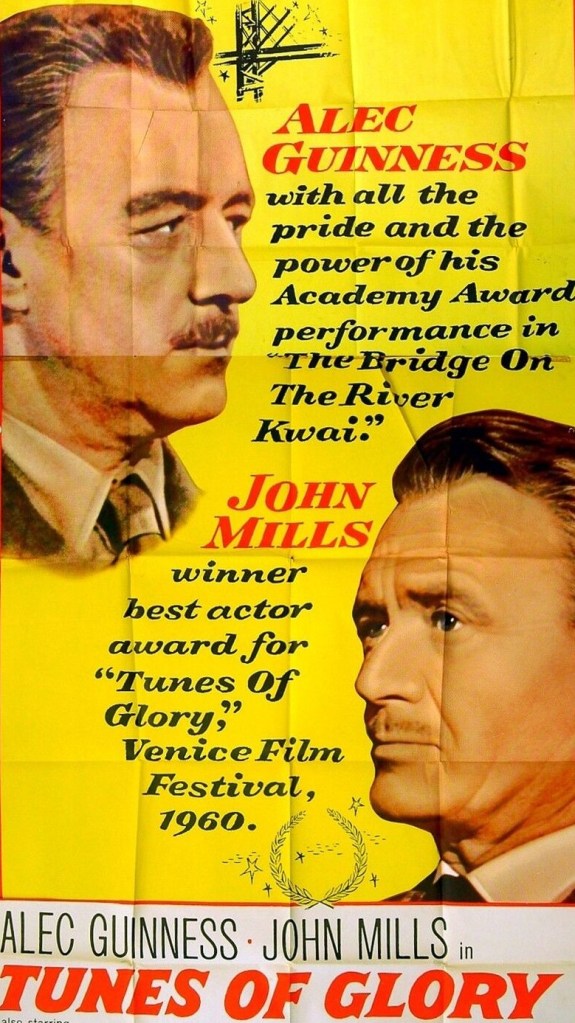
The sparring between Oscar-winning Alec Guinness (The Quiller Memorandum, 1966) and John Mills (The Family Way, 1966), who won the Best Actor Award at the Venice Film Festival for this role, is of the highest quality. Dennis Price (The Comedy Man, 1964) is the pick of the support while Susannah York (Sands of the Kalahari, 1965) makes an auspicious debut.
Few films could boast a better supporting cast: former British leading lady Kay Walsh (A Study in Terror, 1965), Gordon Jackson (The Ipcress File, 1965), Duncan Macrae (Best of Enemies, 1961), John Fraser (Tamahine, 1963), Gerard Harper (Adam Adamant Lives!, 1966-1967, TV series) and Peter McEnery (The Moon-Spinners, 1964).
James Kennaway (The Shoes of the Fisherman, 1968) wrote the screenplay based on his own novel.
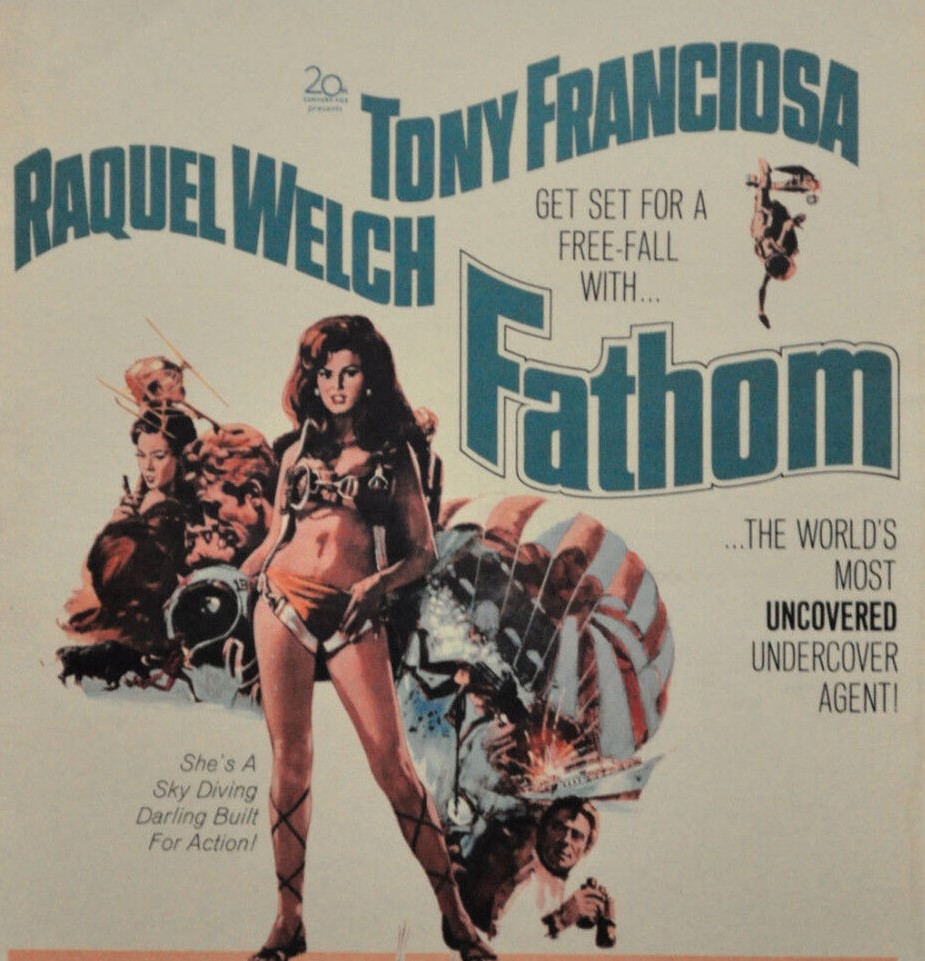
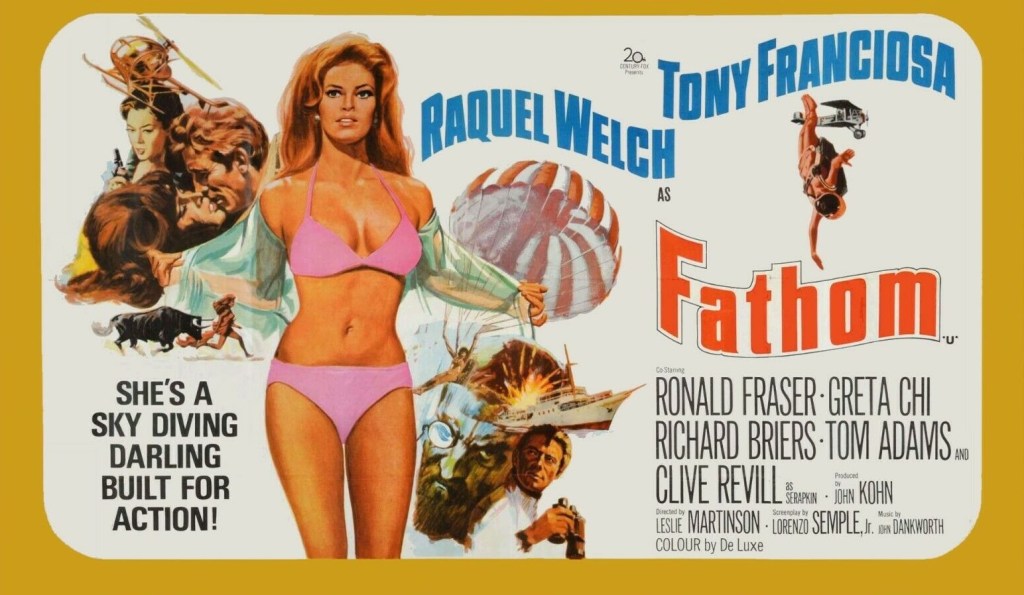
If audiences rallied to the sight of Raquel Welch wearing nothing more than a fur bikini for the entirety of One Million Years B.C. (1966) and a skin-tight suit in Fantastic Voyage (1966) Twentieth Century Fox must have reasoned they would surely return in droves were the star to spend most of Fathom in a succession of brightly-colored bikinis.
Given such a premise who would care that a sky-diving expert was named after a nautical measurement? Or that Fathom (Raquel Welch) came nowhere near the height indicated by her name? Or that the character as described in the source material (a novel by Scottish screenwriter Larry Forester) had a distinctly harder edge; murder, sex and drugs among her proclivities.
With Our Man Flint (1966), the studio had successfully gatecrashed the burgeoning spy genre and spotted a gap in the market for a female of the species, hoping to turn Modesty Blaise (1966) starring Monica Vitti and Fathom into money-spinning series. The Fathom project was handed to Batman, The Movie (1966) co-conspirators, director Leslie H. Martinson and screenwriter Lorenzo Semple Jr. (Flash Gordon, 1980).
Female independence was hard-won in the 1960s and there were few jobs where a woman was automatically at the top of the tree. Burglary was one option for the independent entrepreneur (see The Golden Claws of the Cat Girl) and sport was another.
Welch plays an innocent bystander recruited for her top-notch sky-diving skills (her aptitude demonstrated in the opening sequences) to help Colonel Campbell (Ronald Fraser) of British intelligence recover the “Fire Dragon,” a trigger that could explode a nuclear bomb. Her sky-diving skills are required to land in the courtyard of playboy Peter Merriwether (Anthony Franciosa).
That turns out to be baloney, of course, a MacGuffin to point her in the direction of a valuable Chinese heirloom. And then it’s case of double-cross, triple-cross and whatever cross comes next.
There’s an intriguing mystery at the heart of this picture and a couple of top-class hair-raising moments. In one she is trapped in a bull ring and stunt double Donna Garrett had a few very definite close calls trying to avoid the maddened beast. In another she is stalked at sea by a circling motor boat while being peppered with harpoons. There is also an airplane duel and a ton of great aerial work. A couple of comic sequences are well wrung – Campbell pins his business card to one of the prongs of a pitchfork being brandished with menace by Fathom while Peter delivers a classic line: “The only game I ever lost was spin the bottle and that was on purpose.”
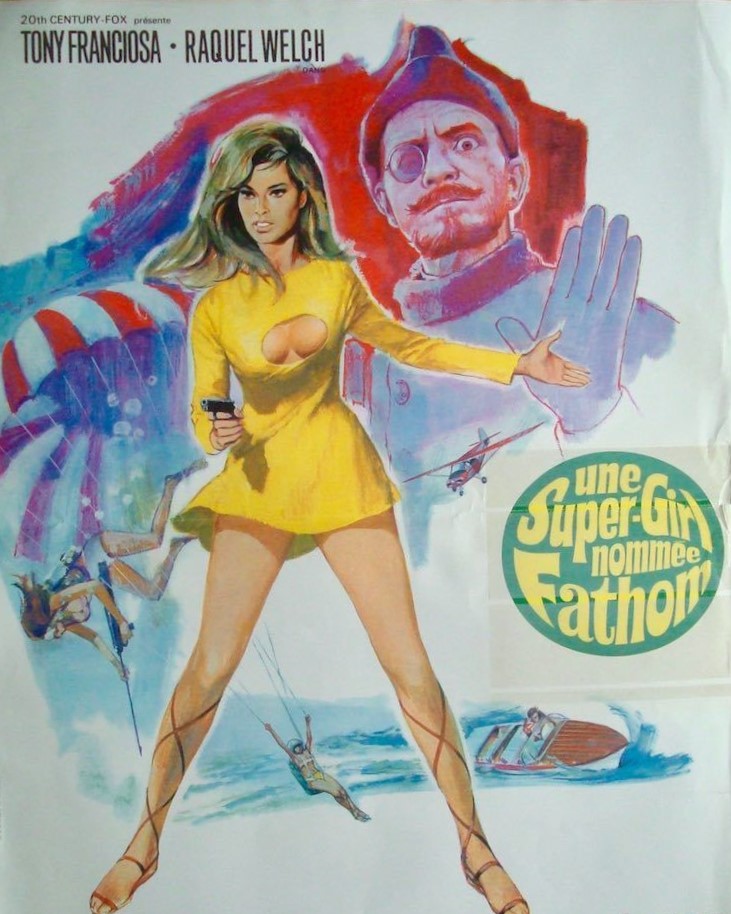
You could probably determine something about national character from the color of costume different countries chose to show Raquel Welch in.
The biggest problem is that the film veers too far away from the source material which posited the heroine as a much tougher character, one who can despatch bad guys with aplomb. Instead, Fathom is presented almost as an innocent, bundled from one situation to another, never taking charge until the very end. Minus karate kicks or a decent left hook, she is left to evade her predators by less dramatic means. She has a decent line in repartee and by no means lets the show down. However, the idea, no matter how satisfactory to fans of the actress, that Fathom has to swap bikinis every few minutes or failing that don some other curve-clinging item, gets in the way of the story – and her character. Into the eccentric mix also come a millionaire (Clive Revill) and a bartender (Tom Adams).
There’s no doubt Welch had single-handedly revived the relatively harmless pin-up business (not for her overt nudity of the Playboy/Penthouse variety) and had a massive following in Europe where she often plied her trade (the Italian-made Shoot Loud, Louder…I Don’t Understand in 1966 and the British Bedazzled in 1967) but she was clearly desperate for more meaty roles. Those finally came her way with Bandolero (1968) and 100 Rifles (1969) and Fathom feels like a lost opportunity to provide her with that harder edge.
She’s not helped by the odd tone. As I mentioned she gets into plenty of scrapes and proves her mettle with her diving skills. In the hands of a better director and with a few tweaks here and there it could have been a whole lot better and perhaps launched a spy series instead of languishing at the foot of the studio’s box office charts for that year.
Anthony Franciosa (Rio Conchos, 1964) , still a rising star after a decade in the business, who receives top billing, doesn’t appear for the first twenty minutes. And then he behaves like a walking advert for dentistry, as though his teeth can challenge Welch’s curves. And some of the supporting cast look like they’ve signed up for a completely different movie. Richard Briers (A Home of Your Own, 1965) – Ronald Fraser’s intelligence sidekick – looks like a goggle-eyed fan next to Ms Welch while Clive Revill (The Double Man, 1967) thinks it’s a joke to play a Russian as a joke. Ronald Fraser (Sebastian, 1968) provides decent support.
But it is certainly entertaining enough and you are unlikely to get bored.
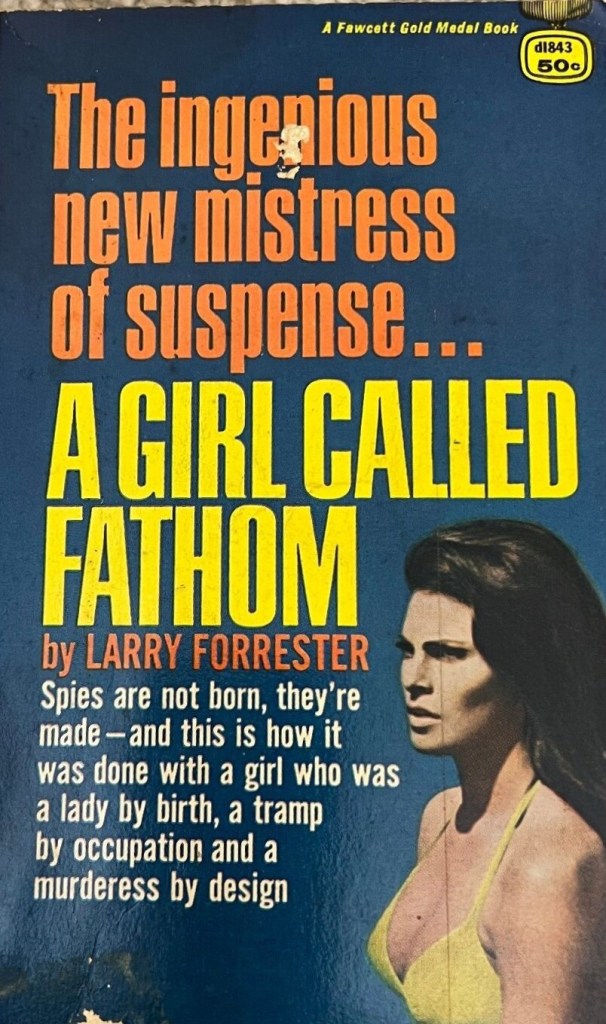
Book into Film: A Girl Called Fathom by Larry Forrester (1967)
The blurb gives the game away. The British paperback published by Pan went: “She was blonde. She was beautiful, she was six foot tall. She’d killed the man who had dragged her to the lowest depths of addiction and lust.” The American Fawcett Gold Medal paperback was more succinct: “lady by birth, tramp by occupation and murderess by design.”
If any of that rings a bell, it was not from the film Fathom (1967) starring Raquel Welch which chose to ignore her background and her venomous skillset. The novel opens with the heroine killing a man in cold blood. He had promised her a film career but turned her into a call girl and heroin addict. Her father, now dead, was in the British secret service. Once she has committed her first murder, she is immediately kidnapped by a secret organization (C.E.L.T.S. – Counter Espionage Long-Term Security) and trained to become an even more ruthless government-sanctioned killing machine.
Larry Forrester was a Scottish television scriptwriter who had worked on a stack of British series such as Whirligig (1953), Ivanhoe (1958) and No Hiding Place (1960-1964) before publishing his first novel A Girl Called Fathom. His sole screenplay was Tora! Tora! Tora! (1970) after which he concentrated on U.S. television including episodes of Fantasy Island (1980-1983) and Hart to Hart (1983-1984).
A Girl Called Fathom is split into two. Comprising roughly two-fifths of the book, the first section concentrates on her brutal training and on getting her off drugs. There’s a fair amount of sexual intrigue not to mention sex. But also a lover’s betrayal. For the final part of her training she is abandoned in the middle of nowhere in scorching heat and barely makes it home. “She had passed over a great divide. She was empty, hard – dehumanized. Alone. She would always be alone.” And then she is forced to kill again.
As was common with this kind of book in the 1960s, it was fast-moving and globe-trotting with plenty of realistic detail to offset the preposterous plot. For the remainder of the book, which shifts location to Europe, Fathom is up against an organization called W.A.R. (World of Asian Revolution) which aims to destabilize the existing world order. Her arch enemy is an American-born Soviet agent (and whip and knife expert) Jo Soon (who turns up in the film Fathom in slightly different form as Jo-May). Fathom’s team must protect French elder statesman Paul-Auguste Valmier whose playboy son Damon (who fantasizes about burning people alive), a friend from her past, is her main contact.
The book is peopled by interesting and occasionally outrageous characters – for example Tin (shades of Iron Man), who has hardly a human bone left in his body; the far-from-harmless Aunt Elspeth; and a sadistic colleague who loves her but dare not let his emotions out lest he loose on her his love of pain. The central plot is driven by a mass of twists and turns, heroine endangerment, fights with knife and gun and fist, traitors (naturally) and the clever idea of killing off the leaders of the free world with a bomb hidden in the coffin of a man worthy of a state funeral being held in Paris.
At the end she is counting the human cost of victory and sees herself as one of the walking wounded, a reject, driven from the herd. The film was apparently based on an unpublished sequel so it’s conceivable that the plot concerning the Chinese heirloom was pulled from that in its entirety. But even so the film’s heroine was neutered, not a patch on the ruthless killer with a sordid past outlined in A Girl Called Fathom.