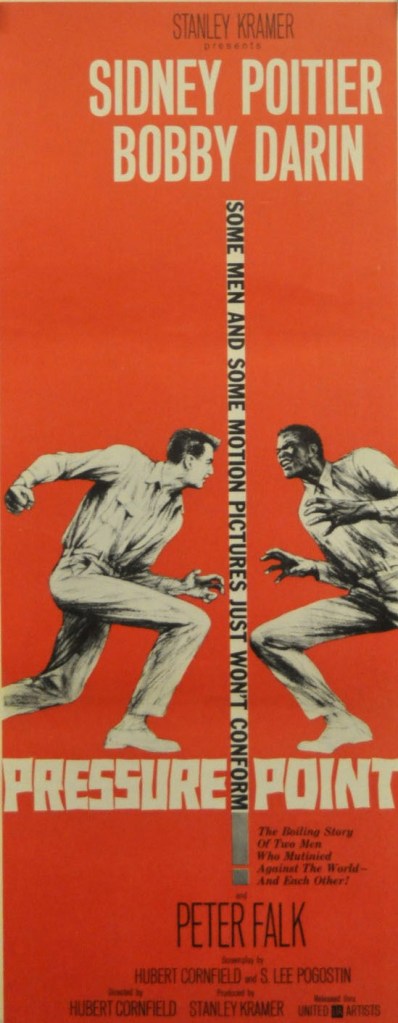
Duel at Diablo (1966) ****

Action-packed and plot-jammed revisionist western with fresh performances from James Garner and Sidney Poitier caught up in an Apache uprising. Tough-as-teak ex-cavalry scout Garner has dispensed with his glib smart-aleck persona in favor of world-weariness and Poitier is a revelation as a cocky cigar-smoking ex-cavalry sergeant horse-dealer. Racism here concerns hostility towards Indian squaw Bibi Andersson (Persona, 1966), Garner, who had married a Commanche (now dead) the only one to treat her with any decency.

Returned to “civilization,” Andersson wants nothing more than to escape, back to her baby it transpires. Her crime is staying alive after Apache capture when she should have done the “decent thing” and killed herself rather than living as a squaw. But prejudice is leavened by husband Dennis Weaver (minus trademark moustache) who retains tender feelings towards her and, eventually, her baby. Apache chief John Hoyt is equally redeemed by his care towards the baby.  

Director Ralph Nelson (Lilies of the Field, 1963) handles the action with aplomb but it is the Apaches who prove the masters of battlefield strategy, deftly maneuvering the cavalry into an ambush and cutting them to shreds. His biggest problem is delivering logical reasons for all the principals – Weaver is an arms dealer, Garner and Poitier no longer in the army – to join up with Bill Travers’ (Born Free, 1966) cavalry troop. However, rather than slowing the story down, the various complications add further tension.  

Nelson never reins in reality. The cavalry are raw recruits, hardly able to control their mounts. Garner and Poitier don’t buddy-up, there is no camaraderie, and Andersson is an outcast in both worlds. And the good guys are constantly out-smarted by the Apaches, Poitier’s mistake leading to initial ambush, the Apaches targeting water supplies to derail the enemy and resorting to bow-and-arrow in case a stray bullet ignites the ammunition wagons. But it is still a duel, Poitier, Garner and Travers each in turn coming up with brilliant ideas to retrieve what looks like a desperate position trapped in a box canyon.     

We might be more sympathetic towards the plight of the Apaches, shoved into a “hell-hole of a reservation,” had Nelson concentrated less on their brutality, the picture opening with the corpse of a mutilated man, the cavalry under siege at Diablo tortured by the screams in the night of a man being tortured, Andersson told that she will be buried alive. But when any Commanche woman can be killed and scalped just because she married a white man and Andersson viewed as fair game for rapists because she lived with Apaches, you can see how little regard the Native Americans have for their oppressors.

Garner and Poitier are superb and top marks for a rounded performance from John Hoyt, savage one minute, gentle the next. Scotsman Travers and Swede Andersson should have added to the authenticity since immigrants such as these provided the mass of settlers, but Travers seems quite out of place and Andersson never quite delivers the angst required of her situation.  William Redfield (One Flew over the Cuckoo’s Nest, 1975) can be spotted. Nelson has a cameo and if you look closely you will see a fleeting glimpse of Richard Farnsworth. Western specialist Marvin H. Albert (The Law and Jake Wade, 1958) co-wrote the screenplay from his novel.

You might be able to catch this for free on Sony Action Movies, but otherwise here’s a DVD link. You might get it on Amazon Prime but last time I posted a link for that, it didn’t work.

Ocean’s 11 (1960) ***

Heist pictures break down into planning, execution and reprisal. Here the planning stage moves at a leisurely pace, a bit of recruitment, and setting up bitebacks that will cripple the military-precision plan by ex-army buddies to rob five Las Vegas casinos of millions of dollars on New Year’s Eve. There’s a bit of reversal, Mr Big (Akim Tamiroff) is a collection of nervous tics, Jimmy Foster (Peter Lawford) a rich guy seeking financial independence from a possessive mother, Sam Harmon (Dean Martin) having second thoughts about the operation, and Danny Ocean (Frank Sinatra) trying to win back estranged wife Beatrice (Angie Dickinson) who surmises he prefers danger to intimacy. Mostly, it’s repartee between Harmon and Ocean while Foster makes a chump out of his mother’s next potential husband Duke Santos (Cesar Romero).

There’s not much hi-tech about the audacious plan, knocking out the electricity supply to the casinos, the switch to auxiliary power allowing the gang access to the inner sanctum where the cash is held, finding their way in and out of the darkness by nothing more sophisticated than luminous spray paint, and with a clever ruse to get the money out once all hell breaks loose.

The fun starts when one of the team (Richard Conte) drops dead post-raid and it transpires Santos is a big-shot underworld figure who investigates the robbery on behalf of the casinos and starts tracking the gang down, leading to a pay-off you don’t see coming.

Given the comedy element, there’s no great tension but it’s a pleasant enough diversion and Sinatra and Martin display an easy camaraderie that lights up the screen. It could have been funded by the Las Vegas Tourist Bureau so much attention is given to the wonder of the casinos, at a time when gambling was still only otherwise legal on racetracks, and with snippets of floorshows and the deluxe atmosphere. Add in a couple of numbers delivered a couple of times by Dean Martin (“Ain’t That a Kick in the Head”), legitimately since he is a cocktail bar singer, and Sammy Davis Jr. (“Eee-O-11”), somewhat shoehorned-in given he is a truck driver.

There’s a couple of neat reversals: Ocean’s dumped girlfriend Adele (Patrice Wymore) gets short shrift from Beatrice when she reveals the affair; casino bosses offered a double-or-quits gamble refuse to consider such a dangerous notion. Red Skelton and George Raft have credited cameos, Shirley MacLaine does not. As well as Richard Conte, Henry Silva (The Secret Invasion, 1964) has a small part as does Norman Fell (The Graduate, 1967).

Although there are on occasion outdated sexist attitudes, there is also a strong anti-racist statement in the hiring of Sammy Davis Jr., showcasing his talents in a big-budget picture, and clearly making the point that he has been welcomed by stars as big as Sinatra and Martin.  

And it’s worth also considering the picture in terms of early-onset brand management.  The “Rat Pack” was a loose group of entertainers which not only became a well-known stand-alone entity in its own right that celebrated what was considered “hip” at the time (assuming you excluded Elvis and his ilk), but as individuals supported each other on television and in live performance. They would make another two pictures as a team and another dozen or so where two or more of the players appeared. The principals were all major attractions at the nascent Las Vegas so they were also promoting their home patch. During the day they made the movie, at night they wove in and out of each others’ acts, creating an entertainment sensation. On top of that, Sinatra had his own record label Reprise – among the early acts Dean Martin and Sammy Davis Jr. So, in a sense, all this cross-promotion was money in their pockets.

Also of note are the opening and closing, the former for the credits devised by Saul Bass, the latter for the famous shot later appropriated by Quentin Tarantino for Reservoir Dogs. Ironically, Lewis Milestone, who devised the original shot, and long before that won two Best Director Oscars, is less well regarded these days than Tarantino.

Daddy’s Gone A-Hunting (1969) ***

Everyone wants to be a star-maker. Director Mark Robson thought he had some form in this area after Valley of the Dolls (1968) showcased Barbara Parkins and Sharon Tate. There’s no doubt British actress Carol White reveling in critical kudos for Poor Cow (1967) had promise. But not necessarily good professional advice otherwise how to account for a supporting role in Prehistoric Women/Slave Girls (1967) her first picture after success in three BBC television productions. The female lead in Michael Winner’s I’ll Never Forget Whatisname (1967) was followed by a small role in the more prestigious John Frankenheimer drama The Fixer (1968). But none of these films did anything at the box office. Enter Mark Robson.

This thriller might have made her a star had it not been so darned complicated. It veers from paranoia to stalkersville to Vertigo via Gaslight without stopping for breath and some elements are so obviously signposted at the start you are just waiting for them to turn up. Plus, if ever a film has dated, it’s this one, going back to the days when abortion carried automatic stigma and fathers could get away with lines like “you murdered my baby.”

So, one of the few times in history San Francisco got snow (it averages zero inches annually according to Google) the meet-cute is sketch artist Cathy (Carol White) being hit by a snowball thrown by wannabe Kenneth (Scott Hylands, making his debut). But when she realizes how much he enjoys watching cats stalking canaries decides she doesn’t want his baby and aborts it.  A few years later she marries congressional candidate Jack (Paul Burke from Valley of the Dolls) and when pregnant crosses paths with Kenneth who manages to insinuate himself into her family via her husband. Twist follows twist until we are on the Top of the Mark (a famous city landmark) for a gripping climax.

White does well as she shifts through the emotional gears but she is barely given respite from being overwrought so at times her acting appears one-dimensional rather than varied. In fairness to her, the movie’s plot gives her no chance to deliver a settled performance. Hyland looks as if he’s auditioning for a role as a serial killer, but the depth of his cunning and his twisted perceptions kept this viewer on edge -what it would take for Cathy to make amends will chill you to the bone.

Robson has some nice directorial touches, a scene reflected in the eye of a cat, a clever jump-cut from marriage proposal to marriage ceremony and some flies in milk.  Mala Powers makes a welcome big screen appearance after nearly a decade in television. That this whole concoction emanated from the fertile imaginations of screenwriters Larry Cohen (It’s Alive, 1974) and Lorenzo Semple Jr. (Fathom, 1967) might give you an idea of what to expect.

Catch-Up: Mark Robson films previously reviewed in this Blog are: The Prize (1963) and  Lost Command (1966).  

            +

The Secret Partner (1961) ****

Curious about what happened to Haya Harareet, Charlton Heston’s leading lady in Ben Hur (1959), filmed in 70mm glorious color, I happened across this neat twisty British thriller filmed in standard ratio and black-and-white. Turned out to be put together by the Basil Dearden/ Michael Relph combo and starring Stewart Granger, one-time star of MGM extravaganzas like King Solomon’s Mines (1951) and clearly now atoning for failing to hit the box office mark often enough for Hollywood’s liking.

Driven by a brilliant plot, whose resolution I defy you to guess, it climaxes with three stunning twists, the first story-driven but the others landing a no less effective emotional and human punch. I should warn you right away that Harareet is not in the picture as much as you would expect given that she took second billing. That’s no surprise, really, since on her first entrance, as wife Nicole, she walks out on husband John Brent (Granger) citing his illicit romantic liaisons.  

Though driving a swanky car and living in a big London house, Brent , a top-level shipping executive, is one harassed individual. He is being blackmailed by alcoholic dentist Ralph Beldon (Norman Bird).  When the shipping company’s safe is robbed of £130,000 (equivalent to £3 million today), suspicion falls on Brent, one of only two employees with both keys and the combination. Enter about-to-retire chain-smoking Detective Superintendent Hanbury (Bernard Lee, shortly to achieve global fame as “M” in the Bond series).

Constantly wreathed in a cloud of smoke, Hanbury’s investigation leads to various suspects – the other keyholder Charles Standish (Hugh Burden) whose job is at risk, interior designer Clive Lang (John Lee) who is too familiar with Nicole and friend Alan Richford (Conrad Philips) who is secretly in love with her. All have good reason to be responsible for the theft, not least Nicole because of Brent’s habit of talking in his sleep and in trying to memorize ever-changing safe combinations constantly running them through his head, conscious or unconscious.

To add to the complications, Brent has a mysterious past. In addition, a masked gunman pops up from time to time. So, although Brent remains the prime suspect, Hanbury, with an investigator’s vigilance and attention to detail that Hercule Poirot would be proud of, uncovers clues that point elsewhere. Pretty soon, Brent is on the run, first to France, where he is arrested, and then, after escaping custody, through the murky streets of Soho trying to locate a girl to whom he might have given the combination while asleep. He, too, discovers some unpleasant truths far closer to home.

Dearden does a brilliant job of setting up the mystery, a dab hand, too, at serving up multiple red herrings, as well as a spot of sleight of hand, not least when the music intrudes too loudly in old-fashioned manner as if to point the finger, and the audience’s attention, in a misleading direction. Sure, it’s a low-budget affair by Hollywood standards and indeed by Dearden/Relph standards (big-budget roadshow Khartoum, for example), and the black-and-white photography is for financial rather than artistic reasons, but it is superbly done and keeps you guessing to the end. Granger is at his suave best. Harareet, all fur coat and steely resolve, gives a good performance. Bernard Lee is an excellent British copper, hoping to end his career on a high note, patiently probing suspects, and there is a good turn from Norman Bird as the dodgy dentist and a fleeting appearance by Willoughby Goddard as an equally dodgy hotel manager.

Except there’s no extraneous violence, it could be a latter-day film noir.

Catch-Up: Other Dearden/Relph films reviewed in the Blog are: Masquerade (1965), Khartoum (1966), Only When I Larf (1968) and The Assassination Bureau (1969). Stewart Granger was also reviewed in The Secret Invasion (1964).

The Venetian Affair (1966) ****

Robert Vaughn gives a terrific performance as a numbed alcoholic ex-C.I.A. journalist drafted into Venice to investigate a plot involving ex-wife and Communist defector Elke Sommer. He’s the spy who lost it rather than a flashy contemporary of James Bond. This occasionally very stylish number kicks off with an excellent credit sequence that concludes with a suicide bomber blowing up a nuclear disarmament conference. Unshaven and with a Columbo cast-off overcoat, Vaughn discovers Sommer was key to the atrocity, the bomber an otherwise distinguished diplomat with no known proclivities in the area of mass murder.

Although sold as an action picture, nobody is ripping through the canals as in a Bond film, and it is altogether a more somber, reflective, intelligent  movie. Vaughn’s feelings for his ex-wife are shown when, in her apartment, he tenderly touches her clothes and smells her perfume. Far from being party to the plot, it appears Sommer has had a change of heart and wants to defect back, leaving Vaughn in a perilous dilemma. Does he believe her or is she just using him? It is beginning to sound like a modern-day film noir, except he is already being used by the C.I.A., his presence in Venice a device to draw Sommer out, C.I.A chief Rosenfeld (Edward Asner) every bit as ruthless as the villains.

His investigations lead him to Dr Pierre Vaugiraud (Boris Karloff) and power broker Robert Wahl (Karl Boehm) who possesses a mind-altering drug that can make a man terrified of a mouse, send him into a trance and on his way to deliver savage retribution. There is death aplenty, fisticuffs and chases and Sommer, in hiding disguised as a nun, is worth waiting for.

Based on the bestseller by Scottish novelist Helen MacInnes, who outsold Alistair Maclean in her day, the project was at one point to be directed by Guy Hamilton. Coincidentally, David McCallum, Vaughn’s co-star in The Man from U.N.C.L.E. television series, was in Venice at the same time shooting Three Bites of the Apple.

Vaughn is superb in a downbeat role – shaking off his Napoleon Solo television persona- never sure if he is being duped, on the rack from falling back in love, and emerging from an alcoholic haze with a few decent ruses up his sleeve. It’s often forgotten that this is an Oscar-nominated (for The Young Philadelphians, 1959) star and that the subtlety of his performance in The Magnificent Seven (1960) is generally overlooked.

Television stalwart Jerry Thorpe making his debut contributes some interesting moments. Interpreters listening in to the conference hear the magnified ticking of the bomb moments before explosion. A sequence on a train is well done and the activity surrounding the mouse is first class. There’s a solid cast, Asner menacing even as a good guy, Karl Boehm a charismatic villain, Karloff memorable in his last performance in a non-horror picture, and interesting appearances by Felicia Farr as a C.I.A agent masquerading as the murderous diplomat’s unsuspecting mistress and Luciana Paluzzi as the girlfriend of an agent. Lalo Schifrin produces an outstanding score.

It was a flop first time round because audiences, partly duped by the title (all Uncle episodes incorporated the word “Affair” although the book, in fairness, was written long before the television series was envisioned) expected to pay to see Napoleon Solo, or something quite like him, on the big screen, with all the pizzazz and gimmickry of the small-screen show. Unfairly under-rated, this is a really satisfying thriller set against a murky Cold War background with Vaughn, trapped between love and redemption, the only character with a streak of morality.

Stiletto (1969) ***

Tough talking Patrick O’Neal (Castle Keep, 1969) whose “hello” is usually accompanied with a fist enlivens this adaptation of a slim bestseller by Harold Robbins as cop George Baker on the trail of Mafia hitman Count Cesari Cardinali (Alex Cord ). Unusually, Cord was the go-to star for producers of Mafia pictures, his previous movie being The Brotherhood (1968). Equally unusual, Cardinali is a part-time assassin, spending the rest of his time as a fun-loving playboy with a string of women, fast cars and racehorses. Only problem is he wants to retire – and not in normal fashion, weighted down by a block of cement. Unfortunately, his dilemma is hardly one to solicit sympathy from an audience much less Mafia boss Emilio Matteo (Joseph Wiseman) and Cord isn’t enough of an actor in any case to tug at the heartstrings.

Cord made a brief splash as an action hero in the monosyllabic Clint Eastwood/Charles Bronson mold after debuting in the John Wayne role of the Ringo Kid in the remake of Stagecoach (1966) and Italian-made A Minute to Pray, A Second to Die (1967). But didn’t have more than half a dozen stabs at making his name on the big screen before disappearing into the television hinterlands. So he’s something of an acquired taste, maybe the small output enough to qualify him for cult status. Here, he’s a decent fit for the violence but saddled with a role that makes little sense and sure enough he soon discovers that Wiseman doesn’t consider him a candidate for a pension while O’Neal bullies witnesses into providing the legal ammunition to bring the gangster down.

One such person is illegal Polish immigrant Illeana (Britt Ekland), Cardinale’s girlfriend when he is not chasing Ahn Dessie (Barbara McNair). This is another thankless role for Ekland (Machine Gun McCain, 1969), there to add glamour, but, surprisingly, she manages to bring pathos to the part. McNair, who is always worth watching and had made an auspicious debut the year before in If He Hollers, Let Him Go, hardly gets any screen time.  But it’s O’Neal (Alvarez Kelly, 1966) as the ruthless cop who holds it all together.

Director Bernard L. Kowalski (Krakatoa, East of Java, 1968) proves better at the action than the characterization, though, luckily nobody needs to be anything other than tough. Three scenes, in particular, are well handled – the opening murder in a casino, a shoot-out at a penthouse and the climax on a deserted island which has more than a hint of a spaghetti western. Wiseman (Dr No, 1962) rustles up another interesting performance and Roy Scheider (Jaws,1975) also appears.

This old-style tough-guy thriller would have been better off had the Cord vs. O’Neal set-up taken center stage, with the assassin on murderous overkill hunted down by the zealous cop. As it is, it’s a missed opportunity for Cord to develop an Eastwood/Bronson persona and enter the action star hall of fame. This was the seventh adaptation of the books of bestseller writer Harold Robbins after Never Love a Stranger (1958), A Stone for Danny Fisher (filmed as King Creole in 1958), The Carpetbaggers (1964) – which also resulted in Nevada Smith (1966) – and Where Love Has Gone (1966).

This isn’t easy to get hold of but you are more likely to find it will find it on Ebay (new) than Amazon.

Les Biches (1968) *****

Innocence and experience alike are corrupted by the destructive power of love in this elegant and compelling early masterpiece from French director Claude Chabrol. Although he owed much of his later fame to slow-burning thrillers, this is more of a three-hander drama with a twist and it says much for his skill that we sympathize in turn with each of these amoral characters.

Wealthy stylish Frederique (Stephane Audran), in an iconic hat, picks up younger pavement artist, the artistically named Why (Jacqueline Sassard) in Paris. They decamp to St Tropez where Audran keeps a rather discordant house, indulging the antics of two avant-garde house-guests. Sassard loses her virginity to architect Paul Thomas (Jean-Louis Trintignant) who soon abandons her in favor of Frederique. Each is guilty of betrayal and although a menage a trois might have been one solution instead the lovers dance from one to another with Frederique apparently in control, in one scene stroking Why’s hair with her hand and caressing Paul’s face with her foot. In an attempt to win the man back, Why dresses like her rival down to hairstyle, make-up and even the older woman’s beauty spot.    

At no point is there angry confrontation, nor does Frederique simply dismiss Why from the household, but the story works out in more subtle insinuation, Frderique clearly expecting either that Why makes herself scarce or, alternatively, make herself available for whenever the bisexual Frederique tires of male companionship. The movie’s focus is the baffled Why. When the older pair disappear to Paris, the camera follows Why through off-season St Tropez, chilly weather replacing glorious sunshine. Frederique and Paul are the sophisticates who expect Why to know how to play the game. The younger woman has wiles enough to see off the avant-garde irritants.

It looks for a while as if it might be a coming-of-age tale or of young love thwarted but every time Frederique enters the picture her dominance is such that proceedings, no matter how deftly controlled, have an edge and so it becomes a study of something else entirely. At one point, each has power over the other. What appears on the surface, how each character is initially represented, disguises their interior lives. If Why has learned anything it is restraint, so the movie never descends to tempestuous passion. She also learns, in a sense, to submit, since the impoverished can never compete with the rich. In the end her revolt takes the only other option available, against which even the wealthy have no defense.

Not that it makes much difference unless you were going to analyse the picture to the extreme but clearly the names have significance. Frederique is a feminization of a male name, Paul Thomas is two male names (perhaps indicating alpha male) while Why is obviously not a real name, and either meant to represent anonymity or intrigue. Luckily, the acting is of such a high standard we are not left only in thrall to the intricacies of naming characters.

Jean-Louise Trintignant was the best known of the stars following the international success of A Man and a Woman (1966). Stephane Audran, wife of the director, had been in movies for a decade, this her best part to date. Jacqueline Sassard had broken through with Joseph Losey’s Accident (1967). Claude Chabrol, a driving force behind the French New Wave, had enjoyed conspicuously less success than compatriots Jean-Luc Godard and Francois Truffaut until finding his metier in crime thrillers The Champagne Murders (1967) and The Road to Corinth (1967) but it was Les Biches that marked him out as a sensational talent.

The Secret Ways (1961) ***

This gritty realistic thriller, based on Alistair Maclean’s The Last Frontier, has much in common with The Quiller Memorandum (1965) with spies stalked through dark cobbled streets. To pay off his gambling debts, Michael Reynolds (Richard Widmark), posing as a journalist, agrees to smuggle out of Hungary resistance leader Jansci (Walter Rilla) on the Soviet hit list after the failed 1956 uprising.  Assisting him is Jansci’s daughter Julia (German star Sophie Ziemann) and, making her debut, Senta Berger as Elsa.

This is a city of staircases and tunnels and echoing footsteps and authorities keeping close tabs on visitors. The first time Widmark escapes their notice he is beaten up and it takes considerable skill, dodging through cinemas, creeping along window ledges, to make any headway in his assignment. Various complications ensue, not least that Julia despises Reynolds and that Jansci does not want to flee his country. Reynolds, who starts out as anything but your standard good guy, ends up less mercenary.

Mostly it is atmospheric cat-and-mouse with ruthless opposition partial to the odd spot of torture. Once it gets going, it a chase that the escapees are unlikley to evade. That Reynolds is distrusted by those he is trying to help and that he doesn’t want to be here at all, forced into adventure by adverse personal circumstance, stokes up the tension.

Widmark doesn’t quite abandon his snarling persona but manages some deft dry-wit comedy when trying to play a journalist accommodating his hosts. Senta Berger makes a striking debut. Sophie Ziemann is less impressive but veteran character actor Walter Rilla has the brooding and charismatic presence of a leader. Vienna, generally not considered a soulless city, does a great job standing in for Budapest.

This was one of many Widmark bids to gain greater control of his career and provide himself with more interesting leading roles than the standard villains or tough guys that Hollywood marked him down for. He was the producer and at one point took over direction from Phil Karlson after artistic differences of opinion. Jean Hazlewood, Widmark’s wife, wrote the screenplay. While there’s less out-and-out action than Maclean devotees brought up on Where Eagles Dare and Fear Is the Key might expect, there are still considerable rewards from an intelligent screenplay and the crackle of pursuit. Seen as a late entrant to the Hollywood cloak-and-dagger genre than a precursor of the 1960s Bond-style adventure, this has a great deal going for it.

Catch-Up: Previously reviewed in the Blog – Senta Berger in Major Dundee, Bang! Bang! You’re Dead!, and The Quiller Memorandum; Richard Widmark in The Bedford Incident, The Long Ships, Flight from Ashiya and Alvarez Kelly.

Red Line 7000 (1965) *

Quentin Tarantino is probably alone in preferring this movie mishap to John Frankenheimer’s Grand Prix (1966) – or I have somehow missed a “cult” picture. There was no doubt director Howard Hawks could handle speed. Check out the action in Hatari! (1962) as jeeps battle across tougher terrain than NASCAR racing circuits. But for some reason, he thought he would get away with interspersing footage of races and spectacular crashes with shots of actors behind the wheel. Any time something exciting is about to happen we’re alerted by the commentator saying “oh oh” or “wait a minute” or “hold it.” There’s none of the feverish excitement or authenticity of Grand Prix.

Hawks hired a no-name cast in a bid a) to become a star-maker, b) to prove he did not require the marquee wattage of the likes of John Wayne and c) to show he could make a movie cheaply. He failed on all three counts. He probably didn’t think he was taking any kind of gamble at all, as a male approaching 70, in trying to depict the lives of people around 50 years younger. James Caan, in his sophomore outing, comes out best, but that’s not saying much since he has very little to do except growl and look broody. Marianna Hill (El Condor, 1971) is also believable.

While the racing footage has dated in a way that Grand Prix has not, the main problem is just a jumble of characters getting lost in a jumble of stories. No sooner has one character been introduced than we are onto another. There’s none of the cohesive story-telling that marked out The Big Sleep (1946) or Rio Bravo (1959) and, frankly, none of the characters are particularly interesting. And what possessed him to stick in a song sung by a character (Holly, played by Gail Hire) who cannot sing – she talks the lyrics – with a backing group made up of waitresses, I can’t begin to guess.

The most fun to be had is spotting in bit parts people famous for other reasons. Carol Connors, for example, who co-wrote the lyrics to “Gonna Fly Now” (Rocky, 1976) appears as a waitress. As does Cissy Wellman, daughter of veteran director William Wellman. Comedian Jerry Lewis has a cameo. It says much for Hawk’s star-spotting abilities that of two female leads, Laura Devon only made five pictures and Gail Hire just two. Of the main supporting males, this was the beginning and end of John Robert Crawford’s movie career while Skip Hire made a bigger splash as a producer of television series The Dukes of Hazzard.

However, the French had a word for it – “genius.” Despite being dismissed as a rare misstep by the bulk of critics worldwide, Cahiers du Cinema decided it was one of the year’s Top Ten pictures. So what do I know? Make up your own mind – catch it on Amazoon Prime.

The Prize (1963) ****

Thoroughly involving potboiler with alcoholic novelist Paul Newman turning unlikely detective to uncover murky double-dealings at the annual Nobel Prize ceremony. Based on the Irving Wallace bestseller set in Stockholm, director Mark Robson (Von Ryan’s Express,1965) strings together a number of different stories that coalesce in a gripping climax. Screenwriter Ernest Lehman (North by Northwest,1959) brings alive what could have been a very soggy adaptation of a beefy bestseller with witty and literate dialog and a plot that hovers just the right side of hokum.

Elke Sommer, delegated to look after Newman, starts out as stuffed shirt not sexpot, allowing Newman’s attention to drift towards Emily Stratman (Diane Baker) – daughter of another winner Dr. Max Stratman (Edward G. Robinson) – while he is also dragged into romantic entanglement with neglected wife Dr Denise Marceau (Micheline Presle). Mostly, Newman just wants his next drink and his almost continual inebriation sparks some good comedy and he is gifted good lines to extricate himself from embarrassment. Simmering in the  background are warring winners – the Marceau husband-and-wife team and Dr John Garrett (Kevin McCarthy) convinced that Dr Carlo Farelli (Gerard Oury), with whom he is sharing a prize, has stolen his research.  

 There are sufficient character clashes and plots to be getting along with if you were just intent on taking a Valley of the Dolls approach to the material, that is, cutting between various dramatic story arcs, but, without invalidating the other subsidiary tales, the movie takes quite a different turn, providing the potboiler with considerable edge.  

Turns out that Newman is so impoverished that he has been writing detective novels under a pseudonym and suspecting that Dr Stratman is an imposter he starts investigating. So in some respects it’s a private eye procedural played out against the glamorous backdrop of the awards. But the clues are inventive enough and there is a femme fatale and once Sommer comes along for the ride and with Newman a target the picture picks up an invigorating pace. Echoing the humorous auction scene in North by Northwest is a sequence set in a nudist colony where Newman seeks refuge to avoid villains while another terrific scene plays out in the docks.

Newman looks as if he is having a ball. In most of his pictures he was saddled with seriousness as if every part was chosen with an eye on the Oscars. Here, he lets rip with a lighter persona, and even if he mugs to the camera once too often, the result is a screen departure that lifts the picture. Inebriation has clearly never been so enjoyable. Sommer is a delight, showing great dramatic promise. Edward G. Robinson (Seven Thieves,1960), more renowned for his gangster roles, convinces as a scientist. Diane Baker (The 300 Spartans, 1962), Kevin McCarthy (Invasion of the Body Snatchers,1956) and Leo G. Carroll (North by Northwest) provide sterling support.

Robson directs with dexterity, mostly with an eye on pace, but it is Lehman’s script with occasional nods to Hitchcock that steals the show.

Catch-Up: Previously reviewed in the Blog – Paul Newman in Torn Curtain and Cool Hand Luke; Diane Baker in Marnie and The 300 Spartans; Elke Sommer in The Corrupt Ones and Mark Robson picture The Lost Command.  


Discover WordPress

A daily selection of the best content published on WordPress, collected for you by humans who love to read.

The Atavist Magazine

by Brian Hannan

WordPress.com Blog

News, Tips & Website Tutorials