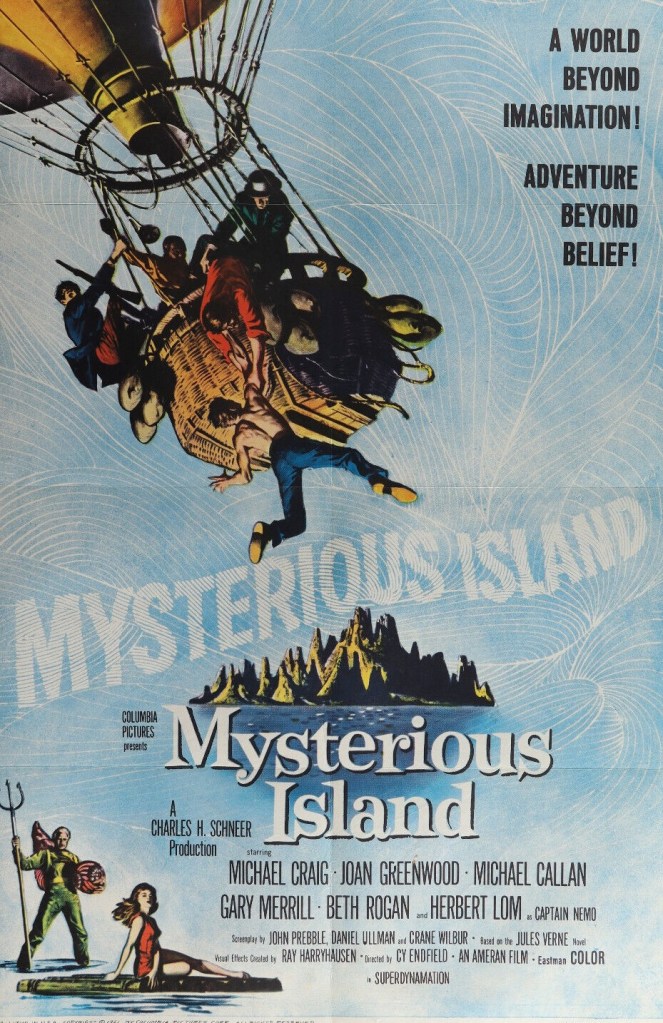
Mysterious Island (1961) ****

It’s the Ray Harryhausen Show. You’re not here for the story, surely, or the characters. You’re just waiting patiently for the monsters to appear. The only element that’s ever wrong with this kind of picture is that in-built delay. The need to set up the story and establish the oddities of the world before the behemoths trundle into view.

Doesn’t matter whether the creatures already live in an accommodating  global ecosystem like Jason and the Argonauts (1963) or One Million Years B.C. (1966). Or whether you are  going to come across them by the simple device, most famously, of dropping through a rabbit hole (Alice in Wonderland) or via a cupboard door (The Lion, the Witch and the Wardrobe) or a  rockface cracking open (Prehistoric Women / Slave Girls, 1967) or a time warp (Wonder Woman, 2017).

Here, it’s a bunch U.S. Civil War soldiers who need to break out of their prison and commandeer a handy hot-air balloon that can fly thousands of miles to the uninhabited volcanic island occupied by giant beasts. So we’ve got a monstrous crab, giant bees, chicken, gigantic octopus. And the success or failure of the picture relies not so much on whether our heroes can overcome these than that they look realistic.

And, boy, they are just brilliant. This is fairly early on the Harryhausen catalogue but if his stop-motion animation was still going through an experimental stage it’s hardly noticeable. Enhanced claws and beaks are just dandy for trapping humans, having them wriggling madly to avoid being split open with one snap. And the bee is pretty cunning, filling in the hole the invading humans have created in the massive honeycomb.

And should, perchance, your mind be wandering director Cy Endfield (Zulu, 1964) has a bout of sequel-itis, throwing in Captain Nemo from author Jules Verne’s 20,000 Leagues under the Sea (1954), and prequel-itis – the pirates from his In Search of the Castaways (1962) – plus, to add the romantic touch, a couple of shipwrecked damsels and, for the climax, volcanic eruption.

No doubt you’re dying to know about the characters you couldn’t really care less about who are encountering this legion of beings. So, we’ve got the grizzled Capt. Harding (Michael Craig), young Herbert (Michael Callan) who will express his romantic side, Sgt. Pencroft (Percy Herbert), Corporal Nugent (Dan Jackson) and Gideon (Gary Merrill). There are joined by posh English lady Mary Fairchild (Joan Greenwood), who happily buckles to and is handy with a rifle, and her niece Elena (Beth Rogan) who decides laziness is the better option when she’s not canoodling with Herbert.

Their job is to squabble, beat off the monsters, adapt a local geyser for cooking purposes, set to building a boat to escape, and await the next monster/person who’s going to upset their plans.

Captain Nemo certainly makes an impression, his ship, the Nautilus, stranded under the volcano and the man himself taking a break from the world since he doesn’t believe he is such a good fit. Turning up out of the waves in an improvised aqualung isn’t quite an entrance on a par with Ursula Andress in Dr No (1962), but it runs it close, though bikini tops rubber-suit all the time.

The pirates are just a menace and I wouldn’t be surprised if you came away with the notion that they are rammed into the tale just so their sunken ship, scuttled by Nemo, can miraculously rise from the waves thanks to the sailor’s ingenuity.

Time has been kind to Harryhausen. What was once viewed as appealing only to children and the childish wondrous aspects of adults has now become cult viewing. And no wonder. In the age of CGI, it’s quite astonishing what he has managed to achieve with what appears the most rudimentary of techniques.

Of the actors, British star Michael Craig (Doctor in Love, 1960) has his hands full to stop the picture being stolen by rising American actor Michael Callan (The Interns, 1962), a grumpy Gary Merrill (A Girl Named Tamiko, 1962), an almost avuncular Herbert Lom (The Frightened City, 1961) and a delightful turn by plummy-voiced Joan Greenwood (The Moon-Spinners, 1964).

You wouldn’t think this was the ideal movie to set you up for Zulu, but Cy Endfield does a good job of keeping the story moving and keeping out of the way during the Harryhausen sections. Screenplay by John Prebble (Zulu), Daniel B. Ullman (the television writer’s only movie of the decade) and veteran Crane Wilbur (The George Raft Story, 1962).

Huge fun. All hail King Ray.

https://amzn.to/3Rmb76d

Remake Double Bill – The Three Musketeers: Milady, or Part Deux if you prefer (2023) *** / Godzilla Minus One (2023) ***

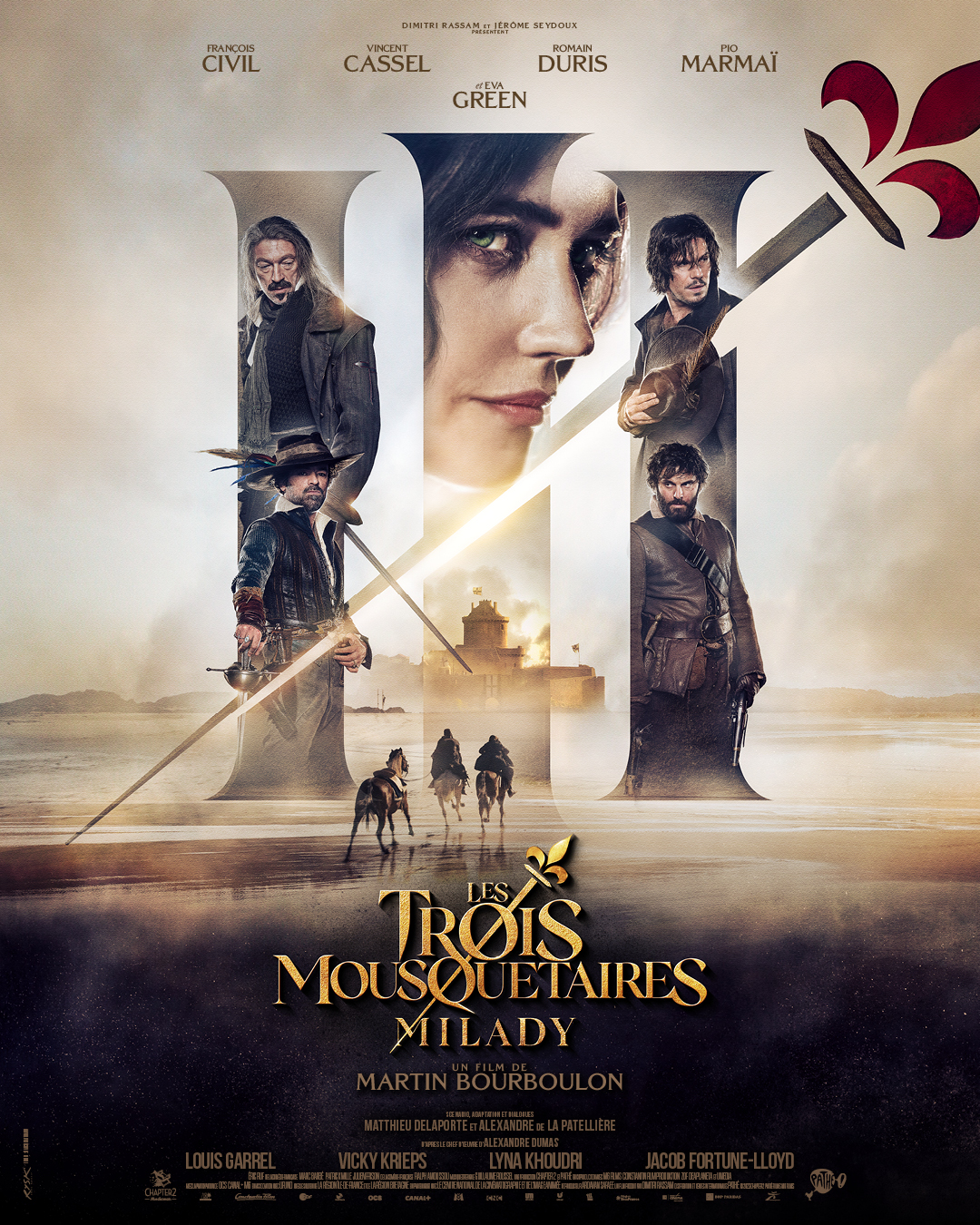
The Three Musketeers

Cherchez la femme, as they say in French. Here, because everyone is doubling up (or doubling down, I never get that right, and it is of course a sequel), the narrative has our heroes (and these being four musketeers if you include D’Artagnan and not three) chasing all over France in pursuit of two women.

If you recall from episode one (and it doesn’t matter if you don’t because this starts with a neat re-cap), D’Artagnan’s (Francois Civil) girlfriend Constance (Lyna Khoudri) has been abducted after overhearing details of a plot to kill King Louis XIII (Louis Garrel), so he’s trying to find her. Meanwhile, everyone’s after Milady (Eva Green), the double-crosser’s double-crosser. In fact, to complicate matters, the movie begins with her being rescued by D’Artagnan.

As it turns out, that’s one of the easiest complications because unless you’ve got a PhD in French history, you won’t have a clue what’s going on, what with imminent English invasion, traitors inside the palace, eternal bad guy Cardinal Richelieu (Eric Ruf) and the French laying siege to their own port of La Rochelle. I’m guessing, because it’s not exactly plain, that the background is Catholic vs Protestant enmity.

I’d forgotten of course that our heroes are called musketeers for a reason and it’s not because they are swashbucklers, though they are pretty nifty with the sword, but the name indicates a certain dexterity with muskets. So, there’s rather a lot more guns being fired and buckles being swashed.

The 1932 version.

And you could be forgiven for thinking this is some kind of riposte to Downton Abbey because everywhere our heroes go there is sure to be some fabulous chateau or castle and all kinds of pomp and circumstance. It’s a tad overladen with characters and not all stand out enough. D’Artagnan doesn’t quite command the screen and of other trio it’s lusty Porthos (Pio Marmai) who steals the show, always ready with a chat-up line or falling down unconscious from alcoholic intake.

Milady is by the far the most interesting character, tying all the males in knots, escaping every type of peril, dodging the hangman’s noose and an inferno and setting up Part III with a clever climax. Although the period wasn’t rife with feminism, she is the poster girl, not just adept with any weapon (including teeth), but detailing what it’s like to be eternally molested by men.

Constance, on the other hand, is as dumb as they come. The scene that allows D’Artagnan to wallow in pathos, you can’t help howling with laughter because the stupid girl has brought on herself a pitiless fate.

Sets quite a pace, but sometimes it’s hard to keep up with the politics and who is romancing who, and why someone who has been helpful in the past now has to be bumped off.

I hope this has earned its big budget back in France because I doubt if it will do well anywhere else.

Feels like director Martin Bourboulon (Eiffel, 2021) has bitten off more than anybody can chew.

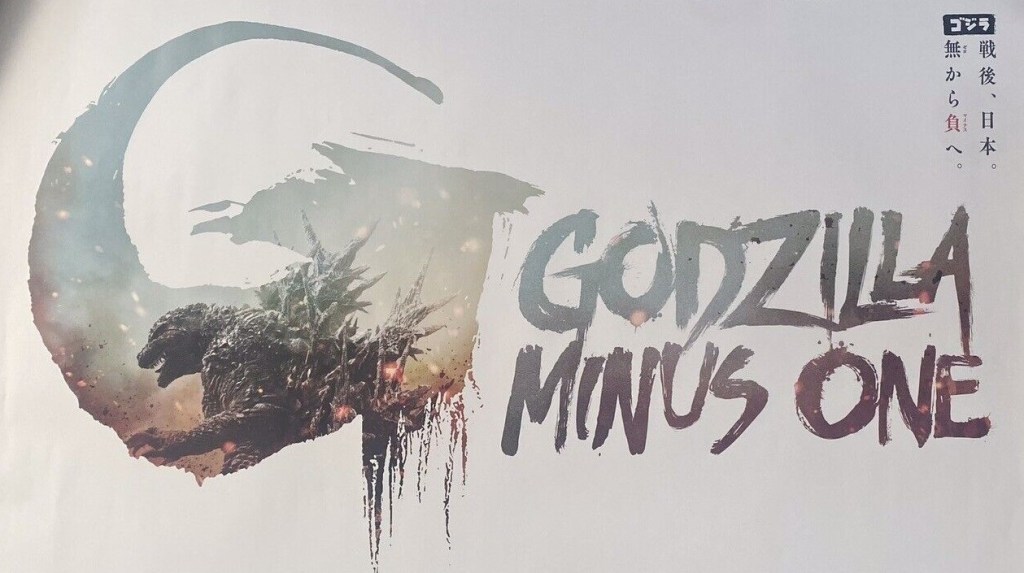
Godzilla Minus One

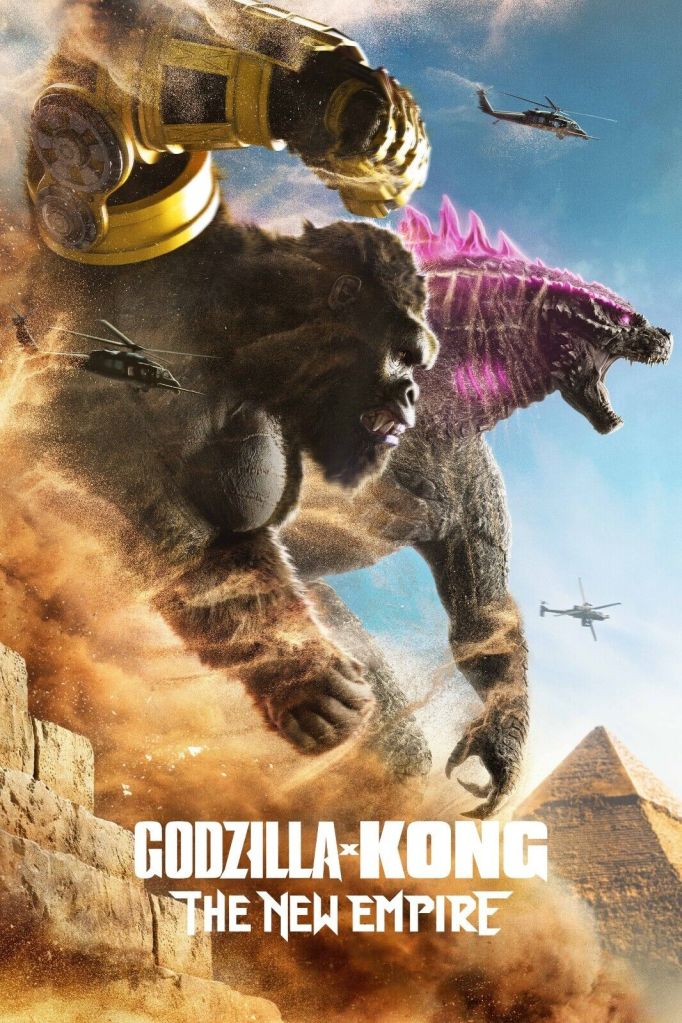
Not just a remake but, as it turns out, a prequel. It’s nipped in early, ahead of the next vehicle in the recycle business Kong vs Godzilla due out next year.

In this Japanese version, made by Toho Studios which was responsible for the 1954 original, the timeline is 1945-1947. It kicks off at the end of World War Two with cowardly Japanese kamikaze pilot Skikishima (Ryonusuke Kamiki) unable to pull the trigger as the monster emerges from the depths. Fast forward to U.S. nuclear tests on the Bikini Atholl, and the creature now mutates with devastating impact on the mainland.

By this point, Skikishima has acquired an orphaned baby and takes on a job on a minesweeper (his trigger finger now put to good use) destroying the thousands of mines left behind after the war so he’s in the front line when the monster re-emerges with an atomic heat-ray in its arsenal, never find those stomping feet and destructive tail.

There’s some clever scientific ruses to destroy Godzilla involving Freon tanks (whatever they are) and some jiggery-pokery to lower the water’s buoyancy (what now?) but basically as you might expect it’s mostly our favorite monster decimating cities and taking on every warship and airplane that the country can throw at it.

It’s pretty good fun but you might find it hard to sympathize with a kamikaze pilot.

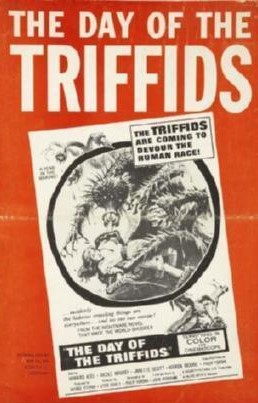
Day of the Triffids (1963) ****

Pandemic means panic and these are by far the best scenes in the adaptation of John Wyndham’s famed sci-fi novel. Virtually everyone in the world is struck blind by the fierce  brightness emitted from a bombardment of meteorites.

When passengers on a plane realize their pilot is blind, the panic is breathtaking. Ditto a train crashing into a station. While those with sight intact such as a busload of convicts can terrorize the blind, forcing them to submit to sexual overtures. On top of that are terrific scenes of deserted cities – very familiar to us all during the current pandemic – and of those unable to see trying to walk hands outstretched or attach themselves to anyone still blessed with sight.

One of the standouts is patient Bill (Howard Keel), saved from seeing the dazzling light display because his eyes were bandaged, walking through a deserted and trashed hospital. And perhaps Jurassic Park found useful the scene where the plants test an electrified fence.

And on top of that, of course, are the unstoppable monstrous man-eating plants whose growth has been triggered by the comets. Steven Spielberg over a decade later showed how to maintain tension by showing a terrifying predator in small doses and indicating its presence through musical cues and especially, when your monster ain’t quite up to scratch, keeping it hidden for as long as possible.

Interestingly, this film uses sound cues, specific noises attributable to the creatures, though the plants are shown too soon and too often but, in terms of special effects, not at all bad for their time and the low budget. And the sheer normality of the locations works very well – a caretaker having his sandwich, hard-boiled egg and flask of coffee the first victim. Some deft humor undercuts the terror. “Once you’ve tasted this coffee of mine,” remarks a character, ”you’ll know nothing worse can happen.”

Leading the fight against the monsters are sailor Bill (Howard Keel), ironically recovering from an eye operation, hotel proprietor Christine (Nicole Maurey) and in an isolated location alcoholic scientist Tom (Kieron Moore) and his wife Karen (Janette Scott).  Bill and Christine are initially intent on mere escape, but in the end have to fight.

A lean 93 minutes (the same as Gravity, 2013), tension is the key. That in itself is astonishing, given cinematographer Freddie Francis was called in at the last minute to puff out what would have been a too-short-to-release feature (under one hour at that point) directed by Steve Sekely (Kenner, 1968). Philip Yordan (El Cid, 1961) and Bernard Gordon (55 Days at Peking, 1963) knocked up the screenplay.

But once again a film like this shows how much more powerful is imagination. We can imagine being blind and walking in a vacuum with the vulnerability and helplessness that fear  entails. As the recent pandemic has shown, the unknown is terrifying and fear of the unknown even worse.

https://amzn.to/3FtsfBt

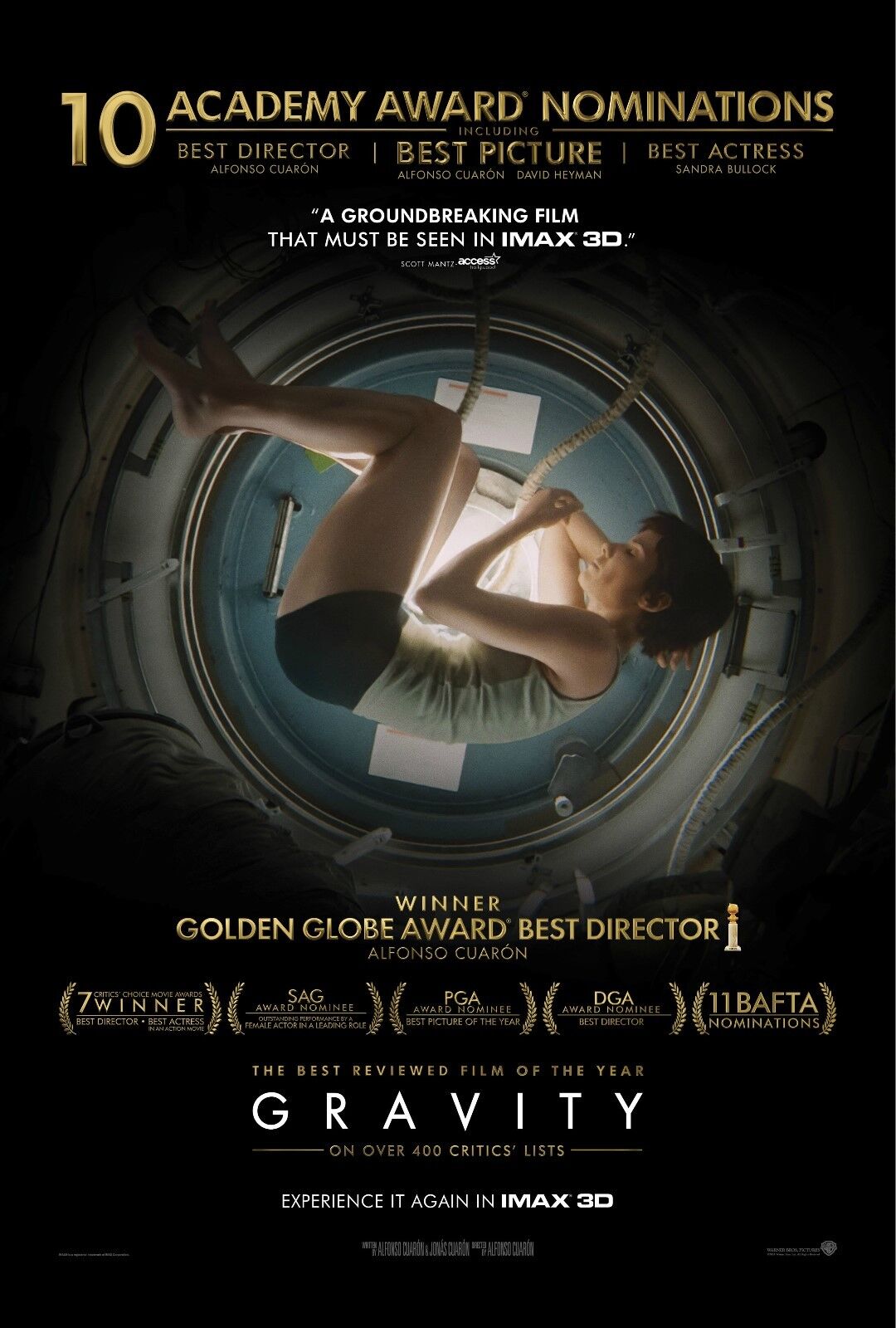
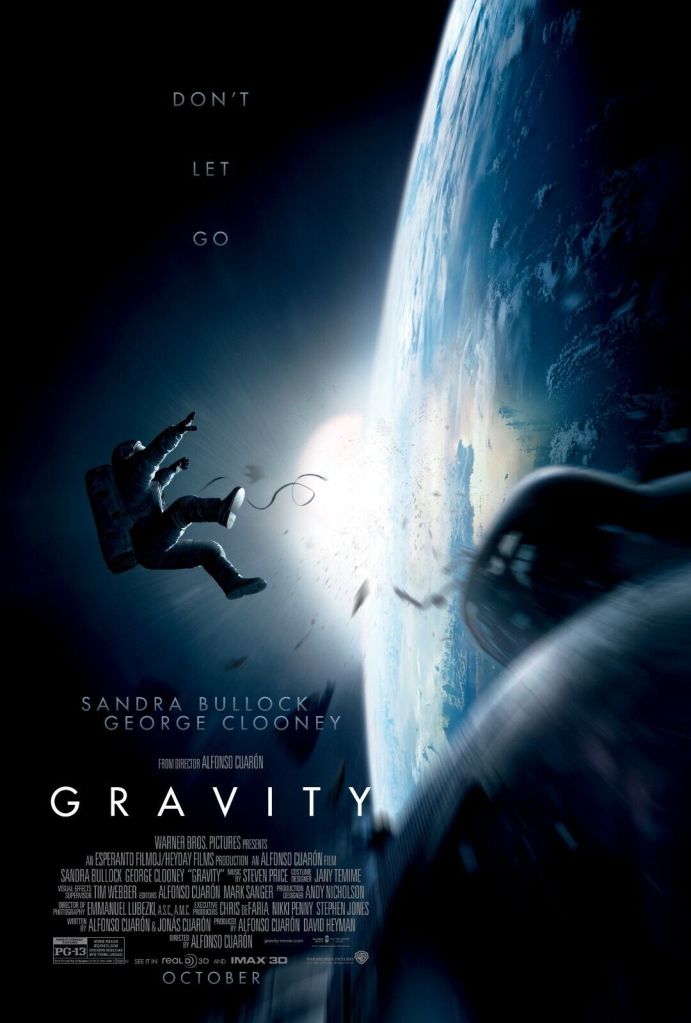
Gravity (2013) ***** in 3D, Seen at the Cinema

Superb piece of counter-programming saw this sleek sci-fi disaster picture pitted against the uber-lengthy Killers of the Flower Moon. Clocking in at under half the running time of the Scorsese feature (but with the bonus of 3D), almost B-movie style in a mean 93 minutes, it still stands as an awesome achievement by Oscar-winning director Alfonso Cuaron (Harry Potter and the Prisoner of Azkaban, 2004).

Stripping away the tedious back story that generally afflicts sci fi, and bold enough Psycho-style to dispense with a major box office figure halfway through, like John Wick it’s action from the get-go. No aliens here, just a couple of almost nerdy astronauts, sewn-up grieving mother Ryan (Sandra Bullock) and jabber mouth Matt (George Clooney), doing boring maintenance on a pretty mediocre-looking space vehicle, not the kind that’s going to blast off into deep space mapping unknown territories.

Russian space trouble causes a chain reaction that sends hundreds of miniature missiles in diabolic orbit around Earth, hitting the beleaguered Yanks time and again until their entire crew, and that of Russian and Chinese space units, is wiped out. Fits into the survival-in-space mini genre that accommodates Apollo 13 (1995) as easily as The Martian (2105) and the sub-sub-genre of women-surviving- in-space that Sigourney Weaver kicked off in Alien (1979).

So, you know from the off that you’re not going to get a woman bleating about the situation and unable to cope. It’s all about hanging on and using whatever skills got humanity into space in the first to get them back out. As usual, the answer is a pretty straightforward piece of reverse engineering.

But mostly this is sheer spectacle held together by one of the greatest actors of modern times in Sandra Bullock (The Lost City, 2022). When you need someone to emote for the most part from under a space suit, she’s the one. Takes the feet from under you though in the human twist. Why not just let nature take its course, instead of fighting for your life? Might have made a bigger psychological impact if Ryan had just let go, but that’s not, I would imagine, as big box office as the battle for individual survival, especially from someone who has zilch to live for.

I’ve no idea how they achieved the effects and don’t want to know, but a lot of it looks as if shot in-camera, with Ryan floating around in the spaceship. Quite how Cuaron, on triple-hyphenate duties here, writer-producer-director, captured her helplessly turning cartwheels across empty space is anybody’s guess.  

If it had been the usual muscled-up candidates hurtling towards their doom, I doubt if audiences would have cared so much, but the everywoman aspects of Ryan nailed it. No point trying to explain the narrative of destruction, suffice to say that whatever deadly comes her way is just as mundane as whatever is helpful.

Pure raw cinematic ride with no let-up in the action. Not sure it will hold up so well on a small screen (though the Blu Ray should provide a hefty impact) so I’m grateful for Warner Brothers for bringing this back for a reissue one-night stand to celebrate its tenth anniversary. Not sure either that it found much of an appreciative audience though. There was just me and one other person in the cinema audience last night.

A blast with heart.

https://amzn.to/3tMUvfO

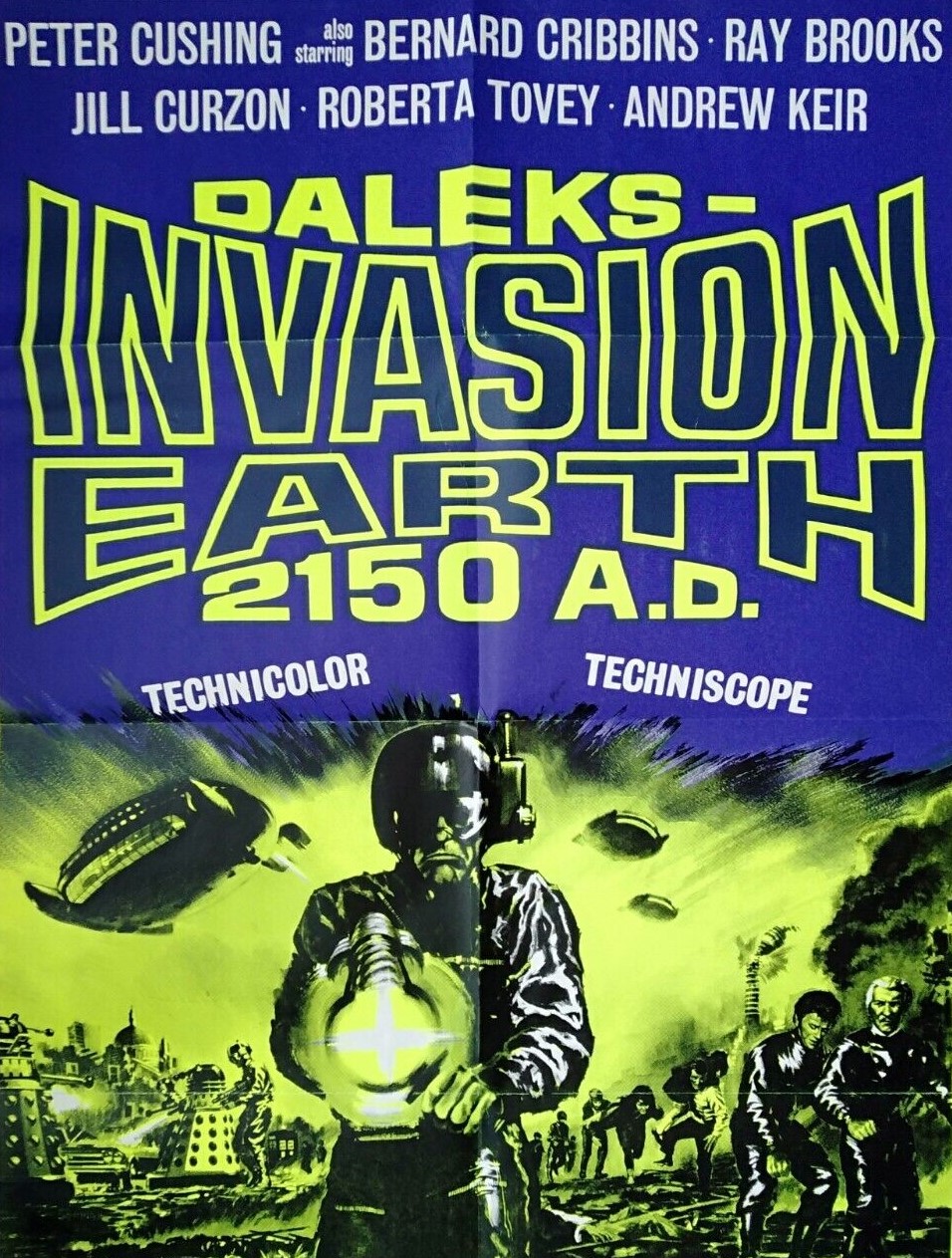
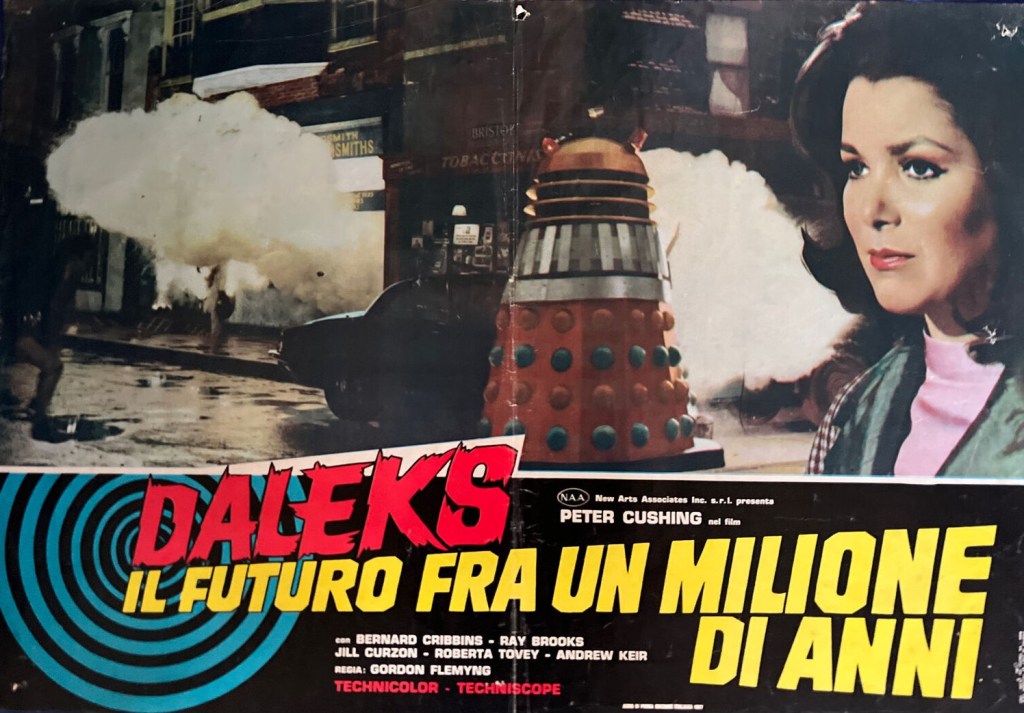
Daleks’ Invasion Earth 2150 A.D. (1966) ***

Sequels being all the rage – James Bond, Matt Helm, Derek Flint, The Pink Panther, The Magnificent Seven – in the 1960s it was no surprise that the success of Dr Who and the Daleks (20th top film at the British box office in 1965) suggested that a second go-round might be as profitable. As was standard, a recurring formula was the key.

In this case, Dr Who (Peter Cushing) and grand-daughter Susan (Roberta Tovey) repeated their previous roles though another grand-daughter Barbara (Jennie Linden) was replaced by a niece Louise (Jill Curzon) and hapless passenger Ian (comedian Roy Castle) was ousted in favour of  hapless London cop Tom (comedian Bernard Cribbins). But returning director Gordon Flemyng (The Split, 1968) upped the ante. Instead of waiting ages for the dreaded mechanical monsters with their electronic catchphrase (“Exterminate”) to appear, they turn up virtually in the first reel.

As if to emphasise the versatility of the Tardis, this time instead of space travel it’s time travel, Dr Who turning up in a blitzed London virtually two centuries ahead only to discover his nemesis rules the planet. It being set in a familiar locale, nobody is loaded down with information dumps, a tedious feature of the first picture, and it doesn’t take as long to get going, and our heroes, in various configurations, and while befriending the rebels – leader Wyler (Andrew Keir) and David (Ray Brooks) – endure a cycle of trap and escape while the good doctor tries to work out what brought the daleks to his home planet.

I’m giving this the benefit of the doubt and suggesting that the first appearance of the daleks is a homage to Dr No (1962) although one of the creatures emerging from the River Thames is hardly a patch in the sexy-entrance stakes as a bikini-clad Ursula Andress. Amidst all the mayhem, there are a couple of standout sequences, the best of which is a comedy skit involving Tom, disguised as a leather-clad member of the brainwashed automatons. This reminded me of Bob Hoskins in the first Super Mario Bros (1993 vintage) being trapped in an elevator with the Goombas. Tom is just too human to fit into this gang, constantly out of step with their actions.

Naturally, the Dr Who team are split up, allowing the action to move into two converging directions. The daleks plan to turn the planet into a giant spacecraft it can tow around, that storyline somehow involving a mining operation outside London while there’s some clever sci fi tomfoolery using the Earth’s magnetic poles to destroy the enemy.

Oops, I’ve given away the climax. Not that anybody cares that much, the main fun being the escaping formula – the daleks even use this as a plot twist, commending the intelligence of any human who can manage to escape – and watching the doctor outwit the enemy. Actually, the main fun is the dastardly daleks. Every time they appear you can imagine yourself back in a cinema crammed with thousands of kids yelling “Exteminate! Exterminate!”  

The plot keeps rolling along, no time to draw breath. And we’re not having to bother with any of the boring MCU claptrap intent on giving the super-villains a backstory or expiating their evil brains. The daleks represent alien domination, and they’re not here to give lectures on inhumanity or peace. In their determination to kill, they could almost be contemporary, given the number of serial killers and/or madmen clogging up cinema screens.

If not conspicuously inventive, Gordon Flemyng’s management of a large cast and a variety of action brought him to Hollywood attention. Given the storied career of Peter Cushing (The Skull, 1965) storied career, his performances as the doctor are generally overlooked, which is a pity, because he is certainly among the best to essay this character.  Carry On regular Bernard Cribbins livens up proceedings without needing to resort to slapstick in the Roy Castle mode. This must have seemed a bit of a come down for Ray Brooks after unexpected hit The Knack (1965) but he always seemed more at home on the small screen (although Flemyng hired him again for The Last Grenade, 1970).

The series ended here after the movie flopped on home territory. The original had bombed in the States, so the producers were heavily dependent on British box office. I guess just getting U.S. audiences aware there was such a thing in Britain as a “police box” would have been harder to grasp than the fact that it housed a time machine, and that the interplanetary craft was just there without a whole story about how it had come into being.

Made on a miserly budget by anybody’s standards, the sfx was never going to come up to scratch. But who cares.

“Exterminate! Exterminate!”

https://amzn.to/3FkXVJa

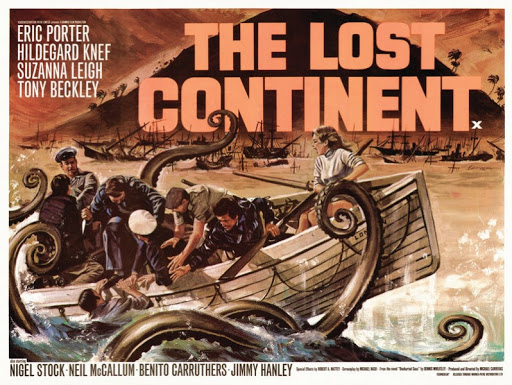
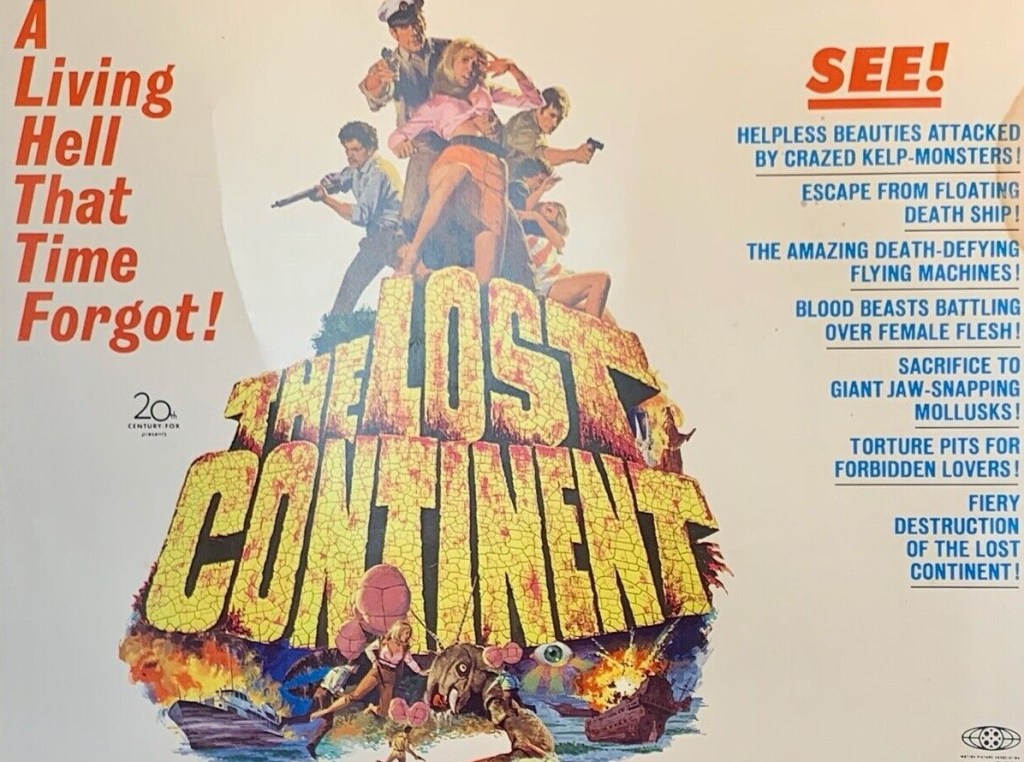
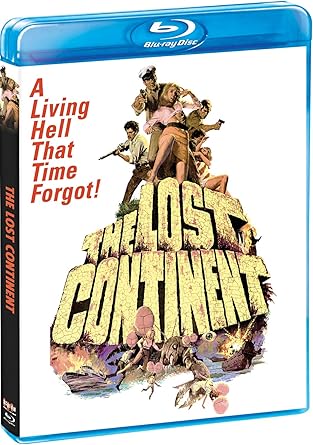
The Lost Continent (1968) ***

Hammer had struck gold revisiting ancient civilization in One Million Years B.C. (1966) and with its adaptation of Dennis Wheatley’s The Devil Rides Out (1967). The Lost Continent was another Wheatley number (source novel Uncharted Seas) mixing dangerous voyage, hints of the legendary Atlantis, and monsters. While the first half could have been marketed as The Wages of Fear At Sea the second half would come under the heading  “The Greatest Oddball Film Ever Made.”

It boasts one of the most intriguing setting-the-scene openings not just of a Hammer picture but of any film – a camera pans along a steamship on whose deck are: people dressed in furs, others in modern clothing and – Conquistadors. Attention is focused on a coffin.  How and why they got there is told in flashback. A first half of taut drama, mutiny, sharks, a ferocious octopus, and lost-at-sea a thousand miles from land segues into sci-fi with carnivorous weeds, monsters, and a weird, weird world.

It’s hard to know what’s worse, Captain Lansen (Eric Porter) with a cargo of toxic chemicals made combustible when touched by water or the equally combustible passengers all with murky pasts, so determined to escape their previous lives that they refuse to turn back in the face of a hurricane. Heading the Dodgy Half-Dozen is dictator’s mistress Eva (Hildegarde Knef) with two million dollars in stolen securities and bonds. Dr Webster (Nigel Stock), a back-street abortionist, is at odds with daughter Unity (Suzanna Leigh), who has cornered the market in backless dresses. Harry (Tony Beckley)  (The Penthouse, 1967) plays a conman while Ricaldi (Ben Carruthers) is trying to recover the pilfered bonds.

But the arrival of cleavage queen Sarah (Dana Gillespie) as an escapee from the weird world signals a shift to Planet Oddball. The only way to navigate the weeds trapping the ship is with a primitive version of snowshoes with balloons attached to the shoulders. Soon they are trapped in the past, not as prehistoric as One Million Years BC (1966), just a few centuries back to the Spanish Conquistador era. The film steals the idea from the Raquel Welch picture of giant creatures locked in battle but without going to the necessity of hiring Ray Harryhausen.

You couldn’t legislate for the movie’s logic and you shouldn’t even try, just go with the weird flow. It’s on safe enough territory until like The Hangover (20090  it has to explain the bizarre opening sequence. If ever a film has bitten off more than the special effects can chew, it’s this, but it’s still fun watching it try.

The casting relied heavily on actors best known from television or rising stars. Eric Porter was straight from BBC television mini-series mega-hit The Forsyte Saga (1967). Nigel Stock essayed Dr Watson in the BBC Sherlock Holmes series (1964-1968). Falling into the emerging-star category were:  Tony Beckley (The Penthouse, 1967), Suzanna Leigh (The Pleasure Girls, 1965) Neil McCallum (Catacombs / The Woman Who Wouldn’t Die, 1965), and Dana Gillespie (Secrets of a Windmill Girl, 1966). Hildegarde Knef (Mozambique, 1964) was just about the most experienced.

In this kind of picture, without being sexist about it, if a woman is required to do more than just scream, it often indicates she has the better part. And so it is here. Leigh and Knef hog the dramatic highlights while Gillespie, courtesy of her outfit and footwear, can’t help but steal the show.

On board ship, director Michael Carreras, fresh from Prehistoric Women (1967), does well, the characters are all solidly presented with decent back stories, but once he enters weird world budget deficiencies sabotage the picture. Even so, it’s worth a look just to see what you’re missing. If you’re looking for a genuine freak show, this ticks the boxes.

The 10th Victim (1965) ****

Sexy, stylish, sci-fi that spawned a host of imitators. Its key issue, population growth, has only  worsened since the movie appeared though killing for sport goes back to the Roman gladiators and government-sponsored killing – aka genocide – is hardly so novel. And it sets up a feminist perspective – the female killer is deadlier than the male, experience counting for everything in the assassination game.

None of the villainous females in the decade’s myriad spy films, not even the vicious pairs that gave Bulldog Drummond such a headache, could match the lethal striptease performed by authorized huntress Caroline (Ursula Andress) which culminates in a volley of bullets from her bra. Caroline is hoping to strike gold with her tenth killing, which not only brings a hefty financial bonus (and retirement) in itself, but could bring a massive bounty if captured on television and to that end she has negotiated a sponsorship deal with the Ming Tea Company, and adopts the façade of TV reporter.

Her potential victim is Marcello (Marcello Mastroianni) who would be rich enough from his six killings except his earnings have been squandered by ex-wife Lidia (Luce Bonifassy) and mistress Olga (Elsa Martinelli), not to mention the upkeep of his parents who he, illegally, has kept alive. To maintain his lifestyle he is the face of a cult worshipping the setting of the sun, but that gig is threatened by a rival cult of moon worshippers.

Set in 2079 in the aftermath of World War Three “The Big Hunt” is viewed as a legitimate method of curbing the instincts of those with violent tendencies, just the type to thirst for a fourth global conflagration. Participants must switch between being killer and potential victim, five times in each role. Naturally, victim can also take down assassin.

While attracted to Caroline, Marcello is nonetheless suspicious of the sexy reporter who in the course of claiming to be doing a story on the sexual habits of Italian men attempts to entice him to the ancient Temple of Venus in Rome where, naturally enough, sexy dancers in sexy costumes will be part of the show.

Assassination pictures are always complicated – check out The Manchurian Candidate (1962) or The Mechanic (1972) a decade later – and here the unexpected factor is love. But in the old love vs. money dynamic there’s a considerable twist, both protagonists seemingly more intent on worldly gain than enriching their souls. So it’s a twisty picture as killer and victim seek to outwit the other by any means, romance considered an acceptable weapon.

Stylistically, it’s a visual delight as director Elio Petri (A Quiet Place in the Country, 1968) meshes the burgeoning Pop Art movement with the classical architecture of ancient Rome, and the Colosseum, dismissed in the film as a unsuitable locale, though a reminder of the origins of single combat. Clever without being pretentious, sexy without veering on the side of voluptuousness, the approach is mostly ironic and can easily be viewed as a social and political commentary. Every serious element is undercut, even post-killing some bureaucrat rushes in with an official judgement on the murder. And how could you possibly take seriously the blond barnet of Marcello Mastroianni (A Place for Lovers, 1968)? That’s almost an ironic play in itself.

Austin Powers (1997) in comedic fashion took this as its stylistic cue, while other movies as wide-ranging as Death Race 2000 (1975), The Running Man (1987), Battle Royale (2000) and The Hunger Games (2012) emphasized the violence and/or political undertones. 

But none of these boasted such a stunning cast. Mastroianni performs these disaffected roles so well, while as a more than worthy adversary the generally-underrated Ursula Andress is in the form that made The Southern Star (1969) such a pleasure. Throw in Elsa Martinelli (Maroc 7, 1967) and what else could you ask for. Based on the short story The Seventh Victim – later novelized – by Robert Sheckley.

A fun ride that still makes you think.

Crack in the World (1965) ***

There’s only one thing better than a crackpot sci-fi notion. And that’s two crackpot notions. The first one might have contemporary appeal – the need to find a cheaper source of sustainable energy. Come to think of it, the second one is even more contemporary – saving the world. Although this is achieved not by cutting back on nuclear power but by doubling down on it.

With so much resting on the special effects it’s a shame producer Philip Yordan lacked as  indulgent an employer as Samuel Bronston for whom he was the go-to-guy on a string of epics like El Cid (1961) and The Fall of the Roman Empire (1964). Had Bronston been involved  this would have had world-shattering special effects. Even so, Yordan was way too smart to fall into the trap that awaited many producers of disaster movies, that the special effects would save a movie weighted down with a clunky script.

Here at least Yordan shows his pedigree. Dr Sorensen (Dana Andrews) isn’t so much the mad scientist as a guy overwhelmed by his own cleverness, his insanity of possibly a worse kind, driven by ambition and arrogance. And he’s a heck of a manipulator. When pitching the notion to Sir Charles Eggerton (Alexander Knox) and sundry political and military types he ensures his doubter Dr Rampion (Kieron Moore) isn’t around to spike his theory.

He’s got history in getting Rampion out of the way, ensuring he was in a lofty position thousands of miles away, making the coast clear for Sorensen to woo his rival’s lover Maggie (Janette Scott) to whom he is now married. Sorensen isn’t just a flawed human being, he’s a dying specimen, gradually taking on the appearance of a mummy he’s so clad in bandage one way or another as the story progresses.

Of course, it all goes wrong. Who could have foreseen there would be a pocket of hydrogen down there in the earth’s crust to knock for six Sorensen’s carefully calculated calculations. A ring of fire begins to spread around the globe, threatening to split the world in two. Of course if you drop a nuke down a volcano, as one might expect, that could possibly reverse the process.

Sorensen’s way too ill by now to take on such a physical endeavor so it falls to Rampion, naturally immune inside his Hazchem suit to the heat inside a volcano. But this proves an emotional miscalculation because it throws Maggie and Rampion together and you only need to see the look on her face when he enters the danger zone to realize that their love has only been temporarily buried not extinguished.

Oddly enough, it’s the flaws of character that hold this picture together. Sorensen determined to win his second Nobel Prize at any cost, the politicians pure suckers to anyone who can promise a new source of energy, Maggie deceiving her dying husband, Rampion principled enough to challenge Sorensen but betraying his trust to win back his former lover.

And it’s all delivered with enough believable scientific jargon snapped out in a staccato of confidence that you hardly question the concept. And Sorensen is pure scientist to the end and at least given to accepting he was wrong.

A modern audience might laugh at some of the special effects. The volcano looks like a toy and the inevitable train heading towards destruction, as though Yordan had boarded a Cinerama vehicle (which he would later do), also looks like something you’d buy in a shop. But you need to cut it some slack. This was before anyone (Fox with Fantastic Voyage, 1966, MGM on 2001: A Space Odyssey, 1968) was happy to back imagination to the tune of millions of dollars in sfx. The pressure cooker is kept on tight with the flawed characters, a traitorous romance, the fire circling the globe, Sorensen at first denying his experiment was causing earthquakes, and a simplifying of the scientific.

There’s a great scene at the start when Sorensen demonstrates the pros and cons of his scheme with the use of two panes of glass. And various maps are all we need to keep up to speed on the disaster spiralling out of control.

But if you ever want to humanize a barmy scientist call on Dana Andrews, clipped delivery, handsome, carefully coiffed silver hair, correct in every calculation until now, even emotional ones, realizing that in the September of his life he deserves romance. Astonishingly, this was his first picture in four years and he still dominates the screen.

Kieron Moore is clever casting, too, for he falls into the jutting-jaw category of handsome actor, not the bespectacled, wizened boffin, tough enough to take on Sorensen, handsome enough to challenge him romantically. Janette Scott and Moore played a couple in Day of the Triffids (1963) and she does well enough as the romantic prize. Director Andrew Marton (Texas: Africa Style, 1967) holds it all together.

Avatar: The Way of Water (2022) *** – Seen at the Cinema

Avatar: The Next Generation and the Rescue Marathon. Not sure about that, Jim, lacks punch. How about Avatar Meets Moby Dick? Hmm. You got a MacGuffin? Yep, the Earth is dying and the bad guys need to wipe out everyone on Pandora before they ship out the emigrants. And more Impossibilium? You’ll like this, this time we’re extracting anti-ageing serum from whales, worth $80 million a pop. And there’s also Avatar Meets The Titanic, seemed a shame to waste a ship going down.

So we don’t see as much of Sam Worthington this time round, is that right? Well, we’ve got to introduce his four kids, all approaching the rebellious stage, plus Spider, who’s maybe the son of the Quaritch (Stephen Lang) who was cloned before he died, plus the kids of the water king and of course all the kids squabble and make up and squabble again – you get the picture.

So how many rescues, exactly? To be honest I’ve lost count, but basically when A gets captured he needs rescued by B who then also gets captured and needs rescued by C who also gets captured and then…Yes, we get the picture.

Sigourney Weaver? Kate Winslet? Blink and you’ll miss them. But great for the marquee, right?

So, you see, with all these complications, you’re darned lucky I can manage to cram everything into a three-hour-plus running time.

Yep, it’s a bit of a mess, but the good news is while I might have been irritated by the narrative repetition I didn’t walk out. It certainly looks amazing. And you can’t top James Cameron for extended battle scenes. And there’s an emotional twist, starts out Jake protecting his family and ends up with his kids and wife saving him. Plus if you want woke, there’s a ton of Gaia-style philosophy.   

Gerry Anderson’s Fireball XL5, Supercar, Now in Color (2022) ****

Heading for the five-star bracket on nostalgia alone. Before he hit the cult heights in full color with Thunderbirds (1965-1966, plus later films) and live action Space:1999 (1975-1976) innovator Gerry Anderson created a number of television series including the three highlighted here – western Four Feathers Falls (1960) and the futuristic Supercar (1961-1962) and Fireball XL5 (1962-1963).

Now colorisation, it has to be said, is anathema to the movie buff. A whole slate of top directors exploded in anger when Hollywood had the temerity to try and make an extra buck by colorising classic black-and-white movies in a bid to reach a younger audience.

Dynamic duo from “Fireball XL5” – Venus and Steve Zodiac.

But I can’t see anything wrong in making these wonderful programs, that would otherwise just be limited to the cult audience, more accessible to the modern youngster. To achieve the correct color palette, the producers here simply used on-set stills taken during the original shooting (you didn’t think actors in black-and-white programs or movies only wore black-and-white costumes, did you?) to match the vivid visuals of the later color series. Computer wizardry did the rest.

So the result is far more interesting than mere nostalgia, which would have been the case with releasing the three series in original format. Children of all ages are going to love the results.

Anyone unfamiliar, if that is humanly possible, with the Gerry Anderson output should be aware that he uses marionettes – based on the difficult Czech style. Ever with an eye to marketing, he called the process “Supermarionation.”

Inventiveness is the key to whether old television programs can capture a new market and I reckon this succeeds hands-down. While the color makes them instantly more attractive, the worlds established are what appeals more.

Got a copy of one of these memoranilia spin-offs and you’re probably sitting on a fortune.

Gerry Anderson’s sci-fi, far from rudimentary with advanced space-age machinery, had interesting heroes and narrative drive. In Supercar square-jawed hero Mike Mercury was supplemented by interesting boffins, Professor Popkiss and Dr Beaker. Pet monkey Mitch could be counted on for comedy. In Fireball XL5 Steve Zodiac has a female sidekick Dr Venus (voiced by Sylvia Anderson) , blonde template for Lady Penelope in Thunderbirds, while Professor Matic keeps everything shipshape and lazy pet Zoonie (vocabulary only marginally bigger than Groot’s) from a distant planet provides the humor.

Villains, invariably out to disrupt or destroy the universe and invariably recurring, were straight out of James Bond: Masterspy in Supercar and a whole bunch of them, the Subterrains, from Planet 46 in Fireball XL5.   

Trademarks included a launch sequence, catchphrases, and a theme song (has any romantic lyric ever surpassed “my heart would be a fireball, a fireball, if you would be my Venus of the stars” in Fireball XL5?).

So what we’ve got here are three 30-minute episodes of Fireball XL5, two of Supercar and one 13-minute episode of Anderson’s debut series Four Feather Falls plus compilation features You’ve Never Seen These and Space City Specials. The Fireball trio are “The Sun Temple,” “The Granatoid Tanks” and “A Day in the Life of a General.” Supercar contributes “Pirate Plunder” and “Supercar: Take One” while the offering from the western is “First Train Through.”

The stories follow a similar format of threat and rescue – in “The Sun Temple” Venus is mysteriously captured and laid out to be tortured by the rays of the sun (think James Bond and the laser). And they’re none the worse for that.

Of course, I may be biased since Gerry Anderson formed a key component to my childhood, these programs followed in due course by Stingray, Captain Scarlet and the Mysterons, Joe 90 and Thunderbirds.

My only reservation is the strings often show up quite clearly. I viewed this via Vimeo on a screen that i doubt was even a foot wide, so a tiny screen by modern standards and the strings were clearly visible, so I’ve no idea what they’d look like on a 40-incher or bigger. Maybe another bout of computer wizardry in the future would erase those.

The colorization works a treat and opens up a new audience for these early Anderson programs. Hopefully, if the idea works, then we can look forward to the entire series of the three programs being colorised. If you want to make sure that happens, play your part by buying this new DVD which is available on December 12, but can be pre-ordered now. You wouldn’t want to miss out, would you? You can always pretend you’re buying it for the kids or grandkids.  

Thanks to Network for a streamer. Link below.

https://networkonair.com/coming-soon/3489-presented-in-supercolorisation-blu-ray-

Discover WordPress

A daily selection of the best content published on WordPress, collected for you by humans who love to read.

The Atavist Magazine

by Brian Hannan

WordPress.com News

The latest news on WordPress.com and the WordPress community.