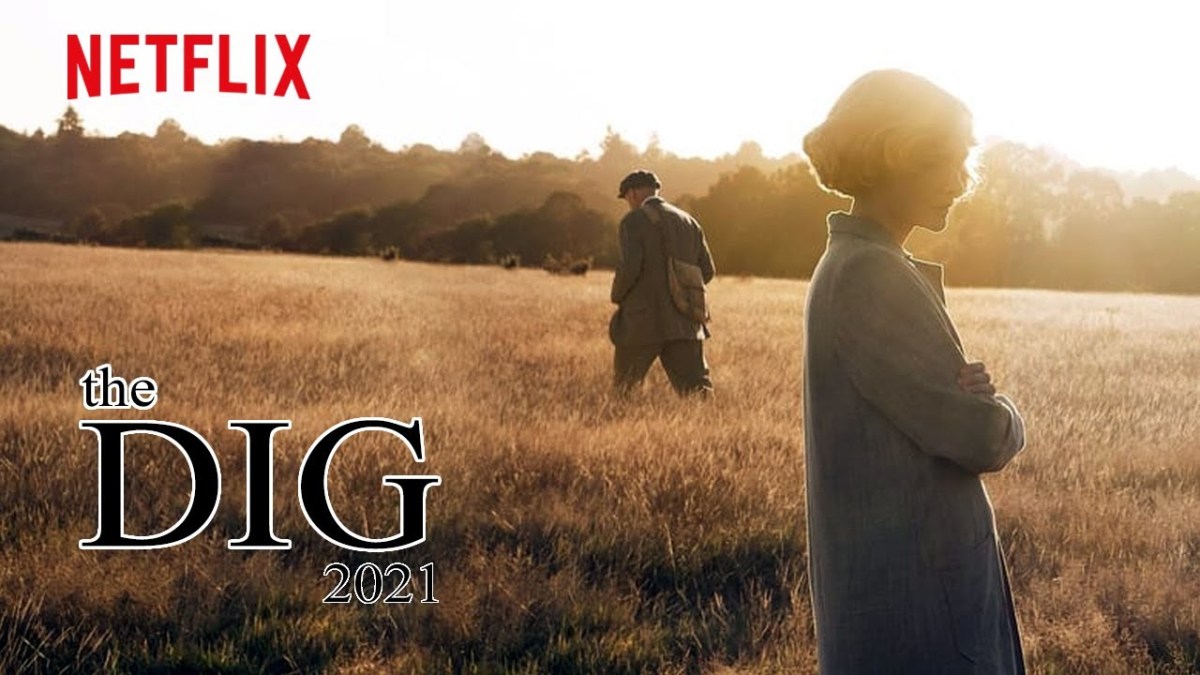
The Dig (2021) **

When stuck in a plot hole, crime writer Raymond Chandler used to send in a new character  with a gun. Director Simon Stone has employed the same concept, minus weaponry. People just keep turning up in The Dig, adding very little to the story, which in itself, setting aside National Trust hype, is on the slim side. A sixth-century Suffolk burial site (thought it does cast new light on the Dark Ages so we are told) is not in the same archeological class as a velociraptor or an Egyptian tomb.  Mostly, we are misled. For the first third it looks like we are heading for Lady Chatterley’s Lover territory with posh lady (Carey Mulligan) eyeing up the digger (Ralph Fiennes) until his wife turns up. Then it looks like it’s going to be a battle royal between Fiennes and the Establishment, but that is headed off.  

It’s 1939 so the Second world War is on its way. Cue the arrival of wannabe pilot (Johnny Flynn). A top archaeologist (Ken Stott) also appears but that doesn’t go anywhere either, bringing with him Ben Chaplin and Lily James fresh from their honeymoon. James gets the hots for Johnny Flynn and there’s just enough time before the credits roll for them to get at it.

This is the kind of film that has money to spend on an old WW2 aeroplane or maybe a CGI version of one but not enough for decent sound recording equipment. Most of the time conversations are over the shoulder or in long shot. It’s not just words, it’s expressions, faces that tell a story, and being denied these seems bizarre. It may be an artistic decision, some critic thought we were being made to “dig” for the story. But it’s hard enough to work up any enthusiasm without being made to work harder.

Ralph Fiennes is excellent, a son of the soil, self-taught, but no shrinking violet either. His scenes with posh lady’s son (Archie Barnes) are very touching, the young lad having invented a whole world for himself. Carey Mulligan just looks as though she’s about to burst into tears, probably wondering how she managed to be talked into playing (at age 34) a woman who was actually 56 at the time of the dig and wishing Nicole Kidman and Cate Blanchett (closer to that age) who were at one point attached had not left her to it.

The dig itself is interesting – but only for about five minutes. We know all we need to know about the boring sifting and brushing and digging from other films and we don’t learn more from this except how easy it is for a wall to suddenly collapse and nearly kill someone.

The most intriguing part of the film came at the end when we discovered that the burial ship dug up was buried for the duration of the war in an Underground station in London. How did they manage that, I wondered. Whereas I didn’t wonder much about anything else in this film.  

https://www.netflix.com/gb/title/81167887

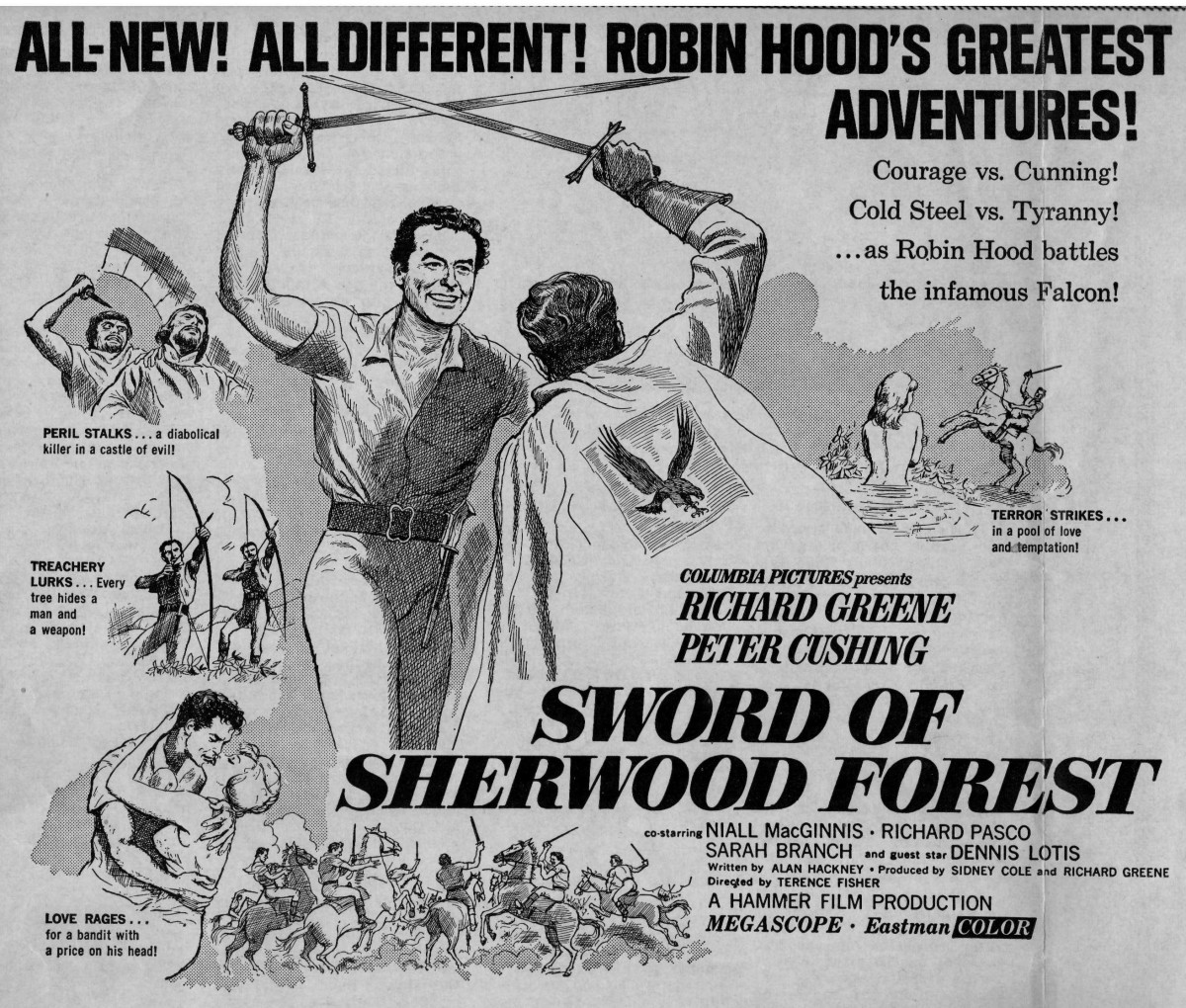
Sword of Sherwood Forest (1961) ***

The last swashbuckler to cut a genuine dash was The Crimson Pirate (1952) with an athletic Burt Lancaster romancing Virginia Mayo in a big-budget Hollywood spectacular. The chance of Hollywood ponying up for further offerings of this caliber was remote once television began to cut the swashbuckler genre down to small-screen size. Britain’s ITV network churned out series based on Sir Lancelot, William Tell and The Count of Monte Cristo and 30-minute episodes (143 in all) of The Adventures of Robin Hood. So when Hammer decided to rework the series as a movie, their first port-of-call was series star Richard Greene.

And to encourage television viewers to follow the adventures of their hero on the big screen, Hammer sensibly dumped the small screen’s black-and-white photography in favour of widescreen color and then lit up the canvas at the outset with aerial tracking shots of the glorious bucolic greenery of the English countryside (actually Ireland). Further temptation for staid television viewers came in the form of Maid Marian (Sarah Branch) bathing naked in a lake. Robin Hood is soon hooked.  

Sarah Branch was given the cover girl treatment in British fan magazine “Picture Show and TV Mirror” but this preceded “Sword of Sherwood Forest” and instead was for “Sands of the Desert” (1960), a Charlie Drake comedy in which she plays a travel agent kidnapped by a sheik. Branch only made four pictures, with Maid Marian her final film role.

Two main plots run side-by-side. The first is obvious. The Sheriff of Nottingham (Peter Cushing) is quietly defrauding people through legal means. The second takes a while to come to fruition. Robin Hood is hired by for his archery skills by the Earl of Newark (Richard Pasco) – he shoots a pumpkin through a spinning wheel, a moving bell and a bullseye through a slit – before it becomes apparent he is being recruited as an assassin. Oliver Reed and Derren Nesbitt put in uncredited appearances and the usual suspects are played by Niall MacGinnis (as Friar Tuck) and Nigel Green (as Little John).

There is sufficient swordfighting to satisfy. Director Terence Fisher, more at home with the Hammer horror portfolio, demonstrates a facility with action. Richard Greene makes a breezy hero and the picture is ideal matinee entertainment.

Many of the films from the 1960s are to be found free of charge on TCM and Sony Movies and the British Talking Pictures as well as mainstream television channels. Films tend to be licensed to any of the above for a specific period of time so you might find access has disappeared. But if this film is not available through these routes, then here is the link to the DVD and/or streaming service.
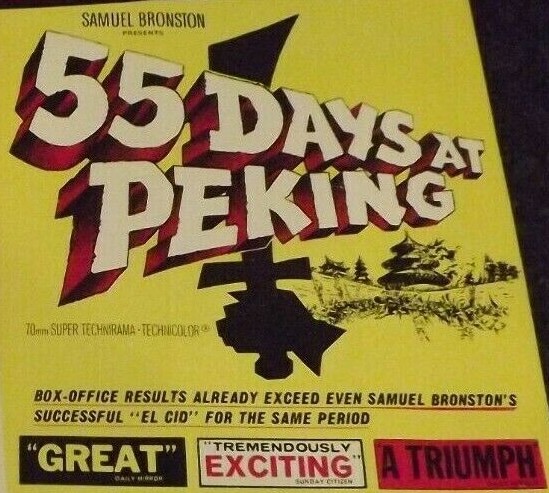
55 Days at Peking (1963) ***

Imperialism is hard to stomach these days but at the start of the twentieth century it was rampant and as shown in this picture not just restricted to the main culprit, the British. China was Imperialism Central, round about a dozen nations including the USA and Russia claiming control of sections of the country or its produce. So they had all set up diplomatic shop in Peking. And the film begins with an early morning roll call of national anthems before this domination by outside interests in shattered by rebellion.

Just as hard to stomach, of course, was the movie mainstream notion in those days that all rebellions must perforce be put down regardless of how put-upon the peasant classes were. Audiences had to rally round people in other circumstances they would naturally hate. So one of the problems of 55 Days at Peking is to cast the rebels (known as Boxers) and the complicit Chinese government in a bad light while ensuring that those under siege are not seen as cast-iron saints. There’s no getting round the fact that the rebels are shown as prone to butchery and slaughter while the Chinese rulers are considered ineffective and traitorous.

Producer Samuel Bronston built his Peking set on a 250-acre site at a ranch 16 miles from Madrid, Spain, near the foot of the Sierra Guadarrama mountains. To ensure authenticity, a canal was enlarged to supply 15,000 gallons of water a day from a specially-prepared reservoir holding half a million gallons. Over 1.3 million feet of tubular steel – all the scaffolding available in Madrid, Barcelona, Seville and Valencia – was used in the set construction.

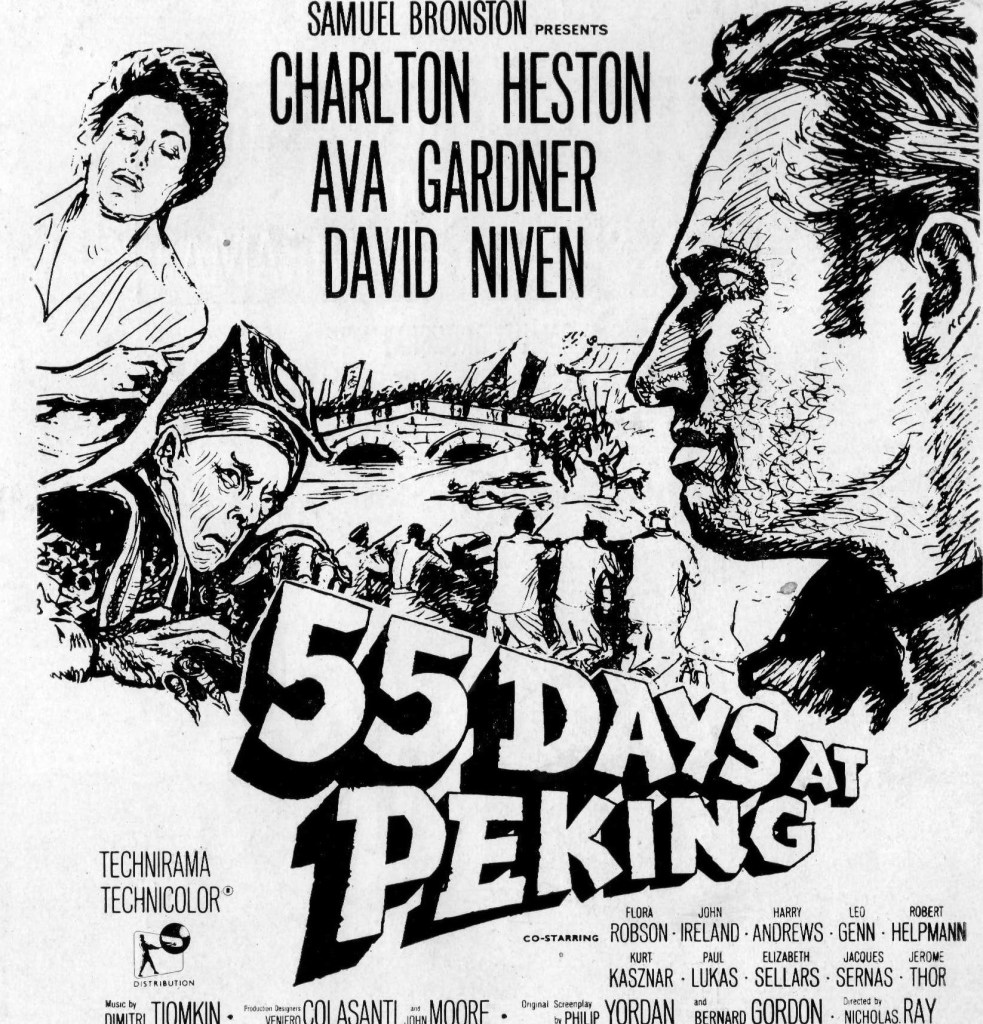
So it’s left to the likes of Charlton Heston as the leader of U.S. Marines stationed in the city to bring some balance to proceedings. “Don’t get the idea you’re better than these people because they can’t speak English,” he expounds. David Niven plays the British Consul trying to keep this particular league of nations onside while negotiating with one hand tied behind his back – “we must play this game by Chinese rules” – with the Chinese Dowager Empress (Flora Robson) while knowingly endangering his wife (Scottish actress Elizabeth Sellars, a one-time big British star) and two children. Ava Gardner is an unscrupulous Russian baroness with little loyalty to her home country.

To ensure journalists provided authentic coverage of the siege, press materials included a copy of the detailed map printed in the Saturday October 13, 1900, edition of British daily newspaper “The Times” and its account of the action. Producer Samuel Bronston claimed that some of the costumes worn by Flora Robson in her role as the Dowager Empress were actual ones worn by the empress and purchased from an Italian family who had connections in the Italian embassy during the siege.

The picture is one-part action, one-part politics and one-part domesticity, if you include in the last section Heston’s romance with Gardner, Niven’s guilt when his son is wounded in an attack and Heston’s conflict over a young native girl (Lynne Sue Moon) fathered by one of his own men who is then killed. Two of the best scenes are these men coping with parental obligation, Niven coping with a wounded son, Heston finding it impossible to offer succour to the child.

The action is extremely well-handled. The siege goes on longer than expected when the expected troops fail to arrive, tension rising as casualties mount and supplies fall low. As with the best battle pictures, clever maneuvers save the day. Two sections are outstanding. The first has Heston marshalling artillery to prevent the Chinese gaining the high ground. The second is a daring raid – Niven’s idea, actually – through the city’s sewers on the enemy’s ammunition dump. Personal heroism is limited – Heston volunteers to go 70 miles through enemy territory to get help but has to turn back when his men are wounded or killed.

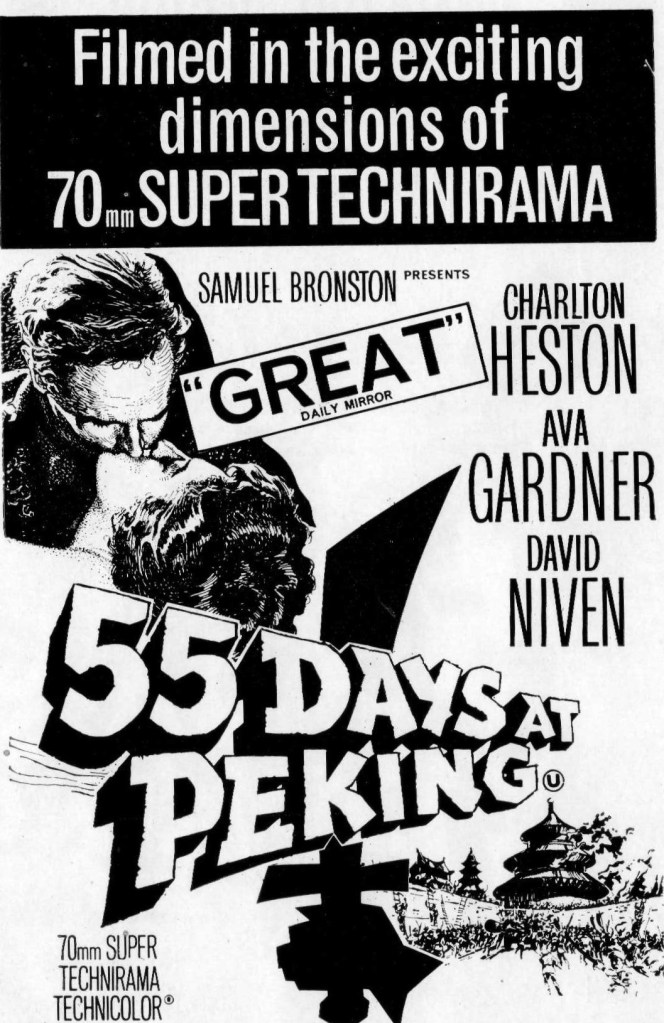
The film was not released in 70mm roadshow in the United States as originally planned but like “El Cid” went straight into general release in a 35mm version. but it was seen in 70mm in Europe. Among suggested promotional activities were a “guess-the-flag” competition since 11 nations were involved. The tie-ins included a Corgi paperback, the original soundtrack by Dmitri Tiomkin and four singles – Andy Williams singing the theme song “So Little Time,” The Brothers Four with “55 Days at Peking” (also recorded by Kenny Ball and his Jazzmen) and Tommy Riley with “Peking Theme.”

There’s a fair bit of stiff upper lip but while Heston, in familiar chest-baring mode, has Gardner to distract him, Niven is both clever, constantly having to outwit the opposition and hold the other diplomats together, and humane, drawn into desperation at the prospect of his comatose son dying without ever having visited England.  Gardner moves from seducer to sly traitorous devil to angel of mercy, shifting out of her beautiful outfits and glamorous hats to don a nurse’s uniform, at the same time as shifting her outlook from selfish to unselfish. All three stars acquit themselves well as does Flora Robson in a thankless role.

This was the third of maverick producer Samuel Bronston’s big-budget epics after King of Kings (1961) and El Cid (1961) with a script as usual from Philip Yordan and directed by Nicholas Ray.

All in all it is a decent film and does not get bogged down in politics and the characters do come alive but at the back of your mind you can’t help thinking this is the wrong mindset, in retrospect, for the basis of a picture.

Many of the films from the 1960s are to be found free of charge on TCM and Sony Movies and the British Talking Pictures as well as mainstream television channels. This one I noticed is available on YouTube at the point where I was reviewing it. But if this film is not available through these routes, then here is the link to the DVD and/or streaming service.

The Long Ships (1964) ***

Decent hokum sees Vikings ally with Moors to seek a mythical giant bell made of gold, “the mother of voices.” There are stunning set-pieces: a majestic long ship coming into port, superior battles, the Mare of Steel, the discovery of the bell itself, while a clever ruse triggers the climactic fight. There’s even a “Spartacus” moment – when the Vikings declare themselves willing to die should their leader be executed.

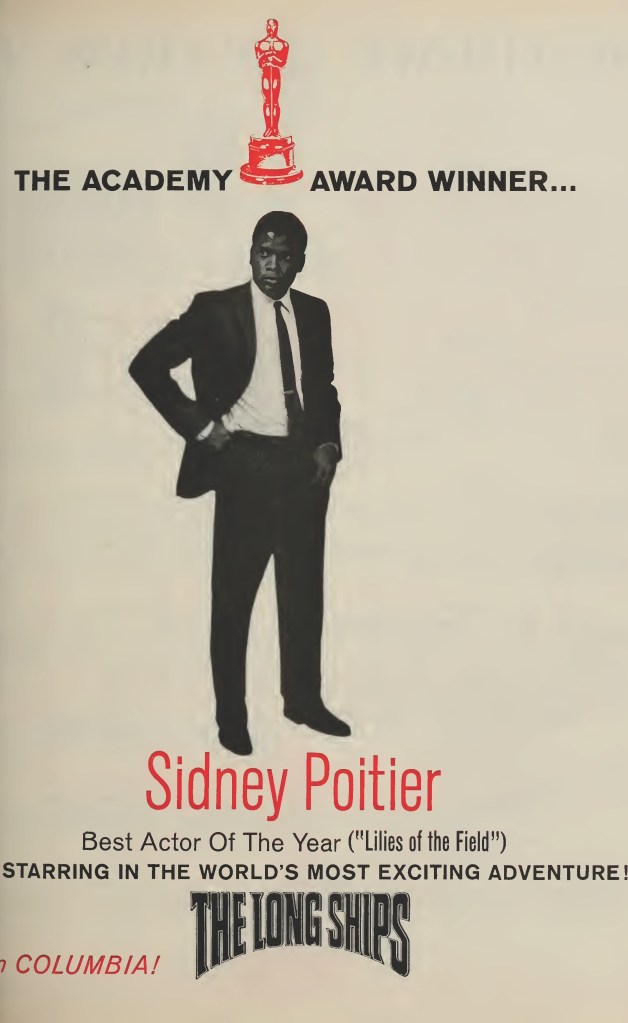
Richard Widmark as a wily Viking, second cousin to a con man, makes the most of an expansive role. Instead of seething with discontent or intent on harm as seemed to be his lot in most pictures, he heads for swashbuckler central, with a side helping of Valentino, gaily leaping from high windows and  engaging in swordfights although he does appear to spend an inordinate amount of time swept up ashore after shipwreck. Sidney Poitier, laden down with pomp and circumstance rather than immersed in poverty as would he his norm, is less comfortable as the Islamic ruler. Fresh from winning the Oscar for Lilies of the Field (1963) it surely must have the chance of a big payday that lured him into this role. (Widmark and Poitier re-teamed in The Bedford Incident, 1965, previously reviewed in the blog.) The diminutive Russ Tamblyn, as Widmark’s sidekick, is easily the most athletic of the trio.

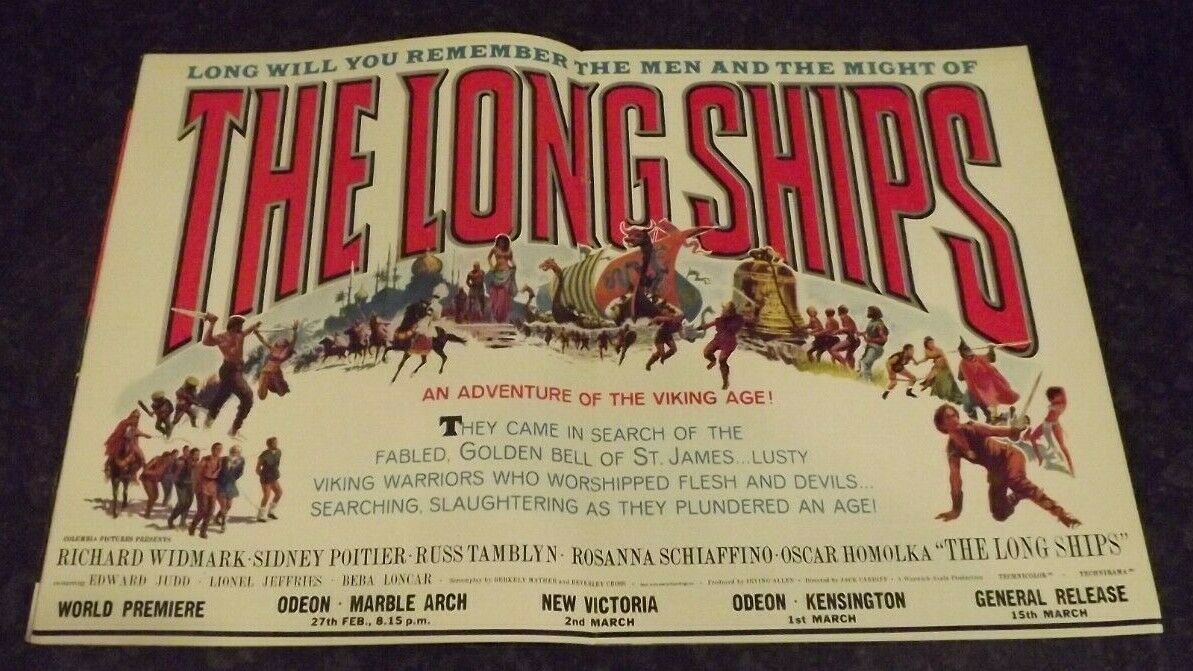
British production company Warwick could hardy believe their luck in landing an Oscar-winner. They had gone down the swashbuckling route before with The Black Knight (1954) and had made films with big Hollywood names like Robert Mitchum and Rita Hayworth in Fire Down Below (1957). This was a trade advertisement in “Box Office” magazine (April 27, 1964) – in the same issue was an advert for Poitier’s triumph in Lilies of the Field.

Although handy with a sword, both are equally adept as employing seduction, Poitier making eyes at Viking princess Beba Loncar (in her Hollywood debut) while Widmark targets Poitier’s neglected wife Rosanna Schiafffino (The Victors, 1963). The story is occasionally put on hold to permit the Viking horde to pursue their two favorite pastimes – sex and violence – and they make the most of the opportunity to frolic with a harem.

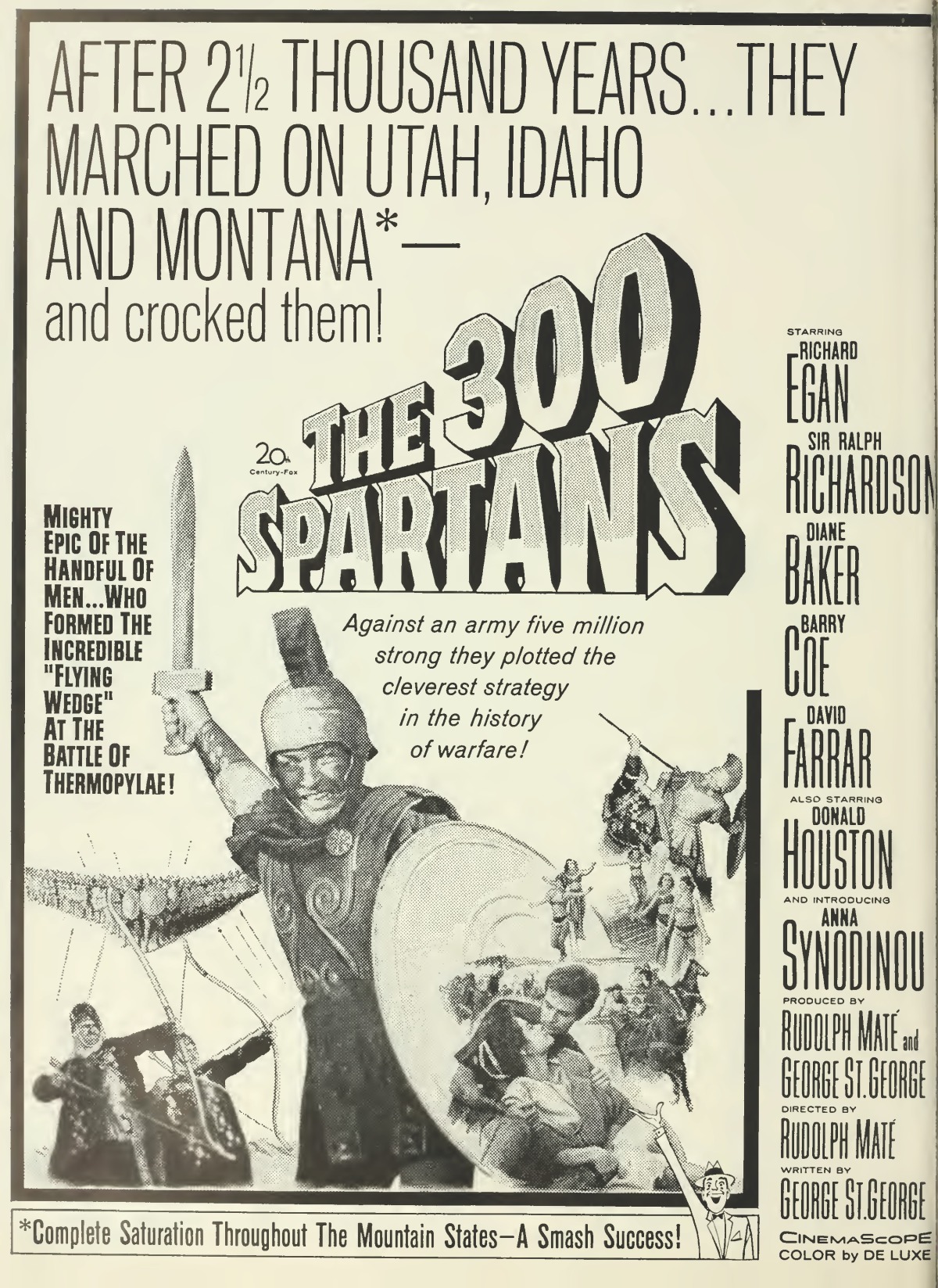
One of the marks of the better historical films is the intelligence of the battle scenes. Here, faced with Muslim cavalry, the Vikings steal a trick from The 300 Spartans by lying down to let the horses pass over them then rising up to slaughter their riders. But there is also an unusual piece of intelligent thinking. Realising, as the battle wears on, that they are substantially outnumbered and have their backs to the sea, Widmark takes the sensible option of surrendering.

Director Jack Cardiff, Oscar-nominated for Sons and Lovers (1960), brings to bear his experience of working on The Vikings (1958) for which he was cinematographer. He is clearly at home with the action and equally there is some fine composition. However, the story in places is over-complicated, he fails to rein in the mugging of one of the industry’s great muggers Oscar Homolka and there is a complete disregard for accent discipline.  Edward Judd (The Day the Earth Caught Fire, 1961), Scotsman Gordon Jackson (The Great Escape, 1963) and Colin Blakely (The Private Life of Sherlock Holmes, 1970) have supporting roles. 

Many of the films from the 1960s are to be found free of charge on TCM and Sony Movies and the British Talking Pictures as well as mainstream television channels. But if this film is not available through these routes, then here is the link to the DVD and/or streaming service.
Pharaoh/Faraon (1966) ****

I had been familiar with Polish film Pharoah (1966) from a striking cover of British movie magazine Films and Filming and surprised at coming across the film while browsing YouTube I began watching without realizing there were no subtitles. I was so mesmerized by the visuals and the stunning camerawork that I could not stop watching.

There are as many versions of the Jerzy Kawalerowicz picture as director’s cuts of Blade Runner. The original clocked in at three hours. The version given limited showings in European countries was hacked down to under two hours. The DVD released in 2000 is limited to two hours, although the most recent DVD is 25 minutes longer. I suspect it was the latter that had ended up on YouTube since that version runs two hours and twenty-four minutes.  

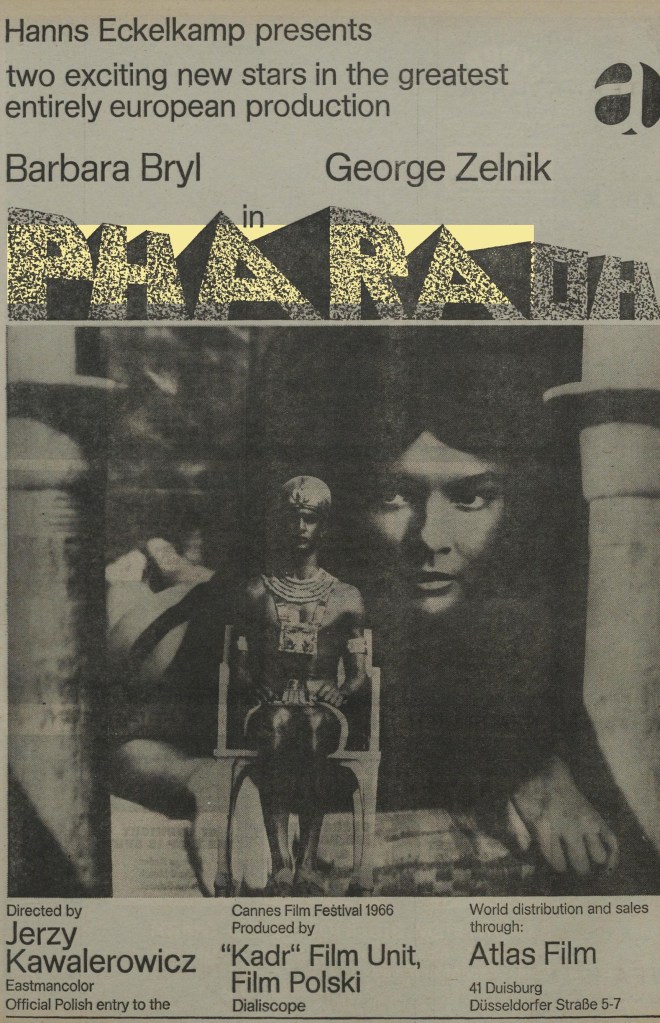
Advert in Variety (May 4, 1966). Although little seen outside Poland it did well in Rome where it was a “smash” at the box office on the strength of a “sex-baiting campaign promising filmgoers a full dish of screen nudity approved exceptionally by the censors in the name of art” (“Shrew Paces Rome Box Office,” Variety, April 19, 1967, p64).

The story is relatively straightforward. The theme is power. Egypt is in decline when a fictional Rameses XIII (in reality only eleven bore that name) in ascending to power clashes with priests who seek to usurp his rule. That religion dominates Egypt is seen in the opening sequence where, rather than disturb two holy scarabs rolling a ball of clay, the priests take the army en route to battle out of their way. That leads to the destruction of a newly-built and much-needed canal, and the suicide of one of the loin-cloth-clad laborers working on the channel.

But that opening image and the director’s stunning use of the camera as well as the brilliance of the actors in depicting emotion through their eyes and facial expressions makes the film more than accessible despite the lack of sub-titles. This is a different Egypt to that conjured up by Hollywood and such desert-worshippers as David Lean. There is no beauty in a desert. Viewed as a waste, but one in which people have to live, through which foot soldiers have to trudge (rather than gloriously charge on camels), it is a lived-in reality, a great emptiness, devoid of mystery or splendor. The desert is a dead weight. Water is such a visual delight that in a brief scene on the river, the screen is at once bright and wonderful.

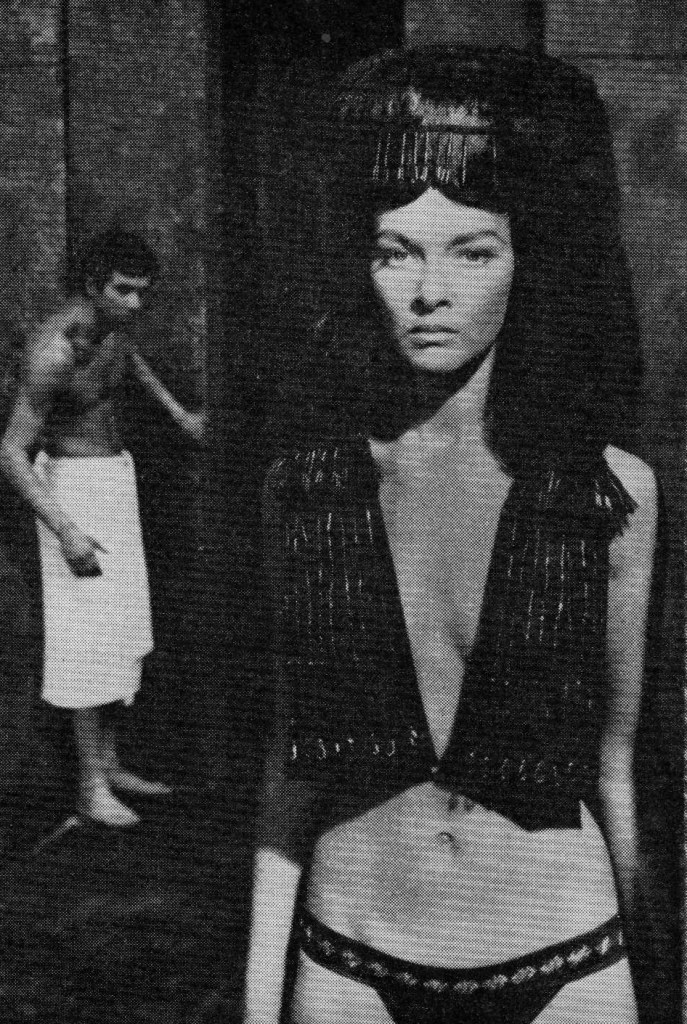
Barbara Brylska as the priestess-dancer who seduces Rameses. It is she who appears on the cover of “Films and Filming.”

Glory – temples, pyramids, jewellery – is man-made. But the whole enterprise is naturalistic. Men are bare chested, many clad only in loin cloths, priests are bald while the wealthy are attired in in heavy wigs.   What is not lacking is genuine historical detail. Hollywood had a habit of cherry-picking history for the items that would show up best on camera, but that is not the case here.  

What elevates the film is visual mastery and cinematic flair. Just opening an epic film with two dung beetles having a scrap on an arid plain and holding that image for the best part of a minute suggests a director of considerable talent. He follows this with over a minute of a reverse tracking shot following a soldier running who reveals a waiting army. There are a host of terrific visual scenes – a wild horse is impaled with spears as if in a Spanish bullring, the corpse of the suicidal laborer swings from a noose, cumbersome battles see soldiers surmount arduous dunes, golden doors open one after the other in the palace. 

Even in simple emotional scenes, Kawalerowicz knows where to place the camera and how to use it. The camera follows a woman as she enters a scene. She crouches down to the prostate Rameses. The camera remains on her as she retreats and he comes up to stop her and he remains out of shot as she moves away to the wall where, with her back to him, she begins to wail and then kneels down, hands raised in supplication. Another scene is shot in darkness except for Rameses in a white tunic and a seductress in a transparent dress.

The acting is uniformly good and even though the style is somewhat stilted Jerzy Zelnik as Rameses and the two women in his life, who bear the film’s emotional brunt, Krystyna Mikolajewska as his Jewish mistress and Barbara Brylska as a seductive priestess, are excellent.  Kawalerowicz was best known for Mother Joan of the Angels (1961). Pharaoh was the official Polish entry for the Cannes Film Festival and nominated for the Best Foreign Language Film Oscar, up against the far more commercially viable A Man and a Woman from Claude Lelouche (the winner), Gillo Pontecorvo’s The Battle of Algiers and Milos Forman’s Loves of a Blonde.

Treat the Youtube version as a sampler and if you are impressed you will find below a link to the DVD with Polish voices dubbed into English.

The 300 Spartans (1962) ****

Doomed for half a century to be seen as Saturday television matinee material and then put into the shade by the Zack Snyder’s stylish 300 (2006), The 300 Spartans is in sore need of re-evaluation.  Lacking the big budget of an El Cid (1961) or Lawrence of Arabia (1962) and released during an era when historical drama – Barabbas (1961), The Mongols (1961), Sword of the Conqueror (1961), The Trojan Horse (1961), and The Tartars (1961) – was at a peak, this is a stripped-down version of the famous Battle of Thermopylae in 480 B.C. and none the worse for it.

Clever camerawork suggests thousands of warriors involved but there is little sign of scrimping in the wardrobe department and there is more than enough action. Also, this is a surprising literate picture, with great lines for cynical politicians as much as for warriors and peasants. Themistocles (Ralph Richardson) comments: “Some day, I may enter religion myself. It’s better than politics. With the gods behind you, you can be more irresponsible.”  Told that the invading Persian army has “arrows that will blot out the sun,” Spartan King Leonides retorts, “then we will fight in the shade.”  And there’s sexist banter typical of the period between a peasant couple: wife – “goats have more brains than men”; husband – “who can understand the ways of the gods, they create lovely girls and then turn them into wives.”

Originally titled” The Lion of Sparta”, the film could not have been made without the wholesale cooperation of the Greek army which supplied over 2,000 soldiers. Those playing Spartans had to be over six foot tall. Since the Greeks had no cavalry and few knew how to ride, around 200 were given a crash course. It was a bonanza for the soldiers – their normal wage of $2 was supplemented by $5.50. Thermopylae no longer looked like the area immortalised by the battle, so the action was shot at Loutraki, near Corinth and 80 miles from Athens. 

Quite how Leonides ends up fighting the massive army on its own is down to a mixture of politics and religion. Oracles foretell doom. The various Greek states refuse to join together, although Athens lends Sparta its fleet (“Athens’ wooden wall”). Even Sparta officially refuses to participate on the grounds that battle would interrupt a major religious festival. Leonides’ “army” of 300 men is comprised of his bodyguard. A romantic subplot involving a young couple results in catastrophe. Just how ruthless is the opposition is shown when  Persian king Xerxes slaughters all his soldiers’ wives to make the men more determined to get to Greece where doubtless they will enslave the female population. When his archers fire, he doesn’t care if the arrows hit his own men.

What marks out the best historical action pictures is the intelligence behind the battle. Strategy is key. The first weapon, of course, is surprise so the Spartans sneak into the Persian camp from the sea and burn their tents. During battle, to counteract the Persian cavalry, the front row of the Spartan army lies down and allows the horses to jump over them, then rising up, traps the cavalry and drives them into the sea. Other clever measures are used deal with the Persian crack infantry regiment, the Immortals. Even at the end, the Spartans continue to confound the enemy with clever ruses.

Richard Egan is effective as Leonides, Ralph Richardson excellent as the wily but honourable Themistocles while Hitchcock protégé Diane Baker (“glaringly miscast” according to Variety) has the female lead though Anne Wakefield as a Persian queen the more interesting role. Former British star David Farrar (Meet Sexton Blake, 1945) is the intemperate Xerxes.

Five-time Oscar-nominated cinematographer Rudolf Mate delivers the directorial goods, his handling of the dramatic scenes as confident as the action and masking the holes in his budget by making clever use of trees as the invaders march, suggesting an army far bigger than he could afford to put on the screen. Color-coding the Spartans – they were in red – made the action clearer to follow. George St George, with few credits of notes (and few at all) doubling up as producer, wrote the script. This thoughtful drama with striking action deserves reassessment.

Discover WordPress

A daily selection of the best content published on WordPress, collected for you by humans who love to read.

The Atavist Magazine

by Brian Hannan

WordPress.com Blog

News, Tips & Website Tutorials