The Slender Thread (1965) ****

Hollywood paranoia in the 1970s ensured that any type of electronic surveillance was treated with suspicion. Cops, too, were almost certain to be corrupt. Although he would subscribe to such paranoia and implicit corruption in Three Days of the Condor (1973), in his movie debut director Sydney Pollack turns these concepts on their head.

Crisis center volunteer Alan (Sidney Poitier) faces a battle against time to save potential suicide Inga (Anne Bancroft), using his own powers of empathy and persuasion, but helped more than a little by dedicated policemen and the system of tracking calls. On the one hand the ticking clock ensures tension remains high, on the other Alan own’s battle with his nascent abilities brings a high level of anxiety to the proceedings especially as we learn of the particular circumstances driving Inge.

Alan is studying to be a doctor and he carries within him the arrogance of his profession, namely the power to cure. But that is within the realms of the physical. When it comes to dealing with the mental side of a patient he discovers he is ill-equipped. The intimacy he strikes up with Inga ensures he cannot seek relieve by handing over the problem to anyone else, the fear being that the minute he introduces another voice the spell will be broken. His medical training means only that he knows far better than a layman the effect of the pills the woman has taken and can accurately surmise how long she has to live. In the process he experiences a wide range of emotions from caring and sympathetic to angry and frustrated.

By sheer accident Inga’s otherwise loving husband, Mark (Steven Hill), skipper of a fishing vessel, has discovered that their son is not his. On being rejected, she has nothing to live for.

The simple plotline is incredibly effective. The pair never meet but we discover something of Inga’s life through flashbacks as her life gradually unravels and elements of insanity creep in. Alan, meanwhile, is shut in a room, relying on feedback from colleagues such as psychiatrist Dr Coburn (Telly Savalas) and others monitoring the police investigation attempting to discover where she is.

 Initially, the movie treats Seattle as an interesting location with aerial shots over the credits and other scenes on the shore or seafront, but gradually the picture withdraws into itself, the city masked in darkness and the principals locked in their respective rooms.

Sidney Poitier is superb, having to contain his emotions as she tried to deal with a confused woman, at various times thinking he was over the worst only to discover that he was making little headway and if the movie had gone on for another fifteen minute she might have reflected how impotent he had actually been. Anne Bancroft matches him in excellence, in a role that charts disintegration. The fact that their characters never met and that their conversations were conducted entirely by telephone says a lot about their skills as actors in conveying emotion without being in the same room as the person with whom they are trying to communicate.

Telly Savalas (The Dirty Dozen, 1967) delivers a quieter performance than you might expect were you accustomed to his screen tics and flourishes. Ed Asner (The Venetian Affair, 1966) and Steven Hill, in his last film for 15 years, are effective. This was only the second screenplay of the decade by prolific television writer Stirling Silliphant (In the Heat of the Night, 1967).

The bold decision to film in black-and-white pays off, ensuring there is no color to divert the eye, and that dialogue, rather than costumes or scenery dominates. Pollack allows two consummate actors to do their stuff while toning down all other performances, so that background does not detract from foreground. As the High Noon of the psychological thriller this ore than delivers. Gripping stuff. And it’s worth considering the courage required to undertake such subject matter for your first movie.

Winning the Oscar for Lilies of the Field (1963) had not turned Sidney Poitier into a leading man and in fact he took second billing, each time to Richard Widmark, in his next two pictures.  Anne Bancroft was in similar situation after being named Best Actress for The Miracle Worker (1962) and although she took top billing in The Pumpkin Eater (1964) it was her first film after her triumph and, besides, had been made in Britain. And for both 1967 would be when they were both elevated to proper box office stardom.

CATCH-UP: Sidney Poitier performances reviewed on the Blog are Pressure Point (1962), The Long Ships (1964), The Bedford Incident (1965) and Duel at Diablo (1966); regarding Anne Bancroft only The Pumpkin Eater (1964) features here.

The Moon-Spinners (1964) ***

Every new Hayley Mills film was an exercise in transition. Would audiences allow the successful child star – the first for a generation – to grow up? Or would they turn against her as they had Shirley Temple? And would her paymasters Disney in the penultimate film in her contract assist her by offering more mature roles or insist she remained the cute kid? She had already ventured into more adult territory with the British-made The Chalk Garden (1964).

Set on the island of Crete, what starts out as typical Disney travelog – traditional Greek wedding and annual festival parade – soon morphs into darker sub-Hitchcockian territory. Nikki (Hayley Mills) on holiday with her aunt (Joan Greenwood), a collector of folk songs, becomes mixed up with skin diver Mark (Peter McEnery) who appears for reasons unknown to be on the trail of a local man Stratos (Eli Wallach). Young love looks set to blossom except for the villainy afoot. The picture holds on to its various mysteries for too long so exposition comes in a flood in the second act while the third act introduces a new set of characters including British consul (John Le Mesurier) and wealthy yacht owner Madame Habib (legendary silent star Pola Negri).

Along the way some excellent scenes feature: a nerve-tingling high-wire stunt on a revolving windmill, a punch-up on a speeding boat, the drunken wife (Sheila Hancock) of the consul, feral cats in an ancient monument, an old woman thinking she is going crazy when a bottle moves seemingly of its own volition, a hearse doubling as an ambulance, a cowardly leopard and a belter of a slap meted out by Nikki. Mark, physically inhibited by a gunshot wound, has to cede investigation into the nefarious activities to Nikki who in any case has already played the independence card.

Getting all the necessary information to the audience and ensuring various characters are properly introduced without the whole enterprise turning into a turgid mess is a tricky proposition but director James Neilson is equally at home with complicated plot and multi-character scenario from his experience on Dr Syn, Alias the Scarecrow (1963) and with Mills from Summer Magic (1963). And he lets mystery and action take precedence over budding romance, the kiss when it comes hardly going to make an audience swoon, and uses the traditional Greek elements to build up atmosphere.

All in all entertaining enough, especially if viewed as Saturday matinee material, but it’s clear that the leading roles would have worked better if played by older characters as was the case with the source novel by Mary Stewart. Hayley Mills (Pollyanna, 1960) makes a game stab at putting forward a more grown-up persona but relies far too much on the acting tricks that got her into the child-star business in the first place. Even so, once she exerts her independence, she becomes more believable although the idea of a teenager solving a crime creates more problems than it solves in attracting an adult audience.

In his first leading role Peter McEnery (Beat Girl, 1960) impresses. Villainy is a stock in trade for Eli Wallach (The Magnificent Seven, 1960) but here he dials down the brutality. Irene Papas (The Guns of Navarone, 1961) plays his sister and were it not for her husky voice Joan Greenwood  (Tom Jones) would have been a dead ringer for a dotty aunt. It’s a treat to see a famed silent star Pola Negri (Shadows of Paris, 1924) putting in an appearance. Character actors John Le Mesurier (The Liquidator, 1965), Andre Morrell (The Vengeance of She, 1968) and Sheila Hancock (Night Must Fall, 1964) complete the British contingent.   For British television writer Michael Dyne this proved his sole screenplay.

Catch Up: you can follow Hayley Mills’ unfolding career on the Blog through reviews of Pollyanna, The Truth about Spring (1965), Sky, West and Crooked / The Gypsy Girl (1966)  and her adult breakthrough The Family Way (1966). Eli Wallach films reviewed are: The Magnificent Seven, Lord Jim (1965), Genghis Khan (1965) and A Lovely Way to Die (1968).   

Titane (2021) *****

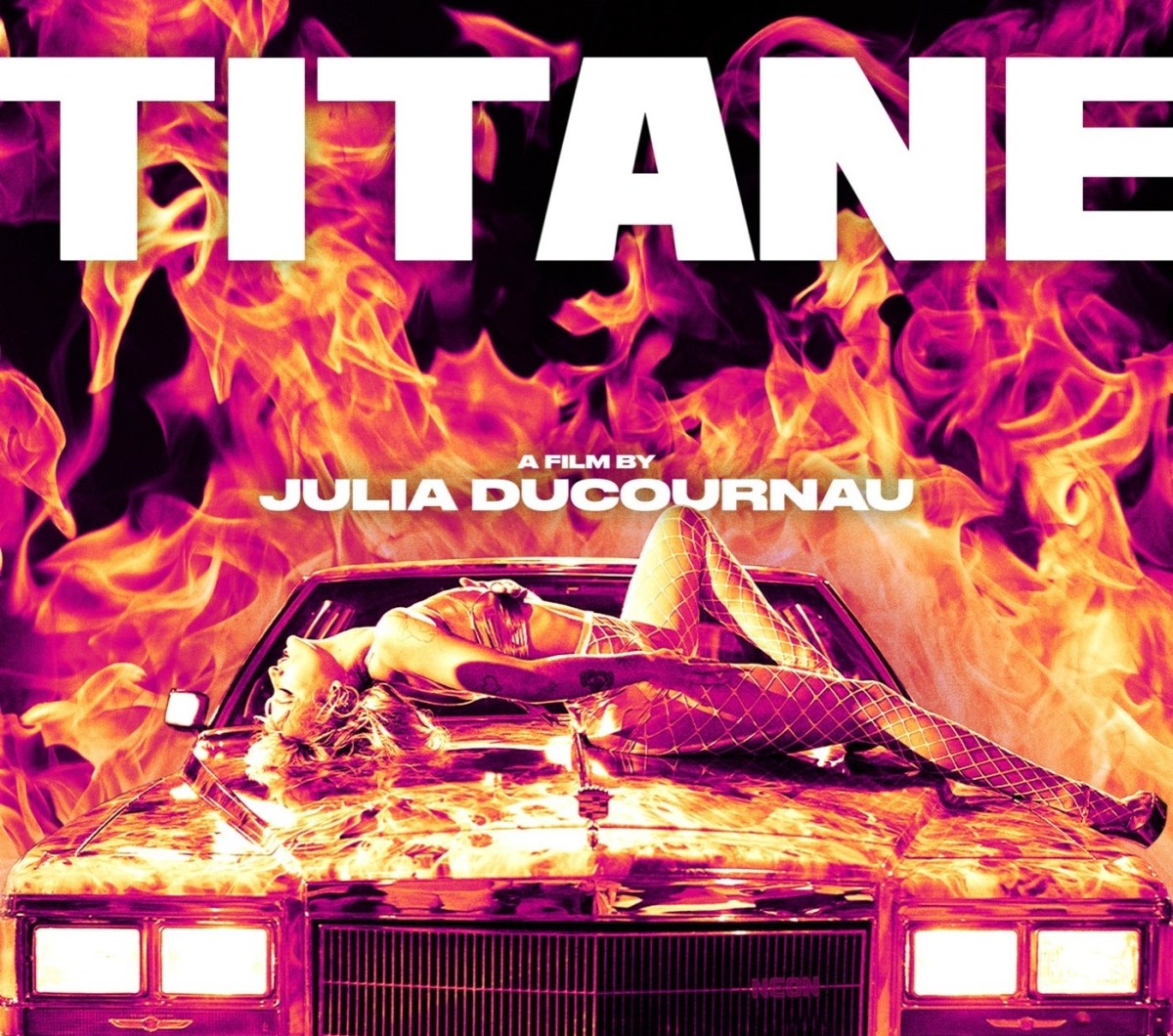
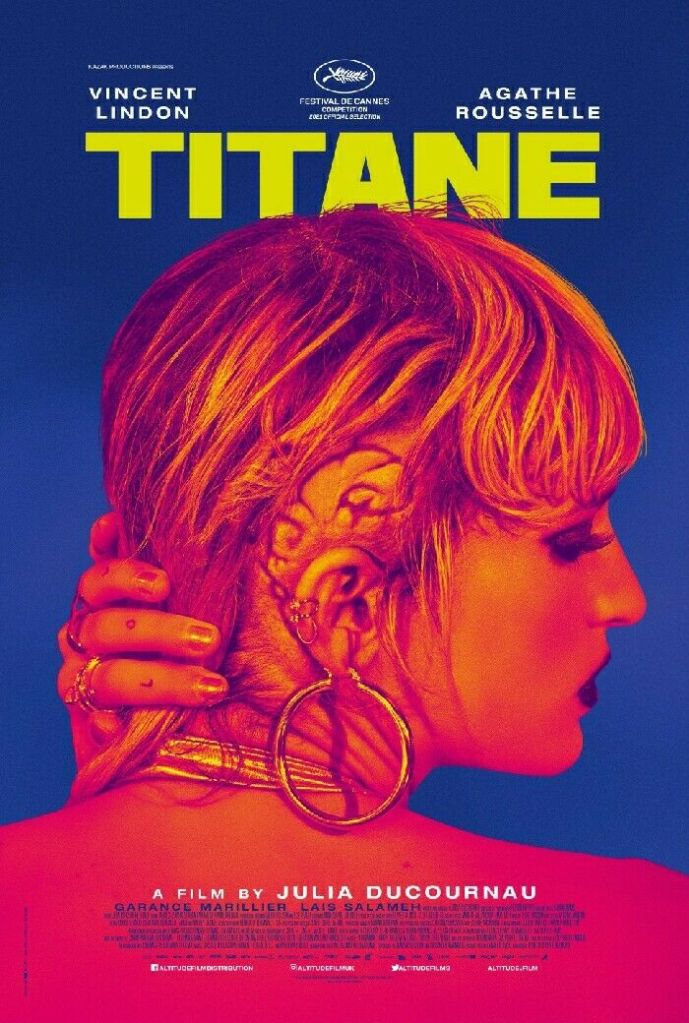
Perhaps the most unforeseen development of this startling picture is that ruthless serial killer Alexia (Agathe Rousselle) develops a caring relationship with an anguished fire chief father (Vincent Lindon) when masquerading as his long-lost son.  Even when it becomes increasingly clear he is harbouring an imposter his naked need for familial intimacy forces continued acceptance. Of course, given Alexia has been impregnated by an automobile, the cinematic wild ride is hardly over. Not just that the father is inclined to pump himself full of steroids to maintain his failing virility and the firemen let off steam by dancing, with no homoerotic overtones, of dancing among themselves.

But tension never slackens due to the off-the-wall off-the-scale opener that saw her enter the realms of the serial killer and the fact that her nipples start leaking oil. A relationship that could have been creepy and/or unbelievable becomes incredibly tender especially when the so-called boy, as teenagers will, causes his father major embarrassment only this time by revealing a more feminine side to his dancing.

While exploring similar territory to David Cronenberg’s Crash (1996), this shifts into a completely league. With the exception of what she undertakes to create the transformation into a boy, binding her breasts and breaking her nose, the violence is less about self-harm  than straight-out murder, weapon of choice being a handy hatpin. The most bizarre aspect about the enterprise is not the victims mounting up, but the hilarity the film engenders. When Alexis discovers that she has chosen the wrong locale for one of her killings and with a shrug of frustration has to embark on hunting down an entire household you can’t help but laugh. And the meet-cute with a female model is one of the funniest ever put on the screen.

We never find out what has turned her into a murderer especially as she is not gender-specific in this department. A car accident as a child that resulted in her being fitted with some metal has clearly created some affinity with vehicles and she earns a living as a bikini model who drapes herself over motors at car shows to the delight of leering men. Automobiles are more generally seen as expressions of male eroticism so it’s something of a twist that Alexia takes such love to the ultimate extreme.

Outside of superhero and fantasy movies, it’s rare to find a picture that creates its own world and maintains it in consistent fashion. What we learn about this vicious killer is that she needs care as much as anybody else. As the movie shifts from her selfish enjoyment to filling a gap in the fireman’s life it takes us on quite a different journey to that initially suggested.

Director Julia Ducournau (Raw, 2016) presents an unflinching vision that may be too brutal for most tastes. It won the Palme d’Or at Cannes but looks like being ignored by the Oscar fraternity. But the surface is deceptive. If the ending comes as a shocker then you haven’t been paying attention because enough hints are provided as to the potential outcome. And it also means you’ve been ignoring the film’s development which is heading in the direction of togetherness and paternal understanding rather than individual insanity.

In her movie debut Agathe Rousselle is quite astonishing, giving herself up to the needs of a picture that forces tremendous physical demands. It’s a tour de force in what it means to be a committed actor, action driven by character. Oscars have been handed out for a lot less and what makes her characterisation stand out is the transition from woman trapped by a fetish whose only emotional outlet is murder to someone accepting love without question or vicious rejection.

Vincent Lindon (Rodin,2017)  is at the other end of the career scale, with nearly three decades in the business, highlighted by a previous Cannes and Cesar win for The Measure of a Man/ La Loi du Marche (2015). His is a thankless role, at the very least a willing dupe, as much a self-harmer judging from the bruises on his exterior, as likely to be lost and flailing in his jab – a sequence of a forest fire is outstanding – as in his empty emotional life. Hats off also to Lindon, as one of France’s biggest stars, for supporting this project. Without his involvement, funding would have been more difficult.

Titane is a true original with surprising emotional depth.

The Ugly American (1963) ***

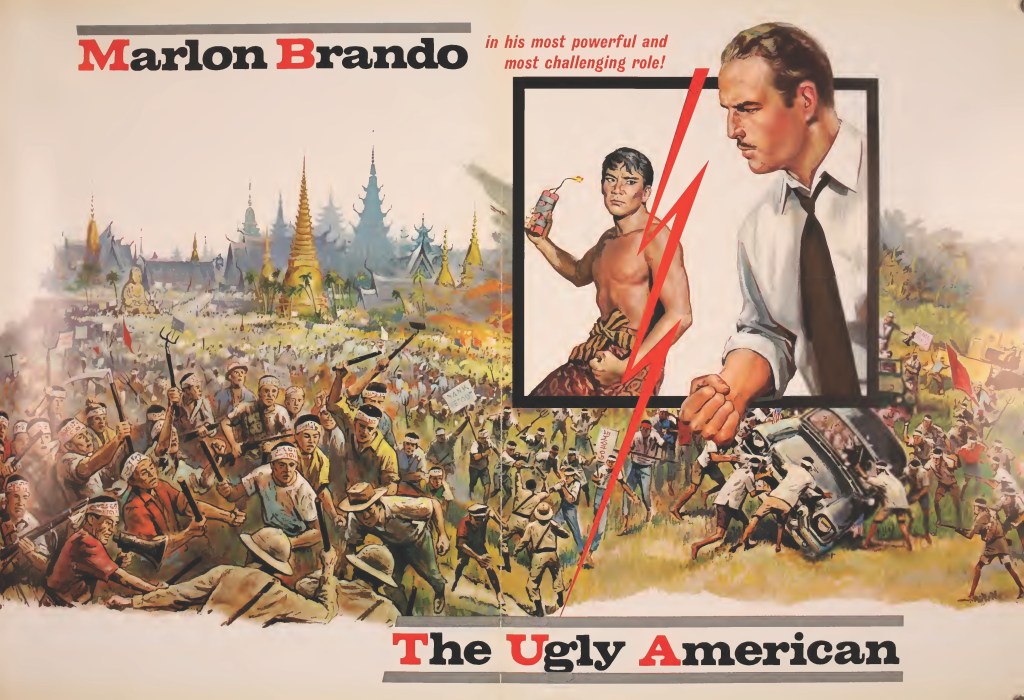
Terrific performance from Marlon Brando saves this prescient but preachy meditation on Vietnam. Harrison MacWhite (Marlon Brando) is the new ambassador, whose political credentials are questioned by many,  parachuted into the fictional South-East Asia country of Sarkhan, knee-deep in civil war, communist north versus westernized south. The battleground is the American construction of a “Freedom Road” north to China which dissenters fear will be a conduit for the military. MacWhite owes his appointment to his friendship with Deong (Eeji Okada), a charismatic leader.

On arrival, the ambassadorial car is engulfed in a riot, car rocked, windscreens smashed. MacWhite shakes up a complacent embassy and though articulate and scholarly believes he holds the solution to the tricky situation while unwilling to accept that national self-determination does not necessarily mean complete hatred of the Americans. There is duplicity on both sides, rebels blaming U.S. truck drivers for deaths they caused, the Americans so used to getting their way they don’t stop to think if it is the right way.

Anxious not to be seen as a lapdog for Communism, MacWhite’s actions inflame the situation, while Deong falls victim to internal forces. Construction boss Homer Atkins (Pat Hingle) promotes the clever use of building hospitals along the road, thus encouraging locals to back it, but nobody falls for such honest skull-duggery masquerading as well-meaning intent.

Friends turning into enemies is a decent premise for any movie but this is over-burdened with debate that while interesting and providing a reflection of the times is basically a mixture of virtue-signalling and apportioning blame and, most heinous of failings, doesn’t really advance the story.

First-time director George Englund handles the action sequences well and captures the essence of a country about to explode against a background of growing tension and political machination. Use of Thailand as a location added authenticity.

The movie was based on a controversial novel by political scientist Eugene Burdick (who also wrote a more straightforward cold War thriller Fail Safe) and William Lederer, navy veteran and CIA officer, so it carried the stamp of authority in terms of putting forth the arguments for both sides. However, while the film bore only a “passing resemblance” to the book, according to co-author Burdick, he deemed it a superior achievement on the basis of its more dramatic treatment. Stewart Stern (Rebel Without a Cause, 1955) was the screenwriter who received blame and praise in equal measure.

Marlon Brando (Bedtime Story, 1964) exudes authority, broad shoulders packed into a suit, and brilliantly captures the anguish of a man led into disaster by arrogance. Coming off back-to-back flops One-Eyed Jacks (1961) and Mutiny on the Bounty (1962), this was a considerable change of pace for the actor, the first of several excursions into political territory. Eeji Okada (Hiroshima, Mon Amour, 1958) proves a worth opponent. Pat Hingle (Sol Madrid, 1968), Arthur Hill (Moment to Moment, 1965) and Jocelyn Brando (The Chase, 1966) provide sterling support.

The movie did not just predict what would happen if the U.S. lost the battle for hearts and minds but a similar situation confronting the U.S. Ambassador to Indonesia in 1965 whose appointment was unwelcome in that country.

You can catch this on Amazon Prime.

House of Gucci (2021) ***** – Seen at the Cinema

Beautifully constructed, stylish, compelling narrative about passion, betrayal and the death of a dynasty. Just as The Godfather is not just about the Mafia, this is not just about fashion; rather, both fit into the niche of movies about family. In each, there are principled fathers and both weak and strong sons. While decisions are driven by character, ambition clogs the mind and ultimately it is the clear-sighted who win.

In a beautifully-played love story outsider Patrizia (Lady Gaga) manages to snag Gucci heir Maurizio (Adam Driver), her lowly status driving a wedge between him and ill patriarch Rodolfo (Jeremy Irons), who shares control of the company with his brother Aldo (Al Pacino). Almost a geek poster-boy, Maurizio nonetheless fits easily into her world. But when Aldo draws Maurizio into the family business, it triggers conspiracy and betrayal.

Aldo and Rodolfo are polar opposites, the former willing to dilute the brand in the race for profit, the latter seeing himself as the curator of a more sedate way of doing business. While Rodolfo pines for his dead wife in his palatial Italian sanctuary, Aldo has an eye for the ladies in New York. The weak link in the family chain is Aldo’s “idiot” son Paolo (Jared Leto) who considers himself a fashion genius. But, in reality, they are all weak, seduced by wealth and power, believing themselves untouchable despite wholesale fraud, business folly and self-delusion on a colossal scale.

The quest for power is ostensibly driven by Patrizia, but she proves no match for a flinty-eyed Maurizio. And for his all self-aggrandisement, Maurizio proves no match for the circling predators, his rampant self-indulgence a death wish in a boardroom.

Over-acting could have sent this picture off the rails but everyone is terrific and the soap-opera tag is unfair. In the best Shakespearian style, hubris accounts for tragedy.  Few characters escape humiliation. Paulo may be a figure of fun, but his mortification at the hands of Rodolfo renders him extremely human. Aldo may exalt in his business skill but in the face of betrayal is destroyed. Patrizia receives a massive put-down by Maurizio in front of his high-class friends.

Lady Gaga, who demonstrates the onscreen radiance and incandescence of a latter-day Elizabeth Taylor, is superb as the woman whose prize is snatched away. Adam Driver puts in his best performance yet, so natural, and his scenes with Gaga are electrifying. Al Pacino encompasses a massive range, man in his pomp, loving father, and in the depth of agony at betrayal. Jared Leto is a revelation, and an early Oscar favourite, as the ridiculous and ridiculed son. Jeremy Irons and Jack Huston as the conniving lawyer are excellent

There are so many brilliantly-wrought scenes – seduction on a rowing boat, a rugby match that gets out of hand, a snake-pit of a boardroom, Aldo lavishing attention on his cows, Patrizia indulging a psychic (Salma Hayek), Maurizio leaping around a room for a Vogue photo shoot. A weighty look at the corruption of power but also a fabulously entertaining picture. Better known for visual tropes, here Scott displays his mastery of narrative as we sweep in and out of unbridled egos hell bent on triumph at any cost. And it is the best film about business since Wall St (1987).

When I first watched this, I was inclined to give it a four-star rating but after seeing it a second time on the big screen that appeared niggardly for a work of such awesome majesty. (Now that I’ve seen it a third time, the five-star ranking still stands). Just like American Gangster (2005) and Thelma and Louise (1992), when Scott moves outside his self-appointed sci-fi and historical treasure trove, he does so with effortless style. This just zipped along. I hardly noticed the time at all. Second time around, I just did not want it to finish, I was so immersed. I even found myself laughing at the same jokes and situations.

What a banner year for the 83-year-old British director. The Last Duel could have bookended this piece – wronged woman proved innocent compared to wronged woman found guilty. Given Scott is synonymous more with the historic than anything approaching the contemporary, I thought I would have preferred The Last Duel, but I now consider House of Gucci the greater film.

Seconds (1966) *****

John Frankenheimer’s censor-baiting and game-changing paranoia drama was decades ahead of its time – it created the template for Blade Runner (1982), The Swimmer (1968), The Stepford Wives (1975), The Parallax View (1974) and The Truman Show (1998) to mention just a few –  and underneath the sci-fi surface asked deeper questions about identity, reality and depression. And it might well qualify as reaching for the impossible dream. Kafkaesque aspects intrude. It’s as much an essay on hopelessness as it is on hope, a scorching portrayal of the human condition. Unusual camera angles and depth of field make this a visual, if occasionally challenging, delight.

Disillusioned banker Arthur (John Randolph), marriage off-kilter, reacting to a call from someone he believes is dead, gets hooked into a deal which promises rebirth. After plastic surgery and a faked death, he is reborn as a much more handsome figure (Rock Hudson), pursues a new career as an artist, is sexually re-born during an orgy, but finds memories of his old life resurfacing at  inopportune moments and takes against the notion that he has to recruit friends or colleagues to go through the same process.

Although audiences had been treated to some paranoid impulses like The Manchurian Candidate (1962) and films dealing with mental health such as Lilith (1964), this was the first film to touch on paranoia about big business, the unseen conglomerates controlling lives in unseen ways that directors in the 1970s pounced upon. Although a piece of breakthrough technology, the rebirth business is now just that, a business, wherein an anonymous  corporation, known here only as The Company, seeks to maximize profit from human misery.  

You could almost view the men who had more successfully undergone the experiment than Arthur as Stepford Husbands, guys who had created an ideal version of themselves. They could be body snatchers who have stolen a more convenient body. In another respect, the conventional Arthur turns into the rebel in society, refusing to accept this new creed. And he is gullible enough to believe his employers will accommodate his demands.   

On the one hand it is a self-destructive horror story. Arthur willingly gives in to his desire for a better life regardless of the emotional cost and is somewhat surprised to find that the community in which he lives is a construct, almost as fictional as any computer game.

It is an amazing mixture of sci-fi and horror. But the sci-fi has the bleakness of Blade Runner,  the hospital and offices where the future unfolds are drab, while the beach locations have an uncanny unreality. The horror is for the most part confined to two scenes – the new Arthur waking up swathed in bandages and later, strapped to a gurney, realizing too late his destiny.

But mostly what I found resonating was the examination of male psyche and its inability to deal with adversity and depression. Arthur isn’t so much desperate to wake up as a handsome hunk as to enter a new existence where he does not feel so lonely and displaced, where he can discover the humanity he has lost. It is not that he wants to be absolved of all responsibilities but wishes to be free of his current joyless life. While he becomes an improved physical specimen, he finds to his consternation that he has not shaken off the gloominess lurking in his brain.

The futuristic aspects are compounded by brilliant down-to-earth scenes. Company executive Ruby (Jeff Corey) goes into all the details of their contract while eating a chicken dinner, an old friend Charlie (Murray Hamilton) is deskbound, when Arthur arranges in his new skin to meet wife Emily (Frances Reid) he discovers his old true self had been only too apparent, cursed with unspoken longing and divorced from reality. Even romance with the outgoing Nora (Salome Jens) only offers brief reinvigoration after he partakes in an orgiastic grape-stomping event.

This is Frankenheimer’s masterpiece, and given he also directed The Manchurian Candidate, that is some accomplishment. He exercises total control in a film about total control but he is indebted to cinematographer James Wong Howe for developing new techniques to achieve a quite different, often austere, look.

It incurred the wrath of the Production Code – the U.S. censor – with scenes of full-frontal female nudity. These were all cut (though you will find them on the DVD). Whether their inclusion would have turned the film into a hit – rather than being booed at the Cannes Film Festival and a big flop at the American box office – is a moot point since, at that time, films as obscure as Blow Up (1966) had attracted big audiences due their more permissive approach. This should have been a late career transition for Rock Hudson (Strange Bedfellows, 1965) into more mature work but his excellent and brave performance was dismissed by the critics.

Sisters (1969) ****

Erotically-charged, symbolically-heavy French drama of siblings trying to re-establish the intense relationship they enjoyed as teenagers. After a nervous breakdown and on the point of divorce, blonde translator Diana (Nathalie Delon) seeks respite at the home of younger sister Martha (Susan Strasberg), a brunette happily married to the wealthy and indulgent Alex (Massimo Girotti).

Initially, the more worldly Diana, the more flamboyant dresser, appears the superior but it soon transpires she is the more fragile. The apparently timid Martha allows her husband to control her life to the point of buying all her clothes and she confesses to feeling as if she is on “a perpetual cruise.” While on the surface, it seems as if she has given up too much, in reality she disapproves of disorder and seeks perfection. She comes across as needing protection, and believes the woman’s role is to sacrifice, but in fact has managed to arrange her life to her own satisfaction.

Their competitive streaks emerge in different ways, Diana in obvious fashion, seeking to beat her sister while out horse-riding, Martha in more subtle and sensual manner, flaunting her sexual relations with her husband, almost offering her sister to her husband, and having a lover (Lars Bloch) on the side. There is a sense of each attempting to impose their world view on the other. Diana gives her sister a make-over, a new look which Alex adores, Martha hates it. There’s a sense of a chess game, males the obvious pawns.

Sensuality is never far away. Diana nuzzles her sister’s neck to smell her perfume. Alex is photographed, encouraged by Martha, in almost intimate mode with Diana. Dario (Giancarlo Giannini) is brought in to tempt Diana. And a scene where the girls experiment with colorful scarves suggests libertarianism. 

But it is clear that both sisters live empty lives devoid of true love and equally obvious as the picture progresses that both have arrived at the conclusion that they were at their most happiest when together. There are subtle hints of incest, comforting each other in bed, the sensuality electric and the film begins to examine whether this taboo can be crossed and, if so, will it provide the necessary escape.

Despite Martha’s apparent subjugation, there is more than an inkling of feminism, the girls involved in a complicated scenario in which males are either rejected or made to look fools. While not fulfilled, Martha has turned as much as possible to her own advantage and Diana seems perfectly capable of taking what she wants.

Alex provides the symbolism. He cultivates rare plants in a greenhouse that need to hide from the sun, lengthy exposure to whose atmosphere would be fatal to humans. He endlessly photographs them because they won’t last long. And in similar fashion provides a haven for the apparently vulnerable Martha.

Nathalie Delon (When Eight Bells Toll, 1970), married at this point to Alain Delon, shows a subtlety of expression that is rare for someone appearing in just her third film, and effects a gradual character transition throughout. Susan Strasberg, daughter of famed acting coach, Lee Strasberg, inventor of the Method Style of Acting, was one of the boldest actors of her generation, appearing in drug pictures The Trip (1967) and Psych Out (1968). She delivers an excellent portrait of a woman who manages to keep her true personality hidden, and for whom sexuality has few barriers.

This is the puppy-fat version of Giancarlo Giannini (Swept Away, 1974), barely recognizable as the future arthouse superstar whose physical appearance relied on gaunt, angst-riddles features.  Massimo Girotti (Theorem, 1968) is good as the husband who thinks he has everything, not realising how little he has.  

Although this was an accomplished directorial debut from Roberto Malenotti, he only made one more movie. Perhaps he made enough from directing the famous Coke commercial I’d Like To Teach The World To Sing (1971).

Always intriguing, revelations continually undercutting what we think we know of the characters, but delivered in subtle European tones rather than employing Hollywood shock, each of the four main people involved changing considerably due to their interaction with the others. While certainly skirting close to the borders of what was permissible at the end of the 1960s, it does so without exploiting the actresses.

Not an easy one to find, your best bet is a secondhand copy on Ebay.

King Richard (2021) **** – Seen at the Cinema

Absorbing sports biopic mixing feel-good and a no-holds-barred approach to the titular subject with a terrific performance from Will Smith. Some commentators complained the film was too long but I was so caught up in it I was surprised when it suddenly came to an end. Beyond recognizing the achievements of the Williams sisters, I had no foreknowledge of the Williams story. The movie follows their early years until the professional debut of Venus (Saniyya Sidney).

Although following a traditional triumph-over-adversity narrative, this is as concerned about the intricate workings of U.S. tennis where the odds were so stacked against black players, saving Arthur Ashe, that club members were taken aback to register the boldness with which Williams Snr, entered their arena. For most of the picture what we see is struggle, Richard Williams (Will Smith) trying to interest coaches in his two daughters. The tennis system is laid bare, the need for funding and then big bucks sponsorship the ultimate goal, the Jennifer Cipriani case quoted as the downside of a system where parents push their children to the limit, setting aside any interest in a normal childhood in a bid to break into the professional game.

Williams is both inspiration and a complete pain in the neck. He comes across as warm and awful at the same time, a whole set of rigid rules getting in the way of the happy family he seeks to establish. His arrogance takes some beating. Having devised a business plan to turn his kids into superstars he finds it difficult to change his tune even when his methods result in zero success. He wants to correct the coaches, on occasion cheat them, but is so determined that Venus and Serena will not become tennis brats that he holds back their leap up the junior tennis circuit in case it prevents their development as people, impacts on their education and denies them a childhood.

The tennis matches are well handled. My ignorance about the Venus sisters’ career path meant that I found the actual tennis riveting. And the fury of children beaten by the upstart Venus tells you all you need to know about the pressures facing prodigies.

Zach Baylin’s debut screenplay is terrific, finding time to fill us in on Williams’ checkered past, professional and romantic failure. Prejudice isn’t limited to white people, he is beaten up by local hoods while a neighbour calls in social services. Charting the family dynamics allows wife Oracene (Aunjanue Ellis) an occasional turn in the dramatic spotlight. The relationship between Venus and Serena (Demi Singleton) is well nuanced as they move from giggling kids to more mature teenagers, loyalty to each other tested when Venus receives preferential treatment, each with their individual battles, until in specific ways they take charge of aspects of their careers.

Will Smith (Bad Boys for Life, 2020) is a sure thing for an Oscar nomination, but the supporting cast is exceptionally strong. Aunjanue Ellis takes a giant step up from television (Lovecraft Country, 2020) and as the sisters Saniyya Sidney (Fences, 2016) and in her rmovie Demi Singleton – just 15 and 14, respectively – are both delightful and convincing. Jon Bernthal (Those Who Wish Me Dead, 2020) and Tony Goldwyn (The Mechanic, 2011) play real-life coaches, the former frustrated to the point of torture by Williams’ antics.

Reinaldo Marcus Green (Joe Bell, 2020) delivers on several counts: drawing sterling performances from the actors, allowing the screenplay to breathe so the picture doesn’t feel cramped or rush, and setting genuinely exciting tennis matches.

This is already a certified box office flop, in part because of Warner Brothers’ hybrid release, in part I guess don Richard Williams polarising public attitudes, and that’s a shame because it is thoroughly enjoyable and despite misgiving about Williams as a person it is a truly astonishing achievement that against all odds a security guard and his nurse wife should have achieved such success.

Mayerling (1968) ****

Sumptuous historical romantic drama set in a fading European empire awash with political intrigue and incipient revolution. Archduke Rudolf (Omar Sharif), married heir to the throne and constantly at odds with rigid father Emperor Franz-Josef (James Mason), sympathizes so strongly with Hungarian dissidents that he threatens to tear apart the Austro-Hungarian Empire. However, when he falls in love with Maria (Catherine Deneuve) and wants to marry her instead that, too, threatens to throw the empire into disarray.

Although dissolute, a mistress (or two) on the side, and addicted to morphine, that is not the way Rudolf is introduced to the audience. Instead, he is one of a string of bloodied men arrested after a demonstration giving his name to an officer in a police station who, once he is recognized, orders all other prisoners be released. He is the poster boy for good royalty. The Hungarians, agitating for independence, want him to become their king.

Beautifully mounted with lavish sets and enough in the way of balls, ballet, processions,  horse riding and sleighs to keep up a steady parade of visually interesting distractions, the films steadily builds up an undercurrent of tension, both between father and son and between rebels and ruler. The emperor is a political genius, not just spying on his son, but full of devious devices to hold together whatever threatens to break up the empire.

The romance develops slowly and with true historical perspective, the first kiss they share is not on the lips, Rudolf kisses both her cheeks, she kisses his palm. Yet, there is a real sense that, no matter his power, they can still both be trapped in roles they despise, separated at the whim of parents. Rudolf, as he understands true love for the first time, finds the self-belief to challenge political certainties.

The regal aspects are well done, arguments about the rule of monarchy come over as heated conversation rather than boring debate, the political realities unavoidable. Rudolf, desperate to avoid a future where someone has to die before he has a reason to live. Escape is not an option.

There is a wonderful bitchy atmosphere in the court, where ladies-in-waiting disparage each other behind their backs, one dress described as “wallpaper,” and are forever seeking advancement. Countess Larish (Genevieve Page) is a self-appointed procurer-in-chief for Rudolf, not caring what chaos she causes.

I should add, if you are as ignorant of your European history as myself, that Mayerling is a place not a person. I tell you this so that you don’t make my mistake of waiting for a Mayerling character to appear. The film pointedly avoids a history lesson but it could have spared a minute to explain that the events depicted take place just 20 years after the Austro-Hungarian Empire, the second largest land-mass in Europe, and among the top two or three nations. That would have helped clarify why Franz-Josef was in such a constant state,  worried about forces that could break up the empire, and as concerned that his son, living such a debauched life, lacked the personal skills to hold it together after his father’s death.

It is ironic that Rudolf does prove his worth as a result of being briefly separated from Maria, taking the army to task for its incompetent officers and poor maintenance of everything from weaponry to horses.

To his credit director Terence Young (Dr No, 1962) does not rely on Omar Sharif’s soulful brown eyes and instead allows action to convey character and looks and touch the meaning of his love. This is probably Omar Sharif’s best role, one where he clearly made all the acting decisions rather than being over-directed by David Lean as in Doctor Zhivago (1965). Catherine Deneuve is equally impressive as a far-from-docile innocent, especially given the wide range of more sexually aware characters she has created for Repulsion (1965) and Belle de Jour (1967).

James Mason (Age of Consent, 1969) is superb as the conniving emperor, so rigid he will not approve a change of buttons for the army, so cunning that an apparent rapprochement with his son has unseen strings attached. Ava Gardner (55 Days at Peking, 1963) sweeps in briefly as an empress protective of her son and making the best of life in a gilded cage. Also impressive are Genevieve Page (Grand Prix, 1966) and James Robertson Justice (Doctor in Distress, 1963) as the high-living British heir nonetheless under the thumb of his mother Queen Victoria.

Terence Young also wrote the literate, often amusing script, although Denis Cannan (A High Wind in Jamaica, 1965) and Joseph Kessel (Night of the Generals, 1967) are credited with additional dialogue. While Francis Lai (The Golden Claws of the Cat Girl, 1968) wrote the score he relies heavily on classical music from Aram Khachaturian’s Spartacus.

If you come at this not expecting a David Lean style affair full of striking compositions, but an old-fashioned drama advancing at leisurely pace, you will not be disappointed.

The Shoes of the Fisherman (1968) ****

Thought-provoking drama with a surprisingly contemporary slant set against the grandeur of the Vatican amid geo-political turmoil. At a time of global crisis, dissident Russian archbishop Lakotov (Anthony Quinn) is unexpectedly freed from a labour camp by the Russian premier (Laurence Olivier). Arriving at the Vatican, he is promoted to cardinal by the dying Pope (John Gielgud) before becoming an unexpected contender for Papal office.

The spectacular wealth of the Catholic Church is contrasted with the spectacular poverty of China, on the brink of starvation due to trade sanctions by the United States, nuclear war a potential outcome. The political ideology of Marxism is compared to the equally strict Christian doctrine, of which Lakotov’s friend Father Telemond (Oskar Werner) has fallen foul. There is a sub-plot so mild it scarcely justifies the term concerning television reporter George Faber (David Janssen) torn between wife Ruth (Barbara Jefford) and younger lover Chiara (Rosemary Dexter).

Lakotov is drawn into the Russian-Chinese-American conflict and the battle for the philosophical heart of the Christian faith while bringing personal succour to the lovelorn and performing the only modern miracle easily within his power, which could place the Church in jeopardy, while condemned to the solitariness of his position.

The political and philosophical problems addressed by the picture, which was set 20 years in the future, are just as relevant now. The film’s premise, of course, while intriguing, defies logic and although the climax has a touch of the Hollywood about it nonetheless it follows an argument which has split the Church from time immemorial.

You would not have considered this an obvious candidate for the big-budget 70mm widescreen roadshow treatment, but MGM, after the Church not surprisingly refused access to the Vatican, spent millions of dollars on fabulous sets, including the Sistine Chapel. The roadshow version of the picture, complete with introductory musical overture and an entr’acte at the intermission, is leisurely and absorbing, held together by a stunning – and vastly under-rated – performance by Anthony Quinn (The Lost Command, 1966) who has abandoned his usual bombastic screen persona in pursuit of genuine humility and yet faces his moments when he questions his own faith.

Ruth has a pivotal role in bringing Lakotov down to earth but George has the thankless task, setting aside the quandaries of his love life, of talking the audience through the sacred ceremonies unfolding sumptuously on screen as the cardinals bury one Pope and elect another.

You wouldn’t think, either, that Hollywood could find room in such a big-budget picture for philosophical discussion but questions not only of the existence of God but whether he has abandoned Earth are given considerable scope, as are discussions about Marxism and practical solutions to eternal problems. None of these arguments are particularly new but are given a fair hearing. There is a hint of the Inquisition about the “trial” Telemond faces. Oskar Werner (Interlude, 1968) carries off a difficult role.

David Janssen (Warning Shot, 1967) is mere window dressing and Rosemary Dexter (House of Cards, 1968) mostly decorative but Barbara Jefford (Ulysses, 1967) is good as the wounded wife. Laurence Olivier (Khartoum, 1966) is the pick of the sterling supporting cast which included John Gielgud (Becket, 1964), Burt Kwouk (The Brides of Fu Manchu, 1966), Vittorio de Sica (It Happened in Naples, 1960), Leo McKern (Assignment K, 1968), Frank Finlay (A Study in Terror, 1965), Niall McGinnis (The Viking Queen, 1967) and Clive Revill (Fathom, 1967). In a small role was Isa Miranda, the “Italian Marlene Dietrich,” who had made her name in Max Ophuls Everybody’s Woman (1934) and enjoyed Hollywood success in films like Hotel Imperial (1939) opposite Ray Milland.

Michael Anderson (Operation Crossbow, 1965) directed with some panache from a script by veteran John Patrick (The World of Suzie Wong, 1960) and Scottish novelist James Kennaway (Tunes of Glory, 1960) based on the Morris West bestseller.

I found the whole enterprise totally engrossing, partly because I did not know what to expect, partly through Anderson’s faultless direction, partly it has to be said by the glorious backdrop of the Vatican and the intricacy of the various rites, but mostly from the revelatory Quinn performance. And even if the plot is hardly taut, not in the James Bond clock-ticking class, it still all holds together very well. From the fact that it was a big flop at the time both with the public and the critics, I had expected a stinker and was very pleasantly surprised.

Discover WordPress

A daily selection of the best content published on WordPress, collected for you by humans who love to read.

The Atavist Magazine

by Brian Hannan

WordPress.com News

The latest news on WordPress.com and the WordPress community.