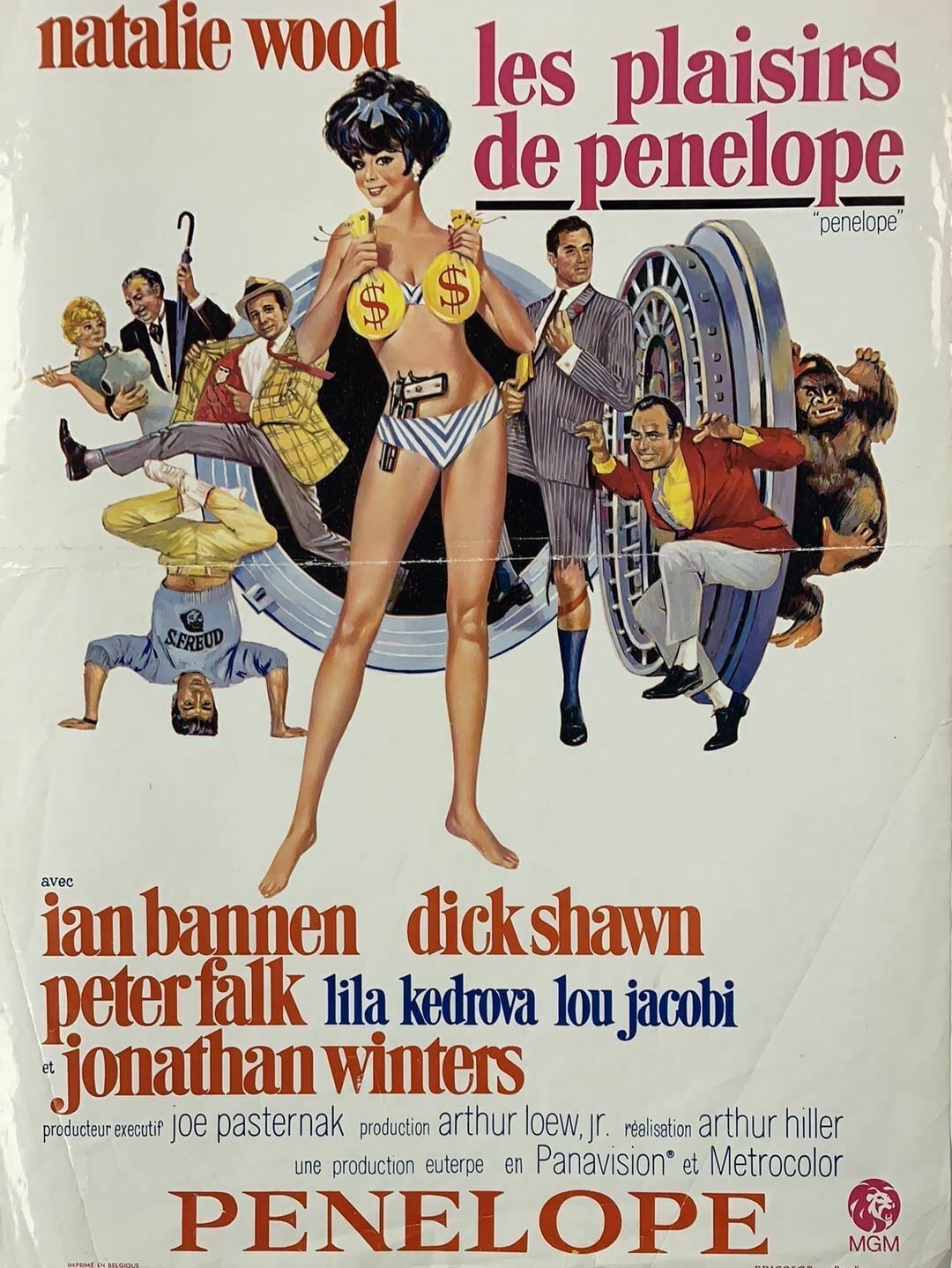
“Penelope” (1966) ***

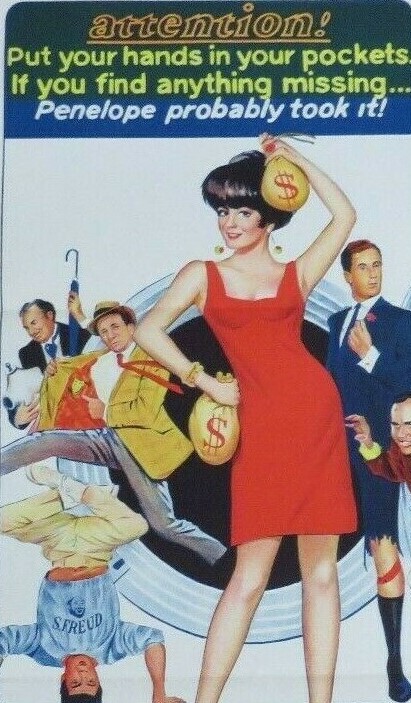
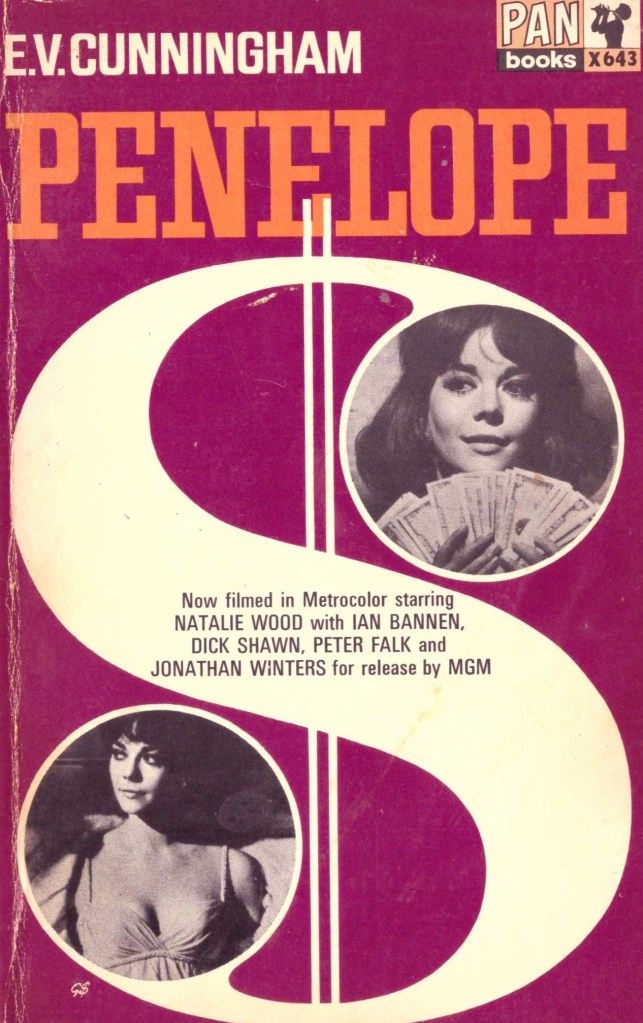
Comedic twist on the heist movie with Natalie Wood (This Property Is Condemned, 1966) as a kleptomaniac. Given its origins in a tight little thriller by E.V. Cunningham, pseudonym of Howard Fast (Mirage, 1965), it’s an awful loose construction that seems to run around with little idea of where it wants to go. Wood, of course, is a delightfully kooky heroine who takes revenge on anyone who has ignored or slighted her by stealing their possessions.

The picture begins with her boldest coup. Cleverly disguised as an old woman, she robs the newest Park Avenue bank owned by overbearing husband James (Ian Bannen). This prompts the best comedy in the movie, a man with a violin case (Lewis Charles) being apprehended by police, the doors automatically locking after a clerk falls on the alarm button, James trapped in the revolving doors losing his trousers in the process.

In flashback, we learn that she turned to thievery after a rape attempt by Professor Klobb (Jonathan Winter), her college tutor, and while half-naked managed to make off with his watch fob. She stole a set of earrings from Mildred (Norma Crane) after suspecting she is having an affair with James. “Stealing makes me cheerful,” she tells her psychiatrist, Dr Mannix (Dick Shawn) and while admitting to dishonesty denies being a compulsive thief. After the bank robbery she even manages to relieve investigating officer Lt Bixby (Peter Falk) of his wallet.

Nobody suspects her, certainly not her husband who could not conceive of his wife having the brains to carry out such an audacious plan. Bixby is a bit more on the ball, but not much. Clues that would have snared her in seconds if seen by any half-decent cop are missed by this bunch. And generally that is the problem, the outcome is so weighted in Penelope’s favor. The plot then goes all around the houses to include as many oddballs as possible – boutique owners Sadaba (Lila Kedrova) and Ducky (Lou Jacobi), Major Higgins (Arthur Malet) and suspect Honeysuckle Rose (Arlene Golonka). Naturally, when she does confess – to save the innocent Honeysuckle – nobody believes her in part because everyone has fallen in love with her. Bixby, just as smitten, nonetheless makes a decent stab at the investigation.

Howard Fast under the pseudonym of E.V. Cunningham wrote a series of thrillers with a woman’s name as the title. He was on a roll in the 1960s providing the source material for Spartacus (1960), The Man in the Middle (1964), Cheyenne Autumn (1964), Sylvia (1965), Mirage (1965) and Jigsaw (1968).

Taken as pure confection it has its attractions. It’s certainly frothy at the edges and there are a number of funny lines especially with her psychiatrist and the slapstick approach does hit the target every now and then. The icing on the cake is top class while the cake itself has little of substance. It strikes a satirical note on occasion especially with the Greenwich Village cellar sequence. It doesn’t go anywhere near what might be driving this woman towards such potential calamity – that she gets away with it is only down to her charm. There has probably never been such a pair of rose-tinted spectacles as worn by Penelope, even though her every action is driven by revenge.

Without Natalie Wood it would have sunk without trace but her vivacious screen persona is imminently watchable and the constant wardrobe changes (courtesy of Edith Head) and glossy treatment gets it over the finishing line. It’s one of those star-driven vehicles at which Golden Age Hollywood was once so adept but which fails to translate so well to a later era. Ian Bannen (Station Six Sahara, 1963) is in his element as a grumpy husband, though you would wonder what initially she saw in him, and Peter Falk (Robin and the 7 Hoods, 1965) delivers another memorable performance.  Dick Shawn (A Very Special Favor, 1965) is the pick of the supporting cast though screen personalities like Lila Kedrova (Torn Curtain, 1966), Jonathan Winters (The Loved One, 1965) and Lou Jacobi (Irma la Douce, 1963) are not easily ignored.  Johnny Williams a.k.a John Williams wrote the score.

Arthur Hiller (Tobruk, 1967) delivers as much of the goods as are possible within the zany framework. Veteran Oscar-winner George Wells (Three Bites of the Apple, 1967) wrote the screenplay and it’s a far cry from the far more interesting source material and I would have to wonder what kind of sensibility – even at that time – could invent a comedy rape (not in the book, I hasten to add).

Sergeants 3 (1962) ***

There’s a terrific western directed by John Sturges (The Magnificent Seven, 1960) inside this Rat Pack offering, the second of four in the series. On the plus side are plenty twists on traditional scenarios, Frank Sinatra and Dean Martin displaying a certain kind of easy screen charisma, and three exceptional and well-choreographed battle scenes.

Sinatra, Martin and Peter Lawford play the eponymous sergeants, Lawford committing the cardinal sin of wanting to quit the regiment to get married, with Sammy Davis Jr. as a former slave, bugler (an important plot point) and horse-lover wanting to sign up, and Joey Bishop (television star and occasional movie actor) as their sergeant-major boss.

A fair bit of time is spent on the usual Rat Pack shenanigans, getting drunk, brawling, playing tricks on each other, and exploring odd comic notions such as playing poker with a blacksmith’s implements as chips. But when it gets down to proper western stuff, it fairly zings along, with a decent plot (a Native American uprising) and excellent action scenes. You could have had William Goldman writing the script for the number of reversals involved as the picture keeps one step ahead of audience expectation.

For a start, rather than flushing out outlaws from a town, the troopers have to remove Native Americans who have taken it over. Instead of the cavalry pursuing Native Americans, it is mostly the other way round. It is the soldiers rather than the Native Americans who attack a wagon. Sinatra finds himself employing a bow-and-arrow and then a tomahawk rather than being on the receiving end of such weaponry.  Instead of dynamite, the good guys make do with fireworks. Where Native Americans are usually pinned down, this time it is Sinatra’s merry band. And when it comes to resorting to serious violence, that, too is usually the remit of the Native Americans, not as here, Sinatra chucking man off a cliff.

When it sticks to action, the picture is very well done and involving. When Sinatra has to take charge instead of larking about, the movie has focus. Both Sinatra and Martin were undertaking serious roles around this time, the former in The Manchurian Candidate (1962), the latter in political drama Ada (1961) so this might have appeared welcome relief.

The comedy isn’t along the laugh-out-loud lines of Support Your Local Sheriff (1969) or Blazing Saddles (1973) and the action of so full-on you wonder why anybody thought this required comedy at all, although there is a pretty good punchline ending. Action aside, It’s almost the equivalent of easy listening. The Rat Pack was a particular 1960s institution, the members joining each other on stage in Las Vegas or featuring in television programs, but there’s no real modern correlative.

It was interesting to see how the Rat Pack concept developed. This movie chucked out the idea of including a few songs as with Oceans 11 (1960) while the next one in the series, 4 for Texas (1963) was more of a serious straight western. But the final picture Robin and the 7 Hoods (1964) went in the opposition direction and was a full-on musical as if by the time they came to making that picture everyone had realized the film would make more sense if it played to their inestimable talents.

The series developed in other ways, too. Romance was minimal in Oceans 11, barely seen here, but was a major element of 4 for Texas – who would want to waste the talents of Ursula Andress and Anita Ekberg – but just as Andress is a smooth operator in 4 for Texas when it came to the last Rat Pack picture Barbara Rush was also a significant player for whom romance was merely a means to an end. You could also argue that the disappearance of Lawford and Bishop allowed the supporting roles to be played by actors who were not in on the joke.

CATCH-UP: the entire Rat Pack quartet has now been reviewed in the Blog with Oceans 11 (1960) and 4 for Texas (1963) also to be found here. Other Frank Sinatra films reviewed are Can-Can (1960), Cast a Giant Shadow (1966), The Naked Runner (1967) and The Detective (1968) while for Dean Martin the list, so far, comprises Texas Across the River (1966) and Rough Night in Jericho (1967).

When Comedy Was King (1960) ***

The 1960s was as much devoted to old movies as to new – the production shortage sent studios and producers back to the vaults to find anything that could fill a slot on a cinema program – and one of the most surprising beneficiaries of this was the silent movie.

It’s impossible to understand the 1960s without realizing what underpinned both the revival of slapstick comedy in such movies as It’s a Mad, Mad, Mad, Mad World (1963) and The Great Race (1965) and, just as crucially, brought to the attention of a new public other non-comedic stars from Hollywood’s “golden age,” the revival of whose movies in turn prompted a reissue boom and a decade or so further on provided the stimulus for the restoration of forgotten masterpieces.

The innovator in the silent comedy field was Robert Youngson, a two-time Oscar-winner (in the one-reel documentary category), who had set the ball rolling with The Golden Age of Comedy (1957).

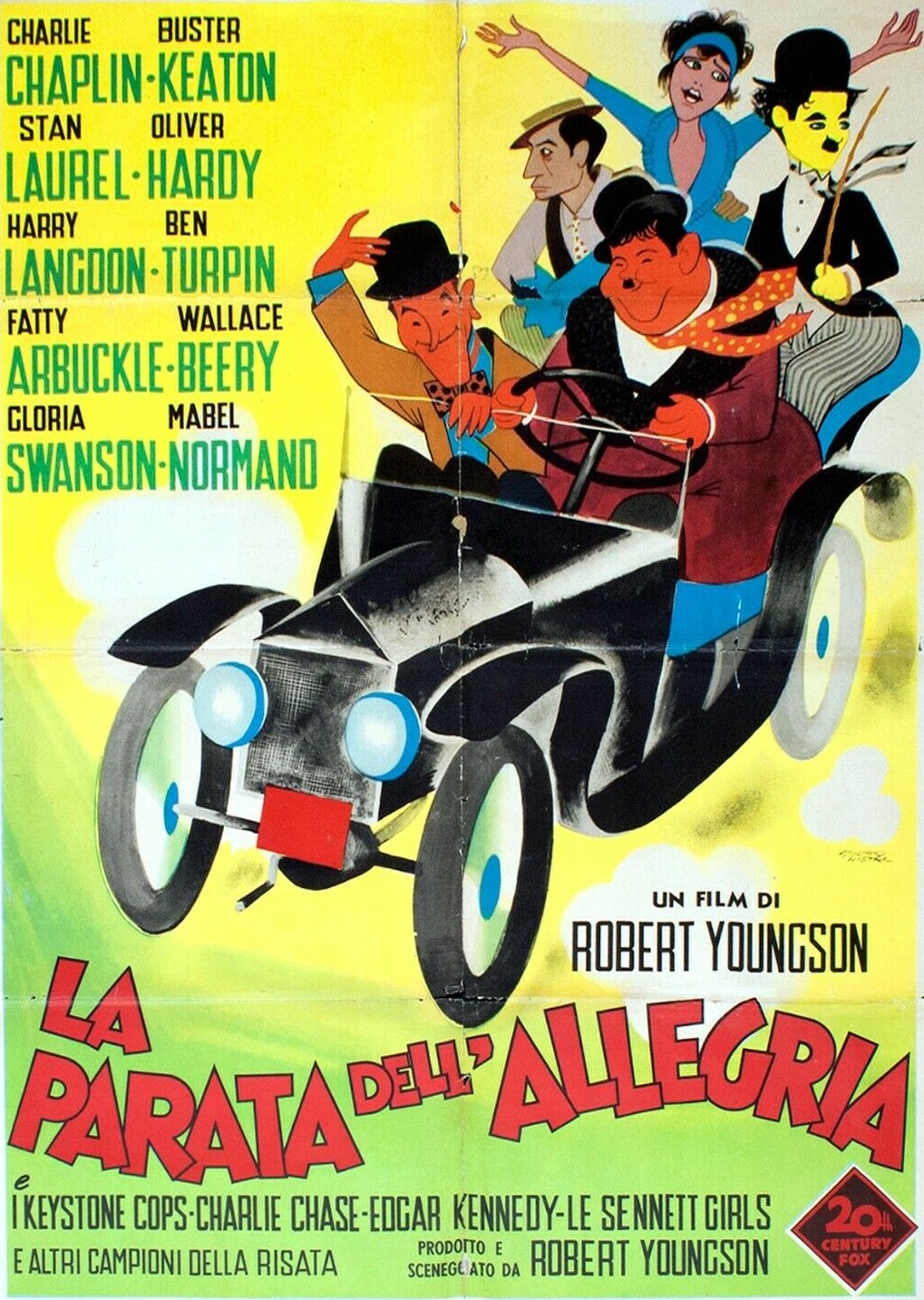
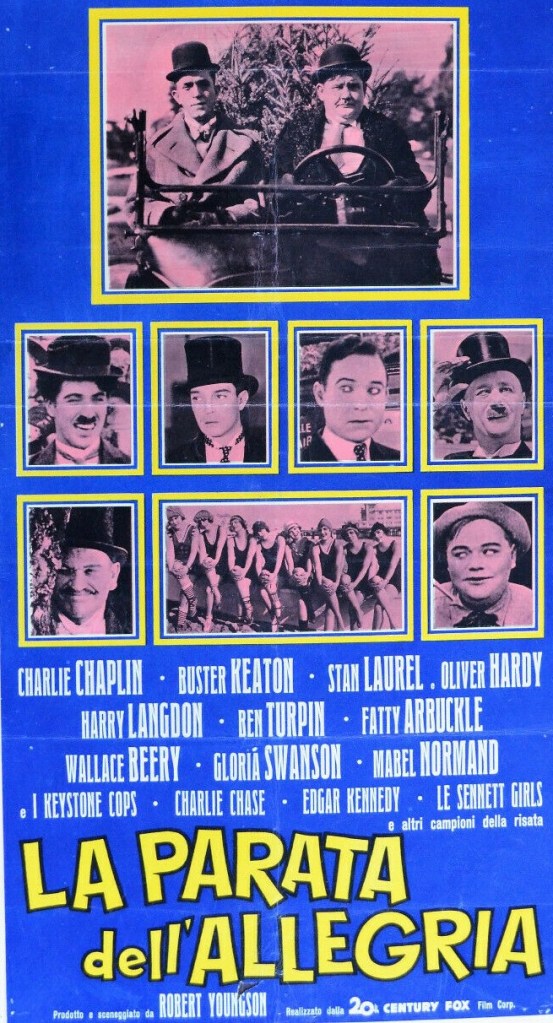
When Comedy Was King sports a greater repertoire of stars and in essence presents a tribute – though not necessarily a greatest hits – to some of the best of the silent comedians The line-up includes Charlie Chaplin, Buster Keaton, Fatty Arbuckle, Laurel and Hardy, Mabel Normand and the Keystone Cops.

It was renamed “The Parade of Joy” for European markets.

None of the shorts featured are necessarily an individual artist’s greatest work – Chaplin’s contribution, for example, is drawn from a trio of 1914 pictures, The Masqurader, Kid Auto in Venice and His Trysting Place, none of which would be seen to represent the actor at his height. But they do give an idea of what silent comedy was all about.

Buster Keaton’s contribution is selected from the 18-minute Cops (1922) with well-timed gags, slapstick and car chases. Mutual self-destruction is a hallmark of Laurel and Hardy and Big Business (1929) sees the pair get into an argument with a customer, ending up demolishing everything in sight.  This is probably the pick of the compilation since the pair’s comedy relies on their relationship with each other and with anyone who gets in their way.

Appreciation of the particular talents of Fatty Arbuckle scarcely survived the scandal that ended his career while memory of Mabel Normand would also have been hazy so Fatty and Mabel Adrift (1916) is a good example of their comedy styles. They play a couple whose bed ends up floating on the sea.

Youngson was not above cashing in on a star’s future fame even when the example used of the person’s work could hardly be considered their best. In the case of Gloria Swanson (Sunset Boulevard, 1950) she was unrecognizable especially as she was only 12-years-old and being billed at the time as Gloria Dawn. Her inclusion is taken from the short Jimmie the Fox (1911) later renamed Bobby’s Sweetheart. Certainly, she is displaying none of the dramatic ability which made her the highest paid actress of the 1920s.

For all the varying quality of the actual footage, it does work as a showcase for the various stars, even though they would achieve greater success in later films. As importantly, it opened up for the 1960s generation the world of silent comedy and seemed to make that decade’s audience laugh as much as it had done previously.

Youngson would go on to make another five of these compilations throughout the decade. Without his initial forays into old school comedy, big-budget 70mm roadshows like It’s A Mad, Mad, Mad, Mad, Mad World would never have seen the light of day, nor would more modest efforts like the British-made The Plank (1967), written, directed and starring Eric Sykes.

Texas Across the River (1966) ****

Excellent comedy western mixing dry wit and occasional slapstick to joyous effect. The wedding between Spanish duke Don Aldrea (Alain Delon) and Louisiana belle Phoebe (Rosemary Forsyth) is interrupted by her previous suitor Yancy (Stuart Cottle) who is killed in the resulting melee. Escaping to Texas, Don Aldrea’s marksmanship leads settler Sam (Dean Martin) to recruit him to help fight raiding Commanches. Romantic entanglement ensues when the Don rescues Native American Lonetta (Tina Marquand) and Sam has more than a passing interest in Phoebe.

It is so tightly structured that nothing occurs that doesn’t have a pay-off further down the line. Bursting with terrific lines – including a stinger of a final quip – and set pieces, it pokes fun at every western cliché from the gunfight, the cavalry in hot pursuit, and fearsome Native Americans to the snake bite and the naked bathing scene. Incompetence is the order of the day – cavalry captain Stimpson (Peter Graves) issues incomprehensible orders, chief’s son Yellow Knife (Linden Chiles) cannot obey any.

The Don, with his obsession with honor and his tendency to kiss men on the cheeks, is a comedy gift. Despite his terrific head of hair, he is stuck with the moniker “Baldy” and every time he is about to save the day he manages to ruin it. Sam is the kind of guy who thinks he is showing class by removing his spurs in bed while retaining his boots. His sidekick Kronk (Joey Bishop), a mickey-take on Tonto, mostly is just that, a guy who stands at the side doing nothing but delivering dry observations.

Lonetta is full of Native American lore and has enough sass to keep the Don in his place. “What is life with honor,” he cries to which she delivers the perfect riposte, “What is honor without life?” Phoebe is a hot ticket with not much in the way of loyalty.

Two sequences stand out – the slapping scene (whaat?) and a piece of exquisite comedy timing when Sam, Phoebe and the Don try an iron out a complicated situation.

Good as Dean Martin (Rough Night in Jericho, 1967) is the picture belongs to Alain Delon (Once a Thief, 1965) and I would argue it is possibly his best performance. Never has an actor so played against type or exploded his screen persona. Delon was known for moody, sullen roles, cameras fixated on his eyes. But here he is a delight, totally immersed in a role, not of an idiot, but a man of high ideals suddenly caught up in a country that is less impressed with ideals. If he had played the part with a knowing wink it would never have worked.

Martin exudes such screen charm you are almost convinced he’s not acting at all, but when you compare this to Rough Night in Jericho it’s easy to see why he was so under-rated. Joey Bishop (Ocean’s 11) is a prize turn, with some of the best quips. Rosemary Forsyth (Shenandoah, 1965) is surprisingly good, having made her bones in more dramatic roles, and Tina Marquand (Modesty Blaise, 1966) more than holds her own. Michael Ansara (Sol Madrid, 1968) played Cochise in the Broken Arrow (1956-1958) television series. Under all the Medicine Man get-up you might spot Richard Farnsworth. Peter Graves of Mission Impossible fame is the hapless cavalry leader.

Director Michael Gordon (Move Over, Darling, 1964) hits the mother lode, the story zipping along, every time it seems to be taking a side-step actually nudging the narrative forward. He draws splendid performances from the entire cast, knowing when to play it straight, when to lob in a piece of slapstick, and when to cut away for a humorous reaction, and especially keeping in check the self-indulgence which marred many Rat Pack pictures – two of the gang are here, Martin and Bishop. There’s even a sly nod to Sergio Leone spaghetti westerns when the electric guitar strikes up any time Native Americans appear. Frank De Vol (Cat Ballou, 1965) did the score.

The Secret War of Harry Frigg (1968) ***

Except for an ingenious escape attempt and Paul Newman spoofing his Cool Hand Luke  persona, this World War Two POW number falls into the “sounded like a good idea at the time” category. Harry Frigg (Newman), the American army’s most notorious escapee (though from British military prisons), is promoted from buck private to two-star general and parachuted into northern Italy to organize a breakout of five one-star generals.

The premise that the war effort is hampered by embarrassment at the generals being captured seems far-fetched as is the notion that the quintet are hopelessly incompetent when it comes to doing anything that sounds like proper army stuff. Adding another offbeat element is that they are being held in effectively a deluxe POW camp, an ancient castle run by Colonel Ferrucci (Vito Scotti), a former Ritz hotel manager with a lapdog attitude to the rich and powerful.

Almost immediately Frigg discovers an escape route through a secret door but is disinclined to go any further since it leads into the boudoir of the countess (Sylva Koscina). New Jersey inhabitant Frigg feels out of the place with the high-falutin’ generals and proceeds to get himself a cultural education. Meanwhile, the countess, obtaining her position through marriage rather than birth, trying to bolster his confidence naturally triggers his romantic impulses.

The humor is of the gentlest kind – Frigg taking advantage of his superiority, Italians speaking tortured English – and not much in the way of bellylaffs either. Director Jack Smight, who collaborated so well with Newman in Harper (1966) and manages to achieve a tricky balance in No Way to Treat a Lady (1968), loses his way here, not least structurally, as the movie pingpongs between the generals, the commandant and Frigg and, thematically, issues of power. Crucially, he fails to rein in Newman.

The generals, squabbling among themselves for power, would be caricatures except that their characters are rounded out by the players, the pick being Charles Gray (The Devil Rides Out, 1968) as Cox-Roberts and Tom Bosley (Divorce American Style, 1967) as Pennypacker. The other generals are played by Andrew Duggan (Seven Days in May, 1964), John Williams (Harlow, 1965) and Jacques Roux (The List of Adrian Messenger, 1963). Representing the American top brass in England are James Gregory ( a repeat role in the Matt Helm series) and Norman Fell (The Graduate, 1967).

After her excellent turn as a mischievous and vengeful villain in Deadlier than the Male (1967), Yugoslavian Sylva Koscina comes down to earth with a less rewarding role as charming leading lady with a sly sense of humor rather than the femme fatale of A Lovely Way to Die (1968). Werner Peters (The Corrupt Ones, 1968) makes a late appearance as a Nazi and you might spot screenwriter Buck Henry (The Graduate) in a bit part.

The screenplay by Peter Stone (Arabesque, 1966) and Oscar-winner Frank Tarloff (Father Goose, 1968) is an odd mixture of occasional sharp dialogue and labored story. The set-up takes too long and you keep on wondering when it is going to get to the pay-off.

No doubt looking for some light relief after a quartet of heavier dramatic roles – Harper (1966), Torn Curtain (1966), Hombre (1967) and Harper (1967) – Newman acts like he has escaped the straitjacket of a considered performance and instead indulges in mugging and hamming it up, his body freeing up a barrage of mannerisms previously held in check.

The Plank (1967) ****

Hilarious credit sequence – I dare you not to laugh at the banana gag – sets the standard for this virtually silent slapstick vehicle featuring the cream of British television comedians. Hapless construction workers Eric Sykes (The Liquidator, 1965) and Tommy Cooper (The Cool Mikado, 1963) meet their match in the shape of a piece of wooden flooring. Running gags involve a car, a policeman with a bigger eye for a pretty girl than his duty, a car that is soon denuded of all its working parts, paint, rubbish and a pub.

But mostly this is driven by the antics of the bewildered pair, masters of the double-take and pained expression. Even when you think you can see the joke coming a mile off, some other piece of clever invention will take the idea in a completely different direction. Not reliant on clever dialogue, it’s one brilliantly imagined sequence after another. The plot, such as it is, is nothing but a succession of funny incidents.

British audiences were enjoying a small run of semi-silent comedies from A Home of Your Own (1965) through to Futtock’s End (1970), the hand of Bob Kellett behind this series of unlinked movies, but the difference between these and a gem like The Plank is that the latter was written and directed by a comedian (Eric Sykes) who understood timing and above all comic possibility. Clearly silent comedy classics provided much of the inspiration and Sykes has the sense not to spoof that genre but to create twists on originals.

The all-star comedy cast includes Jimmy Edwards (Bottoms Up, 1960), Carry On alumni Hattie Jacques and Jim Dale, Roy Castle (Dr Who and the Daleks, 1965), Sunday Night at the London Palladium television host Jimmy Tarbuck making his movie debut, Graham Stark (The Wrong Box, 1966) and the only straight actor among them Stratford Johns (BBC’s crime drama Z Cars, 1962-1965).

Too short at 45 minutes to qualify as a feature, it played for several years as a support to different movies and was often far more entertaining than the films it supported.

Ghostbusters Afterlife (2021) **** – Seen at the Cinema

This Geeks’R’Us (Junior Dept) reboot of a dying franchise is a blast. After the last leaden reinvention, this social-media infused spin brings redemption few brands can dream of. Most kid-centric films rely on a really cute kid. No need here. A brilliant screenplay does the job of bringing the kids to life, and you better believe kids can be that smart.

Drained impoverished Callie (Carrie Coon) dodges eviction by sneaking off to the prairie heartlands with her two offspring to a bleaker version of Bates Motel, owned by her unloved distant grandfather, now deceased. Pretty soon strange things happen, chess pieces move of their own volition, an overhead light points the littlest dork Phoebe (Mackenna Grace) in the right direction. Meanwhile the older nerd Trevor (Finn Wolfhard) uncovers the original Ghostbusters vehicle mouldering away in a collapsed barn. Teacher Grooperson, the kind of guy who lets his charges watch horror videos all day, fills her in on the seismic activity in the region.

It’s not long before all hell lets loose with new types of monsters, something to do with an ancient civilization and a mine filled with diabolical secrets. The action scenes are great fun but what holds it all together, as in the original, are the characters, and in particular the cynical social-media-savvy Podcast (Logan Kim) with a wry comment on every event, the kind of kid who enters what looks like a haunted house with relish.

If Ghostbusters (2016) was a gender reversal, this is a generational reversal, with the adults in general flopping around, Callie on an alcoholic spectrum (she’d be drunker if she could afford it), Grooperson capable of boring a date into insensibility. The kids take charge and not only save the day but save the brand. Podcast looks good for a few sequels to come. The scene where this oddball realises he has made a friend in Phoebe in pure acting gold.

Phoebe is saddled with the exposition, Podcast given the snappy one-liners. We’ve seen a Phoebe before but never a Podcast. Sappy Trevor, in love with waitress Lucky (Celeste O’Connor), brings more zing as the driver of the recharged Ghost-mobile. But this is the kind of film where all the parts fit, where something that seemed like a distraction turns out to be anything but.

Setting it in the middle of nowhere is a masterstroke, with fields and mountains aplenty for ghosts and ghosthunters alike to roam, and a town small enough that even the smallest ghost is going to make a big impact.

Four-time Oscar nominee Jason Reitman (The Front Runner, 2018) brings home a sequel so fresh it feels like a stand-alone. He co-wrote the screenplay with Gil Kenan (Poltergeist, 2015). Amazingly, this is Logan Kim’s movie debut. Much as he steals the show, Mackenna Grace (Malignant, 2021) delivers an excellent portrait of an outsider who grows into herself. Celeste O’Connor (Freaky, 2020) and Finn Wolfhard (Stranger Things, 2106-2022) create a believable juvenile not-yet romance. Paul Rudd (Ant-Man and the Wasp, 2018) is better for dropping the cuteness and Carrie Coon (The Nest, 2020), drained by life of all life, in a different movie universe would have had a movie all of her own.  

Not so much afterlife as reborn.

No Way To Treat a Lady (1968) ****

Sly cunning highly original drama hugely enjoyable for a number of reasons, top among which would be Rod Steiger’s serial killer. As the wealthy and cultured Christopher Gill, the actor employs disguise to enter the homes of the unsuspecting. Disguises range from Irish priest,  German maintenance man, wig salesman, a woman and even a policeman knocking on doors to advise people not to admit strangers.

Clearly Steiger has a ball with these cameos, but, more importantly, his character pre-empts the celebrity status accorded the modern-day mass murderer. This is a killer who wants everyone to know just how good he is at his self-appointed task, who desperately wants to be on the front pages, who revels in a cat-and-mouse taunting of the police. To be sure, an element of this is played as comedy, but from our perspective, half a century on, it is a terrific characterization of the narcissistic personality, and far more interesting than the psychological impulse that causes him to kill in the first place.

The hapless detective (George Segal) on the receiving end of Gill’s brilliance is named Morris Brummel which means that he is met with laughter anytime he introduces himself since he that is invariably shortened to Mo Brummel, close to Beau Brummel, the famous historical dandy, from whom the cop could not be further removed. And Brummel is not your standard cop, the kind we have seen often who is stewed in alcohol with marital problems, feuding with his bosses and close to burn-out. Brummel would love marital problems if only to get out from under his nagging mother (Eileen Eckhart) , with whom he lives.

He is dogged, but respects authority and takes his demotion like a man. Not coincidentally, killer and cop are linked by mother issues. Although Gill is angry when ignored he does not taunt Brummel the way his mother does. She is ashamed he is a cop and not wealthy like his brother.

Even less standard is the meet-cute. Kate Palmer (Lee Remick) is a useless witness. She can’t remember anything about the priest she passed on the stairs. When the cop arrives, she is hungover and just wants to get back to sleep, and without being aware that Brummel is in fact Jewish praises his nose. Gill is a bit ham-fisted in the seduction department and it is Palmer who makes the running. But although appearing glamorous when first we see her, in reality she is a mundane tour guide. Their romance is conducted on buses and a police river launch, hardly the classic love story.

Although the trio of principals boasted one Oscar and two nominations between them, their careers were at a tricky stage. Winning the Oscar for In the Heat of the Night (1967) did not trigger huge demand for Steiger’s services and he had to skip over to Italy for his next big role. Both Remick and Segal, in freefall after a series of flops, had been working in television. Whether this picture quite rejuvenated their careers is a moot point for the picture was reviled in certain quarters for bringing levity to a serious subject and it was certainly overshadowed in critical terms by The Boston Strangler (1968) a few months later. But all three give excellent performances, especially Steiger and Segal who subjugated screen mannerisms to create more human characters.

While Jack Smight had directed Paul Newman in private eye yarn Harper (1966) the bulk of his movies, regardless of genre, were tinged with comedy. While he allows Steiger full vent for his impersonations, he keeps the actor buttoned-down for most of the time, allowing a more nuanced performance. Violence, too, is almost non-existent, no threshing of limbs of terrified victims. John Gay wrote the screenplay from a novel by William Goldman (who had written the screenplay for Harper) so short it almost constituted a movie treatment.  

In reality, the comedy is slight and if you overlook a sequence poking fun at the vertically-challenged, what remains is an examination of propulsion towards fulfilment through notoriety and the irony that the murders elevate into significance the mundane life of the investigating officer.   

Catch-Up: George Segal films previously reviewed in the Blog are Invitation to a Gunfighter (1964), Lost Command (1966), The Quiller Memorandum (1966) and The Southern Star (1969). I also covered Rod Steiger in The Pawnbroker (1964).

The French Dispatch (2021) **** – Seen at the Cinema

It can only be ironical that Wes Anderson’s wonderfully idiosyncratic, evocative, often hilarious, picture – featuring ex-pats writing for an American magazine in the style of the New Yorker – is located in the French town of Ennui (translation: “boredom”) because it is anything but, a continuous stream of imaginative and inventive scenes, settings and characters. Where other directors make aspects of history their own (Ridley Scott, David Lean) and others lay claim to greatness by inverting genres (Quentin Tarantino), Anderson’s genius lies in creating worlds nobody else could lay claim to. Although this particular film covers just a triptych of tales, you can easily imagine Anderson has another hundred or so stories at his fingertips, all contained in his own unique universe.

You can see why actors queue up to work with him for he allows them to develop highly-individual characters far removed from their denoted screen personas.  Some like Timothy Chamalet, Benicio del Toro, Jeffrey Wright and Lea Seydoux take advantage of this freedom to conjure deliciously realised human beings, while others such as Owen Wilson and Tilda Swinton let the opportunity slip or appear  in the picture so briefly (Elisabeth Moss, Henry Winkler, Bob Balaban) as to make little impact. Even headliner Bill Murray, who bookends the show, is given to more inventiveness than usual, breaking up his usual deadpan  delivery to make an occasional emphatic point.

While mostly this zips along, when Anderson occasionally stops for breath the effect is electric, for example a static camera taking in the back of a tenement through which we see by virtue of various windows a waitperson’s exhausted ascent. Mostly, the tales follow their own internal logic, but when forced into a genre corner, such as a shoot-out, Anderson resorts to pure zest. And while the narrative is mostly driven by voice-over, this takes on different aspects, from a loquacious raconteur (Jeffrey Wright) to a droning lecturer (Tilda Swinton).

Clearly planning to keep one step ahead of critics who claim his movies run out of steam, Anderson heads off that issue by filming three short unconnected stories. Del Toro and Seydoux head up the best item which sees a psychotic murderer embark on an artistic career that hooks art dealer (Adrien Brody).  Those who expect Anderson to spring surprises might still be taken aback when it transpires that the nude model (Seydoux) of the prisoner (Del Toro) is in fact his gaoler. Having opened a box of twists, Anderson continues in this wild vein. Narrators attempting to impose a semblance of normality generally find themselves at odds with their subject matter. In the second tale, as off-beat a student revolutionary as you could find, Chamalet breathes as much life into the character as he appeared stultified in trying to create a real person in the misfiring Dune (2021). Crime is not usually best served best by asides and droll self-importance but Wright, in the final story, manages to tie up in knots what should a taut kidnapping tale.   

If you come looking for star turns by Bill Murray and Oscar-winner Frances McDormand, you will be sorely disappointed but if you willing to settle for an energetic, fresh, nostalgic take on an imaginary France, with plenty laugh out loud moments, you should come away well satisfied. Of course whether the French will feel as insulted as by television show Emily in Paris remains to be seen but I’m sure the Hungarians did not take The Grand Budapest Hotel (2014) too literally.

I notice that this received a platform release in the States and broke per-cinema box office records in the process and I wonder what might have been the fate of The Last Duel (2021), regardless of its budget, had it opted for a similar launch approach.

The Swinger (1966) ***

Pure confection. There was a sub-genre of romantic comedy pictures that spun on a simple plot device to throw together actors with terrific screen charisma. Doris Day, Rock Hudson and Cary Grant did little more than meet a potential new partner, fall out with them and then resolve their differences. The importance of actors of this calibre was the difference between a high class piece of froth and mere entertainment. This falls into the latter category, neither Ann-Margret nor Anthony Franciosca reaching the high standards of the likes of That Touch of Mink or Pillow Talk.

That said, this was clearly custom-made for Ann-Margret and her growing fan-base. Despite displaying unexpectedly serious acting chops in Once a Thief (1965) this plays more obviously to her strengths. She gets to sing, dance and generally throw herself around. The face, hair, smile and body combine in a sensational package.

Kelly Olsson (Ann-Margret) plays a budding writer so naïve she tries to sell her stories to Girl-Lure, a Playboy-type magazine, owned by high-class Brit Sir Hubert Charles (Robert Coote) and run by Ric Colby (Anthony Franciosca). When her work is rejected, Olsson writes an imitation sex-novel, The Swinger, purportedly based on her own life. Sir Hubert buys the idea and Ric sets up a series of accompanying photo-shoots using Kelly as the model until he discovers her book is pure fiction.

The setting is an excuse to show an avalanche of young women in bikinis. The slight story is justification enough for Ann-Margret to strut her stuff as a singer and dancer. Since her stage show depended more on energy than singing, this effectively showcases her act.

So two-dimensional are the principals, you are not going to mistake any of these characters for actual characters. The film lacks such depth you would not be surprised if the likes of Elvis Presley or Cliff Richard popped up. The comedy is very lite, an initial attempt at satire soon dropped, the few bursts of slapstick seeming to catch the stars unawares.  

But that’s not to say it’s not enjoyable, Ann-Margret is a gloriously old-fashioned sex symbol and certainly knows how to shake her booty. The standout (for lack of a better word) scene revolves around body painting. She even gets the chance to ride a motorcycle, one of  her trademarks. Anthony Franciosca (Go Naked in the World, 1961) has little to do except smile. Yvonne Romain (The Frightened City, 1961) has a thankless role as Ric’s girlfriend.

Director George Sidney teams up with Ann-Margret for the third time after Bye Bye Birdie (1963) and Viva Las Vegas (1964). This was his penultimate outing in a 20-year Hollywood career whose highlights included Anchors Aweigh (1945), The Three Musketeers (1948), Annie Get Your Gun (1950), Showboat (1951) and Pal Joey (1957). So he certainly had the musical pedigree to ensure the songs had some pizzazz but clearly less impact on the script which was reputedly scrambled together at short notice by Lawrence Roman (McQ, 1974) to fulfil a studio commitment to the star.

The film is available on Youtube.

CATCH-UP: Previous Ann-Margret films reviewed in the Blog are The Cincinnati Kid (1965) and Once a Thief (1965).

Discover WordPress

A daily selection of the best content published on WordPress, collected for you by humans who love to read.

The Atavist Magazine

by Brian Hannan

WordPress.com News

The latest news on WordPress.com and the WordPress community.