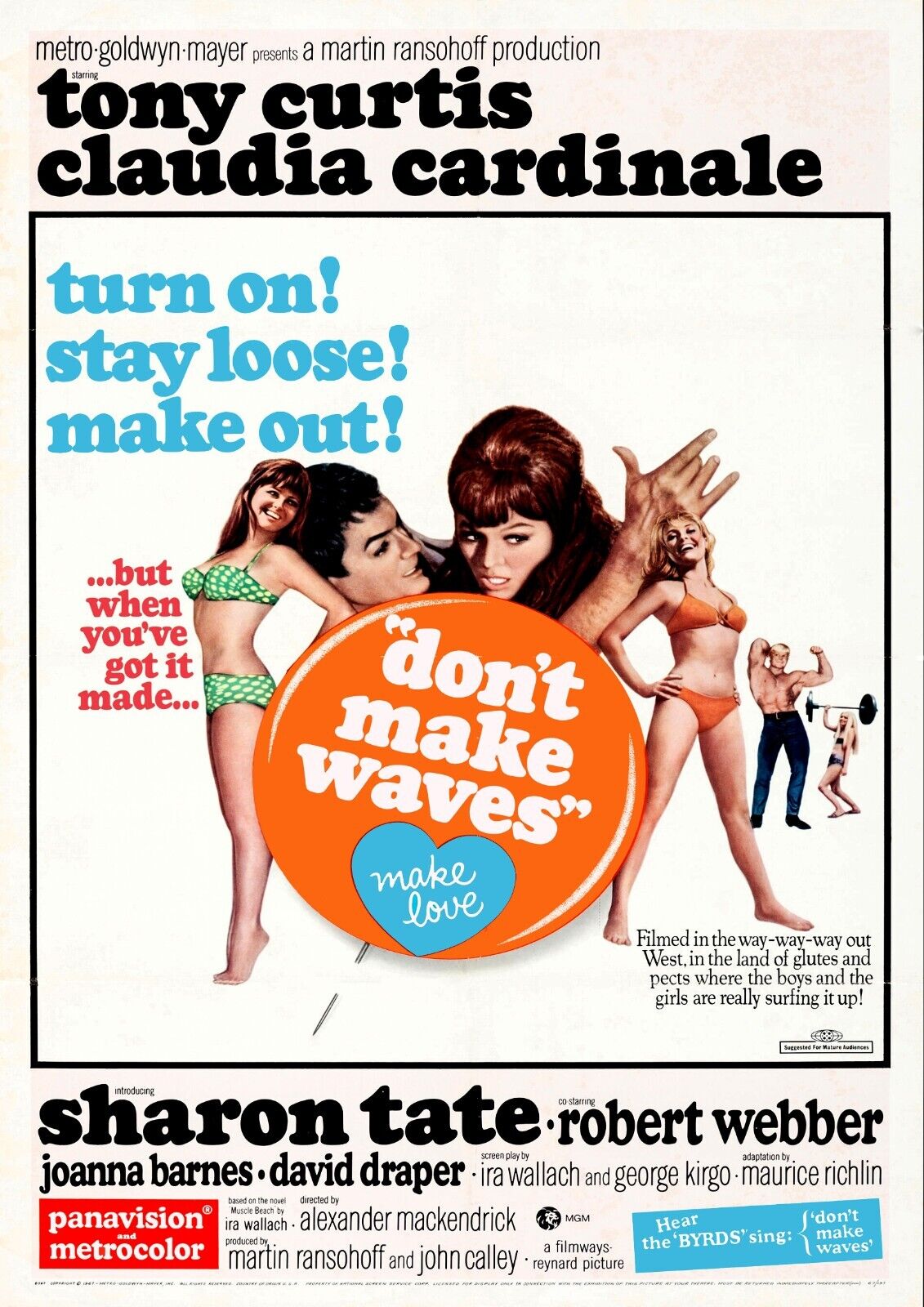
Don’t Make Waves (1967) ****

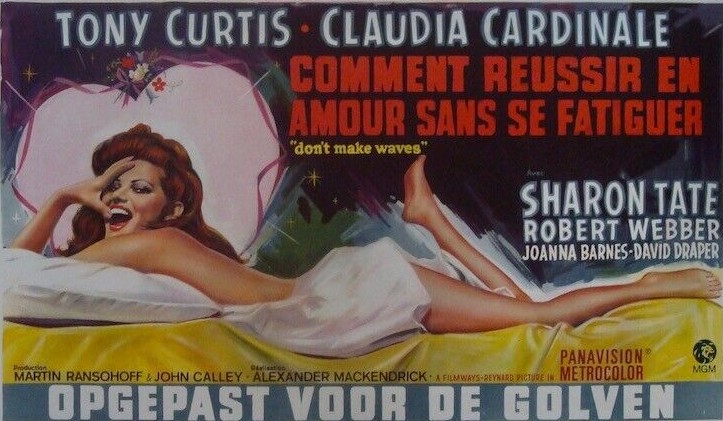
Unfairly maligned on release. Part throwback screwball comedy, part farce, part satire and in low-key fashion the first disaster movie. Oddly enough, that wild combination hits the mark. Tony Curtis makes amends for Boeing Boeing (1965). Claudia Cardinale on top form as a ditzy brunette. Last hurrah for Ealing Comedy grey eminence Alexander Mackendrick (A High Wind in Jamaica, 1965). Plus Sharon Tate as a sky-diver. What’s not to like?

Hardly surprising though at the time it got the thumbs-down from critics and the cold shoulder from audiences. A very late arrival to the short-lived beach movie cycle and unlikely to compete with the harder-edged satires like The Russians Are Coming, The Russians Are Coming (1966) and Divorce American Style (1967) or the latest off the Neil Simon conveyor belt Barefoot in the Park (1967).   

Marvelous opening with sight gags galore sees vacationer Carlo (Tony Curtis) wrestling with a runaway car then seeing hapless wannabe artist Laura (Claudia Cardinale) accidentally setting fire to the vehicle. To make amends for destroying all his belongings, she invites him to stay the night. Unfortunately, her married lover Rod (Robert Webber) turns up, cueing a whole layer of farce, traditional bedroom-style here but later even better in the office, properly done this time compared to Boeing Boeing.

The next day Carlo is rescued from drowning by Malibu (Sharon Tate) with whom he promptly falls in love and attempts to separate her from her hulk of a boyfriend Harry (David Draper), all muscle but little brain and prone to easily-exploited bouts of depression.

Carlo is the smarter younger brother of the character in Boeing Boeing, managing to muscle in on Rod’s swimming pool business and demonstrating his sharp salesmanship skills. Except that Laura is so shrill and a kept woman, you’d expect him to be more interested in her than Malibu, but then where would be we be without a love triangle. In an odd sub-plot involving an astrologer (Ed Bergen), Carlo manages to win over Malibu. Meanwhile, Rod’s smarter wife Diane (Joanna Barnes) infiltrates her husband’s cosy love nest.    
Although Carlo is effectively set up as somewhat shifty hero he undergoes a series of humiliations, brought down to earth by being repeatedly picked up and carried like a doll by Harry, and being drowned in mud. Other times he lives high on the hog, realizing he could make a killing here.

There’s no great plot, just the usual misunderstandings, but, unusually, characters are given moments of self-reflection and self-deprecation, and the satire focuses on the self-involvement of the beautiful people. There’s a fair bit of ogling but the camera is gender-equal, the toned bodies of the muscle men given as much attention as any passing female in a bikini.

I found myself chuckling all over the place, mostly at the antics of Carlo. This is a pretty good performance by Tony Curtis, mugging kept well under control but adept at physical comedy. And Claudia Cardinale (Once Upon a Time in the West, 1968) is equally game, drenched for a good chunk of time, and hit by sudden self-awareness as the tale unfolds. You might balk at her high-tempo performance but otherwise the set-up wouldn’t work. If she wasn’t so annoying why would Carlo look elsewhere for romance?

The disaster element involves a runaway clifftop house, a situation created by the unlucky Laura, and it doesn’t take much to see what elements The Poseidon Adventure filched, playing it for drama rather than comedy.

While not in the same category Mackendrick classics The Man in the White Suit (1951), The Ladykillers (1955) or even The Sweet Smell of Success (1957) – co-starring Curtis – this is not to so far off. Mackendrick excels at building the comedy, confidently marshals the farce, but, more importantly, doesn’t lose sight of the characters in the ensuing chaos.  

Producer Marty Ransohoff tries to pull a fast one by slapping an “introducing” credit on Sharon Tate, conveniently ignoring her performance in the previous year’s Eye of the Devil (1966). She’s less iconic here – unless you imagine that with her bronzed face she’s a distant cousin of George Hamilton – but she’s far from the dizzy blonde, much more pragmatic, the one who switches electricity back on after the blackout, and with her own oddball ways. Trivia note: they modelled “Malibu Barbie” on Tate.

Worth a look.   

Boeing Boeing (1965) ***

Farce is particularly difficult to pull off on screen. What is so effective on stage where the audience has full view of doors opening and characters appearing/disappearing and can often view, like a pantomime, circumstance changing ahead of the characters, grinds to a halt when the camera has to cut between various characters.

A speeded-up Tony Curtis (The Boston Strangler, 1968) doesn’t help though lack of his usual zaniness provides Jerry Lewis (The Nutty Professor, 1963) with the opportunity to present a more grounded character. To some extent, there’s little director John Rich (Wives and Lovers, 1963) needs to do than to keep the ample supply of balls rolling.

The movie displays its sexist credentials – listing the measurements of the female stars – not just in posters such as the one above but also in the film’s credit.

Though it sticks to the normal formula of girls falling out of the woodwork at inappropriate times, the Parisian set-up is a beaut. Journalist Bernard (Tony Curtis) has three girls on the go, all airline stewardesses, all believing themselves to be his fiancée, and by dint of assiduous study of flight schedules ensures that their paths never cross. His acidic housekeeper Bertha (Thelma Ritter) keeps the love machine well-oiled by switched around framed photos are changed and relocating underwear to suit the next imminent arrival.

Things go awry when American airline Boeing introduces a faster model, meaning that his lovers return sooner than anticipated. Stakes are raised when reporter rival Robert (Jerry Lewis) queers his pitch. So mostly it’s Bernard trying vainly to keep all his balls in the air without being rumbled while Robert attempts to sabotage the operation.

There’s not much more to it than that, the girls’ consternation at finding another woman in the apartment, Bernard gamely finding excuses for their presence.

Nor is it as risqué sex-wise as you might expect. The period didn’t allow for the hostess trio to actually be engaging in hanky-panky with Bernard. They are all allocated separate bedrooms so it will seem to a modern audience that all his frantic energy is wasted, though the initial stage audiences would accept the bedroom shenanigans as long as conventions were respected. Amorality goes only as far as keeping three girls on a string rather than actually taking them all to bed.

Of course it builds up into a riotous outcome but the farce remains forced.

Tony Curtis mugs his way through the entire thing, face twisted a  million ways, eyeballs rolling so much you think they are going to bounce clear of the sockets, and delivering dialog so fast he can hardly get to the end of one thought before another has interjected. Jerry Lewis is better value as the straight man, not relying on the physical comedy of previous roles, nor any obvious mugging, and creating a sly believable character intent on getting revenge.

Suzanna Leigh (The Pleasure Girls, 1965) is the pick of the hostesses but that’s not saying much since each has tumbled straight out of the cliché barrel. Dany Saval (Moon Pilot, 1962) flies the French flag while Christine Schmidtmer (Ship of Fools, 1965) is the dominating German.  

The biggest joke is on producer Hal Wallis (The Sons of Katie Elder, 1965). A past expert at choosing properties, he purchased the rights to the successful stage play by Marc Camoletti when  it was enjoying a hugely successful run in London’s West End. But when the production transferred to Broadway it was a resounding flop, leaving the movie with none of the usual hit play hype to build upon.

With only A Girl Named Tamiko (1963) in his portfolio as evidence of his familiarity with comedy (and that gentle in nature), Edward Anhalt (The Sins of Rachel Cade, 1961) was an odd choice for the screenplay except that he had recently adapted for Wallis hit Broadway play Becket (1964). (As a footnote, you might be interested to know that Mark Rylance won a Tony for playing Robert in a Broadway revival.)

Lightweight matinee material, but worth it for Jerry Lewis playing against type.

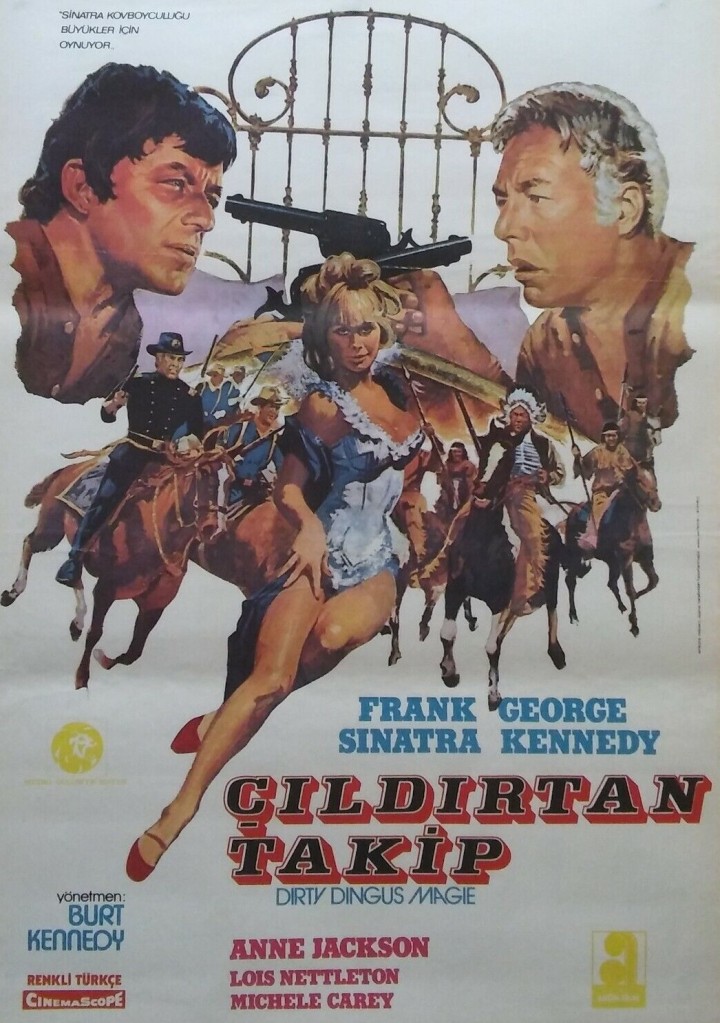
Dirty Dingus Magee (1970) ***

The boldest role ever undertaken by a major star of Frank Sinatra’s generation – and little thanks he got for it. Not only was he virtually unrecognisable under a slab of make-up that George Hamilton would have envied but the role was a complete reversal of his screen persona. Admittedly, he had flipped that persona for Tony Rome (1967) and as the cuckolded cop in The Detective (1968), but this was on a completely different level.

Sinatra was no Tom Hanks or Daniel Day-Lewis, known for inhabiting different types of characters, and, while he did have a vulnerability that he put to good use in The Manchurian Candidate (1962) and The Man with the Golden Arm (1955), he was best known on screen as the guy in charge.

That was far from the case here. Dumb and dumber might be more apposite. Dingus Magee (Frank Sinatra) is a scamp, an outlaw so useless he is worth only $10 in reward money, who steals the stash of old rival Hoke Birdsill (George Kennedy), triggering a revenge caper that is complicated by a host of unnecessary complications by director Burt Kennedy (Welcome to Hard Times, 1967) who has set his heart on some kind of satirical comedy western with a revisionist slant.

So we get a female mayor, Belle (Anne Jackson), who happens to own the local brothel, whose commercial prospects are endangered when the local Cavalry are called away to fight the Native Americans, an Indian chief Crazy Blanket desperate to trade his daughter for a rifle, and when that looks like not working out calling on any available squaw to seal the deal,  predatory schoolteacher Prudence (Lois Nettleton) and a running gag involving a Brown Derby hat that results in a gunfighter (Jack Elam) being mistaken for Magee.

It’s a bit long on complications and short on satire and is rescued by the double act of Magee and Birdsill, who constantly get in each other’s way or try to pull a fast one. Birdsill, as it happens, is appointed sheriff, since that’s in the purview of the mayor, and, on the right side of the law for the first time in his life, makes an ill-fated attempt to do good.

Magee tries to help him along. In exchange for the sheriff turning a blind eye for a period of time to Magee’s nefarious activities, the reward for the outlaw will mushroom, permitting greater kudos for the sheriff on his capture.

The main problem is that Kennedy directs with a very heavy hand, very obvious musical cues for a start, and there’s not enough that’s intrinsically funny. Though there is a reversal of an obvious joke of Birdsall being sent to the brothel to locate the mayor, expecting to find a client not the owner.

But both Sinatra and George Kennedy (The Sons of Katie Elder, 1965) are a delight, the latter also playing against type rather than his usual dominating character. Their dumbness takes some beating. Sinatra just about gets the upper hand, but there’s not much in it.

The best thing about the picture is the sense of reality. The U.S. Cavalry spend more time in the brothel than out hunting Native Americans. Law and order can go to hell as long as everyone is having illicit fun. The respectable schoolmarm proves a skilled seductress. Peace is desirable because it is more profitable than war. And the bulk of the outlaws in the Wild West are far from achieving legendary status, just two-bit punks.

Not surprisingly, this was a massive flop and killed off Sinatra’s movie career for the rest of the decade – not that he was overly concerned, “My Way” having reignited his singing career and he was a Vegas regular. But it’s a shame the acting was so vilified, Roger Ebert blamed Sinatra rather than the director for its failure, in particular taking him to task for the one-take approach that Gena Rowlands previously exalted (but what does she know, she’s just an acclaimed actress and knows how a movie works better than a critic).

Well overdue for a reappraisal and if you go in duly warned you might even enjoy it, or at least the Sinatra-Kennedy double act.

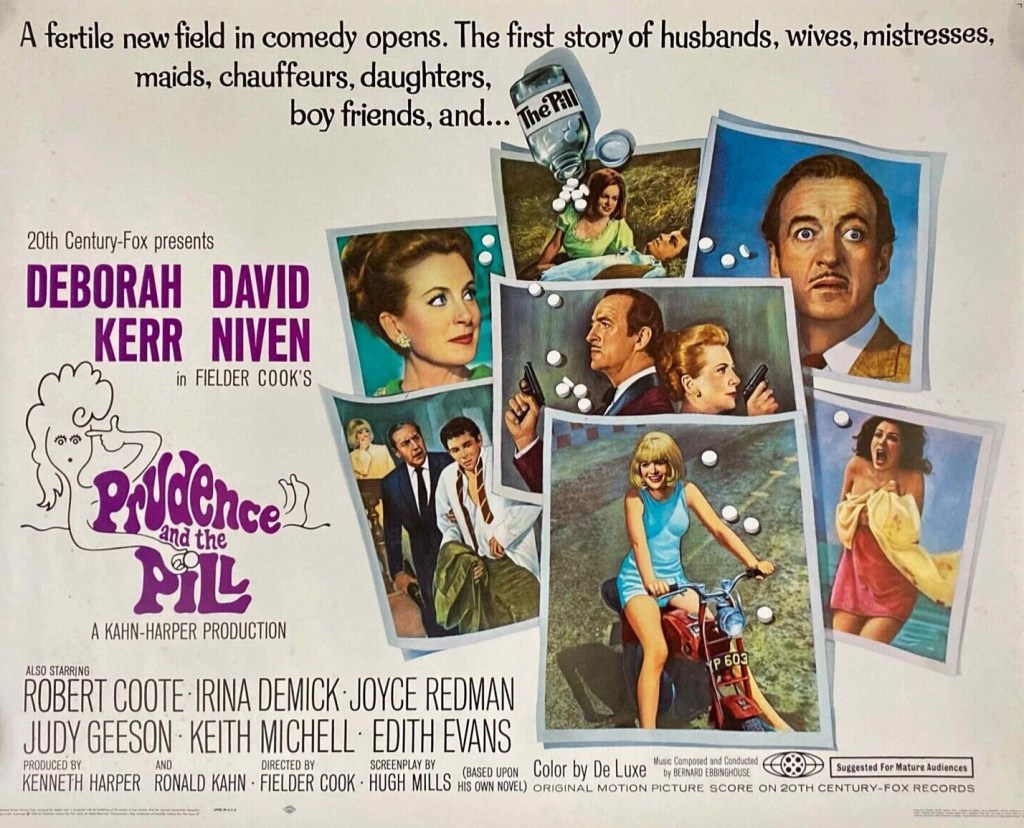
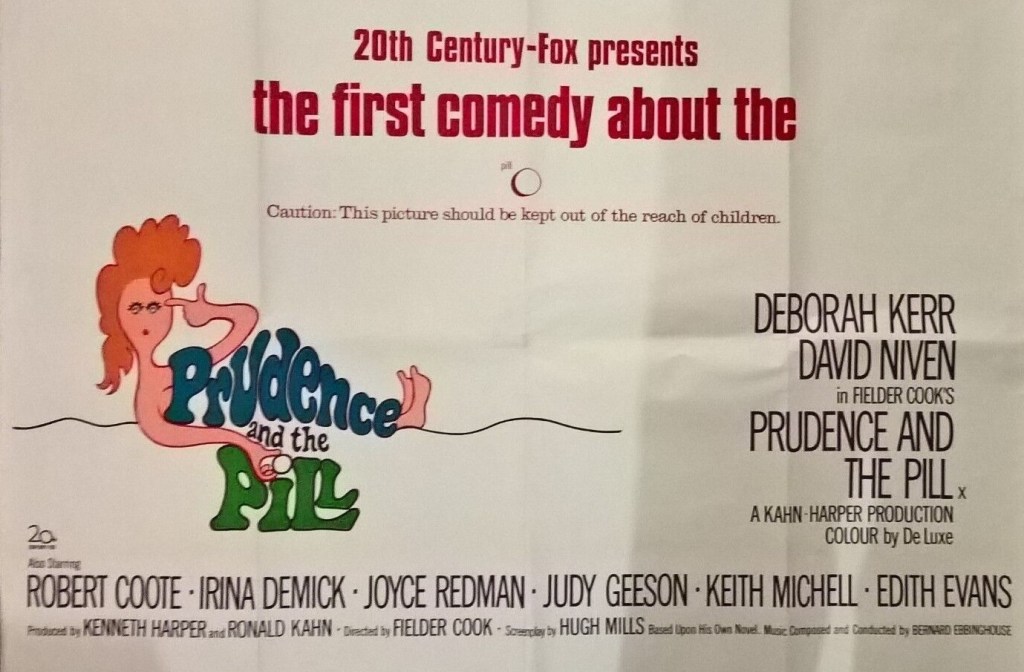
Prudence and the Pill (1968) ****

Cleverly calibrated chuckle-worthy comedy of manners. Far more enjoyable than the basic material might suggest, especially as you will easily guess where it all ends. Anchored by redemptive performances, after disappointing turns in The Eye of the Devil / 13 (1966), by Deborah Kerr and David Niven, playing a middle-aged upper-class childless couple whose marriage survives on civility alone, and a sparkling showing by Judy Geeson (Here We Go Round the Mulberry Bush, 1967).

It’s surprising what a fresh look at cliché can achieve. On the face of it, American director Fielder Cook (How to Save a Marriage and Ruin Your Life, 1968) is the last person to be tackling the upper classes, especially as there’s scarcely a hint of satire. It’s wonderfully pitched, no sexist jokes, no farce, no tourist or Swinging London, and avoids the temptation of aiming for the lowest common denominator (Carry On Up the Pill for example). But authority is constantly confounded, pomposity pricked, and, astonishingly for a  movie about relationships in Britain – the home of the kitchen sink drama – in the late Sixties, everyone ends up happier ever after.

The titular drug in question, in case that term is no longer in common usage, is the contraceptive pill, here sold under the generic name of Thelon. The biggest shocks here might well be that mothers and fathers in middle-age still have sex. Although that is balanced by a contemporary vibe of having children late in life.

So the fun begins when Henry (Robert Cooote) and Grace (Joyce Redman) discover bubbly daughter Geraldine (Judy Geeson) in bed with Tony (David Dundas). Cue howls of anger from staid parents, who divide up the ticking-off, the mother tasked with warning daughter about the dangers of pregnancy – and with it the specter of single motherhood, a high society no-no – the father to whip the young rascal.

The mother is only mollified – though still affronted at such blatant expression of sexuality – when she discovers her daughter is on the Pill. But shocked to discover Geraldine has been pilfering her own supply. Father is taken aback to discover the lover is not only heir to a fortune but has already proposed.

Unlike most movies of the era, where sexuality remained a dirty word, and most illicit romances were conducted in secrecy and ended up in disaster, the vivacious Geraldine could be the poster girl for sex. She is delighted to have lost her virginity, and to expand her sex education, and stands up against her mother’s old-fashioned views.

However, the replacement of mother’s Pill with aspirin presents a dilemma. Robert and Grace are also enthusiastic lovers and the absence of contraception for so long points towards the possibility of a very embarrassing pregnancy.

Meanwhile, Henry’s brother, bored company chairman Gerald (David Niven), who lives in a mansion with servants and swans around in a chauffeur-driven Rolls-Royce, discovers, to his horror, that his wife Prudence (Deborah Kerr) has been taking the Pill, denying him his much-cherished desire to have children. So he swaps it for a vitamin pill. Unknown to him, his young maid Rose (Vickery Turner), warming to the amorous attentions of the chauffeur Ted (Hugh Armstrong), has taken a leaf out of Geraldine’s book and snaffled her mistress’s Pill.

You can see where this is headed. But there’s a complication. Assuming (as a man would) that their lack of children was due to his wife’s infertility, Gerald could have had children by his younger mistress Elizabeth (Irina Demick). But he refuses to seek a divorce (the scandal, don’t you know) and Elizabeth views him as a poor candidate for marriage (would he not just have another mistress) and fatherhood.

Prudence, it soon transpires, also has a lover, Dr Huart (Keith Michell). Equally resistant to divorce, for societal reasons and to prevent her husband marrying his mistress, Prudence soon warms to the thought of having a child, but abhors the prospect of having Gerald as its father.

In the best Hitchcock fashion, the audience is privy to information denied the characters who fluster around in their incompetence.

It should never work. The story is so obvious and, from a narrative perspective – given unplanned pregnancy does not lead to dark deeds, humiliation and abandonment – weak. That it is pretty much a triumph owes as much to the direction (witty use of musical cues, for example) as a script that feasts on reversals. The acting is first-class all round. David Niven and Deborah Kerr, in their final pairing, atone for the under- and over-acting, respectively, of Eye of the Devil. Judy Geeson is a standout as a marvellously gleeful liberated young woman. Edith Evans (The Chalk Garden, 1964) pops up for a delightful cameo.

Pure joy.     

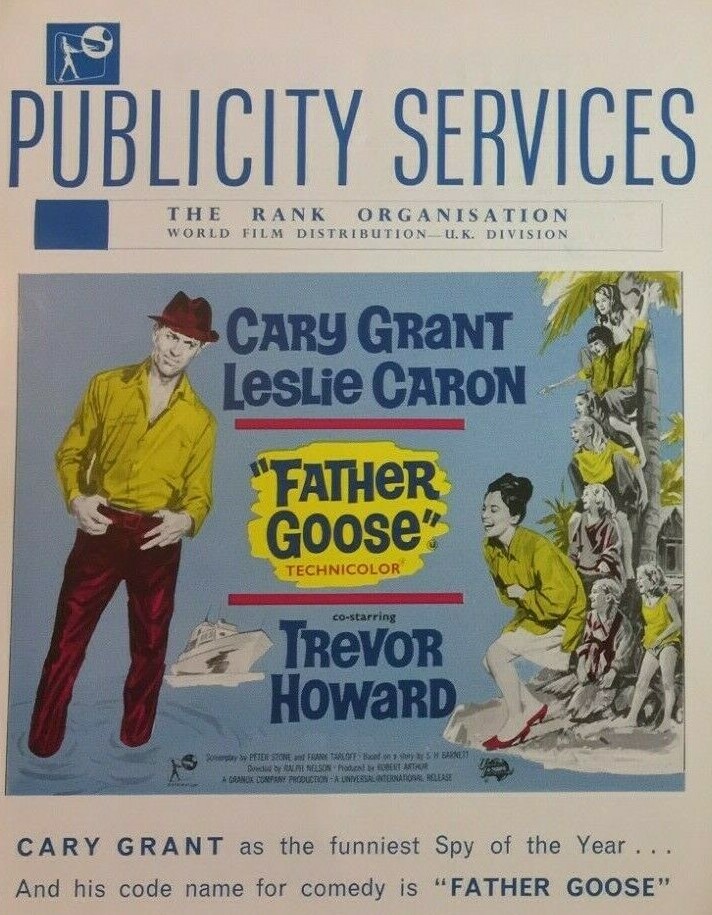
Father Goose (1964) ***

The African Queen with kids or 100 ways to see Cary Grant deflated. The penultimate movie in the screen giant’s career is a tame affair especially after the thrilling Charade (1963) and it may have prompted him to shy away from attempting to carry on a romance with a woman decades younger as occurs in his final offering Walk, Don’t Run (1966). When Trevor Howard (Von Ryan’s Express, 1965) effortlessly steals the picture with a performance that turns his screen persona on its head, you can be sure it’s not quite top notch.

In World War Two, Walter (Cary Grant), a hobo on water with a knack of stealing official supplies, is commandeered by British officer Houghton to operate a radio outpost on a Pacific island giving early warning on Japanese aircraft sorties. While there, he encounters Catherine (Leslie Caron), a French schoolmistress and consul’s daughter, in charge of a pack of female schoolkids.

Effectively, both relationships follow a pattern of verbal duels, initially with Walter losing them all as he is kept on a leash by Houghton and then is beaten by teacher and children. The kids steal his hut, his bedding, clothes (shredded and sewn to fit young girls), food, booze and sanity.

The straight-laced Catherine is happiest when straightening a picture. Walter only regains some of his standing when it transpires he has practical skills like catching fish, repairing a boat and encouraging to talk a girl who has been traumatized by war into temporary dumbness. Naturally enough, any time Leslie warms to him he does something off-putting. But gradually, of course, they get to know each other better, romance is in the air, and secrets are revealed, his hidden past laughable.

It’s a series of set pieces, designed to make the most of Cary Grant’s deftness with physical comedy, he can pull faces with best of them and long ago mastered the double take and the pratfall. So there’s little here you’ve not seen before. And the trope of man and woman trapped on a desert island – most recently probably best exemplified given its inherent twist in Heaven Knows, Mr Allison (1957) – has long been over-used and this addition to the sub-genre suffers from lack of originality.

The little blighters are less an innovation than a complication (or perhaps a multiplication) but they do have the advantage of reducing him to impotence, since he can hardly deal with their transgressions the way he might Catherine. And of them is smart enough to realize that he runs on booze and rations this out.

All in all it’s gentle stuff, nothing too demanding, redemption neither an issue nor an option. Cary Grant is an unusual species of top star in that, as with Rock Hudson and a few others, he didn’t mind being the butt of all the jokes, and in some respects sent up his screen persona. 

Keeping Cary Grant in check might well be a sub-genre of its own, so Leslie Caron (Guns of Darkness, 1962) is inevitably limited in the role, primarily a foil/feed for the Grant, the part not not quite of the caliber of the roles played by actresses in his thrillers such as like Grace Kelly (To Catch a Thief, 1965), Eva Marie Saint (North by Northwest, 1959) and Audrey Hepburn in Charade.

As I mentioned, Trevor Howard is the surprise turn, and steals the show. Ralph Nelson (Soldier Blue, 1970) directs from s script by Peter Stone (Charade), Frank Tarloff (The Double Man, 1967) and S.H Barnett, a television writer in his only movie. I’ve clearly under-rated the script because it collected the Oscar.

Perfectly harmless and enjoyable, if a tad obvious.

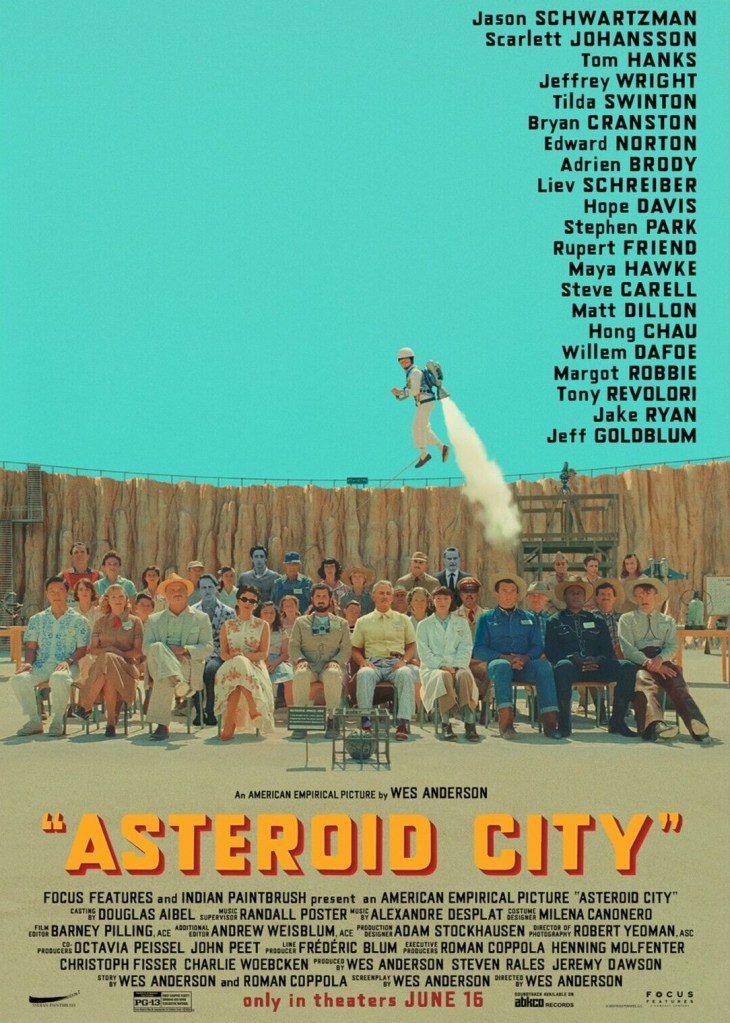
Asteroid City (2023) **** – Seen at the Cinema

“Up to his clavicle in whimsicality,” is the best I can do. While acknowledging that quote is not mine, I should also make clear it could apply to any Wes Anderson picture. He strikes me as critic-proof. With a hard core of fans, whether his movies enter box office heaven depends on the oldest and most elusive of marketing tricks: word-of-mouth.

I am going to be telling everyone to go-see without really being able to explain why they should. I might not be able to describe the plot without putting everyone off. I might get the plot wrong. Ostensibly, it’s about a bunch of disparate characters coming together in the titular city (pop: 87!!) to celebrate in the mid-1950s the gazillionth anniversary of the landing of an asteroid, a pock-marked rock about the size of a giant watermelon.

The motley crowd includes scientists, U.S. Army representatives, schoolkids taking part in a science competition, sightseers and some characters stranded there and, halfway through, an alien who commits the heist of the century, though unlike most caper pictures there’s none of the usual pre-robbery set-up.

While Anderson has a consistency of outlook that delights/bewilders/infuriates critics, he has a stunning sense of originality. He doesn’t repeat himself and reveals an astonishing freshness when it comes to the myriad methods employed to tell a story. At least here, the narrative is, roughly, straightforward not breaking off into various routes (or even cul de sacs) as in his previous outing The French Dispatch, which struggled in the old word-of-mouth department but which I adored.

To help me along here with what the film was all about I looked up the lead review in Imdb. Not only was it no help at all, it was pretty dispiriting. Poor old Wes Anderson gets walloped for lack of plot. I couldn’t care tuppence for plot as long as I’m entertained. And I went along quite happily with the ultra-post-ironic (post-something anyway) notion that we were watching the filmed version of a famous play or possibly the situation which inspired the play but cutting between both and the actors in the movie version not only playing characters but dropping into their genuine personalities – or perhaps not, maybe these were the characters from the play.

And here, the last thing I want to do is put you off. So, yeah, if you think narrative isn’t just watching a bunch of people who’ve never met before interact, a category into which I guess you would chuck movies as different as The Towering Inferno (1974) and Titanic (1997), and think they have to be gathered for a doomsday scenario, and ignore the likes of Bus Stop (1956) then just go ahead and talk yourself out of that rare sighting on the Hollywood hills, an adult movie with nary a superhero (discounting said alien of course, whose back story might include super-heroism for all I know) involved.

This might just be one long litany of jokes, but why would you complain about that? Anyway, for the sake of anyone who has come here for a proper review, here goes.

Grieving widower Augie (Jason Schwartzmann) is unexpectedly stuck in Asteroid City when his car goes into meltdown. His three young children think they are auditioning for Macbeth, constantly casting spells and intent on burying their mother’s ashes, contained in a Tupperware bowl, in the desert, and generally acting weird. His equally widowed father-in-law Stanley (Tom Hanks), dressed as if coming straight from the golf course, turns up to pretty much tell him how much he dislikes him. Augie has a short affair with movie star Midge (Scarlett Johansson) while her science-minded daughter gets to experience first love and proves a whiz at some extremely complicated memory game that I might have played when young but can’t remember the name of or which could equally be a Wes Anderson invention.

Please sir, that’s as much plot as I can remember. Various other characters appear, flitting in and out, and don’t behave as you might expect. Oh, some do, there’s a hotel owner selling plots of real estate, but there’s also the apparently straight from Central Casting General Gibson (Jeffrey Wright) whose speech sounds more like an elevator pitch for a novel. See, I told you, explaining it won’t help. You just gotta go see it.

You might spend the whole picture rubber-necking, spotting stars in cameo roles, but except for Edward Norton and to some extent Tilda Swinton none of them are doing what they are famous/infamous for. Maybe Wes Anderson has a constant queue of A-list applicants for small roles just because a) they get to play someone completely different from normal and/or b) they get to work with the great man.

Roman Coppola (Moonrise Kingdom, 2012) was drafted in to help write the screenplay maybe just so the director can get to share the blame if it’s a critical dog.

Go see.

Did I already say that?

The Fortune Cookie / Meet Whiplash Willie (1966) ***

It’s the miracle of cinema. A supporting actor whom you might have glimpsed in a variety of roles over the preceding years suddenly appears as if by magic in a new screen persona and is hailed as a new star. One such was Walter Matthau. From the lecherous neighbor in Strangers When We Meet (1960), good guy in Lonely Are the Brave (1962), bad guy in Charade (1963) and Mirage (1965) and tetchy arrogant analyst in Fail Safe (1964), as if undergoing metamorphosis he creates the slimy, grouchy, crouchy, greedy lawyer duping his brother-in-law in Billy Wilder’s too-obvious satire The Fortune Cookie, beating the top-billed  Jack Lemmon (How To Murder Your Wife, 1965) into a cocked hat.

It doesn’t help Lemmon that this most physical of actors is physically constrained for the bulk of the picture, trussed up within an inch of his life as the key ingredient in a million-dollar insurance scam. And Matthau makes the most of the opportunity, dominating the screen not just with his octopus-like arms, but with his facial expressions, his snarling and growling and snapping, as if this was in fact a one-man movie. He’s so dominant that you almost forget Lemmon, an unavoidable force in most of his movies, is there.

And it’s true that television cameraman Harry Hinkle (Jack Lemmon) is a patsy, duped by his adulterous wife Sandy (Judi West), conned by ambulance-chasing lawyer Willie Gringrich (Walter Matthau) into believing that exaggerating the injury he suffered from colliding with pro football player Boom Boom (Ron Rich) will bring her scurrying back. Never mind that while on the phone apparently going with her ex-husband’s fantasies, we can see her current boyfriend in the background lying abed or taking a shower.

But then Willie has everyone figured out. He can play highball or lowball, he knows every trick in the book and if you try to challenge him he can quote chapter and verse on every personal injury claim over the last century that would favor the victim. And he expects his opposite numbers to play dirty too, and uses to his own advantage the microphones and cameras they have planted in the apartment where Harry is purportedly recuperating.

There’s not much more to the picture than to enjoy Willie hoodwinking everybody in sight. But he’s such a performer to watch that you will be rooting for him rather than his sad sack brother-in-law who you know has paid-up membership of the Suckers Union.

Not for the first time, foreign distributors felt they were saddled with an unworkable title so in
the UK it became Meet Whiplash Willie even though the idea of the con of the whiplash
injuries in supposed car accidents was more prevalent in the US than Britain.

There’s some neat observations of the way law firms work, and the way medical experts refuse to commit in case they are later sued for a wrong diagnosis, and there’s some cute stuff about nuns with the gambling habit and seeing Boom Boom fall apart with guilt. But given the movie’s running time and the talent involved – script by Billy Wilder and I.A.L. Diamond (Some Like it Hot, 1959) and directed by the said Wilder –  it’s not as funny as it could be and sometimes it feels like they’re scraping the barrel to squeeze out an unfunny joke.

But it hardly matters. This could be Fail Safe and with this Walter Matthau persona on the loose you wouldn’t care tuppence if the Russians bombed the hell out of everyone as long as Matthau was in the middle of the action, working out how to chisel a bigger piece for himself, and playing everyone for the dumb schmucks they are.

After this Walter Matthau – as unlikely a mainline star as Lee Marvin or Charles Bronson – never looked back. Unlike other major stars he never had to be completely trustworthy and was almost virtually responsible for bringing a severe dose of cynicism to the forefront of American acting. He could charm you if he set out to do so, but you better keep your wits about you because the chances are he would be robbing you blind.

If The Odd Couple (1967) set the seal on one of Hollywood’s greatest comedy partnerships, The Fortune Cookie was where it all began. Lemmon isn’t bad, just out-acted, and we’ve seen his whiny/forlorn/dumb act many times before. Judi West (A Man Called Gannon, 1968) has the other plum role as the blonde who is anything but dumb and would have proved an ideal partner for Gringrich except he would have seen through her too easily. Ron Rich (Chubasco, 1968) plays the only other character who isn’t spun out of a cliché.

Below par Wilder redeemed by heavenly performance by Matthau.

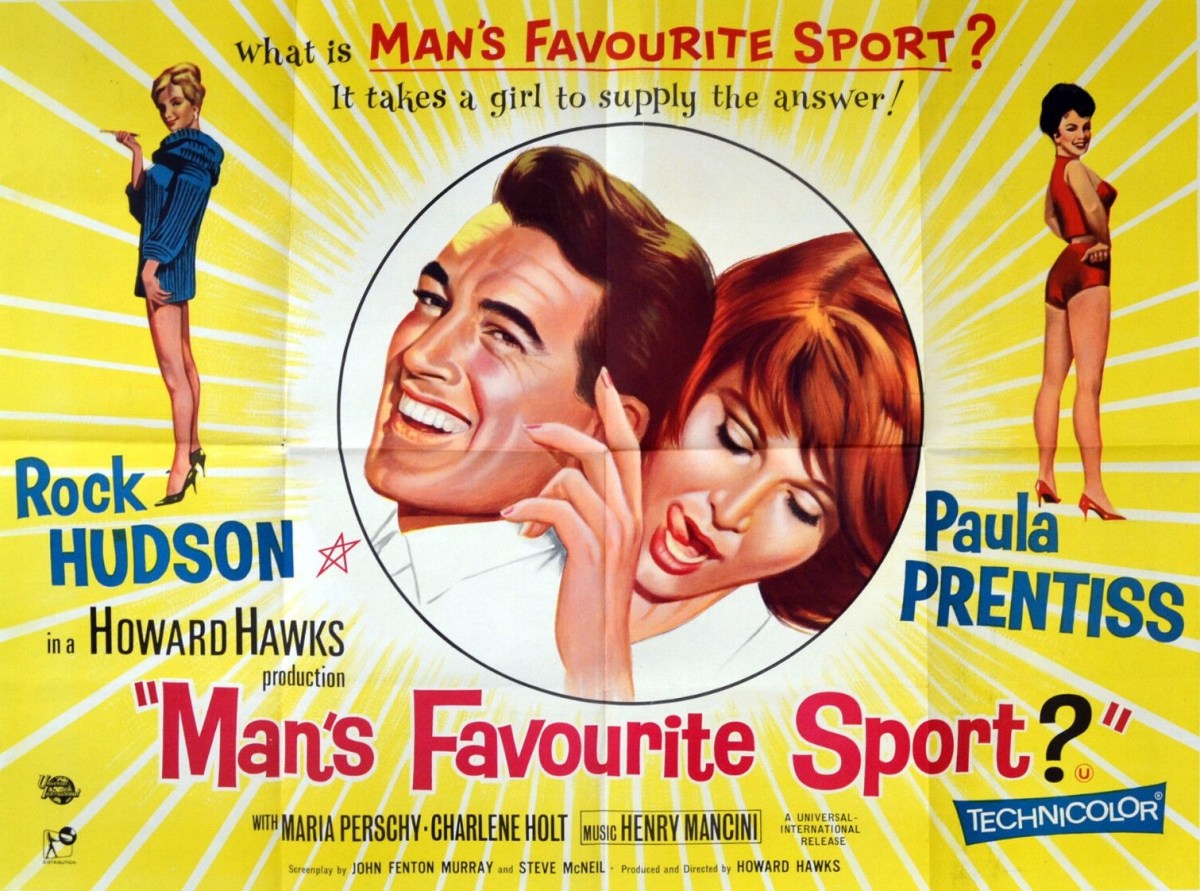
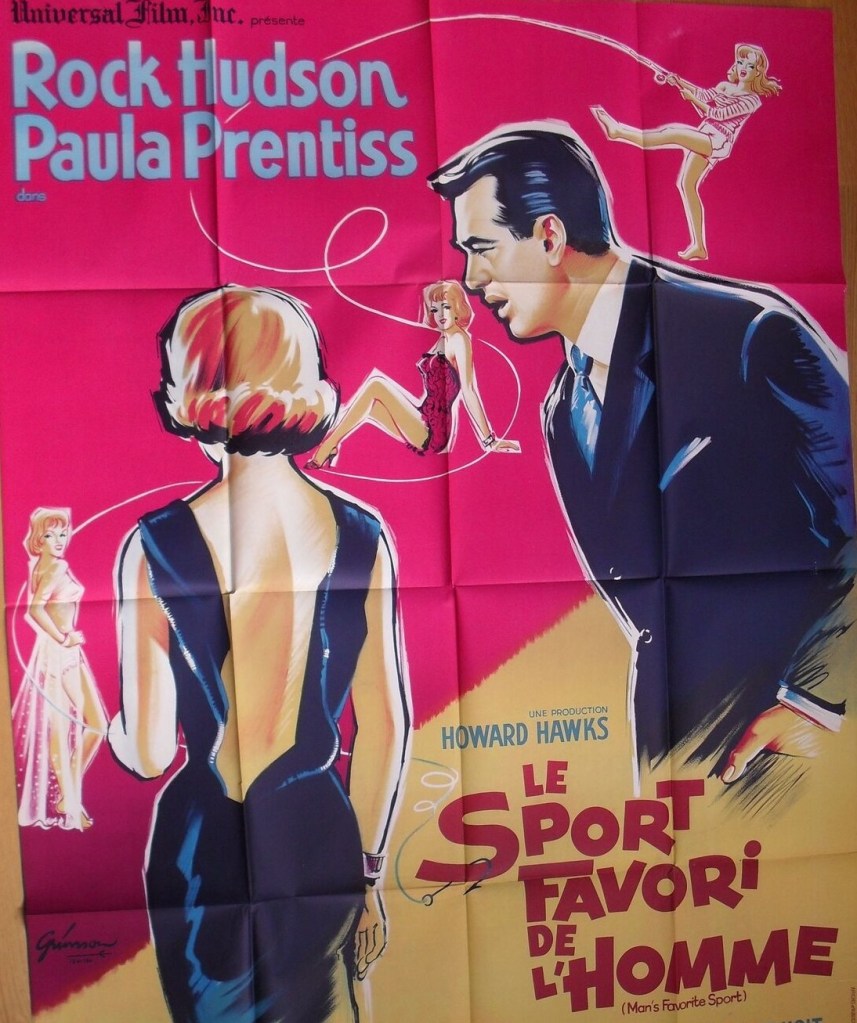
Man’s Favorite Sport (1964) ****

Wow! From an academic/critical perspective this is veteran director Howard Hawks (Hatari!, 1962) taking the mickey out of his famed style, where women are always competing to enter the sacrosanct male world. But, shades of his earlier Bringing Up Baby (1938), a fast-talking assured sassy woman takes command of a hapless male. Sure, Rock Hudson and newcomer Paul Prentiss aren’t in the Cary Grant-Katharine Hepburn league but they make darned good substitutes. And there’s a big difference to the earlier picture. There, Grant was an accepted expert, and it’s not his knowledge that’s in question but here Hudson is a phoney and relies on the woman.

But fiddlesticks to academe and critics, this is just helluva good fun. Built on a brilliant premise, it just rolls along from one set-piece to another to fashion as daft a screwball comedy as you could imagine.  Maybe Rock Hudson left all the physical comedy in Send Me No Flowers (1964) to Doris Day because he was plumb tuckered out by his exertions on this one.

So, Roger Willoughby (Rock Hudson) is a fishing expert employed as a salesperson by Abercrombie & Fitch. When, in a public relations wheeze, Abigail Page (Paula Prentiss) invites him to participate in a competition, she uncovers his terrible secret. He’s never fished before in his life, he’s just a clever listener, passing on fishing lore from one customer to another. She agrees to help him out. But, of course, he’s an idiot and it’s not long before he’s upside down in a car that’s way too small for him, walking around with rubber buckets for shoes and upside down (again) in a lake trapped by inflatable waders.

There’s a marvellous meet-cute where they get off on the wrong foot because she steals his reserved parking spot and his first encounter with her dexterity with language should have warned him what he’s letting himself in for. The situation is complicated by, natch, Abigail falling in love with him, not to mention her buddy Easy (Maria Perschy) not unattracted either, and his fiancée Tex (Charlene Holt) about to appear any second.

So when Roger’s not tying himself in knots, he’s allowing himself to be persuaded to pretend to have a broken arm, which to make it realistic must be encased in plaster, which Abigail and Easy concoct.  The fact you know full well this is only the first step to major complication doesn’t make it any the less funny. Then there’s the problem of the zip in a sleeping bag. And the fiancée turning up at the wrong time.

I could have done without the fake Native American (Norman Alden), but the rest is top-notch. Any other director would have kept the wig gag going for ages, but here it’s dumped early on because the wearer, Roger’s boss Cadwalader (John McGivern), needs little excuse to stop wearing it.

You’d be hard put to find sexuality as cleverly dealt with as here, Abigail and Easy provided with good reason to swan around in skin-tight clothing and later prattling on fifteen to the dozen as pouring rain renders their shirts see-through much to the discomfort of Roger. While Roger might be a typical male, the trio of women are far from typical of the period with a streak of independence that allows little room for the notion of men as the superior species. Not only is Abigail as competent as any male in this type of sport, she far exceeds the capabilities of the supposed expert. Furthermore, Abigail is the antithesis of the scatter-brained Susan Vance from Bringing Up Baby. She knows exactly what she’s doing even if shifted slightly off kilter by the unexpected impact of love.

As the male coming unstuck outside of his comfort zone, Rock Hudson is excellent especially in the physical comedy but the real gem is Paula Prentiss, as effervescent a star as you would ever find. You only have to see her in The Parallax View (1974) to understand what a terrific character she has succeeded in creating. Never mind that she handles the script deftly, she virtually bursts off the screen.  

The general critical consensus is that Howard Hawks went downhill after Rio Bravo (1959), and that outside his final pair of westerns El Dorado (1966) and Rio Lobo (1971) was very much at the tail end of his career. Most critics seemed to have simply ignored that Man’s Favorite Sport took a different approach to the male-female dynamic or that, setting academia aside, this is just a very enjoyable romantic comedy.

The Art of Love (1965) ****

Priceless. Effortless comedy from the same director, Norman Jewison, as Send Me No Flowers (1964) but minus the box office powerhouses of Doris Day and Rock Hudson and perhaps it’s their absence that makes this work so much better. Or perhaps you get more comedic leeway in Paris. Although the scripts were written by different people, I sense a directorial insistence that the supporting characters are believable, not just there to oil the plot.

The story here is fraud, penniless artist Paul (Dick Van Dyke) faking his own death to give his paintings the necessary burst of publicity to make them hot items. Except he doesn’t fake his death. He dives into the Seine to save a drowning girl Nikki (Elke Sommer) and his buddy Casey (James Garner), a wannabe writer for whom Paul is a meal ticket, and who you would have to say was instrumental in suggesting such a scam, assumes he has committed suicide.

Paul goes along with the scheme for as long as it takes art dealer Zorgus (Roger C. Carmel) to make a killing (no pun intended) from his paintings. Nikki ends up a housemaid at a risqué nightclub (though it being Paris what other kind is there) run by Madame Coco (Ethel Merman) where, coincidentally, heavily disguised, Paul hides out. Meanwhile, in the final piece of the complication jigsaw, Paul’s fiancée Laurie (Angie Dickinson), turns up. A bit like the lecherous friend in Send Me no Flowers, Casey knows how to make the most of the opportunity to give a potential widow a shoulder to cry on. “How can you make a play for this girl?” he asks his reflection, but she’s too gorgeous for qualms.

You can pretty much guess where it will go from here.

It works so well because none of the principals is permitted to milk their roles (though Van Dyke can’t resist making a meal out of a sneeze) and the supporting cast drive it along with selfish action. Dick Van Dyke (Divorce American Style, 1967) has none of his usual zaniness or limbs that refuse to obey orders. James Garner, though in part cloning his character from The Americanization of Emily (1964), plays it as drama. Elke Sommer (The Venetian Affair, 1966) is the best I’ve seen her, no longer the pouting sexpot but a girl-next-door from the suburbs fallen on hard times. Angie Dickinson (Jessica, 1962), further down the billing than I’d expect, has to play it for drama, almost the foil for Casey’s seductive tendencies.

There are some superb running gags. Paul is furious to find a red-headed woman in the bed of flat-mate Casey. But, sight gag number one, it belongs to a mannequin. The wig, sight gag number two, is used to disguise Paul. Casey gets ride of the mannequin by stuffing it into a furnace only it doesn’t fit so he has to saw off its legs and is discovered from above by a waiter, sight gag number three, who naturally thinks he is sawing a woman in half. (I always think the beauty of a good comedy is that you can see the gag coming and you still laugh.) That gag has even more miles to run.

The supporting cast, as I said, are all given just delicious lines. Paul and Nikki, soaking wet, are saved by a passing barge. Paul hangs out her clothes to dry. When the naked woman in the wheelhouse calls for her clothes, the barge skipper, enjoying the prurient scene, implores,  “Don’t give her her clothes back.” And when, after a row, that allows her to leave the barge, the skipper whines, “I told you not to give her her clothes back.”

. “I don’t want you to think I came for the rent you owe,” says Casey’s landlord. “What did you come for,” asks Casey. “The rent you owe, but I didn’t want you to think it.” The landlord’s wife comforts the grieving Casey (at this point he thinks Paul is actually dead) with some chicken soup. Casey admits the suicide was his idea. The woman snatches back her soup.

Having put Nikki on a bus, Paul, handing over few coins, asks the driver to keep an eye on her. Comes the reply, “I would whether you pay me or not.”

Sure, Ethel Merman (There’s No Business Like Show Business, 1954) gets to sing. Audiences expected that. But that’s understandable. What a voice. When you wonder why Ann-Margret wasn’t given more opportunity to sing in proper musicals, this is the answer. She lacks the voice of an Ethel Merman, Julie Andrews or Barbra Streisand.

The sly screenplay was concocted by Richard Alan Simmons (Della, 1965), William Sackheim (First Blood, 1982) and Carl Reiner, who had written for both Dick Van Dyke (his eponymous television show) and James Garner (The Thrill of It All, 1963).

The stars play proper roles, not just one-note characters driven by plot. Doesn’t take much to work out where it’s going all right but that doesn’t lessen the enjoyment of the journey.

I always wondered why, after making his name in comedy, Norman Jewison was selected for more serious works like The Cincinnati Kid (1965) or In the Heat of the Night (1967), but when you see the care he takes with each character, far more than standard directors in the fun genre, how he carefully builds the narrative, you do tend to agree he’s wasted in comedy.

A pure delight.

Send Me No Flowers (1964) ***

Doris Day (With Six You Get Eggroll, 1968) is such a whiz at physical comedy you wonder why it is ever rationed, as it appears to be here, limited to a fabulous sequence where her coat is caught in the door while collecting supplies from the milkman and a  shorter one where she loses control of her golf cart. And until the relevant misunderstandings kick in, this slightly limps along on the tale of hypochondriac George (Rock Hudson) believing he has only a few weeks to live and determining to make provision for his wife Judy (Doris Day) once he is dead.

Unfortunately, he confesses to his neighbor Arnold (Tony Randall) who is overcome with grief, even writing an eulogy along the lines of “when they wanted a good sport in Heaven they called on George Kimble.” Into the misunderstanding mix are innocent Dr Morrissey  (Edward Andrews), Bert (Clint Walker), Judy’s college sweetheart, and lecherous bachelor Winston (Hal March) who preys on women with marital issues.

The fun only really starts when Judy, on discovering George kissing a woman in a cloakroom, believes he is having an affair and discovers that he is being more of a hypochondriac than usual in assuming early mortality. And that’s when we come to Doris Day’s other priceless (rather under-rated ) asset – her range of expressions, not just the expected outrage at deception, but the look in her eye that tells you she is planning revenge.

Most of the supporting characters are well-drawn. Dr Morissey, endlessly envious of colleagues making a killing in one speciality or another, is the kind of man who has a ring of white atop his tanned face indicating where he has kept his hat on when out fishing in hot weather. The predatory Winston demonstrates his talents for picking up vulnerable women. The undertaker is ridiculously jolly. And Bert acts as if Judy made a big mistake in throwing him over. For that matter, Judy seems unable to resist his romantic arm around her shoulder.

It’s not until the complications mount up in that Rock Hudson (Seconds, 1966) comes into his own – an excellent scene sharing Tony Randall’s bed when kicked out by Judy during which his neighbor revises the eulogy downwards, and a cracker of a sequence where, taking his neighbor’s advice, he has to invent a lover in order to confess an affair to his wife in the hope of speedy forgiveness.

It’s all effortless fluff but you do wonder how well it would have worked in other hands. You often don’t appreciate the skill of actors at this kind of light-hearted comedy, creating highly believable characters and at the same time leaving themselves open to be ridiculed by the script. The narrative skips through three arcs. First we focus on the hypochondriac, then the “good sport” trying to ensure that his wife is so well looked after following his death that he buys his own burial plot and attempts to find her a second husband, and it’s only in the third act that the engineered complications kick in.

I was surprised to find Norman Jewison’s hand on this particular wheel, having associated him with more serious pictures like The Cincinnati Kid (1965) and In the Heat of the Night (1967) while even The Russians Are Coming, The Russians Are Coming (1966) fits more the category of satire. But comedy was very much his forte in his initial foray in Hollywood.

Of course, you could argue that the Rock Hudson-Doris Day cavalcade needed little steering, the two principals pretty capable of making the whole enterprise run smoothly, so I’m assuming the attention he paid to the supporting cast was where his effort was most noticeable. And, also, given this was based on a short-lived Broadway play, he does an excellent job of widening it out, so that it rarely feels stage-bound. Although maybe that credit should go to screenwriter Julius J. Epstein (Return from the Ashes, 1965) who adapted the play by Norman Barasch and Carroll Moore.

Nothing to exert you here, just sit back and enjoy the fun.

Discover WordPress

A daily selection of the best content published on WordPress, collected for you by humans who love to read.

The Atavist Magazine

by Brian Hannan

WordPress.com Blog

News, Tips & Website Tutorials