Behind the Scenes – “This Sporting Life” (1963)

Star Albert Finney and director Karel Reisz of Saturday Night and Sunday Morning (1960) turned it down. Director Lindsay Anderson, screenwriter David Storey, author of the novel on which the film was based, and star Rachel Roberts all suffered from massive doubt in their own abilities.

Anderson was the last of a generation that included Reisz and Tony Richardson (Tom Jones, 1963) to make a movie. He was better known as film critic and theatre director. As far as the screen went, he had got only as far as five episodes of The Adventures of Robin Hood for television, and some documentaries and shorts. If he was going to make a movie it almost certainly depended on finance from British production outfit Woodfall which had backed Reisz and Richardson. However, Woodfall was outbid for the rights to This Sporting Life and Anderson only came into the frame when Reisz rejected the idea of directing the movie in favor of turning producer and giving Anderson his opportunity.

Cover of the Danish program.

“I was not sure I was up to it,” confessed Anderson. Theoretically a tale of a rugby footballer Frank Machin’s (name changed from the Arthur Machin of the book) rise and fall, Anderson wanted to explore the novel’s “dark poetry” and the ambiguities of the a central character who was by turn overbearing and sensitive and involved in a “tortured, impossible relationship.”

However, Storey, also making his movie debut, struggled with the script. Until the sudden success of This Sporting Life, the aspiring artist had lived a debt-ridden life as a supply teacher (17 schools in three-and-a-half years) in poverty-stricken London boroughs, writing his novels on train journeys north to fulfill his contract to play professional rugby. Reprinted prior to publication This Sporting Life, his debut novel, received excellent reviews and won the inaugural U.S. MacMillan Award worth $7,500.

When the film industry came sniffing Storey took tea with Stanley Baker at the Dorchester Hotel, lunched with Tony Richardson at the Trocadero and was wooed by director Joseph Losey at his Knightsbridge flat. Initial expectations were that the rights would go for £3,000, but a bidding war between Woodfall and Rank sent the bill up to £10,000 with the latter emerging victorious. Karel Reisz agreed to become producer on condition he could choose director, writer and cast. He introduced Storey to Anderson and to an initially interested Albert Finney.

Cover of the first edition of the British hardback.

Storey, a working-class son of a coal miner, and Anderson stood at different ends of British class divide. Initially suspicious of each other, they had opposite temperaments. “Lindsay was an optimist,” explained Storey,” I was a reclusive, and when in doubt, morbid.” Even after Storey completed a treatment and the pair went north to scout locations, the project remained in doubt, in part because Anderson did not understand the book and had a “curious lack of confidence” and in part because Storey resisted reshaping the material into something “new.” In fact, Anderson’s lack of confidence was so deep it took several months before he actually signed his contract.   

Storey, too, suffered from revisiting the area where he had grown up. The death of a sibling  cast a devastating shadow over the rest of his life, the Wakefield rugby ground in fact “scarcely a stone’s throw “from the child’s grave. “Wakefield was being opened up to me in a way I had never known before,” explained Storey, referring to the grand houses visited as possible locations whose exteriors he had glimpsed while working as a marquee laborer.  

Despite “exhaustive consultations” with Anderson and Reisz, the script failed to gell. “I felt the authority I wanted was not there,” commented Anderson. Although actors are often decried for interfering with the script, in this case it was star Richard Harris who arrived at the solution.
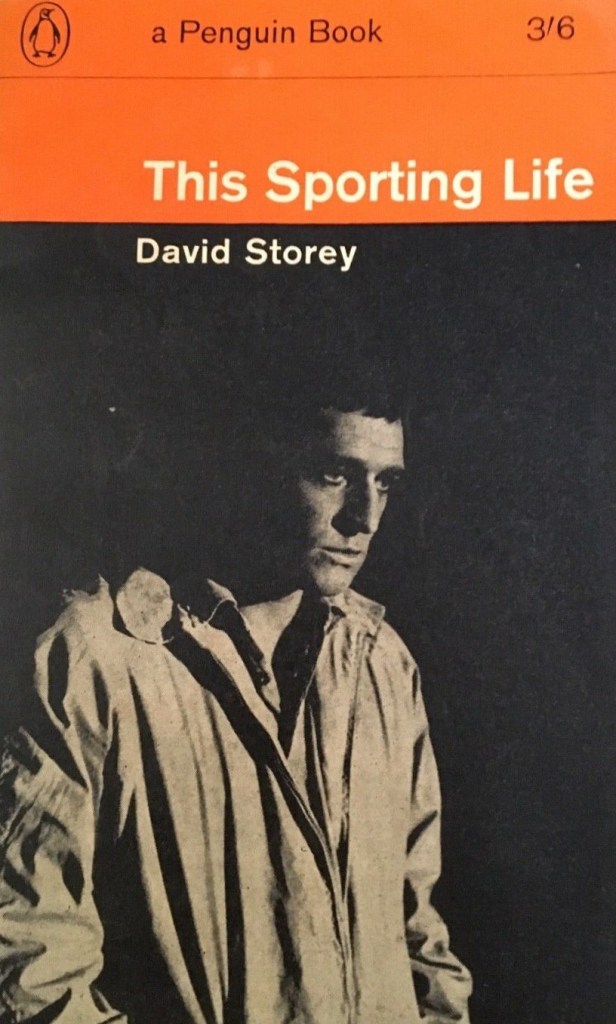
British paperback film tie-in.

Anderson had been attracted to Harris from seeing him in the stage adaptation of J.P. Donleavy’s The Ginger Man.  The director flew off to Tahiti where Harris was filming Mutiny on the Bounty (1962) to be met at the airport at five in the morning by the actor, “ his 18th century seaman’s hair down to his shoulders, bursting to tell me what he thought of the script we had sent him.”

Anderson recalled, “Within ten minutes we were at it…we talked and argued right through the day. I quickly realized he was right…we had lost what was most unique and brilliant in the novel…it was Richard, who, with passionate intransigence, brought us back to the book…in the evening after his shooting on the Bounty we sat in his bungalow going through the script and his own heavily-annotated copy of the novel…and slowly a conception emerged which began to satisfy us.”

Storey agreed with the new look which basically followed a subjective point-of-view rather than being cluttered by the novel’s flashbacks. “With an unequivocal endorsement of the book and the rejection of a script which had wearied me more than I’d imagined, I found rewriting the script in the manner in which the book had been written, from the inside looking out rather than the outside looking in, a surprisingly exhilarating task…Once Richard Harris had become identified with the part …the material was no longer a problem.”

Retaining that subjectivity was Anderson’s biggest issue  An Oxford scholar, he had little innate understanding of Frank Machin’s world and in consequence “was liable to slip into an objective view of scenes that needed to be presented through Machin’s own temperament.” Harris proved instrumental in keeping the director on course.

Rachel Roberts twice turned down the role – Mary Ure (Look Back in Anger, 1959) was also in the frame with four other actresses – and failed to turn up for a screen test. Karel Reisz once commented how odd it was that “the two films that made this great-hearted flamboyant woman best-known (the other being Saturday Night and Sunday Morning) were ones in which she played withdrawn, bleak, ungiving women. Rachel’s great talent was to sink her personality into the part without losing access to her own sensuality. You felt the tension.”

Of This Sporting Life, Reisz added, “She had great doubts about her ability to play Mrs Hammond because she’s a very held back, undemonstrative woman. A passionate person, certainly, but someone who’s turned puritanical through so much constant repression of her feelings. Rachel was afraid of this: she didn’t know out of which part of herself to play the role.”

Lindsay Anderson was as unsure as Roberts: “She didn’t appear to me to be the Mrs Hammond character…Rachel was anything but repressed.” Actress Sybil Williams remembered finding a whole sheaf of notes in Rachel’s script about “the Mrs Hammond character she appeared to be playing so intuitively.” Said Anderson, “Richard Harris was bit awed by Rachel. She could acquit herself with a first-rate reading in just a couple of takes. Richard took a few more to feel he had got it right. Rachel’s security as an actress made him feelmore respectful towards her.”

The scenes between Harris and Roberts were endlessly rehearsed, involving a full 10 days prior to shooting and then during evening and weekends while in production. Roberts was playing a woman “whose feelings, though fierce, are almost continually suppressed: the relationship deepens without self-explanation…through incessant conflict…It called for an actress of exception ‘interior’ quality with real wildness within as well as the capacity for an iron restraint.”

Somewhere in the BBC archive is a programme, never aired, about the making of the film shot for its Monitor arts strand, although Storey was interviewed later on the show by Huw Wheldon, later BBC managing director.

Although Lindsay Anderson only made four more movies, the most memorable being If…(1968), and David Storey never wrote another screenplay, the pair achieved considerable success together when the author turned to writing plays such as Home (1970) and The Changing Room (1971), set in a rugby club.  

If This Sporting Life appears to have two main characters driven by demons, part of the explanation as to how such creatures emerged from David Storey’s imagination can be found in his riveting memoir A Stinging Delight  which traces a core of depression from his earliest days through to the times in later life when he was in and out of mental hospitals. Rachel Roberts also suffered from mental illness and committed suicide in 1980.

SOURCES: Lindsay Anderson, “Sport, Life and Art,” Films & Filming, February 1963, pages 17-20; David Storey, A Stinging Delight (Faber, 2021), pages 217-218, 221-223, 227-231, 233, 240-242; No Bells on Sunday, The Journals of Rachel Roberts, Edited with a documentary biography by Alexander Walker, Pavilion, 1984, pages 37, 55, 56, 58.
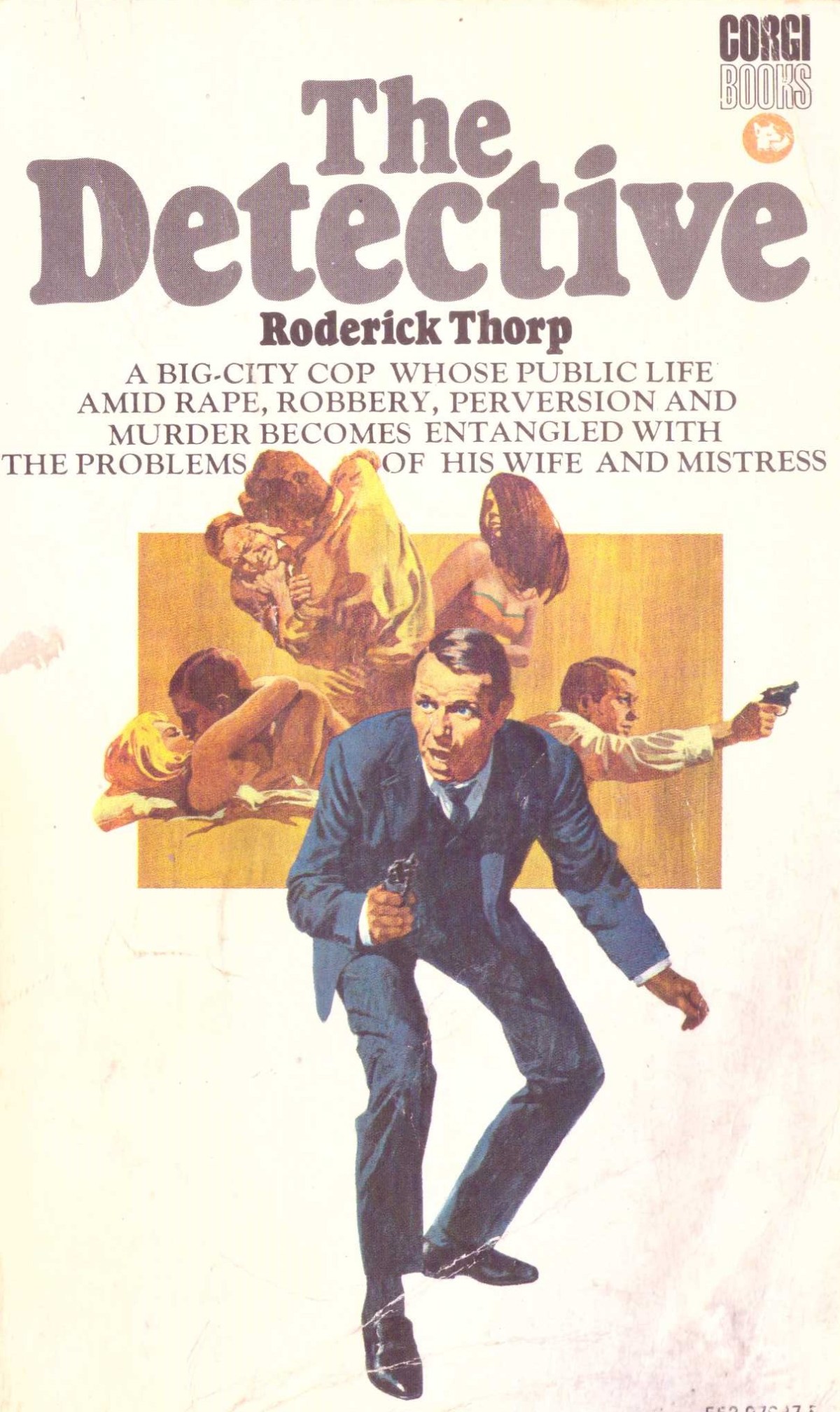
Book into Film – “The Detective” (1968)

Screenwriter Abby Mann (Judgement at Nuremberg, 1961) had his work cut out adapting Roderick Thorp’s tombstone of a novel that ran to over 500 pages. The first job was to make the book – set mostly in the 1940s – contemporary. The book’s fictional locations of Port Smith and Manitou were transposed to New York. Joe Leland was younger in the book – in his mid-30s compared to the 50-plus Frank Sinatra.

And while the principals remained the same, the screenwriter employed some distinctive structural sleight of hand to keep apart the two investigations occupying Leland, the murder of a homosexual and the apparent suicide of a businessman. In the book the first investigation takes place in the past and is told in a long, detailed, flashback, while the suicide case takes up the present. For the film Mann relocated both crimes to the same timeframe, with the suicide simply following on to the murder.

But there was one distinct change. When Leland in the book investigates the suicide, he is doing so as a private eye, not a cop. He had resigned from the force after seeing a criminal sent to the electric chair. A minor alteration was also involved in the suicide case in that the widow Norma (Jacqueline Bisset in the film) was six months pregnant in the book.

More significantly was the swapping over of the sexual characteristics of Leland’s estranged wife (Lee Remick in the film) and the widow. In the film Remick is the nymphomaniac. In the book, it is the other way round, although Norma, after marriage, has that tendency under control.

Although Leland is a decent enough policeman, he makes none of the overt pitches for decency that occur in the film. That is all Abby Mann’s invention. And the scene in the picture where Leland objects to the stripping of a suspect is lifted from another episode in the book, one in which Leland has no involvement. While incorporating minor aspects from the book such as the annoying politician and civic corruption, Mann invented the atmosphere of the police station, the friction between the various cops and Leland’s ruthless ambition.

As I noted in my Blog on the novel A Cold Wind in August (published in 1960), fiction writers had far greater flexibility as regards sexuality than movie makers and Thorp’s 1966 novel reflects that trend. Although the book falls into the category of police procedural, and Thorp himself worked for his father’s detective agency, the sprawling canvas offers as much insight into human relationships as crime and investigative processes.

In some respects this is a textbook adaptation, stripping away the various layers of a dense book to focus on the essential narrative, then both trimming and expanding the main relationships to suit the new plotline. Virtually unspoken in both book and film are Leland’s reaction to the situations that have arisen as a result of his action, not because the writer in either circumstance was dodging the issues, but because both reader and moviegoer could work it out for themselves without introducing melodrama where it was not required.

Book into Film – “The Satan Bug” (1965)

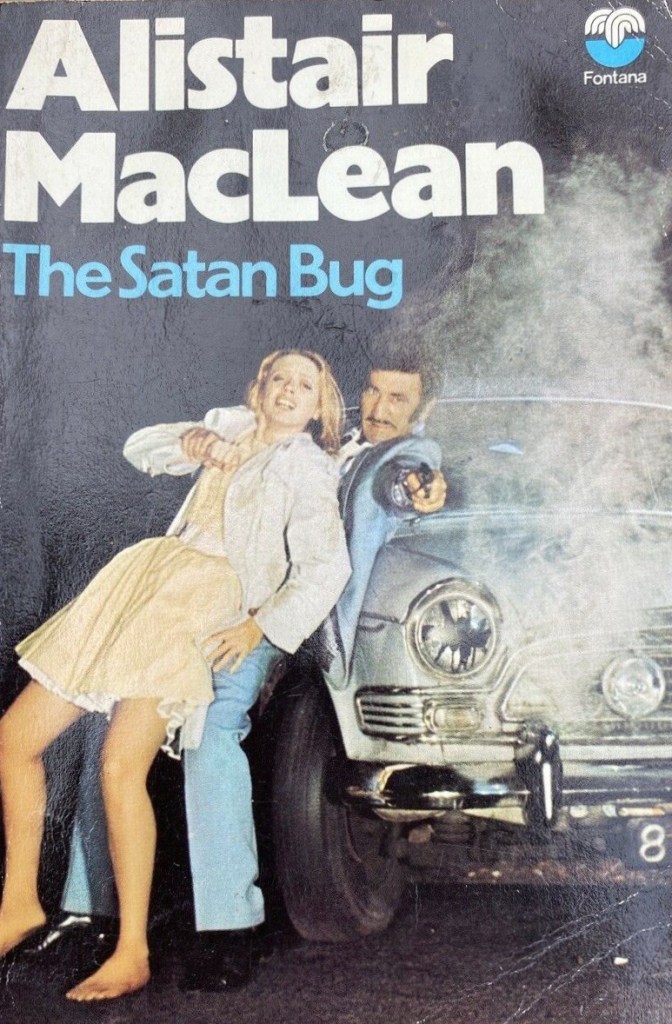
Not unexpectedly, director John Sturges shifted the action of the Alistair MacLean Doomsday-scenario thriller from Britain to the United States and the locale of the secret chemical facility from lush English countryside to desert and from above ground to underground. Not unusually, either, wholesale changes were made to the names of all the characters. The MacLean chief investigator was called Pierre Cavell, but Sturges altered that to Lee Barrett (George Maharis), chief scientist Dr Gregori becomes Dr Hoffman (Richard Basehart), General Cliveden turns into General Williams (Dana Andrews), his daughter Mary becomes Ann (Anne Francis). MacLean’s Cavell was far from the handsome Hollywood hero, walking with a limp and face scarred. Mary is his wife and not, as in the Sturges version, an ex-flame.

More surprisingly, Sturges inserted a 15-minute prologue. The initial scenes taking place at the research facility are pure invention on the part of screenwriters James Clavell (633 Squadron, 1964) and double Oscar-winner Edward Anhalt (Becket, 1964), although drawing on material dealt with as backstory in the original novel. In typical Alistair MacLean fashion, the novel went straight into the action with the attempt to recruit Cavell/Barrett for nefarious purposes, allowing the reader/viewer the chance to learn about his past.  

There are other considerable differences between book and film. In the first place Sturges widened out the action, so that the idea of mankind in complete peril is more obviously cinematically achieved. (In the book a small village is wiped out after a nerve gas attack with London the main objective for the Satan Bug).  In addition, the General plays a greater on-screen role and in some respects controls the manhunt.

But the narrative thrust of film and book go their separate ways. Barrett,a Korean war veteran, operates in standard espionage territory while Cavell is more of an old-fashioned detective, interviewing suspects. While Barrett, with the help of the General, closes in on the suspect responsible for the panic, Cavell had to investigate myriad possibilities before fixing on the culprit.

Perhaps the most important differences are that MacLean’s hero solves the mystery primarily through his own skill while Barrett is less self-reliant. Cavell often informs his mystified superiors that he knows exactly what is going on.  A further departure from the film is that Cavell spots the real reason for the theft of the Satan Bug, realizing it is merely a front for a bigger plot. With the author’s usual audacity this supposes that the villain’s blackmail scheme is simply a method of clearing out central London in order to carry out a series of heists on bank vaults while the city is deserted of all personnel and police.  

However, the heist to end all heists had already being adequately covered in terms of grand larceny in Goldfinger the previous year and Sturges could clearly see the cinematic benefits of an audience fearing the impact of wholesale slaughter rather than worrying whether a James Bond-type hero would survive. Sturges correctly calculated that audiences would respond more to the paranoia pervasive at the time than individual derring-do. In some respects, Sturges created a template for future bug movies that threatened to leave swathes of the population dead such as The Andromeda Strain (1971), The Cassandra Crossing (1976), Black Sunday (1977) and Outbreak (1985). Silent destruction – rather than the devastating fire rained down by invading aliens – also touched on implicit human fears of unknown powers at work and of course is now decidedly contemporary.

The screenwriters did lift complete sections from the book – the initial interrogation of Cavell/Barrett, how the dogs were silenced at the facility, the nerve gas attack on the imprisoned pursuers (in an abandoned gas station in the film, a farm in the book), and Barrett’s insistence that the bad guys take away Ann immediately prior to this attack.

But most of the Sturges film veers so far from the Alistair Maclean blueprint that it relies heavily on the invention of the screenwriters. But it would be interesting to know why they deprived Barrett – perhaps determined to establish him as a loner – of more personal ties for in the novel it is the wife who is endangered not an old girlfriend and the investigator’s best friend is among the casualties at the facility.

The book itself is highly recommended, not just tautly- but well-written. The author’s later books were often a parody of his earlier excellence but this novel, published in 1962, is one of his best and well worth a read.

Book into Film – “Dr No” (1962)

If the screenwriters had faithfully adapted the book it would be death by centipede that faced James Bond in his bed. Never mind that a centipede would be nobody’s idea of a scary creature, the insect would have been impossible to replicate on screen. The idea of a poisonous spider being slipped under Bond’s covers was filched from Honey Rider’s past. In the film she recounts how she killed a rapist with a knife, but in the book she employed a black widow spider.

Nor would the idea of Dr No making his fortune from bird shit (guano) seem to carry much appeal, so that was changed for the film, and that forced an alteration to the ending as well for Ian Fleming has the villain drowning in a pile of guano. And in that context, Strangways’ investigation of the island relates to rare spoonbills (a type of birds) not rocks.

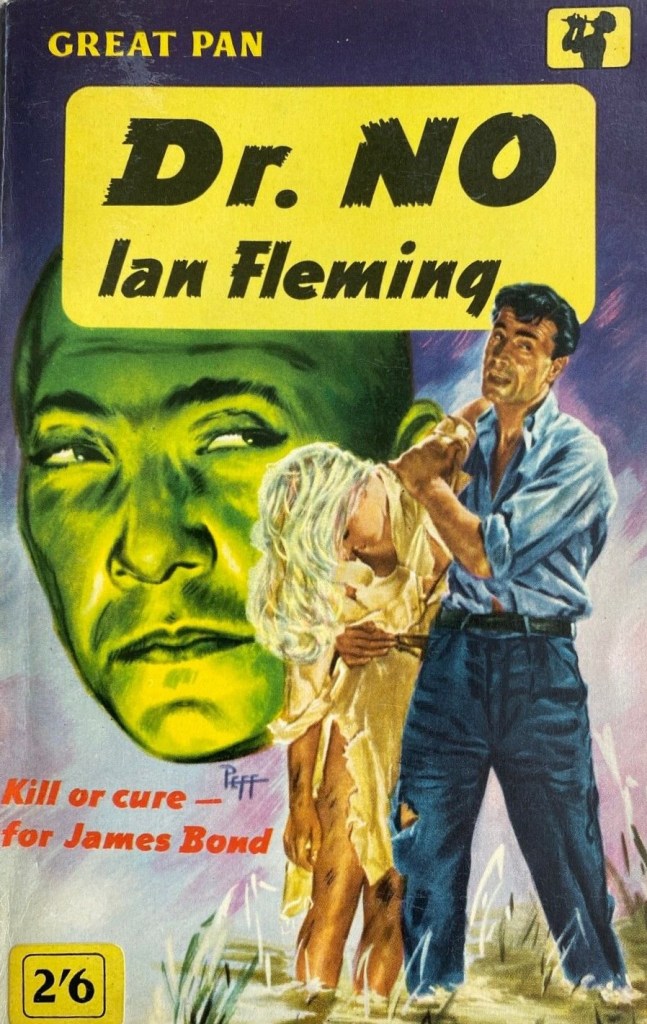
Original British paperback edition prior to the movie being made

So the myriad team of screenwriters –Richard Maibuam (The Day They Robbed the Bank of England, 1960), Johanna Harwood (Call Me Bwana, 1963), Berkely Mather (The Long Ships, 1964), Wolf Mankowitz (The Day The Earth Caught Fire, 1961) and director Terence Young – chopped, changed and invented to turn the sixth James Bond novel into the first James Bond film. In publication sequence, this followed From Russia with Love in which Bond had a particularly dangerous encounter with Rosa Klebb, and at the start of the Dr No episode has been recuperating from being poisoned. The Jamaican mission is seen as something of a convalescence, a way to ease Bond gently back into the field, a trip so lacking in urgency that three weeks have passed since the disappearance of Strangways and his secretary.

Naturally, the scriptwriters have to cut to the chase more quickly than that, hence Bond being despatched immediately. Needless to say, there is no dalliance with a certain Ms Trench, that being a screenwriters invention, along with the scene in the casino, inserted in order to punch up the Bond screen legend. Not only is there no dodgy chauffeur waiting for Bond at the airport but Quarrel is introduced immediately as an ally not an opponent. While the female photographer is a genuine freelance, she does scrape Quarrel’s face with a broken flashbulb and delivers a warning about Dr No.

Bond’s tradecraft extends to closely examining the basket of fruit in his room and sending off samples for analysis, and finding they contain cyanide. But the book contains no Professor Dent, Felix Leiter or Miss Taro, and no other attempts (beyond the centipede) on Bond’s life  so the story in some respects moves more straightforwardly towards the mysterious island.

Original U.S. paperback edition prior to the movie being made

As with the film, Bond arrives on the island with Quarrel. But Honey Rider does not appear in dazzling style out of the waves. Bond first catches sight of her from the back. But she is nude and has a broken nose, two provisos that would not go down well either with the censor or a cinematic audience. Much of their dialogue, including the stuff about learning from encyclopedias comes from the book, but her backstory is completely different. Instead of her father being a marine zoologist, he is dead and her once-wealthy family destitute, leaving her to fend for herself, and considering entering prostitution to make a decent living.

The arrival of Dr No’s speedboat and the ensuing gunfire, the destruction of her boat, the chase and the “Dragon” all come from the book, as does Dr No’s million-dollar aquarium, his steel hand, and the opulence of the prisoners’ accommodation. However, there being no radiation in the plot for the book, there is no requirement for them to be stripped naked once captured.

But in the matter of the clear sexual attraction between Bond and Rider, the book and the film are at variance. In the original Fleming version, Rider, although initially resisting his overtures to the extent of dumping cold beans on his hand, is soon making the running, inviting him to share her sleeping bag, an offer which he rejects. Surprisingly, the usually rampant Bond further resists her allure once inside the Dr No compound on the grounds that he has to “stay cold as ice to have any chance of getting out of this mess.”

The screenwriters come up with completely different plot for the climax while incorporating some elements of the book’s ideas. While Dr No remains the same power-mad maniac, his plan is to turn the island into the most important technical intelligence center in the world with the ability to take control of  U.S. rockets and point them at London.

Deeming Bond and Rider as mere irritants, Dr No intends to use them for a sadistic experiment, pegging out Rider in the path of a swarm of crabs and putting Bond through a terrifying obstacle course. Although Bond does escape through a grille and encounter both heat and water, in the book he also has to cope with a giant tarantula and squid before stealing a crane, sending Dr No to his doom and shooting his way out. 

In the film we briefly see Rider tethered to stakes awaiting the crab onslaught before Bond races to the rescue. But, in reality, in the book Dr No’s assumption that death by crabs would be a terrifying ordeal is somewhat misplaced. As Rider points out, she never felt in any danger because crabs are simply not carnivorous. But both book and novel are agreed – they do have sex at the end.

While the screenwriters use elements of the book it is primarily their inventions that turn the novel into an instant screen classic, defining Bond for generations to come. You can almost count the action beats, whether a chase or a fight or mere confrontation, with sex or humor providing welcome respite, but all moving in the same direction of creating a feel for a new type of character and a new kind of film.

Book into Film – “The Cincinnati Kid” (1965)

Richard Jessup’s brilliant 1963 novel was so short – barely 150 pages – it was almost custom-made for the movies. While it built up the tension to the confrontation between young stud poker contender The Cincinnati Kid (Steve McQueen in the film) and the reigning world champ Lancey Hodges (Edward G. Robinson) and covered the on-off relationship between the Kid and Christian (Tuesday Weld), a large chunk of the novel was in effect an insider’s guide to the world of poker and its unwritten rules.

As appeared always to be the case in translating novels to films, there were some incidental changes. The Kid was 26 in the book, but clearly in his 30s in the film. Lancey’s surname became Howard. In the book he was thin, in the film well-upholstered. Melba (Ann-Margret), the girlfriend of Shooter (Karl Malden) is not given a name in the book. The book is set in St Louis, the film in New Orleans.

But the book lacks sub-plots. It’s a straightforward narrative. The Kid decides to take on Lancey and while waiting for the game to be fixed up, having effectively broken up with Christian, he takes a 20-hour bus journey out to see her at her farm, returns on his own and for the rest of the book is involved in the poker duel with Lancey. Incidental characters make an appearance, Shooter as the dealer, some others including Pig (Jack Weston) making up the poker table.

The book doesn’t open with the Kid hustling, playing in a run-down part of town against inferior players, being accused of cheating, getting involved in a punch-up and being chased across a railroad yard. That’s all the invention of the scriptwriters Terry Southern (Barbarella, 1968) and Ring Lardner Jr. (Mash, 1970). The young shoeshine boy who interacts with the Kid several times throughout the movie doesn’t appear in the book either. And there was no cockfight in the book, that was also added by the screenwriters.

These were small devices to develop screen character. The punch-up showed that the Kid could take care of himself. The scenes with the shoeshine boy suggested that the Kid had begun early as a compulsive gambler, always measuring himself against an older player. And those scenes also demonstrated that gambling was not a sport for the kind-hearted. An actor with less confidence in his screen persona than McQueen might have insisted that he did not take the boy’s losing bet. (Such considerations are not rare – Robert Redford, for example, refused to play lawyer Frank Galvin in The Verdict unless the character was changed from being an alcoholic). The cockfight revealed that the characters mostly lived in an illegal world – the cops might turn a blind eye to a poker game in a private room in a hotel but would frown upon a bloody and brutal sport like cockfighting.

Sometimes, the screenwriters had to embellish certain scenes to bring them alive. The sequence where the Kid won over Christian’s parents with his card tricks is nothing more than a sentence in the book and characters like Pig are fleshed out.

But the most significant alterations to the book were the additions of two sub-plots. The first had Shooter, while acting as dealer, risk his reputation by agreeing to flip the Kid an occasional good card. This comes from being blackmailed by wealthy businessman Slade (Rip Torn) who threatens to call in Shooter’s marker, his gambling debt. Not only is this idea a screenwriter creation, but the character of Slade does not exist in the book. In fact, the whole idea runs against the unwritten code of honor among big-time poker players. And it would be extremely unlikely that Shooter would stoop so low. Even if broke, he would be able to eventually win back a stake. But if caught facilitating cheating his name would be mud and he would never play poker again in his life.

The second sub-plot concerns Melba (Ann-Margret). She exists on the periphery in the book. But she is something of a character, a genuine class act among the women who follow the game or are in relationships with the players. In the book, she was believed to have had a college education because “she read thick books and she dressed New York”  and she attended arthouse cinemas. She was also admired for sticking with Shooter when his luck turned bad.

That’s not the character in the film. While not a gambler per se, she has a competitive streak and cheats at ordinary games – solitaire, jigsaw puzzles – where it makes no sense to cheat. In the book she is merely “beautiful;” in the film she turns into a man-eater, seducing the Kid, an action that went against her character in the book.

You would harldy argue that these sub-plots impaired enjoyment of the film. Perhaps those who read the  book first might object. But, as ever, in examining what happens to books once they are bought up for the movies, each film examined is an example of the difference between a book and a film and how screenwriters compensate for perceived flaws. Some books, Blindfold, for example, required wholesale changes. Here, while the key storyline works like a charm, what was missing were the extra beats to ramp up the tension, otherwise there would be too long a wait in hanging around for the poker game to start. As a result of the sub-plots, what is put in jeopardy is the Kid’s relationship with Christian and his purity of involvement in the game itself, not just that any hint of cheating would bar him from the game, but that he wanted to beat Lancey fair and square so that, should he achieve that ambition, he would never have cause to doubt how he managed it.

Bestseller Hollywood, Part Three – Novelizations

Novelizations were the hidden secret of 1960s Hollywood. While the decade is better known for widescreen 70mm roadshows, James Bond and the spy deluge, the musical and western revival and the start of the American New Wave, the novelization revolutionized the way films were marketed. By the end of the decade virtually every film released was accompanied by a book tie-in, either a bestseller sold to Hollywood, or a film script turned into a paperback / soft cover book.

At the start of this boom, around 1960, studios virtually gave away screenplays to publishers and allowed them to turn them into novels in return for the marketing angle they could provide.  “Producers looked at tie-in books primarily as an exploitation aid not a source of income,” explained Patricia Johnson of paperback specialist Gold Medal Books in 1962. “Motion picture companies with no  more – and often much less – than a rough script are being besieged by droves of publishers vying for the right to novelize original scenarios.”

The novelizations were usually short – about 60,000 words – and therefore attractively priced for the reading public but they could sell as many as half a million copies. But except in particular circumstances, studios allowed the rights to go to publishers for minute amounts of money. And for one simple reason – marketing. Half a century before social media, there was little advance promotion of movies. The week they were about to be released would see a flurry of advertising, but in general little promotion before that. Even journalists who had attended the press junkets I mentioned in a previous Blog would concentrate their articles into the week of release.

“What a publisher does for a film concern,” said Johnson, “is it creates a nationwide market, a popular anticipation of a film before it would ordinarily be more than a vague glimmer in the public consciousness.” The 125,000 outlets for books included not just bookstores but locations that targeted passing trade with extensive foot traffic. Newsstands in the street, hotel lobbies, railroad stations, department stores, airports and drugstores all boasted racks of paperback books with glossy covers, informing potential moviegoers of forthcoming films. Studios wanted to take advantage of the promotional device that bestsellers turned into movies could generate. For studios they represented an early marketing tool. Incorporating the movie advert or photos of the stars raised awareness of a forthcoming picture long before the first advert had appeared in a newspaper or billboard.

Robert Bloch cashed in on his “Psycho” fame to turn his original screenplay for The Couch into a novel.

One of the earliest novelizations was for Rat Pack heist picture Ocean’s 11 (1960) – pictured at the top of this page – and it showed the format to which publishers readily adhered. As you might expect, the cover featured a still from the movie incorporating the main stars, but there was also, by dictat of the Writers Guild of America (the screenwriters union), mention of the original scriptwriters in the same size of typeface as the authors who had carried out the novelisation.

Very rarely did the original screenwriter undertake this task. For a start, most considered it beneath their dignity. But, secondly, they got paid anyway. The screenwriter automatically received one-third of the fee a publisher paid the studio and the same share of royalties. By the mid-1960s the WGA was negotiating for a set fee of $6,000 (about $50,000 equivalent now) so a nice amount for no work but less appetising for a full-time screenwriter to do the whole job.

Bellah’s novel “The Valiant Virginian” was the inspiration for the TV series “The Virginian.”

But there were exceptions. Robert Bloch decided to turn his original screenplay The Couch (1961) into a novel. But then he had the experience of Psycho (1960) behind him. Prior to the 1960 Hitchcock film, his novel had only sold only 4,000 copies in hardback. The success of the film shifted 500,000 copies in paperback. Bloch must have reckoned his name emblazoned on the cover – and gaining sole credit, fee and royalties – would be more financially beneficial. Western author James Warner Bellah undertook the novelizations of his screenplays for Sergeant Rutledge (1960), A Thunder of Drums (1961) and The Man Who Shot Liberty Valance (1962).

But neither would have been as assiduously wooed by publishers as the team of Arthur C. Clarke and Stanley Kubrick who were jointly credited for the novelization of 2001: A Space Odyssey.  An extremely unusual aspect of this deal was that the novelization appeared first as a hardback. Although based on a Clarke short story, and despite the fact that Clarke was considered one of the greatest names in science fiction, on the writing side movie and book were promoted as joint efforts. Delacorte-Dell forked out a $150,000 advance for the hardback with a 15% royalty rate. Clarke/Kubrick refused to allow the hardback publisher a share of the paperback spoils for which they negotiated a 12-15% royalty, way above the norm.

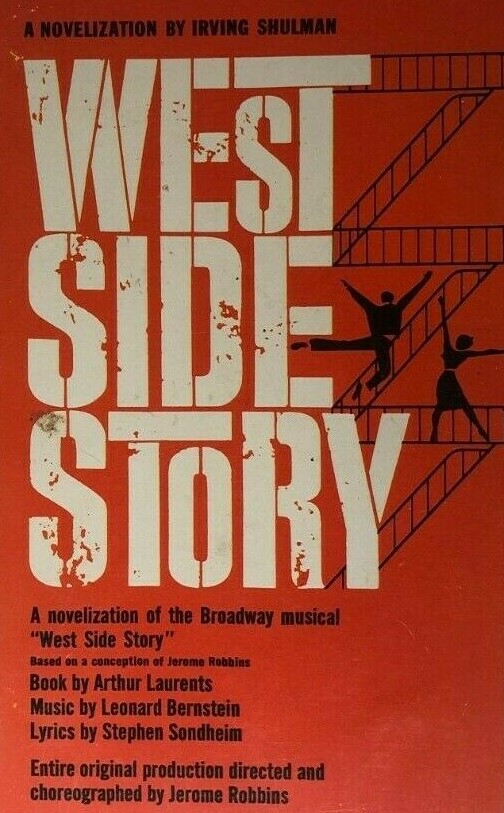
Note how many credits for the original musical were carried on the cover.

Occasionally the novelization would be undertaken by an author famous in their own right, such as when another sci fi giant Isaac Asimov took on the task of writing the book based on the script of Fantastic Voyage (1966). Famed western writer Louis L’Amour was handed the novelization of James Webb’s script for How the West Was Won (1963). Irving Shulman was a well-known novelist when called upon to turn West Side Story (1961) and The Notorious Landlady (1962) into novels. Screenwriter Adela Rogers St John (The Girl Who Had Everything, 1953) novelized King of Kings (1961). Sci fi writer Robert W. Krepps churned out novelizations for historical epics El Cid (1961) and Taras Bulba (1963), comedy Boys Night Out (1962) and westerns Stagecoach (1966) and Hour of the Gun (1967). Crime writer Jim Thompson novelized James Lee Barrett’s script of western The Undefeated (1969).

Some who took the novelization coin later made their name as bestselling authors in the own right. Marvin H. Albert – later known for the “Tony Rome” private eye novels that were filmed starring Frank Sinatra – was a relatively unknown journeyman writer when he became the go-to author for comedy novelizations, lending his name to the books of Come September (1961), Lover Come Back (1962), Move Over Darling (1963), The Pink Panther (1963), The Great Race (1965) and Strange Bedfellows (1965). Similarly, David Westheimer, a year before he published the bestselling Von Ryan’s Express, knocked out the book of Days of Wine and Roses (1962) from the J P Miller screenplay.

But mostly the novelizations were produced by journeymen such as Richard Wormer (Operation Crossbow, 1965), Alan Caillou (Khartoum, 1966), Ed Friend (Alvarez Kelly, 1966), John Burke (Privilege, 1967), Richard Meade (Rough Night in Jericho, 1967), Ray Gaulden (Five Card Stud, 1967), Jackson Donahue (Divorce American Style, 1967), Michael Avallone (Krakatoa-East of Java, 1968) and Joseph Landon (Stagecoach, 1966).

Publishers were not above picking over the spoils of decades-old scripts. Borden Deal was hired to novelize an un-made 1933 script written by Theodore Dreiser, author of An American Tragedy; Johnny Belinda (1948) was novelized in 1961. There were other departures. When writer-director S.Lee Pogostin received a $10,000 advance to novelize his own Hard Contract (1969) the book that appeared comprised the original script with stage directions and filmic addenda, in part due to the success of Butch Cassidy and the Sundance (1969) which was published as a screenplay rather than being novelized.

No genre was safe. Even musicals were plundered for their appeal to the book-reading public or for moviegoers wanting another way of reliving the film they had seen or getting a flavor of a picture they might consider seeing. As well as West Side Story and The Music Man (1962), there were novelizations of My Fair Lady (1964), Funny Girl (1968) and Paint Your Wagon (1969), an unexpected bestseller thanks to Clint Eastwood and Lee Marvin on the cover.

It wasn’t all plain sailing. Hollywood was notoriously lax when it came to release dates, the opposite of the publishing industry for whom such dates were sacrosanct. So a publisher could have put a great deal into organizing the delivery of hundreds of thousands of copies of a novelized title into over a hundred thousand outlets only for the book to molder away on the shelves waiting for a movie which arrived months late – or never at all. Or the movie might undergo a last-minute title change leaving publishers trying to flog a picture nobody had heard of.

SOURCES: “3-Yr Advance Campaign for King of Kings,” Hollywood Reporter, July 5,1961, p2; “Book Notes,” Hollywood Reporter, October 27, 1961, p9; “Book Notes,” Hollywood Reporter, December 5, 1961, p11; Patricia Johnson, “Ego, Yes, Indecision Often, But Love That Hollywood,” Variety, January 10, 1962, p42; “How the West Was Won with L’Amour,” Hollywood Reporter, January 26, 1962, p10; “Book Notes,” Hollywood Reporter, December 5, 1961, p11 “Book Notes,” Hollywood Reporter, January 17, 1962, p7; ; “Willson Novelizing Script,” Hollywood Reporter, February 5, 1962, p3; “Book Notes,” Hollywood Reporter, April 3, 1962, p8; “Book Notes,” Hollywood Reporter, August 15, 1962, p7; “Roger Lewis, Phil Langner and Corp Ready Garrick Production Slate,” Variety, November 13, 1963, p19; “Crossbow Books Tie In with Picture Release,” Box Office, May 31, 1965, pA2; “Stagecoach Screenplay To Become Paperback,” Box Office, March 14, 1966, pA1; “Signet Print Paperback of Cinerama Khartoum,” Box Office, June 13, 1966, pA1; “Divorce American Style Film and Book Tie-Up,” Box Office, June 20, 1966, p12; “Inside Stuff – Pictures,” Variety, August 10, 1966, p24; “Anti-Brush-Off of Writers,” Variety, November 16, 1966, p11; “Gold Medal Books to Print Alvarez Kelly Paperback,” Box Office, September 12, 1966, pA1; “Four Paperbacks Are Set On New Universal Films,” Box Office, September 19, 1967, pA2; “Sci Fi Award Goes To 20th-Fox for Voyage,” Box Office, September 26, 1966, pSW2; “Paint Your Wagon Set for Novelization,” Box Office, October 6, 1969, pA2; “The Undefeated Is Now Available in Paperback,” Box Office, November 3, 1969, pA2; “Inside Stuff – Pictures,” Variety, January 1, 1969, p23; “Advertisement, Krakatoa East of Java,” Box Office, November 17, 1969, p13-18; “Wagon Tie-In into Second Printing,” Box Office, December 1, 1969, pA2; “Marooned Printed in Paperback,” Box Office, December 15, 1969, pA1.

Book Into Film – “She” (1965)

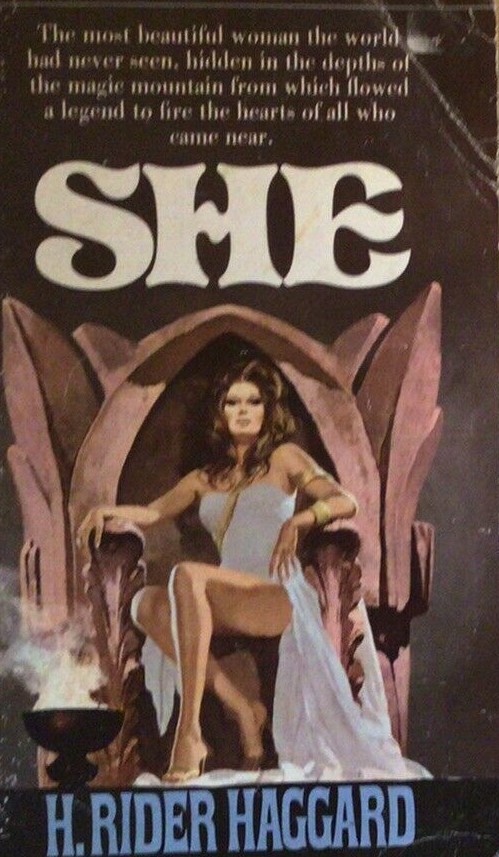
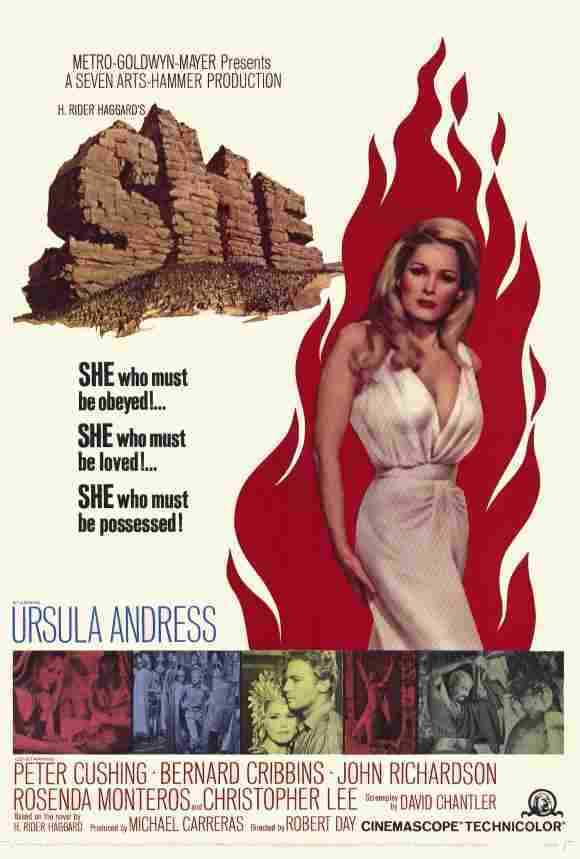
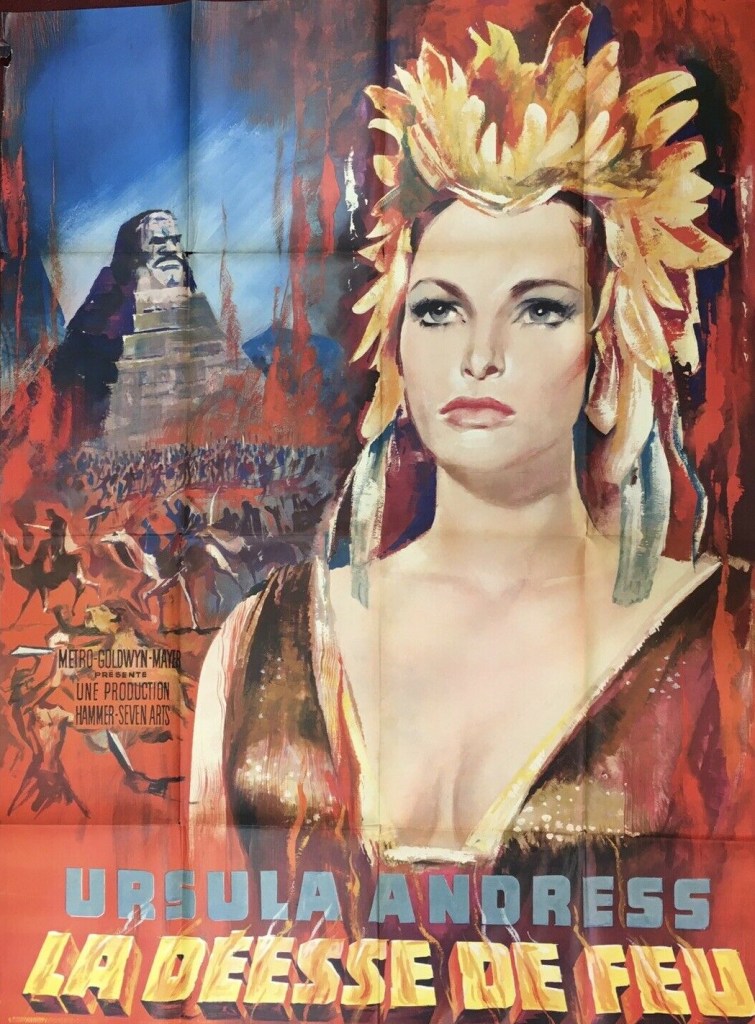
Hammer made a substantial number of changes for its version of She. For a start, H. Rider Haggard’s novel was published in 1886, three decades before the time in which the film which took place at the end of World War One.  While the three main characters – Horace Holly (Peter Cushing in the film), his manservant Job (Bernard Cribbins) and the younger Leo (John Richardson)  – remain the same, their relationships are significantly different, in that in the book Holly is the legal guardian of Leo.

The book is far more Indiana Jones than sheer adventure, the journey into the unknown instigated by a piece of parchment and a translation of a potsherd from the fourth century B.C. In the film the spur towards the journey into the unknown is a vision. But in the book the adventurers already know before they set off that ancient Egyptian high priest Kallikrates found Ayesha and the sacred flame and was killed by her because he loved another.

Unlike the film the book has no trek through the desert either which renders them hungry, thirsty and exhausted and leads to visions of Ayesha for Leo. Instead, they are shipwrecked. And their peril comes from swamps and wild animals such as lions and crocodiles. In fact, the filmmakers clearly resisted the opportunity to include one of the tropes of jungle adventure, namely a wild animal battle, in this case crocodile vs. lion, which was a feature of the book.

While they shoot a water buck for food, nonetheless they do later face exhaustion, only rescued by the sudden appearance of an Arab, who mentions She-Who-Must-Be-Obeyed and arranges for them to be transported in litters to a mysterious land in the heart of African darkness. This land is rich and fertile, with herds and plenty of food.

Two important elements introduced here shape the book but are ignored in the film. The first is that Leo, seriously ill at this point – and not capable of being strung up for the movie’s sacrifice –  remains ill  for the rest of the book so that it is Holly who enjoys most of the encounters with Ayesha. Secondly, and a rather advanced notion for the times, the women in this country are independent, neither considered chattels nor subordinate to men, and are free to choose their own lover. But it is only now that Leo meets Ustane (Rosenda Monteros) rather than in the film which brought them together almost immediately.  Here, they also meet Billali (Christopher Lee) whom Holly rescues from a swamp.

With Leo still ill, it is Holly who first encounters Ayesha, who dresses as she will in the film, in a gauzy white material. In the writer’s eyes her beauty lay in her “visible majesty” as well as more obvious physical features, which could not be dwelt on at such length in a Victorian novel. Holly falls in love with her on the spot, even though he is “too ugly” to be considered a potential suitor, and learns of the fate of the earlier Killikrates and also catches a glimpse of her bemoaning her fate, imprisoned in immortality for two thousand loveless years.

“It is hard for a woman to be merciful,” proclaims Ayesha as she puts to death the villagers. Throwing them down the pit was invented by the screenwriters. By this point Leo is nearly dead and only saved by a phial administered by Ayesha. She also decrees that Ustane must die because “she stands between me and my desire.” In the film it is Leo who intervenes to attempt to save Ustane. But in the book it is Holly. He blackmails Ayesha, threatening to reveal her secret, that she had killed Killikrates in the past. Ustane claims she has taken Leo as her common-law husband. Ayesha promises to spare Ustane if she will give up her claim to Leo and go away. But Ustane refuses. In the book, there is an astonishingly visual and terrifying scene where, in revenge, Ayesha claws at Ustane’s black hair, leaving there the imprint of three white fingers. 

It is the film that introduces the element of palace intrigue, with rebellious subjects and Billali believing he is entitled to immortality. That is not in the book.

When Leo finally wakes up, he is reunited with Ustane, but Ayesha catches them and kills Ustane, not by throwing her down the pit, but by her magic power. Despite being appalled, Leo cannot resist Ayesha. Even so, he is fully aware of his predicament, believing he has been “sold into bondage” and forced to love a murderess. But when she enters the sacred flame – naked, it has to be said, in the book, which was an exceptionally daring image for that era – she dies.

Holly in the book is more a narrator than a protagonist and shifting the emphasis more squarely back to Leo suits the film’s dramatic purpose. There was no real reason the film could not have followed the thrust of the book except that it would perhaps cost more costly to bring a jungle and swamps  to life than a desert and arid mountains. More importantly, perhaps, was the need to introduce the physical Ayesha more quickly than in the book.

It is worth pointing out that the concept of She-Who-Must-Be-Obeyed was not so alien to British readers. After all, when the book was published, the country was ruled by a woman, Queen Victoria. And although democracy had reduced elements of her absolute power, the people still had to bow down before her. In addition, the British celebrated the rule of a previous female monarch, Queen Elizabeth I, who had been an absolute ruler, in the days before there was any notion of democracy and Parliament, and in those days anyone who opposed such a figure was liable to meet as swift a death as that meted out by Ayesha.

She (1965) ****

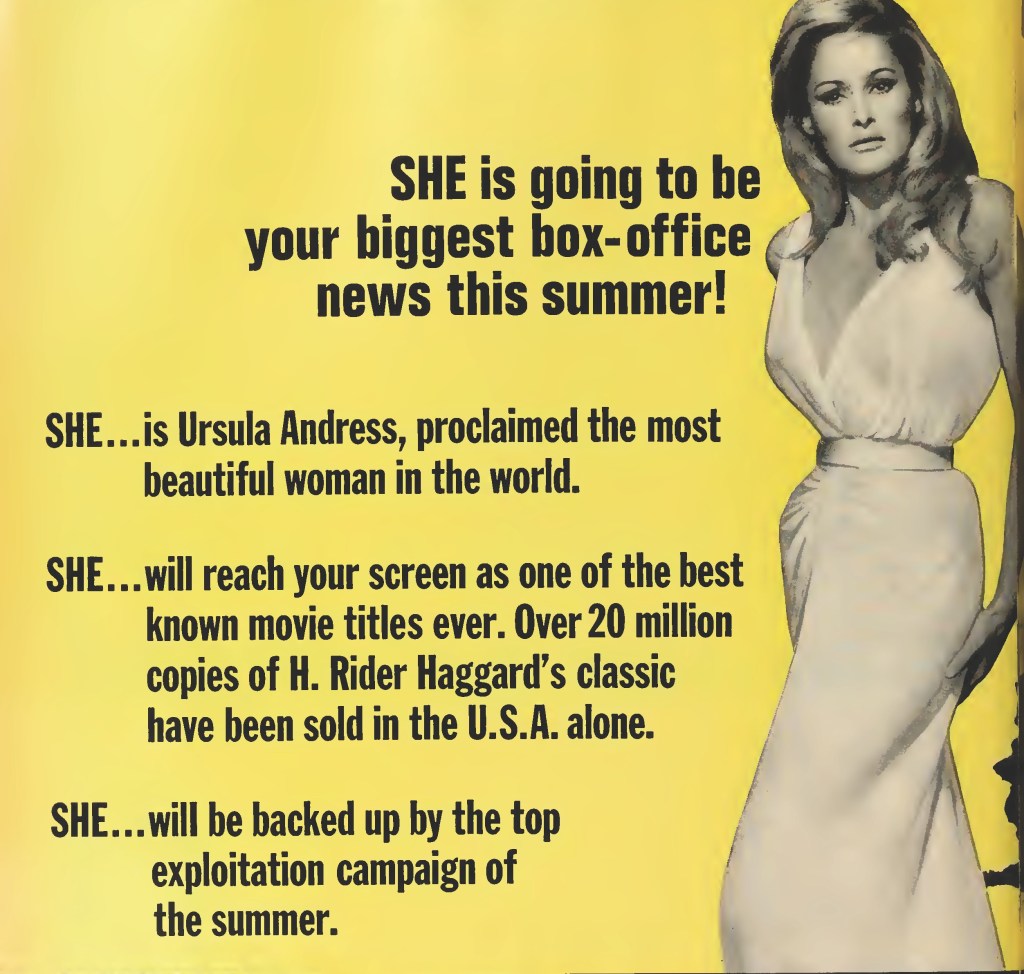
Ursula Andress certainly knows how to make an entrance. Emerging out of the sea in a bikini in Dr No (1962) proved a Hollywood calling-card but failed to put her center stage. She fixed that with She and dominates this superior adventure hokum. Studio Hammer lucked into a solid piece of storytelling, a classic, and all it had to do – with the help of a bit more finance than was usual for their productions courtesy of MGM – was not muck it up.

Three soldiers are celebrating the end of the First World War in a Palestinian night club and while archaeologist Holly (Peter Cushing) and his bowler-hatted valet Job (Bernard Cribbins) are tripping the light fantastic with belly-dancers, blond-haired Leo (John Richardson) is seduced away by Ustane (Rosenda Monteros) because he bears a stunning resemblance to an ancient medallion. Encountering a vision of Ayesha (Andress) he is urged to embark on a dangerous journey to the lost city of Kuma where she awaits.  

Despite the theft of their camels and loss of water, the trio trek exhausted across desert and mountains, Leo sustained by his vision, by the fact that he seems to know the way and with the assistance of Ustane. But a savage tribe reckon Leo would make an ideal sacrifice to the gods. Just as the tribe are driving themselves into ritualistic frenzy, high priest Billali (Christopher Lee) comes to the rescue, escorting the explorers into Kuma.

The regal Ayesha is as beautiful in the flesh as in the vision, but more ruthless, condemning slaves to a terrible death for disobedience and, noting the attraction between Leo and Ustune, planning also to rid herself of her rival. Leo’s arrival will fulfil an ancient prophecy with the Englishman attaining immortality, and he seems to be able to “float through the sea of time” and remember events from two thousand years ago. However, Ayesha has a dubious past, providing one of several unexpected twists.

Most films of this sub-genre rely on improbable mumbo-jumbo and are loaded down with wearying amounts of exposition. But here is nothing but clarity, the ancient backstory tale told with minimum visuals and verbals and the intellectual sparring between Holly and Ayesha on the one hand and the archaeologist and the high priest on the other are intelligently-put, presenting opposing options for the development of civilisation, absolute monarchy vs. democracy and immutability vs. change.

But that takes place within a highly-charged drama, the enfolding romance between Ayesha and her chosen man both touching and perilous, while the battle for the life of Ustane is brilliantly presented. Lack of reliance on special effects and art direction  utilizing the MGM millions – the mountain-sized statue outside Kuma (prefiguring perhaps Game of Thrones) and the set for Ayesha’s room especially magnificent, as is her golden crown – prevents the picture falling into the camp camp. Instead, it emerges as an adventure classic.

Ursula Andress (4 for Texas, 1963) is stunning, every inch a goddess and yet believably mortal. Her looks tended to mask her abilities and while she rarely received credit for her acting she holds her own in some redoubtable company. John Richardson (Black Sunday, 1960) doesn’t quite step up and remains more a creature of adoration. But the supporting cast more than compensates. Peter Cushing (The Skull, 1965) has had a persona transplant, replacing his normal grim demeanor with fun and enthusiasm, not lacking courage where required, and delivering a very fine performance. Bernard Cribbins (Crooks in Cloisters, 1964) provides the humor. And we still have Christopher Lee (The Gorgon, 1964), filled to bursting with self-entitlement, in malevolent form, Andre Morell (The Vengeance of She, 1968) and Rosenda Monteros, scandalously under-used in films since The Magnificent Seven (1960). It’s interesting to see Cushing and Lee, who dealt with immortality in the Dracula series, engage in conflict without coming to blows.

Director Robert Day (Tarzan’s Three Challenges, 1963) keeps up a brisk pace at the same time as focusing on character and provides Hammer with a marvelous adventure template for the future.  Five features and two shorts had already been adapted from the H. Rider Haggard classic, but the last was in 1935, starring future U.S. House of Representatives member Helen Gahagan. This version presents the best shot at visual interpretation of the classic.

Catch-Up: Ursula Andress was reviewed in the Blog for 4 for Texas (1963), The Blue Max (1966) and The Southern Star (1969). Christopher Lee pictures already reviewed are: The Devil-Ship Pirates (1964), The Gorgon (1964), The Skull (1965), The Brides of Fu Manchu (1966), Five Golden Dragons (1967) and The Curse of the Crimson Altar/The Crimson Cult (1968).

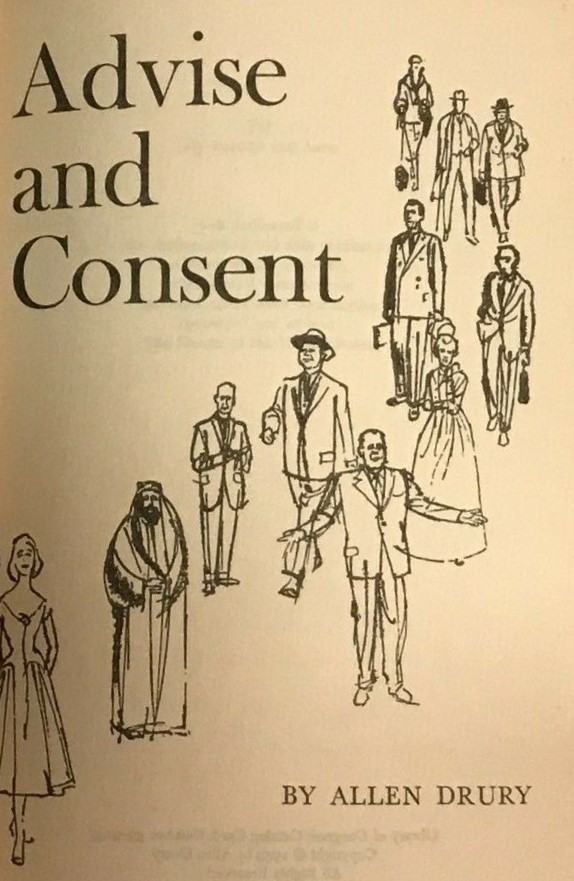
Book into Film – “Advise and Consent” (1962)

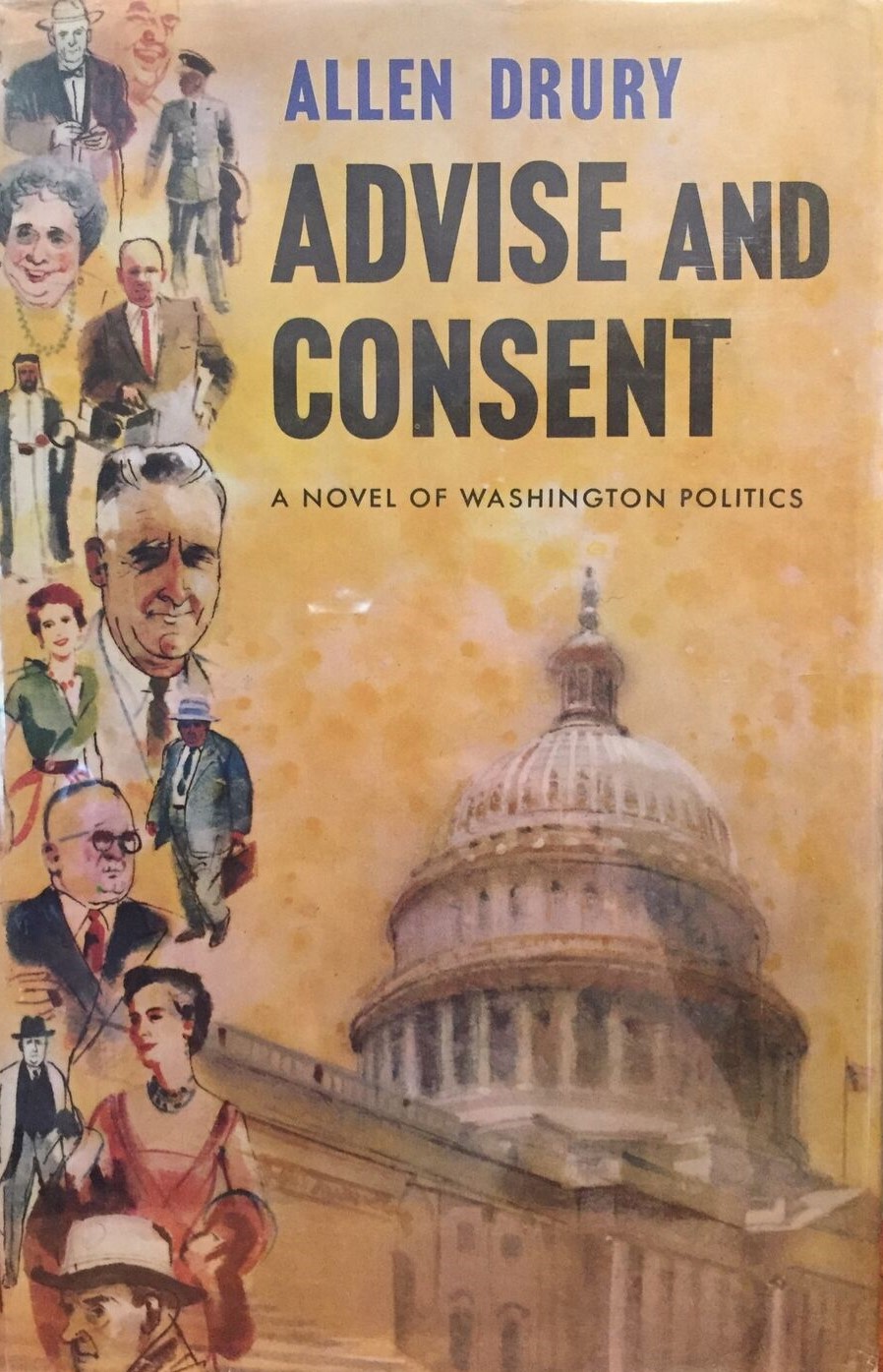
While Otto Preminger could be quite intemperate on the movie set, he actually toned down the novel on which Advise and Consent was based. He considered author Allen Drury an “arch-conservative.” So from the outset the film takes a more moderate approach. Where Drury named the U.S. enemy as the Soviet Union, Preminger stuck to the more generic communists. it was a different story when he was trying to set up a picture. Not only did the director cut down on the obvious anti-communist stance but veered away from taking a moral high ground.

In any case, there was a great deal that required to be eliminated- especially from a novel that clocked in at 600-plus pages. For example, the Leffingwell story is effectively dealt with 100 pages before the end of the book.  

More importantly, Preminger made the main character Leffingwell (Henry Fonda) more sympathetic. In the book, he is more of a typical politician, able to talk his way out of anything and proud of such a skill. Various scenes, not in the book, were inserted to make Leffingwell more principled, the main addition being the sequence where the politician confesses to the President (Franchot Tone) that he had lied about previous Communist affiliations. In the book Leffingwell and Van Ackerman (George Gizzard) are allies, but not in the film. More importantly, to rack up the tension, the book has Leffingwell easily defeated in the vote, whereas there is deadlock in the film.

It would have indeed been casting against type had Fonda played Leffingwell as outlined in the novel and the Preminger presentation he has a presidential stature and unusual humility for a politician.

Narrative simplification was also necessary. Van Ackerman carries the blame in the film for the blackmail scheme, but in the book this involves a greater conspiracy. Drury portrays Ackerman as a fairly villainous character with severe personality malfunction but the film treats him in more rounded fashion. Orrin Knox (Edward Andrews), one the book’s main characters, was marginalized in the film.

Preminger added scenes relating to the homosexuality of Brig (Don Murray) in an effort to give the character greater depth and to clarify his motivation and especially to ensure his suicide was a result of his internal conflict rather than the blackmail, as was the case in the book. The letter at the end makes no judgement on him.

Drury tended to show his characters in black-and-white, so that instead of a muscular and inflammatory critique of the politicians, with all their chicanery, but Preminger allows the characters to speak for themselves rather than setting them up to be shot down by an audience. As I mentioned in my review of the film in the Blog, many of the politicians engage in verbal duels and present themselves not so much as cocky but confident, not so much smarmy as charming. Here, the actors are encouraged to become performers without their performances degenerating into ham acting.

As congressional correspondent for the New York Times, Drury had an intimate knowledge of the political scene and it is no surprise that each character in the book was modelled on an existing politician – even the blackmail story was drawn from a real-life incident.. By removing much of the party politics in order to concentrate on the main central issues, and by allowing the actors great freedom with their roles, Preminger was able both to humanise the characters and also ensure they were not easily recognizable as current or past politicians.

As in other films, Preminger set to out create a picture about  a moral issue, not one where there is a right way and a wrong way, although the governing party is shown to be generally uncompromising when it comes to dealing with anyone who steps out of line.

In a film that could be easily have been dogged by dialogue or argument, Preminger’s free-flowing camera movement ensures there is a sense not just of excitement and exhilaration but forward movement. Perhaps this film demonstrates more than nay other the director’s mastery of cinematographic techniques.

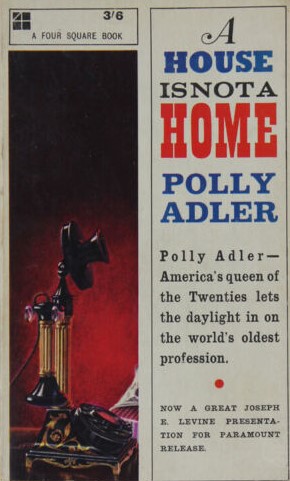
Book into Film – “A House Is Not A Home” (1964)

Hollywood biopics tended to follow one of two routes – overcoming circumstances or falling victim to circumstances. Polly Adler’s autobiography A House Is Not A Home fitted into neither category. It was more of a survivor’s guide and if there was any element of triumph it was within an unsavory profession and one that sailed too close to the nether worlds of the Prohibition gangster.

The film stuck to a shorter time frame than the book, kaleidoscoping certain events and characters, highlighting an inevitably impossible romance and adding a gangster subplot, while acting as an expose of civic corruption, cops especially rubbing their noses in the financial trough.

Dramatic license is taken throughout the film, for example Adler (Shelley Winters in the film) was not rescued in the book by future lover Casey Booth (Ralph Taeger), who was in any case a pseudonym, but first met him when he drank himself unconscious in her brothel. Lucky Luciano (Cesar Romero) makes only a brief appearance in the book. Both film and book skip present Adler as businesswoman first and victim second.

Adler’s unflinching attitude to the business is core to both book and film but inevitably a movie made in Hollywood in the mid-1960s enjoyed less freedom in matters relating to sex than a book published a decade before. In some respects it’s a shame that the film was shot  in such prohibitive times. Had it been made today either as a movie or mini-series it would have had a more decent chance of telling a better story and bypassing the pressing issues of morality, as was the case with Molly’s Game (2017), another true story, about a woman heading up a multi-million-dollar illegal gambling racket.

The book tells a fascinating story and casts a light on troubled times. Adler came to the U.S. as an immigrant at the age of 13, was raped by her workplace supervisor, thrown out of her home and went into the pimping business by accident before setting up her own brothel. But she did quit and operated instead as a lingerie retailer before being duped out of her savings. Thereafter, back in the sex worker business, she made a point of hiring only the most beautiful girls and her career path  demonstrated a fascinating understanding of business, especially her grasp of marketing, as she moved from the gangster world into high society.

There were busts along the way and she went out of business for over a year when implicated in the Seabury vice investigations of 1930-1931 and for a time afterwards was bankrolled by gangster Dutch Schultz. And although Adler worked her way up to notable personality and enjoyed the attention of artists and members of high society who used her premises almost as a salon, she did not run shy of spelling out the worst aspects of the life.

Loneliness was a key factor. It was impossible to retain a relationship except a destructive one with a pimp or gangster. Poverty, lack of education, poor home environment, lack of love and early exploitation were the reasons women became sex workers. Suicide – loss of hope – was common as was drug use. A high-class brothel was a long way from the type of operation where women were expected to service 25 men a day – a record of their activity kept by a “lace curtain” of holes punched into a sheet – but yet, inevitably, that was the final destination for the high-class girls once age or drugs or alcohol took its toll.

 “To outsiders it seems hypocritical and hair-splitting for a madam to make a distinction between herself and a pimp,” said Adler who maintained she did not fall into the latter category because her girls kept more of the money they earned and she did not take on inexperienced girls whereas a pimp seduced girls into the life and kept them there often by hooking them on drugs. 

Much like Don Corleone in The Godfather, morality did not enter the equation. “If I was to make a living as a madam, I could not be concerned either with the rightness or wrongness of prostitution considered either from a moral or criminological standpoint.”

Unlike the bulk of women employed as sex workers, the Adler story had a happy ending. After being busted in 1943 and undergoing a public humiliation on vacation, she retired from the business, went to university and wrote her biography which turned into a bestseller. She died in 1962, two years before the film appeared.

Discover WordPress

A daily selection of the best content published on WordPress, collected for you by humans who love to read.

The Atavist Magazine

by Brian Hannan

WordPress.com Blog

News, Tips & Website Tutorials