Director William Wyler was “saved,” to use the term preferred by his biographer Jan Herman, from what turned out to be the biggest picture of all time (up till then) The Sound of Music (1965) by a piece of door-stepping by two determined young producers who presented him with a pre-publication copy of John Fowles’ novel The Collector.
Wyler had been well down the pre-production route for The Sound of Music. It was he who hired Julie Andrews, having seen her performance on Broadway in My Fair Lady, and been granted access to the rushes of Mary Poppins (1964). While he was an odd choice to direct, being more of an opera buff and hard of hearing, he would later nurse Funny Girl (1967) to box office and critical acclaim.
While instinct told the German-born director that The Sound of Music “would be a success” he was troubled that it was set in Austria at a time just before World War Two when the country was mostly whole-heartedly welcoming the Nazis. “I can’t bear to make a picture about all those nice Nazis,” he said.
So when novice producers Jud Kinberg and John Kohn, television writers who had set up Blazer Films, brought him what would turn out to be a sensational bestseller, actor Terence Stamp already under contract and a deal in place with Columbia, turned up on Wyler’s doorstep with a completed screenplay they gave him a reason to pull out of The Sound of Music. He ignored the screenplay in favor of devouring the book.
“I couldn’t put the book down and I’m a man who can put down books very easily,” he said. While not so enamoured of the screenplay by Stanley Mann, he signed up, and although since the 1950s he had either officially or unofficially acted as producer on his own movies, he agreed to allow Kinberg and Kohn to do the job this time, as long as they did not interfere with direction and that he, of course, had final say.
Despite critical acclaim for Billy Budd (1962), a part he won ahead of the likes of Warren Beatty, Terence Stamp had not made a film since, and begun to doubt whether he was cut out for stardom. He wasn’t short of media attention – the various women he squired seemingly all the time made sure of that – but he was distinctly lacking in movie offers.
He took on the role of the deranged Freddie – even though he loathed the character – primarily because he had no other choice. “I hadn’t gotten any new work in roughly a year,” he explained. “I knew the camera loved me, so I had confidence in that. But I just thought this Freddie character was beyond me.” And once Wyler was signed, Stamp felt he would not come up to the director’s high standards. Told that Wyler had no objections to his casting, the still dubious actor asked to take part in the screen tests the director was holding for actresses hoping to win the role of Miranda, the female lead, partly to feel his way into the part and partly to give Wyler an opportunity to fire him if he wasn’t up to the mark.
Without the director being present, he tested with Sarah Miles, whom he had played opposite in Term of Trial (1962) and Samantha Eggar (Doctor in Distress, 1963). Once Wyler saw the footage, with Stamp clad in his own notion of the character’s clothing he expressed his confidence in the actor and told him, “I’m not going to make the book. I’m going to make a modern love story.”
Samantha Eggar was fired three weeks into rehearsals, undermined by just how good Stamp was, unable in her inexperience to cope with his “nasty attitude,” a deliberate decision by the actor, remaining in character during shooting, in part because they had attended drama school together where he had a crush on her and could not allow himself to feel inferior to her. Although his character worshipped her in one sense, his level of entitlement made him feel superior to her in another.
It turned out Stamp was following Wyler’s instructions. The director didn’t want Stamp and Eggar mixing off-set. The actor was to be as cold to her in real life as the character was in the film.
There had been enormous press coverage over Eggar being chosen, one of those Gone with the Wind-style star hunts of which Hollywood was so fond, so the press would leap at the news that she had departed the picture without shooting a scene. Wyler, in the meantime, pursued Natalie Wood (Splendor in the Grass, 1961), a far more accomplished actress and certainly not going to be dominated on screen, or in real life for that matter, by the likes of Stamp. Columbia production head honcho Mike Frankovich intervened on Eggar’s behalf, a script read-through was arranged, and Eggar was back in, on condition she agreed to an acting coach, Kathleen Freeman, of Wyler’s choosing.
But it wasn’t just the humiliation of working with a coach – although Marilyn Monroe famously employed a coach, she was scorned for relying on one – that Eggar had to put up with. Eggar wasn’t permitted to leave the set during the day, or eat with the rest of the cast, forcing her to remain in the daunting isolation of her character.
“He wanted her in a constant state of terror and that’s really very difficult to act,” revealed Stamp, who agreed to conspire with the director to drag out of her the performance of her life. It felt to Stamp that they were torturing the young actress even if that extended to no more on his part than giving her the cold shoulder.
Wyler went further. He wanted her to feel defenceless. During the rain sequence, she had a bucket of water thrown in her face so she was absolutely drenched. And while her travails were not much compared to what, for example, Kate Winslet endured on Titanic, it has been viewed as yet another example of a director bullying a young actress.
I’m not so sure about that, to be honest. The scene called for Eggar to be soaked to the skin and whatever way that occurred she would need to be absolutely drenched. Whether she believed a gentle shower of rain from a sprinkler would achieve the same effect is unknown and you might consider whether Wyler took the bucket approach because he believed her incapable of registering the required look of shock.
It transpired that Eggar hadn’t a clue, beyond checking his credits, who Wyler was. She hadn’t been allowed to visit the cinema until she was 18. And “had no knowledge…of the history of film.” Directors scarcely made the gossip pages and the flurry of biographies and critical appreciations were a few decades away. And minus VHS or DVD there was no way to easily lay your hands on a director’s back catalogue. “I was very ignorant,” she admitted, “of the position that he held as a Hollywood icon.” It’s entirely possible she never even saw Ben-Hur, for she has never mentioned doing so.
During the love scene, she was kept nude while Stamp had his clothes on. “I kept wondering why I had to stand there with no clothes on when they were only shooting me from the waist up.” (And in keeping with the Production Code rules, no nudity was shown on screen). Eggar wondered if perhaps Wyler, who had a reputation as a ladies man and enjoying dalliances during shooting with some of his actresses, had taken a fancy to her. But he showed no signs of making any moves or even making the kind of remark that suggested he was in love with her, or ogling her body. It was just another device to keep her in character. (Thought it might have been better all round if she had been given some say in this approach.)
On the other hand, Wyler clearly went out of his way to help her. He reversed his own decision to use her. To help her remain in character and develop her role, ridding her gradually of the confidence she exuded in her earlier scenes, Wyler shot the film in sequence, as unusual a method in Hollywood as the other techniques mentioned here. And when a photographer hid in the gantry to get a shot of Eggar in the nude, Wyler raced to her defence, ripping the camera from the intruder’s hand, destroying the film and throwing the man out.
A later decision in the editing room enhanced her performance without the actress having to express single emotion, speak an extra line or give another look. The script called for her character to remember her lover, using his image to see her through her ordeal. But Wyler completely cut out actor Kenneth More playing the lover, leaving in just one shot of the back of his head, so that instead of appearing to rely on that memory and those feelings to combat the situation, she was presented instead as woman of great resilience. “It’s love keeping her alive,” Eggar would later say.
And there’s certainly no sense that Wyler was dissatisfied with her performance. However, like Stamp, she doubted her own skill. “At first I just felt I couldn’t do it. It took me five weeks to get on Wyler’s wavelength. When it’s over you realise you have done the best you could do. It’s very satisfying for an actress.”
Stamp saw a different side to Wyler. He recalls a director who didn’t even call “action.” He would “simply roll his hand” in order not to disturb an actor’s concentration. Unless, of course, an actor was not up to the mark: Maurice Dallimore, who played the nosy neighbor, felt the rough edge of the director’s tongue when he could not manage the necessary English accent.
Originally, Wyler intended to shoot the film in black-and-white. But when the cinematographer did a black-and-white test of Eggar he also did a color one that captured the magnificence of her red hair and skin. Wyler had feared that color would act as a distraction and “could be phony, exaagerated.” Except for some establishing shots in Britain, the picture was shot in Hollywood. The scene with the bathwater running down the stairs was not in the book and of course Wyler took quite a different approach to the novelist. Even so, John Fowles appeared pleased with the result.
Stamp changed his views of Wyler. Initially, he told Roger Ebert, “I don’t go much for Wyler.” But, contacted by Jan Herman for the Wyler biography, he claimed Wyler and Fellini were the two best directors he had ever worked with. “It was one of the great experiences of my life. He was just wonderful in a way I’ve never come across before,” he told Brian Raven Ehrenpreis.
SOURCES: Jan Herman, William Wyler, A Talent for Trouble (Da Capo Press, 1997) p418-428; Roger Ebert, “Interview with Terence Stamp,” New York Times, June 12, 1968; Brian Raven Ehrenpreis, “Get Your Sword!”, www.thequietus.com , August 25, 2018; “Collecting Life, An iIterview with Samantha Eggar, www.terrortrap.com ; Kathleen Carroll, “Redhead Mad for Pink,” New York Daily News, June 20, 1965.
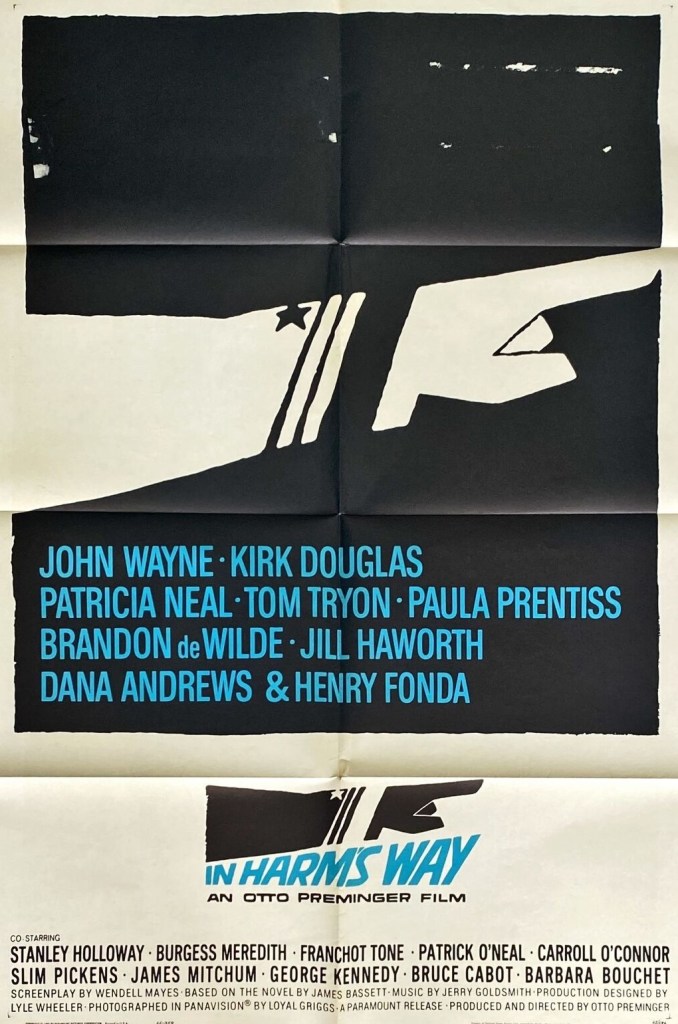
In October 1962 Otto Preminger bought the rights to Harm’s Way, a thumping big bestseller by Ronald Basset with a host of characters and sub-plots which serve, like Advise and Consent by Allen Drury, to analyse an American institution, in this case the Navy, pre- and post-Pearl Harbor. In some respects, it was an odd choice, Preminger better known for pictures that filleted such august institutions, The Cardinal (1964) exposed the inner workings of the Catholic Church. On the other hand, it rubbed shoulders quite happily with Exodus (1960), a tale of battle against the odds.
Preminger’s aim was to blunt the current onslaught of movie pessimism with a picture that ended on an optimistic note. He observed: “We are attacked, we are unprepared in every way, and manage by sheer guts, character and resourcefulness to start to work out of it.” He concluded that such action “should remind us and perhaps other people that there is never any reason to give up or to give in to anything that is not right or dignified.”
Celebrated Saul Bass poster.
“One of the reasons I made In Harm’s Way,” explained the director, “is that it is a big step away from most of the films I have made so far. I try not to repeat myself too much…not to make pictures in just one category…I was very fascinated by the characters and the story..,(which) shows that people will act even if they are unprepared and don’t want war.”
Wendell Mayes (Advise and Consent, 1962) started on the screenplay right away, taking it so far as embarking on a rewrite with the director in London. But the project was unexpectedly shelved for a couple of years. In the meantime Preminger assigned a different writer, Richard Jessup. But when the concept received the director’s full attention once again Mayes was at the wheel and with a different approach. “I had a fresher point of view and did many things that were not in the book at all. I think we improved it for that reason, since we had quite forgotten the novel.”
But collaboration with Preminger was exacting. “We sat together and and worked over almost every line,” explained the director. “I always work very closely with the writer on the screenplay…There is one man, the independent producer-director, who from very beginning takes the whole responsibility and has complete autonomy. I feel responsible for the script: I engaged the writer and I worked with him. Like I direct actors, I feel a director also directs the script.”
In particular, into sharper focus came the son, Jeremiah (played in the film by Brandon de Wilde) of Rockwell Torrey (John Wayne). In the book he had been a passing, insignificant character, who quickly befriended his father. “He had no feelings about the fact that his father had left his mother, and we changed that in the script,” said Mayes. This provided not just a source of dramatic tension but a more mature role for Wayne, who had to express regret for the estrangement, all his fault. (Although the idea of a son enlisting against the mother’s wishes reflect a similar situation in Rio Grande, 1950).
Wayne was Preminger’s first choice. “Because it has passive elements, a strong actor like Wayne is ideally cast,” said the director. Despite being sent an incomplete script, the star signed up – for $500,000. “I don’t look for stars and I don’t avoid them,” he said. The leading roles in Bunny Lake Missing (1965) and The Cardinal (1964) went to relative unknowns. “I would not ask John Wayne to play, say, a coward because his image is not the image of a coward, or have him play a Greek philosopher…He at least fulfilled all my expectations more than I could possibly hope for. Kirk Douglas, too, came to my mind almost immediately.”
The movie should have ended up at Columbia which had funded the director’s last two movies and would back Bunny Lake. But Preminger had just struck a deal for seven pictures with Paramount and in January 1964 that agreement was announced with the re-titled In Harm’s Way (a phrase associated with John Paul Jones).
Mayes completed the new draft two months later with the rest of the cast now assembled, including Preminger contract players Tom Tryon (The Cardinal) and Jill Haworth (Exodus) who replaced original choice Carol Lynley (Bunny Lake). Keir Dullea turned down the part of Jeremiah. Advise and Consent’s Henry Fonda came on board as the overall Navy commander at the expense of Chill Wills who was fired after shooting had begun.
One uncredited recruitment was Hugh O’Brian (Africa, Texas Style, 1967) who undertook the part of Liz Eddington’s lover. “He played a role as a favor without compensation,” recalled Preminger. “He did not want billing and only asked that I give some money to a charity. I needed somebody who was a secure actor and right for the part because I used a complete beginner (Barbara Bouchet) for the girl he plays opposite. And if I used some other young actor with her, people would have felt that this couple would disappear almost immediately at the beginning of the film. It was important to me to establish this young couple as an important episode at the beginning of the film and he helped that.”
The director spent three days scouting locations in Hawaii but decided to shoot in black-and-white because “ a picture like this has much more impact and you can create more of the feeling, the illusion of reality, than when you shoot it in color.” False guns mounts were attached to more recent ships since the older relevant vessels were no longer available.
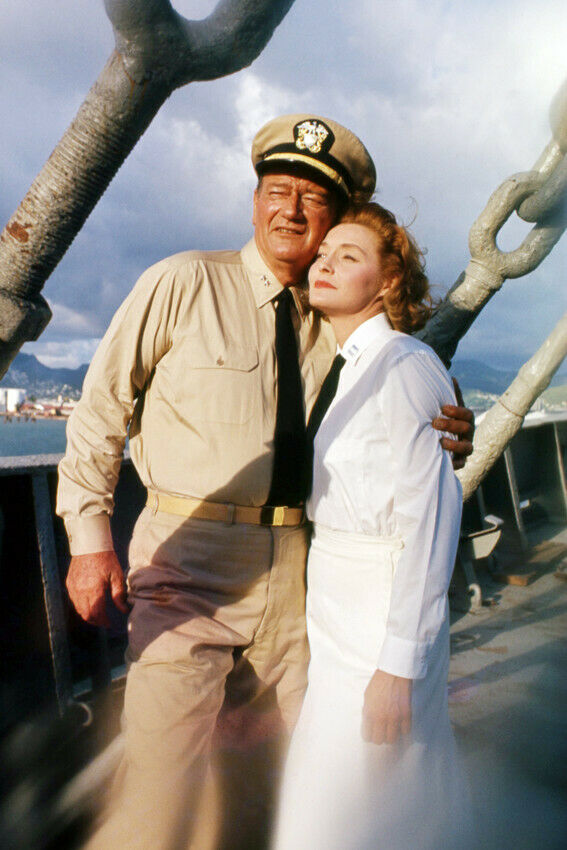
Wayne with co-star Patricia Neal.
Shooting started on June 23. The biggest issue was transportation, drivers getting lost reaching locations for the night-for-night sequences. Preminger struggled to meet his shooting schedule and the movie was soon over budget thanks to long hours, Sunday working and extra local staff. Even so, the Hawaii shoot came in 17 days ahead of schedule. Five days were assigned for shooting at sea. Larger than usual miniatures – some as much as 55ft long – were shot over a month on a lake in Mexico and in the Gulf of Mexico, the battle of Leyte Gulf costing an estimated $1 million. “I needed the real horizon,” said Preminger.
Some scenes were proving impossible to capture first time out. A second unit had two attempts filming a car going over a cliff, a marine landing was spoiled by water on the lens, and technical problems prevented Preminger achieving a “mystic-hour shot” of a plane taking off. Part of the director’s problem was his insistence on rehearsal. “I could make every picture in ten days if I slough it. Some actors just need more time and more rehearsal.”
Despite observers expecting – perhaps hoping – for volatile confrontation between the director and star, the pair enjoyed a cordial relationship based on mutual respect. Of Wayne, Preminger commented that he was “the most cooperative actor, willing to rehearse, willing to do anything as long as anybody. I was surprised really how disciplined a professional Wayne is and he liked this particular part very much.”
From Wayne’s perspective, “He had my respect and I had his respect. He is terribly hard on the crew and he’s terribly hard on people that he thinks are sloughing. But this is a thing that I can understand because I’ve been there (directing The Alamo) and I know that if a fellow comes on and he’s careless and he hasn’t thought at all about his…I come ready and that he appreciated that. I was usually there ahead of him on the set and he couldn’t believe that. So we had a really nice relationship.”
It was surprising Wayne remained on such an even keel since he was beginning to suffer from the cancer that would eventually kill him. “He looked ill,” Tryon remembered, “He was coughing badly, I mean, really awful. It was painful to see, so God knows what it was like for him. He’d begin coughing in the middle of a scene and Preminger would have to stop filming.” Although he refused to consult a doctor during filming, he agreed to a check-up once shooting of his role was complete, three weeks earlier than scheduled. He may indeed have owed his life to Preminger’s speedy shooting.
Kirk Douglas had a bone to pick with Preminger after the director stole the glory of being the first director to publicly announce, on Exodus, that he had employed a blacklisted writer, pre-empting Douglas who had done the same for Spartacus (1960). Although Douglas didn’t rank Preminger as a director he enjoyed a good relationship with him except for one minor confrontation.
Douglas got on well with Wayne: “There was a mutual respect…We got along quite well…He was a strange fellow. I’ll never forget the talk we had about my playing in Lust for Life (1956). Although emotionally we were not close and politically we were antipodal he asked me to work with him several times.” (Not entirely true – Douglas would have been the driving force for their collaboration on Cast a Giant Shadow in 1966 and he fell out spectacularly with Wayne on The War Wagon in 1967).
But others suffered from Preminger’s notorious temper, Tom Tryon in particular. The bullying became so bad Kirk Douglas once walked off the set. Douglas advised Tryon to fight back but Tryon could not pluck up the courage. Chill Wills who endured Preminger at his “absolute worst” did stand up to him and was fired. Patrick O’Neal turned on actors who refused to fight their corner. “Stand up to him once and find out he’s a human being,” was his advice.
Myth has it that Paula Prentiss’s role was truncated after she fell foul of the director but rumour was baseless. In fact, Prentiss was another of the director’s defenders, claiming he was “absolutely wonderful to work with. For a scene to work, tension needs to be put into a scene. There have to be genuine efforts to make the scene work. And Preminger understood this and was able to get much conflict and tension into the scenes.” And he was not all tough talk. She recalls him as particularly gentle guiding her through the scene where she asks her husband to make her pregnant.
Although surpassing the original $5 million budget, it was not by much, an extra $436,000. The Production Code had objected to the phrase “screw the captain,” a line Preminger refused to remove and despite further protest from the censor, who threatened to withhold the precious official approval,the director got his way. Preminger had shot the scene where Barbara Bouchet was dancing topless from the rear but the still photographs were sensational enough for publication in Playboy in its May 1965 issue.
The decision to shoot in black-and-white probably accounted for the picture’s relatively poor box office. Its length and the all-star cast should have qualified it for roadshow. (It was roadhsow for all of one day at two prestigious new York first houses; the next day it went continuous, but you could advance book a seat for an extra 50 cents). It was a sign of how quickly audience perceptions had changed that only three years previously the black-and-white The Longest Day had appeared as a roadshow and proved a resounding hit.
As a result of Wayne’s illness The Sons of Katie Elder was postponed. Preminger moved onto a smaller project, Bunny Lake Is Missing and Douglas reverted to top billing for The Heroes of Telemark (1965). Tom Tryon never worked for Preminger again and after top-billing in The Glory Guys (1965) faded from Hollywood view, re-emerging as the bestselling author of The Other. Paula Prentiss shifted sideways into television with He and She (1967-1968) and Jill Haworth made very few films after this, of which most were horror.
SOURCES: Chris Fujiwara, The World and Its Double, The Life and Work of Otto Preminger (Faber and Faber, 2008), p317-329; Scott Eyman, John Wayne, The Life and Legend, (Simon & Schuster, 2015) p385-387; Maurice Zolotow, Shooting Star, A Biography of John Wayne (Simon & Schuster, 1974) p361-362; Michael Munn, John Wayne: The Man Behind the Myth (Robson Books, 2003) p254-255; Kirk Douglas, The Ragman’s Son (Simon & Schuster, 2012), p387-381; Ian Cameron, Mark Shivas, Paul Mayersberg, “Interview with Otto Preminger,” Movie 13 (Summer 1965), p15-16; Patrick McGilligan, Backstory 3, p266; Otto Preminger, “Keeping Out of Harm’s Way,” Films and Filming, June 1965, p6; Newsweek, April 20, 1964; New York Herald Tribune, October 17, 1965, p55.
No one would have invited journalist John Gregory Dunne to observe the inner workings of Twentieth Century Fox in 1967 had they know how badly the project was going to backfire. The studio was enjoying a commercial peak, The Sound of Music (1965) continuing to set records, the public turning out in droves for the critically-lambasted Valley of the Dolls (1967). Fattening up studio coffers were Von Ryan’s Express (1965), The Blue Max (1966) and spy franchise Our Man Flint (1966) and In Like Flint (1967). By the time Dunne’s book, The Studio, was published however, in 1969, the studio was in financial meltdown.
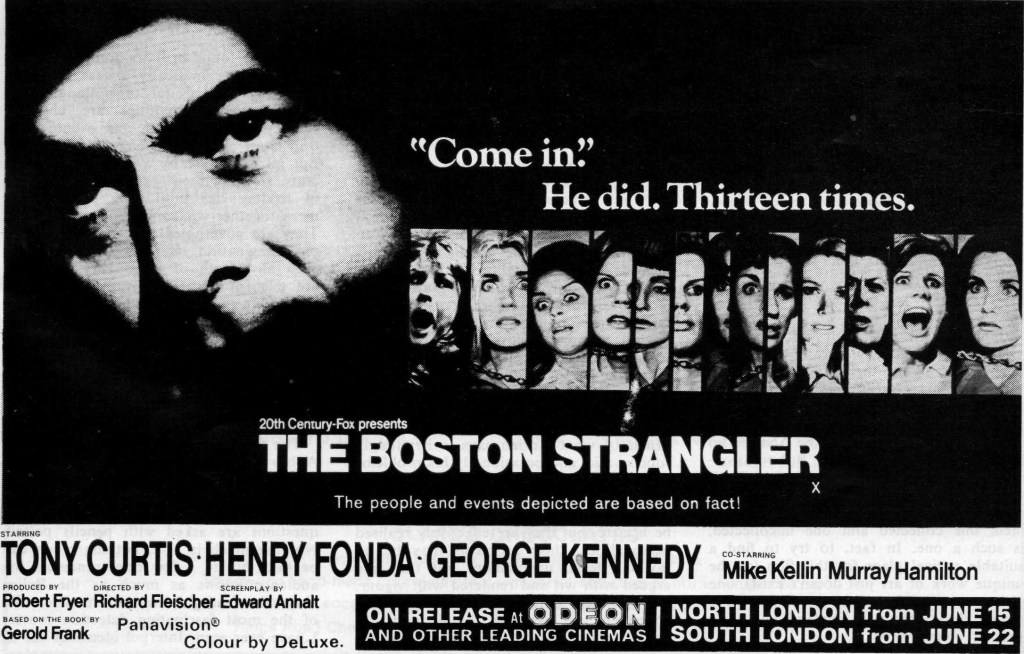
On a hubris high was studio chief Darryl F. Zanuck, who a few years before had saved Fox from bankruptcy. Dunne (later a screenwriter, most notably of A Star Is Born, 1976) had carte blanche to sit in on all sorts of meetings. The studio was going for broke with big-budget musicals, $18 million on Doctor Dolittle starring Rex Harrison (My Fair Lady, 1964) , $12 million for Star! with Julie Andrews (The Sound of Music), both actors considered bankers for their previous work in musicals. There was even $4.5 million allocated to The Boston Strangler which lacked any star commitment.
There were actually two Zanucks. Father Darryl and whizz-kid son Richard who was in charge of production and with whom Dunne had most of his dealings. Dunne observed first-hand how the younger Zanuck whittled down director Martin Ritt’s salary from $350,000 to $200,000 by threat of legal action.
Script problems had pushed back production on The Boston Strangler, a first attempt by English playwright Terence Rattigan (The VIPs, 1963) rejected and the project now in the hands of Edward Anhalt (Becket, 1964). And it lacked a star.
Robert Shaw was one possibility. He was being paid $300,000 for a picture that would never be made, The Nine Tiger Man, to be directed by George Cukor, deemed too expensive at $7.2 million. Zanuck could save money if Shaw accepted The Boston Strangler as an alternative. He didn’t. Or another, cheaper, project A Severed Head. He didn’t. Instead, Zanuck dumped A Severed Head (released by Columbia in 1971).
Christopher Plummer also walked away without doing any work. When Rex Harrison quit Doctor Dolittle, Plummer (The Sound of Music) signed up as his replacement for $300,000, Harrison said he hadn’t meant to quit. That wasn’t the only issue Harrison caused. He refused to pre-record his numbers and then mouth the lyrics to a playback. The Harrison, more expensive, method was to be recorded live. As if producer Arthur P. Jacobs (Planet of the Apes, 1968) hadn’t already been through the mill. Alan Jay Lerner (My Fair Lady) was contracted to do the music. But after 15 months: nada. Jacobs turned to Leslie Bricusse. The budget had risen by 50 per cent, from $12 million to $18 million.
It was hoped the 50-plus companies involving in licensing and contributing $12 million in overall marketing spend would bring in the public. Over 300 items would be sold on the back of the picture, resulting in 45,000 displays in retail stores. This was a picture you couldn’t miss. Expecting a soundtrack bonanza, the initial print run was set at half a million copies – bigger than that for The Sound of Music. Jacobs was perturbed to learn he would have to pay for window space – retailers paid with free copies.
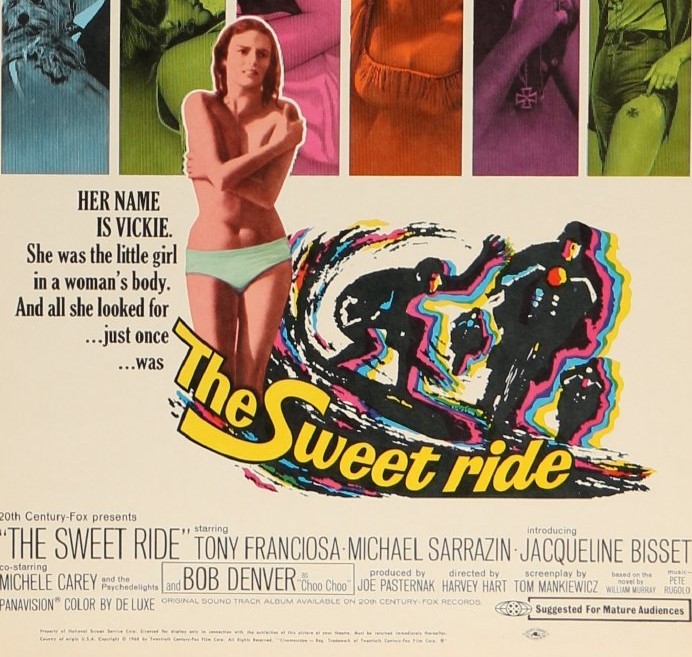
Legendary producer Joe Pasternak was making his 100th movie The Sweet Ride. One of his concerns was that Jacqueline Bisset’s bikini didn’t look tight enough. “It looked baggy in the rushes,” complained Pasternak. Bisset countered, “It fits when it’s dry. It just got a terrible pounding when I was in the water.” She mentions the scene where it got such a pounding in fact that the sea whipped the top off. She reckons that crossing her arms to protect her modesty prevented her tugging the pants on tighter. Once that picture was finished so was Pasternak – he never made another picture.
Another legendary producer Pandro S. Berman was trying to interest English directors John Schlesinger or Lindsay Anderson in Justine (directed by George Cukor in 1969) and on that basis wanted to hire a writer Laurence Marcus (Petulia, 1968) to rewrite the existing Ivan Moffat script in order to entice them. Zanuck’s take: he expected a director to make script changes but couldn’t see the point of altering a script to suit a director you didn’t know would be interested. Nonetheless, Marcus got signed.
All the time agents and directors were pitching movies. Agent Phil Gersh pushed a comedy version of Candy – screenplay by English writing duo Keith Waterhouse and Willis Hall (it ends up minus the Englishmen at Cinerama Releasing). Veteran director Henry Koster’s idea for a musical was nixed. As was the original trailer for Tony Rome, Zanuck hating the voice-over.
On Deadfall (1968), the Michael Caine heist movie directed by Bryan Forbes, actress Giovanni Ralli was having trouble with her English and her contract prevented her being dubbed. It would mean the actress having to lip-synch in post-production. The solution – “tell her she’s got 500 loops and when she hears that maybe she’ll get discouraged and let someone else dub her.” The studio had come up with 14 alternative titles to The Magus (1968) including Seduced by Fate and The Goddess and the Demon.
Fred Zinnemann was priming a $10 million western about Custer. He thought he might save $3 million by shooting in Mexico. The picture was to have no big stars. The only actor who could pull it off was John Wayne and he hated Custer. So Zinnemann planned to go with big names in cameo roles and Toshiro Mifune as Crazy Horse. That picture, too, would be dumped.
Also in the wings, Hello, Dolly! which would get made and Tom Swift, which would be canned despite advance work on building his aeroship, which would not. Nor would another Berman project John Brown’s Body.
Apart from insights into the way movies are made, marketed and released, Dunne’s book captures the extraordinary Hollywood mix – cynicism and greed coupled with fervor and bone-headed optimism.
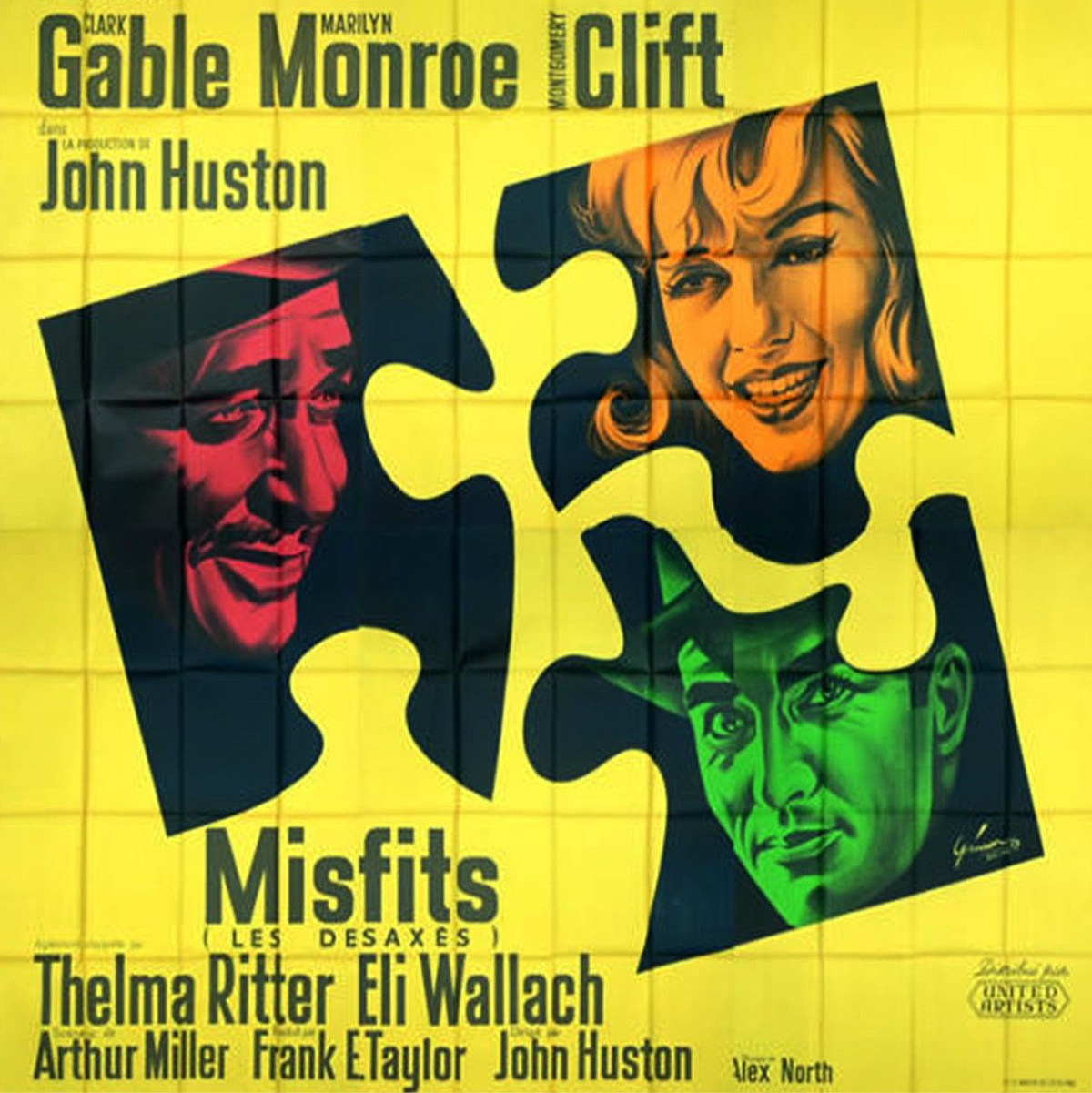
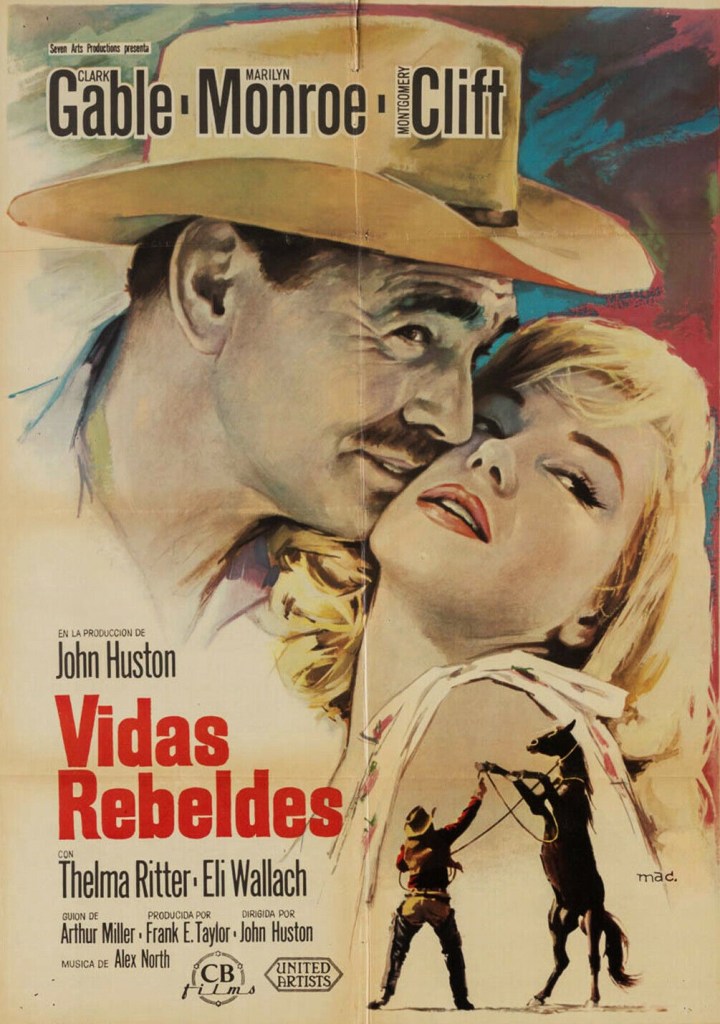
Arthur Miller, author of arguably the greatest play of the 20th century, Death of a Salesman, had gone to Reno to get a divorce so he could marry Marilyn Monroe. While there, he befriended some cowboys who took him with them while they caught horses. He turned the experience into a short story The Mustangs, published in Esquire (October 1957 issue). It provided the basis for the screenplay The Misfits. While the character of Roslyn, played by Monroe, was based on another woman, Miller explained, “I had written it to make Marilyn feel good.”
In July 1958 he sent it off to director John Huston, not just on account of a body of work that included The Big Sleep (1946) and The Treasure of the Sierra Madre (1948), but because he had nursed Monroe through her debut on The Asphalt Jungle (1952) calming her nerves by telling her “if you’re not nervous you might as well give up.” Miller felt Huston would “present Marilyn with the bracing challenge, her fighting her problems through to a fine performance.”
Huston was enthusiastic – he saw the story as representative of a “dog-eat-horse-society” – and called the writer over to his house in Ireland where they spent two weeks putting the finishing touches to the screenplay, except for the last 15 minutes. Originally, it was a lengthy piece, almost an epic, production executives timing it at two hours 47 minutes, too unwieldy for a standard drama, so inevitably compromise would be required.
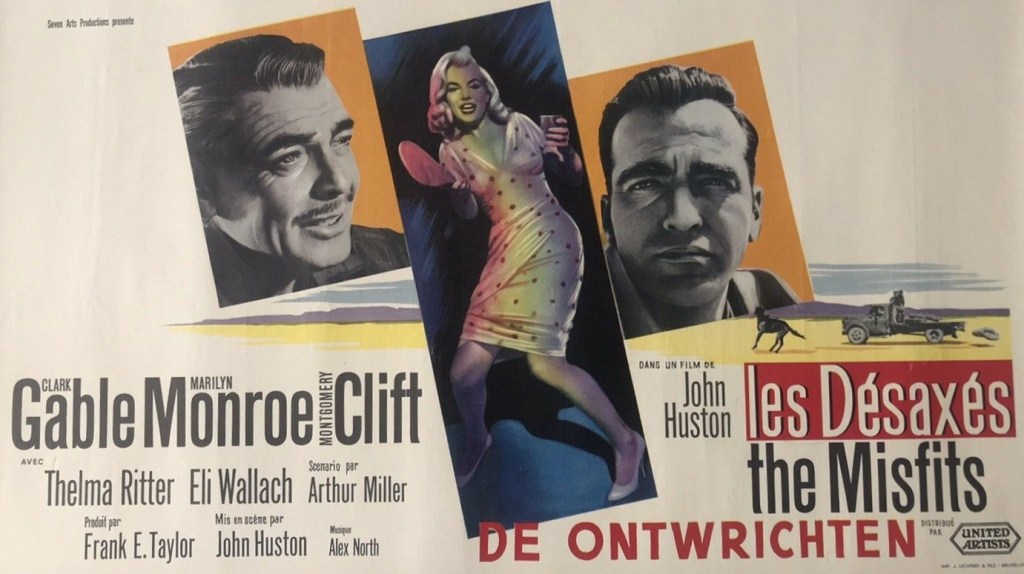
For tax reasons, Huston wanted to film in Mexico but relented and agreed to shooting it in Nevada. Talent agency MCA, which represented Huston, effectively put the film together as a package. Although Robert Mitchum was initial first choice, when he didn’t respond the screenplay went to Clark Gable, another MCA client, who accepted immediately. Eli Wallach was next on board. At this point, with only six films under his belt and better known for his work on Broadway, Wallach would not have expected to see his name above the title. But he was told that his name would be second to appear on the credits, after Gable.
But as the weeks went by and first Monroe then Montgomery Clift – both MCA clients – signed up his name slipped further down the credits. He consoled himself that his name would be “first position under the title” as that billing position was technically known. That proved an illusion. Thelma Ritter, apparently, boasted greater box office wattage so in the final credit rankings he placed fifth.
Although Monroe was viewed as the most mentally fragile, Clift and Gable also had issues to overcome. Due to the injuries suffered in a car crash and his well-known dependency on drugs, nobody would insure Clift but eventually an agreement was reached. Gable failed the medical, having gained 35lb while filming It Happened in Naples (1960) in Italy, ballooning his weight to 230lb. But two weeks later he was cleared.
The producer for such a heavyweight production was an industry lightweight. Frank E. Taylor’s main claim to fame was that he had been Miller’s publisher before he achieved fame as a playwright, working for the small company that published the author’s non-fiction work Situation Normal (1944) and the novel Focus (1945). Taylor had some Hollywood experience, but after four years employed there managed only one credit, John Sturges’ film noir Mystery Street (1950).
The original plan to start filming in September 1959 was scuppered by the incompletion of It Happened in Naples so it was shelved until the next spring. The next start date – March 3, 1960 – was an unexpected casualty of the Actors Strike which had delaying shooting on Monroe-starrer Let’s Make Love by five weeks. So when that film finished on July 1, there was little of a break for Monroe what with costume and wig fittings and test photographs before reporting on July 18, 1960, for what was expected to be a 50-day shoot, for The Misfits.
The budget was set at $3.5 million – a substantial amount for a black-and-white picture – with $1.6 million going to the principals. Clark Gable was down for $750,000, Marilyn Monroe and John Huston $300,000 apiece – although a generous profit participation scheme could see the actress earn as much as Gable – and Arthur Miller on $225,000. It was shot mainly on location in Nevada at Reno, Dayton and Pyramid Lake (a misnomer because it was all dried out) with a couple of weeks’ studio work at the end. Unusually, it was being filmed in chronological order to assist Monroe achieve her characterization.
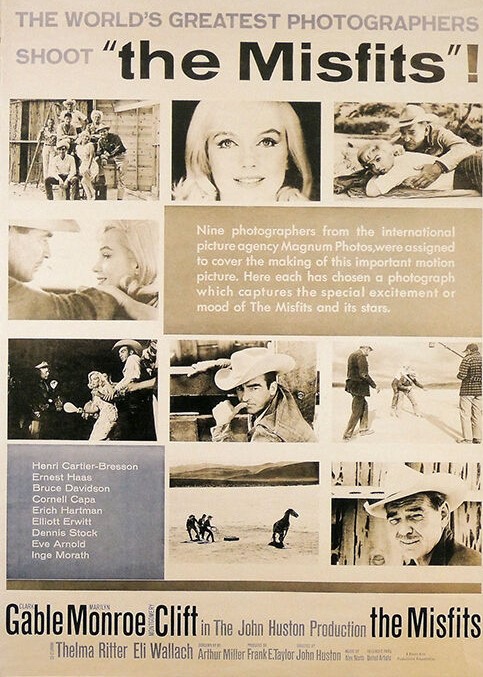
Taylor had achieved a publicity coup by convincing famed photographic cooperative Magnum to cover the shoot in depth. Photographers of the calibre of Henri Cartier-Bresson, Inge Morath and Eve Arnold worked in teams of two, each for a 15-day stint. Bresson would say of Monroe’s ethereal beauty: “I was struck as by an apparition in a fairy tale.”
Before a foot of film was exposed, the movie was in crisis. The script had been refused approval by the Production Code, the self-censorship system to which all studios subscribed. Code head honcho Geoffrey Shurlock complained that “the illicit relationship involving Roslyn and Gay seems to lack effective compensating moral values…(with the) difficulty that your story readily accepts illicit sex rather than condemning it.”
While there was publicity value to be gained from a tussle with the Production Code, it would not sit well with the distributors. The lack of a rating would inhibit many cinemas from risking a booking, despite the box office appeal of the cast.
Everyone had known going into production that getting Monroe on the set at all never mind in a condition to work would be a considerable achievement. Aware of her inability to rise early, Huston had shifted the daily start time by an hour to 10am. Sometimes shooting was restricted to only a couple of hours per day and since she was in most scenes there was a limit to how much the director could shoot around her.
Among the cast nobody knew her better than Eli Wallach. He had met the actress several years before when she had popped backstage after his performance in Teahouse of the August Moon on Broadway. He recalled: “She looked nothing like the movie star I’d seen onscreen; she wore a simple dress and had short blond hair. She was pale, shy, and wore no lipstick.” They became friends and would go out dancing. He introduced her, gradually, to The Actors Studio where she met Lee Strasberg, husband to Paula who became her acting coach.
“By the time we began to work on The Misfits in 1960,” said Wallach, “she seemed to have become a different Marilyn than the one I had known in New York, and the action that happened off-screen during the making of the film seemed to rival what was happening onscreen.”
Even so, the early part of the shoot went well. Commented Wallach, “Her mood waned and she began to lose her self-confidence.” For one scene where she was to do nothing more difficult than cross the road, she kept stopping halfway through. She had forgotten her motivation. Huston advised, “Your motivation comes from your need to cross the street without getting hit by any of the cars.” The next take was perfect.
But the signs of trouble were there from the outset. The evening before her first scene a nervous Monroe nearly took an overdose of Nembutal. Her unpredictability meant that on some days she only managed an hour or two, other days nothing at all. On August 27 she collapsed and was sent to Westside Hospital in Los Angeles for treatment, where she could be weaned off her addiction to barbiturates under the care of her analyst, not returning until September 6. On September 12, 13 and 19, she was indisposed and didn’t turn up for work.
If this was a case of life imitating art – her marriage to Miller was falling apart – she seemed to react to some lines as if the words were intended for Marilyn and not the character she was playing. In one scene Gable says, “You’re the saddest girl I ever met. What makes you so sad?” Monroe burst into tears. Wallach surmised, “Marilyn seemed to feel that the camera could detect her innermost thoughts.” In another scene, where Monroe and Wallach dance she “seemed upset and unhappy.”
Apart from casting her in The Asphalt Jungle, Huston had “saved her from the casting couch” by prior to that film setting up a proper screen test for her opposite John Garfield, providing her with a calling card that would reduce the requirement for her to jump into bed with a producer to get a part. But even on The Asphalt Jungle, she seemed dependent on her acting coach, at this point Natasha Lytess. “At the end of a take,” recalled Huston, “Marilyn would look to her for approval. The coach would nod her head.”
Monroe was taking pills to go to sleep and pills to wake up in the morning. The doctor on location eventually refused to give her any more, but of course she found them elsewhere. After visiting her in hospital, Huston was convinced the worst was over. But her renewed effervescence didn’t last.
“Marilyn returned to her old ways as though she’d never had a break,” recollected Huston. “One Sunday afternoon I visited her in her suite to get an idea of what to expect in the week ahead. She greeted me euphorically – then went into a kind of trance. She was the worst I’d ever seen her. Her hair was a tangle; her hands and feet were grubby; she was wearing only a short nightgown which wasn’t any cleaner than the rest of her.”
Despite her personal problems, Monroe was an extremely skilled actress. Observed Huston, “She could be marvelously effective. She wasn’t acting – I mean she was not pretending to an emotion. It was the real thing. She would go deep down within herself and find it and bring it up into consciousness.”
Huston, not necessarily known for accommodating actors, turned on the charm, always agreeing to another take if Monroe or Paula Strasberg (paid $3,000 a week) asked for it. Although most people disparaged Paula’s presence on the set or, more correctly, Monroe’s dependence on her, Huston acknowledged that without her his job would have been more difficult and he called a halt to crewmen nicknaming her Black Bart after her choice of clothing, habitually a black sack dress and black hat. So integral was Strasberg to Monroe’s life that the actress later moved from a hotel room shared with her husband to Strasberg’s apartment.
When even Strasberg failed to control her client, her husband Lee, the inventor of the Method School of acting which had revolutionised American drama, was flown in from New York. He had a different take on the situation. The problem wasn’t with Monroe but Huston. The director’s – refusing to deal directly with Paula. Raged Lee: “I will not tolerate this treatment of her, she is an artist,” threatening remove his wife from the picture.
Miller saw it differently: “Coach (Strasberg) was a little crazy, she was an opportunist I thought and not competent to help.” However, there was a very real issue to be addressed. Monroe had never come to terms with her fame and could not cope with the pressure of being the screen character with whom the world was infatuated.
Monroe’s technique was very individual. “I don’t want to discuss the Method. I don’t believe I have the experience. I try to use Method to the best of my ability. It makes working more possible…The writer has done the words then it’s up to the actor…I can’t work unprepared, I’d shoot myself. I can’t memorize words by themselves. I have to memorize the feeling.”
Clark Gable was on a career high, at least in terms of remuneration, earning $750,000 a picture, on a par with John Wayne and William Holden, the highest-earning stars at the time. Gable had the privilege of being paired with some of the top female stars – But Not For Me (1959) with Carroll Baker, Doris Day in Teacher’s Pet (1958) and Sophia Loren on It Happened in Naples, the title a twist on his star-making picture It Happened One Night (1934), and more than holding his own against Burt Lancaster in war picture Run Silent, Run Deep (1958).
Despite his commercial appeal he held to a particular ethos when choosing a role. “If I hadn’t liked this story I wouldn’t have done it no matter how much money they offered me,” he said. “I have to like the story or I won’t do it…I never select a part for the part itself. I always look at the overall story first.” Of his character, Gable observed: “He’s the same man but the world has changed. Then he was noble. Now he is ignoble.”
The press was salivating over the prospect of The King falling for The Blonde Bombshell. But regardless of her physical attractions, Gable was put off the actress by her untidiness and her lack of personal hygiene. But he was not perturbed by her behavior. “I’m just unhappy about her problems, her fears, her personal life, but if I were to chastise or criticize her it would only deepen her despair,” he said. When, largely thanks to Monroe’s hospitalization, shooting continued past the original completion date he was compensated to the tune of an extra $48,000.
With the male actors, Gable had a tendency to get off on the wrong foot. Initially annoyed with Montgomery Clift for fluffing lines, they became good friends after trading insults. But it took John Huston to end an unexpected rift between Gable and Eli Wallach.
Prior to their first day working together, Eli Wallach was surprised to answer a knock on his hotel room door to find Gable’s assistant Bama Davis who asked him to read to the visitor the scene they would perform the next day. Somewhat puzzled by this behavior and worried this approach was indicative of the actor, Wallach did not speak to Gable when they first met. It fell to Huston to break the ice by handing both actors a shot of Jack Daniels.
Gable was more sensitive to his own performance than you might imagine. He asked Huston to reshoot the scene where he wakens up Monroe because he “didn’t think he showed the love that was necessary.” He refused a stunt double for the scene where Gable, Wallach and Clift try to throw the mustang. In the film the mare dragged Gable and Wallach around the lake floor. In reality, in long shot it was stunt double Tom Palen being dragged by an actual horse. For close-ups of Gable while there were no horses in sight, the star was still dragged at 35mph for 400ft behind a truck. It took 28 cuts of Gable for the stallion fight to be matched with second unit footage.
Gable was angry at the way the second unit treated Tom Palen. After the stuntman had already endured two injuries Gable drew the line on hearing that he was called upon to be smashed on the face by hooves.
Gable was immensely proud of his work. “I have two things to be proud of in my career – Gone with the Wind and this one.” He later amended that to, “This is the best thing I did in my life.”
John Huston and Reno, where the film crew were housed, were a match made in heaven. The director was an inveterate gambler. He lost $25,000 one night but won it back the next and some. Overall, he left with less than when he arrived.
But he had an artist’s instinct when it came to film. He was not one for giving much direction. Huston expected “actors to be themselves, he didn’t interfere very much with their interpretation.” He prided himself on telling an actor as little as possible. “When I have to step in, I feel defeated.”
But he knew what he wanted and how, technically, to get the best out of an actor. At first Wallach played his drunk scene with rage until Huston pointed out that drunks always try to pretend they’re sober. And Huston knew what he didn’t want. Which was unwanted advice from an actor. For one scene with Monroe, Wallach expected a close up and committed the cardinal error of pointing this out to the director. “Never,” growled Huston, “never tell a director where to set up the camera.”
For Montgomery Clift’s first scene where he is seen talking to his mother in a callbox, Huston wrapped it after the first take, ignoring Clift’s pleas for another shot. ‘You’ll never do it better,’ said Huston, ensuring he did not fall prey to Clift’s lack of self-confidence either.
Monroe seemed to instinctively understand – and approve of – Huston’s technique. “He watches for the reality of a situation and he leaves it alone and he waits until he needs more or less before he comes in.”
Monroe wasn’t the only one whose illness shut down the set. Shooting on October 3 was cancelled because Huston came down with a recurrence of bronchitis due to the alkali dust on the dry lake. He was missing again the following day.
But if the actors in general appreciated Huston’s technique, Arthur Miller did not. It was unusual for a screenwriter to be present during the entirety of a shoot. For all that he brought certain extra intensity to scenes he re-wrote and his improvisation resulted in at least one great scene – Monroe’s paddle-boarding was not originally in the script but incorporated after watching her play with the toy between takes – Miller was generally a pain in the butt.
With no experience of moviemaking he clearly regarded himself as something of an authority and failed to recognise the distinction between the production of a play – where the writer was top dog – and a movie, where he was not.
Miller complained to Huston and Taylor about the lack of atmosphere, calling for more long shots “to constantly remind us how isolated these people are.” He had the temerity to criticize Gable’s performance. For one scene he observed that the actor had not “shown sufficient expression in his eyes.” Gable patiently explained that actions had to be minimized because they would be magnified a hundred times on the screen. “He turned out to be right,” conceded Miller, “he had simply intensified an affectionate look that was undetectable a few feet away.”
“I learnt from John,” said Miller, “ that he would pack the lens with material and let the camera choose…he put a lot of elements in front of the camera and let it find its way. So there’s not a lot of cutting from one face to the other ion conversation.” (In fact, this was old-school filmmaking where characters were grouped together rather than filmed apart). But he complained vociferously about the director’s positioning of Monroe fifty yards from the camera for her “Murderers! Murderers!” scene.
Miller thought such distance would ensure she wouldn’t be heard. But when Miller saw the rushes he realised the director was right. Huston wanted to portray Monroe at this point “as if she were a voice lost in the wilderness.”
Miller also wanted one scene which fades to darkness. Huston had to explain the practicalities. “You can only have one light in any given scene. In plays you can dim the light through a scene but not in a motion picture. You’re asking for values that aren’t there.”
His presence certainly wasn’t doing his wife any good. It might have been better if he had been absent, since the marriage appeared to disintegrate under their noses. He was being prophetic when he said of her first scene: “I couldn’t help feeling her disappointment not only in her character’s marriage but in her own…I had sensed something withdrawn in her, not merely in the character she was playing.”
He was prone to rewriting, in part with what he believed were better ideas, but also to emphasize developments he perceived in the characters as their screen personalities unfolded. By October 6 Gable had enough of the constant script changes and refused to film anything that had been written after September 20. Luckily, he relented and agreed to shoot the much-revised final scene. But even Miller received his come-uppance on a personal level. One day on location miles into the desert, Huston came upon a stranded Miller, abandoned by Monroe and her entourage.
Four-time Oscar nominee Montgomery Clift had an extraordinary success rate in pictures. Up till now he had appeared in only thirteen pictures but at least half were gems – Red River (1948), A Place in the Sun (1951), I Confess (1953), From Here to Eternity (1953), Raintree County (1957), The Young Lions (1958) and Suddenly, Last Summer (1959). But a bad car accident in 1956 exacerbated his drug and sexuality issues and he was considered an unexploded grenade. “He’s the only person I know who’s in worse shape than me,” said Monroe.
In fact, perhaps encumbered with helping nurse Monroe, he was able to put his own problems to one side. Apart from the early tiff with Gable, his most difficult point was when he received rope burns during his part in the mustang chase. He had forgotten to put on gloves at the start of the scene and he couldn’t suddenly appear with them on when he had to haul on the rope.
The longest scene lasting all of five minutes. The longest Huston had ever shot and one of the longest ever committed to camera was shot “day for night,” the effect achieved by a red lens opening and using red and green filters. The shooting area was covered by a black tarpaulin to kill the direct rays of the sun. Big 10k lights were hauled in to give the effect of moonlight on Monroe and Clift. Second unit director Tom Shaw was on standby with insect spray to keep insects off the actors.
But the long stretches of dialog defeated the actors and finally to save film on wasted takes Huston sent them off to rehearse by themselves. After several takes they completed the scene without missing a line. But there had been a problem with Clift’s bandage so the scene required reshooting. First Clift fluffed a line, then Monroe, then Huston interrupted, objecting to the camera position, “that’s a most unflattering angle.” After Clift fluffed a line once again, it was done.
For another scene at the lake also shot “day for night,” the cowboys did not actually build a camp fire, that was artificial, lit underground using gas, while trees and bushes were planted for the occasion.
If you ever wondered how movie crews get the bashes in bashed cars, the answer is they put them there. Monroe’s new Cadillac was battered by sledgehammers to represent a vehicle dented by admirers wanting to attract Monroe’s character’s attention by bumping into her.
It wasn’t just Monroe who caused problems. Two forest fires on August 20 saw Reno covered in black smoke with 200 firemen attending the blazes. Within a day the fire had consumed 35,000 acres and caused $200 million in damages and cut the power lines to Reno. However, the crew reacted by bringing a lighting truck and generator from Dayton.
On October 24, the crew was shipped back to Hollywood for scenes and footage requiring back projection. Landscape scenes of Pyramid Lake, for example, were screened behind the aeroplane and for scenes taking place in cars. Huston had commissioned 360-degree stereopticon shots of the lake so that single head shots could be used with rear projection.
Among the reshoots was the dance sequence at the Stix house “to show more joy and abandon” and the scene on the truck bed between Gable and Monroe in which Miller had complained “there was a lack of interaction between the two players.”
The scene where Gable was trampled by the horse was reshot with artificial hooves. Buckets of actual alkali from the lake were spread on a wooden platform, the artificial legs in the end manipulated by Huston. The last scene shot was a retake of Gable and Monroe in the station wagon. “For the first and last time on the picture,” observed journalist James Goode, “Huston didn’t ask for another take.”
Final scene was shot on November 4 – 40 days behind schedule and $500,00 over budget. One week later, Miller and Monroe announced their separation. Twelve days after shooting ended Clark Gable was dead.
Although the general impression given was that Taylor was a competent producer, in fact he saw his role in a different light. “I have this absurd Machiavellian function…the screenplay here has been a vindictive instrument which Arthur and John are using to attack each other.” He noted: “All the energy is going downhill when it should be going up,” adding, “the writer is blaming the director and the director is blaming the writer.”
Taylor was enthusiastic about the completed film. He told his Max Youngstein of United Artists, “It’s like an express train. It has a pace, a speed you don’t see in the screenplay itself. The script will get an Academy Award and Clark…this is a major-size hero we have on our hands.” But Youngstein was disappointed, concerned it lacked the Huston touch.
In post-production the Production Code situation was exacerbated by the fact that the completed film could, conceivably, contain a scene where Marilyn Monroe showed her right breast. This appeared to have come about by accident.
Nudity was certainly not in the script as no mainstream studio at that time would greenlight a film showing naked breasts. For the bedroom scene on September 21, as Monroe rises from the bed to put on her bathrobe, nine takes in all were filmed. In Take 7 she revealed her right breast. That was the one originally printed.
There were arguments that the nude scene should be included at least for the overseas market where censorship was seen to be less onerous. But Frank Taylor argued that Take 7 should be included for the domestic market. Since the movie was on course anyway to be denied the Seal of Approval from the Production Code there seemed little to lose by including the nudity.
Although Arthur Miller was undecided, Marilyn Monroe was happy enough. “Gradually, they’ll let down censorship” and she suggested that nudity was one way of pulling viewers away from television. Max Youngstein of United Artists was enthusiastic. It was Huston who nixed it, commenting, dryly, “I have always known girls have breasts.” And finally Taylor gave ground after realising that the film would be forever remembered as the one where Monroe revealed a breast rather than for its artistic merit.
The distribution approach was risky. Usually, at that time, big films went out slowly, launched in one or two cinemas in the major cities, and held over there for weeks at a time until ready to slip down the food chain. Instead, UA planned to make available 1,000 prints simultaneously, a distribution technique known then as “saturation” – what today we would term “wide release.” But that was traditionally reserved for low-budget offerings of the here-today-gone-tomorrow variety where the movie had vanished before bad word of mouth could spread. UA had precedent for taking this route. It had used saturation for The Magnificent Seven (1960). But that had been a flop. In the end The Misfits did decent enough business, though not at the level you would have expected from the cast.
In writing this article I delved deeply into the James Goode book, which I can highly recommend, on the making of the film, especially as he goes in for the kind of detail normally excluded from “making-of” books.
For example, he provides a complete breakdown of costs. Apart from the $1.6 million already mentioned, other costs include $200,000 for production, $85,000 for sets, $45,000 for lighting, $39,000 for sound, $150,000 for transportation, $32,000 for negative film (200,000 feet at 0.454 cents a foot), and $25,000 for positive prints. There was $750 per week to rent the generator, $225 per week for the small camera dolly, $400 per week for the motorized camera crane, $200 per week for folding chairs and $200 per month for Monroe’s trailer.
Hiring Boots the stunt horse cost $150 a week against a 10-week guarantee. There was a $10,000 bill to build the rodeo ground, $500 to rent the saloon, $15,000 went on renting the Stix house and $1,000 for use of the lake. The production paid for 17,570 lunches at $2.75 a head. There was $6,000 for hotel accommodation and $2,000 for the Dodge truck used in the lake scenes.
As many as 1,500 extras were called up and paid immediately. Stunt doubles, whether on contract or salary, were paid a base sum plus a bonus according to how much work they did on a given day. Sometimes the media was given a daily meal allowance, but other times not, the same being true for accommodation.
The final cost of the picture was $3.995 million. I found that a fascinating figure. Sure, it was nearly $500,000 over budget. But the film shot for 90 days instead of 50. In other words, shooting the extra 40 days cost proportionately little. Yes, Clark Gable accounted for another $48,000 in overtime but did this really mean that contracts were so tight that it effectively ensured that everyone, once signed up, could not leave until the movie was finished and not receive compensation on a pro-rate basis?
SOURCES: James Goode, The Story of The Misfits (Bobbs Merrill, 1963); Arthur Miller, Timebends, A Life (Grove Press, 1987); Eli Wallach, The Good, the Bad and Me (Houghton Mifflin Harcourt, 2005); David Bret, Clark Gable, Tormented Star (JR Books, 2010); Arthur Miller, Serge Toubiana, The Misfits (Phaidon, 1963); John Huston, An Open Book (Macmillan, 1981); Arthur Miller, “Monroe Miller Magnificent Misfits,” Washington Post, December 13, 1987.
Cary Grant was coming off a commercial career peak, comedy Houseboat (1958) with Sophia Loren, Hitchcock thriller North by Northwest (1959) and war comedy Operation Petticoat (1959) all among the top box office hits of their years. He was in enormous demand. In 1960 Jerry Wald wooed him for Tender Is the Night, eventually made in 1962 with Jason Robards. He went so far along considering Can-Can (1960) that he began working with a voice coach and passed on Let’s Make Love (1960).
The prospect of Lawrence of Arabia – he had been lined up to play the lead over two decades before – reared his head with producer Sam Spiegel eyeing him up for Allenby (played in the 1962 picture by Jack Hawkins). He turned down Lolita and a remake of The Letter. The biggest letdown was John Huston’s The Man Who Would Be King which would have teamed him with Clark Gable. Of the screenplay, Grant commented: “I’ve read it twice and am still uncertain whether it’s fair, good, or perhaps, even excellent.” (It would not be filmed until 1975.)
Also in the pipeline was an intriguing original screenplay in which he and Ingrid Bergman would essay dual roles and his alternative company, Granart, also purchased The Day They Robbed the Bank. (Neither project was made.)
In the face of such indecision it’s not surprising he decided to play safe. The Grass Is Greener would be made by his own company, Grandon, a production outfit set up with director Stanley Donen – they had previously made Indiscreet (1957) – at that point still best known for musicals including Singin’ in the Rain (1951), though he had also directed Grant in the comedy Kiss Them for Me (1957).
Initially Grant cast himself as the American, with Rex Harrison (The Honey Pot, 1967) and his real-life wife Kay Kendall (Once More with Feeling, 1960, also directed by Donen) the titled British couple. Harrison would certainly have brought more natural acidity to the part but he pulled out after his wife died prematurely. Deborah Kerr, the most English of actresses, was ideal for the Earl’s wife.
Robert Mitchum, with whom Kerr had just appeared in The Sundowners (1960), was a late addition as the Yank even though it meant him dropping to third billing for the first time in over a decade. For The Sundowners he had ceded top billing to Kerr on the basis it would be better for the poster, not realizing he would be viewed as the male lead rather than the acknowledged star (not quite as subtle a difference as you might imagine in the cut-throat credits business). Kerr was at an artistic peak, winning her sixth Oscar nomination for The Sundowners. Mitchum, by contrast, nominated in a supporting role for The Story of G.I. Joe (1945) had nary a sniff of peer recognition since.
Jean Simmons (Spartacus, 1960) was a surprise choice for Grant’s character’s ex-lover but was willing to accept lower billing because she was desperate to extend her range by doing comedy. The foursome already had considerable experience working with each other, Mitchum paired with Simmons for Angel Face (1952) and She Couldn’t Say No (1953) while Kerr and Grant had dallied in Dream Wife (1953) and An Affair to Remember (1957). To round things off Kerr had played opposite Mitchum in Heaven Knows, Mr. Allison (1957) and, as mentioned, The Sundowners.
Although the picture was financed by Universal, director Donen was more of a Columbia favorite. On top of Once More with Feeling and Surprise Package for the latter studio, he was contracted to make another four, all to be filmed abroad, the director having set up home in London. Deborah Kerr was involved in Cakes and Ale, based on the Somerset Maugham novel, with George Cukor and was announced as starring in Behind the Mirror (neither film made). Mitchum was also diversifying, the first of a three-picture deal between United Artists and his company being North from Rome (never made), based on the Helen MacInnes thriller.
Shooting began at Shepperton in London on April 4, 1860, but this time round, the personalities did not quite gel. Simmons complained that Grant was “a fuss-budget, everything must be just so.” Although she did admit that his preparation worked wonders. “He’d come forth with the most amusing, polished take, everything so effortless.” Mitchum complained Grant lacked a sense of humor. “He’s very light and pleasant but his humor is sort of old music-hall jokes.”
Despite the high-class cast, Grant had very definite ideas about his star status. In one scene that called for both actresses to be bedecked in expensive jewelry, he instructed the jewels be removed in case the audience was distracted from him.
Grant and Mitchum had one thing in common, a liking for experimenting with drugs. Mitchum’s preference for marijuana was well-known. Although he had been previously jailed for his “addiction,” Mitchum still grew his own. Grant’s drug of choice, on the other hand, was LSD. He had been on a course of LSD treatment since 1958 and was in the middle of coming off the drug. “He was a little weird,” noted Mitchum.
Fittingly, their personality clash was very English, “a mild, undeclared, rivalry.” The battleground was costume, Grant perturbed that Mitchum’s laid-back style was making him look over-dressed while Mitchum complained that he was a glorified feed, employed simply to make non-committal comments in the middle of a Grant monologue.
Grant’s parsimony was also a bit extreme. As part of his invoice for doing publicity on the picture, “not only did he turn in his hotel bills and meal receipts for those four extra days but also the costs of the suits” he had had made in Hong Kong. In other words, he billed his own company. Money paid for these expenses would be deducted from any potential profit he would receive.
Kerr, however, had no complaints. “Between Cary’s superb timing and Bob’s instinctive awareness of what you’re trying to do, this was a very happy film.” But there was one other source of contention. The British media were barred from the set on by Stanley Donen on the grounds that journalists of the more sensation-seeking newspaper were apt to needle actors. Grant softened the blow by arranging to be interviewed once filming was complete.
However, Variety was able to give the picture a publicity boost by hailing stately home tourism as “a new type of British show business,” reckoning the 400 operations raked in $4 million a year. Average admission prices of 35 cents meant over 10 million visitors a year.
Ironically, the infidelity theme cost The Grass Is Greener a lucrative Xmas launch at the prestigious Radio City Music Hall in New York. The cinema felt the content was not in keeping with Yuletide and opted for The Sundowners instead, the Donen picture shifting to the much smaller and semi-arthouse Astor. Just how important the Hall was to a movie’s public reception could be judged by the takings the previous year for Operation Petticoat (a Granart release), a whopping $175,000 opener. The point was made when The Sundowners grossed $200,000 in its first week, three times as much as The Grass Is Greener.
SOURCES: Scott Eyman, Cary Grant, A Brilliant Disguise (Simon & Schuster, 2020) p339-343,363-368; Lee Server, Robert Mitchum, Baby I Don’t Care (Faber and Faber, 2002) p204-207, 429; Eric Braun, Deborah Kerr (WH Allen, 1977) p176-177; “Deborah’s Cakes & Ale,” Variety, July 15, 1959, p3; “Grant in Original, with Himself and Bergman in Dual Roles,” Variety, September 30, 1959, p10; “Nativity and Grant Combo at Hall,” Variety, December 9, 1959, p9; “Maugham-Hurst Film Location in Tangier,” Variety, January 6, 1960, p167; “Col Extending Donen,” Variety, May 25, 1960, p20; “400 Stately Homes of England,” Variety, June 1, 1960, p2; “Needling and Smartalec British Interviewers Not Allowed In By Donen,” Variety, June 22, 1960, p2; “Infidelity Theme Cancels Grant’s Comedy at Hall,” Variety, September 21, 1960, p7; “Cary Grant’s,” Variety, November 9, 1960, p20; “B’Way soars,” Variety, December 28, 1960, p9.
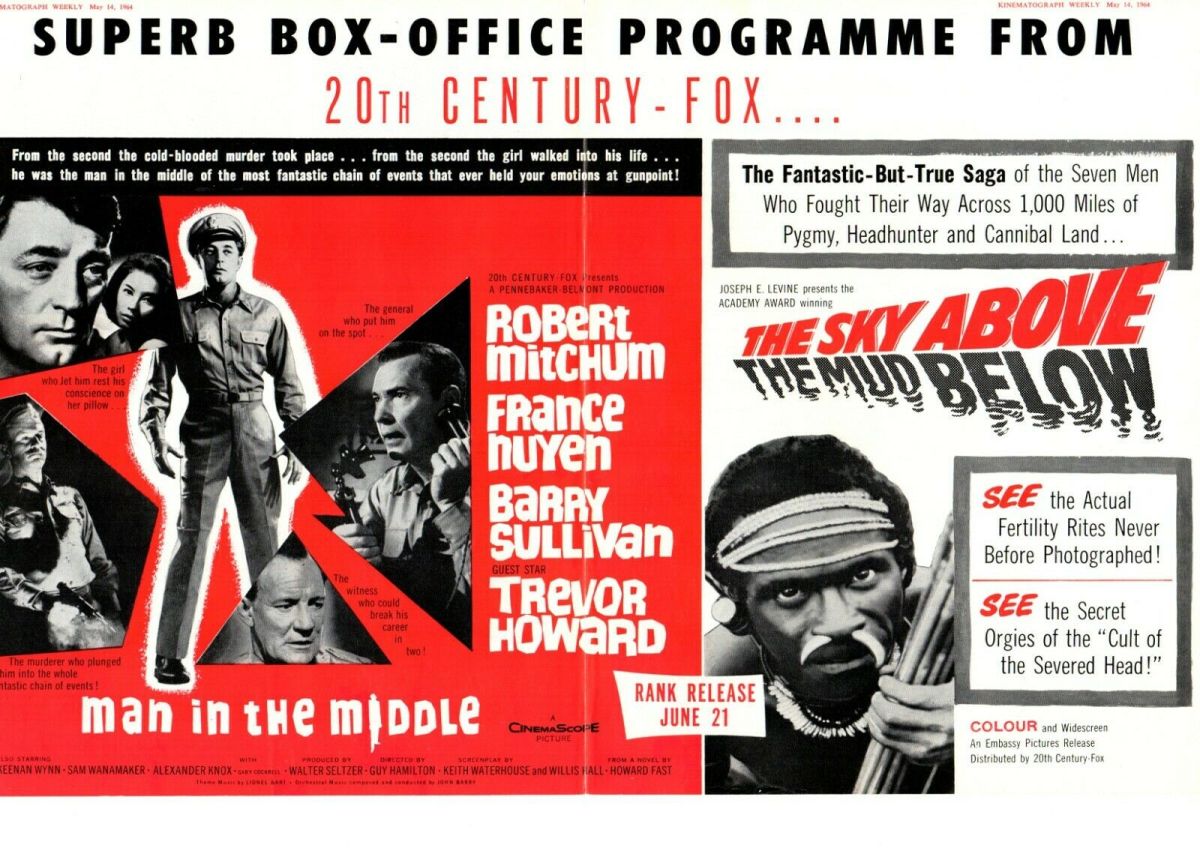
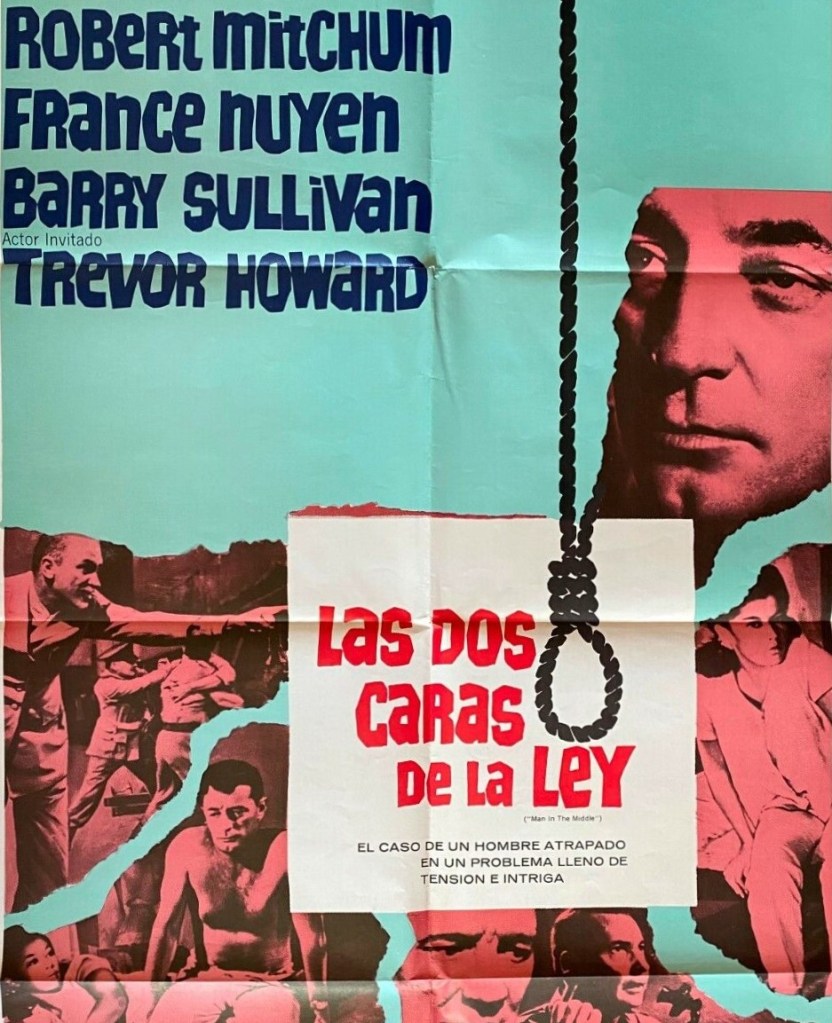
You were asking for trouble to pair heavy drinkers Robert Mitchum and Trevor Howard. But Man in the Middle was a fraught production long before the actors came on board. The picture was intended to kick off Twentieth Century Fox’s revamped 20-picture slate that signaled a studio back from the dead after near-bankruptcy. The success of The Longest Day (1962) triggered a cycle of World War Two pictures, Man in the Middle launching this cluster, which accounted for more than third of the studio’s projected output.
But before fox arrived on the scene, Man in the Middle was intended as a key element in the launchpad or an indie powerhouse, the grandly-named Entertainment Corporation of America (ECA), set up by Max Youngstein, one of the founders of the post-war version of United Artists. Youngstein had an 11-picture tab budgeted at $3 million including Honeybear, I Think I Love You starring Warren Beatty (Bonnie and Clyde, 1967), Cold War thriller Fail Safe, The Winston Affair (as Man in the Middle was originally tabbed) and The Third Secret.
But concerns about legal action against Fail Safe torpedoed the venture within a few months of opening for business in November 1962 after theatre chain Ace Films pulled the plug on its $1.3 million investment and distributor Allied Artists followed suit. Columbia took over Fail Safe (1964) and Twentieth Century Fox The Winston Affair in a co-production with Marlon Brando’s Pennebaker shingle and Talbot which was Robert Mitchum’s outfit.
With Fox’s recent financial vicissitudes keeping the studio in the media spotlight, budget control was essential. The movie’s $1.35 million budget was trimmed by clever scheduling, no actor, outside of the star, on set for more than three weeks, ensuring that overtime vanished. The title, however, appeared forever in flux. Original title The Winston Affair, the name of the Howard Fast book on which the film was based, changed to The Man in the Middle, then back to The Winston Affair, reverting again to The Man in the Middle before ending up with a contracted version of that – Man in the Middle. The confusion played havoc with a movie called Light of Day that snapped up Man in the Middle when the Fox title became vacant but was released as Topkapi (1964) when Fox took the title back.
Producer Walter Seltzer (Number One, 1969) pushed for more African American representation on the picture. Three roles, not written as African Americans in the novel or in the Waterhouse and Hall screenplay, were given to African Americans, the “best men for the job,” according to the producer. The trio were: Errol John, the N.C.O of the prison cell where the murder suspect is held, Frank Killibrew who doubled as the jeep driver and confidante to attorney Adams (Robert Mitchum) and Oscar James as a court reporter.
The two ECA movies taken over by Fox.
Mitchum didn’t just have drink problems. He was in the middle of an affair with Two for the Seesaw (1962) co-star Shirley MacLaine which result in public rows with long-suffering wife Dorothy. Mitchum had enjoyed a long business relationship with Max Youngstein and when the producer came upon The Winston Affair the actor agreed to star in it, only to find the rights had already been snapped up by Pennebaker. However, Pennebaker was in no position to fund a movie and without a commitment from Brando as star unlikely to get it off the ground. Since the production company nonetheless required, for tax purposes, to show a movie on its books Brando had agreed to throw in his lot with Youngstein’s ECA. And when Fox took over, Brando and Talbot retained their production credits.
When Seltzer flew to London to meet Mitchum who was finishing off his cameo for The List of Adrian Messenger (1963) the star lived up to his hell-raising billing, walking drunk from his room along the hallway and down the elevator at the plush Savoy Hotel. He was buck naked.
The bulk of the filming took place in Elstree Studios in London with just a couple of weeks set aside for location work in India. The ongoing romance with MacLaine meant production could grind to a halt in the middle of a scene while Mitchum took a call from the actress in New York although conversation was inhibited with Selzer at his elbow looking at his watch.
“He was a professional in every respect,” recalled Selzer. “He was on time, knew his lines and didn’t make any trouble…very good with France Nuyen (A Girl Called Tamiko, 1962), who was a little unsure of herself, and he did a lot to help her performance and boost her confidence.”
Trevor Howard was a different kettle of fish. Mitchum and Howard had become friends in the 1950s while working in Mexico, and Mitchum was a great admirer of the Englishman’s talent. However, Howard had “been all but blackballed of late due to his drinking.” Oscar-nominated for Sons and Lovers (1960), Howard had only made two films since. And even the role here was more of an extended cameo than a main supporting role. To win the part, Howard invited director and producer to visit him at his home where he put on a very good act of restraint, limiting himself to tea while the others consumed alcohol.
Restraint proved an illusion. While Mitchum could drink and still turn up for work, Howard would go to pieces with a few drinks in his system. On his second day of shooting, Howard turned up on set wearing mismatched socks and threw a drunken fit when asked to change.
Director Guy Hamilton had worked with big Hollywood personalities Kirk Douglas and Burt Lancaster on The Devil’s Disciple (1959) but compared to them Mitchum was a pussycat.
“He understood the importance of listening,” said Hamilton, “which is very, very rare for American stars…If all else failed in a scene, you knew you could always fall back on Mitchum’s reaction shots, which could say more than the dialogue.”
Mitchum was blessed with a photographic memory. Even when confronted with pages of new script he would have no trouble remembering his lines. In fact, if anyone fluffed their lines they could rely on Mitchum helping them out. When the movie decanted to India, he had an encounter with a maharajah’s daughter, which ended up in the bedroom. Once the movie was finished, Mitchum resorted to type, getting stoned on raw marijuana on the 16-hour flight home from India, a zip bag full of the stuff, and sailing through the Nothing To Declare section at Customs at the airport.
Most reports have this down as a big flop. But I’m not so sure. It cost comparatively little and earned $1 million in rentals in the U.S. Mitchum was a big enough star for it to be released around the world and I’d be surprised if it didn’t manage the extra $300,000 required to break even.
SOURCES: Lee Server, Robert Mitchum, Baby, I Don’t Care (Faber and Faber, 2001) p457, 462-467; “Marlon Brando To Film Winston Affair,” Box Office, April 9, 1962, p16, “Youngstein As Exec Producer,” Variety, January 16, 1963, p4; “Entertainment Corp Sets Mitchum Film Overseas,” Variety, January 16, 1963, p4; “Four Months To The Day For Man,” Variety, January 26, 1963, p5; “From Surefire to Fail Safe,” Variety, April 10, 1963, p3; “Winston Affair Set To Start 20th-Fox British Production Program,” Variety, April 24, 1963, p22; “Fascination With Own Era,” Variety, May 22, 1963, p3.“Use Negro Skills in Seltzer’s Film,” Variety, October 2, 1963, p4; “No Principal On Role Longer Than 3 Weeks, Key Budget Control,” Variety, November 27, 1963, p3.
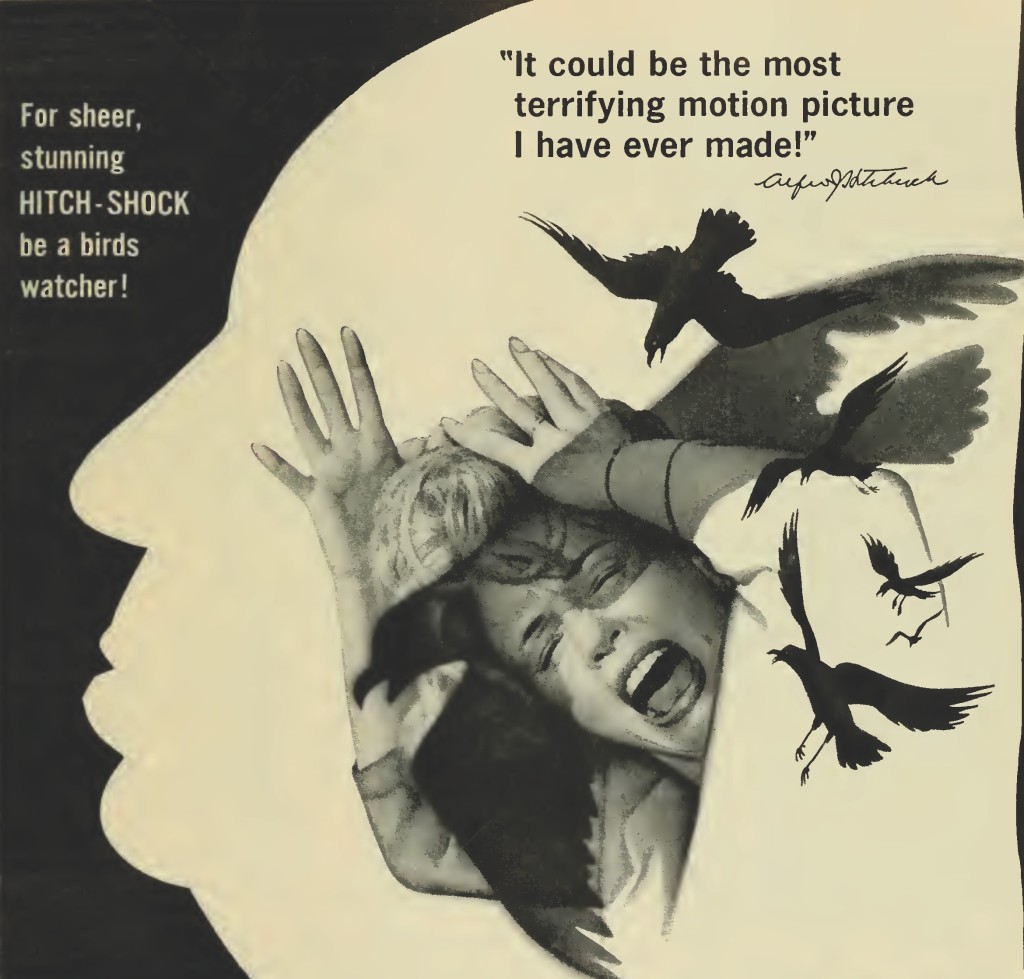
Alfred Hitchcock had a different picture – in fact, several movies – in mind as the follow-up to Psycho (1960), the biggest hit of his career. In pole position was Marnie to star Grace Kelly (“she voluntarily offered to do the picture after reading the story”), the woman he had made a star, in a sensational return to the screen after her marriage to Prince Rainier of Monaco. Her participation would bring her around $1 million. He worked on a script during 1961 but Kelly’s schedule meant the film would have to be postponed to 1963-1964 at the earliest.
A close second came No Bail for a Judge to star Audrey Hepburn. When those projects failed to get off the ground in the gap between Psycho and The Birds (1963), Hitchcock also considered reuniting with James Stewart (Vertigo, 1958) for Blind Man. The original idea came from a visit by the writer to Disneyland where he had an idea for a blind man given an eye transplant who subsequently remembers things he could not have witnessed. This was then transposed to an ocean liner, with Ernest Lehman signing on for script duties in December 1960. For almost a year he worked on a movie called Frenzy, no relation except for serial killing, to the later picture. But there was also Trap for a Solitary Man, Cold War thriller Village of Stars and The Mind Thing.
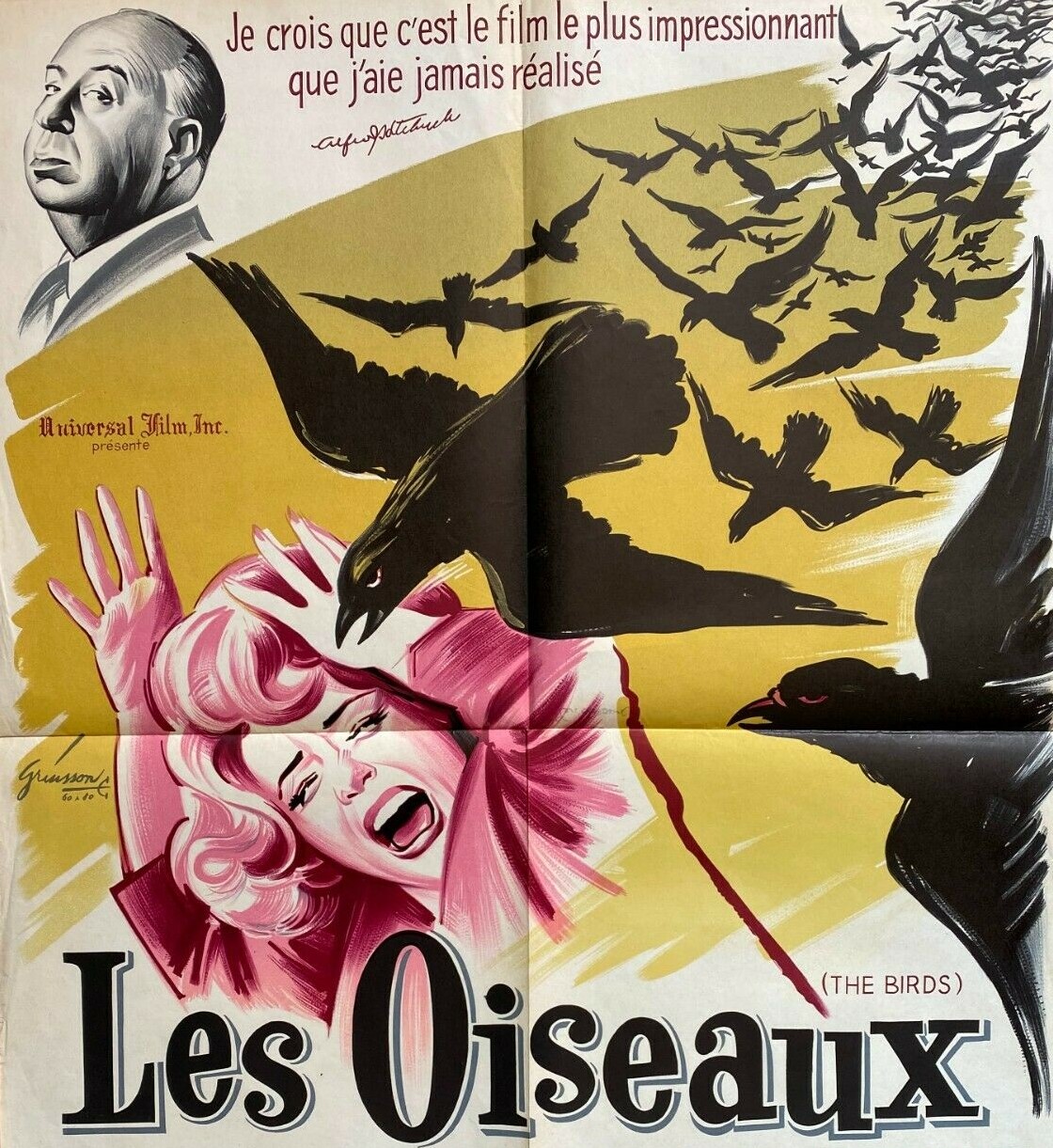
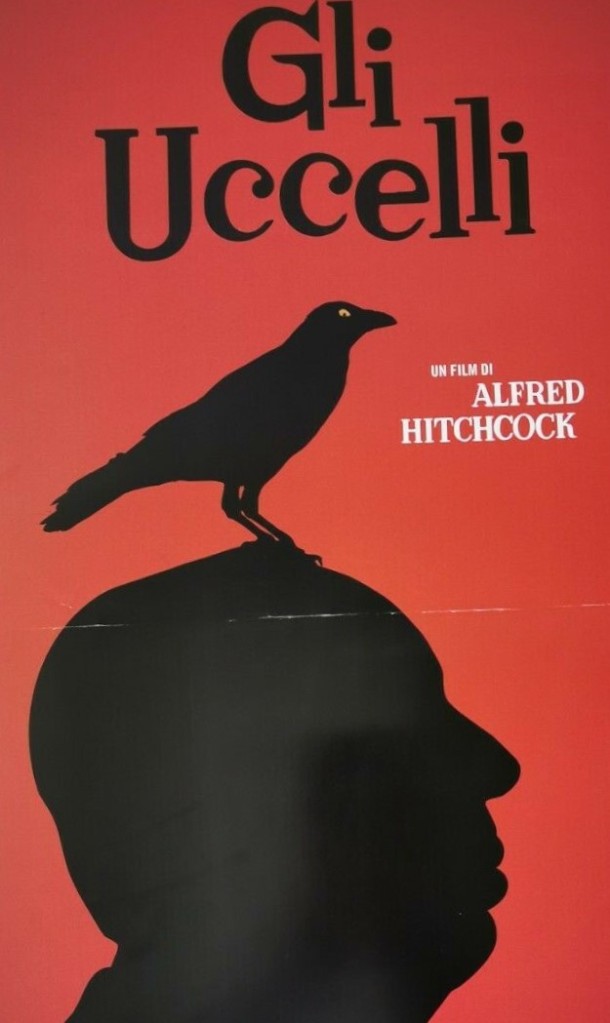
When Hitchcock finally settled on The Birds, based on a short story published in Good Housekeeping magazine in 1952 and reprinted in a Hitchcock anthology in 1959, he first turned to Scottish author James Kennaway (Tunes of Glory, 1960). That collaboration lasted until Kennaway decided the only way the movie would work would be if the birds were never seen. He considered Wendell Mayes (Von Ryan’s Express, 1965) and Ray Bradbury (The Picasso Summer, 1969) before in August 1961 turning to Evan Hunter (Last Summer, 1969). Wearing his Ed McBain (Fuzz, 1972) hat, Hunter was a crime aficionado so it was no surprise he suggested adding a murder to the mix.
But Hitchcock’s first act was to shift the location from Cornwall to Bodega Bay, sixty miles away from San Francisco. While the screenplay was being worked upon, an extensive proce3ss that would include last-minute changes once filming had begun, Hitchcock considered a potential female star.
He screen-tested Pamela Tiffin (One, Two, Three, 1961) and examined footage featuring Yvette Mimieux (The Time Machine, 1960), Carol Lynley (Return to Peyton Place, 1961) and Sandra Dee (Tammy Tell Me True, 1961). He also considered two actresses he already had under contract Joanna Moore (Walk on the Wild Side, 1962) and Claire Griswold (Experiment in Terror, 1962).
Both the women already under contract had proved disappointing. Of Moore, John Russell Taylor wrote: “no one could have been less cooperative in the required making-over process, she did not like the clothes, she did not like the hair styles and she did not seem to like anyone she came into contact with at the studio.” Griswold, more compliant, “seemed to have little professional ambition and was quite content with what she was, Mrs Sydney Pollack.”
But then he spotted model Tippi Hedren in a television commercial. She was signed up to a seven-year $26,000-a-year ($254,000 at current prices) contract before she even met Hitchcock, one of the director’s modus operandi to ensure fees did not increase when his name was mentioned. Although actors, once successful, tended to complain they were hired at unfair salaries, this was in fact a pretty good amount for an untrained actress who would automatically become a star by the very fact of being in a Hitchcock picture. Of course, Hitchcock hoped to profit by keeping her salary low for any future movie. But it was still a gamble; if her career fizzled out, as did occur, he would lose out.
However, given his reputation for treating actors as cattle and expecting them to know what to do with little direction, he went to extreme pains to ensure Hedren was prepared for the role. He encouraged her to sit in on script conferences, meetings with set designers, and other essential collaborations like the director pf photography and the music supervisor and went into considerable detail about her motivation and how the film would move from periods of intensity to relaxation. Nobody ever received a more complete education in the Hitchcock method.
Hitchcock admitted he would have preferred to cast more experienced stars with guaranteed box office marquee such as Cary Grant and Audrey Hepburn but the long shooting schedule and the time required for trick photography would render them too expensive.
For this picture, Hitchcock switched studios from Paramount to Universal. At $3.3 million, very little going to the stars, this was his most expensive movie date especially in comparison to the $800,000 of Psycho. After a tortuous screenplay process, Hitchcock also sought input from others like famed short story writer V.S. Pritchett whose several notable suggestions the director accepted, much to the ire of Evan Hunter. According to Taylor, Hitchcock found himself “nervy and oppressed” possible due to the film’s Day of Judgement elements, and abandoned his normal shooting routine.
He was famous for shooting the picture he already had in his head. Instead, here “he started studying the scenario all over again while shooting it…(and) began to do something he never normally did – improvising on set.” He went deeper into characterizations – making the viewpoint far more subjective than initially conceived, in particular “keeping the audience much closer to the Tippi Hedren character”
At the last minute he dropped several pages of dialogue and the original Hunter ending. He edited out a love scene between Hedren and Taylor and detailed a script for the sound, specifying what kind he wanted for every scene. While Bernard Herrmann was involved, it wasn’t in the usual sense, and instead they worked out musical scenario of “evocative sound and silence” which was created by Remi Gassman and Oskar Sala who specialized in electronic music.
It was by far the most complicated shoot Hitchcock had ever attempted. The birds were a mixture of trained birds, dummies and optical illusions. When the gull attacked Hedren as the boat docks that was a dummy on a wire pulley, the blood a pellet implanted on her clothes. But as filming intensified, the blood seen on the screen was real blood. Anchovies and ground meat were spread on the actors’ hands at attract the gulls.
But when it came time to shoot the scene in the attic Hedren was not warned the birds would be real. Hitchcock believed terror would be better expressed by an untrained actress if it was real. While propmen wore thick leather gloves to protect their skin, the actress was permitted no such luxury. When the birds avoided Hedren, the propmen simply picked them up and threw them at the actress. Filming took a week, by the end of which, after getting her eye clawed, Hedren broke down in tears. It would be impossible for a director to take such liberties today although young, impressionistic actors tend to fall prey to such actions.
The proposed ending was jettisoned in favor of a lengthy shot of Hedren and co-star Rod Taylor driving through a bird-infested landscape that the director called the “single most difficult shot I’ve ever done.”
Hitchcock got into trouble with the authorities over unauthorized use of birds. His permit allowed for the use of 20 dead and 30 live birds but an investigation by the U.S. Wildlife and fisheries found 40 dead gulls and 54 live ones as well as 60 songbirds for which no license had been given. He was fined $400. The movie was of course a boon for exhibitors planning promotional stunts. A thousand pigeons were released in a shopping center in Albany, carrier pigeons carried a message from Los Angeles to Memphis, birds trainers were in full flight, 200 exotic birds were displayed in the lobby of the Stanton in Baltimore, while the director attracted notoriety by making birds singular rather than plural when the tagline became “The Birds Is Here!
Much has been written of Hedren’s reactions to the birds, but it’s worth having a look at Roar (1981), a famous disaster of a picture, which she and husband Noel Marshall financed, where she appeared to be quite happy to be bitten and clawed by lions, a lot less tame than was suggested. The mauling was so bad Hedren required 50 stitches, required plastic surgery and nearly lost an eye. In one unscripted scene that ended up in the picture a lion grabbed her hair and would not let go. Most of the lion attacks resulted in injury to someone, actors and crew, including cinematographer Jan de Bont who required 120 stitches to sew his torn scalp back in place. By such standards, her treatment by Hitchcock was relatively tame.
SOURCES: Patrick McGilligan, Alfred Hitchcock, A Life in Darkness and Light (Regan Books, 2003), p608-629; John Russell Taylor, Hitch, The Authorised Biography (Faber and Faber, 1978) p262-270; Brian Hannan, Darkness Visible, Alfred Hitchcock’s Greatest Film (Baroliant, 2013); “Princess Grace’s Take Per Hitchy Estimate,” Box Office, April 4, 1962, p2; “Fine Hitchcock $400,” Box Office, April 18, 1962, p17; “Pigeons Blaze a Trail,” Box Office, April 8, 1963, pB3; “Pigeons for Birds,” Box Office, May 6, 1963, pB3; “The Birds Is Here,” Box Office, May 13, 1963, pA1; “Bad Girls Bird House,” Box Office, May 27, 1963, pA3.
A million-and-a-half dollars potentially went down the drain when, thanks to the Russian invasion two months into production, producer David L. Wolper had to shift location shooting of World War Two picture The Bridge at Remagen from Czechoslovakia to Italy and Germany. Actors and crew woke up on August 21, 1968, to find their hotel surrounded by Russian tanks. Only quick action saw 80 personnel ferried in a taxi convoy through the only remaining open checkpoint to the airport, their departure coinciding with the arrival of the Russian paratroopers.
This had not been the first international incident for the movie, based on the destruction of the Ludendorff Bridge over the Rhine at Remagen in Germany. Previously, Wolper had been accused of being a C.I.A. spy and reports were circulating that armaments were being brought in to support Czech leader Dubcek while rumours flew of “busloads of American troops…arriving in Prague disguised as tourists and film technicians.” Matters were so bad that the Czech army placed under lock and key the film’s entire TNT and dynamite inventory amounting to over 6,000 sticks of the former and 800lb of the latter.
Ben Gazzara and George Segal open fire.
Small wonder the Russians were alarmed because the production had arrived with a massive cache of weaponry – an inventory over 1,000 pieces strong – including eight Sherman tanks and over 130 Browning and Thompson machine guns, MI rifles and carbines and Colt pistols as well as 300 dummy rifles. Luckily, most of the film’s battle scenes action had been completed when production was interrupted but that still meant a month of interiors and exteriors.
Wolper was something of a Johnny-come-lately to the Remagen scene. Budd Schulberg (On the Waterfront, 1954), who had fought at Remagen, and his brother Stuart were first into the frame, planning in 1958 to film for Warner Brothers Ken Hechler’s 1957 bestseller on the battle, as a follow-up to their first production, Wind Across the Everglades (1958). Stanley Kubrick was being lined up to direct. When WB bowed out the Schulberg Brothers moved it first to Columbia and then United Artists. When that gamble failed to come off, United Artists assigned Phil Karlson (The Secret Ways, 1961) as director but that also hit the buffers. Although Wolper started work developing a treatment in 1965 – Irvin Kershner in his mind as director – he had Ihe had to deal with another contender in Flaum and Grinberg Productions which in 1966 announced this as their debut production.
Wolper had come to movies on the back of documentaries. Using his Metromedia outfit as an umbrella, he had struck a six-picture deal with United Artists. The first movie had been the documentary Four Days in November (1964). But the next was intended to be a “plotted dramatic film based on fact with a big star cast” known at the time as The Remagen Bridge. From the outset this was seen as a “harsh recreation of actual slogging combat with some four letter words and not a glorification of war but underlining its hellishness.”
In the event, this was overtaken on the Wolper schedule by another war movie The Devil’s Brigade (1968). Further pictures planned were Europe U.S.A. (a.k.a. If It’s Tuesday It Must Be Belgium, 1968) and All the Conquerors (never made). Wolper had also in 1965 purchased the source material for The Green Beret, that proved to be a war movie too far and the project ended up with Warner Brothers and John Wayne.
After Roger Hirson delivered a story treatment for Wolper in 1965, the screenplay of The Bridge at Remagen went through the hands of Richard Yates, paid $25,000, the uncredited Ted Strauss (a Wolper executive with writing credits on documentaries) and Sam Watson who stiffened the treatment, with input from Wolper determined to “reinforce the image of Michaels (Segal) as one of the walking dead.”
While veteran William Roberts (The Magnificent Seven, 1960) finalized many of the film’s elements, Wolper also turned to Ray Rigby (Operation Crossbow, 1965) to “deepen the characters and create scenes with more punch” and Rod Serling (another $25,000). But Hirson could lay claim to setting up the movie’s dynamic. “This is the story of two men and a bridge,” he wrote. Initially, the American was called Earl Ammerman then Floyd Love before hitting on Michaels and finally Hartman, although that first name went from Curt to Vic to Phil. The German originally Hans Heller transitioned to Major Krueger, based on the real-life Hans Scheller.
Early drafts contained references to German secret weapons, a chaplain, a group of Polish sex workers and a brief glimpse of the woman (Anna Gael) at the end. Anthony Hopkins, then unknown, and Robert Vaughn were considered for the role of Major Krueger. Vaughn could read German and had an Oscar nomination and was a leading television star. George Segal faced no competition for his starring role, having already been in uniform for King Rat (1965). But Alex Cord (Stagecoach, 1966) declined a supporting role and Robert Blake (Tell Them Willie Boy Was Here, 1969) was considered
Filming on the original Rhine bridge was no longer possible given it had fallen ten days after the battle. Depending on which report you read, finding a replacement took around three years or 18 months or maybe just six months and involved a global search. One usable bridge was found in Washington State but with bare hillsides rather than town and mountain. John Frankenheimer on The Fixer (1968) had set a precedent for filming behind the Iron Curtain by using Budapest in Hungary to represent Russia.
Robert Vaughn about to open fire.
Not far from Prague in what was then known as Czechoslovakia the production unit alighted on the Davle road bridge, and struck a deal in October 1967. It was almost a perfect match for Ludendorff once towers had been added at either end, the bridge itself raised by 14ft and been augmented for authenticity by wooden and steel girders. To complete the transformation an 80ft tunnel was blasted out of the surrounding mountains. And a false church, another key scene, was built on a hill.
For $20,000 Wolper also bought a village called Most which the government had marked for demolition, allowing him to blow up designated buildings in a three-square block, providing the location for a key sequence in which the town was devastated by tank bombardment. (As I mentioned in my review, the collapse of these buildings looked incredibly real, and no wonder given they were not plaster-and-lathe imitations but genuine stone.)
Prague’s Barrandov Studios supplied 188 crew, up to 5,000 extras, interiors and transport. As part of the deal Czech labs would carry out the processing but not the synching or mixing. The decision to shoot in Czechoslovakia was primarily financial. Wolper reckoning shooting there could be done for $3.5 million, saving the production an estimated $2 million-$2.5 million if filmed in Hollywood. For the Czechs The Bridge at Remagen was a “test situation.” Should the country’s movie industry prove amenable to Hollywood it could result in an influx of hard currency and a stampede of U.S. productions. Already The Reckoning was heading for Bratislava.
Ironically, the success of a Communist-ruled country like Czechoslavakia in embracing Hollywood business lay in its acceptance of capitalism. It was ironic that what Wolper demanded of his Czech counterparts would have been impossible to achieve in a democratic country. “No western society could suspect traffic from a public thorough fare for three months to benefit a private enterprise.” Motorists were forced to use a temporary ferry and river traffic was held whenever required.
Englishman John Guillermin, a World War Two veteran, was hired on the basis of World War One picture The Blue Max (1966). That he had completed A New Face in Hell (1968) by the time shooting began was a bonus. Vaughn credited Guillemin with the film’s success. “I think he did a lot of research to make it more than just another war movie.”
George Segal concurred, “That was a movie constructed by John Guillermin and cinematographer Stanley Cortez. They shot a war and Guillermin made sense out of it – the angles were so dramatic….It was an epic… (P.J./A New Face in Hell) was a tough-as-nails movie at that time and I knew that’s what Remagen needed…Developing the war-weary character of Hartman was a little bit of me and a little bit of working it out with Guillermin…He brought so much texture to it that you fed off him and his attitudes and the way he conducted himself… Very focused, very concentrated, Guillermin was very economical in his shooting…He was a great influence on me in that film because I was the one who had to take charge and he demonstrated to me how to take charge.”
There was another side to Guillermin that almost caused him to be fired. “He was kind of a martinet,” explained Vaughn, “but I got along very well with him.” Added Segal, “I know sometimes he was implacable and I know that Wolper had problems with him.” That was putting it mildly. “The first day of shooting,” recalled Bo Hopkins, “John Guillermin hollered so loud his veins stuck out.” But when Guillermin attempted to bar Wolper from the set for a complicated battle scene, the producer promptly fired him. “When he realized I was serious,” Wolper recollected, “he apologized so I rescinded his firing. But I wasn’t kidding. Without that apology, he would have been gone. I had learned early that, as a producer, you have to be tough and you have to be tough right away.”
That it was truly a war out there can be judged from the armoury. The rolling stock came courtesy of the Austrian army by way of a sale from the U.S. in 1947. These included eight M-24 Chaffee tanks, three M-3 half-tracks, three M-8 armoured cars, eight 2½ ton trucks and six jeeps. The German actors and extras were armed with 250 Mauser rifles, 28 M-P machine guns, 14 P-38 pistols, 14 Lugers and eight Bren machine guns on top of four 88mm anti-aircraft guns, eight troop carriers and a dozen assorted armoured vehicles. In total the picture drummed up 150,000 rounds of ammunition, and in addition to the TNT and dynamite consignment mentioned above over three tons of smoke-producing powder.
The German and American stories were filmed separately, with little crossover between the two units. Remagen battle tank veteran Col Cecil E. Roberts, retired, oversaw the training of extras as U.S. and German soldiers. Hal Needham took charge of the stunts.
Part of the Czech Hollywood education was understanding the hospitality needs of the stars. Usually for a long shoot abroad, principals would be lodged in private houses, but here the 35 most important personnel were pup up in hotels. To the Czech way of thinking “deluxe hostelry was inappropriate” was actors who would be playing tough soldiers so the worst of the modern hotels, The International, was where many ended up.
The mollycoddled Hollywood contingent, wherever accommodated, found service uniformly slow, water supplies liable to vanish at short notice, no water at all one day, and drycleaning facilities that took two days. The normal contingent of wives had little confidence in the Czechs reaching the necessary standards. Janice Rule (Mrs Ben Gazzara) lasted three weeks before skipping off to Paris. Mrs Segal and her child remained in Switzerland for the duration. Although the three top stars dined each night Segal drank little on the grounds that “it interferes with my suffering.”
The stars were suddenly newsworthy when they became the first refugees from Czechoslovakia. Robert Vaughn and most of the world had expected a different outcome when Alexander Dubcek took over, a basic form of democracy heralded as the “Czech Spring.” Recalled the actor, “By the time we started filming (on June 6, 1968) it was a joyous time to be in Prague…the smiles (the public) wore and their exuberant anything-is-now-possible mood exemplified the socialism with a human face then making headlines the world over.” Ben Gazzara commented: “They were closing down the borders. If one of our people hadn’t called the U.S. Embassy we would have gone to the wrong border checkpoint, one already closed by the Russians.” Gazzara smuggled out a local waitress. The taxi convoy was met at the border by a fleet of buses organized by Wolper.
Stuck with an incomplete movie, and having to come to terms with the volume of equipment equipment left behind, Wolper took three weeks to reorganize. Most of the action sequences had been completed, but the vast arsenal borrowed from Austria would require substantial compensation if not returned. In addition, also lost were 40 reels of unprocessed colour negative worth $250,000 and crucial plates for rear projection work. In the end, the Russians were not willing to go to war with a Hollywood studio and returned 5,200 items of materiel, arms, costumes and film as well as 47 heavy-duty military vehicles straight to Vienna. .
Wolper found two locations to replicate the lost Dalve bridge – a crossing near Hamburg employed to represent the underside of the historic bridge for a key scene and at Castel Gandolfo close to Rome in Italy he built a half-scale replica. The addition of a small part of the bridge and a tunnel allowed the director to complete a number of vital sequences including when Hartman runs under enemy fire.
A second unit under the direction of William Kronick was permitted to return to Czechoslovakia to film 12,000 feet of “critical shots that couldn’t be duplicated.” These comprised long shots of the Germans trying to blow up the bridge and the eventual crossing of the bridge by 600 American soldiers – played by Czech Army personnel in the relevant uniform – and tanks and half-tracks. This was done, however, under the watchful eye of 500 armed Russian troops. Wolper had to pony up an extra $1 million for reconstructing sets originally used in Prague, for building the new bridge in Italy, for transport and for an extraq five weeks in salary.
“We defy anyone to identify what was shot near Prague and what was shot near Hamburg or outside Rome,” boasted Wolper (although in fact such mismatches provoked negative comment). He was especially proud of the scene of George Segal running across the bridge which was begun in Czechoslovakia nine weeks before it was completed at Castel Gandolfo on the reconstructed bridge. “You cannot tell the difference,” he said. Considering the unexpected interruption, he could be justifiably smug that the movie completed shooting in just 93 days.
Wolper had no illusions about the movie business and did not believe in the notion that any studio or producer possessed a magic touch, much though that was a line given out by any filmmaker enjoying a bout of success. “Audiences are very selective nowadays,” he said. “The moviegoer has an antenna that goes up if they like a film. If the antenna doesn’t go up nothing will drag him in.”
Wolper decide to launch the picture with an old-fashioned “local” world premiere. Ever since Cecil B. DeMille premiered The Buccaneer (1938) in New Orleans, this had turned into a major marketing device, with movies having first showings in a variety of small towns and cities all over America linked to a location shoot or birthplace of a star. The idea had long been out of fashion but since the original author was now a respected West Virginia Congressman, the movie premiered at the Keith-Albee cinema in Huntingdon, the mayor declaring a “Remagen Week” and tanks rolling through the streets as part of a publicity blitz.
By the time The Bridge at Remagen appeared, Wolper was a big-time indie producer, having splashed out $500,000 pre-publication on John Updike’s Couples to be directed by Joseph L. Mankiewicz (never made). Also on his agenda were: The Confessions of Nat Turner to star James Earl Jones with first Norman Jewison at the helm then Sidney Lumet, an original screenplay by Mort Fine (The Pawnbroker, 1964) called The Blessed McGill, The Great Cowboy Race from a screenplay by Abe Ginnes, Three Women (renamed I Love My Wife, 1970) and King, Queen Knave (1972) based on the Nabokov novel.
It’s axiomatic of the vagaries of Hollywood for even the most successful producers that two of these films never saw the light of day. Wolper stopped making movies after 1972, concentrating on television mini-series and documentaries for over two decades before returning to Hollywood in triumph with L.A. Confidential (1997).
SOURCES: Steven Jay Rubin, The Making of The Bridge at Remagen, Cinema Retro, Vol 12, Issue 33, pages 26-37 and Vol 12, Issue 34, pages 18-25; “Schulberg Next for WB Rhine Crossing Saga,” Variety, August 13, 1958, p7; “Schulberg Freres Will Roll Book by Congressman,” Variety, June 3, 1959, p7; “Rolling in Germany,” Variety, November 16, 1960, p5; “Phil Karlson Will Direct Mirisch Film in Europe,” Box Office, Jul 26, 1961, pW4; “Remagen Bridge As Plotted Film for UA,” Variety, March 3, 1965, p17; “Wolper Purchases Rights to GreenBeret,” Box Office, July 5, 1965, pW2”; “Flaum and Grinberg Form Production Firm,” Box Office, May 30, 1966, pW1; “Wolper Forms New Company To Produce Features, “ Box Office, February 27, 1967, p5; “Borrow Span, Blow Up Town,” Variety, November 8, 1967, p7; “UA Signs Wolper for Couples Release,” Box Office, February 26, 1968, p5; “Representative Hechler Is Adviser on Bridge at Remagen,” Box Office, April 22, 1968, p8; “Czechs Learn Fast What Yanks location Wants,” Variety, July 3, 1968, p31; “E Germans: Remagen a C.I.A. Front,” Variety, August 14, 1968, p14; “Czechs Want Western Production,” Variety, August 21, 1968, p16 – astonishingly this story ran on the day the Czechs ended any chance of Western movie investment when the Russians invaded the country; “Remagen Crew Safe, Will Finish at Hamburg Studio Site,” Variety, August 28, 1968, p3; “Remagen Weapons List,” Variety, August 14, 1968, p14; “Actors Cross Borders in Nick of Time,” Box Office, September 2, 1968, p12, “Wolper Retreat From Prague Costs Him Vast Arsenal for Remagen,” Variety, September 25, 1968, p32; “Remagen, 2nd Unit Shoots with USSR Troops Watching,” Variety, November 6, 1968, p2; “Despite Reds Czech Invasion, Wolper Winds His Remagen,” Variety, November 27, 1968, p28; Advertisement, Variety, January 15, 1969, p33; Advertisement. “Bridge at Remagen, The Incredible Log of the Motion Picture that Became An International Incident,” Variety, May 7, 1969, p132-133. “Audiences Still Puzzle for Producer David Wolper,” Box Office, July 14, 1969, pWC2; “Photograph,” Box Office, August 18, 1968, pB2.
Sherlock Holmes vs Sherlock Holmes was the initial tantalizing casting prospect. Basil Rathbone, the most venerated actor to don the distinctive deerstalker, and Peter Cushing, just signed up by the BBC for a new 16-episode series, the former signed to play the villain, the latter his nemesis in a film that started out with the title of The Death’s-head Vampire, the first film by a new production shingle Tigon Films.
While Tigon was new, with a distinctive logo, its driving force was well-known British producer Tony Tenser who with partner Mike Klinger had initially specialized in exploitation pictures with titles such as Naked as God Intended (1961) and London in the Raw (1964). The pair split after the artistic and commercial success of Roman Polanski’s Cul de Sac, Tenser initially setting up under his own name for Mini-Weekend/Tomcat (1966), mining the exploitation vein as before, and The Sorcerers (1967) a new venture into the horror market. Expanding the business with fresh capital and new partners, Tigon was born.
Supporting feature to “Witchfinder General” on ABC circuit release in Britain.
Explaining the new departure, Tenser said, “Films needs to be inexpensive. They need to sell, they need to appeal to an international audience, and one subject that always finds a market is horror.” Horror budgets were low, the genre did not require big stars, and the films had a surprisingly long shelf life.
First movie on the new company’s agenda was not The Death’s-head Vampire. Instead, Tenser had hooked Raquel Welch for a ghost story The Devil’s Discord to be produced by her husband Patrick Curtis, who had performed a similar task on The Sorcerers, and star Peter Cushing (The Skull, 1965). When that fell through, he held onto Cushing for a proposed Horror of Frankenstein and when that also bit the dust turned to him for The Death’s-head Vampire on a budget of just £40,000 (about $100,000). Offered the choice of playing villain Dr. Mallinger or Detective Inspector Quennell, the actor plumped for the “goodie,” Basil Rathbone lined up for the other role. The concept of older man/younger woman with action concentrated on an isolated house and the surrounding countryside was a horror trope.
Vernon Sewell (Strictly for the Birds, 1964), entering his third decade as a director, had worked with Cushing on Some May Live (1965) and was primarily known for low-budget and B-movies, and more importantly from Tenser’s perspective, sticking to a budget without any artistic pretensions or improvisation. He didn’t waste time on anything that would not be captured by the lens. He was calm on set, “nothing fazed him.” Cushing was a kindred spirit, never complaining, except famously, on this picture, when he told Sewell it was the “worst picture” he had ever made. The pair, however, had a very good working relationship to the extent that Sewell never offered Cushing any advice on the role –“he didn’t need my input.”
The Sherlock Holmes connection is promoted in this poster.
Just over two weeks before the August 1967 start date, Basil Rathbone died of a heart attack. Robert Flemyng, the last-minute replacement, was Cushing’s opposite, complaining all the time. The cast was rounded out by 32-year-old Doctor Who star Wanda Ventham (mother of actor Benedict Cumberbatch) and 18-year-old Vanessa Howard whose career highpoint thus far had been a duet with Cliff Richard for a television presentation of Aladdin (1967).
Interiors were shot at Goldhawk Studios, a converted three-story building in London’s Shepherd’s Bush, with exteriors at Grims Dyke, the former home of W.S. Gilbert, in north-west London. The 19th century manor house had lain empty since 1963.
Roger Dickens, who had cut his teeth on Thunderbirds Are Go! (1966) and worked on 2001: A Space Odyssey (1968) and would be later lionized for the mini-beast bursting out of John Hurt’s stomach in Alien (1979) was responsible for creating the monster. The model for the giant larvae was a much simpler task than creating a believable female giant insect. He took a mold of Ventham’s face, giving the features a repellant slant, using costume jewelry for the eyes, adding a furry cap and two-foot long antennae, a representation that would only really work if you scarcely saw the creature. For art designer Wilfred Woods his woods set turned into a disaster when the trees wilted and lost their leaves.
Opinions differ as to whether Tenser interfered with production. He saw his role during the film process to ensure that the project followed the script. “Sometimes you can put something in a film which will hinder the selling, sometimes you need to put something in which will help the selling.”
Comedian Roy Hudd, playing the morgue attendant, thought the script so awful he was delighted to work with Cushing on improvements.
When John Ford’s boast that he never shot an extra foot of film in order to prevent a producer turning in a different film has resulted in many a masterpiece, the same did not hold true for Sewell. Sticking so close to the script, not filming anything that was not absolutely necessary meant that the movie was too short. Editor Howard Lanning commented: “I put in everything that was available. Even with expanding the lecture scene and the amateur dramatics as long as possible, to the detriment of pace, the picture clocked in at just 81 minutes, not the length expected of a main feature.
To ensure the movie came in at the required length, Tenser added the African sequence at the beginning (an extra five minutes) and re-shot the morgue material (two more minutes), encouraging Cushing and Hudd to improvise. The final product was over-budget and a week late. The version shown to the censor was 87 minutes though the official running time was a minute longer.
Tenser now deemed the working title as insufficient, preferring “something catchy and something that told people what you were selling.” His first stab at a new title was Blood Beasts from Hell. But in the final analysis it was altered to The Blood Beast Terror. Hoping to sell it to a circuit as a main feature it was originally shown in a double bill with Castle of the Living Dead, but despite the supposedly attractive title, audiences were not interested. To cut his losses, the film was repackaged as the support to another Tigon production Witchfinder General (1967) which meant Tenser would not have to share receipts with another distributor.
The Blood Beast Terror did not prove so sellable overseas either. It was shelved in France until 1971, although, sold for a flat fee, it did well in South America. A.I.P. who had U.S. distribution rights to Witchfinder General – title altered to The Conqueror Worm – had no interest in The Blood Beast Terror but it was picked up by Pacemaker Pictures who were also in title-changing mood and released it in summer 1969 as Vampire Beast Craves Blood on a double bill with Curse of the Blood Ghouls (1964).
Tenser’s predictions of long shelf life were correct. In Britain, the movie was reissued on a late night double bill with The Secret of Blood Island (1961), and then was revived with The Devil’s Hand (1961) before being re-teamed with Witchfinder General on a Sunday’s-only screening. Although none of these would be circuit releases in the sense of a nationwide day-and-date opening, they were nonetheless likely to get reasonable bookings to fit specific engagement profiles. In the States where there was endless demand for horror triple- and quadruple bills and all-nighters, The Blood Beast Terror received ongoing bookings.
SOURCES: John Hamilton, “The Making of the The Blood Beast Terror,” Little Shoppe of Horror, Issue No 43, p67-91; John Hamilton, “Regretting Nothing: John Sewell, Little Shoppe of Horror, Issue No 43, p92-98.
Shooting might have been less stressful and cheaper if director Martin Ritt had stuck to his initial schedule but when the shoot start-date was pushed back from late fall 1964 to January 1965 he lost original star Burt Lancaster (planning to play the original Englishman as a Canadian). At relatively short notice, Richard Burton stepped in, but for an eye-watering fee of $750,000, at that time the biggest salary paid in Hollywood. (Due to Ritt’s involvement there had been rumors Paul Newman would star.) And although Burton pushed for his wife Elizabeth Taylor for the small role of Nan, he was overruled on the issue of cost, and that audience expectations would be unfairly raised.
It didn’t matter, though, if Ritt refused to cast Elizabeth Taylor. He got her anyway, and her vast entourage, generally happy to remain out of the way but occasionally arriving on location in the middle of Dublin in her white Rolls-Royce sending fans into convulsions. There were two schools of thought as to which woman caused more disruption: the jealous wife exerting 24-hour surveillance on a husband with a wandering eye or one of his previous lovers, Claire Bloom, who was playing Nan. (The name changed from Liz in the book.)
“It was not a happy picture and the central reason fort that was: Claire Bloom,” averred Burton’s biographer Melvyn Bragg. “The real problem was not from Bloom but from Elizabeth Taylor’s jealousy,” claimed Sam Kastner. That Burton incurred Bloom’s wrath was not without doubt. But it wasn’t the first time. Prior to Taylor, but while he was married to Sybil, Burton and Bloom had been lovers.
Burton was “not prepared for Bloom and found it very difficult to handle.” The pair had met on a touring production of The Lady’s Not for Burning in the 1940s but their romance remained unconsummated. A few years later in the early 1950s the affair began in earnest and continued on and off for five years. When both were cast in Look Back in Anger (1959), Bloom expected them to pick up where they had left off. But that notion was dashed when Burton appeared, still married, on the arm of Susan Strasberg (Sisters, 1969).
The other elephant in the room was, of course, Burton’s alcohol intake. A very heavy drinker, verging on the alcoholic, his hand had begun to tremor until he received liquid sustenance. If Burton had an equally boisterous co-star as in Peter O’Toole in Becket (1964) or a very indulgent director as with John Huston in The Sandpiper (1965), his drinking would not attract comment. But “Martin Ritt did not approve of Burton’s heavy drinking and Burton resented that.”
Never mind Burton’s issues with ex-lover and wife, he was having difficulty delivering the performance Ritt demanded. The director wanted a stripped-down character, minus the oratory which had made the actor famous, the acting so flattened as to “make him anonymous.” Author John le Carre would have preferred James Mason or Trevor Howard for the “embattled” personas they presented, and which would have fit more into the director’s perception of the character. “For Burton this time there would be no strong sex, no oratory, no action, no charm.” The director wanted that Burton intensity, but coiled, not sprung. As the production wore on, director and star were barely speaking. “Ritt had come to despise Burton whom he saw as a spoiled and self-indulgent actor who had dissipated his talent.”
The initial screenwriter Guy Trosper made changes that seemed out of kilter with the book, for instance sending Leamas to psychiatric hospital rather than jail for punching the grocer. When he became ill he was replaced by Paul Dehn who did not veer so far from the book. Le Carre was brought in at the last minute at Burton’s insistence to do rewrites. But that merely added to the existing aggravation. While waiting for nightfall to shoot the escape sequence, Le Carre was obliged to keep the actor company, trying to consume most the available whisky so that Burton did not go on set drunk. While little of Le Carre’s rewrites found their way into the finished product, he did provide a new scene for Fiedler (Oskar Werner).
Ritt had a revolutionary picture in mind, not just filming in black-and-white to downplay the glamor of the espionage business as evidenced by James Bond, but to employ “a point of view that’s never been found before.” He was not a believer in the end justifying the means nor of depicting the enemy as rabid. “Most of the time,” he explained, “you have actors playing Communists as if they’d just switched over from playing Nazis in World War Two pictures…the Communists in this picture are people and one of them at least …is an honest, ethical man.”
While the decision to film in black-and-white was a creative decision, intended to give the film a realistic edge, he knew it would not necessarily go down so well with the end user, the exhibitor. “The needs of creative people and the needs of exhibitors are completely different. Exhibitors want pictures and creators want to express themselves and those two factors don’t always satisfy each other.” Although the movie was Oscar-nominated and critically well-received and did well in key city first-run, it was condemned by exhibitors in small towns, one of whom discouraged others from booking it and complained that the black-and-white aspect made the film impossible to view on old projectors.
Author John le Carre was an unknown, two previous books published to no great sales. But The Spy Who Came in from the Cold proved a phenomenon. Debuting in the number spot in February 1964, the book spent 35 weeks topping the hardback bestseller chart. It ended up the hardback number one title in the U.S. during 1964, a quarter of a million copies sold, winner of the Edgar Award for Best Mystery, initial paperback order topping two million copies, five million books in print by the time the film appeared. So it seemed all the more astonishing that the movie rights had been snapped up for a mere $21,000 (with escalating clauses based on sales that took it up to $38,000). Martin Ritt claimed glory for that astute purchase, making a bid to a hard-up author when the book was in galley form. “When I bought it nobody else was running to buy it,” claimed Ritt. But it turned out the real star was Kay Selby, a Paramount story editor, who had dug it out of a pile of novels submitted. Le Carre did not make the same mistake again, movie rights for his next book The Looking GlassWar were sold for $400,000 and the paperback rights for the same
When the film had still been a relatively low-budget production, Paramount planned to film exteriors in London and interiors in Hollywood. But Ritt wanted “to capture the full brunt of the winter atmosphere for dramatic emphasis” and there was very little Hollywood could bring to the party to recreate an actual bleak British weather.
The bulk of the film was shot in Ireland at the defunct Ardmore studios in Bray – Ritt rented them from the Official Receiver, the first production there since November 1963 – and on location in Dublin, the historic Cornmarket standing in for Checkpoint Charlie while with the addition of breezeblock, barbed wire and an iron ladder, Dublin Square was transformed into the Berlin Wall, though some scenes set in East Berlin were shot in the London Docklands.
However, shooting kicked off in London, at Shepperton studios on January 9, 1965, before switching for two months to Ardmore, wrapping up there a week early, heading for location filming in Amsterdam (briefly) and 9-10 days in Garmisch (Germany) before returning to Shepperton in April. Ritt brought the picture in under budget.
Paramount launched a teaser campaign in November 1965 New York – the idea stolen by United Artists for A Fistful of Dollars the following year – with a 1,000-strong two-sheet poster campaign in the city’s subway, promoting the film but missing out the opening date and the cinemas it would play, that information supplied closer to the launch which took place over the lucrative Xmas period in 1965, coincidentally just in time to qualify for Oscar consideration.
And also in time to face a spy box office tsunami called Thunderball and the roadshow epic Doctor Zhivago among the 20-plus movies launched for the festive season. In fact, the Bond films had triggered a resurgence of spy pictures. As the Ritt picture got underway, others on the starting grid include “The Matt Helm Project,” The Ipcress File, James Garner in Welcome Mr. Beddoes (A Man Could Get Killed) and Masquerade starring Cliff Robertson. In addition the potential line-up also included female spy Christy O’Hare, Aaron Rosenberg’s Smashmaster and Strangers on a Bridge; the first two were never made, the last one taking over half a century to hit the screen as Steven Spielberg’s Bridge of Spies.
Burton was Oscar-nominated, but in the year when Thunderball (1965), Torn Curtain (1966), The Silencers (1966) and Our Man Flint (1966) all featured in the top ten films of 1966, The Spy Who Came in from the Cold did not prove a counter-programming smash, sitting at 32nd in the annual chart with $3.1 million in rentals. Although the movie was critically well-received and did well in key city first-run, it was a bust in smaller towns. Don Stott of the Calvert Drive-In in Prince Frederick, Md, complained “it was one of the lousiest pictures I’ve ever had my displeasure to exhibit and lose my shirt on…the print was so dark…it was barely visible.” Added Arthur K. Dame of the Scenic Theater in Pittsfield, N.H., “it comfirms the fact that we are not going to do well with spy films.”
SOURCES: Adam Sisman, John Le Carre, The Biography (Bloomsbury, 2013) p258, 266, 273, 277-280; The Richard Burton Diaries (Yale University Press, 2012), p79-80; Melvyn Bragg, Rich: The Life of Richard Burton, (Hodder and Stoughton, 2012) p200-203; Sam Kashner, Furious Love (Harper Perennial, 2019) p120-131; “Burt Lancaster Plans More Pix Of His Own,” Variety, January 1, 1964, p27; “Bestseller at $20,000,” Variety, March 25, 1964, p15; “Broadway,” Box Office, April 20, 1964, pE5; “Director Martin Ritt: Big Dig Is Scripts You Can Sell to Producers,” Variety, May 13, 1964, p13; “Six for Paramount in Alien Locales,” Variety, July 15, 1964, p18’“Richard Burton Receives Role in Spy by Martin Ritt,” Box Office, August 24, 1964, pW1; “Voices in the Diplomatic Pouch,” Variety, December, 9, 1964, p7; “Ritt Starts Spy Who Came in from the Cold in London,” Box Office, January 18, 1965, pE5; “Spy Success Sires Speedy Sequel, Le Carre Learning Loot Lesson,” Variety, February 17, 1965, p3; “Martin Ritt May Wind Berlin Wall Episodes on Spy This Month,” Variety, February 24, 1965, p28; “Paperbacks Up their Covers and Advance $,” Variety, March 3, 1965, p1; “Burton Winds Irish Shooting Spy Film,” Variety, April 14, 1965, p20; Maxwell Sweeney, “Harassed Irish Studio Revives,” Variety, May 12, 1965, p54; “Kay Selby’s Coup,” Variety, August 11, 1965, p3; “Subway Posters First Step in Promoting The Spy,” Box Office, November 29, 1965, pA2; “Review,” Box Office, December 20, 1965, 1965, pA11; “Three Paramount Pix To Open in N.Y. Dec 23,” Box Office, December 20, 1965, pE16; “Martin Ritt Is Promoting His Spy for Paramount,” Box Office, December 20, 1965, pE12; “Espionage Shown in Its Dirty Clothes,” Variety, December 22, 1965, p4; “The Exhibitor Has His Say,” Box Office, June 13, 1966, pA4 and October 10, 1966, pB4; Big Rentals of 1966,” Variety, January 4, 1967, p8.