Despite a luminous performance by Marilyn Monroe (Some Like it Hot, 1959) , in revealing outfits half the time, this backstage musical drama barely staggers over the line. Whatever relationship the actress enjoyed off-screen with co-star Frenchman Yves Montand (Grand Prix, 1966) fails to register here. In this fish-out-of-water tale of the Broadway intrigue involved in putting a musical together, watching klutz billionaire Jean-Marc Clement (Montand) getting his act together as neophyte actor-cum-singer fails to fly.
It’s always difficult observing a good actor trying to be bad. If he’s a really good actor, it’s going to be an awful watch. And unless he’s got the comedic chops to trigger a bucketload of laughs it’s painful to observe. Gregory Peck reportedly quit this role in favour of The Guns of Navarone (1961) because there was too much Marilyn Monroe in it, and possibly an awkward Peck would have been more fun to watch though comedy was scarcely his forte, but without Monroe the movie would have been virtually unwatchable.
The story’s familiar, a twist on Cinderella with Clement being the ugly duckling in terms of talent. The billionaire businessman, notorious for his love life, attends a rehearsal of a show intending to register outrage at its veiled portrayal of him. Instead, he is mistaken for an auditioning actor and offered a role. He falls for Amanda (Monroe) but she shows little interest, either obsessed with her knitting or trying to improve her education at night class, and appears far more interested in her stage co-star Tony (Frankie Vaughan).
In order to sharpen up his act, Clement hires a bunch of well-known thespians: Milton Berle, Bing Crosby and Gene Kelly.
This is where the show could be get interesting. Genuinely learning the secrets of a great comedian, singer and dancer should at the very least provide a fascinating insight into their skills. Of these, Crosby is the pick, demonstrating the importance of raising or dropping your voice at various points in order to maximize the emotion in a song, in other words a singing masterclass. Berle has too much screen time and does little to justify it.
Whatever, regardless of what the script says, Clement seems to take on board little of what he is taught. Montand was a gifted crooner in any case, having begun his career as Edith Piaf’s protégé, and it just seems like he switched instantly from being a bad singer to a good one. In contrast, when Amanda has to take direction, she immediately shows how simple it is to improve a number by adding some actions.
Luckily, Monroe is such a mesmeric screen quality that she can rescue any indifferent movie. This would work better with a more charismatic leading man – and the prospect of Peck teaming with Monroe was intriguing – but regardless of who she acts opposite Monroe will always blow them away. This is a different kind of role for her because in a sense she is neither the girl adored nor the victim of romance gone wrong. For the most part she’s just a career girl focusing all her attention on getting on. She’s almost just the foil in the dramatic sequences for Montand. But once she has the stage or screen or to herself she dazzles.
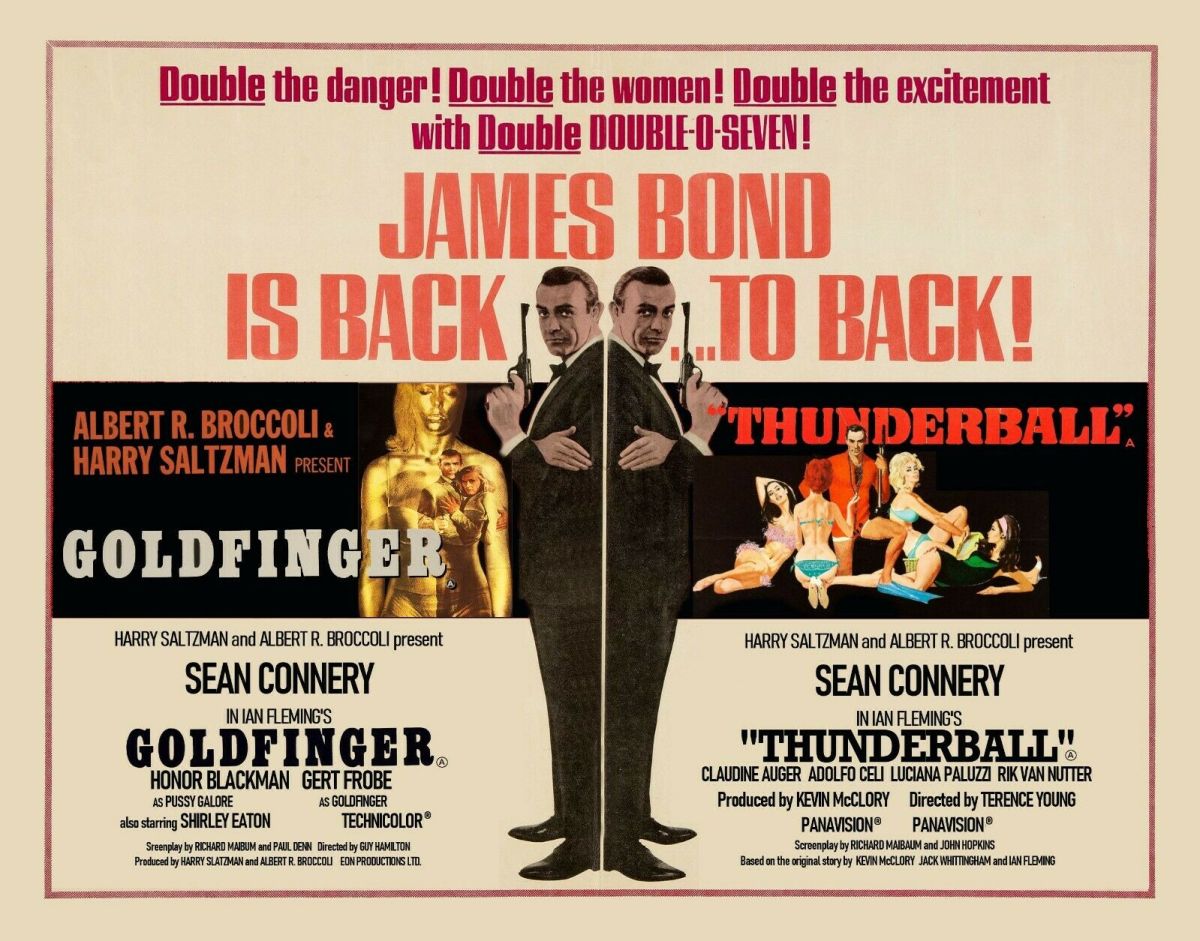
The 60th Anniversary celebration of the James Bond phenomenon in British cinemas that has been running for a few months now sent me back to examine the extent of the James Bond Reissue Double Bill.
As I mentioned a few weeks back, the Dr No (1962)/From Russia with Love (1963) revival in 1965 kicked off the biggest-ever demand for a screen character, one of whom the public never seemed to grow tired, certainly for the next decade until the first of the series were sold to television. Prior to United Artists’ approach with the Bonds, unless a picture had Oscar-driven box office power it would not even be considered for revival for around seven years, considered a generation in audience terms.
In Britain, the movies were guaranteed circuit releases on the Odeon chain. However, contrary to the approach in the United States, the movies were not thrown back into circulation right away and it wasn’t until three years later that the next double bill – Goldfinger (1964)/Thunderball (1965) – put in an appearance. But thereafter, there was no stopping the Bond bandwagon. In 1969 You Only Live Twice (1967) went out with either From Russia with Love or Dr No (cinemas could choose their preferred pairing).
In 1970, United Artists took a break from the Sean Connery reissue business by concentrating on the studio’s other big male star Clint Eastwood, doubling up For A Few Dollars More (1965) with A Fistful of Dollars (1964). But by 1971 it experimented with playing Connery and Eastwood together, first pairing You Only Live Twice/A Fistful of Dollars and later the same year Goldfinger/For a Few Dollars More. But in 1972 the studio reverted to type with Thunderball/Dr No and the following year Diamonds Are Forever (1971)/From Russia with Love.
In 1974 it was You Only Live Twice/Thunderball and few months later Dr No/Goldfinger. Come 1975 it was time for two of the later offerings to enter the revival business – Live and Let Die (1973) and On Her Majesty’s Secret Service (1969) followed at the end of the year by The Man with the Golden Gun (1974) and Live and Let Die. The next year brought a programme change – Diamonds Are Forever teamed up with new Bond Roger Moore in the non-Bond adventure Gold (1974).
In 1977, for the first time in nearly a decade the Bond reissue was absent from British cinemas although the following year saw a re-teaming of Live and let Die and The Man with the Golden Gun. But that pretty much spelled the end of the annual James Bond double bill, television by now too quickly eating up new product.
The British approach was almost conservative compared to the way the Bond revivals were handled in the US. After the sensational performance of Dr No/From Russia with Love in 1965 U.S. exhibitors had to wait only a year for Goldfinger/Dr No. United Artists showed little restraint, following a policy of “play them till they drop,” and launching the Connery/Eastwood combo in 1968 with You Only Live Twice/The Good, the Bad and the Ugly (1967) plus a straightforward Connery item Thunderball/From Russia with Love the same year followed by Goldfinger/Dr No in 1969.
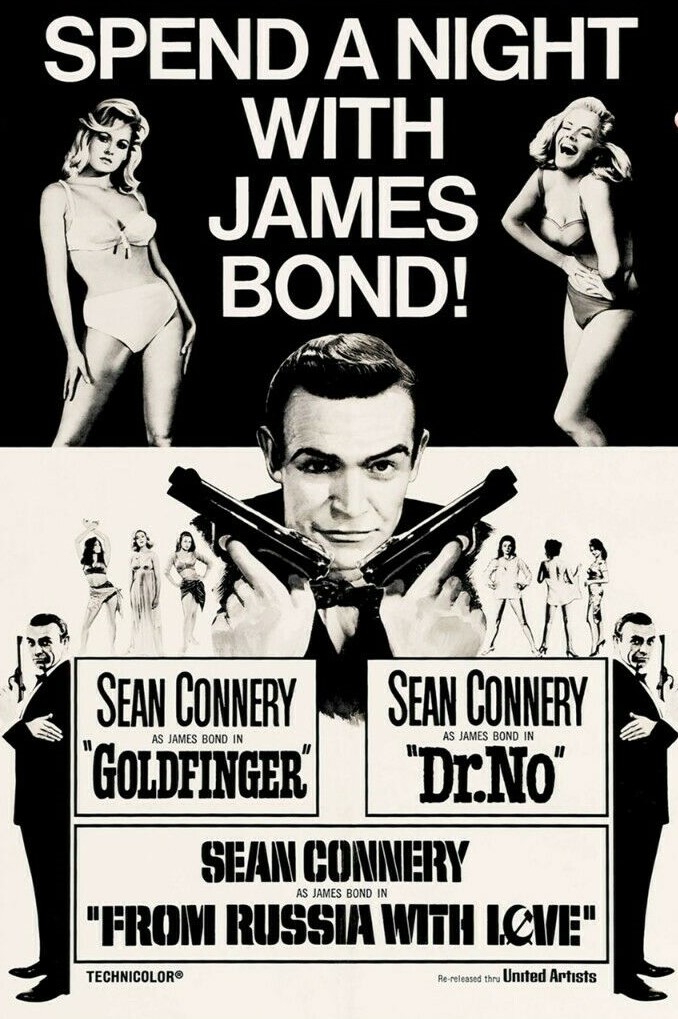
In the U.S. the year of the missing Bond reissue was 1970. But in 1971 United Artists reissued two Bond dualers six months apart. First out was Thunderball/You Only Live Twice and then Dr No/From Russia with Love. Ahead of the television premiere of Goldfinger in September 1972, UA brought back Goldfinger/From Russia with Love and then the triple bill (“Spend a Night with James Bond!”) of Goldinger/Dr No/From Russia with Love plus a double bill of Thunderball/You Only Live Twice, the last program incidentally knocking up a colossal gross of $122,000 – equivalent to $853,000 now – from 14 houses in New York in its opening week.
But the bonanza came to an end when television ponied up $17.5 million – equivalent to $126 million today – for the first seven pictures in the series. And this was before residuals kicked in from VHS, television resale and syndication, DVD, cable and streaming. Even when the MCU can guarantee billion-dollar revenues from many of its movies it’s doubtful if any one of its blockbusters made as much money as the best of the Bonds in their lifetime, much of that extra revenue coming from the way the revivals proved the enduring popularity of the series.
SOURCES: Allen Eyles, Odeon Cinemas 2: From J. Arthur Rank to the Multiplex (Cinema Theatre Association, 2005) p211-220; Brian Hannan, Coming Back to a Theater Near You (McFarland, 2016) p147-151, 175-177, 227.
I could have seen this for nothing on Netflix, but instead, hoping to do an action picture justice by seeing it on the big screen, I shelled out my bucks for the privilege. Bourne Ripoff is as much as you need to know. Lazy writing with a bundle of the incongruities you can get away with within the MCU because as long as there’s the requisite action nobody bothers too much about logic.
Don’t be fooled into thinking this is John Wick gone wild. It’s many things gone wild, including a heap of overacting, and a pair of the biggest villainous klutzes you will ever come across. It’s vaguely redeemed by an explosions/ shootout/ tram chase in Vienna but that’s only enough to shift it up from one-star to two. And it’s a shame because Ryan Gosling (First Man, 2018) in his first movie for four years is a believable tough guy in the Bourne tradition and Ana de Armas delivers on the action chops she displayed in No Time to Die (2021).
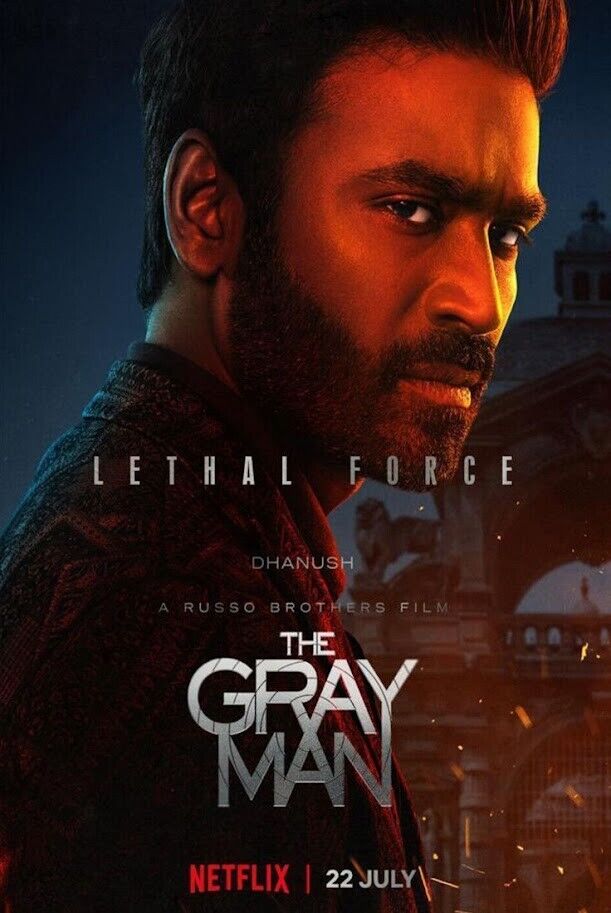
A poster straight out of the Joseph E. Levine playbook. He used to dream up these kind of posters which characters were assigned titles that bore no resemblance to the part they played on screen.
It should be an action romp, but instead it’s a mess. A C.I.A. black ops unit – inventively called the gray department – is hiring convicted killers to knock off anyone they want. Six (Ryan Gosling) got jailed for an insane amount of time, would you believe (nope!) for, as a teenager, killing his dad who was domestically abusing both his sons (trying to drown Six, for example). Six’s latest mission is to kill a guy who turns out to be an assassin in the same line of work but who is blackmailing C.I.A. boss Carmichael (Rege-Jean Page).
There’s nothing cool about Carmichael, he throws coffee at windows when he’s cross, and that sets an awfully bad example because his underling Suzanne (Jessica Henwick) is also prone to getting very cross. But that’s nothing compared to complete nutjob Lloyd (Chris Evans) who enjoys a bit of torture and gives psychopaths a bad name, but if I got this right attended Harvard with Carmichael so that’s okay then. Lloyd is hired to kill Six because he knows too much. And Lloyd calls in other assassins.
Now we’ve had that template in Bourne so what’s going to make it different? I know, let’s ramp it up. Instead of individual assassins, who might display some kind of finesse, let’s have teams of rampaging assassins. You can’t really wreck Vienna with just an assassin or two, you need a whole army.
Danush (Avik San) is an unusual assassin in that he operates on his own, not needing a huge team, but he is also cursed by – remember he’s a ruthless assassin – being suddenly conscience-stricken.
Oh, I forgot to mention Fitzroy (Billy Bob Thornton), the guy who sprung Six from jail but is now retired. Luckily, he happens to have a young niece Claire (Julia Butters). And that comes in handy when Lloyd needs to bring him to heel – and can kidnap the girl. But wait, two years before, Six was assigned to protect Claire and saved her life twice.
Twice? Yep, once from assassination and once when he rushed her to hospital after something went wrong with her pacemaker. Yep, she has some terrible heart disease. But not enough apparently to prevent her being the world’s pacemaker poster girl. Guess what? She can race along the top of a castle and jump 100 feet off a castle wall into a moat.
After being blame-shamed by Carmichael, Six’s C.I.A. sidekick Dani (Ana de Armas) switches sides to help him and can be counted on to turn up to shoot darts at Lloyd and appear with a fast car in time to save Six from assassins on the aforesaid tram. But she’s one of the victims of the lazy writing. She has two clear chances to save the day by marksmanship and fails each time. The first excuse is just so dumb. Thrown a sharpshooting rifle by Six, she discovers this comes minus ammunition. “Never throw a loaded gun,” must be one of the stupidest lines ever written, a lame joke that clearly makes reference to No Time to Die. Armed with another sharpshooting device and with clear line of sight on Lloyd, for reasons that are never made clear she doesn’t shoot.
Did I mention that Six is the kind of tough guy who, armed with little more than a penknife, can saw through a water pipe because the directors want to do some kind of riff on Kingsman: The Secret Service (2014) or that this this is the thriller version of If It’s Tuesday It Must Be Belgium (1969) with a different country about every ten minutes. And if people aren’t losing digits, it’s fingernails.
Ryan Gosling and Ana de Armas come out of this well but Chris Evans (Avengers: Infinity War, 2018), with a Tom Selleck moustache, is just awful, a joke villain, the only surprise being he doesn’t twirl said moustache. It’s almost as if he’s doing his utmost to make people forget he was ever Captain Marvel, but this is to the utmost and beyond. Stick to Bridgerton would be my advice to Rege-Jean Page. Billy Bob Thornton (Bad Santa 2, 2016) plays one of his more restrained characters.
The Russo Brothers (Avengers: Infinity War) throw every trick in the book at the movie without starting from the obvious point – a decent script.
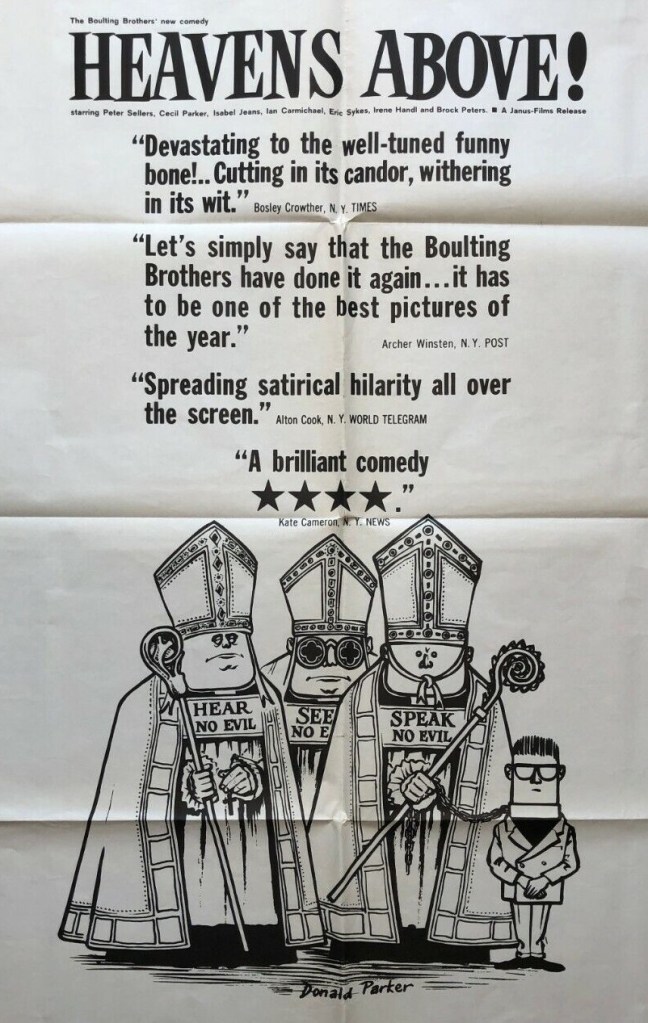
Surprisingly topical – food banks a key element – social satire. And a surprising box office smash – among the top 12 films of the year – in Britain, although the Boulting Brothers (I’m Alright Jack, 1959), often viewed as inheriting the Ealing mantle, had both commercial and critical form.
In a case of mistaken identity, simplistic prison chaplain Rev Smallwood (Peter Sellers) is sent to rich parish Orbiston Parva, virtually endowed by the Delpard family, owners of the Tranquillax business nearby. Smallwood, an advocate of the meek inheriting the earth and making it his mission to ensure the rich can enter the kingdom of Heaven other than through a needle, convinces Lady Delpard (Isabel Jeans) to spread her wealth. This takes the form of the Good Neighbour Fellowship, whereby she sets up a food bank whose popularity soon endangers the town’s retailers and merchants, the public, naturally enough, preferring to do their shopping at the free church outlet than spend money on a butcher or baker (possibly candlestick makers escaped the impact).
Meanwhile, to show he is up to scratch in the poverty ranks, Smallwood invites into his palatial manse the Smith family who are being evicted from their plot of ground to make way for an expansion of the Tranquillax factory. Despite ruffling feathers in the ministry, Smallwood can’t be turfed out, since religious law dictates he effectively owns the manse. However, once shops have to close for lack of trade and factories, for lack of goods being sold, make thousands redundant, Smallwood’s do-gooding backfires.
While Harry Smith (Eric Sykes) is an archetypal welfare swindler (taking home £90 a week) and inclined to siphon off items from the food bank for his own entrepreneurial purposes as well as stealing lead from the church roof, the rest of his enormous brood, led by the redoubtable Rene (Irene Handl) are converted to the joys of Christianity, enough so much so that baptism and marriage (between the couple) beckon.
Most of the humour is gentle, the biggest laughs – Smallwood inadvertently eating dog biscuits, a dog peeing on his leg, choirboy reading a dirty book, the butler initiating a miraculous intervention – are straight out of the Charlie Chaplin joke book. And the timing for many lines appears out of kilter, as though the laughs were not intended.
British films around this time often received rave reviews from U.S. critics which ensured reasonable business at the arthouses while not striking a box office chord with the general public. there.
Apart from Smallwood, his assistant Matthew (Brock Peters) and the converted Lady Despard you are hard put to find any Chistians. As one character observes “not enough decent Christians to feed one lion.” And the townspeople are generally shown as scroungers of one kind of another with the Smiths typical sex-obsessed chip-guzzling working class. The business owners, bishops, aristocrats and assorted politicians are similarly pilloried for greed and inefficiency so you could say the Boultings are being fair straight down the line.
The best scene, and the one that makes the most out of a comic situation, is when the real Rev Smallwood (Ian Camrichael) turns up, is treated as an imposter and locked up for displaying psychotic tendencies. And there’s a clever, even more topical ending, involving space exploration, which equally cleverly mimics an earlier scene. Actually, there are two scenes that echo earlier activities, and both are intelligently used.
The satire retains some of its bite. There are even more rich people around now who hold onto their wealth and there are more poor people in clear need of help, assistance that would extend far beyond food banks, a relatively recent phenomenon. You can be sure selfish big business will be as self-interested.
Peter Sellers, complete with regional accent, in pre-Pink Panther mode shows dramatic skills that he would rarely be allowed to exhibit until much later in his career and although I think he should have been permitted more leeway in his lines he doesn’t deliver them as though he is milking a joke which means dramatic intent is not diluted. He is perfectly believable as the quietly-spoken forgiving vicar surrounded by more grasping colleagues who appear to have forgotten the basics of Christianity, his immediate boss, for example, on holiday in Monte Carlo.
British television comedian Eric Sykes (The Liquidator, 1965), barely recognisable after abandoning his trademark stance and voice, is the standout as the conniver-in-chief. Brock Peters (The Pawnbroker, 1964) is effective as the bin lorry driving protégé and Isabel Jeans (A Breath of Scandal, 1960) a delight as Smallwood’s slightly dotty benefactor – her look as she realizes he has scoffed the dog biscuits worth a couple of laughs. The others, good as they are, are called upon to play little more than stock characters: Cecil Parker (The Comedy Man, 1964), Ian Carmichael (The Amorous Mr Prawn, 1962) and Irene Handl (The Wrong Box, 1966). Look out for Roy Kinnear (Lock Up Your Daughters!, 1969), the first Doctor Who William Hartnell and the future Miss Marple Joan Hickson.
Ably directed by Roy and John Boulting who easily hit all their targets, the screenplay is by Frank Harvey (I’m Alright, Jack), John Boulting and critic Malcolm Muggeridge.
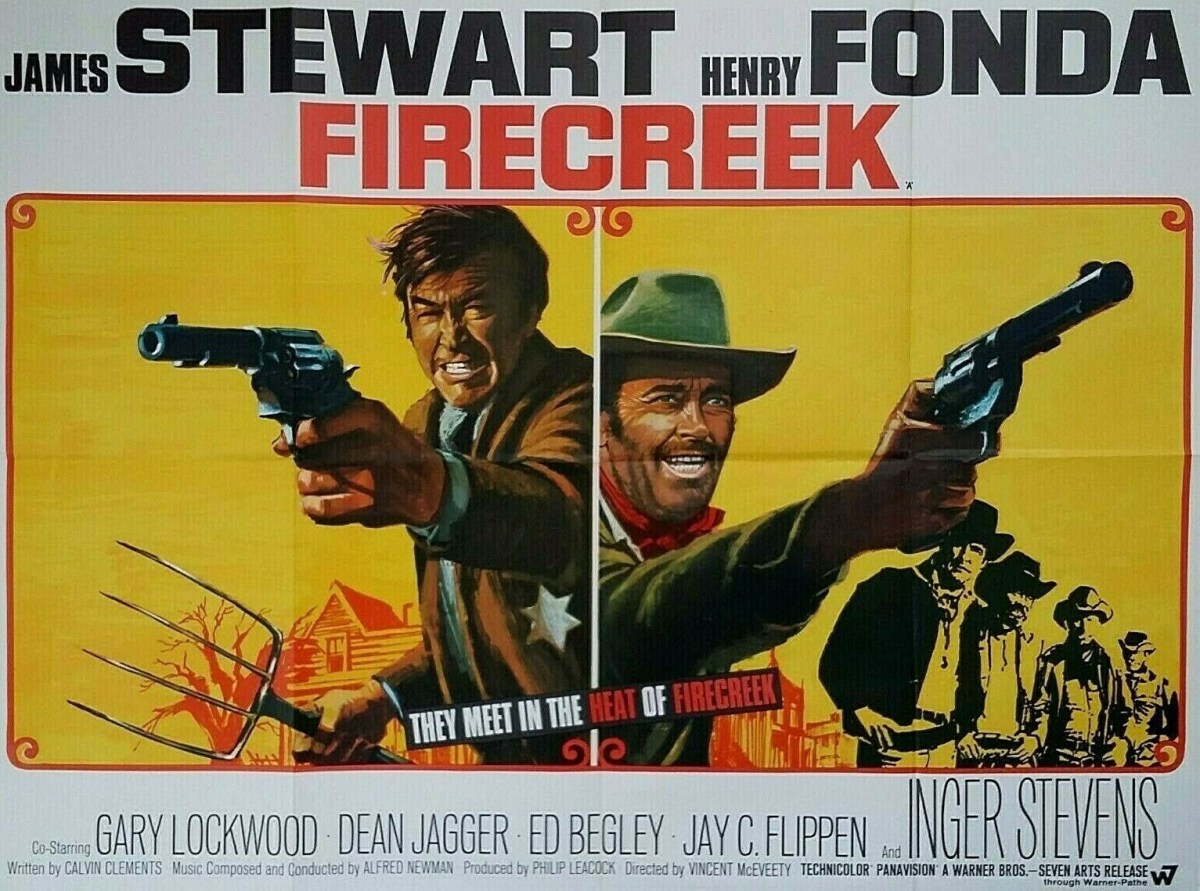
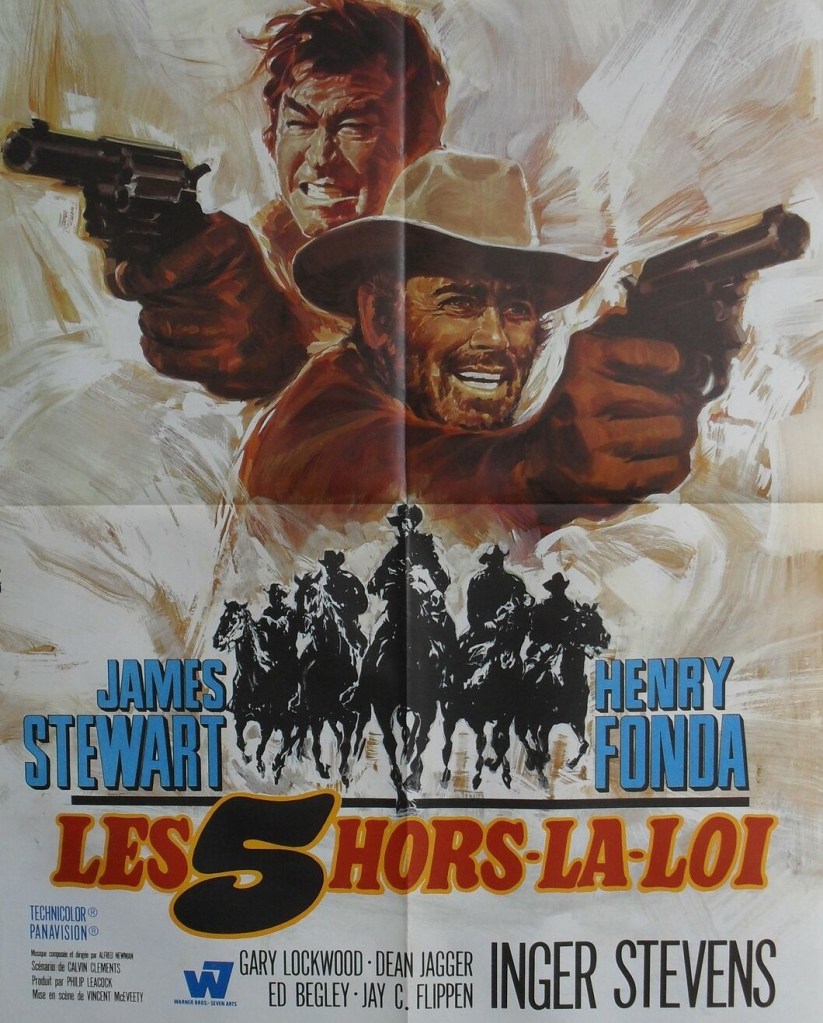
Unfairly overlooked intelligent western with terrific performances from the two male stars and thematically prefiguring both Once Upon a Time in the West (1969) and The Wild Bunch (1969). Granted it appears slow but it’s the slow-burn kind of slow that works exceptionally well. Too often under-stated means under-rated while subtlety rarely attracts critical plaudits. And if you see the role of the screenwriter as probing personality and uncovering self-delusion rather than merely devising pithy lines then this is one for you.
Johnny (James Stewart) is a two-bit (“honorary”) sheriff in a two-bit town stuffed full of losers. Into his patch comes a gang of hired killers fresh from range wars led by the wounded Bob (Henry Fonda) and including cocksure trigger-happy Earl (Gary Lockwood), mean Norman (Jack Elam) and dumb Drew (James Best). With Bob side-lined with his injury, it’s not long before the gang kicks off, Earl half-drowning a man, smashing up the saloon and nearly killing a pompous preacher (Ed Begley) while Norman attempts to rape Native American squaw Meli (Barbara Luna). They think a few dollars will repair the damage and nullify hurt feelings.
But for the most part tensions just simmer, it looking like the outlaws are temporary visitors, Johnny using diplomacy to settle matters, and none of the townspeople inclined to get into a shooting match. And there’s a rich seam of characters who even when they skirt cliché seem to offer if not necessarily something new but not shop-worn either and with emotional depth.
Headstrong teenager Leah (Brooke Bundy) is attracted to dangerous Earl even though he would as soon rape as romance her, level-headed Evelyn (Inger Stevens) finds solace in a man she knows is a killer and midwife Dulcie (Louise Latham) is so dry her language could cut you with a knife. Johnny’s too trusting wife Henrietta (Jacqueline Scott) bewails “why did we settle for less than we wanted,” storekeeper Whittier (Dean Jagger) would be a knife-whittling charming elder statesmen except for his habit of going for the jugular, and hero-worshipping stable boy Arthur (Robert Porter), too old to be just cute and verging on a calamity, “couldn’t tell you what day it was.” And there’s a hint that the upstanding Johnny ain’t quite so perfect, the question of Meli’s white child left dangling in the air.
It’s the kind of “cemetery” town people end up when they’ve nowhere else to go, the inhabitants discomfited “because today didn’t turn out like yesterday.” Johnny’s the worst offender, stopping here on his way to a better life further west because all he “saw here was land nobody wanted and ground that nobody would be challenging me for.” The only person who will stand up for law and order is the witless Arthur who unwittingly triggers trouble. The townspeople mirror the villagers in The Magnificent Seven (1960) who require the assistance of mercenaries before they can stand on their own two feet except in this case nobody is rushing to the rescue.
The initial stand-offs between Johnny and Bob are under-stated, serving to stoke up tension, and the twist is that it’s Bob who tries to avert a showdown, feeling sorry for the sheriff, knowing he will be no match for a proven gunslinger, while the climax provides a surprising saviour. In fact, Bob is the most self-aware of all the characters. He tells Evelyn “you are living even more in the past than I am” and that “I don’t have your temperament to accept another empty day.” And even though he doubts the quality of his gang, he can’t give them up, or the power of being in charge. “I’ve been alone, didn’t like it…I can’t gamble with being a nobody, I’ve been that, doesn’t work for me.”
Among the ton of great touches are Johnny’s badge, made by his kids, title misspelled, the climax in a dust whirlwind, the pompous preacher whose bluster can’t save him, and the most terrible wake you will ever witness.
It’s quite astonishing that a film with such a high quotient of characters – except Johnny at the end – lacking redeeming features could work so well. Director Vincent McEveety was the epitome of a journeyman, best known for television and Disney (Herbie Goes Bananas, 1977) go-to guy. This was his debut feature – if you exclude Blade Rider, Revenge of the IndianNations (1966) stitched together from episodes of television’s Branded – and it sank at the box office despite the presence of Stewart and Fonda, admittedly at the tail end of their marquee power.
Outside of the wake and the climax, the best scenes are under-played. McEveety lets the words do the talking, a good choice given the exemplary writing (as indicated above) and three principal actors who can be relied upon to ignore the temptations of over-acting. He handles the action well and there’s a growing sense of terror as the townspeople realize what their cowardice has let them in for.
There’s a nod here and there to High Noon (1952) with the town full of cowards but from today’s perspective it’s as a precursor that the movie is perhaps more interesting. Henry Fonda’s (The Best Man, 1964) performance, complete with pitiless stare and thick stubble, seems a rehearsal for Once Upon Time in the West (1969) while his gang, like The Wild Bunch (1969), complete with squabbling outlaws and leadership challenge, are “running out of borders.” You might notice how Fonda’s death here – the movement to the side when shot, the shock in his eyes – while markedly less operatic closely resembles a similar scene in Once Upon a Time in the West. And if you want further reference to Sergio Leone’s epic, how about a nearby town called Sweetwater.
You might think you’ve seen this James Stewart (The Rare Breed, 1966) performance before but it’s a subtle variation on the hapless character of Mr Hobbs Takes a Vacation (1962) and far removed from the take-charge characters of this decade. This is man who has fooled himself into thinking he is something he is not, a man of the west in name only.
Inger Stevens (House of Cards) again delivers, like the other townspeople acting tough to hide the weak interior. There’s a terrific supporting cast. Gary Lockwood (2001: A Space Odyssey) is given more rein than anybody else outside of Ed Begley (Warning Shot, 1967). Look out also for Dean Jagger (Elmer Gantry, 1960), Richard Porter (Mackenna’s Gold, 1969), Jay C. Flippen (Hellfighters, 1968), Louise Latham (Marnie, 1964), James Best (Shenandoah, 1965), Brooke Bundy (The Gay Deceivers, 1969) making her movie debut, Barbara Luna (Che!, 1969) and Jack Elam (Once Upon a Time in the West).
Credit for the intelligent screenplay goes to Calvin Clements (Kansas City Bomber, 1972), also making his first picture.
Almost a curiosity in the Clint Eastwood canon from the later perspective, this modern western concerning a maverick Arizona cop pursuing a fugitive in New York could also be interpreted as a riposte to the violent avenger of the “Dollars” trilogy and Hang ‘Em High (1968). Like Rio Conchos (1964) there’s an action-packed start and finish and not much in between unless you count Coogan (Clint Eastwood) being beaten up, and like Firecreek, made in the same year but less of an audience attraction, a slow burn with little of the depth of the Vincent McEveety effort.
It fits more neatly into the “victim” niche of The Beguiled (1970) and Play Misty for Me (1971) with Eastwood, while attempting to present a macho image, set upon by predatory women. Here, although led into a trap by the girlfriend Linny (Tisha Sterling) of the wanted Ringerman (Don Stroud), the victim elements are mostly humorous, Coogan a fish-out-of-water taken advantage of by cab drivers and hoteliers and by a justice system that takes more note of due process than he is accustomed to. Otherwise, it’s pretty much a romance as Coogan, for whom persistence pays off, beds probation officer Julie (Susan Clark).
Coogan is a paid up member of the wham-bam-thank-you-ma’am fraternity, frolicking with an adulterous lover in Arizona, and displaying no qualms about getting it on with Linny. In the hands of Jack Lemmon this would be a comedy, so it’s a strange choice for Eastwood unless for experimental purposes, trying to set himself up more as Steve McQueen than John Wayne.
The picture opens with Coogan tracking down a Native American, and manacling him to a pole outside a house while he repairs inside for sex. Interrupted by a sheriff frustrated by his ways, he is despatched to New York where he manages, through a bluff, to have Ringerman removed from Bellevue mental hospital. On the way home, he is ambushed by Linny and some thugs, losing consciousness and his gun, neither going down well with the more bureaucratically-minded Lt. McElroy (Lee J Cobb) whose undercover stake-out plans he has also ruined.
Luckliy, Coogan has chanced upon probation officer Julie who can’t quite manage to deter his amorous advances and at an appropriate moment he sneaks a look at her files for his next lead. Not quite as sharp as he imagines, and clearly not much good at assimilating painful lessons, after a dalliance with Linny, he is astonished to be led into yet another trap. In the end, of course, he gets his man, courtesy of a motorbike chase. But there’s a curious ending. Not only does Julie, who he has betrayed with Linny, turn up to wave him off, but, as if he has now turned into a kinder, more humane specimen, he affords his prisoner a smoke, something he pointedly refused to do with the Native American.
It’s not dated particularly well and modern audiences will have trouble accepting domestic abuse and rape as comedic situations and eyebrows are scarcely going to be raised at the drug-addled Linny nor the club where naked women fly overhead on trapezes. The idea that intelligent women like Julie, weighed down with psych jargon and over-concern for offenders, just need a big hunk in their lives doesn’t fly either.
But if you accept the out-of-towner trope, and are happy to see Clint practising his squint and double take , you will find in between the action and “victim” agenda, a quite tolerable romance. It was a bold choice for a star best known for killing people. Tough guy that he is, he is flummoxed by the big city and has a hell of a job getting his man. On the other hand Eastwood and Clark have excellent chemistry. This is embryo Eastwood, almost as if he is trying on a variety of screen persona to see what will fit. After Dirty Harry (1971) there was little truck with romance except for The Bridges of Madison County (1995) and In the Line of Fire (1993) so it’s interesting to see his moves, albeit that the best romantic work he did was in the director’s chair with Breezy (1973).
Susan Clark is superb, all the professional confidence of Tell Them Willie Boy Is Here (1969) but the romantic cynicism replaced by an appealing hesitancy. Lee J. Cobb (Exodus, 1960) has little to do except be grumpy, Don Stroud (Madigan, 1968) doesn’t feature prominently enough while Tisha Sterling (Journey to Shiloh, 1968) makes the bigger impact.
Don Siegel (Dirty Harry) would become an Eastwood long-time confederate, directing him in six movies, of which this was the first. He had just made a Hollywood comeback after six years in the feature film wilderness with Madigan (1968), a tougher cop picture. I would be inclined to lavish more critical plaudits on the idea of playing around with the tough guy persona, but I’m not sure that was the intention.
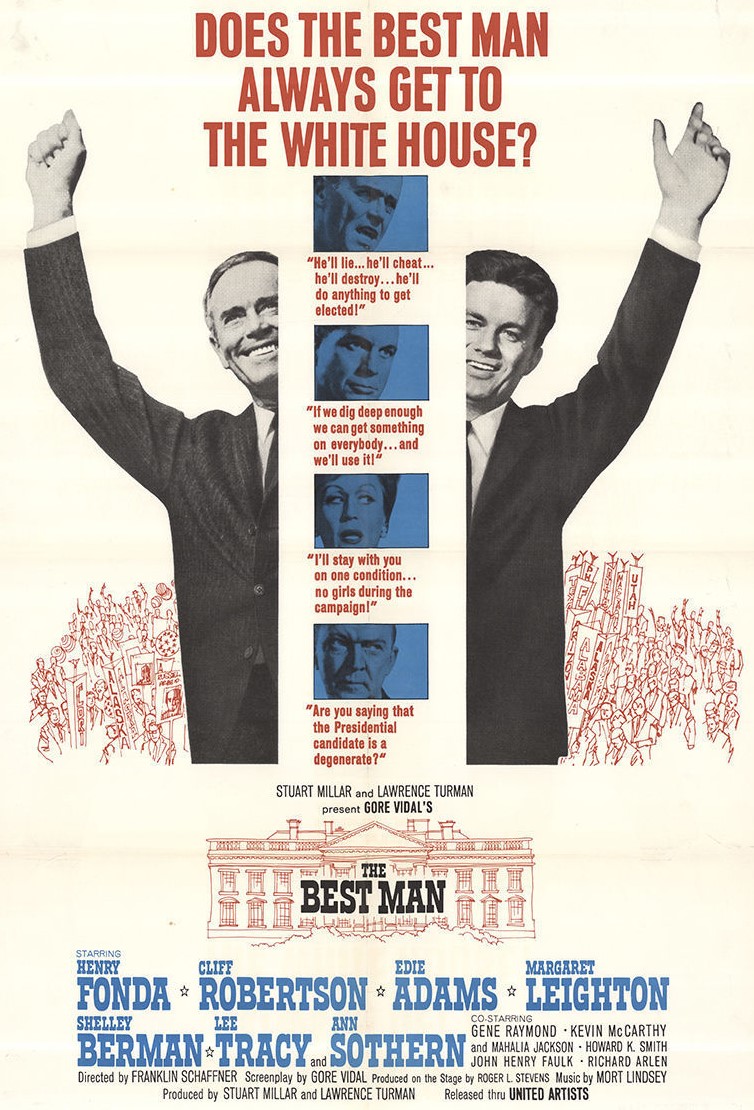
Current openness towards mental health issues has bestowed a contemporary vibe on this lively political drama. The other topic raised here has long ceased to be controversial. Not that far removed from Otto Preminger’s Advise and Consent (1961) in terms of dirty dealing and horse trading, flaw is the weapon used to cut opponents down to size.
The two principal candidates seeking their (un-named) party’s Presidential nomination could not be further apart, William Russell (Henry Fonda) a rich intellectual, Joe Cantwell (Cliff Robertson) a self-styled man of the people. Cantwell chases the populist vote with a campaign built on fulminating against immigration and Communism, driving down taxes and spending more on the military. Russell seems unsuited for the cut-and-thrust of politics, too idealistic, too indecisive.
But he is a good judge of character whereas Cantwell most decidedly is not and in misreading the intentions of President Hockstader (Lee Tracy) shoots himself in the foot and leaves the nomination wide open, triggering his use of the dark arts, planning to circulate a file on his opponent’s problems with mental illness. Existing on a much higher plane, Russell refuses to fight back, although he has access to a witness claiming Cantwell was gay.
Apart from discussing these taboo issues – this was the first time the word “homosexual” was uttered in a movie – what’s interesting is that Russell’s philandering is not deemed damaging as long as his wife Alice (Margaret Leighton) is seen to publicly stand by him. Despite the fact that Cantwell is as clean as a whistle – doesn’t drink or smoke or have a lover – affairs are seen as such a fact of life of politics that Cantwell’s wife Mabel (Edie Adams) assumes he will have one. Cantwell, very much one to go for the jugular, clearly believes the public takes the same non-judgemental view otherwise he would easily skewer Russell on his marital discord.
In some respects, Cantwell is by far the better candidate if you were to judge him on personal behaviour, but he lacks the necessary savvy, “ a tragedy in a man and a disaster in a president.
As you might expect from a script written by novelist Gore Vidal, sometime political heavyweight, there are plenty zingers: “expect 22 minutes of spontaneity”; “I don’t object to you being a bastard, I object you being a stupid bastard;” and “I won’t throw my mud if you won’t throw your mud.”
It may be artistic irony that determined director Franklin J. Schaffner to film in black-and-white since politics is nothing but various shades of grey, but there was probably a more practical reason, to incorporate footage from conventions.
Somewhat surprisingly, both men are honest with their wives, Russell making a pact to divorce Alice if not elected, their marriage long ago defunct, while Cantwell’s wife is fully aware of the slur on her husband’s name. The women here are well-drawn, not quite the submissive types you might expect, certainly not Alice who has every right, given his infidelities, to act the shrew, instead of which she plays the shrewd card. Mabel proves a loving wife but a little indulged to the extent her teetotal husband has no idea how much alcohol she can shift and she reserves her right to keep him waiting. Alice, it might be noticed, is more vicious than her husband should it come to the down-and-dirty.
And there’s a stack of wannabe power-makers from pushy busybody Mrs Gamidge (Ann Sothern) – so full of her own importance that she fails to see the slight in being told that “talking to you is like talking to the average American housewife” – to walking timebomb Sheldon Bascomb (Shelley Berman).
Not so full of arcane American politics as Advise and Consent, and with a more straightforward narrative, it digs the dirt in compulsive fashion on the dirt-diggers. In questioning whether someone with mental health issues could be a worthy national leader, the movie naturally ignores the narcissism and megalomania that seemed essential criteria for any person achieving high office or excessive business success. It’s probably a subject that remains unresolved, although a good many personalities have admitted to such problems.
Cliff Robertson (The Honey Pot, 1967) takes the acting honours if only because we have seen a version of the Henry Fonda (Battle of the Bulge, 1965) political idealist before in Advise and Consent. Robertson essays a character of Donald Trump dimensions and Fonda is clearly modelled on Kennedy, but Robertson comes across stronger and even Fonda may have been getting fed up with being such a straight-shooter as seen by his later villainous choices. Edie Adams has a more complex part here than in The Honey Pot and Margaret Leighton (The Fighting Pimpernel, 1949) can play ramrod-stiff women till the cows come home.
Hollywood veteran Ann Sothern of Maisie fame is terrific as the interfering Mrs Gamidge and Shelley Berman (Divorce American-Style, 1967), making his movie debut, is one of the most irritating characters you will ever see. Kevin McCarthy (Mirage, 1965) plays Russell’s whip-smart aide with Lee Tracy (Dinner at Eight, 1933) in his first movie in nearly two decades as the wily President.
Audiences were denied the first glimpse of Penny Singleton (the Blondie series) in fourteen years when her part was excised. To make up for that, we get to see Mahalia Jackson sing.
Director Franklin J. Schaffner (The Double Man, 1967) keeps characters to the fore rather than relying on the many twists, and does a decent job, complete with aerial helicopter shots, of opening up Gore Vidal’s stage play. Vidal (Ben-Hur, 1959) had stood unsuccessfully for Congress so had an insider’s viewpoint.
It was time someone took the piss out of the MCU. Just as well Marvel decided to do it for themselves. The result is a hoot.
Finding gainful employment for the universe’s dumbest superhero is no joke, but in a welter of visual and verbal gags the studio celebrates his stupidity. I was laughing from the outset and I didn’t stop and from the mad recaps to the giant goats, Thor (Chris Hemsworth) treating his weapons as if they had the power to upset him, his ignorance of the devastation he wreaks, and non-PC references to orgies and the size of his manhood, the inevitable Marvel save-the-world plot takes second place to humor.
Asgard has been turned into a tourist attraction, terrible actors perform sagas in tacky productions to entertain visitors, until Gorr (Christian Bale) the god-killer, having been allocated in normal mysterious fashion and in Excalibur-style the Necrosword, comes calling, kidnapping children, packing them off to the Shadow Realm as a means of luring Thor. Fortunately, lost love Jane Foster (Natalie Portman), unfortunately dying of cancer, reappears in his life, though, on the debit side, she steals his hammer, causing him to turn to his axe. There’s hammer hocus-pocus, the usual lengthy daft exposition, but that’s offset by Thor, sensitive soul that he is, feeling he has to woo the discarded axe.
Also recruited are Asgard king Valkyrie (Tessa Thompson) and stone-man Korg. First port of call, naturally, is Omnipotence City where all the top gods hang out, including Zeus (Russell Crowe), the top god of all. Unwilling to help them out when there are delectable maidens hanging on his every word and orgies to enjoy, Zeus foolishly picks a fight and loses his lightning bolt.
But that’s enough of the madcap fun. Now it gets serious in the usual annoying way, redemption and its alter-ego sacrifice required at every turn, as you try to keep up with the new ideas suddenly introduced, the Bifrost and Eternity, and have to remind yourself of the rules regarding the axe and sword and the various pitfalls awaiting the characters. But the first half has given the movie sufficient energy to woosh you through the second half.
I’m not sure of The Avengers recruitment policy and how Thor ever fitted in and it’s just as well his cohorts in this adventure, part of the way at least, are the equally demented Guardians of the Galaxy phalanx led by the vain and vainglorious Star Lord (Chris Pratt). I always felt the rest of the MCU mob, albeit they occasionally deliver a good quip or two, were just too serious a bunch, what with all the saving-the-universe-and-beyond malarkey whereas Thor and Star Lord are blood brothers, daft specimens, useless at romance and anything serious, good for nothing except a good scrap.
There are a whole bunch of stand-out comic scenes – Thor looking to Star Lord of all people for advice on matters of the heart, the goats leading the space craft crash-landing into a planet. Admittedly, excepting the serious bits at the end, this is far more light-hearted than anything else in the MCU and thankfully sticking to the one universe rather than the multi-universe departures of late.
Chris Hemsworth (Thor: Ragnarok, 2017) as usual is superb, just the right bombast and imbecility coupled with vulnerability and sweetness, his clipped delivery at odds with his befuddlement, his eve-of-battle speeches would have Churchill turning in his grave. But Russell Crowe (Unhinged, 2020), with his mangled Greek accent, matches him in the dumb stakes. Natalie Portman (Lucy in the Sky, 2019) makes a welcome return and Tessa Thompson (Passing, 2021) proves a good side-kick to both. Christian Bale (Ford vs. Ferrari, 2019) bring his malevolent A-game as a memorable villain. Watch out for cameos from Matt Damon (The Last Duel, 2021), Melissa McCarthy (Superintelligence, 2020), Luke Hemsworth (Death of Me, 2020) and Sam Neill (Jurassic World: Dominion, 2022).
Director Taika Waitiki (Thor: Ragnarok , who also voices Korg, does a quite brilliant job of combining action and comedy. He also takes credit for the screenplay along with Jennifer Kaytin Robinson (Unpregnant, 2020).
Inconvenient truth never bothered Hollywood scriptwriters when it came to history and here the prospect of solving the “Great Hannibal Mystery” proved irresistible. For in 218 B.C. this invader from Carthage (modern-day Tunisia) had crossed the Alps, battered the Roman army into submission and had Rome at his mercy. But one of the greatest generals of all time did not attack Rome. Why? Love was the answer, according to the filmmakers, following the Romeo and Juliet template.
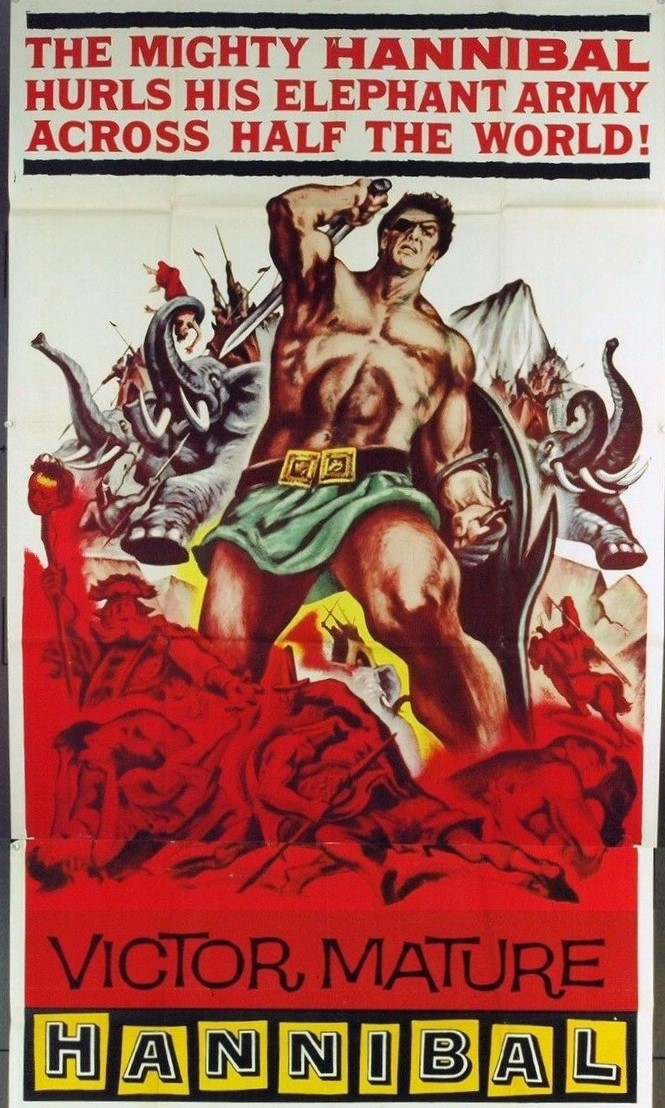
I have to admit I didn’t have that on my mind. I was seduced by the poster, the involvement of cult director Edgar G. Ulmer (The Black Cat, 1934), the prospect of an action-packed adventure with marauding elephants and the fact that although familiar with the name Hannibal I had no idea who he was and why he crossed the Alps when surely it would have easier to take a ship from Tunisia to Italy. But I guess star Victor Mature (Samson and Delilah, 1949) was also duped into thinking that if an American nobody like Steve Reeves (Hercules, 1958) could make it big in Italy then so could surely the original Hollywood Mr. Muscles. Mixing the new-look sword-and-sandals genre with the old-style historical epic appeared a potential winner. But I should have guessed that the lean running time of 103 minutes meant an “epic” was out of the question.
The British Trade Descriptions Act would have a field day with the way the posters promoted the elephants. The much-vaunted “army” is scarcely seen in battle and the great beasts looked more cuddly than anything, striding along linked trunk-to-tail.
The picture does take a good while to warm up although the movie begins with a sense of the epic, otherwise how to explain the 15 minutes before Hannibal hoves into view, the preceding period of invaders crossing the Alps short of dramatic incident beyond a couple of men falling to their deaths and the elephants becoming a bit restive. Endless lines of soldiers, in this case stretching into the snowbound horizon, almost becomes a motif, too much valuable time wasted on too many marches.
Hannibal turns out to be a clever commander, wanting to conquer Rome more by fear than battle, reckoning that if the Italians believed he possessed an unstoppable force they would rush to the negotiating table rather than engage in open battle and risk the destruction of their cities. He sends the captured niece Sylvia (Rita Gam) of Senator Fabius (Gabriele Ferzetti) back to her uncle with frightening tales. This doesn’t fool Fabius who views the woman as a traitor and realizes the pitfalls of surrender. Hannibal and Sylvia getting it together causes discord not just in Rome but in the Carthaginian camp, the delay in attacking the city put down to their romantic dalliance.
The initial battle scenes come up short, presented primarily in montage, little snippets of fighting here and there, rather than opposing forces facing each other, no sign either of elephants striking terror into the hearts of their opponents. But the later battle more than recompenses. One of the greatest assets of historical and war pictures is the detail given over to strategy. And if filmed properly, you can see plans executed. Hannibal demonstrates his genius by drawing the main Roman phalanxes into a trap, attacking them from both sides and forcing them back towards a river from which there is no escape. Superbly filmed, it’s a bloody conflict (for movies of the period), arms hacked off, faces and bodies weeping with blood. There’s a tragic end to the romance.
Oh, and by the way, Hannibal loses an eye – but it’s not in battle but from conjunctivitis.
I should point out, having done my own digging, but there was a sounder reason than love for Hannibal not advancing on Rome. Simply put, he lacked the machinery to do it. The only way to conquer a city was by siege and to achieve that you needed siege machines which Hannibal lacked. But no matter how much he later tried to draw the Roman armies into the open, he was denied that opportunity by the wily Fabius who, instead, waged a war of attrition.
Hannibal was, in fact, an irritant to Rome for a decade, so this tale is heavily truncated. Although the tale of the strong man brought to his knees by passion is a Hollywood trope – look no further than Samson and Delilah – the lovers fail to strike the necessary sparks, in part because initially Hannibal views Sylvia merely as a tool to achieve a political end and in part because their time together is too limited. This is no grand passion in the vein of Doctor Zhivago (1965).
And that’s a shame because despite (or perhaps because of) his muscles, Victor Mature was no slouch in the romantic sweepstakes, having dallied in the past with the like of Janet Leigh (Safari, 1956), Susan Hayward (Demetrius and the Gladiators, 1954) and Jane Russell (Las Vegas Story, 1952). Here, Mature is better as a leader than a lover. The svelte Rita Gam (The Thief, 1952) – first wife of director Sidney Lumet – was the opposite of the more voluptuous Italian screen queens of the Sophia Loren/Gina Lollobrigida variety and her career had not really taken off, only eight films prior to Hannibal and only two in the next decade. Paradoxically, she is better battling her uncle and accepting her fate than a woman in the grip of passion.
Gabriele Ferzetti (Once Upon a Time in the West, 1968) makes the most of a complex character. Look out for Rik Battaglia (Sodom and Gomorrah, 1962) as Hannibal’s brother and, as Fabius’s son, Terence Hill (God Forgives…I Don’t, 1967) and in a smaller role his future sidekick Bud Spencer.
Directorial credit was split between Ulmer and Carlo Ludovico Bragaglia (Amazons of Rome, 1961) with Mortimer Braus (The Son of Dr Jekyll, 1951), Sandro Continenza (The Inglorious Bastards, 1978) and Ottavia Poggi (Queen of the Nile, 1961) involved in the screenplay.
Shave 20-30 minutes from this and you would have had a taut thriller. You could start with the number of clever dicks who happen to notice that what’s going on bears a close resemblance to a play Volpone by Shakespeare contemporary Ben Johnson, even down to the anglicizing of the names of those fictional characters. And prune the number of detectives, three is two too many especially when there’s an actual genuine detective in the mix. And the shock ending is just…well…mince.
Otherwise, quite fun in a way. Wealthy Cecil Fox (Rex Harrison) hires sometime actor, sometime factotum, law graduate Marty McFly – oops William McFly – to help him pull off an elaborate joke, “people-baiting”, a modern version of “bear-beating” apparently. Fox pretends to be dying in order to bring three former lovers, all he presumes desperate to be named in his will, to his bedside in a grand palazzo in Venice. Upfront reason, some kind of revenge. Hidden reason, something darker obviously.
The trio are Texan Mrs Sheridan (Susan Hayward), movie star Merle (Edie Adams) and Princess Dominique (Capucine). Sheridan is accompanied by a nurse Sarah (Maggie Smith), the “voice of morality.” They all certainly seem to have a sense of humor. Two presenting Fox with gifts of clocks, the princess with an hour-glass filled with gold dust instead of sand, presumably with the notion that he can watch his life ticking away. Needless to say, this is like an reality TV show, Fox not having named an heir in his will, so they are all battling to be the heir, and as he points out, even the rich will succumb because there is no such thing as “enough money.”
Things do not go according to plan when Sheridan unexpectedly dies. Enter Inspector Rizzo (Adolfo Celi). Sarah suspects McFly because he used her as an alibi but disappeared for a time when she (for unexplained reasons) fell asleep in a posh restaurant (and nobody tried to wake her). Turning detective herself, she comes up with “proof positive.” Turns out the two remaining suspects had conspired to also give themselves an alibi, easily demolished by the kindly inspector. McFly, too, has been doing some digging.
But then comes another twist and everything you thought you knew flies out the window. Cue more investigation, more alibis and finally an Agatha Christie pay-off when the two amateur detectives and the real one confront everyone in the drawing room. By which time the twists are coming thick and fast.
Best thing about this is the playing. Although decidedly stagey, very little in the way of visual audacity, that works to the movie’s benefit, and not a bad choice to rely so heavily on the acting given the cast. With the exception of Edie Adams, Capucine and Celi, all were Oscar anointed. Two winners – Rex Harrison for My Fair Lady (1964) and Susan Hayward for I Want to Live (1958) – and between them another five nominations – and two future winners in Cliff Robertson for Charly (1968) and Maggie Smith for The Prime of Miss Jean Brodie (1969). The others were not out of their depth, Edie Adams (Made in Paris, 1966) clocking up Emmy nominations. Adolfo Celi (In Search of Gregory, 1969) a deuce of nominations from the Cannes Film Festival while even Capucine (The 7th Dawn, 1964) had been nominated for a Golden Globe.
So director Joseph L. Mankiewicz (Cleopatra, 1964) makes the right decision to let his actors get on with. Rex Harrison is at his suave best, but with a malevolent undercurrent, and has most of the best – and zestiest – lines. Robertson, usually the hero, is sly and duplicitous. Susan Hayward was in her comfort zone, forthright and taking no prisoners, Capucine at her cold and haughty best. Smith and Celi were the revelations, the former losing the trademark drawl and the nurse’s mousiness as to some extent she exerts control, and Celi departing from the bombast and delivering a lower-keyed performance.
Doing double duty, Mankiewicz worked up the script from three sources: the original Volpone, the play Mr Fox of Venice by Frederick Knott (Dial M for Murder) and a novel The Evil of the Day by Thomas Sterling. Next time the director went to the stage for inspiration he chose a better source for a mystery – Sleuth (1972).












 The Magnificent 60s