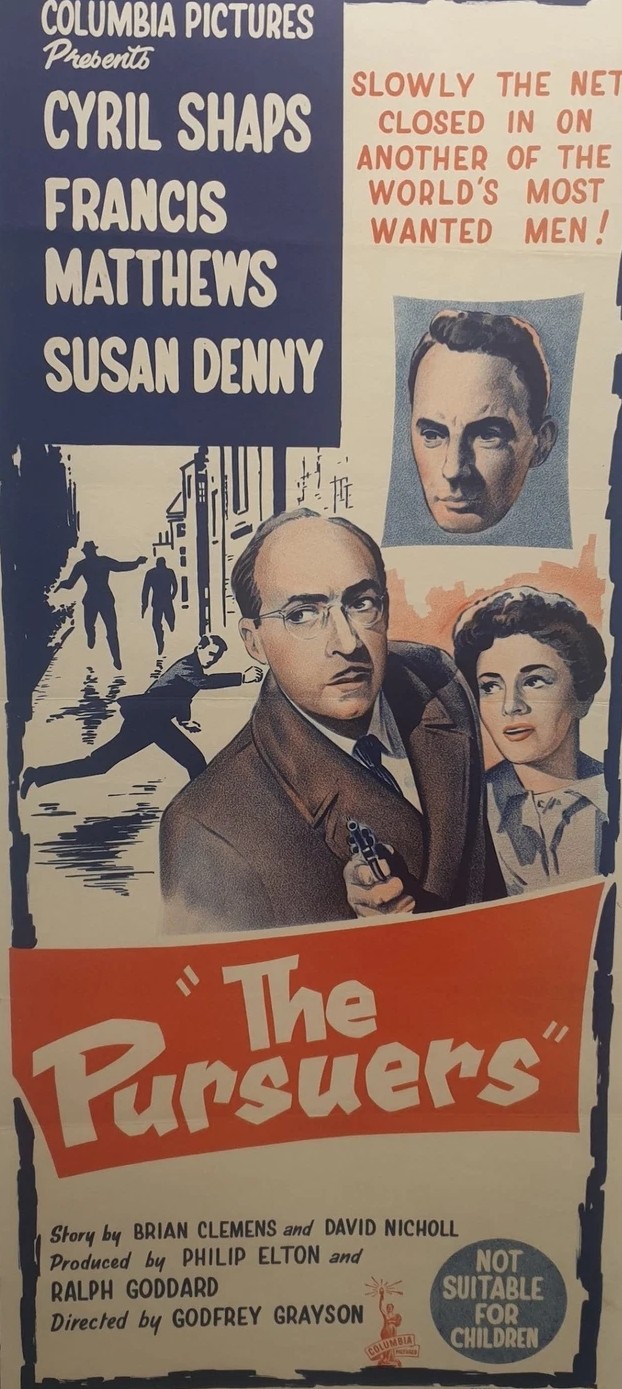
I tell you now there’s nothing particularly great or particularly awful about this tidy British programmer, made to take advantage of the Eady Levy and suitable only for the bottom half of a double bill, and yet it still has quite a bit to offer. It’s a chase picture, a hunt, but the emphasis, despite the title, is not on the hunters but on the hunted.
Who in this case turns out to be one of those evil people hiding out under the guise of the normal. Before emigrating to Britain, Luther (Cyril Shaps) was a Nazi commandment of a concentration camp. David (Francis Mathews), member of secret group operating out of Paris (cue an establishing shot of the Eiffel Tower), has been despatched not to out him but to kill him.
Luther runs a respectable business in London, and what makes this so interesting is that all the people he turns to for help are all in respectable businesses, yet all have war crimes to hide and appear to have done so successfully. So if you are a famous film director, the British movie industry will welcome you with open arms and scarcely a trace of suspicion about your past.
Since British food was generally in the 1960s regarded as the worst in the western world, then any German who can add a bit of culinary class to a restaurant is also more than welcome. And so it goes on. It’s like these people have managed to disappear into a witness protection program. Although the Mossad hunted down war criminals and had recently located Eichmann in South America and brought him back for a show trial in Israel, it’s clear there was no coordinated worldwide hunt for Nazi war criminals.
When his old buddies don’t want to disturb their carefully constructed facades by helping him out, Luther turns to the underworld. At first, it looks like he’ll get away. He plans to take the next flight out. He’s got plenty dough stashed away.
But what has prompted his fear of discovery is that his apartment’s been burgled and the burglar has daubed a swastika on a mirror. But nothing else has been taken and the police refuse to post a guard outside his house. Except something has been taken – the most important page in his passport has been cut out so that escape route is, temporarily, blocked.
Nightclub owner and gangster Rico (Sheldon Lawrence) fingers him for being someone who can easily and subtly be relieved of his cash, so he sends over sex worker Jenny (Susan Denny) to chat him up.
Ostensibly taking pity on him, Jenny, who escaped the concentration camps, agrees to hide him away in her apartment, presumably able to show sympathy while at the same time finding a way to rob him. She believes his tale of being a good German, a soldier forced to fight.
Unfortunately, this is too loosely constructed for the movie to take advantage of this situation. Though, technically, he is forced to confront one of his victims, in reality her tale washes over him and there’s no sign of remorse. You might not expect that, of course, mass murderers, especially ones who believe what they are doing is right, are unlikely to examine their consciences. But, still, the fact that he shows no reaction at all, makes this just appear a narrative contrivance, since after all, we already know what the Nazis did in the concentration camps.
This came out after Judgement at Nuremberg (1961) which was more specific about the Nazi atrocities, so we wouldn’t have needed any further exposition. That it does work is down to Jenny, sufficiently taken in by this imposter to open up her soul.
Anyways our Luther is a clever clogs and working out that, since his pursuers know both that he lacks a passport and that he’s already been turned away at the airport, he reckons the last thing they’ll expect him to do is try to use that escape route again.
There’s more shootout than you’d expect from what appeared initially as a straightforward drama. But it poses more interesting questions rather than being a rewarding thriller.
As far as I can make out this proved the only top-billed role in the career of Cyril Shaps (Return of a Stranger, 1961) but he enjoyed a very healthy run as a supporting actor. Susan Denny (Too Hot to Handle, 1960) only made one more film. Francis Mathews (Crossplot, 1969) made more of an impact on television as Paul Temple (1969-1971) and as the voice of Captain Scarlet in Captain Scarlet and the Mysterons (1967-1968).
Directed by Geoffrey Grayson (The Lamp in Assassin Mews, 1962) from a script by Brian Clemens (The Corrupt Ones / The Peking Medallion) and David Nicholl in his debut.
For such an undemanding piece, asks interesting questions.

