Behind the Scenes – “The Thomas Crown Affair” (1968)

Richard Burton was first choice. Sean Connery second. Jack Lemmon a distinct possibility. A suave Frenchman such as Jean-Paul Belmondo (Breathless, 1960) was briefly entertained. Brigitte Bardot a certainty for the female lead. Thoughts of entertaining Steve McQueen for the male lead were so far beyond left field as to have entered the outer limits. He played down’n’dirty working characters clad in nothing more sophisticated than denim. Faye Dunaway’s screen persona – violent slutty bitch – was the opposite of the character depicted.

Producer Walter Mirisch was well versed than most about McQueen, having hired him for The Magnificent Seven (1960) and The Great Escape (1963). But when Burton rejected the part, “we determined to try to interest Sean Connery in the role.” The Scottish actor was receptive to any movies that would instantly take him away from the typecasting of the James Bond series. Lunch at the Regency Hotel  was followed by further conversation “for most of a Saturday afternoon.”

But to no avail. “We were crestfallen when we failed to convince Sean Connery,” who was, after all, the biggest star in the world, and looked immaculate in a suit.

Even Steve McQueen acknowledged he was an odd choice. He told a film school class in January 1967 that he was a “limited actor, I mean my range isn’t very great.” But after the possibility of crowning his acting career with Oscar glory for The Sand Pebbles (1966) had faded and with motor racing epic Day of the Champion in cold storage but with a six-picture with Warner brothers promising a hefty $700,000 per, he had the pick of projects.

Maybe too many came his way, over 100 in a few months. He took a meeting with Twentieth Century Fox over a proposal to star with Audrey Hepburn in Two for the Road (1967). He was mooted, along with Paul Newman, for In Cold Blood (1967) and was wooed by John Huston for The Kremlin Letter (not made till 1970).

Eventually, director Norman Jewison, who had worked with McQueen on The Cincinnati Kid (1965), another change to the actor’s screen persona, after much badgering, agreed to let him see the script.  “Norman and I both felt that Steve was completely wrong to play Thomas Crown,” commented Mirisch, especially over the demand that “he should to wear a necktie on the screen.”

Although Jewison and McQueen shared the same agency, William Morris, the notion of the actor being tapped up for the role didn’t come from there. McQueen heard about it from a friend Steve Ferry who had seen the screenplay. Jewison came straight to the point when he took a telephone call from McQueen: “If it’s Thomas Crown, forget it.  You’re not right. I love you and respect you as an actor. But I’ll never tell you lies. You can’t have the part.”

Jewison went further, listing the actor’s shortcomings, explaining McQueen was prone to “looking down at the ground or squinting up into the sun…What’s going to happen when you have to look people in the eye?” Only after three hours on the director’s back lawn did Jewison’s obstinacy relent. “The more he talked, the more I saw him as Thomas Crown. Now we had the problem of turning him physically into Thomas Crown.”

“He’s a rebel like me,” surmised McQueen, “Sure, a high society rebel, but my kinda cat.” Jewison kept telling him he “wasn’t right for it.” It was “unlike anything Steve had ever done” and casting him still seemed a risk. McQueen was aware of the damage miscasting could do to this career. “I don’t have any illusions on that score…If people laugh at me, my ass is gone.”

McQueen explained his enthusiasm for the role. “I had thought of changing my screen image for more than a year. I felt it was time to get past those tough upright types. When Norman  showed me the Crown part I grabbed it.”

It was an odd movie from the beginning, not churned out by a seasoned professional. An experienced Hollywood type would never have considered writing a heist picture where the mastermind was a slick millionaire with a string of successful businesses behind him, who, rather than being a professional criminal, was drawn to crime from sheer boredom.

Alan R. Trustman was a legal eagle, partner at the law firm of Nutter, McClennen and Fish. “I had never written a line, except for law briefs. One Sunday afternoon I got bored watching TV and suddenly, for no apparent reason, I thought it would be fun to write a screen story…in two months The Crown Caper was done.” But it was nothing like the polished movie that ended up on screen. “It had a lot of dialogue, a lot of description and a lot of prose,” recalled Mirisch, and at thirty pages long was more of a treatment than a script. “But it had a great germ of an idea.”

Mirisch was an early advocate of Faye Dunaway, having seen her on stage in a play, Hogan’s Goat (1965), recognized her potential and “always had in mind that, one day, a role would come along.”

Mirisch had McQueen on some sort of a financial string. Their multiple-picture deal with him dated back to The Magnificent Seven (1960), at a time when he was a rising rather than established star. In the way of such pacts, initial remuneration was pretty low, rising with each successive picture, and relying on the actor having become, somehow, a success.

“His agent and manager made a big fuss about the nominal salary provided for in our second option. To settle the argument,” stated Mirisch, “I agreed to pay him the salary called for in the third option as well as to cancel that last option. I recognized that we really should be paying him more than the price stipulated in the option. Also I felt that trying to enforce the third option would be difficult if not impossible.”

If Walter Mirisch thought he was getting a bargain, it wasn’t much of one. McQueen still pulled in $650,000 plus $1,000 a week living expenses and a ton of perks – including it later transpired the dune buggy (worth about $50,000 at today’s prices), all the tailor-made suits, and the shoes and a swag-bag of props. The actor called on his Beverley Hills tailor Ron Postal to deck him out in $400 suits (over $3,500 now), had his hair transformed by celebrity stylist Jay Sebring (later murdered along with his girlfriend Sharon Tate by the Manson gang) and learned to play polo “until his hands literally bled.”

Dunaway, by contrast, with Bonnie and Clyde (1967) in the bank and wanted by every studio in town, was paid a larger salary (though McQueen made up for it by his profit share). Out of the $4.3 million budget around a third was spent on the salaries of the two principals.

Dunaway proved terrific casting for another reason. She was as tough, single-minded and independent as the character she played. She had an inner strength McQueen’s previous leading ladies and contemporary amours lacked. In person “she threw him off-balance” and she “did the same thing on camera” which provided the anchor of their relationship. She was far from the typical Hollywood “love interest.”

Mirisch’s pact with Jewison had proved wildly successful, among the best financial deals the company had ever achieved, the hot box office of The Russians Are Coming, The Russians Are Coming (1966) exceeded by In the Heat of the Night (1967). Jewison rehired many of the crew from his previous picture, including two budding directors, cinematographer Haskell Wexler (Medium Cool, 1969) and editor Hal Ashby (Shampoo, 1975). 

Aside from the sensational screen charisma of the leading actors, the screenplay’s originality was enhanced by a huge step forward in the use of technology, the innovative split-screen process, executed by visual designer Pablo Ferro, who had devised the credit sequence for  The Russians Are Coming, The Russians Are Coming.

Multiple image was used in three principal area – to introduce six characters and establish their relationship during the initial robbery, for the polo game, and in the final caper. The polo game employed “not only out-of-focus and soft effect panels but also at some point involved over fifty separate panels on the screen simultaneously,” said Jewison. For the second robbery “the amount of film used in relationship to the amount of screen time was probably in the ratio of four-to-one.”

In other words, not only was it incredibly stylish, but it vastly compressed screen time, reducing the running length by fifteen or twenty minutes, ensuring that the audiences concentrated on the evolving relationship between McQueen and Dunaway.

McQueen could ride, of course, what Hollywood star, with westerns in high demand, could not. “But he hated horses and he hated polo, but he wasn’t about to give up.” Thanks to his dedication, he  proved a worthy competitor. Jewison only believed in McQueen once he witnessed him in action playing polo. “That’s when I realized how much he was giving for the film. Polo was symbolic of all the reasons why he wanted to play Thomas Crown.” The snobs at the club might sneer but they could not ignore “his sensational back hand.”

McQueen had never used the English saddle, a prerequisite for polo. He trained at the Myopia hunt club from morning till night until he mastered the art of riding using his knees not his arms (essential to be kept as free as possible to swing the mallet) as well as becoming such a “proficient player” he received a standing ovation from the members.

The F.B.I. refused to cooperate. Rejecting a request to film in its Boston office, the crime buster operation complained about what it perceived as “an outrageous portrayal of the Bureau” especially as the film ended with Thomas Crown outwitting the organization.

McQueen turned up for shooting as if he had swallowed the Method. “Call me Tommy,” he told the crew. But there was limited time to knock the character into shape, the actor having only signed up for a week of pre-production.

The twelve-week shoot was marred for McQueen by “some letters of a threatening nature that he had received.” That meant posting a security guard on his rented house to ensure the safety of his children. “It preyed on his mind a great deal during the shooting,” said Mirisch.

According to Jewison, McQueen’s security concerns evolved into paranoia, itself driven by his drug-taking. As well as a 24-hour security detail and surveillance on the front of his house, he demanded the same facility for the back of his house which between him and the Atlantic Ocean consisted only of a private beach. “Who the hell did he think was going to get in from there?” mused the director. Off-screen McQueen never exhibited his on-screen confidence. Jewison observed, “He was tortured.”

Filming was, as Jewison put it, best described as “bittersweet.” Producer Robert Relyea recalled “refereeing” a few incidents between actor and director. McQueen’s unease or the eternal power battle between director and actor resulted in one opportunity missed. For the dune buggy scene, said Jewison, “we had everything lined up for a scene on the beach at Magic Hour just as the sun was going down. Beautiful… conditions were perfect, everyone was ready except Thomas Crown Esq who was out in the surf in his dune buggy not answering his radio.”

Oddly enough, McQueen objected to the director speaking to him snippily when the actor returned and after that their relationship wasn’t the same, McQueen nibbling away at the director’s confidence, objecting to scenes or lines, until Jewison at one point ended up in tears. McQueen became a consummate actor, expressing emotion with the slightest lift of an eyebrow, or tightening a facial muscle, because “he couldn’t get his tongue around a lot of words.”

The producer was delighted to return to Boston, the movie’s main location, because he had attended college there a quarter of a century previously. Locations used included Old Copp’s Hill Cemetery, the Boston commons, the Little Italy outdoor markets, Anthony’s Pier 4 restaurant, and the sand dunes near Crane’s Beach and Provincetown. The St James Ballroom of the Jordan Marsh mansion provided the setting for the ballroom while the chess game was shot at the Goldwyn Studio. The initial bank robbery was filmed using hidden cameras at the National Shawmut Bank.

For the chess game “ we were hoping to get inspired moments that could give us more than dialog could.” Inspiration didn’t stop there, the fashionable outfits adorning Dunaway helped enormously and, of course, the movie hit pay dirt with the Oscar-winning theme song, “The Windmills of Your Mind” composed by Michel Legrand with lyrics by Marilyn and Alan Bergman, a huge success in the global singles charts.

The original title of The Crown Caper was changed for a time to Thomas Crown and Company before setting finally on The Thomas Crown Affair.

Although initially criticized as being primary style over substance, and now recognized as a work of inspired genius, one of the few times when everything falls into place on a movie, according to Mirisch, it was more “an exhibition of style…we hoped to dazzle the audience with the multiple panels and the chess game, the photography and the music.”

It proved a smash at the box office, rentals of $6.25 million in the U.S, nearly matched by $5 million abroad.

SOURCES: Walter Mirisch, I Thought We Were Making Movies, Not History (The University of Wisconsin Press, 2008) p265-270; Penina Spiegel, Steve McQueen, The Untold Story of the Bad Boy of Hollywood (Collins, 1968) p201-209; Christopher Sandford, McQueen, The Biography (HarperCollins Entertainment, 2002) p196-198, 202-206.
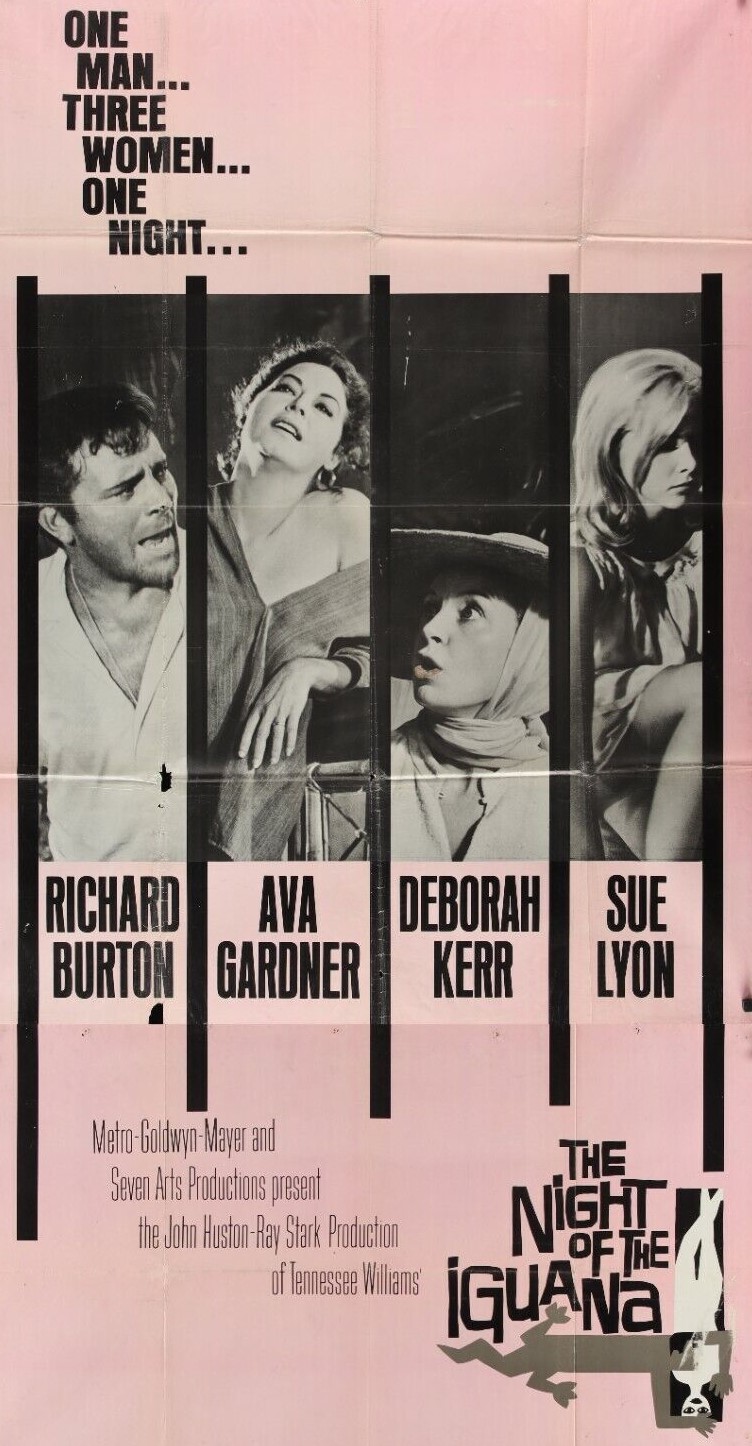
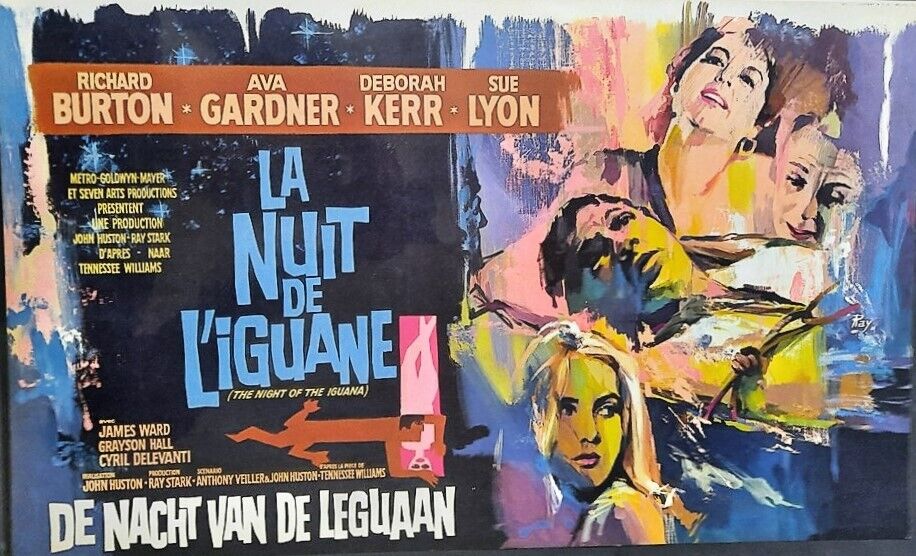
The Night of the Iguana (1964) ****

The eponymous reptile is a rather obvious metaphor for characters trapped by quixotic decisions. Regardless of the Rev Dr. T Lawrence Shannon (Richard Burton) being a defrocked priest, he was always going to lead a dissolute life, alcohol the least of his temptations. This heady drama begins with comedy about a man with ideas above his station ending up as an incompetent tourist guide.

And if his behaviour is not scandalous enough for current coach party, middle-aged Baptist ladies, he leads them to a hotel in Mexico run by former lover Maxine (Ava Gardner) who has two younger lovers on the go. And as is the way with author Tennessee Williams there’s a posse of fascinating characters, led by spinster Hannah (Deborah Kerr) who ekes out an itinerant living selling paintings while her aged grandfather (Cyril Devalanti) recites poetry. Raising the moral stakes is under-age Charlotte (Sue Lyon) who has taken a fancy to Shannon, partly in rebellion against her frosty chaperone Judith (Grayson Hall).

For a movie with no great narrative drive, there’s no shortage of drama, whether it’s the Reverend under constant attack from his charges, Charlotte making advances, Shannon succumbing or trying to fight his addictions, Maxine succumbing then rejecting his advances, and Hannah on the sidelines trying to work out why her entire life has been lived in the shadows.

A simple dramatic fuse has been lit, disparate group with secrets set to explode, and you just sit back and enjoy the ride. Exceptionally daring, even if in discreet fashion, for the time, not just the Lolita-style Charlotte, but the middle-aged Maxine cavorting with not one but two men young enough to be her sons, so effectively a Cougar (before the term was invented) in a threesome, a woman in full command on her sex life not at the whim of a male. There’s as overt a gay woman as you would find in this era. And that’s before we come to Hannah, one of whose two sexual experiences involved averting her eyes while her male companion masturbated on a piece of her clothing. That was taking it way beyond the limits of acceptable on-screen behaviour of the day.

Characters are either engulfed by their passions or weaknesses or trying to come to terms with them, sometimes both. Over everything hangs poignancy at the self-deception practised, redemption scarcely a possibility, communication a minefield, acceptance the best anyone can hope for. Quality acting prevents this disappearing down a sinkhole of self-pity.

Richard Burton (Becket, 1964) was on a roll, one brilliant performance after another either with or without Elizabeth Taylor, essaying a wide range of characters. This is one of his best. You should despise the sham he has become, relying on charm to dig himself out of a hole, relying far too much on the kindness of strangers whose sympathy is exhausted. Yet the loss of the only position, a clergyman, for which he was possibly suited, thrown out for committing unforgiveable sin while preaching sanctity, makes him a very relatable human being. This isn’t Days of Wine and Roses reborn, but someone trying to win the pinch of oxygen required to keep his soul alive, and stir the energy inside. And he would be furious if you ever made the mistake of feeling sorry for him.

Ava Gardner (Mayerling, 1968) is superb, staring age in the face, unrepentant, sex an acceptable substitute for love, underlying sadness admirably restrained. But Deborah Kerr (The Chalk Garden, 1964), brings a refreshing dash to her introspective character, a woman with practical solutions except to her own emotional emptiness. Sue Lyon (Lolita, 1962) is only briefly scandalous and the movie’s conclusion suggests she is capable of settling down and not giving into the base desires that afflict all the others.

Just as with The Misfits (1961), director John Huston allows his characters to breathe. It would have been very easy to allow Shannon to have a more heroic or stoic stature, instead of someone stumbling around. Tinges of comedy and wit lighten the load. Huston and Anthony Veiller (The List of Adrian Messenger, 1963) wrote the screenplay from the Tennessee Williams play.

Becket (1964) *****

Two stars in impeccable form, an intriguing tale of betrayal and redemption, and a sharp reminder that Britain was once a conquered nation. Given the original play was written by a Frenchman, Jean Anouilh, I wondered how much of the experience of France being occupied by Germany during World War Two informed the work.

Becket (Richard Burton) is dabbed a collaborator for having anything to do with King Henry II (Peter O’Toole), not just in his gainful employ and rising to positions of enormous power, but in accepting his friendship being viewed as a traitor to his countryman. England then, 100 years after the invasion of William the Conqueror, was divided into Normans, who ruled, and Saxons, the indigenous population, who obeyed. The only source of rebellion was through the Catholic Church which could claim, in its prime allegiance to God, to place religion above ruler.

Initially, it’s the story of two unprincipled men, who drink and lust to their heart’s content, until Henry, misreading his friend’s personality, appoints him Archbishop of Canterbury, the most important religious leader in the country, assuming that Becket would continue in his hypocritical ways and bring the clergy to heel. Unfortunately, in taking on the position, Becket takes to heart everything it stands for and instead of extending his power Henry finds it challenged.

It’s classic narrative, fast friends turned bitter enemies, the American Civil War in a nutshell. The more Becket sticks to his guns, the more his life is imperilled. Since the story is based on historical actuality, anyone who saw it at the time would be aware of the famous outcome, but the teaching of history and English history at that, either having fallen in abeyance or being given the revisionist treatment, viewers coming at afresh will be surprised at the political and moral twists and turns.

Nor is it of the “thee” and “thou” school of historical drama. The language is modernised, it is filled with humor, and spiced through with irony. Caught in a downpour during a hunt and sheltering, wet and bedraggled, in a peasant hut in a wood, Becket explains to the king that anyone who dared light him a fire would be hanged for taking precious wood out of the forest, a law laid down by Henry to make more money from his forests.

Likeable though Henry is, full of energy and fun, he is also sly and mean. On the basis of what’s mine is yours, he passes on a peasant lass to Becket, but in demanding the favour returned insists that Becket allow him to have sex with his fiancee, who promptly commits suicide rather than submit.

Henry wheedles as much as he demands, needing to keep his nobles in line if they are to fund his lifestyle and wars. There is always the tricky business of making alliances with untrustworthy rivals. This almost a template for Game of Thrones, the business of ruling as much about the velvet glove as the iron fist, negotiation and concession as important as outright demonstrations of strength.

Even when in an inferior position, there is always diplomatic recourse. The French king (John Gielgud), deliberately keeping waiting a British contingent, explains that the delay will allow them time to be measured for some fashionable French clothing. Now that is a barb served in silk.

It’s possibly as big a surprise to Becket, as indulgent in drinking and whoring as the king, to discover that he has principles. The clergy was known for abusing its power and, despite taking a vow of poverty, living high on the hog. So he stuns both his fellow priests and bishops as much as the king when he gives away all his possessions to fulfil that basic vow. There’s almost an element of naivety. Having played the game so far, suddenly he refuses, to the consternation of everyone in power.

For a time it becomes a battle of wills and that eternal question of who is more important, the invisible God or the human king, and Becket to some extent becomes a pawn.

And it’s brilliantly acted. In his first role since coming to global attention with Lawrence of Arabia (1964) Peter O’Toole creates a more down-to-earth conniving ruthless character. Richard Burton (Cleopatra, 1963), trying to prove he can attract an audience without the help of Elizabeth Taylor, matches him every step of the way. The fiery oratory is replaced by introspection.

Director Peter Glenville (The Comedians, 1967) resists the temptation to open up the stage play, which he also helmed on Broadway (where it won the Tony for Best Play), and for a historical picture set in warring times it’s surprisingly lacking in battles. But it’s easily one of the best historical pictures ever made and it’s a travesty that the Oscar for Best Actor went to neither O’Toole nor Burton, both nominated who split the vote, but to Rex Harrison for My Fair Lady. John Gielgud (The Charge of the Light Brigade, 1968) was a whimsical quirky delight, so different to his normal screen persona.

Out of 12 Oscar nominations, it won only for screenplay, by Edward Anhalt (The Satan Bug, 1965).

Does what historical movies so rarely accomplish: thoughtful, stylish, brilliantly structured with superb acting and direction.

Behind the Scenes: “The Comedians” (1967)

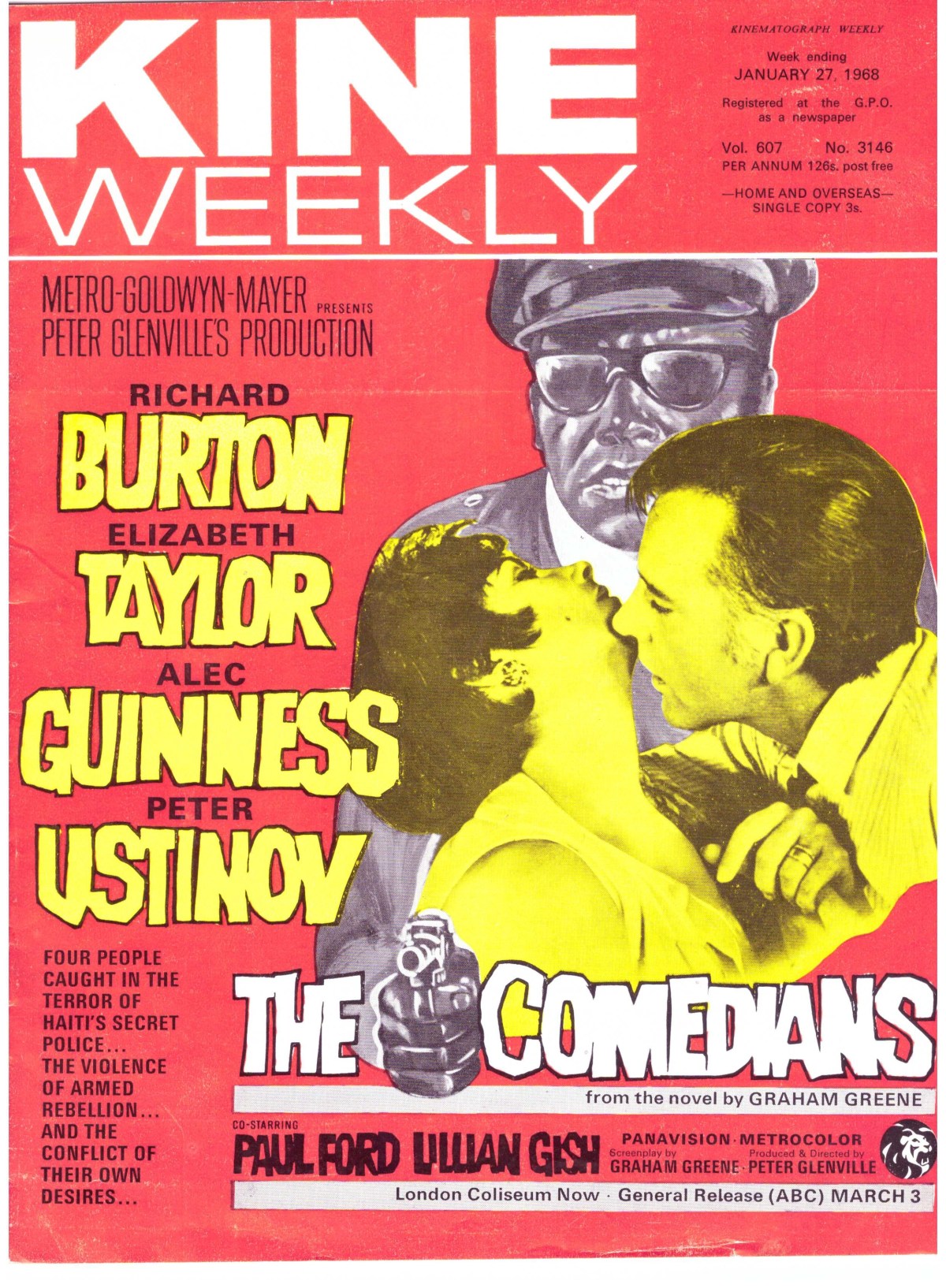
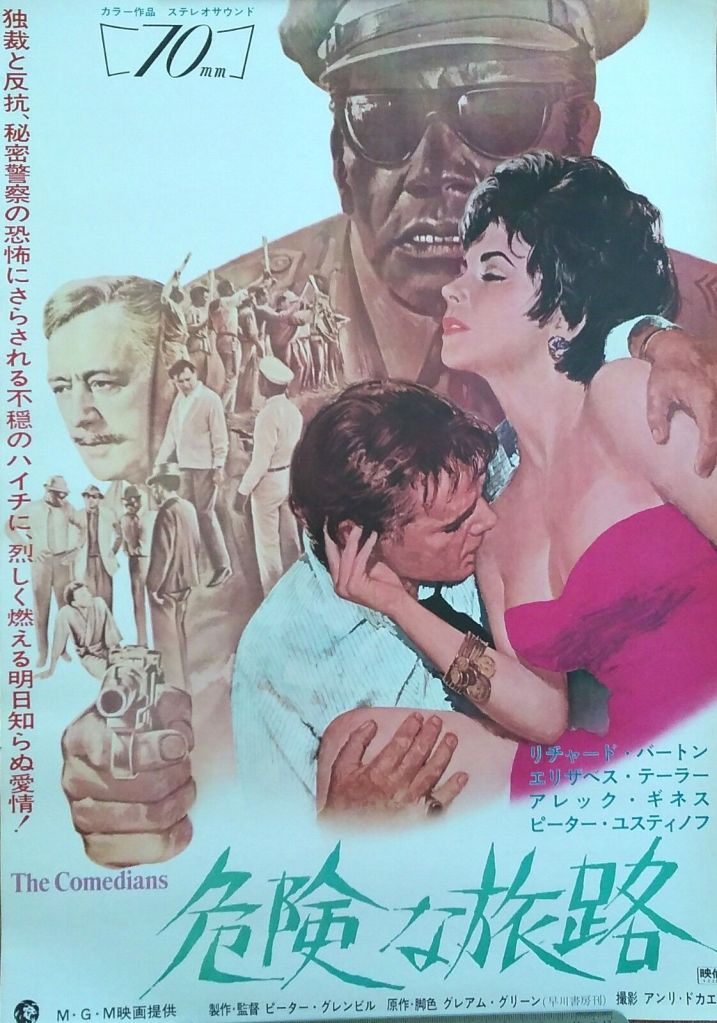
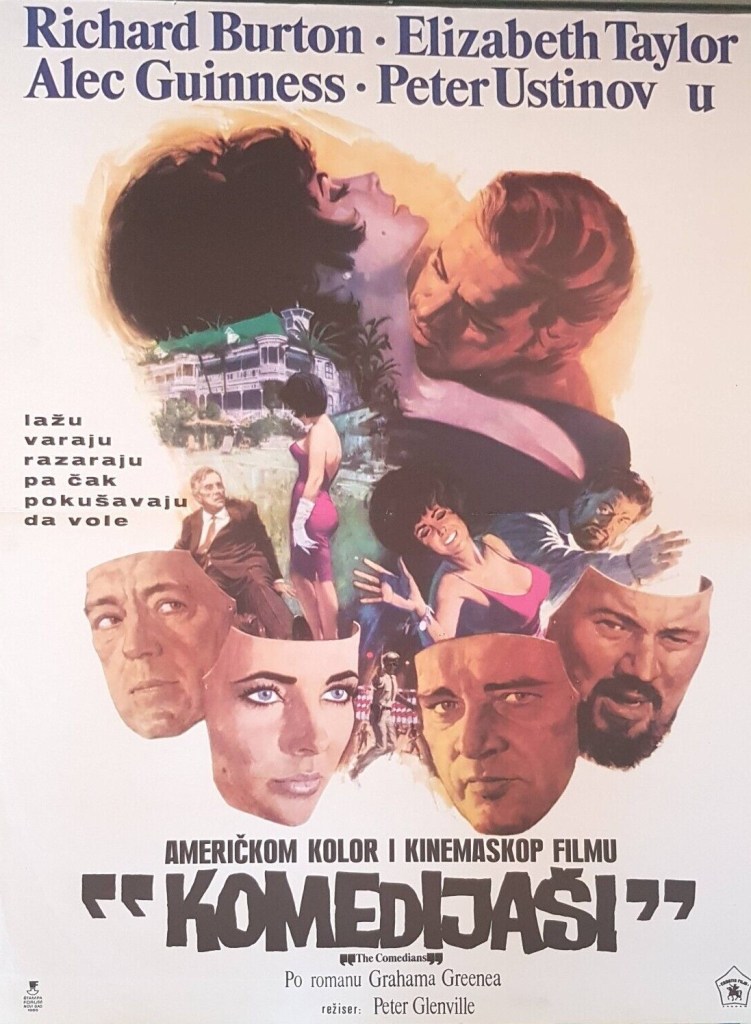
Richard Burton was at his box office peak. From Cleopatra (1963) through The VIPs (1963), Becket (1964), The Night of the Iguana (1964), The Spy Who Came in from the Cold (1965), The Sandpiper (1965), Who’s Afraid of Virginia Woolf (1966) and The Taming of the Shrew (1967) he had enjoyed massive box office success and notched up  three Oscar nominations. He was being pursued for Camelot (1967) – the part he played on Broadway – and himself pursued the rights to Bernard Malamud’s The Fixer. But out of admiration for novelist Graham Greene he accepted, sight unseen, the leading role in The Comedians.

Director Peter Glenville, better known at the time as a stage director, owed his career to the two male principals. Alec Guinness had backed him for his debut The Prisoner (1955) and starred in his latest film, the farce Hotel Paradiso (1966). Burton had been one of his two incendiary stars of Becket (1964), a box office smash, as a consequence of which the director signed a four-picture deal with MGM. All three of his previous films had begun life as plays directed by Glenville.

Before the picture could get off the ground it faced a potential legal minefield from producer George Glass. He owned the rights to a short story The Prisoner, written by screenwriter Ernest Lehman (North by Northwest, 1959) and published in the January 1952 edition of Cosmopolitan magazine. It had since been turned into a television play directed by john Frankenheimer for the Playhouse 90 series in February 1957. Glass argued the new picture would infringe his copyright.

Although without doubt Taylor was the bigger box office star, the better remunerated  and the more acclaimed, at least by Oscar standards (two wins to his five nominations), in their personal life the roles were reversed. “There seems little doubt,” wrote Burton biographer Melvyn Bragg, “that although he was drawn into what he saw as the mystery and fun of Elizabeth he was the dominating partner. She soothed him. She sought him in bars.” Burton himself said, “We never had any question of who was boss. She always realised I was to run the show.”

Whether that was the reason she took what was no more than a supporting role in The Comedians at half her usual salary (for the first time Burton on $750,000 versus her $500,000 was the financial top dog) is unclear, but she certainly, as was attested on The Spy Who Came in from the Cold, did not like to leave him footloose and fancy free on a film set where he could indulge his liking for liquor and pretty women. On her previous film, Reflections in a Golden Eye (1967) “she resented playing second fiddle” to Marlon Brando, and might have preferred making a picture where she regained a sense of her own importance, but instead she accepted a role that was not up to her usual high standard.

Director Peter Glenville (Becket) had not particularly wanted Taylor for the role, possibly feeling she might over-balance the project. It would be the couple’s seventh movie together, a pairing that was being discussed in the same hushed tones as the legendary Tracy-Hepburn. Alec Guinness was somewhat apprehensive about the film. Calls he had made to the couple’s suite at the Dorchester Hotel in London had gone unanswered and gifts returned. Burton was mortified. It turned out his staff had been too protective of their employer.

Shooting began in January 1967 before the novel was published. Although producers often purchased books while still in galley stage, they generally preferred the book to have acquired a substantial readership before embarking on a costly movie investment. However, Graham Greene could fairly lay claim to being the greatest living English writer and his involvement appeared to add gravitas to the project, although it would be fair to say that none of the translations of his works into movies had enjoyed anything like the success of The Third Man (1949). He had not written for the screen since Our Man in Havana (1960), also starring Guinness.

Unusually for a novelist, he had acquired a reputation for setting his stories in trouble spots. Often, he would take on a journalistic assignment from the likes of the British Sunday Times to investigate conditions in countries undergoing brutal change. His literary reputation often gave him access to the inner sanctum from which an ordinary reporter would have been barred. The author had adored Haiti before the Duvalier takeover and hated that Papa Doc ruled by terror, backed by the dreaded Tonton Macoutes.  The Comedians was a determinedly political novel, the author hoping his expose of an “unique evil” might put pressure on the dictator.

Greene described Haiti as a “a tormented little country” and had feared for his life on his last visit. The author told an Italian journalist that he had clearly got under Duvalier’s skin. “A writer is not so powerless as he usually feels,” he once wrote, “and a pen, as well as a silver bullet, can draw blood.”  Martha (the Elizabeth Taylor character) was based on a woman the author had known in Martinique who ran a hotel and had a son.

Initially, Glenville had envisaged making the film in Haiti, where the book was set, but, given the author had taken careful aim at country it was a concern that the dictator might take revenge on stars who had the audacity to film in his own backyard. Dahomey, in West Africa, about the size of Cuba, was its replacement.

When accidents plagued the shoot, and since voodoo was a story element, rumors spread that Duvalier had ordered witch doctors to curse the production. “Apparently voodoo spells cannot travel over water,” recollected Guinness, “and have to be operated at hand…(but) on the first day of filming one of the unit stumbled on the beach, possibly from a heart attack, and drowned in a foot of water before anybody could assist him. Several people complained of difficulty in breathing, suffering from acute headaches and deep depression; one or two had to be sent home….there was something a little sinister in the atmosphere.” Guinness, in conversation with the French Consul, was informed the country was still inhabited by cannibals, a threat he took seriously enough to warn actor Paul Ford’s wife not to sit around alone on her porch, but which was later discounted by the local archbishop as the kind of joke a foreigner would too easily fall for

Guinness also saved the director from drowning. Not realizing how treacherous the sea, with an infamous undertow, could be, Glenville had gone for a swim. Reading on the beach nearby, Guinness heard him calling for help and had to drag him to safety. Guinness suffered from a mysterious rash for four days.

Of course, Burton and Taylor were treated like royalty, They were met by President Soglo and given use of the presidential compound. And it was also a humbling experience. Washing was strung along lines in the presidential courtyard, the Queen’s closet was filled with “a perfectly ordinary rack of shoes.” Burton had mixed feelings, commenting in his diary, about the President: “his clothes were ill-made…he obviously likes women and was forever taking E (Taylor) by the arm…We both found the experience oddly moving. Here was this huge, mosaiced palace, only completed three years ago, and outside the immense Salle de Reception, capable of receiving 3,000 people at one time, there was washing on the line.”

But this treatment did not extend everywhere, and for the better. Most people in Dahomey had never heard of the couple so they were able to dine out without harassment. “Glenville noticed that the lack of outside stress helped them relax in front of the camera.”

But the heat was intolerable, temperatures some days reaching 110 degrees, hitting 138 degrees under movie lights. This resulted in no one dallying over takes. The situation was exacerbated by Burton’s drinking. “I hardly find him the same person,” commented Guinness, recalling the times the pair had occasionally spent together in the late 1940s when he was by far the bigger star. “Drink has taken a bit of a toll.” Breakfast for Burton on the first day of shooting was a Bloody Mary. On one occasion Burton was so inebriated he failed to turn up for a presidential dinner in their honor in front of two hundred guests.  He was an ugly drunk and his wife bore the brunt of it. Being top dog financially and in terms of screen credit did not appear to bring him the solace he required.

The Burtons’ extensive entourage recruited an additional member with a specific skill. Photographer Gianni Bozzachi was “considered the number one re-toucher in Italy,” his job solely to ensure that any photographs of Taylor sent to the press were “as beautiful as humanly possible.” He became the couple’s official photographer, often taking candid pictures unobtrusively.

Bozzachi believed Taylor more beautiful in person – her left and right profiles were equally symmetrical, a rare physical gift –  than on camera and was attempting to capture that inner beauty. He said, “without make-up she glows. There’s a sensuality always present.” But he also exuded a sensuality that disturbed Burton. That a tall curly-haired handsome young man was showering attention on his wife made Burton jealous.

Burton and Alec Guinness respected each other’s talent. In one four-minute scene where Guinness took center stage and Burton was simply listening, Guinness commented, “That was the greatest support I’ve had from an actor in my life.”

Burton was not particularly enamored of Dahomey. Although he retained a “certain amount of nostalgia” for the country, he also referred to the “dangerous sea,” the arrogance of the Americans, the “mad palace, the President and his dowdy provincial wife.” But then Burton in his diaries was particularly waspish.  Guinness was even more forthright. “I was glad to leave Dahomey. I couldn’t help feeling it was sinister…ideas of voodoo are never absent from one’s mind.” The final stages of filming were completed in Nice.

In the wake of the violence in The Dirty Dozen (1967) and, more especially, Bonnie and Clyde (1967), which stirred up huge controversy, not least against the Production Code which had passed both films, MPAA president Jack Valenti took against the violence in the film and persuaded Glenville to “mute” one particularly bloody scene.

This proved a difficult film to market outside of the star names and the adaptation of a literary bestseller. However, Duvalier inadvertently helped, launching a furious tirade in the press against the picture, threatening legal action against what he termed “inflammatory libel” and exciting the U.S. media so much it triggered a four-part television series. There was a major article in Look magazine which had sent a reporter and photographers to the set in Dahomey. And the marketing team pulled off something of a coup in persuading the Museum of Modern Art in New York for the first time to devote a complete exhibition to a movie.

Despite the top-heavy English cast, the movie premiered in New York at the Coronet where it ran concurrently at the DeMille. Although it opened in the same week as Cool Hand Luke, it trailed the Paul Newman prison drama at the box office, taking $64,000 from two cinemas compared to $92,000, also from a pair. But that was still deemed a good result and initial U.S. first run bookings were brisk – the box office termed “socko” and “boffo.”

Post-production MGM had considered turning it into a roadshow for the U.S. market but decided against it. However, for the later British launch, in January 1968,  it was blown up into 70mm and presented as roadshow in London’s West End at the Casino Cinerama and in various countries around the world. The American version, running at 156 minutes,  was edited by nine minutes though the programme was effectively lengthened to accommodate the necessary roadshow intermission.

Though named by three critics as one of the top ten films of the year, the movie received no Oscar nominations. It proved to be Glenville’s last film although he lived for another 30 years.

SOURCES: Chris Williams (editor), The Richard Burton Diaries (Yale University Press, 2012) p130-131, 152-157; Melvyn Bragg, Rich, The Life of Richard Burton (Hodder and Stoughton, 1988) p223, 231-232, 236-237; Sam Kashner and Nancy Schoenberger, Furious Love, Elizabeth Taylor, Richard Burton, The Marriage of the Century (JR Books paperback, 2011) p196-204; William J. Mann, How to Be a Movie Star, Elizabeth Taylor in Hollywood (Faber and Faber, 2009) p378-379; Alec Guinness, Blessings in Disguise (Hamish Hamilton, 1985) p209-210; Leopold Duran, Graham Greene, Friend and Brother (Harper Collins, 1994) p153, 238, 258; “Burton-Guinness Teamed,” Kine Weekly, September 8, 1966, p4; “Burton-Guinness Teamed,” Box Office, September 16, 1966, p4; “George Glass Protests Metro’s Comedians Treads on his Teleplay,” Variety, October 26, 1966, p5; “Elizabeth Taylor to Co-Star in Comedians for MGM,” Box Office, October 10, 1966, p7; “Comedians Looms as Metro Roadshow,” Variety, April 12, 1967, p26; “Plan Comedians Premiere,” Box Office, September 11, 1967, pE3; “Urge Films Shun Shock’n’Violence for Own Sake,” Variety, October 25, 1967, p1; “Museum to Devote Entire Exhibit to Comedians,” Box Office, October 30, 1967, pE7; “Haiti Protests Showing of Comedians,” Box Office, November 6, 1967, pE4; “Comedians on Roadshow at London Coliseum,” Variety, January 3, 1967, p5; “Year-End Best Picks,” Variety, January 10, 1968, p8.

The Comedians (1967) ***

Over-long, over-hyped and over-cast. Pretty much an early example of virtue-signalling, exposing corruption in a dictatorship (Haiti), but offering more through the singular self-deception of the main characters. An element of sleight-of-hand is also practiced on an audience enticed by four big stars “above the title” comprising three Oscar winners and one multiple nominee. Luckily, the ironic in-joke of naming characters with traditional English names – Smith, Jones and Brown – would probably pass most people by.

Brown (Richard Burton), a hotelier, is present throughout but Major Jones (Alec Guinness) appears only briefly at the beginning then disappears until late on to spike the plot. Martha (Elizabeth Taylor), the adulterous love interest, pops up sporadically as does her husband Ambassador Pineda (Peter Ustinov). There’s not much of a story, Brown, cynical about the dictatorship, is friendly with a rebel leader, Jones is an ineffectual arms dealer, and missionary couple the Smiths (Paul Ford and Lillian Gish) offer comic relief until barbarity rears its head.

Great play is made of naivete but the film suffers from the Hollywood curse of only being able to examine foreign politics through the prism of a (white) American or Englishman. At the time it might have been shocking to see brutality so convincingly dispensed, and there is, also, in Mondo Cane fashion, too much time spent on strange ritual, but at the same time, of course, the U.S. was inflicting its own barbarities on the Vietnamese.

On the other hand, Brown is exactly the kind of foreigner who believes things must improve because, damn it all, he’s British and bad things can’t happen to a Brit in a strange land. He is convinced he will be able to sell a hotel located in a war-torn country, persists in believing Martha will abandon husband and son, and convinces himself he is the very man the rebels have been looking for.

Jones mistakenly believes everyone is taken in by his hail-fellow-well-met routine and his tales of heroism in World War Two jungles, thinks he is in with a chance with Martha and that his gun-running activities will avoid detection. The ambassador thinks his wife will not leave him as long as he turns a blind eye to her affairs. And Martha, probably wondering why she married such a buffoon, can’t work out to dump him. Everyone who has much to lose appears to be continually on a precipice and it’s hard to see what they could gain from their actions. 

They are all misfits, “comedians,” stuck in the rut of their own destiny, unable to change.

Nobody is more gullible than those who dupe themselves and the film comes into its own when it sets personal delusion against political naivete. In narrative terms Jones is the most obviously unmasked but the others are no less shown to be foolhardy in their expectations.

This had all the hallmarks of a prestige picture, initially planned as a roadshow,  around $2 million spent on the above-the-line cast, another chunk on buying the rights to the Graham Greene bestseller and assigning the author the screenplay, location shooting in Dahomey.

Don’t expect oratorical fury from Richard Burton (The Bramble Bush, 1960) nor outbursts of angst from Elizabeth Taylor (Secret Ceremony, 1969). There’s something almost comically homely in their deception and in the outwardly confident Brown perceiving Jones as a love rival.  Alec Guinness (The Quiller Memorandum, 1966) is the big treat, an upmarket con man, his boisterous voice and mannerisms far removed from his more usual introspective performances. Peter Ustinov (Topkapi, 1964), a bit too fidgety for my liking, nonetheless attracts sympathy as the man who is batting above his weight in snaring a trophy wife he knows he cannot hold onto.

Burton was the odd one out in the Oscar rankings. Despite five nominations by this stage, he had never taken home the statuette. Elizabeth Taylor, by contrast, had won twice, for Butterfield 8 (1960) and Who’s Afraid of Virginia Woolf (1966), Guinness once for Bridge on the River Kwai (1957) and Ustinov also twice Spartacus (1961) and Topkapi.  

However, in some senses if you remove the star turns, you are left with a rawer picture, and director Peter Glenville (Becket, 1964) captures much of the personal intensity of the novel. Taylor, in particular, misses the mark. Although playing a German, she never once bothers attempting an accent. Had Burton been the sole star, the movie would have worked much better since his low-key playing would not have been so much at odds with other actors.  

There’s a host of striking turns from supporting stars, ranging from silent film star Lillian Gish (The Unforgiven, 1960) to Roscoe Lee Brown (Topaz, 1969), James Earl Jones (The Great White Hope, 1970), Raymond St Jacques (Uptight, 1968) and Cicely Tyson (Sounder, 1972).

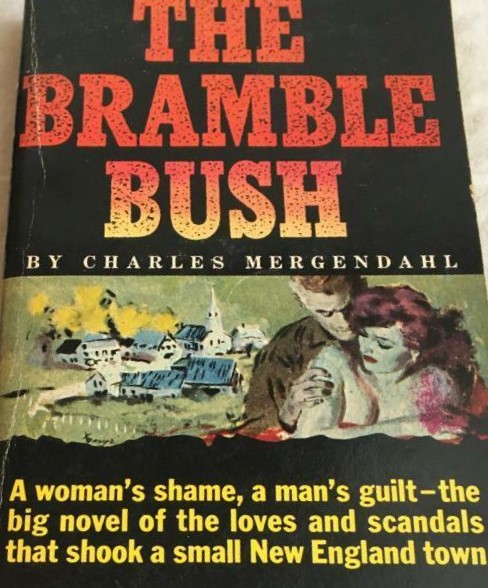
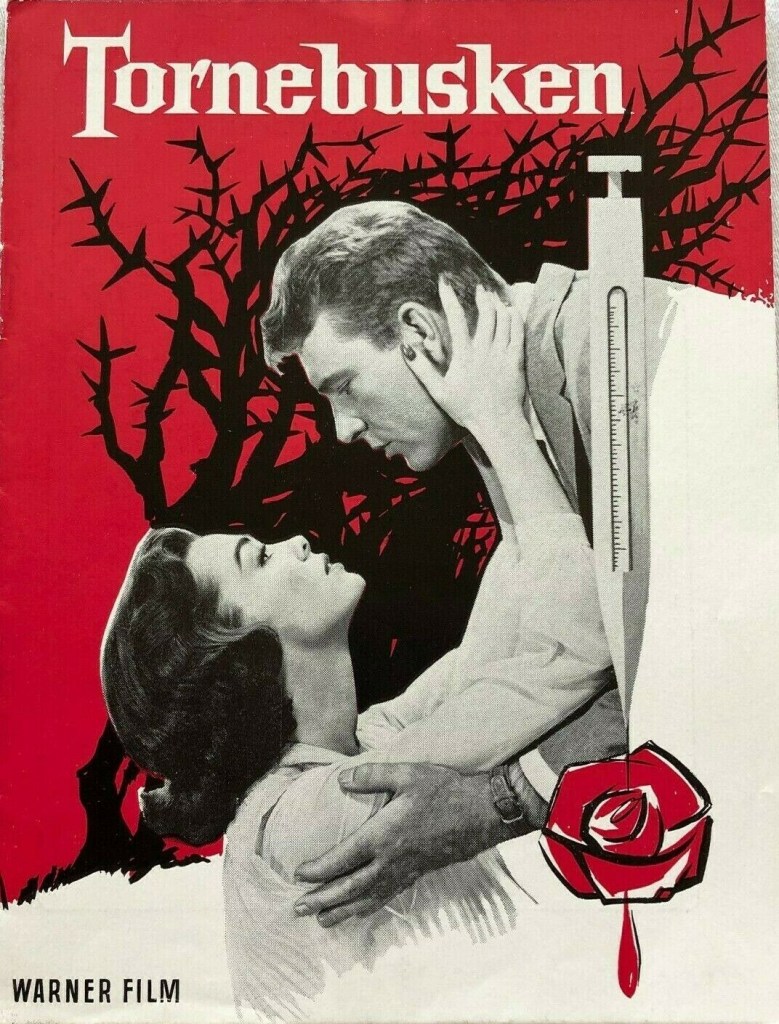
Book into Film: “The Bramble Bush” (1960)

Few novels have been as abruptly shorn as Charles Mergendahl’s massive bestseller – seven million copies sold – The Bramble Bush. The last quarter of the original story was just dumped. For screenwriters seeking to heighten every emotion this was a very strange decision for it is in the last section that the book delivers huge dramatic punch.

The film – SPOILER ALERT – ends with Guy (played in the film by Richard Burton) judged not guilty of the murder of dying best friend Larry. Guy’s one-night stand with Larry’s wife Margaret (Barbara Rush) has made her pregnant but now widowed she leaves him on the grounds that he will be unable to live with what he has done. It’s a sad enough ending but it’s nothing compared to the book.

The trial section takes place three-quarters of the way through the novel. In the film, it is placed much closer to the end so there are only five minutes or so to tidy up in a rather ho-hum manner, nothing highly dramatic, no floods of tears, just Margaret leaving him behind.  

Following the trial in the book, however, Margaret’s departure is much more sudden. There is no goodbye. She just vanishes. While judged innocent of murder, Guy has lost his license to practice so in the absence of professional commitments is free to spend months hunting for her. And find her he does.

The dramatic point you would have thought would be simply whether she can ever accept as a lover the man who has injected her husband with a fatal dose of morphine regardless of whether this was done with the best of intentions and could be construed as a mercy killing. But the author isn’t finished with these characters yet. Yes, they are reconciled and in fact get married.

But it’s too late. Margaret has tuberculosis – a considerably more dangerous condition in those days than now, and in some cases as untreatable as the incurable Hodgkin’s Disease that afflicted her husband. That puts both her life and that of her unborn child in danger. Guy faces another dilemma, just as he did with her husband. If he has to choose, whose life would he want to save.

The baby is born, and both survive. But only for the time being. Margaret’s TB has not abated. Since Guy’s license has by now been restored, they return to the town. But he’s in for a shock. The town is outraged. The public which had stoutly defended him and the jury which had set him free now turn against both, aware through the arrival of the child that they must have had an affair while the husband was still alive, which therefore clouds the issue of exactly why Guy committed euthanasia.

But before Guy can decide to move elsewhere and nurse his sickly wife and care for his newborn child – called Larry after the dead husband – Margaret dies.

That turns the book into a three-handkerchief tragedy that the film never was. Except for running time, you wonder why the screenwriters elected to miss all this out. Maybe the movie would have run over the two-hour mark, perhaps two hours fifteen minutes, but that would hardly make it so undesirable to exhibitors nor so offensive to the public given the ending was so much more dramatic.

Even then, the author isn’t finished. He provides an ironic ending The rejected Fran – dumped also by this point by Bert, Guy’s lawyer– determines that she will look after the child, allowing Guy to recover from his ordeal. And there is the hope – although she would not press her love for Guy on him – that in due course he will come to appreciate her and reciprocate her love.

Quite a different ending indeed from that foisted on moviegoers. Hard to say whether readers were disappointed, but when a novel is such a huge success it is generally because the public likes the story the author has devised. So to rob them of that seems extremely odd.

The novel had raced to the screen. The book was published in September 1958 and the film opened in February 1960, barely seventeen months later. When the gap between novel and movie is so short, it generates feverish public anticipation. And it seems almost perverse to deny the waiting audience the movie they expected.

Naturally, in the transition from book to screen there are other eliminations – and additions. And there is also the usual welter of changes made for no particular reason, for example the town of East Dereham becomes East Norton in the film.

Certainly, the aim of a movie being to heighten drama and combine disparate elements into a more cohesive whole, you can see why in the film it raises the stakes for the lawyer Bert Mosley (Jack Carson) to already be campaigning for district attorney rather than, as in the novel, only dreaming about it. Although both his parents are dead, Guy came from far more prosperous stock in the film than the book, the hospital named after his father in the film but not the novel.

Some of the changes must have seemed to create more drama, but I’m not so sure. What difference did it make whether it was Guy or the dying Larry (Tom Drake) to be the one returning home? In the film it’s Guy, in the book Larry. In the book Guy is kind to the town drunk Stew (James Dunn) but it’s the opposite in the book, hostile and physical abusive to him from the outset. In the book we learn why – Stew was Guy’s mother’s lover and their affair triggered the suicide of his father – from an internal monologue, but in the film this plays out in more dramatic fashion when Margaret confronts Guy about what she sees as his unfair treatment of the older man.

There’s an elimination that’s so shocking you can’t understand why it was left out by the screenwriters. In the book we discover that Stew is in fact Guy’s father, a fact ignored in the film. And in the last section of the book when Guy is tracking down Margaret in different towns he takes Stew’s surname as his own. And one core element of the film – Larry pushing Guy and Margaret together – is the screenwriters’ invention. (Perhaps audiences would view Guy in a lesser light if he simply took advantage of his friend’s illness to sleep with his wife). And to tie things up more neatly, it’s Guy in the film who prescribes sedatives for Margaret whereas in the book that’s not part of his role.

On the other hand Larry’s father Sam is hostile to Guy for reasons that are kept from us in the film – but in the book we find out it’s because Sam blames Guy’s father (also a doctor) for his wife dying in childbirth, an incident that caused him to lapse into the insanity mentioned in the trial scene in the film.

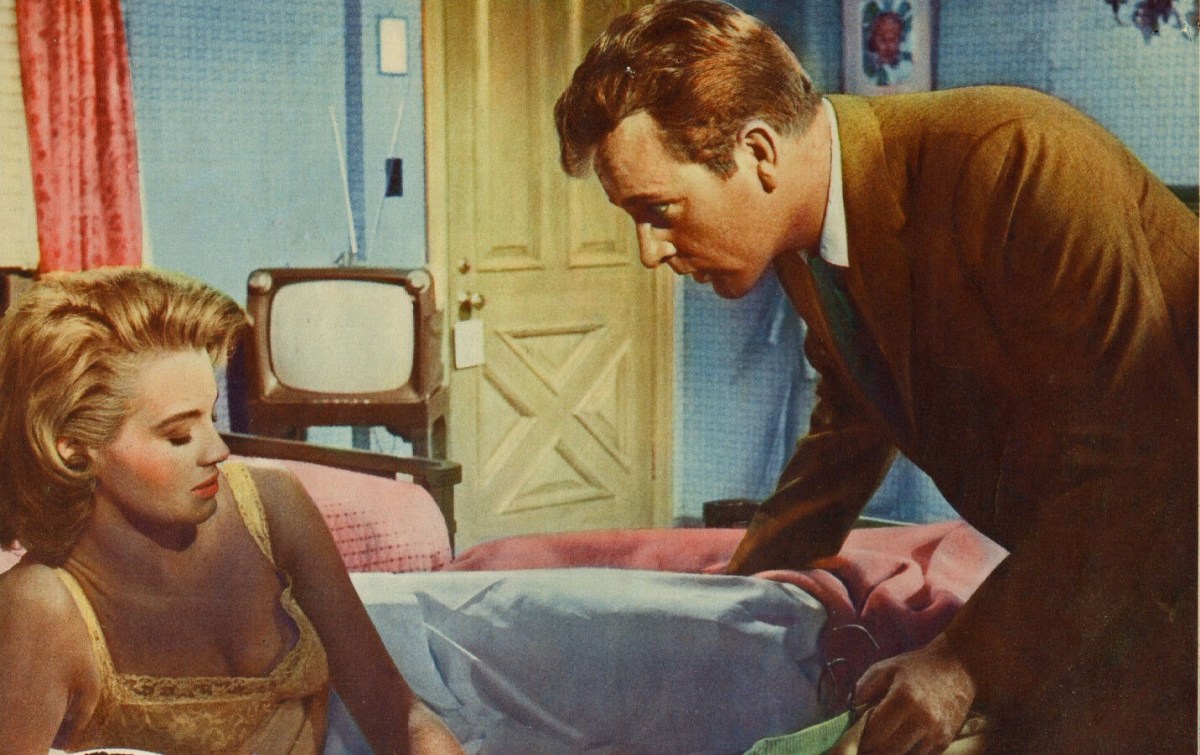
You can see why some elements of the book are not included. The creepy newspaperman Welk (Henry Jones) who blackmails Fran (Angie Dickinson) into posing nude for him later dupes his assistant into doing the same. Bert falls for a tough Boston reporter Sylvia for whom he quits town and dumps Fran.  On discovering she is pregnant by Guy, Margaret’s initial reaction is to seek an abortion. And there’s a section where hospital chief Dr Kelsey and Fran discuss the various ethical ways doctors have of letting exceptionally ill babies die.  The judge suggests to the jury that Guy could be acquitted due to temporary insanity. And there is a bunch of peripheral characters whose main purpose is to highlight the jealousies inherent in small-towns.

But there are two character turnarounds the screenwriters choose to ignore. The first is that the drink-sodden Stew becomes a recovering alcoholic after discovering he is a grandfather. The second is more touching. After Fran was rejected early on by Guy and later dumped by Bert she had resigned herself to a life of “doing terribly immoral things.” But the book ends with, as mentioned above, her taking a huge emotional leap by giving herself the task of nursing both motherless child and widowed father.

It’s always fascinating to see how screenwriters tee up a book for the big screen treatment, deciding what to leave in and what to take out, occasionally (as in Mirage, for example) using little more than the title and the original idea and jettisoning the rest. Of course, limitations may be imposed on the screenwriters of which we are unaware, star demands or budget impositions and other factors. Here, I felt that screenwriters Milton Sperling (also the producer) and Philip Yordan did not get the best out of the book.

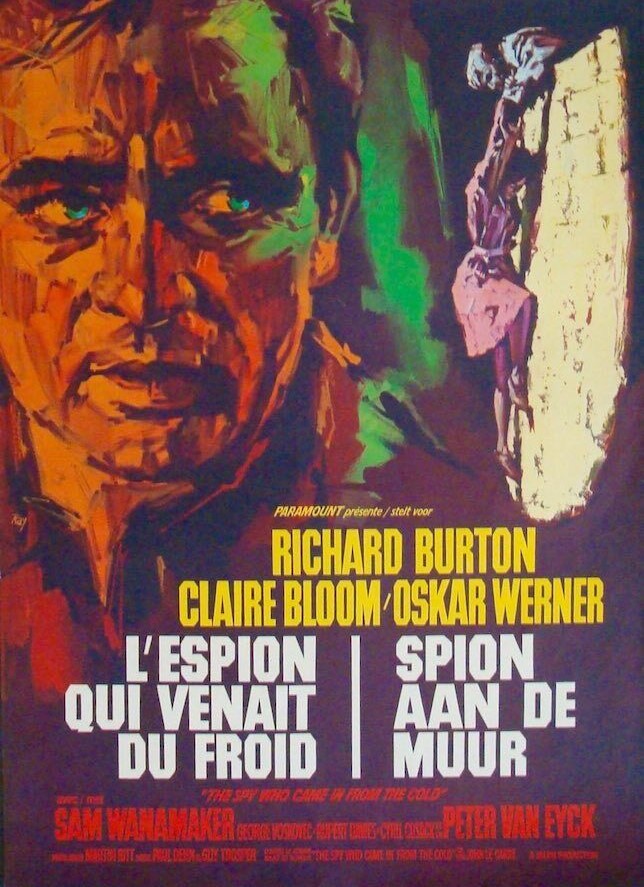
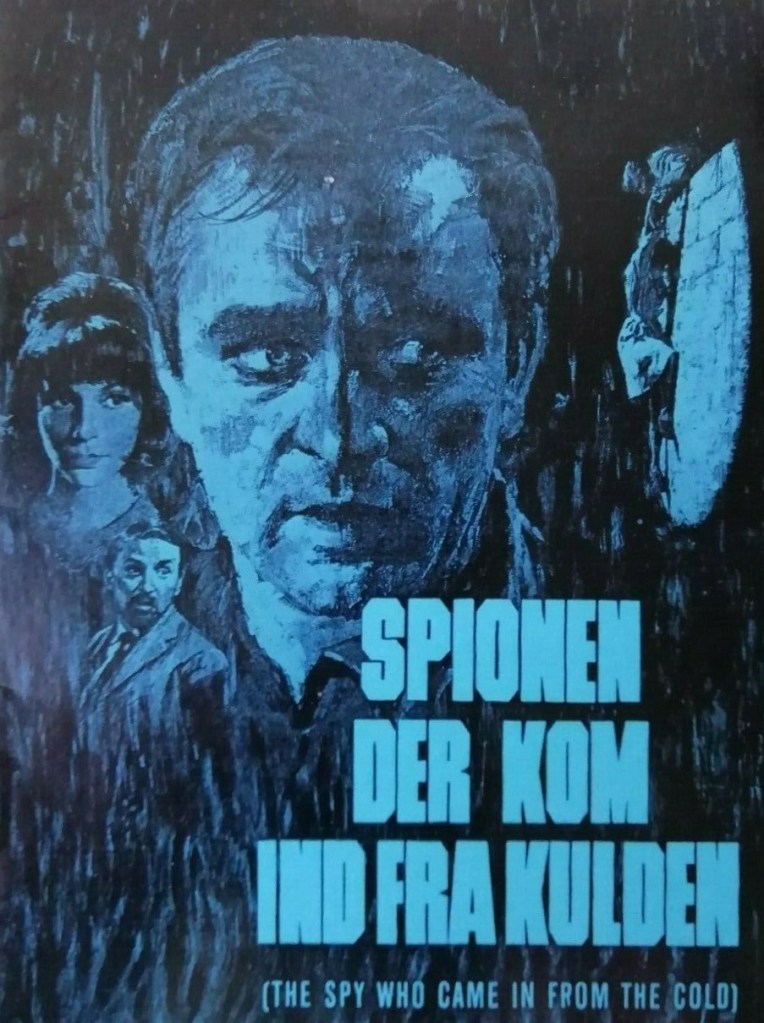
Behind the Scenes: “The Spy Who Came in from the Cold” (1965)

Shooting might have been less stressful and cheaper if director Martin Ritt had stuck to his initial schedule but when the shoot start-date was pushed back from late fall 1964 to January 1965  he lost original star Burt Lancaster (planning to play the original Englishman as a Canadian). At relatively short notice, Richard Burton stepped in, but for an eye-watering fee of $750,000, at that time the biggest salary paid in Hollywood. (Due to Ritt’s involvement there had been rumors Paul Newman would star.) And although Burton pushed for his wife Elizabeth Taylor for the small role of Nan, he was overruled on the issue of cost, and that audience expectations would be unfairly raised.

It didn’t matter, though, if Ritt refused to cast Elizabeth Taylor. He got her anyway, and her vast entourage, generally happy to remain out of the way but occasionally arriving on location in the middle of Dublin in her white Rolls-Royce sending fans into convulsions. There were two schools of thought as to which woman caused more disruption: the jealous wife exerting 24-hour surveillance on a husband with a wandering eye or one of his previous lovers, Claire Bloom, who was playing Nan. (The name changed from Liz in the book.)

“It was not a happy picture and the central reason fort that was: Claire Bloom,” averred Burton’s biographer Melvyn Bragg. “The real problem was not from Bloom but from Elizabeth Taylor’s jealousy,” claimed Sam Kastner. That Burton incurred Bloom’s wrath was not without doubt. But it wasn’t the first time. Prior to Taylor, but while he was married to Sybil, Burton and Bloom had been lovers.

Burton was “not prepared for Bloom and found it very difficult to handle.” The pair had met on a touring production of The Lady’s Not for Burning in the 1940s but their romance remained unconsummated. A few years later in the early 1950s the affair began in earnest and continued on and off for five years. When both were cast in Look Back in Anger (1959), Bloom expected them to pick up where they had left off. But that notion was dashed when Burton appeared, still married, on the arm of Susan Strasberg (Sisters, 1969).

The other elephant in the room was, of course, Burton’s alcohol intake. A very heavy drinker, verging on the alcoholic, his hand had begun to tremor until he received liquid sustenance. If Burton had an equally boisterous co-star as in Peter O’Toole in Becket (1964) or a very indulgent director as with John Huston in The Sandpiper (1965), his drinking would not attract comment. But “Martin Ritt did not approve of Burton’s heavy drinking and Burton resented that.”

Never mind Burton’s issues with ex-lover and wife, he was having difficulty delivering the performance Ritt demanded. The director wanted a stripped-down character, minus the oratory which had made the actor famous, the acting so flattened as to “make him anonymous.” Author John le Carre would have preferred James Mason or Trevor Howard for the “embattled” personas they presented, and which would have fit more into the director’s perception of the character. “For Burton this time there would be no strong sex, no oratory, no action, no charm.” The director wanted that Burton intensity, but coiled, not sprung. As the production wore on, director and star were barely speaking. “Ritt had come to despise Burton whom he saw as a spoiled and self-indulgent actor who had dissipated his talent.”

The initial screenwriter Guy Trosper made changes that seemed out of kilter with the book, for instance sending Leamas to psychiatric hospital rather than jail for punching the grocer. When he became ill he was replaced by Paul Dehn who did not veer so far from the book. Le Carre was brought in at the last minute at Burton’s insistence to do rewrites. But that merely added to the existing aggravation. While waiting for nightfall to shoot the escape sequence, Le Carre was obliged to keep the  actor company, trying to consume most the available whisky so that Burton did not go on set drunk. While little of Le Carre’s rewrites found their way into the finished product, he did provide a new scene for Fiedler (Oskar Werner).

Ritt had a revolutionary picture in mind, not just filming in black-and-white to downplay the glamor of the espionage business as evidenced by James Bond, but to employ “a point of view that’s never been found before.” He was not a believer in the end justifying the means nor of depicting the enemy as rabid. “Most of the time,” he explained, “you have actors playing Communists as if they’d just switched over from playing Nazis in World War Two pictures…the Communists in this picture are people and one of them at least …is an honest, ethical man.”

While the decision to film in black-and-white was a creative decision, intended to give the film a realistic edge, he knew it would not necessarily go down so well with the end user, the exhibitor. “The needs of creative people and the needs of exhibitors are completely different. Exhibitors want pictures and creators want to express themselves and those two factors don’t always satisfy each other.” Although the movie was Oscar-nominated and critically well-received and did well in key city first-run, it was condemned by exhibitors in small towns, one of whom discouraged others from booking it and complained that the black-and-white aspect made the film impossible to view on old projectors.

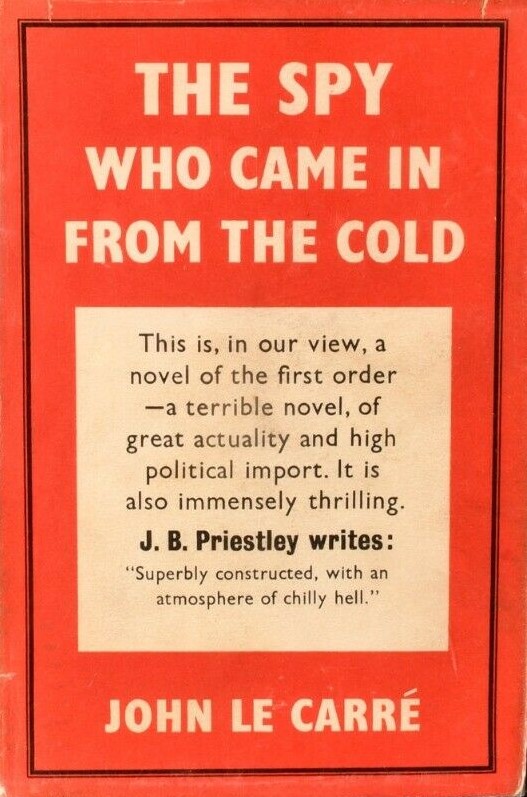
Author John le Carre was an unknown, two previous books published to no great sales. But The Spy Who Came in from the Cold proved a phenomenon.  Debuting in the number spot in February 1964, the book spent 35 weeks topping the hardback bestseller chart. It ended up the hardback number one title in the U.S. during 1964, a quarter of a million copies sold, winner of the Edgar Award for Best Mystery, initial paperback order topping two million copies, five million books in print by the time the film appeared. So it seemed all the more astonishing that the movie rights had been snapped up for a mere $21,000 (with escalating clauses based on sales that took it up to $38,000). Martin Ritt claimed glory for that astute purchase, making a bid to a hard-up author when the book was in galley form. “When I bought it nobody else was running to buy it,” claimed Ritt. But it turned out the real star was Kay Selby, a Paramount story editor, who had dug it out of a pile of novels submitted.  Le Carre did not make the same mistake again, movie rights for his next book The Looking Glass War were sold for $400,000 and the paperback rights for the same

When the film had still been a relatively low-budget production, Paramount planned to film exteriors in London and interiors in Hollywood. But Ritt wanted “to capture the full brunt of the winter atmosphere for dramatic emphasis” and there was very little Hollywood could bring to the party to recreate an actual bleak British weather.

The bulk of the film was shot in Ireland at the defunct Ardmore studios in Bray – Ritt rented them from the Official Receiver, the first production there since November 1963 – and on location in Dublin, the historic Cornmarket standing in for Checkpoint Charlie while with the  addition of breezeblock, barbed wire and an iron ladder, Dublin Square was transformed into the Berlin Wall, though some scenes set in East Berlin were shot in the London Docklands.

However, shooting kicked off in London, at Shepperton studios on January 9, 1965, before switching for two months to Ardmore, wrapping up there a week early, heading for location filming in Amsterdam (briefly) and 9-10 days in Garmisch (Germany) before returning to Shepperton in April. Ritt brought the picture in under budget.

Paramount launched a teaser campaign in November 1965 New York – the idea stolen by United Artists for A Fistful of Dollars the following year – with a 1,000-strong two-sheet poster campaign in the city’s subway, promoting the film but missing out the opening date and the cinemas it would play, that information supplied closer to the launch which took place over the lucrative Xmas period in 1965, coincidentally just in time to qualify for Oscar consideration.

And also in time to face a spy box office tsunami called Thunderball and the roadshow epic Doctor Zhivago among the 20-plus movies launched for the festive season. In fact, the Bond films had triggered a resurgence of spy pictures. As the Ritt picture got underway, others on the starting grid include “The Matt Helm Project,” The Ipcress File, James Garner in Welcome Mr. Beddoes (A Man Could Get Killed) and Masquerade starring Cliff Robertson. In addition the potential line-up also included female spy Christy O’Hare, Aaron Rosenberg’s Smashmaster and Strangers on a Bridge; the first two were never made, the last one taking over half a century to hit the screen as Steven Spielberg’s Bridge of Spies.   

Burton was Oscar-nominated, but in the year when Thunderball (1965), Torn Curtain (1966), The Silencers (1966) and Our Man Flint (1966) all featured in the top ten films of 1966, The Spy Who Came in from the Cold did not prove a counter-programming smash, sitting at 32nd in the annual chart with $3.1 million in rentals. Although the movie was critically well-received and did well in key city first-run, it was a bust in smaller towns. Don Stott of the Calvert Drive-In in Prince Frederick, Md, complained “it was one of the lousiest pictures I’ve ever had my displeasure to exhibit and lose my shirt on…the print was so dark…it was barely visible.” Added Arthur K. Dame of the Scenic Theater in Pittsfield, N.H., “it comfirms the fact that we are not going to do well with spy films.”

SOURCES: Adam Sisman, John Le Carre, The Biography (Bloomsbury, 2013) p258, 266, 273, 277-280; The Richard Burton Diaries (Yale University Press, 2012), p79-80; Melvyn Bragg, Rich: The Life of Richard Burton, (Hodder and Stoughton, 2012) p200-203; Sam Kashner, Furious Love (Harper Perennial, 2019) p120-131;  “Burt Lancaster Plans More Pix Of His Own,” Variety, January 1, 1964, p27; “Bestseller at $20,000,” Variety, March 25, 1964, p15; “Broadway,” Box Office, April 20, 1964, pE5; “Director Martin Ritt: Big Dig Is Scripts You Can Sell to Producers,” Variety, May 13, 1964, p13; “Six for Paramount in Alien Locales,” Variety, July 15, 1964, p18’“Richard Burton Receives Role in Spy by Martin Ritt,” Box Office, August 24, 1964, pW1; “Voices in the Diplomatic Pouch,” Variety, December, 9, 1964, p7; “Ritt Starts Spy Who Came in from the Cold in London,” Box Office, January 18, 1965, pE5; “Spy Success Sires Speedy Sequel, Le Carre Learning Loot Lesson,” Variety, February 17, 1965, p3; “Martin Ritt May Wind Berlin Wall Episodes on Spy This Month,” Variety, February 24, 1965, p28; “Paperbacks Up their Covers and Advance $,” Variety, March 3, 1965, p1; “Burton Winds Irish Shooting Spy Film,” Variety, April 14, 1965, p20;  Maxwell Sweeney, “Harassed Irish Studio Revives,” Variety, May 12, 1965, p54; “Kay Selby’s Coup,” Variety, August 11, 1965, p3; “Subway Posters First Step in Promoting The Spy,” Box Office, November 29, 1965, pA2; “Review,” Box Office, December 20, 1965, 1965, pA11;  “Three Paramount Pix To Open in N.Y. Dec 23,” Box Office, December 20, 1965, pE16; “Martin Ritt Is Promoting His Spy for Paramount,” Box Office, December 20, 1965, pE12; “Espionage Shown in Its Dirty Clothes,” Variety, December 22, 1965, p4; “The Exhibitor Has His Say,” Box Office, June 13, 1966, pA4 and October 10, 1966, pB4; Big Rentals of 1966,” Variety, January 4, 1967, p8.

Discover WordPress

A daily selection of the best content published on WordPress, collected for you by humans who love to read.

The Atavist Magazine

by Brian Hannan

WordPress.com Blog

News, Tips & Website Tutorials