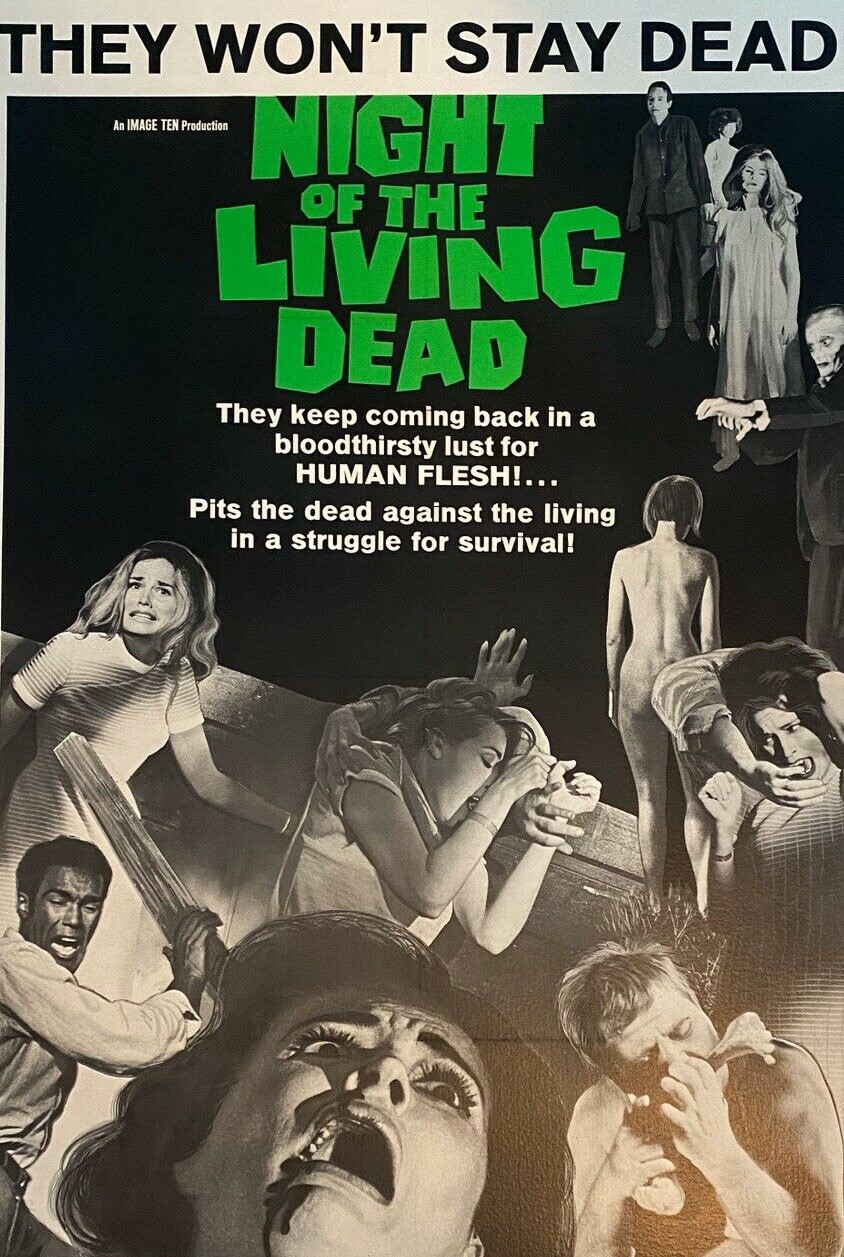
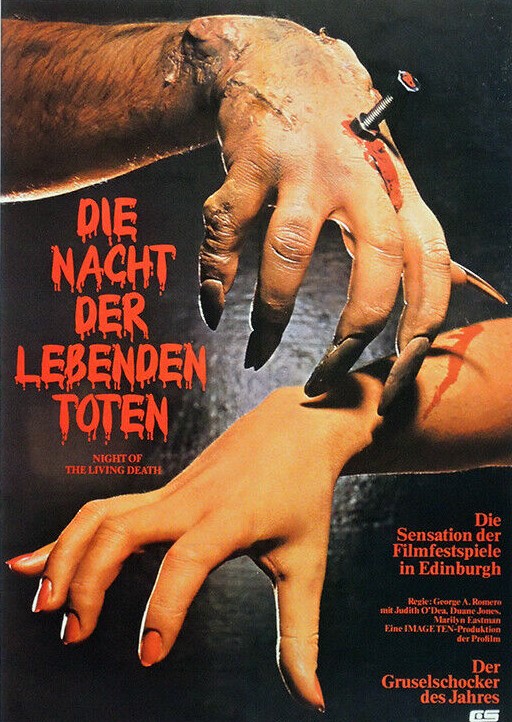
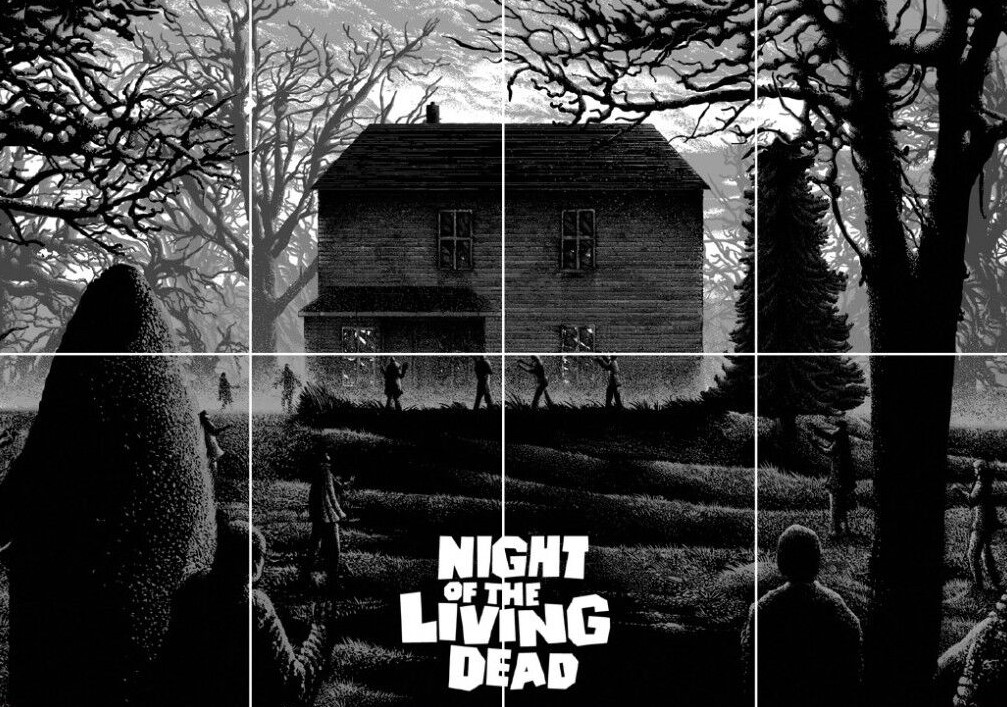
Night of the Living Dead (1968) ****

Ground-breaking thriller in the apocalyptic vein that appeared destined for oblivion after being judged too over-the-top by the AIP/Hammer criteria suitable only for the denizens of late-night horror quintuple bills. I say “thriller” because even by today’s slaughter-fest standards when the heroes/heroines generally escape, it was unheard-of for the entire cast to die, especially considering the post-ironic ending which made a sharp political point.

Brother and sister Johnny (Russell Streiner) and Barbara (Judith O’Dea), having driven 200 miles to visit their father’s grave, are ambushed in a cemetery by a zombie. Johnny is chalked up as victim number one. Barbara escapes to what appears to be an abandoned house, attacked by more zombies, where in a by-now near-catatonic state she is eventually joined by the more action-oriented Ben (Duane Jones) who boards up door and windows and fires at the ghouls with a rifle.

The days when the Edinburgh Film Festival could put its imprimatur on breakthrough movies is long gone.

Hiding in the cellar are the Coopers, Harry (Karl Hardman) wife Helen (Marilyn Eastman) and daughter Karen (Kyra Schon), ill from being bitten by the monsters after their car was overturned, and Tom (Keith Wayne) and girlfriend Judy (Judith Ridley). In the ensuing panic and continued onslaught, the numbers of zombies growing by the minute, Harry determined they would be better off hiding in the cellar and at one point locks Ben out of the house.

Radio and television broadcasts reveal a mass outbreak of people rising from the dead and feasting on the living, the result it appears of radiation in space, caused by man-made accident. The zombies can be killed off by a bullet or blow to the head or being burned. A gas pump being nearby, Ben, Tom and Judy drive there but while Ben lays down a carpet of fire to deter the marauders Tom accidentally spills gas over the truck which catches fire. Ben escapes but the couple are incinerated, turned into a tasty barbecue for the invaders.

While the relentless siege continues, Karen dies and is reanimated. And so, as you don’t expect, there is no escape, the survivors fighting zombies outside and the living dead inside.

The final image, a photographic montage, takes the movie in another direction, down the Civil Rights route, as the corpse of the only African American is hoisted up on meat hooks.

Until George A. Romero (Dawn of the Dead, 1978) took this idea and ran with it, the indie-scene was populated by cheaply-made movies of no discernible artistic credit aimed at the bottom end of the distribution market or by artistically-minded directors who hoped their talents might be acclaimed and lead to a fat Hollywood contract.  

Although there was no shortage of shockers, most had laughable special effects, little in the way of narrative, and certainly no earth-shattering concept like nobody gets out of here alive.

A budget of just over $100,000 ensured there was little room for grandiose special effects but nonetheless the scenes of relentless zombies striding forward, the single creature at the outset joined by a mass, was cinematic genius. Nor were these fragile ethereal beings, but strong enough to physically kill and turn over cars. On top of that was the revelation that death did not sate their hunger, and they weren’t vampirically-inclined either, the tastes lying in the cannibalistic. If you were able to die quickly enough to be reanimated you might escape being turned into a meal.

Taboo-busting came easily. Never mind flesh-eating zombies, and graphic violence, what about matricide? And perhaps a nod towards the power of relentless pressure, the armies of the night here could easily translate to the armies of protesters taking to the streets in broad daylight to march against injustice and Vietnam, whose continued opposition to government would drive change.

No doubt the decision to film in black-and-white was budget-driven, but that turned out to be a boon, no need to invest in gallons of what might pass as red blood, or create bloody corpses, just focus on the relentless threat.

It helped, too, that the characters under siege were very human, Barbara going out of her head with fear, isolationist Harry willing to kill the others to defend his notion of hiding out in the cellar, hoping to escape unscathed.

This was the ultimate word-of-mouth picture, critically dismissed not to say reviled on initial release, but gradually picking up an audience until it became a must-see movie. Romero’s horror approach became widely imitated, though his influence took years to permeate down. Co-writer John A. Russo later became a director, helming Santa Claws (1996).

The Collector (1965) *****

William Wyler’s paean to Incels strike such a contemporary note it’s hard to believe it was made over 60 years ago. An insightful study of male entitlement, female submission and    novice serial killer that showcased two emerging British stars, this is as much about the psychological make-up of the victim as the captor.

Following a lottery win (see Note), lonely bank clerk Freddie (Terence Stamp) kidnaps the woman of his dreams, flame-haired art student Miranda (Samantha Eggar) in the hope that once she gets to know him she will fall in love. He has found a large cellar beside the secluded mansion he bought with his winnings. But this is no dank dungeon with a prisoner chained to the walls, but a comfortable abode with lighting, heating, clothing, food, and art materials. However, it is locked.

In turn angry, puzzled and submissive, Miranda tries to work out what she needs to do to achieve her liberty without realising that no matter what she does she will never fulfil his dreams. Despite his shyness, it wouldn’t be hard in other circumstances to fall for a guy as good-looking as this, if only for an affair. She is sexually experienced, but has just been rejected by an older man (Kenneth More), and love on the rebound is hardly uncommon.  

Unfortunately, Freddie lives such a soulless, empty, existence, no interests beyond an obsession with butterflies, of which he has amassed a collection large enough to supply a complete museum, that the chances of finding common ground are remote and the circumstances of their meeting pretty much douse the potential for any spark.

At first, once she has expended her anger at her incarceration, she is grateful not to be murdered or raped – even pleads that if he is going to take her by force sexually not to drug her – and soon her mind turns to ways of escape, especially once he invites her into the big house, allows her to bathe, cooks her a meal and shows the world she could enjoy as his willing partner.

With every step, Freddie dares to dream more, that his insane idea will come to fruition, that a beautiful princess will love the lowly commoner. And as much as this focuses on male domination, it is also an examination of female independence, Miranda being in the foreground of that generation to espouse personal freedom, not viewing marriage as an ultimate destination, but seeking a fulfilling career with love almost a perk on the side.

Even without going to extent of kidnapping a woman, males of the period still expected a female to cater to their every whim, wife-beating hardly considered a crime, and, ironically, it would be a rare woman who would not enjoy the worship a more ordinary Freddie planned to bestow on his beloved.

It being set in the England of a particular period, Freddie blames the gulf between them on “class,” that where or to whom you are born creating an unattainable barrier between young men and young women, despite considerable evidence to the contrary. But, of course, to the thwarted, there is always someone to blame.

You will be very familiar with the cinematic tale of the imprisoned female attempting to escape by wiles and ingenuity, but even so, this will take you by surprise, in part because the idea of being forcibly detained was a rare event back then, so Miranda does not spend her time trying to chisel through loose cement using a stolen fork or other ideas along the same lines. That she has even managed to negotiate the length of her prison term makes her initial custody tolerable, especially as, in terms of material things, she wants for nothing.

Unfortunately, although Freddie is immune to normal feelings, he is alert to the slightest nuance, and would feel it an insult to his intelligence should she just play along and pretend to fall in love with as a means of engineering her escape. That the audience is probably more aware of this than Miranda makes the tension virtually unbearable.

This is a duel of the highest caliber between captor and detainee. At several moments it looks as if the tide will turn. A terrific scene with overflowing bath water fails to make a nosy neighbor suspicious. She even at one point manages to whack her assailant over the head with a shovel and attempt a genuine escape. You are left to wonder if making a sexual sacrifice, even taking the initiative with a virgin, will make the necessary difference. But one look into those implacable eyes would have told you exactly where you stood without having to wait until you were dragged by the hair across the lawn in a rainstorm.  

Audiences more familiar with the director through late-career roadshows like Ben-Hur (1959) and Funny Girl (1967) or the earlier rom-com Roman Holiday (1953) would be forgiven for forgetting how adept Wyler was at racking up the tension from his early thrillers or dealing with unattainable love (Wuthering Heights, 1939) or entitlement (Jezebel, 1938). He evokes such a claustrophobic atmosphere, ingrained with pure Englishness, and plays with ironies of character beauty – Freddie’s eyes and cheekbones, that should have attracted women by the score, instead lending him devilish menace while Miranda’s sensational looks that would have most men begging for just a minute of her company prove insufficient to enslave this particular creature.

That there is genuine sexual tension, not just whether he will end up raping her, but whether she might see his more attractive version of himself and come to give him what he wants without being repulsed, brings a surprising sexual tension. You wouldn’t say there was chemistry between the characters in the normal sense, but the situation is electrifying.

This was a career high for Terence Stamp (Term of Trial, 1962), minus many of the acting foibles and vocal tics that peppered his later work, and the same went for Samantha Eggar (Walk, Don’t Run, 1966). But the performances are of such a high quality, especially when you think she has breached his defences sufficiently, that at times it is an unbearable watch. John Kohn (Caprice, 1967) and Stanley Mann (The Naked Runner, 1967) based their screenplay on the bestselling – and highly praised – novel by John Fowles, author of later cult work The Magus.

This would have stood the test of time anyway as a pure thriller but since it digs into what has now become a counter-culture it carries even greater significance today.

NOTE: He didn’t win the lottery. That didn’t exist then. Instead he won on the “Football Pools,” but that concept – it began in 1923 –  is so hard to explain to non-British people that I took the easy way out. However, the “pools” was a gambling phenomenon of the times, the entry fee so low, at its peak played by 14 million people in the UK every week in the hope of winning a jackpot akin to lottery cash. In essence, you had to guess out of all the soccer games being played on a Saturday (all games in those days kicked off at 3pm on a Saturday) how many would end in draws.

Triple Bill Blues: Fall (2022) ***; The Forgiven (2021) **; Three Thousand Years of Longing (2022) ** – Seen at the Cinema

You may be aware that I am partial to a triple bill on my weekly Monday trip to the cinema. I’m rather an indiscriminate cinemagoer and generally just see what’s available, though it’s true return trips to view Top Gun: Maverick have helped paper over cracks in the current distribution malaise. Sometimes a triple bill can reveal unsung gems, sometimes I am rowing against the critical tide in my opinions and sometimes, not too often thank goodness, I end up seeing movies with few redeeming qualities. That was the circumstance this week.

FALL

So now I know. If I need to get a mobile phone dropped 2,000 feet without it breaking into pieces, the thing to do is stuff it inside a cadaver. That’s one of the more outlandish suggestions in this climbing picture two-hander that for most of the time is quite gripping.

So as not to have to spend the first anniversary of her husband’s death sozzled in booze and despair, Becky (Grace Caroline Currey) agrees to partner YouTube click-hound Hunter (Virginia Gardner) in scaling an extremely high disused radio mast. Becky, a mountaineer, had watched her husband fall to his death, so is pretty iffy about the expedition. When they reach the top they can’t get down again since the ladder they climbed has disintegrated. Although there was mobile phone reception at ground level, there’s none this high up. Hunter has 60,000 followers and reckons if only her phone reached the ground it would automatically activate so they toss it down in a shoe stuffed with a bra.

That doesn’t work nor does firing a flare pistol to alert two guys in a nearby RV – all they are alerted to is the girl’s vehicle which they promptly steal. The girls are trapped without water or drone, both stuck 50ft below on radio dishes. At one point you think this is going to go in an entirely different – murderous – direction after Becky discovers Hunter had an affair with her husband. But they manage to get over that hiccup. Recuing their water and drone results in Hunter being out of action as far as further climbing goes and it’s up to Becky to reach the top of the mast and recharge the drone from the power there, fending off a passing vulture.

There’s definitely one weird bit where it turns out that Hunter, who you imagined was up there all the time supporting a defeatist Becky, is already dead. But, luckily, the corpse provides the cavity in which to bury the mobile phone. I’m not sure much of a human body survives a drop of 2,000 ft, certainly not enough to safeguard a phone, but that’s the way this plays out.

A great mountaineering film is always a welcome find in my book. This isn’t great but it’s certainly passable. And while Becky is more interesting than the gung-ho Hunter, the pair, emotions almost spinning out of control, make a very watchable pair.

Grace Caroline Curry aka Grace Fulton (Shazam!, 2019) does well in her first starring role and Virginia Gardner (Monster Party, 2018) is as convincing. Jeffrey Dean Morgan (Rampage, 2018) has a small role. A novel take on the mountaineering sub-genre, it’s kudos to director Scott Mann (Heist, 2015) – who co-wrote the screenplay with Jonathan Frank (Final Score, 2018)  that I spent a lot of time wondering just how the hell they managed to make it look so realistic.

THE FORGIVEN

Note to studios, no matter how much you plan to tart up a modern version of Appointment in Samarra – aka a tale of unavoidable fate – you ain’t going to get anywhere if it’s filled with entitled obnoxious characters. The worst of it is this is well-made.

Functioning alcoholic doctor David Henninger (Ralph Fiennes) knocks down and kills young Muslim boy Driss (Omar Ghazaoui) while on the way with wife Jo (Jessica Chastain) to a hedonistic weekend party in Morocco hosted by Richard Galloway (Matt Smith) and his partner Dally (Caleb Landry Jones). There are hints that Driss was planning to hijack the tourists, but while his death is deemed an accident by the local cops, David agrees to go back with the boy’s father Ismael (Abdellah Taheri) and observe the local funeral rites and possibly pay the father off.

While her husband is away Jo has a one-night stand with serial seducer Tom (Christopher Abbott) while the rest of the party – including Lord Swanthorne (Alex Jennings) and assorted beautiful men and woman – trade bon mots and make racist and sexist remarks. While the arrogant David changes his perspective and accepts his fate, there is not, himself included, a single likeable person in the whole of the tourist contingent which makes it impossible to care what happens to anybody. Written and directed by John Michael McDonagh (Calvary, 2014) it spends all its time trying to make clever points, not realizing the audience has long lost interest.

THREE THOUSAND YEARS OF LONGING

Note to studios, if you’re going to indulge an action director in a vanity project, make sure he hires actors who don’t just drone on. It might also help if the director could decide what story he wants to tell, and not essentially present a voice-over narrative of stuff that happened in the past, no matter how exotic the timescale.

I was astonished to discover there actually is a job called narratologist. Alithea (Tilda Swinton) is a dried-up old stick of a narratologist who summons up the dullest genie/djinn in movie history known – no names, no pack drill – just as The Djinn  (Idris Elba) who proceeds to bore the audience to death with his stories of how he came to end up in a bottle.  

There’s a bundle of academic nonsense about storytelling, a swathe of tales that sound like rejects from The Arabian Nights, and a lot of unconnected characters. The invention of director George Miller (Mad Max: Fury Road, 2015) just isn’t inventive enough and the visuals just aren’t arresting enough. I’m assuming this got greenlit on the basis Miller would turn in a couple more in the Mad Max franchise.

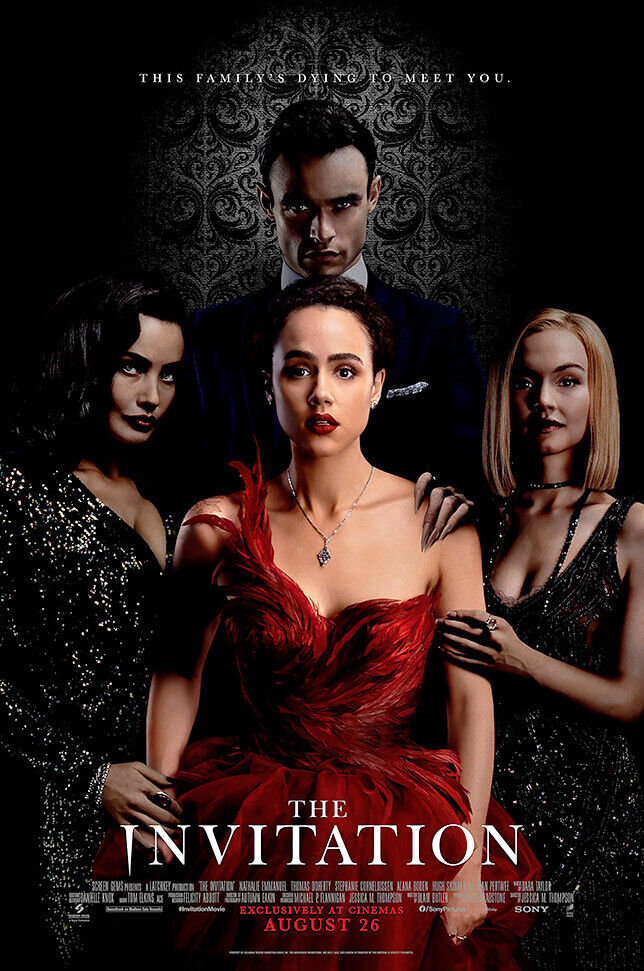
The Invitation (2022) ***- Seen at the Cinema

Two words – “Whitby” and “Carfax” – hint at what’s coming but luckily have no resonance for impoverished New York ceramics artist Evie (Nathalie Emmanuel) who takes up an invitation to visit long-lost relatives in an English mansion of significant splendour. Immediately taken by her host, lord of the manor Walt (Thomas Docherty), who comes across like a Regency buck, she finds herself a surprising guest of honour for a forthcoming wedding.

Head butler Mr Fields (Sean Pertwee) and the statuesque Viktoria  (Stephanie Cornelissen), another guest, are snippy but the others, a smorgasbord of three influential European families, make her welcome. A nightmare and a few things unexplained drive her into the arms of the sympathetic Walt and before she knows it, she has agreed, in jest, to marry him. “The Big Reveal” – a subject of the last two posts – is well-paced giving Evie time to react to her unexpected circumstances. Like Hide and Seek (1964) she has been led into a trap of her own making, millennial entitlement coupled with the chance to mix with the rich and famous enough to do the trick.

She, it transpires, is the bride of a very particular individual and despite her efforts to escape it will be a very red wedding.

If there had been no mention of Whitby and Carfax – and I don’t remember anything in the trailer – I would have been completely unprepared for what followed, at least in the vampiric context, for the other goings-on did not tilt the viewer in that direction. The romance was refreshingly modern, with various reversals, including Evie standing up for menials who had fallen foul of the butler, and for herself against belittlement by Viktoria.

The ice-house, a mainstay of such buildings prior to refrigeration, also turns out to be fit for purpose and in another twist Walt favours the harem approach to marriage.

Considerably less savage than your modern horror picture, and definitely a shade more romantic, I can see why it would go down poorly with the modern horror cognoscenti but I felt it was very well directed, much more in the classic tradition of pacing, character development and twist. And it has an excellent ending that I suspect might kick-start a sequel.

Nathalie Emmanuel – best known from a stint in Game of Thrones and F9: The Fast Saga (2021) – will surely be elevated to stardom after her first leading role. A big-screen natural, she carries the picture effortlessly, and even though effectively playing the innocent abroad, there are few moments where the character is out of her depth, tribute to her innate acting skills. This could have gone wrong in so many ways, but her performance evokes natural sympathy while at the same time you would not make the mistake of pitying her.

A bright future also awaits Thomas Doherty (High Strung Free Dance, 2018) who carries off his role with style and except until necessary does not hint at the real character underneath the charm. Sean Pertwee (The Reckoning, 2020) shows he can glower with the best of them but Stephanie Corneliussen, in her movie debut,  makes an excellent queen bitch and her whimpering sidekick Alana Boden (Uncharted, 2022) proves anyone can turn nasty given the right amount of prodding.

Big shout out to Scottish actress Carol Ann Crawford – better known as the dialect coach for Outlander – as the maid who sets Evie right. I do believe I was at university with her.

Director Jessica M. Thompson (The Light of the Moon, 2017) does an excellent job of keeping a tight rein on proceedings and even when all hell is about to break loose ensures that the ensuing havoc is carried out with some style. Blair Butler (Polaroid, 2019) knocked out the screenplay.

My only gripe is that Emmanuel and Doherty make such a fine couple – with the kind of screen charisma that is in short supply these days – it was a shame that the story had to take a turn into horror rather than continue (forgive the pun) in the romantic vein.

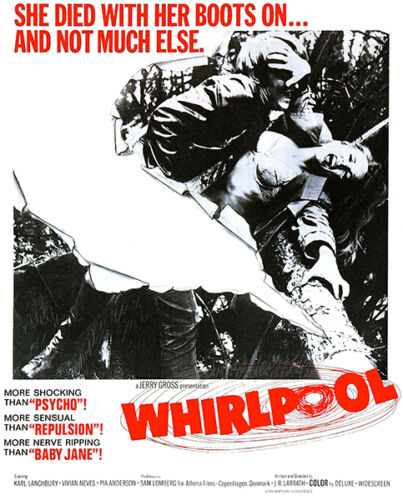
She Died With Her Boots On / Whirlpool / Perversion Flash (1969) ***

Sexual adventuress takes trip to the country with disastrous results. Best described as an early British venture in the giallo mold it lacks some of the style of that genre but is notable for the debut of Spanish cult director Jose Ramon Larraz (Vampyres, 1974). Perhaps as interesting is that it details a nascent killer warming to his task and climaxes in a nihilistic ending. Scoring so high on the sex/nudity quotient in the U.S., it was considered an out-and-out exploitationer.

Wealthy older woman Sarah (Pia Andersson) brings home model Tulia (Vivian Neves) for her protégé Theo (Karl Lanchbury), a budding photographer.  Sarah’s proclivities are apparent from the start, preferring young women though young men will also suffice, a switch in the normal power play of the era (and now for that matter) of rich old men chasing younger women.

Tulia is no innocent, lured or straying into the big dark house, and she’s game for anything, happily participating in a game of strip poker that ends in sex with Theo. However (and striking a contemporary note), he is unable to perform – for reasons that might be similar linked to young people today who suffer from the same condition due to over-exposure to porn – and in Theo’s case because he prefers watching.

Quite how far he is willing to go to achieve his kicks is shown in a scene where he drives Tulia to the woods where she is almost raped by his friend Tom so that Theo can photograph the act. Quite how far Tulia is willing to go is indicated by the fact that, while upset at this incident, she doesn’t run a mile and instead continues to enjoy games of seduction, this time with Sarah, with Theo at first limiting his participating to recording the action but later taking part in a menage a trois.

Meanwhile, a Scotland Yard Detective Inspector (Barry Craine) interrogates businessman Mr. Field (Edwin Brown), sugar daddy to missing Irishwoman Rhonda (Johanna Heger), and Field takes it upon himself to pay Theo a visit. Quite how he knows of Theo’s involvement with Rhonda is unclear but he doesn’t accept the explanation that the girl has gone home and hangs around to do a bit of spying. Not such a good idea, because he pays the penalty.

Although it’s a pleasant detached cottage and far from an old dark house, Tulia takes it upon herself to take a look at Theo’s studio where she finds various items of female clothing and photos of an unsavoury nature. A flashback reveals the death of Rhonda, seduced by Tom, then, following the arrival of Theo and his trusty camera, raped by a tramp. But it’s not Theo who kills her. It’s Tom, and largely by accident.

So what’s being set up really is how far beyond his normal games Theo will go, with Tulia providing the test case.

A chunk of the tension comes from having no idea what’s going on beyond Sarah indulging Theo. She appears ignorant of the depth of his perversion. And with Tulia being so complicit initially in the sex it appears to be going down a different route to the slasher pictures like Scream and more in keeping with the giallo which had yet to get into its stride. Tulia is a modern girl for the times, certainly not sexually repressed, which was refreshing, and being a model comfortable with her body. But she would not have been expecting something like this.

Karl Lanchbury (What’s Good for the Goose, 1969) looked like he was perfecting the creepy persona that would carry him through a few more Larraz pictures. Vivian Neves was a model, famous two years later for featuring in the first nude advertisement in The Times, but also a glamour model with pictorials in Penthouse and The Sun, and known as “The Body” a quarter of a century before that title was appropriated by Elle Macpherson, and later set up her own modelling agency. Pia Andersson only made this one picture.

Given he was dealing with so much inexperience and was himself a debutant, Larraz does a pretty good job. He would go on to make another 25 films mostly in the exploitation vein.  

I came across this on YouTube while looking for the Otto Preminger film noir Whirlpool (1950). The version I saw is taken from a very ropey VHS with time codes but there’s a better print on the channel under the title of Perversion Flash.

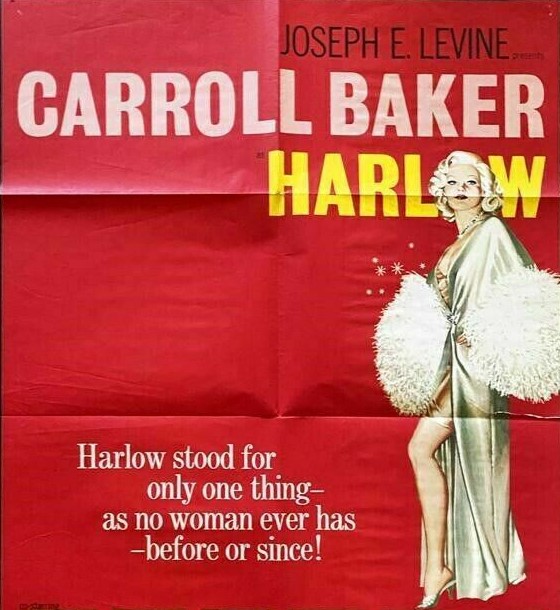
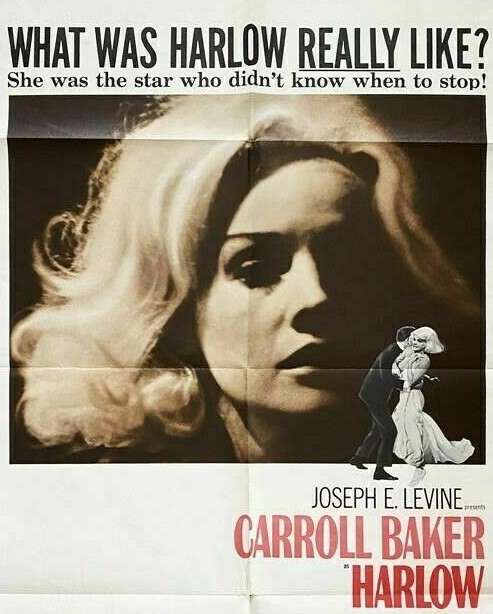
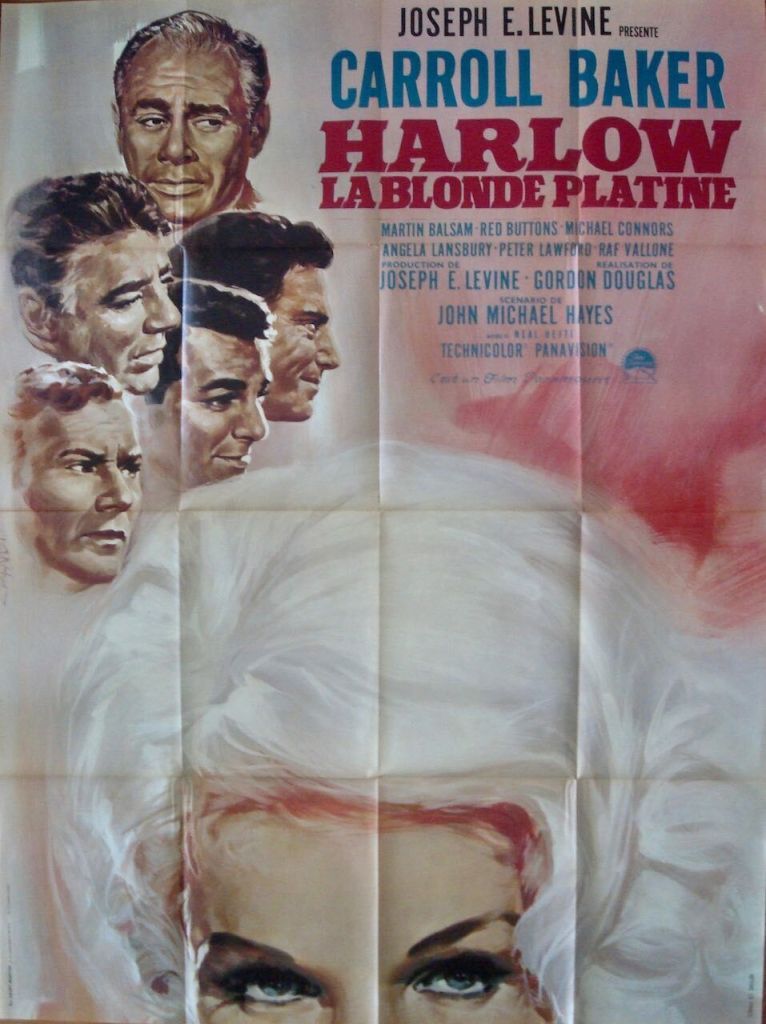
Harlow (1965) ***

Harlow presents such a convincing picture of Hollywood abuse that I was astonished to discover that it was not entirely truthful where the title character was concerned.

Jean Harlow was a hugely popular star in the 1930s before her untimely death at the age of 36. This film depicts her as a virgin (not true) who turns neurotic (not true) after her impotent husband commits suicide (debatable) on their wedding night (not true) leading to her go off the rails and die from pneumonia (not true). But in terms of the Hollywood system a great deal rings true and if the Me Too movement had existed in the late 1920s the finger would be pointed at a huge number of men.

The film is at its best when dissecting the movie business. A five-minute opening sequence demonstrates its “factory” aspect as extras and bit players clock in, are given parts and shuffle through great barns to be clothed and made up, often to be discarded at the end of the process.

No sooner has this version of Jean Harlow (Carroll Baker) been given a small part than she encounters the casting couch, operated by a lowly assistant director, who bluntly offers five days’ work instead of one if she submits to his advances. When she turns him down, work is hard to come by and she resorts to stealing lunch before rescued by agent Arthur Landau (Red Buttons). After tiny parts that mostly consist of her losing her clothing, receiving pies or eggs in the face and displaying her wares in bathtubs, she geta a big break only for that producer to demand his pound of flesh – “I’ve already bought and paid for you.” Here she has “the body of a woman and the emotions of a child” and ends up choosing the wrong suitor which leads to a calamitous outcome.

However, the pressures of stardom are well-presented: she is the breadwinner for her unemployed mother Jean (Angela Lansbury) and lazy stepfather Marino (Raf Vallone) and soon box office dynamite for studio chief Everett (Martin Balsam) who sees in her the opportunity to sell good clean sex. The negotiations/bribery/blackmail involved in fixing salaries are also explored.

But the film earns negative points by mixing the real and the fictional. The agent and husband Paul Bern (Peter Lawford) existed but most of the others are invented or amalgamations of different people. MGM is represented as “Majestic” and among her films there is no Red Dust (1932) or China Seas (1935) but lurid inventions like Sin City

Director Gordon Douglas was a versatile veteran, with over 90 films to his credit, from comedies Saps at Sea (1940) and Call Me Bwana (1963) to westerns The Iron Mistress (1952) and Rio Conchos (1964) and musicals Follow That Dream (1962) and dramas The Sins of Rachel Cade (1961) and Sylvia (1965) which also starred Baker. The opening scene apart, which is a seamless construction, he is adept at this kind of helter-skelter drama. John Michael Hayes (Rear Window, 1954) has produced a punchy script based on the book by Arthur Landau and Irving Shulman.

In the title role Carroll Baker (Sylvia) has probably never been better, comedian Red Buttons (Stagecoach, 1966) excellent in a straight role while the smarmy Raf Vallone (Nevada Smith, 1966) is the stand-out among an excellent supporting cast that also includes Angela Lansbury (In the Cool of the Day, 1963), Peter Lawford (Sylvia), Leslie Nielsen (Beau Geste, 1966), Martin Balsam (Seven Days in May, 1964) and Mike Connors (Stagecoach, 1966).

Except that virtually none of the movie is true, I would have given it four stars for its portrayal of Hollywood but I have come to expect that biopics, while moving facts around for dramatic purposes, are required to be good more faithful to their subjects than this. 

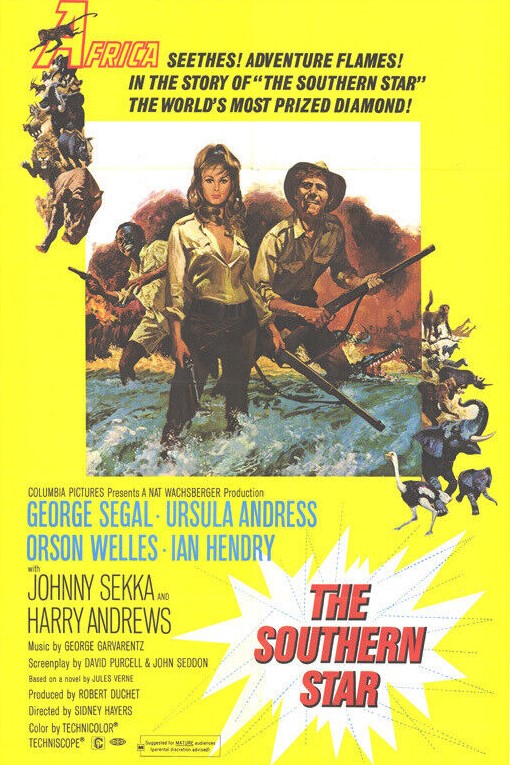
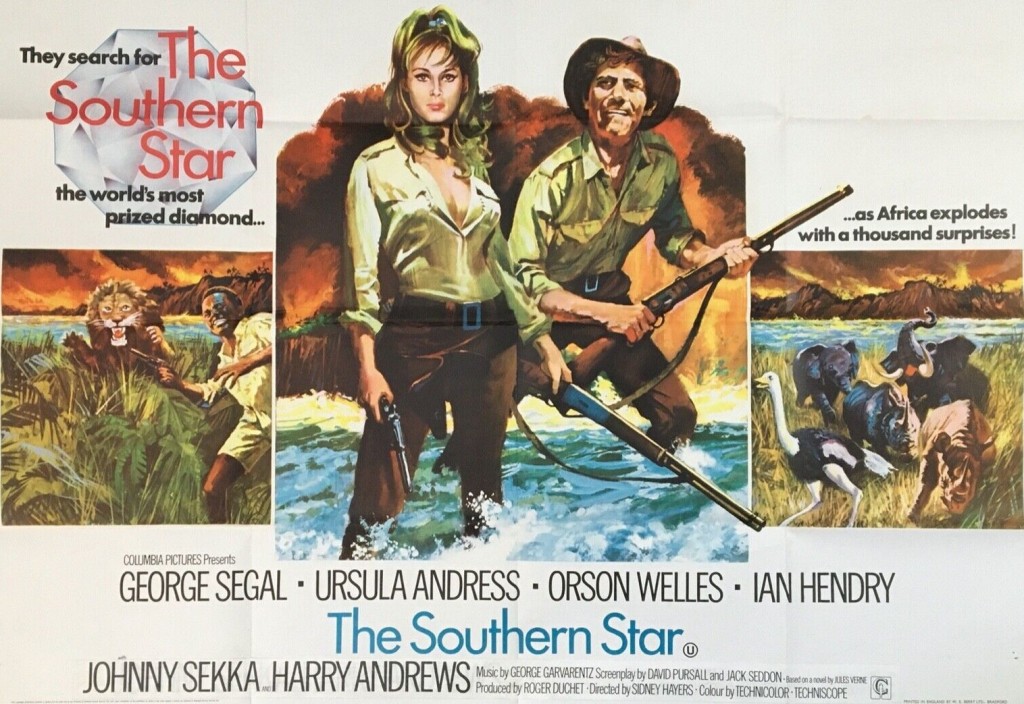
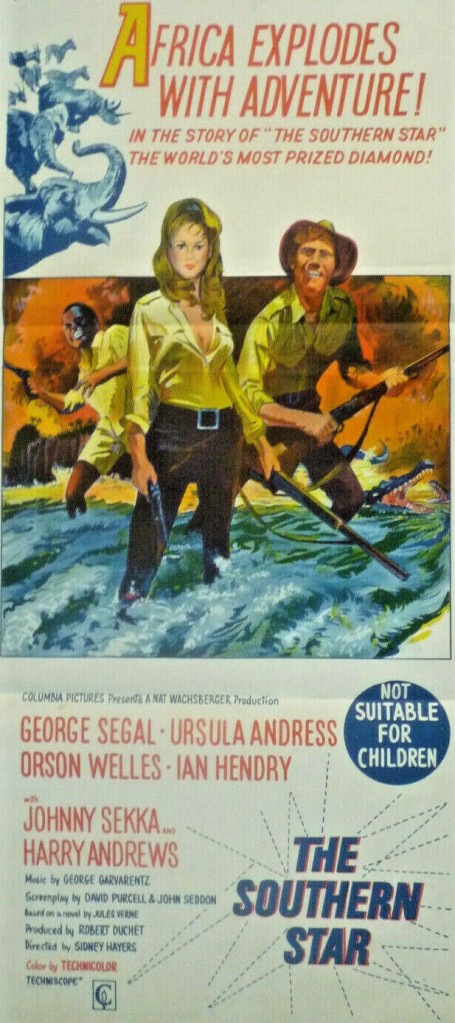
The Southern Star (1969) ***

There’s a surprisingly good movie here once you strip out the cliché jungle stuff and the racist elements. The diamond of the title is actually a MacGuffin, just enough to get you started on two parallel tales of revenge.

Dan (George Segal) is a mining engineer-cum-adventurer and Erica (Ursula Andress), daughter of mine owner Kramer (Harry Andrews), as far from the traditional jungle heroine (except in one regard) as you could get. She saves him from crocodiles, rescues him from jail and quicksand, swims across a hippo-infested river and is a better shot than him (or anybody for that matter) with a rifle. This is female empowerment with a vengeance.

Suspected of stealing the diamond, he is hunted by ranger Karl (Ian Hendry), Dan’s love rival, who intends to win Erica back using the simple expedient of killing the thief. Lying in wait is all-purpose rogue Plankett (Orson Welles) who seeks revenge on Karl. The second unit had a whale of a time filming anything that moved –  lions, leopards, zebras, giraffes, buffaloes, monkeys, antelopes, the aforementioned hippos and crocodiles and what looked like a cobra – and at one point everything does move in coordinated fashion if you can call a stampede coordinated.

But the main focus is an Erica who constantly confounds Dan’s sexist expectations. Docility is her disguise. Anytime she appears to be doing what she’s told you can be sure she’s planning the opposite. While Dan does have his own specific set of jungle skills, he often looks a fool. But they do make a good screen partnership and their dialogue is lively.

Hollywood spent millions of dollars trying to create screen chemistry between various stars and although it seemed to work very well in the industry’s golden age with Clark Gable and any number of MGM female stars, Bogart/Bacall and Tracy/Hepburn and I guess you could chuck John Wayne-Maureen O’Hara into that particular mix, the formula seemed to have gone awry by the 1960s discounting the Doris Day/Rock Hudson combo, big budget romances like El Cid (1961) and Doctor Zhivago (1965) and an occasional home run with whomever Cary Grant was romancing on screen. So it was usually hit-or-miss whether any sparks flew between the stars.

Andress had certainly been a European femme fatale par excellence as seen in Dr No (1962) and The Blue Max (1966), but it was certainly not a given that she would more than hold her own for an entire picture. Segal was nobody’s idea of a romantic leading man although the notion had been given a tryout in The Girl Who Couldn’t Say No (1968) with Virna Lisi. But here the whole enterprise works in an It Happened One Night vein with the supposedly superior male recognizing that perhaps his companion was more than a match.

Harry Andrews and Orson Welles both try to steal the picture, with polar opposite characterizations, Andrews loud and menacing, Welles soft and menacing. You can tell Scottish director Sidney Hayers (The Trap, 1966) was an editor because he cuts for impact and mostly does an efficient job of sticking to the story. Supposedly, Orson Welles directed his own scenes, but that might be to make sure he got to hog the camera. He has enough choice lines and bits of business to keep him happy and gives his venomous character a camp edge. Matakit (Johnny Sekka), Dan’s buddy, who actually has the diamond, is separately pursued and subjected to racism and being whipped.

Despite my reservations, this is well constructed and keeps one step ahead of audience expectation with plenty twists to subvert those, although the music by Johnny Dankworth gets in the way, offering musical cues opposite to what is required.

As it is a jungle picture there is the obligatory heroine’s bathing scene – and to balance the books on that score Segal does whip off his shirt at one point. Except for the clichés and the racism, it would have gone higher in my estimation for by and large it is well done and Andress is once again (see The Blue Max) a revelation.   

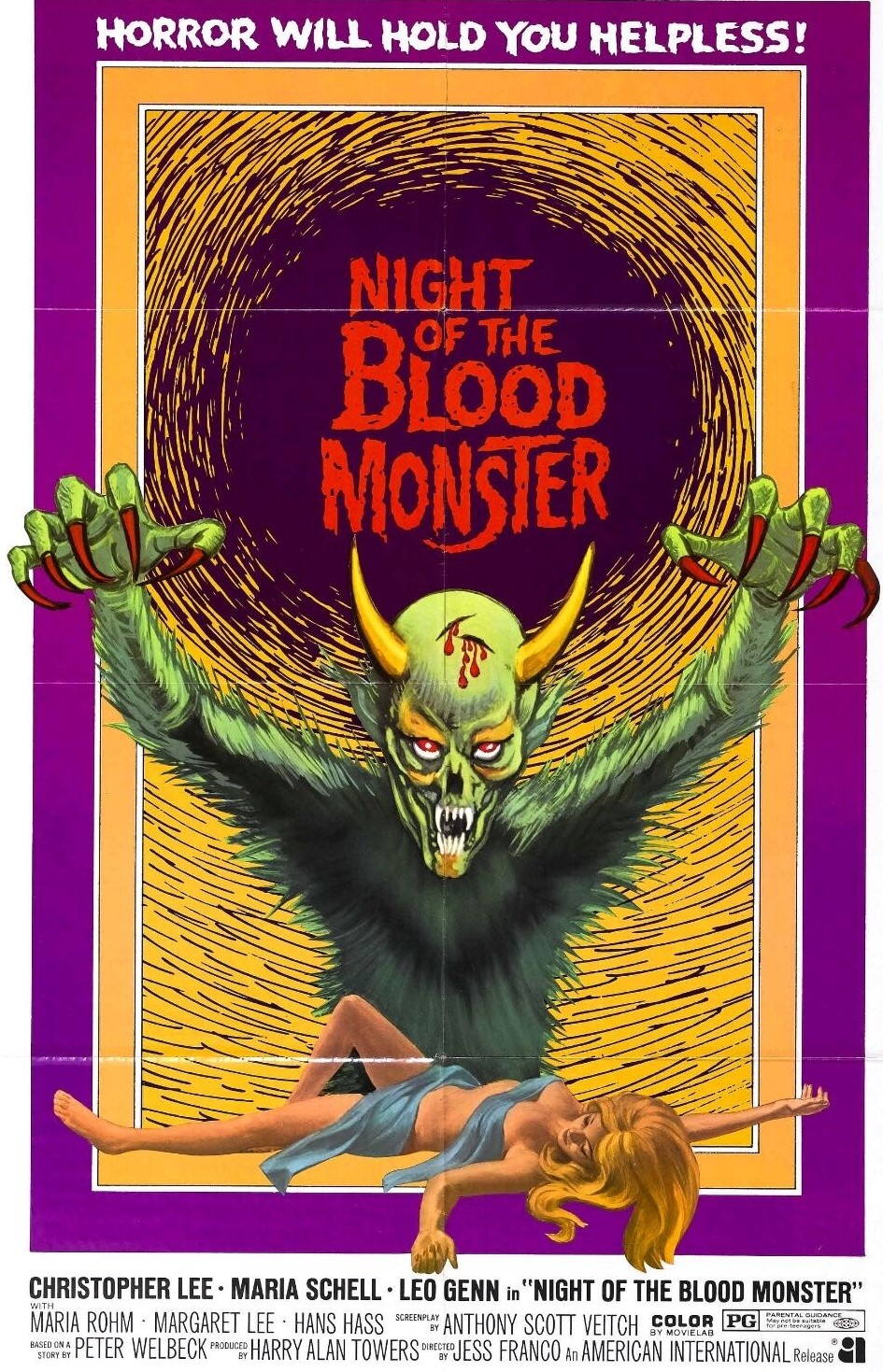
Night of the Blood Monster / The Bloody Judge (1969) ***

Handsomely mounted historical drama set in 17th century England on the brink of revolution  meets Son of Witchfinder General. An uprising headed by the Duke of Monmouth in the south-west threatens to overthrow King James II. Involved in the plot are Harry Selton (Hans Hass), son of suspected agitator Lord Wessex (Leo Genn), whose beloved Mary Gray (Maria Rohm) is in the sights of Judge Jeffreys (Christopher Lee) after he has condemned her sister Alicia (Margaret Lee) to be burned as a witch.

The minute witchcraft enters the equation the narrative thrust is constantly interrupted by scenes of nudity, blood and torture, mostly involving women, but actually the film does attempt to cover the rebellion and its notorious aftermath when hundreds of rebels were executed, the “Bloody Assizes” with “Bloody Judge” Jeffreys to the fore. Conflating witchcraft with a genuine historical episode does not work very well and unlike Witchfinder General (1968), the murder of innocent women is more of a sideshow, despite the brutality involved, and you get the impression the story has been hijacked to accommodate supposed witch Mary in the interests of adding titillation.

Even as the story of the rebellion unfolds, the threat to the crown spelled out, the origins of the revolt mostly made clear (Monmouth being the illegitimate son of Charles II, and nephew to James II) although the sectarianism behind the rebellion is ignored, the narrative keeps jumping back to the witch element. Jeffreys connects the parallel narratives, hunting down rebels and witches, while handling most of the exposition. Given the budget, there’s a surprisingly good battle sequence, cavalry charging cannon. Given his later reputation, Jeffreys also reflects on the meaning of justice.

And while there are some camp moments – Jeffreys playing the organ while attired in grand robes, dancing girls sticking pins in his effigy – the twists and turns (Mary captured and rescued, captured again)  are effective enough. Despite the copious nudity, there a couple of low-key love scenes and, oddly enough, a touching moment when Mary licks the blood from a dead prisoner. And for all the blood, that is effect rather than cause, nothing too gory.

But with the powerful all-mighty, and investigators able to plant evidence, and the innocent forced into immoral acts to save their loved ones, lawlessness is apparently next to godliness. But in reality the wicked did not get away with their crimes so various villains get their come-uppance.

Most peculiar sight is Christopher Lee in a love scene where he is not about to sink his incisors into a neck. Occasionally, the film bursts into German with English subtitles – as if various versions were pillaged to produce this copy – or has lines like “you turn me on.”

However, fans of Spanish cult director Jess Franco (The Girl from Rio) who expected something more along the lines of 99 Women (1969) and Venus in Furs (1969) may be disappointed that he spends so much time on the historical elements and less on the random T&A. You might not be surprised to learn of the involvement of ubiquitous producer Harry Alan Towers (Five Golden Dragons, 1967).

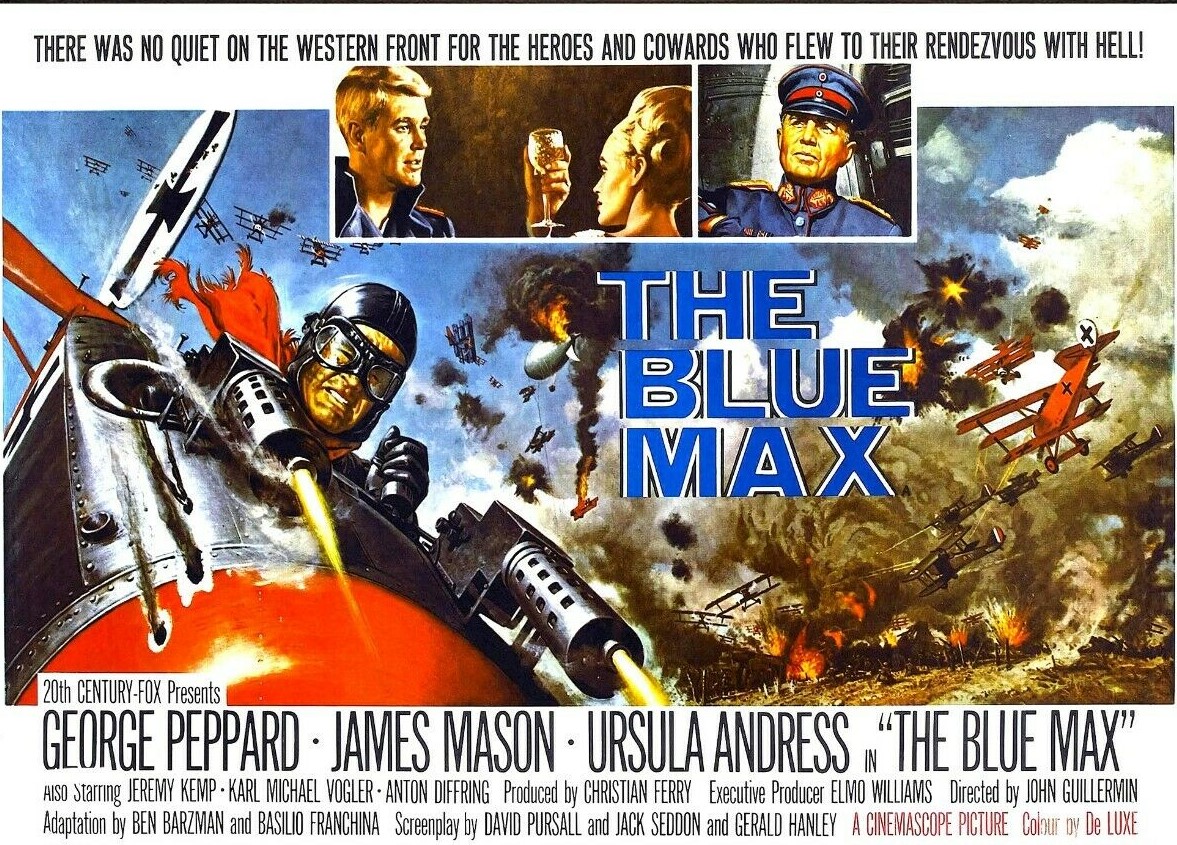
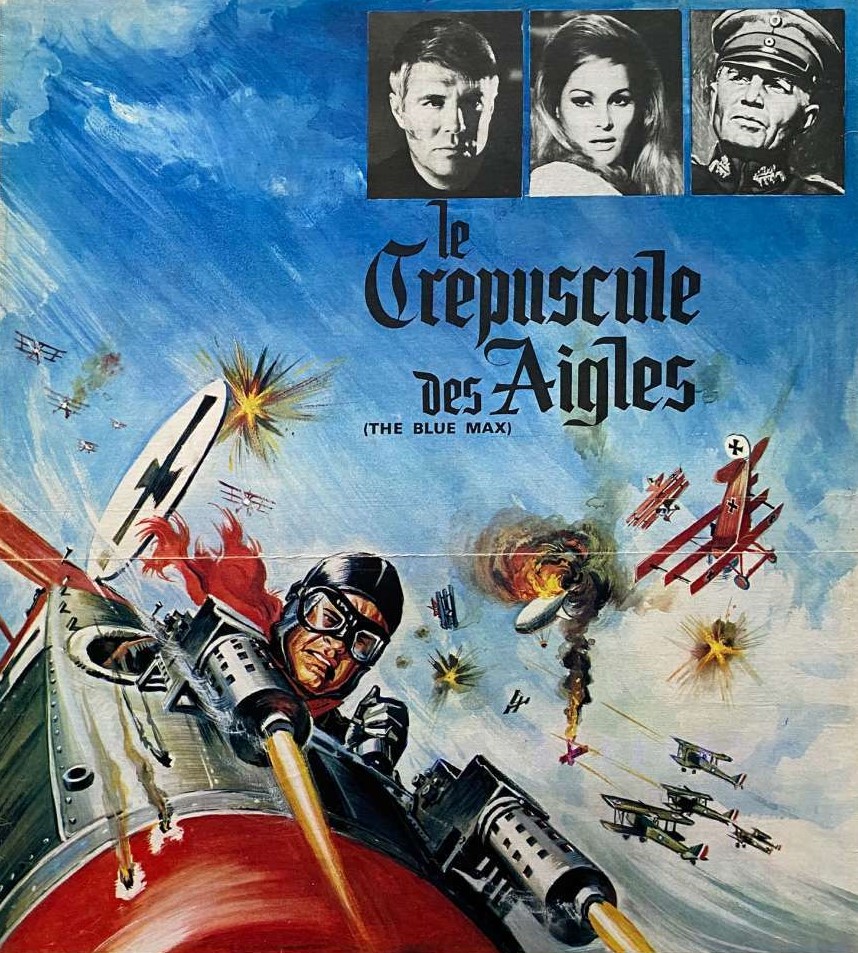
The Blue Max (1966) ****

Watching The Bridge at Remagen sent me back with renewed admiration to John Guillermin’s take on World War One in The Blue Max. Again, a tale of two men battling for supremacy, although in this case they are both on the same side. Flying aces Lt Bruno Sachel (George Peppard) and Willi von Klugerman (Jeremy Kemp) could easily be accommodated within the highest echelons of the German fighter pilot division except that each wishes to be known as the country’s number one pilot and there is also a question of class and nepotism.

Quite how working-class Sachel Peppard makes the transition from grunt in the trenches to Germany’s elite flying corps is never made clear in this glorious aerial adventure. But he certainly brings with him an arsenal of attitude, clashing immediately with upper-class colleagues who retain fanciful notions of chivalry – harking back to the days of cavalry charges – in a conflict  notorious for mass slaughter.

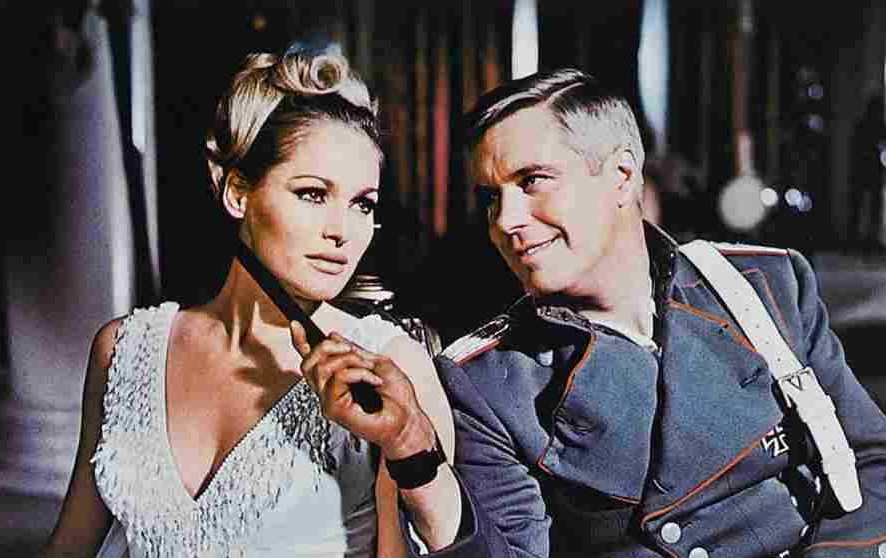
He climbs the society ladder on the back of a publicity campaign designed by General Count von Klugerman (James Mason) intent on creating a new public hero. On the way to ruthlessly gaining the medal of the title, awarded for downing twenty enemy aircraft, he beds Mason’s playful mistress Kaeti (Ursula Andress).  

While the human element is skillfully drawn, the innate jealousy and petty rivalries that threaten to spoil the camaderie so essential to any war effort, it is the aerial element that captures the attention. The planes are both balletic and deadly. Because biplanes fly so much more slowly than World War Two fighters, the aerial scenes are far more intense than, say, The Battle of Britain (1969) and the dogfights, where you can see your opposite number’s face, just riveting. Recognition of the peril involved in taking to the sky in planes that seem to be held together with straw is on a par with Midway (2019) while the ability of the best pilots to dodge trouble in the sky has been more recently highlighted in top Gun: Maverick (2022).

I was astonishing to discover not only was this a flop – in part due to an attempt to sell it as a roadshow (blown up to 70mm for its New York premiere) – but critically disdained since it is an astonishing piece of work. Guillermin makes the shift from small British films to a full-blown Hollywood epic with ease. His camera tracks and pans and zooms to capture emotion and other times is perfectly still.

The best scene, packing an action and emotional wallop, will knock your socks off. Having eliminated any threat from an enemy plane, rather than shoot down the pilot, Peppard escorts it back to base, but just as he arrives the tail-gunner suddenly rouses himself and Peppard finishes the plane off  over the home airfield, the awe his maneuver originally inspired turning to disgust.  

The action sequences are brilliantly constructed, far better than, for example 1917 (2019) – which by contrast appears labored. One battle involving planes and ground troops is a masterpiece of cinematic orchestration, contrasting raw hand-to-hand combat between enemy soldiers with aerial skirmish. Guillermin takes a classical approach to widescreen with action often taking place in long shot with the compositional clarity of a John Ford western. Equally, he uses faces to express emotional response to imminent or ongoing action.

George Peppard (Pendulum, 1969) is both the best thing and the worst thing about the picture. He certainly hits the bull’s eye as a man whose chip on one shoulder is neatly balanced by arrogance on the other. But it is too much of a one-note performance and the stiff chin and blazing eyes are not tempered enough with other emotion, and he fails to portray the kind of complex character he would essay so brilliantly in P.J./New Face in Hell (1968) and House of Cards (1968)  It would have been a five-star picture had he brought a bit more savvy to the screen, but otherwise it is at the top of the four-star brigade.

James Mason (Age of consent, 1969) is at his suave best, his aristocratic German somewhat redeems the actor after his appalling turn the same year as a Chinaman in Genghis Khan. Jeremy Kemp (A Twist of Sand, 1968) is surprisingly good as the equally ruthless but distinctly more humane superior officer. For once given the chance to act, Ursula Andress (The Southern Star, 1969) is more than mere eye candy, the kind of mistress with an eye more on the main chance than true love, although she does manage to swan around in one scene clad in only towels.

Look out for Derren Nesbit (The Naked Runner, 1967), Anton Diffring (Where Eagles Dare, 1968), Harry Towb (The Bliss of Mrs Blossom, 1968) and Karl Michael Vogler (The Dance of Death, 1967).

Guillemin’s technical skill is outstanding. In Bridge at Remagen it was the tracking camera and the blitz of war that captured the eye, here it is fabulous aerial photography. In the later picture, it was often hard to delineate individuals within the overall frame since the whole point of the film was the absolute messiness of war, but The Blue Max, dealing with one-on-one duels, presented a better opportunity to take advantage of cinematic elan. The screenplay, based on the bestseller by Jack Hunter, was courtesy of the team of David Pursall and Jack Seddon (The Southern Star) and Gerald Hanley (The Last Safari, 1967) after initial work by Ben Barzman and Basilio Franchina (both The Fall of the Roman Empire, 1964).

There had been a marked trend towards even-handedness in terms of presenting both sides during World War Two, as exemplified by Battle of the Bulge (1965), but this was the first to present the Germans in such heroic fashion.

Men (2022) ** – Seen at the Cinema

Bizarre movie seeks cult audience! You might as well have stuck that on the poster. When I tell you the film climaxes like a Monty Python sketch with four successive men giving birth – from a variety of orifices – the first three to emerge different versions of the same character, the last the dead husband James (Paapa Essiedu) of Harper (Jessie Buckley). And that men also appear fully naked, in the form of some kind of vegetation, and can survive despite having an arm spliced from elbow to fingers. And that James desperately wants her to feel guilty about his suicide, triggered by her demanding a divorce.

Of course, all this could be taking place in her tormented mind except that she steadfastly refuses to admit to torment over the suicide even though she does scream her head off in church. If any of this is remotely realistic it points to someone with a severe downer on men, since there is not a single likeable one in sight. Men, in fact, are just four-letter words (choose your own) whose sole purpose is to accuse women of not loving them enough. And women – cue symbolism – are all born of Eve and inclined to eat a forbidden apple.

None of this would be so bad if in attempting a psychological thriller and/or horror film (I am assuming horror because of the births and arms sliced in two) there was actually a shock or two or even a general sense of creepiness. On the plus side, should this ever achieve cult status – “makes Titane look like Paddington” (1 or 2, you choose) – then I am sure director Alex Garland will only be too happy to turn up for a tenth anniversary Q&A and explain his intentions and/or symbolism and if he’s very lucky find an audience composed of students who have written a thesis on the film.

So the story – or did you think there wasn’t one – sees Harper repair to a village in the country to a fantastic country house with all the trimmings including an Aga and a baby grand for two weeks holiday to recover from the suicide, her mind still so muddled that she’s not thought to change her married name. It’s the kind of village where there appears a considerable amount of inbreeding. The letting agent (Rory Kinnear) looks suspiciously like the long-haired vicar (Rory Kinnear) and the rude schoolboy (Rory Kinnear) and the policeman (Rory Kinnear) and the bollocks-naked stalker (Rory Kinnear).

Harper gets lost in the unfamiliar countryside and happens across a tunnel where the echo effects could have been created by Robert Fripp and is then chased by a man (Rory Kinnear anyone?) and then catches sight of the naked man who later appears in her garden looking like an rewilded exhibit from the Chelsea Flower Show. The various versions of the man appear at different points and even when the letting agent appears good (and brave) actually he is just as bad.

I felt sorry for the Oscar-nominated Jessie Buckley (The Lost Daughter, 2021) for having to put up with this script. I also felt sorry for Rory Kinnear (No Time to Die, 2021) with a movie career so far consisting of supporting roles who must have been convinced that the chance to channel his inner Alec Guinness/Peter Sellers and play multiple characters would have been his breakthrough.

I did not in the slightest feel any sympathy towards Alex Garland (Ex Machina, 2014) for dreaming up this pile of tosh. This is one those films that strides the critic/moviegoer divide. Around 70 per cent of critics on Rotten Tomatoes gave it a positive review but moviegoers disagreed and, as surveyed by Cinemascore, gave it a D score (on a rank from A to F).

Discover WordPress

A daily selection of the best content published on WordPress, collected for you by humans who love to read.

The Atavist Magazine

by Brian Hannan

WordPress.com Blog

News, Tips & Website Tutorials