Last week’s headline-grabbing articles about how few women featured in the rankings of top-earning movie stars, suggesting this was an age-old problem, overlooked one inconvenient truth. A century ago, actresses were the biggest earners in Hollywood.
In fact from Hollywood’s inception around 1910 and for the next sixty years actresses from Mary Pickford in the 1910s to Elizabeth Taylor either out-earned or equalled the male pay packets. I know. I wrote a book about it – When Women Ruled Hollywood (Baroliant, 2019). It was subtitled – “How Actresses Took on the Hollywood Hierarchy – and Won.”
The simple fact of the matter is that a woman – Florence Lawrence – in 1910 became the first Hollywood star, on the princely (or should I say princessly) salary of $50 a week, at a time when 77% of the female workforce survived on less than $7 a week. She was the equal highest-paid earner of the day.
Taylor earned $3 million for Cleopatra.
When movies began, movie stars were not as highly paid as those who worked on stage. But, again, women were by far the highest paid earners. The number one star in vaudeville – the U.S. version of music hall – was Gertrude Hoffman on, wait for it, $3,000 a week (about $90,000 equivalent now). In 1911 the number one spot was shared – by two women. Sarah Bernhardt and Gaby Deslys now took home $4,000 a week. The following year Bernhardt was top dog again, on $9,000 a week and the next year again as the highest earner she pulled in $22,000 a week.
Movie stars of neither gender were earning that much but everyone knew what vaudeville stars earned so there was no shortage of precedent for actresses in the burgeoning movie business to ask for more. They employed a simple technique. They held studios to ransom. Give me more money or I jump ship.
In 1915, Mary Pickford broke all records for movie star earnings by taking in more than $150,000 a year. This was far more than male sensation Charlie Chaplin and even as his salary leapt upwards so did hers. In 1918 she picked up $1.8 million a year.
Despite the advent of top males in the 1920s of the calibre of Valentino, Lon Chaney, Tom Mix, Harold Lloyd and John Gilbert, women topped the earning chart once again. Gloria Swanson would have easily been the top-ranked earner had she accepted an offer of $18,000 a week but turned it down preferring to retain her independence. In her absence Corinne Griffiths came out of top with a $13,000 a week salary at First National.
Hepburn was on a cool $1 million per picture.
In the early 1930s Greta Garbo topped the heap with $500,000 a year – for a 40-week deal. In 1935 Mae West took home $480,000, not just the highest earner in the movies, but the second highest earner, $20,000 behind publishing magnate William Randolph Hearst, in the whole of the United States.
In 1936, when Gary Cooper came top with Ronald Colman second, women occupying the next three spots. In 1937 when Fredric March took the top spot, women placed, second, third, four, fifth and sixth. In 1938 Claudette Colbert was number one and Irene Dunne the topper in 1939.
Bing Crosby topped the bill in 1940, and the next year it was Colbert again. The war inflicted a number of anomalies on the business, mainly the arrival from radio of Abbott and Costello, top earners in 1942, with Fred MacMurray, without even taking top billing in most of his films of the period, hitting the earnings peak for both 1943 and 1944. Ginger Rogers was top in 1945, Joan Crawford in 1946 and except for a parachute payment to stop him leaving Warner Brothers Humphrey Bogart would have been pipped at the post by Bette Davis, with chanteuse Deanna Durbin top of the heap in 1948.
With demise of the studio system in the 1950s, female earnings tumbled except for Marilyn Monroe who ran top earners John Wayne and William Holden close. But in the 1960s Elizabeth Taylor out-earned everyone by a huge margin and Audrey Hepburn, Doris Day and Julie Andrews either earned or equaled the earnings of top male attractions like John Wayne, Steve McQueen and Paul Newman.
The advent of action pictures, which sold more easily around the world than comedies or dramas, ensured that from the 1970s onwards men mostly ruled the earnings game. But still stars like Barbra Streisand, Jane Fonda, Julia Roberts and Sandra Bullock held their own. And it was not so long ago that it was the likes of Jennifer Lawrence, thanks to The Hunger Games franchise, beat everyone.
You can buy my book on Amazon for about £10 and $12.
We’ve all been there. You are scrolling through a movie website and you come across a new Audrey Hepburn picture called The Loudest Whisper (1961) and you get all excited and wonder how on earth you could have missed it. You check it out. Something about the other credits sounds familiar – directed by William Wyler, co-starring Shirley Maclaine. Wait a minute, isn’t that The Children’s Hour? Yep, you got it. Welcome to the title jungle, the constant changing of the names of movies from country to country.
You could see how this was necessary, possibly even essential, as different languages and cultures struggled to make sense of Hollywood titles. There could be other reasons. What actually does To Kill a Mockingbird (1962) mean and is it translatable into Greek or Italian? What happens if the publisher of the bestseller-cum-movie has already changed the title? Or if an American bestseller sank like a stone in other countries and the whimsical title means nothing to nobody.
But The Loudest Whisper was the British title for the William Wyler picture. And Britain, it turns out, was not shy about changing titles. Elia Kazan’s America, America (1964), a straightforward title you might think, suggesting longing, was changed into the incomprehensible The Anatolian Smile, assuming the ordinary public knew where (or what) Anatolia was. Burt Kennedy western Mail Order Bride (1964), an idea too obvious for the sensitive Brits, became the meaningless West of Montana.
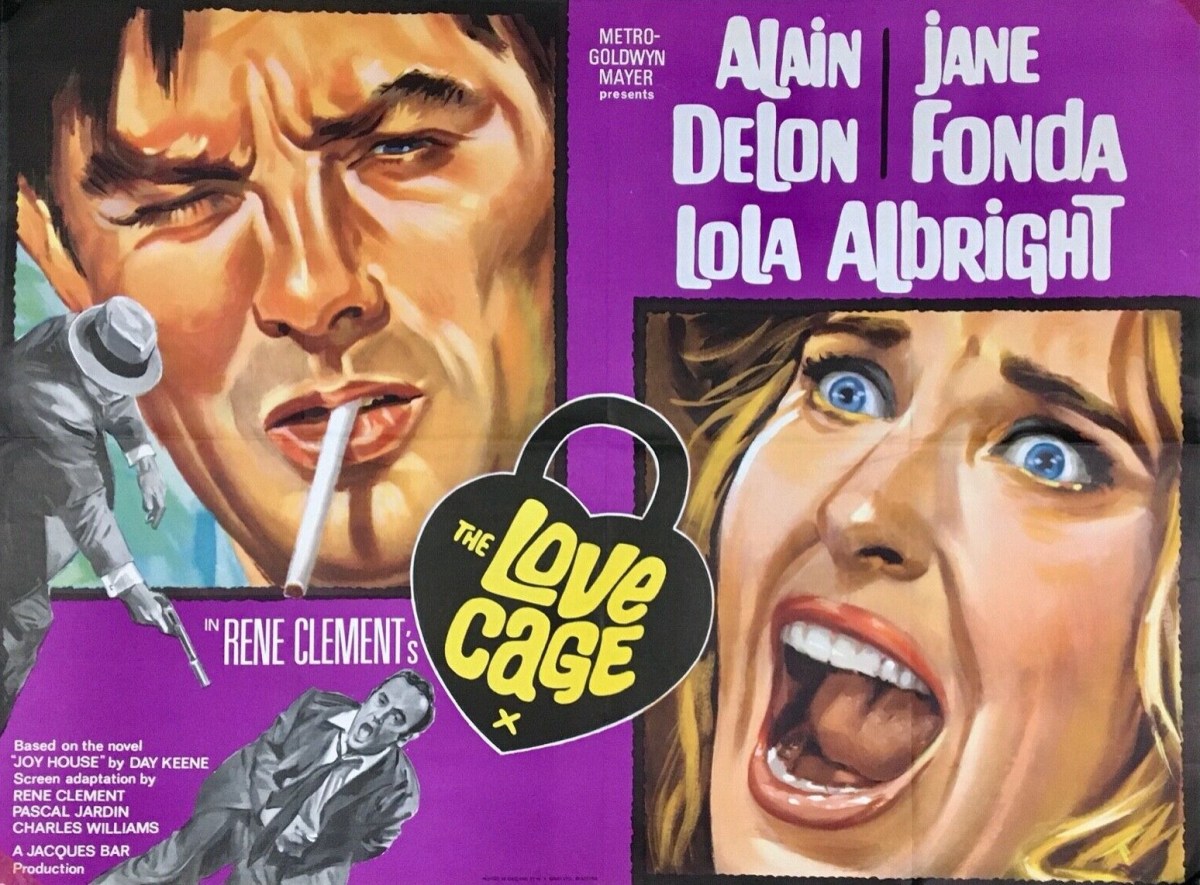
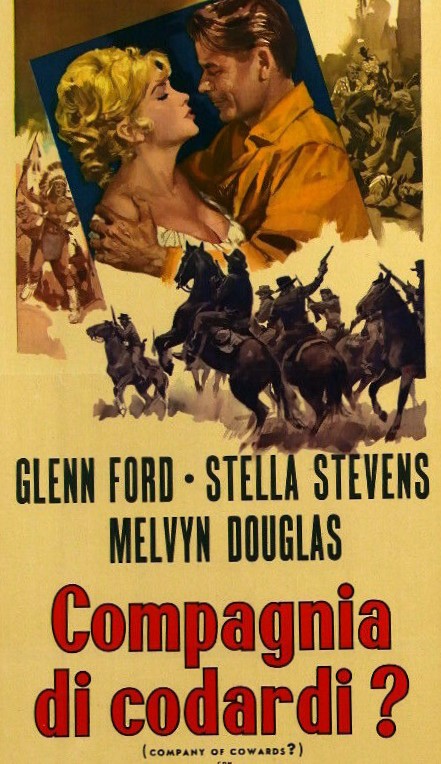
Glenn Ford-Stella Stevens western comedy Advance to the Rear (1964), a simple joke in any language unless your mind ran in cruder directions, turned into Company of Cowards. Glenn Ford again, Experiment in Terror (1962) was translated for British audiences as The Grip of Fear. Rene Clement French thriller Joy House, perhaps suggestive of a house of ill-repute, with Alain Delon and Jane Fonda became the no-less risqué Love Cage. And any notions that The Stripper would prove impossible to resist for any red-blooded male were scuppered by renaming it Woman of Summer.
In any case, the Italians had already co-opted the whole stripping thing, Warner Brothers musical Gypsy (1962) was translated as The Woman Who Invented Striptease, which was actually what Gypsy Rose Lee was famed for even if Hollywood did not want to admit it upfront. In fact, the people in charge of foreign titling often came up with a better choice than the original. Two Seducers was the Italian title for Bedtime Story (1964) starring Marlon Brando and David as, guess what, rival seducers.
In case you had no idea what The Prize (1963) referred to, what could be better than renaming it, as in Italy, Intrigue in Stockholm or, in accepting some knowledge of the Nobel Prize, the Greek version No Laurels for Murderers, both revamped titles a bit more persuasive above a marquee than the bland original, especially if the Irving Wallace bestseller on which it was based had not been a success in the respective countries.
Cape Fear (1962) – based on a book with the straightforward title of The Executioner – was improved upon in several countries, all taking a similar approach to the problem. In Switzerland it was known as Bait for a Beast, in West Germany Decoy for a Beast, both of which actually touched more succinctly on the main plot than the Hollywood version. And some countries believed in saying it as they saw it, Irma La Douce (1963) shown in Greece as The Streetwalker.
Clearly, some Hollywood titles provoked much head-scratching as titling experts tried to work out if they had, perhaps, a hidden meaning. Frank Sinatra comedy Come Blow YourHorn (1963) was variously called I’ll Take Care of the Women (Italy), If My Sleeping Room Could Talk (West Germany), If My Bed Could Talk (Greece) and the more straightforward Bachelor’s Apartment (Israel).
Some titles came with inbuilt bafflement. Italy had an interesting take on MGM musical The Unsinkable Molly Brown (1964), tabbing it I Want To Be Loved in a Brass Bed. Move Over Darling (1963) emerged as One Too Many in Bed (West Germany) and Her Husband Is Mine (Greece) while another Doris Day vehicle Lover Come Back (1961) became A Pajama forTwo (Switzerland), and A Pair of Pajamas for Two (West Germany). But some essential facet of the character of Hud (1962) was captured in Wildest Among a Thousand (West Germany) and Wild as a Storm (Greece).
And back to that To Kill a Mockingbird problem. Italian audiences were treated to Darkness Beyond the Hedge and Greek moviegoers to Shadows and Silence. Incidentally, in Israel The Stripper was known as Lost Rose while Advance to the Rear in West Germany appeared as Heroes without Pants.
SOURCE: “How U.S. Titles Are Retitled in Foreign Lands,” Variety, May 12, 1965, p108 and examination of movies on Imdb.
Dream Team Number One: Clark Gable and Jean Harlow. This was of course a good 30 years before the movie actually got made. The Horace McCoy novel was purchased in 1935 by MGM as a big-budget project teaming Clark Gable and Jean Harlow. This was despite Variety proclaiming it was “not screen material.” The premature death of Harlow put paid to the idea. Next, actor Wallace Ford (Freaks, 1932) bought it with Broadway in mind. A production was scheduled to open in 1939, but never did.
Dream Team Number Two: Charlie Chaplin and Marilyn Monroe. When the comedian purchased the rights in the early 1950s he intended Marilyn Monroe to play the leading female. Although she was a mere starlet Chaplin had form in building up newcomers. Author McCoy had by that point become an accomplished screenwriter with over 30 credits including Gentleman Jim (1942), film noir Kiss Tomorrow Goodbye (1950) and The Lusty Men (1952) That concept fell by the wayside when Chaplin was effectively banished from America while launching Limelight (1951) in Britain.
It was another 14 years before interest in the novel was revived by screenwriter James Poe, who purchased the rights from the McCoy estate. Although most famous within the trade for being accused of fraudulent behaviour in relation to his screenplay for Around the World in 80 Days (1956). Despite an Oscar for the film he was sued for $250,000. However, he had a sterling body of work including Cat on a Hot Tin Roof (1958), Sanctuary (1960), Lilies of the Field (1963), The Bedford Incident (1965) and Riot (1969) and two other Oscar nominations.
In 1965 he had signed a multi-picture writer-director deal with Columbia. He was either going to make his directorial on The Gambler or They Shoot Horses, Don’t They. It turned out to be the latter. Failing to get the movie off the ground with Columbia or under his own steam, he turned to new studio Palomar, which was a production entity set up by the ABC television network, which bought over his rights as well as his script but kept Poe on as director.
Dream Team Number Three: Faye Dunaway. Yep, one big star, not two. Poe’s screenplay, while not eliminating the male lead, spun on a female star. Dunaway, hot after Bonnie and Clyde (1967), was offered $600,000 to play the role. Mia Farrow was also in contention, for $500,000. The only problem was, the budget could not remotely stretch to that. As helmed by Poe, it was to cost no more than $900,000. The film was scheduled to begin shooting in spring 1968 but a month later the start date shifted to June.
Two relative newcomers Robert Chartoff and Irwin Winkler were brought in as producers to move the project along. Later they would be responsible for such classics as Rocky (1976), The Raging Bull (1980), The Wolf of Wall Street (2013) and The Irishman (2018), but at this point they had just three pictures under their belt, although that included Point Blank (1967), Their first task: persuade Poe to rewrite the script. They felt the third act needed work with restructuring elsewhere to make the pay-off work.
But Poe, believing his position was sacrosanct, refused to discuss a rewrite. He refused to discuss anything, period, treating the producers as his assistants rather than people with some power within the studio. According to Irwin Winkler, “Poe seemed unaware of the of the normal process of preparation, even though he’d been around movie sets for decades.”
Realising that getting a star on their budget was impossible, Chartoff and Winkler changed tack and talked to good actors, but even then few were interested. A less dramatic star than Jane Fonda you could not imagine, her resume filled with light comedies, French films that utilised her sexuality or the extravaganza that went by the name of Barbarella (1968). But the pregnant Fonda was keen on change. The film was delayed until after she had given birth. Michael Sarrazin should have been out of the equation. John Schlesinger had lined him up for the Jon Voigt role in Midnight Cowboy (1969) but Universal, to whom he was under contract, asked too much to send him out on loan.
With no sign of the rewrites, the producers became antsy about the director. However, they showed their true mettle as producers, convincing Palomar there was no way the original budget would cover the ballroom set, huge number of extras, live orchestra and salaries. It would need to at least triple.
In a picture of one predicament following another, there was one crisis the producers had not foreseen. They were going to be fired. Apart from anything else, they were only executives on the picture with any experience, it being not only Poe’s first movie but that of Chartoff and Winkler’s superiors at the studio. The outcome – the guy who had told the pair they were being fired was shown the door instead.
Susannah York was cast after the producers saw a sneak of The Killing of Sister George (1969) at the Robert Aldrich studios. She had committed to Peter O’Toole vehicle Country Dance/Brotherly Love (1970), written by her cousin James Kennaway (Tunes of Glory, 1960). After too many delays on They Shoot Horses she planned to pull out in favour of the other film. Although Sally Kellerman (Mash, 1970) was set as a last-minute replacement, the issue was resolved by asking MGM to delay the start on the rival picture.
Believing Poe was in no position to helm such a big-budget picture enterprise, Chartoff and Winkler began the process of removing him only for Jane Fonda to dig her heels in. She changed her mind after witnessing first-hand Poe’s directorial skills – or lack of them – when she took part in a screen test for Bonnie Bedelia. Winkler recollected, “On the set Jane asked Poe questions about the blocking of the scene, why she moves in one direction rather than another, why in front of a sofa rather than behind it etc. He couldn’t answer her questions and told her to talk to the cameraman.” Exit Poe.
In terms of a replacement, Chartoff and Winkler set their sights of Sydney Pollack (The Scalphunters, 1968) with whom they had previous dealings, and William Friedkin, then being hailed for The Homecoming (1968) – luckily The Night They Raided Minsky’s (1968) had yet to be released. But studio executives had a third director in mind, Jack Smight (No Way to Treat a Lady, 1968). Friedkin should have been in pole position, having only received $75,000 for The Homecoming. His agent, sensing an opportunity, demanded $200,000. Jack Smight’s agent also got greedy and wanted $250,000. Pollack’s agent was happy with the $150,000 on offer.
When Poe was eased out, filming was announced as beginning on February 17, 1969, the budget having now increased to $3.2 million – including $400,000 for extras. However, acoustic issues – seawater had eaten away the bottom of the pier – prevented use of the old Aragon ballroom in Santa Monica. That set was constructed on the Warner lot.
Pollack then turned it down. He had reservations about the script, which had still never been rewritten. When Robert E. Thompson, a television writer but “a Horace McCoy expert,” was mooted, Pollack changed his mind. The new script contained the “flash forward” scenes that prepared audiences for the shock ending. However, the new scenes and delays in starting increased the budget which now ballooned to $4.7 million.
It turned out the director was the best actor of all. “I was impressed with Sydney Pollack’s ease on the set,” recalled Irwin Winkler. “He never seemed to be working hard and yet was able to get marvelous performances out of the actors. Everybody in the company adored him.” Asked by Winkler how he remained so calm dealing with the actors and all the extras and the complicated camera set-ups, he replied, “it was really quite easy.” That same afternoon he collapsed on set and was diagnosed with “nervousness.”
The studio, the stars, the producers, all seemed confident about the picture. All they had to do was convince the audience. But at the first preview in San Francisco the audience roared with laugher at the climactic scene. That shocked the studio to the core until the producers were able to reassure the head honchos that the “fast forwards” would smooth over that problem. Which they did.
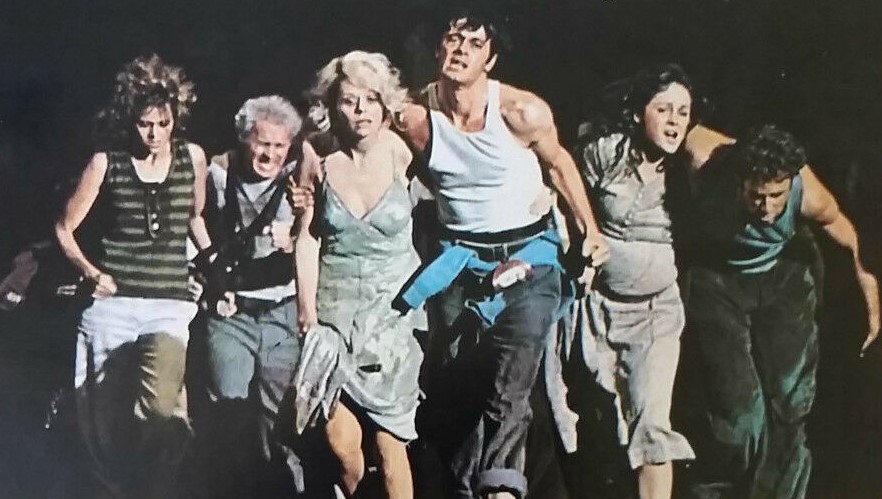
It was nominated for nine Oscars – Best Director, Best Screenplay, nods for Jane Fonda, Gig Young and Susannah York among others. Only Gig Young won.
SOURCES: Irwin Winkler, A Life in Movies, (Abrams Press, New York, 2019) p34-47; “Tough Stuff,” Variety, August 7, 1935, p59; “Ford Buys for B’Way,” Variety, September 11, 1939, p42; “Dance Marathon Reprise,” Variety, August 3, 1966, p24; “IT&T In No Way Slowing Down Theatrical Feature Program of ABC,” Variety, January 10, 1968, p4; “Crowded Slate for Palomar,” Variety, February 28, 1968, p18; “Bob Evans Chips-Service To Writers As Stars At Paramount,” Variety, May 1, 1969, p19; “Jane Fonda Gets Top Role in Palomar’s Horses,” Box Office, July 22, 1968, pW1; “Palomar Horses on W7 Space,” Variety, October 23, 1968, p3; “Jan 6 Filming Date for They Shoot Horses,” Box Office, December 16, 1968, pW5; “Cheery Side of Delay on Horses,” Variety, January 15, 1969, p21; “Winkler Wants Films With Social Comment,” Box Office, January 19, 1970, pW1.