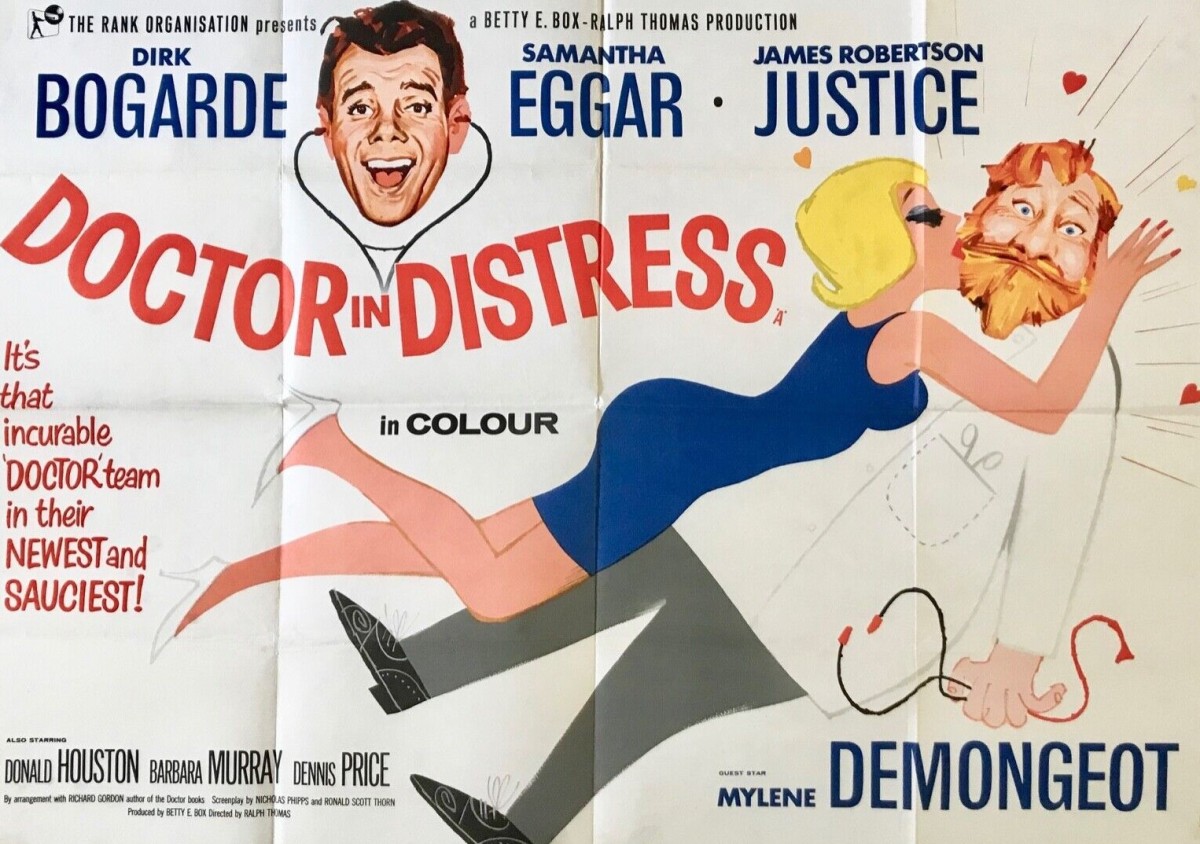
Doctor in Distress (1963) ***

Bait-and-switch as the romantic complications of the grumpy Dr Spratt (James Robertson Justice) take precedence over the by-now pretty competent Dr Sparrow (Dirk Bogarde). Just about getting by on Bogarde’s charm in his fourth and final outing in a role that had made him a British box office star and possibly more notable as his final film as an out-and-out matinee idol before he shifted into the arthouse arena.

Dr Sparrow has come a hell of a long way since being a shy junior doctor, mercilessly bullied by Spratt and a love life that was filled with tangle. Here, he not only stands up to Spratt, but is something of a lothario, happily ditching new love Delia (Samantha Eggar), a model, albeit temporarily, in favor of French masseuse Sonia (Mylene Demongeot).
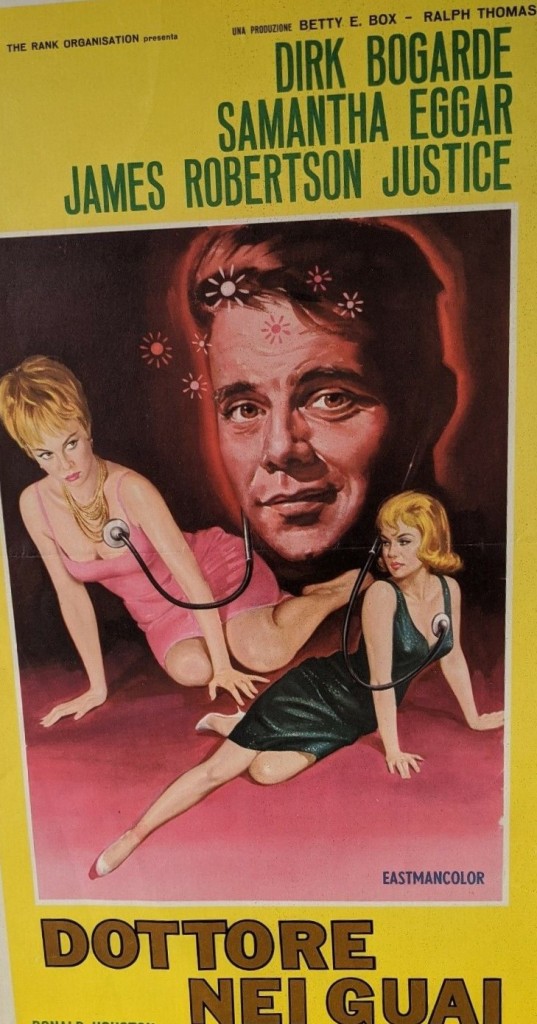
There is very little of the traditional rom-com-love-on-the-rocks in Bogarde’s relationship with Delia, who arrives as a patient with a sprained ankle at the hospital and is whisked home by Sparrow for a spot of practised seduction. Spratt, on the other hand, has fallen for physiotherapist Iris (Barbara Murray) and in trying to win her hand undergoes weight loss treatment at a health clinic, endures the indignity of wearing a corset, hires a private detective to get the lowdown on her, and finally, donning a disguise of dark glasses and hiding his bulky frame behind an umbrella, proceeds to attempt to discover who is his rival for her affections.

Sparrow is left to occasionally swat out of the way the interfering Spratt and alternatively offer him advice or a shoulder to cry on while trying to prevent Delia pursuing a movie career. So it’s just a series of situations, none of which are particularly funny, apart from the idea of Spratt getting his come-uppance.

It’s worth noting that for a British sex comedy, the females are in charge. Iris knocks back her various suitors, Delia refuses to let romance interfere with her career, jetting off to Rome over Sparrow’s objections, and the diminutive and muscular Sonia is more than a match for any man and just as predatory.
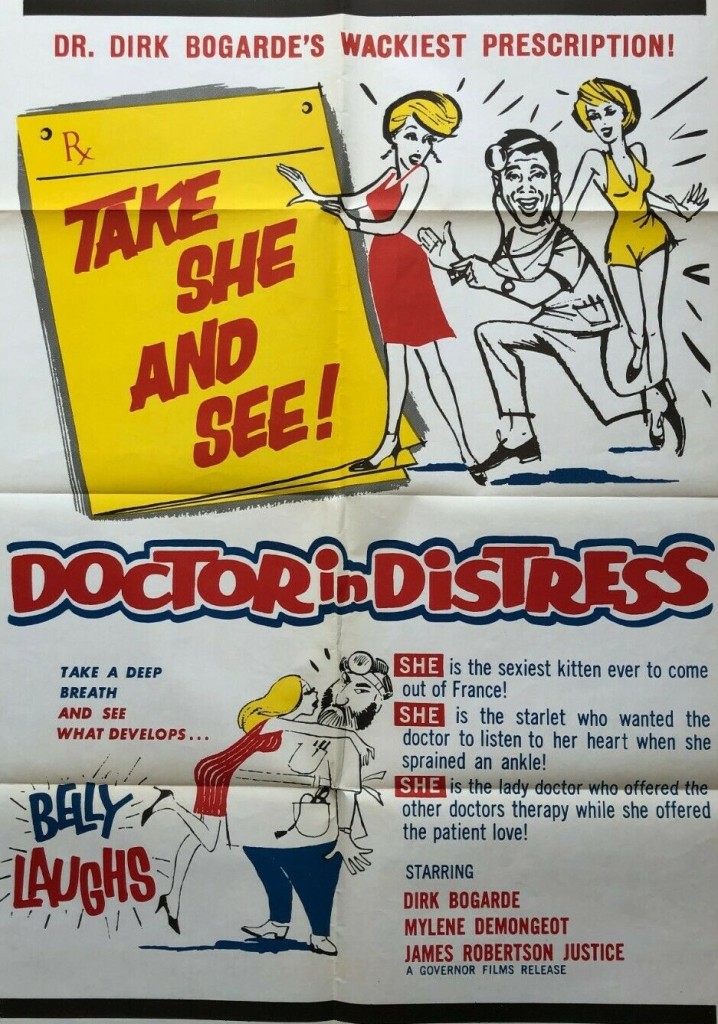
What’s most surprising is that a genial comedy like this can get away with so much permissiveness. This was opposite of the in-your-face snigger-snigger Carry On series so for Sparrow to be successfully spreading his wild oats seemed somewhat out of character. But you can see most of the jokes a mile off though probably in a packed cinema these would provoke more laughter than watching it at home on the small screen.

It’s probably worth it to see Leo McKern (Hot Enough for June, 1964) as a movie producer who envisages Sparrow as his new star and Frank Finlay as a corset salesman, a completely different role to his part in Robbery (1967). Fenella Fielding (Lock Up Your Daughters, 1969) has a cameo as a neurotic passenger on a train and Dennis Price (Tunes of Glory, 1960) as a sadistic health clinic manager while Donald Houston (A Study in Terror, 1965) has a larger part as another of Iris’s suitors.  

Dirk Bogarde (Justine, 1969) can essay this kind of character in his sleep but there is no doubting his screen charisma or charm. But I doubt if James Robertson Justice (Mayerling, 1968) varied his character much from picture to picture, perhaps louder and more bumptious here but unlikely to attract audience sympathy. Samantha Eggar (The Collector, 1965) doesn’t get enough to do and has her thunder stolen by the late arrival of Mylene Demongeot (Fantomas, 1964).

Director Ralph Thomas had made more than a half-a-dozen films with Bogarde including more dramatic ventures like Campbell’s Kingdom (1957) and The Wind Cannot Read (1958) and makes the most of this undemanding feature. You would have thought this was the end of the line for the series but with Leslie Phillips (Maroc 7, 1967) as Bogarde’s replacement it soldiered on for another couple of episodes.

Proof that a true star can always help a film rise above its material.
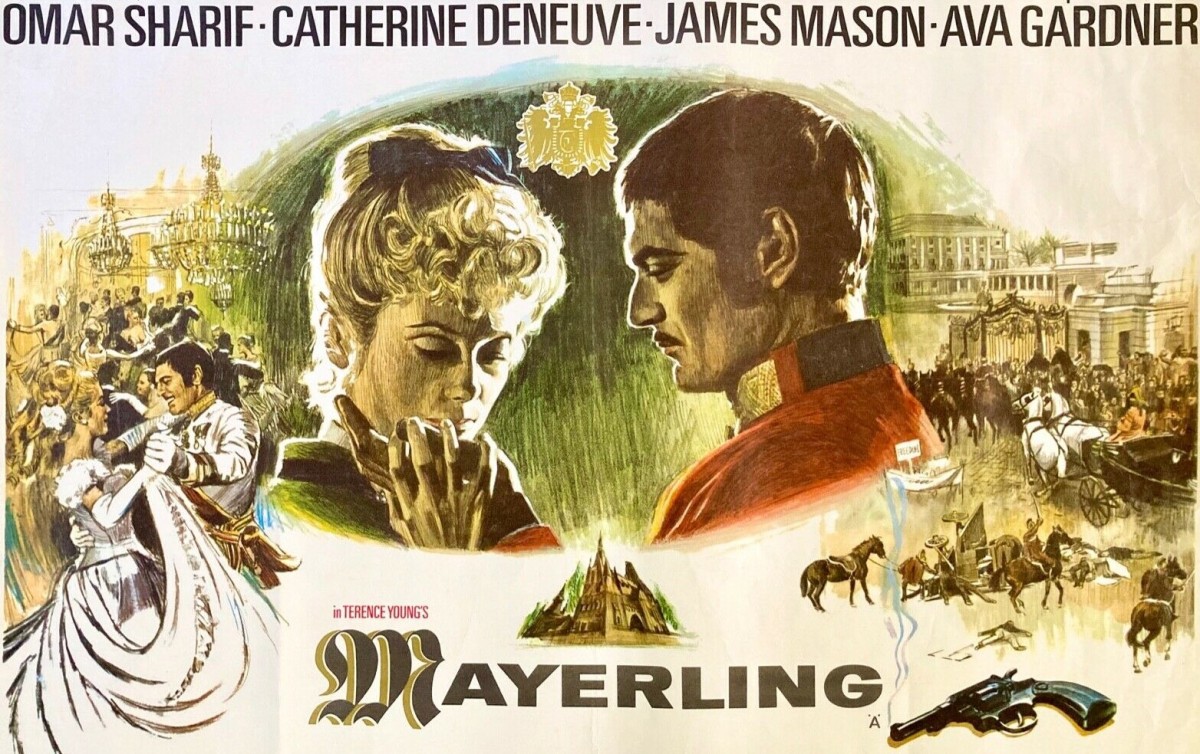
Mayerling (1968) ****

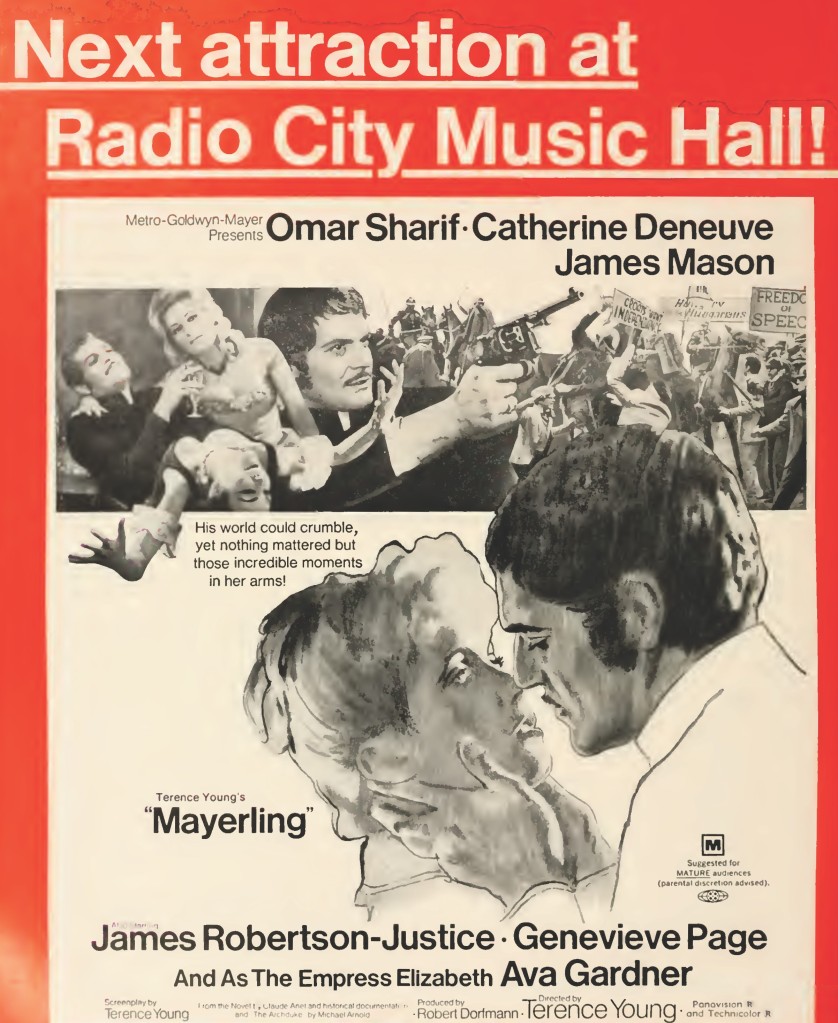
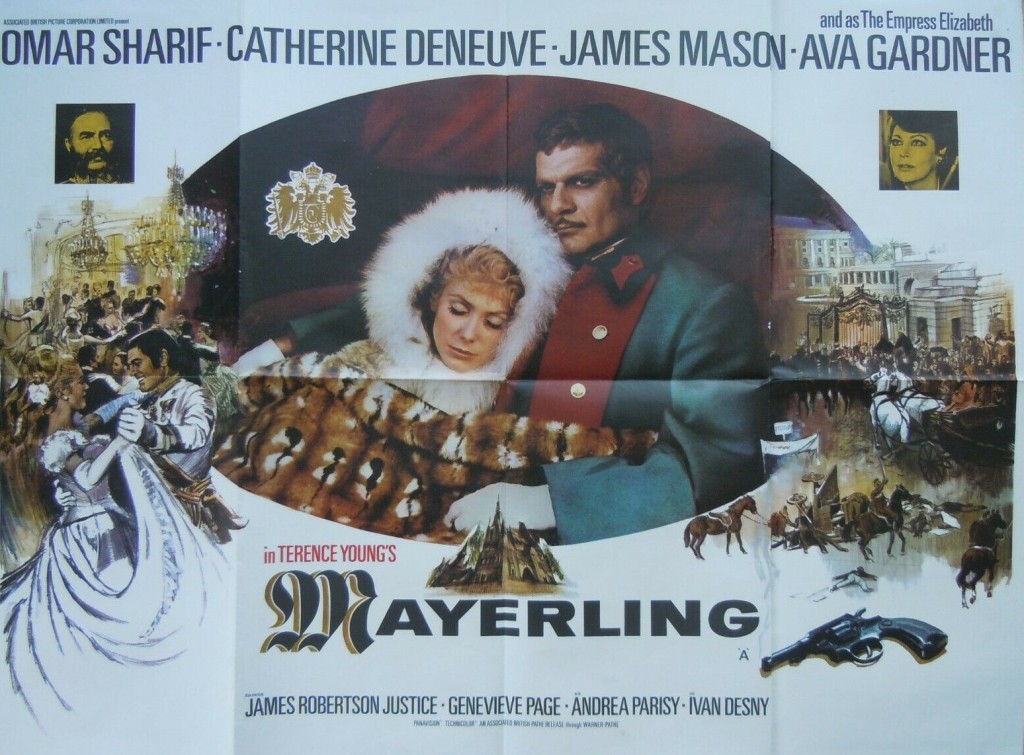
Sumptuous historical romantic drama set in a fading European empire awash with political intrigue and incipient revolution. Archduke Rudolf (Omar Sharif), married heir to the throne and constantly at odds with rigid father Emperor Franz-Josef (James Mason), sympathizes so strongly with Hungarian dissidents that he threatens to tear apart the Austro-Hungarian Empire. However, when he falls in love with Maria (Catherine Deneuve) and wants to marry her instead that, too, threatens to throw the empire into disarray.

Although dissolute, a mistress (or two) on the side, and addicted to morphine, that is not the way Rudolf is introduced to the audience. Instead, he is one of a string of bloodied men arrested after a demonstration giving his name to an officer in a police station who, once he is recognized, orders all other prisoners be released. He is the poster boy for good royalty. The Hungarians, agitating for independence, want him to become their king.

Beautifully mounted with lavish sets and enough in the way of balls, ballet, processions,  horse riding and sleighs to keep up a steady parade of visually interesting distractions, the films steadily builds up an undercurrent of tension, both between father and son and between rebels and ruler. The emperor is a political genius, not just spying on his son, but full of devious devices to hold together whatever threatens to break up the empire.

The romance develops slowly and with true historical perspective, the first kiss they share is not on the lips, Rudolf kisses both her cheeks, she kisses his palm. Yet, there is a real sense that, no matter his power, they can still both be trapped in roles they despise, separated at the whim of parents. Rudolf, as he understands true love for the first time, finds the self-belief to challenge political certainties.

The regal aspects are well done, arguments about the rule of monarchy come over as heated conversation rather than boring debate, the political realities unavoidable. Rudolf, desperate to avoid a future where someone has to die before he has a reason to live. Escape is not an option.

There is a wonderful bitchy atmosphere in the court, where ladies-in-waiting disparage each other behind their backs, one dress described as “wallpaper,” and are forever seeking advancement. Countess Larish (Genevieve Page) is a self-appointed procurer-in-chief for Rudolf, not caring what chaos she causes.

I should add, if you are as ignorant of your European history as myself, that Mayerling is a place not a person. I tell you this so that you don’t make my mistake of waiting for a Mayerling character to appear. The film pointedly avoids a history lesson but it could have spared a minute to explain that the events depicted take place just 20 years after the Austro-Hungarian Empire, the second largest land-mass in Europe, and among the top two or three nations. That would have helped clarify why Franz-Josef was in such a constant state,  worried about forces that could break up the empire, and as concerned that his son, living such a debauched life, lacked the personal skills to hold it together after his father’s death.

It is ironic that Rudolf does prove his worth as a result of being briefly separated from Maria, taking the army to task for its incompetent officers and poor maintenance of everything from weaponry to horses.

To his credit director Terence Young (Dr No, 1962) does not rely on Omar Sharif’s soulful brown eyes and instead allows action to convey character and looks and touch the meaning of his love. This is probably Omar Sharif’s best role, one where he clearly made all the acting decisions rather than being over-directed by David Lean as in Doctor Zhivago (1965). Catherine Deneuve is equally impressive as a far-from-docile innocent, especially given the wide range of more sexually aware characters she has created for Repulsion (1965) and Belle de Jour (1967).

James Mason (Age of Consent, 1969) is superb as the conniving emperor, so rigid he will not approve a change of buttons for the army, so cunning that an apparent rapprochement with his son has unseen strings attached. Ava Gardner (55 Days at Peking, 1963) sweeps in briefly as an empress protective of her son and making the best of life in a gilded cage. Also impressive are Genevieve Page (Grand Prix, 1966) and James Robertson Justice (Doctor in Distress, 1963) as the high-living British heir nonetheless under the thumb of his mother Queen Victoria.

Terence Young also wrote the literate, often amusing script, although Denis Cannan (A High Wind in Jamaica, 1965) and Joseph Kessel (Night of the Generals, 1967) are credited with additional dialogue. While Francis Lai (The Golden Claws of the Cat Girl, 1968) wrote the score he relies heavily on classical music from Aram Khachaturian’s Spartacus.

If you come at this not expecting a David Lean style affair full of striking compositions, but an old-fashioned drama advancing at leisurely pace, you will not be disappointed.

Guns of Darkness (1962) ***

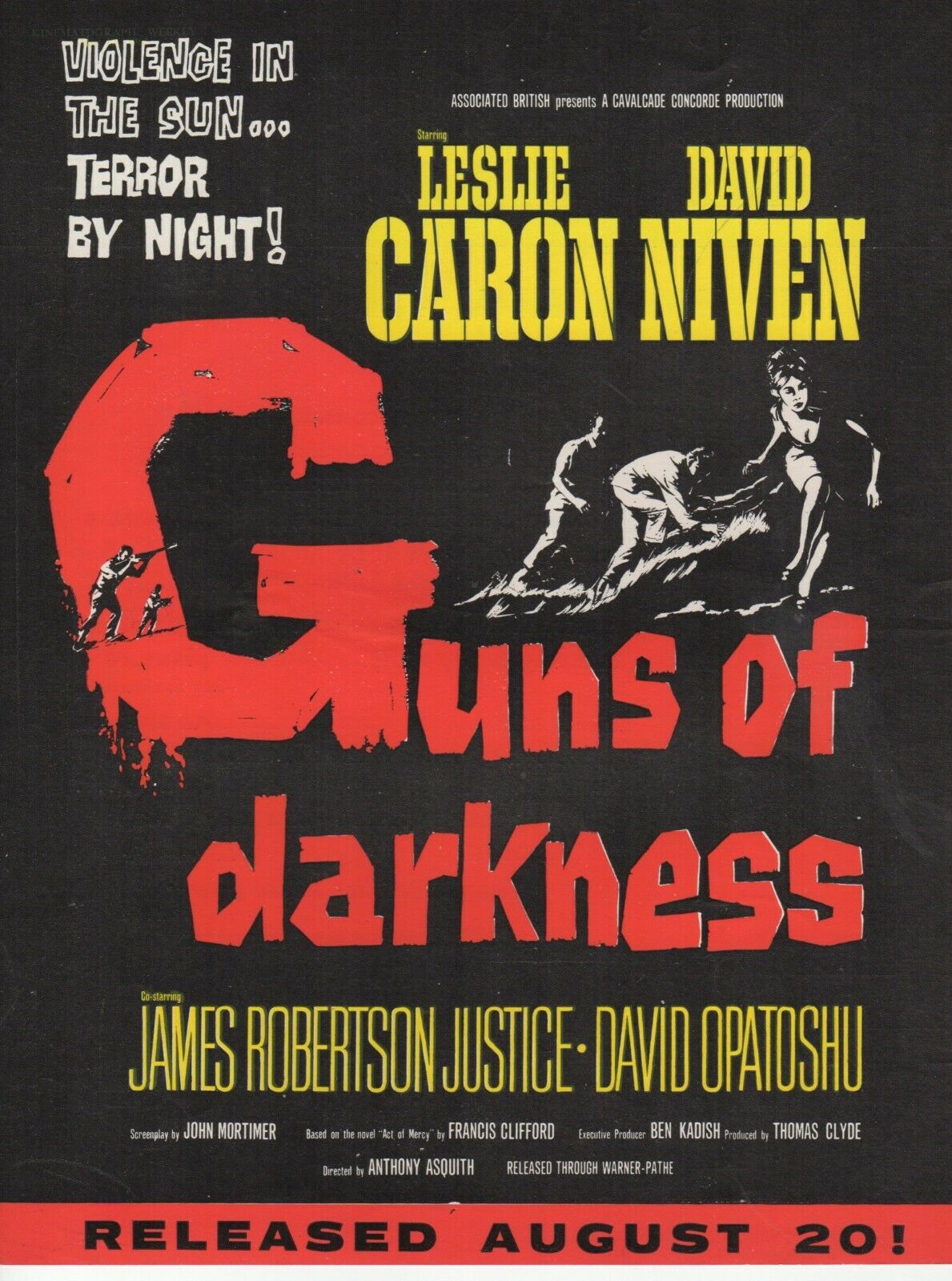
You might think David Lean in Lawrence of Arabia (1962) had cornered the market in startling transitions involving light (from Peter O’Toole’s match to the rising sun) and gut-wrenching scenes involving quicksand but nearly six months prior Anthony Asquith (The Millionairess, 1960) in the less-heralded Guns of Darkness had adopted similar techniques. He cuts from a nightclub singer blowing out a candle to a man lighting a candle in a church and since his film is in black-and-white it cannot hope to match Lean’s fabulous color transition. However, the quicksand scene in the Asquith, I would argue, lacking color or not, is far superior to that of the desert epic.

Thanks to Pygmalion (1938) and The Winslow Boy (1948) Asquith was one of a handful of British directors – Lean, Powell/Pressburger and Carol Reed the others – with an international reputation. Stars David Niven and Leslie Caron had topsy-turvy careers. Niven’s box office cachet had almost disappeared in the mid-1950s before an unexpected Oscar for Separate Tables (1958) and a starring role in The Guns of Navarone (1961). Although Caron had An American in Paris (1951), Lili (1953) and Gigi (1958) on her dance-card she was not an automatic big-name star. It reflects their respective positions that Caron has star billing.

Niven and Caron are an unhappily married couple caught up in a revolution in a fictional South American country. His boyish charm has long worn thin, his employment record is spotty and he is inclined, when drunk, to insult bumptious boss (James Robertson Justice). On New Year’s Eve while an enclave of pampered Brits is counting down to the bells, rebels  are preparing to storm the presidential palace and seize power. Niven seems the last person to give shelter to a fugitive from the revolution, especially when the runaway turns out to be the ex-president Rivero (David Opatoshu, Exodus, 1960). Caron, who has been planning to leave Niven the next day, finds herself involved in the escape.

The couple are both quickly disabused of notions of the saintliness of presidents and peasants, Rivera nearly strangling a child who discovers his hiding place, Caron stoned by villagers, pacifist Niven forced into a horrific act of violence.  

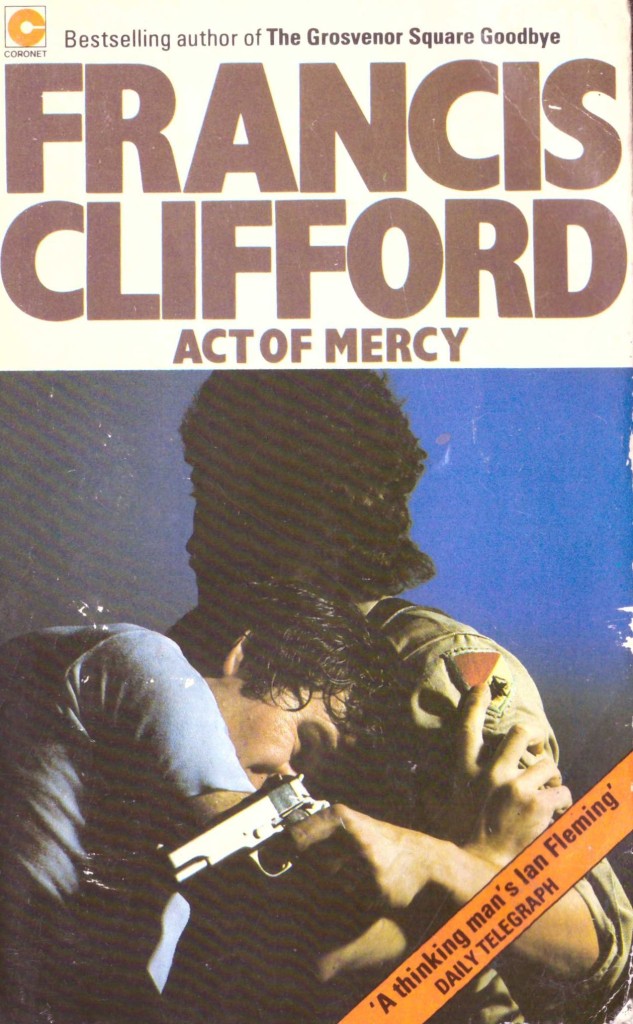
If you ever wondered what screenwriters do to earn their money, this film is a good place to start. It was based on a book “Act of Mercy” by British thriller writer Francis Clifford, who also wrote “The Naked Runner,” also later filmed. The screenwriters changed the David Niven character from the happily married committed businessman of the book to the dissatisfied dilettante of the film. As a happy couple, there are none of the marital tensions in the film. The revolution in the book has already started but in the film it is moved to New Year’s Eve and about to begin. The quicksand scene is a screenwriter’s invention as is the incident with the boy and the massacre in the village.

The pace is brisk from the outset, Asquith cross-cutting between revolutionaries and the Brits and as the manhunt steps up a gear the three escapees face a succession of perilous incidents. Not least is a river that has turned to quicksand. This six-minute scene is a standout, the mud closing in on their heads, Niven having to crawl back to rescue Rivera. As you would expect with this kind of picture there is a fair bit of philosophizing, moralizing and sheer brutality. As the couple flounder towards reconciliation, the script spends some time trying to ascertain Niven’s motives. Had the film stuck to the source book’s title, Act of Mercy, that would not have been necessary.

A taut film with, once the revolution has begun, the British put in their place rather than acting as imperialist overlords. There are a couple of unexpected twists at the end and Asquith finished with a technical flourish of his own, the camera tracking back from people walking forward. Both Niven and Caron are excellent, James Robertson Justice at once cuddly and ruthless, and the picture comes out as a tidy character-driven thriller.

Many of the films from the 1960s are to be found free of charge on TCM and Sony Movies and the British Talking Pictures as well as mainstream television channels. But if this film is not available through these routes, then here is the link to the DVD and/or streaming service.

Discover WordPress

A daily selection of the best content published on WordPress, collected for you by humans who love to read.

The Atavist Magazine

by Brian Hannan

WordPress.com Blog

News, Tips & Website Tutorials