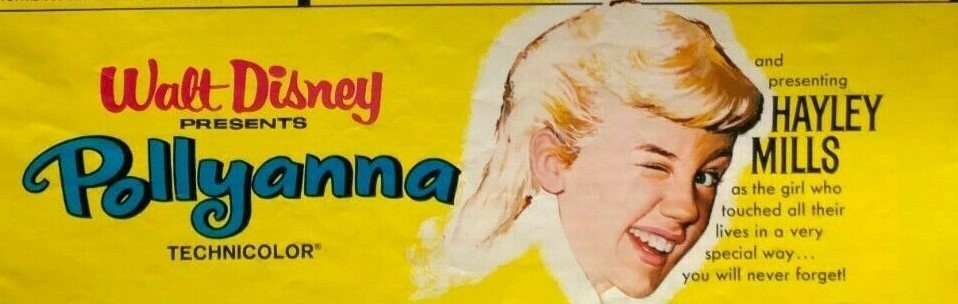
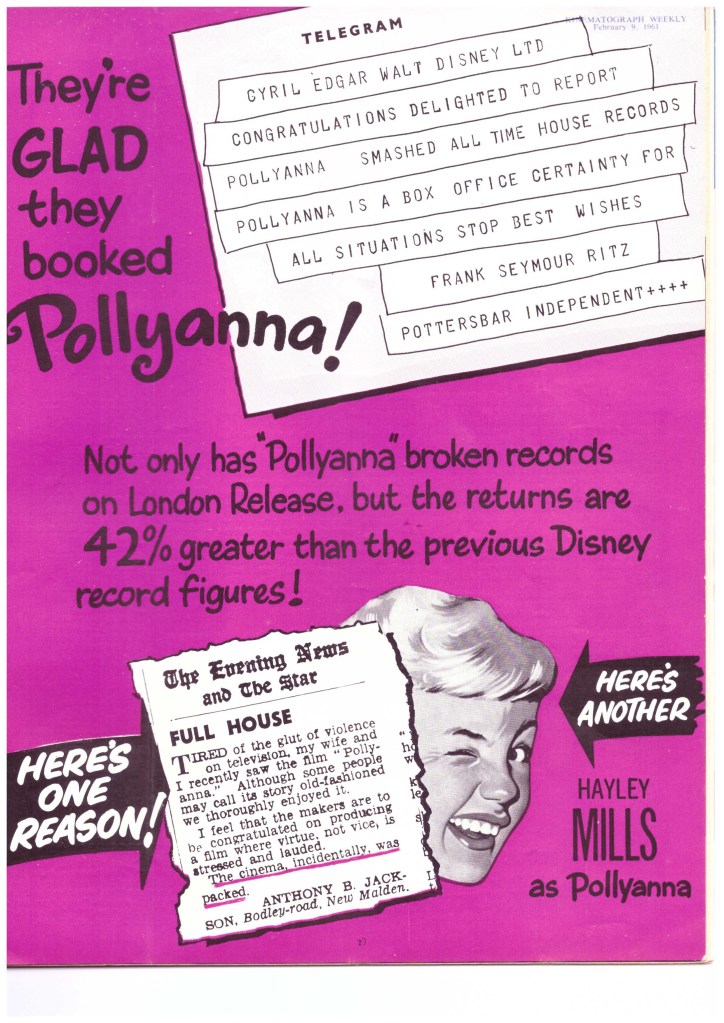
Although a truly innocent movie about young love, wrapped up in a sunken treasure scenario, the marketeers then and now could not resist trying to inject elements of sexuality, the poster for the original movie highlighting what would be Hayley Mills’ second screen kiss (following a smacker from Peter McEnery in The Moon-Spinners the year before), the poster for the DVD sticking the star in a bikini that she does not wear in the film.
The film was based on the 1921 novel Satan: A Romance of the Bahamas (filmed as Satan’s Sister in 1925 with Betty Balfour) by Henry de Vere Stacpoole, who had previously dallied with young love in The Blue Lagoon. Despite the title, there was a complete absence of the demonic. In the book, she is sailing with her brother. That character was eliminated in favour of a father.
The 1960s teen movie that could as easily morph into angst (Splendor in the Grass, 1961), blackmail (Kitten with a Whip, 1964) or madness (Lilith, 1964) was generally more at home with innocence. The beach party movies and series like Gidget rarely involved more than a stolen kiss, the characters all clearly virgins, and certainly did not go down the brazen sexuality route that would mark the second half of the decade.
Hayley Mills is on charming form as tomboy Spring Tyler (hence the title) sailing the Caribbean as mate to her conman father Tommy (played by her real-life father John Mills). Their idyllic life is heading for the rocks since the father didn’t “figure on the little girl growing up.” With one eye on providing a suitor for his daughter, the skipper takes on board a Harvard Law School graduate William (James MacArthur) ostensibly to give him experience of fishing.
True love takes its time since the girl has no intention of growing up and prefers a life of independence. Initially, they are sparring partners – she mocks the fact that he wears pyjamas. But once the story kicks off, they find they have more in common.
The sunken treasure element, while slim, is enlivened by some over-the-top acting by Jose (Lionel Jeffries) and Judd (Harry Andrews). The three leads are actually quite good, John Mills (Tunes of Glory, 1960) totally convincing as a effectively a spiv on the high seas with Hayley Mills (The Family Way, 1966) as the independent woman (“I’m me so don’t expect anything else”) and the confident sailor becoming entangled in unexpected emotions.
Surprisingly, James MacArthur, also a graduate from the Disney acting school, though a decade older than Hayley Mills, shows unexpected subtlety, and this would be a springboard to more demanding roles in cold war thriller The Bedford Incident (1965) and WW2 epic Battle of the Bulge (1965). Cocky and rich, he is quickly brought down earth when she proves a faster swimmer and plays tricks on him. But he soon proves his worth.
Director Richard Thorpe’s career was winding down after four decades in the business and this was a far cry from MGM spectaculars Ivanhoe (1952) and Knights of the Round Table (1953) and even Jailhouse Rock (1957) but he keeps a tight rein on the narrative, makes good use of the scenery (Spain doubling for the Caribbean) and walks the delicate line of allowing the adolescents to explore their feelings with tipping over into anything more overt.
He was a better director than the material deserved, but then so was writer James Lee Barrett who the same year would receive screen credit for The Greatest Story Ever Told and western Shenandoah. However, their involvement made it an accomplished little picture and gave audiences a taste of what Hayley Mills could do in a film that did not tether her to child star mode.
The New York Times second-string reviewer Howard Thompson, in tagging the star “this delectable miss, now all of 18” opined (review, June 17, 1965) that the “two young people are the most winning advertisement for young love in a long time.”
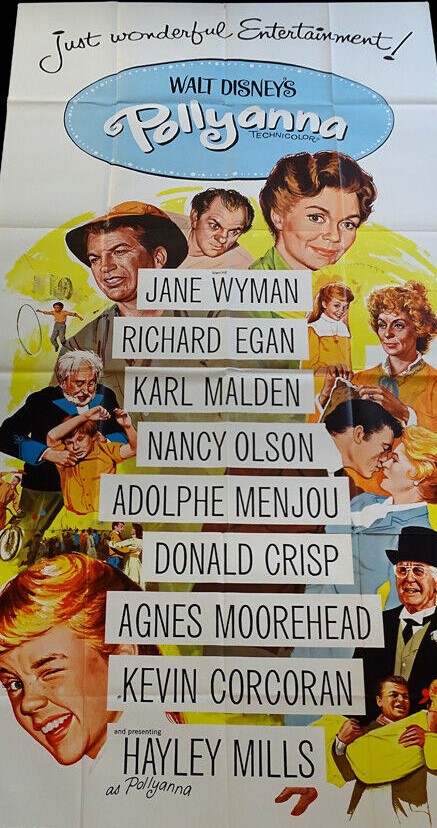
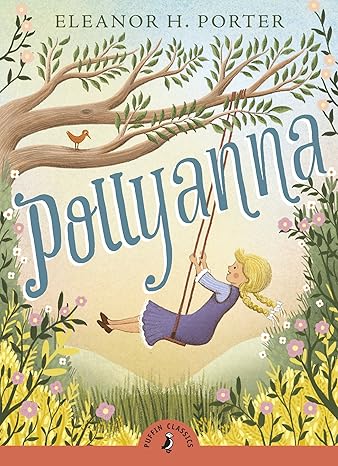
Walt Disney discarded much of Eleanor H. Porter’s original best seller not to mention a great deal of the tear-jerking section that played to superstar Mary Pickford’s strengths in the silent 1920 adaptation. Pickford was in her late 20s at the time and a movie mogul to boot (having launched United Artists) so had a depth of emotion Hayley Mills (aged 13 during filming) could not hope to match.
The screenplay, by David Swift (Love Is A Ball, 1963) is an object lesson in how to retain the essential element of a story – a positive-thinking orphan alleviates the gloom in an embittered town – while providing enough worthwhile for adult audiences. Disney assembled an awesome cast with three Oscar-winners – Jane Wyman (Best Actress, Johnny Belinda, 1948), Karl Malden (Best Supporting Actor, A Streetcar Named Desire, 1952) and Donald Crisp (Best Supporting Actor, How Green Was My Valley, 1942) – plus four-time nominee Agnes Moorehead and Adolph Menjou.
Despite no Oscar recognition Nancy Olsen had been leading lady to the likes of Bing Crosby (Mr Music, 1950), John Wayne (Big Jim McLain, 1952) and William Holden (Force of Arms, 1951). In effect, parents would be very familiar with the stellar supporting cast.
Orphan Pollyanna (Hayley Mills) – British accent explained by parents being missionaries – , majoring on optimism, tries to enliven a town torn apart by dissent and petty feuds and in thrall to her intimidating aunt and fading spinster Polly Harrington (Jane Wyman). While she tries to see the good in everyone, the rest of the population is forever pointing out the bad. The main source of contention is a derelict orphanage. The townspeople want it demolished and a new one erected. Polly Harrington wishes it preserved in its dilapidated state as a monument to her father who had built it. It’s the kind of attitude someone would take who was just plain determined to get their own way. Pollyanna tries to sway opinion against her aunt, resulting in no end of trouble.
Various sub-plots include stifled romance, Harrington has driven away boyfriend Dr Chilton (Richard Egan), fire-and-brimstone preacher Rev Ford (Karl Malden),another orphan Jimmy (Kevin Corcoran), the reclusive Mr Prendergast (Adolphe Menjou) coaxed back into communal life, and the mayor (Donald Crisp) trying to repair the rifts.
Unusually for a kid’s picture, Wyman, Malden and Crisp each are given a reflective moment to prove they are doing more than taking an easy salary cheque, bearing some of the weight of the narrative, Malden especially allocated more screen time than would be normal in a movie aimed at kids.
I have never read the book nor (to my shame) seen the Pickford version, so I came to the movie with low expectations, anticipating a lazy, maudlin effort. So I was quite surprised to discover how much I enjoyed it and was shocked by the final piece of action which turned the movie on its head. Sure, it relies on a feelgood drive but there is some decent stuff here – Pollyanna’s determination to find goodness in every event and every person takes her into some strange avenues, the rainbow playing on the walls, the “good parts” of the Bible – that these days makes for an entertaining matinee.
At least in Hollywood terms (Mills made her debut the year before in the British Tiger Bay, 1959) Pollyanna falls into the a-star-is-born category. The actress acquits herself well, with her expressive face, while hearing the emotion she packs into the word “gorgeous” is word admission alone. Being older than the usual child star, she was one of the few who made the transition into adult roles. Karl Malden is the pick of the supporting cast but he is given a good run for his money by Jane Wyman. Disney’s trick of peppering a children’s film with actors well-known to the adult audiences was one he would use again.
Swift, in dual capacity as director (and making his movie debut) played down the saccharine nature, making the main character less just automatically bouncing with happiness and more striving to make the best of difficult situations.
Nudity was not an option for previous child stars attempting to make the leap into adult roles. Shirley Temple in the 1930s and Margaret O’Brien in the 1940s were kids when they played kids and when they outgrew their cuteness audiences proved indifferent.
Being older when playing younger characters increased the chances of career survival. Silent movie superstar Mary Pickford was 22 when she first tackled child heroine Tess of the Storm Country (1914) and 30 for the remake and she made an absolute fortune from these kinds of roles. Judy Garland was 17 when The Wizard of Oz (1939) appeared and managed another 15 years at the top before drugs and drink took their toll, still worthy of supporting roles after A Star Is Born (1954) and even star billing in her last film I Could Go On Singing (1963). But she was fired from Valley of the Dolls (1967), ironically enough given the film’s subject matter, due to alcohol and drug dependency.
Hayley Mills was 14 when her first Disney picture Pollyanna (1960) was released and for the next five years at that studio never played anyone approaching her true age. She was protected from studio abuse because this was Disney and because her father was actor John Mills, who often appeared in her movies. When the Disney contract ended, Sky, West and Crooked (1966), her father’s directorial debut, attempted to refashion her screen persona with a more challenging role.
But The Family Way forced audiences to set aside all preconceptions. Not only did she show her naked derriere, but this was a film essentially about sex. No sex is actually shown because newly-weds Jenny (Hayley Mills) and Arthur (Hywel Bennett) have problems consummating their marriage. You can thank the Carry On films for the snigger-snigger British mindset to sex. The promiscuous and often predatory characters of Darling (1965) and Alfie (1965) occupied a different world, almost a foreign country as far as the inhabitants of this solid working-class town were concerned.
They would have looked askance at such permissiveness. Here, at this particular point in history, both sexes were still expected to be virgins when they married. Sex in Darling and Alfie, for example, carries little emotional overtones. The Family Way is novel in treating sex as fundamental to happiness within marriage.
The subject of impotence would not be first on your list when you set out to make a warm-hearted drama. But here screenwriter Bill Naughton (Alfie) in adapting his play All in Good Time uses the theme to explore family values. But where recrimination – and subsequent confrontation – might be the first port of call for another writer, Naughton foregoes that obvious route to concentrate on the way impotence eats at a man’s self-worth. Two secrets drive the plot but the second is preserved right to the end, resulting in possibly the most moving finale you will ever watch.
In documenting working-class life it is superior to the earlier Saturday Night and Sunday Morning (1960). It is life without inbuilt bitterness. Families are still crammed into small houses, a visit to the housing department – to get a new council house or just be put on the waiting list – an invitation to humiliation, but there is full employment and enjoyment to be found in simple pleasures.
Family dynamics are expertly explored. Arthur, with a shelf load of books and penchant for classical music, is diametrically opposed to his down-to-earth but exceptionally obtuse father Ezra (John Mills), and there is a wonderful scene early on where Arthur seeing how badly his father takes defeat allows him to win an arm-wrestling competition.
Ezra is the standout, devoted to the memory of a long-departed childhood pal and struggling with his position as patriarch especially in the face of perennial sniping by wife Lucy (Marjorie Rhodes). Ezra is so expressive of longing and emotion, and it is he who has the heart-breaking final scene.
The older characters are fully rounded, bluff exteriors concealing fragile emotion. Hard-faced Lucy appears almost fey when she recalls a moment of love. Jenny’s burly father (John Comer) cannot cope with her departure from his household, especially as that leaves him at the mercy of his shrewish wife (stand-up comedienne Avril Angers).
Hywel Bennett begins a successful movie career with a difficult part, an introspective role calling for him to contain his emotions – not venting his spleen like the endlessly complaining Arthur Seaton of Saturday Night – until they erupt in a spectacular fist fight that does not go at all the way you would expect.
Barry Foster (Frenzy, 1972) has the showy part as the rough-edged workmate and Murray Head (later part of the love triangle in Sunday, Bloody Sunday, 1971) also makes his debut in an equally showy role as Bennett’s brother who makes advances to his frustrated sister-in-law.
Even without the nudity, Hayley Mills, the denoted star, makes the transition to movie adulthood with ease. In part, all she had to do was drop the unnatural excitement that appeared essential to her Disney portfolio. Her delivery, her reading of a line, had always been good and she had clearly worked out she was going to be an actress not a sex symbol so there was no exaggerated use of her physicality.
Even the nudity worked in her favor, startled to be disturbed emerging from a bath, genuinely shy, not the mock-shy or reveling in her naked state that was de rigeur in Hollywood. She was also helped by being a light foil to the brooding, gloomy Bennett, her natural bright personality, while affected by their problem, still capable of enjoying harmless pleasures.
This was a distinct change of pace for the fraternal producer-directing team John and Roy Boulting, stalwarts of British production since the 1940s with a host of well-regarded dramas and comedies, often with Peter Sellers, to their name. Generally, they took turns about in the director’s chair – the former putting his name to thriller Brighton Rock (1948) and comedies Lucky Jim (1957) and I’m Alright, Jack (1959), the latter claiming credit for drama Fame Is the Spur (1947), thriller Run for the Sun (1956) and comedy A French Mistress (1960). Occasionally, they shared the directing chore as with thriller Seven Days to Noon (1950), comedy Heavens Above (1963) and in this contemporary drama.
Their approach to The Family Way went against the grain of the gritty working-class dramas in the vein of Saturday Night and Sunday Morning and This Sporting Life (1962). Nobody here has a job they hate or comes home covered in grime. In fact, since the central thrust (pardon the pun) of the movie is about pleasure (sexual, that is), it is set against a background of enjoyment. Both principals have jobs in entertainment, Arthur an assistant projectionist in a cinema, Jenny working in a record store and also seen at a disco and a motocross event. Alcohol plays a role, of course, but not to the extent of over-indulgence, not drinking yourself to oblivion like Arthur Seaton, and its main purpose is to present the father as an amiable host.
What impact the burgeoning affair between Hayley Mills and Roy Boulting (33 years her senior) had on the production is anyone’s guess but possibly it helped steady the star’s nerves when it came to the nude scene. From today’s perspective the nudity appears gratuitous. And certainly back then it was shocking, ensuring an X-certificate (although the subject matter probably already guaranteed that).
Actually, it was social comment. While living in a decent-enough house, the family lacked one particular amenity – an indoor toilet. Washing took place at a communal sink or in the privacy of a bedroom with a bowl of water. A bath was a mobile unit, a zinc item dragged out of the scullery into the living room, filled with endless pots or kettles of hot water.
But for a young woman to take a bath demanded privacy. So when Jenny is interrupted in her ablutions, males and females in the audience had opposite reactions. It would not be unreasonable to suggest that males simply enjoyed the sight of the naked posterior. Women, on the other hand, would wince.
Aversion to nudity may have played a part but more likely women would feel deeply the humiliation at the lack of privacy in such a household, that someone could come upon you at your most vulnerable at any time. Sure, nothing went hidden in such houses, the sounds of any activity would carry through walls, but such a deep personal activity as exposure while taking a bath said far more about the brutal congestion of family life than jokes about hearing someone urinating into a container in the next room.
Paul McCartney contributed a very hummable melody as part of his debut movie score.
American audiences did not respond so well to Hayley Mills’ emergence as an adult actor and the movie failed to click at the box office there. But by that point it was already in profit, a runaway British hit (among the top twelve films of the year) and set the female star up for an adult career, pointed Hywel Bennett in the right direction and gave John Mills one of his most memorable turns.
Director Lewis Gilbert’s career was at an impasse. He had made his name primarily in a string of typically British stiff upper lip World War Two pictures including Reach for the Sky (1956) and Sink the Bismarck! (1960). It will come as a surprise to many British people to learn that virtually no British movie, not even the WW2 films that were big hits domestically, made any impact at the U.S. box office, Sink the Bismarck! a rare exception.
Ferry to Hong Kong (1959) starring Orson Welles had flopped and WW2 comedy Skywatch/ Light Up the Sky (1960) had died the death.
British director Victor Saville, who had made a name for himself in Hollywood with Greer Garson sequel The Miniver Story (1950) and Kim (1950) starring Errol Flynn, had turned producer, purchasing the rights to the bestseller by Rumer Godden (Black Narcissus, 1947).
Saville had entered into a partnership with veteran independent producer Edward Small (Solomon and Sheba, 1959) who had a deal with United Artists. The duo had three films on their slate, the others being movie version of The Mousetrap (delayed due to the length of a stage run that still prevents it being turned into a movie) and Legacy of a Spy (never made). Cary Grant was initially touted as the lead for Loss of Innocence.
When that deal foundered, it shifted from UA to Columbia after the intervention of British producer John Woolf (The African Queen, 1951), a relation of Saville, who had an ongoing relationship with Columbia. The script found its way to Kenneth More (Sink the Bismarck!) still a highly-rated draw at the British box office. He had to lose weight for the role. Later, Gilbert intimated he was not right for the part and would have preferred Dirk Bogarde.
More’s wife Mabel was friends with Gilbert’s wife Hylda and it was at the former’s suggestion that Lewis was roped in. Gilbert was initially wary of working with Saville who, although highly respected as a director, had a reputation of being difficult to work with. A director turned producer was all too likely to have ideas about the direction rather than sticking to the production side. As it turned out, Savile “didn’t interfere at all.”
Hayley Mills (The Family Way, 1966) was first choice for the female lead. Her Disney contract was not exclusive and at 15 she might have been ideal casting. But such a role would almost certainly impact on her future with Disney.
Mrs Gilbert was instrumental in the casting of Susannah York (aged 21) having called her husband down the stairs to see the young actress in a television production of Arthur Miller’s The Crucible. As it happened, Saville was on the same page, also having witnessed that performance, calling the director the following day to suggest York. Coincidentally, the Gilberts had been invited to dinner with Sylvia Syms, female lead in Ferry to Hong Kong, only to find York was a guest. Auditioned for the role of Jos, the oldest of the four sisters stranded at a chateau in France after their mother is taken ill, York won the part.
“The hard part to cast,” according to Gilbert, was Hester, Jos’s younger sister, wise beyond her 14 years “who can see trouble where Jos couldn’t.” Contrary to received wisdom, the bulk of children who attended stage schools were working class. “Their parents needed the income. Middle-class parents, preferring their children to be properly educated, discouraged them from going to stage schools.”
In consequence, the bulk of the girls turning up for auditions spoke Cockney whereas the part called for a “nicely-spoken girl.” Just as Gilbert was about to give up on the process, he received a phone call from an agent, promising a new discovery. “Her name was Jane Asher…a pretty 14-year-old with long red hair.”
Other casting gambles didn’t work out so well. Seeking a young man to play a French gardener, Gilbert hit on the notion of hiring a real Frenchman, having found a young lad with curly hair who appeared just right for the part. The only problem was – he couldn’t speak English. But it didn’t seem so insurmountable since he was cast three months before shooting began. But when the cameras rolled “he was unintelligible.”
Gilbert surmised that “someone so chaotic as that curly-haired Frenchman would never amount to anything.” He was wrong. The man was Claude Berri, later the highly successful screenwriter and producer of Jean de Florette (1986).
The movie’s original title – The Greengage Summer – caused a massive problem. Naturally, it was expected that greengages (plums) would feature prominently in the background. But there were no greengages thanks to a blight that had ruined the harvest all across France. As a consequence, British greengages were used, removed from their sacks by the thousands and sewn onto trees by the art department.
Susannah York created another problem when, in her naivety, she decided that the most authentic way to play drunk was to be drunk. Gilbert tried to dissuade her, explaining that the scene would go on all day not just last five minutes and in order to play a drunk you needed your wits about you. York ignored the advice and a day’s filming was ruined. Filming, split between England and France, began in August 1960.
Although it received “extraordinarily good notices” in both Britain and America it failed to light a spark with audiences in either country. Gilbert’s retrospective assessment, citing previous movies like Billy Wilder’s Love in the Afternoon (1957) with Gary Cooper and Audrey Hepburn and Sabrina (1954) with Bogart and Hepburn, was that “very few films where you get a young girl in love with an older man have ever been successful.”
SOURCES: Lewis Gilbert, All My Flashbacks (Reynolds and Hearn, 2010) p207-210; Kenneth More, More or Less, (Hodder and Stoughton, 1978); Roy Fowler, “Interview with Lewis Gilbert,” British Entertainment History Project; Philip K. Scheuer, “Saville to Resume Producing Career; Godden Novel First of Three,” Los Angeles Times, November 3, 1958, pC13; Richard Nason, “Small and Saville Planning Dear Spy,” New York Times, October 7, 1957, p47; Stephen Vagg, “Movie Star Cold Streaks, Hayley Mills”, Filmink, March 19, 2022.
You couldn’t make a movie like this now because (plot spoiler, I’m afraid) even the dottiest of old ladies would make at least a better attempt at collecting a reference from a prospective employee for fear she might be hiring someone disreputable. Though I doubt if many employers would expect a governess to turn out to be a murderess.
That this movie chimes with a contemporary trope – the criminal wanting to prevent others from following in their footsteps – makes it far ahead of its time. Made today, of course, the unruly child rather than merely threatening to unleash her arson impulses would probably have burned the house down.
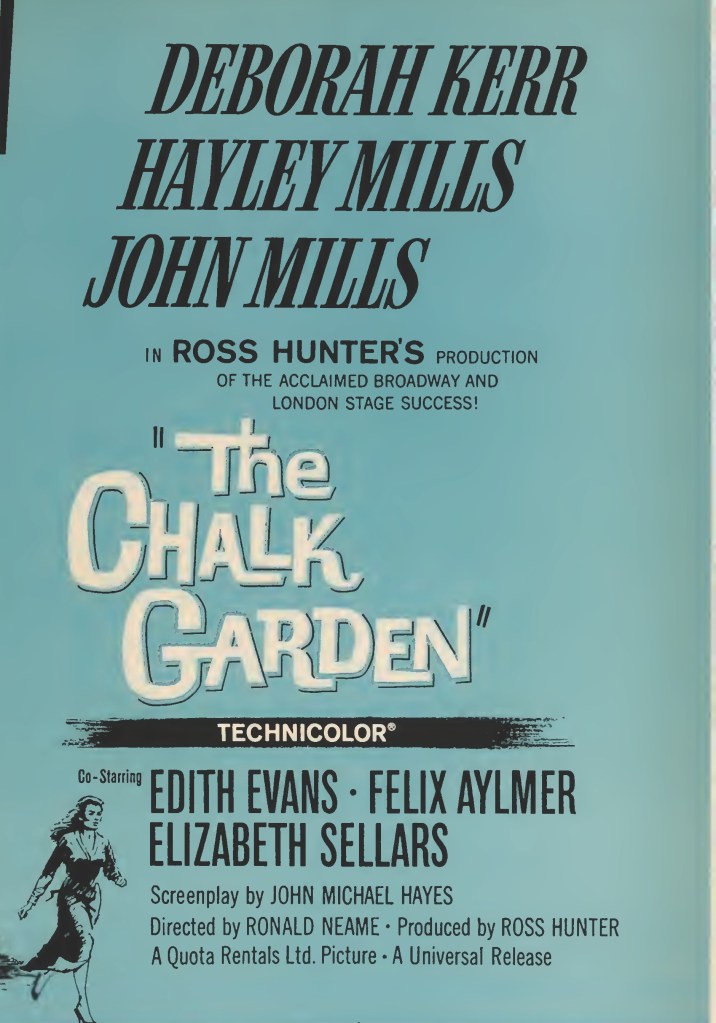
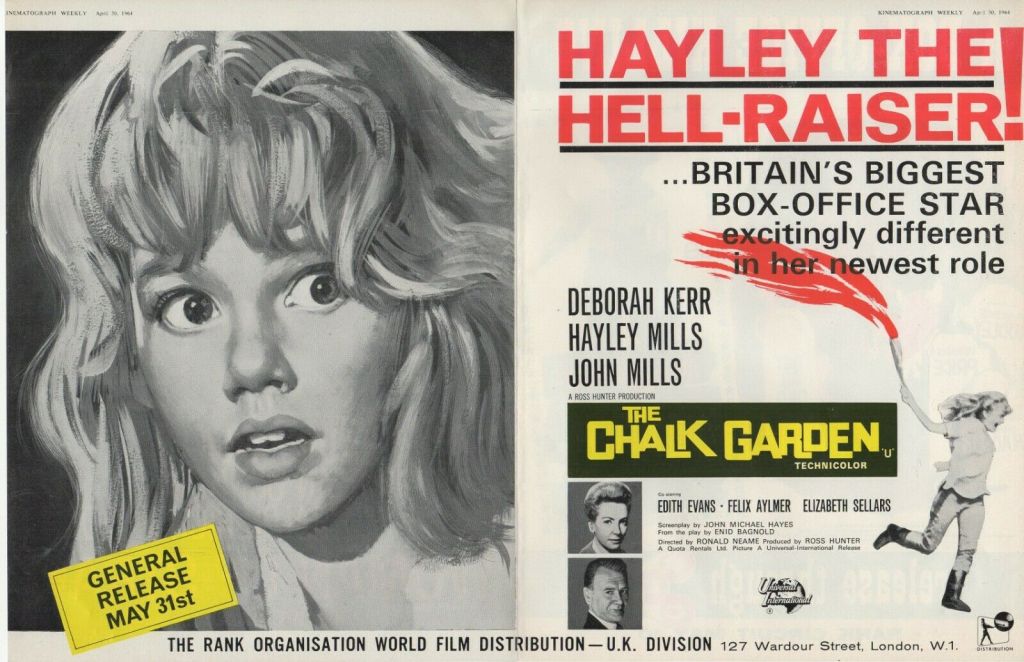
So it’s more a drama of manners, if you like. Very presentable but clearly down-on-her-luck Miss Madrigal (Deborah Kerr) is taken on by Mrs St Maugham (Edith Evans) as governess for her grandchild Laurel (Hayley Mills) because nobody else wants the job. Laurel’s outrageous behavior has sent a score perfectly well qualified ladies scurrying. Madrigal is hardly fazed by anything Laurel can get up to.
But the child is clearly suffering abandonment issues, her beautiful mother Olivia (Elizabeth Sellars) having gone off with another man. Grandmother incites grandchild to hate the mother. But Olivia’s maternal instincts have kicked in and she wants her child back. While Madrigal can deal with Laurel’s tantrums she is less fortified against the child’s inveterate snooping. Finding a mysterious suitcase leads Laurel to fantasize about Madrigal’s past.
Mostly the film is a four-hander, butler Maitland (John Mills) playing a significant role in proceedings, not least in his effortless management of the wild child. Quite why a such a pragmatic and assured gentleman should end up in this remote mansion is another mystery and thankfully there is no attempt made at playing up the cliff-top location in a suspenseful manner.
Mrs St Maugham is imperious but not entirely practical, either in setting child against mother or in trying to grow flowers in such chalky soil, though Madrigal appears to have sufficient horticultural knowledge to set her straight on the latter and attempt to intervene on the former.
There’s a deadline of sorts. Olivia is coming to remove the child. Whether she goes willingly or not doesn’t matter. Madrigal sees her role as trying to prepare a child to love her mother and be more grown-up than the adults around her and forgive her.
Madrigal’s guilt unnecessarily causes her to reveal that she had been jailed for murdering her stepsister, having been as resentful and jealous of the girl as Laurel currently is of her mother. Mrs St Maugham had called on old acquaintance Judge (Felix Aylmer ) for legal advice on how to prevent Olivia getting the child. He was the presiding judge in Madrigal’s case. Imagining he had not forgotten the trial – which of course he has – she feels duty bound to blurt out the truth before she is humiliated. The confession helps Laurel realise how dangerous a path she is on and pushes her towards reconciliation rather than revenge.
It has all the making of a well-made play which is hardly surprising since it is based on Enid Bagnold’s Broadway success, at one time mooted as a film to star Joanne Woodward and Sandra Dee. So it moves along in the traditional three-act manner, plenty space given to establishing characters, introducing the undercurrents and leading to revelation and resolution.
So, mostly, it depends on the acting. Luckily, it is excellent. This was Hayley Mills in transition, far removed from Disney saccharine of The Parent Trap (1961) and about the same distance from the full-blown adult bottom-baring of The Family Way (1966). She projects a great deal more torment than in either of those films and comes across as believable, not exactly a young hoodlum but left to her own devices and starved of parental love only a matter of time before she would commit a crime of some kind.
Deborah Kerr hadn’t made a film in three years but her screen persona had shifted from the passionate – From Here to Eternity (1953), An Affair to Remember (1957), The Sundowners (1960) – to the repressed. Her spinster introduced in The Innocents (1961) had a great deal in common with her spinster of The Night of the Iguana (1965). But this is a different kettle of fish. Here, she exudes capability but with a self-awareness that undercuts such confidence, trying to keep a lid of emotions she struggles to handle.
John Mills (Tunes of Glory, 1960) casts a sardonic eye on the household while Edith Evans (The Whisperers) portrays a sorely wounded matriarch. Director Ronald Neame (Gambit, 1966) cleverly opens up the play, using the cliffs, gardens and rocky beach to considerable effect, but keeps the drama taut. John Michael Hayes (Nevada Smith, 1966) produced a workable screenplay.
Apologies for giving away the story, a good watch more for the acting than the twist.
Every new Hayley Mills film was an exercise in transition. Would audiences allow the successful child star – the first for a generation – to grow up? Or would they turn against her as they had Shirley Temple? And would her paymasters Disney in the penultimate film in her contract assist her by offering more mature roles or insist she remained the cute kid? She had already ventured into more adult territory with the British-made The Chalk Garden (1964).
Set on the island of Crete, what starts out as typical Disney travelog – traditional Greek wedding and annual festival parade – soon morphs into darker sub-Hitchcockian territory. Nikki (Hayley Mills) on holiday with her aunt (Joan Greenwood), a collector of folk songs, becomes mixed up with skin diver Mark (Peter McEnery) who appears for reasons unknown to be on the trail of a local man Stratos (Eli Wallach). Young love looks set to blossom except for the villainy afoot. The picture holds on to its various mysteries for too long so exposition comes in a flood in the second act while the third act introduces a new set of characters including British consul (John Le Mesurier) and wealthy yacht owner Madame Habib (legendary silent star Pola Negri).
Along the way some excellent scenes feature: a nerve-tingling high-wire stunt on a revolving windmill, a punch-up on a speeding boat, the drunken wife (Sheila Hancock) of the consul, feral cats in an ancient monument, an old woman thinking she is going crazy when a bottle moves seemingly of its own volition, a hearse doubling as an ambulance, a cowardly leopard and a belter of a slap meted out by Nikki. Mark, physically inhibited by a gunshot wound, has to cede investigation into the nefarious activities to Nikki who in any case has already played the independence card.
Getting all the necessary information to the audience and ensuring various characters are properly introduced without the whole enterprise turning into a turgid mess is a tricky proposition but director James Neilson is equally at home with complicated plot and multi-character scenario from his experience on Dr Syn, Alias the Scarecrow (1963) and with Mills from Summer Magic (1963). And he lets mystery and action take precedence over budding romance, the kiss when it comes hardly going to make an audience swoon, and uses the traditional Greek elements to build up atmosphere.
All in all entertaining enough, especially if viewed as Saturday matinee material, but it’s clear that the leading roles would have worked better if played by older characters as was the case with the source novel by Mary Stewart. Hayley Mills (Pollyanna, 1960) makes a game stab at putting forward a more grown-up persona but relies far too much on the acting tricks that got her into the child-star business in the first place. Even so, once she exerts her independence, she becomes more believable although the idea of a teenager solving a crime creates more problems than it solves in attracting an adult audience.
In his first leading role Peter McEnery (Beat Girl, 1960) impresses. Villainy is a stock in trade for Eli Wallach (The Magnificent Seven, 1960) but here he dials down the brutality. Irene Papas (The Guns of Navarone, 1961) plays his sister and were it not for her husky voice Joan Greenwood (Tom Jones) would have been a dead ringer for a dotty aunt. It’s a treat to see a famed silent star Pola Negri (Shadows of Paris, 1924) putting in an appearance. Character actors John Le Mesurier (The Liquidator, 1965), Andre Morrell (The Vengeance of She, 1968) and Sheila Hancock (Night Must Fall, 1964) complete the British contingent. For British television writer Michael Dyne this proved his sole screenplay.
Catch Up: you can follow Hayley Mills’ unfolding career on the Blog through reviews of Pollyanna, The Truth about Spring (1965), Sky, West and Crooked / The Gypsy Girl (1966) and her adult breakthrough The Family Way (1966). Eli Wallach films reviewed are: The Magnificent Seven, Lord Jim (1965), Genghis Khan (1965) and A Lovely Way to Die (1968).
This Walt Disney version discarded much of Eleanor H. Porter’s original best seller not to mention a great deal of the tear-jerking section that played to superstar Mary Pickford’s strengths in the silent 1920 adaptation. Pickford was in her late 20s at the time and a movie mogul to boot (having launched United Artists) so had a depth of emotion Hayley Mills (aged 13 during filming) could not hope to match.
The screenplay is a good lesson in how to retain the essential element of a story – a positive-thinking orphan alleviates the gloom in an embittered town – while providing more for adult audiences. Disney assembled an awesome cast with three Oscar-winners – Jane Wyman (Best Actress, Johnny Belinda, 1948), Karl Malden (Best Supporting Actor, A Streetcar Named Desire, 1952) and Donald Crisp (Best Supporting Actor, How Green Was My Valley, 1942) – plus four-time nominee Agnes Moorehead and Adolph Menjou.
Despite no Oscar recognition Nancy Olsen had been leading lady to the likes of Bing Crosby, John Wayne and William Holden. In effect, parents would be very familiar with the stellar supporting cast. Unusually for a kid’s picture, Wyman, Malden and Crisp each are given a reflective moment to prove they are doing more than taking an easy salary cheque.
At least in Hollywood terms (Mills made her debut the year before in the British Tiger Bay, 1959) Pollyanna falls into the a-star-is-born category. The actress acquits herself well, with her expressive face, while hearing the emotion she packs into the word “gorgeous” is word admission alone. With a healthy subplot about a town in thrall to matriarch Wyman, the weight of the movie does not fall on Mills’ shoulders alone and fire-and-brimstone preacher Malden and faded spinster Wyman are particularly good; Malden especially allocated more screen time than would be normal in a movie aimed at kids.
I have never read the book nor (to my shame) seen the Pickford version, so I came to the movie with low expectations, anticipating a lazy, maudlin effort. So I was quite surprised to discover how much I enjoyed it and was shocked by the final piece of action which turned the movie on its head. Sure, it relies on the feelgood factor but there is some decent stuff here – Pollyanna’s determination to find goodness in every event and every person takes her into some strange avenues – the rainbow playing on the walls, the “good parts” of the Bible – that these days makes for an entertaining matinee.