Selling the Exotic – Pressbook for “24 Hours to Kill” (1965)

No matter how small a picture, its budget had to stretch to a Pressbook. Even if the movie would end up on the bottom half of a double bill or a drive-in programmer and did not have much to shout about, it still needed a Pressbook. Low-budget films meant low-budget advertising campaigns unless your name was Joe Levine who often spent far more promoting films than he did making them.

The Pressbook was essential because it was the source of the movie’s adverts that could appear in a newspaper – these came in a variety of sizes so an  exhibitor could remove the one most relevant and take it down to their local newspaper to make up the display advertisement. In the pre-digital era, it was a crude as that, adverts were effectively cut and pasted.

While some Pressbooks could run to 16, 20 or 24 A3 pages in full color, the most basic requirement would be four pages, enough to show the ads and get the basic message across. This was of the basic variety. In this case, ads took up the first two-and-a-half pages, leaving a half-page to list the credits and explain the plot. The final page contained information about the stars..  

Perhaps as revenge for producer Harry Alan Towers not coughing up enough money for a decent Pressbook, his name was left off it. Instead, filing his slot was Oliver A. Unger, more famous as a pioneer of syndicated television, importer of foreign films and producer of The Pawnbroker (1964). In reality, he was an executive producer, in those days that function being fulfilled by someone who either invested in the picture upfront or once filming was complete bought territorial rights.

Artwork was minimal, one main advertisement, one alternative. But more or less the same taglines appear in both. Hoping to hook in the audiences was the notion of “perfumed harem…in mysterious Beirut…where every hour can be your wildest.. and your last.”

Usually films like these boasting a flotilla of European beauties devoted some space to explaining their origins and puffing up their potential. Not so here. Space is just too tight. The only actors covered are Lex Barker, Mickey Rooney and Walter Szelak. Strangely, no mention is made of Barker’s socko career as a German western hero – the notion that Europeans could make westerns remained absurd at this point (A Fistful of Dollars would take three years following completion to reach U.S. screens).

According to the Pressbook, Barker more or less jumped straight from Tarzan to this kind of thriller. Though he had been out of the loin-cloth for more than a decade (Tarzan and the She-Devil, 1953, his final appearance), the 40 pictures he had made since then (including La Dolce Vita, 1960) did not merit a sentence. The Pressbook did carry a quotable quote from Barker explaining his reasons for quitting jungle life: “It made me feel like a male Bardot because I was always parading around almost nude.” This was the type of quote that only made sense until you realised that Bardot did not become a star till three years after he quit playing Tarzan. Still, who was going to argue?

A strict regimen of physical exercise allowed him to keep in the shape necessary for the film which required him to “run for his life, rescue a pretty hostess from kidnap by helicopter and fight off thug after thug.” 

Mickey Rooney gets a better write-up, especially for making the rare jump from successful child star to accepted by audiences for his adult roles. Though the writer of the Pressbook never appeared to actually go the movies. Spot the mistake in this sentence: “Last seen in runaway box office hit It’s A Mad, Mad, Mad, Mad, World Rooney now appears for producer Oliver A. Under in a drama equally as challenging.” That the first film was actually a comedy and not a drama never seemed to sink in.

The usual promotional material – suggestions for marketing, maybe a record of the soundtrack available, perhaps a theme song to target radio stations, various stunts – was non-existent even though the movie leant itself to a tie-in with an airline or a travel company especially as the National Lebanese Tourist Council had gone out of its way to accommodate the production.

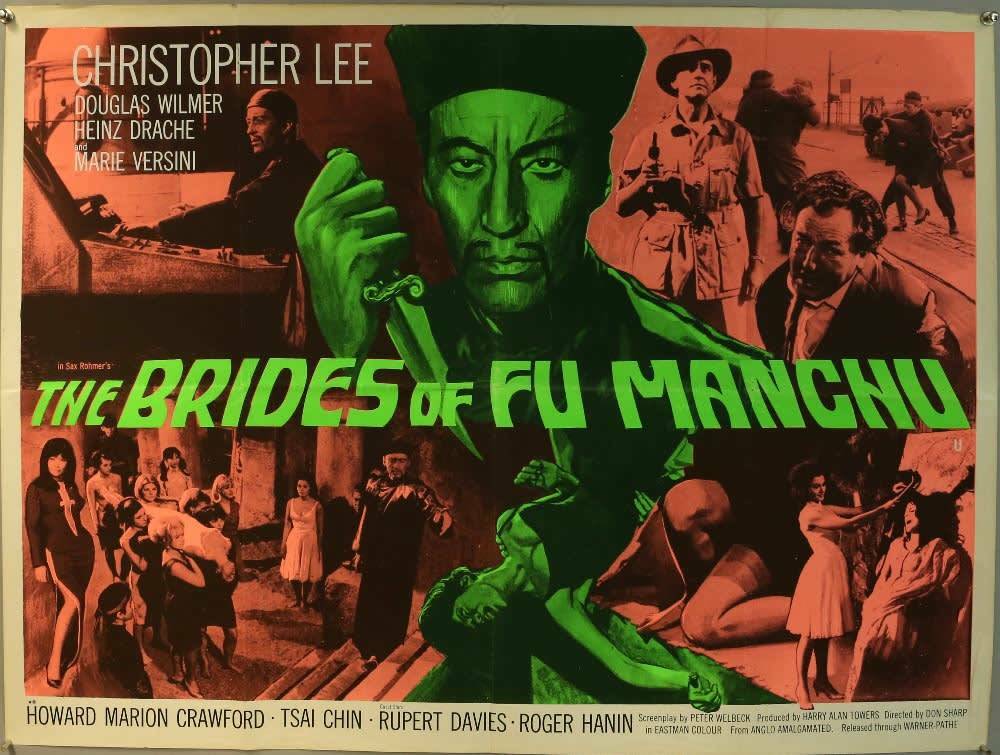
The Brides of Fu Manchu (1966) ****

The 1960s was awash with movie megalomaniacs, most courtesy of the spy vogue. You could also count on secret agents for trailing in their wake bevies of beauties. So no surprise then that criminal mastermind Fu Manchu (Christopher Lee) has his own gang, his “brides,” although they are hardly volunteers, being the kidnapped daughters of top scientists. His plan for global domination this time consists of transmitting energy as sound waves, using miniaturization, a sonic death ray, with enough power to destroy a city.

The result is good hokum, a thriller set in the 1920s with a cracking pace, plenty of action, explosions, burgeoning romance, and  plot that gets more complicated by the minute as a tribe of worthies try out to outwit the evil genius. There is a terrific lair – where the disobedient end up in a snake pit – a passable laboratory, chases, truth serums (“the dust that loosens tongues”), hypnotism, bait-and-switch tricks and decent special effects.  Three stories race along in a parallel pell-mell: Manchu needs one more kidnapping to complete his complement of daughters; the good guys headed by Fu Manchu’s old adversary Nayland Smith (Douglas Wilmer) are trying to locate the bad guy’s secret location while at the same time attempting to find out where he will strike next. 

While Fu Manchu is indestructible – supposed dead after the previous film – his henchmen (and henchwomen) are all too human. It takes three attempts to kidnap Manchu’s next victim. They are easily identifiable by their giveaway cummerbunds and bandannas and their method of assault is not kung fu but brawling so a good solid British punch of the old-school soon sorts them out. Manchu’s daughter Lin Tang (Tsai Chin) is a chip off the old block, delighted at any opportunity to torment the brides.  

The brides wear diaphanous gowns that might have been a job-lot from the set of She, but are far from compliant, even rebelling at one point, and employing vicious fight tactics. Fans of director Don Sharp will find him every bit as inventive as in The Devil-Ship Pirates and Bang, Bang, You’re Dead. It’s another Harry Alan Towers (written under his pseudonym Peter Welbeck) production so that means an international cast. Two television cops, British Rupert Davies (BBC’s Maigret) and German Heinz Drache (cop in a Francis Durbridge series), plus Francois Mitterand’s brother-in-law Roger Hanin, provide solid support. Not forgetting Burt Kwouk as a henchman. Brides of the Year include French Marie Versini (German western Winnetou, 1963) and Rhodesian Carole Gray (Curse of the Fly, 1965). The film did not prove much of a jumping-off point for other brides such as Ulla Berglin, Danielle Defrere and Anje Langstraat, for whom this debut was as far as their careers went.

Christopher Lee, despite the dodgy moustache, is resplendent, exuding evil, and with a gift for rising again (just like Dracula) as he would do for another three films in the series.

Note: The Devil-Ship Pirates and Bang, Bang, You’re Dead are reviewed on this blog.

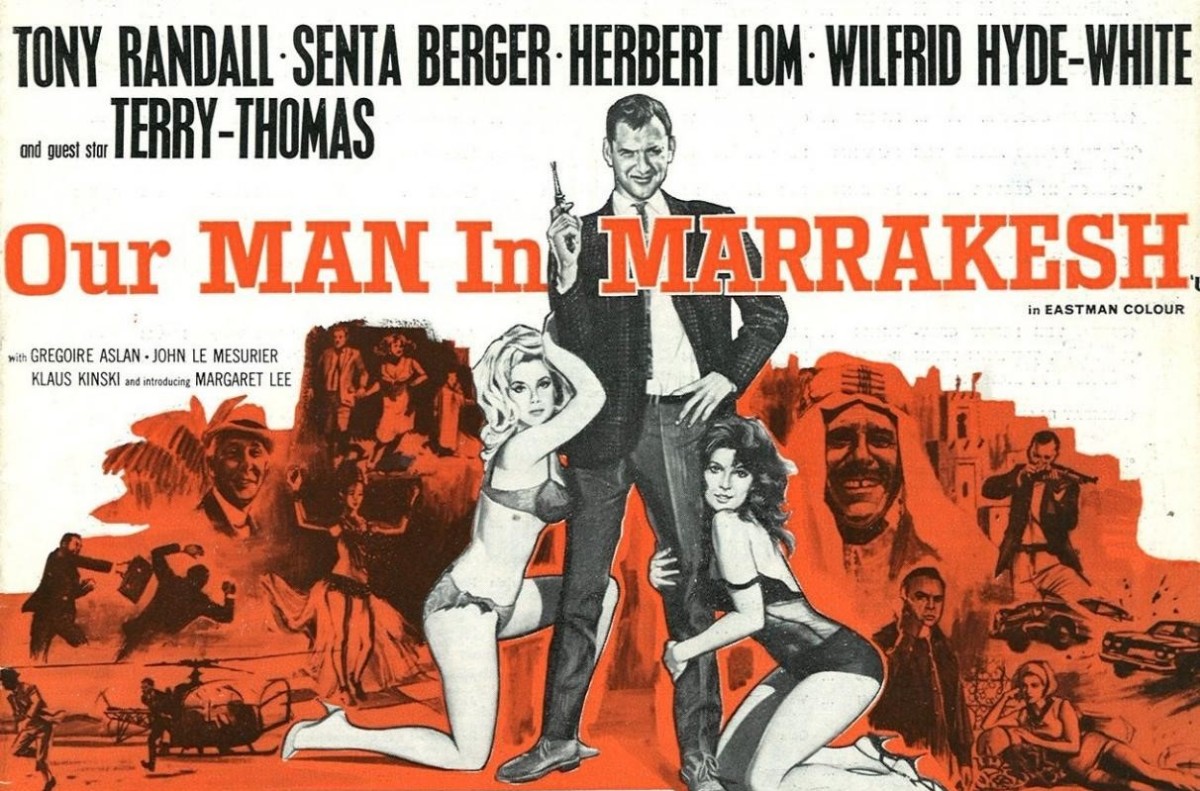
Our Man in Marrakesh aka Bang! Bang! You’re Dead! (1966) ***

All hail Senta Berger! Another from the Harry Alan Towers (Five Golden Dragons, 1967) portfolio, this is a spy-thriller mash-up with a bagful of mysteries and a clutch of corpses. At last given a decent leading role, and although you wouldn’t guess it from either poster, Senta Berger steals the show from the top-billed Tony Randall (as miscast as Robert Cummings in Five Golden Dragons) and a smorgasbord of European  talent including Herbert Lom (The Frightened City, 1961), Terry-Thomas, Klaus Kinski (Five Golden Dragons), John Le Mesurier and Wilfred Hyde-White (Carry On Nurse, 1959). In this company, the glamorous Margaret Lee (Five Golden Dragons), as Lom’s cynical lover (“you are never wrong, cherie, you told me so yourself,” she tells him) is an amuse-bouche.

A more comedic approach to the movie when it was re-titled for U.S. release. At least here it did not try to sell itself as a Bond-type picture.

Six travellers – including oilman Randall, travel agent Le Mesurier, salesman Hyde-White and tourist Berger, meeting her fiancé – board a bus from Casablanca airport to Marrakesh. One is carrying $2 million as a bribe to ease through a vote in the United Nations, but bad guy Lom doesn’t know which one it is. When Berger’s fiance’s corpse tumbles out of Randall’s cupboard, the pair become entangled. Berger is a marvellous femme fatale, trumping Randall at every turn. 

With no shortage of complications, the tale zips along, directed on occasion with considerable verve by Don Sharp (The Devil-Ship Pirates, 1964). There are some inventive double-plays – with a body in the boot Berger and Randall are stopped by a cop who tells them their boot is open. An excellent rooftop chase is matched by a car chase. And there’s a terrific shootout. Kinski is at his sinister best and Terry-Thomas a standout in an unusual role as a Berber.

The film was shot on location including the city’s souks, the ruined El Badi Palace and La Mamounia hotel (featured in The Man Who Knew Too Much, 1956). But Berger seamlessly holds the whole box of tricks together, at once glamorous and sinuous, practical and tough and exuding sympathy, and it’s a joy to see her for a large part of the picture leading Randall by the nose. Quite why this did not lead to bigger Hollywood roles than The Ambushers (1967) remains a mystery.

Discover WordPress

A daily selection of the best content published on WordPress, collected for you by humans who love to read.

The Atavist Magazine

by Brian Hannan

WordPress.com Blog

News, Tips & Website Tutorials