Book into Film – “The Secret Ways” (1961)

You might ask yourself why star Richard Widmark bought the rights to Alistair MacLean Cold War thriller The Last Frontier (title changed to The Secret Ways for American publication and the film) if he was going to ignore so much of the author’s brilliant story. In the original version hero Reynolds (the Widmark character) does not simply fly into Vienna as in the film, but has already crossed the Austrian border into Hungary in a blizzard after hitching a lift in a truck but now is stranded on foot in sub-zero temperatures, 30 miles from Budapest. This is not the only change authorized by Widmark, wearing his producer’s hat.

His Reynolds is a freelance gun for hire clearing a gambling debt and hired by an American spy ring compared to MacLean’s British secret service agent, intensely trained for 18 months for this mission. The mission in MacLean’s book is to rescue/kidnap British scientist Professor Jennings, the world expert on ballistic missiles, with the help of Hungarian resistance leader -Hungary at the time part of the Soviet bloc – Jansci (Wolf Rilla). Widmark eliminated all mention of Jennings. Instead, the task facing his Reynolds is to get Jansci out of Hungary. Widmark’s Jansci is still a resistance leader but doubling up as the professor albeit a straightforward scholar with nothing to do with missiles.  

Cover of the Doubleday U.S. hardback edition in 1959.

Combining characters was not unusual in the movie business and Widmark may have deemed it necessary to streamline the plot. But if the idea was to simplify the plot, that hardly explained the existence of Elsa (Senta Berger). She was not in the book. Her sole purpose may have been to provide Widmark with casual romance – a testament in Hollywood terms to his irresistible attraction – early in the story.

This was Alistair Maclean’s first shift away from the trio of war novels, including The Guns of Navarone, which had rocketed him into the bestseller class, and it proved to be a major change of style that created the non-stop thriller template that would underpin the later Fear Is the Key (published in 1961), When Eight Bells Toll (printed in 1966) and Puppet on a Chain (1969 publication), all of which were filmed, which saw loners or secret agents enduring horrific physical abuse as they battled the odds.

MacLean’s Reynolds enters Budapest a captive, rather than as in the Widmark version merely catching a train. Widmark meets Jansci’s daughter Julia (Sonia Ziemann) in Vienna. But in the book the secret agent meets Julia, along with her father, after he is captured by the resistance. In the book Reynold’s kidnap occurs in the first 20 pages, in the film at the halfway mark. From the outset Maclean thrusts his hero pell-mell into action with nary a let-up but in the film the action is punctuated by romance and various political meanderings.

Giving the game away No 1: the back cover of the Fontana paperback movie tie-in explains the plot – and it’s different from the one Widmark filmed.

Perhaps Widmark shied away from the MacLean plot due to budget constraints for the novel is certainly more intense and continually action-packed. Starting with the blizzard and ending with a perilous river crossing, the novel has several scenes which would have looked stupendous on screen. The story Widmark ignored involved the scientist in danger of being removed from Hungary to be returned to the Soviet Union, forcing Reynolds to effect a rescue on board a train, in a devil-may-care episode worthy of James Bond, by separating one car from the rest. There follows a 400-kilometer chase to the Austrian border where, pursued by Hungarian secret police, they cross the river Danube. In a final twist, while the professor and Julia are safe, Jansci refuses to leave his native country.

In various blogs covering the transition of novel into screenplay, I have mostly understood why a screenwriter would delete, alter or embellish plot, characters, time scale and even locale. Sometimes the screenwriter simply comes up with a more believable plot (as in Blindfold) or is required by the sheer length of the novel to make considerable changes. It’s rare for me to think that the screenwriter has taken the wrong approach. I thought The Devil Rides Out could have done with more of the occult background in the Dennis Wheatley novel. Here, it’s quite obvious that Maclean had a far better storyline than the film Widmark chose to make, the blizzard, train and river crossing scenes far more exciting than anything in the finished picture. As I noted, money may have been the issue.

Giving the game away No 2: the back cover of the Pocket Books paperback movie tie-in explains that Reynolds is a British secret service agent – but that’s not how Widmark played him.

However, it’s just as interesting that Widmark and Co. managed to make an enjoyable picture by not following the original story. The role of gambler-gone-bad was more appropriate to the Widmark screen persona than a secret service agent (outside of the humorous Our Man in Havana, there were not many of those around until a few years later). The film did introduce Senta Berger to a wider audience and the plot as it stands made a lot of sense.

The book was published in Britain in 1959 as The Last Frontier. In America the same year Doubleday renamed it The Secret Ways. There was a Victor Mature western called The Last Frontier in 1955 – and the title had also been used in 1932 and 1939 – so unless  Richard Widmark had purchased the film rights prior to American publication and announced a name change, then I have no idea why the book title changed.
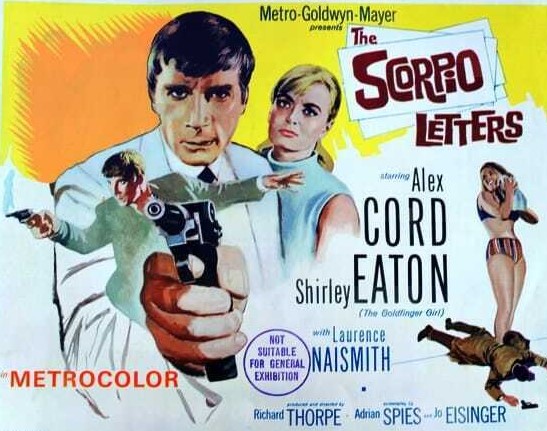
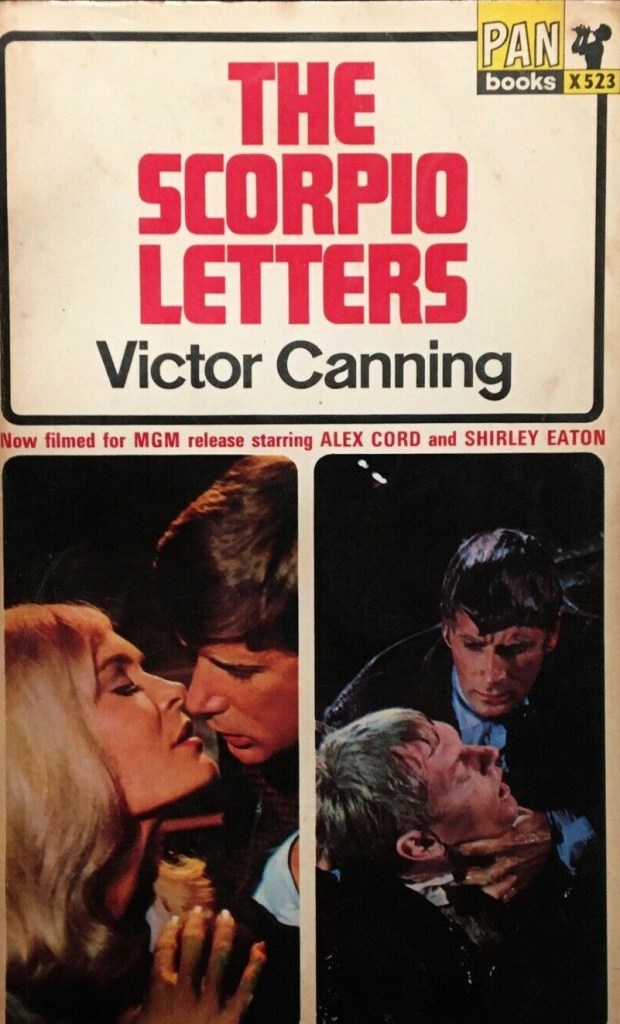
 

The Scorpio Letters (1967) ***

Desultory spy thriller with over-complicated story that’s worth a look mostly for the performance of Alex Cord (Stiletto, 1969). I can’t say I was a big fan of Cord and I certainly didn’t shower him with praise for his role as a disillusioned Mafia hitman in Stiletto. But now I’m wondering if I have been guilty of under-rating him.

Normally, critics line up to acclaim actors if they deliver widely differing performances – Daniel Day-Lewis considered the touchstone in this department after Room with a View and My Beautiful Launderette opened in New York on the same day in 1985. But usually screen persona rarely changes, amounting to little more than a heightened or amalgamated version of the actor’s character or features. Once Charles Bronson, for example, started wearing his drooping mustache he was never seen without.  Actors may grow old, but never bald.

The macho mustachioed Cord of Stiletto is nowhere in sight. In fact, in The Scorpio Letters minus moustache and resisting attempts to reveal his musculature, he is almost unrecognizable. In this picture Joe Christopher (Alex Cord) is flip, resentful, thoughtful, occasionally pedantic, more natural than many of the crop of Hollywood new stars being unveiled at the time, and for once as a transplanted American in London rather scornful of British traditions. There’s a realistic flourish here, too, he is so poorly paid – and on a temporary contract – that he has to take the bus. And although he is an ex-cop fired for brutality, that level of violence ain’t on show here. Virtually the opposite of the character Cord created for Stiletto, I’m sure you’ll agree. So full marks for versatility and talent.

Unfortunately, the rest of the movie is not up to much, at the very bottom of the three-star review category, almost toppling into two-star territory. Christopher is investigating the death of a British agent who was the subject of a blackmail attempt. By coincidence – or perhaps not – another part of British Intelligence is investigating the same death and this brings Christopher into contact with Phoebe Stewart (Shirley Eaton) and eventually they work together to unravel a list of codenames and uncover the conspiracy with a bit of risk to life and limb.

But the pay-off doesn’t work despite all the exposition attempting to build it up and you’re left with a kind of drawing-room drama rather than exciting spy adventure. It’s determinedly London-centric with red buses, red postboxes, Big Ben, and The Horse Guards all putting in an appearance. The scene shifts to Paris and Nice without a commensurate heightening of tension. Despite a couple of neat scenes – a chase held up behind a wedding party, an irate German chef, an interrogation in a wine cellar – it’s much too formulaic.

Cord apart, Shirley Eaton (Goldfinger, 1964) adds some glamour, but her rounded portrait depicts a character with warmth rather than oozing sex. This is the kind of film that should be awash with character actors and up-and-comers but I recognized few names except for Danielle De Metz (The Karate Killers, 1967), Oscar Beregi (Morituri, 1965) and Laurence Naismith (Jason and the Argonauts, 1963).

One-time top MGM megger Richard Thorpe (The Truth about Spring, 1965) was coming to the end of a distinguished career which had included Ivanhoe (1952) and Knights of the Round Table (1953). This was his penultimate film. The appropriately-named Adrian Spies (Dark of the Sun, 1968) wrote the screenplay based on the Victor Canning thriller. Making his movie debut was composer Dave Grusin (Divorce American Style, 1967)

Albeit made on a budget of just $900,000, MGM intended the picture for theatrical release but with a short cinema window to make it available for a speedy showing on ABC TV. It was originally scheduled for a May 1967 theatrical release but MGM, contractually obliged to deliver the picture within a specified time to television, could not fit in an American release. So it made its debut in the “Sunday Night at the Movies” slot on February 19, 1967, and was shown in cinemas abroad. Nor was it shown first on U.S. television because the studio believed it to be a disaster. Reviews were positive. Variety (February 22, 1967, page 42) called it “very hip.”

Subterfuge (1968) ***

Worth seeing just for super-slinky leather-clad uber-sadistic Donetta (Suzanna Leigh) who  delights in torturing the daylights out of any secret agent who crosses her path, in this case Michael Donovan (Gene Barry). She’s got a neat line in handbags, too, the poisonous kind. Two stories cross over in this London-set spy drama. American Donovan is under surveillance from both foreign powers and British intelligence. When his contact comes into unfortunate contact with a handbag, he finds himself on the sticky end of the attention of Shevik (Marius Goring) while at the same time employed by the British spy chief Goldsmith (Michael Rennie) to find the mole in their camp.

The three potential British suspects are top-ranking intelligence officer Col. Redmayne (Richard Todd), British spy Peter Langley (Tom Adams) and backroom underling Kitteridge (Colin Gordon). On top of this Langley’s wife Anne (Joan Collins) adds conscience to the proceedings, growing more and more concerned that the affairs of the secret state are taking too much precedence over her marriage.

The hunt-the-mole aspect is pretty well-staged. Kitteridge always looks shifty, keenly watching his boss twisting the dials on a huge office safe containing top secret secrets. Langley is introduced as a villain, turning up at Shevik’s with the drugs that are going to send the Donovan to sleep for eight hours before being transported abroad in a trunk. But he turns out to be just pretending and aids Donovan’s innovative escape. Charming but ruthless Redmayne is also under suspicion if only because he belongs to the upper-class strata of spies (Burgess, Philby and Maclean) who had already betrayed their country.

In investigating Langley, Donovan fixes on the wife, now, coincidentally, a potential romantic target since her husband is suing for divorce. She is particularly attracted to Donovan after he saves her son from a difficult situation on the water, although that appears manufactured for the very purpose of making her feel indebted. However, the couple are clearly attracted, although the top of a London bus would not generally be the chosen location, in such glamorous spy pictures, for said romance to develop.

As you will be aware, romance is a weak spot for any hard-bitten spy and Shevik’s gang take easy advantage, putting Anne, her son and Donovan in peril at the same time as the American follows all sorts of clues to pin down the traitor.

This is the final chapter in Gene Barry’s unofficial 1960s movie trilogy – following Maroc 7 (1967) and Istanbul Express (1968) – and London is a more dour and more apt climate for this more down-to-earth drama. Forget bikinis and gadgets, the best you can ask for is Joan Collins dolled up in trendy mini-skirt and furs. Barry, only too aware that London has nothing on Morocco or Istanbul in the weather department, dresses as if expecting thunderstorms, so he’s not quite the suave character of the previous two pictures. In this grittier role, he does not always come out on top. But that does not seem to dampen his ardor and the gentle romantic banter is well done.

Joan Collins, in career trough after her Twentieth Century Fox contract ended with Esther and the King (1960), has the principled role, determining that the price paid by families for those in active secret service is too high. No slouch in the spy department himself, essaying Charles Vine in three movies including Where the Bullets Fly (1966), Tom Adams plays with audience expectations in this role. It’s a marvelous cast, one of those iconic congregations of talent, with former British superstar Richard Todd (The Dam Busters, 1955), Michael Rennie, television’s The Third Man (1959-1965), Marius Goring (The Girl on a Motorcycle, 1968) and Suzanna Leigh (The Lost Continent, 1968) trading her usual damsel-in-distress persona for a turn as terrific damsel-causing-distress.

Shorn of sunny location to augment his backgrounds, director Peter Graham Scott (Bitter Harvest, 1963) turns his camera on scenic London to take in Trafalgar Square, the zoo, Royal Festival Hall, the Underground, Regent’s Park with the usual flotilla of pigeons and ducks to fill in any blanks in the canvas.

Catch-Up: Previously reviewed in the Blog are Gene Barry in Maroc 7 (1967) and Istanbul Express (1968), Joan Collins in Esther and the King (1960) and Suzanna Leigh in The Lost Continent (1968).

This is hard to find so your best bet is ebay although it is available on Youtube for free but the print quality is not great.

The Liquidator (1965) ****

Brilliant premise, brilliant execution, brilliant acting. The best send-ups are driven by their own internal logic and this is no exception: spy boss, known simply as The Chief (Wilfred Hyde White), determines in most un-British fashion to get rid off a mole in the operation by eliminating all potential suspects. Bristling Colonel Mostyn (Trevor Howard) recruits Boysie Oakes (Rod Taylor) for the job, believing Oakes showed particular gallantry during World War Two, unaware this was pure accident. Oakes is given all the perks of a super spy – fast cars, fashionable apartment – and attracts women in a way that suggest this is also a perk and once realizing that being a killer is outside his comfort zone delegates the dirty work to another hit man Griffen (Eric Sykes).

The sweet life begins to unravel when Oakes takes a weekend abroad with Mostyn’s secretary Iris MacIntosh (Jill St John) and is kidnapped. Forced to battle for survival, another Oakes emerges, a proper killer.  Cue the final section which involves trapping the mole.

Where films featuring Matt Helm and Derek Flint imitated the grand-scale espionage they aimed to spoof, the laughs here come from small-scale observation and attacks on bureaucracy. According to regulations, Oakes’ liaison with MacIntosh is illicit. There is endless paperwork. Apart from an aversion to needless killing, Oakes has terrible fear of flying. Nobody can remember code names or passwords. Oakes’ automobile numberplate is BO 1 (the letters in those days being a standard acronym for “body odor”). It is all logical lunacy. And even when the story gets serious, it follows logic, a ruse, a dupe, a climax pitting resolve against human weakness.

Best of all, the parts appear custom-made for the players. Rod Taylor (The Birds, 1963), in his first venture into comedy, displays a knack for the genre without resorting to the slapstick and double takes requisite in the Doris Day pictures to follow. And he is a definite screen charmer.

By this point in his career the screen persona of Trevor Howard (Von Ryan’s Express, 1965) had been shorn of subtlety. He was generally one choleric snort away from a heart attack. Here, while the narrative pricks his pomposity, he remains otherwise ramrod certain. The audience is in on the joke, but nonetheless his genuine ability as a spy master is not in question. On the other hand Jill St John (Who’s Minding the Store, 1963) is allowed considerable leeway in the subtlety department, as a demure English rose rather than the sexier roles into which she was later typecast.  In some respects British television comedian Eric Sykes is miscast. It is a particular English joke to present him as a killer since on television (in shows unlikely to be shown in America) he was hapless.

And it is worth mentioning Akim Tamiroff whose villainous stock-in-trade is allowed greater depth. David Tomlinson (Mary Poppins, 1964) and Gabriella Licudi (You Must Be Joking!, 1965), have small parts. Aso watch out for future British television stars Derek Nimmo (Oh, Brother, 1968-1970) and John Le Mesurier (Dad’s Army, 1968-1977) as well as Jennifer Jayne (Hysteria,1965) and Betty McDowall (First Men in the Moon, 1964).

Director Jack Cardiff had tried his hand at comedy before with My Geisha (1962) starring Shirley Maclaine but was better known for Oscar-nominated drama Sons and Lovers (1960) and action picture The Long Ships (1964).  John Gardner, who wrote seven books in the Boysie Oakes series, later penned James Bond novels.

It is well worth considering whether The Liquidator would have punctured the success of both Our Man Flint (1966) and The Silencers (1966) and sent spy spoofery in a different direction. It had premiered in the U.K. prior to both but litigation held up its American launch  until long after that pair had gone on to hit box office heights.

Catch-Up: Previously reviewed in the Blog are Jack Cardiff’s The Long Ships, Rod Taylor in The Glass Bottom Boat (1966) and Hotel (1967) and Trevor Howard in Operation Crossbow (1965) and Von Ryan’s Express (1965).

Discover WordPress

A daily selection of the best content published on WordPress, collected for you by humans who love to read.

The Atavist Magazine

by Brian Hannan

WordPress.com News

The latest news on WordPress.com and the WordPress community.