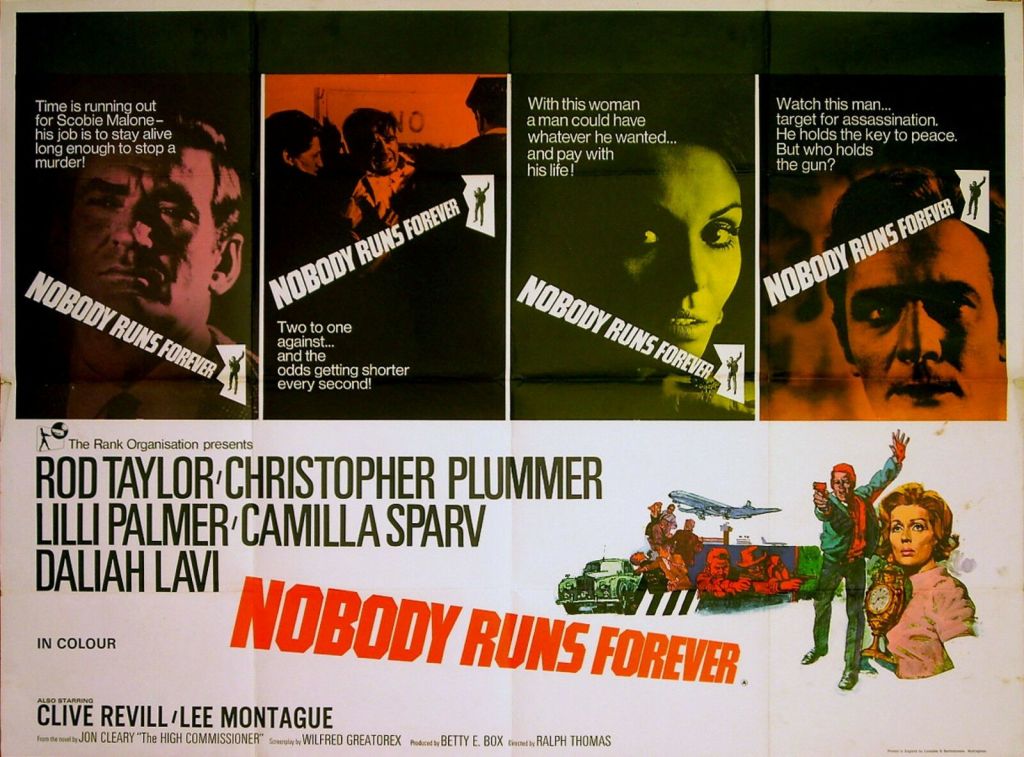
Character-driven intelligent thriller ripe for re-evaluation. And not just because it stands out from the decade’s genre limitations, neither hero threatened by mysterious forces in the vein of Charade (1963) or Mirage (1965) nor, although espionage elements are involved, fitting into the ubiquitous spy category. Instead, it loads mystery upon mystery and leaves you guessing right to the end.
And a deluge of mystery would not work – even with the London high-life gloss of cocktail parties, casinos and the Royal Box at Wimbledon – were it not for the believable characters. Rough Aussie Outback cop Scobie Malone (Rod Taylor) is despatched to London at the behest of New South Wales prime minister (Leo McKern) to bring home Australian High Commissioner Sir James Quentin (Christopher Plummer) to face a charge of murder.
Probably a better title than either “Nobody Runs Forever” or “The High Commissioner.”
Unlike most cop pictures, Malone is not sent to investigate a case, he is merely muscle. While he may have his doubts about the evidence against Quentin, suspected of murdering his first wife, he resists all attempts to re-open the case. Arriving in the middle of a peace conference hosted by the principled Quentin, he agrees to investigate security leaks from Australia House and along the way turns into an impromptu bodyguard when Quentin’s life is endangered. But Quentin’s wife Sheila (Lilli Palmer) and secretary Lisa (Camilla Sparv) are not taken in by the deception and so Malone himself forms part of the mystery.
With a preference for cold beer to expensive champagne, you might expect Malone to be a bull in a china shop. Instead, dressed for the part by the solicitous Quentin, Malone fits easily into high society, taking time out from his duties for a dalliance with the elegant Madame Chalon (Daliah Lavi). The background is not the gloss but the passion the Quentins still feel for each other, she willing to do anything (literally) to save her husband, he losing the thread of an important speech when worried about his wife.
While there is no shortage of suspects for all nefarious activities, red herrings abound and cleverly you are left to make up your own mind, rather than fingers being ostentatiously pointed. There is some delicious comedy between Malone and Quentin’s uptight butler (Clive Revill), enough punch-ups, chases and clever tricks to keep the movie more than ticking along but at its core are the relationships. Malone’s growing respect for Quentin does not overrule duty, Lisa’s evident love for Quentin cannot be taken the obvious further step, Sheila’s overwhelming need to safeguard her husband sends her into duplicitous action.
The politics are surprisingly contemporary, attempts to alleviate hunger and prevent war, and while there was much demonstration during the decade in favor of world peace, this is the only picture I can think of where a politician’s main aim is not self-aggrandisement, greed or corruption. There are some twists on audience expectation – the dinner-jacketed Malone in the casino does not strike a James Bond pose and start to play, he is seduced rather than seducer, and remains a working man throughout.
Rod Taylor (Dark of the Sun, 1968) and Christopher Plummer (Fall of the Roman Empire, 1964) are terrific sparring partners, red-blooded male versus ice-cool character, their jousts verbal rather than physical. The rugged Taylor turns on the charm when necessary, a throwback to his character in Fate Is the Hunter (1964). Thoughts of his wife soften Plummer’s instinctive icy edge. Lilli Palmer (The Counterfeit Traitor) is superb as yet another vulnerable woman, on the surface in total control, but underneath quivering with the fear of loss. Two graduates of the Matt Helm school are given meatier roles, Daliah Lavi (The Silencers, 1966), as seductress-in-chief is a far cry from her stunning roles in The Demon (1963) and The Whip and the Body (1963) – and it still feels a shame to me that she was so ill-served in the way of roles by Hollywood. Camilla Sparv (Murderers Row, 1966) has a more low-key role.
Clive Revill (The Double Man, 1967) has another scene-stealing part and look out for Calvin Lockhart (Dark of the Sun), Burt Kwouk (The Shoes of the Fisherman, 1968) and, shorn of his blond locks, an unrecognizable Derren Nesbit (The Naked Runner, 1967) and in his final role Hollywood legend Franchot Tone (Mutiny on the Bounty, 1935).
Ralph Thomas (Deadlier than the Male, 1967) directs with minimum fuss, always focused on character, although there is a sly plug for Deadlier than the Male in terms of a cinema poster. (Speaking of posters, I couldn’t help notice this interesting advert at an airport for a VC10 promoted as “10derness.”) Wilfred Greatorex (The Battle of Britain, 1969) made his screenplay debut, adapting the bestseller by Jon (The Sundowners) Cleary. This may not be quite a true four-star picture but it is a grade above three-star.
CATCH-UP: Rod Taylor films reviewed in the blog so far are Seven Seas to Calais (1962), Fate Is the Hunter (1964), The Liquidator (1965), The Glass Bottom Boat (1966), Hotel (1967) and Dark of the Sun (1968).
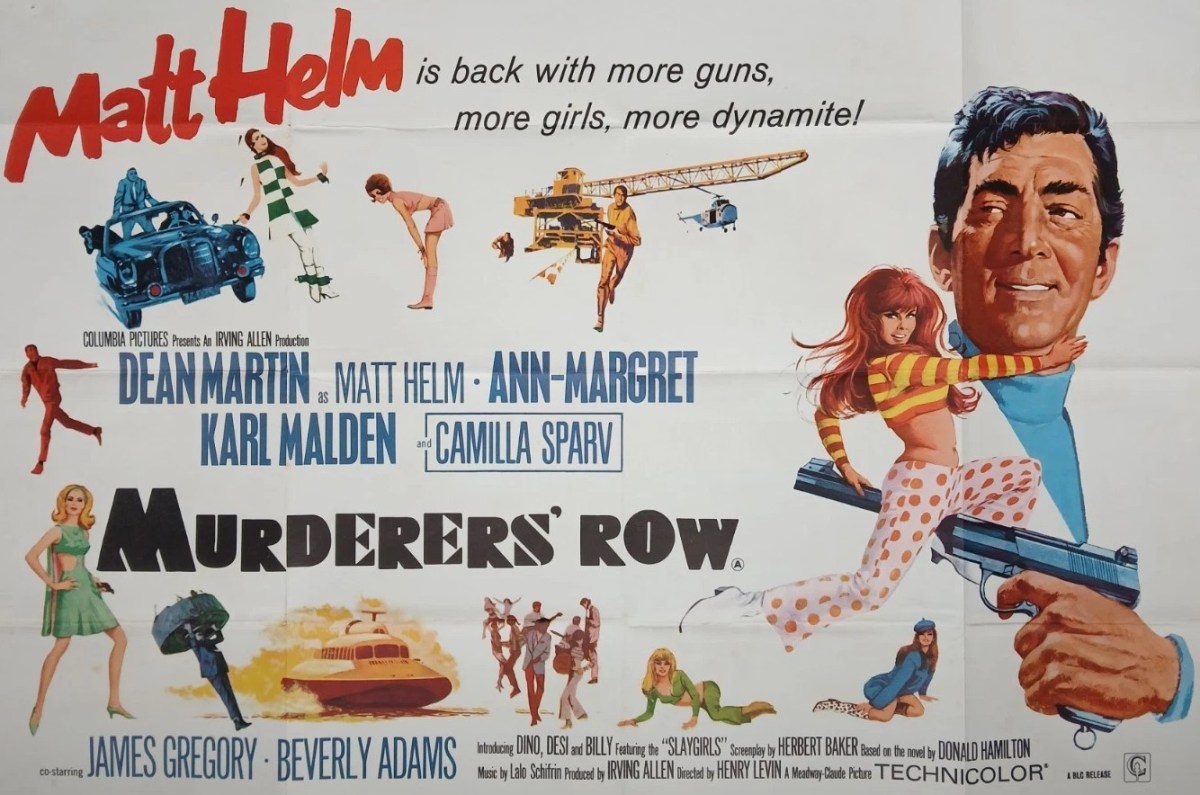
Chucklesome brew. It’s easy to get wrong idea about the Matt Helm series, what with the onslaught of girls in bikinis, a hero majoring in seduction and madmen wanting to take over the world. You could be hoodwinked into thinking this had something to do with espionage rather than a platform for the non-stop delivery of deadpan one-liners and wry visual gags. The star prevents anyone taking anything seriously with a rat-tat-tat quip a minute. The plot’s hooey and the female stars scarcely register. But who cares. The audience has buckled up for a fun ride.
Apart from the dialog the narrative is distinctly lazy. Assuming it’s what audiences want, the action takes time out to note parades of passing girls in bikinis and occasionally stops dead should there be the opportunity to watch youngsters dancing wildly. With humor to the fore, you could probably have gone for a dozen other storylines as good – or bad – as this one and nobody would have noticed.
Matt Helm (Dean Martin) is forced to interrupt photographing a bevy of beautiful girls in order to save the world from madman Julian Wall (Karl Malden) who plans to use the power of the sun to destroy Washington D.C. “Operation Scorch” relies on the brain of scientist Dr Solaris (Richard Eastham), who has been kidnapped to persuade him to hand over his formula.
This takes Helm, masquerading as a Chicago mobster, to Monte Carlo where he almost immediately faces a charge of murder. Tracking down Wall and his squeeze Coco (Camilla Sprav) proves easy. In rather desultory fashion Helm hooks up with local beauty Suzie (Ann-Margret) and until we discover that her father is Solaris her presence is mostly redundant as, for once, neither love nor lust is in the air.
Like any self-respecting madman Wall hangs out on an island where he is putting the final details to his plan and torturing Solaris. With Suzie in his wake, Helm easily infiltrates the rather desultory hideout, is captured, Solaris surrenders the secret formula once his daughter is threatened, and Suzie comes into her own by disabling the infernal machine by the simple device of a hairpin. This leads to a rather desultory happy ending.
I’m not entirely sure why Ann-Margret chose this vehicle, since she is called upon to do very little except shake her trademark booty. If she had gone up in critical estimation after her turns in Once a Thief (1965) and Stagecoach (1966) she plummeted back to earth here. You could say the same for Camilla Sparv – all the hard work in gaining reasonable notices for The Trouble with Angels (1966) and especially heist thriller Dead Heat on a Merry-Go-Round (1966) undone. She has even less to do than Ann-Margret. Eye candy is too good a word for them and they are unfairly underused.
Karl Malden (Nevada Smith, 1966), who usually attempts to humanize his characters, avoids that idea and goes straight for cartoon villain.
So it’s left to Dean Martin to keep the enterprise afloat which he does with tremendous chutzpah. As well as the verbal drollery there are some excellent visual gags, including the use of a giant magnet to render defenseless menacing thug Ironhead (Tom Reese), so called because has a large metal plate on his skull. Virtually every line produces a rejoinder from Dean Martin, and that lightness of delivery matches the souffle nature of the picture, a sequel to The Silencers (1966), both big box office hits.
Director Henry Levin (Genghis Khan, 1965) gives himself no airs or graces, sensible enough to stick the camera on Dean Martin and let him do the rest. Written by Herbert Baker (Hammerhead, 1968) from the bestseller by Donald Hamilton.
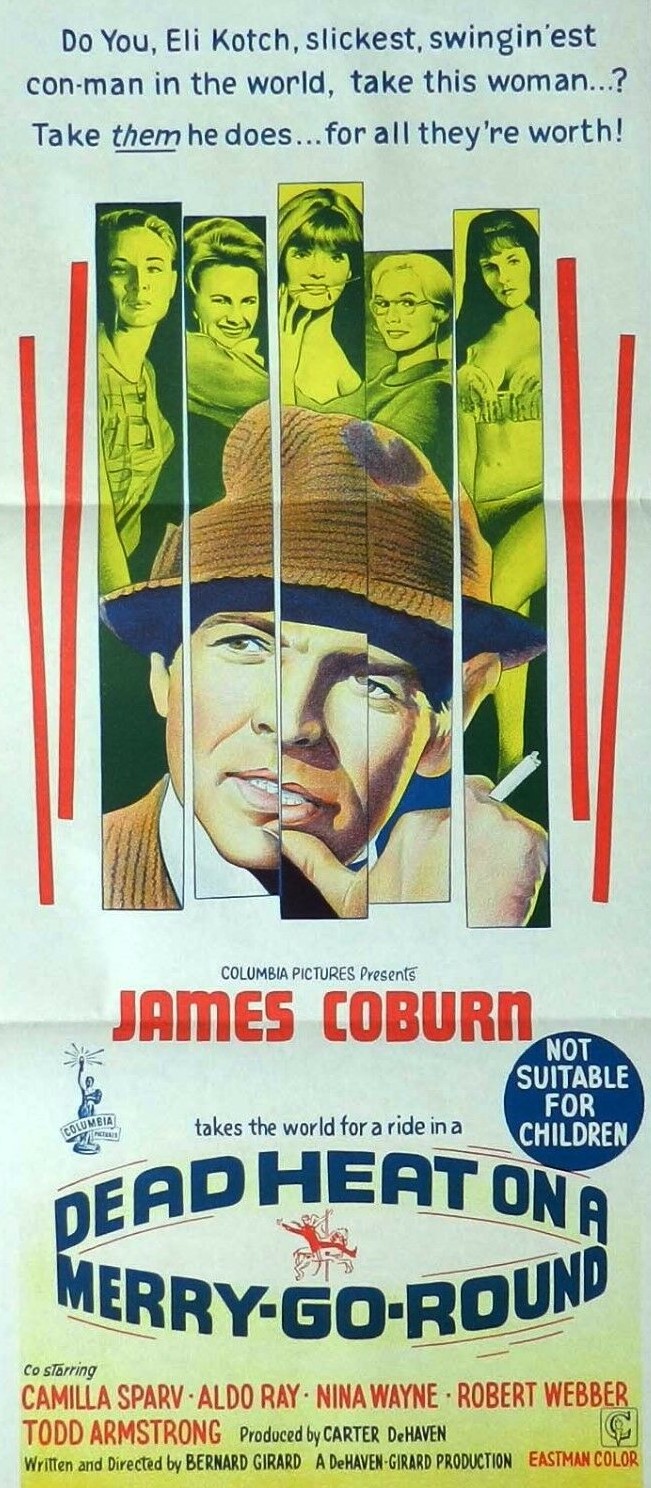
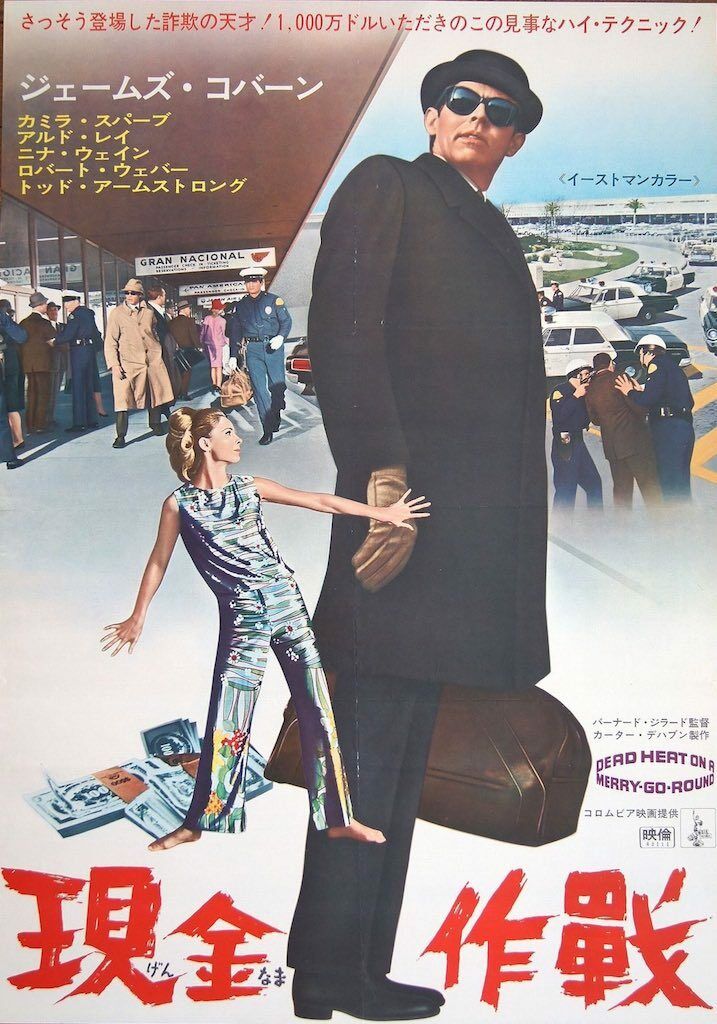
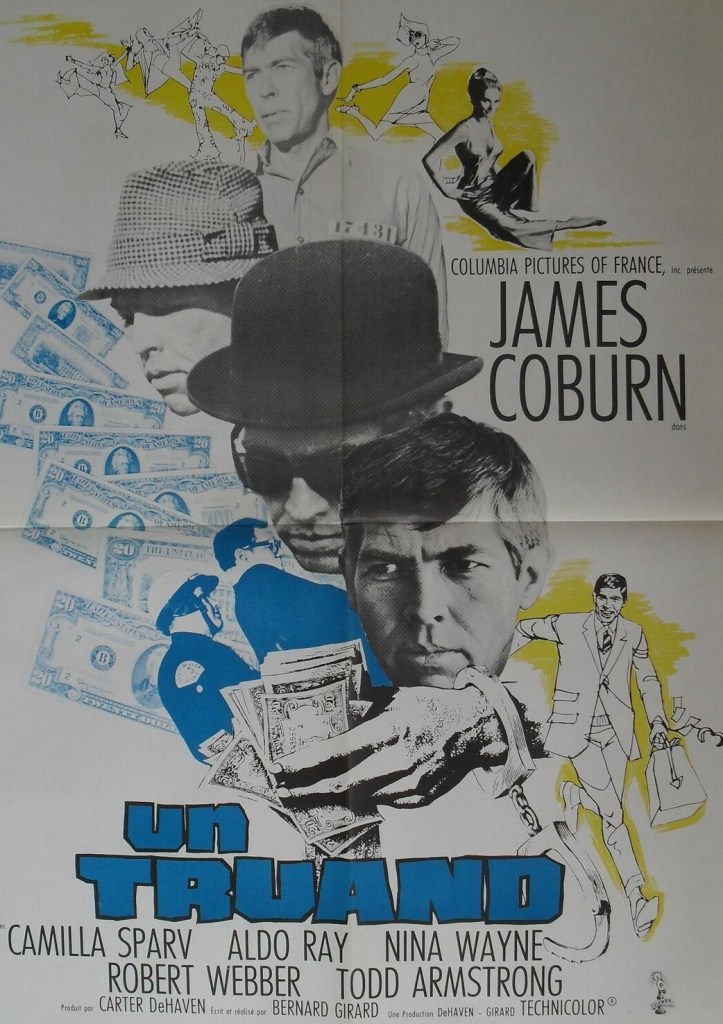
Highly entertaining woefully underrated heist picture with an impish James Coburn (Hard Contract, 1967), Swedish Camilla Sparv (Downhill Racer, 1969) in a sparkling debut and at the end an outrageous twist you won’t see coming in a million years. This is the antithesis of capers of the Topkapi (1964) variety. Not only is it an all-professional job, it takes a good while before you even realise the final focus is robbery or even the actual location. There are hints about the that event and glimpses in passing of material that may be used, and although the theft is planned to intricate detail, none of that planning is revealed to the audience.
The paroled Eli Kotch (James Coburn), who has seduced the prison psychiatrist, immediately skips town and starts fleecing any woman who falls for his charms. He changes personality at the drop of a hat, fitting into the likes of the mark, and in turn is burglar, art thief, car hijacker, in order to raise the loot required to buy a set of bank plans, and yet not above taking on ordinary jobs like shoe salesman to meet the ladies and coffin escort to get free travel across the country. So adept at the minutiae of the con he even manages to impersonate a hotel guest in order to get free phone calls.
He enrols girlfriend Inger (Camilla Sparv) to act as an amateur photographer working on a “poetic essay on transient populations” to get an idea of sites he means to access. He manages to have the head of a Secret Service detail blamed for a leak. Everything is micro-managed and his final masquerade is an Australian cop with a prisoner to extradite which provides him with an excuse to linger in a police station, privy to what is going on at crucial points.
If I tell you any more I’m going to give away too much of the plot and deprive you of delight at its cleverness. The original posters did their best not to give away too much but you can rely on critics on Imdb to spoil everything.
This is just so much fun, with the slick confident Eli as a very engaging con man, the supreme manipulator, and almost in cahoots with writer-director Bernard Girardin (The Mad Room, 1969) in manipulating the audience. There are plenty films full of obfuscation just for the hell of it, or because plots are so complex there’s no room for simplification, or simply at directorial whim. But this has so much going on and Kotch so entertaining to watch that you hardly realize the tension that has been building up, not just looking forward to what exactly is the heist but also how are they going to pull it off, what other clever tricks does Kotch have up his sleeve for any eventuality, and of course, for the denouement, are they going to get away with it, or fall at the last hurdle. There is a great twist before the brilliant twist but I’m not going to tell you about that either.
There’s plenty Swinging Sixties in the background, the permissive society that Kotch is able to exploit, and yet the film has some unexpected depths. You wonder if the memories Kotch draws upon to win the sympathy of his female admirers have their basis in his own life. You are tempted to think not since he is after all a con man, but the detail is so specific it has you thinking maybe this is where his inability to trust anyone originates.
Bernard Giradin was not a name known to me I have to confess, since he was more of a television director than a big screen purveyor – prior to this he had made A Public Affair (1962) with the unheard-off Myron McCormick – and Coburn was the only big star he ever had the privilege to direct. But there are some nice directorial touches. The movie opens with a wall of shadows, there are some striking images of winter, a twist on bedroom footsie, and jabbering translators. But most of all he has the courage to stick to his guns, not feeling obliged to have Kotch spill out everything to a colleague or girl, either to boast of his brilliance, or to reveal innermost nerves, or, worse, to fulfil audience need. There’s an almost documentary feel to the whole enterprise.
James Coburn is superb. Sure, we get the teeth, the wide grin, but I sometimes felt all the smiling was unnecessary, almost a short cut to winning audience favour, and this portrayal, with the smile less in evidence, feels more intimate, more seductive. This may well be his best, most winning, performance. Camilla Sparv is something of a surprise, nothing like the ice queen of future movies, very much an ordinary girl delighted to be falling in love, and with a writer of all the things, the man of her dreams.
The excellent supporting cast includes Marian McCargo (The Undefeated, 1969), Aldo Ray (The Power, 1968), Robert Webber (The Dirty Dozen, 1967), Todd Armstrong (Jason and the Argonauts, 1963) and of course a blink-and-you-miss-it appearance of Harrison Ford as the only bellboy (that’s a clue) in the picture. You might also spot showbiz legend Rose Marie (The Jazz Singer, 1927).
I should mention the George Lucas connection right away because, for some, that is the movie’s main contemporary connection.
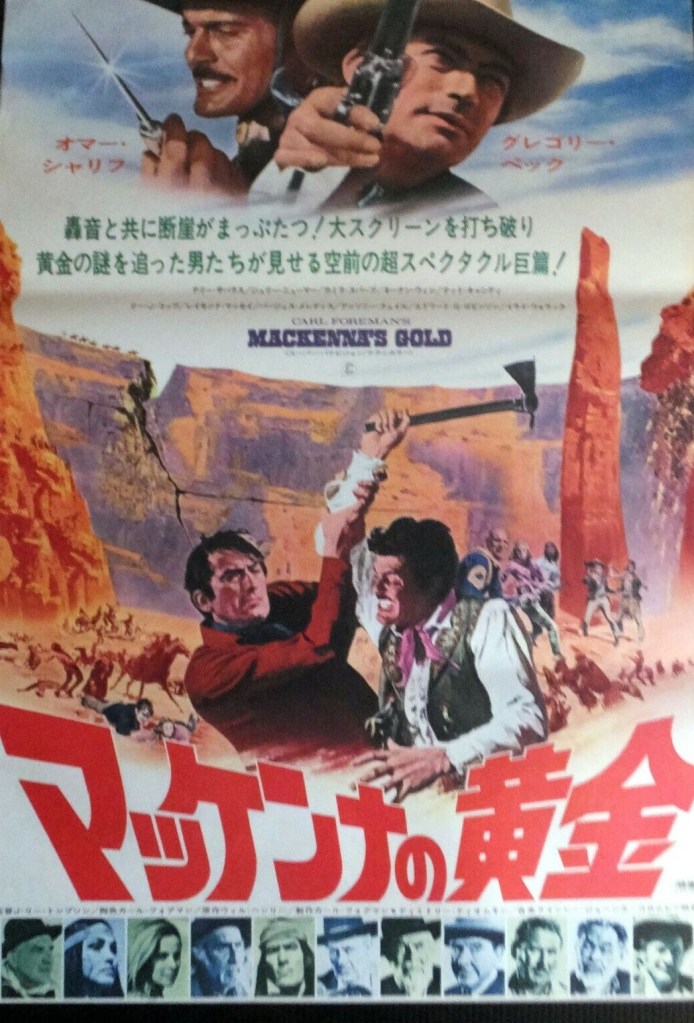
Mackenna’s Gold was originally intended as a three-hour movie[i] for roadshow release to be shot in early 1966 for Columbia Pictures by writer-producer Carl Foreman (Guns of Navarone, 1961) who would also be in the director’s chair.[ii] But outside of How the West Was Won (1962) westerns had foundered in roadshow. The Alamo (1960), John Ford’s Cheyenne Autumn (1964) and John Sturges The Hallelujah Trail (1965) were surprising roadshow flops. Foreman persuaded Columbia to increase the budget to $5 million – and then beyond – and film the movie in Cinerama, (over 25 percent of the budget was allocated to Cinerama to license the name and use the equipment – $1.35 million in total of initial negative costs[iii]).
In January 1967 Columbia launched the marketing campaign with full page advertisements in the trade papers promoting the fact that the movie would be filmed on location in the USA in Cinerama and that it would bring together the “creators of The Guns of Navarone,” meaning, at this point, Foreman and director J. Lee Thompson. The advertisement also highlighted author Will Henry, on whose novel the film was based (as the “author of San Juan Hill and From Where the Sun Now Stands”) and plugged the book as “a novel of Apache gold and Apache revenge based on the search for the fabulous Lost Adams Diggings.” By the following year, Foreman’s star was in the ascendant after the Parisian revival of High Noon[iv] and Columbia had another two major roadshows planned for the 1968-1969 season: Barbra Streisand’s movie debut in William Wyler’s Funny Girl also starring Omar Sharif and Carol Reed’s Oliver![v]
By this time, Columbia had reshaped its marketing effort to provide the specialist support required for promoting roadshows. In early 1967, it had poached sales guru Leo Greenfield from Buena Vista with the express aim of setting up an effective unit to market hard-ticket product – “first assignment Mackenna’s Gold, Oliver! and Funny Girl”[vi] – to the record number of Cinerama theaters[vii] and those desperate to accommodate roadshow. By the end of 1968, both Cinerama and Columbia had reported record revenues and profits, the former turning a $290,000 loss into a $679,000 profit,[viii] the latter on an unprecedented streak of success with a gross profit of $9.3 million profit on a gross income of $239 million.[ix] Columbia soon added another roadshow prospect to its slate, Sydney Pollack’s World War Two drama Castle Keep starring Burt Lancaster, and was so confident about the two non-musicals, for example, that it expected the western and the war picture to run consecutively from late spring 1969 well into the following year at Loews Hollywood in Los Angeles.[x]Funny Girl hit $550,000 in advance sales – $80,000 was the usual figure.[xi]Mackennas’s Gold’s was scheduled to premiere in Phoenix, Arizona, on February 15, 1969, with the roadshow launch set for the DeMille theater in New York five days later.
Within the next month, however, the world premiere was called off, work began on editing down the near-three-hour running time, and plans, two years in the making, for an ambitious roadshow release were quietly dropped. Public reaction to The Stalking Moon – also starring Gregory Peck – was one reason. Two other Cinerama movies, Custer of the West (1967) and Krakatoa – East of Java (1968) had also flopped. If Mackenna’s Gold was to be marketed as a drama in a western setting rather than a shoot-out in the tradition of 100 Rifles, then Columbia looked worryingly at Isadora, boasting a 177-minutes running time, whose roadshow run in Los Angeles was swiftly truncated, and the movie butchered in a bid to find an audience.[xii]
The studio took a different tack. The world premiere shifted to Munich, West Germany, in March[xiii] with most of the rest of the European capitals holding gala premieres (and running it as roadshow or at least 70mm) before the picture made its U.S. debut in Phoenix on May 10. But the picture unveiled in Phoenix was a ghost of the original. The running time technically came in at 128 minutes, but, in effect, was under two hours long, the introductory narration lasting eight minutes and the end credits accounting for further time. However, what was oddest of all was the 18-month gap between completion and world premiere. Filming had begun on May 16, 1967 and wrapped on September 29. Columbia had shelved one of its biggest budgeted movies for nearly 15 months.
The movie had a troubled history. For a start, Foreman didn’t own the rights to the Will Henry source novel. Dmitri Tiomkin, after a debilitating eye condition restricting his composing career, had in 1964 purchased the rights. Tiomkin agreed to sell the rights to Foreman in April 1965 in return not just for a fee and an agreement to compose the music[xiv] but also the vital producer’s credit necessary to launch him on a new career.[xv] Foreman was initially keen on filming the movie in Spain to take advantage of generous government subsidies.[xvi] But Foreman was demoted from director. His last picture as writer-producer-director The Victors (1964) had flopped. The studio did not want to offer the producer any distraction from the complex logistics of a location shoot where much of the time the crew would be 50 miles from the nearest town and where, despite the desert environment, could be subject to storms and flash floods. Instead, J. Lee Thompson (The Guns of Navarone) came on board as director. (Thompson was also at this point lined up to direct Charlton Heston in Planet of the Apes, whose rights he co-owned.)
However, the Thompson-Foreman relationship did not run smoothly. Foreman recalled: ‘I was not very happy with the work of J. Lee Thompson on that film and entirely apart from that we still got into trouble in terms of scheduling and so forth and our relationship was always a problem.’[xvii] Logistics were always going to be an issue on a picture of this scale, shot almost exclusively on some of the most inhospitable places on Earth. The buzzard section was filmed in Monument Valley on the Arizona/Utah border, and other scenic wildernesses included the Glen Canyon of Utah, Spider Rock in Canon de Schelly in Arizona, Kanab Valley, Sink Valley, the Panguitch Fish Hatchery in Utah, and Medford in Oregon.
Gregory Peck was not first choice for the titular role in Mackenna’s Gold. He only got the part after Steve McQueen and then Clint Eastwood had turned it down[xviii] and even then Peck wavered, only agreeing after pressure from Foreman, and in recognition of their work together on The Guns of Navarone.[xix] Depending on your point of view, Omar Sharif was miscast or cast against type, a matinee idol whose character, in ruthless pursuit of gold, eschewed any element of romance. By the time the movie appeared, Sharif’s marquee appeal had taken a tumble. MGM’s Mayerling and Twentieth Century Fox’s Che had flopped, The Appointment (1969) shelved and Funny Girl’s success rightly attributed to Streisand.
Over the past few years, Telly Savalas had discovered the harsh reality of Hollywood. An Oscar nomination for Best Supporting Actor in The Birdman of Alcatraz (1962) had done less for his career than the odious Maggott in The Dirty Dozen (1967) after which he was promptly promoted to third billing on Sol Madrid (1968), western The Scalphunters (1968) and The Assassination Bureau (1968). Although he retained that billing on Mackenna’s Gold, he did not appear until halfway through, suggesting that his role as Sgt Tibbs had been a casualty of the editing needed to reduce the running length. Camilla Sparv had been leading lady in Dead Heat on a Merry-Go-Round (1966), Assignment K (1968), and Nobody Runs Forever (1968). Newmar, a decade older, was best known for playing “Catwoman” in the television series Batman (1966-1967). Foreman had given her the leading female role opposite Zero Mostel in Monsieur Lecoq (1967) but the movie was unfinished, although Newmar still attracted attention after stills from the picture appeared in Playboy magazine. Mackenna’s Gold aimed to set a new standard in the quality of actors in supporting roles – the by now requisite roadshow all-star cast including Edward G. Robinson (The Biggest Bundle of Them All, 1968), twice-Oscar-nominated Lee J. Cobb (Coogan’s Bluff, 1968), Burgess Meredith (Skidoo, 1968), Anthony Quayle (The Guns of Navarone), Oscar nominee Raymond Massey (Abe Lincoln in Illinois, 1941), Keenan Wynn (How the West Was Won) and Ted Cassidy (“Lurch” in The Addams Family television series, 1964-1966).
The George Lucas Connection
In some respects, the involvement of George Lucas (Star Wars) in Mackenna’s Gold has overshadowed that of director J. Lee Thompson. Committed to bringing through a new generation of talent, Foreman had established an internship for the picture. Lucas was one of four winners and his entry was the first version of THX 1138 (1971). The internship funded the winners to shoot a short film on the location. Foreman became immediately a fan because of the quality of Lucas’s effort. Foreman explained: “He did the shortest one of the lot and the most technically accomplished. It ran only one minute and 47 seconds and it had no title – he gave it a date – and then we agreed we’d call it A Desert Poem because he went out on the desert and did a lot of stop-action photography. George really knew his camera and he played with his camera and it was around and about the film – he was doing the desert more than anything else but in the desert was the film company with its parasols and all that shimmering in the distance and he played around with little things where the sun was shining and the film company was working. And then it began to rain, and it rained like hell, and then the sun came out again. It was awfully good. He did a lot of trick stuff with his camera and that’s what the boys resented, that he could just go out by himself and do that.”[xx]
The “boys” resented Lucas for more than his technical accomplishment but Foreman’s admiration for the neophyte director increased after seeing a display of professionalism that put the other professionals to shame. “We were…in a very difficult location…near the place where we had painted in this great seam of gold…We got to the big scene, the scene where they (the actors) all discovered it (the gold), and they all started running towards it…But it (the location) was in a kind of ravine and there was a problem about the light – you could only shoot it…at that time of year when the sun was more or less directly overhead or had just begun to go down or had just passed the meridian…(but when Foreman arrived on location) the entire company was just sitting there. Lucas therefore pointed out in an indirect manner that the scene had not been rehearsed because J. Lee Thompson was waiting for the sun to rehearse it during the precious moments when the sun was there instead of being ready for when the sun was there.”[xxi]
Reception
Trade magazine Variety came out in overall favor of Mackenna’s Gold: “splendid western, stars plus special effects and grandeur should insure box office success.”[xxii]Hollywood Reporter predicted, “Audiences should queue up,” and Film Daily proclaimed “a fine, exciting western adventure.”[xxiii] However, Vincent Canby in the New York Times called it a “truly stunning absurdity,” The New York News, while generally positive, nonetheless complained it was “sprawling” and “pretentious.” New York magazine and the Washington Post were among the nay-sayers.[xxiv] Perhaps, Peck’s own opinion was the most damning: “Mackenna’s Gold was a terrible western, just wretched.”[xxv]
Star fatigue did not occur in the days of the studio system, when releases were carefully spaced out to give the public a breathing space between each release. Actor independence meant timing of releases was removed from studio control – Gregory Peck’s movies in 1969 came from three different studios, Universal (The Stalking Moon), Twentieth Century Fox (The Chairman) and Columbia (Mackenna’s Gold), and Omar Sharif was in the same position with MGM for Mayerling, Twentieth Century Fox for Che and the western from Columbia. As you might expect, releases were not coordinated, studios did not sit down around a table and discuss how to avoid each other’s movies clashing. So in the first six months of 1969 audiences were treated to three pictures apiece from the stars, the earlier ones flops though Mayerlingr was a big hit overseas.[xxvi] Whatever the reason, Mackenna’s Gold did not race out of the gate. Its final rentals tally of $3.1 million – 42nd spot in the annual chart,[xxvii] ahead of The Stalking Moon and Once Upon a Time in the West, but well below the much less expensive Support Your Local Sheriff and 100 Rifles. In budget terms it was close to a disaster. However, it was a huge hit in India, setting a record in Madras for the best showing for a foreign picture.[xxviii]
SOURCES:
This is an edited version of a much longer chapter from my book, The Gunslingers of ’69: Western Movies’ Greatest Year.
[i] Sheldon Hall has argued that the movie was never intended to be three hours long and that judging from a screenplay of 145 pages the film would have been roughly two-and-half-hours long. He identified a major sequence that was filmed but edited out – of another battle between the Apaches and the gold-seekers (“Film in Focus, Mackenna’s Gold,” Cinema Retro, Issue 43, 40.)
[ii] “Foreman to Start Gold, Delays Churchill Pic,” Variety, September 8, 1965, 4. The Churchill project would eventually become Young Winston made in 1972 for Columbia. The movie was originally postponed due to political unrest in the chosen movie locations.
[iii] Filmmakers licensing the Cinerama name had to pay $500,000 upfront and Foreman was committed to spend $875,000 for Cinerama camera equipment. The cost might escalate because Columbia also had to agree to pay Cinerama 10 percent of the gross (“C’rama Sets Major Int’l Expansion As More Pix, More Theaters Use Process,” Variety, November 15, 1967, 25).
[iv] “Junket for Noon Sparks Nostalgia,” Variety, April 24, 1968, 31. Not only was the revival a critical success but it was a box office hit all over again in Paris.
[v] “Leo Greenfield’s Chore,” Variety, May 31, 1967, 8. Wyler, of course, was the king of the roadshow, having directed Ben Hur. Reed had directed The Agony and the Ecstasy (1965) after an initial chastening experience with roadshow having pulled out of MGM’s Mutiny on the Bounty (1962) after clashing with star Marlon Brando.
[xii] “Switching of Isadora,,” Variety. The film, which had opened on December 18, was set to close on February 8 and go straight into continuous performance.
[xiii] “Col Bows Gold in Munich to Spark Lagging Box Office,” Variety, March 26, 1969, 41; “Mackenna’s Gold Launching Pattern,” Variety, March 5, 1969, 28. While it was true the studios were concerned about falling box office in Europe, the true reason for launching the picture in Europe ahead of America was because Foreman was so much better known there courtesy of his major marketing blitz for The Guns of Navarone and The Victors. It opened in Paris and Rome in March and in April in London.
[xiv] By the time the movie came out, Tiomkin had given up composing and the score was done by Quincy Jones.
[xv] “Tiomkin-Foreman Partners for Col,” Variety, April 21, 1965, 19.
[xvii]The Carl Foreman Tapes, Transcripts of Tapes between Sidney Cohn and Carl Foreman, Carl Foreman Collection, ITM – 4408, (Tape V – A, December 20, 1977, British Film Institute, Reubens Library, London).
[xviii] Avery, Kevin ed, Conversations with Clint, Paul Nelson’s Lost Interviews with Clint Eastwood, 35 ; Neibaur, James L, The Clint Eastwood Westerns, 44.
[xix] Fishgall, Gary, Gregory Peck, A Biography (Scribner, New York, 2002), 264.
The Treasure of the Sierra Madre (1948) set in the West – men driven mad by gold fever. Straightforward plot, however, complicated by an avalanche of characters. And for a two-hour running time it seemed perverse to waste the first six minutes on scenery, narration – explaining the Apache legend of a fabulous hidden seam of gold – and theme song.
The real film begins with a shoot-out between Marshall Mackenna (Gregory Peck and an Indian. “You will wish you never saw this map,” says the Indian before he dies, but Mackenna burns the map. That doesn’t go down well with villain Colorado (Omar Sharif), whose gang has taken Inga (Camilla Sparv) hostage. Convinced the lawman has memorized the map, Colorado adds Mackenna to his hostage quotient.
At Colorado’s hideout Hesh-Ke (Julie Newmar) has a hostile reaction to Mackenna. Like Colorado, they have history. Mackenna and Inga bond when he fends off an Indian intent on raping her. As if this isn’t a pretty straightforward set-up, old foes reunited, potential romance brewing, a treasure hunt, further complications arise in the shape of a posse led by Ben Baker (Eli Wallach), not hunting renegades but also chasing gold. As if that wasn’t already a complication too far now we have a Cavalry troop, who confuse the posse with outlaws thus mostly eliminating a complication before it gets too complicated – the pursuing Apaches finish them off.
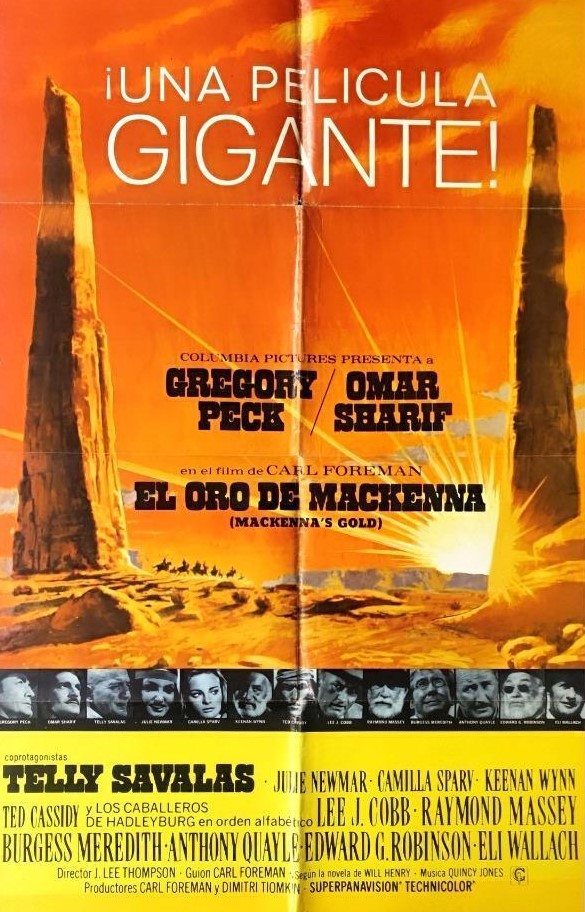
And in a nearby pool, we get a deadly twist on the naked attraction, as Hesh-Ke, first trying to lure Mackenna then trying to drown the woman she views as her romantic rival. When the Cavalry reappear, they have turned rogue, led by Sgt Tibbs (Telly Savalas). So now we’ve got the narrative ironed out it’s three separate groups – outlaws, Cavalry and Apaches – searching for gold with various individual old scores to be settled. And, just in time, they’ve arrived at Shaking Rock, the tall pillar visualized in the poster, and a sunrise worth waiting for. It is a glorious scene.
After a close-up of the rising sun and the pillar, and the screen changing color, the shadow of the pillar creeps across the canyon floor and points to a crack in the canyon wall. The crack is a tunnel entrance and on the other side the sun is shining on a seam of bright gold. And that leaves only the various denouements to be played out. And some surprises – straightlaced Inga succumbing to gold fever, the supposedly barbarous Apaches revealed as good guys – treating pillar (and gold) with reverence – and (would you believe it) an earthquake.
The earthquake might just have been too big a temptation given this was filmed in Cinerama. But it’s the least effective use of the process. A fairly standard western trope, crossing a dodgy bridge, is heightened in Cinerama but it’s still a cliché. Much better is the river crossing, the camera’s dizzying effect echoing the rollercoaster ride in This Is Cinerama and the rapids and runaway train of How the West Was Won (1962), audiences pitched headlong into camera point-of-view, racing water, oncoming rapids, thundering waterfall. The final section is triggered by the Cinerama camera racing for two minutes down the twisting track leading to the gold. So, in Cinerama terms, the audience got its money’s worth.
And there should have been enough conflict to keep the narrative on track – Mackenna vs. Colorado, Hesh-Ke vs. Inga, Inga vs Colorado, Calvary vs. outlaws vs. Apaches, plus various fist, gun, knife and belt fights. The individual conflicts, Inga’s genuine fear over her fate, the romantic triangle and especially ruthless Colorado revealed (ditto Butch Cassidy) as a dreamer, imagining life in faraway lands (swap Butch’s Bolivia and Australia for Colorado’s Paris) were more than enough to be going on with without being drowned out by a simplistic message about greed. This is nothing more – or nothing worse – than a decent western wrapped up in the bloated shadow of a roadshow.
Gregory Peck (Arabesque, 1966) and Omar Sharif (Mayerling, 1969) are both pretty good in roles that play against type, both female roles are well-written and well played by Camilla Sparv (Downhill Racer, 1969) and Julie Newmar (The Maltese Bippy, 1969) but the film is overloaded with way too many cameos. As he had proven in The Guns of Navarone (1961) J. Lee Thompson was excellent at handling large casts especially in scenes featuring a host of characters and his visual and aural skills are superb but not so good at putting writer-producer Carl Foreman in his place.
Take away the Cinerama effects and the roadshow elements, and trim another 20 minutes off the picture, and you would have had a tight character-driven picture.
Shocking Fact No 1: director Ida Lupino was the only female director working in Hollywood at this time. And she hadn’t worked in features for over a decade. Her previous picture, The Bigamist (1953), was her fifth. And while she had continued to find work in television, the movie business shunned her. What was perhaps more shocking, as I pointed out in my book When Women Ruled Hollywood, was that in the period 1910-1919 more women worked as directors in Hollywood than at any time since and that it was a woman, Alice Guy, rather than Melies, who actually made the first narrative movie. Worst of all, despite being a major box office hit, this was Lupino’s last picture.
Shocking Fact No 2: this didn’t turn Hayley Mills into a major adult star. Oh yes, she made the transition – and how – in The Family Way later that year, a British romantic drama that saw her shed her clothes. Big hit in Britain, not so well-received in the USA. Her career then took an odd turn, into thrillers like Twisted Nerve (1968) and Endless Night (1972).
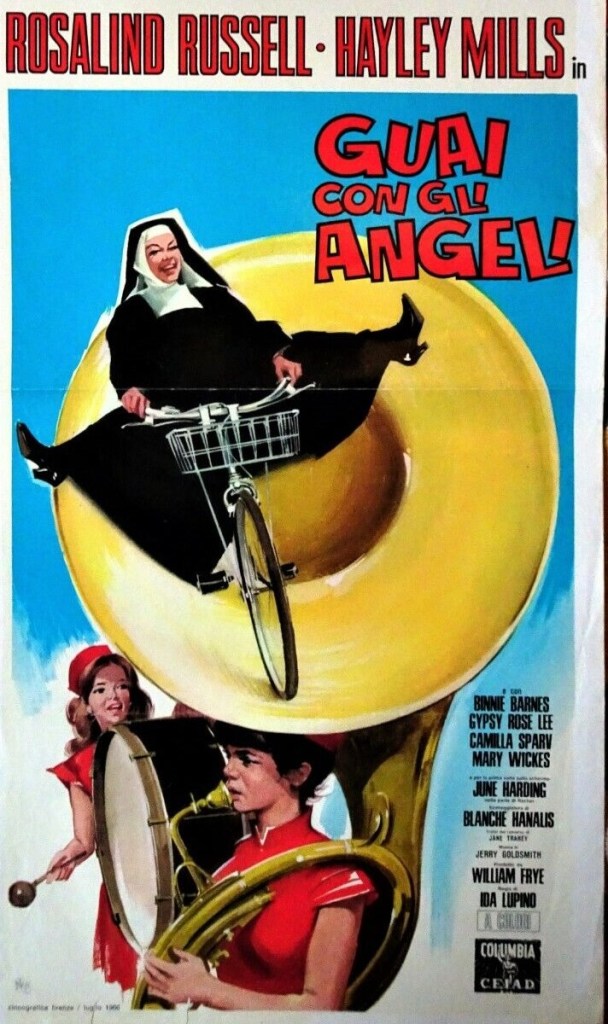
Not exactly demure. Marching band outfit takes the grey out of the convent uniform.
I say an odd turn because if there was any better demonstration that the actress had properly developed her comedy chops I’d yet to see it. Sure, Disney had used her in comedy, but that was mostly routine stuff. Here, she revealed an emotional maturity lacking in her previous work and, to some extent, in her future movies.
And, in part, because Lupino keeps her away from big dramatic moments, relying entirely on her facial expression to reveal character development. I am surprised that, at this point, with Doris Day’s box office allure dimming, that nobody saw Mills as her natural successor. She had the same puckish demeanor and she deftly handled comedy. Give her a few years and she would have been a natural for such polished items as Barefoot in the Park. You get the feeling there was more natural ability that was left untapped.
Anyway, on with the show.
This is just a delight. It shouldn’t work at all, certainly not for a modern audience accustomed to sharply-honed laugh lines. But it’s so cleverly constructed, in covering a three-year period, it could easily have been a string of loosely-connected episodes rather than a picture with an underlying narrative that mostly takes place beneath the surface.
Orphan Mary (Hayley Mills) has been dumped by rich playboy uncle (Kent George) in a convent boarding school that looks more like a medieval fortress than anything else. She teams up with the equally unhappy Rachel (June Harding), whose parents are at least indulgent, and together they torment the life out of the nuns and other kids, pouring detergent into tea-pots, setting off fire alarms, charging their schoolmates for an illicit guided tour of the convent, developing their smoking habits, breaking everything in sight. One scheme goes so badly awry the nuns have to take shears to a face mask.
Throughout all of this, she comes up against a tough Mother Superior (Rosalind Russell) who comes across like Miss Jean Brodie, minus her dangerously progressive side, but ever ready with a quip, able to tackle any emergency, though Mary drives her to distraction. While set in her ways, the nun does sail close to the wind, kitting out the girls in red cheerleader outfits in order to give them an unfair advantage in a marching band competition.
Any other director would have made the marching band competition the climax of the movie. I was fully expecting it to take up the final third, as pupils with little musical ability work hard and discover they can improve enough to win the competition and in so doing find out some platitudes about themselves. Instead, every episode is kept short and sweet, often the pay-off delivered in unexpected manner, for example, that we discover the girls have won when Mother Superior takes the opportunity to gloat over her rival headmaster (Jim Hutton). Or a section where teenage girls sent to buy their first bra go wild trying on all sorts of outrageous outfits that in other hands could easily have been expanded is ended sharply by Mother Superior holding up the plainest item and ordering two dozen of them.
It fairly skates along. But every now and then it dramatically slows down. And for what? Pretty much nothing at all. Just Mother Superior taking a quiet moment to herself amid all the hurly burly of running a school and dealing with mischief. But gradually, in those quiet moments, she is joined, at a distance, by a staring Mary, wondering about the nun’s inner calm.
Ida Lupino’s color palette is extraordinary. Sure, it’s nuns, so we can expect a lot of black and white. But Lupino avoids the temptation to compensate with huge swathes of color. Instead, for most of the film, the girls are decked out in grey. So when splashes of yellow or pink or red appear they are distinctive. Only as the girls grow older does more color emerge.
The wry Rosalind Russell (Gypsy, 1962) is on top form. Instead of attempting to dominate, she nips in and steals scenes with her dry delivery. She shifts from indominable to maternal and eventually engages the psychological attention of Mary in a superb scene about her own life.
In that sense Hayley Mills has her work cut out to hold her own against such an accomplished professional, which she achieves through her own delivery, but much more through facial expression. This was June Harding’s only movie. But look out for Camilla Sparv (Assignment K, 1968) in her movie debut and a cameo from Gypsy Rose Lee.
Terrific direction for Ida Lupino – watch for example how the camera closes in on characters – from screenplay by Blanche Hanalis (Where Angels Go Trouble Follows! 1968) from the bestseller by Jane Trahey.
As old-fashioned as they come and a joy to watch.
Catch it on YouTube – the first link is rent or buy, the second one is free but punctuated by adverts.
Robert Redford rarely took the easy option. Even his big romantic number, The Way We Were (1973), with Barbra Streisand had a serious center, Jeremiah Johnson (1972) focused on ecology and he used his star power to get studio backing for All the President’s Men (1976). Even starting out, and before Butch Cassidy and the Sundance Kid (1969) anointed him a star, when he could, or should according to some observers, have been capitalizing on his good looks he did not shrink from playing unlikeable characters.
Idealizing heroes is endemic. Most films which portray sport stars with feet of clay generally begin with an attractive personality who presses the self-destruct button through alcohol, sex or drugs (or all three) such as Number One (1969) with Charlton Heston. The general consensus is that this approach to the sports movie was not rescinded until the brutal boxer exposed in Scorsese’s Raging Bull (1980).
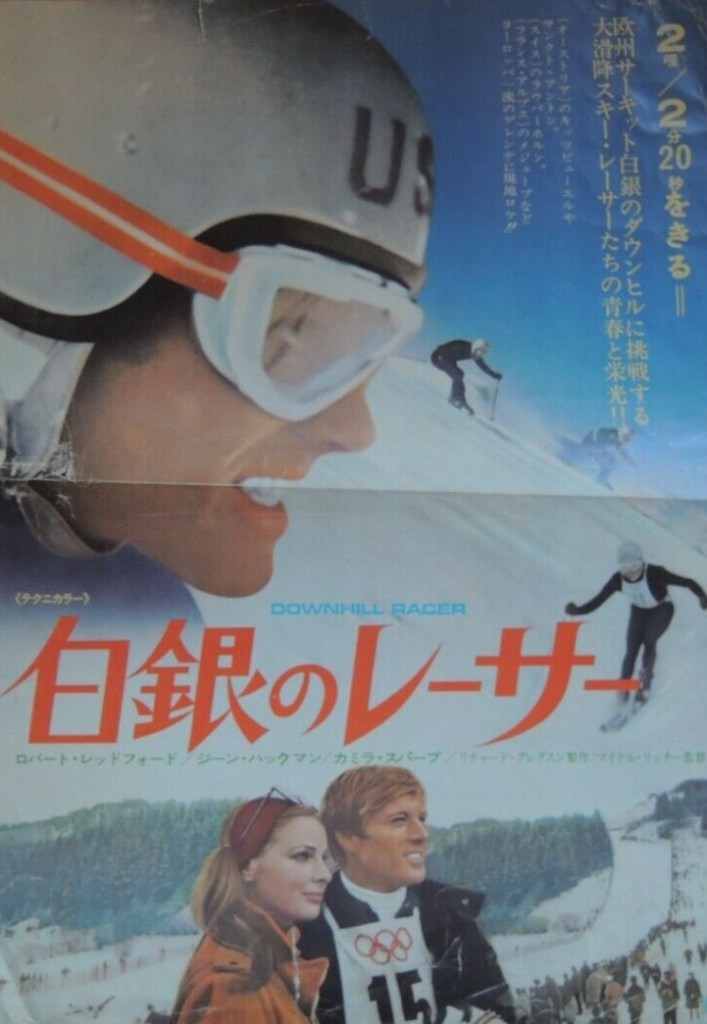
But it turns out Scorsese was not the first. In this ski drama Chappellet (Robert Redford) is a loner who cares for no-one but himself. Alienated from his father (Walter Stroud), his girlfriend at home little more than a sex object, the obsessed skier proves a constant source of friction for his national team manager Claire (Gene Hackman) and not above the kind of dirty tricks as typified in Slap Shot (1977). He sees nothing wrong with making no bones about the fact that he is in the game for fame.
Totally lacking in self-delusion, he’s a farm boy and few steps up from being illiterate. The world of the professional skier was hardly the obvious subject for a sports drama. There’s certainly an excitement in the action that couldn’t be captured on television, but the essential competitive element, the race against the clock, is not so riveting as the last-minute touchdown or winning home run.
Pretty much Chapellet’s only attractive feature is that he is played by Robert Redford, and the film plays upon the conceit that as handsome a man as this will at some point turn into a good guy. There’s an interesting debate – and one that would last decades – about whether Redford’s looks got in the way of the characters he portrayed. Imagine Robert Duvall in the part, for instance, and relentless determination would not be called into question.
This leaves the film with only pity as a way to provide the character any sympathy, the sense that if he turns into a loser the audience will warm more to him than if he is a champion, but that arrives outside the competitive circle, and perhaps is even more touching, when his hopes of genuine romance with top-notch blonde Carole (Camilla Sparv) are dashed.
Michael Ritchie (The Candidate, 1972), making his directing debut, opts for a documentary-style approach, so minimalist it’s almost perfunctory. This is a decent option given there’s very little going on beyond lonely hotel rooms, and an endless round of competitions and an occasional outburst from the manager. The skiing scenes, sensational at the time, are boosted by Blu Ray. Although it gained good reviews, audiences failed to respond although Redford was on a career high after Butch Cassidy and the Sundance Kid (1969).
While it was a brave choice for the actor, the script by James Salter (Three, 1969), based on the Oakley Hall bestseller, doesn’t bring enough insight, though you could argue it was intended to keep the character at arm’s length. A novel can be engaging enough just by opening up an unusual world, but a movie needs to do more. This is pre-chuckle Gene Hackman (The Gypsy Moths, 1969) and at this point you would probably have bet on him remaining a supporting player.
A good notch above the routine spy thriller, this deserves another look. By the mid-1960s the screen was awash with spies so other than trying to invent a new hero in the Matt Helm/Derek Flint vein or revamping older characters such as Bulldog Drummond or sending up the entire genre in the style of Casino Royale (1967), it was difficult to find a fresh angle.
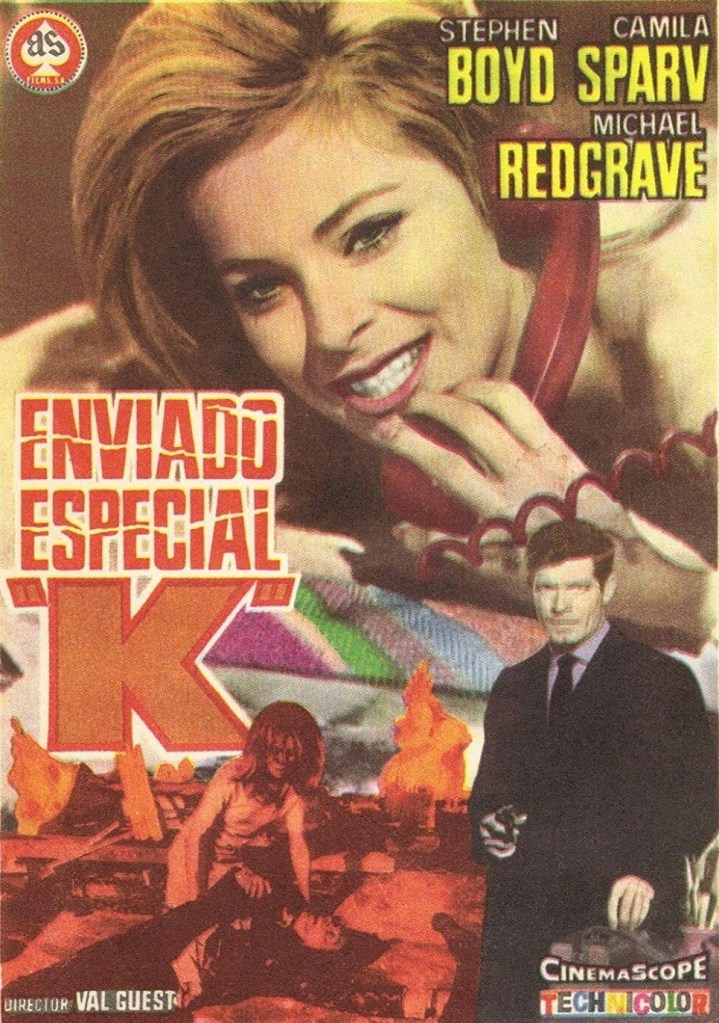
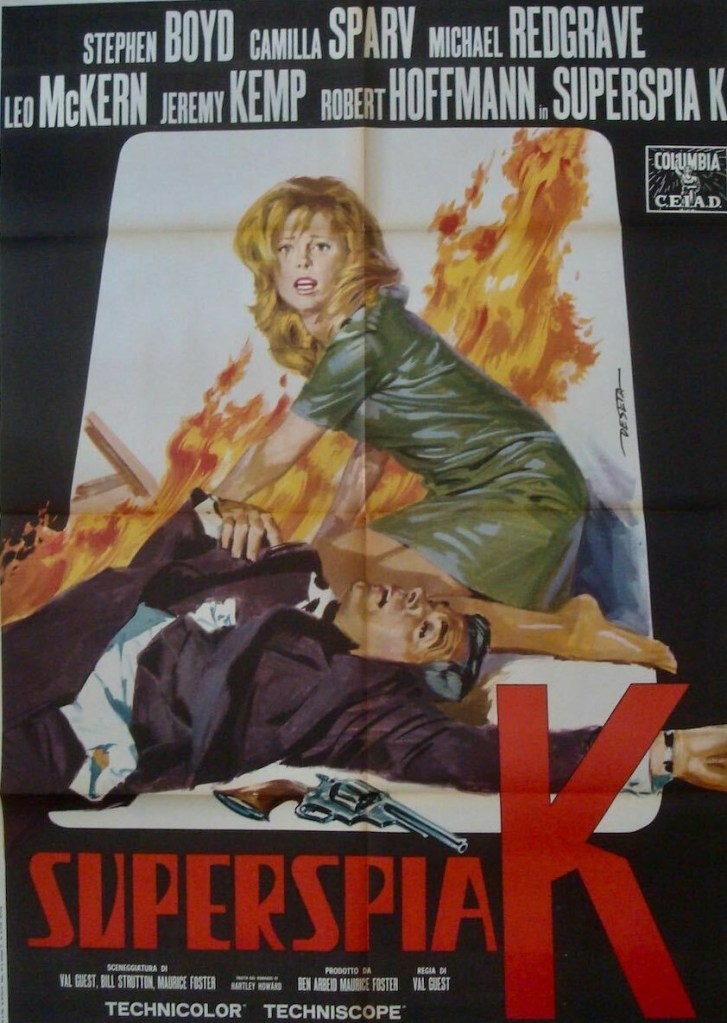
Assignment K does in some measure succeed, in part by going down the grimy route of The Spy Who Came in from the Cold (1965), in part by stuffing the picture full of glorious scenery – the Austrian Alps – and in part by turning Stephen Boyd into the kind of spy who has begun to question the entire business. For reasons unspecified, former racing driver turned toy salesman Boyd (The Big Gamble, 1961) is running his own spy operation loosely linked into British intelligence but when the network is compromised his life and that of new love interest Camilla Sparv (Nobody Runs Forever/The High Commissioner, 1968) endangered. Things get trickier when she is kidnapped and he has to save her while not compromising his own agents.
There is enough mystery to keep the plot, uncoiling like Russian dolls, ticking along and the entire effort is underwritten by some decent tradecraft, dead letter drops, microfilm hidden inside cigarette filters and so on. Tension is surprisingly high. And Boyd is surprisingly human, falling properly in love for one thing, not just treating women in the James Bond/Matt Helm fashion as notches on a bedpost, not ice-cool under pressure either, face knotting in fury on occasion, and not so accomplished in the old fisticuffs department. There is less reliance on just sticking out his chin and looking handsome and this is a more assured performance than in The Big Gamble.
Michael Redgrave (The Hill, 1965), Leo McKern (Nobody Runs Forever) and a pre-Please, Sir John Alderton provide decent support though Jeremy Kemp (The Blue Max, 1966) is somewhat subdued. But Boyd is a revelation. Here, his screen charm and charisma are at their best and while he was never going to attract the attention of the Oscar fraternity is entirely believable as a spy coming to wonder at decisions taken.
Sparv, too, is much better than I have ever seen her. Unlike her turn in Murderers Row (1966), her role is not merely decorative and the unfolding romance would work perfectly well just as a love story never mind tucked away in the guise of a spy thriller. There is a lovely demonstration of her acting skill, although an odd one to describe, as she pulls on a bathrobe and shimmies out of the towel underneath; I can’t believe that was ever scripted, but if you watch it you will see what I mean. Swedish Sparv was often viewed just as another of the decade’s ubiquitous European starlets but in fact she shows genuine acting ability.
Director Val Guest was usually labelled a “journeyman” despite a repertoire that included The Quatermass Xperiment (1955) and its sequel, Yesterday’s Enemy (1959) and sci-fi The Day the Earth Caught Fire (1961) and he had previous form in this genre with Where the Spies Are (1966) which played more to the comedy gallery and did some work on Casino Royale to boot. Guest was also involved in the screenplay along with two first-timers Bill Strutton and Maurice Foster, the former primarily a television writer, the latter a producer. Guest’s work here falls into the efficient category, but it does zip along at the same time as allowing Boyd and Sparv to develop their characters and make their relationship believable. All in all quite enjoyable.
CATCH-UP: The Blog has reviewed Camilla Sparv in Dead Heat on a Merry-Go-Round (1966) Nobody Runs Forever/The High Commissioner (1968) and Downhill Racer (1969). Stephen Boyd pictures reviewed so far are The Big Gamble (1961), The Fall of the Roman Empire (1964) and The Third Secret (1964).
If you’ve not already come across Cinema Retro magazine – now celebrating 18 years of publication – or its various Special Issues you are in for a treat. Spy Girls fell under its “Foto Files Special Edition” portfolio and includes over 200 illustrations of the actresses who dominated the wave of espionage pictures in the 1960s and to a lesser extent the 1970s.
As well as focusing on the leading female stars in every series film – James Bond, Derek Flint, Matt Helm, Bulldog Drummond, The Man from Uncle and Harry Palmer – the magazine also pay tribute to the wide variety of starlets who appeared in bit parts such as Zena Marshall (Dr No, 1962), Aliza Gur (From Russia with Love, 1963), Shirley Eaton and Margaret Nolan (Goldfinger, 1964) Molly Peters (Thunderball, 1965) and Gila Golan (Our Man Flint, 1966).
However, in the main the concentration is on the flood of European actresses who set Hollywood agog following multiple appearances in spy pictures. Beginning with original Swiss-born Bond girl Ursula Andress (Dr No and Casino Royale, 1967, the magazine features every actress who had a starring role in the mainstream spy films. Some, of course, seemed very comfortable in the genre with roles in several pictures.
Leading that particular parade were Italian Daniela Bianchi who, after her spy debut in From Russia with Love, was seen in Slalom (1965), Operation Gold (1966), Special Mission Lady Chaplin (1966), Requiem for a Secret Agent (1966) and Operation Kid Brother (1967). Matching her was Austrian Senta Berger, caught in The Secret Ways (1961), The Spy with My Face (1965), Our Man in Marrakesh (1966), The Quiller Memorandum (1966), The Ambushers (1967) and Istanbul Express (1968).
Not far behind came Israeli Daliah Lavi who lit up the screen in The Silencers (1966), The Spy with a Cold Nose (1966), Casino Royale (1967), Nobody Runs Forever (1968) and Some Girls Do (1969). German Elke Sommer was another regular, headlining The Venetian Affair (1967), The Corrupt Ones (1967), Deadlier than the Male (1967) and The Wrecking Crew (1968.) Also a regular in the genre was Yugoslavian Sylva Koscina with Hot Enough for June/Agent 8¾ (1964), That Man in Istanbul (1965), Agent X-77 Orders to Kill (1966) and Deadlier than the Male (1967)
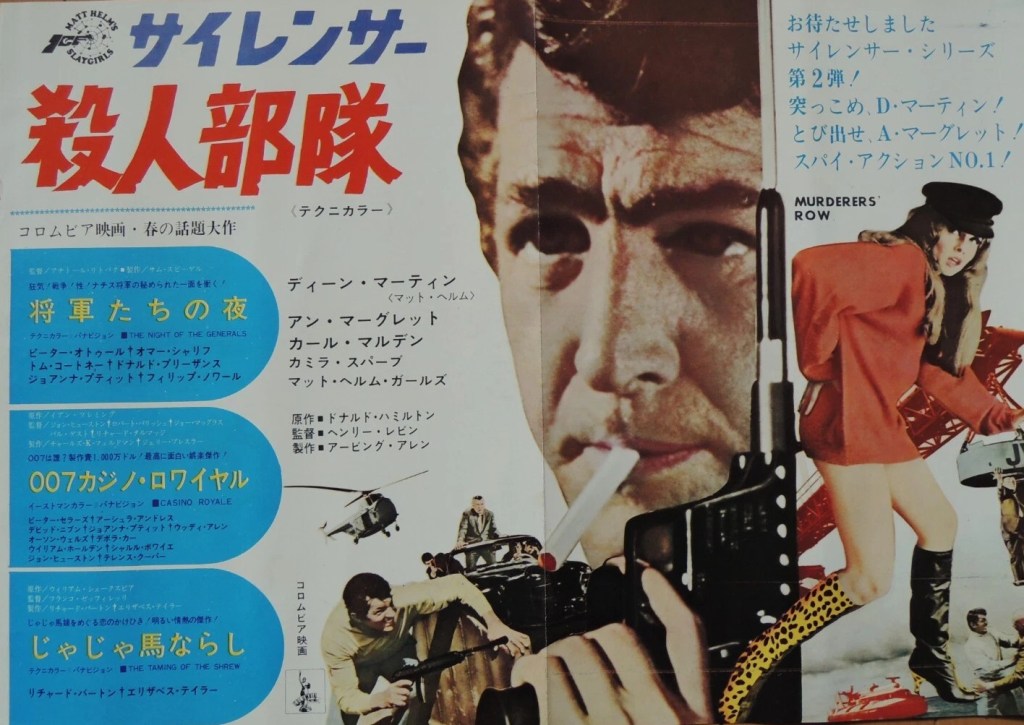
Canadian Beverly Adams featured three times in the Matt Helm series, in The Silencers, Murderers Row (1966) and The Ambushers (1967). Czechoslovakian Barbara Bouchet turned up in Agent for H.A.R.M (1966), Casino Royale and Danger Route (1967) and Austrian Marisa Mell had top roles in Masquerade (1965), Secret Agent Super Dragon (1966) and Danger:Diabolik (1968). Another three-peater was Rome-born Luciana Paluzzi – To Trap a Spy (1964), Thunderball (1965) and The Venetian Affair (1967) – not forgetting Swede Camilla Sparv in Murderers Row (1966), Assignment K (1968) and Nobody Runs Forever (1968).
No study on the girls involved in espionage over these two decades would be complete without mention of Raquel Welch for Fathom (1967), Monica Vitti in Modesty Blaise (1966), Honor Blackman in Goldfinger and Britt Ekland in The Man with the Golden Gun (1974). The occasional American leavened the pot – Jill St John appearing in The Liquidator (1966) and Diamonds Are Forever (1971) and Lana Wood also in the latter.
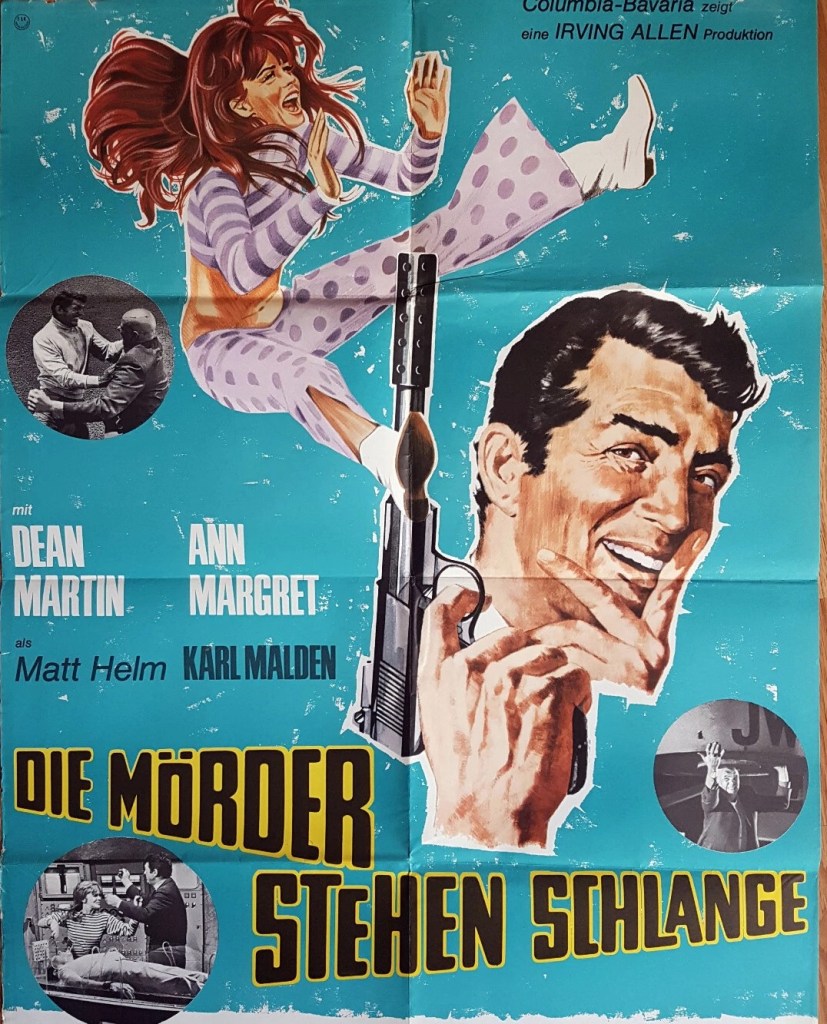
The extensive illustrations include stills, and photographs of the stars relaxing on set or setting up a shot, as well as a veritable archive of posters from virtually every country in the world, often with substantially different artwork to the originals. In addition, articles on the main actresses are included as well as snippets of information on the lesser stars.
Priced at just £6.95 / $11.99 this might make a nice Xmas filler.
Idealising heroes is endemic. Most films which portray sport stars with feet of clay generally start off with an attractive personality who presses the self-destruct button through alcohol, sex or drugs (or all three) such as Number One (1969) with Charlton Heston. The general consensus is that this approach to the sports movie was not rescinded until the brutal boxer exposed in Scorsese’s The Raging Bull (1980). But it turns out Scorsese was not the first.
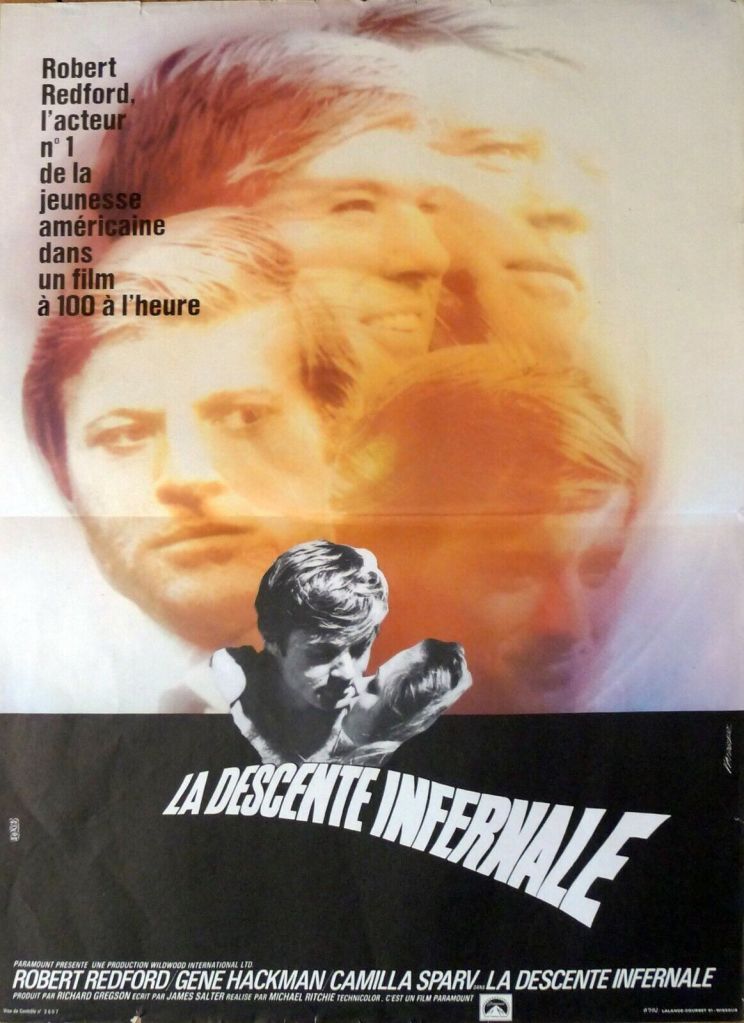
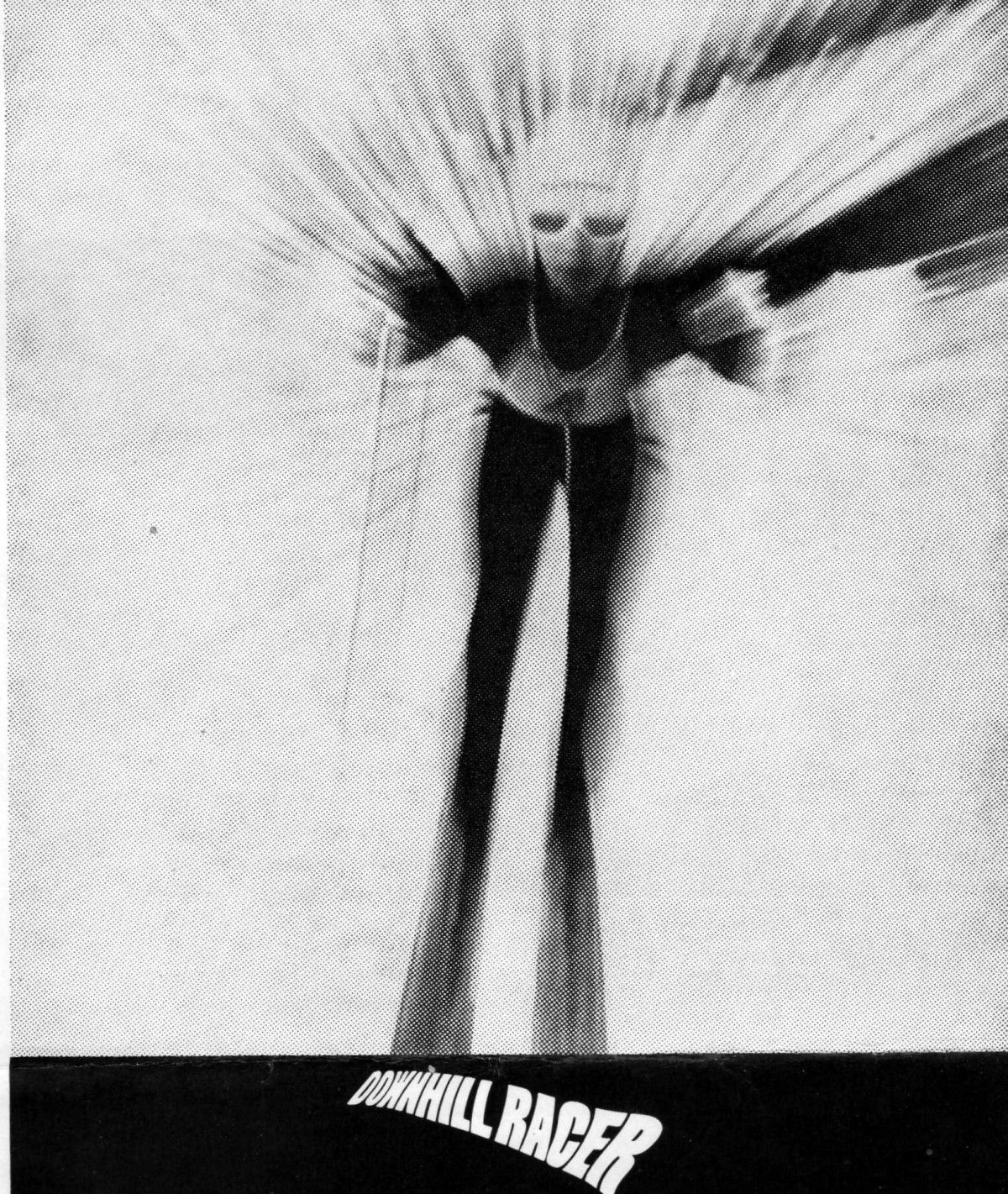
Downhill Racer is a character study of a loner who cares for no-one but himself. Alienated from his father, his girlfriend at home treated as little more than a sex object, a constant source of friction for his national team manager (a pre-chuckle Gene Hackman) and not above the kind of dirty tricks as typified in Slap Shot (1977) he sees nothing wrong with making no bones about the fact that he is in the game for fame. He has no illusions, he’s a farm boy and few steps up from being illiterate.
That Paramount had little faith in the project was shown by the Pressbook. It was a mere eight pages long when 16-plus pages were devoted to other pictures. There was no mention of the startling success of “Butch Cassidy and the Sundance Kid” released a few months before. Its limited appeal was shown by the fact there were only two adverts, both very artistic, whereas most movies had at least half a dozen different variations to help cinemas market the movie to their specific audiences. And there was but a single tag-line “how far must a man go to get from where he’s at.” Studio marketeers had managed to drum up just two promotions, both fashion-led, a six-page section in “Glamour” magazine and five pages in “Ski” magazine. A better bet was the accompanying two-page advertising supplement showing the movie had scored excellent reviews from “Time”, “Life”, “Newsweek” and the “New York Times.”
His only attractive feature is that he is played by Robert Redford, and the film plays upon the conceit that as handsome a man as this will at some point turn into a good guy. There’s an interesting debate – and one that would last decades – about whether Redford’s looks got in the way of the characters he portrayed. Imagine Robert Duvall in the part, for instance, and relentless determination would not be called into question. This leaves the film with only pity as a way to give the character any sympathy, which duly occurs when his hopes of genuine romance with a top-notch blonde (Camilla Sparv) are dashed.
Michael Ritchie, making his directing debut, opts for a documentary-style approach, so minimalist it’s almost perfunctory. This is a decent option given there’s very little going on beyond lonely hotel rooms, and an endless round of competitions and an occasional outburst from Hackman. Less welcome is his decision to fall back on television commentators to fill us in on exactly where we are geographically and specifically regarding individual competitions.
The film’s biggest drawback is that the skiing scenes, sensational at the time, offer little on the small screen. But at least they were competently done. Ritchie drew on a number of experts in that department: German racer Heini Schuler, Swiss team members Peter Rohr and Arnold Alpigger and ski instructors Marco Valli and Rudi Gertsch. Former U.S. Olympic team member Rip McManus turns up as an on-camera commentator. Although it gained good reviews, audiences failed to respond although Redford was on a career high after Butch Cassidy and the Sundance Kid (1969). But it was a brave choice for the actor.
And it was the start of his producing career. The film had been a stop-start project at Paramount and when the studio continued to dither Redford set up Wildwood with Richard Gregson, husband of Natalie Wood with whom Redford had appeared in Inside Daisy Clover (1965) and This Property Is Condemned (1966).












 The Magnificent 60s