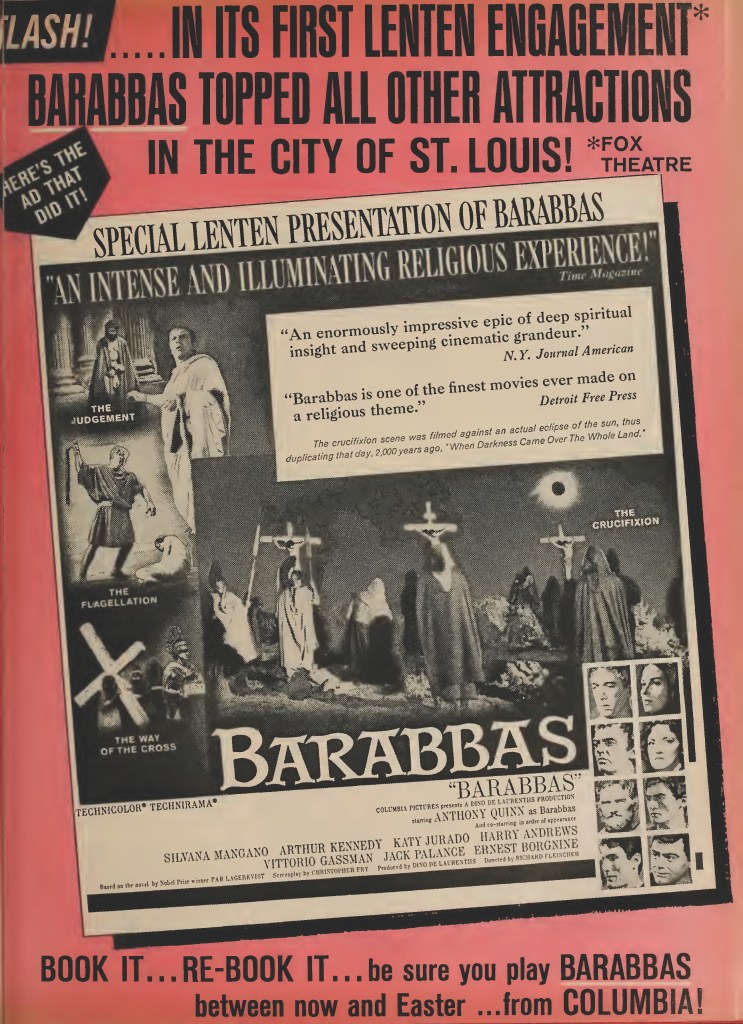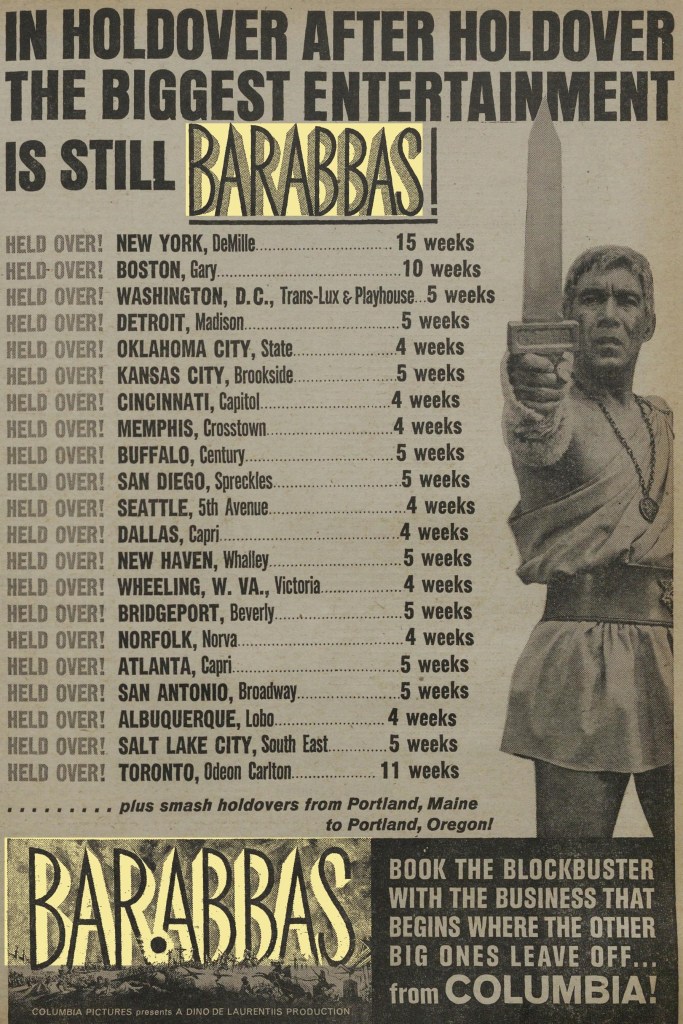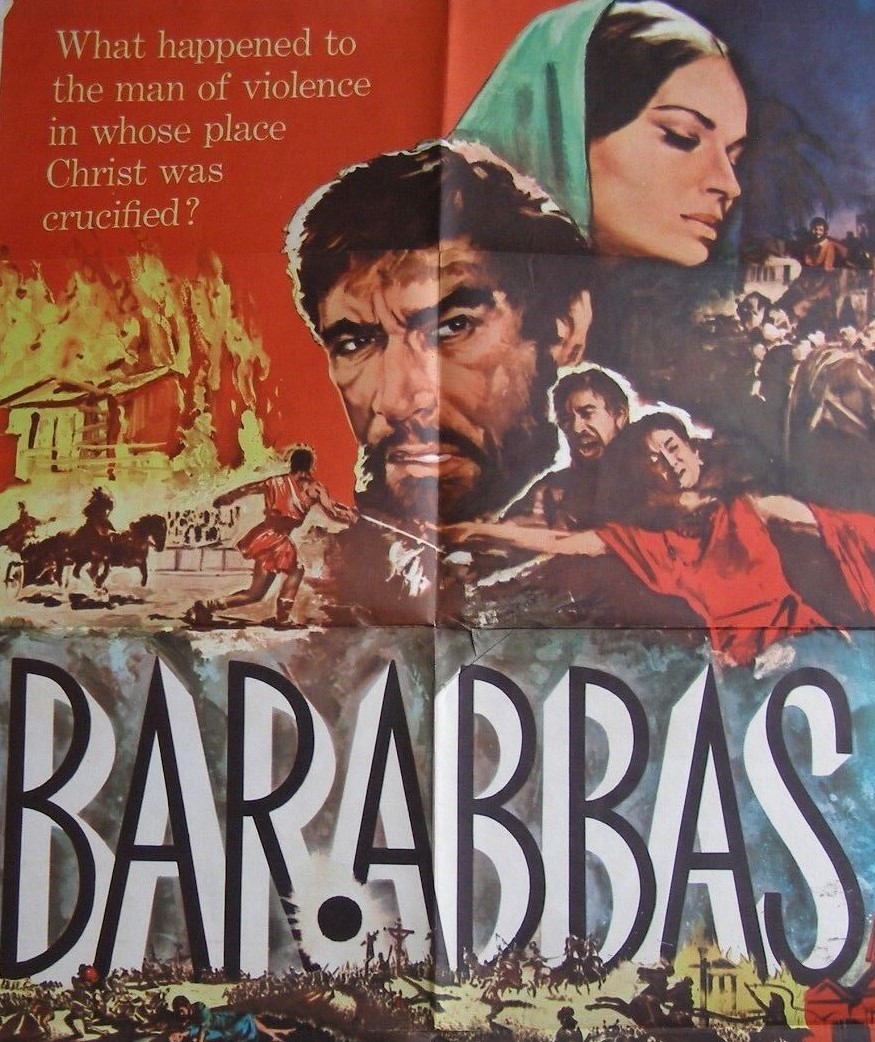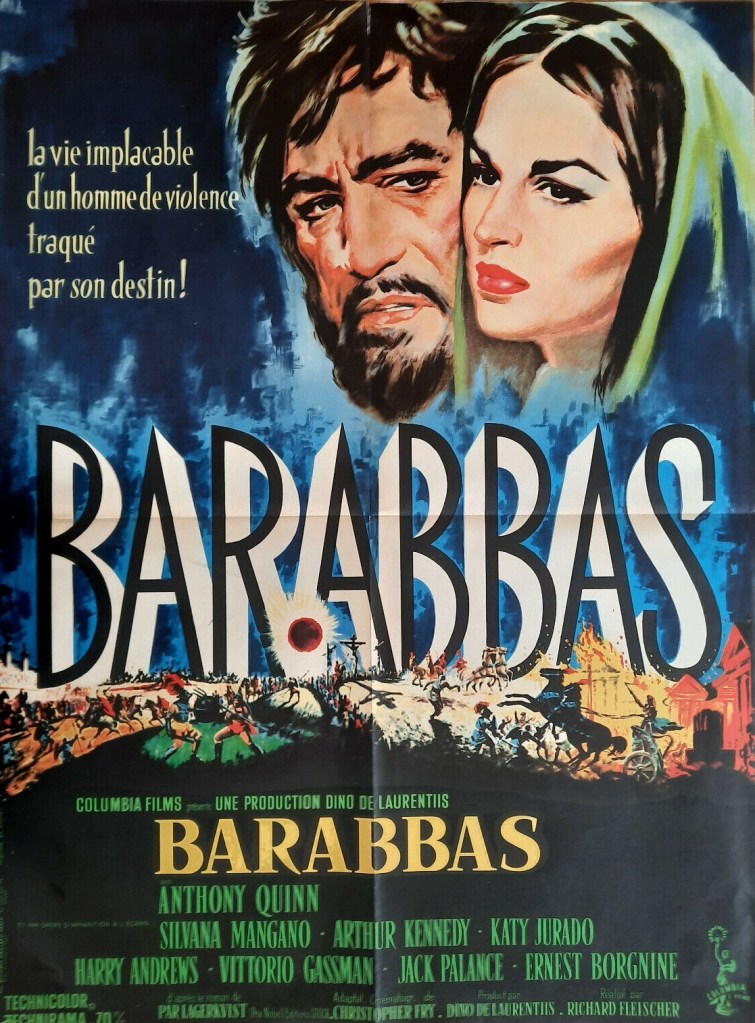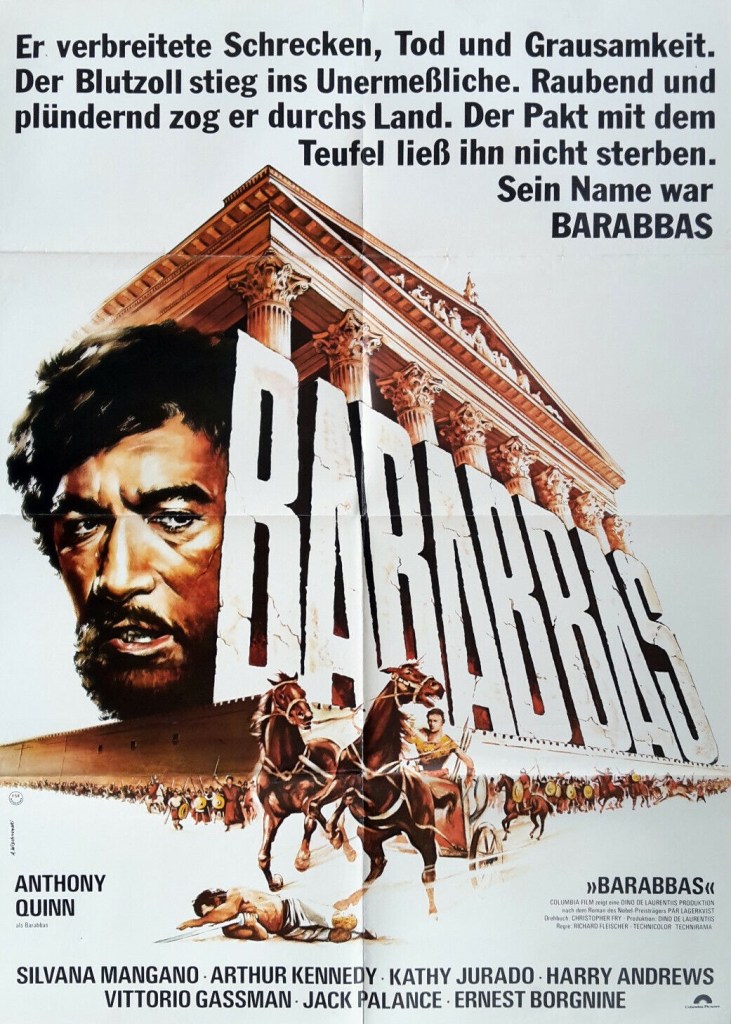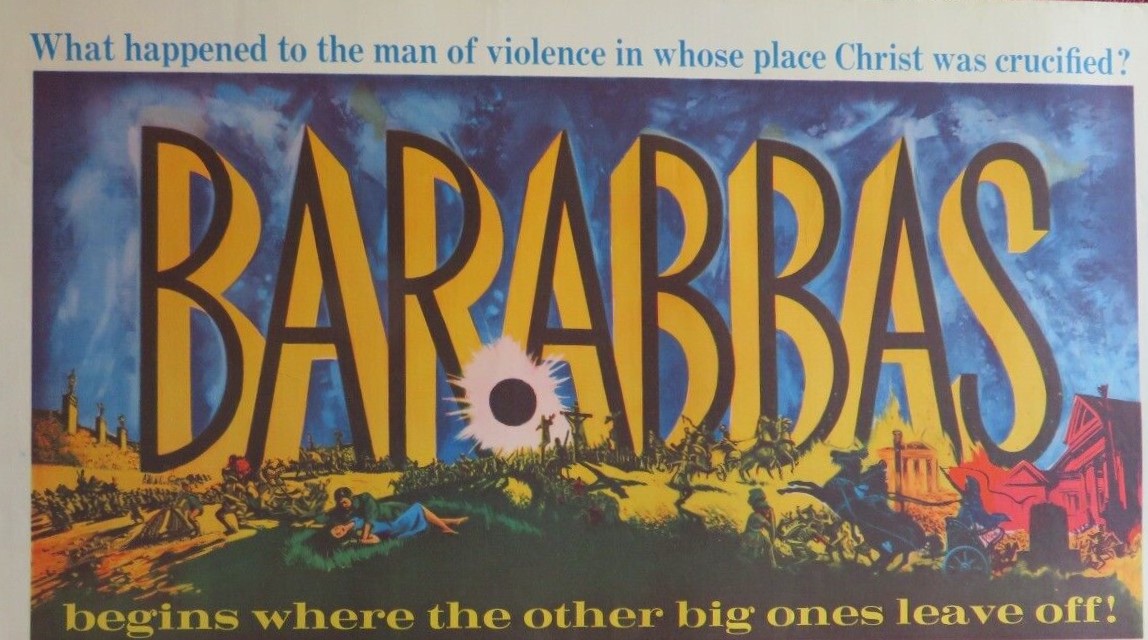
Brutally ironic ending adds a final twist to this religious epic that sheds a murky rather than heavenly light on the early days of Christianity. Barabbas (Anthony Quinn), in case you are unaware, is the criminal who, in a public vote, is spared crucifixion instead of Jesus Christ. Intent on returning to his lusty life, instead he finds himself drawn to the teachings of the Son of God despite his feverish attempts to deny it. Death might have been preferable to two decades spent imprisoned in the sulphur mines followed by a stint as gladiator only, finally refusing to deny his conversion, he ends up on a cross.
The fate of Barabbas in the Bible is undetermined, only meriting a few lines, but in the imagination of Swedish novelist Par Laverkvist he lived quite an extraordinary life, a criminal vagabond coming to believe in what he originally despised. The religious element is almost an excuse to investigate life at the edge of a pauper’s existence, a world in which faith is possibly the only way to get through the day. It’s an episodic tale with Barabbas as a Job-like peasant on whom constant indignity and humiliation is heaped.
A witness at times to the most exalted elements of Christianity – the eclipse surrounding the crucifixion, the stone rolled away from the tomb – he also sees lover Rachel (Silvana Mangano), a Christian convert, stoned to death. It’s a miracle he survives imprisonment in the mines and that when, thanks to an earthquake, he escapes it’s almost bitter irony that he ends up in gladiator school, facing the demonically sadistic Torvald (Jack Palance). Even when pardoned, he is again arrested for, believing the end of the world is nigh as described in the Christian teachings, helping burn Rome to the ground. Arrest this time sends him back to where he started, heading for crucifixion, though this time willingly.
Anthony Quinn (Guns for San Sebastian, 1968) is excellent as the dumb, mostly mystified peasant, only occasionally rising to the occasion, mostly defeated, or captured, and failing to defend those he should protect. Not entirely cowardly, witness his battle in the arena, but self-serving, and in a sense cursed by events outside his control.
Others are only briefly in the spotlight, Silvana Mangano (Five Branded Women, 1960) good as the converted Christian accepting her fate, ditto Vittorio Gassman (Ghosts of Rome, 1961) as an enemy prisoner in the mines, and Jack Palance (Once a Thief, 1965) over-the-top as the kingpin gladiator. In cameo roles – not exactly the promised all-star cast – you can find Ernest Borgnine (Chuka, 1967), Arthur Kennedy (Claudelle Inglish, 1961), Katy Jurado (A Covenant with Death, 1967), Valentina Cortese (The Visit, 1964) and Harry Andrews (The Charge of the Light Brigade, 1968).
Director Richard Fleischer (The Big Gamble, 1961) does a brilliant job of keeping reverence at bay, turning the potential awe of the eclipse into a moment of personal terror, ensuring that current persecution rather than potential eternal life remains foremost, focusing on the human not the ethereal. He presents Barabbas as constantly mystified at his escape, guilt-ridden that he has done nothing with his life, thwarted in virtually every attempt at redemption.
The big scenes are well-handled, the sulphur mines a pit of Hell, the arena far more realistic than Spartacus (1960), the burning of Rome that initially represents freedom turning into a trap. Filmed in Technirama 70mm, Fleischer makes the most of the widescreen and the historical detail.
In some respects this makes more sense if viewed alongside the director’s crime triptych of Compulsion (1959), The Boston Strangler (1968) and 10 Rillington Place (1970) which concentrate on outsiders coming to national attention through illicit activity.
Far from the usual stodgy religious offerings of the period, more in keeping with a Pasolini-like vision, with a keener eye on history than creed, it’s been rather overlooked and deserves reappraisal.
Christopher Fry (The Bible…in the Beginning, 1966) was credited with the screenplay from the book by the Nobel prize-winning novelist Par Laverkvist.
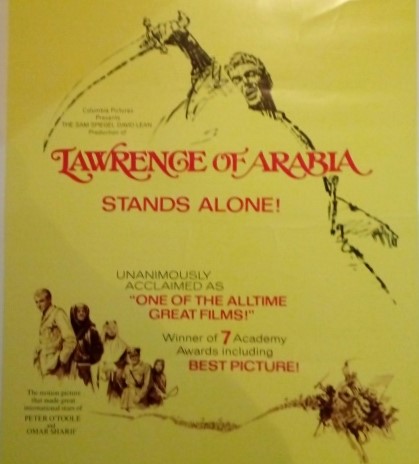
As unlikely as it sounds, John Wayne was once the leading contender to play Lawrence of Arabia. On January 14, 1953, the trade newspaper Variety reported that Cinerama, only known at the time for travelogs, was planning to move into feature filmmaking with productions of the hit Broadway musical Paint Your Wagon and Lawrence of Arabia, the latter with Wayne in the frame. Cinerama, as discussed in a previous Blog, was the sensation of the 1950s, the saviour of a movie industry eroded by television, prompting the boom in big-budget widescreen movies that were the hallmark of the next two decades.
It was a three-screen process, which meant filming with three cameras, somewhat unwieldy for working with actors. But This Is Cinerama, its first film, was the top earning film of 1952, even though it only played in a handful of cinemas. The driving force behind the idea was assistant board chairman Lowell Thomas, who, more than 30 years before, had single-handedly created the legend of Lawrence of Arabia.
Thomas had been a journalist covering the Middle East during the First World War. He had photographed the triumphant entry into Jerusalem in 1918 of the British forces led by General Allenby. The following year Thomas spun this event into a lecture that was launched in August in London to sensational results. Originally it was entitled ‘With Allenby in Palestine’, but after sensing the public was more interested in the unknown T E Lawrence, who he had photographed in Arab headdress, he changed the name to ‘With Allenby in Palestine and With Lawrence in Arabia’.
The show was so successful that when it came to the end of its run at the Covent Garden theatre, the owners offered 70% of the box office receipts to keep it on. Eventually, over five million people in Britain and the United States paid to see the lecture. And the Lawrence of Arabia industry was born. Thomas turned his lecture into a book which appeared in 1924 followed three years later by A Boy’s Life of Colonel Lawrence. Lawrence himself contributed to the legend with the publication of The Seven Pillars Of Wisdom (1926) and a shortened, easier-to-read, version called Revolt In The Desert (1926). Various best-selling biographies followed including Lawrence Of The Arabs (1928) by Robert Graves (Goodbye To All That), two tomes by military historian Capt Basil Liddell Hart, T E Lawrence: In Arabia And After (1934) and Colonel Lawrence, The Man Behind The Legend (1934) and Reginald H Kiernan’s Lawrence of Arabia (1935).
The first film on the subject was announced in 1929 by director Sydney Olcott for Supremacy Films, but the project came to nothing. In 1933 there was a US four-part serial by Jock Lawrence (no relation) called Flying Lawrence In Arabia, based on the exploits of Lawrence’s pilot during the war, Capt John H Norton. Two full-length feature films were announced the same year. First out of the gate was The Uncrowned King from RKO to feature top Hollywood star John Barrymore. Director Ernest Schoendanck spent several months in Mesopotamia shooting background material and by the time he returned the film had a new name, Fugitive From Glory.
In Britain movie magnate Alexander Korda’s London Films put Lawrence Of Arabia into production with Walter Hudd in the lead. Korda had acquired the rights to the biographies by Graves, Liddell Hart and Kiernan as well as Revolt In The Desert and an agreement from Lawrence’s trustees to use incidents from The Seven Pillars of Wisdom. After seeing British actor Walter Hudd in the George Bernard Shaw play The Apple Cart, Lawrence had declared Hudd was his personal choice for the part. But Korda agreed to delay production until after Lawrence’s death.
That came sooner than anyone expected, in a motorcycle accident in 1935 and generated such enormous public demand in the adventurer that publisher Doubleday Doran printed a limited edition of only a dozen copies of Lawrence’s last unpublished 76,000-word book The Mint for sale at an astonishing $500,000 each. U.S. producer Sherman S. Krellberg planned a serial based on Lawrence and a play was written by Mary K. Brookes. Korda moved quickly, getting financial backing from the Bank of America, acquiring the rights to the Thomas book and taking on the author as a technical adviser. The film was to be directed by Korda’s brother, Zoltan, who spent months in Jerusalem scouting locations, with a $400,000 budget. It was going to be momentous for another reason – it was planned as the first British film in color. In preparation, Korda sent to Hollywood for 8,000 items of color make-up and Natalie Kalmus of Technicolor was dispatched from the U.S. to supervise the process.
But it took another two years before Korda received the go-ahead from the UK government to film in Palestine, where there was political unrest. In the meantime, the first British color film had been released, Wings Of The Morning starring Henry Fonda. Hudd had been replaced by movie star Leslie Howard and Zoltan by U.S. director William K. Howard and the film was now being produced for Paramount. By then The Uncrowned King, produced now by Transamerica, had reached the screen, but only as a 10-part serial starring Lionel Atwill and with a 16-voice choir instead of an orchestra supplying the music. More importantly, the delay also allowed other U.S. studios to catch up.
Twentieth Century Fox dispatched director Otto Brower to Britain to begin a rival production and MGM was planning a film to star either Clark Gable or Paul Muni. In the end a Fox subsidiary New World became involved in the Korda film, but the project was called off after, it was rumored, severe government pressure. In 1938, the situation changed again. The sensation of the year was a claim by an Egyptian woman Nour Dahabi in Cairo to have found 3,500ft of film showing Lawrence on maneuvers in Arabia. MGM teamed up with Gaumont-British. And it was all change for Korda. His Paramount deal hit the rocks and he switched to United Artists, returned later in the year to the original studio, only to go back to UA who promised an increased budget. But, of course, in 1939 the beginning of the Second World War scuppered everyone’s plans.
After the war. Korda’s rights to Revolt In The Desert lapsed and he did not renew them. The American studios also gave up. John Sutro, who had helped found London Films, took over and, resurrected the project in 1947 at Rank under the banner of his Ortus Films. Although Rank was the biggest film company in Britain, involved in film production and exhibition, the film languished in development hell until 1953 when Cinerama appeared on the scene. Lowell Thomas had been instrumental in setting up the company in conjunction with Michael Todd. Thomas was the public face of the process and when projectors broke down in the middle of a Cinerama film, a short starring Thomas would fill the screen until the problem was solved.
But, as ever, the minute one company announced a Lawrence project, more popped up. David Rose claimed he was close to concluding a deal for the rights to Revolt In The Desert. British-based Anatole De Grunwald had a script by top British playwright Terence Rattigan who had written David Lean’s The Sound Barrier (1951).
In 1953 De Grunwald did a deal with Paramount who wanted Gary Cooper or Gregory Peck, who bore a likeness to Lawrence, in the lead, while De Grunwald pressed for Richard Burton. In the end the John Wayne project was shelved. By 1956 De Grunwald had approached American director King Vidor, and the film was due to roll in March 1957 but Vidor pulled out, Rank re-entered the equation, investing £2 million in a De Grunwald production with Anthony Asquith as directing Dirk Bogarde. In April 1958, Rank pulled the plug. Re-enter Twentieth Century Fox with Mark Robson helming.
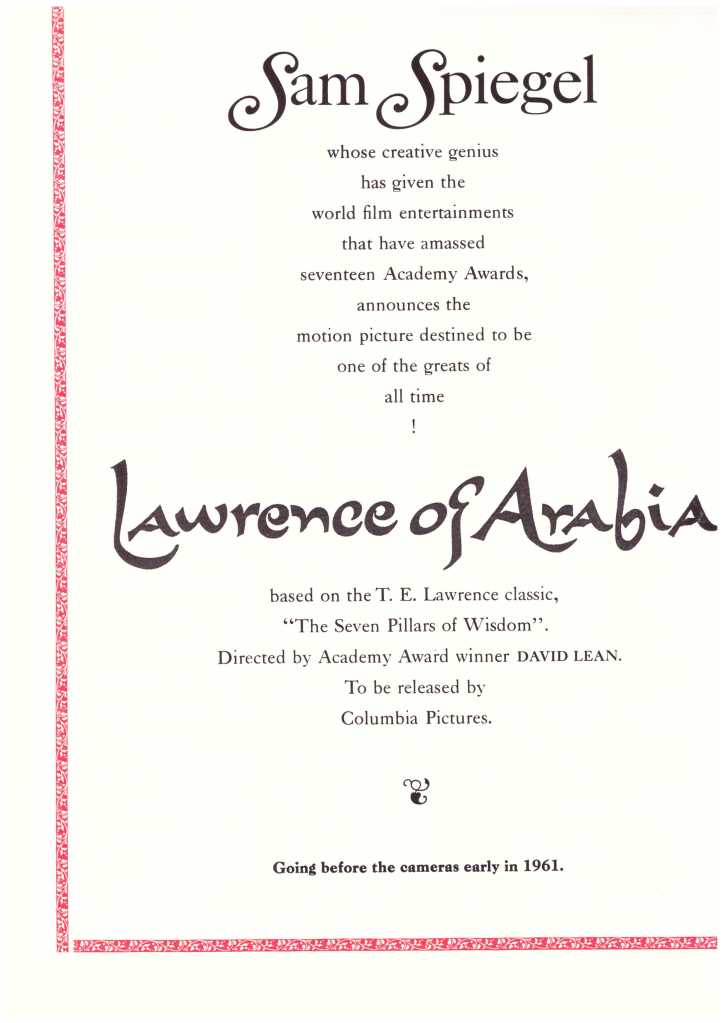
But in July 1959 Columbia made a deal with Sam Spiegel and David Lean who had turned Bridge On The River Kwai (1957) into the studio’s biggest hit. Meanwhile, Rattigan had turned his screenplay into the play Ross with Alec Guinness in the title role. Spiegel targeted Marlon Brando for Lawrence with a start date of summer 1960.
Spiegel had hired blacklisted screenwriter Michael Wilson, incurring the wrath of Columbia. Lean hired playwright Robert Bolt (A Man For All Seasons) to rewrite it. Meanwhile, Rank announced it had Alec Guinness for the lead.
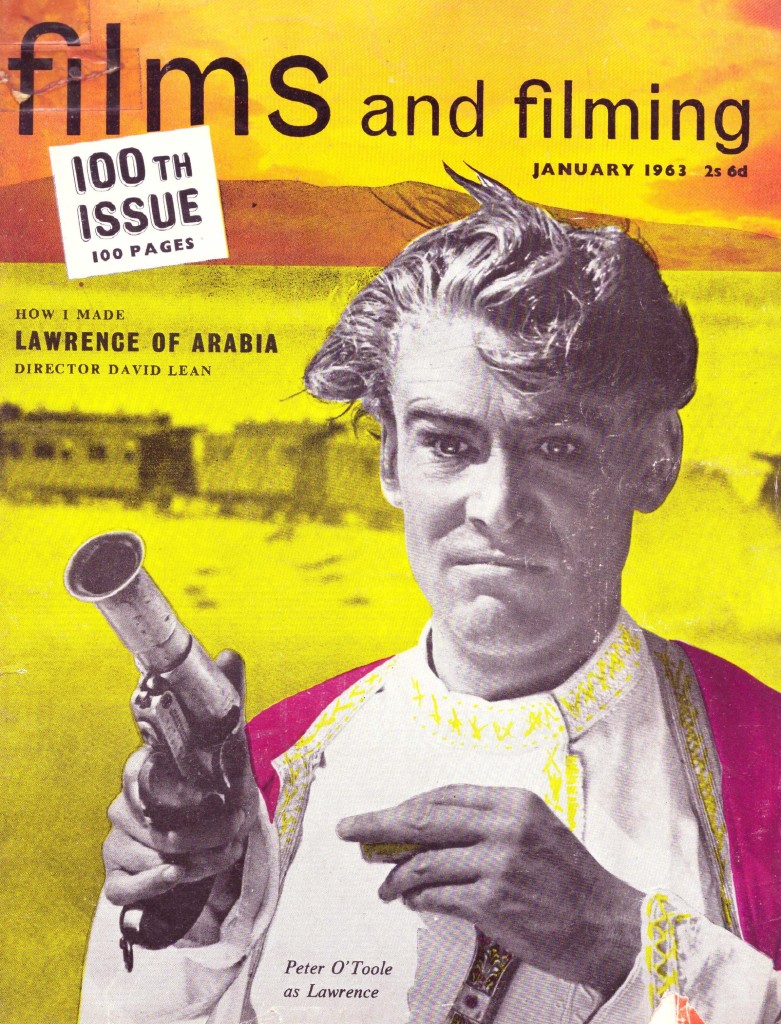
In July 1960 Brando pulled out. While Spiegel scoured Hollywood for a replacement, British producer Herbert Wilcox spent $364,000 on the rights to Ross with Laurence Harvey (Butterfield 8, 1960) to star. Lean went after British actor Albert Finney (Saturday Night And Sunday Morning, 1960) but the actor baulked at a long-term contract. His replacement was unknown Irishman peter O’Toole. Just as unknown, Omar Sharif was fifth choice for the pivotal role of Sherif Ali.
Filming was delayed until April 1961. Oscar-winner Alec Guinness, albeit in a supporting role, was crucial to bring cachet to the picture. The presence of two other Oscar winners, Jose Ferrer and Anthony Quinn, bolstered the marquee.
Finally, filming got underway in May in Jordan, despite an incomplete script. But conditions were horrific. Swarms of locusts hampered transport, temperatures hit 116 degrees Fahrenheit, the nearest water was 150 miles away. After a break, filming resumed in Spain on December 15 but Seville, chosen for its distinctive Arabian heritage, had just suffered the worst floods in a century, delaying production. The final location was Morocco and in July 1962 four planes flew 104 cast and crew there. Conditions there were as bad as in Jordan. After a few weeks in England, filming on the 313-day schedule ended on September 21, 1962. But with the world premiere set for December 10, it was panic all the way, especially after original composer Richard Rodgers of South Pacific fame quit.
Worse, ticket sales for the roadshow were poor, in part caused by the absence of a female in the cast. By mid-October sales for the U.S. opening stood at a paltry $11,424, compared to an advance of $700,000 for Exodus and $500,000 for How the West Was Won.
The world premiere of Lawrence Of Arabia took place in front of Her Majesty the Queen on December 10 at the flagship Odeon Leicester Square in London’s West End. The American premiere occurred on December 16 at The Criterion in New York.
But the public and the critics responded. On its first Saturday in London with only two performances, it set a new one-day record of $7,200. The Criterion’s opening week in New York was $46,000 which Variety described as ‘little short of amazing.’ The film was edited shortly after launch, the original prints cut by 20 minutes.
In the end it was both a box office and critical powerhouse, winning seven Oscars including Best Picture and Best Director, making stars out of O’Toole and Sharif, and for the past 60 years being acclaimed as one of the greatest films ever made.
Pre-Stagecoach (1939) Hollywood used to differentiate between historical adventure pictures and westerns. Given it’s set in 1746, before there was such a thing as a revolver or repeater rifle, so a complete absence of gunslingers, this falls squarely into the former camp though its format displays western credentials. A tad top-heavy with religious allegory, “miracles,” peasant piety and an Ennio Morricone score mainlining on the celestial, nonetheless it manages to achieve a character-driven narrative and some powerful action sequences.
However, it’s a lengthy set-up. Outlaw Leon (Anthony Quinn), on the run from Mexican troops, takes refuge in a church. As punishment for giving him sanctuary Fr Joseph (Sam Jaffe) is expelled to the abandoned church of San Sebastian in an equally abandoned village. Ringing the bell to attract parishioners only alerts bandits who kill him. Donning his garb, Leon is mistaken for a priest by Yaqui leader Teclo (Charles Bronson) and strung up crucifixion style. But he’s rescued by villagers who almost elevate him to sainthood courtesy of a couple of accidental “miracles.”
Enjoying his newfound status, but still attracted to peasant Kinita (Anjanette Comer), he directs the parishioners to build a dam to flood the fields to assist in corn-growing. Teclo objects to challenges to his authority and burns down the village. The villagers turn against Leon, and although initially intending to vanish, he decides instead to blackmail his mistress, the wife of the local governor (Fernard Gravey) who agrees to supply him with weapons. Leon builds a fortress to withstand the expected attack setting up a very engaging climax in which the dam plays a critical role.
A modern audience might expect a sturdier narrative rather than one that seems to shift at whim, not helped by Leon’s indecision. And it’s too slight a vehicle to carry the political points, the state of Mexico at the time, the settlers vs. original occupants (i.e. Native Indians) scenario, the problems facing half-breeds (Leon and Teclo both), but it’s better at exploring the power of the church, the worship bestowed on any priest who turns up, regardless of how ill-suited he appears. The occasional comic sequence, banter with an architect, negotiation with a Mexican colonel, seems out of place.
On the other hand there is a truly mesmerizing performance from Anthony Quinn (Lost Command, 1966) as a womanizing low-life who happens upon redemption, so deep does his impersonation of a priest go that he can’t bring himself to touch the compliant Kinita, who is aware of his true identity. Switching between shiftiness and godliness at the drop of a hat and deriding villagers for their lack of character his turning point comes when he realizes he has fallen into the same trap. That he emerges as a wily man of conscience is no mean feat.
The other big bonus is to see someone at last recognize Charles Bronson (Once upon a Time in the West, 1969). Here he is given cinematic status, camera pitched up at his face, and allowed to eliminate the growl and monosyllabic delivery that has been his wont in lesser roles. He’s a rather decent villain at the end.
There are a couple of inconsistencies. Teclo wants villagers to take to the hills but on the other hand somehow to spend enough time tending the corn that come harvest time he can steal. And it’s a bit too neat how he falls into the dam trap.
All in all, enjoyable and very under-rated primarily, i suspect, because people come at it expecting a western rather than a historical film in the adventure vein. But it’s elevated by the intriguing narrative, the questionable hero, Quinn’s performance and the introduction to a new-look Bronson.
Frenchman Henri Verneuil (The Sicilian Clan, 1969) does well to probe so many issues for an audience probably expecting something more straightforward. James Webb (Alfred the Great, 1969) wrote the screenplay based on novel by a William Faherty, a Jesuit priest. In the book, the hero was a soldier who became a priest rather than an atheist opportunistic outlaw.
Films that reach the screen two years after filming was completed are generally stinkers. Ken Annakin caper movie The Biggest Bundle of Them All wrapped production in summer 1966 and was not released until January 1968. But the reason was not the usual.
The cause of the unseemly delay was a temper tantrum by Oscar-winning uber-producer Sam Spiegel (Lawrence of Arabia, 1962) who had been working on a similar project about incompetent amateurs kidnapping a gangster kingpin – The Happening (1967) starring Anthony Quinn (previously reviewed in the Blog). After bringing a charge of blatant plagiarism, Spiegel was mollified by being permitted to bring his movie out first, with an inbuilt eight-month gap between both releases, the deal sweetened by a 15% cut of The Biggest Bundle’s profits and the right to vet the script.
Despite success with Those Magnificent Men in Their Flying Machines (1965) and Battle of the Bulge (1965) British director Annakin was at a career impasse. The Fifth Coin written by Francis Ford Coppola and starring George Segal failed to get off the ground. He turned down western Texas Across the River (1966) at a time when Catherine Deneuve and Shirley Maclaine were slotted in for the female roles and was fired from The Perils of Pauline (1967). The Italian Caper as it was then known, recalled Annakin, “did not seem a world-shattering movie but I found the caper fascinating and the cast irresistible.”
Let them eat cheesecake.
It marked the movie debut for producer Josef Shaftel of The Untouchables television fame and for screenwriter Rod Amateau (The Wilby Conspiracy, 1975), also then a television regular although the final script was attributed to another neophyte Sy Salkowitz. The film made the most of Italian locations, Naples and Rome, as well as the South of France and Provence. Annakin caught pneumonia just as shooting was to commence. Shaftel took over for five days only for his material to prove unusable.
Both veteran actors proved easy to direct. “Robinson was like putty in my hands, completely trusting.” And while Vittorio De Sica was every bit as amenable he was inclined to fall asleep on the set as the result of entertaining his mistress the night before. Di Sica was also a compulsive gambler and at one point lost half his salary in a casino.
Raquel Welch, in only her second picture after One Million Years B.C. (1966) – which contained minimal dialogue – was initially a handful. Primarily, this was due to inexperience and her desire to present herself in as alluring a fashion as possible, with impeccable hairstyles and make-up. After she had kept the crew waiting once too often Annakin threatened to eliminate her close-ups unless she respected the shooting schedule.
“On the whole I was quite pleased with the results because she really applied herself and so long as one broke up the scenes into a couple of lines at a time she became able to handle them quite adequately…I was getting along excellently with Raquel – even to the extent of trying to find another picture with her,” Annakin noted in his autobiography. Since this was written three decades after the movie was made, it would have given him ample time to get rid of any latent hostility to the actress. This reaction, it has to be said, is contrary to much of what has been written about Welch’s behavior on the picture. At the time of filming he reported that “she has a marvelous flair for comedy.”
But it appeared that Annakin was the only one who spotted her star potential. “The rest of the cast, especially Bob (Robert Wagner), regarded her as a pin-up girl on the make…none of them thought she was particularly sexy at this time.”
Otherwise, the only other trouble came from Godfrey Cambridge who “had a chip on his shoulder” and from Robert Wagner’s insistence on wearing false eyelashes. Problems arose over the cinematographer’s determination to employ powerful lights even at the height of a Mediterranean summer and a massive dust storm interrupted filming of the final scenes. Annakin also benefitted from the locations and using his experience was able to shift 35 pages of script from interiors to outdoors, completely altering the look of the picture. This made the $2 million movie “look like it cost three or four million,” according to Annakin.
At this point Welch, best known for having been sued by her publicist, was in the process of turning herself into a star in demand. In 1966 Welch was something of a Hollywood secret. She had three pictures in the bank, was working on a fourth and had signed up for a fifth before any of her movies had been released. On the other hand, she was fast becoming one of the most famous faces (and bodies) in the world, on the cover of of hundreds of magazines in Europe, many for the fourth or fifth time.
Having set up a company, Curtwel, managed by husband Patrick Curtis, she would earn $15,570 a week on loan to MGM for a second film Italian movie Shoot, Loud…Louder, I Don’t Understand (1966), considerably more than through her contract with Twentieth Century Fox. A year later she collected £100,000 for two weeks on portmanteau picture The Oldest Profession (1967).
Curtwel was also moving into the production arena, in 1965 attempting to set up No Place for the Dead and the following year optioning the musical comedy The Opposite Sides of the Fence and taking a quarter share in the mooted The Devil’s Discord to star Peter Cushing and Edd Byrnes under the direction of Michael Reeves (Witchfinder General, 1968). None of these ventures materialzed.
As well as having to contend with audience disinterest in the clumsy crook scenario as witnessed by the flop of The Happening, the enforced time gap allowed a second picture featuring bungling criminals called Too Many Crooks (1967) to reach cinemas prior to The Biggest Bundle. However, by January 1968, Welch was a much bigger name on movie marquees, having appeared on 400 international magazine covers and selected by U.S. exhibitors for the International Star of the Year Award while The Biggest Bundle had been preceded by another seven pictures including hits One Million Years B.C. and Fantastic Voyage (1966).
SOURCES: Ken Annakin, So You Wanna Be a Director, (Tomahawk Press, Sheffield 2001), pages 187-194; “Raquel Welch and Manager Form Curtwel Co,” Box Office, May 3, 1965, pW3; “Raquel Welch, Pat Curtis Form Curtwel Prods,” Box Office, October 5, 1965, pSE6; “Toutmasters Sue for 5% of Raquel Welch,” Variety, October 6, 1965, p14; “Raquel Welch in Rome,” Box Office, April 25, 1966, page SE1; “MGM’s Bundle Wrapping at Nice, Orders On Set in 3 Languages,” Variety, July 6, 1966, p7; “8 Pix for 2 Unseen Actresses,” Variety, August 17, 1966, p5; “Businesswoman Side of Raquel Welch,” Variety, November 2, 1966, p20; “Oldest Profession Gets New Locale in West Berlin, Raquel Welch’s 100G Job,” Variety, January 18, 1967, p24; “Columbia-Spiegel Holds 25% Share of MGM’s Bundle,” Variety, December 6, 1967, p3.
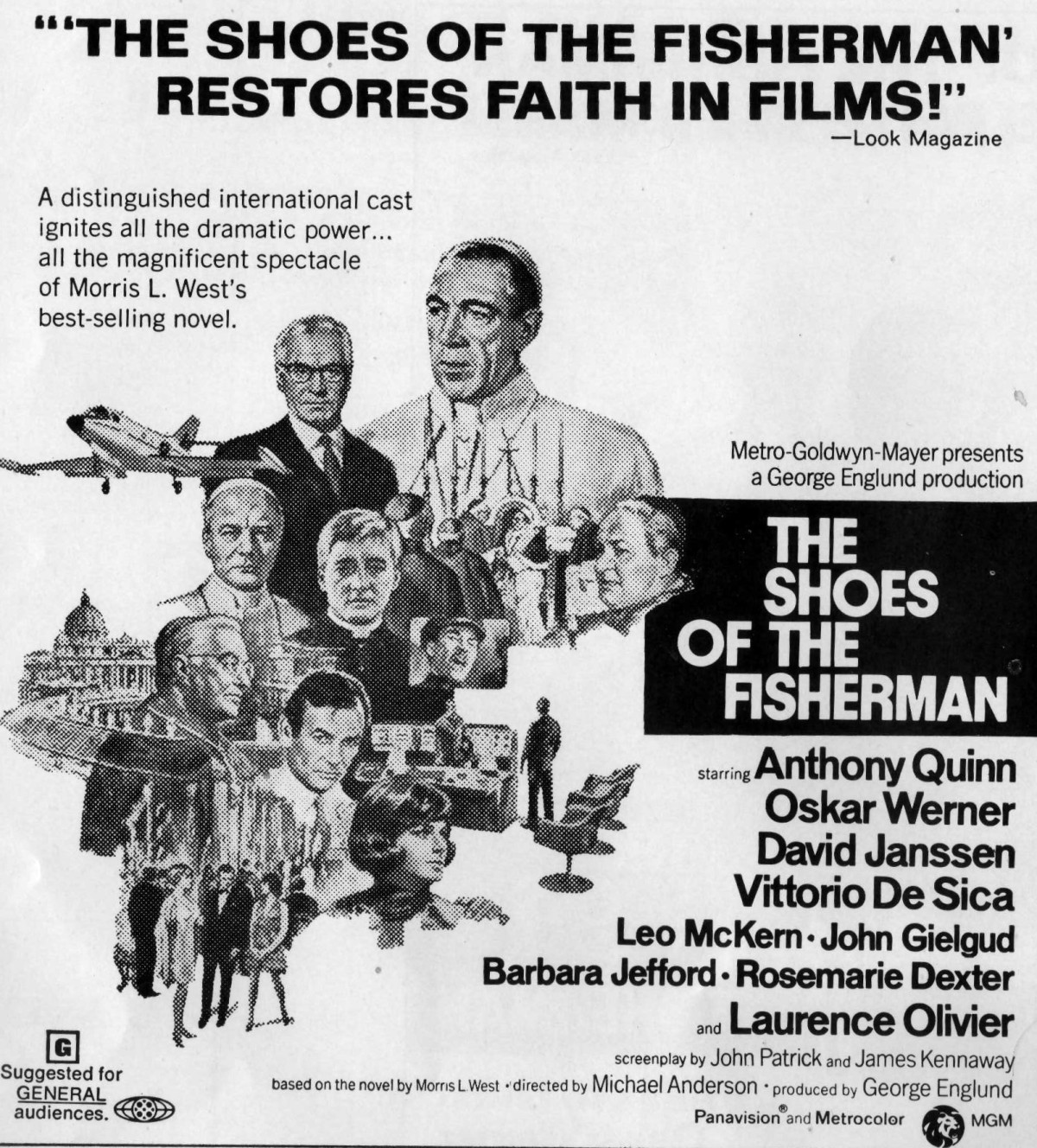
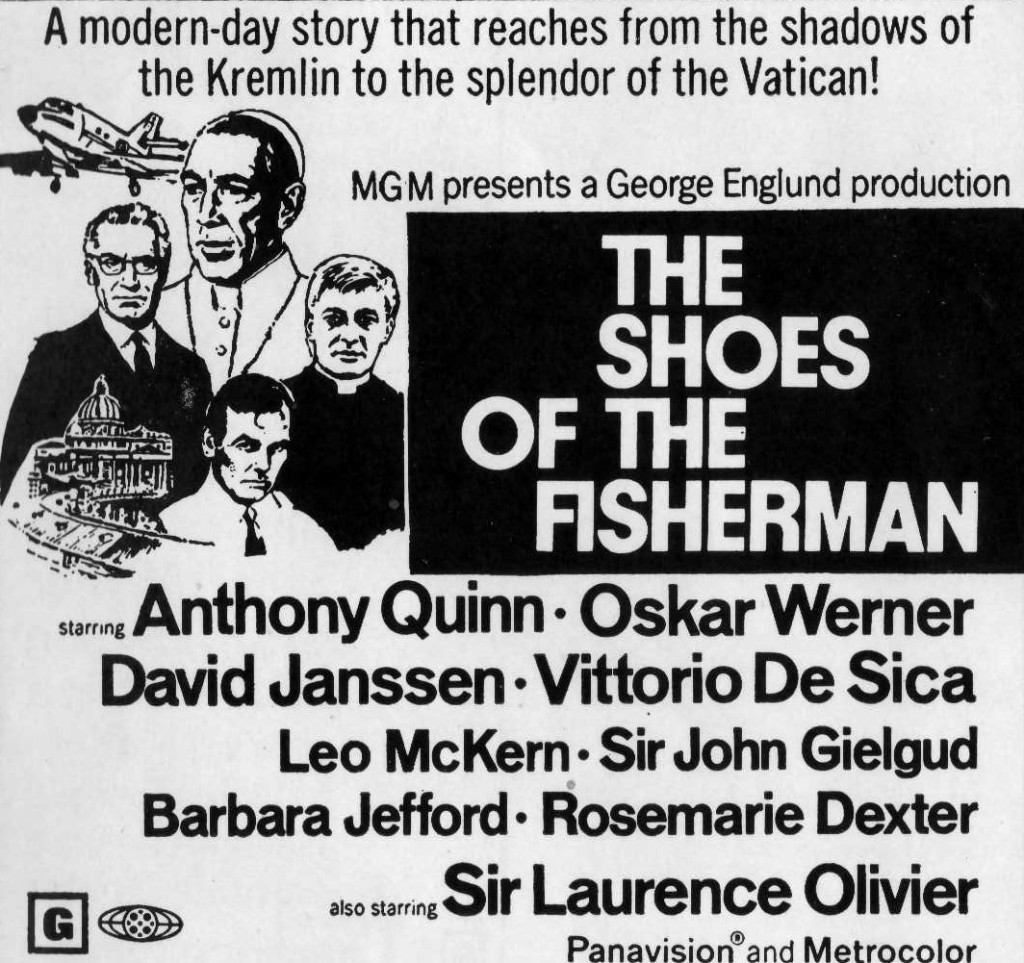
The Pressbook for The Shoes of the Fisherman is almost reverential in approach. For a start there is a complete lack of the madcap schemes designed by marketing men to promote the picture to the exhibitor. Nor is there any mention of the tie-ins that did exist – the book had sold seven million copies and the soundtrack by Alex North was already being acclaimed – it would be nominated for an Oscar. And there are very few of the titbits that might appeal to a local journalist.
There is only one piece of artwork, although a truncated version provides a secondary opportunity for advertising and combined with a scene from the film material for a third ad. Taglines are equally scarce. “A distinguished international cast ignites all the dramatic power…all the magnificent spectacle of Morris L. West’s best-selling novel” is all there is apart from a puff from Look magazine puff that espouses “The Shoes of the Fisherman restores faith in films.”
The better tagline, in the sense that it sold an actual story rather than promoted the ingredients, was: “A modern-day story that reaches from the shadows of the Kremlin to the splendor of the Vatican.” One further tagline gave away more of the plot: “In a last desperate attempt to prevent World War III, a secret meeting is arranged. One man is called upon to succeed where all the world leaders have failed. That man was once a prisoner in a Russian labour camp. He is now the Pope.”
So what’s left, you might ask. Well, as promised in the tagline, the “distinguished international cast” and “magnificent spectacle.” The cast was awash with Oscars. The stars included four-time Oscar winner Vittoria De Sica, two-time Oscar winner Anthony Quinn, Oscar winner Laurence Olivier and Oscar nominated Oskar Werner.
The sets were of the no-expense-spared variety. Barred from using the Vatican itself, the producers used a mixture of real locations and sets at Italian studio Cinecitta to create the necessary backdrops. The Sistine Chapel set measured 133 feet by 45 feet and the paintings that dominate the altar including “The Last Supper” were copied in Hollywood and transported piece by piece. This set actually functioned and was accurate down to the tiniest detail. The only major touch omitted from the sets was the steps leading to the altar, since that would have necessitated cumbersome ramps to track the movement of the cardinals as they cast their votes.
Oher buildings were appropriated for modern scenes – the Palazzo dello Sport for the secret peace conference. Cardinals arriving to vote were filmed at Fiumicino airport and Stazione Termini railroad station. Other locations included the Palazzo Farnese at Capranola used for scenes of the breaking of the old Pope’s seals, the Church of San Andrea della Valle for the interior of St Peter’s for the papal coronation, and Castello San Angleo, Biblioteca Vallicelliani and Palazzo Barberini.
Incidental information, the kind that journalists could use to augment their material, was scant. Author Morris L. West had once been a monk; bit part actor Clive Revill had been knifed in his previous film by Burt Kwouk; stage actress Barbara Jefford was appearing in only her third film and her role as a cerebral wife was in stark contract to her debut as the sensual Molly Bloom in Ulysses (1967); small-screen star David Janssen of The Fugitive played a small-screen reporter; and Oskar Werner had turned down over a 100 screen roles if they interfered with his commitment to the stage.
Thought-provoking drama with a surprisingly contemporary slant set against the grandeur of the Vatican amid geo-political turmoil. At a time of global crisis, dissident Russian archbishop Lakotov (Anthony Quinn) is unexpectedly freed from a labour camp by the Russian premier (Laurence Olivier). Arriving at the Vatican, he is promoted to cardinal by the dying Pope (John Gielgud) before becoming an unexpected contender for Papal office.
The spectacular wealth of the Catholic Church is contrasted with the spectacular poverty of China, on the brink of starvation due to trade sanctions by the United States, nuclear war a potential outcome. The political ideology of Marxism is compared to the equally strict Christian doctrine, of which Lakotov’s friend Father Telemond (Oskar Werner) has fallen foul. There is a sub-plot so mild it scarcely justifies the term concerning television reporter George Faber (David Janssen) torn between wife Ruth (Barbara Jefford) and younger lover Chiara (Rosemary Dexter).
Lakotov is drawn into the Russian-Chinese-American conflict and the battle for the philosophical heart of the Christian faith while bringing personal succour to the lovelorn and performing the only modern miracle easily within his power, which could place the Church in jeopardy, while condemned to the solitariness of his position.
The political and philosophical problems addressed by the picture, which was set 20 years in the future, are just as relevant now. The film’s premise, of course, while intriguing, defies logic and although the climax has a touch of the Hollywood about it nonetheless it follows an argument which has split the Church from time immemorial.
You would not have considered this an obvious candidate for the big-budget 70mm widescreen roadshow treatment, but MGM, after the Church not surprisingly refused access to the Vatican, spent millions of dollars on fabulous sets, including the Sistine Chapel. The roadshow version of the picture, complete with introductory musical overture and an entr’acte at the intermission, is leisurely and absorbing, held together by a stunning – and vastly under-rated – performance by Anthony Quinn (The Lost Command, 1966) who has abandoned his usual bombastic screen persona in pursuit of genuine humility and yet faces his moments when he questions his own faith.
Ruth has a pivotal role in bringing Lakotov down to earth but George has the thankless task, setting aside the quandaries of his love life, of talking the audience through the sacred ceremonies unfolding sumptuously on screen as the cardinals bury one Pope and elect another.
You wouldn’t think, either, that Hollywood could find room in such a big-budget picture for philosophical discussion but questions not only of the existence of God but whether he has abandoned Earth are given considerable scope, as are discussions about Marxism and practical solutions to eternal problems. None of these arguments are particularly new but are given a fair hearing. There is a hint of the Inquisition about the “trial” Telemond faces. Oskar Werner (Interlude, 1968) carries off a difficult role.
David Janssen (Warning Shot, 1967) is mere window dressing and Rosemary Dexter (House of Cards, 1968) mostly decorative but Barbara Jefford (Ulysses, 1967) is good as the wounded wife. Laurence Olivier (Khartoum, 1966) is the pick of the sterling supporting cast which included John Gielgud (Becket, 1964), Burt Kwouk (The Brides of Fu Manchu, 1966), Vittorio de Sica (It Happened in Naples, 1960), Leo McKern (Assignment K, 1968), Frank Finlay (A Study in Terror, 1965), Niall McGinnis (The Viking Queen, 1967) and Clive Revill (Fathom, 1967). In a small role was Isa Miranda, the “Italian Marlene Dietrich,” who had made her name in Max Ophuls Everybody’s Woman (1934) and enjoyed Hollywood success in films like Hotel Imperial (1939) opposite Ray Milland.
Michael Anderson (Operation Crossbow, 1965) directed with some panache from a script by veteran John Patrick (The World of Suzie Wong, 1960) and Scottish novelist James Kennaway (Tunes of Glory, 1960) based on the Morris West bestseller.
I found the whole enterprise totally engrossing, partly because I did not know what to expect, partly through Anderson’s faultless direction, partly it has to be said by the glorious backdrop of the Vatican and the intricacy of the various rites, but mostly from the revelatory Quinn performance. And even if the plot is hardly taut, not in the James Bond clock-ticking class, it still all holds together very well. From the fact that it was a big flop at the time both with the public and the critics, I had expected a stinker and was very pleasantly surprised.
Old causes never die but they do go out of fashion and interest from movie audiences in the issues surrounding the Spanish Civil War had fallen from the peak when they attracted artists of the caliber of Ernest Hemingway and Pablo Picasso. But passions surrounding the conflict remained high even 20 years after its conclusion as indicated in this Fred Zinnemann (The Sundowners, 1960) drama.
Manuel Artiguez (Gregory Peck) plays a disillusioned guerilla living in exile in France who has ceased raiding the Spanish border town under the thrall of the corrupt Captain Vinolas (Anthony Quinn). Artiguez has two compelling reasons to return home – a young boy Paco asks him to revenge the death of his father at the hands of Vinolas and his mother is dying. But Artiguez is disinclined to do either. Heroism has lost its luster. He has grown more fearful and prefers to live out his life drinking wine and casting lustful glances at young women.
In France he enjoys a freedom he would be denied in Spain. He is not hidden. Ask anybody in the street where he lives and they will tell you. This is a crusty old soldier, unshaven, long past finding refuge in memories, but not destroyed either by regret. There is a fair bit of plot, some of it stretching incredulity. The action sequence at the end, conducted in complete silence, is very well done, but mostly, while a shade on the earnest side, this is a character piece.
This is not the upstanding Gregory Peck of his Oscar-winning To Kill a Mockingbird (1962). He is a considerably less attractive character, burnt-out, shabby, grizzled, lazy, easily duped, unwilling to risk his life to see his mother. We have seen aspects of the Anthony Quinn character before but he brings a certain humanity to his villain, bombastic to hide his own failings, coarse but occasionally charming, suitably embarrassed when caught by his wife visiting his mistress and praying earnestly to God to deliver Artiquez into his hands. Omar Sharif is the most conflicted character, forced by conscience to help an enemy of the Church.
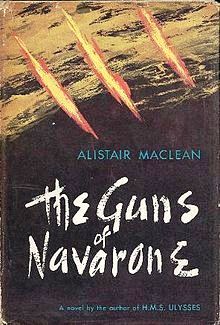
Movie tie-in paperback edition.The more esoteric cover for the original hardback edition.
However, two elements in the picture don’t make much sense. Paco tears up a letter (critical to the plot) to Artiquez which I just cannot see a young boy doing, not in an era when children respected and feared their elders. And I am also wondering what was it about Spain that stopped directors filming it in color. This is the third Spain-set picture I have reviewed in this Blog after The Happy Thieves and The Angel Is Red. For the first two I can see perhaps budget restrictions being the cause, but given the stars involved – Rex Harrison and Rita Hayworth in the first and Ava Gardner and Dirk Bogarde in the second – hardly facing the production dilemmas of a genuine B-picture. But Behold a Pale Horse was a big-budget effort from Columbia and while black-and-white camerawork may achieve an artistic darkness of tone it feels artificial. This was never going to be the colorful Spain of fiestas and tourist vistas but it would have perhaps been more inviting to audiences had it taken more advantage of ordinary scenery.
J.P. Miller (Days of Wine and Roses, 1962) adapted the film from the novel by Emeric Pressburger who in tandem with Michael Powell had made films like Black Narcissus (1947) and The Red Shoes (1948). The film caused calamity for Columbia in Spain, the depiction of Vinolas with a mistress and taking bribes so upset the authorities that all the studio’s movies were banned. Peck and Quinn had worked together in The Guns of Navarone (1961) and Quinn and Sharif in Lawrence of Arabia (1962).
I’ve been writing this Blog now for one year, beginning July 2020, so I thought I’d take a look at which posts proved the most popular (in terms of views) with my readers. So here’s the annual top 30 films, ranked in order of views.
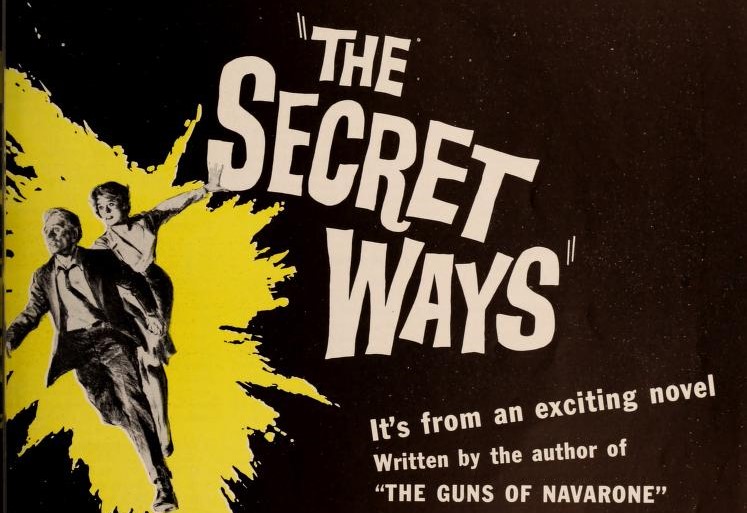
The Secret Ways (1961) – Richard Widmark and Senta Berger – making her Hollywood debut – behind the Iron Curtain in gripping adaptation of the Alistair Maclean thriller.
Ocean’s 11 (1960) – Frank Sinatra, Dean Martin, Sammy Davis Jr. and the Rat Pack in entertaining heist movie set in Las Vegas.
It’s Not All Rock’n’Roll (2020) – remarkable documentary about the other side of the music business as ageing rocker Dave Doughman tries to keep his dreams alive.
Age of Consent (1969) – British actress Helen Mirren makes her movie debut as the often naked muse for painter James Mason in touching drama directed by Michael Powell.
The Venetian Affair (1966) – Robert Vaughn shakes off his The Man from Uncle persona in taut Cold War thriller also starring Elke Sommer as his traitorous wife and Boris Karloff in a rare non-horror role.
The Golden Claws of the Cat Girl / La Louve Solitaire (1968) – French cult thriller starring Daniele Gaubert as sexy cat burglar forced to work for the government.
Pharoah / Faron (1966) – visually stunning Polish epic about the struggle for power in ancient Egypt.
The Swimmer (1968) – astonishing performance by Burt Lancaster as a man losing his grip on the American Dream.
Stiletto (1969) – Mafia thriller with hitman Alex Cord and and illegal immigrant girlfriend Britt Ekland hunted by ruthless cop Patrick O’Neal.
The Naked Runner (1967) – after his son is taken hostage businessman Frank Sinatra is called out of retirement to perform an assassination.
Marnie (1964) – Sean Connery tries to reform compulsive thief Tippi Hedren in Alfred Hitchcock thriller.
Our Man in Marrakesh / Bang! Bang! You’re Dead (1966) – Entertaining thriller sees Tony Randall and Senta Berger mixed up in United Nations plot involving the likes of Klaus Kinski and Herbert Lom.
The Happening (1967) – Anthony Quinn locks horns with Faye Dunaway and a bunch of spoiled rich kids in kidnapping yarn.
Dark of the Sun / The Mercenaries (1968) – Rod Taylor and Jim Brown head into the heart of darkness in war-torn Africa with a trainload of diamonds and refugees including Yvette Mimieux.
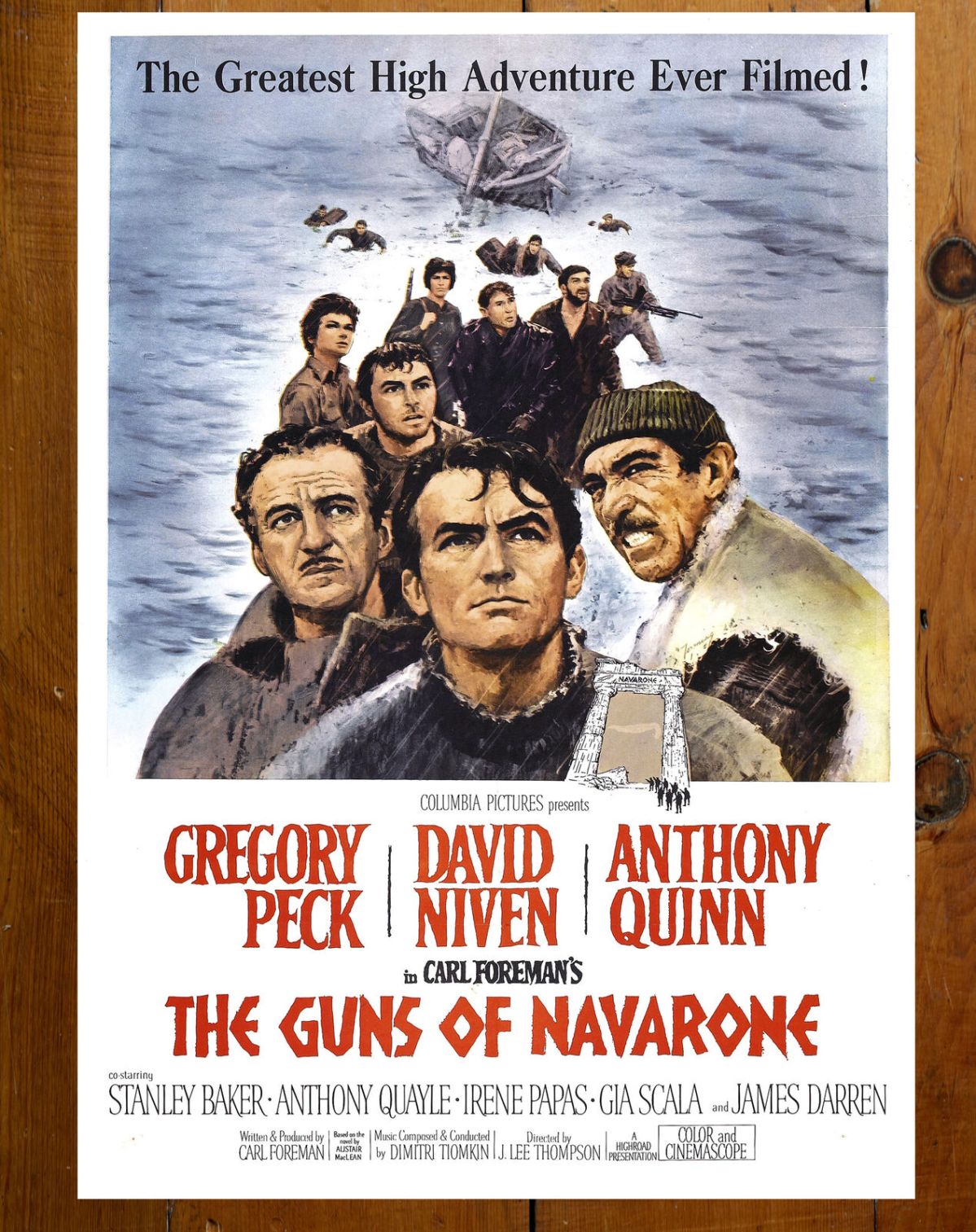
The Guns of Navarone (1961) – men-on-a-mission Alistair Maclean World War Two epic with all-star cast including Gregory Peck, David Niven, Anthony Quinn, Anthony Quayle, Stanley Baker, Irene Papas, James Darren and Gia Scala.
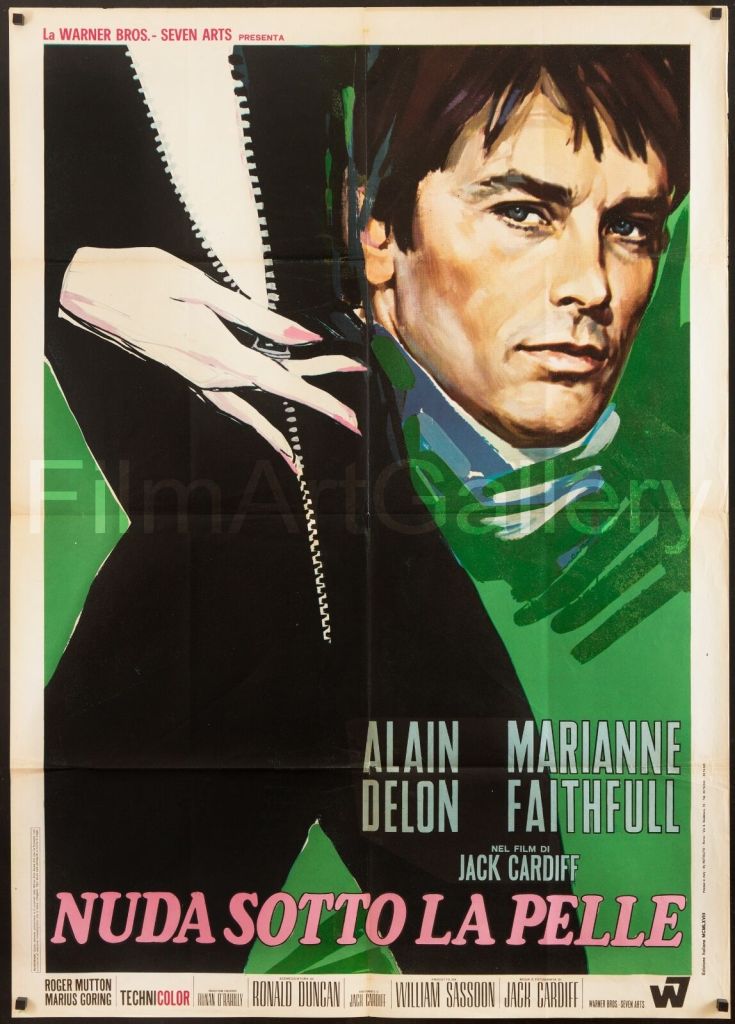
The Sicilian Clan (1969) – three generations of French tough guys – Jean Gabin, Lino Ventura and Alain Delon – clash in Mafia-led jewel heist.
4 for Texas (1963) – Frank Sinatra and Dean Martin as double-dealing businessmen in highly entertaining Robert Aldrich Rat Pack western starring Ursula Andress and Anita Ekberg.
Five Golden Dragons (1967) – Innocent playboy Robert Cummings becomes enmeshed with international crime syndicate led by Christopher Lee, George Raft and Dan Duryea.
Duel at Diablo (1966) – James Garner and Sidney Poitier team up to protect Bibi Andersson in Ralph Nelson western.
Move Over Darling (1963) – after years marooned on a desert island Doris Day returns to find husband James Garner just married to Polly Bergen.
Pressure Point (1962) – prison psychiatrist Sidney Poitier is forced to treat paranoid racist inmate Bobby Darin.
Wonder Woman 84 (2020) – in one of the few films to get a cinematic screening during lockdown, Gal Gadot returns as mythical superhero to battle supervillain Kristen Wiig.
Genghis Khan (1965) – Omar Sharif as the Mongol warrior who conquered most of the known world, tangling with rival Stephen Boyd and Chinese mandarin James Mason on the way.
A Fever in the Blood (1961) – Warner Bros wannabes Efrem Zimbalist Jr, Angie Dickinson, Jack Kelly and veteran Don Ameche in tough political drama.
The Prize (1963) – Paul Newman and Elke Sommer investigate murder in the middle of the annual Nobel Prize awards in Sweden.
In Search of Gregory (1969) – wayward Julie Christie embarks on pursuit of Michael Sarrazin who may – or may not – be a figment of her imagination.
Justine (1969) – Dirk Bogarde and Michael York become entangled in web woven by Anouk Aimee in corrupt pre-World War Two Middle East.
The Girl on a Motorcycle (1968) – singer Marianne Faithful in a hymn to the open road and sexual freedom.
Blindfold (1965) – psychiatrist Rock Hudson and dancer Claudia Cardinale in highly entertaining mystery thriller about missing scientists.
Hammerhead (1968) – secret agent Vince Edwards and goofy Judy Geeson on the trail of evil mastermind Peter Vaughn.
It’s time to celebrate the 60th anniversary of The Guns of Navarone – world premiere on April 27, 1961, in London and New York opening on June 22, 1961. Although the picture set a new benchmark in high-octane entertainment, a fast-moving war thriller packed with twists and a genuine all-star cast, it was far – very far – from the sure thing it appears in retrospect.
Box office smash in Britain.
For a start, U.S producer Carl Foreman, a victim of the McCarthy anti-communist witch-hunt of the early 1950s, was unable to assemble any of the talent he had set his heart on. He lost his preferred male cast of William Holden and Cary Grant and original scriptwriter Eric Ambler, the thriller writer famed for The Mask of Dimitrios and other novels.
He had a registered a major publicity coup by engineering the screen debut of opera diva Maria Callas, one of the most famous people in the world, but she also dropped out as did his other initial choice for leading lady. On top of that, once filming began he lost his director, Alexander Mackendrick, who had not only achieved a critical and commercial success with the British Ealing comedy The Ladykillers (1951) but also crossed the Atlantic to make the acclaimed The Sweet Smell of Success (1957) starring Burt Lancaster and Tony Curtis, to prove he could handle big Hollywood stars.
On top of that David Niven nearly lost his life during production and by the time the picture appeared Gregory Peck had suffered so many box office flops that he was a potential liability. And Foreman’s own marriage was in trouble.
Building the massive guns set.
It was a wonder it was made at all for Foreman was nobody’s idea of a sure thing. Although he had made his name as a screenwriter with three Oscar nominations for Champion (1949), The Men (1950) and High Noon (1952), his career was in ruins after being slung out of America for his supposed communist sympathies. He set up in London where he wrote screenplays under pseudonyms. But in 1956 won a four-picture production deal with Columbia at a time when that studio was investing heavily in making films in Britain to take advantage of the government’s Eady Levy (effectively, a tax rebate) and cheaper costs. But his first film, The Key (1958) with William Holden and Sophia Loren flopped in the U.S. Columbia persevered, seeing Foreman as the man to tackle its biggest-ever European production.
The Guns of Navarone almost fell at the first hurdle. Foreman’s first choice of location was Cyprus which was threatening to erupt into a civil war. At the last minute, he changed his mind and shifted production to Rhodes. Foreman, who also acted as screenwriter, made considerable changes to the book by British bestselling thriller writer Alistair Maclean, not least of which was introducing female characters to a story that had been resolutely all-male.
Original hardback book cover.
There was tension on set – four-time Oscar nominee Gregory Peck was annoyed at sharing the screen with two winners David Niven (Best Actor for Separate Tables, 1958) and Anthony Quinn (twice Best Supporting Actor for Viva Zapata, 1952, and Lust for Life, 1956). Replacement director J. Lee Thompson (Ice Cold in Alex, 1958) managed to sink a ship on loan from the Greek navy. The Actor’s Strike in Hollywood nearly forced the departure of the two younger stars.
The set for the titular guns was the largest ever built, costing £100,000, and even though that proved a design miracle, that, too, was not exempt from disaster, having to be rebuilt after a thunderstorm destroyed part of the set. The injury to David Niven was so severe he nearly died, putting the production in jeopardy. Even when the film approached completion there were other obstacles in the way, composer Dmitri Tiomkin (The Alamo, 1960), for example, demanding a record fee and Foreman locking horns with Columbia over his insistence on launching the picture as a roadshow, request which was ultimately denied, and one of the reasons for the film’ release delay,
I’ve written a book about The Making of The Guns of Navarone. Originally published in 2013, it has been revised with over 30 illustrations added for a new edition to tie in with the 60th anniversary – available both in print and Kindle versions. Needless to say, it would also make an ideal present for Father’s Day.
If you’re interested in this kind of book, you might like to know that I’ve also written The Making of The Magnificent Seven.
Stone-cold action classic that blazed a trail for the big-budget men-on-a-mission war picture like The Dirty Dozen (1967) and Where Eagles Dare (1968). Brilliantly structured, written and directed, and featuring a sea battle, storm, shipwreck, mountaineering, chase, interrogation scenes, infiltration of an impregnable fortress, a pair of romances, two traitors, and an awe-inspiring climax make this a candidate for one of the greatest war pictures ever made.
The set-up is simple. Knock out the gigantic guns at Navarone or two thousand men will perish. It’s mission impossible and the clock is ticking. You don’t know who to trust and the enemy is ruthless.
In the early days of the all-star-cast, producer Carl Foreman rounded up an astonishing line-up, bulking out the bestseller by Scottish thriller maestro Alistair Maclean (The Secret Ways, 1961) with three top stars in five-time Oscar nominee Gregory Peck (The Big Country, 1958), double Oscar-winner Anthony Quinn (Heller in Pink Tights, 1960) and Oscar-winner David Niven (Please Don’t Eat the Daisies, 1960). Add in British household names Anthony Quayle (Ice Cold in Alex, 1958), Stanley Baker (The Concrete Jungle, 1960) and James Robertson Justice (Doctor in Love, 1960), a sprinkling of rising stars in James Darren (Let No Man Write My Epitaph, 1960), Gia Scala (I Aim at the Stars, 1960) and Richard Harris (The Night Fighters, 1960) and renowned Greek actress Irene Papas (Antigone, 1961).
Each man is a specialist. Capt. Mallory (Gregory Peck) the mountaineer whose climbing skills are essential to completing the fist part of the mission, explosives expert Corporal Miller (David Niven), mechanic ‘Butcher’ Brown (Stanley Baker), Greek patriot Stavrou (Anthony Quinn) and the ruthless killer Pappadimos (James Darren) who has the contact with the Greek resistance. The stakes are ramped up when we learn both Mallory and Stavrou have bounties on their heads, not to mention the fact they are sworn enemies, and that before the mission even gets under way, spies are discovered in the camp. The ostensible leader of the group Major Franklin (Anthony Quayle) is wounded early on, turning him into a liability and making Mallory the de facto leader.
The stakes are ramped up further – this time through relationships. Their Greek contact turns out to be a woman, Maria (Irene Papas), brother of Pappadimos. She brings with her a mute girl Anna (Gia Scala) for whom Mallory develops romantic feelings while Stavrou has eyes for Maria. Mallory is also torn about Franklin, his best friend.
And from there it pitches into one disaster after another. They are too easily hunted by the Germans. They are shelled with mortars and attacked by dive bombers as they race across open mountains and through caves to reach their destination. They have to shoot their way out of traps and finagle their way into the fortress. There are twists and turns all the way, the clock ticking in almost James-Bond-style as the deadline for the destruction of the troops approaches.
And although this is clearly a war picture it is also as obviously an anti-war one, no end to the killing in sight, people dying pointlessly.
Although the acting was ignored come Oscar time, each of the stars delivers and it is a communal tour de force. Director J. Lee Thompson (Ice Cold in Alex) ensures that in visual terms none of the stars dominates, each given equal screen time while the strong supporting cast each has their own narrative arc. With over two-and-half-hours’ running time, Thompson has both the bonus of time to allow each element to be fully played out and the problem of keeping the picture taut and he succeeds brilliantly in both aims. It is a masterpiece of suspense. And it looked fabulous, the guns themselves, by which the picture might succeed or fail, were awesome.
Thompson was Oscar-nominated as was producer Carl Foreman for both Best Picture and the screenplay, Dmitri Tiomkin for the score (one of the longest-ever), John Cox for sound, Alan Osbiston for editing. Bill Warrington who did the visual special effects and Chris Greenham who did the sound effects were the only winners on the night.
It was a commercial smash, top picture of the year in the U.S., the biggest picture of all time at the British box office and breaking records all over the world.