Breakfast at Tiffany’s (1961) **** – Back on the Big Screen

Reassessment sixty years on – and on the big screen, too – presents a darker picture bursting to escape the confines of Hollywood gloss. Holly Golightly (Audrey Hepburn) is one of the most iconic characters ever to hit the screen. Her little black dress, hats, English drawl and elongated cigarette holder often get in the way of accepting the character within, the former hillbilly wild child who refuses to be owned or caged, her demand for independence constrained by her desire to marry into wealth for the supposed freedom that will bring, contradictory demands which clearly place a strain on her mental health.

Although only hinted at then, and more obvious now, she is willing to sell her body in a bid to save her soul. Paul Varjak (George Peppard), a gigolo, being kept, in some style I should add with a walk-in wardrobe full of suits, by wealthy married Emily (Patricia Neal), is her male equivalent, a published author whose promise does not pay the bills. The constructs both have created to hide from the realities of life are soon exposed.

There is much to adore here, not least Golightly’s ravishing outfits, her kookiness and endearing haplessness faced with an ordinary chore such as cooking. the central section, where the couple try to buy something at Tiffanys on a budget of $10, introduce Holly to the New York public library and boost items from a dime store, fits neatly into the rom-com tradition.

Golightly’s income, which she can scarcely manage given her extravagant fashion expenditure, depends on a weekly $100 for delivering coded messages to gangster Sally in Sing Sing prison, and taking $50 for powder room expenses from every male who takes her out to dinner, not to mention the various sundries for which her wide range of companions will foot the bill.

Her sophisticated veneer fails to convince those whom she most needs to convince. Agent O.J. Berman (Martin Balsam) recognizes her as a phoney while potential marriage targets like Rusty Trawler (Stanley Adams) and Jose (Jose da Silva Pereira) either look elsewhere or fear the danger of association.

The appearance of former husband Doc (Buddy Ebsen) casts light on a grim past, married at fourteen, expected to look after an existing family and her brother, and underscores the legend of her transformation. But the “mean reds” from which she suffers seem like ongoing depression, as life stubbornly refuses to conform to her dreams. Her inability to adopt to normality is dressed up as an early form of feminism, independence at its core, at a time when the vast bulk of women were dependent on men for financial and emotional security. Her strategy to gain such independence is dependent on duping independent unsuitable men into funding her lifestyle.  

Of course, you could not get away in those days with a film that concentrated on the coarser elements of her existence and few moviegoers would queue up for such a cinematic experience so it is a tribute to the skill of director Blake Edwards (Operation Petticoat, 1959), at that time primarily known for comedy, to find a way into the Truman Capote bestseller, adapted for the screen by George Axelrod (The Seven Year Itch, 1955),  that does not compromise the material just to impose Hollywood confection. In other hands, the darker aspects of her relationships might have been completely extinguished in the pursuit of a fabulous character who wears fabulous clothes.

Audrey Hepburn is sensational in the role, truly captivating, endearing and fragile in equal measure, an extrovert suffering from self-doubt, but with manipulation a specialty, her inspired quirks lighting up the screen as much as the Givenchy little black dress. It’s her pivotal role of the decade, her characters thereafter splitting into the two sides of her Golightly persona, kooks with a bent for fashion, or conflicted women dealing with inner turmoil.

It’s a shame to say that, in making his movie debut, George Peppard probably pulled off his best-ever performance, before he succumbed to the surliness that often appeared core to his later acting. And there were some fine cameos. Buddy Ebsen revived his career and went on to become a television icon in The Beverley Hillbillies. The same held true for Patricia Neal in her first film in four years, paving the way for an Oscar-winning turn in Hud (1963). Martin Balsam (Psycho, 1960) produced another memorable character while John McGiver (Midnight Cowboy, 1969) possibly stole the show among the supporting cast with his turn as the Tiffany’s salesman.

On the downside, however, was the racist slant. Never mind that Mickey Rooney was a terrible choice to play a Japanese neighbor, his performance was an insult to the Japanese, the worst kind of stereotype.

The other plus of course was the theme song, “Moon River,” by Henry Mancini and Johnny Mercer, which has become a classic, and in the film representing the wistful yearning elements of her character.

CATCH IT ON THE BIG SCREEN: This is a restoration of the classic. The Showcase chain is showing it all this week in various cinemas throughout the United Kingdom (I caught it last week at my local Showcase). It is also showing in Barcelona on July 26; Amsterdam on July 31-August 3; Stockholm on August 5; and Gent, Belgium, on August 6.

A company called Park Circus – which has offices in London, Paris, Los Angeles and Glasgow – has the rights to the reissue and if you want to find out if the picture will be showing in your neck of the woods at a later date you can contact them on info@parkcircus.com  

Readers’ Choice – Behind the Scenes and Other Stuff Top 10

Regular readers will know that I don’t just write movie reviews but pick up on “Other Stuff” relating to the 1960s. This will take the form of articles about interesting aspects of the decade, book reviews and analyses of how particular movies were sold to the exhibitor via the studio’s Pressbooks / Campaign Manuals.

In addition, I have become especially interested in how works of fiction were adapted for the screen and these go out under the general heading of “Book into Film.” And, lastly, I have written a number of Behind The Scenes posts on the making of specific pictures.

So given I have been highlighting those movies that were the most highly regarded either by myself or my readers during the year, I thought it only fair to include some mention of the “Other Stuff.”

So these are my Top Ten posts of “Other Stuff”- as measured by reader response – during my inaugural year as a movie blogger. It’s worth pointing out that had the “Other Stuff” been included in the same chart as the Top 30 Readers’ pictures, five would have made the Top 20.

  1. “Box Office Poison 1960s Style” highlighted the stars whose attraction was beginning to fade.
  2. The Gladiators vs Spartacus was a two-volume book that I reviewed about the ill-fated production launched by Yul Brynner against the Kirk Douglas production of Spartacus (1960).
  3. Behind the Scenes of “Genghis Khan” (1965) related the battle to bring this Omar Sharif vehicle to the screen
  4. Behind the Scenes of The Night They Raided Minskys (1968) produced a surprising amount of interest given the film, directed by William Fredkin and starring Britt Ekland, was a notorious flop.
  5. The Pressbook for “The Dark of the Sun” / “The Mercenaries” (1968) identified the efforts of the MGM marketing wizards to sell the Rod Taylor-Jim Brown action picture to the wider public.
  6. Behind the Scenes of “The Guns of Navarone” (1961) was based on my own successful book The Making of The Guns of Navarone which had been reissued with additional text and illustrations to celebrate the film’s 60th anniversary.
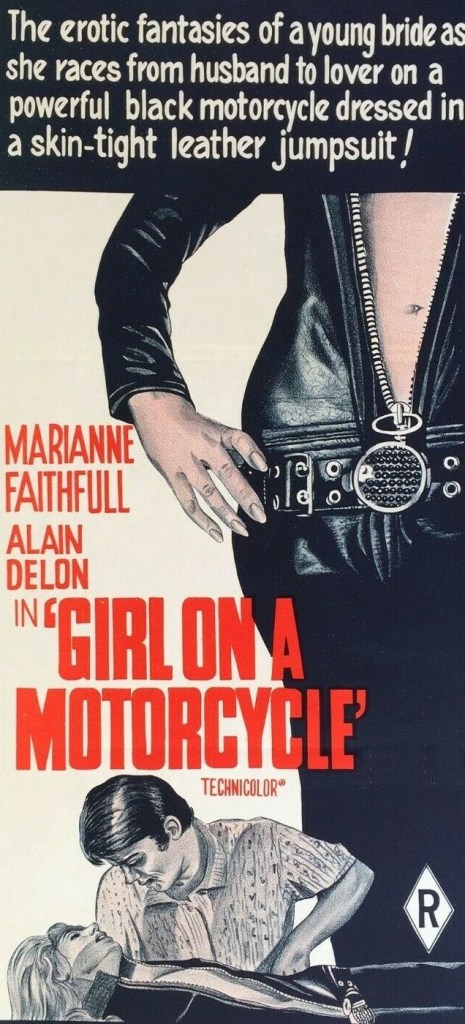
  7. Behind the Scenes of “The Girl on a Motorcycle” tracked how director Jack Cardiff beat the censor and cajoled a decent performance from Marianne Faithful even though it was yanked form U.S. release.
  8. Book into Film – “The Venetian Affair” explained how screenwriter E. Jack Neumann took the bare bones of the Helen MacInnes thriller and turned it into an excellent vehicle for Robert Vaughn trying to escape his The Man from Uncle television persona.
  9. Selling “Doctor Zhivago” (1965) examined the media campaign run by MGM for the London launch of the David Lean blockbuster.
  10. Book into Film – “A Cold Wind in August” demonstrated how screenwriter John Hayes toned down the sexy novel by Burton Wohl to escape the wrath of the censor while turning it into a touching vehicle for Lola Albright.

The Arrangement (1969) ***

It might have been better if director Elia Kazan had handed over the screenwriting chores for this adaptation of his bestseller about the midlife crisis of advertising man Eddie Anderson (Kirk Douglas). Anderson’s attempts to juggle wife Florence (Deborah Kerr) and mistress Gwen (Faye Dunaway) coupled with growing disgust at selling a new brand of cigarettes, Zephyr (“The Clean One”), in a way that pointedly avoids their cancer potential, leads to a suicide attempt.  

During convalescence he determines to quit the advertising world and go back to his first love, writing, but in fact he ends up sabotaging his career. Florence represents impossible seduction and conscience. Slinky, in dark glasses, hot-tempered rather than submissive or demure, she accuses him of self-deception in his job. The picture flits back and forth between his various choices – different job, return to wife, settle down with mistress, or what seems his ideal world, cossetted by both Gwen and Florence.

Gwen is an excellent study of the modern woman (of that fast-changing period, I hasten to add), who needs a man for sex but not necessarily love, and can use the opposite gender as ruthlessly as any man. What she actually requires in her real life is quite different to what she seeks in the fantasy love she enjoyed with Anderson, sex on the beach, the buzz of controlling a high-powered man. Florence could be seen as an old-fashioned portrait of the adoring wife except for capturing so well the bewilderment of betrayal.

Kazan conjures up some wonderful images: the tension before the suicide attempt as Anderson plays chicken between two trucks, Gwen emerging wet from the pool to eat dangling grapes or with her legs up on Anderson’s desk, Anderson’s mother lighting votive candles in her house before using the same match for her cigarette, Kerr’s futile attempts to win back her fallen husband, Anderson flying solo.

In parts well-observed and directorially savvy, quick cuts between the present and the past, however it sinks beneath its own self-indulgence. My guess is that author Kazan could not bear to kill off a single one of the characters he had created for his acclaimed novel and the upshot is a vastly over-populated picture, few of whom cast any real light on Anderson’s predicament. So we are not only introduced to mother, dying father, brother, sister-in-law and  analyst but priest and a bucket of clients and guys from the office. And there are some plot oddities – Anderson gets time off apparently to write journalistic pieces – and what is clearly intended as hard-hitting satire of the advertising world does not come off.

Dunaway (Bonnie and Clyde, 1967) is the standout as Gwen, living life according to her own rules, and with an unexpected vision of domesticity but Deborah Kerr (Prudence and the Pill, 1968) does pain like nobody else and is extremely convincing. Strangely enough, I didn’t go much for Douglas (Seven Days in May, 1964). He could have been leading a cavalry charge for all the range of emotions he exhibited. Douglas is no Montgomery Clift (Wild River, 1960), James Dean (East of Eden, 1955) or Marlon Brando (On the Waterfront, 1954) who was Kazan’s first choice. Kazan had not made a picture in six years and it had been eight years since his last hit Splendor in the Grass (1961). Not quite out-of-touch in concept and delivery, nonetheless it was shunned by the Oscar fraternity.

Book Into Film – “Blindfold” (1965)

In the book by Lucille Fletcher the leading male character (played in the film by Rock Hudson) doesn’t own a horse so he doesn’t go riding in Central Park. The leading female character (Claudia Cardinale in the film) doesn’t own a bicycle and so doesn’t collide with Rock Hudson in Central Park.  The man isn’t a playboy, he’s not dubbed “Bluebeard” by the media and he doesn’t have a commitment phobia. The woman isn’t the secreted-away patient’s sister – she’s his wife and she doesn’t work in burlesque.  

About the only places where the screenplay by Philip Dunne and W.H. Menger touches base with the Fletcher novel is in the basic premise of psychiatrist recruited to treat an atomic scientist who may be in danger of kidnapping and in the business of the hero working out the secret location through auditory clues.

Names have been changed wholesale. The book’s Dr Richard Fenton turns into the film’s Dr. Benjamin Snow (Hudson); likewise the book’s Angela Mallory becomes the film’s Vicky Vincenti (Cardinale). The General in the book is anonymous but, for the sake of a mild pun, is called General Prat (Jack Warden) in the film.

So basically pretty much everything in the film is the invention of the screenwriters. In the book, Fenton carries out all the investigation on his own until assisted late in the day by Mrs Mallory and there is a brief hint of potential romance at the end because by this time the scientist is dead and they were a mismatched couple anyway.  

Two of the cleverest and most intriguing elements of the film were nothing to do with the book. The first was how the psychiatrist (Hudson) was able to analyze many of the characters with whom he came in contact, both good guys and bad guys. The second element was how it was impossible, given government penchant for secrecy, for Hudson to determine if any of the people who claimed they were from the National Security Council, the FBI or the CIA, actually belonged to those organisations.

While we’re at it, there was no Detective Harrigan (Brad Dexter) in the book either. Nor did the heroine, for lack of a better word, have an endearing family. Hudson’s secretary Smitty (Anne Seymour in the film) is an amalgam of his housekeeper Louisa and his secretary Edna in the book, neither of whom possesses Smitty’s dry wit. Even the dubious Fitzpatrick (Guy Stockwell) underwent a name change, if only partially, in the book called Fitzgerald.  And I’m sorry to disappoint you but the book did not boast a mule called Henry.

Lucille Fletcher, as it happened, was a very distinctive personage in the creative world. She had originated Sorry, Wrong Number, one of the most famous and enduring crime tales ever written. Sorry, Wrong Number first appeared a 22-minute radio play, a monologue by Agnes Moorhead with sound effects, on CBS in May 1943, so successful it was broadcast seven times in five years. The author wrote the screenplay for the 1948 film noir starring Barbara Stanwyck and Burt Lancaster. Three times it was turned into a television drama – in 1946, 1954 and 1958.  Prior to Blindfold, she had only written three novels, a novelization of Sorry, Wrong Number with Allan Ullman, Night Man also with Ullman, and The Daughters of Jasper Clay.

The Oscar nominations for the best adapted screenplay in the Blindfold year were for Doctor Zhivago (the winner), Ship of Fools, The Collector, and A Thousand Clowns. The first two certainly required considerable condensation and the others must have endured surgery of some kind, but I doubt very much if they had to discard virtually the entire source material and begin all over again, bringing a different tone, plot and character to the proceedings.

Philip Dunne was a double Oscar nominee in the screenplay department but for films – How Green Was My Valley (1941) and David and Bathsheba (1951) – that could not have been further from this one and he had written pictures as diverse as The Rains Came (1939), The Ghost and Mrs Muir (1947), Pinky (1949), The Robe (1953) and The Agony and the Ecstasy (1965) but nothing hit as sweet a spot as Blindfold with its mix of romantic thriller and comedy.

The screenplay comes with another mystery. Who is W.H. Menger the co-writer? I can find nothing relating to this person beyond that he/she co-wrote Blindfold.

Anyway, kind of the point of writing these non-film reviews of the screenwriting process of various films is to examine a largely unexamined aspect of turning books into films. Original screenplays tend to get greater coverage. Adaptations, unless sourced from difficult subject matter, tend to pass under the radar. This, along with Fathom and The Venetian Affair (1967) are, in my opinion, classic examples of adaptations of novels which have some intrinsic cinematic interest but lack the story/character values necessary to turn them into watchable films and therefore require full-on assistance from a screenwriter.  

“MeToo” Warning – The Pressbook for “Claudelle Inglish” (1961)

Unusually timely in today’s MeToo era, the 10-page A3-size Pressbook had a warning for young actresses 60 years ago about the sex predators operating in Hollywood. On the subject of “coping with an amorous male,” star Diane McBain commented: “The first months in Hollywood are likely to be dreadfully discouraging to any girl trying to gain a foothold as an actress. She needs an older person in whom she can confide.” In other words, get yourself a chaperone to fend off the men.

This was somewhat at odds with the tone of the film itself, which suggested that Claudelle Inglish was a male magnet.

The marketing team took the easy way out in selling this picture. Sleaze was the hook with  copy lines and images as the big come-on. Pick of the copy lines: “When she was seventeen there wasn’t a man she’d let near her…When she was eighteen there wasn’t one she’d keep away.”  More in keeping with the actual film was: “She liked boys looking at her…and thinking…and then she’d take her delicious kind of revenge on them all!”

The promotional people did not have much else in the way of ideas, beyond a glamor portrait of star Diane McBain as a means of stimulating a newspaper poll under the title “The Screen’s Most Beautiful Woman?” Another idea was a contest to list movie titles comprising a female name such as Mildred Pierce, Gigi etc. Probably the most original notion was a tie-up with a shoe store since the film’s main character had a predilection for red shoes.

Otherwise the emphasis was on the provocative. Exhibitors were encouraged to use a sidewalk stencil of the “voluptuous young girl”  or arrange a lobby display of all the gifts Claudelle had received from her suitors. Slightly more complicated was getting restaurants involved in a contest where the letters of the character’s name could be used to part-spell out the titles of Erskine Caldwell books.

Author Erskine Caldwell, the all-time best-selling writer in America at that point with  41 million copies in print, was another big selling point. He had also authored other steamy yarns like God’s Little Acre and Tobacco Road and another 36 books besides so his novels were likely to command prime space in a bookstore. Signet had printed a movie tie-in edition that would go on sale in 100,000 outlets.

In terms of star push, the Pressbook concentrated on Diane McBain, promoted as a newcomer, despite having already appeared in Ice Palace (1960) and Parrish (1961) and with an ongoing role in television series Surfside 6 (1960-1962). Exhibitors were informed that McBain had “soared to stardom in little more than a year.” But also that her legs had given her a “big lift up the ladder of stardom” with several scenes revealing those attributes. McBain was only 20 at the time of the film’s release, born in 1941 in Cleveland, Ohio, but already earning money as a model at college. A Warner Brothers talent scout had spotted her on a modelling assignment which led to a role as the grand-daughter of Richard Burton in Ice Palace.

At the other end of the fame ladder, five-time Oscar nominee Arthur Kennedy appeared content to acknowledge that he was “rarely recognized in public” and if so was usually mistaken for someone else. Constance Ford, who played his wife in the picture, had already been paired with the actor three times, previously, twice on stage – Death of a Salesman and See the Jaguar – and in A Summer Place (1959).

There is a sad postscript to this which was pointed out to me by one of my readers. Sexual assault on women is not restricted to the movie industry. In 1982, Diane McBain was raped and attacked in her garage on Christmas Day after she had returned from a party. The culprits were never found. And although she began a second career as a rape victim counselor, she told the Los Angeles Times eight years later: “The shock of what happened caused loss of memory, inability to concentrate and I’m still startled out of all proportion.” (Gerald Peary, “In Search of…Diane McBain,” LA Times, May 27, 1990, 23).

Claudelle Inglish (1961) ****

Simple small-town morality tale, brilliantly told, with a quiet nod to The Blue Angel and Citizen Kane. Shy dirt-poor farmer’s daughter Claudelle Inglish (Diane McBain) after falling for the handsome Linn Varner (Chad Everett) expects to be married when he returns from his Army stint until she receives a “Dear John” letter. Initially devastated, keeping all his letters and the dancing doll she had won with him at a fair, she decides that lying in bed all day and staring at the ceiling is not going to work. So she smartens up her frumpish look with lipstick and turns her simple wedding dress into a more attractive outfit.

She discovers that the boys are so desperate to come calling on this new-look creature that they will bring presents to every date, ranging from the biggest box of candy in the shop to a pair of red shoes. Encouraging her determined manhunt, dissatisfied mother Jessie (Constance Ford), who has endured twenty years of broken promises throughout marriage to hardworking Clyde (Arthur Kennedy),  beseeches her to go after a rich man. Luckily, there is one in the vicinity, the widowed S.T. Crawford (Claude Akins) who happens to be their landlord. Crawford tries to bribe Clyde with free rent and other benefits to put in a good word, but to no avail, the father believing that true love cannot be bought and, furthermore, will alleviate abject poverty.

Advertisement to the trade encouraging exhibitors to book for one
of the key dates on the U.S. release calendar.

Claudelle bluntly rejects Crawford as “too old and too fat” but takes his present anyway and, under pressure, agrees to go for a ride with him without allowing him to stop the car. Dennis Peasley (Will Hutchins), elder son of a store owner, believes he is the front runner, deluging her with gifts, naively believing she is his sweetheart until he realizes he is in competition with a horde of other local boys, including his younger brother, and outsider Rip (Robert Colbert). Jessie, seeing the prospect of a rich husband slip away, embarks on an affair with Crawford. Soon, Claudelle has the entire male population in the palm of her hand, piling up presents galore. However, tragedy, in the way these things go, is just round the corner.

What struck me first was the subtlety. Nothing here to bother the censor, beyond the immorality on show and despite Hitchcock breaking all sorts of sexual taboos with Psycho the year before. This isn’t an all-hot-and-bothered essay like the previously reviewed A Cold Wind in August or a picture that pivots on twists-and-turns like A Fever in the Blood, both out the same year. It is so delicately handled that took me a while to work out that Claudelle was actually having sex with all these guys.

Erskine Caldwell was America’s bestselling author at the time with over 40 million books sold and most famous, of course, for God’s Little Acre, filmed in 1958, and Tobacco Road (1941).

The initial shy girl blossoming under the first blush of love is done very well, a gentle romance ensuing, Claudelle still withdrawn in company, agreeing to an engagement even though Linn cannot afford a ring, waiting anxiously for his letters, adoring the dancing doll,  paying off a few cents at a time material for a wedding dress. It’s only after she receives a Dear John (Dear Jane?) letter that it becomes clear, though not crystal clear, that sex has been involved because that word is never spoken and that action never glimpsed. Only gradually do we realise that present-givers are being rewarded, and as her self-confidence grows she is soon able to pick her own presents.  One look is generally all it takes to have men falling all over themselves to give her what she wants, which is, essentially, a life where promises are not broken. But the closest she gets to showing how much she is changed from her original innocent incarnation is still by implication, telling a young buck she is “pretty all over.”

I was also very taken with the black-and-white cinematography by Ralph Woolsey. The compositions are all very clear, but in the shadows Claudelle’s eyes become glittering pinpoints. The costumes by Howard Shoup won an unexpected Oscar nomination, his third in three years. Veteran director Gordon Douglas (Them!, 1954) does an excellent job of keeping the story simple and fluent, resisting all temptations to pander to the lowest common denominator while extracting surprisingly good performances from the cast, many drawn from Warner Brothers’ new talent roster.

Diane McBain (Parrish, 1961) handles very well the transition from innocence to depravity (a woman playing the field in those days would be tagged fallen rather than independent) and holds onto her anguish in an understated manner. In some senses Arthur Kennedy (Elmer Gantry,1960) was a coup for such a low-budget production, but this could well have been a part he was born to play, since in his movie career he knew only too well the pain of promise, nominated five times for Best Supporting Actor (some kind of record, surely) without that nudging him further up the billing ladder. His performance is heartbreaking, working his socks off without ever keeping head above water, repairs getting in the way of promises made to wife and daughter, kept going through adoration for his wife.

Constance Ford (Home from the Hill, 1960) is heartbreaking in a different way, scorning her loving husband and dressing like her daughter in a bid to hook Crawford.  Television regular Claude Akins is the surprise turn. In a role that looked like a cliché from the off – i.e. older powerful man determined by whatever means to win the object of his desires – he plays it like he was auditioning for The Blue Angel, hanging on every word, being twisted round her little finger, demeaning himself as he is made to wait, sitting downcast outside the Inglish house like an rejected schoolboy. Of the younger cast, Will Hutchins was Sugarfoot (1957-1961), Chad Everett was making his movie debut, and Robert Overton had appeared in A Fever in the Blood (1961). Leonard Freeman (Hang ‘Em High, 1968) wrote the screenplay based on the Erskine Caldwell bestseller.

And where does Citizen Kane come into all this? The dancing doll Claudelle won at a fair when dating Linn is something of a motif, never discarded, as if a symbol of her innocence, and in close-up in the last shot of the film.

Behind the Scenes: “The Guns of Navarone” (1961)

It’s time to celebrate the 60th anniversary of The Guns of Navarone – world premiere on April 27, 1961, in London and New York opening on June 22, 1961. Although the picture set a new benchmark in high-octane entertainment, a fast-moving war thriller packed with twists and a genuine all-star cast, it was far – very far – from the sure thing it appears in retrospect.

Box office smash in Britain.

For a start, U.S producer Carl Foreman, a victim of the McCarthy anti-communist witch-hunt of the early 1950s, was unable to assemble any of the talent he had set his heart on. He lost his preferred male cast of William Holden and Cary Grant and original scriptwriter Eric Ambler, the thriller writer famed for The Mask of Dimitrios and other novels.

He had a registered a major publicity coup by engineering the screen debut of opera diva Maria Callas, one of the most famous people in the world, but she also dropped out as did his other initial choice for leading lady. On top of that, once filming began he lost his director, Alexander Mackendrick, who had not only achieved a critical and commercial success with the British Ealing comedy The Ladykillers (1951) but also crossed the Atlantic to make the acclaimed The Sweet Smell of Success (1957) starring Burt Lancaster and Tony Curtis, to prove he could handle big Hollywood stars.

On top of that David Niven nearly lost his life during production and by the time the picture appeared Gregory Peck had suffered so many box office flops that he was a potential liability. And Foreman’s own marriage was in trouble.

Building the massive guns set.

It was a wonder it was made at all for Foreman was nobody’s idea of a sure thing. Although he had made his name as a screenwriter with three Oscar nominations for Champion (1949), The Men (1950) and High Noon (1952), his career was in ruins after being slung out of America for his supposed communist sympathies. He set up in London where he wrote screenplays under pseudonyms. But in 1956 won a four-picture production deal with Columbia at a time when that studio was investing heavily in making films in Britain to take advantage of the government’s Eady Levy (effectively, a tax rebate) and cheaper costs. But his first film, The Key (1958) with William Holden and Sophia Loren flopped in the U.S. Columbia persevered, seeing Foreman as the man to tackle its biggest-ever European production.

The Guns of Navarone almost fell at the first hurdle. Foreman’s first choice of location was Cyprus which was threatening to erupt into a civil war. At the last minute, he changed his mind and shifted production to Rhodes. Foreman, who also acted as screenwriter, made considerable changes to the book by British bestselling thriller writer Alistair Maclean, not least of which was introducing female characters to a story that had been resolutely all-male.

Original hardback book cover.

There was tension on set – four-time Oscar nominee Gregory Peck was annoyed at sharing the screen with two winners David Niven (Best Actor for Separate Tables, 1958) and Anthony Quinn (twice Best Supporting Actor for Viva Zapata, 1952, and Lust for Life, 1956). Replacement director J. Lee Thompson (Ice Cold in Alex, 1958) managed to sink a ship on loan from the Greek navy.  The Actor’s Strike in Hollywood nearly forced the departure of the two younger stars.

The set for the titular guns was the largest ever built, costing £100,000, and even though that proved a design miracle, that, too, was not exempt from disaster, having to be rebuilt after a thunderstorm destroyed part of the set. The injury to David Niven was so severe he nearly died, putting the production in jeopardy. Even when the film approached completion there were other obstacles in the way, composer Dmitri Tiomkin (The Alamo, 1960), for example, demanding a record fee and Foreman locking horns with Columbia over his insistence on launching the picture as a roadshow, request which was ultimately denied, and one of the reasons for the film’ release delay,

I’ve written a book about The Making of The Guns of Navarone. Originally published in 2013, it has been revised with over 30 illustrations added for a new edition to tie in with the 60th anniversary – available both in print and Kindle versions. Needless to say, it would also make an ideal present for Father’s Day.

If you’re interested in this kind of book, you might like to know that I’ve also written The Making of The Magnificent Seven.

The Guns of Navarone (1961) *****

Stone-cold action classic that blazed a trail for the big-budget men-on-a-mission war picture like The Dirty Dozen (1967) and Where Eagles Dare (1968). Brilliantly structured, written and directed,  and featuring a sea battle, storm, shipwreck, mountaineering, chase, interrogation scenes, infiltration of an impregnable fortress, a pair of romances, two traitors, and an awe-inspiring climax make this a candidate for one of the greatest war pictures ever made.

The set-up is simple. Knock out the gigantic guns at Navarone or two thousand men will perish. It’s mission impossible and the clock is ticking. You don’t know who to trust and the enemy is ruthless.

In the early days of the all-star-cast, producer Carl Foreman rounded up an astonishing line-up, bulking out the bestseller by Scottish thriller maestro Alistair Maclean (The Secret Ways, 1961) with three top stars in five-time Oscar nominee Gregory Peck (The Big Country, 1958), double Oscar-winner Anthony Quinn (Heller in Pink Tights, 1960) and Oscar-winner David Niven (Please Don’t Eat the Daisies, 1960). Add in British household names Anthony Quayle (Ice Cold in Alex, 1958), Stanley Baker (The Concrete Jungle, 1960) and James Robertson Justice (Doctor in Love, 1960), a sprinkling of rising stars in James Darren (Let No Man Write My Epitaph, 1960), Gia Scala (I Aim at the Stars, 1960) and Richard Harris (The Night Fighters, 1960) and renowned Greek actress Irene Papas (Antigone, 1961).

Each man is a specialist. Capt. Mallory (Gregory Peck) the mountaineer whose climbing skills are essential to completing the fist part of the mission, explosives expert Corporal Miller (David Niven), mechanic ‘Butcher’ Brown (Stanley Baker), Greek patriot Stavrou (Anthony Quinn) and the ruthless killer Pappadimos (James Darren) who has the contact with the Greek resistance. The stakes are ramped up when we learn both Mallory and Stavrou have bounties on their heads, not to mention the fact they are sworn enemies, and that before the mission even gets under way, spies are discovered in the camp. The ostensible leader of the group Major Franklin (Anthony Quayle) is wounded early on, turning him into a liability and making Mallory the de facto leader.

The stakes are ramped up further – this time through relationships. Their Greek contact turns out to be a woman, Maria (Irene Papas), brother of Pappadimos. She brings with her a mute girl Anna (Gia Scala) for whom Mallory develops romantic feelings while Stavrou has eyes for Maria. Mallory is also torn about Franklin, his best friend.

And from there it pitches into one disaster after another. They are too easily hunted by the Germans. They are shelled with mortars and attacked by dive bombers as they race across open mountains and through caves to reach their destination. They have to shoot their way out of traps and finagle their way into the fortress. There are twists and turns all the way, the clock ticking in almost James-Bond-style as the deadline for the destruction of the troops approaches.

And although this is clearly a war picture it is also as obviously an anti-war one, no end to the killing in sight, people dying pointlessly.

Although the acting was ignored come Oscar time, each of the stars delivers and it is a communal tour de force. Director J. Lee Thompson (Ice Cold in Alex) ensures that in visual terms none of the stars dominates, each given equal screen time while the strong supporting cast each has their own narrative arc. With over two-and-half-hours’ running time, Thompson has both the bonus of time to allow each element to be fully played out and the problem of keeping the picture taut and he succeeds brilliantly in both aims. It is a masterpiece of suspense. And it looked fabulous, the guns themselves, by which the picture might succeed or fail, were awesome.

Thompson was Oscar-nominated as was producer Carl Foreman for both Best Picture and the screenplay, Dmitri Tiomkin for the score (one of the longest-ever), John Cox for sound, Alan Osbiston for editing. Bill Warrington who did the visual special effects and Chris Greenham who did the sound effects were the only winners on the night.

It was a commercial smash, top picture of the year in the U.S., the biggest  picture of all time at the British box office and breaking records all over the world.

Dark of the Sun / The Mercenaries (1968) ****

Rod Taylor made a brisk transition to two-fisted action hero from his previous forte of drama (Hotel, 1967) and comedy foil to Doris Day (The Glass Bottom Boat, 1966) in this violent adventure set in the Congo in the early 1960s. As Captain Curry, assisted by sidekick Sgt Ruffo (Jim Brown) and 40-man local outfit Striker Blue Force, he leads an ostensibly humanitarian mission to rescue settlers cut off by the Simba rebels as a cover for collecting $50 million in diamonds. The loot is essential to save the toppling regime of President Ubi (Calvin Lockhart).  The only feasible transport is train. There is a three-day deadline.

Problems immediately ensue, not least a clash with Capt. Heinlein (Peter Carsten), former Nazi leader of Blue Force, who is even more ruthless than Curry, mowing down two native children who stray too close to the train, and apt to take a chainsaw into a fistfight. The train is attacked by a United Nations plane and on reaching its destination Curry is forced to wait three hours until the time-controlled giant diamond vault can be opened, giving the rebels time to catch up. Then it’s an ongoing battle of one kind or another.

Although the worst of the violence is carried out by the rebels – rape, torture and massacre – a core element of the drama is how a lifetime of killing has affected Curry. Ruffo, a man of principle who grew up in a primitive tribe, acts as his conscience – and that of the audience – spelling out how violence is more than a money-making scheme and essential to upholding order in terrorist times. Curry has some redemptive features, saving widow Claire (Yvette Mimieux) from the rebels and then from Heinlein, sending alcoholic Doctor Wreid (Kenneth More) to help a woman give birth, and eventually acknowledging his strong bond with Ruffo. Although Curry would like to think he is the opposite of Heinlein, they are carved from the same stock and when the savage beast is loose blood lust takes over.  

Mimieux is more or less there as bait, tempting Heinlein and any rebels in the vicinity, but coming into her own in convincing Wreid, paralytic by this stage, to carry out a section on the pregnant woman, and as a reminder of civilization for Curry.

The action scenes are terrific, especially the plane strafing the train, and there is a particularly good ruse, instigated by Ruffo, to outwit the enemy. Hollywood never managed to portray the terror of the native Vietnamese on being overrun by Viet Cong, and this film could easily be that substitute, especially when some of the rescued white settlers realize they will not escape.

This is not one of those films like Born Free (1966) or Out of Africa (1985) which are scenic odes to the continent, in part because the picture was shot in Jamaica, but in the main because director Jack Cardiff (The Long Ships, 1964) chooses to focus on the mechanics of the mission. And in so doing, he writes a love letter to a train. There had been a mini-vogue for war movies set on trains – Von Ryan’s Express (1965) and The Train (1965) come to mind – but none reveal an adoration for the power and perhaps the beauty of the locomotive. Every move it makes (to steal an idea from pop group The Police) is noted on screen and on the soundtrack, the hissing, the belching smoke, the wheels, cabooses, engine, the coupling and uncoupling of links, the screech of brakes, and various tracking and crane shots as the train snakes its way through enemy terrain.

Rod Taylor is excellent in the kind of role he is made for. Jim Brown in a major step up the billing after The Dirty Dozen (1967) is surprisingly good in a part that calls as much for reflection as action. Peter Carsten is the all-time Nazi scum. Yvette Mimieux, who had partnered Taylor in The Time Machine (1960), is also in transition mode, her role a meatier dramatic departure from the likes of the innocuous Monkeys, Go Home! (1967). In what was essentially his last major role – even though it doesn’t amount to much in screen time – Kenneth More wavers considerably from his stiff-upper-lip default.

The score by Jacques Loussier is particularly good, as Quentin Tarantino attested when he incorporated elements of it for Inglorious Bastards, which was a boon for the composer since up till then he was best remembered for the music accompanying the advert for Hamlet cigars. You might get a laugh out of the screenplay credits. Quentin Werty (i.e. Qwerty, the first six letters on a typewriter) the pseudonym of Ranald McDougall, Oscar-nominated for Mildred Pierce (1945), co-wrote the screenplay, adapted from the novel by Wilbur Smith, with television writer Adrian Spies.

An outstanding example of the all-out action mission picture, its occasional outdated attitudes do not get in the way of the picture and half a century later from what we now know of how wars are fought the levels of violence will appear realistic rather than exploitative.   

Catch-Up: This completes a Rod Taylor mini-season – previously features in the Blog are The Liquidator (1965), The Glass Bottom Boat (1966) and Hotel (1967).

Catch it on Amazon Prime.

The Woman in the Window (2021) *

I stopped watching this mid-drivel so don’t count on me for a balanced assessment. But it does point up the dangers of the current Netflix obsession. In the cinema, no matter how bad a picture, I would always stay to the end.  Particularly with Netflix’s movie joblot I found myself switching off in frustration that it was ever given the green light. I bet, though, Twentieth Century Fox were delighted to have been able to offload it onto Netflix, which provides no acceptable measure of audience response, rather than watching it sink like a stone at the movie box office.

It’s also a cautionary tale about the problems of snapping up a bestseller supposedly in the Gone Girl (2014) and The Girl on a Train (2016) vein, both featuring as here an unreliable narrator, without working out how such fiction might translate to the screen. Buying bestsellers is usually an astute piece of business from the Hollywood perspective. Both the novels mentioned sold in excess of 20 million copies. Even if only 10 per cent of the book buyers went to see the movie, you are talking about $20 million already at the box office. If it’s 20 per cent, then that’s a flat $40 million, and so on.

Bestsellers tended to get snapped up quickly, often in pre-publication, and although they might come with riders attached relating to copy sales, generally you are looking at a movie sales tag of around $1 million. That’s a tiny fraction of the cost of any movie budget with the double bonus that readers will more than offset the purchase price and that the bestseller angle provides an easy marketing hook.

I go to the movies once a week and watch at least two films and sometimes as many as four. And I pay to go. I buy my ticket rather than, as a movie critic, gaining free access. So I’m a sucker for almost anything and if you’ve been reading my Blog you’ll see that I have a pretty high tolerance level and enjoy a wide variety of pictures. So it takes a lot for me to get a downer on a particular movie.

So what’s gone wrong here? The book pivoted on the notion that the protagonist Anne Fox (Amy Adams), imprisoned by agoraphobia in her apartment, views the world through the prism of old Hollywood movies. So old pictures inform much of the writing, they are referenced all the time, almost in the sense of “what would Humphrey Bogart do.” That’s just not an option for a movie, so we are only given a few glimpses of films like Spellbound and they do not play any part in explaining her mental state.

So then it’s basically a re-run of Rear Window (1954) with instead of voyeuristic proclivities being deemed acceptable because it’s James Stewart doing the peeking we have what is effectively a creepy “cat lady” (minus the cats of course) who moons around her apartment drinking. She employs a psychiatrist but he’s redundant in movie terms because we already know she’s loopy and we don’t need to be told that, and that no matter what she did it’s not going to make us look upon her with any more kindness. Why? Because she has a singularly unattractive personality.

Amy Adams (Arrival, 2016) can normally be relied upon to deliver a good performance, but she is hopeless, generating not an ounce of sympathy for her predicament, not helped by going spare at kids doing nothing more dangerous than enjoying Halloween. But she’s not alone in producing audience antipathy. Of the couple across the street whom she spies upon, Jane Russell (Julianne Moore) has obnoxiousness down to a tee while husband Alistair (Gary Oldman) is over-the-top. And if an audience can’t find anyone to like it’s not going to like the film. 

For a film boasting two Oscar-winners – Gary Oldman for Darkest Hour (2017) and Julianne Moore (Still Alice, 2014) – plus six nominations for Adams and one for Jennifer Jason Leigh and stars Anthony Mackie and Wyatt Russell from current television mini-series The Falcon and the Winter Soldier (2021), this is a hatful of talent waiting for a rabbit to jump out and perform a miracle cure on a thriller with no thrills. A packet of exposition gets in the way of audience involvement and director Joe Wright (Pride and Prejudice, 2005) fails to make any headway in the Hitchockian department.

Perhaps the most bizarre aspect of his movie car crash is that its timing could not be more apposite. A film about not being able to go out during a pandemic that confined global populations to their homes should have struck some kind of chord. Of course, it’s been sitting on the Twentieth Century Fox (now rebranded as “20th Century Movies”) shelf since 2019 and it might have been better for all concerned had it stayed there.

Catch this on Netflix.

Discover WordPress

A daily selection of the best content published on WordPress, collected for you by humans who love to read.

The Atavist Magazine

by Brian Hannan

WordPress.com News

The latest news on WordPress.com and the WordPress community.