Behind the Scenes – “The Americanization of Emily” (1964)

Julie Andrews could not have made a more controversial choice in her bid to prove she was more than a Hollywood goody two-shoes as introduced in her debut Mary Poppins (1964). In the months leading up to release, The Americanization of Emily movie made all the wrong sort of headlines, aligning the innocent Andrews with the unsavory matter of producer Martin Ransohoff (The Cincinnati Kid, 1965) challenging the all-powerful Production Code, the self-censorship system in operation in the United States until the late 1960s.

Ransohoff demanded the right to include four scenes of substantial nudity in the film, at a time when any flashes of skin in mainstream pictures were taboo. He argued that the scenes were “necessary for the farcical overtones of the picture.” But more to the point, he was annoyed that foreign filmmakers, who did not have to abide by the stringent rulings of the Code, could show nudity, sometimes even condoned by censor Geoffrey Shurlock who accepted their artistic validity.  Ransohoff railed: “We are losing our market because we allow pictures that are full of nudity done in an artistic manner to play our top houses but we can’t get into them because the Code robs us of our artistic creativity.”

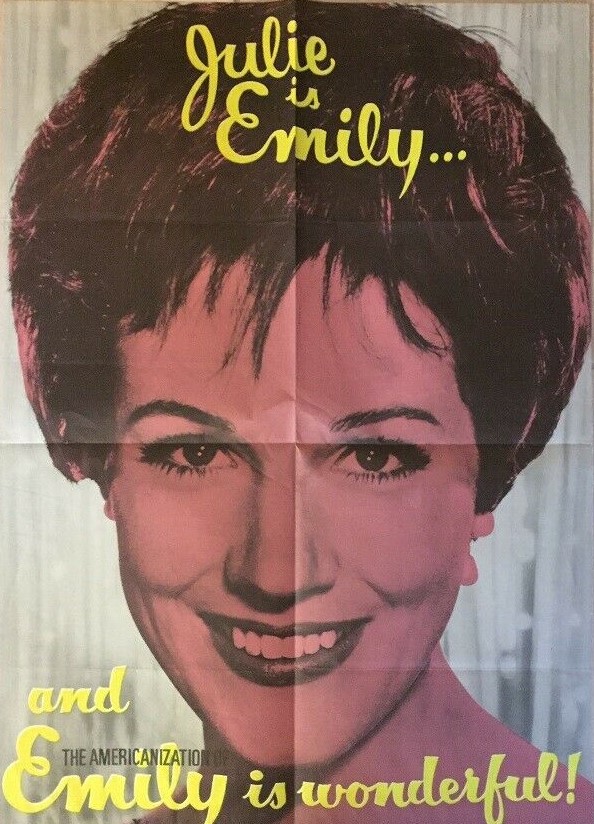
I’m not sure exactly when MGM dropped the “Americanization” element from the title and made Julie Andrews the star by promoting her image more than that of top-billed James Garner.

Faced with a lawsuit from studio MGM for delivering a movie not fit for the Code, Ransohoff conceded he had gone “overboard” with the nudity and that Judy Carne – who later sprang to fame in Rowan and Martin’s Laugh In (1969-1973) –  in particular, was “over exposed.” Other actresses named as revealing too much were Janine Gray (The Pumpkin Eater, 1964) and Kathy Kersh in her movie debut. The women were identified in the movie credits as, disgracefully, “Nameless Broad.”

At the outset, such agitation would not have preyed so much on Andrews’ mind as a possibly limitation in her future career, Mary Poppins not due to be unveiled until the summer and few members of the public aware of what a game-changer that would prove for studio and star alike. But once Mary Poppins hit the box office heights, there was every chance the star would quickly lose the adoration of the public if seen to play the female lead in a steamy picture. Ransohoff complicated matters by failing to come out and say whether Andrews was involved in the nude scenes, no matter they were considerably toned down by the time the movie hit cinemas in October 1964. (Had he delayed the picture’s release six months, his approach might have been deemed more acceptable, as, by that time, a flash of breasts had been passed by Shurlock for The Pawnbroker.)

It had been a troubled picture from the start. As early as 1962, Oscar-winner William Holden (The World of Suzie Wong, 1960) had been signed up to star and the movie was due to go before the cameras in London in July 1963 and, following a slight delay, re-scheduled for the next month under the direction of Oscar-winner William Wyler (Ben-Hur, 1959). Production was not quite settled because Andrews was only hired in September 1963. But when Wyler pulled out a month later he was quickly followed by Holden. Andrews was such an unknown quantity that when she signed up, the news did not even receive a headline in Variety, just a few lines at the bottom of a page.

And there were screenplay issues. Norman Rosten had begun work on the adaptation of the William Bradford Huie bestseller in April 1962 only for, 10 months later, the author to be drafted in. But scripting problems would continue until after shooting was complete (see below) with the filmmakers unable to make up their mind about the tone of the picture.

Despite Rosten being assigned, a story later emerged that the book had struggled to reach Hollywood. Huie contended that it had, after all, not been sold to Ransohoff in 1962 and that the sale only occurred later after the author had written the screenplay on spec and sold it to the producer. He tied this up with another contention, little borne out by fact, that producers had turned against buying blockbuster novels in favour of original screenplays.

At that point Ransohoff was on a roll as one of the biggest independent producers in Hollywood, on his slate The Sandpiper, which would appear in 1965, Topkapi (1964), The Loved One (1965), The Wheeler Dealers (1963) and The Americanization of Emily, a fantastic batting average for a neophyte producer.  Emily would be his third production, The Sandpiper, with two of the biggest stars in the world, Elizabeth Taylor and Richard Burton, his fourth.

James Garner, who had blown his entire fee of $100,000 from three years’ work on television series Maverick on getting out of his contract with Warner Brothers, had been given a helping hand by Ransohoff, winning second billing behind Kim Novak in Boys Night Out (1962) and Lee Remick in The Wheeler Dealers. Ransohoff gambled Garner was ready to make the jump up to top billing in The Americanization of Emily

In fact, it would take several years before Garner was considered a proper star, thanks to Support Your Local Sheriff (1969), with the kind of marquee appeal that produced box office commensurate with his fees. In fact, James Coburn was considered a better prospect with a seven-picture deal with Twentieth Century Fox – for whom he would make his breakthrough movie Our Man Flint (1966) – a five-film deal with Ransohoff and Major Dundee (1965) on the starting grid with Columbia.

The three-minute sequence of the D-Day beach landing cost $250,000. It was shot in California, sixty miles north of Hollywood, on a public beach though anyone happening upon the site would possibly be put off by signs proclaiming “Explosives next ½ mile.” The shoot involved 5,000lb of explosives, mostly dynamite and black powder, planted in iron tubs buried in the sand and connected by wires to a central control board. The complicated set-up involved four cameras rolling simultaneously with a 250ft high crane lifting a camera platform into the sky for aerial shots. Another platform was sited in the surf. Special effects expert Paul Byrd was on hand to point out to participants where explosions would occur. Eighty smoke pots were lit, each in an assigned position. Rehearsals soaked James Garner and while he waited for the scene to be set up again he lay down on the beach, still in n his wet clothes, but covered in a towel.

Preparing the segment had taken four months with bulldozers clearing the area. Ransohoff himself climbed into a camera platform to test the rig. Camera positions were selected to capture close-ups of the actors going ashore. To maximize daylight the lunch break was limited to 30 minutes.

Ransohoff, as much a maverick in marketing as in production, took out a double-page advertisement in Variety in July 1964 – nearly four months before the movie opened – to promote the response of the preview audiences. And although the comment cards returned easily promotable lines like “you have a blockbuster on your hand” and “one of those rare films that combine tragedy, comedy and drama properly,” Ransohoff was clearly intending to continue to court controversy by including quotes along the lines of “I’m broadminded but this time you’ve gone too far” and “a disturbing and terrible thing.”

But you couldn’t argue with Ransohoff seeking an alternative marketing strategy with such a recalcitrant publicist as Garner. The actor had a marked aversion to talking about his private life, which, of course, meant the focus would have to shift to his dubious star quality or the controversial scenes. Nothing infuriated journalists more, especially in those days when the media was not so tightly controlled, than to turn up for an interview with an actor who had nothing to say. “My private life is just that and I’ll keep it that way,” he averred.

Quite why the movie took so long to open is not really a mystery. Sneak previews might be followed by a little tweaking but the film would expect to be in cinemas within a month or so, the previews intended to build public awareness and word-of-mouth buzz rather than tell the director where he had gone wrong. But clearly Ransohoff held back in order to capitalize on the box office of Mary Poppins. Despite the wrangling with the Code being over and done with by March 1964 and the preview taking place three months later, the film did not open until October, going wide at Xmas, with the additional purpose of aiming for Oscar voters.

Even as Ransohoff was adding the finishing touches to the advertising campaign, there were doubts about what kind of picture the public would be shown. Four endings were considered, two filmed with Edison (James Garner) dead which turned the movie into a straightforward black comedy, but the other two retained the  romantic ending.

The black comedy approach dictated that the unsuspecting Edison (James Garner) was lured to his death on Omaha Beach by the glory-hunting Cummings (James Coburn). With no return from the dead, this left Emily (Julie Andrews) in one version to carry the movie to a dutiful conclusion, commiserating with Admiral Jessup, who had been committed to a mental asylum, while a parade commemorating Edison’s sacrifice and led by the treacherous Cummings took place in the background. This was junked when the parade prove too expensive an addition.

All the other endings kept Edison alive, but in one, partly filmed, Cummings was banished to the North Pole, the producers going as far as to film Coburn with penguins.

The major adjustment in all versions was to present Jessup as off his head when he conceived the plan. That meant the Navy could not be blamed for outrageous publicity-seeking, with the finger instead pointed at a maverick officer, whose decisions could be tempered by his temporary instability.

SOURCES: “Holden’s Americanization,” Variety, May 23, 1962, p11; “Screenplay (Ready to Shoot) Cost-Conscious Producers Goal in Retreat from Pre-Sold,” Variety, January 30, `1963, p3; “Emily Screenplay to Be Done by William Bradford Huie,” Box Office, February 11, 1963, pW1; “Ransohoff’s Big Spurt of Features,” Variety, February 17, 1963, p3; “Ransohoff To Start Five Films in 6 Month Period,” Box Office, June 17, 1963, p27; “Julie Andrews,” Variety, September 11, 1963, p16; “Bill Holden Follows Wyler in Leaving Emily,Box Office, October 7, 1963, pW2; “Garner Gets Emily Lead,” Box Office, October 14, 1963, p9; Michael Fessier Jr., “Can’t Be Americanized With Duds On,” Variety, November 20, 1963, p5; “Martin Ransohoff To Seek Production Code Seal,” Box Office, November 26, 1963, p6; “Emily and Her Attire Settled,” Variety, March 25, 1964, p5;“Nudies In Emily Are Cut to Get MPAA’s Seal,” Box Office, March 30, 1964, pW4; “Advertisement,”  Variety, July , 1964, p14; “Admiral’s Glory Seeking Is Final Ending of Metro’s Emily,” Variety, November 4, 1964, p5; “Mad Film Promotion,” Variety, November 4, 1964, p15; “Promo Credo of Hollywood Actor,” Variety, November 4, 1964, p15; Action on the Beach (1964) MGM promotional featurette.
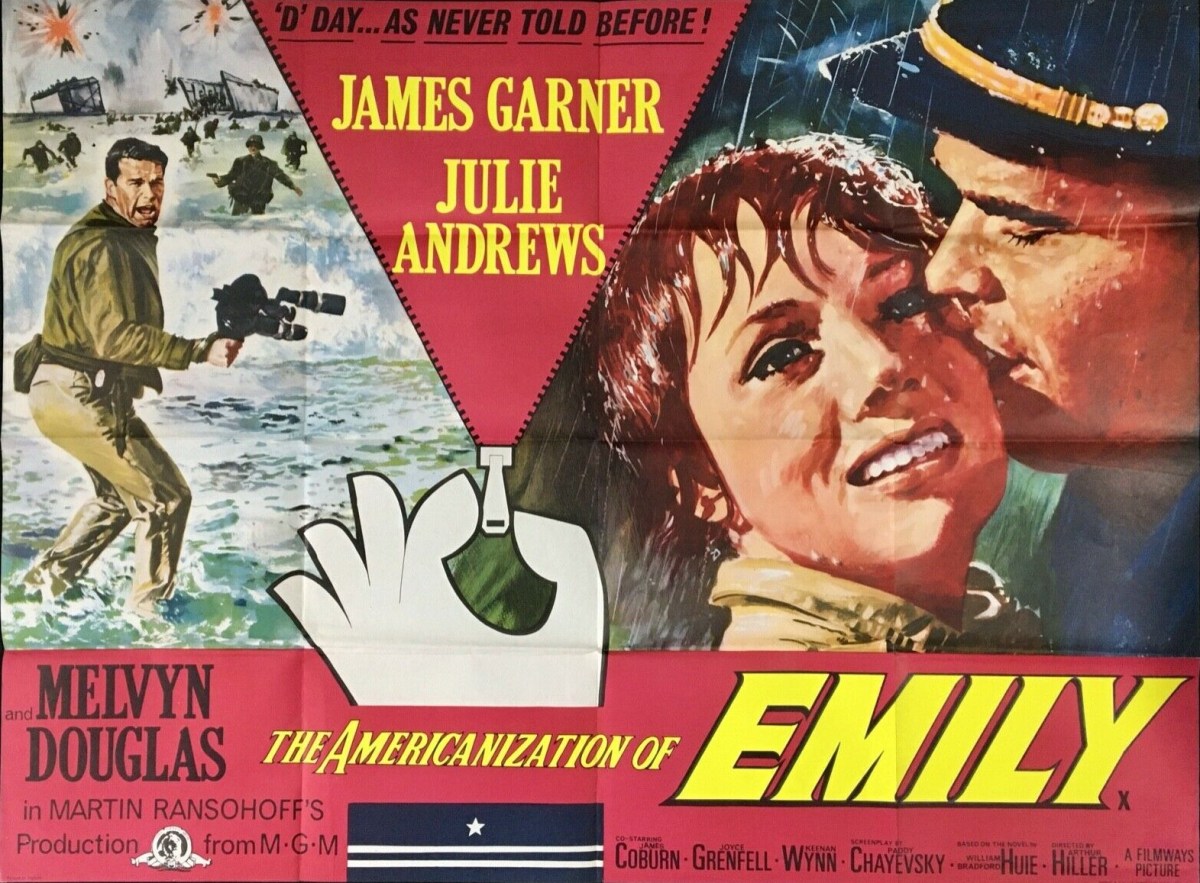
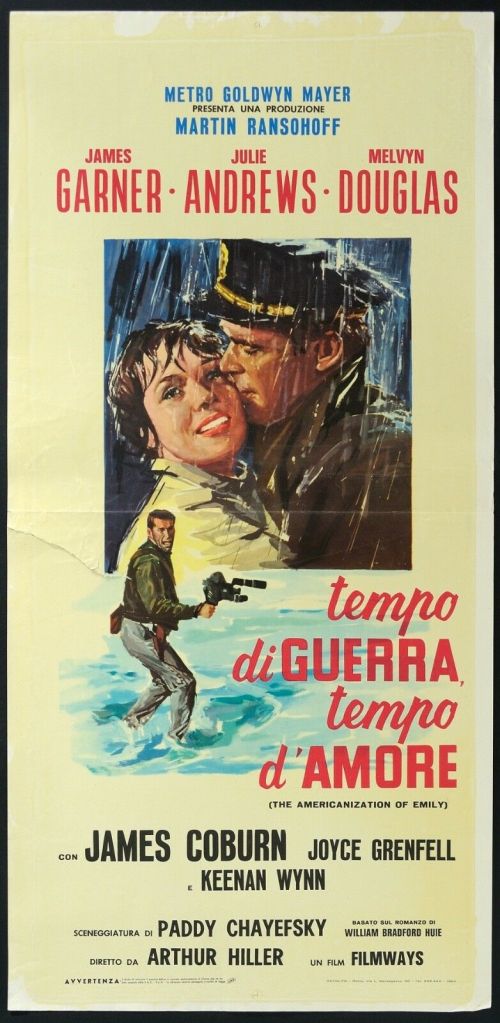
The Americanization of Emily (1964) ****

It’s an immoral job but someone’s got to do it. In wartime, generals need their perks – Winston Churchill with his cigars and champagne the best advocate. And those who supply the perks – Dog-Robbers in American parlance – expect their own perks in the form of a backroom job where they are never exposed to danger. Top U.S. Navy dog-robber in World War Two London on the eve of D-Day is Lt. Commander Edison (James Garner) who can spirit up whisky, steaks, nylon stockings and women, happy even to deliver shoulder massages for boss Admiral Jessop (Melvyn Douglas).

And like the recently-reviewed The Charge of the Light Brigade (1968) what’s mostly on the minds of top commanders is jostling for power, how to win the public relations battle on D-Day and prevent the politicians considering scrapping the service post-war. So Jessup comes up with a brilliant wheeze. What if the first man to die on Omaha Beach was a sailor? Allowing for the construction of a memorial to the “unknown sailor,” a feasible proposition given the Navy demolition unit is scheduled to land on French shores in advance of the invasion force. Edison is enlisted to film the anticipated death.

But Edison, whose brother died at Anzio, is a coward and does everything possible to avoid the job. He struggles to get English girlfriend Emily (Julie Andrews), whose father and brother died in the war, to share his perspective and is counting on buddy Lt. Commander Cummings (James Coburn) to get him out of it. But Cummings has his own ideas and Edison ends up the sacrificial lamb.

And it would be a brilliant black comedy except that, in the interests of a happy ending, Edison, despite being shot on the beach by Cummings, turns up alive.

In that case it becomes a fascinating exploration of the realities of war, the moral and immoral coming to grief in a moral vacuum that ensures that the higher up the food chain the less likelihood there is of dying and, ironically enough, the better opportunity to enjoy, while the masses are on strict rations, the good things of life. Emily would act as the movie’s conscience except that Edison is having none of war’s hypocrisy. He doesn’t want to die for his country and may be following to the letter General Patton’s dictat of making the “other poor bastard die for his country.” He doesn’t so much take a stand against the absurdities of war as stand up for the sanctity of life, in particular his own life, unwilling to fall for the “futile gesture of virtue.”

There’s plenty of what you should and shouldn’t do during wartime, arguments passionately argued for and against duty, though even the self-appointed conscience Emily stops short of turning her nose up at the finer things of life, no matter by what dodgy means they fall her way. that her life teeters on hypocrisy is scarcely explored.

And it does its utmost not to fall into the trap of the wartime romance genre, will-he-won’t-he survive the dangerous mission, precisely because you could never mistake Edison for a hero. And you need a hero not an ordinary joe for that particular genre to work. So what you’re left with is something else entirely, a man brave enough to be seen naked, exhibiting exactly the same lack of scruples in saving his own life as his commanders would employ to have him lose it. It’s kind of complicated that way.

Throw in another get-out clause on behalf of the Allied command, the notion that no high-up would embark on such a selfish vainglorious action, and that Jessup only does so because he is temporarily unhinged after the loss of his wife, when in fact history is littered with generals committing troops to wholesale slaughter for their own reasons.

Ediuon is such a charming character that if you wanted someone to plead the case on behalf of the cowardly you couldn’t make a better choice. The whole idea shouldn’t work at all because it’s only the bad guys, the shifty ones that turn up in every war movie, who  carry the cowardice flag. The film is so cleverly structured, with examples of the impact of loss all around, that it’s virtually impossible to vote against Edison. And part of the cleverness is the casting. If such a good egg as Emily can fall in love with Edison it somehow makes him a less despicable character. He’s certainly not as shifty as Jessup who dreamed up the bizarre stunt in the first place or Cummings, intent on exploiting it.

James Garner (36 Hours, 1964) excelled at playing the morally dubious, the cowardly sheriff played for laughs in Support Your Local Sheriff (1969) his biggest box office hit, but this isn’t far short of his very best work, and an exceptionally bold role for a star. Julie Andrews was already trying to move away from her goody-two-shoes debut in Mary Poppins (1965) that would be further enhanced by The Sound of Music (1965) and while her characterisation is not, on the surface, that far away from either role, the depth she displays here, the sorrow and the soulfulness, give this a edgier riff.

Good support from James Coburn (Dead Heat on a Merry-Go-Round, 1966), Melvyn Douglas (Hotel, 1967), Keenan Wynn (Man in the Middle/The Winston Affair, 1964) and Joyce Grenfell (The Yellow Rolls Royce, 1964).

Director Arthur Hiller (Tobruk, 1967) most of the time walks a very fine line but manages to create a very thoughtful movie that humanized what other anti-war pictures failed to make personal. Oscar-winner Paddy Chayefsky (Marty, 1955) based the screenplay on the bestseller by William Bradford Huie (Wild River, 1960). 

Another in the mini-genre concerning power politics in the Armed Forces. Would make a good triple bill if teamed with The Charge of the Light Brigade and Man in the Middle.


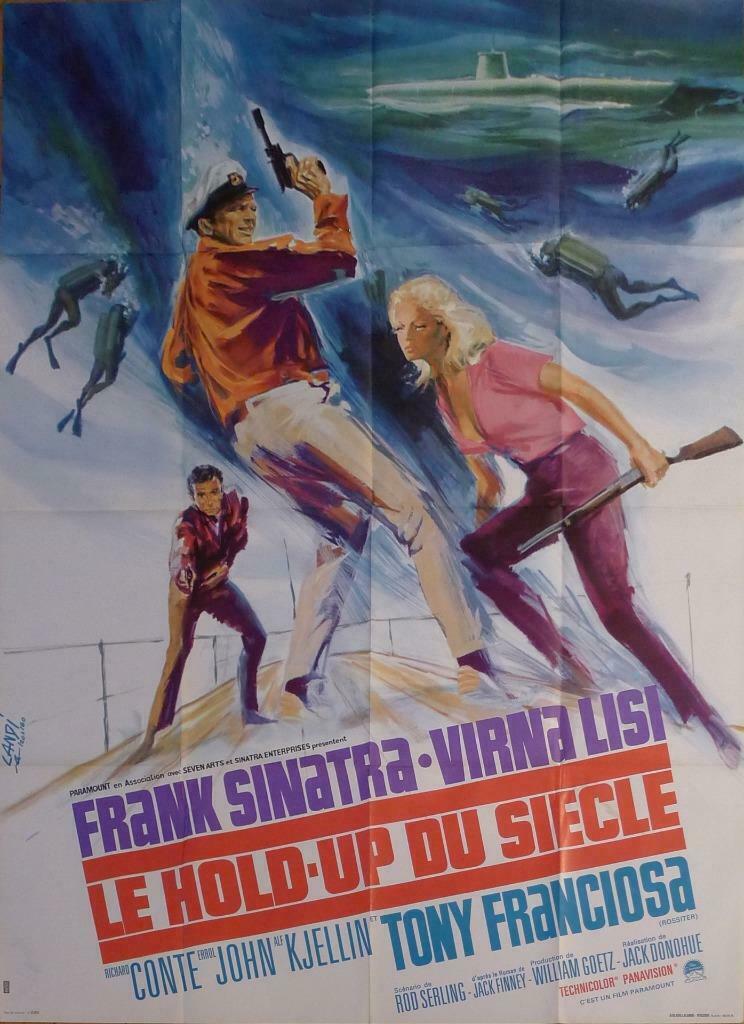
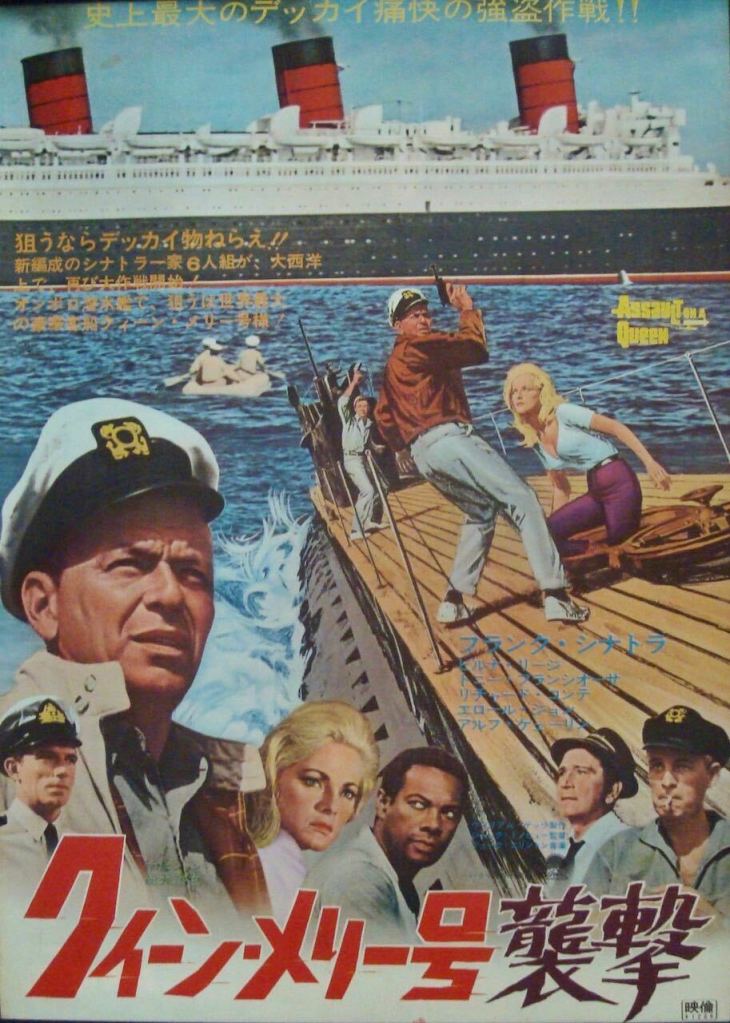
Assault on a Queen (1966) ***

I always wondered why this was a flop. I’m still baffled. Not only is it a perfectly serviceable caper picture, but it’s also high-concept before the term was invented, a World War Two submarine involved in holding up high-end ocean liner Queen Mary (yep, the real thing, thanks to cooperation from owners Cunard). 

The dialogue’s crisp, the robbery well-planned, a good number of twists, plenty underwater thrills, hostility between crew members, and sexual tension kept high by the presence on board of the Italian Miss Big. Diver Mark Brittain (Frank Sinatra) is sucked into a treasure hunt in part because he needs the money and in part through the sexual magnetism of Rosa (Virna Lisi), the expedition backer, who already has suave Vic (Anthony Franciosca) on a string.

The plan evolves into piracy when Brittain discovers a World War Two German submarine on the seabed. As it happens, skippering the salvage vessel is former German U-boat captain Eric (Alf Kjellin). After Mark successfully raises  the sub, it’s game on, Vic’s qualms wilting under Rosa’s seductive gaze. The other team members are engineer Tony (Richard Conte) and wireless operator Linc (Errol John). The prize is a cool million in cash and gold bullion.

Catch No 1: the sub can’t stay submerged for more than an hour. Catch No 2: it’s not that seaworthy and could spring a leak at any time (“don’t just look for water, listen for it,” advises Eric). Catch No 3: in order to successfully board the Queen Mary looking for vital equipment, one of these very American Yanks has to pass himself off as a British sub captain on a secret mission.

Potential Catch No 4 has already been dealt with – if the Queen Mary officers rumble the ruse and call the thieves’ bluff the hijackers plan to put a dummy torpedo up the spout and fire it into the ship’s hull. Catch No 5: there’s so much pent-up hostility among the team the whole endeavor could be sunk. Mark and Vic are vying for Rosa’s favors and clever bombshell that she is she intends to keep it that way, stringing both along.

Racist Vic takes against Eric and also resents splitting the loot with late arrival Tony. Alf not only resents Mark, also a former sub officer, for ending up on the war’s winning side, but exhibits psychopathic tendencies and might just for the hell of it blow a passing tanker out of the water. Like any gang, each member brings something specific to the party. And without giving too much away, the  endgame turns into a battle of wits, especially when the unexpected occurs.

I’m a big fan of Sinatra’s acting style. He is so natural, his gestures don’t look like they’ve been rehearsed for hours in a mirror, you’ll never accuse him of Method acting, or picking parts with Oscars in mind, but somehow he still manages to inhabit his characters.

This is a fascinating role for Virna Lisi (How to Murder Your Wife, 1965), reminiscent of film noir in the way she handles men, but also years ahead of her time not just in combining  sexual and financial independence but of being the boss funding the heist and recruiting the team, and soon has the reluctant Mark playing ball with no sense that’s ultimately she’s going to fall at his feet.

Anthony Franciosca (Rio Conchos, 1964) is mostly a distraction, engaged in a private feud with James Coburn as to who has the brightest and biggest screen teeth. Richard Conte (Lady in Cement, 1969) and Alf Kjellin (Midas Run, 1969) are the physical and mental muscle, respectively, and Trinidadian Errol John (Man in the Middle, 1965) essays an interesting role. Jack Donohue (Marriage on the Rocks, 1965) keeps it all ticking along.

Rod Serling (Planet of the Apes, 1968) devised the screenplay from the novel by Jack Finney (Good Neighbor Sam, 1964). So why did critics and the public have such a downer on the picture? Critical attitudes to the star were easier to understand. Sinatra’s films were generally disliked, and knowledge of his one-take preference allowed critics to thumb their collective noses at his acting, assuming he put no effort into it.

Rumors of his underworld connections were beginning to emerge, he had just married Mia Farrow, less than half his age, and the Beatles and the British invasion had usurped his position in the pop rankings. The general feeling was he was on the way out so why not boot him while he was down. This was despite him receiving some of the best notices of his career for Von Ryan’s Express (1965).

Audiences might have been expecting another Rat Pack lark in the vein of Ocean’s 11 (1960) or felt the supporting cast lacked lustre, Lisi a little known commodity, this only her second Hollywood picture, Franciosca still the second banana, and Hardy Kruger would certainly have invested the German with more malevolence. Otherwise, it’s hard to see what there is to complain about. As I mentioned the dialogue was good, characters simmering, and the story satisfying enough.

Sure, a better director might have extracted more tension from the set pieces, lifted the pace, and added a booming score as with Ice Station Zebra (1968).

It might not be the best heist picture ever made, but it’s too good to be dismissed.

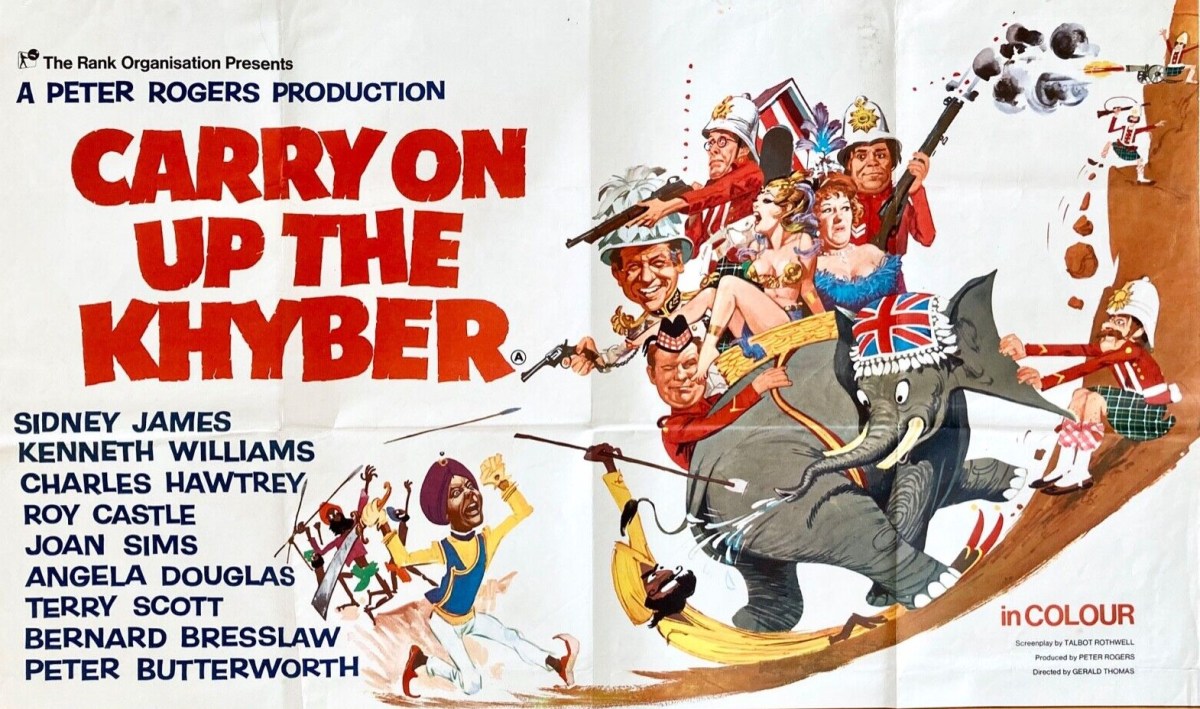
Carry On Up the Khyber (1968) ***

After a spate of serious pictures I thought I’d treat myself to some lighter fare and indulge in double entendres and lavatorial humor. I didn’t realise I had picked the only Carry On picture with serious undertones, exploring the hypocrisy endemic among leadership as much as witnessed in The Charge of the Light Brigade (1969), taking a distinct anti-colonial stance, and poking fun at military inefficiency.  

Despite the need to keep up appearances, British governor Sir Sidney Ruff-Diamond (Sidney James) despises Indian counterpart The Khasi of Kalabar (Kenneth Williams), the truth of their feelings towards each other revealed in muttered asides. Appearances are all that stand between the British and an Indian revolution, the natives fearing the Scottish regiments, the famed kilt-wearing “devils-with-skirts.”

The notion that any army would run a mile from a pair of bollocks – unless of course they had the faint-inducing dimensions of a Thor – is of course bollocks but that’s the film’s central conceit. But when the Indians discover that the British actually wear cotton undergarments as protection against the windy privations of the northernmost parts of the country, and, through the treacherous Lady Ruff-Diamond (Joan Sims), gain potential access to photographic proof, the status quo is threatened.

Lady Ruff-Diamond, furious at her husband’s constant infidelities, has set her eye on the Khasi, and is willing to betray her country for a bit of what could be termed “the other.” A squad of the usual British misfits, despatched to recover the incriminating evidence, naturally enough finds itself in a harem while Sir Ruff has to keep the British end up by entertaining native lasses by the score (he keeps count). When war does break out, the British, under siege, do what they are famous for, which is nothing.

You might have to be British to grasp many of the jokes, Khyber Pass and Khazi both have toilet associations, for example, but other visual gags would not be out of place in a Charlie Chaplin sketch. “Please close the gate” reads a sign on the border. Outside the Governor’s mansion is another sign “No Hawkers.” And you might at times believe the entire production was Chaplinesque, some of the jokes being ancient – “call me an elephant” orders Sir Sidney, referring to the mode of transport, only to be hit by the rejoinder “you’re an elephant.”

Many set-ups are obvious – black-faced British troops tumble into a bath. The double entendres are occasionally inspired – fakir, bullocks and shot among the perfectly innocent words so rendered. But the jokes come so thick and fast that by the time you’ve complained about a poor one an absolute cracker is on the way. Some contemporary notes are struck, references to cuts (at a time when Britain was suffering economically) and a muscular servant striking a gong (reference to the introduction to all films made by British studio Rank).

However, the political insight, if that’s not too complimentary, is not sustained and it soon collapses into more straightforward Carry On territory. A film like this comes of course with multiple warnings about sexism, racial stereotypes, blackface and anything else that could possibly offend, since that was the team’s denoted purpose, and, as you will be aware, it couldn’t be made nowadays so enjoy it – or as much of it as you can stomach – while you can.

Prior to the emergence of the Bond goldmine this was the closest thing the British movie industry had to a solid-gold franchise, this being the 16th in the series. Gerald Thomas directs from a Talbot Rothwell screenplay and the cast involves usual suspects Sidney James, Kenneth Williams, Joan Sims, Charles Hawtrey and Peter Butterworth. Angela Douglas (The Comedy Man, 1964) supplies the glamour and you might spot Wanda Ventham (The Blood Beast Terror, 1968) and Valerie Leon (Blood from the Mummy’s Tomb, 1971) in walk-on parts.

Oddly enough, the early Carry On pictures, seen as the natural successors to Ealing, if somewhat ruder, achieved minor cult status in the United States, Carry On Nurse (1960), the flagship, playing for over 40 weeks in Denver and clocking up $2 million in nationwide rentals (“Carry On Nurse US Rentals Run Over $2,000,000,” Variety, February 14, 1962, p3). However, no others approached that peak and “never received any hard sell to the U.S. and it remained for audiences to discover their buffoonery on double bill programs usually playing second fiddle to reissues of major British  hits” (“Carry On Mostly Discovered By Yankee Fans,” Variety, February 5, 1969, p22). Despite a positive review in Variety (Dec 25, 1968, p18) which deemed it a “beautifully timed and very funny piece of comedy film-making,” Carry On Up the Khyber made little impact on U.S. audiences recording just about $100,000 in rentals (“Variety B.O. Charts 1969 Results,” Variety, April 29, 1970, p26), that figure achieved by rounding up in the normal fashion.

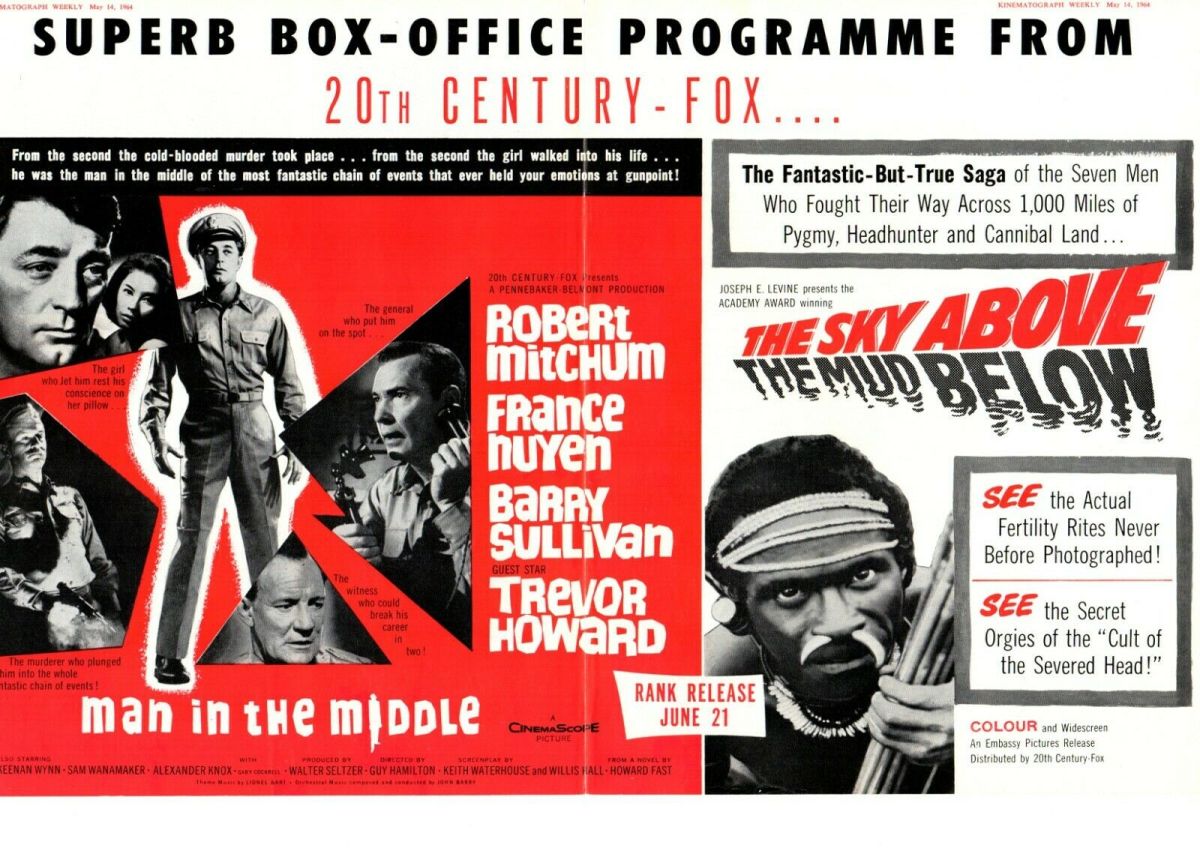
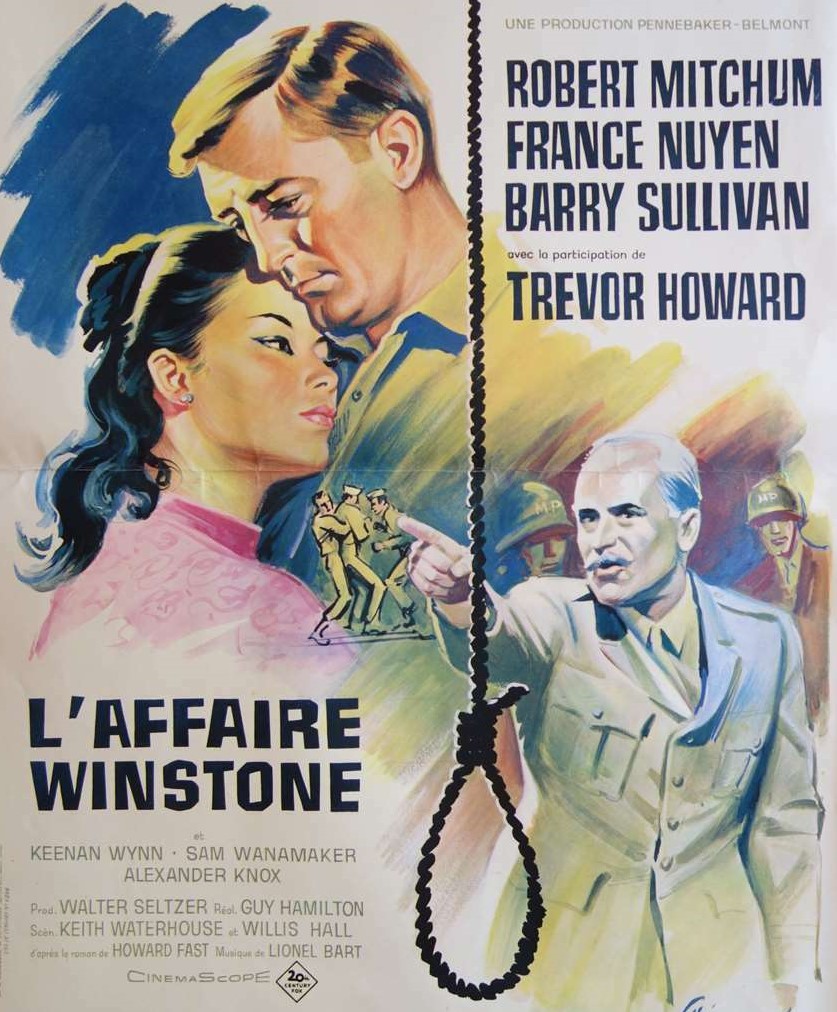
Behind the Scenes – “Man in the Middle”/”The Winston Affair” (1964)

You were asking for trouble to pair heavy drinkers Robert Mitchum and Trevor Howard. But Man in the Middle was a fraught production long before the actors came on board. The picture was intended to kick off Twentieth Century Fox’s revamped 20-picture slate that signaled a studio back from the dead after near-bankruptcy. The success of The Longest Day (1962) triggered a cycle of World War Two pictures, Man in the Middle launching this cluster, which accounted for more than third of the studio’s projected output.

But before fox arrived on the scene, Man in the Middle was intended as a key element in the launchpad or an indie powerhouse, the grandly-named Entertainment Corporation of America (ECA), set up by Max Youngstein, one of the founders of the post-war version of United Artists. Youngstein had an 11-picture tab budgeted at $3 million including Honeybear, I Think I Love You starring Warren Beatty (Bonnie and Clyde, 1967), Cold War thriller Fail Safe, The Winston Affair (as Man in the Middle was originally tabbed) and The Third Secret.

But concerns about legal action against Fail Safe torpedoed the venture within a few months of opening for business in November 1962 after theatre chain Ace Films pulled the plug on its $1.3 million investment and distributor Allied Artists followed suit. Columbia took over Fail Safe (1964) and Twentieth Century Fox The Winston Affair in a co-production with Marlon Brando’s Pennebaker shingle and Talbot which was Robert Mitchum’s outfit. 

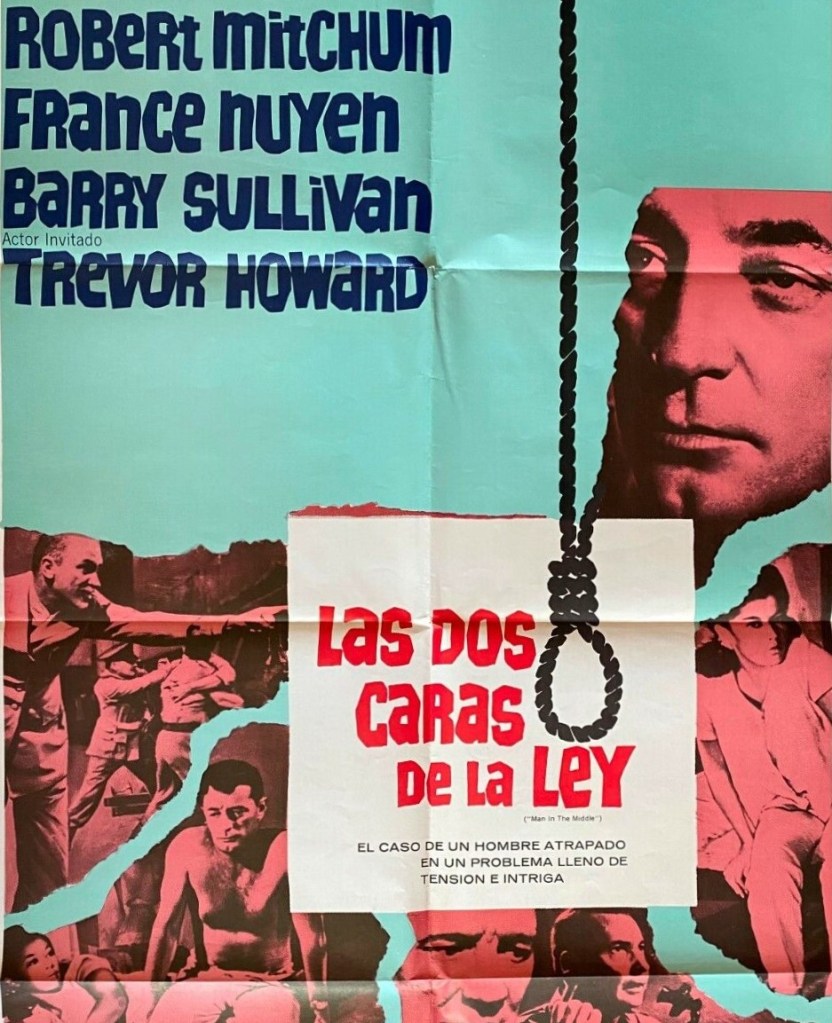
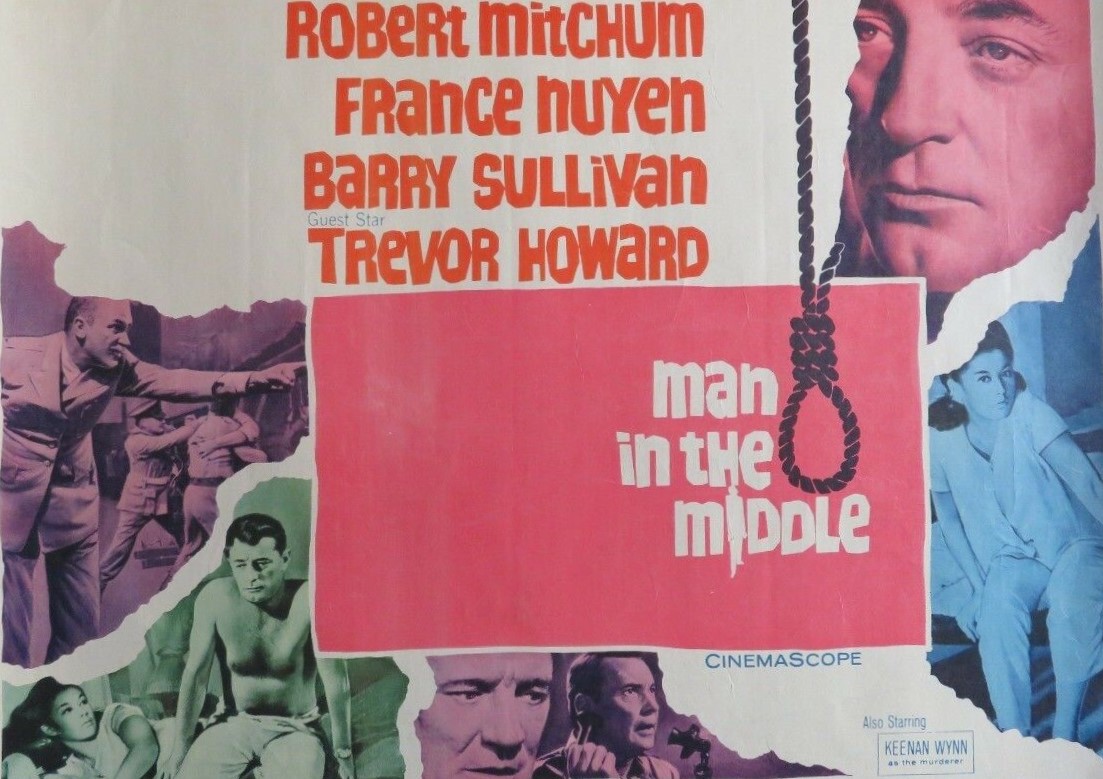
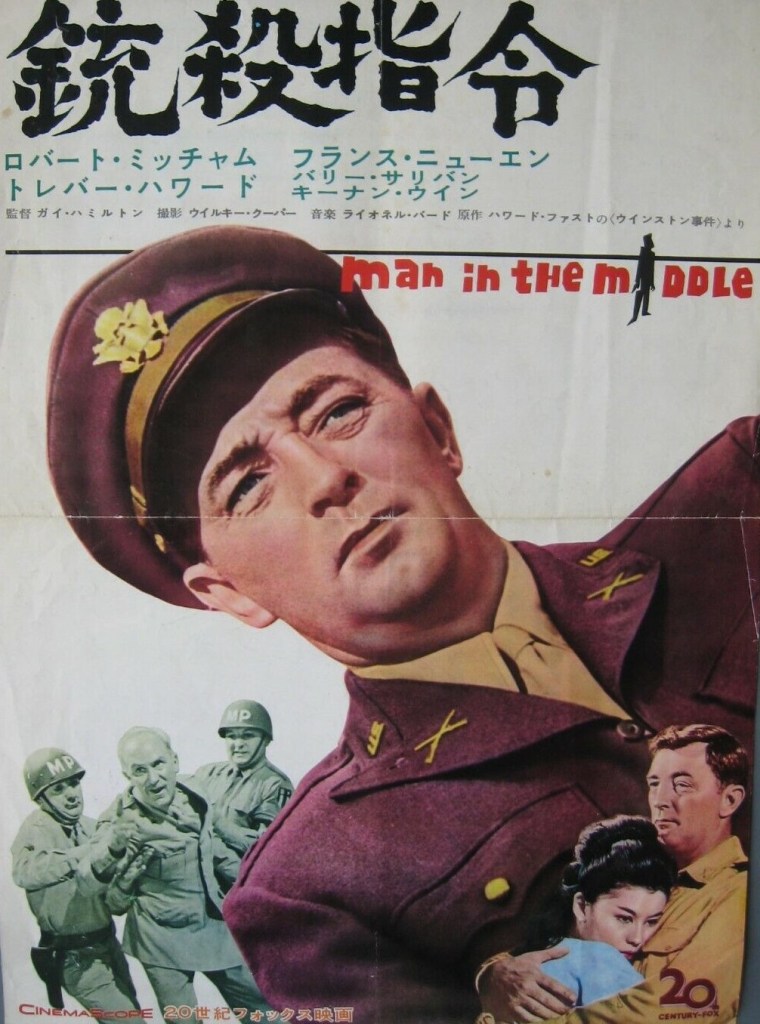
With Fox’s recent financial vicissitudes keeping the studio in the media spotlight, budget control was essential. The movie’s $1.35 million budget was trimmed by clever scheduling, no actor, outside of the star, on set for more than three weeks, ensuring that overtime vanished. The title, however, appeared forever in flux. Original title The Winston Affair, the name of the Howard Fast book on which the film was based, changed to The Man in the Middle, then back to The Winston Affair, reverting again to The Man in the Middle before ending up with a contracted version of that – Man in the Middle. The confusion played havoc with a movie called Light of Day that snapped up Man in the Middle when the Fox title became vacant but was released as Topkapi (1964) when Fox took the title back.

Producer Walter Seltzer (Number One, 1969) pushed for more African American representation on the picture. Three roles, not written as African Americans in the novel or in the Waterhouse and Hall screenplay, were given to African Americans, the “best men for the job,” according to the producer. The trio were: Errol John, the N.C.O of the prison cell where the murder suspect is held, Frank Killibrew who doubled as the jeep driver and confidante to attorney Adams (Robert Mitchum) and Oscar James as a court reporter.

The two ECA movies taken over by Fox.

Mitchum didn’t just have drink problems. He was in the middle of an affair with Two for the Seesaw (1962) co-star Shirley MacLaine which result in public rows with long-suffering wife Dorothy. Mitchum had enjoyed a long business relationship with Max Youngstein and when the producer came upon The Winston Affair the actor agreed to star in it, only to find the rights had already been snapped up by Pennebaker. However, Pennebaker was in no position to fund a movie and without a commitment from Brando as star unlikely to get it off the ground. Since the production company nonetheless required, for tax purposes, to show a movie on its books Brando had agreed to throw in his lot with Youngstein’s ECA. And when Fox took over, Brando and Talbot retained their production credits.

When Seltzer flew to London to meet Mitchum who was finishing off his cameo for The List of Adrian Messenger (1963) the star lived up to his hell-raising billing, walking drunk from his room along the hallway and down the elevator at the plush Savoy Hotel. He was buck naked.

The bulk of the filming took place in Elstree Studios in London with just a couple of weeks set aside for location work in India. The ongoing romance with MacLaine meant production could grind to a halt in the middle of a scene while Mitchum took a call from the actress in New York although conversation was inhibited with Selzer at his elbow looking at his watch.

“He was a professional in every respect,” recalled Selzer. “He was on time, knew his lines and didn’t make any trouble…very good with France Nuyen (A Girl Called Tamiko, 1962), who was a little unsure of herself, and he did a lot to help her performance and boost her confidence.”

Trevor Howard was a different kettle of fish. Mitchum and Howard had become friends in the 1950s while working in Mexico, and Mitchum was a great admirer of the Englishman’s talent. However, Howard had “been all but blackballed of late due to his drinking.” Oscar-nominated for Sons and Lovers (1960), Howard had only made two films since. And even the role here was more of an extended cameo than a main supporting role. To win the part, Howard invited director and producer to visit him at his home where he put on a very good act of restraint, limiting himself to tea while the others consumed alcohol.

Restraint proved an illusion. While Mitchum could drink and still turn up for work, Howard would go to pieces with a few drinks in his system. On his second day of shooting, Howard turned up on set wearing mismatched socks and threw a drunken fit when asked to change.

Director Guy Hamilton had worked with big Hollywood personalities Kirk Douglas and Burt Lancaster on The Devil’s Disciple (1959) but compared to them Mitchum was a pussycat.

“He understood the importance of listening,” said Hamilton, “which is very, very rare for American stars…If all else failed in a scene, you knew you could always fall back on Mitchum’s reaction shots, which could say more than the dialogue.”

Mitchum was blessed with a photographic memory. Even when confronted with pages of new script he would have no trouble remembering his lines. In fact, if anyone fluffed their lines they could rely on Mitchum helping them out. When the movie decanted to India, he had an encounter with a maharajah’s daughter, which ended up in the bedroom. Once the movie was finished, Mitchum resorted to type, getting stoned on raw marijuana on the 16-hour flight home from India, a zip bag full of the stuff, and sailing through the Nothing To Declare section at Customs at the airport.

Most reports have this down as a big flop. But I’m not so sure. It cost comparatively little and earned $1 million in rentals in the U.S. Mitchum was a big enough star for it to be released around the world and I’d be surprised if it didn’t manage the extra $300,000 required to break even.

SOURCES: Lee Server, Robert Mitchum, Baby, I Don’t Care (Faber and Faber, 2001) p457, 462-467; “Marlon Brando To Film Winston Affair,” Box Office, April 9, 1962, p16, “Youngstein As Exec Producer,” Variety, January 16, 1963, p4; “Entertainment Corp Sets Mitchum Film Overseas,” Variety, January 16, 1963, p4; “Four Months To The Day For Man,Variety, January 26, 1963, p5; “From Surefire to Fail Safe,” Variety, April 10, 1963, p3; “Winston Affair Set To Start 20th-Fox  British Production Program,” Variety, April 24, 1963, p22; “Fascination With Own Era,” Variety, May 22, 1963, p3.“Use Negro Skills in Seltzer’s Film,” Variety, October 2, 1963, p4; “No Principal On Role Longer Than 3 Weeks, Key Budget Control,” Variety, November 27, 1963, p3.

Man in the Middle / The Winston Affair (1964) ***

Scratch a war picture and you often find something more interesting underneath. This creditable courtroom drama makes a pitch for justice for all in the Compulsion (1959) vein while exploring the fragile and occasionally fractious relationship between the Allies during  World War Two. In front of several witnesses American officer Lt. Winston (Keenan Wynn) kills  in cold blood an ordinary British soldier in a remote depot in India.

It’s an open-and-shut case requiring a defence attorney of no great distinction. In fact so little legal ability is required that it’s assigned to Lt. Col Adams (Robert Mitchum), recovering from a war wound, who  hasn’t practised law in 14 years. It doesn’t help that Winston is a racist and psychopath, convinced left-wing conspirators are planning to take over the world. While dutiful, Adams displays no great enthusiasm for the task, taking time out to embark on romance with nurse Kate (France Nuyen), who is a good deal more fired-up about injustice than him. Adam’s superior officers just want Winston found guilty and hanged in double-quick-time to placate the British.

As if the odds aren’t already stacked against Adams, his boss General Kempton (Barry Sullivan) has brought in top prosecutor Major Smith (Paul Maxwell) while saddling Adams with two useless assistants. However, when Adams finally gets going, he discovers that Winston was assessed as mentally ill by psychiatrist Dr Kaufman (Sam Wanamaker) who has, unfortunately, been transferred and his report has vanished. Col Burton (Alexander Knox), who has taken over the case, refuses to accept Kaufman’s diagnosis. And Adams gets around to thinking there’s something fishy going on, the bottom line being that if the Winston is declared insane, then he won’t be hanged, the case neither open nor shut, fears rising of repercussions at a time when Allied unity is under threat.

So then we’re into classic courtroom territory. Kate has a carbon copy of the Kaufman report but as any lawman knows that in itself is inadmissible.  They can call back Kaufman to testify but there’s no allowing for the state of the roads and a driver in a hurry is liable not to make it. Major Kensington (Trevor Howard) might prove a trump card – or he may not. It’s a given that any defence lawyer’s life is filled with obstacles and this is no different. The out-of-practice Adams is in a hell of a pickle, and that’s how it should be.

On top of that, or underlying it, is the fight for justice for all. It’s easy to fight for the innocent but harder to battle for the sick and the mentally ill, however repellent their prejudices. You might despise the Winstons of this world, as Kate puts it, but you wouldn’t want to be his executioner.

And in the background are wartime considerations. What is one man’s life when judged against the uproar that would ensue and disrupt war planning should the self-proclaimed murderer be set free. Also, normally the mentally ill at this stage of Hollywood history are generally appealing characters, not hateful, but it’s only when Adams digs away at the experience of Winston that he realises the reasons for the murder, the hell that the insecure undergo when cleverer minds decide on torment.

Robert Mitchum (Secret Ceremony, 1968) is on excellent form as the attorney initially just going through the motions who determines to fight his superiors rather than toe the party line, even at the cost of losing his much-delayed promotion. France Nuyen (A Girl Named Tamiko, 1962) is somewhat spunkier than Hollywood nurses of this period and refuses to let romance get in the way of truth. Keenan Wynn (Warning Shot, 1967), a stubborn nutcase, is the worst kind of client, constantly shooting himself in the foot.

Trevor Howard (The Charge of the Light Brigade, 1968) has toned down the normal irascible persona and makes a respectable showing. Barry Sullivan (Light in the Piazza, 1962) is as ruthless as he is charming. The solid supporting cast includes Sam Wanamaker (Danger Route, 1967), Alexander Knox (In the Cool of the Day, 1963) and Errol John (The Sins of Rachel Cade, 1961).

This was director Guy Hamilton’s last film before he shot to international fame on the back of Goldfinger (1964). The screenplay by British pair Keith Waterhouse and Willis Hall (A Matter of Innocence/Pretty Polly, 1967) was adapted from the novel by Howard Fast (Mirage, 1965).

Courtroom with depth, giving a glimpse of the politics prevalent among High Command in wartime, almost a companion piece of The Charge of the Light Brigade.

Cinema Archives has a much pricier edition but I reckon this cheaper version will do the job.

The Charge of the Light Brigade (1968) ****

It’s worth remembering that Britain, led by roughly the same type of commander lampooned here, won the Crimean War and that initially this particular engagement, despite the deaths, was celebrated for its valour by poet Lord Tennyson, in much the same way as famous defeats like Dunkirk and The Alamo somehow managed to achieve the status of some kind of victory in the public perception. It’s also worth noting that the documentary-style realisation of Dunkirk, (2017) and to that extent Coppola’s Apocalypse Now (1979) owe much to Tony Richardson’s approach, both films more interested in the bigger picture than individual acts of heroism.

And our conscience here, dashing cavalry officer Nolan (David Hemmings), is not quite saintly, engaged in an affair with the wife Clarissa (Vanessa Redgrave) of a friend. Despite the director’s rush to judgement, his approach displays a refreshing change to a genre where acts of selfless courage were the norm. Setting aside the occasional self-reverential artistic lapse, it’s an excellent depiction of class-ridden Britain at war in 1854, an era when military advancement was purchased without any consideration to the leadership skills such high-ranking officers required. I’m never sure if John Ford invented the camaraderie of his Cavalry in westerns, where at dances  the officers mixed with the ordinary soldiers, but here the two classes are kept apart.

And while Richardson clearly wants to blame the class system for the military calamity, the outcome is a no-holds-barred ultra-realistic portrayal of war in in all its sordid glory. At its heart are the machinations of senior commanders jostling for position and control and, much as with Field Marshal Montgomery and General Patton in World War Two, allowing personal enmity to affect decisions.

The two biggest culprits are Lord Cardigan (Trevor Howard) and brother-in-law Lord Lucan (Harry Andrews) in charge of the ill-fated charge who openly spout bile at each other, remain deliberately obtuse, and are, nonetheless, a joy to watch. Cardigan is irascible to the point of apoplexy, incredibly brave, vainglorious, a vindictive sex-mad peacock, with an odd selection of principles (refuses to deal with spies, for example). Nothing can beat a quite marvellous spat between the pair over how to pitch tents. Both, however, are a vast improvement on the ineffectual commander-in-chief Lord Raglan (John Gielgud) whose idea of tactics is to “form the infantry nicely” and another commander who refuses to let the simple matter of being under attack ruin his breakfast.

At the other end of the scale are the poor recruits, drawn from the lower classes, so ill-educated they don’t know their left foot from their right (something of a necessity in obeying orders in the field), lured by the promise of glory and a job, and find themselves turned into horsemen in the most brutal fashion.

In the middle is the effete Nolan, initially introduced as the good guy, who believes horses should be treated with kindness and stands up to Cardigan. His romance with Clarissa is a masterpiece of nuance, all furtive glances, hardly a word spoken. And he has a pivotal role in sending the cavalry in the wrong direction at the Battle of Balaclava, causing the fatal charge.

It’s episodic in structure, characters bobbing in and out, some for comedic purposes, and without the battle it’s doubtful the picture would have been made for, excepting the high-level squabbling, there’s little inherently dramatic. And possibly that’s to the movie’s benefit for it clears the way to concentrate on how an army operates and goes to war, the focus, unlike most war or historical pictures, being as much on what goes wrong as goes right. So the horses dying during the voyage and callously dumped overboard and the men marching through Crimean heat and afflicted by cholera take centre stage rather than lavish sequences of soldiers on splendid parade.

On the downside, you have to accept the director’s version of the war’s causes, British imperialism don’t you know, rather than Russian aggression as a result of religious conflict in the Middle East. And there’s narrative indecision, various characters permitted interior monologue for no particular reason except artistic impulse. Mrs Duberley (Jill Bennett) wife of the paymaster (Peter Bowles) is permitted to accompany the expedition for the sole purpose it would appear of being shagged by Cardigan.

The detail of what exactly went wrong on the battlefield is obscured by the fact that Nolan, who hand-delivered the famous order to attack, itself unclear, died in battle, so it’s like one of those Netflix documentaries about unsolved murders, fascinating but ultimately annoying. If incompetence is measured in casualties, apart from this one charge the British came out better than the other participants, 40,000 dead compared to three times as many among their French allies and more than ten times as many among the Russian enemy.

The acting is of a very high quality, David Hemmings (Alfred the Great, 1968) as good as I’ve ever seen him, Vanessa Redgrave (Blow-Up, 1966), except for her deception a Stepford Wife Victorian-style, Trevor Howard (Von Ryan’s Express, 1965) brilliantly outrageous and John Gielgud (Sebastian, 1968) who turns befuddlement into a high art.

Tony Richardson (Tom Jones, 1963) makes some bold choices, not least in what is included and what is left out, the battle of the tents, fake news (from The Times!), soldiers facing the lash, the dashing charge and its terrible aftermath, the animated sequences, and his revolutionary soundtrack. Sergio Leone might have claimed the artistic high ground with the buzzing fly at the start of Once Upon a Time in the West (1969) but there’s little in film music of the time – beyond Bernard Herrmann’s Psycho score – to compare with the sound of a fly playing over the end credits or its inclusion during the march when men are literally dropping like flies. This is a very different kind of curate’s egg, absolutely brilliant in parts, and never dull.

Unfortunately, there’s a topical parallel, Crimea having been invaded several years back by Russia and now the whole region aflame.

This was the first home-grown excursion into the all-star-cast business – other British movies in that ilk, originating from these shores, previously headlined by a Hollywood star like Gregory Peck (The Guns of Navarone, 1961),  Kirk Douglas (The Heroes of Telemark, 1965) or George Peppard (The Blue Max, 1966). And I can see why the new box office stars David Hemmings and Vanessa Redgrave, repeating their Blow-Up (1966) teaming, would have, in the narrative sense, occupied center stage. But given nobody knew for certain what caused the disastrous charge and that it would taken place anyway in the picture, the far more entertaining approach would be to concentrate entirely on the likes of the feuding Cardigan and Lucan, two characters who leapt off the screen. Outside of the battle itself, Nolan’s sole purpose, it would seem, was to point out that the army treated its horses badly, a point the audience would have easily picked up without Nolan’s display of alternative horsemanship. Still, all told, at the risk of repeating myself, an excellent watch.

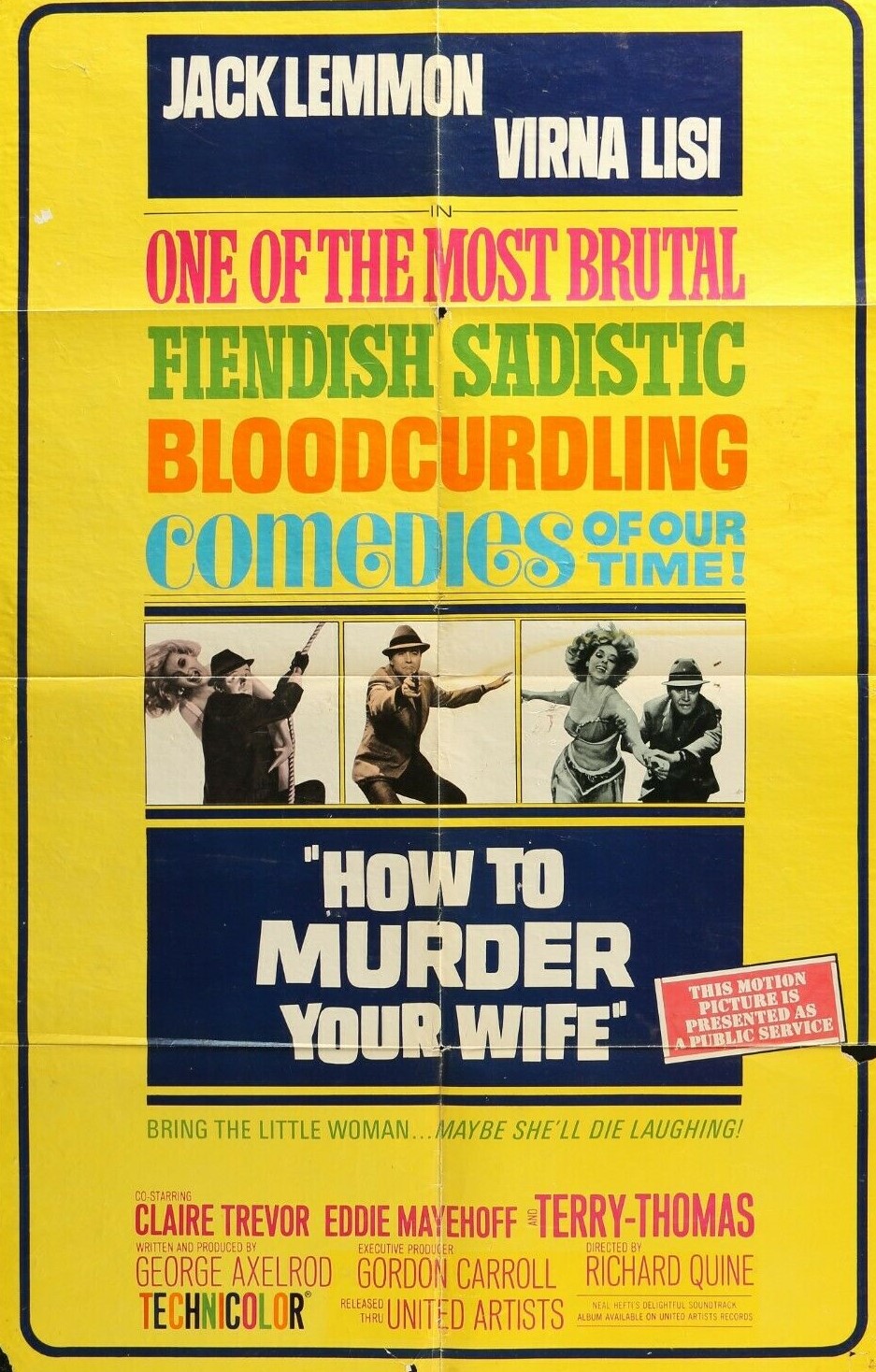
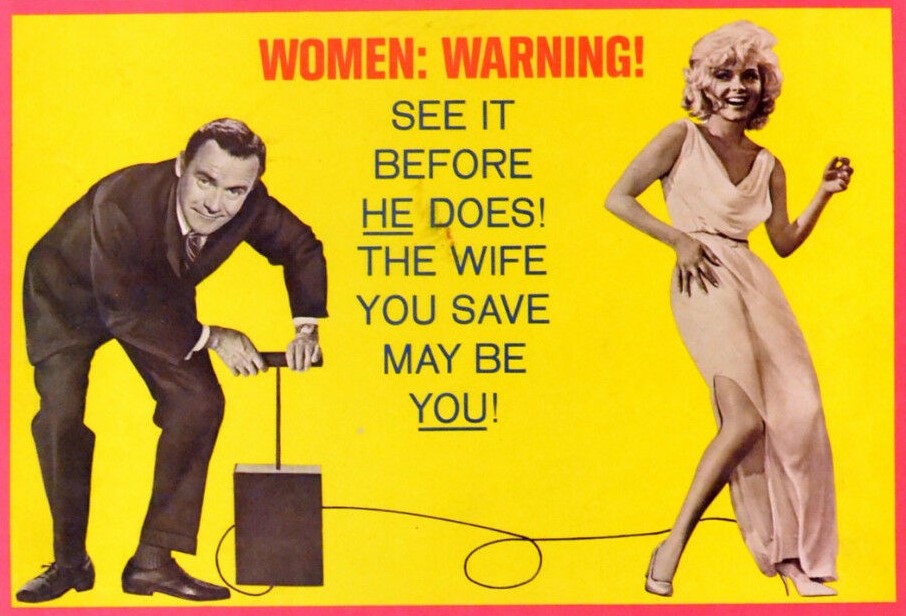
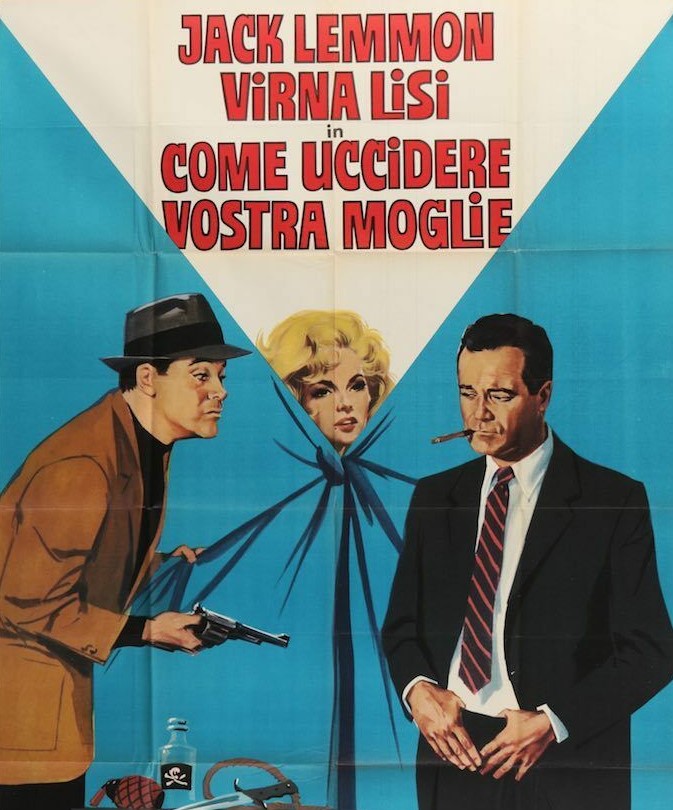
How To Murder Your Wife (1965) ***

Men had a hell of a time in the 1960s to judge from this riff on marital strife that starts off like Walter Mitty meets The Odd Couple. It’s one of those daft comedies that only work on their own terms – and for the most part this works very well.

Dedicated bachelor Stanley Ford (Jack Lemmon), enjoying a host of one-night stands, ensconced in almost a bromance with butler and kindred spirit, the very English Charles (Terry-Thomas), makes the mistake of getting hammered at a drunken party and ends up married to a beauty queen (Virna Lisi). Although she is gorgeous and very loving – most scenes end on a fade as she devours him in kisses – and a good cook (though a bit lax by the high housekeeping standards of Charles), Stanley resents being burdened with a wife, especially when it costs him the services of his butler. 

The biggest casualty is his self-image. He has fashioned his persona after his Bash Brannigan comic strip, syndicated to hundreds of newspapers, that permitted him the fantasy of being secret agent/adventurer/detective, fighting off bad guys and rescuing damsels in distress. Marriage inflicts a devastating change in his mental state, and he transforms from hero into hen-pecked booby.

In a bid to restore his self-esteem, and provide a fictional glimpse of freedom, he plans to murder his wife, if only in the comic strip. It has been Stanley’s working practice to act out and have photographed all the elements of his stories so Charles records the whole episode, from getting advice on how to drug Mrs Ford to (using a dummy) incarcerating her in cement. Unfortunately, Mrs Ford, outraged on discovering the illustrations for this particular comic strip episode, vanishes, leaving no explanation for her disappearance, except that various people witnessed him carrying out the supposed murder. He is arrested and put on trial.

You couldn’t make this up, but strangely enough, it is all very believable. The opening section where Stanley enacts the part of his action man Bash Brannigan in “The Case of the Faberge Navel” is just a delight. When the future Mrs Ford comes to explain exactly why she came to be jumping out of a birthday cake in a bikini, it is as daft as everything else.

However, the picture’s overall theme, the war between men and women, where men feel controlled, is somewhat dated. You might expect such a war to go nuclear when Mrs Ford dares to infringe on the sanctuary of a men-only enclave. The trial scene is particularly laborious in trying to determine that men are victims of controlling women. Despite that, there are some very funny lines that hit the nail on the head – men “are always guilty about something” declares Mrs Ford’s confidante Edna (Claire Trevor) whose strategy is always to keep men off-balance.

Jack Lemmon (The Apartment, 1960) has ploughed this path before, conspirator to the illicit,  although generally to be found in the loser camp rather than, as, effectively here, despite his complaints to the contrary, in the winner’s circle with an enviable lifestyle and willing girlfriends to hand. There’s a gleefulness in his performance, the little boy getting away with everything, that turns into a small boy’s sullenness when it is all apparently taken away.

Italian star Virna Lisi (Assault on a Queen, 1966), in her Hollywood debut, is a delight.  Her frothy sexuality goes down a treat but she is far from a dumb blonde, learning English from television, excellent cook, and wise enough not to go down Edna’s route of dealing with men. Terry-Thomas (Bang! Bang! You’re Dead!, 1966) delivers just as interesting a confection, a touch of ruthlessness to the stiff upper lip, high chieftain of the Male Protection League, reveling in the prospect of ridding the world of insidious influences like Mrs Ford. And there’s a welcome role for Claire Trevor (Stagecoach, 1966), especially when, in a party scene, she really lets go.

The other males, ranging from dumb and dumber to dumbest,  totally lacking in Jack Lemmon’s charm, perfectly illustrate the need for a woman’s firm hand, among them Eddie Mayehoff (Luv, 1967), Sidney Blackmer (A Covenant with Death, 1967) and Harold Wendell (My Blood Runs Cold, 1965).

Richard Quine (The World of Suzie Wong, 1960) directed from an original screenplay by George Axelrod (The Secret Life of an American Wife, 1968).

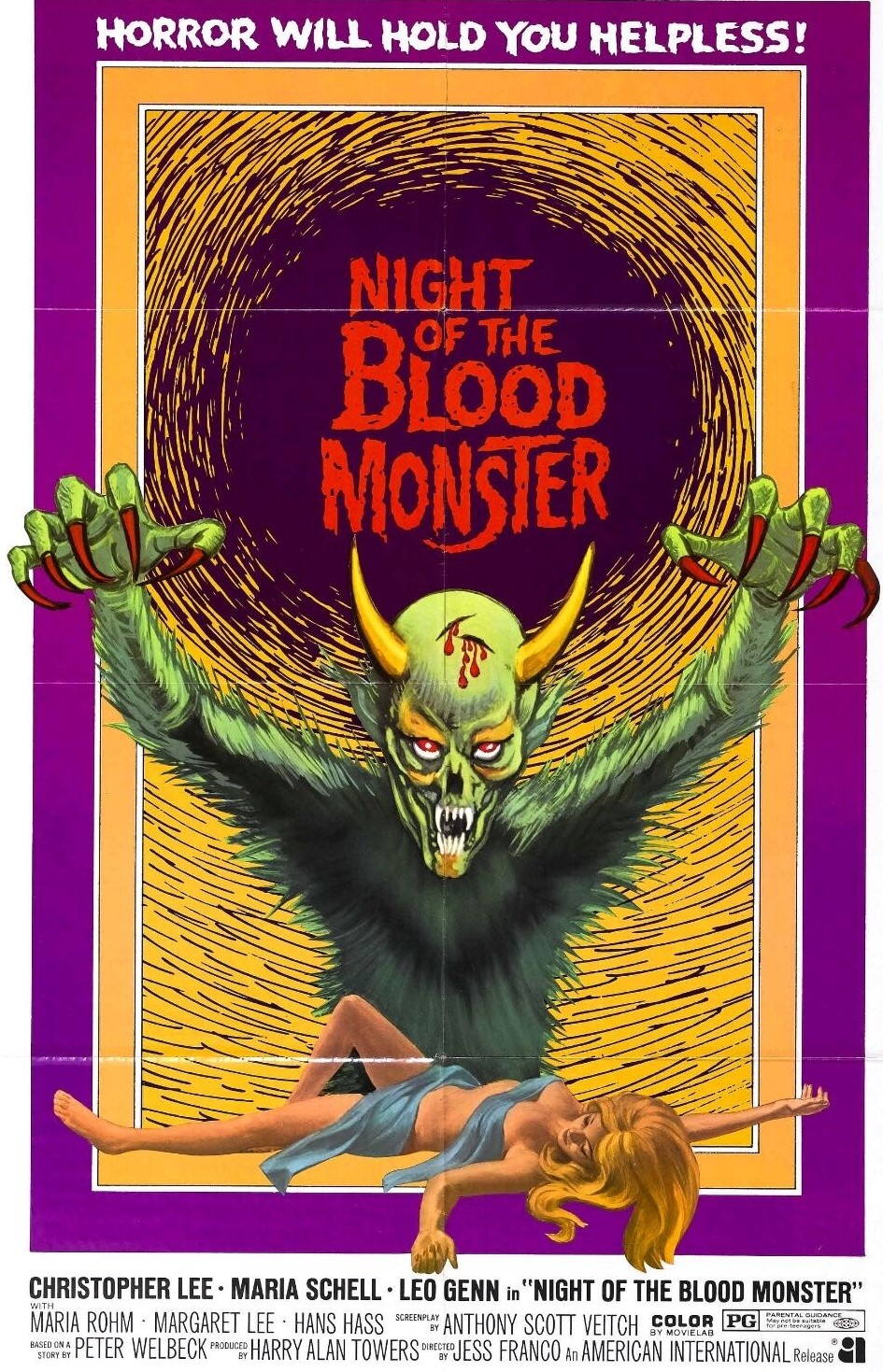
Night of the Blood Monster / The Bloody Judge (1969) ***

Handsomely mounted historical drama set in 17th century England on the brink of revolution  meets Son of Witchfinder General. An uprising headed by the Duke of Monmouth in the south-west threatens to overthrow King James II. Involved in the plot are Harry Selton (Hans Hass), son of suspected agitator Lord Wessex (Leo Genn), whose beloved Mary Gray (Maria Rohm) is in the sights of Judge Jeffreys (Christopher Lee) after he has condemned her sister Alicia (Margaret Lee) to be burned as a witch.

The minute witchcraft enters the equation the narrative thrust is constantly interrupted by scenes of nudity, blood and torture, mostly involving women, but actually the film does attempt to cover the rebellion and its notorious aftermath when hundreds of rebels were executed, the “Bloody Assizes” with “Bloody Judge” Jeffreys to the fore. Conflating witchcraft with a genuine historical episode does not work very well and unlike Witchfinder General (1968), the murder of innocent women is more of a sideshow, despite the brutality involved, and you get the impression the story has been hijacked to accommodate supposed witch Mary in the interests of adding titillation.

Even as the story of the rebellion unfolds, the threat to the crown spelled out, the origins of the revolt mostly made clear (Monmouth being the illegitimate son of Charles II, and nephew to James II) although the sectarianism behind the rebellion is ignored, the narrative keeps jumping back to the witch element. Jeffreys connects the parallel narratives, hunting down rebels and witches, while handling most of the exposition. Given the budget, there’s a surprisingly good battle sequence, cavalry charging cannon. Given his later reputation, Jeffreys also reflects on the meaning of justice.

And while there are some camp moments – Jeffreys playing the organ while attired in grand robes, dancing girls sticking pins in his effigy – the twists and turns (Mary captured and rescued, captured again)  are effective enough. Despite the copious nudity, there a couple of low-key love scenes and, oddly enough, a touching moment when Mary licks the blood from a dead prisoner. And for all the blood, that is effect rather than cause, nothing too gory.

But with the powerful all-mighty, and investigators able to plant evidence, and the innocent forced into immoral acts to save their loved ones, lawlessness is apparently next to godliness. But in reality the wicked did not get away with their crimes so various villains get their come-uppance.

Most peculiar sight is Christopher Lee in a love scene where he is not about to sink his incisors into a neck. Occasionally, the film bursts into German with English subtitles – as if various versions were pillaged to produce this copy – or has lines like “you turn me on.”

However, fans of Spanish cult director Jess Franco (The Girl from Rio) who expected something more along the lines of 99 Women (1969) and Venus in Furs (1969) may be disappointed that he spends so much time on the historical elements and less on the random T&A. You might not be surprised to learn of the involvement of ubiquitous producer Harry Alan Towers (Five Golden Dragons, 1967).

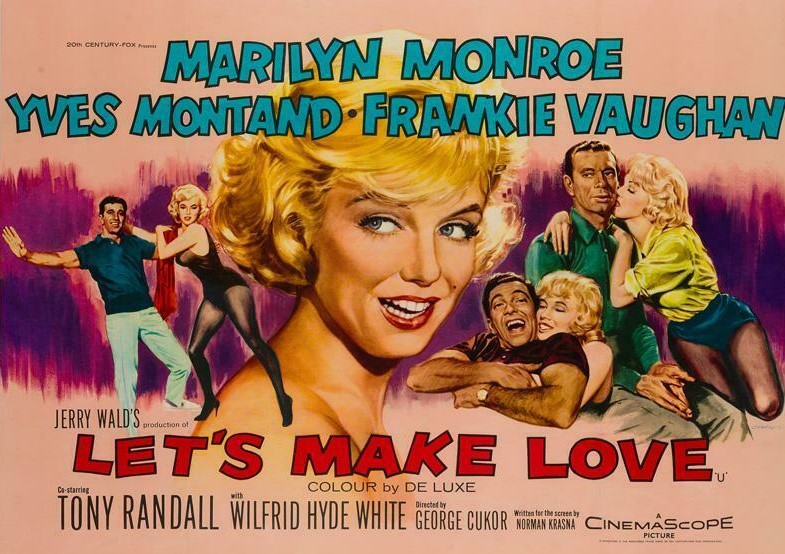
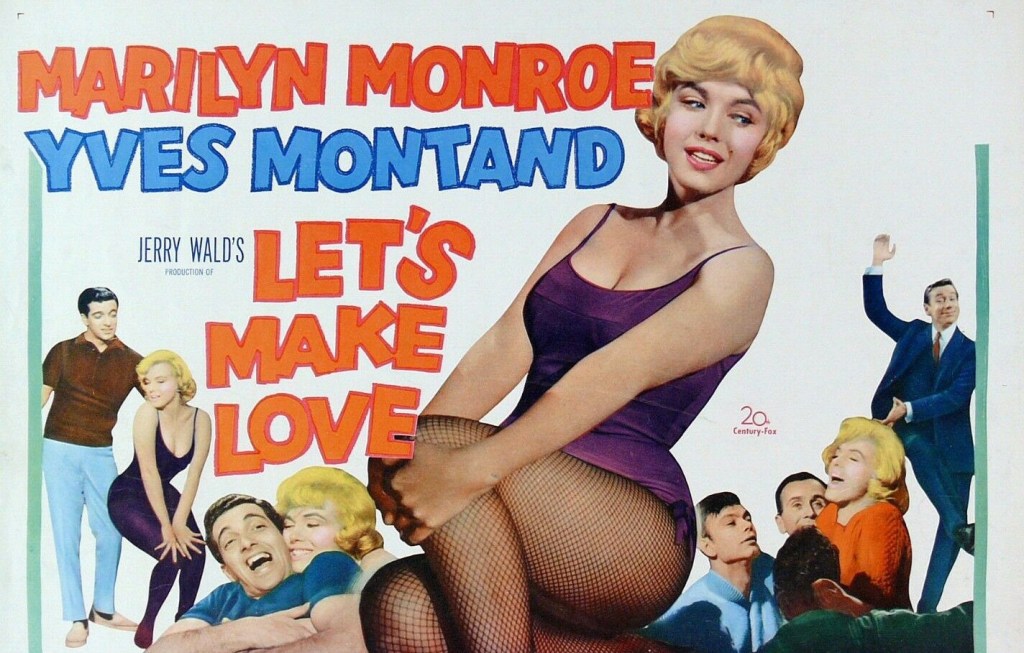
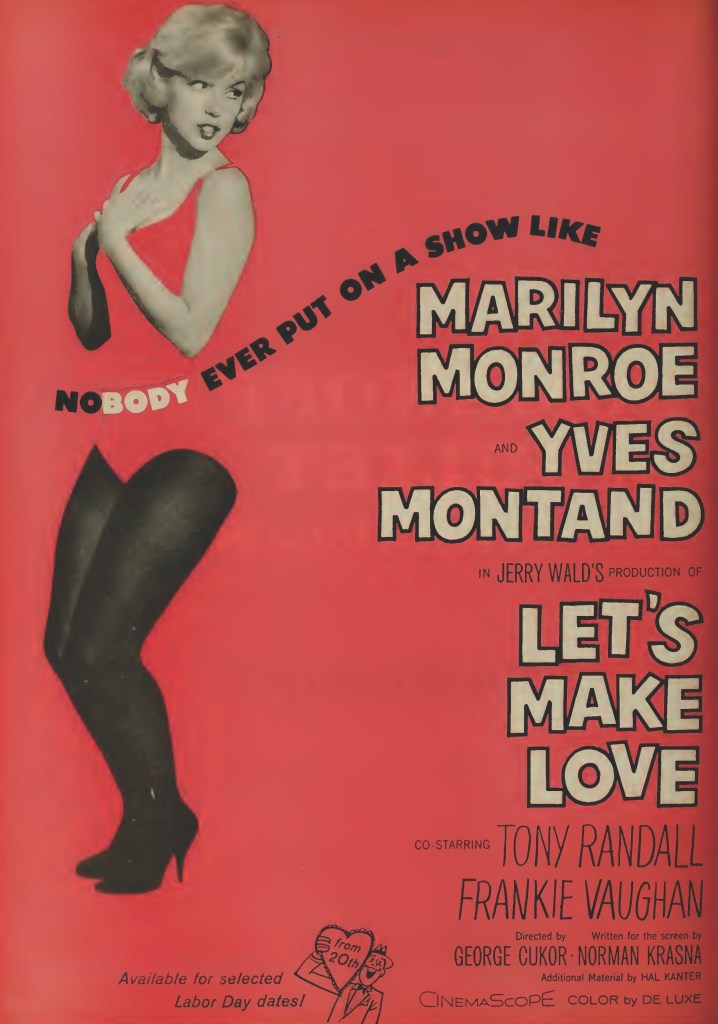
Let’s Make Love (1960) ***

Despite a luminous performance by Marilyn Monroe (Some Like it Hot, 1959) , in revealing outfits half the time, this backstage musical drama barely staggers over the line. Whatever relationship the actress enjoyed off-screen with co-star Frenchman Yves Montand (Grand Prix, 1966) fails to register here. In this fish-out-of-water tale of the Broadway intrigue involved in putting a musical together, watching klutz billionaire Jean-Marc Clement (Montand) getting his act together as neophyte actor-cum-singer fails to fly.

It’s always difficult observing a good actor trying to be bad. If he’s a really good actor, it’s going to be an awful watch. And unless he’s got the comedic chops to trigger a bucketload of laughs it’s painful to observe. Gregory Peck reportedly quit this role in favour of The Guns of Navarone (1961) because there was too much Marilyn Monroe in it, and possibly an awkward Peck would have been more fun to watch though comedy was scarcely his forte, but without Monroe the movie would have been virtually unwatchable.

The story’s familiar, a twist on Cinderella with Clement being the ugly duckling in terms of talent. The billionaire businessman, notorious for his love life, attends a rehearsal of a show intending to register outrage at its veiled portrayal of him. Instead, he is mistaken for an auditioning actor and offered a role. He falls for Amanda (Monroe) but she shows little interest, either obsessed with her knitting or trying to improve her education at night class, and appears far more interested in her stage co-star Tony (Frankie Vaughan).

In order to sharpen up his act, Clement hires a bunch of well-known thespians: Milton Berle, Bing Crosby and Gene Kelly.

This is where the show could be get interesting. Genuinely learning the secrets of a great comedian, singer and dancer should at the very least provide a fascinating insight into their skills. Of these, Crosby is the pick, demonstrating the importance of raising or dropping your voice at various points in order to maximize the emotion in a song, in other words a singing masterclass. Berle has too much screen time and does little to justify it.

Whatever, regardless of what the script says, Clement seems to take on board little of what he is taught. Montand was a gifted crooner in any case, having begun his career as Edith Piaf’s protégé, and it just seems like he switched instantly from being a bad singer to a good one. In contrast, when Amanda has to take direction, she immediately shows how simple it is to improve a number by adding some actions.

Luckily, Monroe is such a mesmeric screen quality that she can rescue any indifferent movie.  This would work better with a more charismatic leading man – and the prospect of Peck teaming with Monroe was intriguing – but regardless of who she acts opposite Monroe will always blow them away. This is a different kind of role for her because in a sense she is neither the girl adored nor the victim of romance gone wrong. For the most part she’s just a career girl focusing all her attention on getting on. She’s almost just the foil in the dramatic sequences for Montand. But once she has the stage or screen or to herself she dazzles.

Discover WordPress

A daily selection of the best content published on WordPress, collected for you by humans who love to read.

The Atavist Magazine

by Brian Hannan

WordPress.com News

The latest news on WordPress.com and the WordPress community.