Five million dollars. That’s roughly the budgetary difference between Hammer’s Quatermass and the Pit and Twentieth Century Fox’s Fantastic Voyage. Although the protagonists in the latter face the unexpected, the movie is (as would be 2001: A Space Odyssey, 1968) an exercise in awe, in controlled exploration of wonder, whereas Quatermass, lacking the money for special effects, concentrates more on story and human impact. The government funds the experiment in Fantastic Voyage while Professor Quatermass (Andrew Keir) finds nothing but obstruction from his superiors.
Quatermass and the Pit is a masterpiece of stealthy exposition. Virtually every minute brings another development, gradually building tension, stoking fear. The principals – Dr Roney (James Donald), Barbara Judd (Barbara Shelley) and the professor – are cleverly kept apart during the early stages. A human skull discovered on a building site for a London Underground station is followed by a skeleton. Palaeontologist Roney determines it is five million years old, older than any previous find.
A metallic object is found nearby. First guess is an unexploded bomb from the Second World War. But it’s not ticking. And a magnet won’t stick to it. Col Breen (Julian Glover) is called in along with hostile rocket expert Quatermass. They have been locking horns from the outset.
There’s a whole bunch of apparent red herrings, mostly of the demonic variety. The location, historically associated with weird occurrences, is a nickname for the Devil. A pentagram is detected. Touching the object can give you frostbite. Col Breen argues it’s a leftover German propaganda machine from World War Two. A hideous dwarf and other spectral images are sighted. Telekinesis is involved. And tremendous vibrations.
Some people, such as Barbara, have a more receptive brain and can play memories millions of years old that reveal the alien truth. But this is an alien race with genocidal tendencies and able to unleash psychic energy.
The genre requires the scientists to discover an improbable solution which of course they do. Given the miserly budget, the special effects are not remotely in the Fantastic Voyage league. But that hardly matters. The movie coasts home on ideas, marrying sci-fi, the demonic, dormant and institutionalized evil, the militarization of the Moon and the ancient infiltration of Earth by Martians, no mean achievement, and a vivid narrative.
Director Roy Ward Baker (aka Roy Baker) provides many fine cinematic moments as he chisels away at the story, finding clever methods of revealing as much of the aliens as the budget will permit, focusing on very grounded characters, concentrating on conflict, and human emotions, mainlining fear rather than awe, building to an excellent climactic battle between man and monster.
Barbara Shelley (The Gorgon, 1964) is the pick of the stars, in part because she is at such a remove from her normal Hammer scream-queen persona, but more importantly because she brings such screen dynamism to the role. It’s refreshing to see her step up, as she carries a significant element of the story. Oddlyenough, although she has as good a movie portfolio as Andrew Keir and is certainly superior to James Donald, the denoted star, in that department, she is only billed third.
While Andrew Keir (The Viking Queen, 1967), warm-hearted for an intellectual, and James Donald (The Great Escape, 1963), trying to keep a cool head in the middle of inclination to panic, are good, they don’t bring anything we haven’t seen before. Julian Glover (Alfred the Great, 1969) is never anything but imperious and/or irascible, so ideal casting here.
The innovative electronic music was down to Tristram Cary and the unsettling credit sequence deserves some recognition. Nigel Kneale, who originally explored similar ideas for the character on television, came up with the screenplay.
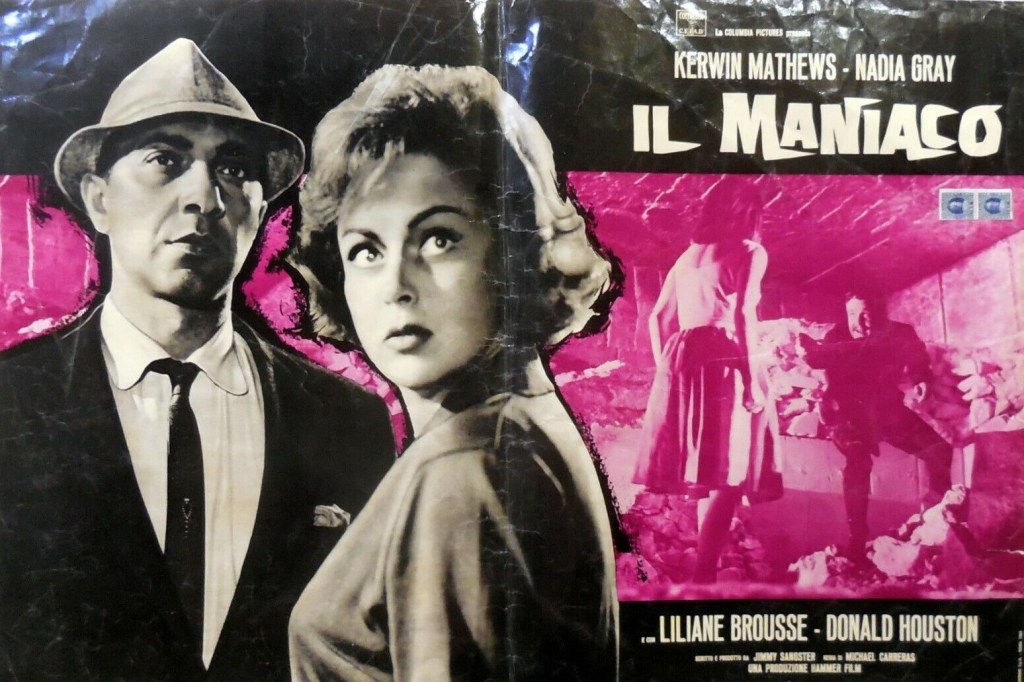
Such an ingenious thriller you just have to applaud. Opening with a close-up of a predatory eye, this scarcely draws breath as it dashes through a latter-day film noir maze, spawning out auditory and visual cues, beautiful woman luring dupe, twisting the expected narrative round her little finger.
Artist Jeff (Kerwin Mathews) setting up his easel in the Camargue, hardly one of the most tourist-friendly spots in France, eyes up Annette (Liliane Brousse), the daughter of a hotelier Eve (Nadia Gray), but, in extremely opportunistic style, settles for the mother. In true noir fashion she is using him, seducing him into a scheme to free her husband George (Donald Houston), incarcerated in a mental asylum for torturing and killing with a blowtorch the aforementioned predator who raped Annette four years before.
Eve convinces Jeff that in return for his freedom the madman will effectively give his blessing to their affair. It’s a deal only a besotted dupe would fall for. George has an ally inside the asylum, assisting his escape, but when George turns up, and Jeff drives him to Marseilles, he leaves behind the corpse of his criminal associate in the boot. Jeff dumps the body in the river.
Cue the start of a series of strange events. A fired-up blowtorch is discovered in the garage where Georges committed his initial crime. Annette, jealous of her mother’s relationship with Jeff, plans to leave and go with her father.
And I’m sorry to say that in order to explain the attraction of this neat little picture I’m going to delve into SPOILER ALERT territory.
All the while of course you are wondering whether George will keep to his side of the bargain, especially as Eve starts to get antsy with Jeff, and the investigating police inspector seems overly suspicious. And it being this kind of picture you expect a twist.
But not one this clever.
George, blowtorch at the ready, traps Jeff in the garage. He has fished the corpse out of the river. He plans to burn the garage to the ground, leaving behind two dead bodies, assuming the police will imagine that in a further bout of psychotic behavior the murderer gave in to his desires and killed again, but in the process accidentally killed himself.
But that’s not the final twist.
One of the victims survives. But which one? He is so badly mutilated as to be rendered unrecognisable and lies in a hospital bed covered head to foot in bandages. Has Eve’s plan backfired? Has she accidentally killed her lover?
But that’s not the final twist.
Eve knows who the man in the bed is. It’s not her lover. Because Jeff is just the dupe. The body dumped in the river was George. All the time Eve was visiting her husband in the mental asylum she was carrying on an affair with one of the guards. The guard killed George after the escape, retrieved the body from the river, left it in the garage and planned to kill off his competition at the same time. If you’re going to be tabbed a maniac, you better behave like one.
It’s a shame you can’t see the shock on the face of poor Jeff because he is encased in bandages. And this isn’t just the clever villain unable to stop herself boasting about how clever she has been. This is Eve getting into the murder racket. She switches off his oxygen.
But that’s not the final twist.
Jeff ain’t dead. He wasn’t even on a life-support machine. He was just trussed up to tempt Eve in revealing herself. He had escaped the garage inferno and told the police what was going on. So you can guess the rest, but even then there’s one other ironic twist. Just like Jeff, the imposter George is as taken with the daughter as the mother.
The twists are so well done, the narrative so compelling, that would be enough to make a convincing case for entry into the category of cult. What makes an undeniable case is the directorial style. Sights and sounds drive the story as much as anything. The eerie bright light in the garage, the sound of blood dripping on the floor, the bold close-up of the eye, the advancing blow torch, setting it in a bleak rather than scenic area of France, are cinematic notions belonging to classic movies, not to a tawdry B-picture.
Although The Devil Rides Out (1968) is generally considered the top Hammer picture of the decade, I would argue this runs it a close second, and possibly even tops it. Taking time off from his studio job Michael Carreras (The Lost Continent, 1968), later Hammer’s managing director, delivers a little masterpiece working to an effortlessly clever original screenplay by future director Jimmy Sangster (The Horror of Frankenstein, 1970).
It’s enough that Kerwin Mathews (The 3 Worlds of Gulliver, 1960) is playing against his screen persona as upright hero. The biggest advantage in casting Nadia Gray (The Naked Runner, 1967) was that she was unknown and didn’t have the kind of onscreen presence that might have you doubting her motives from the start. Liliane Brousse (Paranoic, 1963), in her penultimate movie, is initially too much all-arched-eyebrow and pout, only coming into her own when she becomes dutiful daughter rather than wannabe seducer. The pretend George, real name Henri, Donald Houston (A Study in Terror, 1965), hidden beneath dark glasses most of the time, is a dab hand at a pretend psychopath.
The unexpected U.S. box office success should have propelled star Kenneth More into the Hollywood firmament. The British box office champ of the previous decade, after comedies like Genevieve (1953) and Doctor in the House (1956), war movie Reach for the Sky (1956) and drama A Night to Remember (1958), he had been rewarded by a tie-up between British studio Rank and Twentieth Century Fox. That allowed him bigger budgets and bigger co-stars, pairing him with Jayne Mansfield in comedy western The Sheriff of Fractured Jaw (1958), and Lauren Bacall for historical adventure North West Frontier (1959).
While hits in Britain, they failed to raise his profile in America. That changed with Sink the Bismarck!, his performance highly praised, the movie a genuine and very profitable hit. It should have been the stepping-stone he needed to break into the Hollywood big time. And for a short time it looked as if he would.
He was scheduled to co-star with Gregory Peck in the big budget high adventure war picture The Guns of Navarone (1961), in the part that finally went to David Niven. He lost the role through petulance.
At a public event, he verbally tore into his boss, John Davis, head of Rank, to whom he was contracted and on whose goodwill he relied to loan him out to Columbia for this movie which would become the number one hit in the annual U.S. box office race. In revenge, Davis blocked the loan-out and in effect stymied his career. Few companies were going to invest in a star whose movies would automatically be blocked from being booked on the Odeon chain, owned by Rank, and one of the two biggest circuits in Britain. As a result of his intemperate, drunken, action, More’s career plummeted.
Oddly enough, Sink the Bismarck! also killed off the career of the German-born Dana Wynter, a rising Hollywood star, leading lady to Rock Hudson in Something of Value (1957) Robert Wagner in In Love and War (1958) and James Cagney in Shake Hands with the Devil (1959) and denoted star of Henry Koster’s Fraulein (1958). After Sink the Bismarck!, and On the Double (1961), she lost out on big roles until the low-budget If He Hollers, Let Him Go (1968).
It seemed almost a contradiction in terms that such a big hit as Sink the Bismarck! could produce no outright winners in the career stakes. And although director Lewis Gilbert had a stab at the Hollywood big budget picture with The 7th Dawn (1964) starring William Holden, he relied on later British pictures Alfie (1965) and You Only Live Twice (1967) to give his career the fillip it surely deserved.
Lewis Gilbert was virtually a veteran by the time Sink the Bismarck! appeared, 16 previous pictures including Reach for the Sky, another More-starrer Paradise Lagoon (1957) and Carve Her Name with Pride (1958).
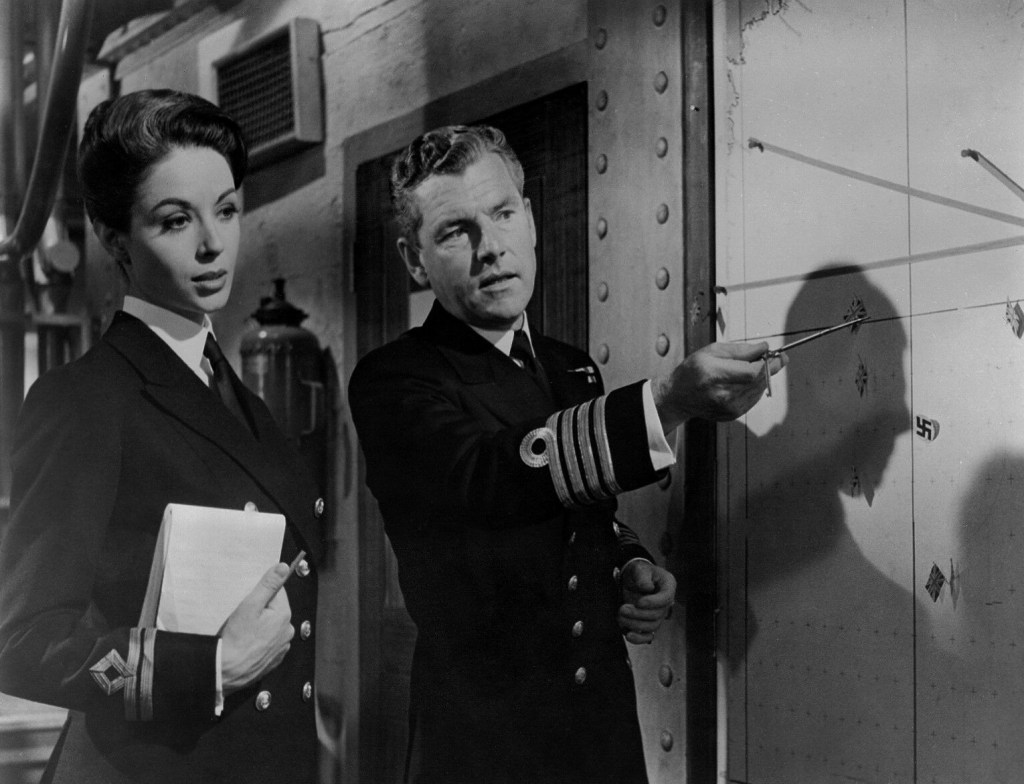
Kenneth More explaining details to Dana Wynter. In the movie they would have the most buttoned-down romance you could imagine, feelings not pronounced until the end.
Gilbert described Sink the Bismarck! as a “detective story set at sea,” and that’s the picture he determined to make, focusing on the hunt more than the normal World War Two heroics, the usual battleground endeavours taking second place to backroom tactics that resembled a “psychological chess game” between British and Germans. It was a change of pace for star Kenneth More, his screen persona the opposite of “someone so stiff and buttoned up.” A star of More’s caliber was all the movie needed to be funded.
The bigger problem was the hardware. “If we were to film on real ships, explode old ones even,” recalled Gilbert, “we would need the cooperation of the Admiralty.” Luckily, the wife of producer John Brabourne (Romeo and Juliet, 1968) was the daughter of Earl Mountbatten, the former Governor of India, who happened to be First Sea Lord (head of the Admiralty) who could put in a good word.
“Blowing up ships, or bits of ships, turned out to be not so hard,” explained Gilbert. Portsmouth’s naval shipyards contained many vessels whose active days were over and who were considered nothing more than scrap metal. So, prior to the commencement of shooting, Gilbert took a crew into the shipyard and began the blowing up. Because these were not models, the use of real ships “gave the film extra conviction.”
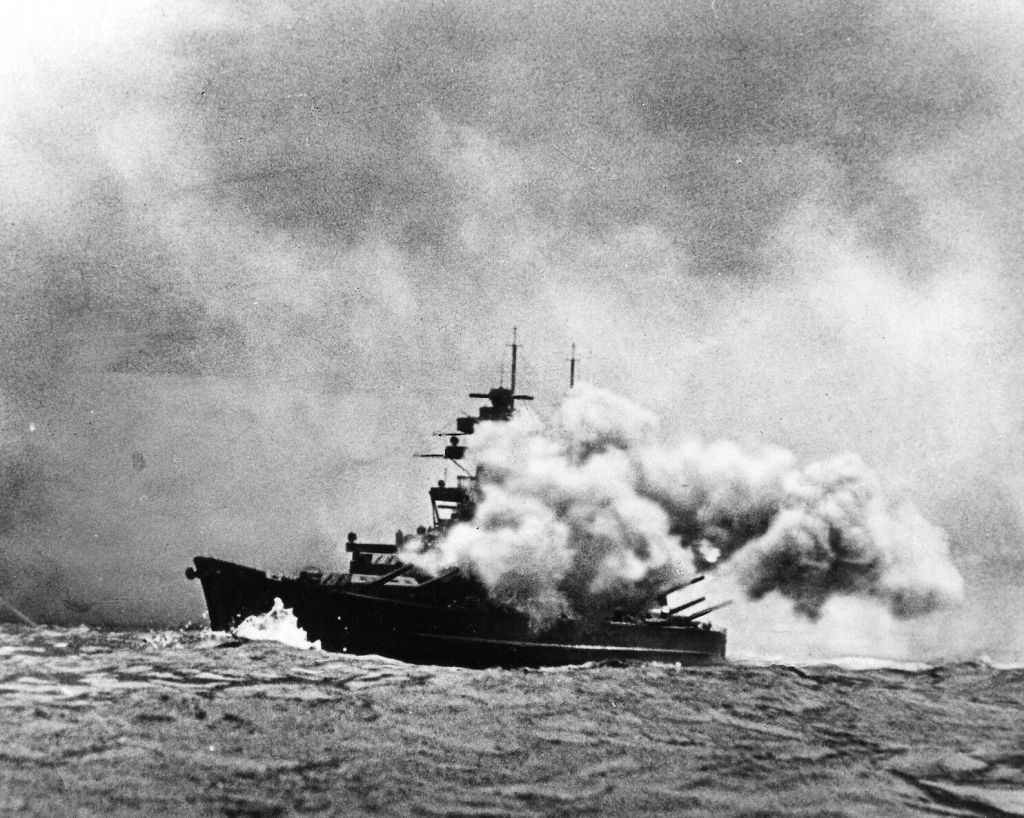
Gilbert also received permission to film on HMS Vanguard, the last British battleship of the era still on active duty although it too was due to be scrapped. That permitted filming the ship’s 15-inch guns in action. It doubled for scenes set aboard HMS Hood, Prince of Wales, King George V and the Bismarck, creating greater authenticity. HMS Belfast stood in for the pursuing cruisers including HMS Norfolk, Suffolk, Dorsetshire and Sheffield. A Dido-class cruiser provided the set for Bismarck’s destruction.
Aircraft carrier HMS Victorious played herself as well as HMS Ark Royal but any actual flying took place aboard HMS Centaur. The destroyers participating in the night-time attacks were HMS Cavalier and HMS Hogue. The bridge of the Prince of Wales was “reproduced down to the last detail.” One of the officers wounded in that attack was Esmond Knight, an actor on the film, who had virtually lost his sight, but from memory was still able to determine that the bridge was “a perfect replica.”
Three Fairey Swordfish biplanes with torpedoes were used. Three RAF jet pilots volunteered to the fly the biplanes in the movie for the experience of understanding the risks involved in diving at less than the top speed of 138 mph in a machine which was little more than wood and canvas to drop torpedoes on a highly-armed ship, but Gilbert had already hired specialist crews.
Top Hollywood model maker Howard Lydecker (The Underwater City, 1962) was recruited to build the 20ft model of the Bismarck, which, unfortunately, sank on launch. Raising it was not a problem. Long shots were filmed on the massive Pinewood water tank. It helped the production that during the battle the weather had been foul, so ships could be seen emerging from fog, or rendered invisible because of it.
Gilbert used his own wartime experience to render the battle realistic. He remembered sailing past the Scharnhorst, one of Germany’s three most powerful battleships, being unable to see it because of fog but aware of its presence from the sound of its guns. “We knew it from what we heard and felt, not from what we saw.”
Post-war the sinking of the Bismarck became a cause celebre. The British were accused of a war crime for nor picking up survivors. However, the British claimed that the presence of U-boats in the area rendered this too hazardous.
SOURCES: Lewis Gilbert, All My Flashbacks (Reynolds & Hearn, 2010) p 197-203; Brian Hannan, The Making of The Guns of Navarone (Baroliant Press, 2013) p67.
Hard to believe but outside of the Hollywood big-budget Bridge on the River Kwai (1957), this was the biggest British film at the U.S. box office in the previous decade. In fact, the British war films that did so well in the home territory, The Cruel Sea (1953) and Reach for the Sky (1956), sank like a stone when exported to in America while earnings for Ealing comedies, limited to arthouses, hardly made a dent in the box office.
What makes this so appealing is the very lack of Britishness and the intrusion of a Yank, famed reporter Edward R Morrow (playing himself), interrupting the action at various points to keep audiences up to speed. The fact that the sinking of the Bismarck, the biggest battleship ever built, was one of the few British actions at the start of the Second World War to be counted a success probably helped. Watching the Brits being lionized for defeat was not an attractive notion for global audiences.
But in the main it is a thrilling docu-drama, very much a departure for the genre, with every nuance of potential consequence spelled out. Dialog and models being moved across maps announce the risks inherent in the British attack: the superiority of the newly-built German battleship, the multiple options the Germans had in 1941 to escape, the difficulties in pinpointing the German vessel in the fog-bound waters of the North Sea, and the devastation the battleship could inflict on the beleaguered convoys on which Britain depended to stay afloat. In addition, even when targeted the Germans could flee to occupied France or potentially summon U-boats or air support.
So in the manner or Operation Crossbow (1965) or Day of the Jackal (1973) the audience is primed for a minute-by-minute enterprise, the battleship deemed so dangerous that the Admiralty is willing to risk its own scarce supplies of battleships, destroyers, cruisers and aircraft carriers in a bid sink the enemy. It is so much a documentary that the beyond the thrill of the hunt there is little room left for drama and certainly little of the stirring kind that had become such a byword for the British version of the genre – and such a turn-off for foreign audiences who could hardly make out what the actors were saying never mind work out why such-and-such a mission they had never heard of was so important.
In any case emotion is forbidden in the subterranean claustrophobic Admiralty War Office where new operational commander Capt Shepherd (Kenneth More) holds sway. A martinet, “cold as a witch’s heart,” on arrival he rids staff of what he sees as the rank indiscipline of addressing colleagues by forename rather than surname, eating sandwiches at a desk to which the workforce have been chained for hours and various minor offences against the strict code of a uniform.
It was inherent in this type of picture that the land-based unit suffer the casualties of war, husbands dead or missing in action, wives and children killed by German bombs. But the tightening of the stiff-upper-lip ensures that when such revelations become known, they appeared like emotional depth-charges on this otherwise staid ocean. And Capt Shepherd, through his choices, as would be true of many high-ranking officers, might be sending his own son to is death.
This is also one of the first instances in war pictures where the Germans are not treated as stock villains, but intelligent people, like Admiral Lutyens (Karel Stepanek) with his own vanity and a hunger for redemption, and Capt Lindemann (Carl Mohner), as valiant an opponent in the cat-and-mouse duel where outwitting the British enemy could wreak untold carnage and hasten – unusually from the German point-of-view rather than from the Allies – the end of the war.
A few months after launch the Bismarck is spotted leaving its home port, destination North Atlantic to feast on convoys travelling from America with invaluable supplies. There are four possible routes open to get round the top of Britain. To prevent the Germans reaching any of them British ships must be sacrificed, including HMS Hood – three survivors out of a crew of 1400.
It’s David vs Goliath except David is a terrier capable of inflicting tiny wounds that drain the battleship of some of its power, loss of fuel and rudder problems limiting movement. It’s a different kind of war picture, as well as the big guns blasting at each other over huge distances, the British employ biplanes loaded with torpedoes, a weapon also used in some instances by its ships.
To keep audiences more heavily involved, there are snippets of dialog involving characters on board the various ships, some in distinctly un-stiff-upper-lip mode, and montages of the various vessels getting ready for action, as well as shots of devastation should a shell find its target.
But basically it’s brilliantly-told tactic-heavy war picture that shows the shifting battleground, how the various ships are deployed, with no shortage of telling the audience how crucial success is and how crushing defeat. There’s no reliance on individual heroism, no snappy soldier defying authority, no hunch being played out, none of the usual cliches of the genre, instead, as with The Longest Day (1962) a clear explanation of what’s going on with superb battle scenes for the action-inclined.
It’s fair to say that even on the small screen, the models look a bit iffy, but this is more than compensated by other scenes on real warships, the use of newsreel footage, and fast cutting. That action never takes place under a clear blue sky but always in murky waters also adds to the realism.
In a role that would have been custom-made for Kenneth More (The Comedy Man, 1964), king of the stiff-upper-lip, rather than simply spouting his lines, he adds considerable emotional depth. Dana Wynter (Something of Value, 1957) is excellent as his equally buttoned-up assistant.
There’s a full crew of supporting British character actors including Michael Hordern (Khartoum, 1966), Laurence Naismith (Jason and the Argonauts, 1963), Geoffrey Keen (Dr Syn, Alias The Scarecrow, 1963) and Maurice Denham (Some Girls Do, 1969) while the Czech-born Karel Stepanek (Operation Crossbow, 1965) and Carl Mohner (Assignment K, 1968) inject humanity into the Germans.
Lewis Gilbert (The 7th Dawn, 1964) does a brilliant job of bringing this all together, adding touches of emotion and humour to what could have been a too-dry concoction, drawing on a screenplay by Edmund H. North (HMS Defiant/Damn the Defiant, 1962) which was based on the book by C.S. Forester of Hornblower fame.
I’m astonished this highly original western has disappeared into critical oblivion. As cruel as it is unusual, overturning every cliché, brimming with realism, more drama that action, some stunning scenes, and an ending only the bold would ever consider, this is desperately in need of reappraisal.
A refuge becomes a trap. The hero never wins. A spurned lover remains spurned. The cavalry are the dregs of society. Nobody listens to common sense. There’s no sending for help to relieve the beleaguered garrison. What chance does anyone have when the commanding officer is proud to die “by the book” rather than engineer a simple escape.
Gunslinger Chuka (Rod Taylor), arriving from the wintry north, shares some of his provisions with starving Arapaho Native Americans, comes upon a broken down stage containing two high-born Mexicans en route to California, Veronica (Luciana Paluzzi) and Helena (Victoria Vetri), his presence, thanks to that simple act of generosity, ensuring the marauding Arapahoes spare their lives. At the fort, a deserter is being whipped on the orders of martinet English commander Col Valois (John Mills). A patrol has failed to return so Valois won’t let the newcomers leave.
Chuka, sympathetic to the situation of the starving Arapahoes, suggests the colonel gives them food and sufficient weapons to allow them to hunt their own food. Veronica, now a widow, turns out to be Chuka’s long-lost love. Romance beckons but his unsavory occupation turns her stomach. Hired gun Chuka is not the only one to exploit need. Major Benson (Louis Hayward), the fort’s second-in-command, has a squaw (Herlinda Del Carmen), trading shelter for sex, stashed away.
Valois convenes a dinner party in honor of his guests – “I miss conversation and the elegance of dining in mixed company” – only to torpedo the occasion by revealing “what a uniform can conceal,” the sins of his officers: Benson a card cheat, Lt Daly (Gerald York) court-martialed for treason, the company doctor a coward. An arrow through the window ends dinner prematurely, Chuka demonstrating his skills in shooting the perpetrators.
Bit of artistic license here – Luciana Paluzzi is buttoned up all the way, no naked back, and Rod Taylor is not quite so athletic.
Honor plays no part in Chuka’s life and he refuses to help out Valois unless paid $200, enough he thinks to start life afresh with Veronica, and only after a knockdown no-holds-barred fight with faithful Sgt Otto Hahnsbach (Ernest Borgnine), the only man on the post who doesn’t despise Valois – an upper-class stranger in a strange land – prevents Chuka leaving in any case.
On a scouting mission, Chuka finds the patrol strung up and a massive Arapaho war party on the verge of attack. He returns to a mutiny, led by Benson, quelled by a single shot by Valois, the first time, it transpires, he has killed a man. In a very moving speech, Hahnsbach reveals that Valois saved his life, but in consequence was tortured and castrated. Benson turns out to have a very soft spot for his squaw, feelings naturally unreciprocated. Valois refuses Chuka’s entreaty to abandon the fort, leaving the supplies and guns behind, but saving the lives of everyone.
This time it’s the Native Americans who exhibit the strategic martial skill. It doesn’t end well. And here’s no stirring music to comfort the audience. Defeat here is raw, none of the manufactured heroics of The Alamo (1960) or The Wild Bunch (1969).
Sure, I expected a tad more action, but in its place was a more than satisfying drama that honed to the reality of the American West, a pitiless region exploited by the pitiless. The rule of authority doesn’t just commit commanding officers to suicidal action, it also condemns civilians like Veronica, who flees her home rather than confronting her father over another forced marriage.
The ranks of the U.S. Cavalry – beatified by the likes of John Ford for whom occasional drunkenness and a fondness for fisticuffs were the only sins – must in reality, like armies the world over, have been filled with the scum of the earth, wanted men, killers, thieves and vagabonds, using new identities to escape their past. As if the best source of recruitment was characters on a par with The Dirty Dozen. While Valois and Hahnsbach believe they have whipped the men into shape, there wouldn’t be any whipping of deserters if that were true.
Valois the martinet certainly has parallels with the commanding officer of Tunes of Glory (1960), also played by John Mills, on the verge of a nervous breakdown as a result of his war experience. And we are led to believe that Valois is as “guilty” as the rest of the outfit when, in fact, he keeps his heroism hidden. Hahnsbach begins with an impersonation of Victor McLaglen, John Ford’s high priest of rowdiness, but he also reveals hidden depths.
This is Rod Taylor reinvented, far removed from the romantic charmer of the Doris Day comedies or the tough hero of The Mercenaries/Dark of the Sun (1968). And Taylor, himself, was very much responsible for bringing this laid-back but deadly gunslinger to the screen. He was the film’s producer, had an uncredited hand in the screenplay, redefining the role as he saw fit. And it was an audacious character to put on the screen. The gunslingers of The Magnificent Seven bemoaned their lot, lack of family, wives, emotional baggage, but they didn’t bring the Revisionist Western to life.
And although Clint Eastwood would put a different spin on the hired gun, the Leone films were not released in the U.S. until after this was made so would not have influenced the production. As well as sharing his food with the starving Arapaho, Taylor ensures his character puts their case in straightforward language.
And a sense of foreboding, courtesy of the opening scenes, hangs over the whole enterprise, and part of the skill of director Gordon Douglas (Stagecoach, 1966) is to lull us into a false sense of security, that somehow the main characters will escape the foretold destiny. I have mentioned before my surprise that Douglas is treated just as a journeyman director. Sure, his western output can’t be mentioned in the same breath as Ford, Howard Hawks or Sergio Leone, but this is not far off not just for its down’n’dirty attitude to the West, but for some moments of pure cinema. Not only does the ending echo the opening but our introduction to Taylor, via an aerial shot, echoes our last image of him, in both cases eyes gazing upwards in apprehension.
The dinner party scene is quite superb, and Mills goes from hidebound martinet to sympathetic character, his wistfulness as he recalls wooing women in the past likely to stay in the memory, as does his reaction to shooting the mutineer, while Borgnine’s recollection of Mills’ heroism is beautifully done, Borgnine, too, morphing from cliché bully to proper character. In another film, a star of Taylor’s caliber would have fought for a happy ending, but every opportunity for one, Taylor and Paluzzi scampering off into the sunset, for example, or being reconciled, is denied.
Good to see Luciana Paluzzi (Thunderball, 1965) in a more interesting role and Victoria Vetri (credited here as Angela Dorian), prior to her Playboy fame, given the chance to play a more rounded character than when she went down the Raquel Welch route in When Dinosaurs Ruled the Earth (1970). Richard Jessup (The Cincinnati Kid, 1965) wrote the taut screenplay based on his own novel.
Couple of minor quibbles – why doesn’t the window break when an arrow comes through it but shatters when Chuka jumps out, how come the Native Americans have enough guns to launch a major attack on the fort but not enough to hunt for food? But those are very minor points.
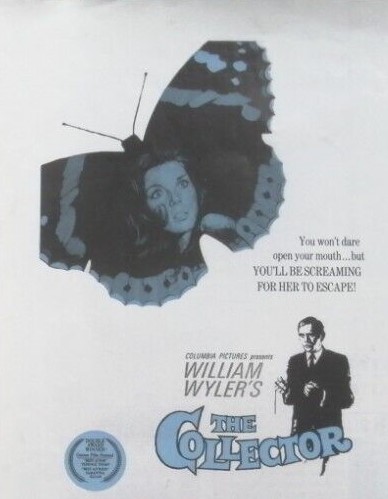
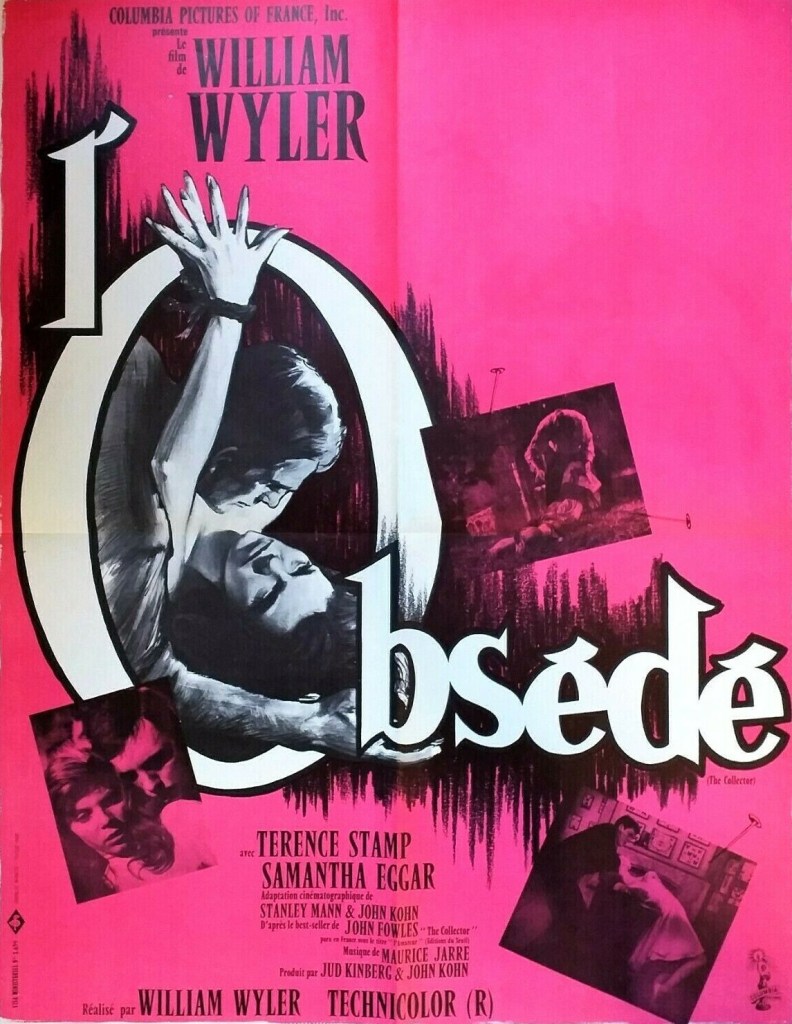
William Wyler’s paean to Incels strike such a contemporary note it’s hard to believe it was made over 60 years ago. An insightful study of male entitlement, female submission and novice serial killer that showcased two emerging British stars, this is as much about the psychological make-up of the victim as the captor.
Following a lottery win (see Note), lonely bank clerk Freddie (Terence Stamp) kidnaps the woman of his dreams, flame-haired art student Miranda (Samantha Eggar) in the hope that once she gets to know him she will fall in love. He has found a large cellar beside the secluded mansion he bought with his winnings. But this is no dank dungeon with a prisoner chained to the walls, but a comfortable abode with lighting, heating, clothing, food, and art materials. However, it is locked.
In turn angry, puzzled and submissive, Miranda tries to work out what she needs to do to achieve her liberty without realising that no matter what she does she will never fulfil his dreams. Despite his shyness, it wouldn’t be hard in other circumstances to fall for a guy as good-looking as this, if only for an affair. She is sexually experienced, but has just been rejected by an older man (Kenneth More), and love on the rebound is hardly uncommon.
Unfortunately, Freddie lives such a soulless, empty, existence, no interests beyond an obsession with butterflies, of which he has amassed a collection large enough to supply a complete museum, that the chances of finding common ground are remote and the circumstances of their meeting pretty much douse the potential for any spark.
At first, once she has expended her anger at her incarceration, she is grateful not to be murdered or raped – even pleads that if he is going to take her by force sexually not to drug her – and soon her mind turns to ways of escape, especially once he invites her into the big house, allows her to bathe, cooks her a meal and shows the world she could enjoy as his willing partner.
With every step, Freddie dares to dream more, that his insane idea will come to fruition, that a beautiful princess will love the lowly commoner. And as much as this focuses on male domination, it is also an examination of female independence, Miranda being in the foreground of that generation to espouse personal freedom, not viewing marriage as an ultimate destination, but seeking a fulfilling career with love almost a perk on the side.
Even without going to extent of kidnapping a woman, males of the period still expected a female to cater to their every whim, wife-beating hardly considered a crime, and, ironically, it would be a rare woman who would not enjoy the worship a more ordinary Freddie planned to bestow on his beloved.
It being set in the England of a particular period, Freddie blames the gulf between them on “class,” that where or to whom you are born creating an unattainable barrier between young men and young women, despite considerable evidence to the contrary. But, of course, to the thwarted, there is always someone to blame.
You will be very familiar with the cinematic tale of the imprisoned female attempting to escape by wiles and ingenuity, but even so, this will take you by surprise, in part because the idea of being forcibly detained was a rare event back then, so Miranda does not spend her time trying to chisel through loose cement using a stolen fork or other ideas along the same lines. That she has even managed to negotiate the length of her prison term makes her initial custody tolerable, especially as, in terms of material things, she wants for nothing.
Unfortunately, although Freddie is immune to normal feelings, he is alert to the slightest nuance, and would feel it an insult to his intelligence should she just play along and pretend to fall in love with as a means of engineering her escape. That the audience is probably more aware of this than Miranda makes the tension virtually unbearable.
This is a duel of the highest caliber between captor and detainee. At several moments it looks as if the tide will turn. A terrific scene with overflowing bath water fails to make a nosy neighbor suspicious. She even at one point manages to whack her assailant over the head with a shovel and attempt a genuine escape. You are left to wonder if making a sexual sacrifice, even taking the initiative with a virgin, will make the necessary difference. But one look into those implacable eyes would have told you exactly where you stood without having to wait until you were dragged by the hair across the lawn in a rainstorm.
Audiences more familiar with the director through late-career roadshows like Ben-Hur (1959) and Funny Girl (1967) or the earlier rom-com Roman Holiday (1953) would be forgiven for forgetting how adept Wyler was at racking up the tension from his early thrillers or dealing with unattainable love (Wuthering Heights, 1939) or entitlement (Jezebel, 1938). He evokes such a claustrophobic atmosphere, ingrained with pure Englishness, and plays with ironies of character beauty – Freddie’s eyes and cheekbones, that should have attracted women by the score, instead lending him devilish menace while Miranda’s sensational looks that would have most men begging for just a minute of her company prove insufficient to enslave this particular creature.
That there is genuine sexual tension, not just whether he will end up raping her, but whether she might see his more attractive version of himself and come to give him what he wants without being repulsed, brings a surprising sexual tension. You wouldn’t say there was chemistry between the characters in the normal sense, but the situation is electrifying.
This was a career high for Terence Stamp (Term of Trial, 1962), minus many of the acting foibles and vocal tics that peppered his later work, and the same went for Samantha Eggar (Walk, Don’t Run, 1966). But the performances are of such a high quality, especially when you think she has breached his defences sufficiently, that at times it is an unbearable watch. John Kohn (Caprice, 1967) and Stanley Mann (The Naked Runner, 1967) based their screenplay on the bestselling – and highly praised – novel by John Fowles, author of later cult work The Magus.
This would have stood the test of time anyway as a pure thriller but since it digs into what has now become a counter-culture it carries even greater significance today.
NOTE: He didn’t win the lottery. That didn’t exist then. Instead he won on the “Football Pools,” but that concept – it began in 1923 – is so hard to explain to non-British people that I took the easy way out. However, the “pools” was a gambling phenomenon of the times, the entry fee so low, at its peak played by 14 million people in the UK every week in the hope of winning a jackpot akin to lottery cash. In essence, you had to guess out of all the soccer games being played on a Saturday (all games in those days kicked off at 3pm on a Saturday) how many would end in draws.
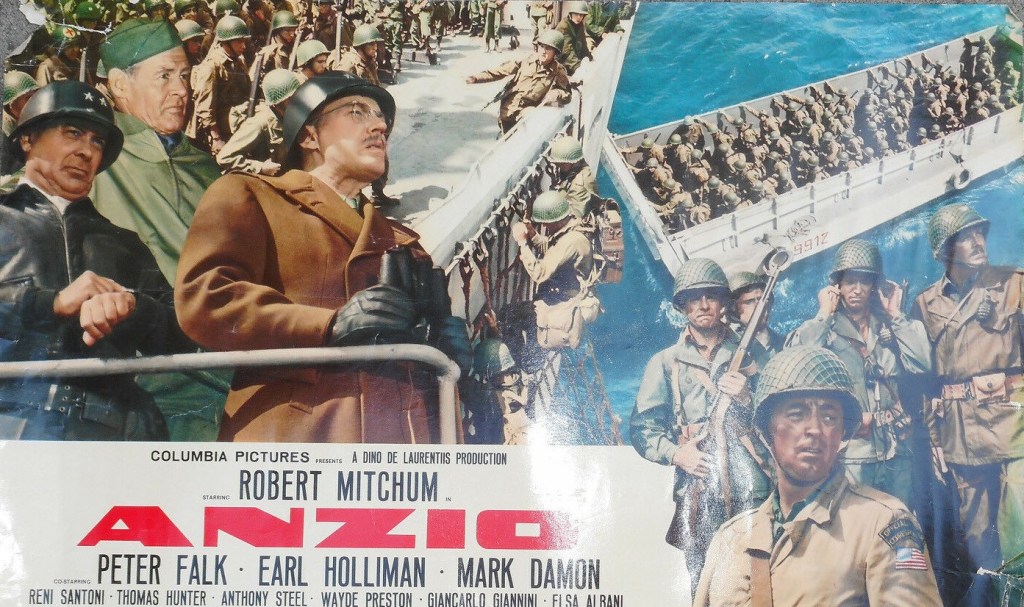
Seems you couldn’t make a moive about defeat in the 1960s, you had to find something in the story that sounded victorious. Although the Allied landings at Anzio in January 1944 eventually led to the liberation of Rome, the whole operation was a mess. So instead of concentrating on outnumbered American and British troops being pounded to pieces on the beaches, director Edward Dmytryk (Alvarez Kelly, 1966) opts for the men-on-a-mission angle.
Somewhat bizarre is the insertion of war correspondent Ennis (Robert Mitchum) into the story. Sure, because he’s not going to get busted for insubordination, he can challenge and/or lambast fictional commanding officers General Carson (Robert Ryan) and Major General Lasky (Arthur Kennedy) but it seems odd that he goes around spreading anti-war sentiment when the people escorting him are in serious danger of ebing killed. On the plus side are three sequences depicting the brutal reality of war in a way that no other picture of the period dared.
After landing unopposed Laskey decides not to risk moving forward, leaving his troops open to being trapped by advancing Germans even though Ennis, after commandeering a jeep, managed to reach Rome with encountering any opposition.
A Ranger battalion is sent to scout the surrounding countryside and the movie chooses to concentrate on a small platoon unit within that, headed by Sgt Stimmler (Earl Holliman) and including the fun-loving Corporal Rabinoff (Peter Falk), the kind of guy who spends the night before the landing entertaining three sex workers in the back of stolen ambulance who are of course desperate to learn the words to “Bye, Bye, Blackbird.”
After the Rangers are cut to pieces at the Battle of Cisterna, the unit escapes through a minefield, discovers a massive German construction site, holes up in house with three Italian women, is pinned down by snipers in a field of shell-holes and finally makes it back.
American tropps being slaughtered at Cisterna is a helluva note as the movie switches tack from exposing leadership folly to just getting the platoon out of this mess. Pursued by a flame-throwing Panzer, they pick their way through a minefield using the quite clever device of lobbing onto it large chunks of stone and then walking across on the stones as if crossing a dangerous river.
Wanting to find out more about the mysterious construction work results in Ennis causing the death of one of the gang. When they hide out in the Italian house, eventually killing off investigating Germans, the naïve Ennis wants to take the women with them.
Bit of marketing sleight-of-hand. Slinging a whole bunch of faces at the bottom of a poster was shorthand for all-star cast, which this picture definitely lacked.
Trapped by snipers in open country, they are being picked off one by one with only clever tricks and sacrifice offering a way out. One of the notions is to throw a fake grenade the snipers’ way. The instant reaction to any soldier to an incoming grenade is to get the hell out of the way, turning themselves into a turkey shoot. But the only other way to entice the snipers to reveal themselves is for the soldiers to take turns in presenting themselves as targets.
One of the ongoing themes of the picture is Ennis refusing to bear arms, and although the trailer shows him blasting away with a machine gun that only occurs at this climax when he seizes the weapon from a dead German. Ennis is an odd character for a war picture. None of the soldiers can believe anyone would not just volunteer to participate in a bloody war but carry nothing to defend themselves with. It’s a bit tiresome to hear him being reminded that he doesn’t have to be here, and to turn down the offer or a rifle or a grenade.
And for a non-combatant he’s not exactly uninvolved in strategic matters. A couple of times, as if he’s the most entitled grunt you ever came across, he virtually assumes command, barking orders that the others obey. Admittedly, it’s his cleverness that gets them through the minefield, but it’s his stupidity that gets others killed and to have him pontificating at the end that men go to war “because they like it” is incredibly facile, although in keeping with the anti-Vietnam sentiments of the time (1968, that is, not 1944).
Rabinoff, the only other character about whom we learn anything, is unfortunately on the preposterous side.
While the movie is far from dire, and as I said, very realistic when in portraying war actuality, it’s not the picture I guess audiences expected. While the scene-stealing of Peter Falk (Penelope, 1966) gets in the way, Robert Mitchum (5 Card Stud, 1968) proves an interesting character, although he is also laden down by having to spout a bunch of dumb lines. Arthur Kennedy (Fantastic Voyage, 1966) is the pick, especially at the end facing up to the ignominy of being relieved of command.
This kind of movie is potentially a breakout for the supporting cast. But here, with the exception of Falk, the script lets them down, nobody given the kind of distinctive characterisation that elevated The Dirty Dozen (1967), for example, above the norm. Apart from Earl Holliman (The Power, 1968) and Italian Giancarlo Giannini (The Sisters, 1969) this was not a career-making movie. You can spot Mark Damon (Dead Men Don’t Count, 1968), Patrick Magee (A Clockwork Orange, 1971), Anthony Steel (The Story of O, 1975), Rene Santoni (Guns of the Magnificent Seven, 1969), Wolfgang Preiss (Von Ryan’s Express, 1965) and Robert Ryan (Battle of the Bulge, 1965).
Edward Dmytryk (Mirage, 1965) does a reasonable job with the materials to hand, and the minefield and sniper scenes are first class. Italian veteran Duilio Coletti (Under Ten Flags, 1960) directed the Italian version though I’ve no idea what that was, or if it differed in any way from the Dmytryk cut. Coletti also had a hand in fashioning the screenplay along with H.A.L. Craig (Fraulein Doktor, 1969), Frank De Felitta (Audrey Rose, 1977) and Giuseppe Mangione (Run, Psycho, Run, 1968).
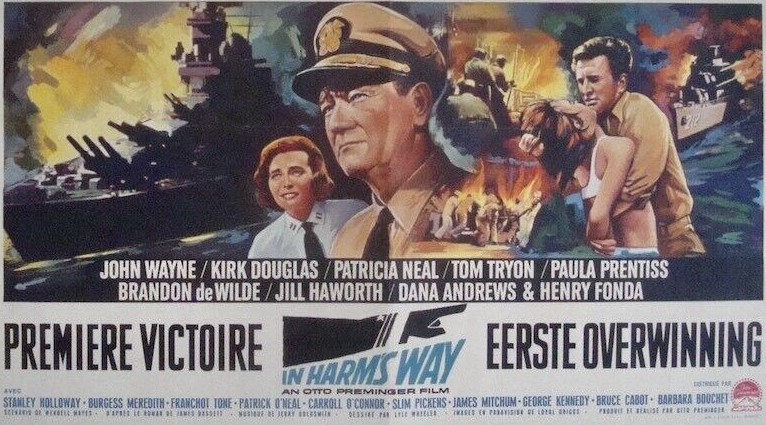
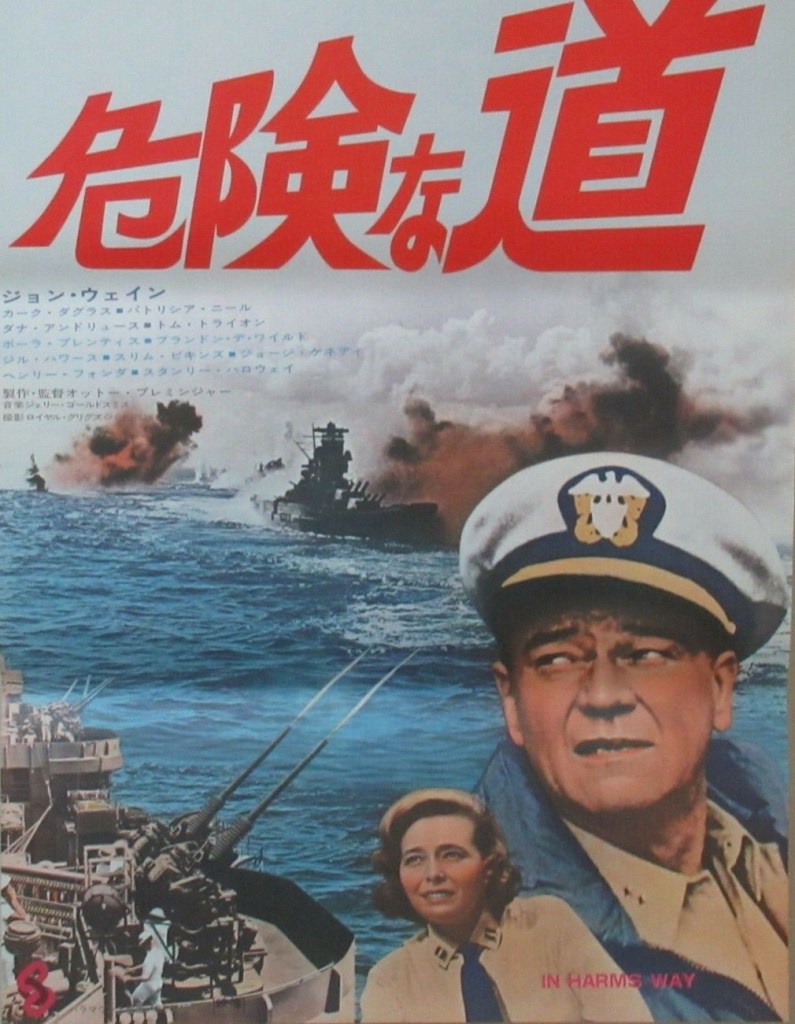
Preminger at a peak, the more I watch this picture, not just the more impressed I become but the more I want to watch it again – three times, as it happens, for this review. A tale of heroism populated by morally wounded heroes, the undertone of critique for the Naval establishment dealt with in brilliant narrative fashion, terrific pacing, one of John Wayne’s very best performances, Kirk Douglas not far behind, great action scenes, and one of the few movies to fulfil this director’s original intent.
You can, of course, argue that it’s the height of political PR. Just as the Americans managed with The Alamo and the British with Dunkirk, the aim was to turn defeat into victory, so this moves beyond the humiliation of Pearl Harbor to the victories beyond. But in some sense Pearl Harbor is just the prologue to a stiffer examination of men at war, rather than sailors taken to task over the complacency that left them so open to cataclysmic attack.
And while there’s a number of sub-plots, these are more expertly handled than I can recall in many another lengthy big-budget picture, no endless cutting between major and minor characters, but the minor characters only entering the frame when they have a dramatic part to play.
Captain “Rock” Rockwell (John Wayne) falls foul of his superiors for basically being in command of a ship sunk by a torpedo. On a technical point, he’s stripped of command, and reduced to a desk job, a casualty of the peace-time hierarchy determined to find someone to blame, only returning to active duty – and promoted to Admiral – when more war-oriented figures are put in charge.
The desk job gives him time to romance feisty nurse Lt. Maggie Haines (Patricia Haines) who has the cojones to take charge of the budding relationship. She happens to share an apartment with another nurse, the much younger Ensign Annalee Dorne (Jill Dorne) who is dating entitled Ensign Jeremiah Torrey (Brandon de Wilde), Rock’s estranged son.
Jeremiah works for slimy glory-hunter Commander Neal Owynn (Patrick O’Neal), a former U.S. Congressman using his political skills to worm his way into the office of by-the-book Vice Admiral Brodick (Dana Andrews). Rock shares his apartment with Commander Egan Powell (Burgess Meredith), a thrice-married playboy, high up in Navy intelligence.
Rock’s second-in-command is Commander – junior to a captain in case you don’t understand the U.S. Navy ranking system – Paul Eddington, a hothead whose mourning for dead wife Liz (Barbara Bouchet) results in him also being reduced to a desk job and exiled to the Pacific. On the fringes of the story are Lt. Commander “Mac” MacConnell (Tom Tryon) and pregnant wife Beverley (Paula Prentiss).
How all these characters enmesh is the consequence of a quite brilliant screenplay by Wendell Hayes (Advise and Consent, 1962). Rockwell and Eddington both seek redemption, the former to prove his Naval worth and regain the affection of his son, the latter to absolve himself for his terrible actions.
You can always tell the hero in war films because they are so rarely a physical casualty of war, all the others are killed and wounded but hardly ever the hero, so it takes something for the Hollywood Hero of the Century to play a character who is wounded not once but twice, and for the early part of the picture walks around with his arm in his sling (not quite an echo of the way he holds his arm in The Searchers, but evoking the same internal conflict).
The only supposed out-and-out hero is MacConnell, but his inaction at the beginning of the movie fails to prevent the death of Eddington’s wife. And his heroism largely takes place off-screen and it’s worth noting that Rock doesn’t raise a rifle or pistol in anger (or even get into a punch-up as was the actor’s wont in other films). Being in charge he’s removed from the core action even if suffering the consequences of battle. In a marvellous touch of irony, Rockwell is the most passive hero to hit the screen. It’s an incredibly bold and self-confident director who would even think of luring audiences into an action picture starring the Hero of the Century and then denying him a single moment of screen glory.
Much has been written about the cinematic arc John Ford took in the beginning and ending of The Searchers, the symbolic opening and closing of doors, but since Preminger is long out of critical favor nobody’s has bothered to notice how much of this film concerns cinematic echo.
To take the most obvious example, the first witnesses of the airborne Japanese attack on Pearl Harbor are illicit pair Liz Eddington and her paramour (Hugh O’Brian) and towards the end it’s her husband Paul, by this point guilty of horrendous behaviour, who leads the airborne fightback against the enemy.
A beach – where Liz and escort make love – is how the director initially pushes the audience towards sympathising with the drunken Eddington. A beach is where we later learn to despise him, as he brutally rapes Ensign Dorne. And it doesn’t take much to work out that his wife’s exuberant wildness explains Eddington’s initial attraction to her, not realising that psychologically it provides him with an excuse for his own darker wildness, initially restricted to self-destruction but when it truly emerges it’s to the detriment of an innocent.
And that’s before we get on to Rockwell as the messenger of death, delivering the bad news to wives, and then being on the receiving end after his son dies in battle. And finally, the political peace-time high-ups get their come-uppance in actual war.
It’s insulting – as some have suggested – that the performance of John Wayne (The Hellfighters, 1968) is the result of undiagnosed cancer when in fact this is a finely nuanced role of a high-ranking figure living out in his life in regret, at times quite shamefaced about abandoning his son at a very early age. Preminger cracked down on Wayne’s habit of splitting his lines in two, so those typical pauses we have come to expect are in large part gone, and it helps the movie’s pacing. For most of the movie the character is saddled with consequence. That passivity that the director saw as essential to the role is virtually present all the time.
Preminger wrings a different performance, too, from Kirk Douglas (A Lovely Way to Die, 1968), equally laden with regret, but not enough to prevent him lashing out and the actor is accorded two quite stunning scenes, the first as he broods in silence over his wife, but for the second, prior to raping Ensign Dorne, the stone-cold look on his face suggests a serial killer held at bay for too long and now about to explode.
Burgess Meredith (Hurry Sundown, 1967) is another brought to directorial heel, his more common scene-stealing and vowel-stretching also eliminated, but in exchange given a larger-than-life character on which to expend screen energy. The entire cast is good-to-excellent and it’s jam-packed: Patricia Neal (Hud, 1962), Tom Tryon (The Cardinal, 1964), Paula Prentiss (Man’s Favorite Sport, 1963), Brandon De Wilde (Shane, 1953), Jill Haworth (Exodus, 1960), Dana Andrews (The Satan Bug, 1965), Franchot Tone (Advise and Consent, 1962), Patrick O’Neal (Stiletto, 1969), George Kennedy (Cool Hand Luke, 1967), Henry Fonda (Battle of the Bulge, 1965), Barbara Bouchet (Danger Route, 1967) and Stanley Holloway (My Fair Lady, 1964) Many of the supporting cast were also playing against type – Prentiss as the young wife falling to pieces, Andrews and O’Neal as slippery political types, Holloway a guerrilla, and perhaps most interesting off Neal, not the typical woman left behind when the man goes off to war but, in her role as nurse, entering harm’s way herself.
And despite criticism of the miniatures used in sea scenes while that might have been obvious on the big screen you don’t notice it on the small screen. The action scenes are very well-done for the time, and quite unusual in that by and large it’s the Americans who appear shell-shocked not the enemy.
Cramming this much narrative into the overall arch of Pearl Harbor and retaliation against the Japanese, while bringing so many different characters to the fore with clear dramatic purpose is an amazing achievement, screenwriter Wendell Mayes (Advise and Consent) doing the heavy lifting in this department.
But Preminger the director is very much to the fore, in his composition and use of the camera for long tracking shots (a particular favorite of mine) such as at the beginning. A riveting watch full of splendid acting. Shooting it in black-and-white might have at one time appeared to date the picture but instead it has rendered it ageless. Five stars without a doubt.
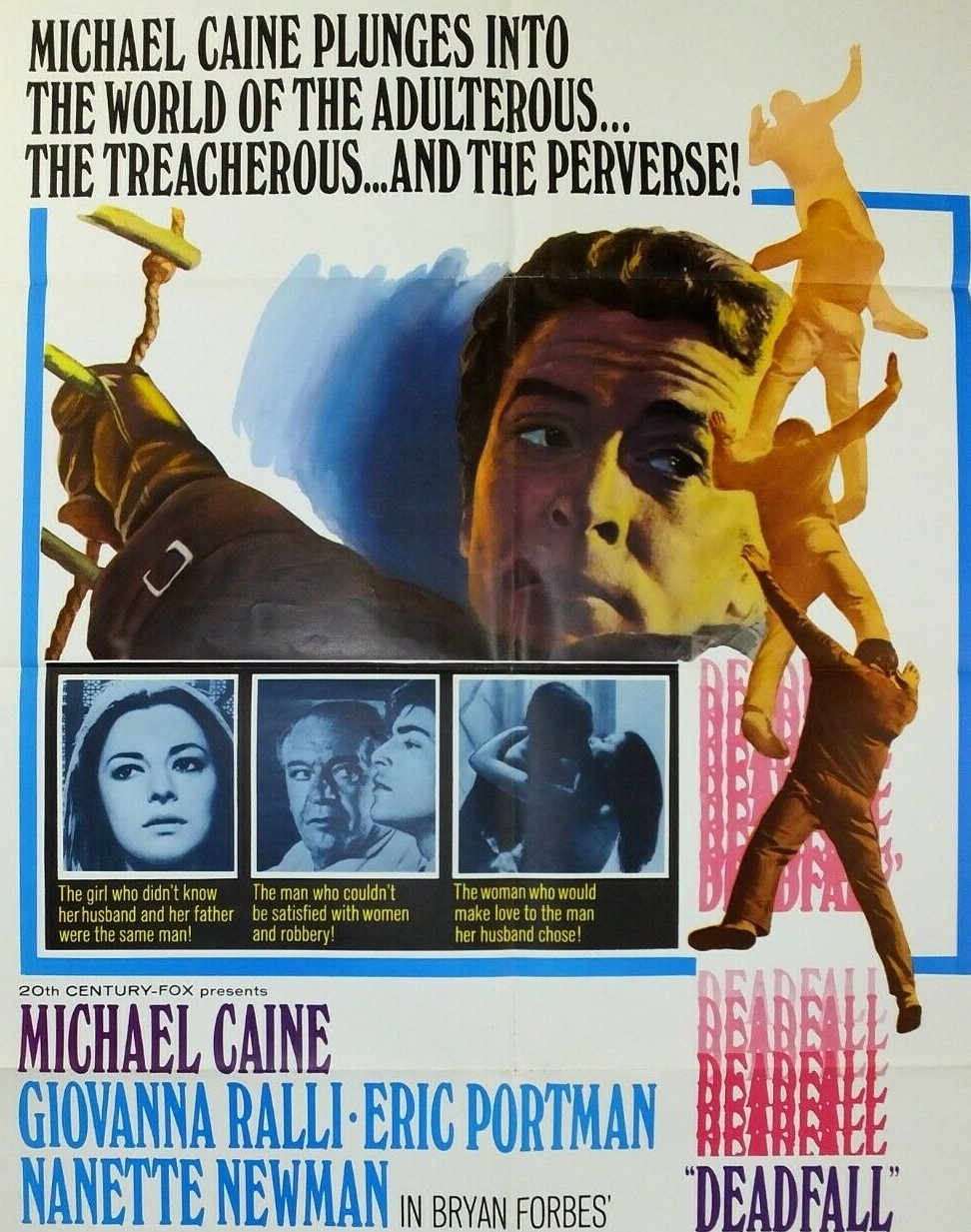
“The Big Reveal” comes too late to save this heist-cum-melodrama. It can’t make up its mind whether it wants to join the canon of superlative 1960s caper pictures – in which case it needed to make a greater effort on the cat burglary front – or whether it’s an odd addition to the menage a trois category, in which case it needed characters you could actually believe. Worst of all, it contains one of the great artistic follies, a robbery carried out in time with an orchestra playing one of the great John Barry compositions, “Romance for a Guitar and Orchestra.”
The only problem, there’s no dramatic reason for this. Since the concert is miles away from the robbery, it’s not as if the music drowns out the shenanigans. Director Bryan Forbes (King Rat, 1965) shoots himself in the foot. It’s too clever a device by half, even if the music is intended as a counterpoint to the robbery’s more dramatic themes or the silence which had become a trope.
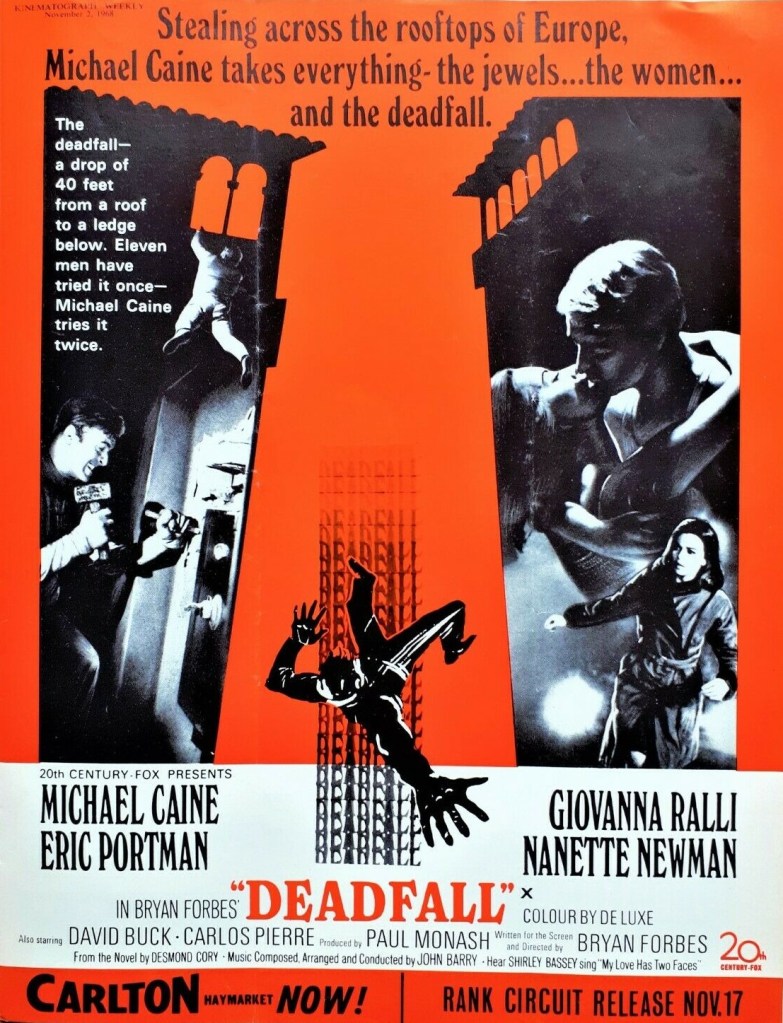
Cat burglar Henry (Michael Caine) forms a business partnership with elderly safecracker Moreau (Eric Portman) and falls for his wife Fe (Giovanna Ralli). The husband-wife relationship is off to begin with, he preferring males, and the wife admitting she doesn’t always find men attractive, though quite what she is hinting at is never made clear. The target is millionaire Salinas (David Buck), whom Henry is investigating to the point of pretending to be an alcoholic so he can get to know Salinas in a sanatorium.
Any other movie would get straight to the point – draw up plans and get on with it. But here, for no real reason except delay, Moreau wants them to do a trial run, a safecracking job on the mansion of the kind of couple who drive off in a posh car to attend a concert. The effort put into the planning isn’t really up to scratch, not when compared to the likes of Topkapi (1964) – to which every heist film of the era was measured – or Gambit (1966) or even the less well-known The Happy Thieves (1960) or Seven Thieves (1960).
Apart from some cat burglary skills the whole episode is perfunctory, guard dogs knocked out by drugs. The background music, the aforementioned John Barry opus, just about kills off any prospect of tension. It only sparks into life when Moreau admits the safe is beyond him and Henry has to prise it out of the wall and cart it to the waiting car.
The second heist would have been far more interesting had we known from the start that Salinas welcomes burglary attempts, seeing it as some kind of duel of wits with malfeasants.
In between the two robberies there is time enough – too much time in fact – for Henry and Fe to get it together, for Fe to run off and then return only to learn in The Big Reveal the kind of despicable man her husband is. The movie can’t even deal with the incestuous sub-plot and just lets it hang there. But by that stage you couldn’t care less. Fe isn’t the type of femme fatale to bother crossing the road for, the romance seems too prescribed and the downbeat ending makes no sense.
I’m only giving this any points at all really because it stars Michael Caine (Hurry Sundown, 1967) and features a lengthy slice of John Barry music. Caine has been in enough duds for sure, but this doesn’t have the ring of one of his doing-it-for-the-money numbers or a stab at the Hollywood big-budget scene. Caine is good enough and Eric Portman (The Bedford Incident, 1965) is an interesting study. But it just doesn’t gel, not just let down by Giovanna Ralli (The Caper of the Golden Bulls, 1967) but by the pretentious direction and dramatic miscalculation of Bryan Forbes.
Forbes’ wife Nanette Newman (The Wrong Box, 1966) makes a puzzling appearance in a small role with no dramatic credibility. Leonard Rossiter (Deadlier than the Male, 1967) provides another cameo. For many the high spot will be to see John Barry in the flesh, conducting the orchestra playing his composition.
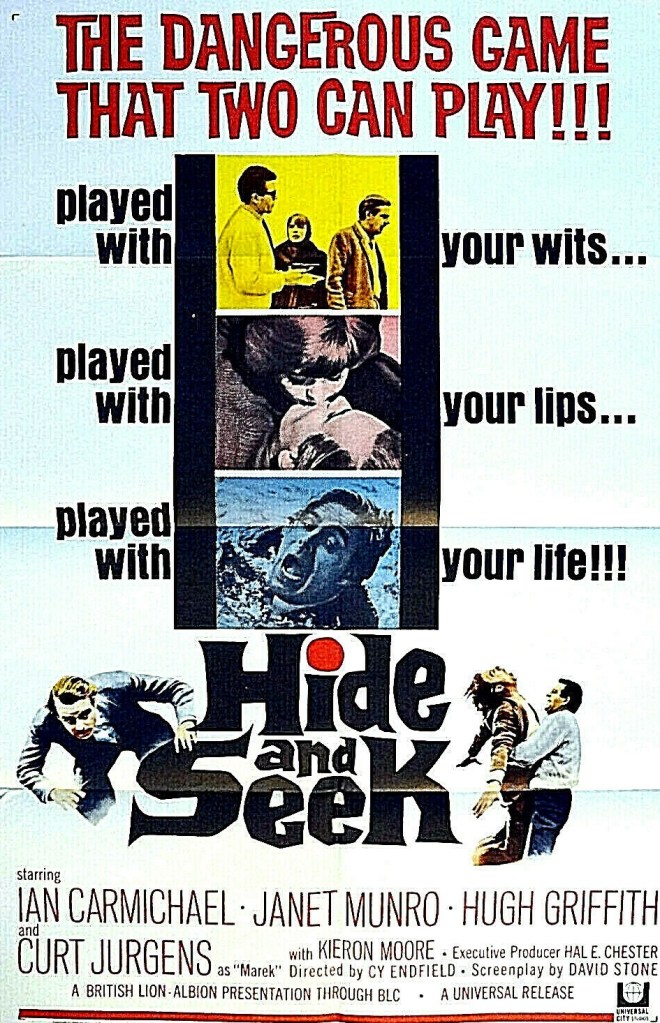
Too many peculiarities for a small British B-picture that just about makes it over the line after “The Big Reveal.” You can start with the fact that, ostensibly, this was director Cy Endfield’s follow-up to his blockbusting Zulu (1964). In fact, it had been made long before, but sat on a shelf for a year, and only released to cash in on Zulu. And you can see why studio British Lion didn’t know what to do with it.
Diving down a 39 Steps thriller-sized rabbit hole, baffled professor saddled with adventurous female go on the run searching for answers to, wait for it, a crime which hasn’t actually been committed. There’s action on a train, some comedy as the worlds of academia and the sophisticated fast set collide, romance on a barge, Cold War skullduggery, too much chess, a bit of welcome role reversal, a cliff-top fight, and some dry wit that might have fitted better into a straightforward romantic comedy. And it ends with a twist of such audacity that it would either come as a relief to a bewildered audience or send them home frustrated at such a denouement.
Rocket scientist David Garrett (Ian Carmichael) becomes embroiled in not even really a plot when he attempts to return a box, containing an inordinate amount of loot, to its owner, chess grandmaster Dr Melnicker (George Pravda). Luckily, a clue in the form of a chess move takes him to a posh London house in fashionable Chelsea where he encounters the slinky Maggie (Janet Munro) and after hiding in a sandpit in a children’s playground to evade pursuers he ends up on a train with her heading north to a place called Flamboro.
But, wait, his pursuers are also on the train, so naturally the couple have to jump off, fall into a river and hitch a lift on a passing barge whose owner Wilkins (Hugh Griffith) proves most obliging. Indeed, Maggie is even more obliging, taking the lead in bedding the shy professor. Things get interesting when Maggie, at a road sign, takes David in the completely opposite direction to Flamboro. That works for about ten seconds until a henchman Paul (Kieron Moore) captures them at gunpoint.
Rather than just shooting David dead he decides it would be cleaner to chuck him over a cliff. Luckily, David is a shade pluckier than you might expect. After winning this cliff-top tussle and shocked at having chucked a man over a cliff he is even more astonished to discover he is stranded, Maggie having made off in the car. Luckily, a passing policeman on a bicycle ensures David makes it safe to Flamboro, which turns out to be a huge mansion perched on a cliff.
My guess is by now you are so hooked by this story that you’ll want me to reveal The Big Reveal. Well, the whole thing turns out to be a trap. Melnicker, the pursuing thugs, Paul (who, you’ll not be too astonished to learn, ain’t dead) and even Maggie have all been plotting to bring David here so that he can be kidnapped and handed over to a submarine arriving the following day. You see, David has been so outspoken (has he?) against his masters that everyone will put his disappearance down to defection. It’s all been a cleverly worked-out chess move as chief baddie Hubert (Curd Jurgens) takes pains to point out.
But our David isn’t exceptionally brainy for nothing and finds a way to outwit the bad guys with Maggie, by now repenting of her bad ways and fallen in love, along for the ride.
So what’s gone wrong? The casting, unfortunately, for one thing. Star Ian Carmichael (School for Scoundrels, 1960), better known for comedy, doesn’t quite make the switch to more straightforward thriller. And Curd Jurgens (Psyche ’59, 1964), whom you might expect to add some gloss, doesn’t appear till the end.
Worse, the film doesn’t find the right tone, too much comedic British observation, and not enough of the hero being in genuine jeopardy. Only a clueless professor would run from the thugs. If the big twist had occurred halfway through and the audience had time to wonder whose side Maggie was on and feel David was in in genuine danger it might have hit the bullseye because, oddly enough, the romance is believable in a Hot Enough for June (1964) kind of way, where innocent male is scooped up by a more worldly female way above his league.
But the role reversal is fun. She’s the one who goes to his rescue when he falls in the river, she’s the seductress, and gets to tell him he looks better “when he’s cross” (a line more typically with slight variations falling to the male) and delivers the movie’s one cracker: “Being a man you have no respect for a mink coat.” She would be an ideal candidate for femme fatale if only the director had let us in on the story quicker, but she’s certainly an astute lure.
Because I wasn’t expecting much, I have probably been a shade less critical than if I was viewing it as a follow-up to Zulu. In the end, it’s passable enough, especially if you are willing to see how clever it’s been.
As I mentioned Ian Carmichael (Lucky Jim, 1957) is the weak link but former Disney protégé Janet Munro (Swiss Family Robinson, 1960), now blossomed in sexy fashion, steals the show and on this performance you might be surprised she did not have a more illustrious career but she had a heart condition and died prematurely at the age of 38. Curd Jurgens was at the early stages of inventing his villainous persona. The other characters are merely pawns in the plot so end up as stock villains. Cy Endfield’s genuine follow-up to Zulu was worth seeing – Sands of the Kalahari (1965).












 The Magnificent 60s