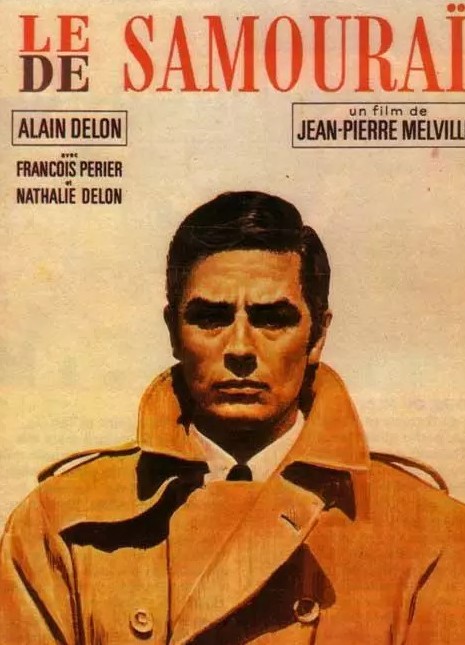
Le Samourai / The Godson (1967) ****

The current trope for giving assassins nicknames – viz Day of the Jackal (2024) – doesn’t stem from Jean-Pierre Melville’s spare picture, the title here more suggestive of the idea of killing as an honorable profession. One of the most influential crime movies of all time, it resonates through Michael Winner’s The Mechanic (1972) – though few critics would give that the time of day -Walter Hill’s The Driver (1978), John Woo’s The Killer (1989), Anton Corbijn’s The American (2010), Nicolas Winding Refn’s Drive (2011) and David Fincher’s The Killer (2023). Even so, few acolytes can match the opening scene of a room empty except for a whiff of smoke in a corner that indicates the presence of recumbent killer Jef (Alain Delon).

There’s none of the false identity malarkey of Day of the Jackal and no high-echelon ultra-secret secret service figures involved in tracking him down. In fact, one of the delights of the movie is the police procedural aspect, with the top cop, here known only as the Commissaire (Francois Perier), insisting on dragging in at least 20 “usual suspects” from each district. Though living a Spartan existence, Jef at least has the sense to acquire an alibi from the lover Jane (Nathalie) he shares with a wealthier man. Nor is he killing public figures. Instead, more like someone from Murder Inc., rubbing out other gangsters.
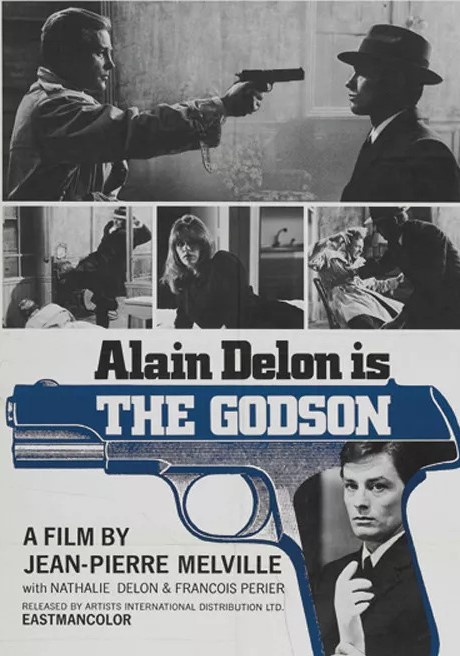
Shameless attempt to cash in on “The Godfather” after U.S. distributors held off for five years from releasing it.

The witnesses provide conflicting information on the man they saw, but the Commissaire does not entirely trust Jef’s alibi, putting pressure on Jane to recant. Her paying lover Weiner (Michel Boisrond) provides a pretty accurate description of Jef. While the cops bug his apartment and  start to shadow him, Jef falls foul of his anonymous employer who is alarmed at the attention the assassin has attracted and to avoid the possibility of being implicated sets an assassin onto the assassin.

Wounded, refusing to accede to Jane’s demand that he acknowledge he “needs” her, he tracks down the assassin’s boss, Oliver Rey (Jean-Pierre Posier), who happens to be the lover of Valerie, a nighgclub singer Jef takes a shine to. It’s worth noting that there’s an innocence – or perhaps an honor matching that of the samurai – in the police behavior. The Commissaire exists in a world where rules are not bent or broken, where suspects are not beaten up, and where often the cops are hamstrung by procedure and must take special care in arriving at a conclusion. To convince himself that Jef is indeed the correct suspect, the Commissaire makes him swap hat and coat with others in a line-up, only for the witness to identify the coat, hat and face that he believes he saw. It’s only Jane’s unbreakable alibi that keeps Jef safe.

Most of the picture is pure bleak style. You never enter the assassin’s head. There’s no background or backstory to shed any light on action. Even the most appealing characters, Jane and Valerie, occupy moral twilight. I’m not sure Melville’s in a mood for homage, though Robert Aldrich was in the Cahiers du Cinema hall of fame, but the ending comes close to replicating that of Aldrich’s The Last Sunset (1961), not just for the climactic action but for the inherent self-realization of unavoidable consequence.

Despite sparseness of the style, there’s enough going on emotionally and action-wise to keep an audience enthralled. While his outfit echoes the Humphrey Bogart private eye of the 1940s, and while walking the same mean streets, Jef is the antithesis of that untarnished hero.

Melville belonged to the hard-boiled school of cinematic crime, summoning up the gods of noir, and providing a new breed of French star with tough guys to kill for.  He died young, just 55, and left behind 14 pictures, at least three or four considered masterpieces including Army of Shadows (1969) and The Red Circle (1970). You might have thought his minimalist style would appeal more to critics than moviegoers but in his native France, in part because stars queued up to be in his movies,  he was highly popular.

When you compare the Delon of this to Once a Thief (1965) or Texas Across the River (1966) you can see how much acting goes into the restraint of the character here, producing one of Delon’s best performances. His wife of the time, Nathalie Delon (The Sisters, 1969) shines but briefly.

Recommended.
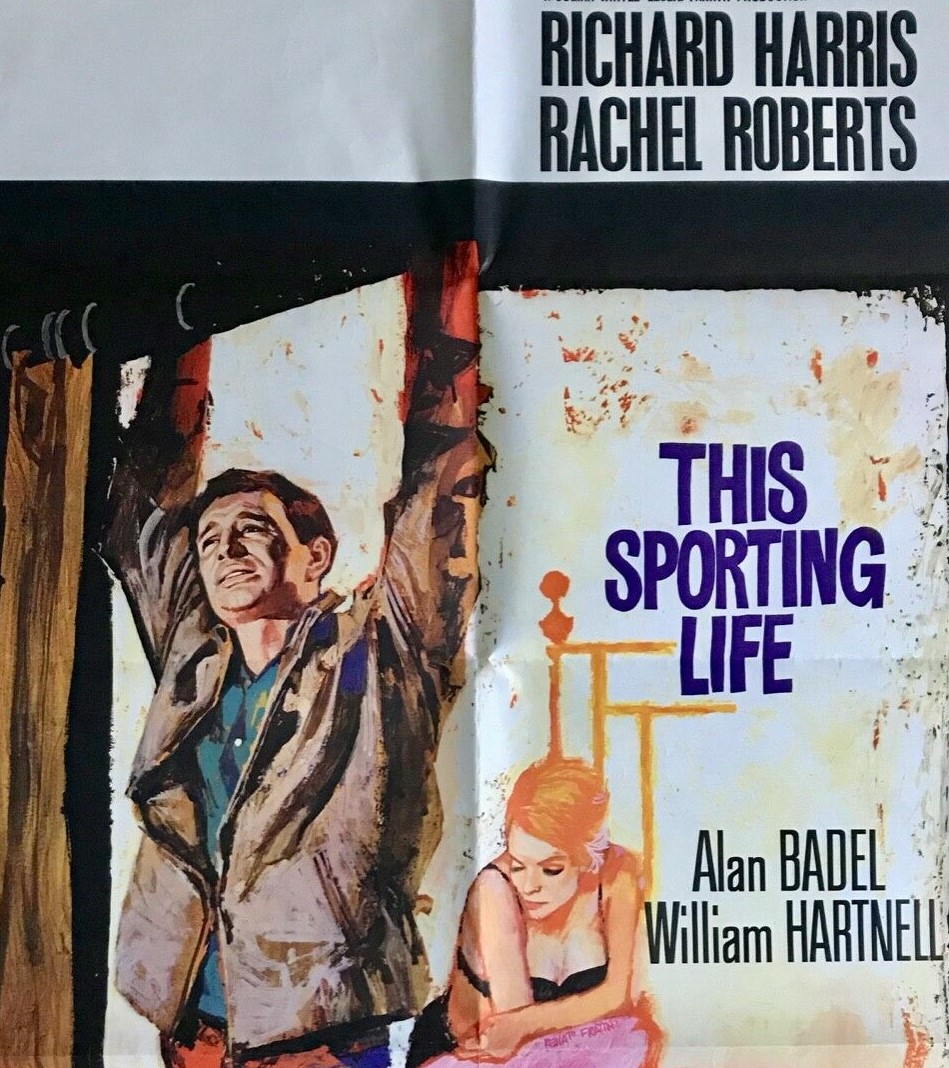
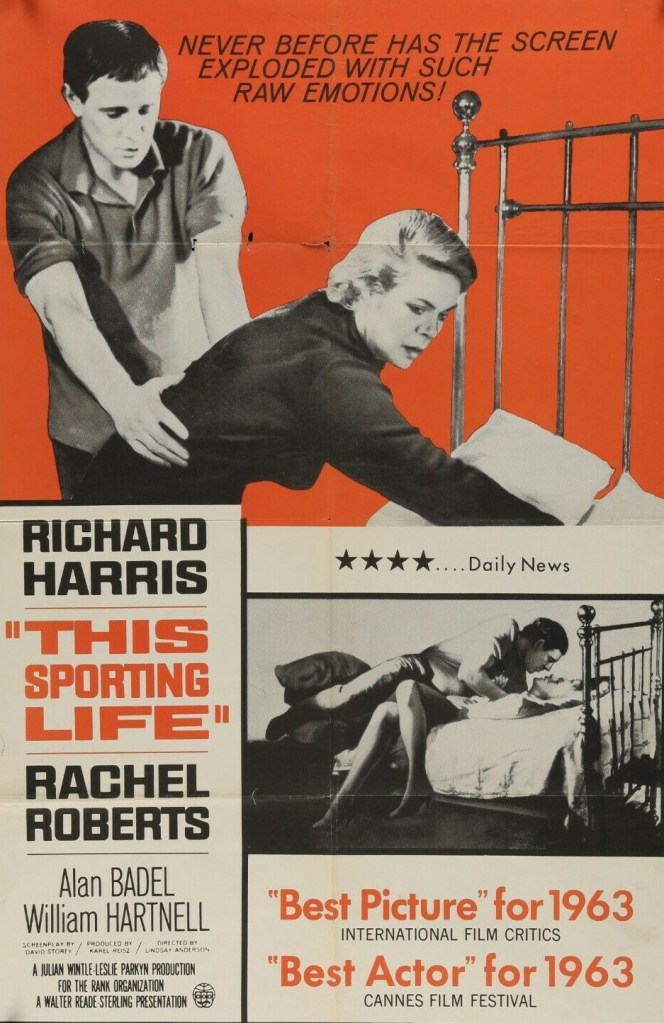
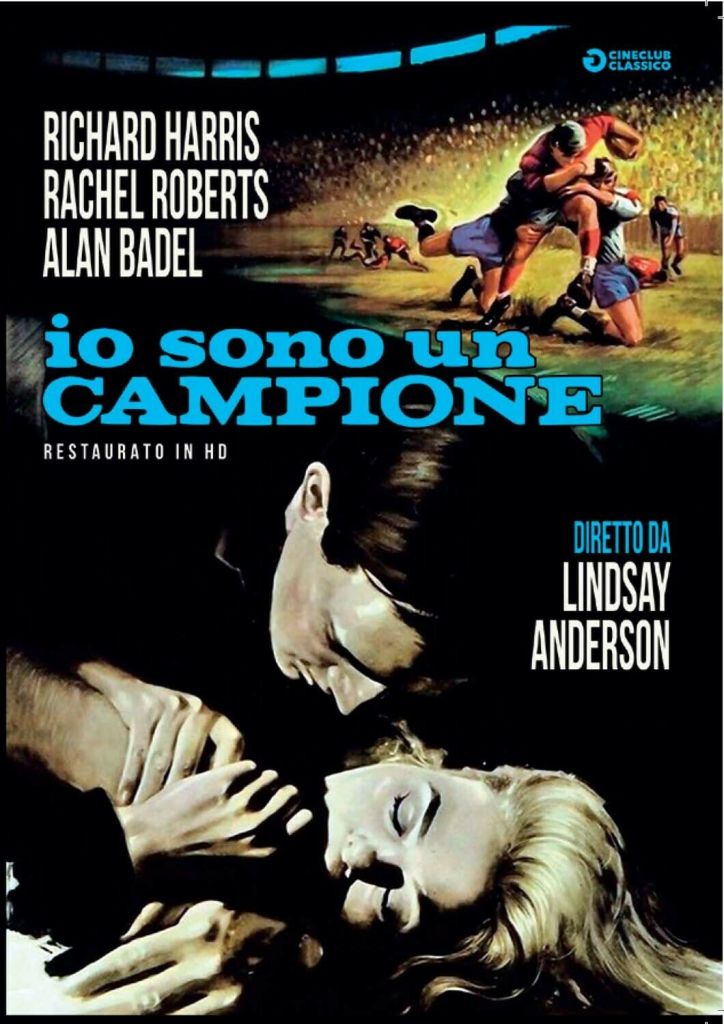
This Sporting Life (1963) ****

What began as the last gasp of the British New Wave working class kitchen sink drama has now after a six-decade gap resolved into a struggle over political and sexual ownership. Macho athlete Frank Machin (Richard Harris) jibes against his paymasters at a Yorkshire rugby league club – in similar fashion to Charlton Heston in Number One (1969) – while trying to hold sway over widowed landlady Margaret (Rachel Roberts). While documenting the class divide over which British writers and directors obsess, Lindsay Anderson’s debut takes a wry look at power.

Machin belongs to the Arthur Seaton (Saturday Night and Sunday Morning, 1960) class of loudmouth boors, determined to take as much as they can, riding roughshod over anyone who gets in their way, even attacking players of his own team. Although a fan favorite, his position at the club still requires backing from the moneyed directors, support that appears go awry when he rejects overtures from Mrs Weaver (Vanda Godsell), wife of a board director (Alan Badel). While Margaret eventually succumbs, her actions fill her with shame, the presents he buys making her feel like a kept woman.

Both Machin and Margaret are the rawest of creatures, forever appearing ready to topple into some emotional crevasse of their own making. At a time when marriage was the rock of society and women had little independence, a woman could dwindle away from the scorn of neighbors, while a man lacking emotional intelligence would crumble in the face of his own fears.

The non-linear narrative blurs some aspects of the story. There is no reference to Machin’s background save that he was once a miner and still works somewhere unspecified to supplement his footballer’s income. He rejects the paternalism of ageing scout Johnson (William Hartnell) while appearing to be seeking to resolve maternal issues, the widow with two small children at least a decade older, and although he could easily afford better accommodation refuses to move out.

His obsession with Margaret is never properly explained, except by her, who sees him as acting like an owner. Equally, Margaret is the opposite of the women in virtually every movie of the period, for whom marriage is the sole ambition. Whether she still grieves the loss of her factory worker husband, who may have committed suicide, or loathes Machin’s dominant nature is never explained. It might have been better if both had married for unhappy husbands and wives tend to give each other both barrels, emotions never concealed. Or she could be in the throes of an undiagnosed depression expressed as anger.

Machin is the other side of the British Dream – that anyone who escapes going down the pits or the mindless grind of the factory will automatically enjoy happiness. While Machin revels in his celebrity, he has no idea how to make his life happier. This is in contrast to the other footballers who either enjoy womanizing and drinking or are married or engaged and accept the unwritten rules of the game rather than fighting everyone.

There is plenty grime on show, and the football field has never been so pitiless, and as a social document it fits in well to the small sub-genre of films depicting working class life, but the picture’s thrust remains that of two opposites who will clearly never meet except in the delusional head of Machin.

Power is demonstrated in various ways. Weaver has the clout to give Machin a hefty signing-on fee against the wishes of the board, his wife takes her pick of the footballers to satisfy her sexual needs, Machin believes he is entitled to berate waiters in an upmarket restaurant, while Margaret is demeaned by accepting his present of a fur coat.

As ever with these films of the early 1960s there is a wealth of acting talent. Both Harris and Roberts were Oscar-nominated. Others making a splash in the cast were Alan Badel (Arabesque, 1966), Colin Blakely (The Vengeance of She, 1968), Jack Watson (The Hill, 1965), and if look closely you will spot double Oscar-winner Glenda Jackson (Women in Love, 1969). Future television stalwarts included William Hartnell (the first Doctor Who), Arthur Lowe (Dad’s Army, 1968-1977), Leonard Rossiter (Rising Damp, 1974-1978), Frank Windsor (Softly, Softly, 1966-1969) and George Sewell (Paul Temple, 1969-1971).

Lindsay Anderson (If… 1969) no doubt believed he was making an excoriating drama about the class struggle, but in fact has delivered a classic thwarted love story. David Storey wrote the screenplay based on his own novel.

Dark Intruder (1965) ***

Sumerian demons, Siamese twins separated at birth, a serial killer, oceans of fog, the flower of the mandrake, a climax that revolves around “it’s in his kiss” and a picture so shorn of light it could easily have been titled Dark Fiancé or Dark Wedding. Thematically truncated, too, and you get the feeling that with a little bit more narrative expertise and budget this could have been spun out into something that fitted in with the decade’s later spurt of horror a la Rosemary’s Baby (1968). There’s the bonus of Leslie Nielsen (Airplane, 1980) in a straight part though one which allows him a fair quota of quips.

In San Francisco 1890, occult expert and straight-down-the-line man-about-town toff Brett Kingsford (Leslie Nielsen) is surreptitiously engaged by the cops to investigate a series of brutal murders. Beside each corpse, the killer has left a memento, a tiny statuette that is traced back to Sumerian times, a demon – similar to the larger kind that turn up at the archaeological dig at the start of The Exorcist (1973) – banished from Earth and which attempts to return by entering another person’s body though presumably none of the four victims coming up to scratch.

Among the dead is Hannah, who had been involved in an archaeological expedition and later adopted a mysterious child. She has a connection to Brett’s friend, antiques dealer Robert Vandenburg (Mark Richman) who is engaged to be married to Evelyn Lang (Judi Meredith), another friend of Brett. Though Brett consults Chinese expert Chi Zang (Peter Brocco) and is attacked by the titular intruder who leaves him with claw marks on his shoulder, the bulk of the detection falls to Robert, who exhibits odd behaviour, standing in a daze, sleepwalking, going off in the wrong direction, suffering from blurred vision, and with a strange scar on his spine. He encounters the mysterious Professor Moloki (Werner Klemperer), face concealed, who tells him all will be revealed on the eve of his wedding.

The killings don’t stop, Brett no closer to catching the killer, and no further evidence forthcoming and the tale falls on the shoulders of Robert who is convinced from his own odd behavior that he is the killer. Eventually, he starts to work out the strange elements of his own life and the “invisible force” he is constantly fighting.

Turns out he was the Siamese twin separated at birth, and that Hannah had brought up the other, deformed, twin, who now wants his twin’s life – and wife. All we see of the creature is the claw, the rest of him hidden under a cloak or shuffling along behind curtains. The pair grapple in the darkness and it appears the bad twin is slain.

But is he? It’s Evelyn who gives him away, revolted by his kiss, and the matter is resolved. So really no more than the assembly of an interesting horror story. The claw is well done but as I said most of the detection comes from the mind of Robert rather than the occult detective working up the clues. But the dapper Brett is good value, keeping chatterbox Evelyn in check, and putting on his best Basil Rathbone impersonation.

As a bonus it’s insanely short, barely an hour long, which would have put it squarely in the B-feature category – but of two decades before, not of the mid-1960s. Turns out this was a pilot for a television horror series that wasn’t picked up by any of the three U.S. networks so was extended enough to be feature-length. The actors try desperately to add characterisation to their thin parts, Leslie Nielsen (Beau Geste, 1966) and Judi Meredith (Queen of Blood, 1966) best at that.

Harvey Hart (Bus Riley’s Back in Town, 1965) directed from a script by Barre Lyndon. The movie was released by Universal, who had Nielsen on an exclusive seven-year contract.

The sum of its parts without much else, but intriguing tale calling out to be extended – or remade.

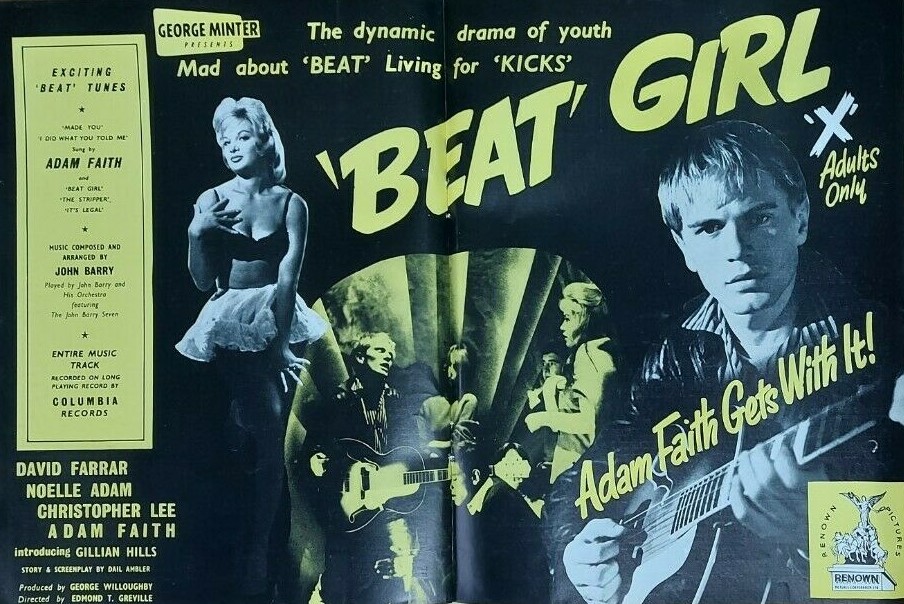
Beat Girl / Wild for Kicks (1960) **

More social document than drama, but that aspect somewhat diluted by the moviemakers’ attempts at exposing rebellious youth while taking for granted more sordid adult behavior. Narrative flow is interrupted now and then to showcase Adam Faith’s singing and to accommodate a few striptease acts. Probably more interesting is the array of new talent on show.

Spoiled teenager Jennifer (Gillian Hill) heads for the wild side of town to experience the beatnik lifestyle in Soho coffee shops and cellars. That there are no drugs involved, and that alcohol is considered “square” – as for that matter is violence – may come as a surprise to students of the period. Apart from one episode of road-racing and playing “chicken” along a railway track, most of the time the gang listen to music or dance until Jennifer gets it into her head that ejoining a striptease show might give her life the thrill it is missing.

This is prompted by the discovery that her new too-young stepmother Nichole (Noelle Adams) has been a stripper and most likely a sex worker in Paris before marrying wealthy architect Paul (David Farrar), cueing a round-robin of confrontations. Strangely enough, from the narrative perspective, none of the young bucks appear romantically interested in the provocatively dressed Jennifer and so it is left to creepy club owner Kenny (Christopher Lee) to make a move.

The gaping hole left by lack of narrative drive is not offset by immersion in the beatnik or striptease scene. Back in the day the British censors took the editing scissors to the striptease but although restored versions available now contain nudity you are left wishing that there was some lost element to the beatnik sections that would have given the picture the energy it required.

Gillian Hill (Les Liaisions Dangereuses, 1959), comes over as a cross between Brigitte Bardot and Diana Dors without having an ounce of the sex appeal of either. All pout and flounce, she is unable to inject any heart into her two-dimensional character, although given her youth and inexperience this was hardly surprising. Former British star David Farrar (Black Narcissus, 1947) was coming to the end of his career and in a thankless role as a frustrated father could do little to rescue the project.

French actress Noelle Gordon (Sergeant X of the Foreign Legion, 1960) could have been Jennifer’s mother given her own tendencies towards wiggle and pout but at least she makes a stab at trying to overcome her step-daughter’s hostility.

In the main, the picture’s delight is bringing to the fore a whole chorus of new faces. Pick of the supporting cast is Shirley Anne Field (Kings of the Sun, 1963) who doesn’t just have a knowing look but looks as if she knows what’s she doing acting-wise. Making his movie debut was teen pop idol Adam Faith, who had made his name playing in coffee bars. He had already notched up a couple of number one singles, but doesn’t quite set the screen on fire. Peter McEnery (The Fighting Prince of Donegal, 1966) plays his inebriated pal.

You can also spot Oliver Reed (Women in Love, 1969), Julie Christie (Doctor Zhivago, 1965), Claire Gordon (Cool It, Carol, 1970) and Nigel Green (Jason and the Argonauts, 1963).

Perhaps the most important debut belonged to composer John Barry. He had already been working with Adam Faith. Barry’s music for the film was the first British soundtrack album ever released, reaching number eleven on the charts, and opening the doors for future soundtrack albums, not least of which was the rich vein of theme tunes produced by Barry in the next few years. 

French director Edmond T. Greville, who brought little panache to the subject matter, would redeem himself with his next picture The Hands of Orlac (1960). 

This doesn’t fall into the “so-bad-it’s-good” category, nor has it been unfairly overlooked, and probably is better known as an example of the kind of exploitation B-picture that the Americans do so much better and a reminder that, except on rare occasions such as The Wild One (1953), older moviemakers seem incapable of capturing the essence of youth.

The Switch (1963) ***

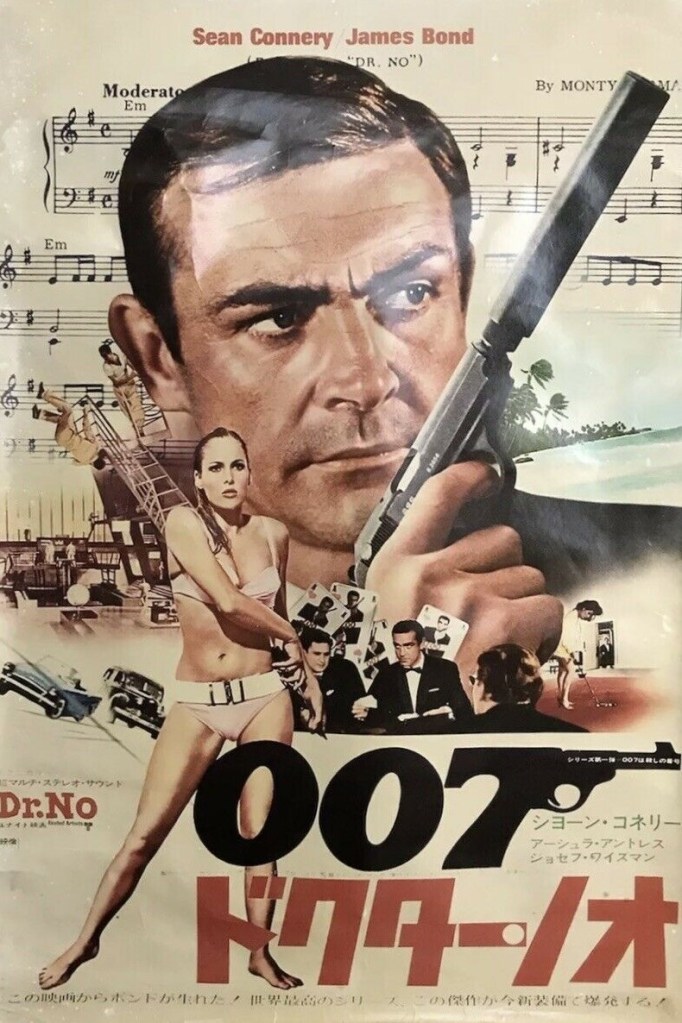
Dr No (1962) was more famous for kick-starting nascent careers – step forward Sean Connery and Ursula Andress – rather than reviving careers that had looked dead and buried as was the case with Zena Marshall. I had just come across Ms Marshall in her last picture, The Terrornauts (1967), a cult sci fi from Amicus, that I had been asked to provide an audio commentary for (you’ll have to wait till next year for that) and was intrigued to discover that, while never becoming a big star, she had managed to eke out a decent living since her debut in Caesar and Cleopatra in 1945. She’d never achieved much more than rising star status, B-movies more her line. She hadn’t made a picture in five years until Dr No but thereafter managed leading lady once a year until her retirement.

Director Peter Maxwell (Serena, 1962) fell into much the same movie backwater but still had the knack of generating interesting narratives. The screenplay turns on some interesting realism, an unusual gadget (especially for this genre)  as well as a couple of entertaining happenstances and in  Zena Marshall one of two very self-assured females who light up a picture otherwise peppered with dour males.

The eagle-eyed among you will have noted that I’ve used a still from “Dr No” as the main picture. Similarly, this is one of Zena Marshall’s earlier movies.
Extant posters of “The Switch” are non-existent, it appears.

A joint police and customs operation has snared a smuggler in a sting. But, almost immediately after Inspector Tomlinson (Dermot Walsh) and Customs Agent Bill Craddock (Anthony Steel) latch onto their prey, their informant ends up in the River Thames and they hit a dead end trying to find the Mr Big behind the high-class watch smuggling racket.

Meanwhile model Carolyn (Zena Marshall), on holiday in France, is taken for a romantic meal by seductive Frenchman Lecraze (Arnold Diamond) while his colleagues stuff her petrol tank with watches.

Takes a while for Carolyn to become a suspect. There’s quite a lot of fun to be had from unexpectedly inept gangsters. When she returns home, she finds her flatmate’s cousin John Curry (Conrad Phillips) having a bath. With his car parked in her garage, she finds somewhere else to stay. His car is mistakenly stolen, as is the car she exchanges at the garage while the original one she brought back from France is in for repairs. The crooks repeatedly steal the wrong car.

Eventually, the cops break open her petrol tank and find the hidden watches. Although under suspicion she is freed, and, being a confident young lass, and quite accustomed to men of all ages taking her out for dinner and buying her presents, is nonetheless surprised when her latest admirer John presents her with his firm’s latest invention, a miniature radio transmitter hidden inside a cigarette case.

Which is just as well because the Frenchman reappears and kidnaps Carolyn hoping to find out from her what happened to her car. Meanwhile, the cops dig up gangster’s moll Janice (Dawn Beret) whose boyfriend is mixed up in the villainy and has herself unwittingly brought stolen goods into the country in her petrol tank after being chatted up by a smooth Frenchman. She’s a cheeky young thing,  as self-assured as Carolyn, suggesting to the straight-laced inspector that if he’s not doing anything at the weekend they could get married.

Meanwhile, John has teamed up with the good guys while they manage to survive Janice’s stream of quips and attempt to track down the kidnapped Carolyn. She doesn’t manage to hold out for long, not when Mr Big removes the gloves.

All in all, it’s cleverly done, playing all the time with audience expectation, not just the cocky confidence of the two women, who are clearly accomplished at leading men astray, but the quirks of the storyline – including a failed escape up a chimney – the details of the smuggling operation, and the introduction of the James Bond-style gadget. There’s even some cheeky self-awareness, John seen sitting up in bed reading the movie tie-in edition of Dr No which features Zena Marshall on the cover.

Apart from Zena Marshall, there’s an interesting cast. Anthony Steel (The Story of O, 1975), husband of Anita Ekberg, was just back from a stint in Rome. Conrad Phillips (The Secret Partner, 1961) had played William Tell in the television series and Dermot Walsh Richard the Lionheart in similar. It marked the last screen appearance of Susan Shaw (Fire Maidens from Outer Space, 1956) and perky Dawn Beret (Victim, 1961) looked promising. In bit parts look out for Carry On regular Peter Butterworth  and Rose Alba (Thunderball, 1965)

This sat on the shelf for a year before going out on the Odeon circuit as support to spy picture Hot Enough for June/Agent 8¾ (1964) starring Dirk Bogarde.

Except for horror, Britain didn’t stoop to having B-Movie Queens, but if they had Zena Marshall would wear the crown.

Bye, Bye, Birdie (1963) ***

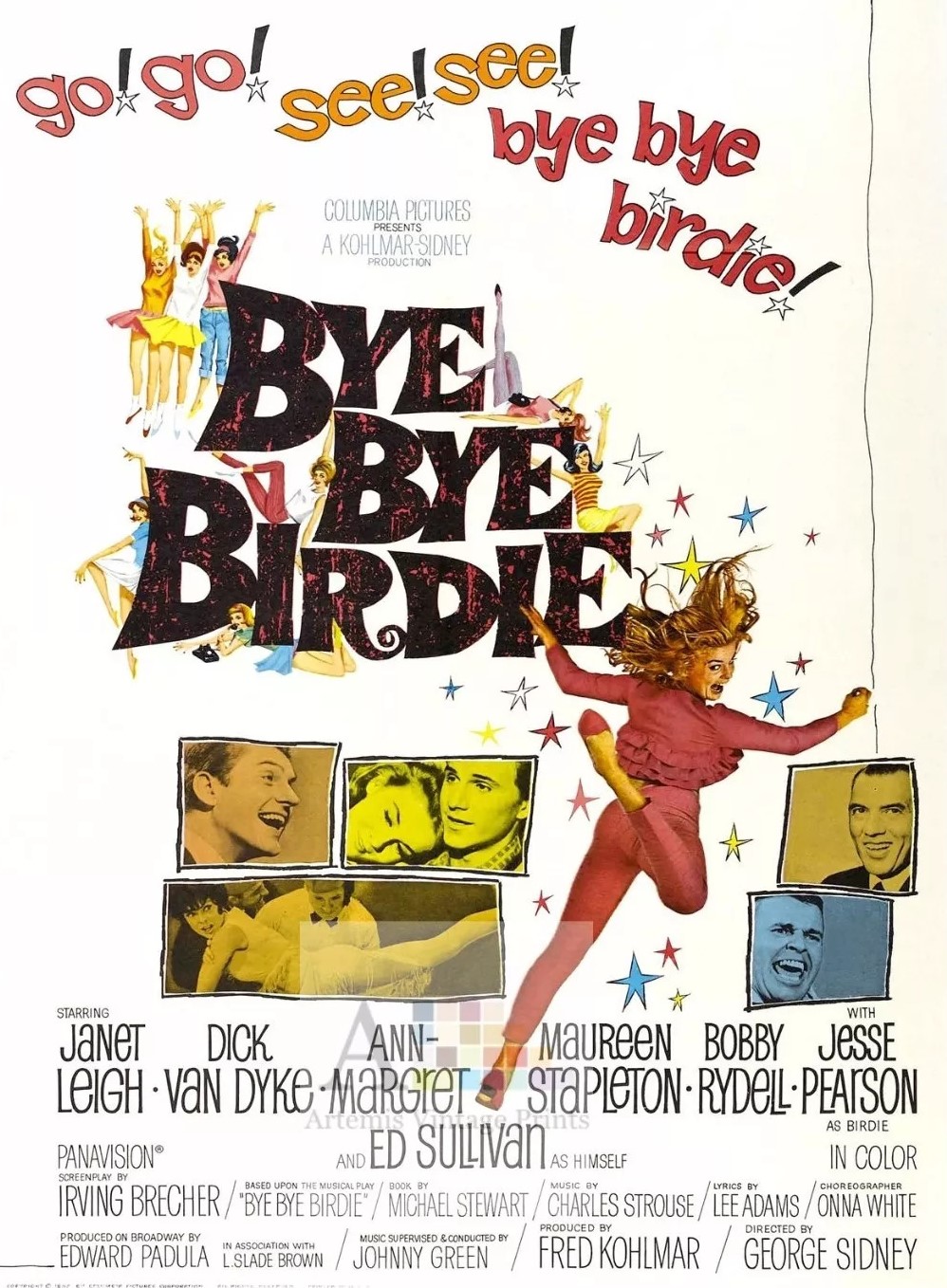
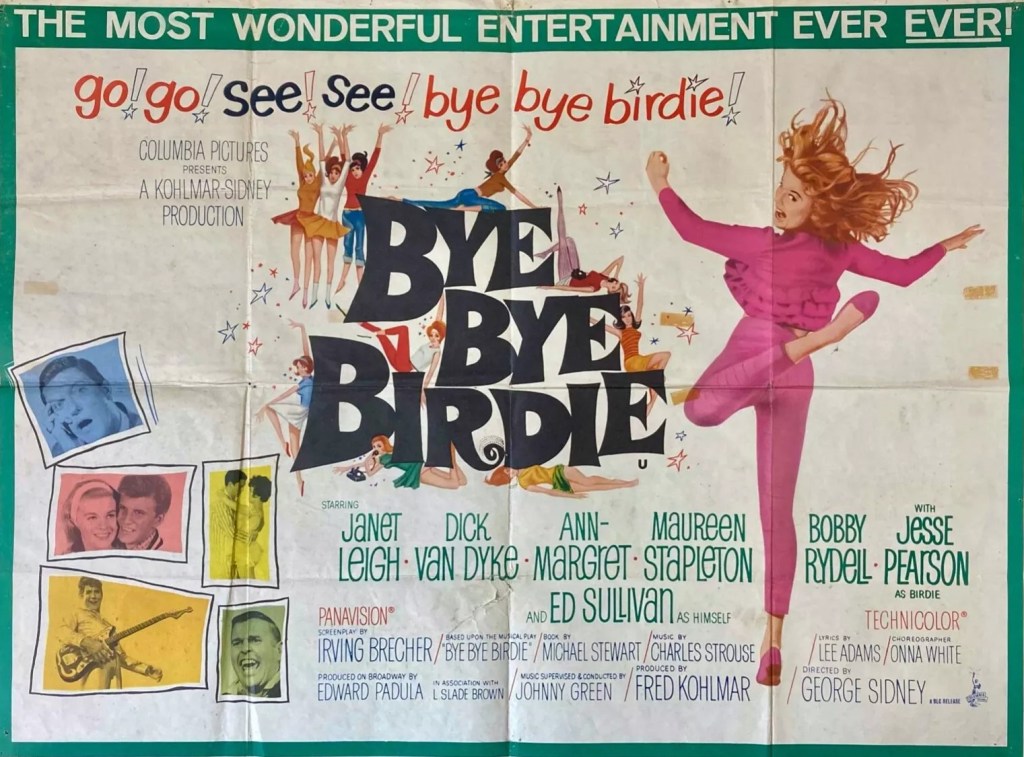
Marketeers employ a cute trick to get round the contractual billing required on movie posters. The position and size of a star’s name in any movie – even now – is stipulated long before a single camera rolls. This is where all the “name above the title” malarkey stems from comes from, that stipulation setting the reals stars apart from the wannabes.

However, whoever was in charge of drawing up the standard boilerplate template was only concerned with names, not images. That left a loophole to be exploited. Should you have a female rising star, whose face or figure might be a darn sight more attractive than the top-billed male, well, by heck, there was nothing to stop you plugging the contractually-less-dominant person all over the poster at the expense of the top-billed star.

The marketeers did it with Marilyn Monroe, they did it with Audrey Hepburn, and now they’re stooping to the same loophole to promote Ann-Margret as virtually the only star of any importance. Admittedly, this was before top-billed Dick Van Dyke achieved much of a reputation as a hoofer in such spectaculars as Mary Poppins (1964). But his second-billed female lead, Janet Leigh, whose features the camera had very much taken a shine to, was also elbowed out of poster prominence.

And small wonder. Excepting Monroe, no actress ever in the last decade burst onto the screen with such pizzazz. By the time Bye Bye Birdie  – her third movie – opened Ann-Margret’s asking price had zoomed to $250,000 and she had struck a two-picture deal with MGM, was contracted to five for Twentieth Century Fox, three for Columbia and another three for Frank Sinatra’s movie production arm.

So a heck of a lot was in the balance. And, boy, does she deliver. Her energy is untouchable and, excepting again Monroe, there was never a sexier singer.

Shame the musical itself is so trite, at its best in homage to those innocent days of the 1950s, that were a more Technicolor version of those 1940s musicals that invariably were sugary confections. The story rips off the Elvis Presley legend. Conrad Birdie (Jesse Pearson) is a pop singer who has been drafted. Songwriter’s secretary Rosie (Janet Leigh) comes up with a publicity gimmick, Conrad singing a song, “One Last Kiss,” written by Albert (Dick Van Dyke) sung on the Ed Sullivan Show, his last gig before joining the Army, with a specially-chosen gal to be recipient of said smooch.

To fill you in, Rosie has had a tough time getting boyfriend Albert, eight years into their relationship, across the wedding finishing line. Bridie fan Kim (Ann-Margret) also has a boyfriend Hugo (Bobby Rydell) who naturally objects to his beloved kissing the pop singer on air in front of millions even it is a publicity stunt. Meanwhile, Albert’s Mama (Maureen Stapleton) is trying to drive a wedge between Rosie and her son. The out-of-sorts Rosie and Hugo conspire to sabotage the television show.

So pretty much the will-she-won’t-she is delivered in wishy-washy style with the plot (call that a plot!) interrupted every few minutes for a song. The narrative seems out of place for a section involving arrest for statutory rape and racism, but that gives the movie some much-needed muscle.

No question that Ann-Margret (The Swinger, 1966) steals the show. That would hardly be surprising given the lack of competition. But she certainly has the song-and-dance chops, and her energy is second to none. She gets a march on everyone by singing the title number over the credits, the credits themselves very much pushed into the background. The other prospective breakout musical star Dick Van Dyke only has one solo and Janet Leigh (Psycho, 1960) wasn’t going to effect a change of screen persona any time soon.

George Sidney directed from a screenplay by Irving Brecher (Oscar-nominated for Meet Me in St Louis, 1944) and Michael Stewart (Hello, Dolly!, 1969) from the original Broadway hit by Charles Strouse (music), Lee Adams (lyrics) and Stewart (book).

Refreshingly lightweight. Ann-Margret lights up the screen.

Dr No (1962) *****

Minus the gadgets and the more outlandish plots, the James Bond formula in embryo. With two of the greatest entrances in movie history – and a third if you count the creepy presence of Dr No himself at the beds of his captives – all the main supporting characters in place except Q, plenty of sex and action, plus the credit sequence and the theme tune, this is the spy genre reinvented.

Most previous espionage pictures usually involved a character quickly out of their depth or an innocent caught up in nefarious shenanigans, not a man close to a semi-thug, totally in command, automatically suspicious, and happy to knock off anyone who gets in his way, in fact given government clearance to commit murder should the occasion arise. That this killer comes complete with charm and charisma and oozes sexuality changes all the rules and ups the stakes in the spy thriller.

 Three men disguised as beggars break into the house of British secret service agent Strangeways (Tim Moxon) and kill him and his secretary and steal the file on Dr No (Joseph Wiseman). A glamorous woman in a red dress Sylvia Trench (Eunice Gayson) catches the eye of our handsome devil “Bond, James Bond” (Sean Connery) at a casino before he is interrupted by an urgent message, potential assignation thwarted.

We are briefly introduced to Miss Moneypenny (Lois Maxwell) before Bond is briefed by M (Bernard Lee) and posted out immediately – or “almost immediately” as it transpires – to Jamaica, but not before his beloved Beretta is changed to his signature Walther PPK and mention made that he is recovering from a previous mission. But in what would also become a series signature, liberated women indulging in sexual freedom, and often making the first move, Ms Trench is lying in wait at his flat.

Another change to the espionage trope, this man does not walk into the unknown. Suspicion is his watchword. In other words, he is the consummate professional. On arrival at Jamaica airport he checks out the waiting chauffeur and later the journalist who takes his picture. The first action sequence also sets a new tone. Bond is not easily duped. Three times he outwits the chauffeur. Finally, at the stand-off, Bond employs karate before the man takes cyanide, undercutting the danger with the mordant quip, on delivering the corpse to Government house, “see that he doesn’t get away.” 

Initially, it’s more a detective story as Bond follows up on various clues that lead him to Quarrel (John Kitzmiller), initially appearing as an adversary, and C.I.A. agent Felix Leiter (Jack Lord) before the finger of suspicion points to the mysterious Dr No and the question of why rocks from his island should be radioactive. Certainly, Dr No pulls out all the stops, sending hoods, a tarantula, sexy secretary Miss Taro (Zena Marshall) and the traitor Professor Dent (Anthony Dawson) to waylay or kill Bond.

But it’s only when our hero lands on the island and the bikini-clad Honey Rider (Ursula Andress) emerges from the sea as the epitome of the stunning “Bond Girl” that the series formula truly kicks in: formidable sadistic opponent, shady organization Spectre, amazing  sets, space age plot, a race against time. 

It’s hard not to overstate how novel this entire picture was. For a start, it toyed with the universal perception of the British as the ultimate arbiters of fair play. Yet, here was an anointed killer. Equally, the previous incarnation of the British spy had been the bumbling Alec Guinness in Our Man in Havana (1959). That the British should endorse wanton killing and blatant immorality – remember this was some years before the Swinging Sixties got underway – went against the grain.

Although critics have maligned the sexism of the series, they have generally overlooked the female reaction to a male hunk, or the freedom with which women appeared to enjoy sexual trysts with no fear of moral complication. Bond is not just macho, he is playful with the opposite sex, flirting with Miss Moneypenny, and with a fine line in throwaway quips.

Director Terence Young is rarely more than a few minutes away from a spot of action or sex, exposition is kept to a minimum, so the story zings along, although there is time to flesh out the characters, Bond’s vulnerability after his previous mission mentioned, his attention to detail, and Honey Rider’s backstory, her father disappearing on the island and her own ruthlessness. The insistently repetitive theme tunes – from Monty Norman and John Barry – was an innovation. The special effects mostly worked, testament to the genius of production designer Ken Adam rather than the miserable budget.

Most impressive of all was the director’s command of mood and pace. For all the fast action, he certainly knew how to frame a scene, Bond initially shown from the back, Dr No introduced from the waist downwards, Honey Rider in contrast revealed in all her glory from the outset. The brutal brief interrogation of photographer Annabel Chung (Marguerite LeWars), the unexpected seduction of the enemy Miss Taro and the opulence of the interior of Dr No’s stronghold would have come as surprises. Young was responsible for creating the prototype Bond picture, the lightness of touch in constant contrast to flurries of violence, amorality while blatant delivered with cinematic elan, not least the treatment of willing not to say predatory females, the shot through the bare legs of Ms Trench as Bond returns to his apartment, soon to become par for the course.

Future episodes of course would lavish greater funds on the project, but with what was a B-film budget at best by Hollywood standards, the producers worked wonders. Sean Connery (The Frightened City, 1961) strides into a role that was almost made-to-measure, another unknown Ursula Andress (The Southern Star, 1969) speeded up every male pulse on the planet, Joseph Wiseman (The Happy Thieves, 1961) provided an ideal template for a future string of maniacs and Bernard Lee (The Secret Partner, 1961) grounded the entire operation with a distinctly British headmaster of a boss.

Masterpiece of popular cinema.

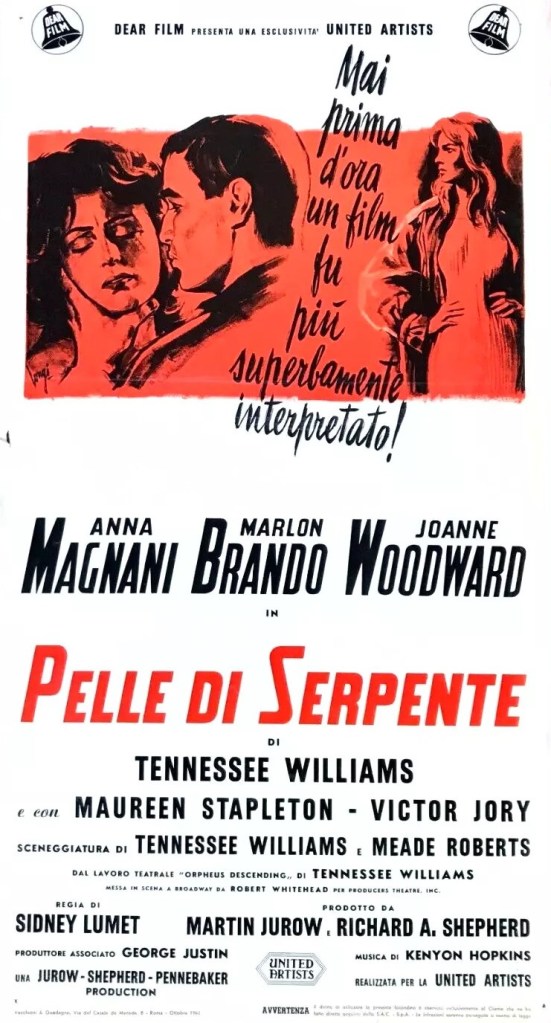
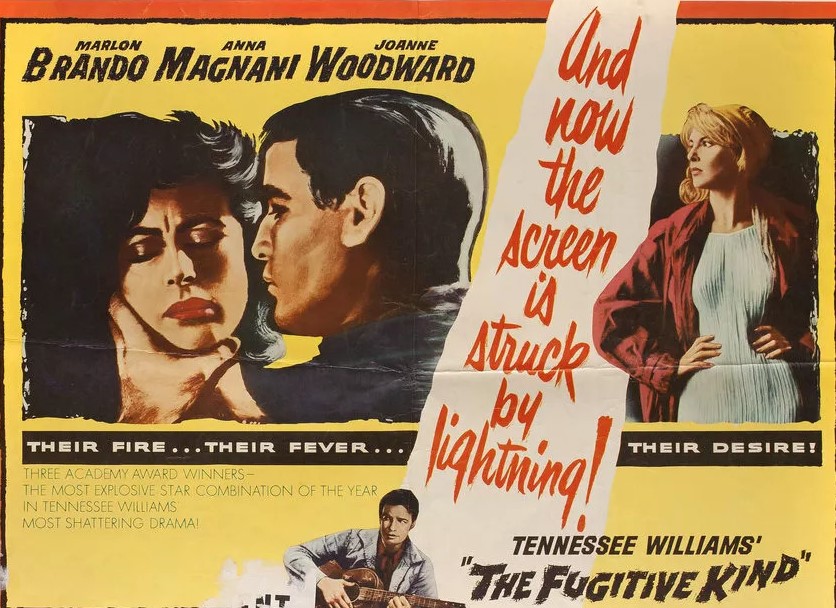
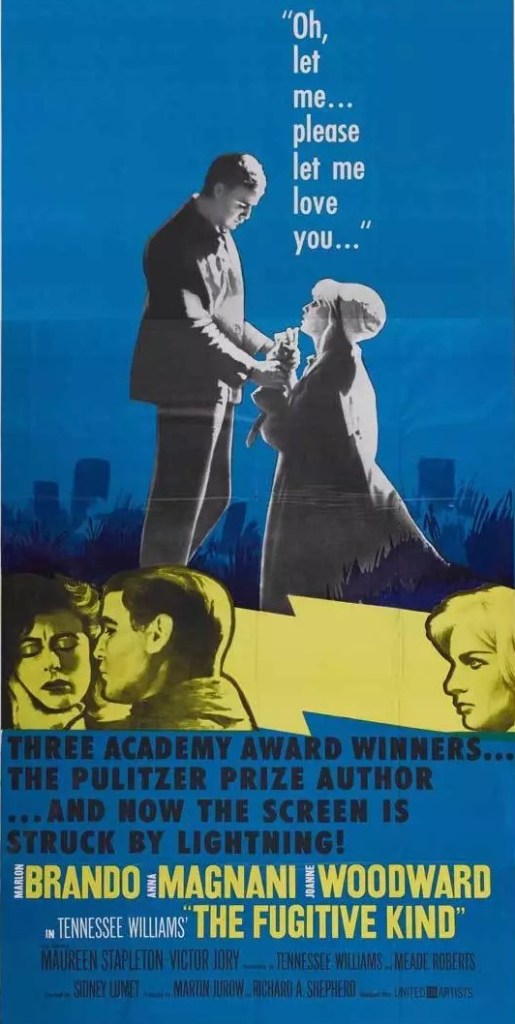
Behind the Scenes: Selling The Million-Dollar Marlon Brando – “The Fugitive Kind” (1960) Pressbook

Should have been a darned-easy sell. After all, Marlon Brando had made global headlines after becoming the first actor to be paid a million bucks for a movie, his fee for The Fugitive Kind outstripping by $250,000 the previous record jointly held by John Wayne and William Holden (see Note below) for The Horse Soldiers (1959). And there was no suggestion – as indeed there is not even now – that audiences held against the stars the wealth their talents accrued.

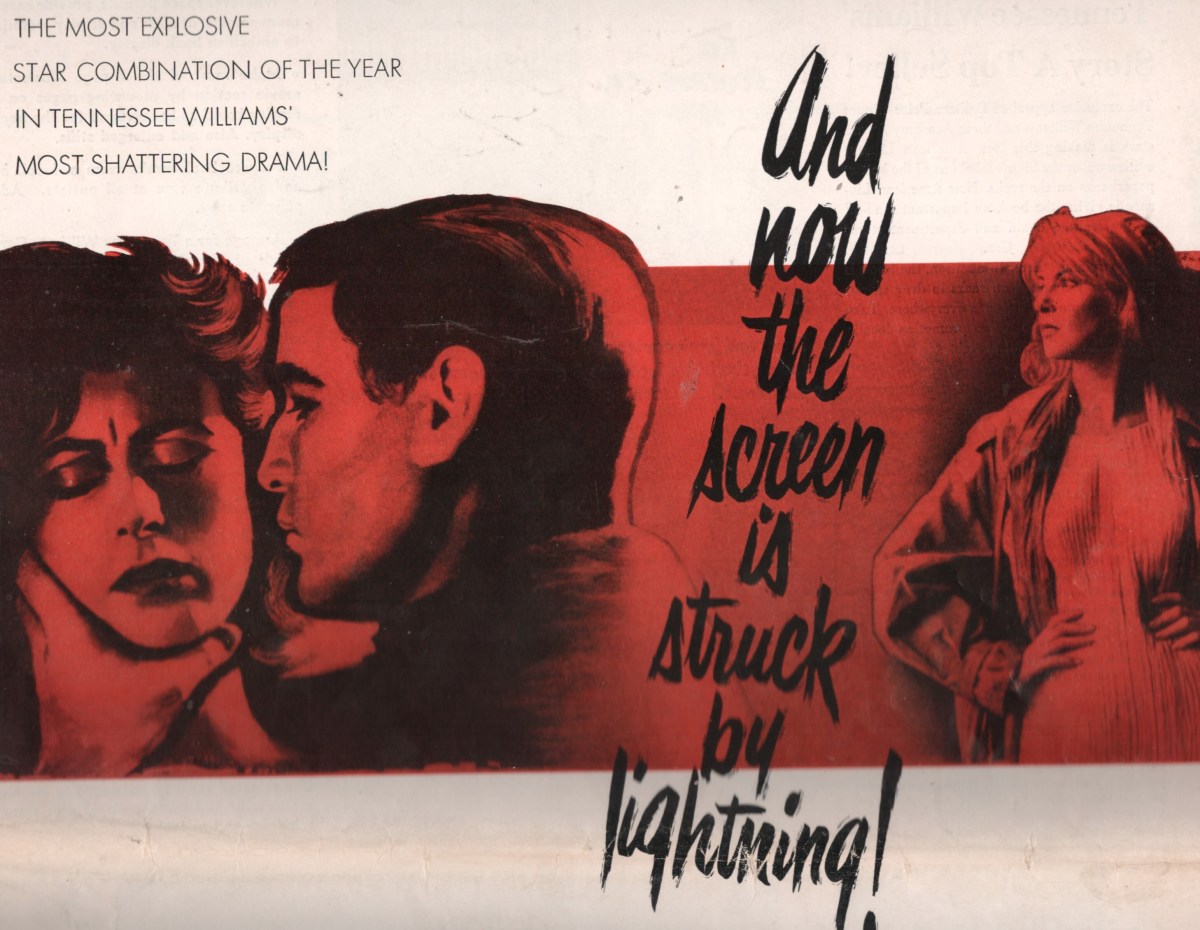
“The Most Explosive Star Combination of the Year” was how this was generally sold, on the back of the Oscars held by each of the principals, Brando, Italian Anna Magnani and Joanne Woodward and the Pulitzer Prize awarded to playwright Tennessee Williams, himself also a two-time Oscar nominee as well as his work providing Oscar wins and nominations by the bucket load for actors and directors.

“Something about the way he looked at a woman, something about the way he handled a guitar” were other notable taglines and marketeers tried to convince the public “the screen is struck by lightning.” And if that was not enough – “their fire…their fever…their desire” was expected to do the trick.

Publicists encouraged exhibitors to make full use of Brando’s accoutrements from the movie, namely his snakeskin jacket, Rolex and Kay Guitar, which in one scene he actually played. Suggestions included auctioning a guitar for charity and running a talent contest. Brando was a reasonably accomplished player, specializing in perennials like “Shenandoah” and “Streets of Laredo.”

How to make a snakeskin jacket was another angle.  The Rolex watch his character wore presented opportunities for marketing tie-ups with jewellery stores. No marketing stone was left unturned to the extent of the Necchi sewing machine, seen in the movie, being offered as a prize in a national competition. Novo Greetings Cards were also seen in passing in Lady Torrance’s store and this company was backing the movie.

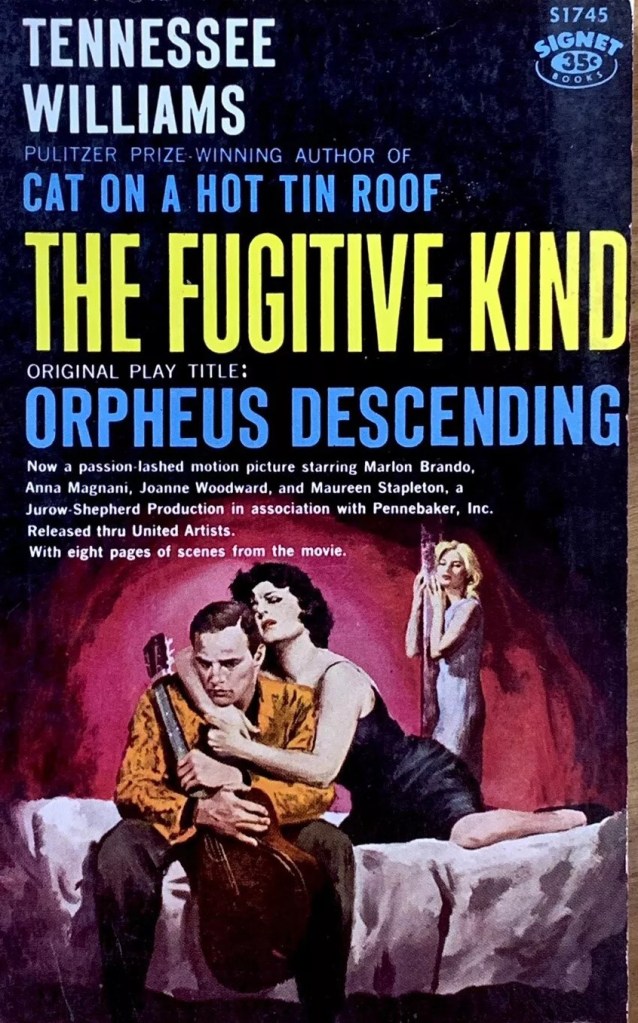
Unusually, Signet was using the movie tie-in approach to sell a play, the paperback comprising the source material Orpheus Descending, which included an eight-page spread of stills from the picture. Williams’ position as the most popular playwright of his generation – his only rival Arthur Miller had less success in Hollywood – brought potential access to libraries, book clubs and schools. Military bases around the world were targeted  through marketing material emphasizing Joanne Woodward.

It would certainly have helped if the movie had been able to set a new fashion trend for the wearing of snakeskin jackets. Or revive a trend that had last occurred in the 1930s, “quite a craze” for shoes, bags, hats and belts. “It wouldn’t surprise me,” said United Artists costume designer Frank Thompson, “if Brando wearing this jacket starts the whole thing again.”

Thompson had quite a task making two identical jackets – in case one was damaged during filming. First of all, he had to locate skins that were found in Mississippi. The choice came down to rattler or python. Opting for python, Thompson went through 200 skins before he found three that matched. “Looking for two snakeskins that match identically is like looking for two fingerprints that are exactly the same.”

The film was based on Battle of Angels, written by Williams in 1939, his first full-length work professionally staged (in Boston). He “never quit working on this one…it never went into the trunk, it always stayed on the work bench.” Rewriting about 75% of the play, it was reprised as Orpheus Descending on Broadway in 1957. Although Williams had Brando and Magnani (star of the film version of The Rose Tattoo, 1955) in mind for the stage play, it went ahead instead with Cliff Robertson and Maureen Stapleton. Williams had written The Rose Tattoo for Magnani but again it was Maureen Stapleton who won the role on stage.

Williams had outstanding success in writing roles that were in tune with Oscar sensibilities. A Streetcar Named Desire (1951) won Oscars for Vivien Leigh, Kim Stanley and Karl Malden with Brando nominated. Anna Magnani won for The Rose Tattoo and Marisa Pavan was nominated. Other nominations included Carroll Baker and Mildred Dunnock for Baby Doll (1956), Elizabeth Taylor and Paul Newman for Cat on a Hot Tin Roof (1958), and Katharine Hepburn and Taylor for Suddenly, Last Summer (1959).

Despite its Mississippi location and except for external establishing shots, The Fugitive Kind was shot in the Bronx. Director Sidney Lumet was a notably New York kinda guy, having filmed his first three movies – Twelve Angry Men (1957), Stage Struck (1958) and That Kind of Woman (1959) – in the city.

He argued, “Hollywood’s great attractions have been the technicians and the shooting facilities, With care, men of comparable talent can be found in New York. As for facilities, a sound stage is a sound stage wherever it is. I concede that in California they’re larger and more elaborate, but the same results can be produced elsewhere. And the fabulous back-lots, which counted so heavily in the past, seem to be outmoded today by the sophisticated eye of the audience. You can’t shoot on studio streets and pretend any more. It has to be real.”

NOTE – William Holden pocketed around $3 million in the end as his percentage share of the gross –not the more contentious net – of Bridge on the River Kwai (1957) so he was the decade’s biggest winner until Richard Burton made more on a similar deal from Where Eagles Dare (1968).

The Fugitive Kind (1960) ***

Audiences were promised sparks that never appeared. Marlon Brando (The Chase, 1960) remained electric but his charismatic screen presence wasn’t matched by miscast co-stars Anna Magnani (The Secret of Santa Vittoria, 1969) and Joanne Woodward (Paris Blues, 1961).  That was three Oscars right there. Throw in a Pulitzer Prize for playwright Tennessee Williams and the project should have been home and dry.

Instead, it struggles to get going as the screenplay flounders under a flotilla of old maids, alcoholics, drug fiends, racists and deadbeats while the central conceit of a May-December romance fails to catch fire. That last element is something of a contemporary trope, and one that even now is exceptionally hard to pull off and it was no easier back in the day.

Itinerant guitarist and sometime criminal Valentine (Marlon Brando), desperate to go straight, ends up in a small Mississippi town when his car breaks down on a stormy night and he finds shelter in the home of Vee Talbot (Maureeen Stapleton), wife of the sheriff. Given his good looks, it’s likely that Valentine would be viewed as a catch, but in this small town he appears to have stumbled upon a nest of sexually frustrated and/or voracious women, way too many dependent on the kindness of a stranger.

First to throw her hat, and virtually everything else, into the ring is the young vivacious unfettered alcoholic Carol (Joanne Woodward), outcast of a wealthy family, barred from shops and bars alike for her uninhibited behavior. But Valentine’s seen too much of her kind. Next up is middle-aged dry goods shop owner Lady Torrance (Anna Magnani) who gives him a job as a counter hand. Bitter and frustrated, she has to run after morphine-addicted husband Jabe (Victor Jory). Vee hovers around trying to pick up the pieces.

Small town, jealousy rife, word bound to get back to duped husbands, tragedy the outcome. By this point the Deep South on screen was pretty much played out as are the various basket cases who inhabit it and there’s not much fresh ground to be ploughed here. Valentine is called upon to do “double duty” as employee and lover, and finally responds to her sense of desperation.

He can’t quite cut his ties to the illicit, stealing from the cash register to fund a gambling stake, and when caught is subtly blackmailed.

The backstory mostly concerns Lady. Her father’s wine plantation was destroyed by vigilantes in revenge for him selling liquor to African Americans. She wants to establish her independence by setting up a confectionary stall. Turns out of course it’s her husband that led the vigilantes. Valentine totes around a guitar that he never plays, as if it’s a reminder of a previous life. He’s running away from a past in New Orleans without any idea of the future to which he aspires. He doesn’t know what he wants but won’t make a move in case it’s the wrong one. He may desire  a mother more than a lover.

It’s all set for a violent melodramatic ending, though the climax doesn’t ring true. Mostly, it’s about loneliness, both within and outside marriage. Relationships fester rather than last. The males are brutal or impotent.

While Joanne Woodward is determinedly over-the-top with her good-time-bad-girl routine, way out of control, and using over-acting as a crutch, Brando’s performance is more subtle and Magnani’s heart-wrenching.

But it just doesn’t add up. There’s too much emphasis on seedy background and forced drama. Williams has an alternative of the Raymond Chandler edict of when in doubt have a man come through a door with a gun; with him it’s unwanted pregnancy.

Director Sidney Lumet (The Appointment, 1969), who would later be more sure-footed, seems unsure here, the faux noir adding little, and inclined to indulge over-acting from the bulk of the supporting cast. Meade Roberts (Danger Route, 1967) adapted the Williams’ play.

An excellent Brando can make up for the rest.

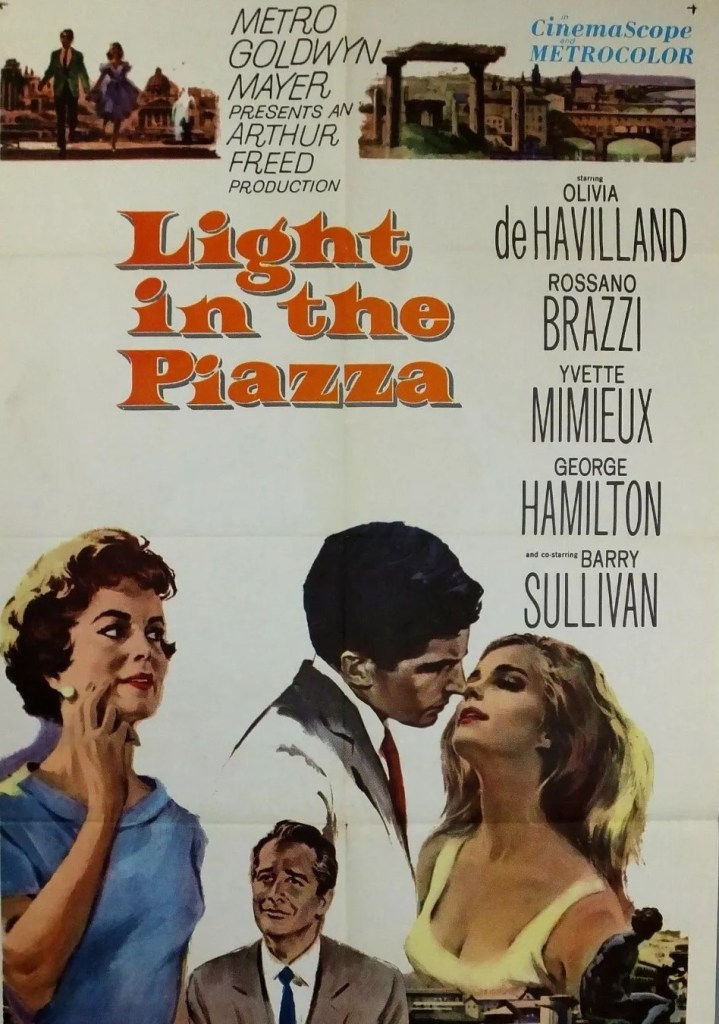
Light in the Piazza (1962) ****

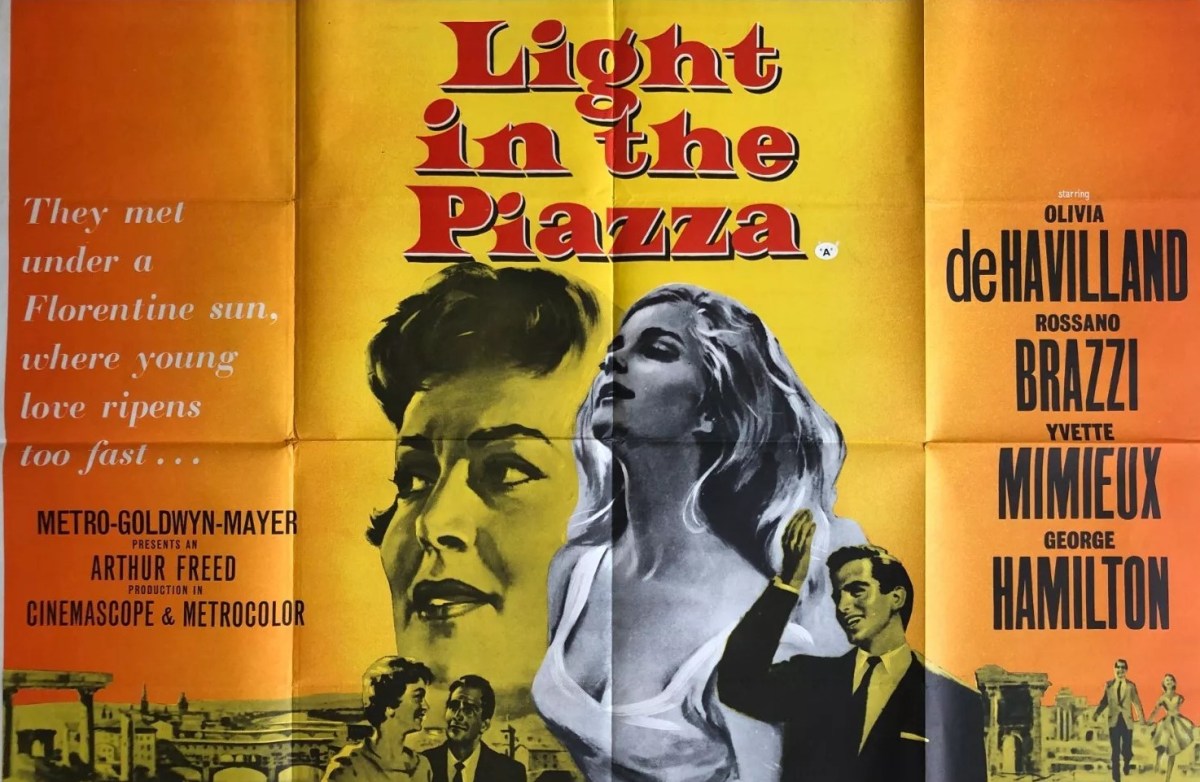
Will resonate more strongly today. Never intended as a light-hearted confection, despite the obvious premise of young love catching fire in Italy, this was a bold picture in its day and a more subtle examination of the wider impact of mental illness than those later movies set in institutions such as Lilith (1962) or Shock Treatment (1964). Bold, too, of Olivia de Havilland to take on a role that is so transparently maternal. Instead of her middle-aged character succumbing to romantic opportunity as the billing might suggest, to a holiday affair with a rich handsome Italian, she is first and foremost a mother.

Initially, standard romance meet-cute as young Italian Fabrizio (an unlikely George Hamilton) catches the runaway hat of young blonde Clara (Yvette Mimieux) in a piazza in Florence. His ardent pursuit is thwarted at every turn by Clara’s mother Meg (Olivia de Havilland). At first this appears to be for the most obvious of reasons. Who wants their naïve daughter to be swept away by a passionate Italian with heartbreak and possibly worse consequence (what mother does not immediately conjure up pregnancy?) to come.

Sure, Clara seems flighty and a tad over-exuberant and perhaps prone to tantrums but then back in the day this was possibly just an expression of entitlement by rich indulged young women. Turns out there’s a more worrying cause of her sometimes-infantile behavior. She was kicked in the head by a pony and has the mental age of a child of ten. If she is not protected, she might end up as prey to any charming young man.

Clara needs tucked up in bed with a stuffed toy, and her mother to check the room for ghosts and read her a bedtime story before she can go to sleep. Even when Fabrizio’s credentials check out – his father Signor Naccarelli (Rossano Brazzi) vouches for his good intentions, but, in the way of the passionate Italians, would not want to stand in the path of true love.

Clara’s father Noel (Barry Sullivan) is the one who spells out the reality. That pony didn’t just kick his daughter in the head it “kicked the life out of” his marriage. His wife lives in a dreamland, hoping for a miracle, and if that is not forthcoming quite happy to live with a daughter who never grows up. He wants to send her to “a school,” convincing himself it’s “more like a country club.”

Meg fights her own feelings that she knows better than her daughter and that love will not provide the cure, at the same time as batting away the affections of the elder Naccarelli. When she finally gives in to her daughter’s desire, wedding plans fall apart at the last minute when Naccarelli Snr discovers that his 20-year-old son is marrying not, as he imagined, a woman of roughly the same age or slightly younger, but actually someone six years older. Eventually, the wedding goes ahead. Meg convinces herself she did the right thing in permitting the marriage to go ahead.

But this is one of those happy ever afters that don’t quite wash and you might find yourself wondering exactly how it played out when the husband discovered exactly what kind of wife she had. Her instability isn’t genetic so no danger of a subsequent child encountering the same issue. And having to care for someone other than herself might well bring out the same level of maternity as her mother shows, but equally clearly Fabrizio is unaware of exactly what he’s taking on. How will he feel when asked to read her a bedtime story or scour the cupboards for imaginary monsters.

The movie didn’t do well enough to warrant a sequel – audiences expecting romantic confection were disappointed – and just hope Clara didn’t turn into the kind of inmate seen in Lilith and Shock Treatment.

Still, takes a very realistic approach to the problems of someone with such problems maturing into adulthood.

The Oscar-garlanded Olivia de Havilland  (two times winner, three times nominee), in her first picture in three years, clearly didn’t want to see out her maturity in those May-December roles that others of her age fell prey to. She is excellent here, no attempt to dress herself up as a sex bomb, and refreshing to see her approach. Yvette Mimieux (Diamond Head, 1962) is excellent as the confused youngster. George Hamilton  (The Power, 1968) lets the side down with his speaka-da-Italian Italian but Rossano Brazzi (The Battle of the Villa Fiorita, 1965), who is Italian, has no trouble with the lingo or with being a smooth seducer.

Director Guy Green (Diamond Head, 1962) adds in some unusual Florentine tourist color, but doesn’t shirk the difficult storyline. Julius J. Epstein (Casablanca, 1942) wrote the script.

Worth a look

Discover WordPress

A daily selection of the best content published on WordPress, collected for you by humans who love to read.

The Atavist Magazine

by Brian Hannan

WordPress.com Blog

News, Tips & Website Tutorials