The Gorgon (1964) ***

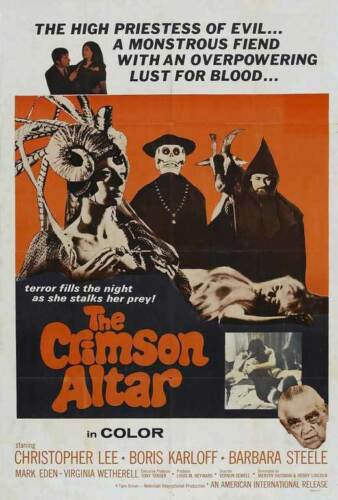
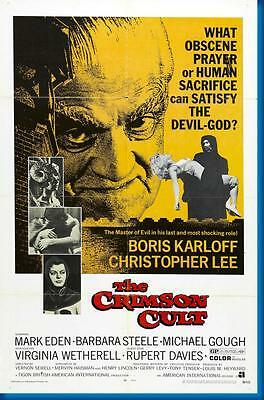
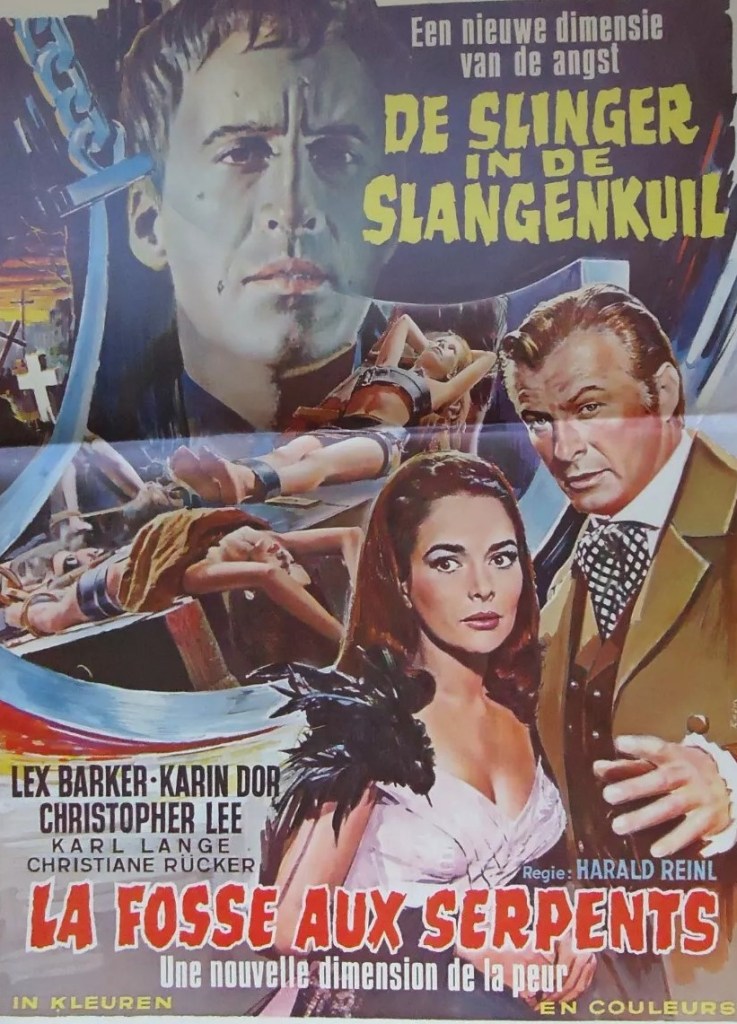
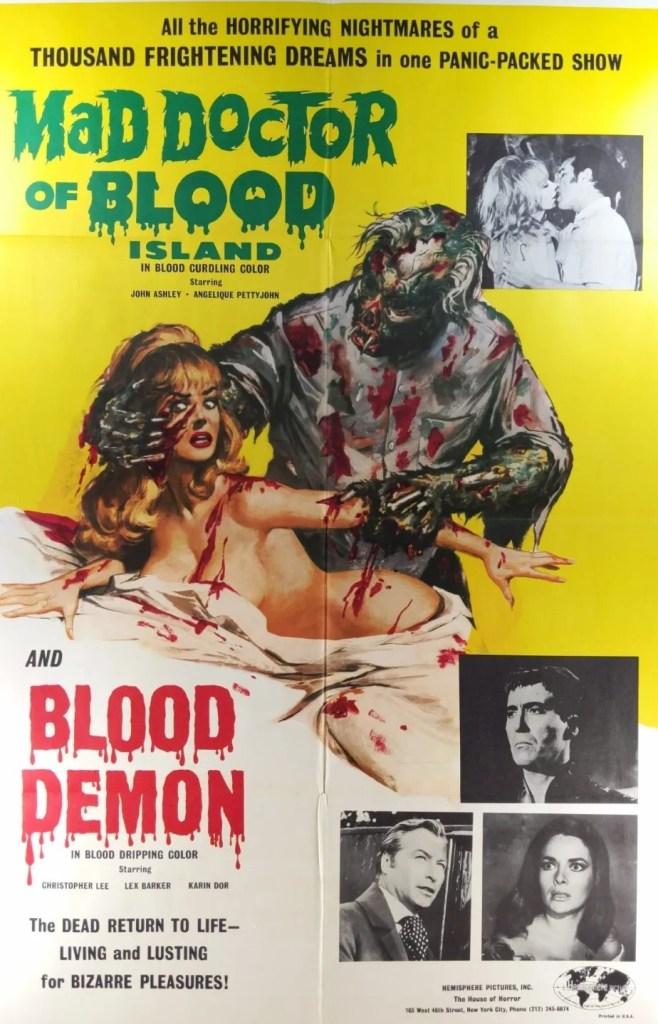
This impressive Hammer conspiracy-of-silence slow-burner, more thriller than horror, features the triumvirate of Christopher Lee (The Devil Ship Pirates, 1964), Peter Cushing (The Sword of Sherwood Forest, 1960) and Barbara Steele (Dracula, Prince of Darkness, 1966) in untypical roles. Lee and Cushing, of course, had locked horns before, namely in Hammer’s reimagining of the classic Dracula, with the former the charismatic fiend and the latter his nemesis.

Dr Namaroff (Peter Cushing) is a  doctor in an unnamed European turn-of-the-twentieth-century police state who knows more than he is letting on about seven inexplicable deaths in five years and the possibility of a 2,000-year-old myth coming to life and taking on a human form. And with quite a human side, jealous when his assistant Carla (Barbara Shelley) falls for a younger man, Paul (Richard Pascoe). Professor Karl Meister (Christopher Lee) appears late in the day to investigate.

Director Terence Fisher, who had shepherded the studio’s Dracula, Frankenstein, the Mummy and Dr Jekyll franchises through the starting gate, builds up the atmosphere with full moons, haunting voices, fog, sudden sounds, drifting leaves and an abandoned castle forever in shadow. The camera is often a weapon of stealth. Shock is kept to a minimum, fleeting ghostly apparitions and a finger falling off a corpse. Given the limitations of special effects in this era, that was a smart move.

Far better to concentrate on fear of impending doom, a man knowing he is turning to stone, a woman living in terror of being taken over by the phantom. The title gives away the story somewhat – even if you didn’t know the Gorgon was a mythical monster with a headful of snakes and the ability to turn people to stone, that is soon explained. 

Death remains the trigger for action, the suicide of an artist after he has apparently murdered his pregnant girlfriend bringing his father onto the scene and then his brother accompanied by Lee. But all investigation hits a wall of silence after Inspector Kanof (Patrick Troughton) refuses to instigate detection.

The Hammer double bill was a common feature in British cinemas. It also meant Hammer didn’t need to share box office receipts with another company.

At the heart of all the relationships is betrayal. The artist leading his girlfriend on, Namaroff willing to endanger Carla, whom he professes to love, rather than revealing the truth. Even Carla spies on the brother, with whom she is falling in love, in order to gather information for Namaroff. 

Forgive the pun, but Shelley steals the picture. An amnesiac, a victim and finally the lure, she remains enigmatic, a whisper of a woman. It is a haunting portrayal far removed from Hammer’s traditional cleavage queens. This is a very human character who nonetheless must stand guard over herself. Shelleye, here a gentle beauty, initially introduced as merely the love interest, becomes central to the story but without sucking up all the available horror oxygen by over-acting.   

Cushing embroiders his character with little touches, smoking a cigarette in a holder, for example, but Shelley’s character, her distrust of herself, shows in every move she makes.

You would need a heart of stone to be unmoved.

https://amzn.to/41dZqD3

The Skull (1965) *****

I have no idea why this masterpiece has not been acclaimed. For virtually half the picture, there is no dialogue, the entire focus on camerawork and reaction. Even Stanley Kubrick in The Shining (1980) gave in to grand guignol and The Exorcist (1973) was filled with over-the-top scenes but here the psychological impact of possession remains confined.

Initially, it appears we are in familiar Hammer territory, a grave-robber detaching a skull from a corpse only to meet an untimely end. There is another flashback to the gothic where the presence of the skull drives an order man to murder. But this is an Amicus production and set in contemporary times where Christopher Lee and Peter Cushing are once again in opposition, but this time only in an auction house bidding for demonic artefacts.

Exposition is straightforward. Dealer Marco (Patrick Wymark) sells Maitland (Peter Cushing) a book about De Sade bound in human skin. Marco may be a con man. He claims to possess the skull of the Marquis de Sade but his attitude towards it, kissing its head, plucking its nose socket, and the fact that he willing to halve his asking price, suggest otherwise. Sir Matthew (Christopher Lee), who once owned the skull, warns Cushing against it.

The rest of the film covers Maitland’s possession of the skull and the skull’s possession of him. There is a notable Kafkaesque sequence where Maitland is arrested, taken before a judge and forced three times to play Russian roulette before ending up in the house of the dealer where he steals the skull. What is less often commented upon is that this nigh-on 15-minute sequence including a 90-second taxi ride is conducted in virtual silence, the camera mostly on Maitland’s face, that silence only broken by the feeding of bullets not the barrel of the gun and the barrel being rolled round. It is not long before Maitland commits his first murder.

There is a famous scene in the Last Tycoon (1976) in which Robert De Niro explains to a truculent word-obsessed British writer why dialogue is redundant in the movies. All you need is camera and reaction. That sets up The Skull’s greatest scene, a 17-minute dialogue-free climax, where Maitland is effectively preyed upon and consumed.

The skull itself appears to have a point-of-view, various shots of Maitland through the skull’s eyes. The actual special effects are limited to what is imminently achievable, the skulls glows, it moves through the air. The impact of its presence is shown on Maitland’s face and by his action. It is just hypnotic.

Various directors have been anointed for the way they move their camera – Antonioni’s 360-degree turn in The Passenger (1975) comes to mind, large chunks of 2001: A Space Odyssey (1968), the long wait for sunrise in Lawrence of Arabia (1962), the lengthy shots of James Stewart driving a car in Vertigo (1958). But I have never seen anything as innovative as the silent sequences in The Skull which would be a waste of innovation were the sequences not so effective, especially on the small screen. Freddie Francis (Nightmare, 1964) directed from a story by Robert Bloch (Psycho, 1960). Equally innovative is the jarring music by avant-garde composer Elizabeth Lutyens.

In the role of his career, Peter Cushing (Dr Who and the Daleks, 1965) turns on the style, his character virtually turning 360-degrees as he becomes enmeshed in diabolic terror.

A must-see.

The Lost Continent (1968) ***

Hammer had struck gold revisiting ancient civilization in One Million Years B.C. (1966) and with its adaptation of Dennis Wheatley’s The Devil Rides Out (1967). The Lost Continent was another Wheatley number (source novel Uncharted Seas) mixing dangerous voyage, hints of the legendary Atlantis, and monsters. While the first half could have been marketed as The Wages of Fear At Sea the second half would come under the heading  “The Greatest Oddball Film Ever Made.”

It boasts one of the most intriguing setting-the-scene openings not just of a Hammer picture but of any film – a camera pans along a steamship on whose deck are: people dressed in furs, others in modern clothing and – Conquistadors. Attention is focused on a coffin.  How and why they got there is told in flashback. A first half of taut drama, mutiny, sharks, a ferocious octopus, and lost-at-sea a thousand miles from land segues into sci-fi with carnivorous weeds, monsters, and a weird, weird world.

It’s hard to know what’s worse, Captain Lansen (Eric Porter) with a cargo of toxic chemicals made combustible when touched by water or the equally combustible passengers all with murky pasts, so determined to escape their previous lives that they refuse to turn back in the face of a hurricane. Heading the Dodgy Half-Dozen is dictator’s mistress Eva (Hildegarde Knef) with two million dollars in stolen securities and bonds. Dr Webster (Nigel Stock), a back-street abortionist, is at odds with daughter Unity (Suzanna Leigh), who has cornered the market in backless dresses. Harry (Tony Beckley)  (The Penthouse, 1967) plays a conman while Ricaldi (Ben Carruthers) is trying to recover the pilfered bonds.

But the arrival of cleavage queen Sarah (Dana Gillespie) as an escapee from the weird world signals a shift to Planet Oddball. The only way to navigate the weeds trapping the ship is with a primitive version of snowshoes with balloons attached to the shoulders. Soon they are trapped in the past, not as prehistoric as One Million Years BC (1966), just a few centuries back to the Spanish Conquistador era. The film steals the idea from the Raquel Welch picture of giant creatures locked in battle but without going to the necessity of hiring Ray Harryhausen.

You couldn’t legislate for the movie’s logic and you shouldn’t even try, just go with the weird flow. It’s on safe enough territory until like The Hangover (20090  it has to explain the bizarre opening sequence. If ever a film has bitten off more than the special effects can chew, it’s this, but it’s still fun watching it try.

The casting relied heavily on actors best known from television or rising stars. Eric Porter was straight from BBC television mini-series mega-hit The Forsyte Saga (1967). Nigel Stock essayed Dr Watson in the BBC Sherlock Holmes series (1964-1968). Falling into the emerging-star category were:  Tony Beckley (The Penthouse, 1967), Suzanna Leigh (The Pleasure Girls, 1965) Neil McCallum (Catacombs / The Woman Who Wouldn’t Die, 1965), and Dana Gillespie (Secrets of a Windmill Girl, 1966). Hildegarde Knef (Mozambique, 1964) was just about the most experienced.

In this kind of picture, without being sexist about it, if a woman is required to do more than just scream, it often indicates she has the better part. And so it is here. Leigh and Knef hog the dramatic highlights while Gillespie, courtesy of her outfit and footwear, can’t help but steal the show.

On board ship, director Michael Carreras, fresh from Prehistoric Women (1967), does well, the characters are all solidly presented with decent back stories, but once he enters weird world budget deficiencies sabotage the picture. Even so, it’s worth a look just to see what you’re missing. If you’re looking for a genuine freak show, this ticks the boxes.

Mercy Falls (2023)

The long tradition of Scottish-made or Scottish-set movies – from Whisky Galore (1949), Brigadoon (1954), The Prime of Miss Jean Brodie (1969) and The Wicker Man (1973) to Local Hero (1983), Highlander (1986), Braveheart (1995) and Trainspotting (1996) – has fallen fallow in recent years. And while Outlander has done its best to fill the gap, the most we can hope is Glasgow or Edinburgh being called upon as brief locales or as substitute locations in blockbusters such as F9 (2021) or Indiana Jones and the Dial of Destiny (2023).

So, as a native Scot, I approached Mercy Falls out of a sense of duty. Anything more meant setting aside the odd notion that a movie set in the wilderness will carry the same dread in a horror scenario as the more usual claustrophobic setting. Or that short of a drug-fuelled bear, speedy surprise will be in short supply. And there’s a struggle in coming to terms with the MacGuffin, that a young lass and her four companions will set off to find a cabin whose whereabouts are largely a mystery and with nobody who can read a map.

Putting aside such misgivings, it’s a refreshing change from the torture porn / mad robots / occult offerings of the more recent Hollywood horror cycle. And since it’s mercifully not funded by government agency Creative Scotland no slavish need to turn backdrops into tourist promotional material. Not a whiff of tartan in sight, much less majestic peaks, and the grass, far from being a sweeping green, is burned an unattractive summer brown, though mists do appear to appear as if by magic and you will wonder how such an accomplished wee folk band just happened to be playing in a remote Scottish pub.

Our cast of potential corpses includes uptight heiress Rhona (Lauren Lyle) and her theoretical boyfriend Donnie (Joe Rising), sex-mad Heather (Layla Kirk) and her definite current Steady-Eddie boyfriend Scott (James Watterson) and opportunistic one-night-stand Andy (Eoin Sweeney).  They are joined by bad-ass hitchhiker Carla (Nicolette McKeown). Tension in the early part is mostly sexual in nature, although you have to wonder if they will ever reach their destination.

As with Shallow Grave (1994) and television series Guilt (2109-2023) accidental death turns the trip into a nightmare. Tell the truth and five people go to jail as culprits or accessories, tell a lie and dump the body under a remote waterfall and everyone gets off scot free. Or that would be the case except ex-soldier Carla has escaped from a mental institution.

Some sequences appear to have escaped from other movies – climbing a cliff-face and crossing a ravine Indiana-Jones-style across a rickety log – but once the gore count rises it’s game on and the meek Rhona channels her interior super-bitch to take on Carla in a winner-takes-all finale.

The men are uniformly useless, the females the sexual or physical predators. And it’s realistic, too. While Carla has honed her killing techniques on the battlefields of Iraq, Rhona has to rely on more basic materials, an axe, knives, and petrol found in the cabin. Rhona, it turns out, is also handy with that Glaswegian thug’s weapon of choice, the bottle, but when she lays out her opponent with it, rather than break open the bottle and slash her opponent’s throat, she scarpers to a convenient cave where she has laid a “trap,” clearly forgetting that with the enemy at your mercy it’s darned foolish to run and give her another chance.

Still, this isn’t the kind of movie where slick characters think straight, otherwise why would the remaining fella, determined to demonstrate his dexterity, just think you could switch on an old-fashioned heavy-duty radio and yell “Mayday! Mayday!” into it and expect to be picked up. Nobody’s going to win an Oscar and the acting is generally at entry-level, eyes steadfastly revealing little of character, but by and large, it’s an acceptable low-budgeter.

Blame or praise Ryan Hendrick (Lost at Christmas, 2020), also co-writer with Melia Grasska in her debut. Nicolette McKeown (Lost at Christmas) is the pick but that’s mostly because she doesn’t have to emote much beyond lust and hatred while Lauren Lyle (Outlander, 2017-2022) is so emotionally drenched she has to occasionally shed a tear.

This will probably quickly end up on a streamer near you so worth a watch for taking a different tack to horror and as a pointer to future Scottish talent.

Eye of the Devil / 13 (1966) ***

Shades of The Innocents (1961), The Wicker Man (1973) and The Omen (1976), but lacking the suspense of any, leading roles woefully miscast, supporting roles, conversely, brimming with inspired casting including the debut of Sharon Tate (Valley of the Dolls, 1967) and a mesmerising role for David Hemmings (Blow-Up, 1967)  Any attempts at subtlety were dumped when the original more intriguing title of 13, which turns out to have more than one meaning, was dumped (except in some foreign markets) in favor of the giveaway designation of Eye of the Devil. Despite embracing a web of sinister legend, it lurches too quickly into full-on demonic horror.

French count Phillippe (David Niven) is called away unexpectedly from the Parisian high life to deal with a crisis in his vineyard. When his son Jacques (Robert Duncan) starts sleepwalking in his absence, his wife Catherine (Deborah Kerr) decamps with daughter Antoinette (Suky Appleby) to the family pile, a huge millennium-old castle. The count’s sister Estell (Flora Robson) fears her arrival. Villagers fear Phillippe, doffing caps when he passes.

Meanwhile, Catherine encounters or witnesses strange goings-on. Archer Christian (David Hemmings) shoots dead a dove which is later offered to unknown gods by his sister Odile (Sharon Tate) in a chamber filled with men in black robes. Later, Odile changes a toad into a dove and hypnotises Catherine into almost falling off a parapet. A quietly spoken priest (Donald Pleasance) offers no succor. The number thirteen could refer to the day of an annual local festival or a ceremony involving thirteen men, twelve of whom dance around the other. In a forest Catherine is trapped by men in black robes, then drugged and imprisoned.

Meanwhile, her husband remains grimly fatalistic, gripped by torpor, except when roused to whip Odile. Generation after generation, going back over a thousand years, the head of the household has come to a sticky end and without explanation it appears Phillipe expects a similar outcome. .

It doesn’t take you long to realise devilry is afoot. It’s a pagan castle, it transpires, a “fortress of heresy.” After three years of poor grape harvest, the earth demands a sacrifice. Where the victim in The Wicker Man is an innocent outsider lured to a remote island, the count accepts his destiny even as his wife struggles to prevent his death. Dramatically, the later film has the edge, the victim struggling against fate rather than a mere observer. That Catherine is powerless somehow doesn’t bring the dramatic fireworks you might expect.

What the posters conceal is that the film was made in black-and-white – the last MGM picture not to be in color – and this is a photo of Sharon Tate as she appeared in magisterial and beguiling form.

There’s a curiosity about the casting of Deborah Kerr (The Gypsy Moths, 1969). This most repressed of actors, as if a veil has been lifted, empowered to scream and batter against doors and race around, seems to drain the movie of energy. She just seems laughably bonkers rather than intense and empathetic. For someone whose performance is generally minimal, who exists in the margins, it seems almost perverse to force her to go so over-the-top.

Perhaps such unusual verbal and physical activity was deemed essential to counter the inactivity, the virtual sleepwalking, of the rest of the cast. While looking pained, David Niven (The Extraordinary Seaman (1969) can’t quite capture the intensity, the personal devastation, the role requires. David Hemmings as the silent archer and especially Sharon Tate as the trance-inducing magician, steal the show, investing their characters with little emotion, and yet, visually, as if mere costumed performers, present the most vivid incarnations.

From an audience perspective, it’s hard to root for Catherine since it’s obvious she is in no mortal danger. Like The Wicker Man, the audience is there in an observatory capacity, but unlike the Scottish policeman the victim attracts little sympathy. There’s not real

It’s a surprising backward step for director J. Lee Thompson after the superb Return of the Ashes (1965) which was chock-full of suspense and interesting characters. After an atmospheric opening, it turns uneven as he falls into the trap of following the wrong character. Screenwriters Dennis Murphy (The Sergeant, 1968) and  Robin Estridge (Escape from Zahrain, 1962) adapted the latter’s acclaimed novel Day of the Arrow, written under the pseudonym Philip Loraine. So perhaps he can be blamed for shifting the investigative focus from Catherine’s ex-lover to Catherine herself.

I was surprised to see Deborah Kerr take on such a role and that is a story in itself which I’ll address tomorrow.

The Vulture (1966) **

The notion that the presence of Oscar-winning Broderick Crawford or that a bunch of expository scenes will divert audiences away from the lack of decent special effects, or story for that matter, comes sadly unstuck. There’s so much exposition that at times it feels like an audio book rather than a piece of cinema. The one great image – a skeleton in  laboratory – is treated with disdain. Not only has it “cult” written all over it but it must be a contender for the all-time “So Bad It Hasn’t A Hope Of Being Good” Award,

Which is a shame because on paper at least this might have sounded passable what with atomic transmutation, hidden treasure, grave-robbing, remote location, strange noises in the night, an incident in the 15th century, man buried alive, eerie tapping on windows, a creepy Church sexton, and a  mythological beast originating from the Incas or Aztecs or even Easter Island.  

But it pivots on the kind of family curse, mysterious past, strange occurrences, that Sherlock Holmes might have been called in to resolve, especially as there seemed an awful lot of explaining to do and it’s easier to hang on to every word of the world’s most famous detective rather than a scientist banging on about the inexplicable. The first two-thirds is taken up with solving the mystery, it’s only in the last section when horror takes over that a genuine sense of tension emerges.

A woman taking a shortcut through a graveyard (as one does) spies a gravestone wobbling, earth erupting in front of her and has visions (enough to make her hair go white) of a huge bird with a man’s head. Visiting nuclear scientist Eric (Robert Hutton) takes an interest. His wife Trudy’s (Diane Clare) uncle Brian (Broderick Crawford) explains the legend of a Spaniard buried alive because he turned himself into a vulture and kidnapped a small child. His buddy, German professor Koniglich (Akim Tamiroff), expands on the story.

Gold coins are found scattered close to the grave. Boys find the bloody leg of a sheep on a beach and there’s a likely unreachable hiding place of a cave in the cliffs. Uncle Brian is of the obstinate variety and refuses to the toe the line and keep his windows firmly closed so he’s next to disappear. But there’s a hungry beast to feed so Brian’s brother Edward (Gordon Sterne) is the next victim. Trudy is despatched out of harm’s way to London but lured back by a mysterious telegram.

Meanwhile, hot on the trail, Eric finds Koniglich’s lair, a laboratory inhabited only by a skeleton, but with his own understanding of the possibilities of atomic science Eric works out the German must have employed nuclear power to fuse man and vulture and set out to wreak revenge.

It was obviously a toss-up between spending the tiny budget on a fading Hollywood star and supporting bad guy actor of some repute rather than on special effects. Quite how, at that time, anyone would have managed a convincing half-man-half-vulture is anybody’s guess and the prospect of making such a creature credibly fly would have been beyond comprehension so sensibly director Lawrence Huntingdon settles for the prospect, showing talons from time to time and letting audience imagination do the rest, and I am sure if you saw this as a child you would be bolting doors and windows.

Robert Hutton (They Came from Beyond Space, 1967) doesn’t have a chance of imposing himself on the picture since he is lumbered by buckets of exposition and supposition. Though he could take a lesson from Broderick Crawford (A House Is Not a Home, 1964) in how to milk a small role. Crawford is something of a clever red herring. Given his screen persona I had expected him to be the bad guy, at the point of his appearance in the picture notions of scientific dexterity not being a prerequisite. Akim Tamiroff (The Liquidator, 1965) plays down his villainous qualities so until we are introduced to his lab, he’s not the obvious bad guy either.

It might have worked better if the audience was filled in on more of the mystery than the investigator, perhaps witnessing Koniglich at least toying with his equipment, maybe making the screen glow the way dodgy scientists were inclined to do.

This was the final film in the 30-year career of director Lawrence Huntingdon (Drums Along the River, 1963) and if he couldn’t manage a swansong of the kind Clark Gable delivered with The Misfits (1960) then I guess the next best thing was a movie for cultists to savor.

The Oblong Box (1969) ***

Vincent Price and Christopher Lee – two scions of 1960s horror – together, yet anyone expecting a clash of the giants would be sorely disappointed as they only share one short scene. This is a typical American International Pictures venture, based even more typically on an Edgar Allan Poe story, with some stylistic direction – the extreme close-up never more effectively utilized – from Gordon Hessler in his third feature.

Given that German-born Hessler (Catacombs/The Woman Who Wouldn’t Die, 1965) was a last-minute substitute for English director Michael Reeves (Witchfinder General, 1968), he made an exceptionally good job of a complicated plot. The production was even more complicated than that since it was originally intended as a Spanish co-production to be shot in Spain. And at one point writer Lawrence Huntingdon (The Vulture, 1966), who did have form as a director (Death Drums Along the River, 1963), was reportedly also carrying out producer-director duties.

What seems like a mishmash of different stories – African sorcery, grave-robbing, disfigurement, forgery, blackmail, lifetime imprisonment, medical experiment, buried alive, a monster in a scarlet mask – soon comes together in a tense tale of retribution and revenge.

Nineteenth century English aristocrat Julain Markham (Vincent Price) has withdrawn to his country manor, for unknown reasons distancing himself from his fiancée Elizabeth (Hilary Dwyer), but in reality to conceal from the world the fact that he has locked up his own brother, Sir Edward (Alister Williamson). When the brother, a disfigured monster, escapes he embarks on a murder spree.

The various storylines keep the narrative sufficiently entangled to sustain tension. Despite what may appear to a modern audience as primitive special effects, several scenes are bone-chilling largely through directorial manipulation. The Gothic look – graveyards, castles, the village – adds to the atmosphere. The violence was trimmed in America to avoid an “R” rating, but led to the film being banned in Australia.

There is more overt sexuality than normal, a scheming whore Heidi (Uta Levka) tempting a man with her bare breasts, and maid Sally (Sally Geeson) entranced by the monster.

The various plot strands appeared to confuse critics at the time and even now the film receives comments that it is “vague” but at a time when Hammer’s output usually comprised a straightforward – and somewhat limited narrative – I found AIP’s approach to this picture a welcome development. The slowly emerging story set the film up as much as a thriller as a horror.

It’s a bit of a reversal for Vincent Price (Witchfinder General, 1968) to be playing the good guy but that works to the movie’s advantage because you spent most of the time thinking this is just a scam and at some point he will show his true colors. Hilary Dwyer (Witchfinder General) is excellent and Sally Geeson (What’s Good for the Goose, 1969) is an example of the type of woman attracted to rather than revulsed by a killer.

Well worth a look if only to enjoy the distinctive Hessler style.

Nightmare (1964) ****

Now this is what you’re looking for when you take an unguided tour into the British B-movie. A tight gripping thriller with a parcel of twists, clever character perspective, some stunning cinematography, and pivoting on perception of insanity.

The opening is a cracker. Teenager Janet (Jennie Linden) stumbles along a dark prison-like corridor with little light hearing someone call her name. Entering a door, she spies a woman in a white nightgown lurking in the corner. She responds to the gentle calling. But once she lets the door close behind her and can’t get out, the woman screams that now they are both mad. And that’s just the first, atmospherically brilliant, nightmare.

Janet is soon removed from her posh boarding school, her constant nightmares too frightening for the other pupils. Driven home in a Rolls-Royce, accompanied by teacher Mary (Brenda Bruce) she passes the asylum where her mother is an inmate, but is surprised to find her legal guardian, charming lawyer Henry (David Knight), isn’t there to greet her. Instead there’s a nurse, Grace (Moira Redmond).

We soon learn she’s been effectively orphaned by her mother, who killed her father, Janet, eleven at the time, witnessing the murder. But without any proper home life, looked after primarily by kindly chauffeur John (George A. Cooper) and maternal maid Anne (Julie Samuel) and with the married Henry often absent, there’s little done to quieten down her obsession that she will follow her mother into madness.

The movie takes her perspective, watching her watching out for mystery, or in her point of view as she catches fleeting glimpses of a woman in white. The apparition looking only too realistic, not dashing out of view but turning and apparently beckoning Janet on and it doesn’t take much to push a disordered mind further out of kilter, leading to attempted suicide. Imagining Henry’s wife is the ghost, she stabs her to death.

End of Act One. Start of Twist No 1. You would expect the movie to follow Janet to the asylum where she would be reunited with her mother, knowing she had inherited those terrible genes, trapped in her insanity. But it goes somewhere more delicious instead.

Turns out nice Henry is not very nice at all. He contrived a situation to be rid of his wife and marry lover Grace instead. But, once married, it is Grace who becomes disturbed and the movie follows a similar arc in the second half. Unexplained goings-on. She believes Henry has another, secret, lover and is trying to drive his new wife crazy. She finds strange cigarettes in his pocket, a barman at a hotel recognizes him even though he claims never to have been there before.

The marriage quickly deteriorates although she stands her ground, telling him in no uncertain terms that she won’t put up with any philandering and slapping his face. He is charm itself, easily turning aside her insinuations and from his casual and disarming manner it’s easy to believe he is perfectly innocent. Of course, that’s before Janet’s doll turns up and locked doors open and there’s an apparition.

The beauty of this picture is the atmosphere, the intensity of the camera, the concentration on two vulnerable females, convinced by genuine or imagined guilt that they will succumb to the madness that appears to pervade this particular house. You think it’s going down one route and are annoyed you didn’t see the next twist coming.

There’s the kind of cinematic repetition that enamored critics of more critically acclaimed pieces like The Searchers (1956). It’s almost as though there’s a beam of insanity identifying the next victim. And that’s helped immeasurably by the lighting which allows no shadow on faces. Like an inverted film noir, where the light has nowhere to go, no atmospheric shadow to create, except to land square on the faces of those involved. This would be the Old Dark House except never has a building been so illuminated, not bright throughout, the illumination predisposed to land on faces rather than rooms.

There are a couple of finely composed scenes, one viewed through a staircase, neat revelations, visual and verbal, a fabulous ending with one character screaming and a telephone dangling off the hook.

You might be astonished to discover this is a Hammer picture. Nary a monster in sight. But then little is scarier than what happens inside the mind, when imagination runs riot without external assistance. That the victim is a teenager, prone to the mood swings of that age, makes it easier for Jennie Linden (Women in Love, 1969) to ramp up the emotions without her seeming too barmy from the outset. David Knight (The Devil’s Agent, 1962) is excellent, conniving he may be but the general demeanor of bonhomie never slips into stage villain. But Moira Redmond (The Limbo Line, 1968) is the pick as she morphs from accomplished accomplice to prospective victim.

Tightly written by Jimmy Sangster (Maniac, 1963), characters fully evolved, twists cleverly concealed, and with excellent direction by Freddie Francis (The Skull, 1965), not just the visuals but in drawing out of a fairly standard set of actors exactly what he needs to make this tick.

Well worth a look. A much under-rated B-picture.

Youtube has an excellent print.https://www.youtube.com/watch?v=EJizyBez6A0&t=1064s

Corruption (1968) ***

Admit it, you always wanted to discover what went on behind Peter Cushing’s chilly British reserve. The man who appeared to be constantly tormenting that nice Dracula or donning a deerstalker to outwit countless villains or battling otherworldly creatures like the Daleks or just a dependable character who in the unconventional Sixties knew right from wrong.

Of course, our Peter had occasionally come unstuck, the duped bank manager in Cash on Demand (1961) but even as Baron Frankenstein he never revealed a demonic side even as he  created monsters who had a tendency to run wild, always civil to the last, stiff upper lip never quavering.

So it’s something of a surprise to see him cast in the first place as the older man lusting after a younger woman. Sir John Rowan (Peter Cushing) is a highly esteemed surgeon who has fallen for model-cum-flighty-piece Lynn (Sue Lloyd) and although he sticks out like a sore thumb at a typical Swinging Sixties party full of gyrating lithe young women he is happy to put up with it for the sake of his girlfriend.

But Lynn has a strong independent streak, she’s not the submissive lass who might have been content to swoon at the feet of such a highly intelligent man, and objects to his attempts at control and can’t resist the chance to show her allure to all and sundry by giving in to the temptation to pose for louche photographer Mike (Anthony Booth), and, as it happens, the assembled throng.

Sir John isn’t going to stand for such brazenness, starting a fight with Mike that ends in a dreadful accident, destroying half Lynn’s face. Naturally, plastic surgery being the coming thing and Sir John capable of turning his hand to anything he’s able to fix up her face good and proper.

Except it’s a temporary measure, something to do with the pituitary gland, and it turns Sir John into a serial killer. There’s no mystery to it, no detective scouting around trying to put together clues, the question soon becomes can Sir John keep it up and what psychological damage is inflicted on Lynn as she comes to the realization that the beauty she had taken for granted, setting aside the predations of age which are still some way off, could vanish in an instant leaving her shrieking in a mirror.

Things get out of hand when they head for the country and fresh victims and find themselves trapped in a home invasion by a gang as gormless and vindictive as the pair from The Penthouse. It doesn’t end the way you’d expect because there’s a twist in the tail that you might accept as par for the course in the unconventional cinematic Sixties or you might just put the producers down for wanting to have their cake and eat it.

Still, it’s good while it lasts. Cushing certainly reveals a different side to his screen persona, and I can’t remember ever seeing him truly in love or indulging in a passionate screen kiss, and certainly to see his murderous side emerge is quite a treat, no scientific excuse to mask his behavior.

And it’s equally good to see Sue Lloyd (The Ipcress File, 1965) in another of those roles where she displayed considerable independence.  As an added bonus future Hammer Queen Kate O’Mara (The Horror of Frankenstein, 1970), here cleavage well hidden, turns up as Lynn’s sister.  You might also spot Vanessa Howard (Some Girls Do, 1969) and Marianne Morris (Vampyres, 1974). Anthony Booth (Girl with a Pistol, 1968) was trying to shake off the shackles of BBC comedy Till Death Us Do Part

Robert Hartford-Davis (The Black Torment, 1964) does pretty well unsheathing the beast within the context of a vulnerable older man. Derek Ford wrote the screenplay with his brother Donald before he decided the sex film was his way to British film legend. The version released abroad contains more gore and sex than when the British censor had its wicked way.

Cocaine Bear (2023) **** – Seen at the Cinema

You probably know by now that this (unnamed) bear has been on a successful box office rampage.  You’ll know, too, that the special effects (you thought it was real bear, duh!) are particularly effective. And you better believe this as hilarious as it is bloody.

What you’ll be less well informed about is the cleverness of the set up. Yes, essentially, it falls into the slasher genre (slabs of claws instead of knives) but has a different approach to the potential victims. Generally, in this kind of horror picture you’ve a good  chance of being slaughtered if you’re sinful, indulging in sex generally the marker but you might enter the killing zone for being a bully or a bitch. While it’s pretty much up to speed with the contemporary trope of the killer being a woman (yep, said bear, it turns out in one hilarious scene, lacks male equipment), but the victims don’t conform to type.

Although it may come in different shapes and sizes, this advert needs only one image.

For the most part they are dumb,  and that includes dumb innocence, but the driving force is  the misguided. Parental focus is misplaced. Sari (Keri Russell) is so desperate for male companionship she ignores the needs of daughter Dee Dee (Brooklynn Prince). Drug runner Syd (Ray Liotta) ignores son Eddie (Alden Ehrenreich), so steeped in sorrow he abandons his son. And then there’s detective Bob (Isaiah Whitlock Jr) who has commitment issues with a new dog.

Hankering after a male leads park ranger Liz (Margo Martindale) to douse herself in perfume in a bid to inflame desire from tepid activist Peter (Jesse Tyler Ferguson). Three dumb teenagers attempt to rob the hulking fashion-conscious Daveed (O’Shea Jackson Jr), less concerned about being attacked than the damage blood can do to tee-shirt and sneakers.

Parallel storylines send Sari hunting her kids, the drug-runners and cops hunting bags of cocaine – missing after being dropped from a plane – into the path of the bear who has taken a liking to the drug. At least, without any education in drug lore, the bear knows to sniff or ingest the stuff rather than try to eat it like Dee Dee and her pal Henry (Christian Convery).

There’s a good reason this picture was set in 1985 – the date of the original “true” story – because these days nobody would believe any pre-teen kid wouldn’t know how to absorb coke, and be desperate to try it. And also because “woke” wasn’t invented so nobody needs to get preachy.

Turns out if you want lessons in maternal instinct, you’d better go find yourself a female bear.

This is keenly directed too, by Elizabeth Banks (putting her career on the line, apparently, after her last two pictures, Call Jane, 2022 and Charlie’s Angels, 2019, stiffed). It would be pretty easy to get lost in this smorgasbord of characters, but Banks has a nifty way of leaving you wondering what happened to character X only to find him/her turning up in a situation that advances the story.

I should point out it’s hilarious. Not just the classic line, “Bears don’t climb trees,” but some wonderful deadpan dialog between Daveed and Eddie and then between Eddie and one of the delinquents, gun-happy Liz’s chat-up lines in between being seven-points-to-Sunday barmy, and a pair of loved-up Icelandic tourists falling out over which band will play at their wedding. The question of how to determine a bear’s sex has entered movie comedy heaven.

Banks equally astutely switches the action between gore and comedy, but keeps sufficient focus on the characters to ensure you don’t just look on them as victims, waiting with some glee for them to be chomped up. There’s not that sense of working out who might be Final Girl. Sensibly, she avoids trying to emulate Jaws in the stoking up of tension, nor does she take the mickey out of the audience by using the kids to tug on their heartstrings.

Just like the out-of-left-field Me3an this has sequel stamped all over it. There’s still plenty cocaine left in that wood and, you never know, the bear might enter rehab or it could go down the crossover route and form chapter five of the John Wick saga. Wait, I’m forgetting the obvious. Cocaine Cubs R Us.

Whatever, this is a riot. Best title of the year by far delivers. The actors, even Liotta, prone to overacting, make it believable. Screenwriter Jimmy Warden (The Babysitter, Killer Queen, 2022) comes up with the goods and Banks and the sfx team do the rest.

Discover WordPress

A daily selection of the best content published on WordPress, collected for you by humans who love to read.

The Atavist Magazine

by Brian Hannan

WordPress.com News

The latest news on WordPress.com and the WordPress community.