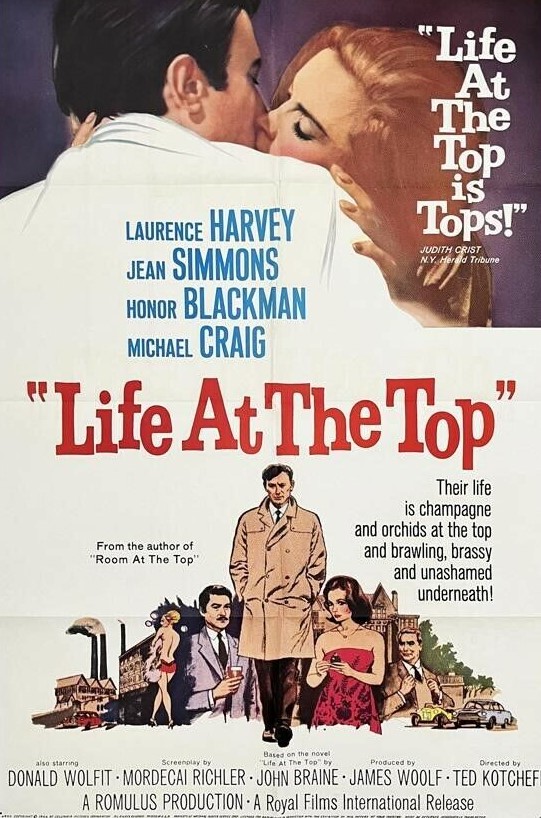
Life at the Top (1965) ***

Succession as seen from the perspective of someone like the inadequate Tom (Matthew Macfadyen), who has married his way into big business and has an elevated idea of entitlement.

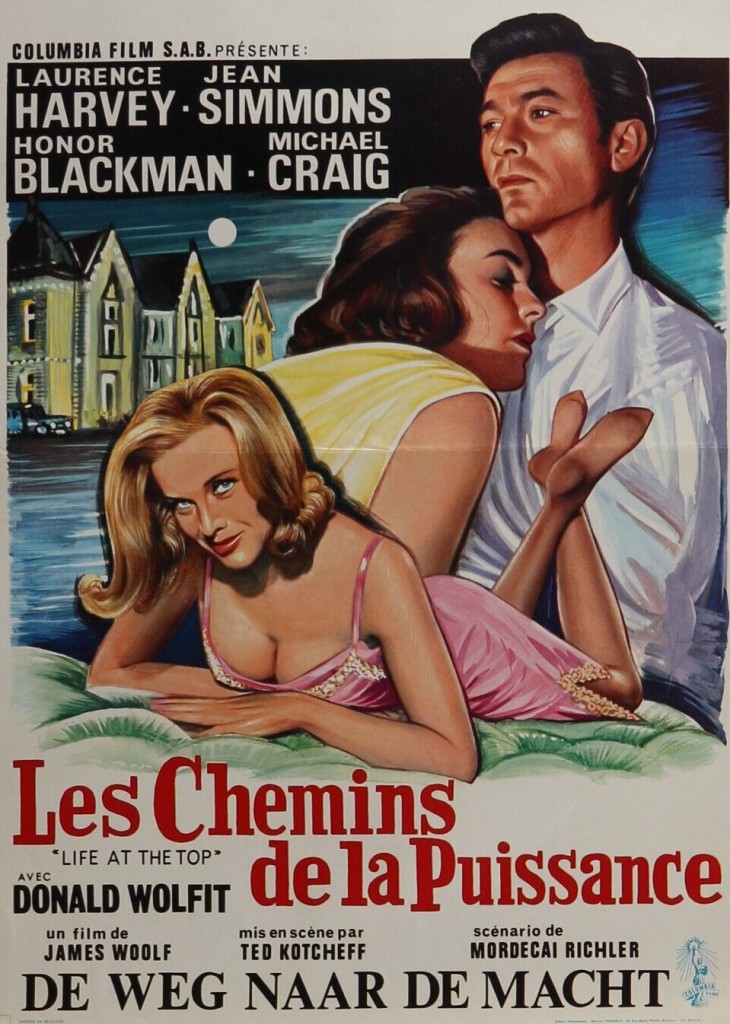
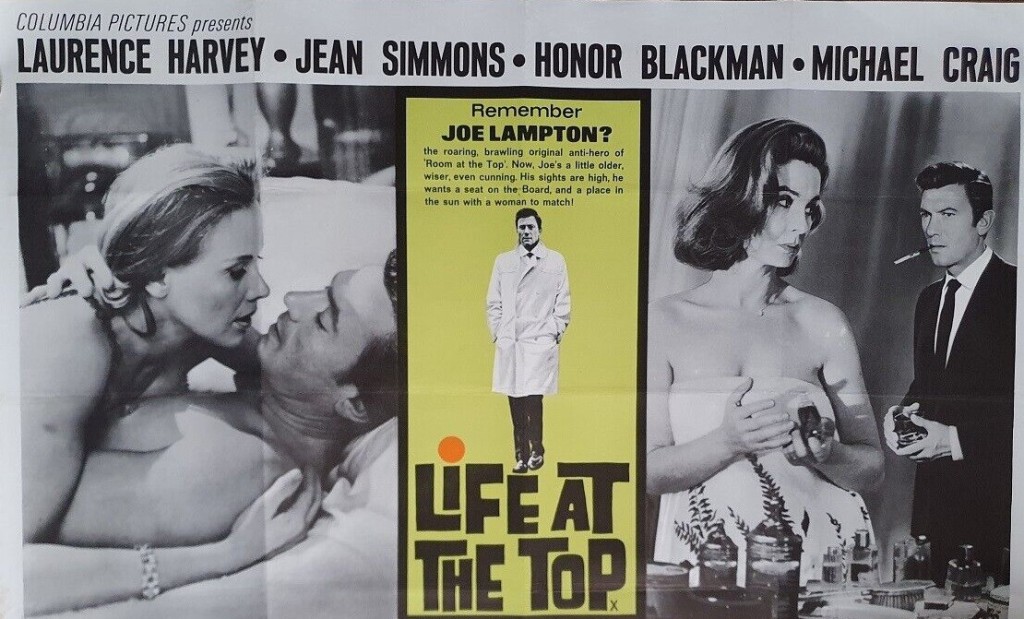
Joe Lampton (Laurence Harvey) was a genuine working-class hero of Room at the Top (1958) who connived his way into the marriage bed of businessman Abe Brown’s (Donald Wolfit) daughter Susan (Jean Simmons) and set himself up as the heir apparent. Several years on, it’s not quite worked out the way he planned, stuck in a loveless marriage, out of his depth among the Yorkshire elite, passed over for promotion, pinning hopes of personal happiness on an affair with television personality Norah (Honor Blackman).

The only problem is that screen-wise he’s a b*****d without an ounce of the dominating personality of Brian Cox, the ultimate b*****d’s b*****d. This plays out more The Tale of Two Spoiled Brats. So if you’re looking to see Lampton get his come-uppance on several fronts, you’ve come to the right place. Unfortunately, that means there’s isn’t a single likeable character in sight. It might be the way of the world among the high-rollers but it makes for rather dispirited watching.

On the other hand, Lampton was always such a louse it is enjoyable to see him not only being put in his place but ending up a few rungs further down the ladder than where he started. This might have scored some points for social commentary but it’s such a scattershot approach – racing pigeons, local government corruption (by Tories, who else), strip club, ballroom dancing (the original Come Dancing before that usurper Strictly Come Dancing came along), drinking a yard of ale, swimming in the canal, ruthless entrepreneurs, luvvies  – it does little justice to any.

Perhaps the most surprising aspect is the independence of the women. Susan has a lover Mark (Michael Craig) and emasculates Joe by going behind his back to get whatever she wants, financially, from her father. Ambitious Norah refuses to give up her career for Joe and is likely to withdraw her favors should his ambition fails to match hers.

Even the cuckolded get in on the act, taunting those who had fallen for their partners’ adulterous ways. George Aisgill (Allan Cuthbertson) mocks Joe for falling (in the previous film) for his wife when she went after anything in trousers. Similarly, Mark’s wife ridicules Susan for just being the latest notch on Mark’s bed.

Naturally, Joe hasn’t the wit to see what a good deal he has and spends all his time in self-pitying mode. Poor Joe – he is stuck with driving a white Jag while Abe swans around in a Rolls-Royce. Poor Joe – his wife isn’t going to make do with hotel bedrooms for illicit assignations, but makes full use of the house. Poor Joe – his son doesn’t like him. Poor Joe – he trots out all his childhood deprivations at the slightest opportunity as if auditioning for a Monty Python sketch.

Poor Joe – he’s not even that good a businessman, so naïve that he doesn’t realise that many deals require sweeteners, backhanders, bribes, though smart enough enough to add on a little extra, when extracting such sums from the more worldly Abe, for himself. Poor Joe – he believes business blandishments. Poor Joe – Abe has no interest in the “Report” he’s slaved his guts over. Poor Joe – when he applies for another job, his lack of education marks him down.

The big problem is it’s impossible to feel any sympathy foe Joe. Your heart is more likely to go out to those he wounds with his atrocious behavior. The more he blames everyone else for his predicament, the more an idiot he looks, duped and a biter bit.

And Laurence Harvey (A Dandy in Aspic, 1968) whose screen person is one part arrogance, one part snarky, and one part well-groomed male is not capable of making you feel for his character. Jean Simmons (Rough Night in Jericho, 1967) reveals greater depths, vulnerable, passionate, seductive, practical. Honor Blackman (A Twist of Sand, 1968) gives a good account of herself as an ambitious woman with a conscience.  

Few of the other characters are more than ciphers but there’s a decent supporting cast in Donald Wolfit (Becket, 1964), Michael Craig (Stolen Hours, 1963), Robert Morley (Deadlier than the Male, 1967), Allan Cuthbertson (The 7th Dawn, 1964) and Nigel Davenport (Sands of the Kalahari, 1965).

Canadian Ted Kotcheff (Tiara Tahiti, 1962) directed from a screenplay by fellow country man Mordecai Richler (Young and Willing, 1962) based on the John Braine bestseller.  And it seems a bit mean to film it in black-and-white, presumably to emphasize the social aspects when in fact most of its takes place in glamorous settings.  

Synanon (1965) ***

Pre-dating Hollywood’s love affair with drugs, before sub-culture transformed into counter culture, before smoking a joint marked a generational divide, before marijuana symbolized freedom and was, well, the epitome of cool, before all that heroin was still seen as a scourge.

Addiction had rarely been viewed as persuasive audience fodder with the odd exception of The Man with the Golden Arm (1953) or the less-starry Monkey on My Back (1957). And this was also before Synanon became a byword for cult excess and was eventually closed down for committing the cardinal sin of employing tax exemption to get stinking rich.

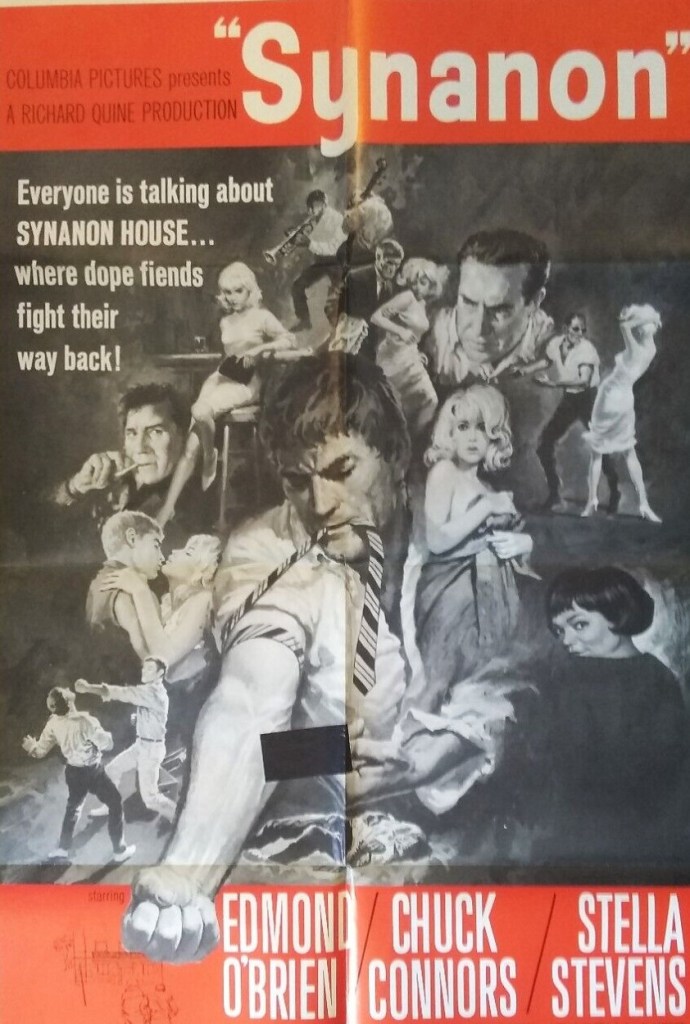
At the time it was a byword for something else – rehabilitation. Its methods might have been controversial given leader Chuck (Edmond O’Brien) had no psychiatric training and was simply an ex-addict looking to find a way back. The main weapon in the community’s arsenal was confrontation. What became known as attack therapy. Rather than being permitted to stew in self-pity, inmates, all voluntary, had their weaknesses spelled out by others until they were ready to acknowledge them for themselves. The key to recovery was talking. Anyone not talking was hiding from their problems. (I’m not so well up on addiction therapy to know whether Synanon invented that kind of counselling of talking out problems in groups that then became the norm.)  If patients took to the scheme they were soon addicted to smoking and coffee; sex being considered too dangerous to contemplate.

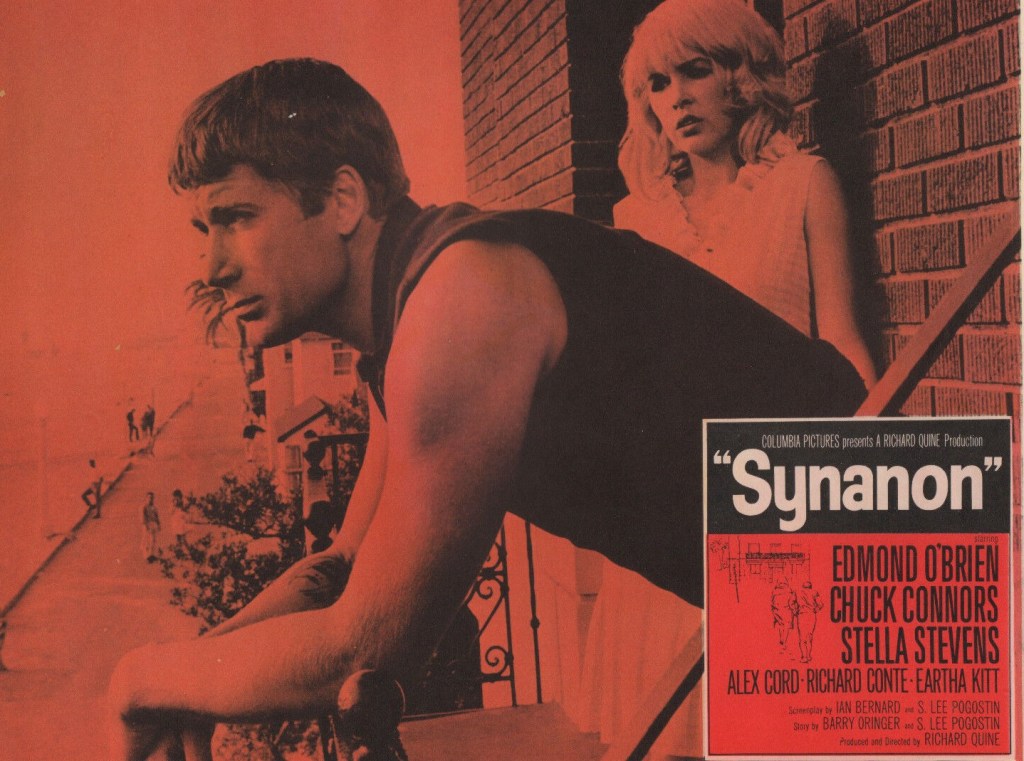
Anyways, heroin addict Zankie (Alex Cord) is a newcomer helped along an entrant’s path by Joaney (Stella Stevens), a single mum so out of kilter with responsibility she kidnaps her son, and confronted by hardass Ben (Chuck Connors), so consumed with guilt over the death of his dope-fiend wife that he spurns all women. There’s a sub-plot of sorts. Chuck is being charged with various minor violations, including permitting convicted criminals out on parole to enter the establishment. But Chuck’s main job is to be sarcastic, challenging anyone’s notions that they could be cured, but occasionally analytically correct. “You put yourself in a position where you could lose control,” he tells Ben.

It’s a hothouse of emotions for sure. Zankie and Ben come to blows over Joaney. Zankie sees little wrong in knocking back some cough medicine. Eventually, Zankie skips out, pursued by Joaney, who goes back to turning tricks to fund her habit. There’s a surprising scene – for the time (likely excised from the British version and possibly the original) – of Chuck going through the whole candle, spoon, injection routine.

Set up as a sanitised public relations package promoting Synanon ideals with overmuch detail on the establishment’s background and conflict with authority, nonetheless it touches far better than most addiction movies on the lack of self-awareness that afflicts users, their creation of fantasy worlds where whatever they do is deemed right. The tension that comes from an entire house of jumpy characters, their dependence on a higher power (Chuck in this case) is well-drawn. Even the incessant smoking and the constant reliance on coffee suggests those with an addictive personality are only too likely to switch to something else.

You might question the casting. Alex Cord (Stagecoach, 1966), Stella Stevens (Rage, 1966) and Chuck Connors (Move Over Darling, 1963) are far too well-groomed to pass for skanky addicts even if on the road to recovery. And Edmond O’Brien (The Man Who Shot Liberty Valance, 1962) and his sidekick (Richard Conte, Lady in Cement, 1968)) come across like tougher versions of the tough priests tackling delinquency that used to be played by the likes of Spencer Tracy.

But Cord and Stevens do suggest the vulnerability of the delusional addict, Stevens little-girl-lost persona at odds with her glamor, actions devoid of the concept of consequence. Although boasting a six-pack, Cord’s portrayal of a man destroyed by weakness did not suggest he would segue from this screen debut into tough-guy leading roles. Better actors might have suggested a greater degree of internal conflict but externally, in the looks department, might have looked like this was always going to be their destination. So the casting works both ways, more surface, less depth, but a warning that even the prom king and queen are not immune from addiction.

Soberly directed by Richard Quine (How To Murder Your Wife, 1965) from a screenplay by Ian Bernard, in his debut, but feels it owes too much from input by the original Chuck Dederich.

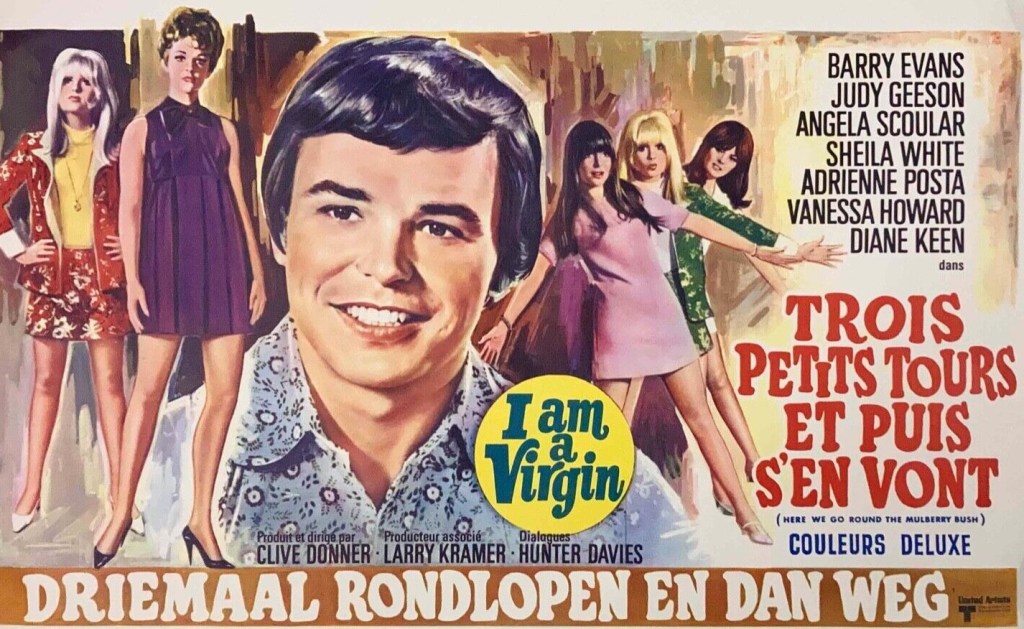
Here We Go Round the Mulberry Bush (1968) **

Breaking the fourth wall has become a common conceit these days, especially in television, so you might be surprised to learn it was the key artistic element of this otherwise straightforward British coming of age drama.

Our teenage guide Jamie (Barry Evans), a delivery boy, spends most of his time lusting after any women he meets. Like a junior version of 10 (1979) women are rated according to their physical attributes. Most, of course, are well out of his league, especially as he lacks for what counts as the smooth patter which his cocky pal Spike (Christopher Timothy) has in abundance.

Essentially a series of episodes with the opposite sex as Jamie tries to lose his virginity. But mostly, it’s just Jamie yakking on about how he’s not lost his virginity and what’s up with all those women that they can’t see what a great catch he is. He’s so determined to have sex he will even go out with the dumbest of dumb blondes, Linda (Adrienne Posta).

Naturally, since reality is too cruel, he succumbs to fantasy with a number of scenarios that seem, inexplicably, torn from silent movies, and nothing approaching the imagination of Hieronymus Merkin. For no particular reason, he strikes lucky with the adventurous Mary (Judy Geeson), whose boyfriends usually run to sports cars, but that liaison is nearly interrupted by a wet dog and Jamie’s inexperience.

Apart from the lusting, there’s little else going on, a couple of women in a fish-and-chip shop complain they are fed up with chicken and beef, his younger brother shows more spark, and his home life is pitifully dull. You can’t really blame the movie for lacking the rebelliousness that was potent at the time, there’s no political awareness and no sign Jamie is going to grow up into one of the Angry Young Man so familiar at the beginning of the decade. It’s a quaint version of American Pie.(1999).

But it’s just boring. While Barry Evans (Alfred the Great, 1969) is personable enough he doesn’t have enough in the wit department to keep you hooked for the duration, most of the humor teetering on the side of inuendo..

Unable to recognise the inherent weakness of the script, and assuming that breaking artistic boundaries with the fourth wall is enough, director Clive Donner (Alfred the Great) spends most of his time trying to visually brush everything up, with little success.

That this was a big British hit at the time might have been more to do with the soundtrack – performed and written by Steve Winwood and Traffic – and the fleeting sight of Judy Geeson (Two into Three Won’t Go, 1969) in the buff. The British censor didn’t take too kindly to the actress revealing all, so in fact audiences were treated to very little, but for teenagers at the time very little was more than usually came their way unless willing to sit through a turgid arthouse picture.

About the only thing to commend it is Geeson’s class, she stands head and shoulders above everyone else in terms of screen charisma, and that there’s a roll call of rising British stars. As well as Christopher Timothy who would achieve fame on television in the original All Creatures Great and Small, the supporting cast includes Vanessa Howard (Corruption, 1968), Angela Scoular (On Her Majesty’s Secret Service, 1969), Diane Keen (The Sex Thief, 1973) and Adrienne Posta (Some Girls Do, 1969) and, to show them all how to do it, Denholm Elliot (Maroc 7, 1967) briefly pops up.

Clive Donner (Alfred the Great) directs. Hunter Davies, making his screen debut, wrote the screenplay based on his bestseller. Generally, any film that scores two stars does so out of incompetence. This is well-enough made but never seems to shift into gear.

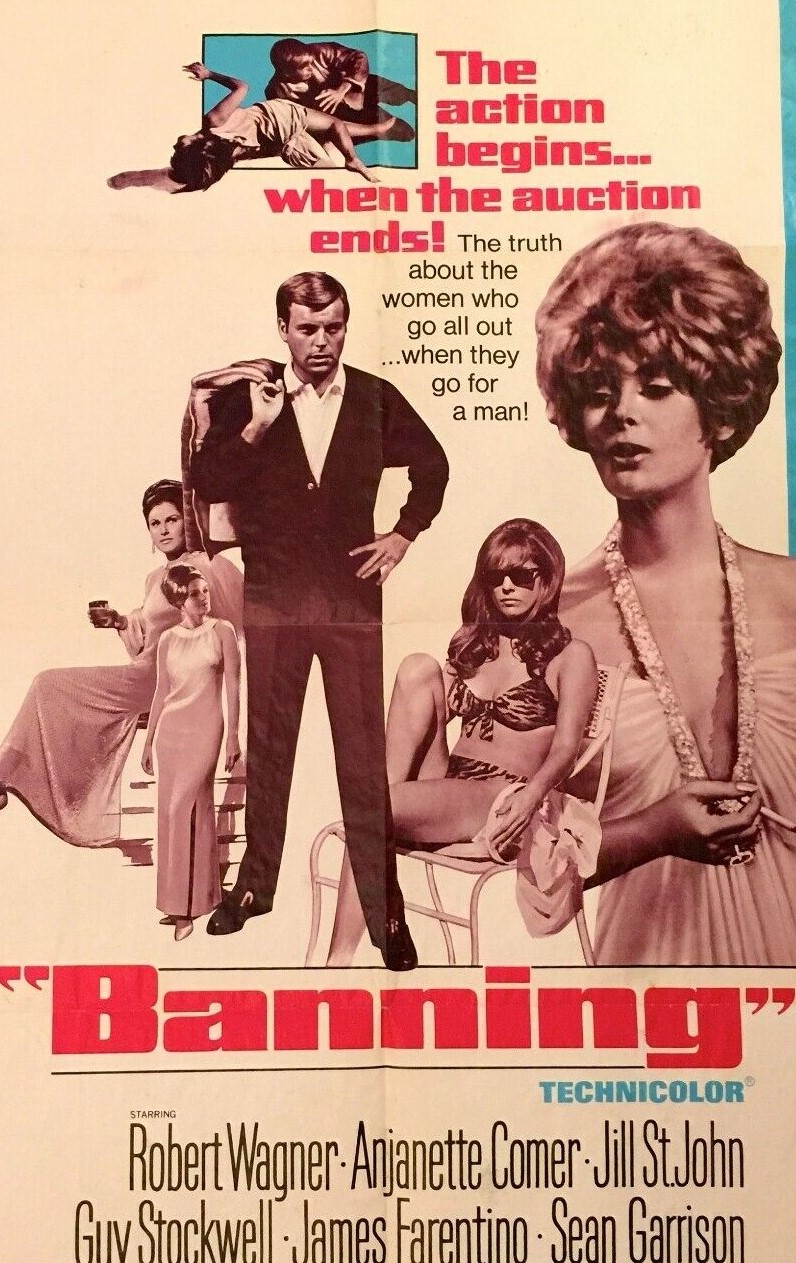
Banning (1967) ***

Robert Wagner’s bid for stardom is scuppered by a limp plot set in the overheated world of the country club set where a posse of sexually predatory women operate. It doesn’t help that the main narrative thrust finds trouble just hanging in there.

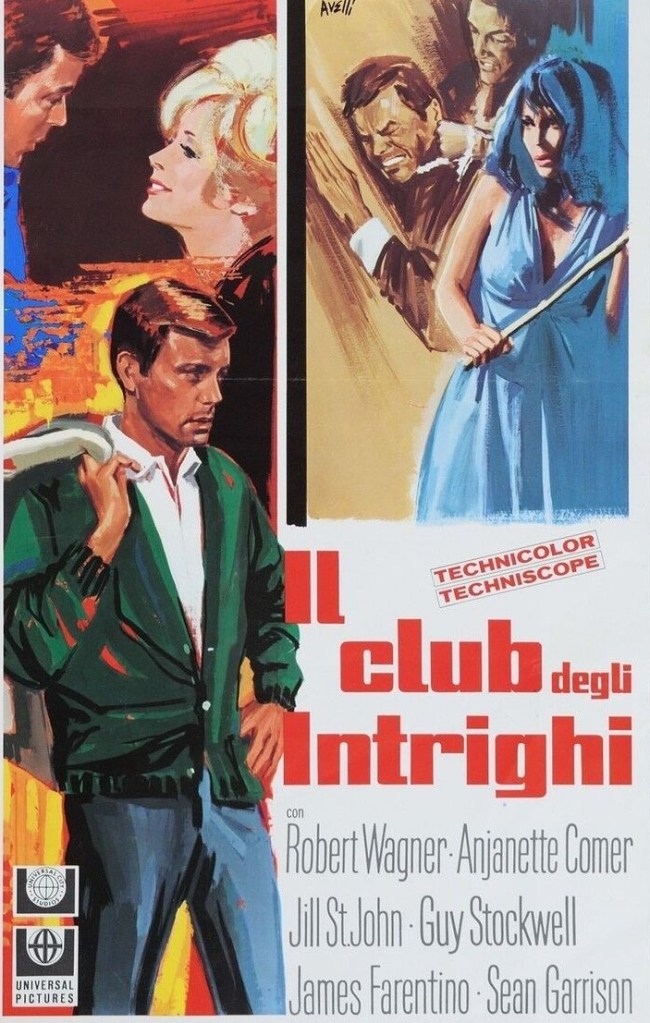
Ex-professional golfer Banning (Robert Wagner), a “moral diabetic” on the run from a loan shark, pitches up at an upmarket country club where he finds work as the assistant golf pro to Jonathan (Guy Stockwell). His most arduous task appears to be picking his way between the toned bikini-ed bodies lounging around the pool and avoiding the advances of Angela (Jill St John) and Jonathan’s wife Cynthia (Susan Clark) while coming on strong to overpaid secretary Carol (Anjanette Comer).

There’s an element of Life at the Top (1965) here, with Jonathan married to the boss’s daughter, resenting their close relationship while not making the executive advances he would like. Every now and then bits of what sound like a complicated past implicating Jonathan and the alcoholic Tommy Del Gaddo (Gene Hackman) pop up and around the halfway mark a subplot kicks in, involving something called a “Calcutta,” a golf tourney which looks like it’s being rigged.

Given that it’s organised by a club boss (Howard St John) who claims every gimme going and feigns drunkenness to skin members at poker, it’s almost a given that Banning is going to come out worst. I have to tell you you probably couldn’t care less, since most of the action, and all of the fun, is off course, and not so much in the bedroom stakes as the war between women for available men.

“I bought you,” purrs Angela in her  most seductive attire after she has made it possible for Banning to find a way to pay off his debts. “I want you,” snaps single mother Carol, making a forthright play after spending most of the picture fending off his advances. Standing on the side-lines, watching Angela making her moves, Cynthia observes, “I’d say Angela’s had at least a dozen husbands,” pause for the punchline, “including mine for all I know.”

Predatory moves are not all one way. Turns out the price Carol pays for a salary five times the going rate and a nice house and private schooling for her daughter is setting aside Thursday afternoons for Jonathan. But in the pragmatic manner that appears inbred in the country club, she states, “No apologies, no excuses.”

And before Carol works out just how attractive Banning actually is she had to cut him dead a couple of times and, in a scene guaranteed to put off the modern audience, prevent him drunkenly raping her. It was almost a throwback to the 1940s and 1950s when, it appeared, a woman just needed a good smack on the chops before she could submit and start billing and cooing.

Robert Wagner (The Biggest Bundle of Them All, 1968), tanned within an inch of his life, doesn’t so much miss the target as not being given a target worth hitting. There’s very little sense danger, of a man on the run from the mob or whichever gangster has picked up the tab for his debt, and he’s not a lounge lizard. Acting-wise, he relies on a raised eyebrow, an eye swivel and that scene-stealing trick, copyright Robert Vaughn, of raising his lowered head to open his closed eyes, a neat device for a supporting star but hardly required when you are top-billed.

Anjanette Comer (Guns for San Sebastian, 1968) doesn’t snatch the brass ring either, relying on a tremulous lower lip to evoke emotion. In fact, it’s a toss-up between the classier Jill St John (The King’s Pirate, 1967) and Susan Clark (Tell Them Willie Boy Is Here, 1969) as to who steals the most scenes, both winging it with striking dialog, emanating power, regarding men as weak and playthings.

Gene Hackman (Lilith, 1964), generally a prime contender for scene stealing, especially with trademark chuckle now in full swing, unfortunately does himself no favors by over-acting.  You might also spot James Farentino (Rosie, 1967) and Sean Garrison (Moment to Moment, 1966).

Ron Winston (Ambush Bay, 1966) directed from a screenplay by James Lee (Counterpoint, 1967). It would have worked better to concentrate more on the bitchy women than the sub-plots.

I’m sorry to say you’ll have a hard job finding this since I purchased my DVD on the second-hand market. Worth the hunt if you’re a fan of St John and Clark or to discover why Wagner’s promising screen career never took off.

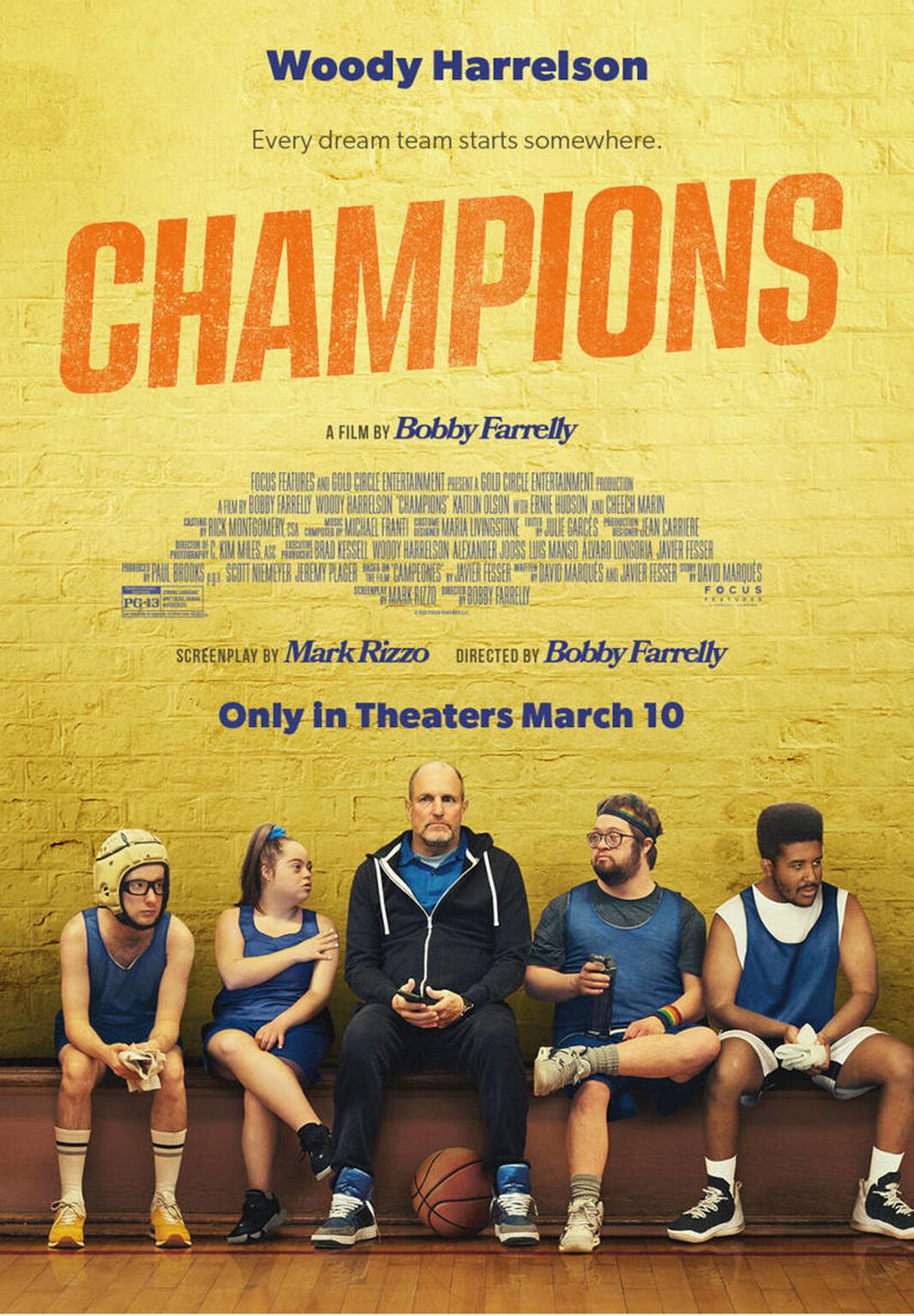
Champions (2023) **** – Seen at the Cinema

If there’s any justice in the world this fresh take on the feel-good movie will trump fading franchise at the box office. Sure, we’ve been here before. Due to a misdemeanour or professional fall from grace, grouchy lame duck is forced to coach a bunch of lame duck misfits. Hell, The Mighty Ducks (1992) even took the same route of community service, though that regarded a lawyer.

Despite his position as a mere assistant coach in the most minor of minor basketball leagues,  Marcus (Woody Harrelson) has an NBA level of arrogance. To escape an 18-month jail sentence following a DUI, he is handed an intellectually challenged gang who test more than his patience. On a  personal level, he has to swap seeing a team as something that can blindly follow his instructions to a group of individuals whose lives require understanding. And go from being an inveterate Tinderite to a keeper.

Marcus as well as Harrelson has his work cut out because you’ve never come across such a bunch of scene-stealers from animal-loving Johnny (Kevin Iannucci) who has a morbid fear of water to Showtime (Bradley Evens) whose specialty is celebration despite his constant inability to hit the target due to his insistence in turning his back on the hoop when taking a shot. In between you’ve Ms Consentino (Madison Tevlin), a legend in her own lunchtime and natural born hard-ass leader, and Darius (Joshua Felder), the team’s top player whose interaction with coach is limited to “Nope” as he goes immediately on strike.

Considerable effort goes into grounding the lives of these characters, all gainfully employed, none actually lame ducks. And seeing the world from their point of view. And thankfully, the movie avoids all signs of virtue signalling, the characters so vibrant on screen they are just a joy to watch.

In plot terms, we are treated to a series of sometimes hilarious, sometimes touching episodes, while Marcus gets wise to his situation and transforms from selfish a**hole to caring person, while not losing sight of his main function which is winning. Along the way, he attracts a girlfriend Alex (Kaitlin Olson), Johnnie’s sister, a 40-something singleton, happy to put up with passable if it means regular sex and with a refreshing line in punchy dialog that would put any cocky fellow in his place.

It doesn’t end the way you’d expect, which is probably another first for this kind of picture, but it’s a very enjoyable ride. You couldn’t choose a more difficult subject than acceptance of the intellectually challenged in the community and director Bobby Farelly (Dumb and Dumber To, 2014), who would probably be the first to admit he was guilty of getting easy laughs from such characters in the past. In his first movie for nearly a decade, he sprints past every potential trap with aplomb, only stopping to indulge in a vomit scene that seems a prerequisite of his style.

A good many of the laughs are at Marcus’s expense and often a phrase used in coaching comes back to bite him. And basketball is such an easy sport to understand, you run from one end of a court to another and lob a ball into a basket so the only tactical element we have to absorb is the intricacy of one specific move, helpfully translated from arcane sporting jargon into the easily understood by a dollop of Shakespeare.

Part of the joy of the feel-good movie is that it will be borne away on the box office wind by word-of-mouth, that impossible-to-define trick where audience approval wins out over gigantic marketing spend. Alternatively, we might live in the kind of cynical society that is already immune to the heart-warming. I hope not because this is immensely enjoyable without stooping to tear-jerking.

Woody Harrelson (Triangle of Sadness, 2022) is back to his best and you can see why he was at one time an out-and-out star. And there’s the credits bonus, unless this is snazzy CGI, of Woody singing and playing the piano and doing a back flip in the pool.After decades of bit parts and television roles Kaitlin Olson comes exceptionally good in a zingy role that delivers a side order of angst. As a bonus on the acting side are roles for Cheech Marin (The War with Grandpa, 2020)  and Ernie Hudson (Ghostbusters: Afterlife, 2021).

Book now.

Rage (1966) ***

You can count on Glenn Ford to bring his A-game to a B-picture. While never reaching the top tier of stardom he had been a box office stalwart in the 1950s until gradually losing his marquee touch in the early 1960s.

This is an odd one, with some nods at Wages of Fear (1953) and any picture that involved a trek or featured a hooker with a heart of gold. The story was certainly unusual – rabies. And the idea of a resulting pandemic will resonate more now than it did then. But it takes quite a long time for the key storyline to emerge, which is just as well because it allows Glenn Ford (Experiment in Terror, 1962) time to turn in one of his best characterisations.

Generally, Ford was Mr Dependable, very capable of holding his own and meting out punishment to anyone who crossed the line. So, this is as far from typecasting as you can get.

Dr Reuben (Glenn Ford) is a washed-up alcoholic working in a flyblown mining pitstop in Mexico, riddled with guilt at the death of wife and child. So when a posse of prostitutes turns up, he’s last in the queue, possibly his disinterest the attraction for Perla (Stella Stevens). By the time he realises he’s contracted rabies, he’s up against the clock, 48 hours to reach a town with an antidote, but still a baby to deliver, a jeep that has to cross a rickety bridge and then runs out of gas, so that, once linked up again with Perla and helped by Pancho, he has to cross mountain and desert to reach safety.

Logic isn’t in much evidence here. Despite knowing he has contracted the disease, he still delivers a baby and then spends most of the final 36 hours in the company of Perla and Pancho (David Reynoso), not to mention that the Mexican has abandoned his wife, who has just given birth in a shack, in order to accompany the doctor, or that the doc finds his way onto a bus loaded up with kids (presumably they are immune).

Not to mention that with a jeep running out of gas surely the last thing you’d want is to weight it down with passengers. And with a budget that’s not going to cater for a proper runaway bus that sequence falls back on the old speeded-up film.  And if you’re going down the line of a rickety bridge, do it once, don’t repeat it.

But then you wouldn’t have anyone on hand to deliver philosophic lines, or to start to fall in love (wih Perla, you understand, not Pancho).

Take away the illogicality and there is still quite enough that works. The driver of the hooker truck unceremoniously jacks up his load to dump them in the town. A woman is tied to a table in preparation for giving birth. A suspected rabies victim is dragged through the streets by rope. The hunt for gas leads them to drain oil lamps. There’s a very self-aware Perla, more than enough common sense for both of them. She knows exactly what she has become and that’s something for which there ain’t no cure. But there are a couple of beautifully-wrought scenes that would allow Reuben and Perla to express their true feelings if either was capable of letting go, and you won’t see more expressive fingers.

They struggled to sell this one. The old “woman scorned” line is out of place as is a town eaten up with rage and Glenn Ford does little pistol-packing. But Stella Stevens does look pretty in pink.

And the clock running down also means that the symptoms are building up. Reuben’s senses are heightened. Light is too bright, sounds deafening, and if the doctor is already too ill he won’t be able to drink from a waterfall.

Every now and then director Gilberto Gazcon – who hadn’t made a picture in four years since La Risa de la Ciudad (1962) and wouldn’t make another for three years – chucks in a cinematic morsel, the camera whizzing around or racing back, to show Reuben’s state of mind. But, honestly, he needn’t have bothered.

You hire Glenn Ford and you get everything through his eyes, maybe a sly tensing of his features or a gesture from time to time, but this is one actor – mostly under-rated – who is just rock solid when it comes to displaying character. So when he’s not trying to save himself, dashing from one scheme to the next, he’s flat out trying to stop himself going mad, and only pausing for a bit of reflection as Perla tries to inject some meaning into his life.

Stella Stevens (Sol Madrid, 1968) ain’t that gold-hearted she’s going to let men treat her like dirt, she hands out a couple of good thumpings, but in her world you’re not going to come across any men who aren’t pure predatory, and it’s a shock for her to meet someone who thinks a woman can’t be bought. This is a rounded character – tough but vulnerable, and surprisingly tender should the opportunity arise.

Definitely a mixed-bag and a bit more work on the screenplay would not have gone amiss but top-drawer performance from Glenn Ford.

Joanna (1968) **

Mike Sarne (Myra Breckenridge, 1970) was one of those talents who ran away with himself, artistic notions indulged by the industry, until he was exposed as having little to say. Joanna is pretty empty of everything except style. And that wouldn’t be so bad if it was consistently stylish or showed a genuine flair for the visual image beyond a woman bathing in a lily pond or chasing an ambulance through a park.

And, of course, it’s never a good idea to park your inexperienced girlfriend upfront and center of your debut feature. Genevieve Waite, a model in the Twiggy fashion, had a thin, whiny baby voice, and lacked the skill to suggest any depth to the titular heroine.

The film stands up today as a shrine to misogyny, for the way in which, in the name of emancipation, women were exploited by men. Sexual freedom, bouncing along from one man to another, is the theme. “All women gained from emancipation is the privilege of being laid,” points out one (male) character. Freedom is expressed as lack of commitment. It’s kind of odd to hear young trendy men going on about commitment and expressing reservations about a flighty lifestyle, but it’s just as if the male authority figure had simply skipped a generation and was determined to keep women in their place.

Joanna, arriving from the countryside laden down with pots of home-made jam, flits through the Swinging London scene, exploring her artistic side through attending an art studio, occasionally working as a model, but more likely living off men, who are as likely to be married, and even then with another woman on the side.

She flits between artist Hendrik (Christian Dormer), nightclub owner Gordon (Calvin Lockhart) and wealthy dying toff Lord Peter Sanderson (Donald Sutherland) with a yacht in Morocco who surrounds himself with talented people because he lacks any talent himself. We don’t learn much about Joanna except her father, whom she fantasizes about cutting his throat, is a powerful enough magistrate that he can intervene when coppers are causing her boyfriend grief.

The other theme explored is racism. Gordon, a Sierra Leone native but a tax-paying British resident for eight years, is subjected to some racial abuse and later given a beating. That’s given more prominence than the miscegenation that would the following year (in 100 Rifles) attract so much controversy.

Lacking a strong narrative – mostly it’s people sitting around talking or getting into bed with each other – the film mostly hangs on a series of fantasies. Any time a new character appears, Joanna has the habit of spiriting them into a fantasy. Gordon’s sister is transformed into a maid in an English country house, Gordon becomes a Regency hero, the minute someone says sex can get you anything you desired even an elephant, lo and behold there’s Joanna sitting atop an elephant.

There’s a self-consciousness that this film can’t quite shake, the idea that somehow Sarne is holding a pillar up to society when in reality it is more a reflection of his own fantasies. The best scene comes at the end when the entire cast sings the theme song along a railway platform. The song, with no sense of irony, rhymes “top banana” with “Joanna.” And, of course, would you believe, this was all a film, director and cameras appearing at the end.

Whimsy is piled upon whimsy and that’s not enough to sustain the film. Waite offers very little except bounce, Donald Sutherland (The Split, 1968) – now coming up on 200 screen and television roles – is sorely miscast. Calvin Lockhart (The High Commissioner, 1968) brings more to the table, a polished performance that avoids the temptation to go too American. Sarne wrote the screenplay.

It’s not as bad as most films that get two stars from me but for the life of me I can’t see how it honestly earns three stars. You can sample it for free – or watch it all the way through – on Youtube.

A Rage To Live (1965) ***

There was one in every town: a woman, rich (Sanctuary, 1961) or poor (Claudelle Inglish, 1961) or in between (Butterfield 8, 1960), with a predilection for sex. There were several men in every town, queuing up to take advantage. The woman was inevitably a shameful creature, the men the envy of their peers. You don’t have to look further than Frank Sinatra’s tom-catting in Come Blow Your Horn (1963) or Omar Sharif as the romantic star of the decade with two women in tow in Doctor Zhivago (1965) for an idea of the double standards in play. Welcome to hypocritical Hollywood.

Grace (Suzanne Pleshette), father dead and stuck with a domineering mother, finds escape and fulfilment in sex, and just to give hypocrisy a final tug discovers that while boyfriends are keen to help her explore such physical needs, they take the hump when they discover they might not be the first – or the only. Parents, naturally, are appalled, and discovery of Grace’s antics – and she’s not particularly particular, a passing waiter will do – leads her mother to collapse.

Having confessed to potential husband Sidney (Bradford Dillman) that he will not be marrying a virgin and almost bursting with gratitude that he is willing to overlook her behavior, Grace becomes a farmer’s wife and then a happy mother, until construction owner Roger (Ben Gazzara) comes on strong. She might well have been able to have her cake and eat it but Roger, having fallen in love,  reacts badly to being dumped and it’s only a matter of time before her world implodes.

Made a couple of years later, when the independent woman was being exalted, this would have been a different kettle of fish. Here, the boot on the other foot, the woman who picks and chooses her lovers seemed a step too far for that generation.

Before the big trouble begins, the movie does explore, though somewhat discreetly, the almost taboo notion that a woman might just enjoy sex for the sake of it. Sure, Grace likes being wanted and likes being held, but if she was around today, nobody would bat an eyelid if she just came out and expressed her preference.

Less discreetly, the subject of consensual sex comes up, but not as a question of debate, more as a matter of fact, that when Grace says no she actually means yes. There’s a very uncomfortable moment at the beginning when in a Straw Dogs-scene, though nothing like as violent, Grace appears to welcome a rape. Whether this is as bad as it sounds, or is just Hollywood hiding the blush that a woman would not seek out sex but could only discover its pleasures when forced upon her, is hard to say.

Nor is Grace a walking sex machine. She knows enough about men that she only has to put out feelers and any susceptible male will take the bait. And given the restrained times, she’s got no female pal with whom she can discuss her unseemly desires.

Of course, if this was a man, nobody would be batting an eyelid. Sure, once caught, he’d come up with all sorts of excuses, denials, begging for forgiveness, but an audience would give him a free pass. It’s only because this is a woman that it causes ructions. The movie just about gets close to what does make Grace happy and why she needs the thrill of extra marital sex but by that point the melodrama has taken over and there’s little time left for discussion, what with Roger intent on revenge and another lovelorn wife, mistakenly imagining her husband has fallen victim to Grace’s charms, also on the warpath.

Small town constraints play their part, too. Washing your dirty linen in public the worst of all offences. Author John O’Hara, on whose bestseller this is based – and whose other works Butterfield 8, Ten North Frederick (1958) and From the Terrace (1960) explored similar worlds  – knows only too well that while wealth brings freedom and privilege it comes with chains attached.

And there’s some interesting role reversal, an illicit lover falling in love with a married person normally a starting point for a movie to explore happiness and its opposite rather than being the one act Grace will not tolerate in a lover, she wants strings-free sex, not anything with encumbrance. While Grace would like to act like a man, and has the wealth to shield herself from the worst of the fall-out, as a mother she is extremely vulnerable, and in this particular era could risk losing her child if seen as maternally unfit.

While lacking the sexual combustibility of Elizabeth Taylor or Lana Turner or other Hollywood heartbreakers, Suzanne Pleshette (Nevada Smith, 1966) gives a decent enough performance especially when it comes to her straightforward attitude to sex, aware she might be causing upheaval, but finding it impossible to ignore desire, or imagine a life in which that does not play an impulsive part.

Bradford Dillman (Sanctuary) has less room for character maneuver and is mostly called upon to suck it up. He comes into his own in the movie’s latter stages when bewilderment at betrayal and public humiliation clashes with continued love for his wife. Ben Gazzara (The Bridge at Remagen, 1969), trademark leer and smug face kept in check, has a showier role especially when the violent aspects of his character explode.

Director Walter Grauman, while better known for war picture 633 Squadron (1963), had just come off another picture dealing with female trauma (Lady in a Cage, 1964) and does quite a decent job here, the camera intensely focusing on the leading actress and then as the tragic outcome unfolds drawing away from her. There’s one great piece of composition. He had used tree branches and the countryside to frame Grace and Sidney at the height of their love. And he does the same again when Grace is abandoned.

Asks some difficult questions without quite getting to grip with the real subject of female sexuality. There was a sense that Hollywood was just on the cusp of accepting the independence of women, but didn’t want to go the whole hog just yet, because, apart from anything else, where would it leave the guys?

The Pleasure Girls (1965) ***

Klaus Kinski and The Pleasure Girls. What depraved mind dreamed up that concoction?

In reality, given this is early onset Kinski, before he was a fully-developed beast, and because it just precedes the British censor throwing off his shackles to accommodate the likes of Blow Up (1966) and The Fox (1967) it’s pretty tame stuff.

Klaus Kinski – what more did any B-picture of the decade need?

The girls might parade in night attire, and, should they happen to sleep in the nude, flash a bit of less rude skin, but that’s as far as it goes although at least couples are permitted to share a bed unlike the U.S. where that was outlawed by the Production Code (hence, in case you didn’t work it out, why there was so much frolicking via censor loopholes such as the outdoors or in the surf a la From Here to Eternity).

And you might find it hard to believe that John Wick’s Ian McShane has been a star for nearly half a century. Though here on the shifty side here and a shade fresh-faced his trademark cynical eyebrow is perpetually raised. He’s one of the suitors of a posse of girls sharing a house in London. A year later and a photographer like him would have had girls throwing themselves at him rather than primly trying to hold onto their virginity.

A weekend of drama awaits model wannabe and suburban lass Sally (Francesca Annis) on her arrival at the house, a whirlwind of parties beckoning, though drugs and booze in little evidence. Among her flatmates glamorous Dee (Suzanna Leigh) is mistress of slum landlord Nikko (Klaus Kinski) and while happy to be wined and dined and presented with jewellery,  fur coats and cash, draws the line at being put up in an apartment. Compliant Angela (Anneke Wills) is enmeshed with unscrupulous gambler Priddy (Mark Eden).

While there are plenty good-time girls to hand in casinos and there is some discreet nudity at a party it’s not exactly high-end stuff what with scenes set in launderettes and street markets and girls cutting themselves shaving their legs. And while proclaiming himself sex-mad, Keith (Ian McShane) is rather more romantic than he would like, prepared to wait for Sally, even while spouting self-conscious lines like “surely every girl wants you to want to even if she doesn’t want to,” the kind of hypocritical male double standard of the day.

The Sally-Keith relationship doesn’t get much beyond will she-won’t she so the real drama takes place in the lives of Dee-Nikko and Angela-Priddy and Dee’s very outgoing brother Paddy (Tony Tanner). Nikko collects debts with the help of thugs and an Alsatian, while Priddy sells his girlfriend’s precious brooch.

There’s more violence than sex. One man beaten up and tied to the hood of a car to be whipped with a belt. Another is tied to a chair and hung out a window. And, for the time, one man’s homosexuality is unusually tenderly expressed while the prospect of a career being more attractive than marriage is given a fair airing.

It’s surprisingly well acted, all the characters believable with enough development twists to keep you interested, and of course it’s not the degrading or unseemly world the posters would have you believe although in a pre-Pill world the dangers of unprotected sex are only too obvious.

Producers Tony Tenser (later founder of Tigon) and Michael Klinger (Get Carter, 1971) had made their reputations on exploitation pictures like the previously-reviewed London in the Raw (1964) and this attempts, at least for marketing purposes, to go down a similar seedy route, but is confounded by a storyline that is more Peyton Place than Bad Girls Have Sex.

It’s more an opportunity for rising stars to be put though their paces rather than characters put in their place. Ian McShane’s (Sky West and Crooked/Gypsy Girl, 1966) twinkle is never far from view and he demonstrates the charm that will keep him in demand for the next near-50 years. Klaus Kinski (Five Golden Dragons, 1967) is remarkably restrained given his later work, proving he doesn’t have to over-act to make his mark.

Of the others in the talent shop window, Suzanna Leigh (Deadlier than the Male, 1967) makes the biggest impact. It didn’t make a star out of Francesca Annis though Mark Eden (Curse of the Crimson Altar/The Crimson Cult, 1968) had marginally better luck.

Gerry O’Hara (Maroc 7, 1967) directed from his own script.

Mickey One (1965) ***

Smorgasbord of paranoia, Kafka and the surreal, set in an American netherworld. Cue trampolines, a mime, what these days we’d call installations, a comic without a decent joke, a wrecker’s yard, organic food, catering kitchens. You could call Arthur Penn (Bonnie and Clyde, 1967) a visionary director just for including some of these aspects. Or you could go for another contemporary word: “random.”

We are pretty used to people being on the run be they innocent of the crime of which they are accused or small-time hoods trying to evade punishment. The notion here is of small-time hood Mickey One (Warren Beatty) fleeing Detroit for Chicago but with no idea for what crime, though the list could include gambling debts and stealing a bigger gangster’s moll.   

A misleading tagline if ever.

His situation is spelled out often enough in case you’ve not got the picture. “Hiding from you don’t know who for a crime you don’t know you committed,”  remarks girlfriend Jenny (Alexandra Hay). In a particularly Kafkaesque moment, Mickey espouses: “The only thing I know is I’m guilty – of not being innocent.”

Smart with the words but not so smart with the actions. Even though he can just about get by  as a kitchen wash-up, he gets sucked back into his former profession of stand-up comedian, hardly the most anonymous of jobs. So he is all angst-on-fire when success in some low dive, keeping clients entertained between strippers, attracts interest from a classier joint which naturally sees marketing the new prospect as part of the deal.

Some of this paranoia might just be in his head were it not for being stalked by car-crunching cranes in the wrecker’s yard, spotlights on stage (though you could point out that’s an occupational hazard) and a silent rag-and-bone man.

It says something for the acting of Warren Beatty (Kaleidoscope, 1966) that this is in any way believable. The fast-living lothario of the opening sequence, with gals and booze aplenty, segues into a bum without missing a beat. His paranoia is consistent and he makes some attempt to find out what the heck he has done to end up this way, though it has to be said there’s no actual evidence of pursuit, just the fear of it, and the notion that he owes somebody maybe twenty grand or that the lass tempted into stripping for him was stepping out of line.

Pretty good plug from a top critic and an arthouse opening – what else could you ask for?

His breadline living is realistic, too, hitching a ride on a train, bumming food from a mission, sleeping among bags of rubbish, a world where down-and-outs steal the clothes from the back of other vagrants and his job is scraping leftover food from plates in a cafeteria. And there’s always someone at the scam, his landlady dumping another tenant (Jenny) in his tiny apartment.

Maybe less realistic that club owners are lining up to hire him when there’s nary a laugh in his schtick. The biggest joke is in the casting, some kind of infernal joke on audiences to put the likes of the uber-handsome Beatty through mental and physical torture, albeit that he’s perceived as man of abundant talent and collects with ease women willing to put up with the depressive side of his nature.  

The movie doesn’t quite fit the Kafka mold because being on stage represents freedom and nobody in Franz’s world ever had a sniff of that. And you wouldn’t call it a thriller either. And if it’s a homage to the French New Wave you’d have to watch a stack of French pictures from this decade to work out what it’s mimicking.

And it’s not like Penn’s work is always on this kind of edge, he’s not the David Lynch of his generation. Every top director is permitted at least one turkey, and this would have been Penn’s except critics in the 1990s started to give it the old reassessment treatment, Penn being a big enough name from his other works to have a stab at how this fits into his repertoire/oeuvre.

So, far from being an intolerable mess. Doesn’t quite ask the big questions Penn hopes it does. More of a curate’s egg of a picture, some interesting ideas, and an excellent performance from Beatty. Alexandra Hay (Only When I Larf, 1968) was part of the French connection, a Canadian model who had hit it big in Paris, with roles in French pictures and an affair with director Louis Malle. But actually she’s good, not the kind of submissive woman Mickey has perhaps been used to, but thoughtful and capable of challenging his illusions.

Screenwriter Alan Surgal was not prolific, this being his only movie.

Discover WordPress

A daily selection of the best content published on WordPress, collected for you by humans who love to read.

The Atavist Magazine

by Brian Hannan

WordPress.com Blog

News, Tips & Website Tutorials