Seven Golden Men (1965) ****

Very stylish caper picture that dispenses with the recruitment section, the ingenious hi-tech robbery accounting for the first half, escape and double-cross the second, a slinky Rosanna Podesta an added attraction/distraction. The Professor (Phillippe Leroy), in bowler hat and umbrella, orchestrates the gold bullion theft from an uber-secure bank using hidden microphones and cameras and a host of electronic equipment, the inch-perfect heist organized to mathematical perfection and timed to the second.

His team, disguised as manual workers, dig under the road, don scuba gear to negotiate a sewer, drill up into the gigantic vault and then suck out the gold bars using travelators and hoists. Giorgia (Podesta), sometimes wearing cat-shaped spectacles, a body stocking and other times not very much, causes the necessary diversions and plants a homing device in a safety deposit box adjacent to the vault. Occasionally her attractiveness causes problems, priests in the neighboring block complaining she is putting too much on show.

It’s not all plain sailing. A cop complains about the workmen working during the sacrosanct siesta, a bureaucrat insists on paperwork, a radio ham picks up communication suggesting a robbery in progress, the police appear on the point of sabotaging the plan.

But the whole thing is brilliantly done, the calm professor congratulating himself on his brilliance, Giorgia seduction on legs. The getaway is superbly handled, the loot smuggled out in exemplary fashion, its destination designed to confuse. Then it is double-cross, triple-cross and whatever-cross comes after that, with every reversal no idea what is going to happen next. It is twist after twist after twist. Some of the criminals are slick and some are dumb. As well as the high drama there are moments of exquisite comedy.

Italian writer-director Mario Vicario (The Naked Hours, 1964) handles this European co-production with considerable verve and although, minus the normal recruitment section, we don’t get to know the team very well except for the professor and Giorgia, each is still given some little identity marker and in any case by the time they come to split the proceeds we are already hooked.

Frenchman Phillippe Leroy (Castle of the Living Dead, 1964) is the standout as a mastermind in the British mold, stickler for accuracy, calm under pressure, working with military precision. Podesta (also The Naked Hours) has no problem catching the camera’s attention or playing with the emotions of the gang to fulfill her own agenda. The gang is multi-national – German, French, Italian, Spanish Portuguese, Irish – with only Gabriel Tinti likely to be recognized by modern audiences.

And there is a terrific score by Armando Trovajoli (Marriage Italian Style, 1964) that changes mood instantly scene by scene. One minute it is hip and cool jazz, the next jaunty, and then tense.

Worth a watch.

A Black Veil for Lisa (1968) ***

John Mills ventures back into Tunes of Glory (1960) territory as a top official coming apart at the seams. This time it’s not the British Army but the Italian Police where, as Franz Buloff, he heads up the narcotics squad. And this time he’s not the complacent victim but decides to take action against his tormentor.

Closing in on drugs kingpin Scheurermann, he finds that one witness after another is being silenced by an assassin with a deadly knife. He suspects a leak in his department, unaware the traitor is much closer to home. And despite the usual dissatisfied boss Ostermeyer (Tillio Altamura) breathing down his neck, he would be making more headway if it wasn’t for the fact that his head is constantly filled with images of his wife Lisa making love to another man.

For her part, Lisa seems determined to unhinge her husband, eliciting jealousy at every turn, by never answering the phone at night and always an excuse, when he tracks her down, for not being where was supposed to be. Rather than calming him down, her occasional seduction of her husband only serves to ramp up his fury.

In any case, it’s an odd set-up, he’s much older and the security he offers is not just financial. She was once a suspect herself and being married to a top cop has put a force field between her and suspicion. There’s clearly an unspoken assertion that somehow she has duped the cop, making him fall in love with an apparently innocent woman. They couldn’t be more opposite. “I like danger,” is her mantra.

He breaks open the case after following up a clue dropped at the scene of the crime. After arresting Max (Robert Hoffman), he strikes a deal with the killer. In return for his freedom, the murderer has to take out Lisa. But, of course, it’s not as simple as that. When Buloff realizes the deep water he is treading, he calls off the assassination. But then when he discovers that Max has helped himself to a bonus – beginning an affair with Lisa – he recants and puts the man back on the spot.

So, now, it’s Max who faces the quandary of having to kill his lover. And that puts up square in cat-and-mouse territory.

This isn’t quite giallo, the genre was still in the process of being born, in part because there’s no mystery about the killer, in part because the murders aren’t bloody enough, and in part because the dead aren’t sexy young women. So it’s more a series of character studies, each driven to an edge by an action that otherwise would be out of character.

A top cop like Buloff should have been a better judge of character than to fall for Lisa’s wiles in the first place. Lisa, too, should have recognized her penchant for the seedier side of life rather than being as she puts it “too young to be buried alive” in a stifling marriage to a jealous husband. But, she, too, is a poor judge of character, expecting to win back the favor of the drug overlord after she had so openly crossed the tracks to the other side of the law.

And Max, one of the first of a series of killers in movies who wanted out (see The Brotherhood, 1968, and Stiletto, 1969), is trapped into more killing because nowhere is safe. Getting rid of Buloff was never in his plans, as that would draw even more unwelcome attention. But then neither was falling in love with the cop’s wife. There’s still a few twists to go not least when Lisa discovers that the husband she felt she had under control had broken free and was intending to have her killed.

John Mills, a surprising addition to the Brits heading for Italy, is excellent especially as the big flaw in Tunes of Glory was his inability to find the cunning to strike back at his chief tormentor. Here, he might have second thoughts about dispatching his wife, but revenge is always the best weapon.

Luciana Paluzzi (Chuka, 1967, which, incidentally, also featured Mills) gets her teeth into a decent role rather than been saddled in lightweight fare since swanning around in swimwear in Thunderball (1965). Austrian Robert Hoffman (Assignment K, 1968) is given a surprising range of emotions to deal with.

Massimo Dallamano (Venus in Furs, 1969) handles the material well and gets the best out of his cast without taking the bloodier route of the later giallo. He was one of four writers contributing to the screenplay. This was one of the feature films made by new American mini-major Commonwealth United, one of the stack of “instant majors” popping up around this time.

John Mills is always watchable and the twists make this one play.

Sisters / Blood Sisters (1973) ****

Trust Brian De Palma to invent a gameshow called “Peeping Toms.” And give Hollywood an insight into the delicious malevolence to come later in his career. Often compared to Hitchcock, this is Hitchcock diced and sliced, awash with style. Not simply inspired use of split screen but an ending Edgar Allan Poe would have been proud of. De Palma plays with and confounds audience expectation and has mastered enough of the Hitchcock approach to make the villainess more attractive than the heroine. If you’re in the mood for Hitchcock homage, this is a good place to start.

Both main characters are strictly low end, sometime model Danielle (Margot Kidder) gameshow fodder, journalist Grace (Jennifer Salt) handed run-of-the-mill reporting jobs instead of, as she would prefer, investigating police corruption. Grace also has to contend with a mother (Mary Davenport), in typical non-feminist fashion, determined to marry her off.  

While the Siamese twin notion is straight out of the B-movie playbook and right up the street of exploitation maestros AIP, De Palma takes this idea and hits a home run. But you’ll have to be very nimble to keep up with the narrative.

Danielle meets Philip (Lisle Wilson) at the gameshow and after dinner she invites him to her apartment for sex. In the morning, he buys a surprise birthday cake for Danielle and her twin Dominique. On his return, he is murdered, an act witnessed by Grace, a neighbor across the street. She calls the police but before they can arrive Danielle’s ex-husband Emil (William Finley) – introduced to the audience, incidentally, as a creepy stalker – cleans up the mess and hides the corpse in the fold-up bed-couch.

Fans of the forensic may have trouble with this section as these days blood is more difficult to hide, but that’s evened up by the notion that a pushy journo would be allowed to sit in on the investigation. But heigh-ho, this was back in the day, so anything goes, and in any case, a la Hitchcock, it’s the woman who enters harm’s way. The cops, annoyed to hell by Grace, give up on the case and the reporter, having found the cake carrying the names of both twins,  manages to destroy the evidence.

Great set of reviews that only served to confuse the public.
An audience searching for schlock doesn’t want art.

Grace isn’t the kind of reporter easily thwarted so she hires private eye Larch (Charles Durning) who burgles the apartment and finds proof Danielle has been separated from her Siamese twin, who died during the operation. Grace follows Emil and Danielle to a mental hospital where, in a brilliant twist, mistaken for a patient, she is sedated and becomes an inmate. Later, hypnotised by Emil, she is convinced there has been no murder.

You’re going to struggle with the sharp turn exposition takes, but, heigh-ho, how else are we going to uncover the truth. Effectively, we learn that sex releases murderous thoughts in Danielle. The detail is a good bit creepier than that, but I wouldn’t want to spoil too much.

In many places it was seen as the lower part of a schlock double bill. A reviewer in the trades was correct when he predicted it was “certain to be an underground fave for some time” (i.e.limited to cult appeal) since well-reviewed horror pictures didn’t attract an initial audience.

But the ending is a corker. Grace is a prisoner. There’s another twist after that, but the notion of the investigator driven mad and ending up a prisoner of their own delusions, true Hitchcock territory, is honed to perfection here.

De Palma uses the split screen in the same way as Hitchcock employed the cutaway shot to increase the tension of potential discovery. Several sequences are rendered very effectively through this device.  Oddly enough, Grace doesn’t fit the Hitchcock mold of classy heroines. She’s way too feisty and independent and there’s almost a feeling that she gets what she deserved for tramping uninvited around a vulnerable person’s life. Here, Danielle is the victim, taken advantage of by the medical profession and her creepy husband, separation from twin ravaging her intellect.

Margot Kidder (Gaily, Gaily, 1969) and Jennifer Salt (Midnight Cowboy, 1969) are both excellent in difficult roles. Charles Durning (Stiletto, 1969) makes a splash in the kind of role that made his name. As a bonus, there’s a great score from Bernard Herrmann (Psycho, 1960).

But this is De Palma’s picture, serving notice to Hollywood that here was a talent of Hitchcockian proportions.  

Twisted Nerve (1968) ***

Another rich kid with mental health issues though without Orson Welles to offer expiation. The cause of this character’s illness is undetermined but it’s easy enough to spot the trigger to violence. The lad’s father is dead and his mother’s new husband, a wealthy banker, wants him out of the way, or at least out of the house, or at least, given he’s twenty-one, out working rather than mooning about the house all day.

And this was certainly the year for the movies exploring split personality – if such shallow treatment could be deemed investigation – what with Tony Curtis and Rod Steiger in serial murderous form in, respectively, The Boston Strangler (1968) and No Way to Treat a Lady (1968). And for movie fans it was an unexpecteldy speedy reteaming for Hayley Mills and Hywel Bennett after the humungous success of The Family Way (1967) in which the actress shed her child-star persona in no uncertain manner and the British film industry was, apparently, suddenly blessed with a duo with marquee appeal.

A poster that gives the game away. And an apostrophe issue.

This takes the Rod Steiger route of charming killer rather than a Tony Curtis puzzled and horrified by the demands of his ulterior personality. Given the emphasis on mental illness these days, Twisted Nerve is the hardest of the trio to take, since it’s effectively a play on an old gimmmick, deviousness concealed inside appeal.

Martin (Hywel Bennett) faced with expulsion from his house by overbearing substitute father Henry (Frank Finlay) pretends to scoot off to France but instead inveigles himself into the boarding house run by Joan (Billie Whitelaw) after tricking her librarian daughter Susan (Hayley Mills) into extending a sympathetic hand to his alter ego, the childish Georgie, whose behavior falls only a little way short of sucking his thumb and clutching a teddy bear.

Joan’s initial cynicism gives way to maternal feelings when he clambers into her bed in the middle of the night after a supposed nightmare. (And not with sexual intent.)

Occasionally, Martin cannot control his true feelings, despite Susan rebuffing his romantic overtures. Father is the first victim, substitute mother Joan the second and it’s only a matter of time before Susan becomes a target either for his stifled sexuality or his inner venom.

This would probably work just as well minus the schizophrenic element. In fact, there’s too much of tipping the nod to the audience. Eventually, Susan’s suspicions are aroused but  director Roy Boulting (The Family Way) is no Alfred Hitchcock able to manipulate an audience. So, mainly, what we are left with is Hywel Bennett’s ability to pull off a double role rather than his victims’ susceptibility to his charms.

Hayley Mills’ character could do with fattening up, otherwise she’s just the dupe, bright, bubbly, self-confident and attractive though she is, although her mother, in passing, is given more depth, a lonely attractive widow prone to sleeping with her attractive guest Gerry (Barry Foster) and, unnerved to some extent by her daughter’s growing independence, wanting a son to mother.

It’s only un-formulaic in the sense that the director is playing with an audience who were not expecting anything like this as a story fit for their two newest adult stars so hats off especially to Bennett for considering a role that could as easily have typecast him for the rest of his career. As I said, setting aside the mental illness elements, Bennett is good fun, as he toys with both aspects of his character, adeptly dealing with those who would patronise him, and like Leopold and Lowe convinced he can get away with the perfect crime, whose planning and attention to detail is noteworthy.

As with the Chicago killers it’s only accident that gives him away, although the policeman here (Timothy West) is less dominant than his American counterpart.

Clearly filmmakers of the 1960s were beginning to grapple with mental illness but either lurching too far towards romance as a way of instigating tragedy as with Lilith (1964) or to the most violent aspects of the condition as with virtually anything else beginning with Psycho (1960).

Worth a look for Hywel Bennett’s chilling performance – template for Edward Norton’s turn in Primal Fear (1996) – and Hayley Mills fans won’t want to miss it. Strong performances by Billie Whitelaw (The Comedy Man, 1964), Barry Foster (Robbery, 1967) and Frank Finlay (The Shoes of the Fisherman, 1968) help enormously. There was quite an input into the screenplay. Along with Boulting, Leo Marks (Sebastian, 1968) doing the heavy lifting adapting work by Roger Marshall (Theatre of Death, 1967) and, in his only movie credit, Jeremy Scott. Great score by Bernard Herrmann.

Well done with misgivings.   

The Secret Partner (1961) ****

Curious about what happened to Haya Harareet, Charlton Heston’s leading lady in Ben Hur (1959), filmed in 70mm glorious color, I happened across this neat twisty British thriller filmed in standard ratio and black-and-white. Turned out to be put together by the Basil Dearden/Michael Relph combo and starring Stewart Granger, one-time star of MGM extravaganzas like King Solomon’s Mines (1951) and clearly now atoning for failing to hit the box office mark often enough for Hollywood’s liking.

Driven by a brilliant plot, whose resolution I defy you to guess, and climaxing with three stunning twists, the first story-driven but the others landing a no less effective emotional and human punch. I should warn you right away that Harareet is not in the picture as much as you would expect given that she took second billing. That’s no surprise, really, since on her first entrance, as wife Nicole, she walks out on husband John Brent (Stewart Granger) citing his illicit romantic liaisons. 

Though driving a swanky car and living in a big house, Brent, a top-level shipping executive, is one harassed individual. What’s more he is being blackmailed by alcoholic dentist Ralph Beldon (Norman Bird).  When the shipping company’s safe is robbed of £130,000 (equivalent to £3 million today), suspicion falls on Brent, one of only two employees with both keys and the combination. Enter about-to-retire chain-smoking Detective Superintendent Hanbury (Bernard Lee, shortly to achieve global fame as “M” in the Bond series).

Constantly wreathed in a cloud of smoke, Hanbury’s investigation leads to various suspects – the other keyholder Charles Standish (Hugh Burden) whose job is at risk, interior designer Clive Lang (John Lee) who is over familiar with Nicole, and friend Alan Richford (Conrad Philips) who is secretly in love with Nicole. All have good reason to be responsible for the theft, not least Nicole because of Brent’s habit of talking in his sleep and in trying to memorize ever-changing safe combinations constantly running them through his head, conscious or unconscious.

To add to the complications, Brent has a mysterious past. In addition, a masked gunman pops up from time to time. So, although Brent remains the prime suspect, Hanbury, with an investigator’s vigilance and attention to detail that Hercule Poirot would be proud of, uncovers clues that point elsewhere. Pretty soon, Brent is on the run, first to France, where he is arrested, and then, after escaping custody, through the murky streets of Soho trying to locate a girl to whom he might have given the combination while asleep. He, too, discovers some unpleasant truths far closer to home.

Basil Dearden (Victim, 1961) does a brilliant job of setting up the mystery, a dab hand, too, at serving up multiple red herrings, as well as a spot of sleight of hand, not least when the music intrudes too loudly in old-fashioned manner as if to point the finger, and the audience’s attention, in a misleading direction. Sure, it’s a low-budget affair by Hollywood standards and indeed by Dearden/Relph standards (big-budget roadshow Khartoum, for example), and the black-and-white photography is for financial rather than artistic reasons, but it is superbly done and keeps you guessing to the end.

Stewart Granger (The Last Safari, 1967) is at his suave best. Harareet, all fur coat and steely resolve, gives a good performance. Bernard Lee is an excellent British copper, hoping to end his career on a high note, patiently probing suspects, and there is a good turn from Norman Bird as the dodgy dentist and a fleeting appearance by Willoughby Goddard as an equally dodgy hotel manager. Written by David Pursall and Jack Seddon who went on to churn out MGM’s Miss Marple thrillers.

No Way to Treat a Lady (1968) ****

Sly, cunning highly original drama hugely enjoyable for a number of reasons, top among which would be Rod Steiger’s serial killer. As the wealthy and cultured Christopher Gill, the actor employs disguise to enter the homes of the unsuspecting. These range from Irish priest,  German maintenance man, camp wig salesman, a woman and even a policeman knocking on doors to advise people not to admit strangers.

Clearly Steiger has a ball with these cameos, but, more importantly, his character pre-empts the celebrity status accorded the modern-day mass murderer. This is a killer who wants everyone to know just how good he is at his self-appointed task, who desperately wants to be on the front pages, who revels in a cat-and-mouse taunting of the police. To be sure, an element of this is played as comedy, but from our perspective, half a century on, it is a terrific characterization of the narcissistic personality, and far more interesting than the psychological impulse that causes him to kill in the first place.

The hapless detective (George Segal) on the receiving end of Gill’s brilliance is named Morris Brummel which means that he is met with laughter anytime he introduces himself since he that is invariably shortened to Mo Brummel, too close to Beau Brummel, the famous dandy, from whom the cop could not be further removed. And Brummel is not your standard cop, stewed in alcohol with marital problems, feuding with his bosses and close to burn-out. Brummel would love marital problems if only to get out from under his nagging mother (Eileen Eckhart) , with whom he lives.

He is dogged, but respects authority and takes his demotion like a man. Not coincidentally, killer and cop are linked by mother issues. Although Gill is angry when ignored he does not taunt Brummel the way his mother does. She is ashamed he is a cop and not wealthy like his brother.

Even less standard is the meet-cute. Kate Palmer (Lee Remick) is a useless witness. She can’t remember anything about the priest she passed on the stairs. When the cop arrives, she is hungover and just wants to get back to sleep, and without being aware that Brummel is in fact Jewish praises his nose. Gill is a bit ham-fisted in the seduction department and it is Palmer who makes the running. But although appearing glamorous when first we see her, in reality she is a mundane tour guide. Their romance is conducted on buses and a police river launch, hardly the classic love story.

Although the trio of principals boasted one Oscar and two nominations between them, their careers were at a tricky stage. Winning the Oscar for In the Heat of the Night (1967) did not trigger huge demand for Steiger’s services and he had to skip over to Italy for his next big role. Both Remick and Segal, in freefall after a series of flops, had been working in television. Whether this picture quite rejuvenated their careers is a moot point for the picture was reviled in certain quarters for bringing levity to a serious subject and it was certainly overshadowed in critical terms by The Boston Strangler (1968) a few months later. But all three give excellent performances, especially Steiger and Segal who subjugated screen mannerisms to create more human characters.

While Jack Smight had directed Paul Newman in private eye yarn Harper (1966) the bulk of his movies, regardless of genre, were tinged with comedy. While he allows Steiger full vent for his impersonations, he keeps the actor buttoned-down for most of the time, allowing a more nuanced performance. Violence, too, is almost non-existent, no threshing of limbs of terrified victims. John Gay wrote the screenplay from a novel by William Goldman (who had written the screenplay for Harper) so short it almost constituted a movie treatment.  

In reality, the comedy is slight and if you overlook a sequence poking fun at the vertically-challenged, what remains is an examination of propulsion towards fulfilment through notoriety and the irony that the murders elevate the mundane life of the investigating officer.   

Compulsion (1959) ****

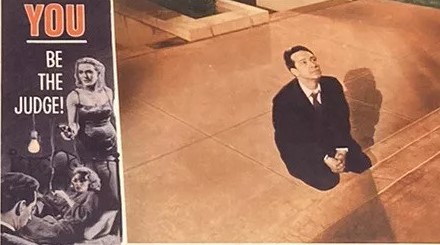
One movie that didn’t need Orson Welles to ride in and save the day and in some senses he gets in its way. Not because he’s – as was often his wont if lacking strong direction – over-acting but because his presence shifts the narrative imperative from motive and psychiatric investigation to a plea against passing the death sentence. A fictionalized version of the “crime of the century,” the kidnapping and killing of a young boy by Leopold and Lowe, a pair of intellectually arrogant wealthy young men, in Chicago 1924, it would make ideal fodder for a Netflix true crime slot, especially as there was no contesting the evidence.

Until the arrival of woebegone defense attorney Jonathan Wilks (Orson Welles) – Clarence Darrow in the real case – this has been given a low key docu style treatment even if it only touches upon what might have caused Arthur (Bradford Dillman) and Judd (Dean Stockwell) to embark on their terrible deed. They have intellectualized murder, believing that they are beyond mortals in their cranial superiority and therefore not only capable of committing the perfect crime, but relishing the prospect of getting away with it and rubbing their inferiors’ noses in the dirt.

Cocky sexually confident Arthur is the dominant one, constantly tormenting his friend for his social deficiencies, Judd the more vulnerable, astonished to find that someone can interpret the loss of his mother as impinging on his emotional security. We enter the tale post-crime and the narrative assumes the audience is already familiar with the Leopold and Lowe case, which proves a distraction now because I had to look them up to fill in the blanks.

Setting aside their superiority, the movie brings to the fore aspects of criminal behavior only familiar to us from more recent analysis. For example, Arthur wants to remain close to the investigation, offering the police advice, and taking malicious enjoyment out of pointing out possible suspects. Police procedure, which would still have been in its infancy, nonetheless turns upon tracing 4,200 purchases of a very common type of spectacles which, in an unexpected twist, is suddenly whittled down to three thanks to this particular pair containing an unique advanced design element.

However, alibis only fall apart by accident as the pair stick to their rehearsed stories even in the face of intense interrogation, especially Judd’s contention that his spectacles could have fallen from his jacket pocket close to where the body was discovered by pure coincidence. The pair have already confessed when Wilks rides to the rescue, or at least save them from corporal punishment. Most of this is via a legal trick. He places the onus of deciding their fate on the thoughtful judge who can follow legal argument more easily than a bloodthirsty jury appalled at the crime and out for revenge.

In his deployment of Orson Welles, director Richard Fleischer (The Boston Strangler, 1968) plays a blinder. Audiences expecting to see Welles in full bombastic oratory flow were blindsided by the almost apologetic tone taken. There’s virtually none of the usual courtroom sparring and there’s no last-minute witness final twist as was de rigeur for the genre. But, then, you’ve got Orson Welles, the greatest American actor never to win an Oscar, given what he could do with words, glances, whispers and silence. He’s always going to get the last laugh in an exchange of banter, but with a life a stake this isn’t the time for bluster.

It’s an incredibly well-judged performance. Setting aside the monologue, the kind actors would kill for, it’s his general demeanor, almost self-effacing, nothing swanky in his dress, and yet not resorting either to actor gimmicks like wiping sweat from his head with a handkerchief nor even raising his voice. Compare this to the Oscar-winning performance of Gregory Peck in To Kill a Mockingbird (1962) and you’ll wonder why the Academy chose to overlook Welles.

But he’s not the only standout. Bradford Dillman (Circle of Deception, 1961) has the showiest role, oozing icy charm and indifference, but the more obviously emotionally-crippled Dean Stockwell (Psych-Out, 1968) has the more difficult. Perhaps Diane Varsi (Wild in the Streets, 1968) has the toughest part, convincing as the girl who finds something worth caring about inside a killer.

Richard Fleischer has always been unfairly tabbed as the not-great director who made a number of great films. Whichever way your sympathy falls on this issue, this is one of his great movies, steering clear of the sensational, cleverly keeping Welles out of sight until virtually the final third of the movie and then, courtesy of how well he has managed the material, not allowing the actor to steal the show.

Hardly dated at all given the death penalty is still practised in many U.S. states and countries around the world. The plea for clemency isn’t so much the driving force as the acceptance that money doesn’t buy immunity from psychiatric disorder and may well be its cause. Despite his arrogance, Arthur seeks the approval of “Mumsy”, while Judd has no mother. With a host of servants to carry out the parenting, the actual parents can go off and enjoy themselves, ignorant of the dangers of lack of attachment.

It’s still hard to feel any sympathy for the pair, indulging in a thrill kill because wealth protects them and at the mercy of intellect, and while Fleischer makes no attempt at exoneration or mitigation a contemporary audience would intuit more about the family imperfections or lack of parental care or psychiatric awareness that drove them to this.

Unmissable.

Nightmare in the Sun (1965) ***

Your first question is how did rookie director Marc Lawrence have the standing and the foresight to  assemble such an amazing cast? Not just wife-and- husband team Ursula Andress  and John Derek (Once Before I Die, 1966) upfront, but Rat Pack member Sammy Davis Jr (Sergeants 3, 1962), The Godfather (1972) alumni Robert Duvall and John Marley, Aldo Ray (The Power, 1968), Richard Jaeckel (The Devil’s Brigade, 1968), Keenan Wynn (Warning Shot, 1966) and Arthur O’Connell (Fantastic Voyage, 1966).

And it’s bold work, throwing the Psycho dice, playing the hell out of the noir tune, most of the time heading down a nihilistic road, and with a terrific twist for a climax. Some great scenes that with a more experienced director would be instantly memorable and managing to fit into what should be a straightforward thriller some intriguing oddball characters.

Anonymous drifter (John Derek) ends up in a small town in Nowheresville where Marsha (Ursula Andress) has a slew of lovers including the sheriff (Aldo Ray). Wealthy rancher husband Sam (Arthur O’Connell) is the jealous type who checks out her speedometer to see if her tales of out-of-town visits tally up. Naturally, a handsome stranger is easy prey to her seductive charms but when hubbie spots said stranger leaving his house he loses his rag and kills her.

Holy moly, talk about Psycho, getting rid of the sexy star one-third of the way through is a heck of a note. Who does this director think the audience is coming to see? But if he’s no  Hitchcock, he’s got another trick up his sleeve. Sheriff won’t let the husband plead guilty, not when he can play that card for all it’s worth, rooking the rancher for thousands of bucks, so he decides to pin the blame on the man seen leaving the house. Not only that, he plants evidence, stolen jewellery etc, on the suspect and handcuffs him.

Suspect escapes, taking with him a cop car, but those handcuffs are tougher to remove than most cinemagoers have been led to believe from previous yarns. A hacksaw won’t do it nor will trying to burn them apart with an oxy-acetylene cutter. So he’s stuck with carrying about proof of guilt or at least suspicion and spends most of the time picking up cats or items to hide the evidence.

A couple of bikers (Robert Duvall and Richard Jaeckel) decide to chase the reward money, able to scoot through the desert in a way denied the cops’ four-wheelers. It’s a shame this pair are anonymous, as most characters here are, defined by occupation rather than slowing down the pace with introductions. So it’s the Robert Duvall character who we discover is more fragile than his appearance would suggest and lashes his bike with a chain when his character is questioned.

So here’s the oddball line-up: a couple (George Tobias and Lurene Tuttle) running a small-time animal-bird sanctuary, nursing back to health creatures peppered with gunshot or the wounded version of roadkill; a junkyard dealer (Keenan Wynn), one-time hoofer who can’t wait to demonstrate his moves; and a type of boy scout leader (Allyn Roslyn) whose troop gets lost in a sandstorm, one of whom our drifter rescues. The latter sequence has a touching aspect, rescued child, probably the only person in the whole movie with an understanding of law, accepting a suspect as innocent rather than guilty, is betrayed by the leader who instead of helping our escapee to safety, hands him over to the cops.

And to a final, quite unexpected, climax.

So it’s corruption all the way, even our innocent, supposedly heading home to a beloved wife, taking time out for a touch of adultery.

There’s something about these early low-budget films that brings out the best in Ursula Andress. She’s not just spouting lines to fill in some essential part in a story, but takes her time over delivery, essentially establishing character with what she does between talking and for a practised seducer there’s an innocence in her pleading, “Please take me somewhere nice.”

Aldo Ray is as odious as they come, sneaky too, and you sense he has practice on pinning the blame on the wrong person. And no wonder the wife plays around when her self-pitying husband gets so stoned he passes out.

I saw this on a very poor print on YouTube but even so its narrative qualities, if less so the direction, were obvious.

Worth a look.

Stiletto (1969) ***

The bursting of the B-movie bubble dealt a death blow to the careers of the two stars here. In the past, rising talent who failed to make the marquee grade could find almost a lifetime of contentment in low-budget westerns, neo-noir thrillers and down’n’dirty exploitationers with the hope of an occasional supporting role in a bigger picture to ease their path. By the end of the decade, just about the only option were Roger Corman biker flicks or spaghetti westerns. Especially if they had gone down the tough guy route, B-pictures might have provided an exemplary move for both Alex Cord and Patrick O’Neal. As it was, this was their last shot at the big time. And it was lean pickings.  

Retirement can be a tough call any time for a high-flying businessman. But when you’re at the top of your profession in the Mafia, loosening such ties can prove problematic. Count Cesare (Alex Cord) is a part-time assassin, spending the rest of his time as a fun-loving playboy with a string of women, fast cars and racehorses. Only problem is, he wants to retire from the Family – and not in normal fashion, weighted down by a block of cement. Unfortunately, his dilemma doesn’t solicit sympathy from boss Matteo (Joseph Wiseman).

Adding to his problems is tough cop Baker (Patrick O’Neal) on his tail who fastens onto illegal immigrant Illeana (Britt Ekland), Cesare’s girlfriend when he’s not pursuing Ann (Barbara McNair). A strictly by-the-numbers thriller it’s enlivened by two underrated tough screen hombres. Alex Cord (The Brotherhood, 1968) isn’t given enough of a character here to  tug at audience heartstrings although elsewhere he had proved better-than-expected value. If anything, he’s an existential kind of hero.

Cord made a brief splash as an action hero in the monosyllabic Clint Eastwood/Charles Bronson mold after debuting in the John Wayne role of the Ringo Kid in the remake of Stagecoach (1966) and didn’t have more than half a dozen stabs at making his name on the big screen before disappearing into the television hinterlands. So he’s something of an acquired taste, maybe the small output enough to qualify him for cult status. Here, he’s a decent fit for the violence but saddled with a role that makes little sense.

Patrick O’Neal (El Condor, 1970) followed a similar career trajectory, swapping television with the occasional movie and even managing a screen persona as a snarky type of villain/supporting character. A few more tough-guy roles and he might well have built a stronger footing in the business.

This is another thankless role for Britt Ekland (Machine Gun McCain, 1969), there to add glamor, but, surprisingly, she manages to bring pathos to the part. Barbara McNair (If He Hollers Let Him Go, 1968), always worth watching and who had made an auspicious debut the year before, hardly gets any screen time. 

Director Bernard L. Kowalski (Krakatoa, East of Java, 1968) proves better at the action than the characterization, though, luckily nobody needs to be anything other than tough. Three scenes, in particular, are well handled – the opening murder in a casino, a shoot-out a penthouse and the climax on a deserted island which has more than a hint of a spaghetti western. Joseph Wiseman (Dr No, 1962) rustles up another interesting performance and collectors of trivia might note Roy Scheider (Jaws, 1975) putting in an appearance.

This old-style tough-guy thriller would have been better off had the Cord vs. O’Neal set-up taken center stage, with the assassin on murderous overkill hunted down by the zealous cop. As it is, it’s a missed opportunity for Cord to develop an Eastwood/Bronson persona and enter the action star hall of fame.

Based on a thin Harold Robbins bestseller, the screenplay by W.R. Burnett (The Great Escape, 1963) and A.J. Russell (A Lovely Way to Die, 1968) doesn’t take any prisoners.

Doesn’t quite deliver what it says on the tin, but interesting to see Cord and O’Neal battle it out.

The Sicilian Clan / Le Clan des Siciliens (1969) *****

Absolutely cracking, brilliantly structured, gangster thriller featuring two fabulous heists and three legendary French stars in Jean Gabin, Alain Delon and Lino Ventura. Roger Sartet (Delon) is a trigger-happy robber whose terrific prison escape is organized for a hefty fee by French-based Mafia chieftain Vittorio Manalese (Gabin). Le Goff (Ventura) is the rugged cop hunting down the escapee which brings him into the orbit of Manalese, about whose existence he is completely unaware, the gangster having kept an extremely low profile, never engaging in violence, hiding behind the legitimate front of a pinball machine business.  Veteran French director Henri Verneuil (Guns for San Sebastian, 1968) dukes between the twin storylines with ease.

Sartet brings Manalese the opportunity to pull off the most audacious jewel robbery in history, even though the older man despises Sartet’s penchant for violence and sex. We often see Manalese at family gatherings, head of the dinner table, the family watching television together, frowning on one son’s liking for alcohol, playing with his grandson. He is not just a calm and clever businessman, but very quick-thinking, his sharp mind in a couple of instances preventing disaster. Sartet, on the other hand, will happily endanger his life and freedom by consorting with prostitutes and breaking an unspoken code of honor in an affair with Manalese’s son’s wife (Irina Demick).

The result combines dogged detective work by Le Goff and the inspired planning and execution of the jewel robbery until the two worlds collide. The investigation alone would have made this an outstanding picture. Le Goff, always seen with an unlit cigarette in his mouth although he is trying to give up smoking, concentrating initially on Sartet, sets up surveillance on the thief’s innocent sister and begins an involved – and engrossing – process of tracking down every potential lead and when at last he has Sartet in his sights it brings him up close to Manalese.

Le Goff’s professionalism is matched by that of Manalese and the picture develops into an absorbing battle of wits and the latter’s family values and moral compass puts him at odds with loner Sartet. There is some brilliant invention, the sacrificial watch, for example, and the unexpected appearance of a faithful British wife, although you do guess just how long Le Goff will go before lighting his ever-tempting cigarette. 

The ultra-cool Alain Delon (Once a Thief, 1965) excels in this kind of amoral part, but Jean Gabin (Any Number Can Win, 1963) and Lino Ventura (Army of Shadows, 1969) as old-style gangster and cop, respectively, steal the show. Irina Demick (Prudence and the Pill, 1968) thrives as the bored wife of a dull gangster who is attracted by the violent Delon, at one point deliberately putting herself in the line of his potential fire for the thrill. Actually, it’s the jewel heist that steals the show. Unlike other heist pictures where you have fair idea in advance of the details of the theft, here the audience is kept completely in the dark. Just as important in any heist is that the thieves get away with their plunder and the plan in this instance is breath-taking.

As proved by The Burglars (1971) director Henri Verneuil has the nose for a heist, but this tops that for sheer audacity and elan. Verneuil, Delon and Gabin had worked together on Any Number Can Play. Written by Verneuil and Jose Giovanni (Rififi in Tokyo, 1963) from the novel by Auguste Le Breton (Rififi, 1965).

Preceding The Godfather (1972) in its exploration of family and Mafia code of conduct, it offers plenty in the humanity department while dazzling with ingenuity in the criminality stakes.

Unmissable.

Discover WordPress

A daily selection of the best content published on WordPress, collected for you by humans who love to read.

The Atavist Magazine

by Brian Hannan

WordPress.com News

The latest news on WordPress.com and the WordPress community.