Peeping Tom (1960) *****

You could hardly get a more prescient movie, almost in the 1984 class in depicting the future. Not dystopian, but the contemporary obsession with filming every inch of a child’s life. You do wonder what kind of reaction this will generate further down the line when Generation ZZZ realizes how little privacy it has been afforded.

Director Michael Powell – thrice Oscar-nominated and at the time after such hits as The Red Shoes (1948) regarded as on a par with the likes of David Lean (Oscar-winner of Bridge on the River Kwai, 1957) and Carol Reed (The Third Man, 1949) – lost his shirt and his reputation on this, and it took decades before Peeping Tom was accepted as nothing short of a masterpiece.

The narrative cleverly links up several strands. With a portable movie camera landlord Mark (Carl Boehm) obsessively records everything in the vicinity, including posing as a journalist to join a police murder investigation and rigging his apartments to check out the goings-on. He’s also, it transpires, a serial killer, the terror registered on corpses’ faces not aligning with the knife wounds that killed them. Into his world comes a young woman Helen (Anna Massey) who is attracted to this intriguing shy figure. Her mother (Maxine Audley) is less accepting.

In the background are the visual memories of Mark’s childhood, perhaps explaining his current compulsions, the films his psychiatrist father made of how his son reacted to fear, most of which episodes are triggered by the father. And the whole movie takes place in another world of make-believe, that of movie making, where directors are driven to distraction by incompetence and Mark can play on ambition by luring wannabe actress Vivian (Moira Shearer) into making an after-hours movie with him, which ends in her death. Even Helen, a children’s writer, has taken as her subject a magic camera.

Although Mark is interviewed by the police and, in a very modern trope, films himself being interviewed, he is not considered a major suspect. He screens his snuff movies for the blind mother. Murder is perceived as an almost erotic act, correlating with the very modern idea of violence as pornography. Clearly, it’s the progenitor of the slasher film. And Helen would be viewed as the first “final girl.”

But it’s also beautifully made, the color palette, use of light and shadow, the mise en scene, all speak to a master at work, and the delving into the mind of a killer is shown, unusually, in visual rather than verbal terms in the dry tones of a psychiatrist such as parlayed by Alfred Hitchcock at the end of Psycho the same year. Quite why only Hitchcock’s film was acclaimed, given they cover similar personality defects, you would have to go ask the critics.

And the big reveal – why the victims died in such fright – would surely be noted by today’s moviegoer as inspired genius. Carl films his victims dying and he has attached a mirror above the camera so the victims can see themselves die in horrific fashion.

Audience and critical revulsion was as possibly triggered by the scenes of the young Carl being tortured by his father, such aspects of society treated in far more discreet fashion, if at all, in those times. The voyeuristic aspects of the murders are only sexual on the surface, and really harbor back to the tormented childhood where a young boy grows up believing all acts of violence are not only permissible but must be recorded. Written by Leo Marks (Sebastian, 1968).

The raw power must be seen to be believed. Martin Scorsese has promoted many movies he believes under-rated but in this one he gets it right.

Night after Night after Night (1969) ***

British giallo sets tough London cop Bill Rowan (Gilbert Wynne) hunting a Jack-the-Ripper type serial killer who has slaughtered his wife (Linda Marlowe). Chief suspect is leering cocky jack-the-lad Pete (Donald Sumpter) of the wham-bam-thank-you-ma’am school of seduction. In an era when pornography and “perversion” were beginning to shake off the shackles – and strippers, prostitutes, voyeurs and transvestites condemned as evils to be stamped out – this skirts the boundaries between sexploitation and heavy moralizing.

Chief among those embarking on a moral crusade is hypocritical puritan Judge Lomax (Jack May) who spurns his attractive wife (Justine Lord) while indulging in cross-dressing. Needless to say, his clerk, ostensibly another upholder of the moral fabric, is a porn addict. As the body count grows, Pete manages to needle Rowan sufficiently for the cop to consider any nefarious means to put him behind bars.

Knives flash in the dark, the killer wears black leather, victims writhe on the ground as they are slashed to pieces, and coupled with the unusually high nudity quotient it is surprising that this picture passed the British censor. The movie never drags and there is enough incidental sleaze to keep the viewer interested. As a historical document, it details the point at which the country hovered between reined-in respectability and full-on sexual freedom.

Operating here under the pseudonym Lewis J. Force, Canadian director Lindsay Shonteff (The Million Eyes of Sumuru, 1967) conjures up a darker vision of a London so often presented in glorious tourist tones with nastiness seeping into every corner of society. Veteran Jack May (A Twist of Sand, 1968) captures well the double life of a decent man undone by what is perceived to be indecency and his later scenes are quite moving. Donald Sumpter (The Black Panther, 1977) is excellent as the taunting petty criminal while Gilbert Wynne makes a decent debut as a leading man. In small roles are Justine Lord (Deadlier than the Male, 1967) and Linda Marlowe (Big Zapper,1973 – directed by Shonteff). Written by Dail Ambler (Beat Girl/Wild for Kicks, 1960).

Jack the Ripper was such an ingrained element of British culture that any movie featuring a similar villain gave audiences the creeps. British television cops were beginning to move out of the shadow of Dixon of Dock Green and into the new age of The Sweeney and while giallo did not catch on  among home-grown filmmakers there was considerably more focus on hardened criminals such as Get Carter (1971) and Villain (1971).

A Working Man (2025) **** – Seen at the Cinema

Audiences have been so let down by high-profile big-budget disasters like Snow White, Captain America, The Joker Folie a Deux, and critical clunkers like Anora, is it any wonder that they queue up to see a movie with a star who generally delivers. Sure, this is a meat-and-potatoes picture and it might well spell a new trend and consign high concept to the trash basket. That’s not to say our star Jason Statham hasn’t had his share of high concept – he doesn’t jump the shark but is inclined to punch it on the nose in the various The Meg iterations and his usual beating up bad guys routine was nearly snarled up in high concept politics in last year’s The Beekeeper.

I saw this at a matinee performance on Monday and the place was packed and as I left I overheard two ladies saying how much they had enjoyed it. Critics have been a bit sniffy about this because the plot is old hat. Who cares? All plots are old hat and those that aren’t are too new hat for audiences to enjoy.

There’s some attempt to repurpose the lonely hero, generally estranged from his family and down on his luck. Here Levon, an ex- (British) soldier, is suffering from PTSD, kept away from his only child by a wealth father-in-law who bankrolls teams of lawyers to ensure visitation rights are kept to a minimum. And Levon blames himself – as does the father-in-law – for being away fighting for Queen and Country when he should have been at home helping his depressed wife and stopping her committing suicide.

It’s piling it on a bit thick though to have him living in his automobile when as a boss on a construction site he must be earning enough to rent even the lowliest bug-ridden apartment, which he eventually does, since “no fixed abode” doesn’t look good on legal papers.

Anyways, we’re soon introduced to his special set of skills when he sets about some gangsters picking on one of his workers. You think the narrative’s going to involve some backlash from the guys he’s beaten up. But it takes a different route. The daughter Jenny (Arianna Rivas) of his boss Joe (Michael Pena) is kidnapped to order by a human trafficking operation headed up by Dimi (Maximilian Osinski), disgraced son of Russian Mafia head honcho Wolo (Jason Flemyng).

Posing as a drug dealer, after carrying out a ton of clever reconnaissance, Levon infiltrates the drugs outfit at a very low level and then works his way up, knocking off members of Wolo’s clan and various affiliates. Meanwhile, Jenny proves herself adept at improvising, in the violence arena, you understand – when your hands and feet are tied, remember you’ve still got your teeth.

This is the kind of film where you’re going to lose count of the number of violent deaths but all you’re interested in is Levon cutting through the wheat and chaff and getting to the top so he can save the girl. Luckily, it doesn’t try to build up a mythical gangster backstory in the manner of John Wick, but there are some interesting scenes where Wolo, initially introduced as sitting at the high table, is put in his place by someone higher up the rankings, and a great scene just at the end where Wolo, by now bereft of his sons, is told by the big boss to accept his losses and get on with the job of selling drugs and leave Levon alone, at which point he lets out the kind of wail that, had he been a bereft hero, would have had him in contention for an Oscar.

There’s no romance either to get in the way so it’s very strictly meat-and-potatoes. In an era when MCU and DC are flailing, Hollywood could do worse than resorting to a more basic kind of hero. Let’s call him, since all superheroes need titles, Workingman Man.

Directed with a zest for pace and tension by David Ayer (The Beekeeper). Interesting to see Sylvester Stallone’s name attached as co-screenwriter and a producer, so I wonder if this had been originally touted as starring him.

Does what it says on the tin.

Murder Inc (1960) ***

A gangster trend hit the mean streets of Hollywood at the start of the 1960s. But in the absence of big box office hitters like James Cagney, Humphrey Bogart and Edward G. Robinson, these were all B films with unknowns or low-ranked stars in the leading roles. Whereas Little Caesar (1931), Public Enemy (1931), The Roaring Twenties (1939) and White Heat (1949) were fictionalized accounts of hoodlums, the gun-toting movie spree kicked off by Machine Gun Kelly (1958) and Al Capone (1959) was based on the real-life gangsters who had terrorized America’s big cities in the 1920s and 1930s.

By the end of 1960, moviegoers had been served up an informal history of the country’s best-known mobsters from Ma Barker’s Killer Band (1960), Pretty Boy Floyd (1960), The Rise and Fall of Legs Diamond (1960) and Murder Inc (1960). The infamy of the criminals was so comparatively recent that moviemakers assumed audiences had a wider knowledge of their exploits and the context of their crimes.

Murder Inc tells how underworld kingpin Lepke Buchalter – Tony Curtis played him in the more straightforward biopic Lepke (1975) – set up a system of killing dissenters in the ranks for the entire American Cosa Nostra (aka The Syndicate) in a way that prevented those ordering the murders being connected to those committing them, the same kind of protective cell operation used by terrorists. He created a separate organization of hitmen.

This quasi-documentary, with occasional voice-over narrative, focuses on three characters – the quiet-spoken Lepke (David J. Stewart), hitman Abe Reles (Peter Falk) and singer Joey Collins (Stuart Whitman) who becomes involved to pay off a gambling debt. Later on, the focus switches to Brooklyn assistant district attorney Burton Turkus (Henry Morgan), against a backdrop of massive police corruption, investigating the murder epidemic this deadly enterprise created. The films jumps around too much to be totally engrossing but it is certainly an interesting watch.

The two main villains could not be more different, Lepke representing the new school, a businessman, ordering killings but never participating, and for such a tough character tormented by a delicate stomach. Reles is old school, relishing opportunities to murder, and raping Collins’ honest wife Eadie (May Britt) in part because she treats him as scum. It’s hard to muster much sympathy for Joey especially as his wife takes the brunt of the violence.

In an Oscar-nominated performance Peter Falk (Castle Keep, 1969) steals the show as the chilling, venomous killer, the kind of nonentity who rises to prominence only through his penchant for homicide. Swedish star May Britt (The Blue Angel, 1959) isn’t far behind with a portrayal of a strong woman saddled with a weak husband. David J. Stewart (The Young Savages, 1961) only made three movies in the 1960s and his milk-drinking hood was as scary in his pitilessness as his more overtly violent underling.

Stuart Whitman (The Commancheros, 1961) is almost acting against type for he was later known for rugged roles. Henry Morgan (It Happened to Jane, 1959) gave his portrayal of Turkus similar characteristics to Lepke, appearing as a quiet individual, concerned with details,  except that he was incorruptible.

Simon Oakland (Bullitt, 1968) is an honest cop, Vincent Gardenia (Mad Dog Coll, 1961) is a lawyer, comedian Morey Amsterdam (The Dick Van Dyke Show, 1961-1964) plays a hotel manager, Sylvia Miles (Oscar-nominated for Midnight Cowboy, 1969) has a bit part and singer Sarah Vaughan is a singer.

For some reason, this movie starred a number of actors in leading roles who made few screen appearances. This was the only movie of the decade for May Britt, David J. Stewart made only three movies during the same period, and Henry Morgan only made three pictures in his entire career, this being the last.

The movie boasted two directors. Stuart Rosenberg (Cool Hand Luke, 1967) was replaced  by Burt Balaban (Mad Dog Coll, 1961) when the threat of strike action by actors and writers in 1960 forced the 18-day shoot to be cut by 10 days so it’s hard to say who was responsible for which scenes, although the film does boast some unusual aerial shots. Written by Irve Tunick (High Hell, 1958) and Mel Goldberg (Hang ‘Em High, 1968) from the book by Burton Turkus and Sid Field.

Killers are loose – and how!

The House in Marsh Road (1960) ***

Well-structured thriller – especially given the short running time – that allows time for the story to blossom and, given the supernatural tinge, in a somewhat unusual fashion. Worth noting, too, the gender fallibility in keeping with the time, the wife who will support her husband come what may, through his heavy drinking, philandering and deceit. The only truth is that somehow or other her husband is going to get hold of her money.

Wife Jean (Patricia Dainton) is initially complicit in her husband David’s (Tony Wright) small-time fraudulent activity, willing to scamper from short-term let to short-term let, vanishing without paying the bills, because she believes in his grandiose ambitions of rising above his lowly status as a book reviewer to become a novelist.

The too handsome to be true bad guy.

When she inherits a house from an aunt, he wants to sell it and use the £6,000 to fund his ambition, though once he meets sexy secretary Valerie (Sandra Dorne) his plans change to using the dosh to set up a new life with Valerie. Of course, that would mean eliminating his wife and inheriting the property himself. A first attempt, to push her down a life shaft, fails and he moves on to sleeping pills.

Jean is so in thrall with him that even when she catches him out in lying, theft and an affair, she still is apt to stand by him after giving him a frosty reception and a good ticking-off. It’s only when she suspects worse that she seeks help.

Unbeknownst to her she has an invisible ally, a poltergeist named Patrick, who has the habit of rearranging furniture, sighing, setting off the alarm, and, for people to whom he takes an aversion – such as David and Valerie – smashing mirrors and disrupting their desk. Given the budget and the period, the paranormal aspects are kept to the minimum, noise the most obvious evidence, while other actions occur when the camera is not present.

You sometimes wish these kind of British B-pictures would add another 30-40 minutes to explore consequence in true film noir style. There’s no doubt that Valerie would soon find a way to rook David of his inheritance and dump him, easiest way being to lead the police to him.

While Jean finds an attorney willing to take note of her suspicions, you can’t but help noting that mention of a poltergeist is not helping her case, and in the normal course of events she would be committed, leaving David free to cash in on the house and indulge his mistress.

It doesn’t get to the obvious ending, of her being disbelieved, and forced to return to the house and spend her time going mad wondering how her husband is going to bump her off. Instead, Patrick comes to her aid, starting a fire which engulfs the house in her absence. Husband and lover die in the blaze.

As ever, no great acting. Patricia Dainton (The Third Alibi, 1961) might be accused of not putting enough terror in her characterization but that would be to overlook the fact that in those days handsome husbands were implicitly trusted. Tony Wright (Faces in the Dark, 1960) is smug enough but Sandra Dorne (Devil Doll, 1964) only requires a touch of smouldering to steal the show.

Based on a story by Laurence Meynall, inventively written by Maurice J. Wilson (Fog for a Killer, 1962), especially for the undercurrent of malevolence and manipulation. Ably directed by Montgomery Tully (The Terrornauts, 1967).

The Poppy Is Also A Flower / Danger Grows Wild (1966) ***

Audiences were likely disgruntled to discover that out of a heavyweight cast boasting the likes of Omar Sharif (Doctor Zhivago, 1965), Yul Brynner (The Magnificent Seven, 1960), Rita Hayworth (Circus World/The Magnificent Showman, 1964), Senta Berger (Cast a Giant Shadow, 1966) and Stephen Boyd (Genghis Khan, 1965), that the heavy lifting was done by a couple of supporting actors in Trevor Howard (Von Ryan’s Express, 1965) and E.G. Marshall (The Chase, 1966).

Most of the all-star cast barely last a few minutes, Stephen Boyd’s character killed in the opening sequence, Senta Berger and Rita Hayworth putting in fleeting appearances as junkies. Like many of the gangster pictures of the decade, it’s set up as a docu-drama, giving the down’n’dirty, courtesy of United Nations which funded the picture, on the international drugs trade.

Benson (Stephen Boyd) heads up an infiltration operation targeting drug suppliers in Iran, where poppies “grow wild as weeds.” Though quickly bumped off, and the goods he’s purchased stolen, he’s replaced by Col Salem (Yul Brynner) who has the Bond-esque notion of enriching the opium with radiation and then tracing it using Geiger counters.

When that scheme fails, it’s down to agents Sam Lincoln (Trevor Howard) and Coley Jones (E.G. Marshall) to hunt down the drugs. Considering themselves unlikely lotharios, they compete over women and play a neat game of stone-scissors-paper to decide who is assigned which task, varying from chatting up Linda (Angie Dickinson), the gorgeous widow of Benson, or searching her room. Linda isn’t all she seems, not least she may not be a widow, carries a gun, and turns up in too many unsavory dives to be on the side of the angels.

Given drug-dealing was not the rampant business it later became, audiences might not be so shocked to discover that opium was transported by cargo ship and refined in Naples before being shipped all over the world. Possibly as interesting is the use of ancetic anhydride in the refining process. As Sam and Coley trudge across half of Europe, from Naples to Geneva to Nice, the audience is filled in on the details of the drug business and they latch on to a Mr Big, Serge Marko (Gilbert Roland).

There’s a hard realism about the project – though not to the levels of The French Connection (1971) -: nightclub dancer needing make-up to hide the tracks on her arms; Marko’s wife (Rita Hayward) stoned out of her skull; director Terence Young (Dr No, 1962) pulling a fast one Hitchcock-style in killing off Sam; and, despite a climax which sees Coley collar Marko, it ends with a pessimistic air – “someone else to take his place.” There’s a good fistfight on a train, and you’ll have guessed what Linda is up to. But there’s an odd softer centre, the movie taking a couple of breaks to highlight the singing of Trini Lopez and female wrestlers.

Before virtue-signalling was invented this was a do-gooder movie, the cameo players signing up for a buck, Grace Kelly on hand for the introduction. These days it stands as an almighty alarm that was scarcely heeded, not as the drug-fuelled counter-culture was about to burst onto the world, and with middle-class drop-outs championing the illicit there was little chance of the warning being heeded.

More like The Longest Day (1962) than Lawrence of Arabia (1962) in its use of the all-star cast. Still manages to make its points with the least amount of lecturing and hectoring.

Terence Young comes into his own in the action highpoints. Written by Jo Eiseinger (Oscar Wilde, 1960) and Jack Davies (Gambit, 1966) from an idea by Ian Fleming.

Vendetta for the Saint (1969) ***

This big-screen version of a small-screen hero is as pleasant a diversion as you can get. Nostalgia pretty much gives it a free pass and in any case the action, which punctuates the drama at regular intervals, was always going to be budget-restricted. Despite being in almost constant danger the insouciance of gentleman thief Simon Templar dictates that the pace is no more than languid.

As the title suggests, we’re in Mafia country, Templar (Roger Moore) drawn into a Cosa Nostra succession scenario as the result of a casual encounter with  former bank clerk Houston (Fulton Mackay), later found dead. Houston has cast doubts on the real identity of  Mafia Don Destiamo (Ian Hendry), one of several contenders to become the next Mafia overlord. Templar sneaks into Destiamo’s world by pursuing his niece Gina (Rosemary Dexter). Although outwardly respectable, Destiamo a bit too fond of using his cigar as a weapon of disfigurement, threatening his blonde English moll Lily (Aimi MacDonald) in this fashion.

Part of Templar’s attraction is that, although he has a nefarious side, he is happy to walk those mean streets and has a strict moral code. And he moves in such elevated circles that he has a nodding acquaintance with dying Mafia chieftain Don Pasquale (Finlay Currie) who has yet to pick his successor.

The other part of his attraction is that he’s played with such suaveness by Roger Moore. For a good chunk of the time someone is trying to knife him, shoot him, blow him up, capture him, jab him with a truth serum, and generally trying to stop him. In fending off such attacks, or out-smarting the villains, there’s rarely a hair out of place. It’s not so much devil-may-care as devil-is-wasting-his-time with such an imperturbable fellow.

Although the action is pretty straightforward, Templar is not above a clever ruse – jamming a bus in a gateway preventing his pursuers continuing the chase – nor an old one such as tying sheets together to climb out of a window. While Malta stands in for Italy, the locations still look authentic enough, ancient stone buildings, the occasional horse pulling a cart. When the action/drama eases up, there’s always pleasant scenery.

Following MGM’s success in stitching together into a movie two episodes of The Man From U.N.C/L.E. television series (which of course had pinched the idea from Walt Disney’s cinematic re-presentation of Davy Crockett episodes) it was no surprise that ATV, then under the control of future movie mogul Sir Lew Grade (Raise the Titanic, 1980), decided to adopt the same idea. Although The Saint had been showing on British television since 1962, by the end of its run in 1969 it had stepped up to bigger budgets, 35mm and colour. Given each episode lasted around 50 minutes, it was relatively simple to devise a two-part programme shown over consecutive weeks on ITV in Britain and then release it throughout the rest of the world as a feature film. The first such project was The Fiction Makers (1968) followed by Vendetta for the Saint.

Roger Moore’s movie career had been in limbo since Romulus and the Sabines (1961) and there’s no doubt that his performance as Simon Templar and later in another glossier British television series The Persuaders (1971-1972) made him a candidate for James Bond. While his interpretation of Templar, especially the wry delivery, does bear some similarities to his incarnation as 007, that only holds true as long as you set aside the year’s supply of Brylcreem dumped on his hair, the shoulder-padded shoulders and the fact that he had not yet perfected his trademark move, the raising of the single eyebrow.

While no match for the quips prevalent in James Bond, Canadian screenwriter Harry W. Junkin – best known for his television work, his only other movies being a similar melding of television episodes of The Persuaders – and John Kruse (Hell Drivers, 1957) – had some neat one-liners. Despite the obvious limitations, director Jim O’Connelly (Berserk, 1967) does a decent enough job.

But Moore carries the show. Ian Hendry makes a passable villain but not a passable Italian. In general, not surprisingly since most characters were played by British actors, the accents are all over the place though Moore, courtesy of squiring Luisa Mattioli (later his wife) manages to deliver his Italian lines in an acceptable accent. Otherwise, the only one who comes close is Rosemary Dexter (The Shoes of the Fisherman, 1968) and that’s because she was Italian. Worth checking out in the supporting cast are Finlay Currie (Ben Hur, 1959) and Fulton Mackay (BBC series Porridge, 1974-1977).

You can find a lot wrong with this without looking very hard but if you switch off your over-critical faculties you will be pleasantly surprised.

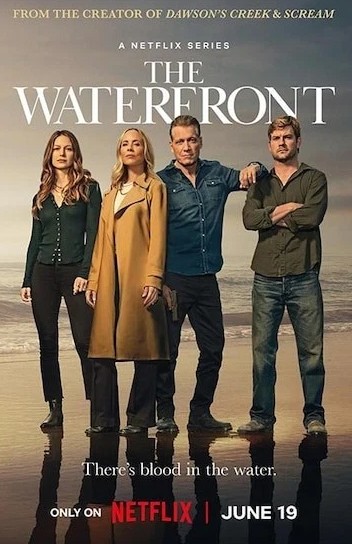
Adolescence (2025) ***

As riveted as I was by the first two episodes, I was bored rigid by the last two which consisted of waiting for simmering father Eddie (Stephen Graham) and 13-year-old son Jamie (Owen Cooper) to explode. That was no big surprise for the mouthy father had been on a short fuse from the outset, but the son, excepting of course he had knifed a female schoolmate to death, had been working hard on presenting an earnest innocent face.

While the much-vaunted one-take technical breakthrough (??) works well enough in the first two episodes it falls apart in the final two as tension completely evaporates. It was always going to be a big ask to maintain any real kind of tension in a series where we know from the start that Jamie is guilty as charged. The CCTV evidence provides all the confirmation we need, although for some reason Detective Inspector Luke Bascomb (Ashley Walters) wants to drag everything out because he lacks a motive for the murder.

Back in the Hollywood Golden Age, characters were always coming in and out of doors  – and, if you recall, one of the greatest images put on film revolved around John Wayne and a door (The Searchers, 1956, if you need a reminder) – but then someone decided we could dispense with all that and just start scenes in rooms. Movies were also keen on people walking down a street – that created ambience, atmosphere, location, whatever, and helpful if they were headed for a western shootout – and television, for budgetary reasons, has tons of sequences of conversations outside during a stroll.

The notion that cinema verite camerawork involving walking endlessly along corridors adds much to a television series beyond bragging rights is misplaced. It comes in handy during the school scenes when the backdrop is teachers barely able to contain riotous kids. It seems a bit odd to expect television audiences who prefer character and story to be asked to applaud these endless walks – and takes lasting a solid hour – just because the director has worked out a way to jump from one character to another without cutting.

Apart from the initial identifying of the murderer, it takes a heck of a long time to go anywhere else. There’s a heinous attempt to make the victim responsible for her own death, she made fun of the younger boy for daring to think he was in her league – or age group – to ask her out. The motivation for the killing appears to revolve around Jamie, in full predator glory, hoping that in taking advantage of a moment of her personal humiliation, that she will relent.

The first two episodes set a high bar in police procedural, especially when answers are not forthcoming and the kids can give two fingers – or worse – to any figure of authority. The moment where Jamie gives vent is damaged by the fact that the psychiatrist Briony (Erin Docherty) is so ineffective.

As you might have guessed, social media is to blame, but any hint of inadequate parenting the director treats like an unexploded bomb best to avoid.

There’s not much character development, the DI farts in the car, a security guard is ignored in his  attempts to spark up conversation with Briony, cop’s son Adam (Amari Bacchus) is subject to constant low-level bullying, and there’s a terrible attempt to make Eddie more empathetic by  recalling his early dating.

Stephen Graham (Boiling Point, 2023) being both co-writer (with Jack Thorne, Toxic Town, 2025) and a producer probably led to him having more scenes than necessary. Directed by Philip Barantini (Boiling Point) who should win the Oscar for choreography.

Owen Cooper, in his debut, is by far the standout.

Netflix is hoping for kudos for this but it feels like one of those European arthouse movies long on style and short on substance.

La Femme Infidele / Unfaithful Wife (1969) ****

Not surprising since French critics worshipped Alfred Hitchcock – the only ones who gave him their wholesale approval in the 1960s – that a French director would attempt to pick up his mantle. But where Hitchcock majored on mystery and suspense and generally an innocent entrapped in conspiracy or crime, here director Claude Chabrol mostly dispenses with mystery concentrating instead on suspense. And it’s of the kind exhibited in To Catch a Thief (1955), Vertigo (1958), North by Northwest (1959) and Marnie (1964) where you are willing a character to get away with their crime or at least find redemption. And where Hitchcock places that load on the glamorous femme fatale, here Chabrol throws us into that most mundane of crimes, the jealous husband wanting revenge on his wife’s lover.

Successful businessman Charles (Michel Bouquet) should be enjoying life, glamorous trophy wife Helene (Stephane Audran) way out of his league, big house in the country, adorable son. But there’s something amiss. When his wife, who appears loving, makes sexual overtures in bed he turns over. He has grown suspicious of the amount of time she wife spends in Paris, ostensibly visiting her hairdresser or having beauty treatments or going to the cinema. Eventually, he hires a private detective and discovers his wife has a lover, Victor (Maurice Ronet). He decides to confront the lover rather than the wife. But instead of playing  the outraged husband card, he pretends to be a man of the world, suggesting that Helene and he have an open marriage and that Victor is the latest in a long line of lovers. What he hopes to achieve from this is unclear, perhaps put Victor’s nose out of joint, perhaps cover up his own anger.

But it doesn’t go the way he planned. He spies an over-large cigarette lighter in the bedroom, a present he gave his wife for their third anniversary and kills Victor. This being the 1960s before forensics determined that you could never entirely eliminate a blood stain on a floor,  Charles, with considerable diligence, cleans up the blood, remembering to wash out the bucket and cloth, wiping his fingerprints from everything he touched, bagging up the man in bed linen and dragging him out to his car.

On the way to disposing the body he is involved in a minor road accident. Police are called. He is saved from opening the car trunk because it is damaged. But when he tries to get rid of the body, the trunk proves impossible to open. Victor had appeared such a smarmy character, you’ve got no compunction about his death, you just want Charles to get away with the murder. Eventually, he forces the trunk open and drops the body in a small algae-covered pond. For a moment air trapped in the package makes it appear unsinkable. But, then – audience enjoying a sigh of relief and perhaps a homage to Psycho (1960) – it disappears.

Whether he revels in the discomfort of his wife who is no longer able to enjoy her twice-weekly assignations with Victor and unable, of course, to explain her bouts of distress to her husband and must keep up a façade, is unclear.

This is only a perfect crime to someone who has never been involved in crime, unaware of all the means of investigation at the disposal of Inspector Duval (Michel Duchaussoy) and his evil-eyed colleague Gobet (Guy Marley) who has the kind of look that says I know you’re guilty.

Turns out Helene’s name is in Victor’s address book and she can come up with no plausible reason for it being there. Charles denies ever having met Victor. The police are not convinced and return to interrogate the pair. Any viewer will quickly realize that it’s virtually impossible for either of the pair to remain undetected, the regularity of Helene’s visits can hardly have gone unnoticed, and even on a quiet street someone might have noticed Charles’s parked car and possibly him lifting the bulky package.

Nor does Charles dissolve in a bout of guilt. There’s an air of inevitability about him. You have no idea whether he might divorce Helene. The notion that she might not just take another lover doesn’t seem to occur to him and he’s not offered the opportunity to air his suspicions. Is he just going to bump off every lover his wife takes?

His wife finds a photograph of her lover in her husband’s pocket. But instead of denouncing him to the police, she burns it, either to protect her marriage or protect herself from the humiliation of being linked to the dead man, or because she has realized the folly of her betrayal.

We never find out her intentions because at that moment the police return and take Charles away.

A marvellous pivot on Hitchcock, with none of the B-film seediness that might have attended such a femme fatale, as Chabrol sets out his stall as a purveyor of the ordinary criminal, the one who didn’t run in high-class circles or was involved in international intrigue. The crime is so commonplace, that’s the beauty of it, and Charles such an ordinary character it all works superbly.

While Stephane Audran (Les Biches, 1968) is luminous, Michel Bouquet (The Road to Cornith, 1967) is her down-to-earth opposite. Written by the director and Sauro Scavolini (Any Gun Can Play, 1967).

A director finds his metier.

Holiday in Spain / Scent of Mystery (1960) **

There were five our great reasons to see this picture. Firstly, it was in Cinerama. Secondly, it was the first attempt in that special format to tell a dramatic story rather than offer just a travelog. Though How the West Was Won (1962) was promoted at the first dramatic use of Cinerama, that was actually untrue. This came first. Third, there was a terrific gimmick – Smell-O-Vision – which allowed audiences to inhale around 30 fragrances at the same time as the onscreen characters. Fourthly, it was produced by Mike Todd Jr., son of the Oscar-winning producer of Around the World in 80 Days (1956) and second husband of Elizabeth Taylor who was instrumental in bringing Cinerama to the big screen in the first place., Lastly, it was the first top-billed appearance of rising British star Denholm Elliott.

Unfortunately, none of these hit the target and it remains a novelty in the Cinerama canon. For a start, there wasn’t much of a story – it’s a chase tale of sorts with crime novelist Oliver (Denholm Elliott) uncovering a plan to kill American heiress Sally Kennedy. In setting out to thwart it he travels all over Spain in the company of philosophic wise-cracking taxi driver Smiley (Peter Lorre). Cue travelog of scenic Spain including fiestas, dances and the running of the bulls, which appears not to have been specially staged but filmed documentary-style as it occurred with the bulls inflicting considerable damage on the humans foolish enough to think it’s a lark.

The hook is the mystery woman who can only be detected by her Schiaparelli perfume while the giveaway for the villain, hired assassin Baron saradin (Paul Lukas), is his tobacco. Cue an onslaught of scents. But the smells don’t just pop up when characters are involved. When a barrel of wine smashes, that produces another smell.

Astonishingly, the movie manages to bring in some of the Cinerama trademarks – the runaway element seen from the audience POV, not just the traditional vehicle but also  barrels of wine.

The smell gimmick worked well enough in cinemas set up for such technical aspects, but that amounted to very few screens, and outside of those the movie just seemed a random series of scenes with only panoramic views of Spain to lessen the boredom.

It did nothing for the career of Denholm Elliott and he did little for the movie. He lacked the edge or innocence required to make such a character come alive and mostly he looks as though he doesn’t know what to do. He didn’t make another movie for three years and on his return for Station Six Sahara (1963) he was no longer the star but quickly shifting into the character actor he would be for the rest of his screen career.

It was nearly the last hurrah for Peter Lorre. He suffered heart attack during filming so the real Peter Lorre is only seen in half the picture, for the other half it’s a stand-in.

The presence of Elizabeth Taylor (Butterfield 8, 1960) could conceivably have redeemed the picture but she puts in only a fleeting appearance, so speedy her distinctive features barely register. You see more of Diana Dors (Baby Love, 1969).

In the hands of Alfred Hitchcock (Psycho, 1960) or imitators like Stanley Donen (Charade, 1963) and with a more finely worked screenplay, reliant on neither visual nor olfactory gimmick, this might have worked. But it was in hands of Jack Cardiff (The Girl on a Motorcycle, 1968), famed cinematographer but only his third outing as a director, and he clearly didn’t know how to balance the various ingredients and so it limps home.

The minute the location of the source novel by Audrey Kelley and William Roos shifted  from New York to Spain and the number of investigators halved, the trouble started. The hunt for a woman whose existence is in question was a standard mystery trope and might very well have worked here minus the smells and Cinerama.

A curiosity.

Discover WordPress

A daily selection of the best content published on WordPress, collected for you by humans who love to read.

The Atavist Magazine

by Brian Hannan

WordPress.com News

The latest news on WordPress.com and the WordPress community.